
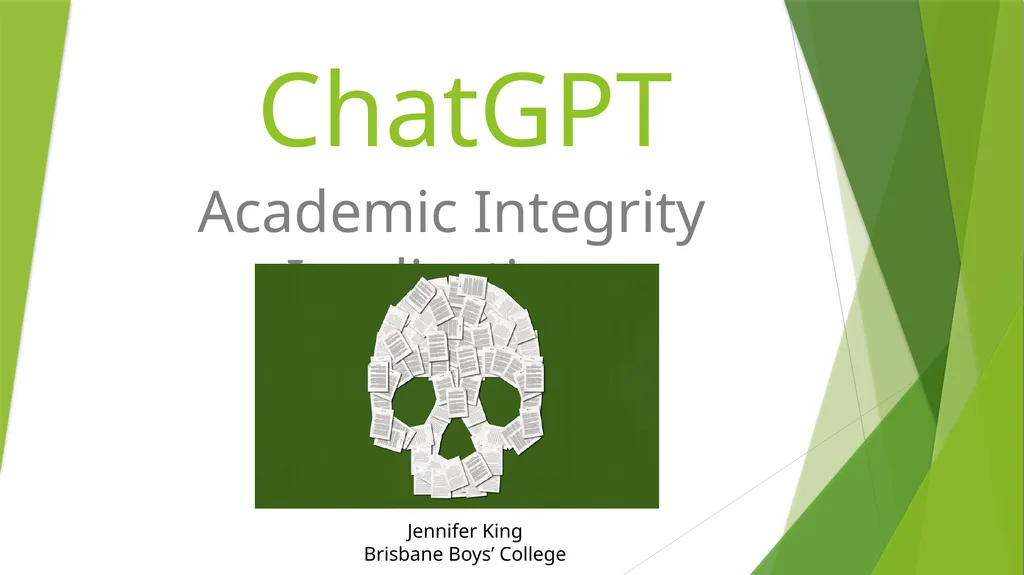
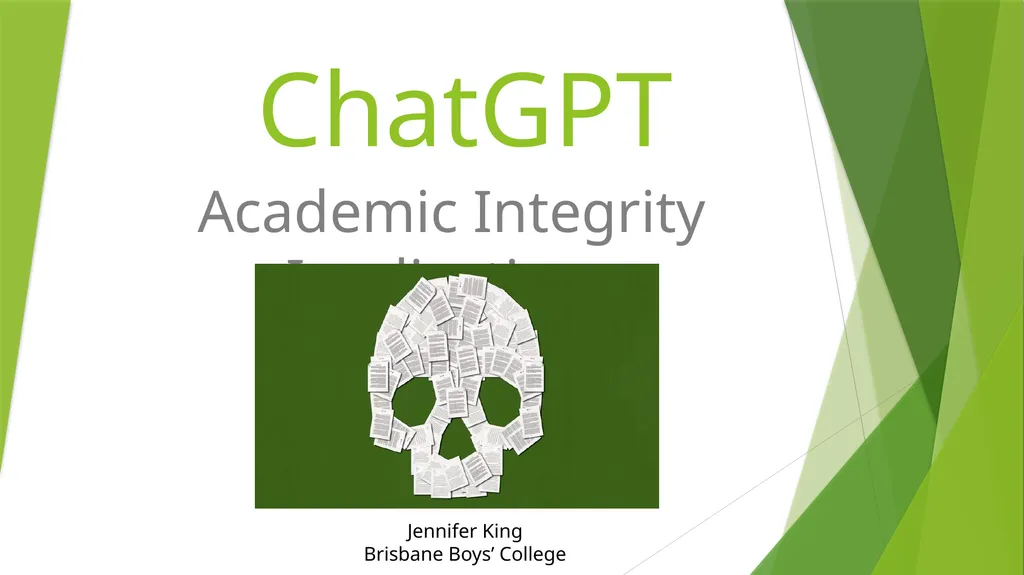
ChatGPT Academic Integrity Implications Jennifer
CB
Published · 13 slides · 0 views
1 / 1
Description
ChatGPT Academic Integrity Implications Jennifer King Brisbane Boys College What is a chatbot? Software or computer program that simulates human conversation or chatter through text or voice interactions. Business-to-consumer (B2C) and
Related Topics
Share
Embed code
Download this presentation From Below
"ChatGPT Academic Integrity Implications Jennifer" is the property of its rightful owner. Permission is granted to download and print the materials on this website for personal, non-commercial use only, and to display it on your personal computer provided you do not modify the materials and that you retain all copyright notices contained in the materials. By downloading content from our website, you accept the terms of this agreement.
Presentation Transcript
01
ChatGPT Academic Integrity Implications Jennifer King
Brisbane Boys’ College<br>
Brisbane Boys’ College<br>
02
What is a chatbot? Software or computer program that simulates human conversation or "chatter" through text or voice interactions.
Business-to-consumer (B2C) and business-to-business (B2B) environments increasingly use chatbot virtual assistants to handle simple tasks. Adding chatbot assistants reduces overhead costs, uses support staff time better and enables organisations to provide customer service during hours when live agents aren’t available
https://www.techtarget.com/searchcustomerexperience/definition/chatbot<br>
Business-to-consumer (B2C) and business-to-business (B2B) environments increasingly use chatbot virtual assistants to handle simple tasks. Adding chatbot assistants reduces overhead costs, uses support staff time better and enables organisations to provide customer service during hours when live agents aren’t available
https://www.techtarget.com/searchcustomerexperience/definition/chatbot<br>
03
What is ChatGPT? ChatGPT (https://chat.openai.com ) is a Silicon Valley startup from a non-profit AI company called OpenAI, funded by $1 billion from Microsoft Corp alone, with involvement from Elon Musk (“no more homework”). (Microsoft will want to get its investment back by integrating into Word and into other tools).
It is an AI-based text generator. It interacts to questions in a conversational way. The dialogue format makes it possible for ChatGPT to answer followup questions, admit its mistakes, challenge incorrect premises, and reject inappropriate requests.
The algorithm is a language model trained through human feedback and a vast amount of public data from a variety of sources like Wikipedia, blogs, e-books, and the world’s literature ie almost all of the written text available on the Internet. 300 billion words and 570 gigabytes of data was used to build its knowledge.
ChatGPT isn't just copying bits from the web, it's genuinely creating new text. It can write elaborate essays, short stories, news articles, movie scripts, solve complex science and math problems, produce working computer code, hold a conversation, and write a limerick explaining the offside rule in soccer!
More than 1 million users signed up in the first week.<br>
It is an AI-based text generator. It interacts to questions in a conversational way. The dialogue format makes it possible for ChatGPT to answer followup questions, admit its mistakes, challenge incorrect premises, and reject inappropriate requests.
The algorithm is a language model trained through human feedback and a vast amount of public data from a variety of sources like Wikipedia, blogs, e-books, and the world’s literature ie almost all of the written text available on the Internet. 300 billion words and 570 gigabytes of data was used to build its knowledge.
ChatGPT isn't just copying bits from the web, it's genuinely creating new text. It can write elaborate essays, short stories, news articles, movie scripts, solve complex science and math problems, produce working computer code, hold a conversation, and write a limerick explaining the offside rule in soccer!
More than 1 million users signed up in the first week.<br>
04
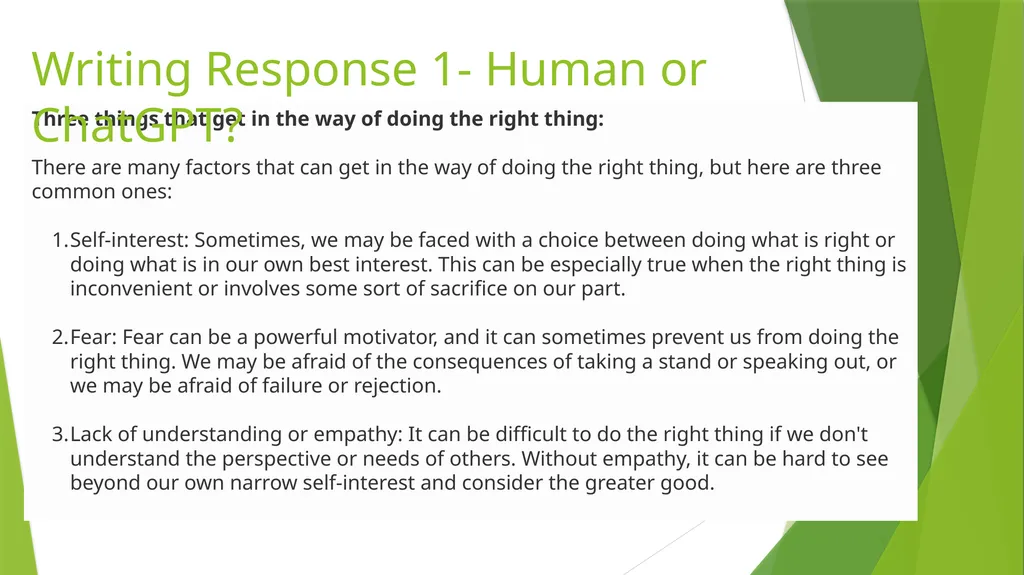
Three things that get in the way of doing the right thing:
There are many factors that can get in the way of doing the right thing, but here are three common ones:
Self-interest: Sometimes, we may be faced with a choice between doing what is right or doing what is in our own best interest. This can be especially true when the right thing is inconvenient or involves some sort of sacrifice on our part.
Fear: Fear can be a powerful motivator, and it can sometimes prevent us from doing the right thing. We may be afraid of the consequences of taking a stand or speaking out, or we may be afraid of failure or rejection.
Lack of understanding or empathy: It can be difficult to do the right thing if we don't understand the perspective or needs of others. Without empathy, it can be hard to see beyond our own narrow self-interest and consider the greater good. Writing Response 1- Human or ChatGPT?<br>
There are many factors that can get in the way of doing the right thing, but here are three common ones:
Self-interest: Sometimes, we may be faced with a choice between doing what is right or doing what is in our own best interest. This can be especially true when the right thing is inconvenient or involves some sort of sacrifice on our part.
Fear: Fear can be a powerful motivator, and it can sometimes prevent us from doing the right thing. We may be afraid of the consequences of taking a stand or speaking out, or we may be afraid of failure or rejection.
Lack of understanding or empathy: It can be difficult to do the right thing if we don't understand the perspective or needs of others. Without empathy, it can be hard to see beyond our own narrow self-interest and consider the greater good. Writing Response 1- Human or ChatGPT?<br>
05
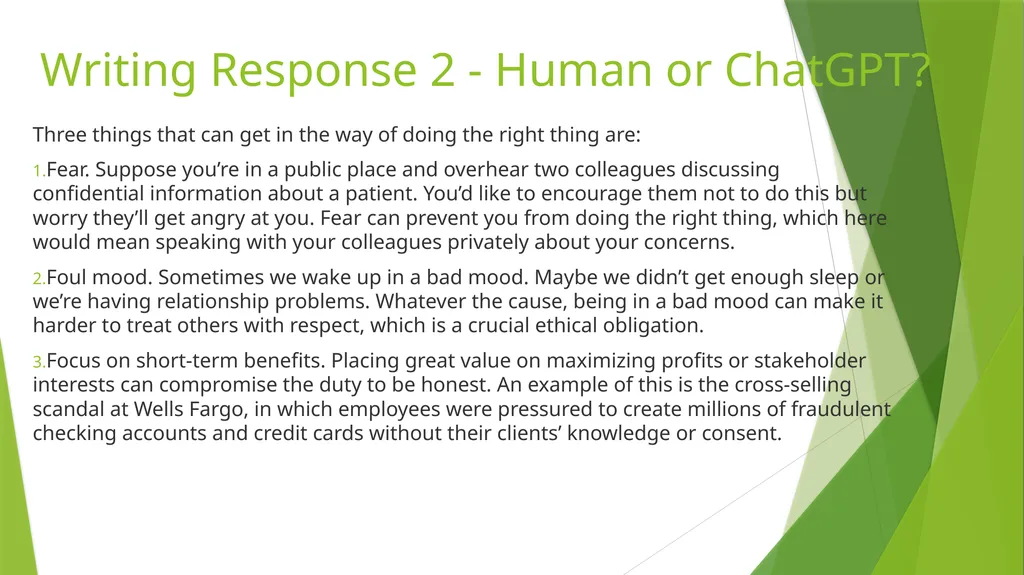
Writing Response 2 - Human or ChatGPT? Three things that can get in the way of doing the right thing are:
Fear. Suppose you’re in a public place and overhear two colleagues discussing confidential information about a patient. You’d like to encourage them not to do this but worry they’ll get angry at you. Fear can prevent you from doing the right thing, which here would mean speaking with your colleagues privately about your concerns.
Foul mood. Sometimes we wake up in a bad mood. Maybe we didn’t get enough sleep or we’re having relationship problems. Whatever the cause, being in a bad mood can make it harder to treat others with respect, which is a crucial ethical obligation.
Focus on short-term benefits. Placing great value on maximizing profits or stakeholder interests can compromise the duty to be honest. An example of this is the cross-selling scandal at Wells Fargo, in which employees were pressured to create millions of fraudulent checking accounts and credit cards without their clients’ knowledge or consent.<br>
Fear. Suppose you’re in a public place and overhear two colleagues discussing confidential information about a patient. You’d like to encourage them not to do this but worry they’ll get angry at you. Fear can prevent you from doing the right thing, which here would mean speaking with your colleagues privately about your concerns.
Foul mood. Sometimes we wake up in a bad mood. Maybe we didn’t get enough sleep or we’re having relationship problems. Whatever the cause, being in a bad mood can make it harder to treat others with respect, which is a crucial ethical obligation.
Focus on short-term benefits. Placing great value on maximizing profits or stakeholder interests can compromise the duty to be honest. An example of this is the cross-selling scandal at Wells Fargo, in which employees were pressured to create millions of fraudulent checking accounts and credit cards without their clients’ knowledge or consent.<br>
06
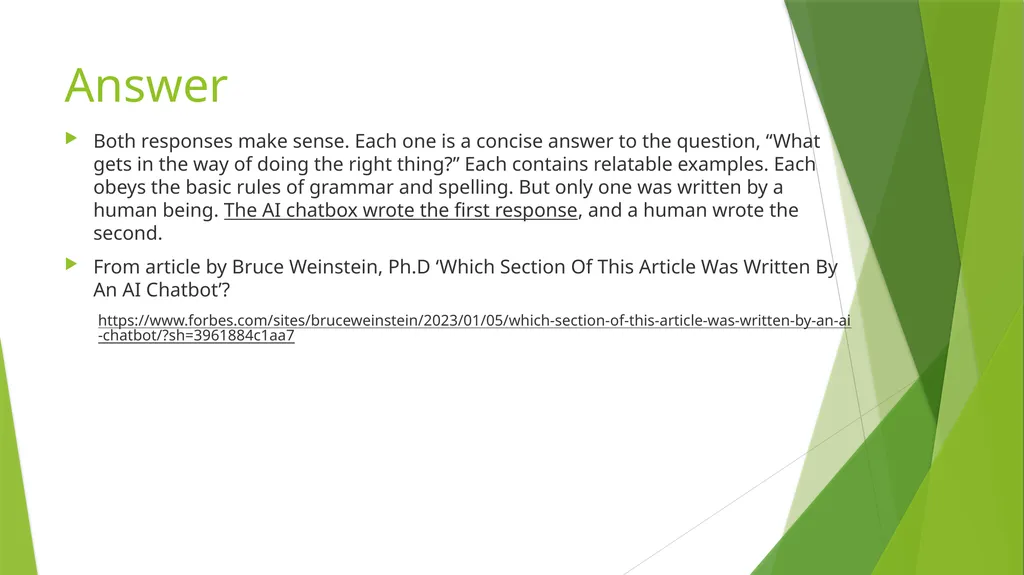
Answer Both responses make sense. Each one is a concise answer to the question, “What gets in the way of doing the right thing?” Each contains relatable examples. Each obeys the basic rules of grammar and spelling. But only one was written by a human being. The AI chatbox wrote the first response, and a human wrote the second.
From article by Bruce Weinstein, Ph.D ‘Which Section Of This Article Was Written By An AI Chatbot’?
https://www.forbes.com/sites/bruceweinstein/2023/01/05/which-section-of-this-article-was-written-by-an-ai-chatbot/?sh=3961884c1aa7<br>
From article by Bruce Weinstein, Ph.D ‘Which Section Of This Article Was Written By An AI Chatbot’?
https://www.forbes.com/sites/bruceweinstein/2023/01/05/which-section-of-this-article-was-written-by-an-ai-chatbot/?sh=3961884c1aa7<br>
07
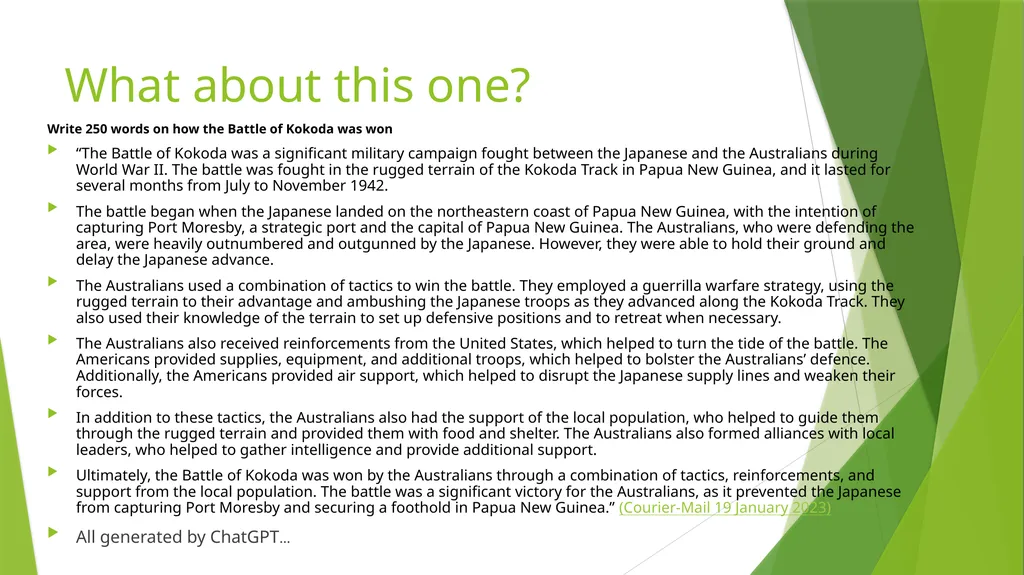
What about this one? Write 250 words on how the Battle of Kokoda was won
“The Battle of Kokoda was a significant military campaign fought between the Japanese and the Australians during World War II. The battle was fought in the rugged terrain of the Kokoda Track in Papua New Guinea, and it lasted for several months from July to November 1942.
The battle began when the Japanese landed on the northeastern coast of Papua New Guinea, with the intention of capturing Port Moresby, a strategic port and the capital of Papua New Guinea. The Australians, who were defending the area, were heavily outnumbered and outgunned by the Japanese. However, they were able to hold their ground and delay the Japanese advance.
The Australians used a combination of tactics to win the battle. They employed a guerrilla warfare strategy, using the rugged terrain to their advantage and ambushing the Japanese troops as they advanced along the Kokoda Track. They also used their knowledge of the terrain to set up defensive positions and to retreat when necessary.
The Australians also received reinforcements from the United States, which helped to turn the tide of the battle. The Americans provided supplies, equipment, and additional troops, which helped to bolster the Australians’ defence. Additionally, the Americans provided air support, which helped to disrupt the Japanese supply lines and weaken their forces.
In addition to these tactics, the Australians also had the support of the local population, who helped to guide them through the rugged terrain and provided them with food and shelter. The Australians also formed alliances with local leaders, who helped to gather intelligence and provide additional support.
Ultimately, the Battle of Kokoda was won by the Australians through a combination of tactics, reinforcements, and support from the local population. The battle was a significant victory for the Australians, as it prevented the Japanese from capturing Port Moresby and securing a foothold in Papua New Guinea.” (Courier-Mail 19 January 2023)
All generated by ChatGPT…<br>
“The Battle of Kokoda was a significant military campaign fought between the Japanese and the Australians during World War II. The battle was fought in the rugged terrain of the Kokoda Track in Papua New Guinea, and it lasted for several months from July to November 1942.
The battle began when the Japanese landed on the northeastern coast of Papua New Guinea, with the intention of capturing Port Moresby, a strategic port and the capital of Papua New Guinea. The Australians, who were defending the area, were heavily outnumbered and outgunned by the Japanese. However, they were able to hold their ground and delay the Japanese advance.
The Australians used a combination of tactics to win the battle. They employed a guerrilla warfare strategy, using the rugged terrain to their advantage and ambushing the Japanese troops as they advanced along the Kokoda Track. They also used their knowledge of the terrain to set up defensive positions and to retreat when necessary.
The Australians also received reinforcements from the United States, which helped to turn the tide of the battle. The Americans provided supplies, equipment, and additional troops, which helped to bolster the Australians’ defence. Additionally, the Americans provided air support, which helped to disrupt the Japanese supply lines and weaken their forces.
In addition to these tactics, the Australians also had the support of the local population, who helped to guide them through the rugged terrain and provided them with food and shelter. The Australians also formed alliances with local leaders, who helped to gather intelligence and provide additional support.
Ultimately, the Battle of Kokoda was won by the Australians through a combination of tactics, reinforcements, and support from the local population. The battle was a significant victory for the Australians, as it prevented the Japanese from capturing Port Moresby and securing a foothold in Papua New Guinea.” (Courier-Mail 19 January 2023)
All generated by ChatGPT…<br>
08
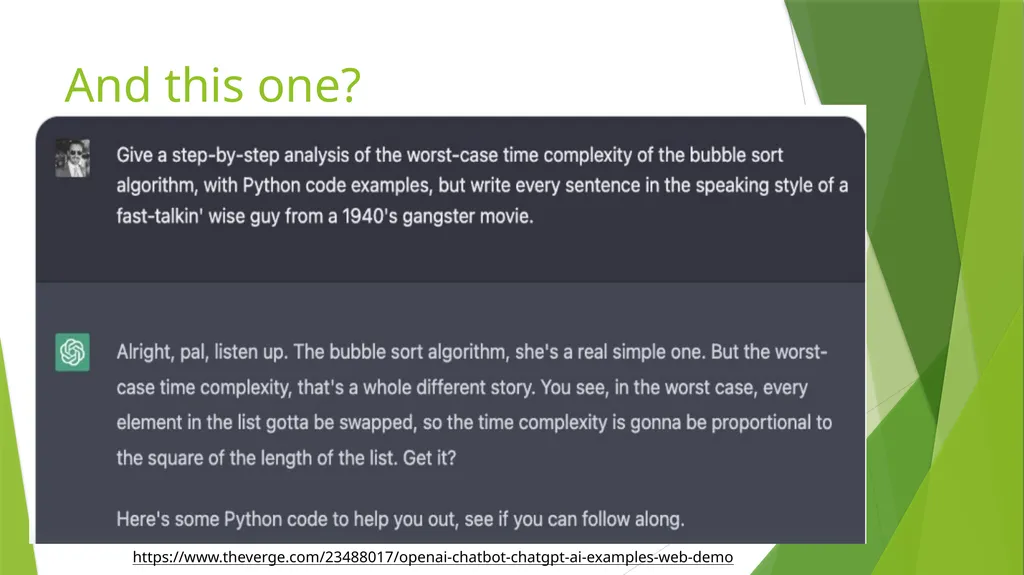
And this one? https://www.theverge.com/23488017/openai-chatbot-chatgpt-ai-examples-web-demo<br>
09
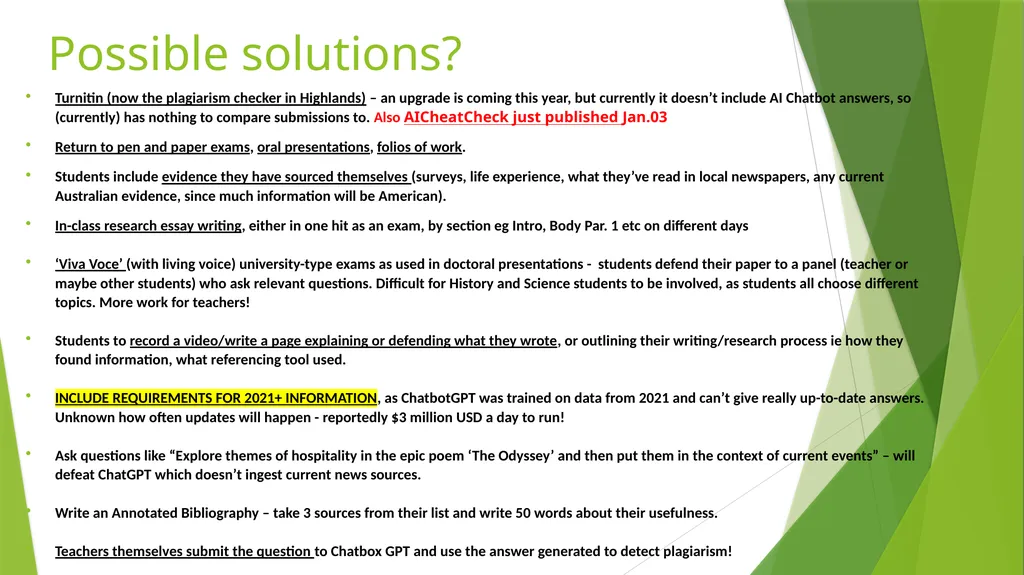
Possible solutions? Turnitin (now the plagiarism checker in Highlands) – an upgrade is coming this year, but currently it doesn’t include AI Chatbot answers, so (currently) has nothing to compare submissions to. Also AICheatCheck just published Jan.03
Return to pen and paper exams, oral presentations, folios of work.
Students include evidence they have sourced themselves (surveys, life experience, what they’ve read in local newspapers, any current Australian evidence, since much information will be American).
In-class research essay writing, either in one hit as an exam, by section eg Intro, Body Par. 1 etc on different days
‘Viva Voce’ (with living voice) university-type exams as used in doctoral presentations - students defend their paper to a panel (teacher or maybe other students) who ask relevant questions. Difficult for History and Science students to be involved, as students all choose different topics. More work for teachers!
Students to record a video/write a page explaining or defending what they wrote, or outlining their writing/research process ie how they found information, what referencing tool used.
INCLUDE REQUIREMENTS FOR 2021+ INFORMATION, as ChatbotGPT was trained on data from 2021 and can’t give really up-to-date answers. Unknown how often updates will happen - reportedly $3 million USD a day to run!
Ask questions like “Explore themes of hospitality in the epic poem ‘The Odyssey’ and then put them in the context of current events” – will defeat ChatGPT which doesn’t ingest current news sources.
Write an Annotated Bibliography – take 3 sources from their list and write 50 words about their usefulness.
Teachers themselves submit the question to Chatbox GPT and use the answer generated to detect plagiarism!<br>
Return to pen and paper exams, oral presentations, folios of work.
Students include evidence they have sourced themselves (surveys, life experience, what they’ve read in local newspapers, any current Australian evidence, since much information will be American).
In-class research essay writing, either in one hit as an exam, by section eg Intro, Body Par. 1 etc on different days
‘Viva Voce’ (with living voice) university-type exams as used in doctoral presentations - students defend their paper to a panel (teacher or maybe other students) who ask relevant questions. Difficult for History and Science students to be involved, as students all choose different topics. More work for teachers!
Students to record a video/write a page explaining or defending what they wrote, or outlining their writing/research process ie how they found information, what referencing tool used.
INCLUDE REQUIREMENTS FOR 2021+ INFORMATION, as ChatbotGPT was trained on data from 2021 and can’t give really up-to-date answers. Unknown how often updates will happen - reportedly $3 million USD a day to run!
Ask questions like “Explore themes of hospitality in the epic poem ‘The Odyssey’ and then put them in the context of current events” – will defeat ChatGPT which doesn’t ingest current news sources.
Write an Annotated Bibliography – take 3 sources from their list and write 50 words about their usefulness.
Teachers themselves submit the question to Chatbox GPT and use the answer generated to detect plagiarism!<br>
10
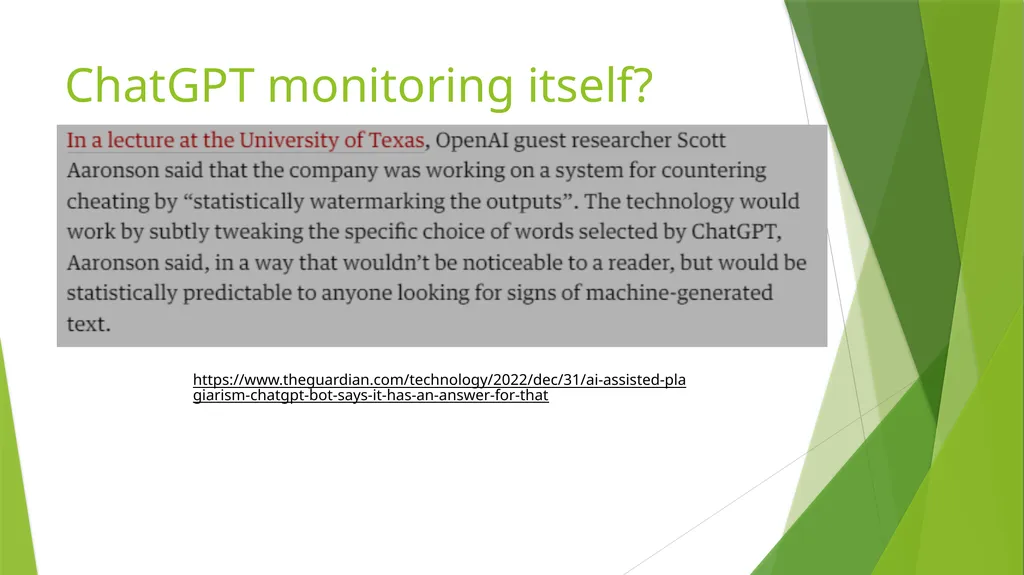
ChatGPT monitoring itself? https://www.theguardian.com/technology/2022/dec/31/ai-assisted-plagiarism-chatgpt-bot-says-it-has-an-answer-for-that<br>
11
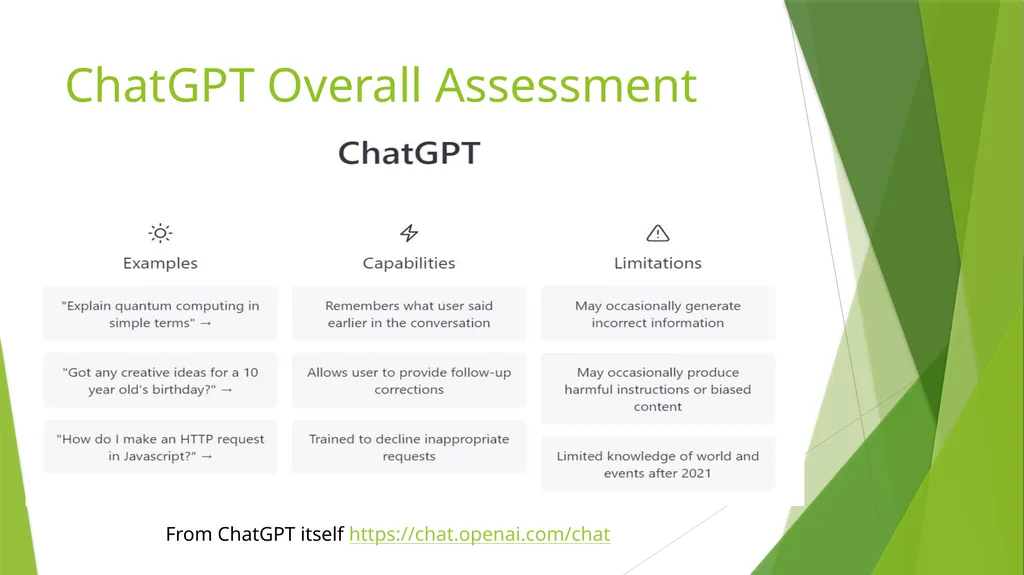
ChatGPT Overall Assessment From ChatGPT itself https://chat.openai.com/chat<br>
12
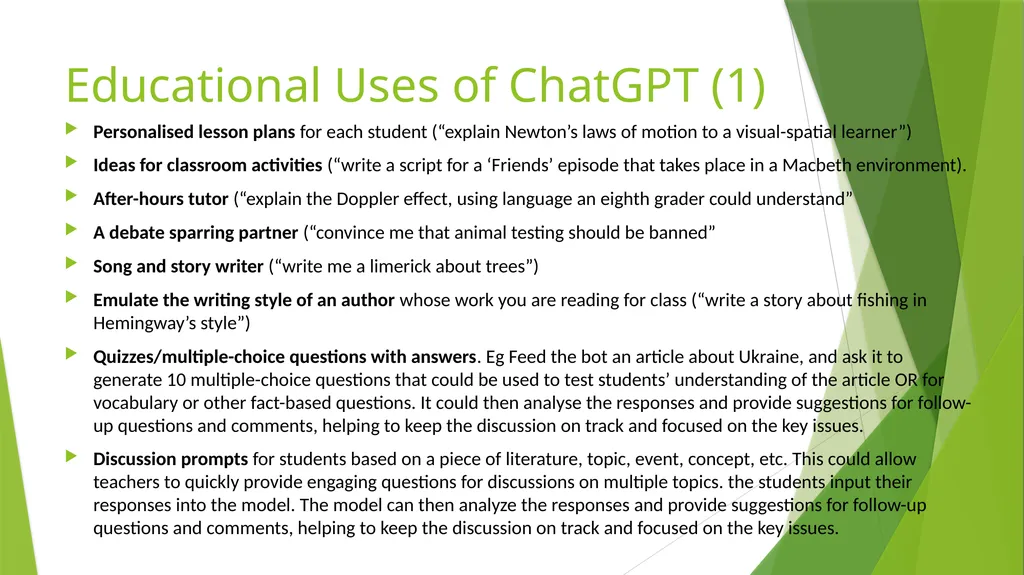
Educational Uses of ChatGPT (1) Personalised lesson plans for each student (“explain Newton’s laws of motion to a visual-spatial learner”)
Ideas for classroom activities (“write a script for a ‘Friends’ episode that takes place in a Macbeth environment).
After-hours tutor (“explain the Doppler effect, using language an eighth grader could understand”
A debate sparring partner (“convince me that animal testing should be banned”
Song and story writer (“write me a limerick about trees”)
Emulate the writing style of an author whose work you are reading for class (“write a story about fishing in Hemingway’s style”)
Quizzes/multiple-choice questions with answers. Eg Feed the bot an article about Ukraine, and ask it to generate 10 multiple-choice questions that could be used to test students’ understanding of the article OR for vocabulary or other fact-based questions. It could then analyse the responses and provide suggestions for follow-up questions and comments, helping to keep the discussion on track and focused on the key issues.
Discussion prompts for students based on a piece of literature, topic, event, concept, etc. This could allow teachers to quickly provide engaging questions for discussions on multiple topics. the students input their responses into the model. The model can then analyze the responses and provide suggestions for follow-up questions and comments, helping to keep the discussion on track and focused on the key issues.<br>
Ideas for classroom activities (“write a script for a ‘Friends’ episode that takes place in a Macbeth environment).
After-hours tutor (“explain the Doppler effect, using language an eighth grader could understand”
A debate sparring partner (“convince me that animal testing should be banned”
Song and story writer (“write me a limerick about trees”)
Emulate the writing style of an author whose work you are reading for class (“write a story about fishing in Hemingway’s style”)
Quizzes/multiple-choice questions with answers. Eg Feed the bot an article about Ukraine, and ask it to generate 10 multiple-choice questions that could be used to test students’ understanding of the article OR for vocabulary or other fact-based questions. It could then analyse the responses and provide suggestions for follow-up questions and comments, helping to keep the discussion on track and focused on the key issues.
Discussion prompts for students based on a piece of literature, topic, event, concept, etc. This could allow teachers to quickly provide engaging questions for discussions on multiple topics. the students input their responses into the model. The model can then analyze the responses and provide suggestions for follow-up questions and comments, helping to keep the discussion on track and focused on the key issues.<br>
13
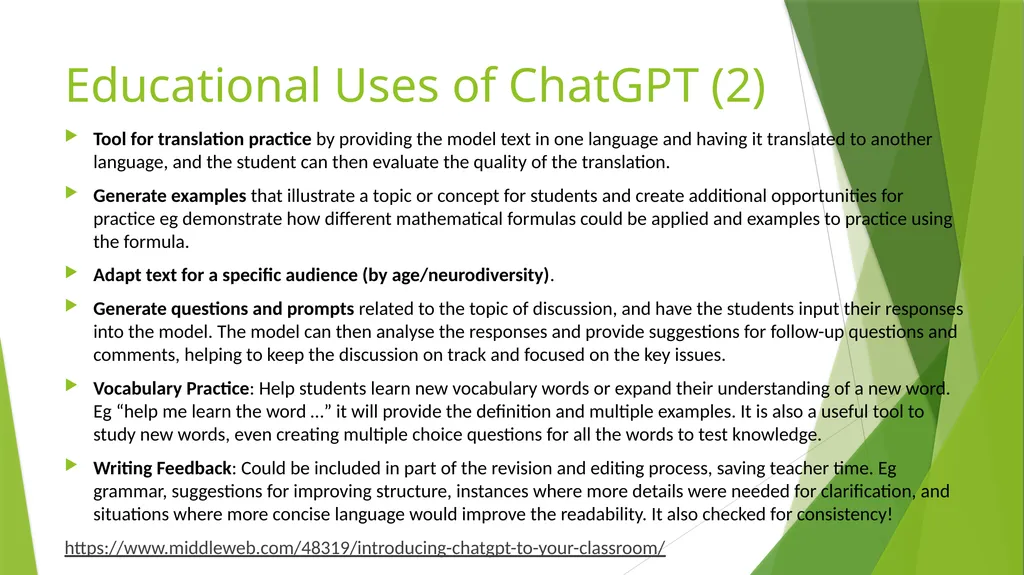
Educational Uses of ChatGPT (2) Tool for translation practice by providing the model text in one language and having it translated to another language, and the student can then evaluate the quality of the translation.
Generate examples that illustrate a topic or concept for students and create additional opportunities for practice eg demonstrate how different mathematical formulas could be applied and examples to practice using the formula.
Adapt text for a specific audience (by age/neurodiversity).
Generate questions and prompts related to the topic of discussion, and have the students input their responses into the model. The model can then analyse the responses and provide suggestions for follow-up questions and comments, helping to keep the discussion on track and focused on the key issues.
Vocabulary Practice: Help students learn new vocabulary words or expand their understanding of a new word. Eg “help me learn the word …” it will provide the definition and multiple examples. It is also a useful tool to study new words, even creating multiple choice questions for all the words to test knowledge.
Writing Feedback: Could be included in part of the revision and editing process, saving teacher time. Eg grammar, suggestions for improving structure, instances where more details were needed for clarification, and situations where more concise language would improve the readability. It also checked for consistency!
https://www.middleweb.com/48319/introducing-chatgpt-to-your-classroom/<br>
Generate examples that illustrate a topic or concept for students and create additional opportunities for practice eg demonstrate how different mathematical formulas could be applied and examples to practice using the formula.
Adapt text for a specific audience (by age/neurodiversity).
Generate questions and prompts related to the topic of discussion, and have the students input their responses into the model. The model can then analyse the responses and provide suggestions for follow-up questions and comments, helping to keep the discussion on track and focused on the key issues.
Vocabulary Practice: Help students learn new vocabulary words or expand their understanding of a new word. Eg “help me learn the word …” it will provide the definition and multiple examples. It is also a useful tool to study new words, even creating multiple choice questions for all the words to test knowledge.
Writing Feedback: Could be included in part of the revision and editing process, saving teacher time. Eg grammar, suggestions for improving structure, instances where more details were needed for clarification, and situations where more concise language would improve the readability. It also checked for consistency!
https://www.middleweb.com/48319/introducing-chatgpt-to-your-classroom/<br>