"Classification of Epidemiological Studies" is the property of its rightful owner. Permission is granted to
download and print the materials on this website for personal, non-commercial use only, and to display it
on your personal computer provided you do not modify the materials and that you retain all copyright
notices contained in the materials. By downloading content from our website, you accept the terms of this
agreement.
Presentation Transcript
01
Classification of Epidemiological Studies Descriptive epidemiology (CM7.3 & 7.5)<br>
02
Classification of Epidemiological Studies 1. Introduction
2. Basic Concepts
3. Classification of Epidemiological Studies
4. Detailed Explanation of Descriptive epidemiology<br>
03
Introduction Epidemiology
The branch of medicine which deals with the incidence, distribution, and possible control of diseases and other factors relating to health.
Epidemiological Study
The study of the distribution and determinants of diseases or disorders within groups of people, and the development of knowledge on how to prevent and control these<br>
04
Importance of epidemiological studies in public health and medicine To understand the distribution of diseases across different populations and geographical locations.
Tracks changes in disease incidence and prevalence over time
Helps in recognizing emerging health threats.
Helps in develop preventive strategies and interventions to reduce the burden of disease.<br>
05
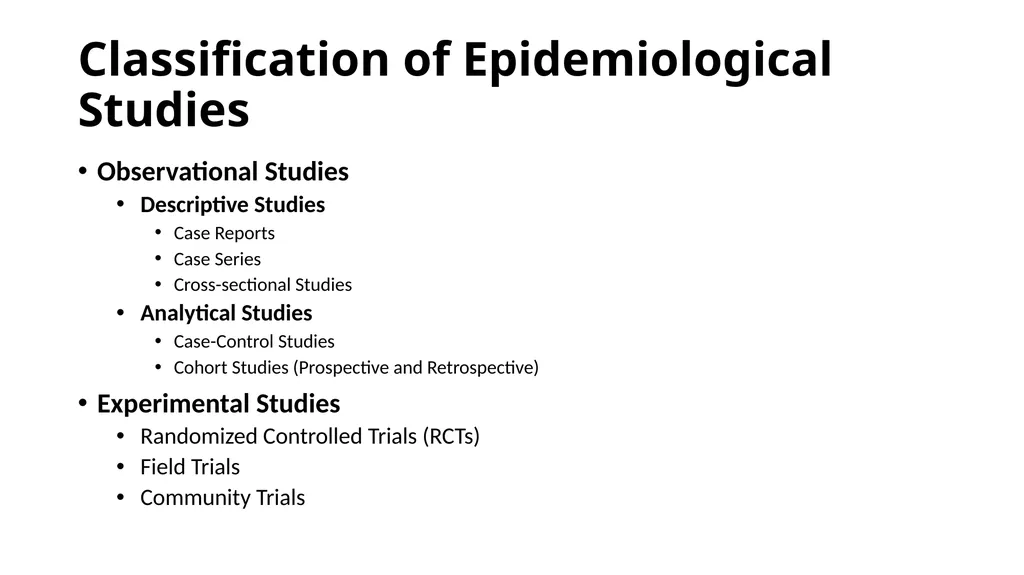
Classification of Epidemiological Studies Observational Studies
Descriptive Studies
Case Reports
Case Series
Cross-sectional Studies
Analytical Studies
Case-Control Studies
Cohort Studies (Prospective and Retrospective)
Experimental Studies
Randomized Controlled Trials (RCTs)
Field Trials
Community Trials<br>
06
Detailed Explanation of Descriptive Studies 4. Detailed Explanation of Each Study Type
Descriptive Studies
Case Reports and Case Series
Characteristics
Advantages and Limitations
Cross-sectional Studies
Methodology
Uses and Applications
Advantages and Limitations<br>
07
Example Outline for a Case Report Title: A Rare Case of [Condition]: Clinical Presentation and Management
Abstract
Introduction
Case Presentation
Patient demographics
Clinical history
Physical examination findings
Diagnostic work-up
Treatment and management
Follow-up and outcome
Discussion
Comparison with literature
Clinical implications
Hypotheses and future directions
Conclusion<br>
08
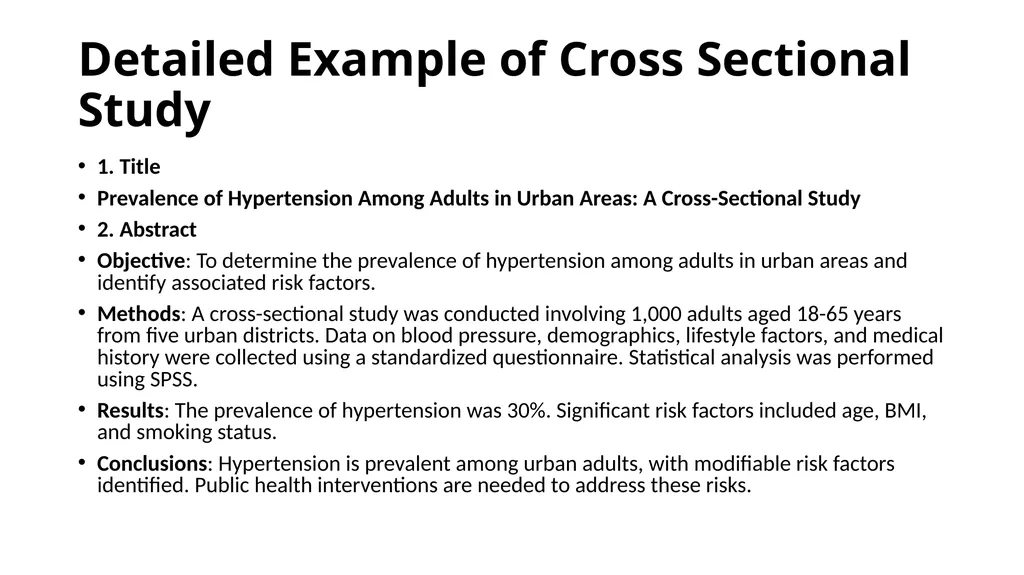
Detailed Example of Cross Sectional Study 1. Title
Prevalence of Hypertension Among Adults in Urban Areas: A Cross-Sectional Study
2. Abstract
Objective: To determine the prevalence of hypertension among adults in urban areas and identify associated risk factors.
Methods: A cross-sectional study was conducted involving 1,000 adults aged 18-65 years from five urban districts. Data on blood pressure, demographics, lifestyle factors, and medical history were collected using a standardized questionnaire. Statistical analysis was performed using SPSS.
Results: The prevalence of hypertension was 30%. Significant risk factors included age, BMI, and smoking status.
Conclusions: Hypertension is prevalent among urban adults, with modifiable risk factors identified. Public health interventions are needed to address these risks.<br>
09
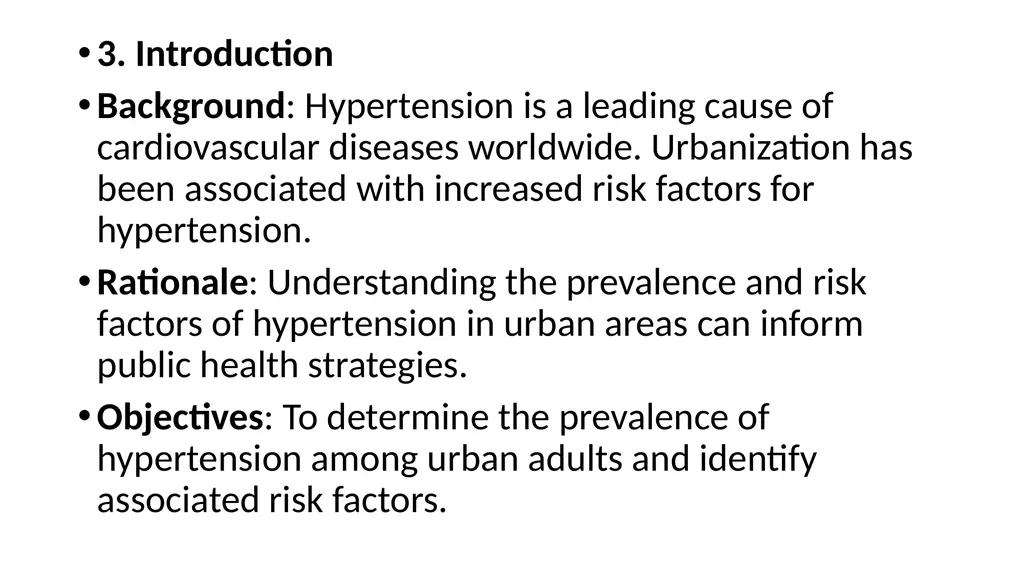
3. Introduction
Background: Hypertension is a leading cause of cardiovascular diseases worldwide. Urbanization has been associated with increased risk factors for hypertension.
Rationale: Understanding the prevalence and risk factors of hypertension in urban areas can inform public health strategies.
Objectives: To determine the prevalence of hypertension among urban adults and identify associated risk factors.<br>
10
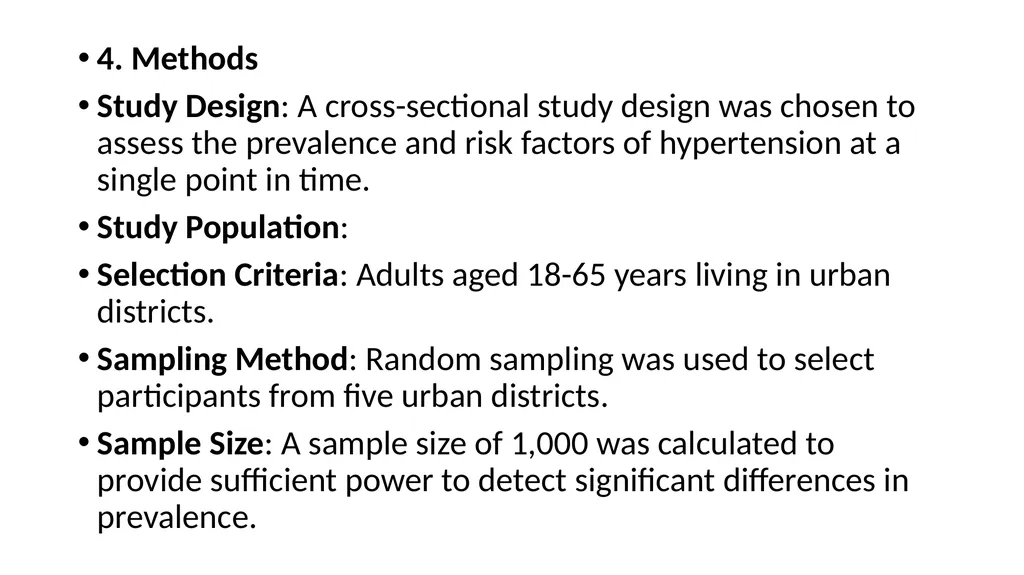
4. Methods
Study Design: A cross-sectional study design was chosen to assess the prevalence and risk factors of hypertension at a single point in time.
Study Population:
Selection Criteria: Adults aged 18-65 years living in urban districts.
Sampling Method: Random sampling was used to select participants from five urban districts.
Sample Size: A sample size of 1,000 was calculated to provide sufficient power to detect significant differences in prevalence.<br>
11
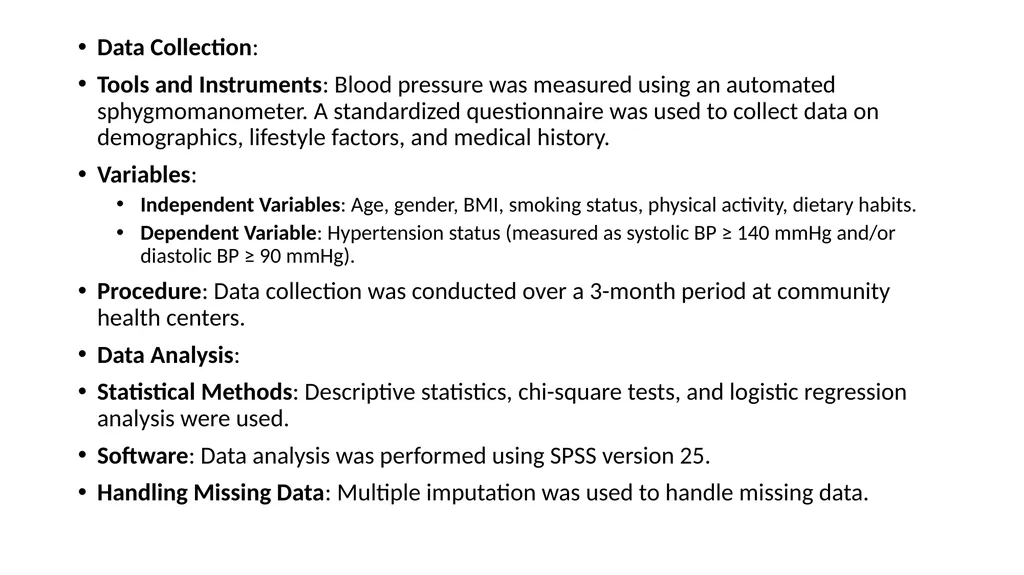
Data Collection:
Tools and Instruments: Blood pressure was measured using an automated sphygmomanometer. A standardized questionnaire was used to collect data on demographics, lifestyle factors, and medical history.
Variables:
Independent Variables: Age, gender, BMI, smoking status, physical activity, dietary habits.
Dependent Variable: Hypertension status (measured as systolic BP ≥ 140 mmHg and/or diastolic BP ≥ 90 mmHg).
Procedure: Data collection was conducted over a 3-month period at community health centers.
Data Analysis:
Statistical Methods: Descriptive statistics, chi-square tests, and logistic regression analysis were used.
Software: Data analysis was performed using SPSS version 25.
Handling Missing Data: Multiple imputation was used to handle missing data.<br>
12
5. Results
Descriptive Statistics: The mean age of participants was 45 years, with a gender distribution of 55% females and 45% males.
Main Findings: The prevalence of hypertension was 30%. Higher age, BMI, and smoking were significantly associated with hypertension.
Tables and Figures:
Table 1: Demographic characteristics of the study population.
Figure 1: Prevalence of hypertension by age group.<br>
13
6. Discussion
Interpretation of Results: The high prevalence of hypertension is consistent with previous studies in urban areas. Age, BMI, and smoking are well-known risk factors.
Strengths and Limitations: The large sample size and random sampling are strengths. Limitations include potential recall bias in self-reported data.
Implications: Findings highlight the need for targeted public health interventions to reduce hypertension risk factors in urban populations.
Comparison with Other Studies: Similar prevalence rates have been reported in other urban studies, reinforcing the need for consistent public health efforts.<br>
14
7. Conclusion
Summary of Findings: Hypertension is prevalent among urban adults, with age, BMI, and smoking identified as significant risk factors.
Recommendations: Public health initiatives should focus on promoting healthy lifestyles and regular blood pressure screenings in urban areas.
8. References
Author A, Author B. Title of the study. Journal Name. Year; Volume(Issue): Page numbers.
Author C. Title of the article. Journal Name. Year; Volume(Issue): Page numbers.
9. Appendices
Appendix A: Standardized questionnaire used for data collection.
Appendix B: Additional tables and figures supporting the results.<br>