
Classroom Assessment Practices vs Principles of K
EM
Published · 42 slides · 0 views

1 / 1


Description
Classroom Assessment Practices vs Principles of K to 12 Assessment One test of the correctness of educational procedure is the happiness of the child. -Maria Montessori Task: In each learning area, do the following: Group 1 Demonstrate an
Related Topics
Share
Embed code
Download this presentation From Below
"Classroom Assessment Practices vs Principles of K" is the property of its rightful owner. Permission is granted to download and print the materials on this website for personal, non-commercial use only, and to display it on your personal computer provided you do not modify the materials and that you retain all copyright notices contained in the materials. By downloading content from our website, you accept the terms of this agreement.
Presentation Transcript
01
Classroom Assessment Practices
vs
Principles of K to 12 Assessment<br>
02
One test of the correctness of educational procedure is the happiness of the child.
-Maria Montessori<br>
-Maria Montessori<br>
03
Task: In each learning area, do the following:
Group 1
Demonstrate an example/counter example of a formative
assessment you use in your classroom. Show How you
involve your students in answering these questions:
Where am I going?
Where am I now?
How can I close the gap?
Group 2
Demonstrate an example/counter example of a formative
assessment where you listen to students and provide
feedback.
Group 3
Demonstrate an example of something you
would/would not consider a formative use of rubrics in
your classroom .<br>
04
Questions What evidences of implementation and results were presented? (positive/negative)
What interested you the most in the presentations?
What does formative assessment mean to you?
What do you wonder about Formative Assessment?
When are you most likely to give feedback?
What aspect of your teaching help students know answers to “Where am I going, how close is my current
achievement or performance? What do I do next?”
What will you try in your classroom? (interesting)<br>
What interested you the most in the presentations?
What does formative assessment mean to you?
What do you wonder about Formative Assessment?
When are you most likely to give feedback?
What aspect of your teaching help students know answers to “Where am I going, how close is my current
achievement or performance? What do I do next?”
What will you try in your classroom? (interesting)<br>
05
Principles of K to 12 Assessment<br>
06
21st Century Assessment balance of assessments - high-quality standardized testing along with effective classroom formative and summative assessments;
useful feedback on student performance that is embedded into everyday learning;
balance between formative and summative assessments that measure student mastery of 21st century skills; Effective Pedagogy in Social Sciences http://www.educationcounts.govt.nz/publications/series/2515/32879/35263<br>
useful feedback on student performance that is embedded into everyday learning;
balance between formative and summative assessments that measure student mastery of 21st century skills; Effective Pedagogy in Social Sciences http://www.educationcounts.govt.nz/publications/series/2515/32879/35263<br>
07
21st Century Assessment portfolios of learner works that demonstrate mastery of skills to educators and prospective employers; and
balanced portfolio of measures to assess the educational system’s effectiveness at reaching high levels of student competency. Effective Pedagogy in Social Sciences http://www.educationcounts.govt.nz/publications/series/2515/32879/35263<br>
balanced portfolio of measures to assess the educational system’s effectiveness at reaching high levels of student competency. Effective Pedagogy in Social Sciences http://www.educationcounts.govt.nz/publications/series/2515/32879/35263<br>
08
DepEd Order No. 73, s. 2012<br>
09
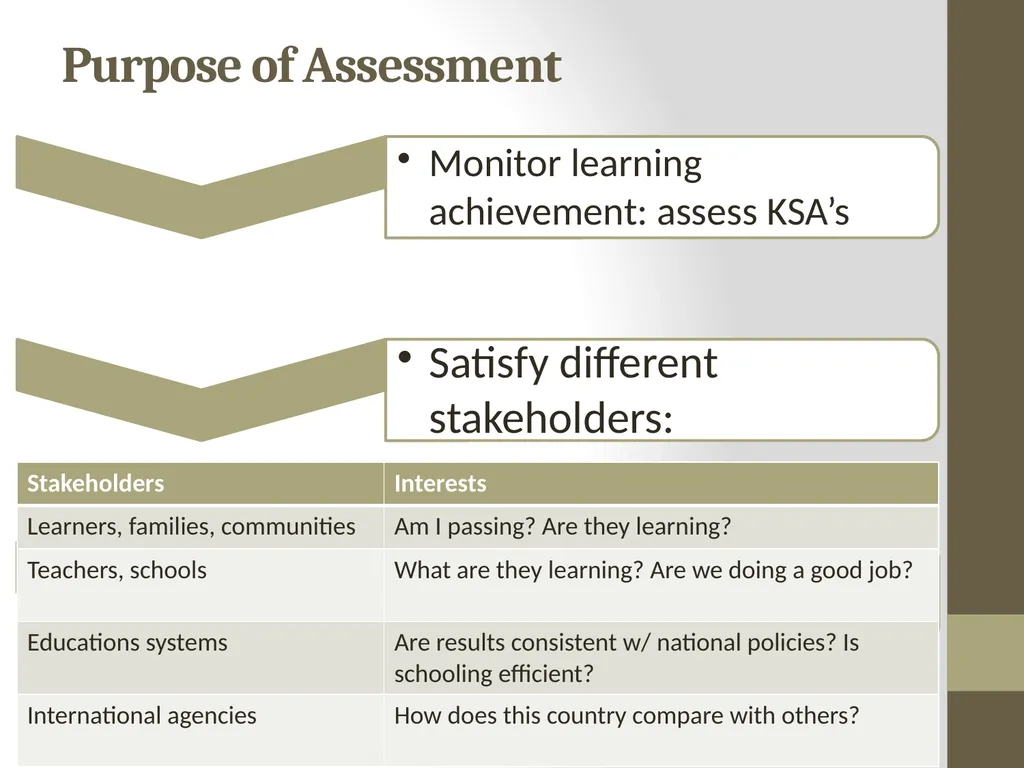
Purpose of Assessment<br>
10
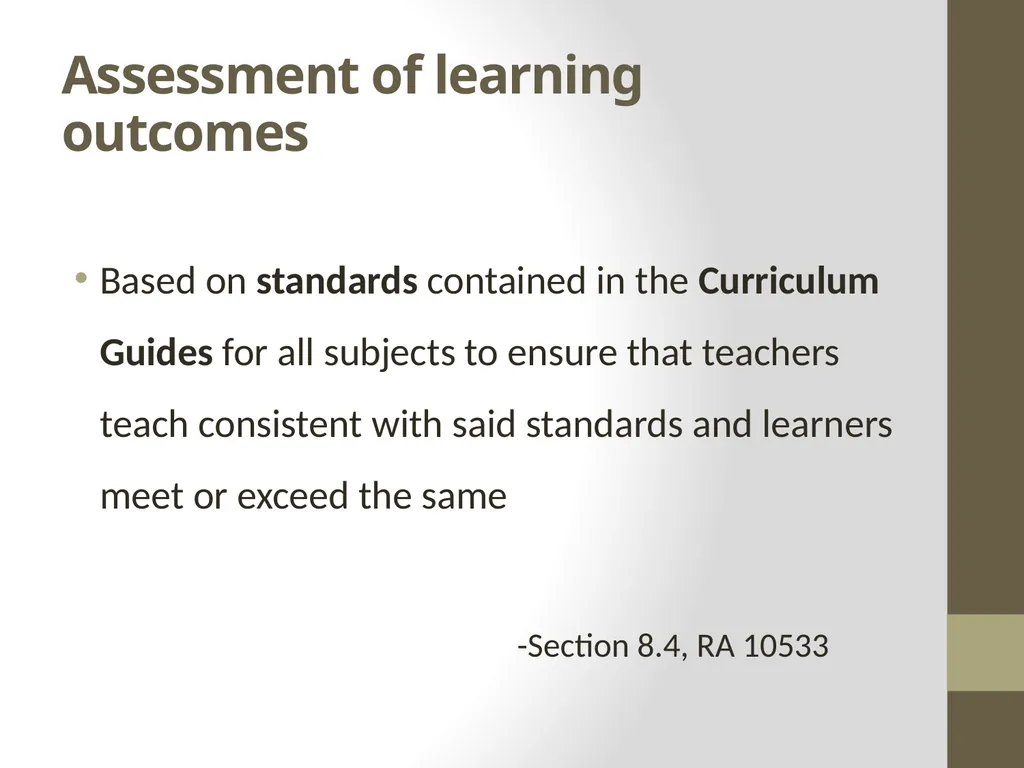
Assessment of learning outcomes Based on standards contained in the Curriculum Guides for all subjects to ensure that teachers teach consistent with said standards and learners meet or exceed the same
-Section 8.4, RA 10533<br>
-Section 8.4, RA 10533<br>
11
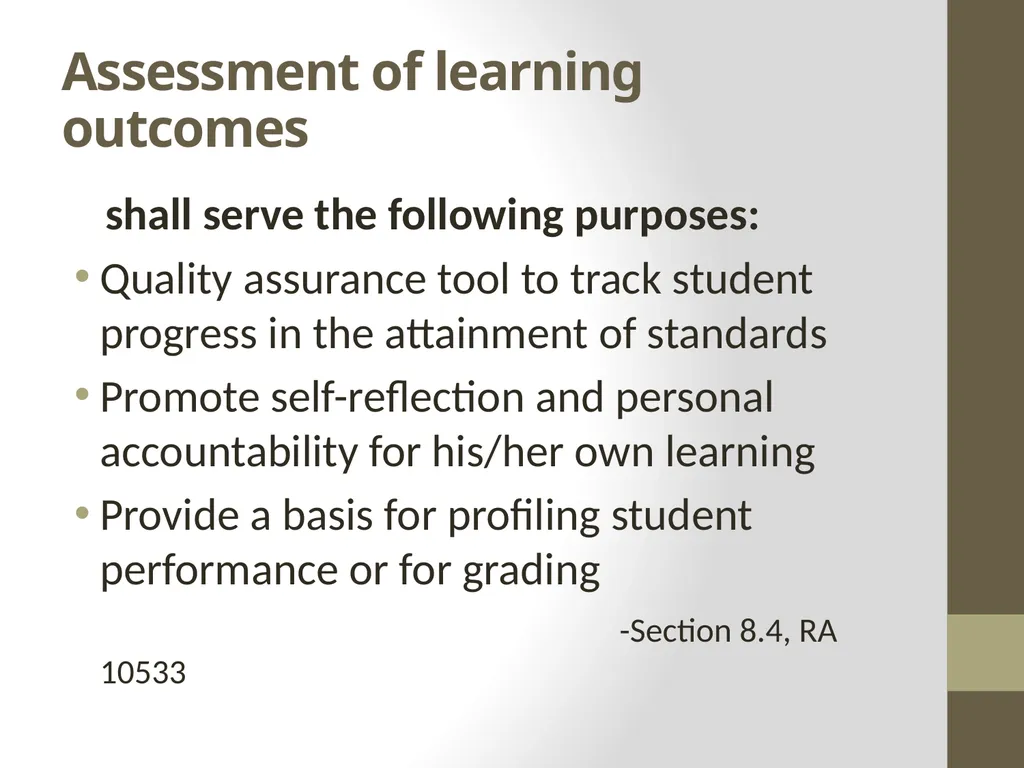
Assessment of learning outcomes shall serve the following purposes:
Quality assurance tool to track student progress in the attainment of standards
Promote self-reflection and personal accountability for his/her own learning
Provide a basis for profiling student performance or for grading
-Section 8.4, RA 10533<br>
Quality assurance tool to track student progress in the attainment of standards
Promote self-reflection and personal accountability for his/her own learning
Provide a basis for profiling student performance or for grading
-Section 8.4, RA 10533<br>
12
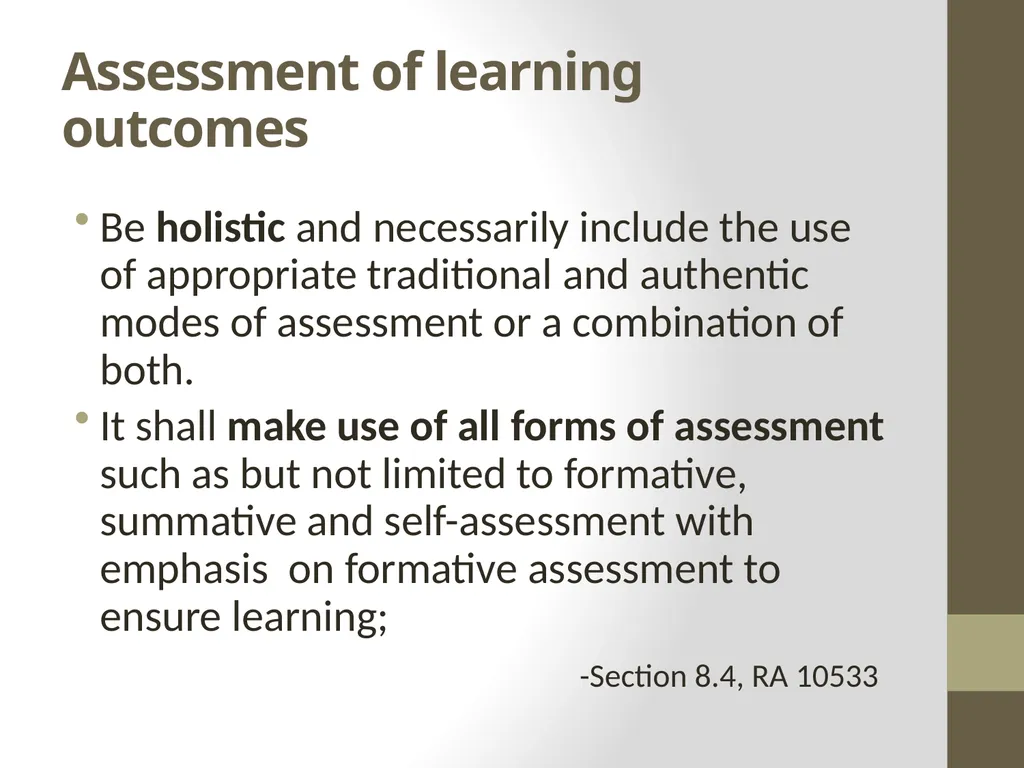
Assessment of learning outcomes Be holistic and necessarily include the use of appropriate traditional and authentic modes of assessment or a combination of both.
It shall make use of all forms of assessment such as but not limited to formative, summative and self-assessment with emphasis on formative assessment to ensure learning;
-Section 8.4, RA 10533<br>
It shall make use of all forms of assessment such as but not limited to formative, summative and self-assessment with emphasis on formative assessment to ensure learning;
-Section 8.4, RA 10533<br>
13
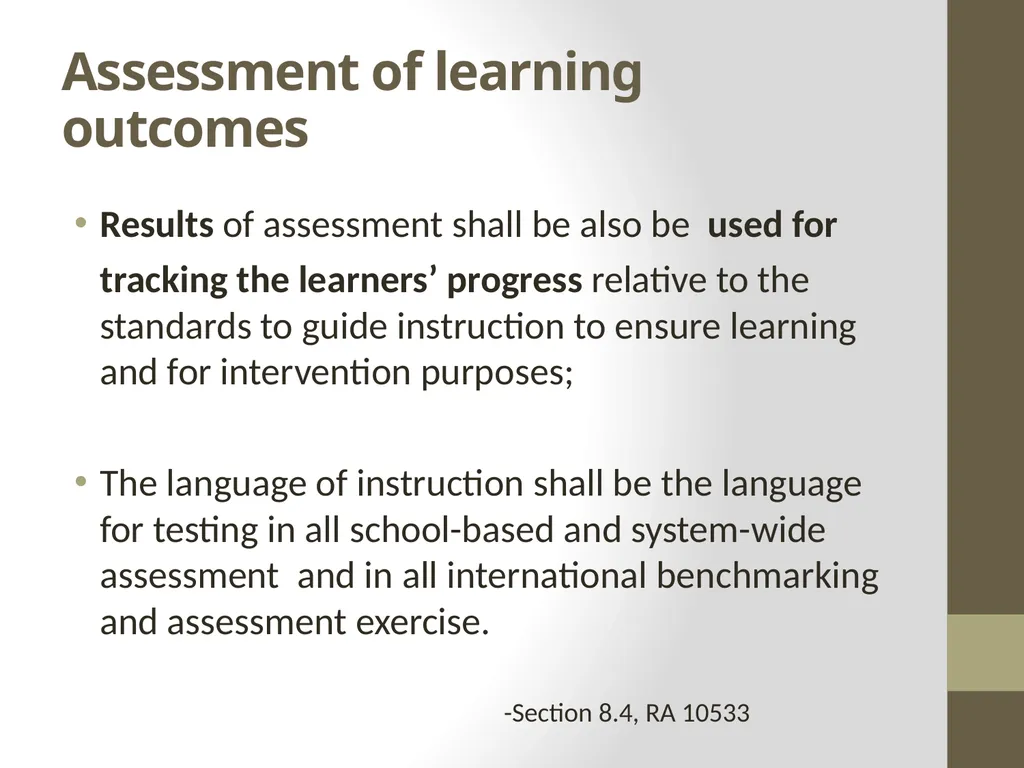
Assessment of learning outcomes Results of assessment shall be also be used for
tracking the learners’ progress relative to the standards to guide instruction to ensure learning and for intervention purposes;
The language of instruction shall be the language for testing in all school-based and system-wide assessment and in all international benchmarking and assessment exercise.
-Section 8.4, RA 10533<br>
tracking the learners’ progress relative to the standards to guide instruction to ensure learning and for intervention purposes;
The language of instruction shall be the language for testing in all school-based and system-wide assessment and in all international benchmarking and assessment exercise.
-Section 8.4, RA 10533<br>
14
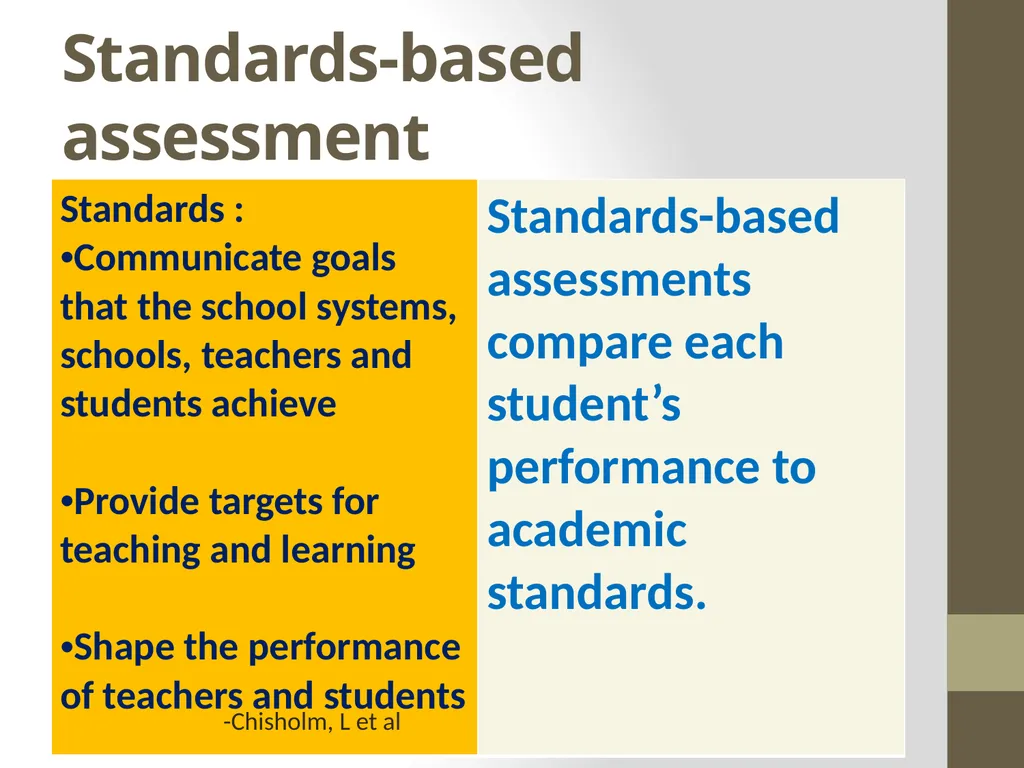
Standards-based assessment -Chisholm, L et al<br>
15
Standards-based assessment
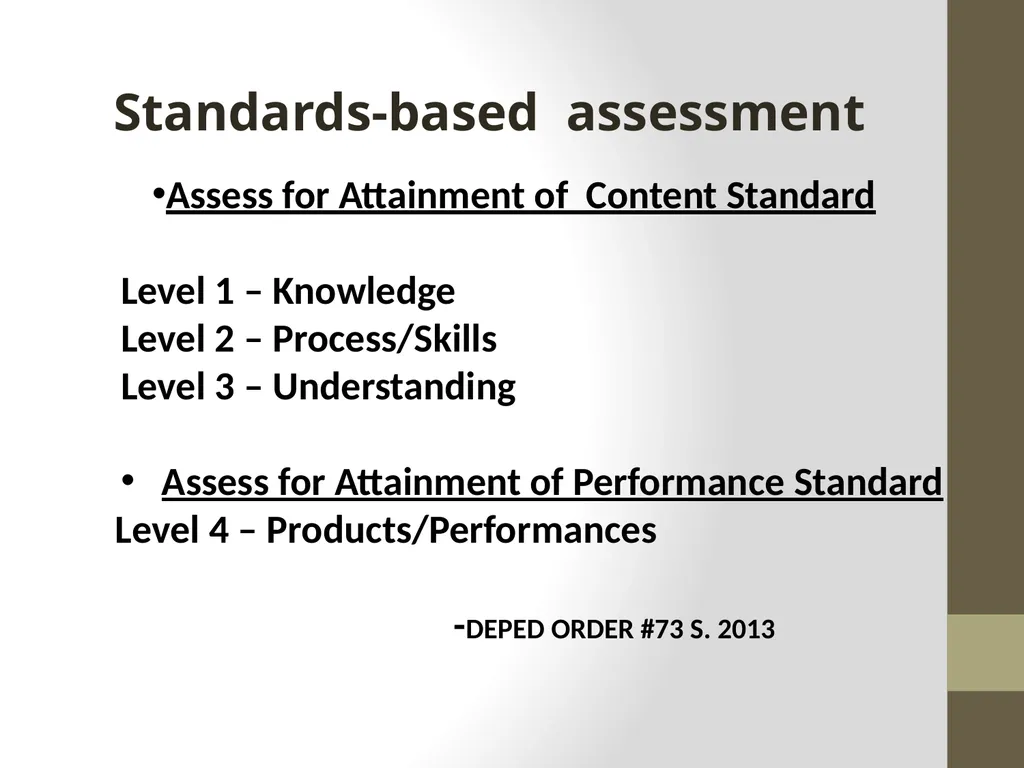
Assess for Attainment of Content Standard
Level 1 – Knowledge
Level 2 – Process/Skills
Level 3 – Understanding
Assess for Attainment of Performance Standard Level 4 – Products/Performances
-DEPED ORDER #73 S. 2013<br>
Assess for Attainment of Content Standard
Level 1 – Knowledge
Level 2 – Process/Skills
Level 3 – Understanding
Assess for Attainment of Performance Standard Level 4 – Products/Performances
-DEPED ORDER #73 S. 2013<br>
16
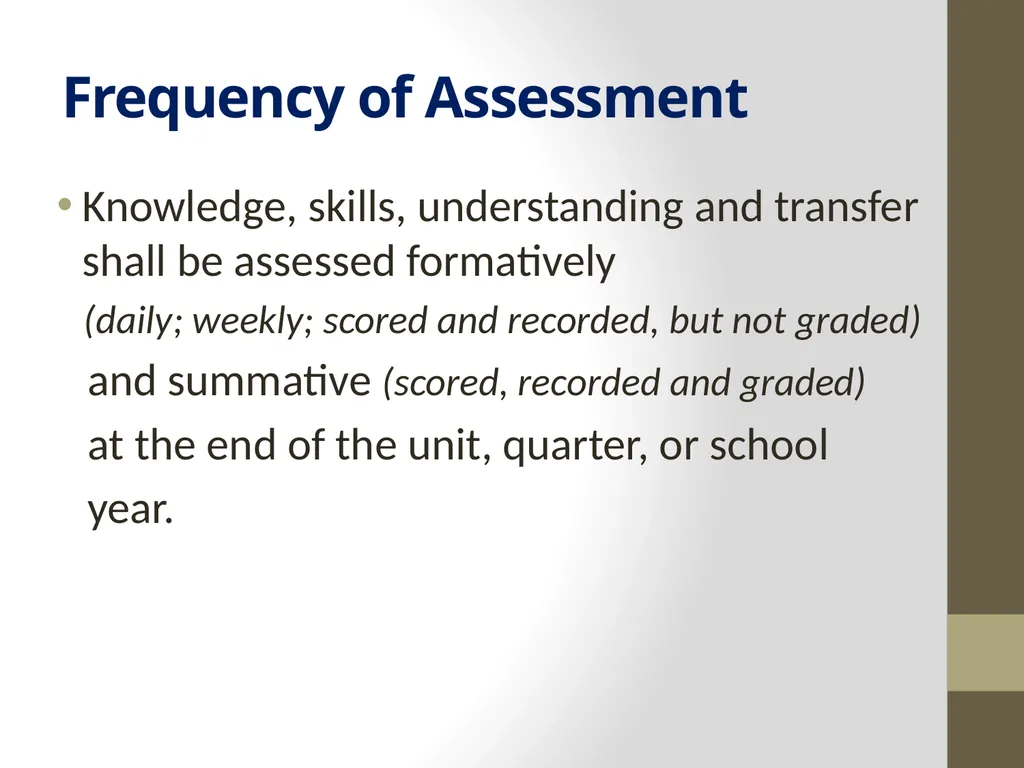
Frequency of Assessment Knowledge, skills, understanding and transfer shall be assessed formatively
(daily; weekly; scored and recorded, but not graded)
and summative (scored, recorded and graded)
at the end of the unit, quarter, or school
year.<br>
(daily; weekly; scored and recorded, but not graded)
and summative (scored, recorded and graded)
at the end of the unit, quarter, or school
year.<br>
17
Top Three
Misconceptions about Formative Assessment<br>
18
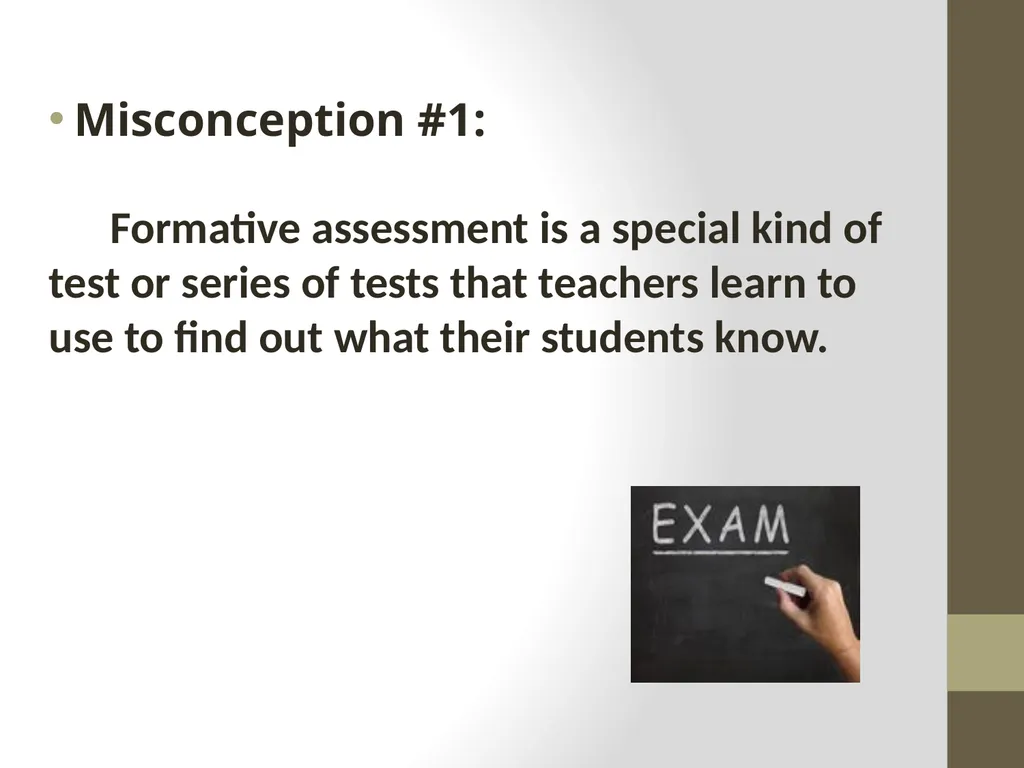
Misconception #1:
Formative assessment is a special kind of test or series of tests that teachers learn to use to find out what their students know.<br>
Formative assessment is a special kind of test or series of tests that teachers learn to use to find out what their students know.<br>
19
Strategic talking points for school leaders Formative assessment
is not a test item, a test, or a series of tests.
is an intentional learning process teachers engage in with their students to gather information during the learning process to improve achievement.
is a learning partnership that involves teachers and their students taking stock of where they are in relation to their learning goals.<br>
is not a test item, a test, or a series of tests.
is an intentional learning process teachers engage in with their students to gather information during the learning process to improve achievement.
is a learning partnership that involves teachers and their students taking stock of where they are in relation to their learning goals.<br>
20
Misconception #2:
Formative assessment is a program that teachers adopt and add to what they already do.<br>
Formative assessment is a program that teachers adopt and add to what they already do.<br>
21
Strategic talking points for school leaders Formative assessment
is not a prepackaged program or set of techniques that teachers adopt and enact.
is a philosophy of teaching and learning in which the purpose of assessing is to inform learning, not merely to audit it.
The formative assessment process is a fundamental reframing of the work teachers and students do day to day and minute by minute in the classroom.<br>
is not a prepackaged program or set of techniques that teachers adopt and enact.
is a philosophy of teaching and learning in which the purpose of assessing is to inform learning, not merely to audit it.
The formative assessment process is a fundamental reframing of the work teachers and students do day to day and minute by minute in the classroom.<br>
22
Misconception #3:
Any practice that gathers information for the purpose of improving programs or improving teaching is a part of formative assessment.<br>
Any practice that gathers information for the purpose of improving programs or improving teaching is a part of formative assessment.<br>
23
Strategic talking points for school leaders To be considered part of the formative assessment process, information gathered must be used to inform the learning of current students.
Although the quality of teaching rises as a result of formative assessment, the intended outcome must be to raise the learning and achievement of the students currently in the classroom on the concepts, processes, and skills that formed the basis for the assessment.<br>
Although the quality of teaching rises as a result of formative assessment, the intended outcome must be to raise the learning and achievement of the students currently in the classroom on the concepts, processes, and skills that formed the basis for the assessment.<br>
24
Formative assessment helps to continuously
generate and strengthen the ff. four important
components of motivation to learn:
Self-efficacy—A learner's belief in his ability to succeed in a particular situation
Self-regulation—The degree to which a learner is metacognitively, motivationally, and actively participating in her own learning<br>
generate and strengthen the ff. four important
components of motivation to learn:
Self-efficacy—A learner's belief in his ability to succeed in a particular situation
Self-regulation—The degree to which a learner is metacognitively, motivationally, and actively participating in her own learning<br>
25
Self-assessment—A learner's act of observing, analyzing, and judging his own performance on the basis of criteria and determining how he can improve it.
Self-attribution—A learner's own perceptions or explanations for success or failure that determine the amount of effort she will expend on that activity in the future.<br>
Self-attribution—A learner's own perceptions or explanations for success or failure that determine the amount of effort she will expend on that activity in the future.<br>
26
Sample formative assessment process in the classroom: A teacher asks students in his 6th grade social studies class to form pairs to generate three strategic questions that will help them better meet their learning target of describing how erosion has produced physical patterns on the earth's surface that have affected human activities.
Before a lesson on creating a family budget, a consumer science teacher states the goals for the lesson and asks the students to paraphrase the goals.<br>
Before a lesson on creating a family budget, a consumer science teacher states the goals for the lesson and asks the students to paraphrase the goals.<br>
27
Sample formative assessment process in the classroom: In a communication arts class, students use a rubric that they generated as a class to plan their essays, monitor their writing, and edit their drafts in order to meet the criteria for a successful essay.
In his feedback to a student, a teacher shows the student what she did correctly in her attempt to draw the life cycle of a frog. Then the teacher gives the student a strategy to use to improve the accuracy of her drawing before she turns in her final sketch.
A middle school student decides to use a story map to plan his short story depicting life in the Victorian era. It will help him reach his goal of improving the organization and sequencing of his story.<br>
In his feedback to a student, a teacher shows the student what she did correctly in her attempt to draw the life cycle of a frog. Then the teacher gives the student a strategy to use to improve the accuracy of her drawing before she turns in her final sketch.
A middle school student decides to use a story map to plan his short story depicting life in the Victorian era. It will help him reach his goal of improving the organization and sequencing of his story.<br>
28
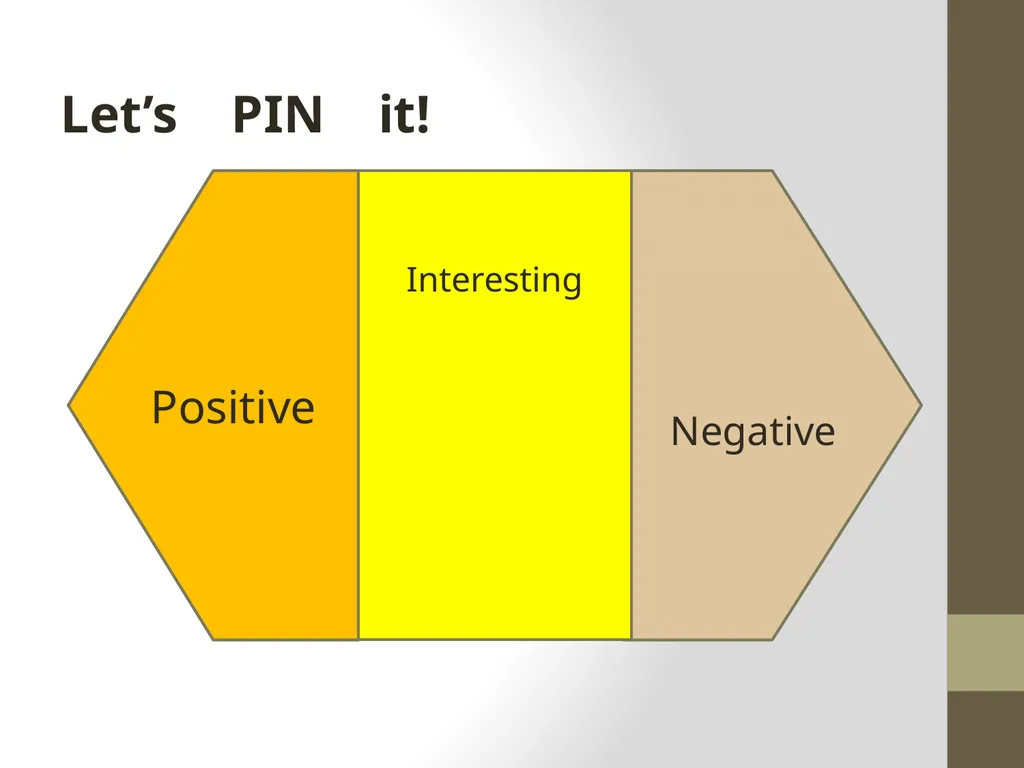
Positive Negative Interesting Let’s PIN it!<br>
29
Session 3<br>
30
It is not the beauty of a building
you should look at;
its the construction of the foundation that will stand the test of time.
David Allan Coe<br>
you should look at;
its the construction of the foundation that will stand the test of time.
David Allan Coe<br>
31
Which comes first, test specifications or test items?<br>
32
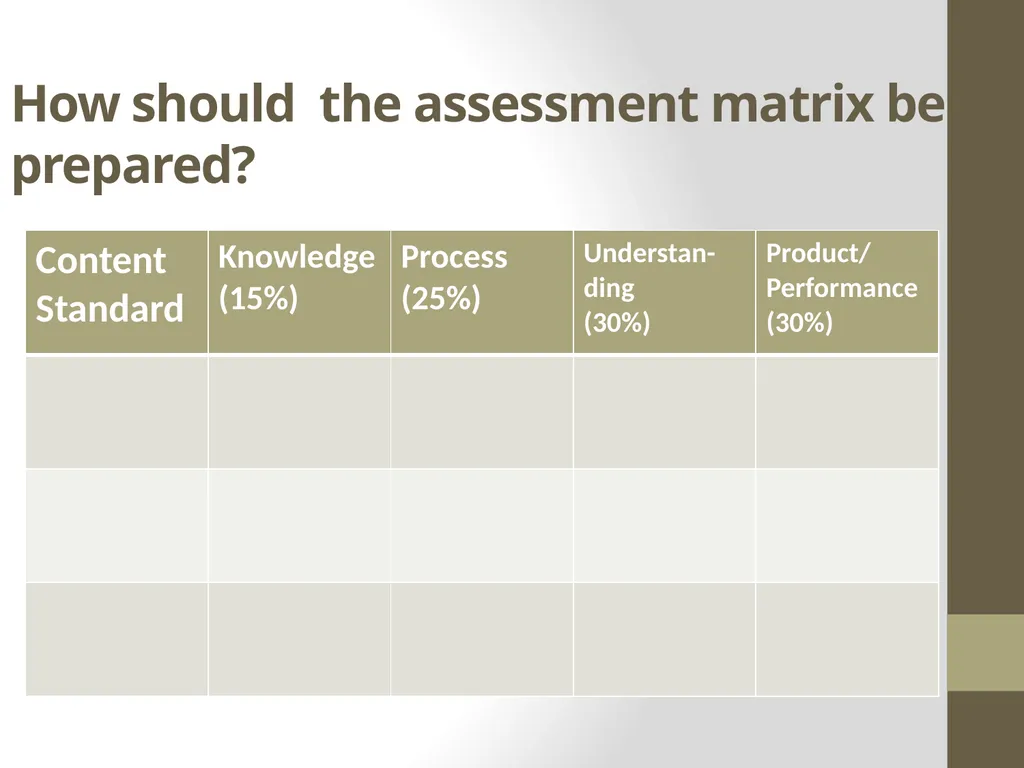
How should the assessment matrix be prepared?<br>
33
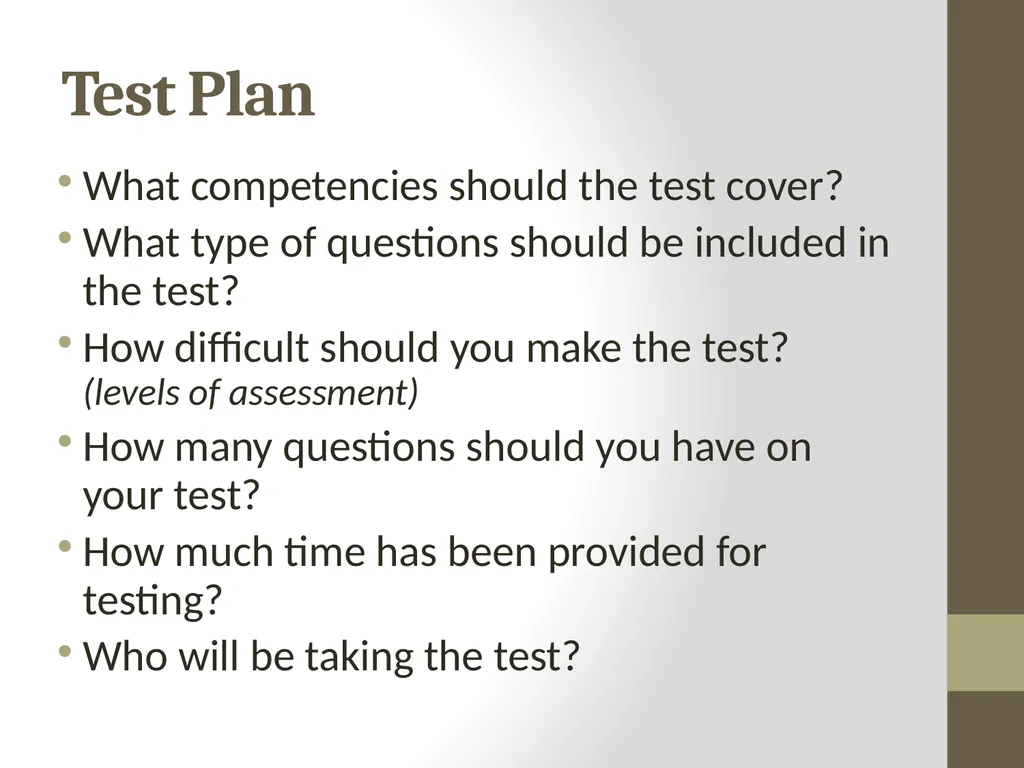
Test Plan What competencies should the test cover?
What type of questions should be included in the test?
How difficult should you make the test? (levels of assessment)
How many questions should you have on your test?
How much time has been provided for testing?
Who will be taking the test?<br>
What type of questions should be included in the test?
How difficult should you make the test? (levels of assessment)
How many questions should you have on your test?
How much time has been provided for testing?
Who will be taking the test?<br>
34
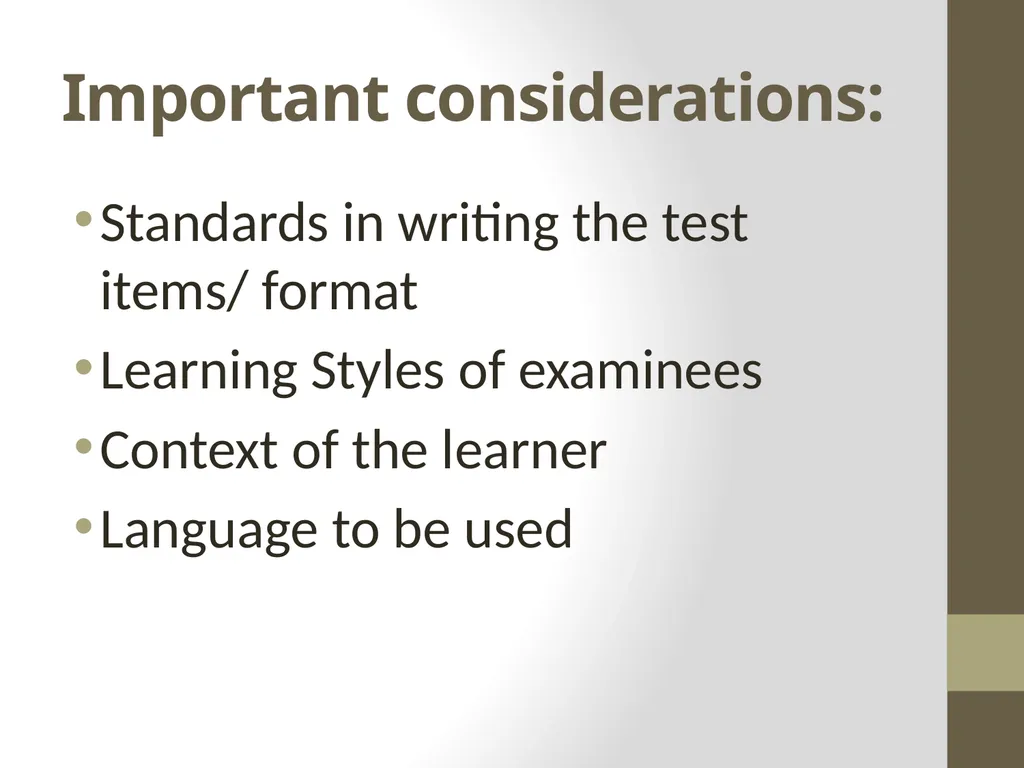
Important considerations: Standards in writing the test items/ format
Learning Styles of examinees
Context of the learner
Language to be used<br>
Learning Styles of examinees
Context of the learner
Language to be used<br>
35
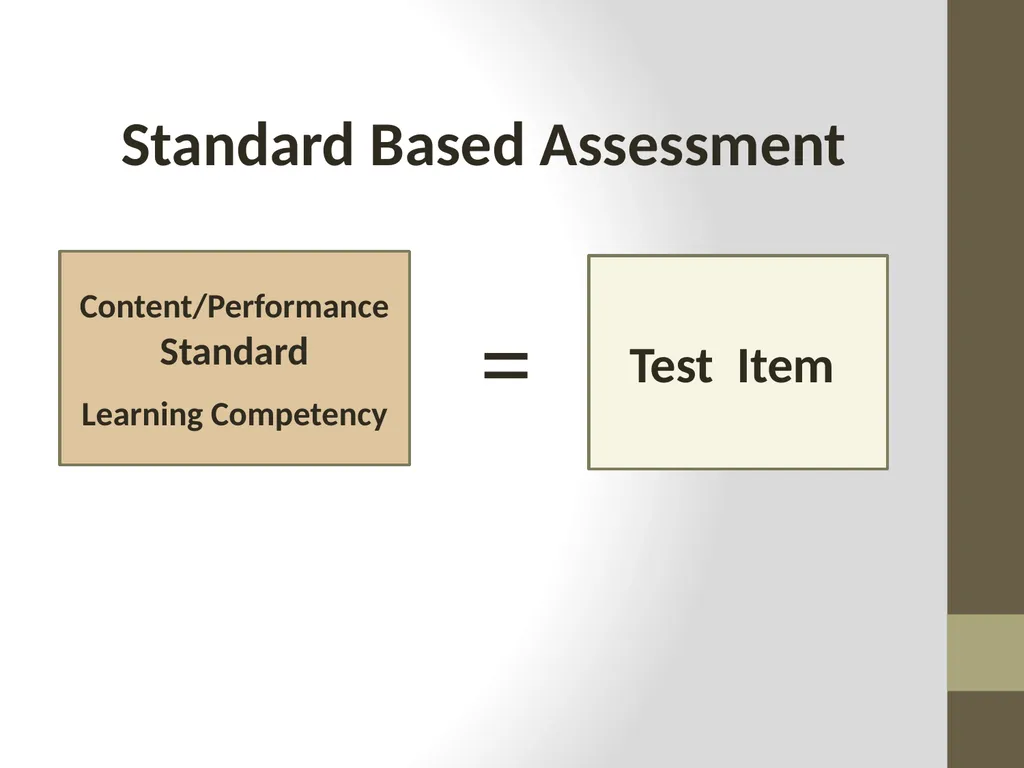
Standard Based Assessment Content/Performance Standard
Learning Competency Test Item =<br>
Learning Competency Test Item =<br>
36
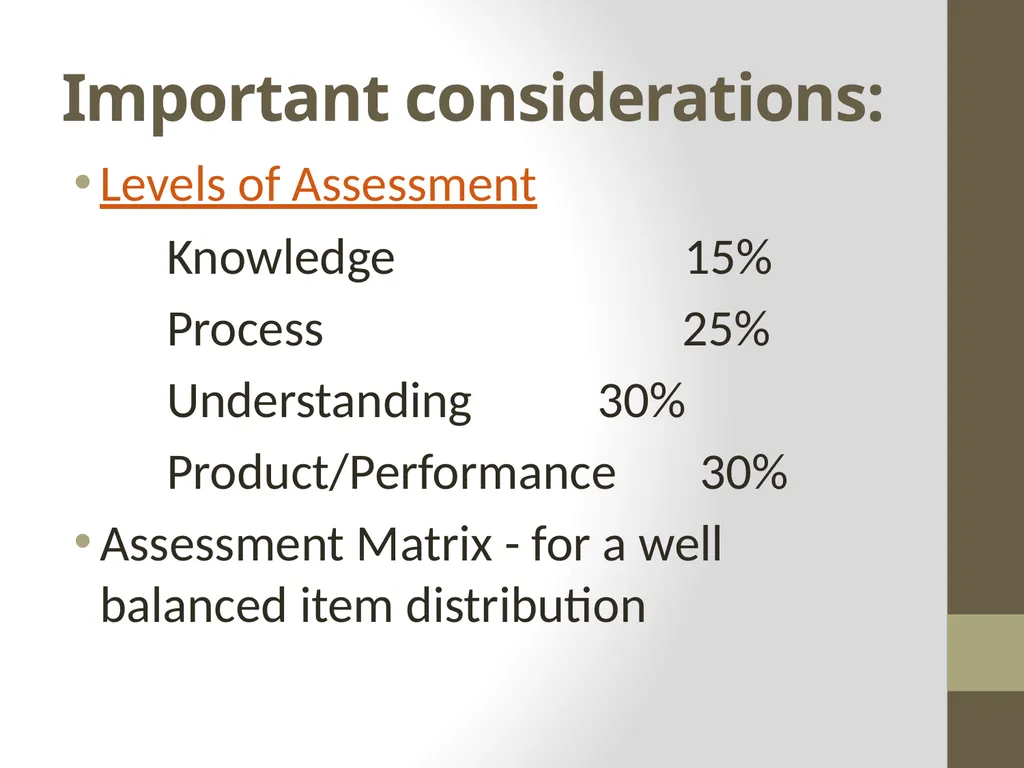
Important considerations: Levels of Assessment
Knowledge 15%
Process 25%
Understanding 30%
Product/Performance 30%
Assessment Matrix - for a well balanced item distribution<br>
Knowledge 15%
Process 25%
Understanding 30%
Product/Performance 30%
Assessment Matrix - for a well balanced item distribution<br>
37
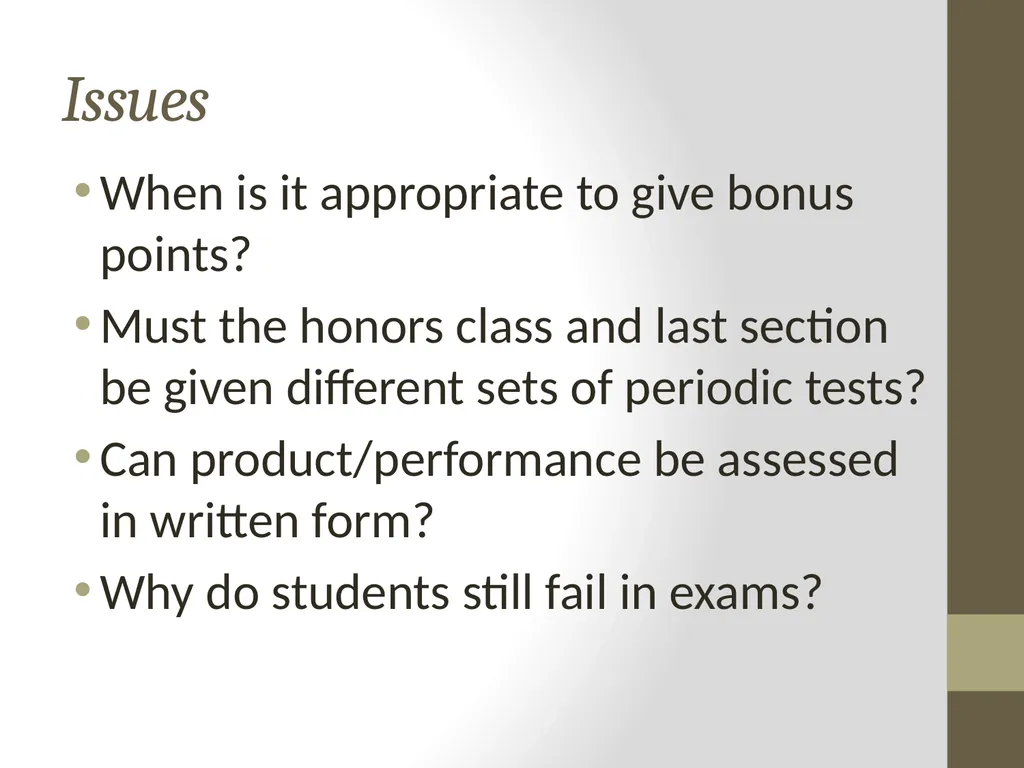
Issues When is it appropriate to give bonus points?
Must the honors class and last section be given different sets of periodic tests?
Can product/performance be assessed in written form?
Why do students still fail in exams?<br>
Must the honors class and last section be given different sets of periodic tests?
Can product/performance be assessed in written form?
Why do students still fail in exams?<br>
38
Life is not a multiple choice test,
it is an open-book essay exam.
-Alan Blinder, Princeton<br>
it is an open-book essay exam.
-Alan Blinder, Princeton<br>