
COLLEGE: CSS DEPARTMENT: GEOGRAPHY COURSE:
TA
Published · 91 slides · 0 views
1 / 1

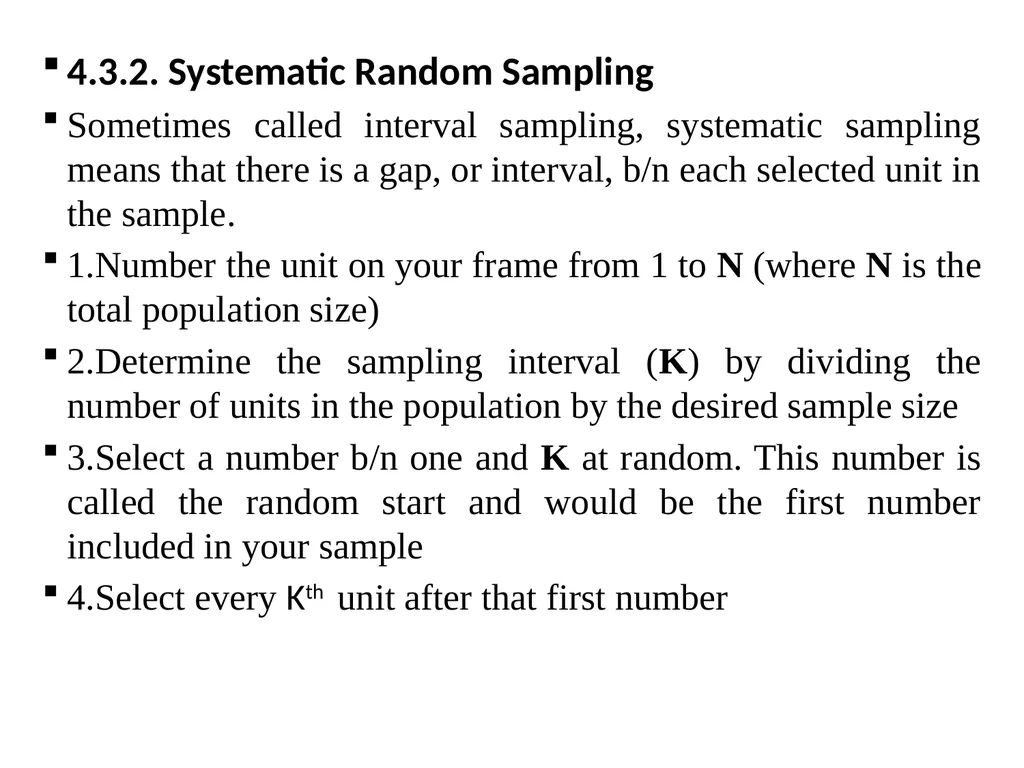
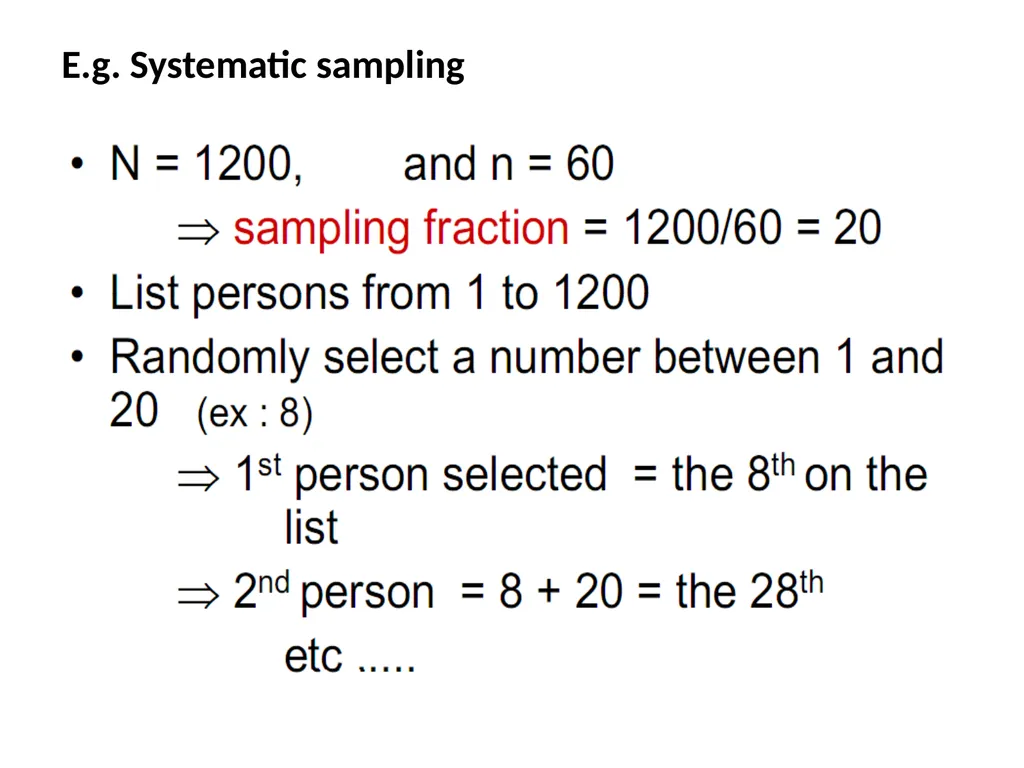
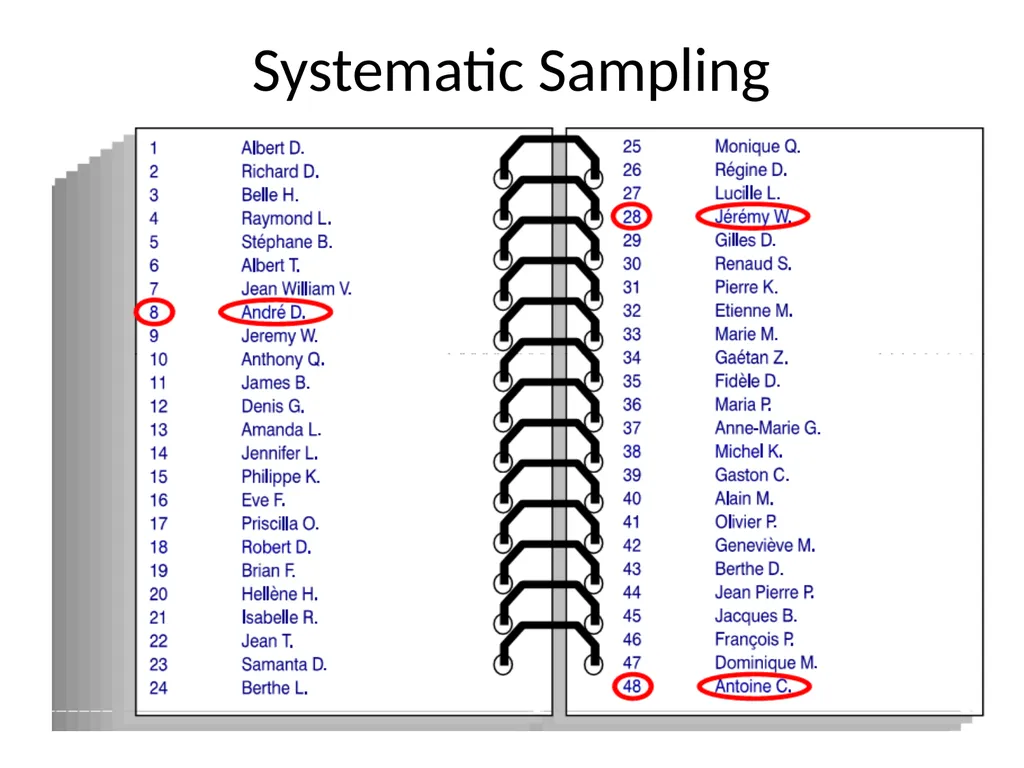
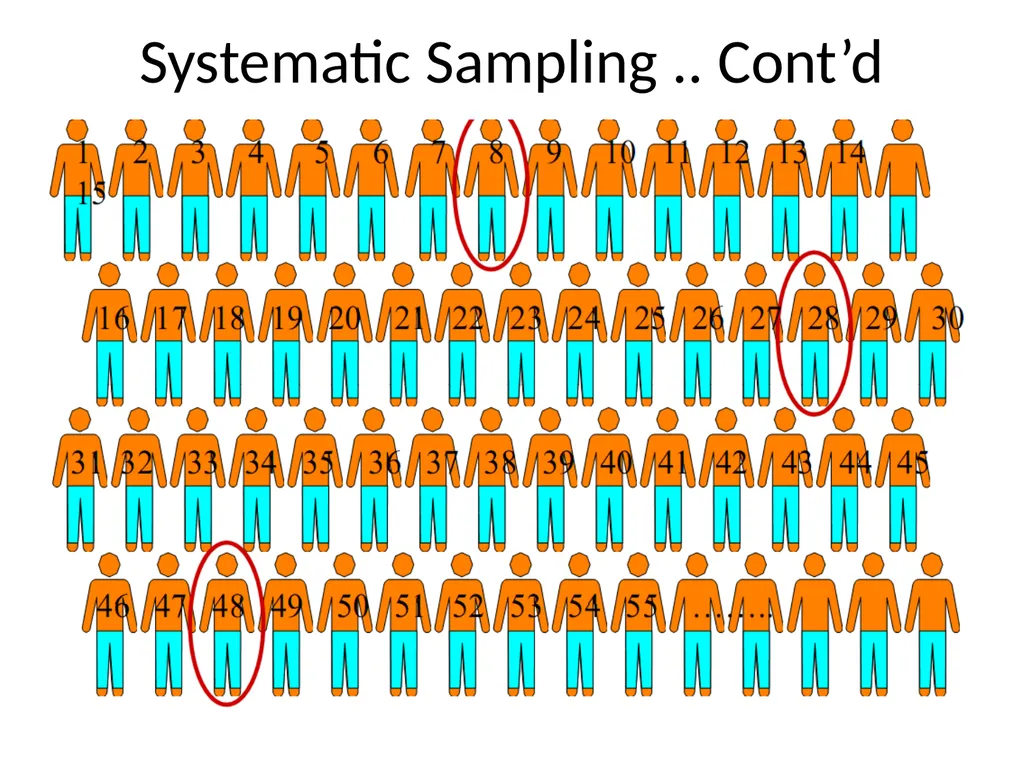
Description
COLLEGE: CSS DEPARTMENT: GEOGRAPHY COURSE: RESEARCH METHODOLOGY AUTHOR: YESHIMAR D. STUDENTS: 2ND YEAR, 2ND SEM Course Objectives: By the end of this course, students should be able to: Explain what is meant by the term research Familiar
Related Topics
Share
Embed code
Download this presentation From Below
"COLLEGE: CSS DEPARTMENT: GEOGRAPHY COURSE:" is the property of its rightful owner. Permission is granted to download and print the materials on this website for personal, non-commercial use only, and to display it on your personal computer provided you do not modify the materials and that you retain all copyright notices contained in the materials. By downloading content from our website, you accept the terms of this agreement.
Presentation Transcript
01
COLLEGE: CSS
DEPARTMENT: GEOGRAPHY
COURSE: RESEARCH METHODOLOGY
AUTHOR: YESHIMAR D.
STUDENTS: 2ND YEAR, 2ND SEM
Course Objectives:
By the end of this course, students should be able to:
Explain what is meant by the term research
Familiar with the purpose of scientific research
Acquaint with various types of research
Generate research ideas and state research problems
develop a research question to be answered and hypothesis to be tested;
Aware concepts of population, sampling, and sampling frames
distinguish various types of sampling techniques and apply them when appropriate
Identify relevant constructs, and variables and then operationalize them in relation to the problems/ the questions and the hypothesis
Apply various measurement strategies in research<br>
DEPARTMENT: GEOGRAPHY
COURSE: RESEARCH METHODOLOGY
AUTHOR: YESHIMAR D.
STUDENTS: 2ND YEAR, 2ND SEM
Course Objectives:
By the end of this course, students should be able to:
Explain what is meant by the term research
Familiar with the purpose of scientific research
Acquaint with various types of research
Generate research ideas and state research problems
develop a research question to be answered and hypothesis to be tested;
Aware concepts of population, sampling, and sampling frames
distinguish various types of sampling techniques and apply them when appropriate
Identify relevant constructs, and variables and then operationalize them in relation to the problems/ the questions and the hypothesis
Apply various measurement strategies in research<br>
02
identify basic principles and limitations of several research methods based on which critically analyze the various research outputs
select appropriate research method and instruments for applications in environmental resources management issues;
prepare research designs in the environmental management context using surveys, interviews, observation, PRA (focus groups) and others;
Process, and analyze the collected data using quantitative and/or qualitative methods, interpreting the results, and write the research reports
understand the ethical consideration of research<br>
select appropriate research method and instruments for applications in environmental resources management issues;
prepare research designs in the environmental management context using surveys, interviews, observation, PRA (focus groups) and others;
Process, and analyze the collected data using quantitative and/or qualitative methods, interpreting the results, and write the research reports
understand the ethical consideration of research<br>
03
Course Description:
The course in advanced research methods which deals with the use and application of research methods on natural resources and environmental management techniques in combination with other research methods used by other scholars/experts. Definitions of research, purpose of scientific research, development of scientific research, major research themes in environmental management, and types of research will be addressed.
Distinguishing various research processes such as problem identification and formulation, articulation of research objective, hypothesis, or research questions, conceptualization, operationalization, population and sampling will be main focuses.<br>
The course in advanced research methods which deals with the use and application of research methods on natural resources and environmental management techniques in combination with other research methods used by other scholars/experts. Definitions of research, purpose of scientific research, development of scientific research, major research themes in environmental management, and types of research will be addressed.
Distinguishing various research processes such as problem identification and formulation, articulation of research objective, hypothesis, or research questions, conceptualization, operationalization, population and sampling will be main focuses.<br>
04
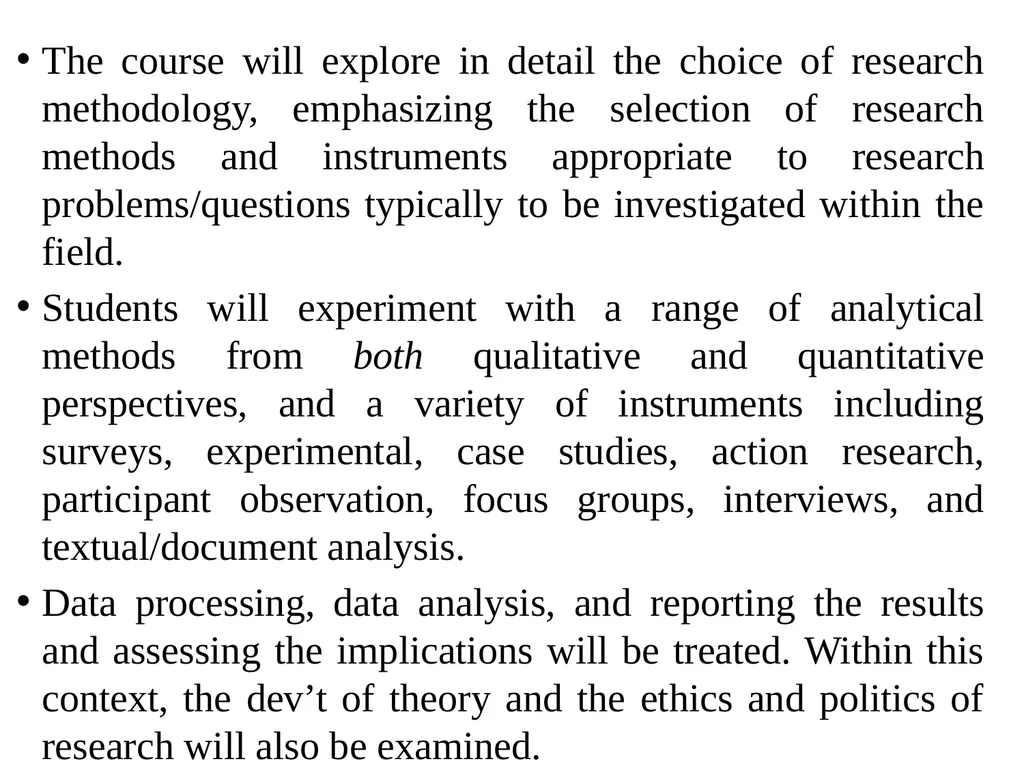
The course will explore in detail the choice of research methodology, emphasizing the selection of research methods and instruments appropriate to research problems/questions typically to be investigated within the field.
Students will experiment with a range of analytical methods from both qualitative and quantitative perspectives, and a variety of instruments including surveys, experimental, case studies, action research, participant observation, focus groups, interviews, and textual/document analysis.
Data processing, data analysis, and reporting the results and assessing the implications will be treated. Within this context, the dev’t of theory and the ethics and politics of research will also be examined.<br>
Students will experiment with a range of analytical methods from both qualitative and quantitative perspectives, and a variety of instruments including surveys, experimental, case studies, action research, participant observation, focus groups, interviews, and textual/document analysis.
Data processing, data analysis, and reporting the results and assessing the implications will be treated. Within this context, the dev’t of theory and the ethics and politics of research will also be examined.<br>
05
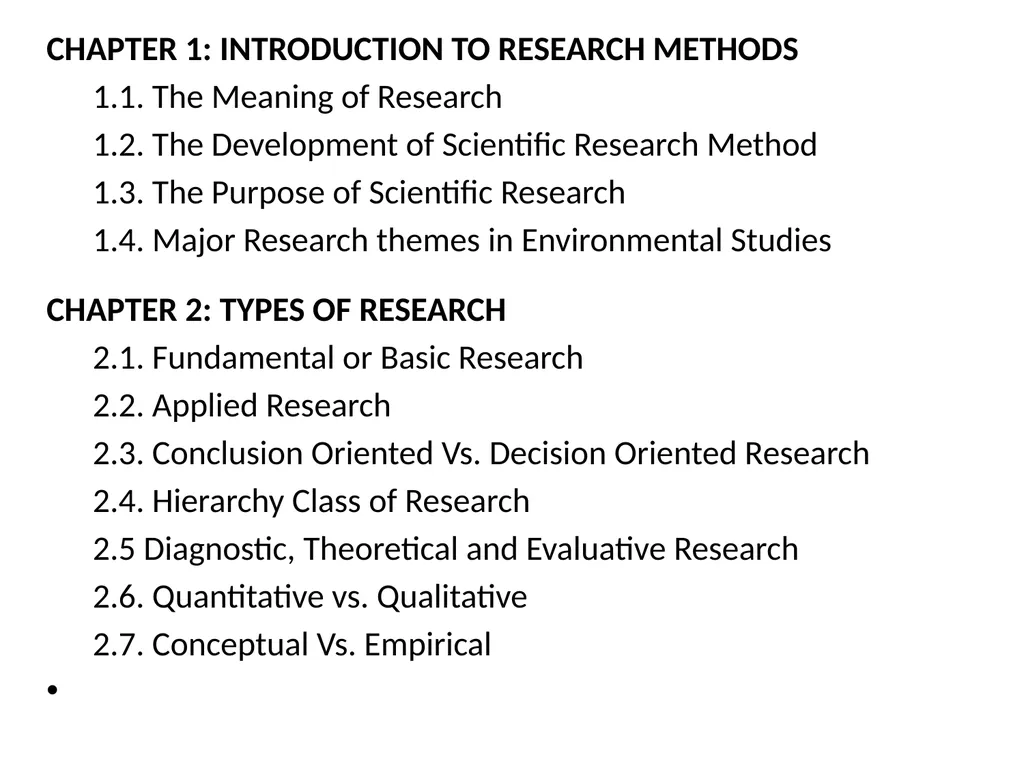
CHAPTER 1: INTRODUCTION TO RESEARCH METHODS
1.1. The Meaning of Research
1.2. The Development of Scientific Research Method
1.3. The Purpose of Scientific Research
1.4. Major Research themes in Environmental Studies
CHAPTER 2: TYPES OF RESEARCH
2.1. Fundamental or Basic Research
2.2. Applied Research
2.3. Conclusion Oriented Vs. Decision Oriented Research
2.4. Hierarchy Class of Research
2.5 Diagnostic, Theoretical and Evaluative Research
2.6. Quantitative vs. Qualitative
2.7. Conceptual Vs. Empirical<br>
1.1. The Meaning of Research
1.2. The Development of Scientific Research Method
1.3. The Purpose of Scientific Research
1.4. Major Research themes in Environmental Studies
CHAPTER 2: TYPES OF RESEARCH
2.1. Fundamental or Basic Research
2.2. Applied Research
2.3. Conclusion Oriented Vs. Decision Oriented Research
2.4. Hierarchy Class of Research
2.5 Diagnostic, Theoretical and Evaluative Research
2.6. Quantitative vs. Qualitative
2.7. Conceptual Vs. Empirical<br>
06
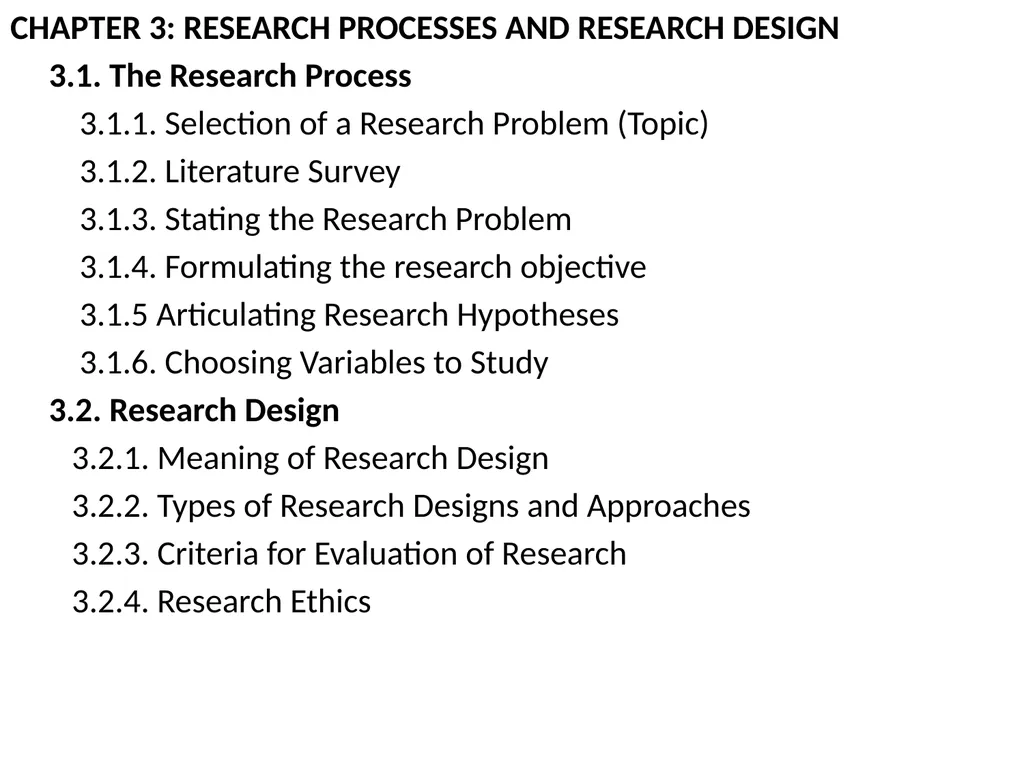
CHAPTER 3: RESEARCH PROCESSES AND RESEARCH DESIGN
3.1. The Research Process
3.1.1. Selection of a Research Problem (Topic)
3.1.2. Literature Survey
3.1.3. Stating the Research Problem
3.1.4. Formulating the research objective
3.1.5 Articulating Research Hypotheses
3.1.6. Choosing Variables to Study
3.2. Research Design
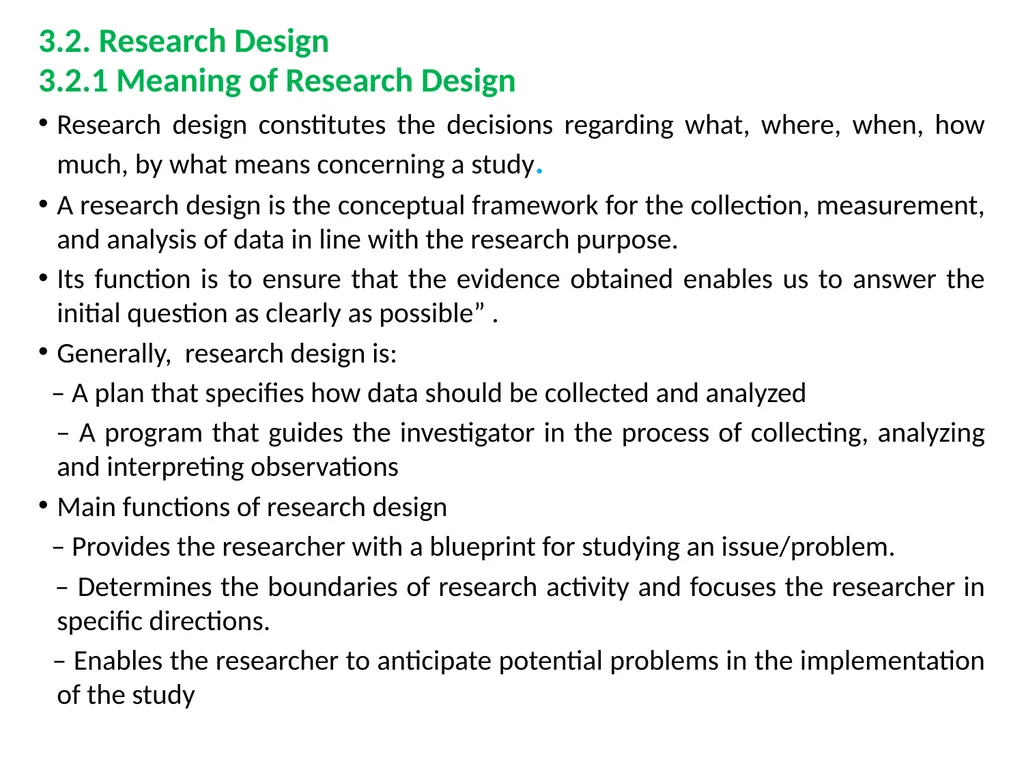
3.2.1. Meaning of Research Design
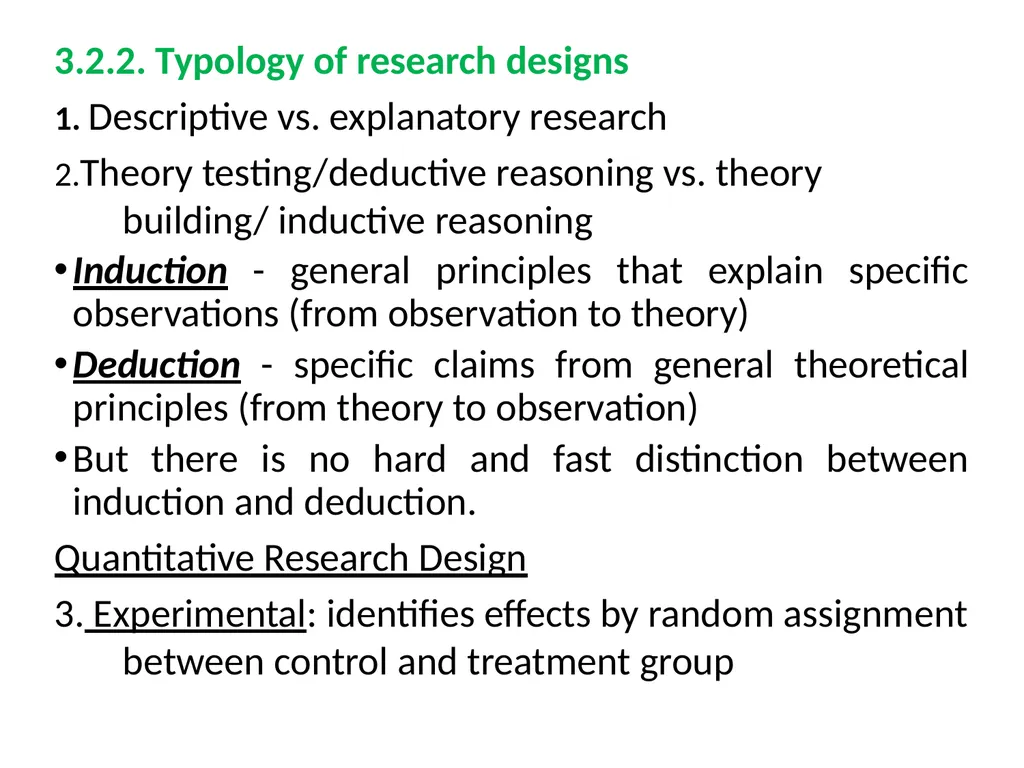
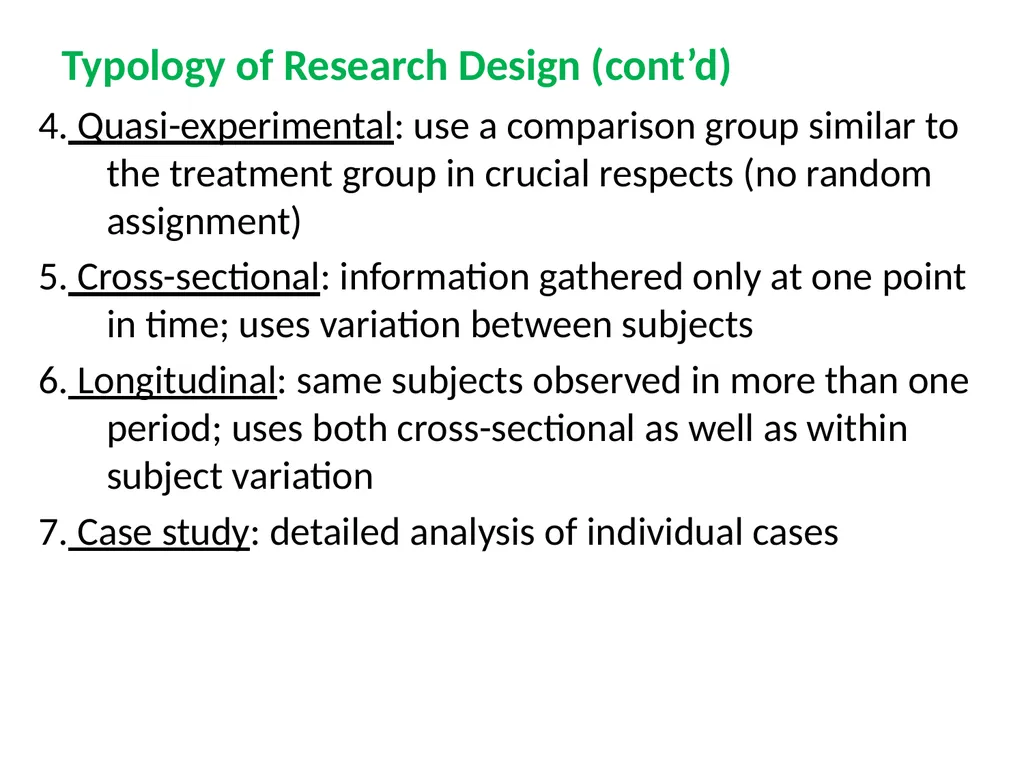
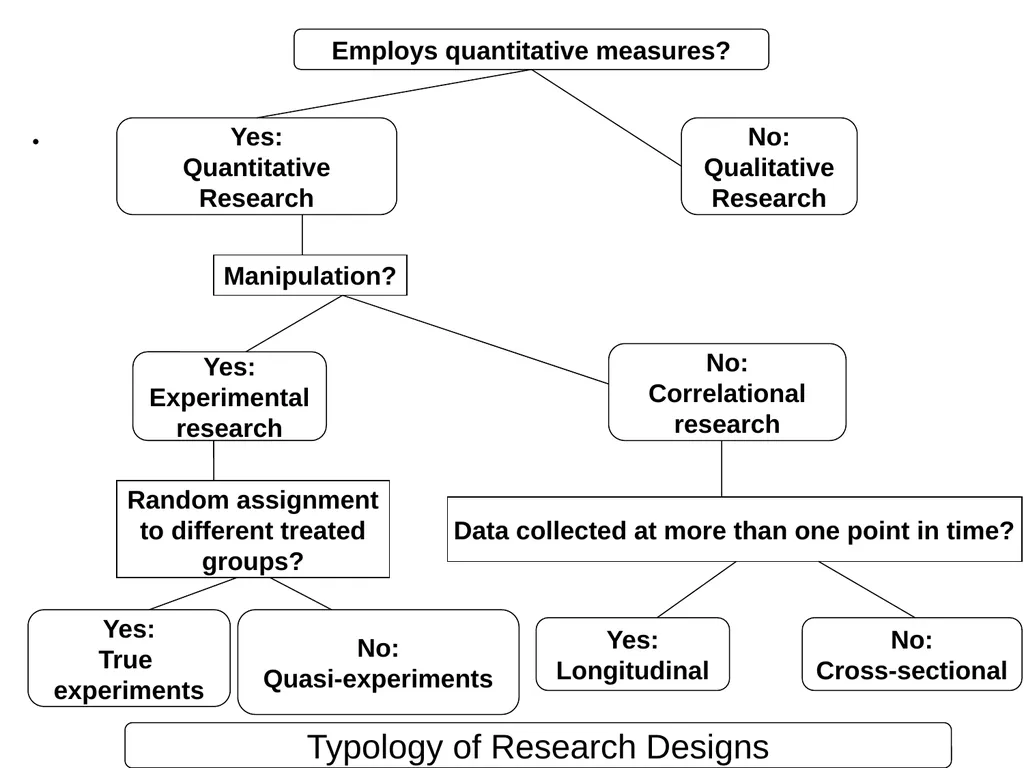
3.2.2. Types of Research Designs and Approaches
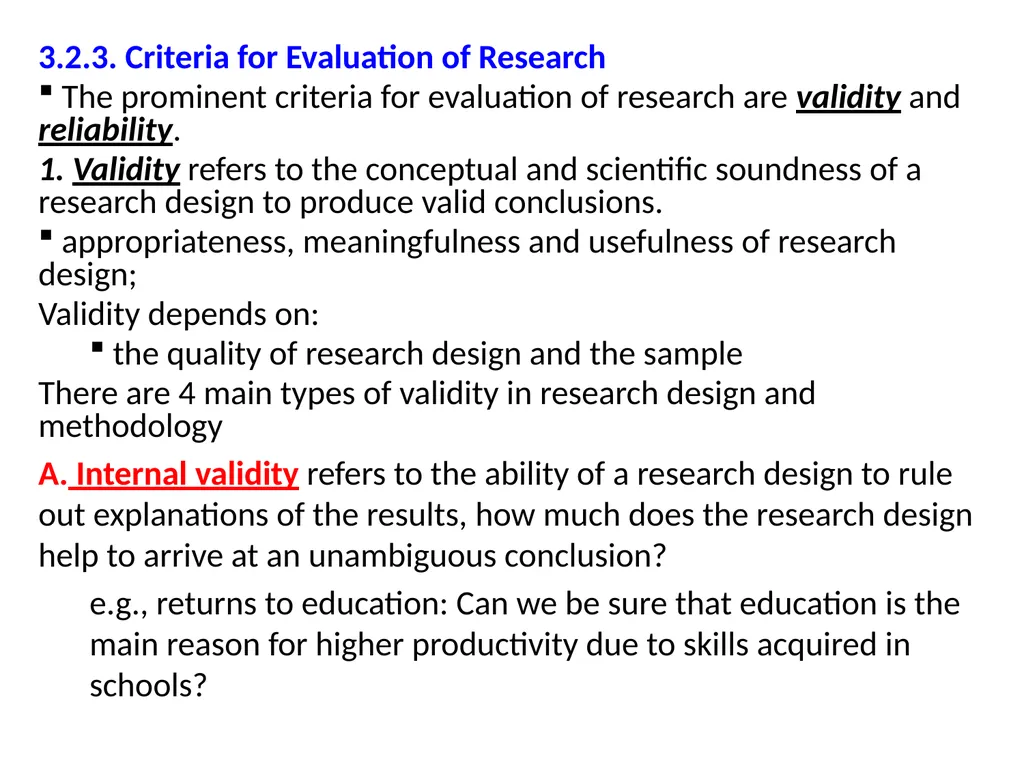
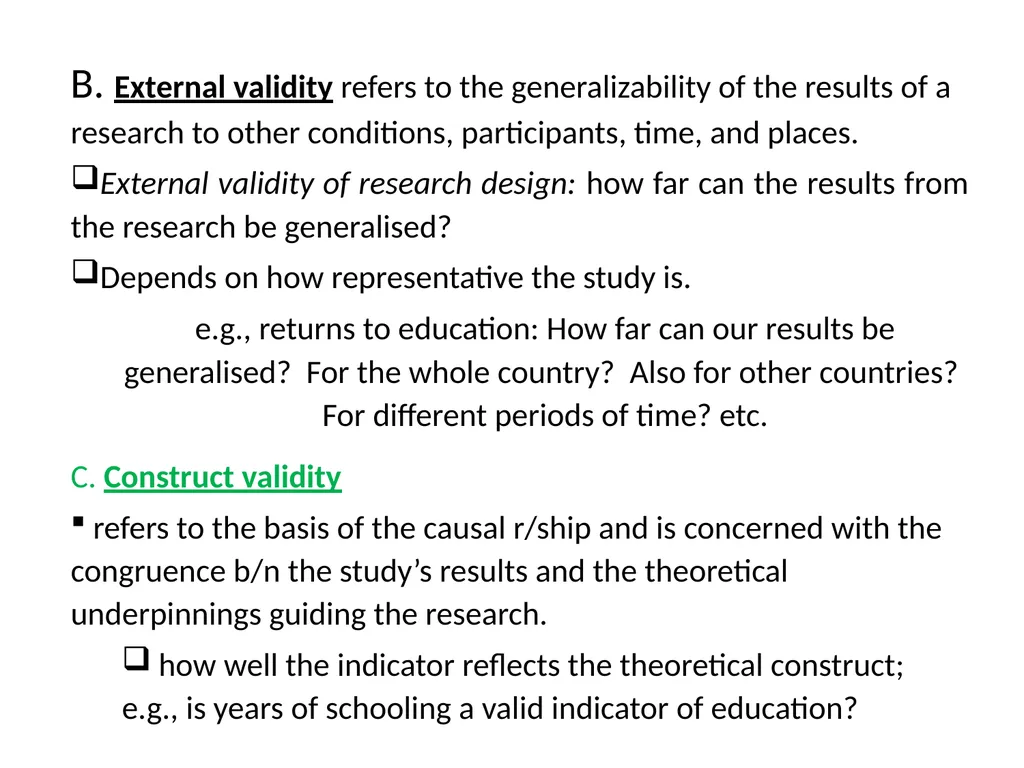
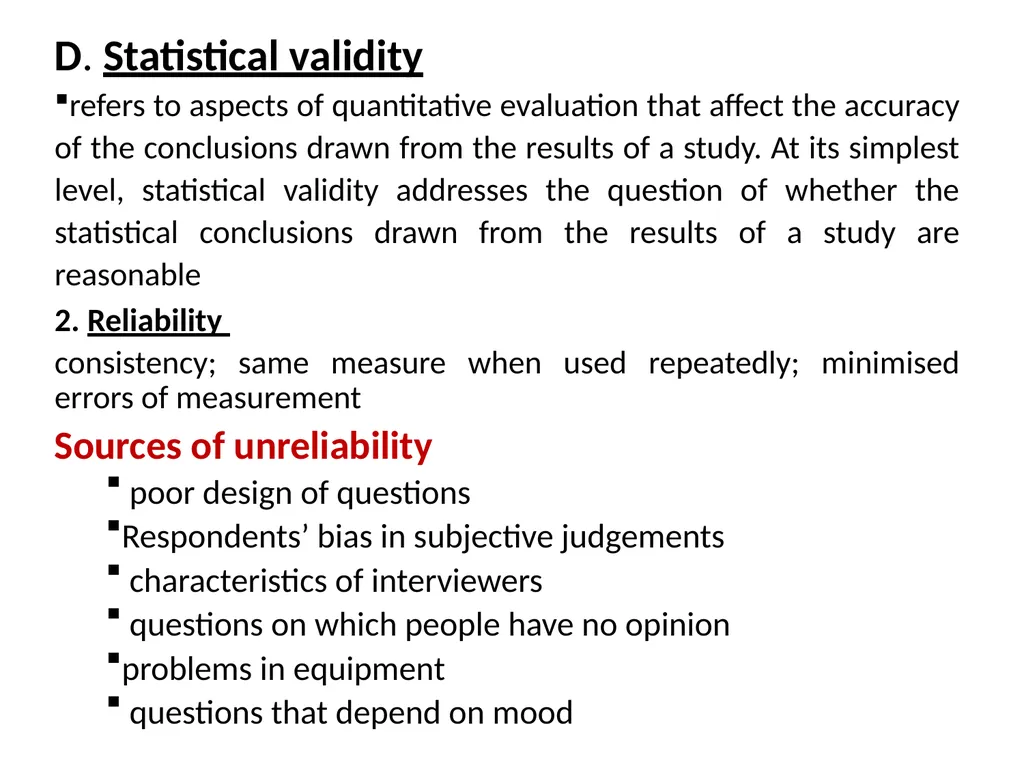
3.2.3. Criteria for Evaluation of Research
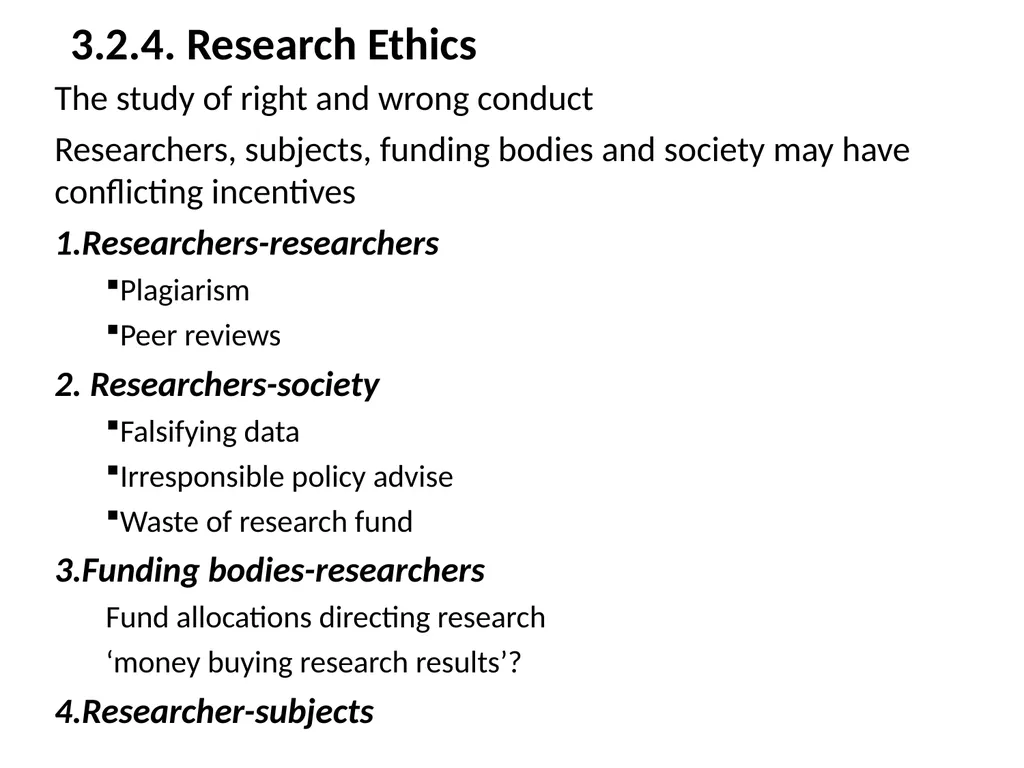
3.2.4. Research Ethics<br>
3.1. The Research Process
3.1.1. Selection of a Research Problem (Topic)
3.1.2. Literature Survey
3.1.3. Stating the Research Problem
3.1.4. Formulating the research objective
3.1.5 Articulating Research Hypotheses
3.1.6. Choosing Variables to Study
3.2. Research Design
3.2.1. Meaning of Research Design
3.2.2. Types of Research Designs and Approaches
3.2.3. Criteria for Evaluation of Research
3.2.4. Research Ethics<br>
07
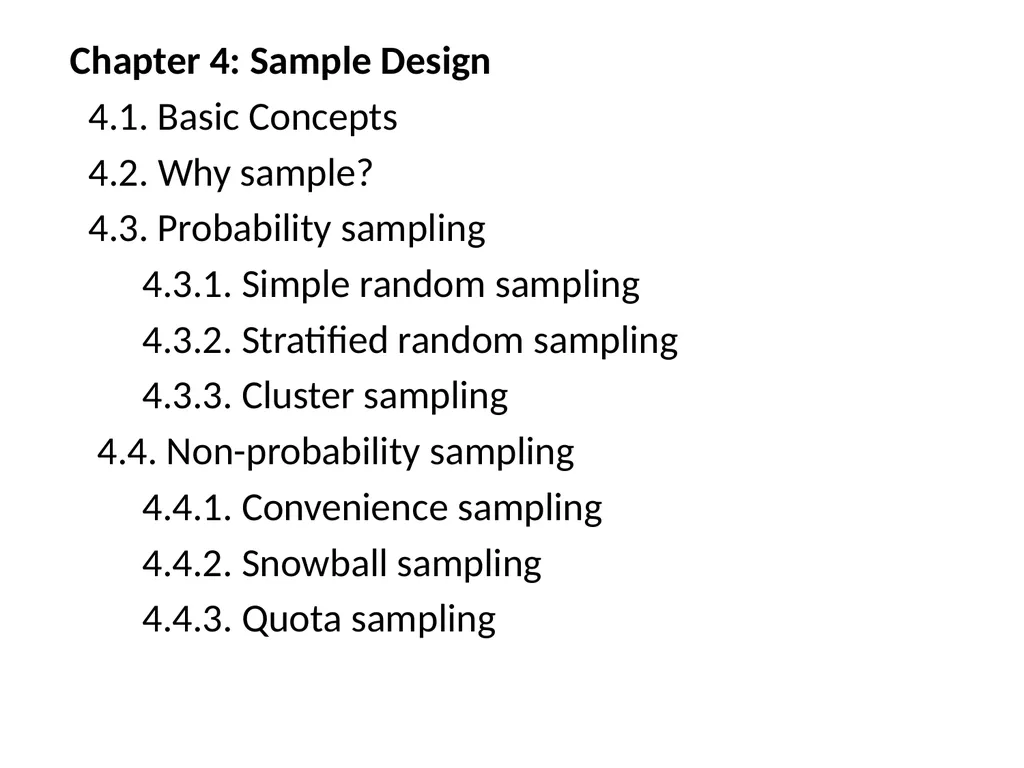
Chapter 4: Sample Design
4.1. Basic Concepts
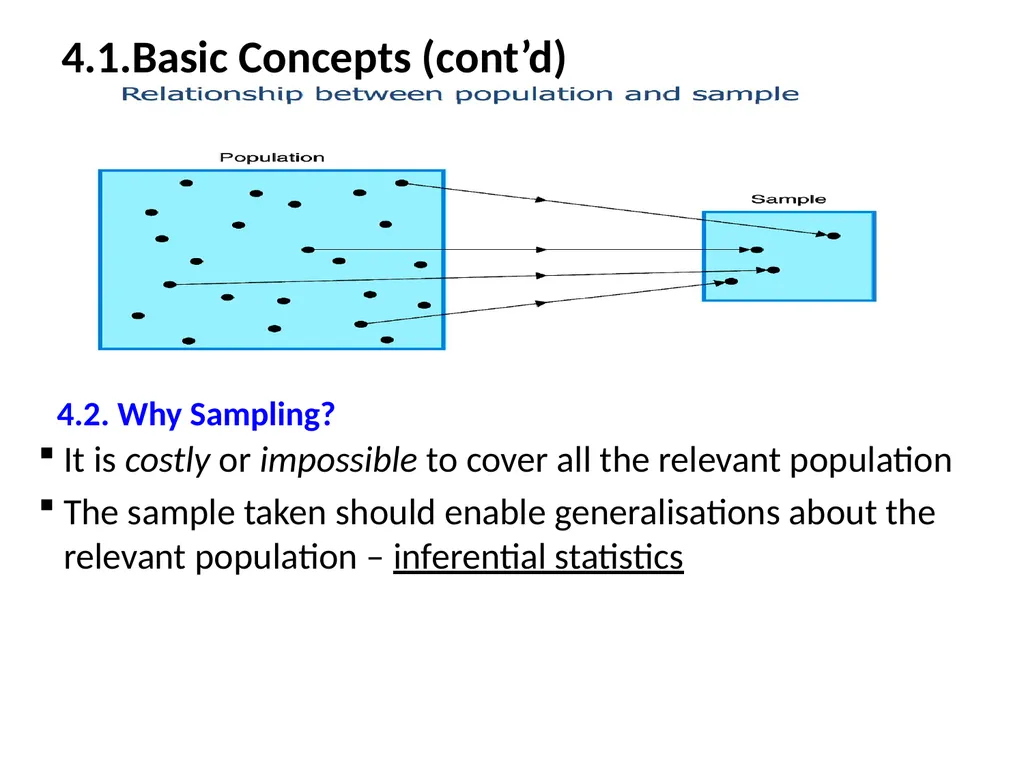
4.2. Why sample?
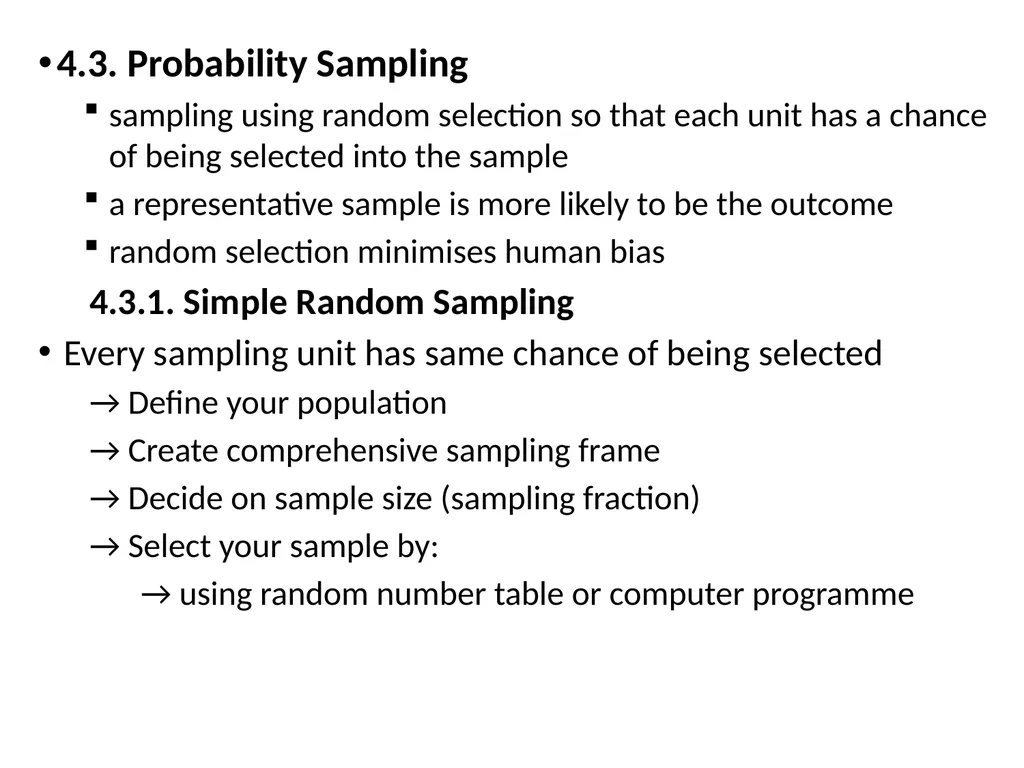
4.3. Probability sampling
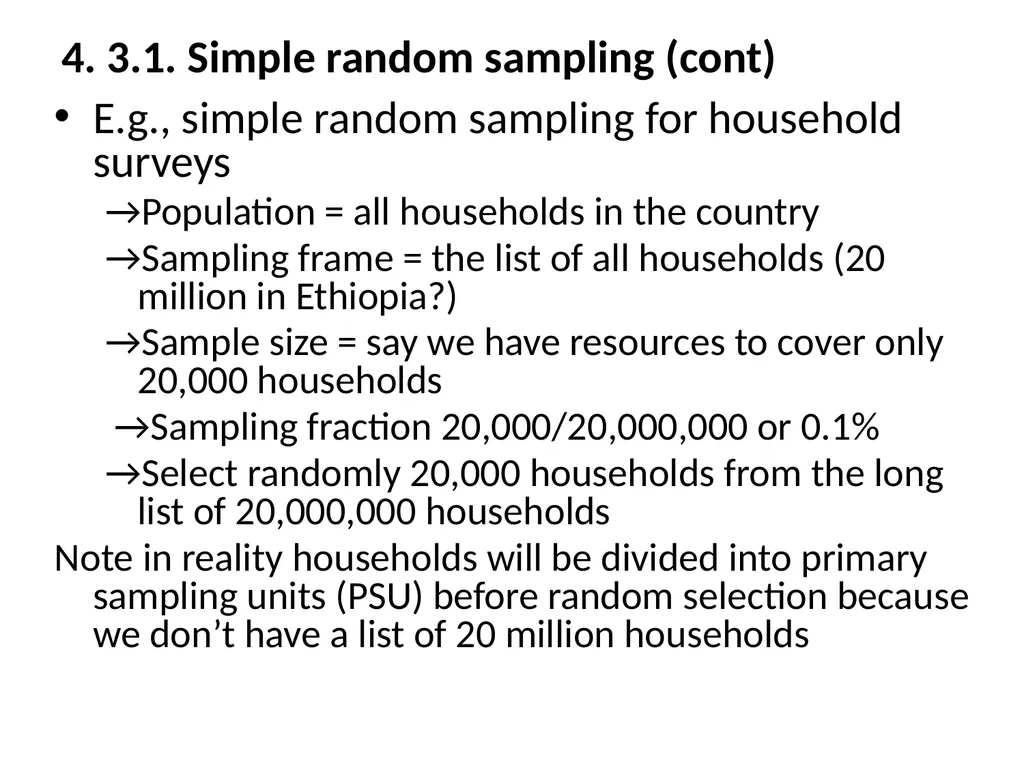
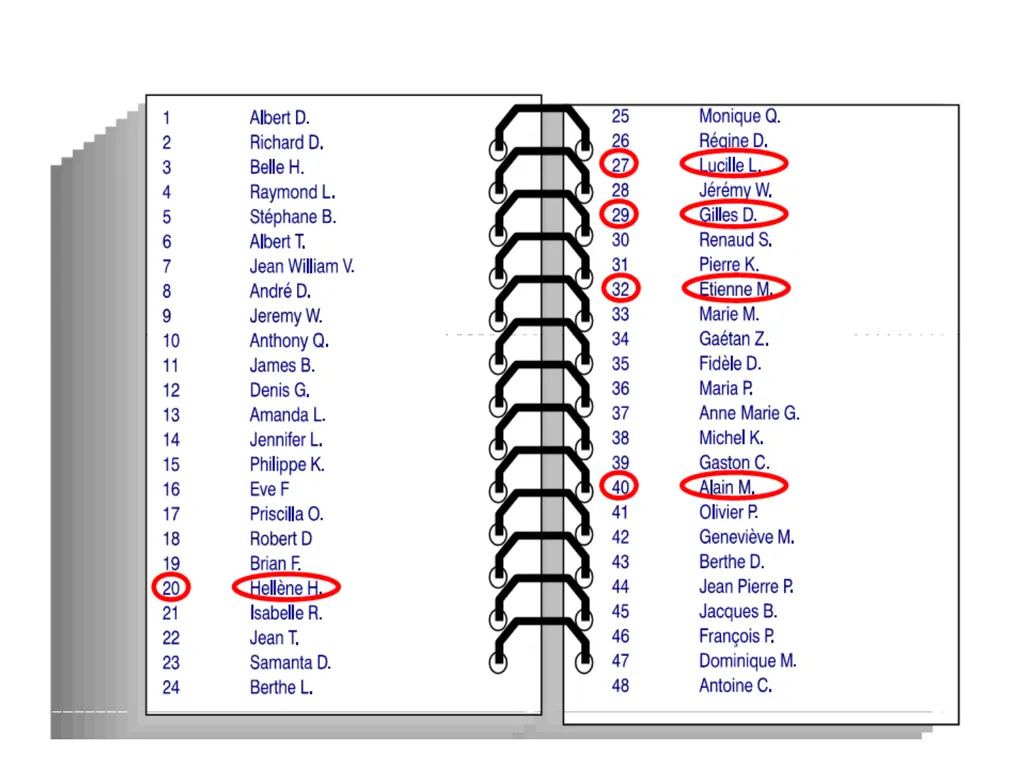
4.3.1. Simple random sampling
4.3.2. Stratified random sampling
4.3.3. Cluster sampling
4.4. Non-probability sampling
4.4.1. Convenience sampling
4.4.2. Snowball sampling
4.4.3. Quota sampling<br>
4.1. Basic Concepts
4.2. Why sample?
4.3. Probability sampling
4.3.1. Simple random sampling
4.3.2. Stratified random sampling
4.3.3. Cluster sampling
4.4. Non-probability sampling
4.4.1. Convenience sampling
4.4.2. Snowball sampling
4.4.3. Quota sampling<br>
08
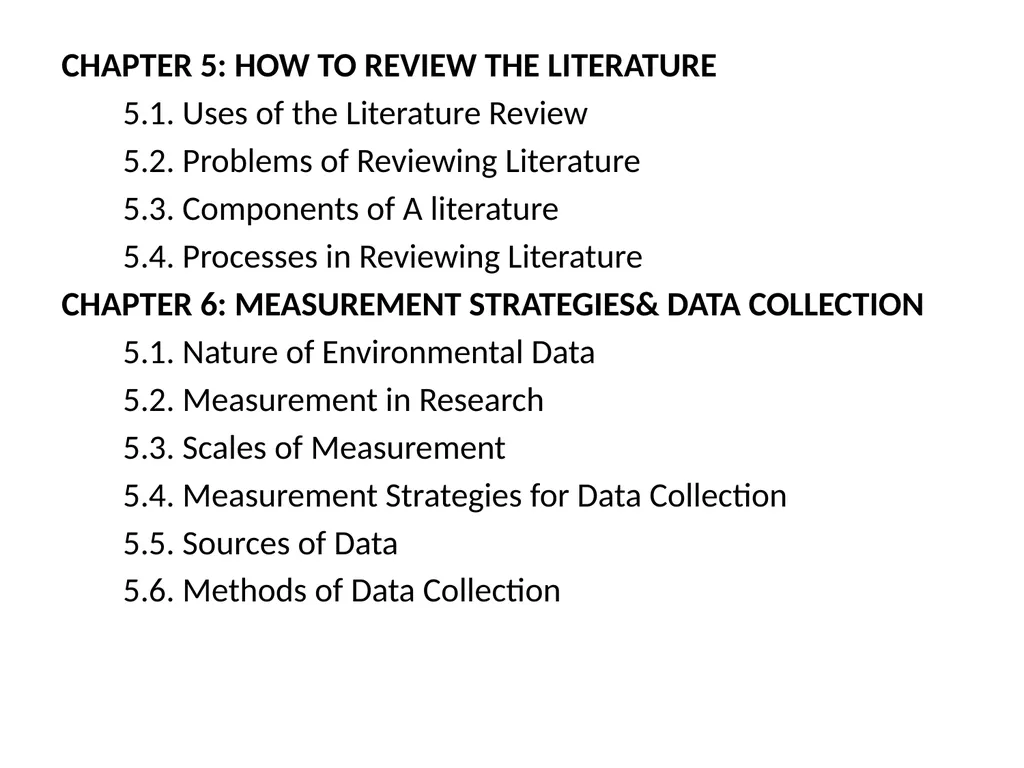
CHAPTER 5: HOW TO REVIEW THE LITERATURE
5.1. Uses of the Literature Review
5.2. Problems of Reviewing Literature
5.3. Components of A literature
5.4. Processes in Reviewing Literature
CHAPTER 6: MEASUREMENT STRATEGIES& DATA COLLECTION
5.1. Nature of Environmental Data
5.2. Measurement in Research
5.3. Scales of Measurement
5.4. Measurement Strategies for Data Collection
5.5. Sources of Data
5.6. Methods of Data Collection<br>
5.1. Uses of the Literature Review
5.2. Problems of Reviewing Literature
5.3. Components of A literature
5.4. Processes in Reviewing Literature
CHAPTER 6: MEASUREMENT STRATEGIES& DATA COLLECTION
5.1. Nature of Environmental Data
5.2. Measurement in Research
5.3. Scales of Measurement
5.4. Measurement Strategies for Data Collection
5.5. Sources of Data
5.6. Methods of Data Collection<br>
09
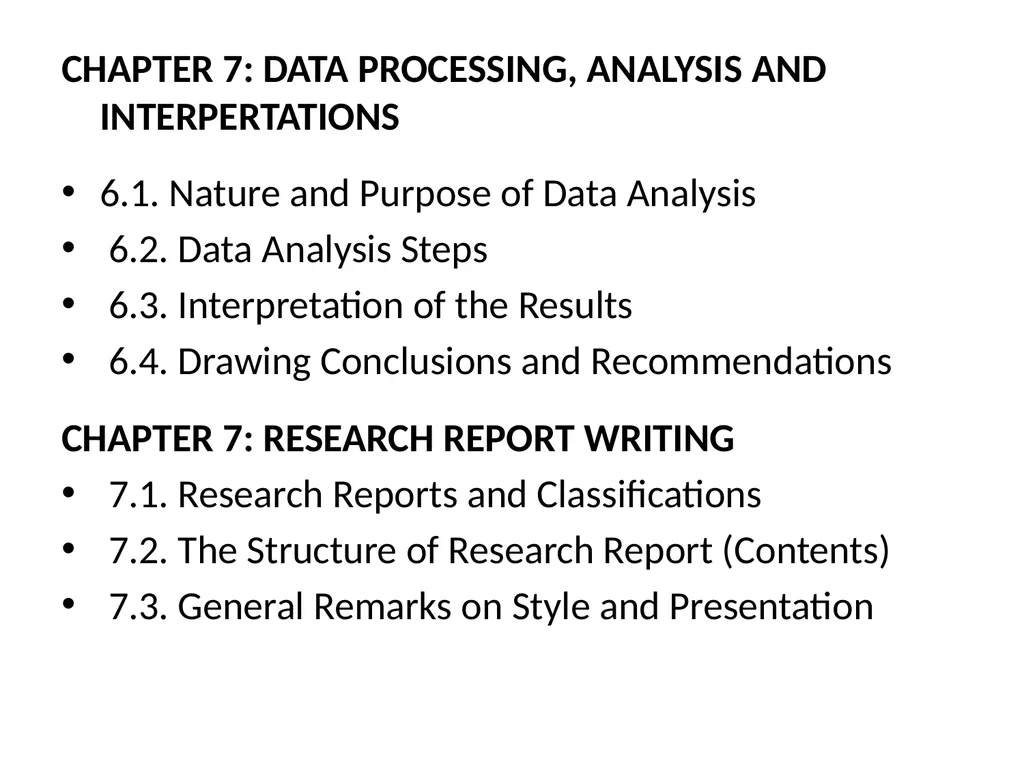
CHAPTER 7: DATA PROCESSING, ANALYSIS AND INTERPERTATIONS
6.1. Nature and Purpose of Data Analysis
6.2. Data Analysis Steps
6.3. Interpretation of the Results
6.4. Drawing Conclusions and Recommendations
CHAPTER 7: RESEARCH REPORT WRITING
7.1. Research Reports and Classifications
7.2. The Structure of Research Report (Contents)
7.3. General Remarks on Style and Presentation<br>
6.1. Nature and Purpose of Data Analysis
6.2. Data Analysis Steps
6.3. Interpretation of the Results
6.4. Drawing Conclusions and Recommendations
CHAPTER 7: RESEARCH REPORT WRITING
7.1. Research Reports and Classifications
7.2. The Structure of Research Report (Contents)
7.3. General Remarks on Style and Presentation<br>
10
Course Instruction Modes
The course will be imparted using lecture;
The session provides opportunity to discuss, obtain feedback, and;
workout assignments to apply the skills covered in the lectures;
also serves as a forum for discussion of readings targeted issues of environmental management and related assignments.<br>
The course will be imparted using lecture;
The session provides opportunity to discuss, obtain feedback, and;
workout assignments to apply the skills covered in the lectures;
also serves as a forum for discussion of readings targeted issues of environmental management and related assignments.<br>
11
Course Requirements and Responsibilities
You should take the responsibility to complete the reading assignments before the lecture;
Successful completion of this course require regular class attendance, and thorough reading of all assigned materials;
Three grade components that comprise the course requirements for the course are: One project assignment, a mid-term test and a final exam;
The assignment guidelines will be distributed and discussed;
The guideline will explain the assignment and the criteria to be used in evaluation in detail.<br>
You should take the responsibility to complete the reading assignments before the lecture;
Successful completion of this course require regular class attendance, and thorough reading of all assigned materials;
Three grade components that comprise the course requirements for the course are: One project assignment, a mid-term test and a final exam;
The assignment guidelines will be distributed and discussed;
The guideline will explain the assignment and the criteria to be used in evaluation in detail.<br>
12
1. Introduction to Research Methods
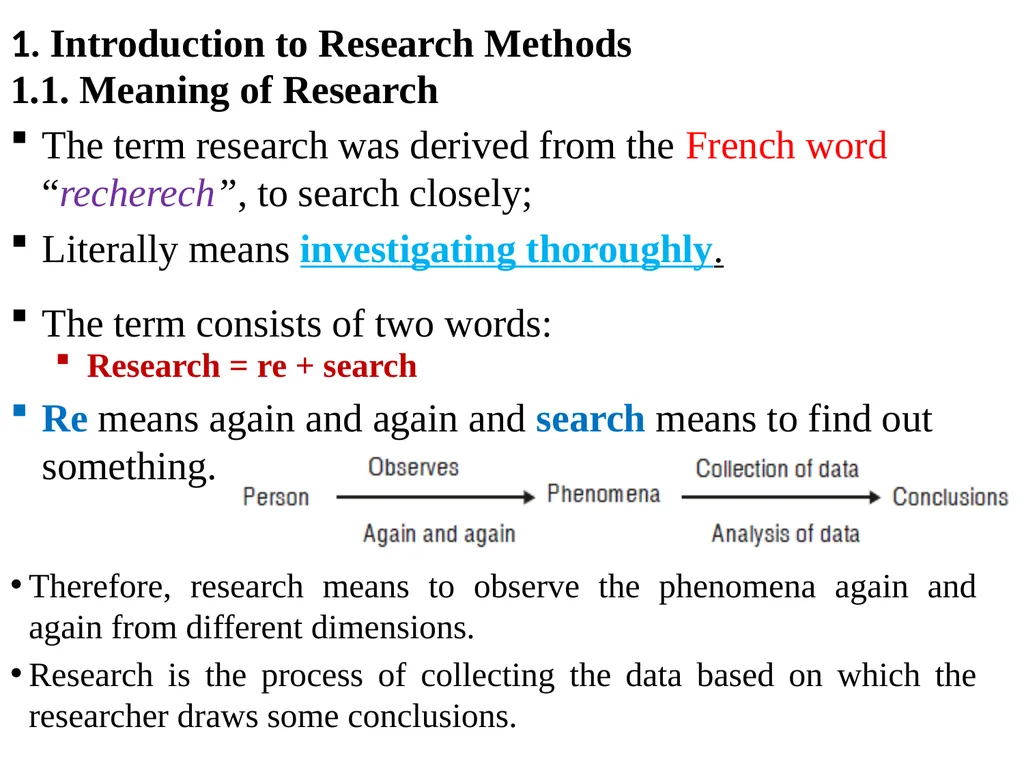
1.1. Meaning of Research
The term research was derived from the French word “recherech”, to search closely;
Literally means investigating thoroughly.
The term consists of two words:
Research = re + search
Re means again and again and search means to find out something.
Therefore, research means to observe the phenomena again and again from different dimensions.
Research is the process of collecting the data based on which the researcher draws some conclusions.<br>
1.1. Meaning of Research
The term research was derived from the French word “recherech”, to search closely;
Literally means investigating thoroughly.
The term consists of two words:
Research = re + search
Re means again and again and search means to find out something.
Therefore, research means to observe the phenomena again and again from different dimensions.
Research is the process of collecting the data based on which the researcher draws some conclusions.<br>
13
Research is the scholarly pursuit of new knowledge, discovery, or creative activity in an area with the goal of advancing a given area.
An art of scientific investigation for knowledge.
self-directed work individually;
research means:
investigate something you do not know or understand;
an academic activity and the term should be used in a technical sense;
involves an entire collection of information<br>
An art of scientific investigation for knowledge.
self-directed work individually;
research means:
investigate something you do not know or understand;
an academic activity and the term should be used in a technical sense;
involves an entire collection of information<br>
14
Research as scientific method is composed of the following key elements:-
Empirical Approach
is the scientific method with an evidence-based approach through direct observation and;
experimentation in the acquisition of new knowledge up on which scientific decisions are made;
Observations
composed of two distinct concepts:
important component in any scientific investigation;
often give rise to the questions addressed through
scientific research. being aware of
the world around us making careful measurements<br>
Empirical Approach
is the scientific method with an evidence-based approach through direct observation and;
experimentation in the acquisition of new knowledge up on which scientific decisions are made;
Observations
composed of two distinct concepts:
important component in any scientific investigation;
often give rise to the questions addressed through
scientific research. being aware of
the world around us making careful measurements<br>
15
Questions:
Research process involves translating that research idea
into an answerable question;
follows getting a research idea based on observations of the world around us;
It is essential to formulate a research question that can be answered through available scientific methods and procedures;
an unanswerable research question is the following: “Is there an exact replica of me in another universe?”
research question can be answered as example, one might ask, whether drought reduces crop yield;
This question could be researched and answered using
established scientific methods<br>
Research process involves translating that research idea
into an answerable question;
follows getting a research idea based on observations of the world around us;
It is essential to formulate a research question that can be answered through available scientific methods and procedures;
an unanswerable research question is the following: “Is there an exact replica of me in another universe?”
research question can be answered as example, one might ask, whether drought reduces crop yield;
This question could be researched and answered using
established scientific methods<br>
16
Hypotheses
the next step in the scientific method;
it is simply an educated and testable guess about the answer to your research question.
Experiments
involves conducting the experiment (or research study);
follows articulating the hypothesis;
e.g. involving investigating the effects of chemical fertilizers on crop yield,
the researcher would design experiment and conduct a study that would attempt to address that question;
In this e.g, the researcher would collect data by experimenting on chemical fertilizers by using an accurate and reliable measurement device;
Then the researcher can analyze the impacts of fertilizers on crop yield and livelihood basis.<br>
the next step in the scientific method;
it is simply an educated and testable guess about the answer to your research question.
Experiments
involves conducting the experiment (or research study);
follows articulating the hypothesis;
e.g. involving investigating the effects of chemical fertilizers on crop yield,
the researcher would design experiment and conduct a study that would attempt to address that question;
In this e.g, the researcher would collect data by experimenting on chemical fertilizers by using an accurate and reliable measurement device;
Then the researcher can analyze the impacts of fertilizers on crop yield and livelihood basis.<br>
17
Analyses
in analyzing the data, calls for the use of statistical techniques
follows gathering the data;
The type of statistical techniques used depends on the design of
the study,
the type of data being gathered, and;
the questions being asked.
statistics help to minimize the likelihood of reaching an
erroneous conclusion about the relationship b/n variables.
Conclusions
draw some conclusions about the results of the study;
important to draw conclusions supported by the data analyses.
Replication
most important elements of the scientific method;
conducting the same research study a 2nd time with another
group of participants if same results are obtained by same researcher
perhaps other researchers may undertake that task.<br>
in analyzing the data, calls for the use of statistical techniques
follows gathering the data;
The type of statistical techniques used depends on the design of
the study,
the type of data being gathered, and;
the questions being asked.
statistics help to minimize the likelihood of reaching an
erroneous conclusion about the relationship b/n variables.
Conclusions
draw some conclusions about the results of the study;
important to draw conclusions supported by the data analyses.
Replication
most important elements of the scientific method;
conducting the same research study a 2nd time with another
group of participants if same results are obtained by same researcher
perhaps other researchers may undertake that task.<br>
18
Checking the generalizablity of the results to other groups of research participants;
If the results of a study are replicated, the researchers and the field in which he/she works can have greater confidence in the reliability and generalizablity of the original findings.
1.2. The Development of Scientific Research Method
Roger Bacon, a philosopher and scientist from 13th century England argue that the Italian scientist Galileo Galilei played an important role in formulating the scientific method.
Later contributions to the scientific method were made by the philosophers Francis Bacon and René Descartes.<br>
If the results of a study are replicated, the researchers and the field in which he/she works can have greater confidence in the reliability and generalizablity of the original findings.
1.2. The Development of Scientific Research Method
Roger Bacon, a philosopher and scientist from 13th century England argue that the Italian scientist Galileo Galilei played an important role in formulating the scientific method.
Later contributions to the scientific method were made by the philosophers Francis Bacon and René Descartes.<br>
19
1.3. The Purpose of Scientific Research
Discover new facts and understand the reality
Verify and test important facts
Describe the characteristics of an individual, situation or a group;
Analyze an event or process or phenomenon to identify the cause and effect relationship between variables
Develop new scientific tools, concepts and theories to understand & solve problems
Improve theories and revise human knowledge on different aspects
Find solutions to scientific, nonscientific and social problems
Overcome or solve the problems occurring in our every day life.
Acquire new knowledge via the application of scientific methods<br>
Discover new facts and understand the reality
Verify and test important facts
Describe the characteristics of an individual, situation or a group;
Analyze an event or process or phenomenon to identify the cause and effect relationship between variables
Develop new scientific tools, concepts and theories to understand & solve problems
Improve theories and revise human knowledge on different aspects
Find solutions to scientific, nonscientific and social problems
Overcome or solve the problems occurring in our every day life.
Acquire new knowledge via the application of scientific methods<br>
20
What Makes People do Research? Desire to get a research degree along with its benefits like better employment, promotion, increment in salary, etc.
to get a research degree and then to get a teaching position in a college or university or become a scientist in a research institution
to get a research position in countries and settle there
Desire to solve the unsolved and challenging problems of society
Desire to get intellectual joy of doing some creative work
to acquire respectability and to get recognition
curiosity to find out the unknown facts of an event
curiosity to find new things
to serve the society by solving social problems.
to gain familiarity with a phenomenon or to achieve new insight into it
Desire to resolve contradictions existing in the area of study.<br>
to get a research degree and then to get a teaching position in a college or university or become a scientist in a research institution
to get a research position in countries and settle there
Desire to solve the unsolved and challenging problems of society
Desire to get intellectual joy of doing some creative work
to acquire respectability and to get recognition
curiosity to find out the unknown facts of an event
curiosity to find new things
to serve the society by solving social problems.
to gain familiarity with a phenomenon or to achieve new insight into it
Desire to resolve contradictions existing in the area of study.<br>
21
1.4. Major Research themes in GeES/Environment
The Spatial Analysis/Locational theme
Ecological Analysis/Human ecology theme
Regional Analysis/Regional complete theme
Earth Science Theme/earth science tradition
(1) Spatial Analysis Theme/ Locational Theme
This theme is primarily concerned with location and distribution of significant properties in space;
answering the ‘where questions’ or spatial distribution of a single or set of physical or human phenomena.<br>
The Spatial Analysis/Locational theme
Ecological Analysis/Human ecology theme
Regional Analysis/Regional complete theme
Earth Science Theme/earth science tradition
(1) Spatial Analysis Theme/ Locational Theme
This theme is primarily concerned with location and distribution of significant properties in space;
answering the ‘where questions’ or spatial distribution of a single or set of physical or human phenomena.<br>
22
The Spatial Analysis/ Locational Theme … Cont’d
The study on human phenomena include:
distribution and density of population, rural poverty, cotton cultivation, and leather and shoe factory.
Natural phenomena include: patterns of temperature, rainfall, vegetation, animals, soils, water resources, wetlands, and other inanimate objects;
Factors and processes governing the distribution and location of phenomena (i.e. finding locational pattern).
This theme has developed into d/t stages & times. For instance, before 1950s locational factors were discussed in the context of absolute location and distance;
But as of 1950’s the case has been changed to deal with relative location, distance, and space.<br>
The study on human phenomena include:
distribution and density of population, rural poverty, cotton cultivation, and leather and shoe factory.
Natural phenomena include: patterns of temperature, rainfall, vegetation, animals, soils, water resources, wetlands, and other inanimate objects;
Factors and processes governing the distribution and location of phenomena (i.e. finding locational pattern).
This theme has developed into d/t stages & times. For instance, before 1950s locational factors were discussed in the context of absolute location and distance;
But as of 1950’s the case has been changed to deal with relative location, distance, and space.<br>
23
Spatial Analysis theme (cont’d)
Enables researchers to
develop the skill of finding optimum location of human activities and;
to help understanding of natural phenomena.
Helps to understand and find out whether the distribution of phenomena is good or bad
helps to overcome locational or spatial problems
Enables researchers to make:
more generalizations and to build more theories;
e.g., to develop hypothesis on how agricultural
developments distribute around the world.<br>
Enables researchers to
develop the skill of finding optimum location of human activities and;
to help understanding of natural phenomena.
Helps to understand and find out whether the distribution of phenomena is good or bad
helps to overcome locational or spatial problems
Enables researchers to make:
more generalizations and to build more theories;
e.g., to develop hypothesis on how agricultural
developments distribute around the world.<br>
24
2. Ecological Analysis/Human ecology theme
Its main concern is with the reciprocal relationship b/n man and the environment (nature) and ;
consequences up on each (human & Env’t);
It was studied throughout the history of geography but was more emphasized as a research theme after the theory of evolution by Charles Darwin (1859);
The theme integrates physical and human elements;
Concentrates:
human attention into environmental problems like
pollution, erosion, degradation, etc.<br>
Its main concern is with the reciprocal relationship b/n man and the environment (nature) and ;
consequences up on each (human & Env’t);
It was studied throughout the history of geography but was more emphasized as a research theme after the theory of evolution by Charles Darwin (1859);
The theme integrates physical and human elements;
Concentrates:
human attention into environmental problems like
pollution, erosion, degradation, etc.<br>
25
3. Regional Analysis Theme/ Regional Complete Theme
describe significant regional characteristics (not on single phenomena);
It identifies and defines the arrangements of phenomena within a given region;
Regions are identified based on certain contexts (landform, vegetation, rainfall, temperature, etc);
Lacks problem-oriented focus and structure which can be boring.
In its best, it integrates:
both the spatial and ecological analyses with in the defined region and;
a careful thorough synthesis of regional characteristics.<br>
describe significant regional characteristics (not on single phenomena);
It identifies and defines the arrangements of phenomena within a given region;
Regions are identified based on certain contexts (landform, vegetation, rainfall, temperature, etc);
Lacks problem-oriented focus and structure which can be boring.
In its best, it integrates:
both the spatial and ecological analyses with in the defined region and;
a careful thorough synthesis of regional characteristics.<br>
26
Chapter Two: Types of Research
2.1. Basic Research
investigate basic principles and reasons for occurrence of a particular event or process or phenomenon;
also known as pure or fundamental or theoretical research;
related to pure science;
primarily aim to improve theoretical knowledge or
understand the logical process and fundamental characteristics of physical and human environments;
Promote the theoretical understanding of the relationship among variables;
mainly concerned with generalizations with the formulation of a theories and a laws. It may also verify the old theories<br>
2.1. Basic Research
investigate basic principles and reasons for occurrence of a particular event or process or phenomenon;
also known as pure or fundamental or theoretical research;
related to pure science;
primarily aim to improve theoretical knowledge or
understand the logical process and fundamental characteristics of physical and human environments;
Promote the theoretical understanding of the relationship among variables;
mainly concerned with generalizations with the formulation of a theories and a laws. It may also verify the old theories<br>
27
Basic research (cont’d)
directed towards finding information that has a broad base of application and thus,
adds to the already existing organized body of scientific knowledge;
It is essentially positive, not normative to explain the phenomena as they are, not as they should be;
not concerned with solving any practical social and environmental problems of immediate interest;
the outcome of such research provides the foundation for many applied research.<br>
directed towards finding information that has a broad base of application and thus,
adds to the already existing organized body of scientific knowledge;
It is essentially positive, not normative to explain the phenomena as they are, not as they should be;
not concerned with solving any practical social and environmental problems of immediate interest;
the outcome of such research provides the foundation for many applied research.<br>
28
B. Applied research
solves certain problems employing well known and accepted theories and principles
Its results are used with reference to the phenomena.
Links basic research methods into practical situations.
its central aim is to discover solutions for urgent practical problems facing societies.
involves normative policy prescription and hence incorporates some value judgments.
can test theories empirically for improving tools & techniques.
applied research is empirical and practical;
Examples of this research type: experimental research, case studies and inter-disciplinary research.<br>
solves certain problems employing well known and accepted theories and principles
Its results are used with reference to the phenomena.
Links basic research methods into practical situations.
its central aim is to discover solutions for urgent practical problems facing societies.
involves normative policy prescription and hence incorporates some value judgments.
can test theories empirically for improving tools & techniques.
applied research is empirical and practical;
Examples of this research type: experimental research, case studies and inter-disciplinary research.<br>
29
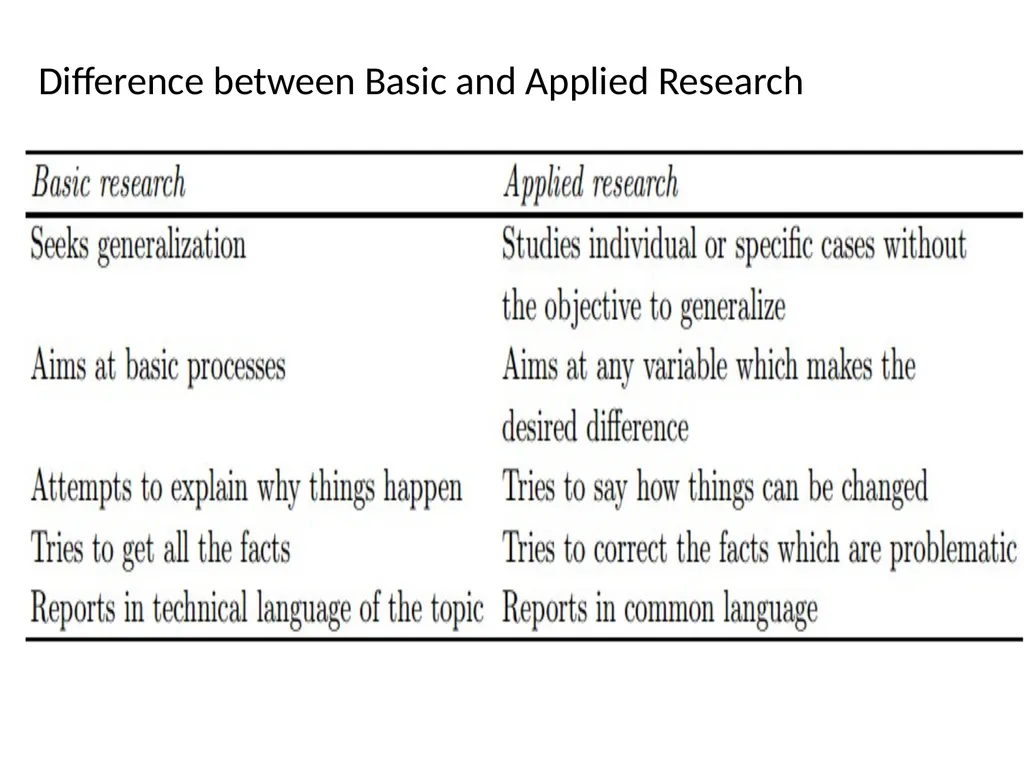
Difference between Basic and Applied Research<br>
30
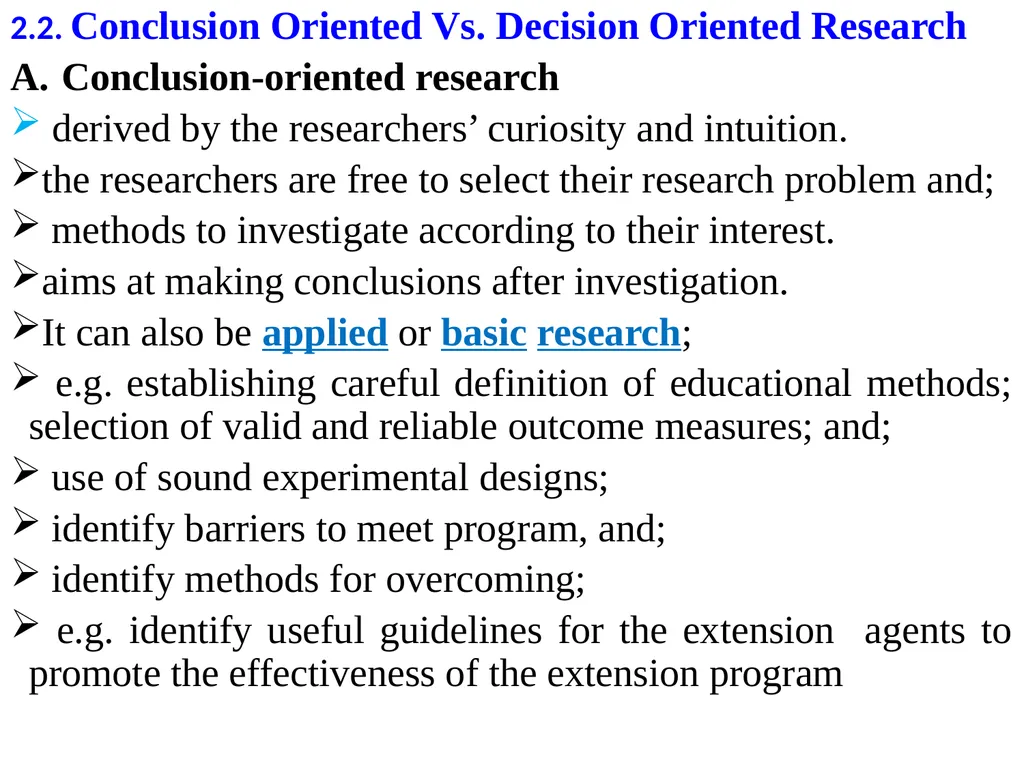
2.2. Conclusion Oriented Vs. Decision Oriented Research
Conclusion-oriented research
derived by the researchers’ curiosity and intuition.
the researchers are free to select their research problem and;
methods to investigate according to their interest.
aims at making conclusions after investigation.
It can also be applied or basic research;
e.g. establishing careful definition of educational methods; selection of valid and reliable outcome measures; and;
use of sound experimental designs;
identify barriers to meet program, and;
identify methods for overcoming;
e.g. identify useful guidelines for the extension agents to promote the effectiveness of the extension program<br>
Conclusion-oriented research
derived by the researchers’ curiosity and intuition.
the researchers are free to select their research problem and;
methods to investigate according to their interest.
aims at making conclusions after investigation.
It can also be applied or basic research;
e.g. establishing careful definition of educational methods; selection of valid and reliable outcome measures; and;
use of sound experimental designs;
identify barriers to meet program, and;
identify methods for overcoming;
e.g. identify useful guidelines for the extension agents to promote the effectiveness of the extension program<br>
31
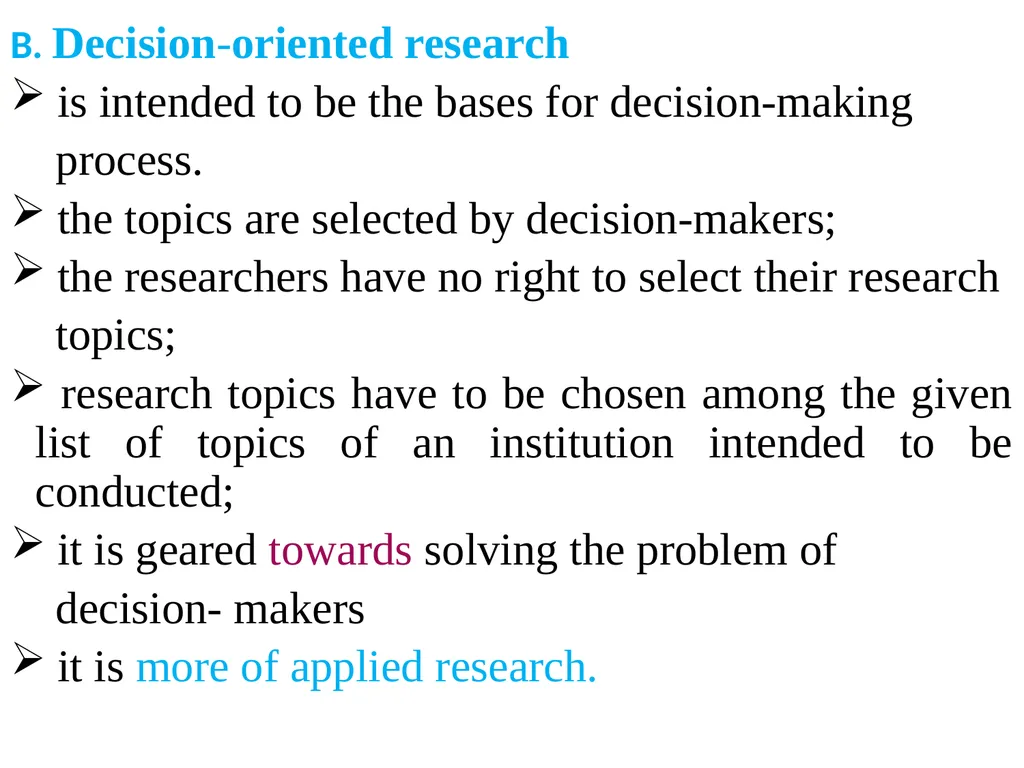
B. Decision-oriented research
is intended to be the bases for decision-making
process.
the topics are selected by decision-makers;
the researchers have no right to select their research
topics;
research topics have to be chosen among the given list of topics of an institution intended to be conducted;
it is geared towards solving the problem of
decision- makers
it is more of applied research.<br>
is intended to be the bases for decision-making
process.
the topics are selected by decision-makers;
the researchers have no right to select their research
topics;
research topics have to be chosen among the given list of topics of an institution intended to be conducted;
it is geared towards solving the problem of
decision- makers
it is more of applied research.<br>
32
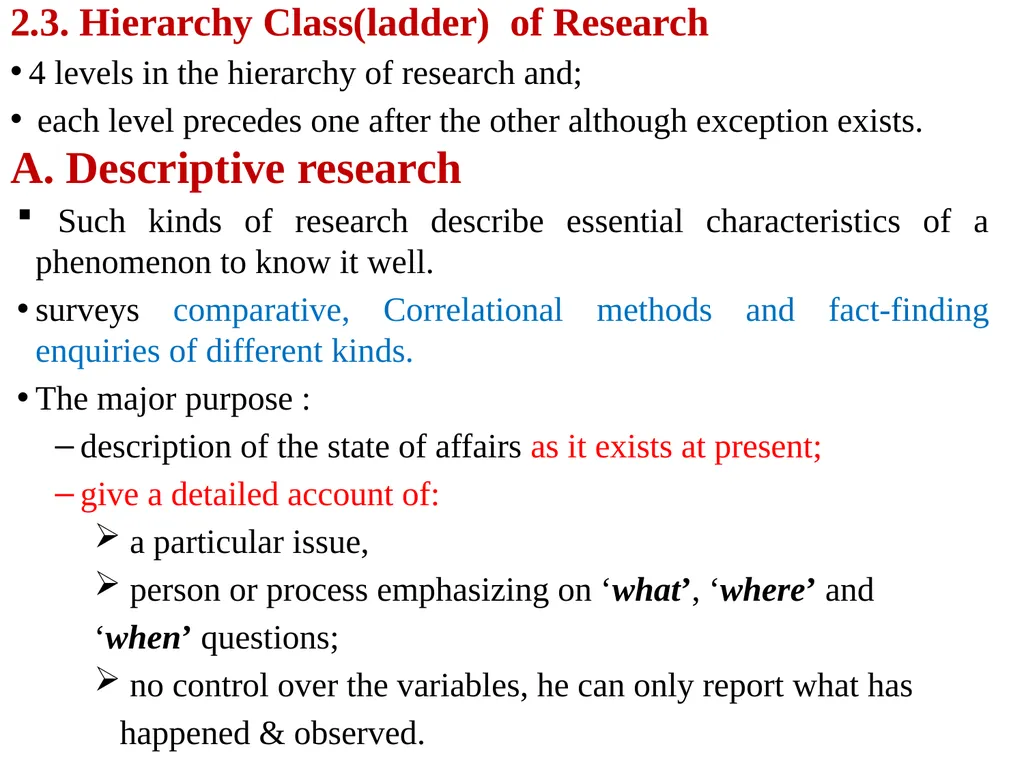
2.3. Hierarchy Class(ladder) of Research
4 levels in the hierarchy of research and;
each level precedes one after the other although exception exists.
A. Descriptive research
Such kinds of research describe essential characteristics of a phenomenon to know it well.
surveys comparative, Correlational methods and fact-finding enquiries of different kinds.
The major purpose :
description of the state of affairs as it exists at present;
give a detailed account of:
a particular issue,
person or process emphasizing on ‘what’, ‘where’ and
‘when’ questions;
no control over the variables, he can only report what has
happened & observed.<br>
4 levels in the hierarchy of research and;
each level precedes one after the other although exception exists.
A. Descriptive research
Such kinds of research describe essential characteristics of a phenomenon to know it well.
surveys comparative, Correlational methods and fact-finding enquiries of different kinds.
The major purpose :
description of the state of affairs as it exists at present;
give a detailed account of:
a particular issue,
person or process emphasizing on ‘what’, ‘where’ and
‘when’ questions;
no control over the variables, he can only report what has
happened & observed.<br>
33
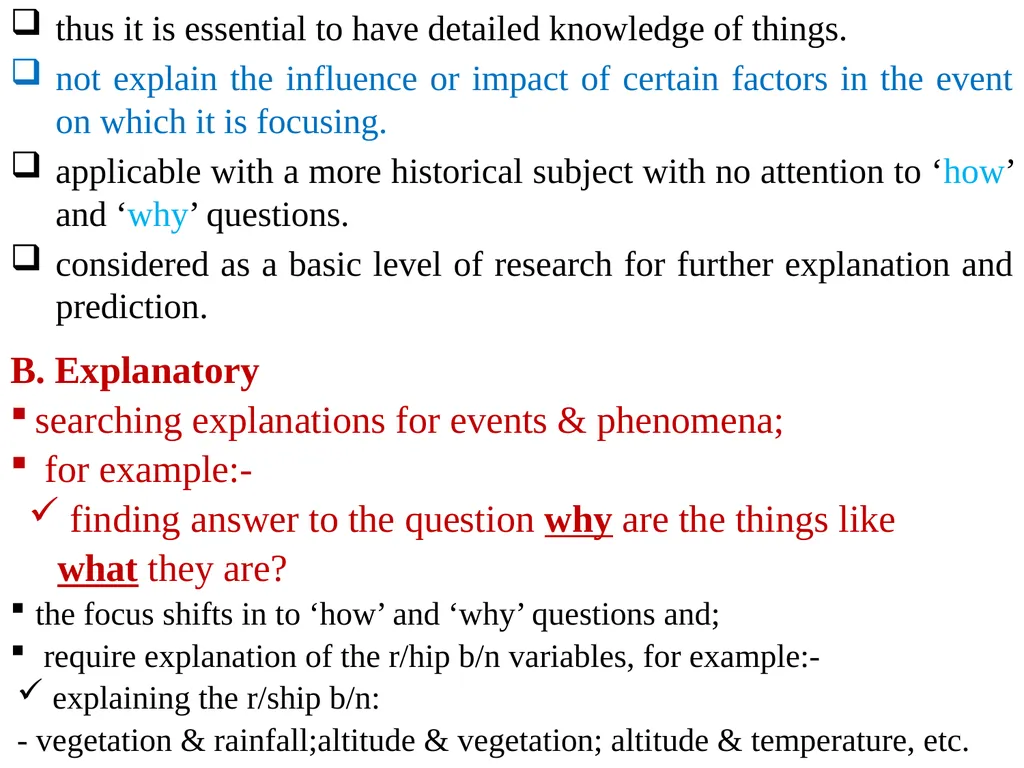
thus it is essential to have detailed knowledge of things.
not explain the influence or impact of certain factors in the event on which it is focusing.
applicable with a more historical subject with no attention to ‘how’ and ‘why’ questions.
considered as a basic level of research for further explanation and prediction.
B. Explanatory
searching explanations for events & phenomena;
for example:-
finding answer to the question why are the things like
what they are?
the focus shifts in to ‘how’ and ‘why’ questions and;
require explanation of the r/hip b/n variables, for example:-
explaining the r/ship b/n:
- vegetation & rainfall;altitude & vegetation; altitude & temperature, etc.<br>
not explain the influence or impact of certain factors in the event on which it is focusing.
applicable with a more historical subject with no attention to ‘how’ and ‘why’ questions.
considered as a basic level of research for further explanation and prediction.
B. Explanatory
searching explanations for events & phenomena;
for example:-
finding answer to the question why are the things like
what they are?
the focus shifts in to ‘how’ and ‘why’ questions and;
require explanation of the r/hip b/n variables, for example:-
explaining the r/ship b/n:
- vegetation & rainfall;altitude & vegetation; altitude & temperature, etc.<br>
34
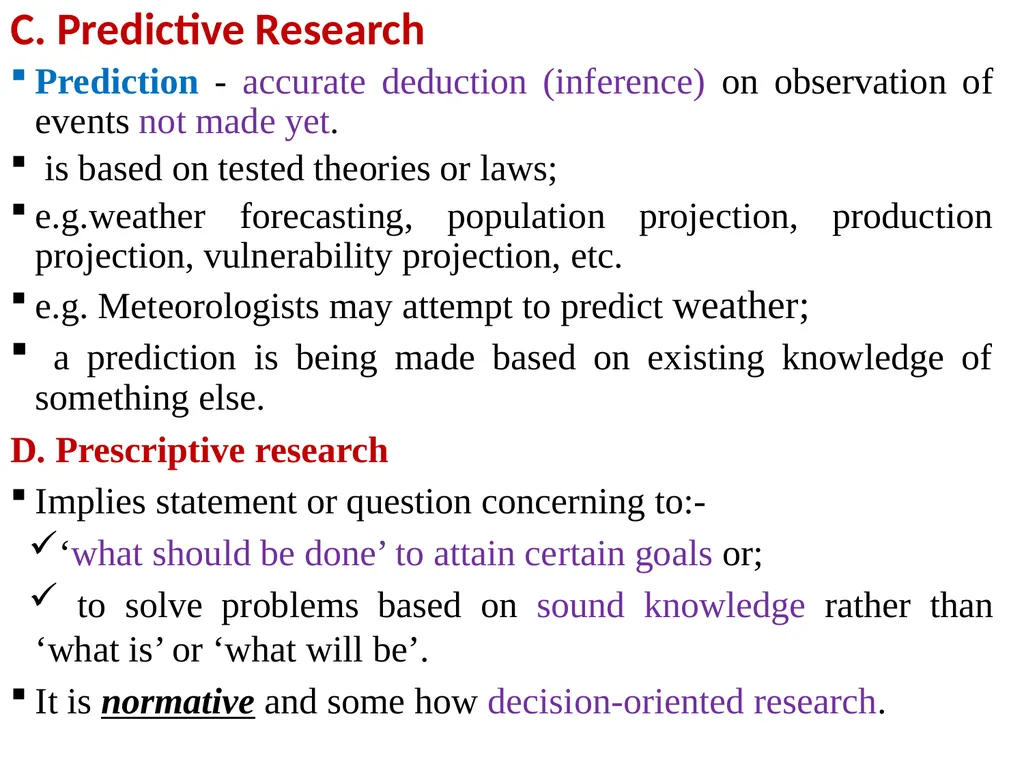
C. Predictive Research
Prediction - accurate deduction (inference) on observation of events not made yet.
is based on tested theories or laws;
e.g.weather forecasting, population projection, production projection, vulnerability projection, etc.
e.g. Meteorologists may attempt to predict weather;
a prediction is being made based on existing knowledge of something else.
D. Prescriptive research
Implies statement or question concerning to:-
‘what should be done’ to attain certain goals or;
to solve problems based on sound knowledge rather than ‘what is’ or ‘what will be’.
It is normative and some how decision-oriented research.<br>
Prediction - accurate deduction (inference) on observation of events not made yet.
is based on tested theories or laws;
e.g.weather forecasting, population projection, production projection, vulnerability projection, etc.
e.g. Meteorologists may attempt to predict weather;
a prediction is being made based on existing knowledge of something else.
D. Prescriptive research
Implies statement or question concerning to:-
‘what should be done’ to attain certain goals or;
to solve problems based on sound knowledge rather than ‘what is’ or ‘what will be’.
It is normative and some how decision-oriented research.<br>
35
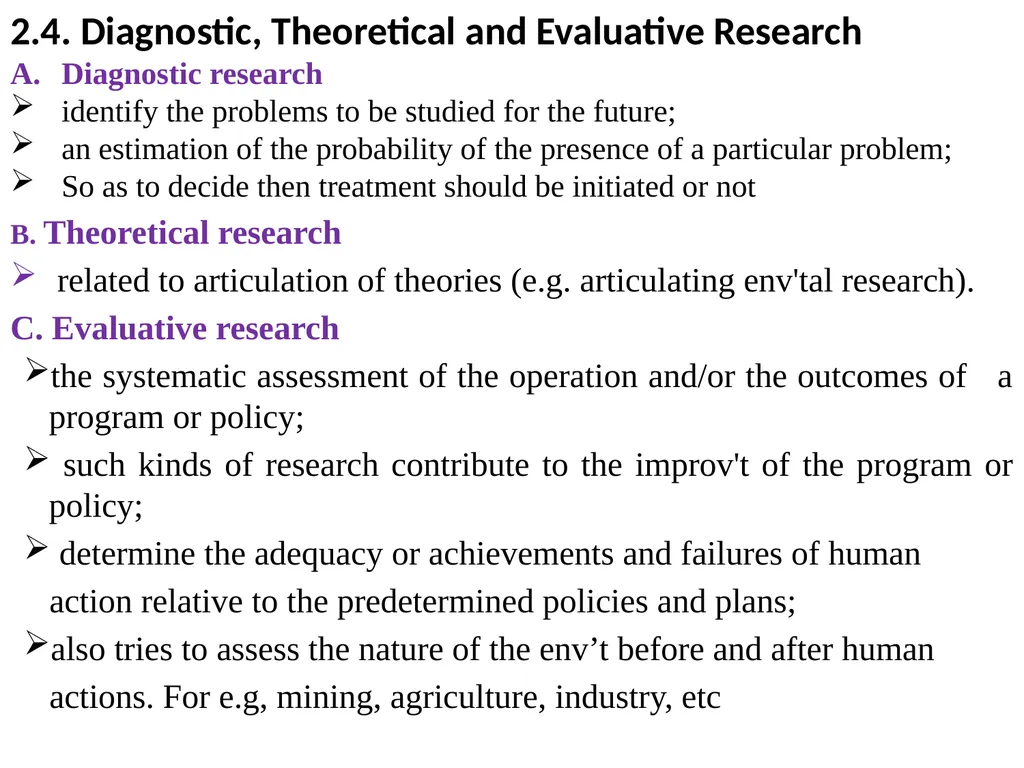
2.4. Diagnostic, Theoretical and Evaluative Research
Diagnostic research
identify the problems to be studied for the future;
an estimation of the probability of the presence of a particular problem;
So as to decide then treatment should be initiated or not
B. Theoretical research
related to articulation of theories (e.g. articulating env'tal research).
C. Evaluative research
the systematic assessment of the operation and/or the outcomes of a program or policy;
such kinds of research contribute to the improv't of the program or policy;
determine the adequacy or achievements and failures of human
action relative to the predetermined policies and plans;
also tries to assess the nature of the env’t before and after human
actions. For e.g, mining, agriculture, industry, etc<br>
Diagnostic research
identify the problems to be studied for the future;
an estimation of the probability of the presence of a particular problem;
So as to decide then treatment should be initiated or not
B. Theoretical research
related to articulation of theories (e.g. articulating env'tal research).
C. Evaluative research
the systematic assessment of the operation and/or the outcomes of a program or policy;
such kinds of research contribute to the improv't of the program or policy;
determine the adequacy or achievements and failures of human
action relative to the predetermined policies and plans;
also tries to assess the nature of the env’t before and after human
actions. For e.g, mining, agriculture, industry, etc<br>
36
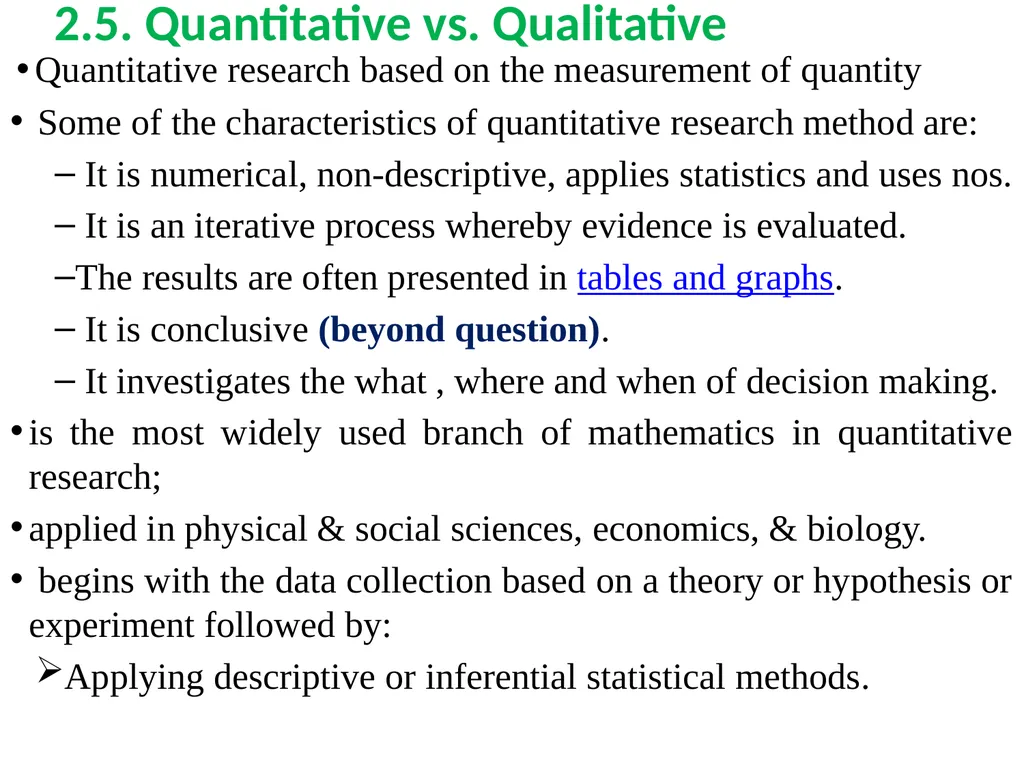
2.5. Quantitative vs. Qualitative Quantitative research based on the measurement of quantity
Some of the characteristics of quantitative research method are:
It is numerical, non-descriptive, applies statistics and uses nos.
It is an iterative process whereby evidence is evaluated.
The results are often presented in tables and graphs.
It is conclusive (beyond question).
It investigates the what , where and when of decision making.
is the most widely used branch of mathematics in quantitative research;
applied in physical & social sciences, economics, & biology.
begins with the data collection based on a theory or hypothesis or experiment followed by:
Applying descriptive or inferential statistical methods.<br>
Some of the characteristics of quantitative research method are:
It is numerical, non-descriptive, applies statistics and uses nos.
It is an iterative process whereby evidence is evaluated.
The results are often presented in tables and graphs.
It is conclusive (beyond question).
It investigates the what , where and when of decision making.
is the most widely used branch of mathematics in quantitative research;
applied in physical & social sciences, economics, & biology.
begins with the data collection based on a theory or hypothesis or experiment followed by:
Applying descriptive or inferential statistical methods.<br>
37
Qualitative research study qualitative phenomenon characterized by:
non-numerical, descriptive, applies reasoning and uses words.
aim to get the meaning, feeling and describe the situation.
cannot be graphed.
exploratory & investigates the why and how of decision making.
concerned with qualitative phenomenon
aims at discovering the underlying motives and desires, using in depth interviews.
Attitude or opinion research
research designed to find out how people feel or what they think about a particular subject or institution is also qualitative research.
important in the behavioral sciences to discover the underlying motives of human behavior.
analyze the various factors motivate people to behave in a particular manner or make people like or dislike a particular thing.
However, applying qualitative research in practice is relatively difficult;
hence, one should seek guidance from experimental psychologists.<br>
non-numerical, descriptive, applies reasoning and uses words.
aim to get the meaning, feeling and describe the situation.
cannot be graphed.
exploratory & investigates the why and how of decision making.
concerned with qualitative phenomenon
aims at discovering the underlying motives and desires, using in depth interviews.
Attitude or opinion research
research designed to find out how people feel or what they think about a particular subject or institution is also qualitative research.
important in the behavioral sciences to discover the underlying motives of human behavior.
analyze the various factors motivate people to behave in a particular manner or make people like or dislike a particular thing.
However, applying qualitative research in practice is relatively difficult;
hence, one should seek guidance from experimental psychologists.<br>
38
2.6. Conceptual Vs. Empirical
Conceptual
related to some abstract idea(s) or theory;
is generally used by philosophers & ;
source of origin to develop new concepts or to reinterpret existing ones.
Empirical
relies on experience or observation alone, often without due regard for system and theory.
It is data-based research, coming up with conclusions which are capable of being verified by observation or experiment;
also known as experimental type of research
Enable to get firsthand facts, at their source, and;
actively to go about doing certain things to stimulate the production of desired information.
is appropriate when proof (verification) is required that certain variables affect other variables in some way;
today considered to be the most powerful support possible for a given hypothesis.<br>
Conceptual
related to some abstract idea(s) or theory;
is generally used by philosophers & ;
source of origin to develop new concepts or to reinterpret existing ones.
Empirical
relies on experience or observation alone, often without due regard for system and theory.
It is data-based research, coming up with conclusions which are capable of being verified by observation or experiment;
also known as experimental type of research
Enable to get firsthand facts, at their source, and;
actively to go about doing certain things to stimulate the production of desired information.
is appropriate when proof (verification) is required that certain variables affect other variables in some way;
today considered to be the most powerful support possible for a given hypothesis.<br>
39
CHAPTER 3: RESEARCH PROCESS AND DESIGNS
3.1. Research Processes: inter-related methodological steps
researchers follow as a guideline.
(1) Selection of a research topic
(2) Definition of a research problem
(3) Extensive literature survey and reference collection
(4) Assessment of current status of the topic chosen
(5) Formulation of hypotheses
(6) Preparing the research design
(7) determining sample design
(8) Actual investigation/Data collection
(9) Data analysis and hypothesis testing
(10) Generalizations and Interpretation of result
(11) Preparation of the report or presentation of the results<br>
3.1. Research Processes: inter-related methodological steps
researchers follow as a guideline.
(1) Selection of a research topic
(2) Definition of a research problem
(3) Extensive literature survey and reference collection
(4) Assessment of current status of the topic chosen
(5) Formulation of hypotheses
(6) Preparing the research design
(7) determining sample design
(8) Actual investigation/Data collection
(9) Data analysis and hypothesis testing
(10) Generalizations and Interpretation of result
(11) Preparation of the report or presentation of the results<br>
40
3.1.1. Selection of a Research Problem
Deciding what to study.
Sensing research problem for investigation.
start with the felt problems/ felt needs of the society.
Research problem-a question researchers try to find answers.
identifying feasible problem though most difficult step especially for the beginners up on w/c the secret for the success of research depends;
Researchers choose the topics for which their decisions are necessarily influenced by many factors.<br>
Deciding what to study.
Sensing research problem for investigation.
start with the felt problems/ felt needs of the society.
Research problem-a question researchers try to find answers.
identifying feasible problem though most difficult step especially for the beginners up on w/c the secret for the success of research depends;
Researchers choose the topics for which their decisions are necessarily influenced by many factors.<br>
41
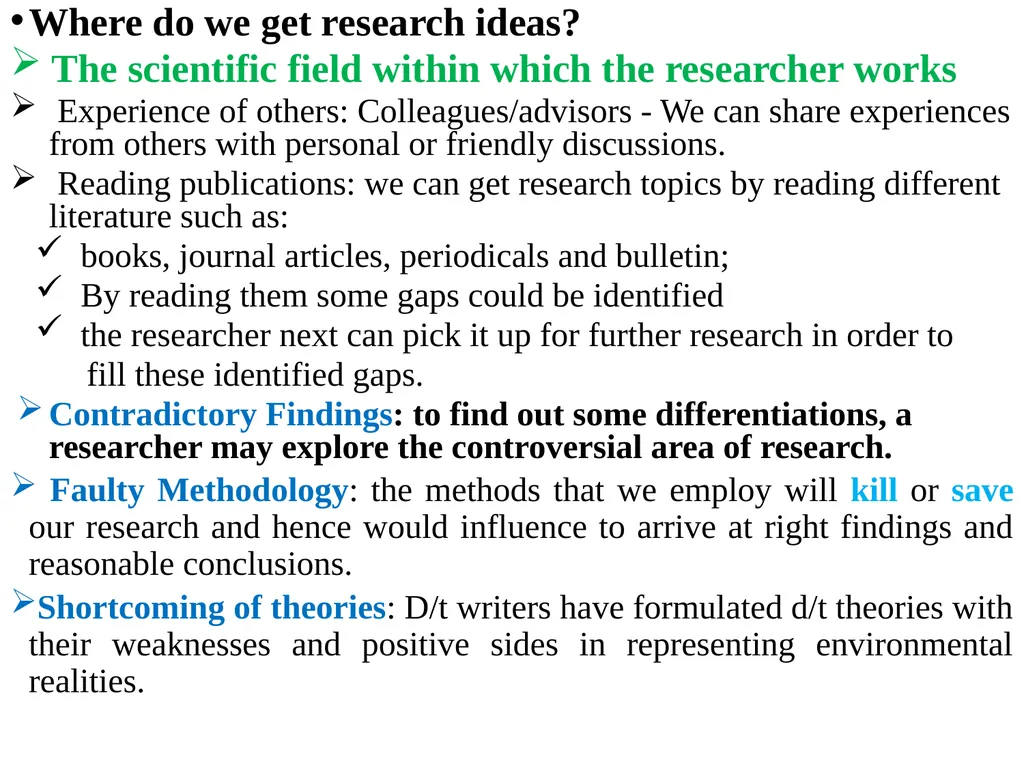
Where do we get research ideas?
The scientific field within which the researcher works
Experience of others: Colleagues/advisors - We can share experiences from others with personal or friendly discussions.
Reading publications: we can get research topics by reading different literature such as:
books, journal articles, periodicals and bulletin;
By reading them some gaps could be identified
the researcher next can pick it up for further research in order to
fill these identified gaps.
Contradictory Findings: to find out some differentiations, a researcher may explore the controversial area of research.
Faulty Methodology: the methods that we employ will kill or save our research and hence would influence to arrive at right findings and reasonable conclusions.
Shortcoming of theories: D/t writers have formulated d/t theories with their weaknesses and positive sides in representing environmental realities.<br>
The scientific field within which the researcher works
Experience of others: Colleagues/advisors - We can share experiences from others with personal or friendly discussions.
Reading publications: we can get research topics by reading different literature such as:
books, journal articles, periodicals and bulletin;
By reading them some gaps could be identified
the researcher next can pick it up for further research in order to
fill these identified gaps.
Contradictory Findings: to find out some differentiations, a researcher may explore the controversial area of research.
Faulty Methodology: the methods that we employ will kill or save our research and hence would influence to arrive at right findings and reasonable conclusions.
Shortcoming of theories: D/t writers have formulated d/t theories with their weaknesses and positive sides in representing environmental realities.<br>
42
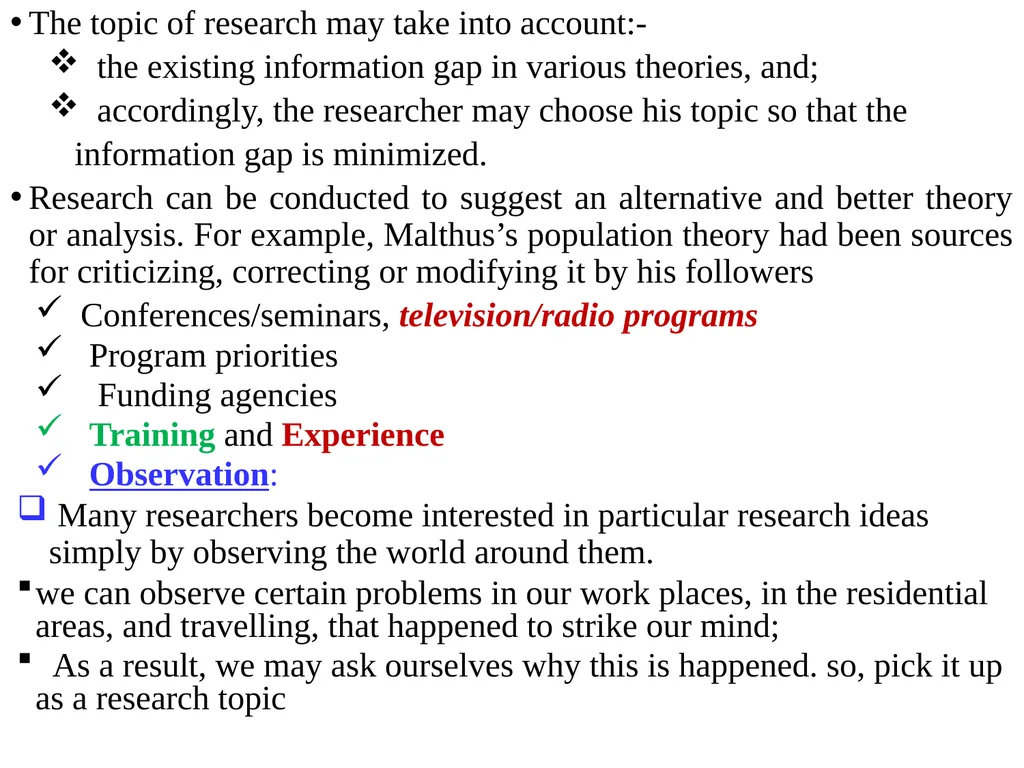
The topic of research may take into account:-
the existing information gap in various theories, and;
accordingly, the researcher may choose his topic so that the
information gap is minimized.
Research can be conducted to suggest an alternative and better theory or analysis. For example, Malthus’s population theory had been sources for criticizing, correcting or modifying it by his followers
Conferences/seminars, television/radio programs
Program priorities
Funding agencies
Training and Experience
Observation:
Many researchers become interested in particular research ideas simply by observing the world around them.
we can observe certain problems in our work places, in the residential areas, and travelling, that happened to strike our mind;
As a result, we may ask ourselves why this is happened. so, pick it up as a research topic<br>
the existing information gap in various theories, and;
accordingly, the researcher may choose his topic so that the
information gap is minimized.
Research can be conducted to suggest an alternative and better theory or analysis. For example, Malthus’s population theory had been sources for criticizing, correcting or modifying it by his followers
Conferences/seminars, television/radio programs
Program priorities
Funding agencies
Training and Experience
Observation:
Many researchers become interested in particular research ideas simply by observing the world around them.
we can observe certain problems in our work places, in the residential areas, and travelling, that happened to strike our mind;
As a result, we may ask ourselves why this is happened. so, pick it up as a research topic<br>
43
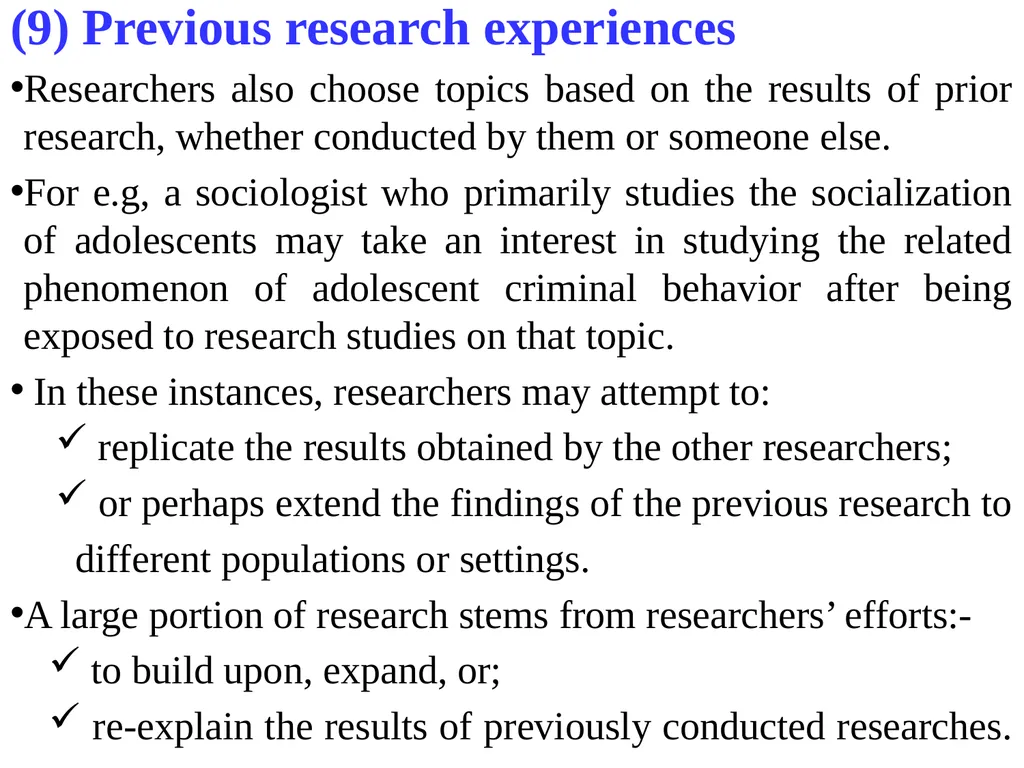
(9) Previous research experiences
Researchers also choose topics based on the results of prior research, whether conducted by them or someone else.
For e.g, a sociologist who primarily studies the socialization of adolescents may take an interest in studying the related phenomenon of adolescent criminal behavior after being exposed to research studies on that topic.
In these instances, researchers may attempt to:
replicate the results obtained by the other researchers;
or perhaps extend the findings of the previous research to
different populations or settings.
A large portion of research stems from researchers’ efforts:-
to build upon, expand, or;
re-explain the results of previously conducted researches.<br>
Researchers also choose topics based on the results of prior research, whether conducted by them or someone else.
For e.g, a sociologist who primarily studies the socialization of adolescents may take an interest in studying the related phenomenon of adolescent criminal behavior after being exposed to research studies on that topic.
In these instances, researchers may attempt to:
replicate the results obtained by the other researchers;
or perhaps extend the findings of the previous research to
different populations or settings.
A large portion of research stems from researchers’ efforts:-
to build upon, expand, or;
re-explain the results of previously conducted researches.<br>
44
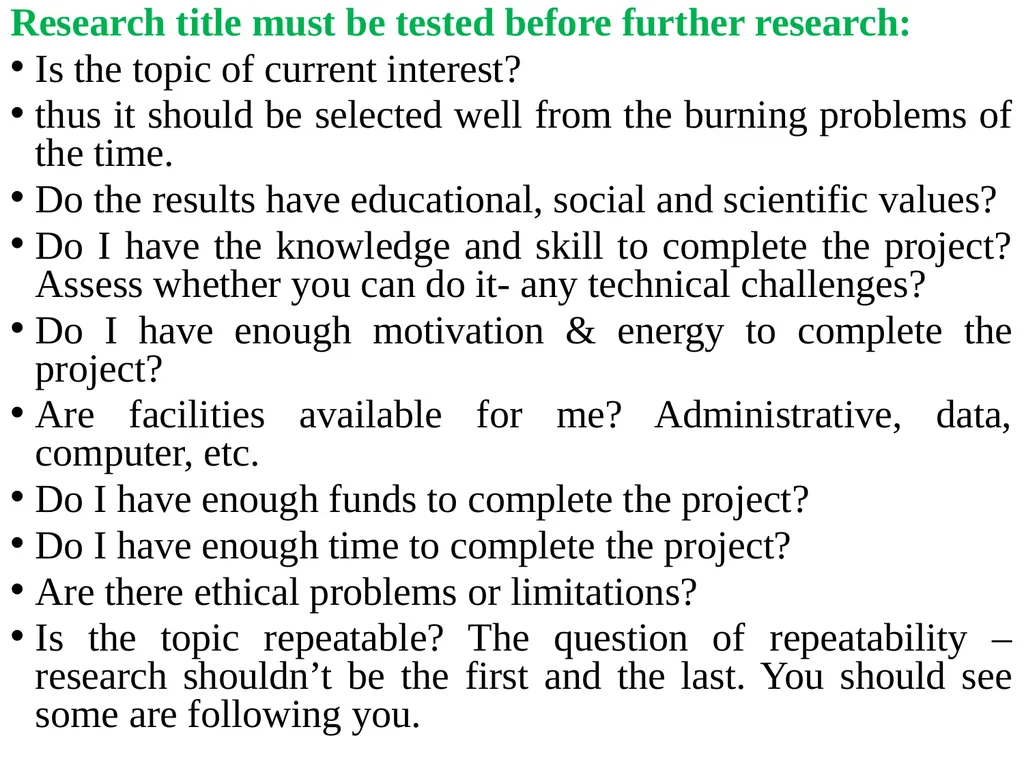
Research title must be tested before further research:
Is the topic of current interest?
thus it should be selected well from the burning problems of the time.
Do the results have educational, social and scientific values?
Do I have the knowledge and skill to complete the project? Assess whether you can do it- any technical challenges?
Do I have enough motivation & energy to complete the project?
Are facilities available for me? Administrative, data, computer, etc.
Do I have enough funds to complete the project?
Do I have enough time to complete the project?
Are there ethical problems or limitations?
Is the topic repeatable? The question of repeatability – research shouldn’t be the first and the last. You should see some are following you.<br>
Is the topic of current interest?
thus it should be selected well from the burning problems of the time.
Do the results have educational, social and scientific values?
Do I have the knowledge and skill to complete the project? Assess whether you can do it- any technical challenges?
Do I have enough motivation & energy to complete the project?
Are facilities available for me? Administrative, data, computer, etc.
Do I have enough funds to complete the project?
Do I have enough time to complete the project?
Are there ethical problems or limitations?
Is the topic repeatable? The question of repeatability – research shouldn’t be the first and the last. You should see some are following you.<br>
45
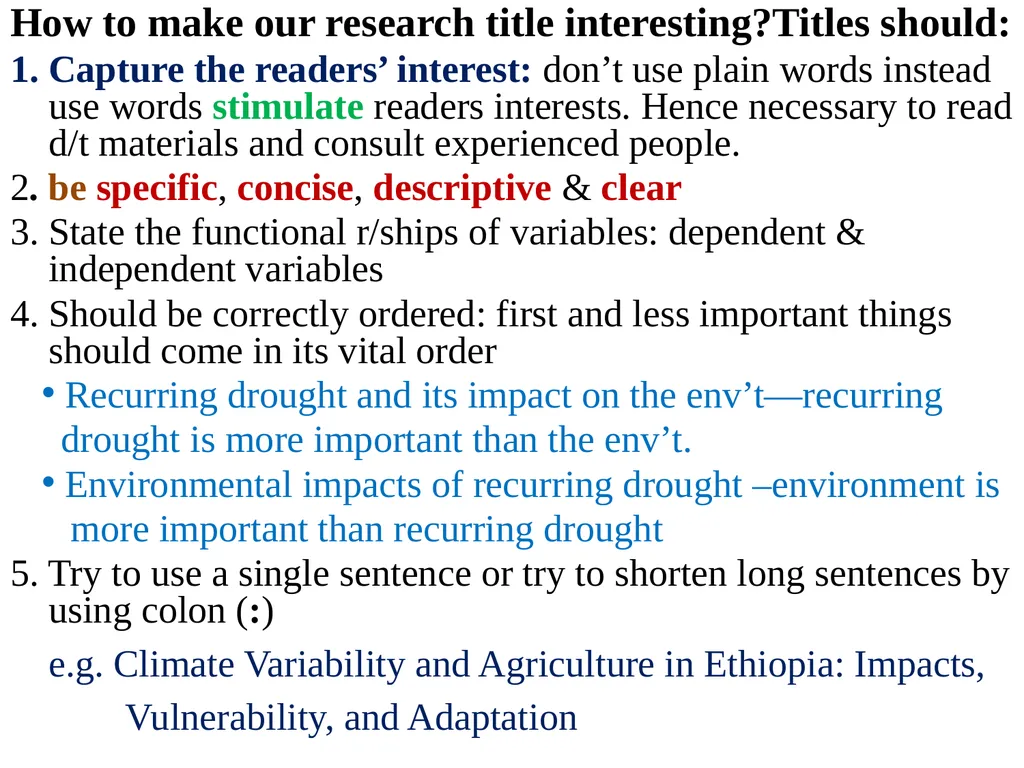
How to make our research title interesting?Titles should:
1. Capture the readers’ interest: don’t use plain words instead use words stimulate readers interests. Hence necessary to read d/t materials and consult experienced people.
2. be specific, concise, descriptive & clear
3. State the functional r/ships of variables: dependent & independent variables
4. Should be correctly ordered: first and less important things should come in its vital order
Recurring drought and its impact on the env’t—recurring
drought is more important than the env’t.
Environmental impacts of recurring drought –environment is
more important than recurring drought
5. Try to use a single sentence or try to shorten long sentences by using colon (:)
e.g. Climate Variability and Agriculture in Ethiopia: Impacts,
Vulnerability, and Adaptation<br>
1. Capture the readers’ interest: don’t use plain words instead use words stimulate readers interests. Hence necessary to read d/t materials and consult experienced people.
2. be specific, concise, descriptive & clear
3. State the functional r/ships of variables: dependent & independent variables
4. Should be correctly ordered: first and less important things should come in its vital order
Recurring drought and its impact on the env’t—recurring
drought is more important than the env’t.
Environmental impacts of recurring drought –environment is
more important than recurring drought
5. Try to use a single sentence or try to shorten long sentences by using colon (:)
e.g. Climate Variability and Agriculture in Ethiopia: Impacts,
Vulnerability, and Adaptation<br>
46
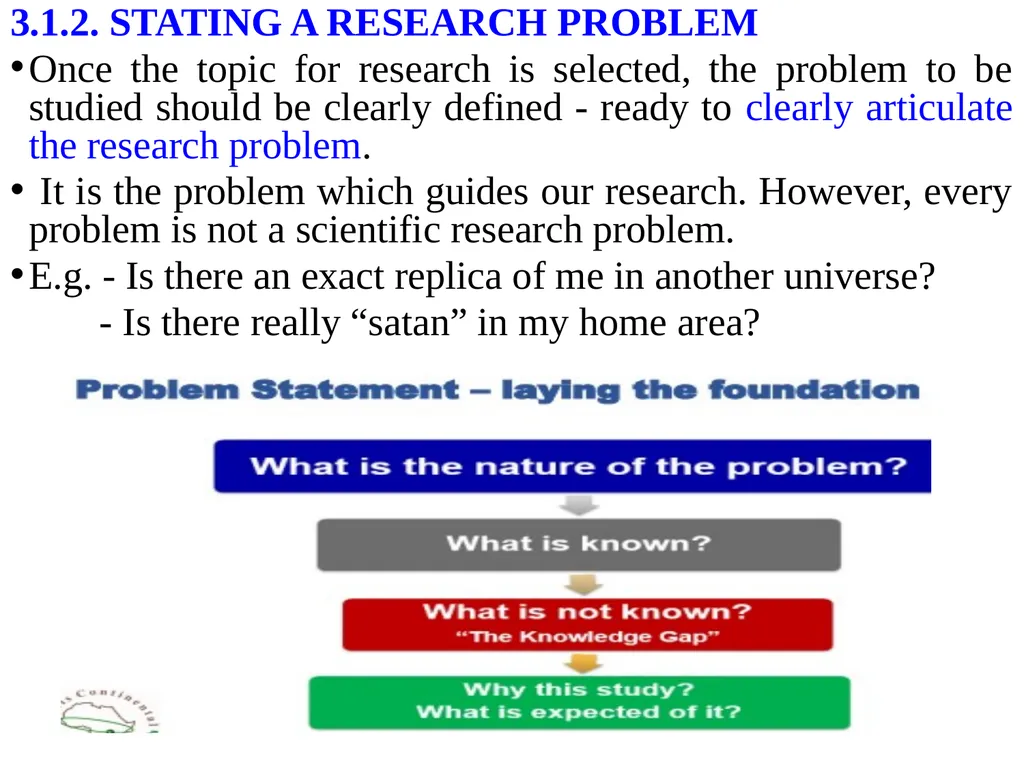
3.1.2. STATING A RESEARCH PROBLEM
Once the topic for research is selected, the problem to be studied should be clearly defined - ready to clearly articulate the research problem.
It is the problem which guides our research. However, every problem is not a scientific research problem.
E.g. - Is there an exact replica of me in another universe?
- Is there really “satan” in my home area?<br>
Once the topic for research is selected, the problem to be studied should be clearly defined - ready to clearly articulate the research problem.
It is the problem which guides our research. However, every problem is not a scientific research problem.
E.g. - Is there an exact replica of me in another universe?
- Is there really “satan” in my home area?<br>
47
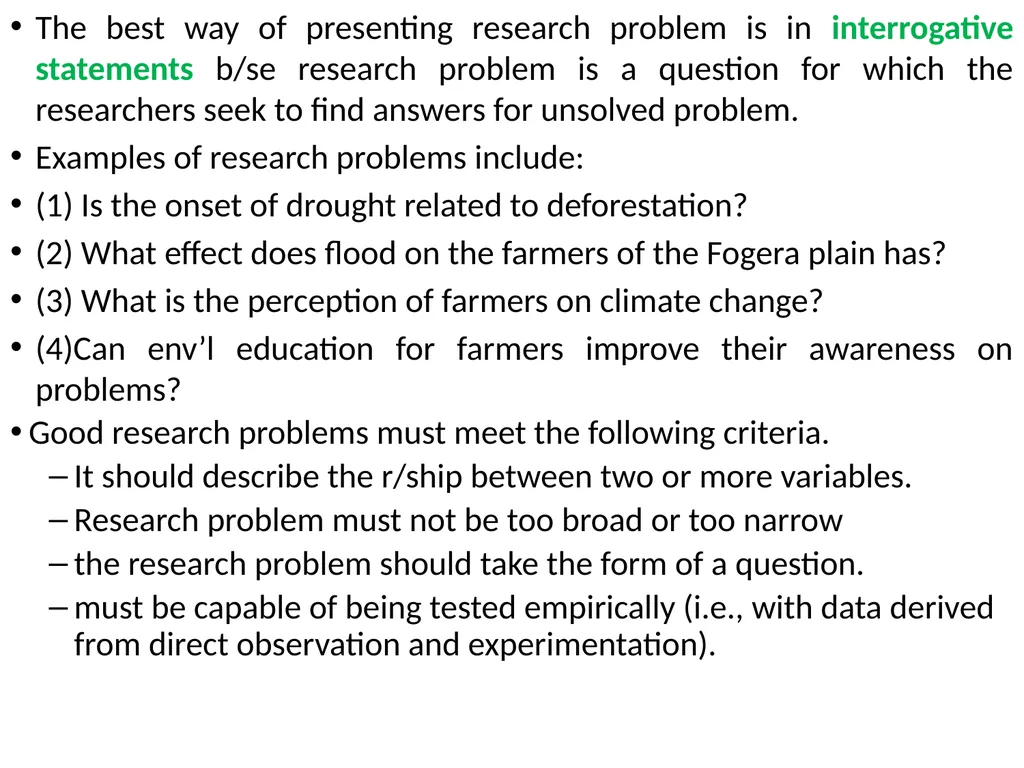
The best way of presenting research problem is in interrogative statements b/se research problem is a question for which the researchers seek to find answers for unsolved problem.
Examples of research problems include:
(1) Is the onset of drought related to deforestation?
(2) What effect does flood on the farmers of the Fogera plain has?
(3) What is the perception of farmers on climate change?
(4)Can env’l education for farmers improve their awareness on problems?
Good research problems must meet the following criteria.
It should describe the r/ship between two or more variables.
Research problem must not be too broad or too narrow
the research problem should take the form of a question.
must be capable of being tested empirically (i.e., with data derived from direct observation and experimentation).<br>
Examples of research problems include:
(1) Is the onset of drought related to deforestation?
(2) What effect does flood on the farmers of the Fogera plain has?
(3) What is the perception of farmers on climate change?
(4)Can env’l education for farmers improve their awareness on problems?
Good research problems must meet the following criteria.
It should describe the r/ship between two or more variables.
Research problem must not be too broad or too narrow
the research problem should take the form of a question.
must be capable of being tested empirically (i.e., with data derived from direct observation and experimentation).<br>
48
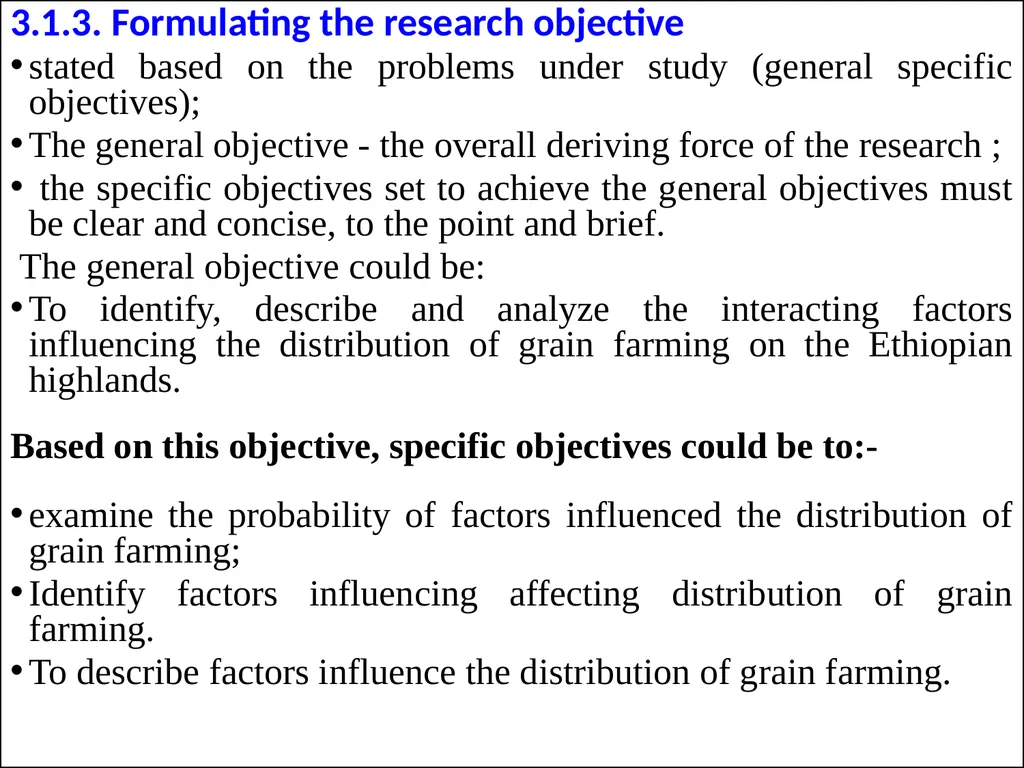
3.1.3. Formulating the research objective
stated based on the problems under study (general specific objectives);
The general objective - the overall deriving force of the research ;
the specific objectives set to achieve the general objectives must be clear and concise, to the point and brief.
The general objective could be:
To identify, describe and analyze the interacting factors influencing the distribution of grain farming on the Ethiopian highlands.
Based on this objective, specific objectives could be to:-
examine the probability of factors influenced the distribution of grain farming;
Identify factors influencing affecting distribution of grain farming.
To describe factors influence the distribution of grain farming.<br>
stated based on the problems under study (general specific objectives);
The general objective - the overall deriving force of the research ;
the specific objectives set to achieve the general objectives must be clear and concise, to the point and brief.
The general objective could be:
To identify, describe and analyze the interacting factors influencing the distribution of grain farming on the Ethiopian highlands.
Based on this objective, specific objectives could be to:-
examine the probability of factors influenced the distribution of grain farming;
Identify factors influencing affecting distribution of grain farming.
To describe factors influence the distribution of grain farming.<br>
49
3.1.4 Articulating Research Hypotheses
one of the most important steps in the research planning process.
attempt to explain, predict, and explore the phenomenon of interest and the r/ship b/n two or more variables.
researcher’s imagined idea or educated guess about how the study will turn out;
It should be logically stem from the research problem being investigated;
is a tentative generalization based on the accumulated previous knowledge to be tested hence they are not final answers;
If the exact result is known, no need of conducting research.
may or may not be proved right;
On the basis of the hypothesis, facts are observed and collected, when by verification, the hypothesis is found to be true, a theory is obtained.
expressed usually in declarative statements, they must be expressed explicitly (unambiguously);
Research problem and hypothesis are two sides of a coin.<br>
one of the most important steps in the research planning process.
attempt to explain, predict, and explore the phenomenon of interest and the r/ship b/n two or more variables.
researcher’s imagined idea or educated guess about how the study will turn out;
It should be logically stem from the research problem being investigated;
is a tentative generalization based on the accumulated previous knowledge to be tested hence they are not final answers;
If the exact result is known, no need of conducting research.
may or may not be proved right;
On the basis of the hypothesis, facts are observed and collected, when by verification, the hypothesis is found to be true, a theory is obtained.
expressed usually in declarative statements, they must be expressed explicitly (unambiguously);
Research problem and hypothesis are two sides of a coin.<br>
50
They provide the r/ship b/n variables as characterized from spatial and temporal point of view;
For example, hypotheses provide the r/ship b/n intensity of rainfall and soil erosion keeping other factors constant.
Functions of Hypothesis
explain all the facts connected with the problem
enables us to guide the course of the research along the right lines through suggesting experiments and observations
It limits the scope of enquiry to a manageable area
distinguish relevant and non-relevant data thus leads to economy of time and money.
It can apply analytical works – regression, correlation, etc.
essential to develop generalizations and theories in most researches
It leads to significant conclusions for advancing knowledge.
But all research problems may not be amenable to formulation of testable hypothesis.<br>
For example, hypotheses provide the r/ship b/n intensity of rainfall and soil erosion keeping other factors constant.
Functions of Hypothesis
explain all the facts connected with the problem
enables us to guide the course of the research along the right lines through suggesting experiments and observations
It limits the scope of enquiry to a manageable area
distinguish relevant and non-relevant data thus leads to economy of time and money.
It can apply analytical works – regression, correlation, etc.
essential to develop generalizations and theories in most researches
It leads to significant conclusions for advancing knowledge.
But all research problems may not be amenable to formulation of testable hypothesis.<br>
51
Hypothesis should be specific to express the r/ship b/n variables.
Typical examples of specific hypothesis are:
Maize farming is affected by the type of soil.
Maize production is high in clay soils than sandy soils.
Soil erosion is influenced by density of grazing sheep &slope angle.
Soil erosion is high in sandy soils than clay soils
Research hypothesis can also express the direction of r/ship.
Soil erosion increases as grazing sheep increases-positively related
Soil erosion and slope angle have positive relationship- logically reasonable .
We can express hypothesis negatively, but it must be logically reasonable.
Grain farming is negatively related to slope angle, i.e., the higher the slope angle the rare the grain farming.<br>
Typical examples of specific hypothesis are:
Maize farming is affected by the type of soil.
Maize production is high in clay soils than sandy soils.
Soil erosion is influenced by density of grazing sheep &slope angle.
Soil erosion is high in sandy soils than clay soils
Research hypothesis can also express the direction of r/ship.
Soil erosion increases as grazing sheep increases-positively related
Soil erosion and slope angle have positive relationship- logically reasonable .
We can express hypothesis negatively, but it must be logically reasonable.
Grain farming is negatively related to slope angle, i.e., the higher the slope angle the rare the grain farming.<br>
52
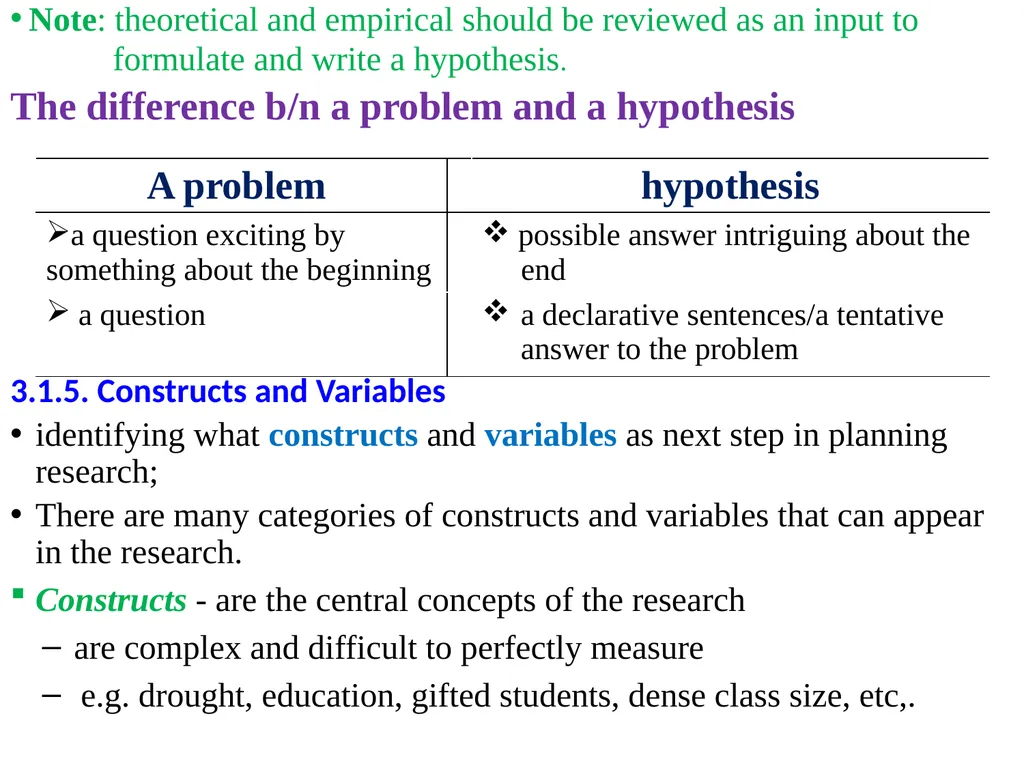
Note: theoretical and empirical should be reviewed as an input to
formulate and write a hypothesis.
The difference b/n a problem and a hypothesis
3.1.5. Constructs and Variables
identifying what constructs and variables as next step in planning research;
There are many categories of constructs and variables that can appear in the research.
Constructs - are the central concepts of the research
are complex and difficult to perfectly measure
e.g. drought, education, gifted students, dense class size, etc,.<br>
formulate and write a hypothesis.
The difference b/n a problem and a hypothesis
3.1.5. Constructs and Variables
identifying what constructs and variables as next step in planning research;
There are many categories of constructs and variables that can appear in the research.
Constructs - are the central concepts of the research
are complex and difficult to perfectly measure
e.g. drought, education, gifted students, dense class size, etc,.<br>
53
Variables are indicators/measures of constructs; operational definition of constructs
E.g. rainfall is a variable to be operational definition for drought.
Year of education is a variable to measure academic achievement
A variable is anything that can take on different values. For example, height, weight, age, race, and attitude are variables because there are d/t heights, weights, ages, races, and attitudes.
By contrast, if something cannot vary, or take on d/t values, then it is referred to as a constant.
Exogenous constructs/variables, causes come from outside the theory; measured as independent variables.
Endogenous constructs/variables, causes appear in the model; measured as dependent variables<br>
E.g. rainfall is a variable to be operational definition for drought.
Year of education is a variable to measure academic achievement
A variable is anything that can take on different values. For example, height, weight, age, race, and attitude are variables because there are d/t heights, weights, ages, races, and attitudes.
By contrast, if something cannot vary, or take on d/t values, then it is referred to as a constant.
Exogenous constructs/variables, causes come from outside the theory; measured as independent variables.
Endogenous constructs/variables, causes appear in the model; measured as dependent variables<br>
54
Independent Variables vs. Dependent Variables
The independent variable is the factor that is manipulated or controlled by the researcher. In most studies, researchers are interested in examining the effects of the independent variable.
In its simplest form, the independent variable has two levels: present or absent.
For example, in a study investigating the effects of a new type of fertilizer on cereal yield, one group will be exposed to the new fertilizer and one group will not be exposed to the new fertilizer. In this example, the independent variable is the new fertilizer.
As you may already know, the group in which the independent variable is present (i.e., that is exposed to fertilizer) is referred to as the experimental group, whereas the group in which the independent variable is not present (i.e., that is not exposed to fertilizer) is referred to as the control group.<br>
The independent variable is the factor that is manipulated or controlled by the researcher. In most studies, researchers are interested in examining the effects of the independent variable.
In its simplest form, the independent variable has two levels: present or absent.
For example, in a study investigating the effects of a new type of fertilizer on cereal yield, one group will be exposed to the new fertilizer and one group will not be exposed to the new fertilizer. In this example, the independent variable is the new fertilizer.
As you may already know, the group in which the independent variable is present (i.e., that is exposed to fertilizer) is referred to as the experimental group, whereas the group in which the independent variable is not present (i.e., that is not exposed to fertilizer) is referred to as the control group.<br>
55
For ex, in a study examining the effects of a new medication on symptoms of depression, the researcher may include three groups in the study—one control group and two experimental groups.
As usual, the control group would not get the medication (or would get a placebo), while one experimental group may get a lower dose of the medication and the other experimental group may get a higher dose of the medication.
In this example, the independent variable (i.e., medication) consists of three levels: absent, low, and high.
Other levels of independent variables are, of course, also possible, such as low, medium, and high; or absent, low, medium, and high.
It is also common for a research to include multiple independent variables, perhaps with each of the independent variables consisting of multiple levels. For example, a researcher may attempt to investigate the effects of both fertilizers and selected seeds on crop yield.
In this example, there are two independent variables (i.e., fertilizer and selected seeds), and each independent variable could potentially consist of multiple levels (e.g., low, medium, and high doses.<br>
As usual, the control group would not get the medication (or would get a placebo), while one experimental group may get a lower dose of the medication and the other experimental group may get a higher dose of the medication.
In this example, the independent variable (i.e., medication) consists of three levels: absent, low, and high.
Other levels of independent variables are, of course, also possible, such as low, medium, and high; or absent, low, medium, and high.
It is also common for a research to include multiple independent variables, perhaps with each of the independent variables consisting of multiple levels. For example, a researcher may attempt to investigate the effects of both fertilizers and selected seeds on crop yield.
In this example, there are two independent variables (i.e., fertilizer and selected seeds), and each independent variable could potentially consist of multiple levels (e.g., low, medium, and high doses.<br>
56
The dependent variable is a measure of the effect of the independent variable. For ex, a researcher may be interested in examining the effects of a new medication on symptoms of depression among college students.
the researcher selects the independent and dependent variables based on the research problem and the hypotheses.
Suppose that a researcher is interested in examining the r/ship b/n rainfall variability and cereal production of small-holder farmers in the Ethiopian highlands, the research problem may be stated in the following manner:
“Does increased rainfall variability result in a decreased cereal yield in the small-holder farmers in the Ethiopia highlands?”
“What are the effects of rainfall variability on cereal production among small-holder farmers in the Ethiopian highlands?”
Following logically from this research problem, the researcher may hypothesize the following: “High levels of rainfall variability will decrease the cereal yields of small-holder farmers in the Ethiopian highlands.” Obviously, several terms in this hypothesis need to be operationally defined.<br>
the researcher selects the independent and dependent variables based on the research problem and the hypotheses.
Suppose that a researcher is interested in examining the r/ship b/n rainfall variability and cereal production of small-holder farmers in the Ethiopian highlands, the research problem may be stated in the following manner:
“Does increased rainfall variability result in a decreased cereal yield in the small-holder farmers in the Ethiopia highlands?”
“What are the effects of rainfall variability on cereal production among small-holder farmers in the Ethiopian highlands?”
Following logically from this research problem, the researcher may hypothesize the following: “High levels of rainfall variability will decrease the cereal yields of small-holder farmers in the Ethiopian highlands.” Obviously, several terms in this hypothesis need to be operationally defined.<br>
57
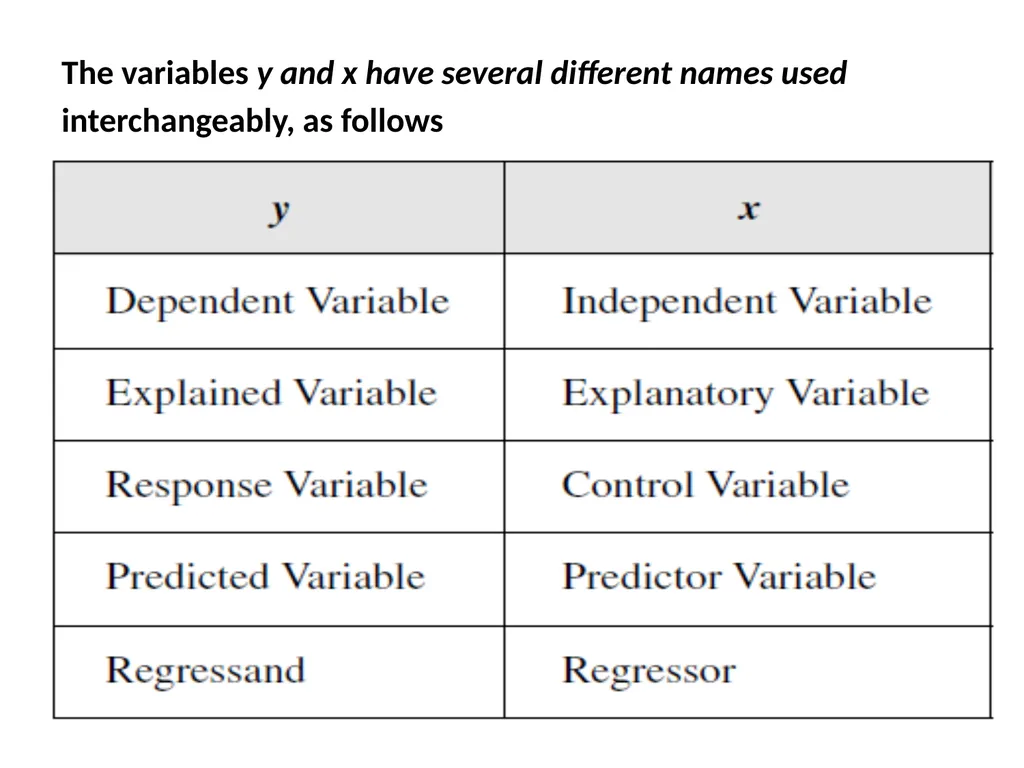
The variables y and x have several different names used
interchangeably, as follows<br>
interchangeably, as follows<br>
58
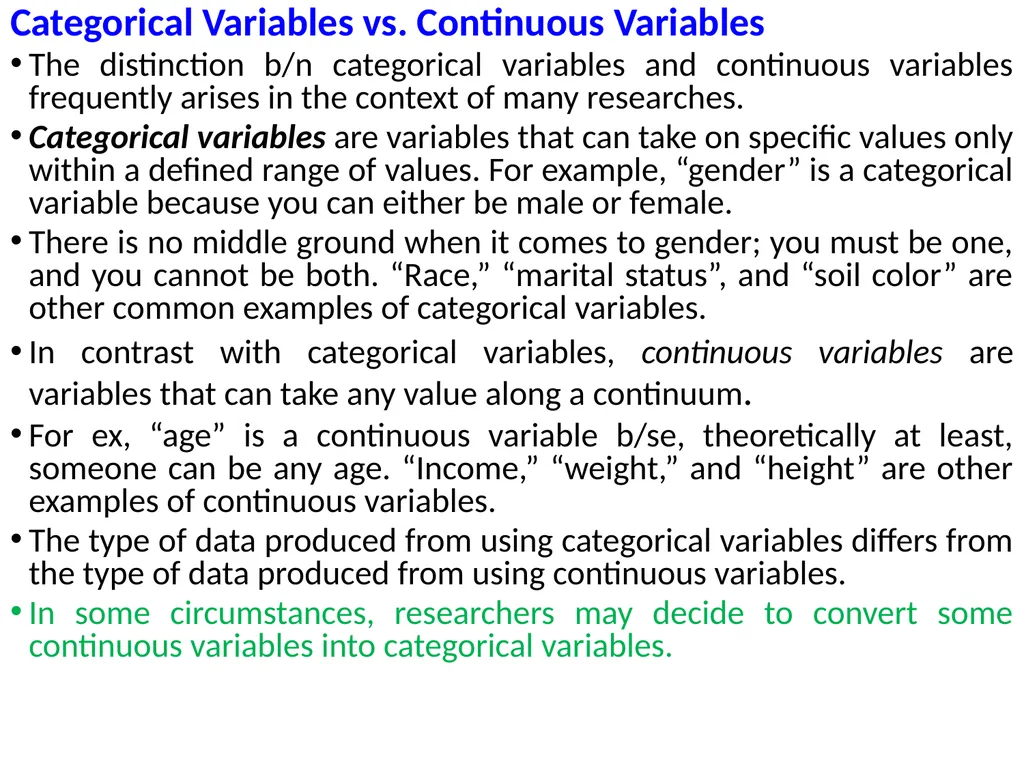
Categorical Variables vs. Continuous Variables
The distinction b/n categorical variables and continuous variables frequently arises in the context of many researches.
Categorical variables are variables that can take on specific values only within a defined range of values. For example, “gender” is a categorical variable because you can either be male or female.
There is no middle ground when it comes to gender; you must be one, and you cannot be both. “Race,” “marital status”, and “soil color” are other common examples of categorical variables.
In contrast with categorical variables, continuous variables are variables that can take any value along a continuum.
For ex, “age” is a continuous variable b/se, theoretically at least, someone can be any age. “Income,” “weight,” and “height” are other examples of continuous variables.
The type of data produced from using categorical variables differs from the type of data produced from using continuous variables.
In some circumstances, researchers may decide to convert some continuous variables into categorical variables.<br>
The distinction b/n categorical variables and continuous variables frequently arises in the context of many researches.
Categorical variables are variables that can take on specific values only within a defined range of values. For example, “gender” is a categorical variable because you can either be male or female.
There is no middle ground when it comes to gender; you must be one, and you cannot be both. “Race,” “marital status”, and “soil color” are other common examples of categorical variables.
In contrast with categorical variables, continuous variables are variables that can take any value along a continuum.
For ex, “age” is a continuous variable b/se, theoretically at least, someone can be any age. “Income,” “weight,” and “height” are other examples of continuous variables.
The type of data produced from using categorical variables differs from the type of data produced from using continuous variables.
In some circumstances, researchers may decide to convert some continuous variables into categorical variables.<br>
59
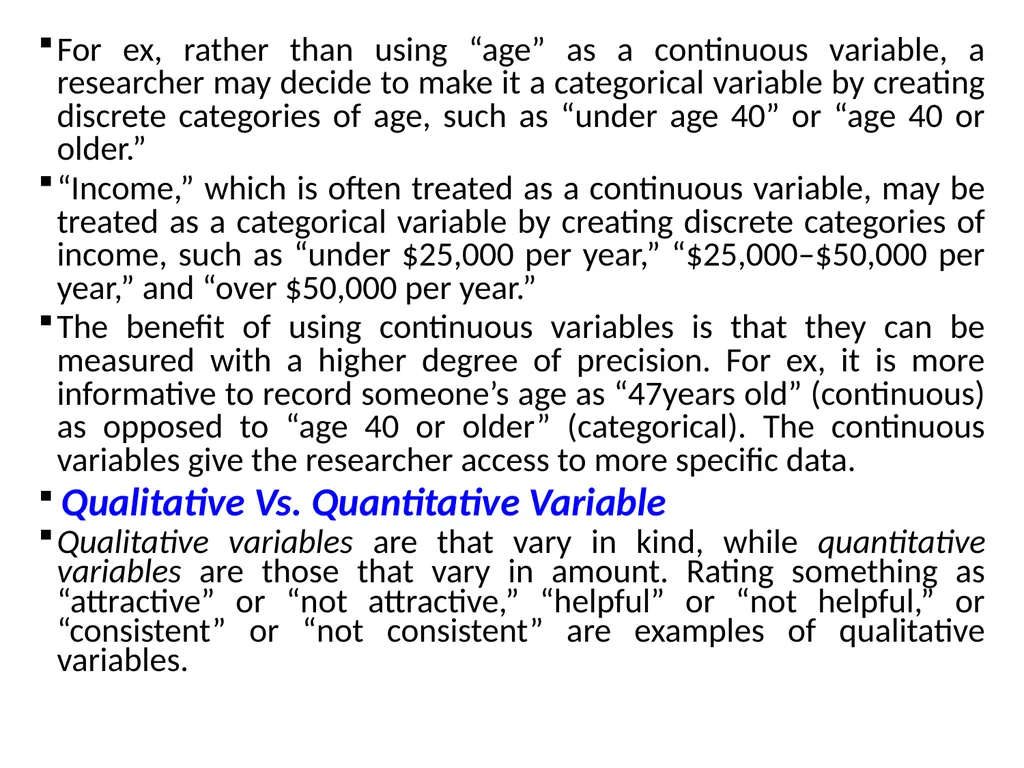
For ex, rather than using “age” as a continuous variable, a researcher may decide to make it a categorical variable by creating discrete categories of age, such as “under age 40” or “age 40 or older.”
“Income,” which is often treated as a continuous variable, may be treated as a categorical variable by creating discrete categories of income, such as “under $25,000 per year,” “$25,000–$50,000 per year,” and “over $50,000 per year.”
The benefit of using continuous variables is that they can be measured with a higher degree of precision. For ex, it is more informative to record someone’s age as “47years old” (continuous) as opposed to “age 40 or older” (categorical). The continuous variables give the researcher access to more specific data.
Qualitative Vs. Quantitative Variable
Qualitative variables are that vary in kind, while quantitative variables are those that vary in amount. Rating something as “attractive” or “not attractive,” “helpful” or “not helpful,” or “consistent” or “not consistent” are examples of qualitative variables.<br>
“Income,” which is often treated as a continuous variable, may be treated as a categorical variable by creating discrete categories of income, such as “under $25,000 per year,” “$25,000–$50,000 per year,” and “over $50,000 per year.”
The benefit of using continuous variables is that they can be measured with a higher degree of precision. For ex, it is more informative to record someone’s age as “47years old” (continuous) as opposed to “age 40 or older” (categorical). The continuous variables give the researcher access to more specific data.
Qualitative Vs. Quantitative Variable
Qualitative variables are that vary in kind, while quantitative variables are those that vary in amount. Rating something as “attractive” or “not attractive,” “helpful” or “not helpful,” or “consistent” or “not consistent” are examples of qualitative variables.<br>
60
In these examples, the variables are considered qualitative b/se they vary in kind (and not amount). For ex, the thing being rated is either “attractive” or “not attractive,” but there is no indication of the level (or amount) of attractiveness.
By contrast, reporting the number of times that something happened or the number of times that someone engaged in a particular behavior are examples of quantitative variables.
These variables are quantitative as they provide information regarding the amount of something.
It is important to keep in mind that a single variable may fit into several of the categories that we have discussed. For ex, the variable “height” is both continuous (if measured along a continuum) and quantitative (b/se we are getting information regarding the amount of height).
Along similar lines, the variable “vegetation/soil color” is both categorical (b/se there is a limited no. of discrete categories of vegetation/soil color) and qualitative (b/se soil color varies in kind, not amount).<br>
By contrast, reporting the number of times that something happened or the number of times that someone engaged in a particular behavior are examples of quantitative variables.
These variables are quantitative as they provide information regarding the amount of something.
It is important to keep in mind that a single variable may fit into several of the categories that we have discussed. For ex, the variable “height” is both continuous (if measured along a continuum) and quantitative (b/se we are getting information regarding the amount of height).
Along similar lines, the variable “vegetation/soil color” is both categorical (b/se there is a limited no. of discrete categories of vegetation/soil color) and qualitative (b/se soil color varies in kind, not amount).<br>
61
3.2. Research Design
3.2.1 Meaning of Research Design
Research design constitutes the decisions regarding what, where, when, how much, by what means concerning a study.
A research design is the conceptual framework for the collection, measurement, and analysis of data in line with the research purpose.
Its function is to ensure that the evidence obtained enables us to answer the initial question as clearly as possible” .
Generally, research design is:
– A plan that specifies how data should be collected and analyzed
– A program that guides the investigator in the process of collecting, analyzing and interpreting observations
Main functions of research design
– Provides the researcher with a blueprint for studying an issue/problem.
– Determines the boundaries of research activity and focuses the researcher in specific directions.
– Enables the researcher to anticipate potential problems in the implementation of the study<br>
3.2.1 Meaning of Research Design
Research design constitutes the decisions regarding what, where, when, how much, by what means concerning a study.
A research design is the conceptual framework for the collection, measurement, and analysis of data in line with the research purpose.
Its function is to ensure that the evidence obtained enables us to answer the initial question as clearly as possible” .
Generally, research design is:
– A plan that specifies how data should be collected and analyzed
– A program that guides the investigator in the process of collecting, analyzing and interpreting observations
Main functions of research design
– Provides the researcher with a blueprint for studying an issue/problem.
– Determines the boundaries of research activity and focuses the researcher in specific directions.
– Enables the researcher to anticipate potential problems in the implementation of the study<br>
62
3.2.2. Typology of research designs
1. Descriptive vs. explanatory research
2.Theory testing/deductive reasoning vs. theory building/ inductive reasoning
Induction - general principles that explain specific observations (from observation to theory)
Deduction - specific claims from general theoretical principles (from theory to observation)
But there is no hard and fast distinction between induction and deduction.
Quantitative Research Design
3. Experimental: identifies effects by random assignment between control and treatment group<br>
1. Descriptive vs. explanatory research
2.Theory testing/deductive reasoning vs. theory building/ inductive reasoning
Induction - general principles that explain specific observations (from observation to theory)
Deduction - specific claims from general theoretical principles (from theory to observation)
But there is no hard and fast distinction between induction and deduction.
Quantitative Research Design
3. Experimental: identifies effects by random assignment between control and treatment group<br>
63
Typology of Research Design (cont’d) 4. Quasi-experimental: use a comparison group similar to the treatment group in crucial respects (no random assignment)
5. Cross-sectional: information gathered only at one point in time; uses variation between subjects
6. Longitudinal: same subjects observed in more than one period; uses both cross-sectional as well as within subject variation
7. Case study: detailed analysis of individual cases<br>
5. Cross-sectional: information gathered only at one point in time; uses variation between subjects
6. Longitudinal: same subjects observed in more than one period; uses both cross-sectional as well as within subject variation
7. Case study: detailed analysis of individual cases<br>
64
. Employs quantitative measures? Yes:
Quantitative
Research No:
Qualitative
Research Manipulation? Yes:
Experimental
research No:
Correlational
research Random assignment
to different treated
groups? Yes:
True
experiments No:
Quasi-experiments Data collected at more than one point in time? Yes:
Longitudinal No:
Cross-sectional Typology of Research Designs<br>
Quantitative
Research No:
Qualitative
Research Manipulation? Yes:
Experimental
research No:
Correlational
research Random assignment
to different treated
groups? Yes:
True
experiments No:
Quasi-experiments Data collected at more than one point in time? Yes:
Longitudinal No:
Cross-sectional Typology of Research Designs<br>
65
3.2.3. Criteria for Evaluation of Research
The prominent criteria for evaluation of research are validity and reliability.
1. Validity refers to the conceptual and scientific soundness of a research design to produce valid conclusions.
appropriateness, meaningfulness and usefulness of research design;
Validity depends on:
the quality of research design and the sample
There are 4 main types of validity in research design and methodology
A. Internal validity refers to the ability of a research design to rule out explanations of the results, how much does the research design help to arrive at an unambiguous conclusion?
e.g., returns to education: Can we be sure that education is the main reason for higher productivity due to skills acquired in schools?<br>
The prominent criteria for evaluation of research are validity and reliability.
1. Validity refers to the conceptual and scientific soundness of a research design to produce valid conclusions.
appropriateness, meaningfulness and usefulness of research design;
Validity depends on:
the quality of research design and the sample
There are 4 main types of validity in research design and methodology
A. Internal validity refers to the ability of a research design to rule out explanations of the results, how much does the research design help to arrive at an unambiguous conclusion?
e.g., returns to education: Can we be sure that education is the main reason for higher productivity due to skills acquired in schools?<br>
66
B. External validity refers to the generalizability of the results of a research to other conditions, participants, time, and places.
External validity of research design: how far can the results from the research be generalised?
Depends on how representative the study is.
e.g., returns to education: How far can our results be generalised? For the whole country? Also for other countries? For different periods of time? etc.
C. Construct validity
refers to the basis of the causal r/ship and is concerned with the congruence b/n the study’s results and the theoretical underpinnings guiding the research.
how well the indicator reflects the theoretical construct; e.g., is years of schooling a valid indicator of education?<br>
External validity of research design: how far can the results from the research be generalised?
Depends on how representative the study is.
e.g., returns to education: How far can our results be generalised? For the whole country? Also for other countries? For different periods of time? etc.
C. Construct validity
refers to the basis of the causal r/ship and is concerned with the congruence b/n the study’s results and the theoretical underpinnings guiding the research.
how well the indicator reflects the theoretical construct; e.g., is years of schooling a valid indicator of education?<br>
67
D. Statistical validity
refers to aspects of quantitative evaluation that affect the accuracy of the conclusions drawn from the results of a study. At its simplest level, statistical validity addresses the question of whether the statistical conclusions drawn from the results of a study are reasonable
2. Reliability
consistency; same measure when used repeatedly; minimised errors of measurement
Sources of unreliability
poor design of questions
Respondents’ bias in subjective judgements
characteristics of interviewers
questions on which people have no opinion
problems in equipment
questions that depend on mood<br>
refers to aspects of quantitative evaluation that affect the accuracy of the conclusions drawn from the results of a study. At its simplest level, statistical validity addresses the question of whether the statistical conclusions drawn from the results of a study are reasonable
2. Reliability
consistency; same measure when used repeatedly; minimised errors of measurement
Sources of unreliability
poor design of questions
Respondents’ bias in subjective judgements
characteristics of interviewers
questions on which people have no opinion
problems in equipment
questions that depend on mood<br>
68
3.2.4. Research Ethics The study of right and wrong conduct
Researchers, subjects, funding bodies and society may have conflicting incentives
1.Researchers-researchers
Plagiarism
Peer reviews
2. Researchers-society
Falsifying data
Irresponsible policy advise
Waste of research fund
3.Funding bodies-researchers
Fund allocations directing research
‘money buying research results’?
4.Researcher-subjects<br>
Researchers, subjects, funding bodies and society may have conflicting incentives
1.Researchers-researchers
Plagiarism
Peer reviews
2. Researchers-society
Falsifying data
Irresponsible policy advise
Waste of research fund
3.Funding bodies-researchers
Fund allocations directing research
‘money buying research results’?
4.Researcher-subjects<br>
69
A. Harm to Participants Physical harm, humiliation, embarrassment, loss of trust, harm to participant’s development, loss of self-esteem, stress, etc.
Maintaining confidentiality
Anticipating harm to participants is difficult
B. Lack of Informed Consent
Participants should be given as much information as needed to make decision on participation
But researchers do not know all the risks
Difficult to present ALL information to participant/s and can be counter-productive to the research
Covert research avoids reactivity but may violate informed consent<br>
Maintaining confidentiality
Anticipating harm to participants is difficult
B. Lack of Informed Consent
Participants should be given as much information as needed to make decision on participation
But researchers do not know all the risks
Difficult to present ALL information to participant/s and can be counter-productive to the research
Covert research avoids reactivity but may violate informed consent<br>
70
C. Invasion of Privacy Privacy of participants should be protected
Participants may refuse to address specific questions even though they have agreed to participate
Covert research usually violates privacy
D. Deception
When researchers present their research as something other than what it is
Researchers usually want to limit participants understanding so that they act naturally
E. Protecting Research Ethics
Legal protection
Professional associations and universities (ethics committees)<br>
Participants may refuse to address specific questions even though they have agreed to participate
Covert research usually violates privacy
D. Deception
When researchers present their research as something other than what it is
Researchers usually want to limit participants understanding so that they act naturally
E. Protecting Research Ethics
Legal protection
Professional associations and universities (ethics committees)<br>
71
Chapter 4: Sample Design
4.1. Basic Concepts
Population
all units (elements) relevant to the research
a theoretically specified aggregation of elements
An element is a unit (e.g., person, object) of a population.
inferences from the sample are made about the population
Census
information on the whole population; enumeration of the entire population
Sampling units/elements
non-overlapping components of the population
‘units/elements’ used because it is not only people or households that are sampled<br>
4.1. Basic Concepts
Population
all units (elements) relevant to the research
a theoretically specified aggregation of elements
An element is a unit (e.g., person, object) of a population.
inferences from the sample are made about the population
Census
information on the whole population; enumeration of the entire population
Sampling units/elements
non-overlapping components of the population
‘units/elements’ used because it is not only people or households that are sampled<br>
72
Sampling is a strategy used to select elements from a population
sample is a subset of the population elements that results from a sampling strategy.
Procedure by which some members of a given population are selected as representatives of the entire population
Sampling frame
A sampling frame is the list of all sampling units/elements in the population from which the sample will be drawn.
Because sampling is the process of selecting population elements to study, sample design addresses two basic issues:
(1) how elements of the population will be selected and (2) how many elements will be selected.
Representative sample
a sample that represents the population accurately<br>
sample is a subset of the population elements that results from a sampling strategy.
Procedure by which some members of a given population are selected as representatives of the entire population
Sampling frame
A sampling frame is the list of all sampling units/elements in the population from which the sample will be drawn.
Because sampling is the process of selecting population elements to study, sample design addresses two basic issues:
(1) how elements of the population will be selected and (2) how many elements will be selected.
Representative sample
a sample that represents the population accurately<br>
73
4.1.Basic Concepts (cont’d) 4.2. Why Sampling?
It is costly or impossible to cover all the relevant population
The sample taken should enable generalisations about the relevant population – inferential statistics<br>
It is costly or impossible to cover all the relevant population
The sample taken should enable generalisations about the relevant population – inferential statistics<br>
74
4.3. Probability Sampling
sampling using random selection so that each unit has a chance of being selected into the sample
a representative sample is more likely to be the outcome
random selection minimises human bias
4.3.1. Simple Random Sampling
Every sampling unit has same chance of being selected
→ Define your population
→ Create comprehensive sampling frame
→ Decide on sample size (sampling fraction)
→ Select your sample by:
→ using random number table or computer programme<br>
sampling using random selection so that each unit has a chance of being selected into the sample
a representative sample is more likely to be the outcome
random selection minimises human bias
4.3.1. Simple Random Sampling
Every sampling unit has same chance of being selected
→ Define your population
→ Create comprehensive sampling frame
→ Decide on sample size (sampling fraction)
→ Select your sample by:
→ using random number table or computer programme<br>
75
4. 3.1. Simple random sampling (cont) E.g., simple random sampling for household surveys
→Population = all households in the country
→Sampling frame = the list of all households (20 million in Ethiopia?)
→Sample size = say we have resources to cover only 20,000 households
→Sampling fraction 20,000/20,000,000 or 0.1%
→Select randomly 20,000 households from the long list of 20,000,000 households
Note in reality households will be divided into primary sampling units (PSU) before random selection because we don’t have a list of 20 million households<br>
→Population = all households in the country
→Sampling frame = the list of all households (20 million in Ethiopia?)
→Sample size = say we have resources to cover only 20,000 households
→Sampling fraction 20,000/20,000,000 or 0.1%
→Select randomly 20,000 households from the long list of 20,000,000 households
Note in reality households will be divided into primary sampling units (PSU) before random selection because we don’t have a list of 20 million households<br>
76
4.3.2. Systematic Random Sampling
Sometimes called interval sampling, systematic sampling means that there is a gap, or interval, b/n each selected unit in the sample.
1.Number the unit on your frame from 1 to N (where N is the total population size)
2.Determine the sampling interval (K) by dividing the number of units in the population by the desired sample size
3.Select a number b/n one and K at random. This number is called the random start and would be the first number included in your sample
4.Select every Kth unit after that first number<br>
Sometimes called interval sampling, systematic sampling means that there is a gap, or interval, b/n each selected unit in the sample.
1.Number the unit on your frame from 1 to N (where N is the total population size)
2.Determine the sampling interval (K) by dividing the number of units in the population by the desired sample size
3.Select a number b/n one and K at random. This number is called the random start and would be the first number included in your sample
4.Select every Kth unit after that first number<br>
77
E.g. Systematic sampling<br>
78
Systematic Sampling<br>
79
Systematic Sampling .. Cont’d<br>
80
4.3.2. Stratified sampling It is done when the population is known to have heterogeneity with regard to some factors and those factors are used for stratification
Using stratified sampling, the population is divided into homogenous, non-overlapping groups called strata using relevant criteria and then independent samples are selected from each stratum.
Any of the sampling methods mentioned in this section (and others that exist) can be used to sample within each stratum
Simple random sample may not reflect the proportion of each stratum from the population due to sampling error; stratification increases precision (standard error is smaller)
Can be multiple stage stratified random sampling
E.g., in the household survey we may be interested to have sufficient number of households from each region of Ethiopia; stratify by region!<br>
Using stratified sampling, the population is divided into homogenous, non-overlapping groups called strata using relevant criteria and then independent samples are selected from each stratum.
Any of the sampling methods mentioned in this section (and others that exist) can be used to sample within each stratum
Simple random sample may not reflect the proportion of each stratum from the population due to sampling error; stratification increases precision (standard error is smaller)
Can be multiple stage stratified random sampling
E.g., in the household survey we may be interested to have sufficient number of households from each region of Ethiopia; stratify by region!<br>
81
4.3.3. Cluster sampling The primary sampling unit is not units of the population but groups within the population (clusters)
Sometimes it is too expensive to spread a sample across the population as the whole
Travel cost can become expensive if interviewers have to survey people from one end of the country to another
Cluster sampling is cost effective to sample from a widely dispersed population
To reduce costs, researchers may choose cluster sampling technique
The cluster should be homogenous unlike stratified sampling whereby the strata are heterogeneous
Can be multiple-stage cluster sampling<br>
Sometimes it is too expensive to spread a sample across the population as the whole
Travel cost can become expensive if interviewers have to survey people from one end of the country to another
Cluster sampling is cost effective to sample from a widely dispersed population
To reduce costs, researchers may choose cluster sampling technique
The cluster should be homogenous unlike stratified sampling whereby the strata are heterogeneous
Can be multiple-stage cluster sampling<br>
82
As mentioned, cost reduction is a reason for using cluster sampling.
It creates pockets of sampled unites instead of spreading the sample over the whole territory
Another reason is that sometimes a list of all units in the population is not available, while a list of all clusters is either available or easy to create
Another drawback to cluster sampling is that you do not have total control over the final sample size.
Since not all schools have the same number of say grade 11 students and city blocks do not all have the same number of households, and you must interview every student or household in your sample, as an example, the final size may be larger or smaller than you expected.<br>
It creates pockets of sampled unites instead of spreading the sample over the whole territory
Another reason is that sometimes a list of all units in the population is not available, while a list of all clusters is either available or easy to create
Another drawback to cluster sampling is that you do not have total control over the final sample size.
Since not all schools have the same number of say grade 11 students and city blocks do not all have the same number of households, and you must interview every student or household in your sample, as an example, the final size may be larger or smaller than you expected.<br>
83
E.g., sampling for household survey in Addis Ababa
Probably no complete sampling frame and costly to cover simple random sample
Randomly select from sub-cities (clusters)
Randomly select kebeles from sub-cities (clusters)
Then randomly select households from the selected kebeles<br>
Probably no complete sampling frame and costly to cover simple random sample
Randomly select from sub-cities (clusters)
Randomly select kebeles from sub-cities (clusters)
Then randomly select households from the selected kebeles<br>
84
4.4. Non-probability sampling Sampling without probability sampling
Sampling units/elements have unequal chances of being selected.
4.4.1. Convenience Sampling
Using accessible/available sample
Difficult to know what population is represented by the sample
Can provide starting point for further research
Results can be linked to existing research
E.g., interview households in your neighbourhood<br>
Sampling units/elements have unequal chances of being selected.
4.4.1. Convenience Sampling
Using accessible/available sample
Difficult to know what population is represented by the sample
Can provide starting point for further research
Results can be linked to existing research
E.g., interview households in your neighbourhood<br>
85
4.4.2. Snowball sampling Start with small number of people and use them to establish contact with others
Useful when there is no sampling frame
E.g. Becker’s (1963) study of marijuana users
The idea of ‘theoretical sampling’ than ‘statistical sampling’ is used
‘theoretical sampling’ – data collected are specifically for developing a theory
‘theoretical sampling’ is an ongoing process unlike statistical sampling<br>
Useful when there is no sampling frame
E.g. Becker’s (1963) study of marijuana users
The idea of ‘theoretical sampling’ than ‘statistical sampling’ is used
‘theoretical sampling’ – data collected are specifically for developing a theory
‘theoretical sampling’ is an ongoing process unlike statistical sampling<br>
86
4.4.3. Quota sampling Sample to reflect relevant proportions in the population
Sampling is not random like in stratified sampling; interviewers choose respondents
Cheap and quick
May not be representative
4.4.4. Purposive/Judgment sample: is a type of nonrandom sample, which is selected based on the opinion of an expert. Results obtained from a judgment sample are subject to some degree of bias, due to the frame and population not being identical.
You might preferentially recruit subjects who have the best knowledge and experience in an area or to find the specific problems and solutions<br>
Sampling is not random like in stratified sampling; interviewers choose respondents
Cheap and quick
May not be representative
4.4.4. Purposive/Judgment sample: is a type of nonrandom sample, which is selected based on the opinion of an expert. Results obtained from a judgment sample are subject to some degree of bias, due to the frame and population not being identical.
You might preferentially recruit subjects who have the best knowledge and experience in an area or to find the specific problems and solutions<br>
87
This type of sampling technique might be the most appropriate if the population to be studied is difficult to locate or if some members are thought to be better (more knowledgeable, more willing, etc.) than others to interview. This determination is often made on the advice and with the assistance of the client.
For instance, if you wanted to interview incentive travel organizers within a specific industry to determine their needs or destination preferences, you might find that not only are there relatively few, they are also extremely busy and may well be reluctant to take time to talk to you.
Relying on the judgment of some knowledgeable experts may be far more productive in identifying potential interviewees than trying to develop a list of the population in order to randomly select a small number.<br>
For instance, if you wanted to interview incentive travel organizers within a specific industry to determine their needs or destination preferences, you might find that not only are there relatively few, they are also extremely busy and may well be reluctant to take time to talk to you.
Relying on the judgment of some knowledgeable experts may be far more productive in identifying potential interviewees than trying to develop a list of the population in order to randomly select a small number.<br>
88
Note: Sampling technique is a series of strategic choices about with whom, where and how to do your research. Two things are implicit in that statement.
First is that the way that you sample has to be tied to your objectives.
Second is an implication that follows from the first, i.e., that there is no one “best” sampling strategy because which is “best” will depend on the context in which you are working and the nature of your research objective(s).<br>
First is that the way that you sample has to be tied to your objectives.
Second is an implication that follows from the first, i.e., that there is no one “best” sampling strategy because which is “best” will depend on the context in which you are working and the nature of your research objective(s).<br>