
Comparing bovine phenotypes developed through
T
Published · 8 slides · 0 views
1 / 1
Description
Comparing bovine phenotypes developed through selective breeding with bovine adaptation and development through natural selection. Bos Taurus Natural Selection vs. Selective Breeding Breed - a relatively homogenous group of animals within a
Related Topics
Share
Embed code
Download this presentation From Below
"Comparing bovine phenotypes developed through" is the property of its rightful owner. Permission is granted to download and print the materials on this website for personal, non-commercial use only, and to display it on your personal computer provided you do not modify the materials and that you retain all copyright notices contained in the materials. By downloading content from our website, you accept the terms of this agreement.
Presentation Transcript
01
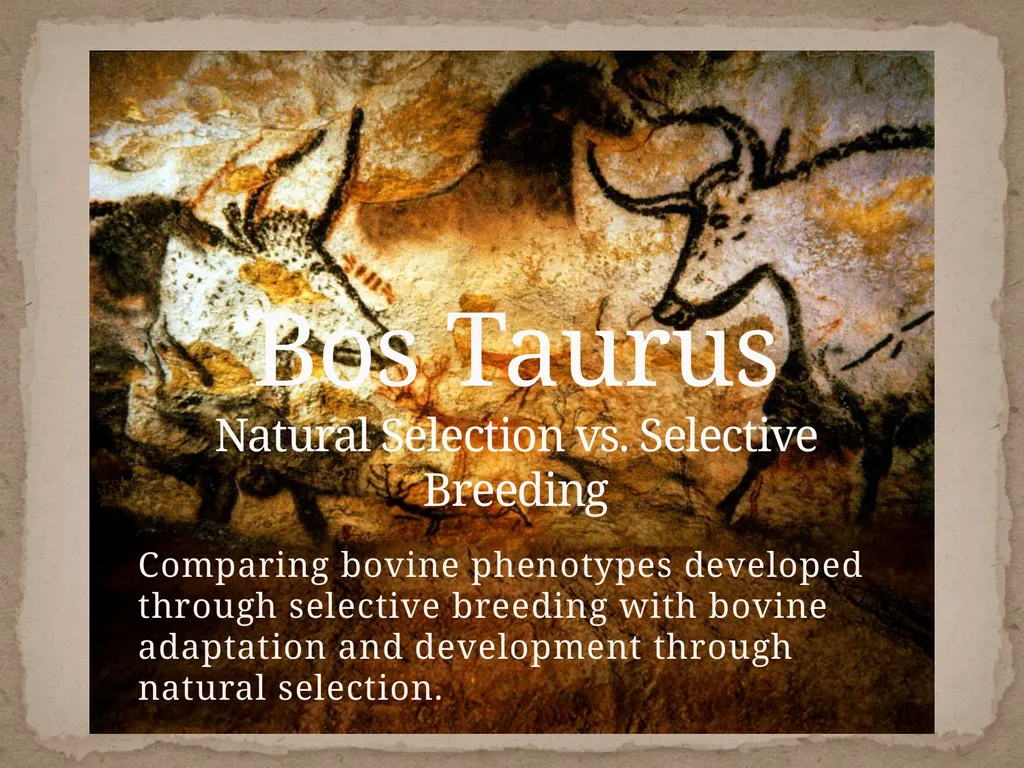
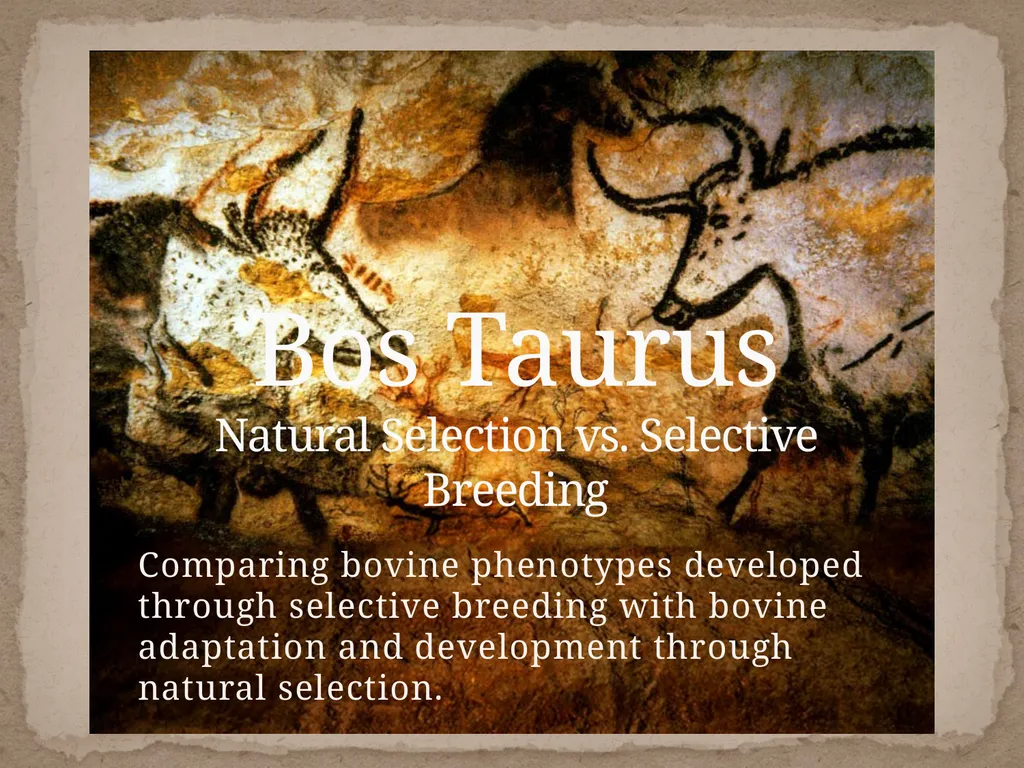
Comparing bovine phenotypes developed through selective breeding with bovine adaptation and development through natural selection. Bos Taurus
Natural Selection vs. Selective Breeding<br>
02
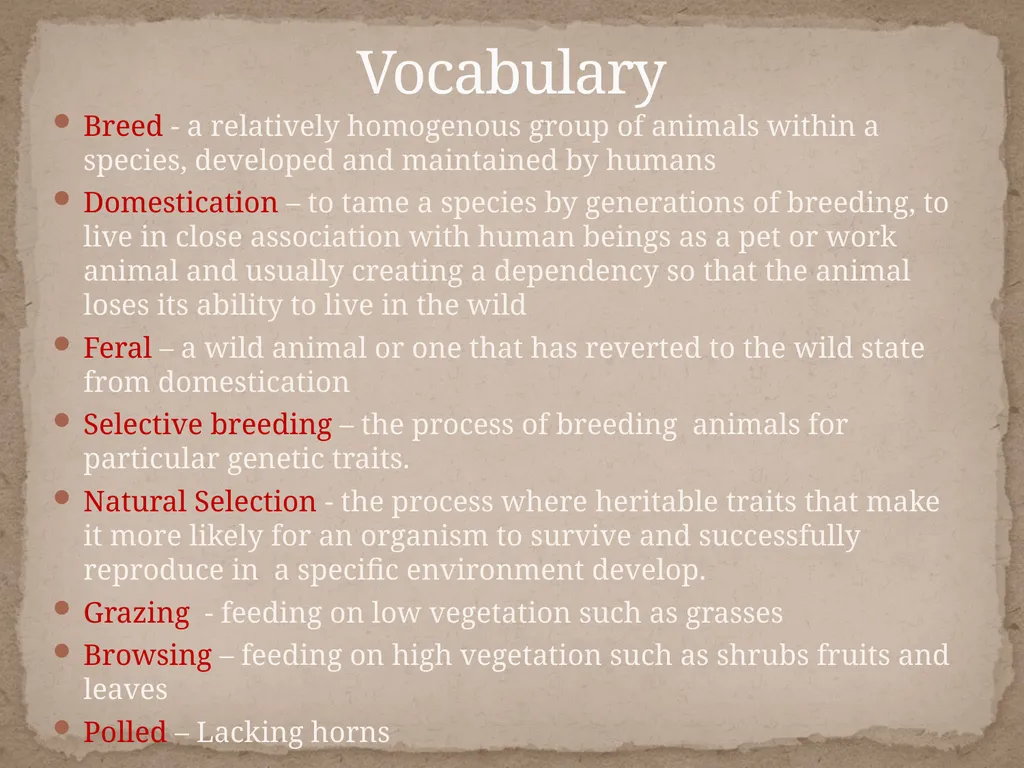
Breed - a relatively homogenous group of animals within a species, developed and maintained by humans
Domestication – to tame a species by generations of breeding, to live in close association with human beings as a pet or work animal and usually creating a dependency so that the animal loses its ability to live in the wild
Feral – a wild animal or one that has reverted to the wild state from domestication
Selective breeding – the process of breeding animals for particular genetic traits.
Natural Selection - the process where heritable traits that make it more likely for an organism to survive and successfully reproduce in a specific environment develop.
Grazing - feeding on low vegetation such as grasses
Browsing – feeding on high vegetation such as shrubs fruits and leaves
Polled – Lacking horns Vocabulary<br>
Domestication – to tame a species by generations of breeding, to live in close association with human beings as a pet or work animal and usually creating a dependency so that the animal loses its ability to live in the wild
Feral – a wild animal or one that has reverted to the wild state from domestication
Selective breeding – the process of breeding animals for particular genetic traits.
Natural Selection - the process where heritable traits that make it more likely for an organism to survive and successfully reproduce in a specific environment develop.
Grazing - feeding on low vegetation such as grasses
Browsing – feeding on high vegetation such as shrubs fruits and leaves
Polled – Lacking horns Vocabulary<br>
03
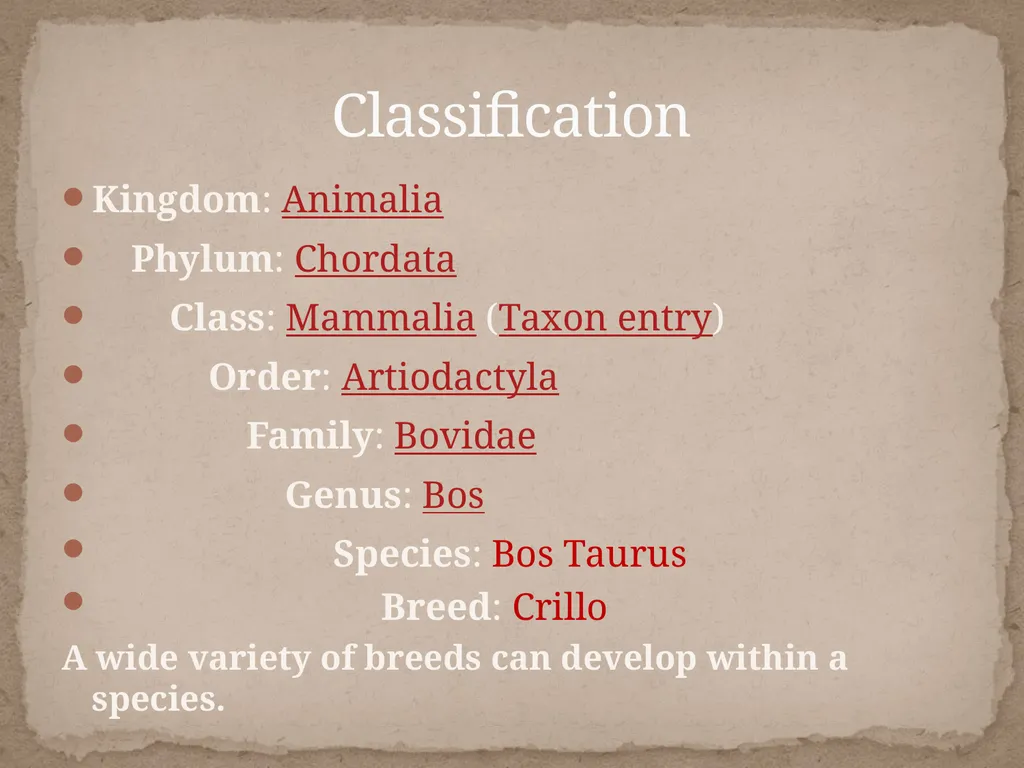
Kingdom: Animalia
Phylum: Chordata
Class: Mammalia (Taxon entry)
Order: Artiodactyla
Family: Bovidae
Genus: Bos
Species: Bos Taurus
Breed: Crillo
A wide variety of breeds can develop within a species. Classification<br>
Phylum: Chordata
Class: Mammalia (Taxon entry)
Order: Artiodactyla
Family: Bovidae
Genus: Bos
Species: Bos Taurus
Breed: Crillo
A wide variety of breeds can develop within a species. Classification<br>
04
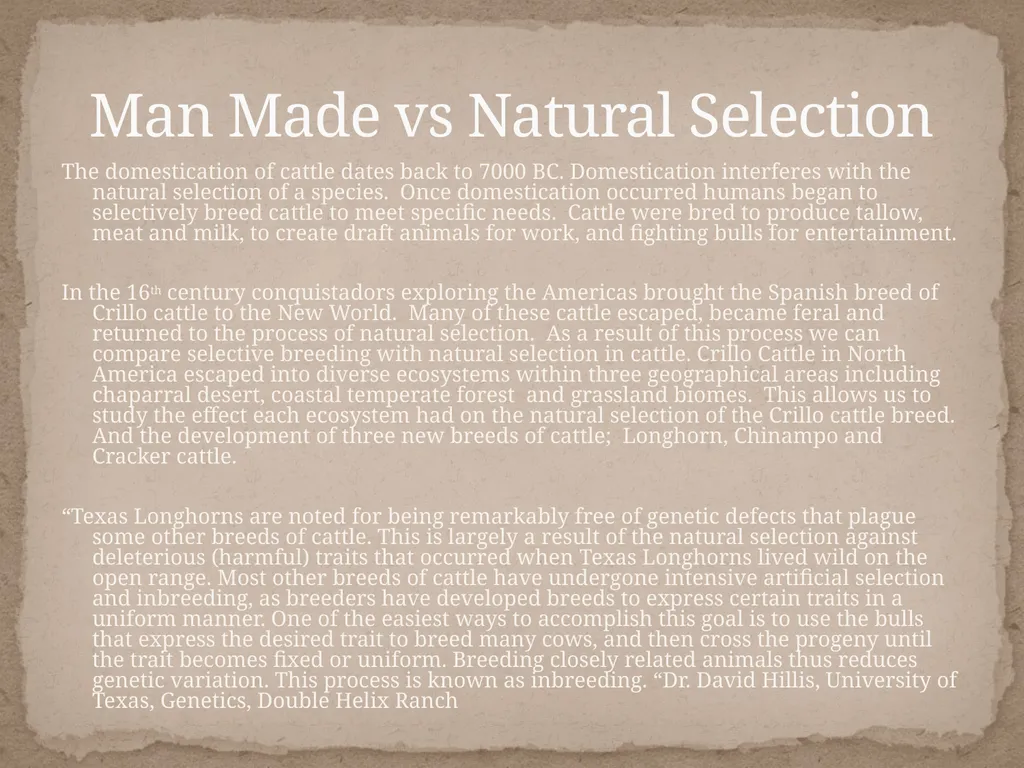
The domestication of cattle dates back to 7000 BC. Domestication interferes with the natural selection of a species. Once domestication occurred humans began to selectively breed cattle to meet specific needs. Cattle were bred to produce tallow, meat and milk, to create draft animals for work, and fighting bulls for entertainment.
In the 16th century conquistadors exploring the Americas brought the Spanish breed of Crillo cattle to the New World. Many of these cattle escaped, became feral and returned to the process of natural selection. As a result of this process we can compare selective breeding with natural selection in cattle. Crillo Cattle in North America escaped into diverse ecosystems within three geographical areas including chaparral desert, coastal temperate forest and grassland biomes. This allows us to study the effect each ecosystem had on the natural selection of the Crillo cattle breed. And the development of three new breeds of cattle; Longhorn, Chinampo and Cracker cattle.
“Texas Longhorns are noted for being remarkably free of genetic defects that plague some other breeds of cattle. This is largely a result of the natural selection against deleterious (harmful) traits that occurred when Texas Longhorns lived wild on the open range. Most other breeds of cattle have undergone intensive artificial selection and inbreeding, as breeders have developed breeds to express certain traits in a uniform manner. One of the easiest ways to accomplish this goal is to use the bulls that express the desired trait to breed many cows, and then cross the progeny until the trait becomes fixed or uniform. Breeding closely related animals thus reduces genetic variation. This process is known as inbreeding. “Dr. David Hillis, University of Texas, Genetics, Double Helix Ranch Man Made vs Natural Selection<br>
In the 16th century conquistadors exploring the Americas brought the Spanish breed of Crillo cattle to the New World. Many of these cattle escaped, became feral and returned to the process of natural selection. As a result of this process we can compare selective breeding with natural selection in cattle. Crillo Cattle in North America escaped into diverse ecosystems within three geographical areas including chaparral desert, coastal temperate forest and grassland biomes. This allows us to study the effect each ecosystem had on the natural selection of the Crillo cattle breed. And the development of three new breeds of cattle; Longhorn, Chinampo and Cracker cattle.
“Texas Longhorns are noted for being remarkably free of genetic defects that plague some other breeds of cattle. This is largely a result of the natural selection against deleterious (harmful) traits that occurred when Texas Longhorns lived wild on the open range. Most other breeds of cattle have undergone intensive artificial selection and inbreeding, as breeders have developed breeds to express certain traits in a uniform manner. One of the easiest ways to accomplish this goal is to use the bulls that express the desired trait to breed many cows, and then cross the progeny until the trait becomes fixed or uniform. Breeding closely related animals thus reduces genetic variation. This process is known as inbreeding. “Dr. David Hillis, University of Texas, Genetics, Double Helix Ranch Man Made vs Natural Selection<br>
05
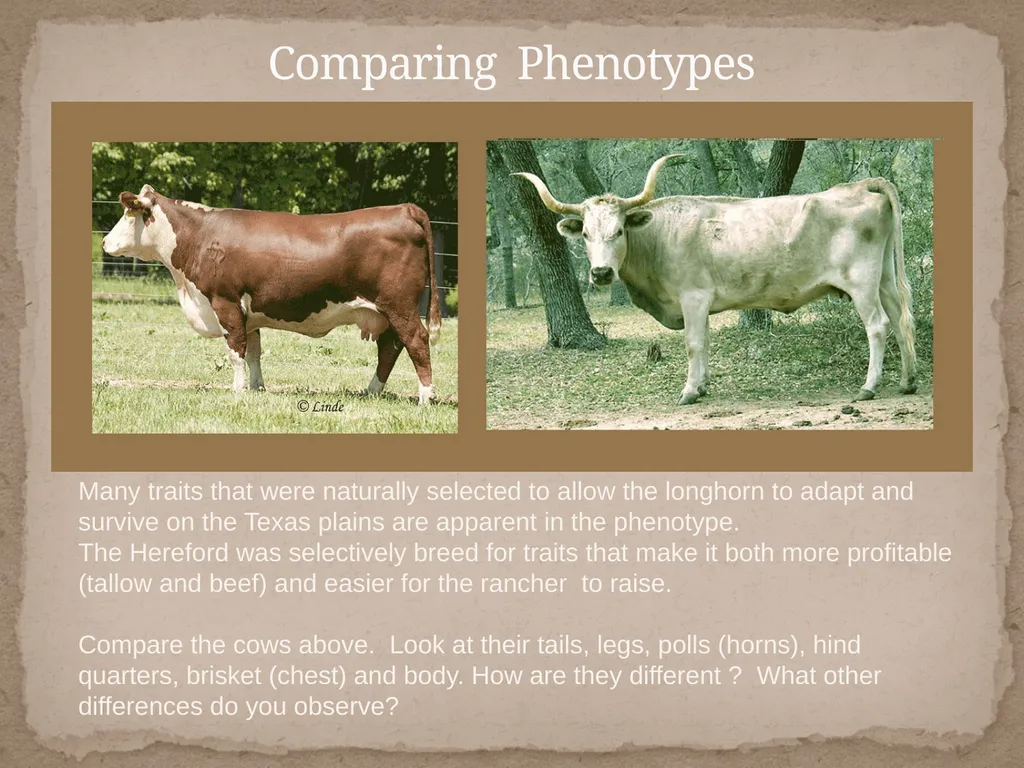
Comparing Phenotypes Many traits that were naturally selected to allow the longhorn to adapt and survive on the Texas plains are apparent in the phenotype.
The Hereford was selectively breed for traits that make it both more profitable (tallow and beef) and easier for the rancher to raise.
Compare the cows above. Look at their tails, legs, polls (horns), hind quarters, brisket (chest) and body. How are they different ? What other differences do you observe?<br>
The Hereford was selectively breed for traits that make it both more profitable (tallow and beef) and easier for the rancher to raise.
Compare the cows above. Look at their tails, legs, polls (horns), hind quarters, brisket (chest) and body. How are they different ? What other differences do you observe?<br>
06
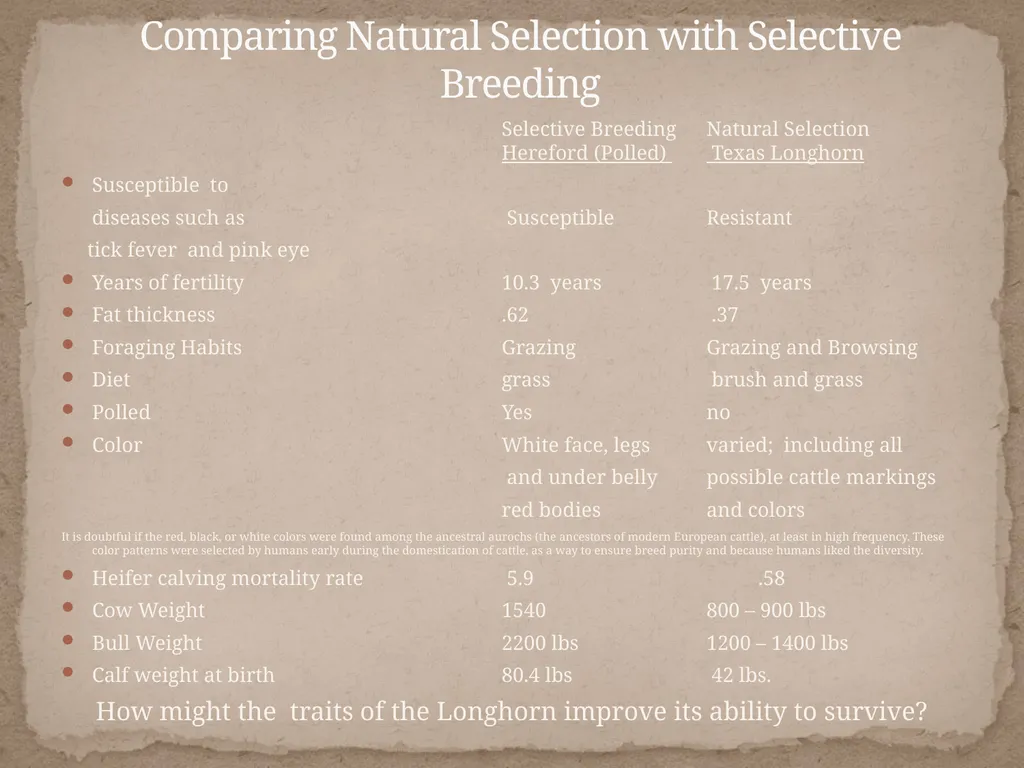
Selective Breeding Natural Selection Hereford (Polled) Texas Longhorn
Susceptible to
diseases such as Susceptible Resistant
tick fever and pink eye
Years of fertility 10.3 years 17.5 years
Fat thickness .62 .37
Foraging Habits Grazing Grazing and Browsing
Diet grass brush and grass
Polled Yes no
Color White face, legs varied; including all
and under belly possible cattle markings
red bodies and colors
It is doubtful if the red, black, or white colors were found among the ancestral aurochs (the ancestors of modern European cattle), at least in high frequency. These color patterns were selected by humans early during the domestication of cattle, as a way to ensure breed purity and because humans liked the diversity.
Heifer calving mortality rate 5.9 .58
Cow Weight 1540 800 – 900 lbs
Bull Weight 2200 lbs 1200 – 1400 lbs
Calf weight at birth 80.4 lbs 42 lbs.
How might the traits of the Longhorn improve its ability to survive? Comparing Natural Selection with Selective Breeding<br>
Susceptible to
diseases such as Susceptible Resistant
tick fever and pink eye
Years of fertility 10.3 years 17.5 years
Fat thickness .62 .37
Foraging Habits Grazing Grazing and Browsing
Diet grass brush and grass
Polled Yes no
Color White face, legs varied; including all
and under belly possible cattle markings
red bodies and colors
It is doubtful if the red, black, or white colors were found among the ancestral aurochs (the ancestors of modern European cattle), at least in high frequency. These color patterns were selected by humans early during the domestication of cattle, as a way to ensure breed purity and because humans liked the diversity.
Heifer calving mortality rate 5.9 .58
Cow Weight 1540 800 – 900 lbs
Bull Weight 2200 lbs 1200 – 1400 lbs
Calf weight at birth 80.4 lbs 42 lbs.
How might the traits of the Longhorn improve its ability to survive? Comparing Natural Selection with Selective Breeding<br>
07
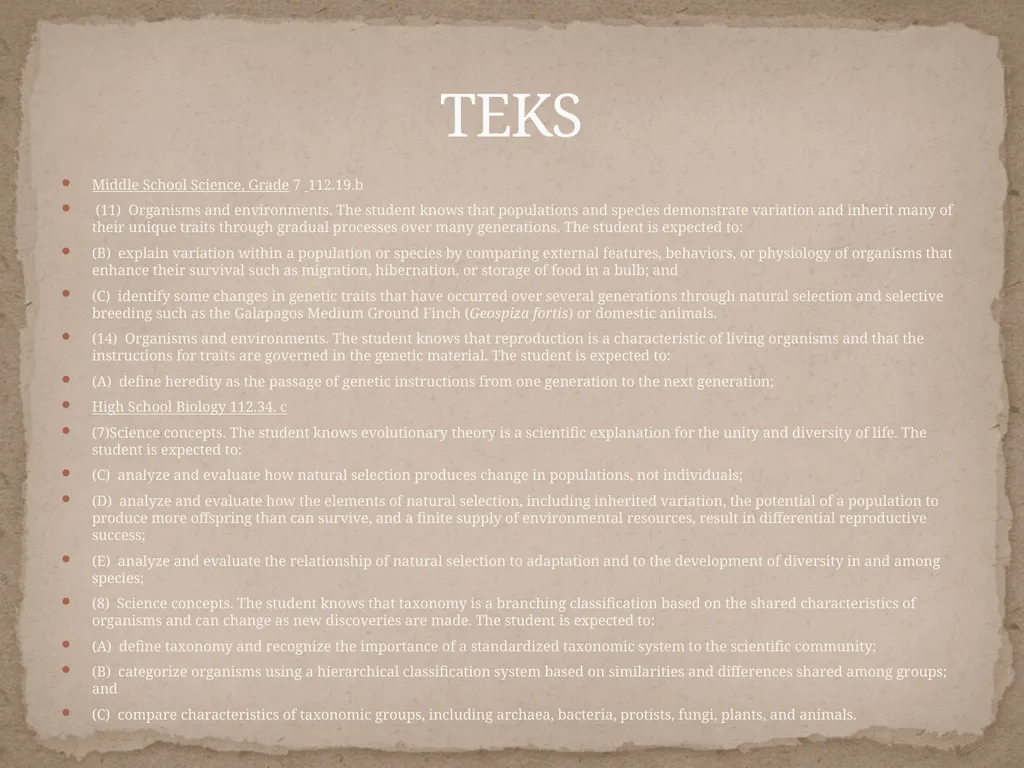
Middle School Science, Grade 7 112.19.b
(11) Organisms and environments. The student knows that populations and species demonstrate variation and inherit many of their unique traits through gradual processes over many generations. The student is expected to:
(B) explain variation within a population or species by comparing external features, behaviors, or physiology of organisms that enhance their survival such as migration, hibernation, or storage of food in a bulb; and
(C) identify some changes in genetic traits that have occurred over several generations through natural selection and selective breeding such as the Galapagos Medium Ground Finch (Geospiza fortis) or domestic animals.
(14) Organisms and environments. The student knows that reproduction is a characteristic of living organisms and that the instructions for traits are governed in the genetic material. The student is expected to:
(A) define heredity as the passage of genetic instructions from one generation to the next generation;
High School Biology 112.34. c
(7)Science concepts. The student knows evolutionary theory is a scientific explanation for the unity and diversity of life. The student is expected to:
(C) analyze and evaluate how natural selection produces change in populations, not individuals;
(D) analyze and evaluate how the elements of natural selection, including inherited variation, the potential of a population to produce more offspring than can survive, and a finite supply of environmental resources, result in differential reproductive success;
(E) analyze and evaluate the relationship of natural selection to adaptation and to the development of diversity in and among species;
(8) Science concepts. The student knows that taxonomy is a branching classification based on the shared characteristics of organisms and can change as new discoveries are made. The student is expected to:
(A) define taxonomy and recognize the importance of a standardized taxonomic system to the scientific community;
(B) categorize organisms using a hierarchical classification system based on similarities and differences shared among groups; and
(C) compare characteristics of taxonomic groups, including archaea, bacteria, protists, fungi, plants, and animals. TEKS<br>
(11) Organisms and environments. The student knows that populations and species demonstrate variation and inherit many of their unique traits through gradual processes over many generations. The student is expected to:
(B) explain variation within a population or species by comparing external features, behaviors, or physiology of organisms that enhance their survival such as migration, hibernation, or storage of food in a bulb; and
(C) identify some changes in genetic traits that have occurred over several generations through natural selection and selective breeding such as the Galapagos Medium Ground Finch (Geospiza fortis) or domestic animals.
(14) Organisms and environments. The student knows that reproduction is a characteristic of living organisms and that the instructions for traits are governed in the genetic material. The student is expected to:
(A) define heredity as the passage of genetic instructions from one generation to the next generation;
High School Biology 112.34. c
(7)Science concepts. The student knows evolutionary theory is a scientific explanation for the unity and diversity of life. The student is expected to:
(C) analyze and evaluate how natural selection produces change in populations, not individuals;
(D) analyze and evaluate how the elements of natural selection, including inherited variation, the potential of a population to produce more offspring than can survive, and a finite supply of environmental resources, result in differential reproductive success;
(E) analyze and evaluate the relationship of natural selection to adaptation and to the development of diversity in and among species;
(8) Science concepts. The student knows that taxonomy is a branching classification based on the shared characteristics of organisms and can change as new discoveries are made. The student is expected to:
(A) define taxonomy and recognize the importance of a standardized taxonomic system to the scientific community;
(B) categorize organisms using a hierarchical classification system based on similarities and differences shared among groups; and
(C) compare characteristics of taxonomic groups, including archaea, bacteria, protists, fungi, plants, and animals. TEKS<br>
08
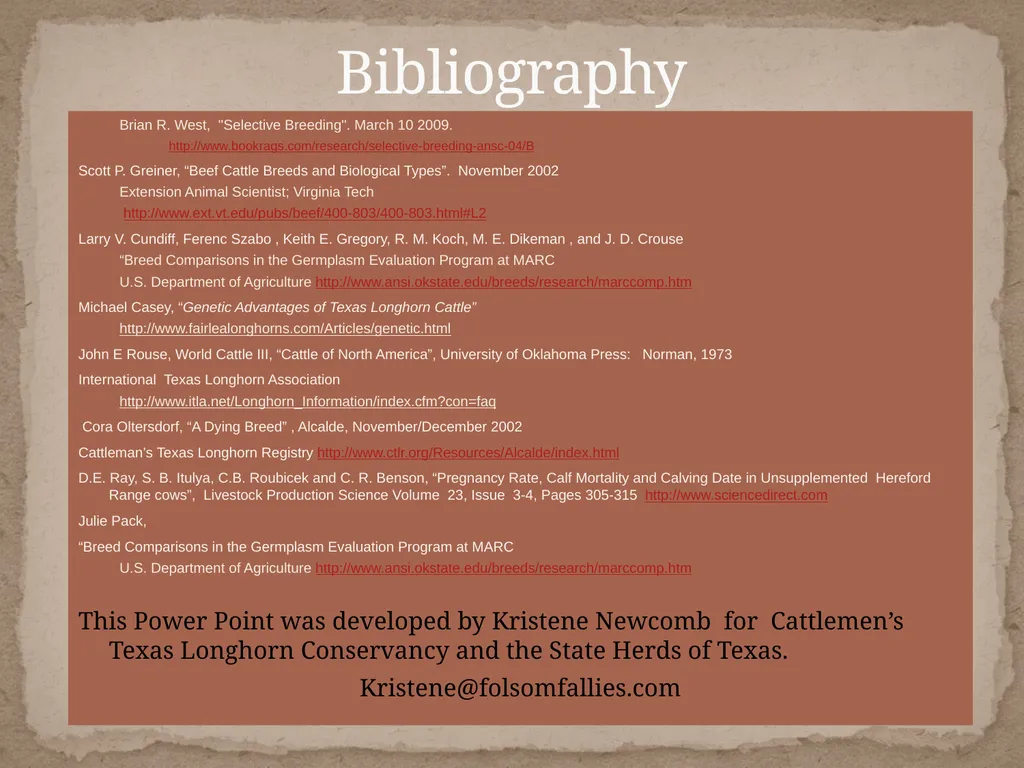
Brian R. West, "Selective Breeding". March 10 2009.
http://www.bookrags.com/research/selective-breeding-ansc-04/B
Scott P. Greiner, “Beef Cattle Breeds and Biological Types”. November 2002
Extension Animal Scientist; Virginia Tech
http://www.ext.vt.edu/pubs/beef/400-803/400-803.html#L2
Larry V. Cundiff, Ferenc Szabo , Keith E. Gregory, R. M. Koch, M. E. Dikeman , and J. D. Crouse
“Breed Comparisons in the Germplasm Evaluation Program at MARC
U.S. Department of Agriculture http://www.ansi.okstate.edu/breeds/research/marccomp.htm
Michael Casey, “Genetic Advantages of Texas Longhorn Cattle”
http://www.fairlealonghorns.com/Articles/genetic.html
John E Rouse, World Cattle III, “Cattle of North America”, University of Oklahoma Press: Norman, 1973
International Texas Longhorn Association
http://www.itla.net/Longhorn_Information/index.cfm?con=faq
Cora Oltersdorf, “A Dying Breed” , Alcalde, November/December 2002
Cattleman’s Texas Longhorn Registry http://www.ctlr.org/Resources/Alcalde/index.html
D.E. Ray, S. B. Itulya, C.B. Roubicek and C. R. Benson, “Pregnancy Rate, Calf Mortality and Calving Date in Unsupplemented Hereford Range cows”, Livestock Production Science Volume 23, Issue 3-4, Pages 305-315 http://www.sciencedirect.com
Julie Pack,
“Breed Comparisons in the Germplasm Evaluation Program at MARC
U.S. Department of Agriculture http://www.ansi.okstate.edu/breeds/research/marccomp.htm
This Power Point was developed by Kristene Newcomb for Cattlemen’s Texas Longhorn Conservancy and the State Herds of Texas.
Kristene@folsomfallies.com Bibliography<br>
http://www.bookrags.com/research/selective-breeding-ansc-04/B
Scott P. Greiner, “Beef Cattle Breeds and Biological Types”. November 2002
Extension Animal Scientist; Virginia Tech
http://www.ext.vt.edu/pubs/beef/400-803/400-803.html#L2
Larry V. Cundiff, Ferenc Szabo , Keith E. Gregory, R. M. Koch, M. E. Dikeman , and J. D. Crouse
“Breed Comparisons in the Germplasm Evaluation Program at MARC
U.S. Department of Agriculture http://www.ansi.okstate.edu/breeds/research/marccomp.htm
Michael Casey, “Genetic Advantages of Texas Longhorn Cattle”
http://www.fairlealonghorns.com/Articles/genetic.html
John E Rouse, World Cattle III, “Cattle of North America”, University of Oklahoma Press: Norman, 1973
International Texas Longhorn Association
http://www.itla.net/Longhorn_Information/index.cfm?con=faq
Cora Oltersdorf, “A Dying Breed” , Alcalde, November/December 2002
Cattleman’s Texas Longhorn Registry http://www.ctlr.org/Resources/Alcalde/index.html
D.E. Ray, S. B. Itulya, C.B. Roubicek and C. R. Benson, “Pregnancy Rate, Calf Mortality and Calving Date in Unsupplemented Hereford Range cows”, Livestock Production Science Volume 23, Issue 3-4, Pages 305-315 http://www.sciencedirect.com
Julie Pack,
“Breed Comparisons in the Germplasm Evaluation Program at MARC
U.S. Department of Agriculture http://www.ansi.okstate.edu/breeds/research/marccomp.htm
This Power Point was developed by Kristene Newcomb for Cattlemen’s Texas Longhorn Conservancy and the State Herds of Texas.
Kristene@folsomfallies.com Bibliography<br>