Control: Organizational and Economic Approaches Kathleen M. Eisenhardt Department of Industrial Engineering and Engineering management, Stanford University Presented by Hui Chen Organization Theory Theory Empirical Discussion Contribution
"Control: Organizational and Economic Approaches" is the property of its rightful owner. Permission is granted to
download and print the materials on this website for personal, non-commercial use only, and to display it
on your personal computer provided you do not modify the materials and that you retain all copyright
notices contained in the materials. By downloading content from our website, you accept the terms of this
agreement.
Presentation Transcript
01
Control: Organizational and Economic Approaches Kathleen M. Eisenhardt
Department of Industrial Engineering and Engineering management, Stanford University Presented by Hui Chen<br>
02
Organization Theory Theory
Empirical
Discussion
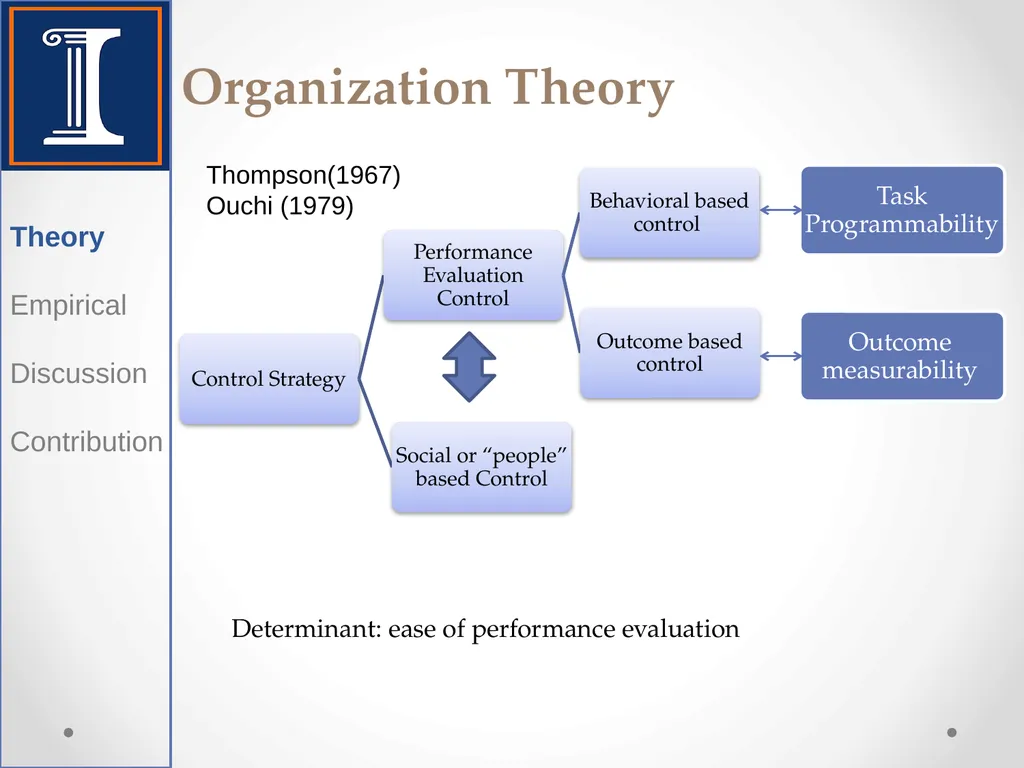
Contribution Thompson(1967) Ouchi (1979) Determinant: ease of performance evaluation<br>
03
Theory
Empirical
Discussion
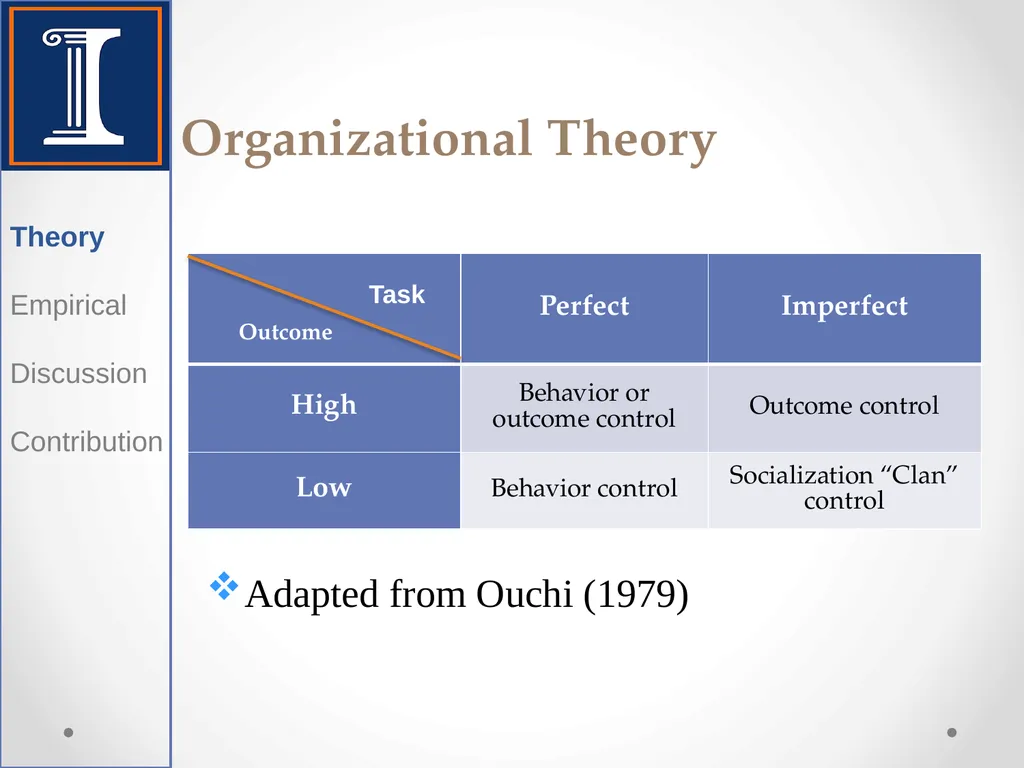
Contribution Organizational Theory Adapted from Ouchi (1979) Outcome Task<br>
04
Theory
Empirical
Discussion
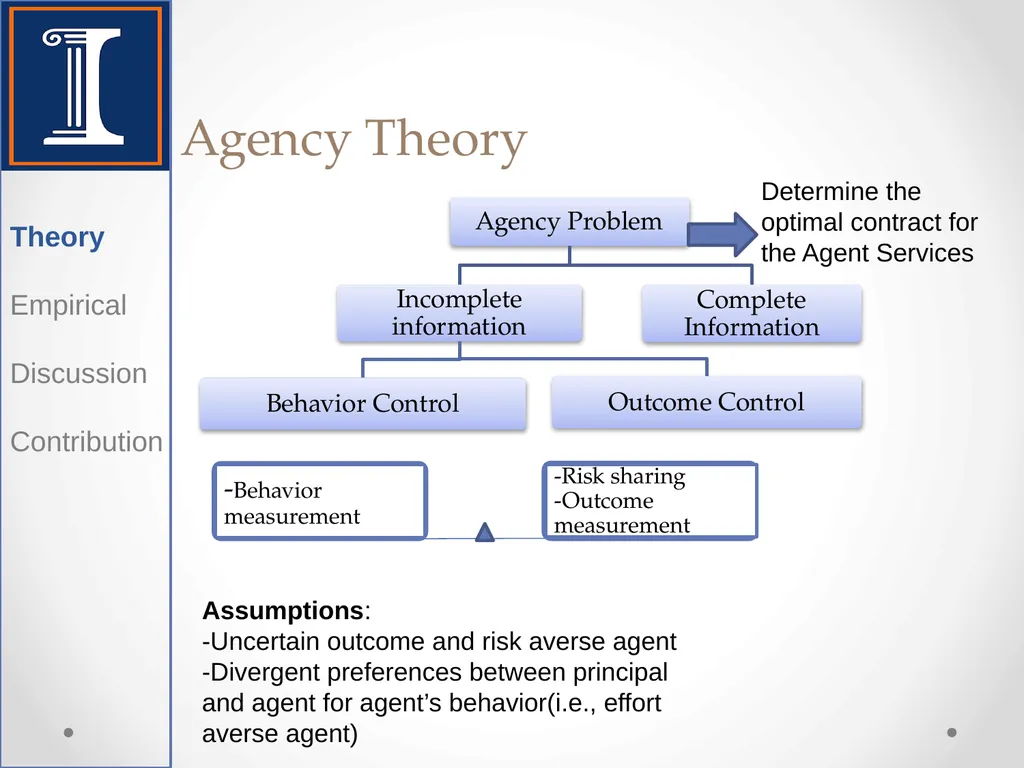
Contribution Agency Theory Determine the optimal contract for the Agent Services Assumptions:
-Uncertain outcome and risk averse agent
-Divergent preferences between principal and agent for agent’s behavior(i.e., effort averse agent)<br>
05
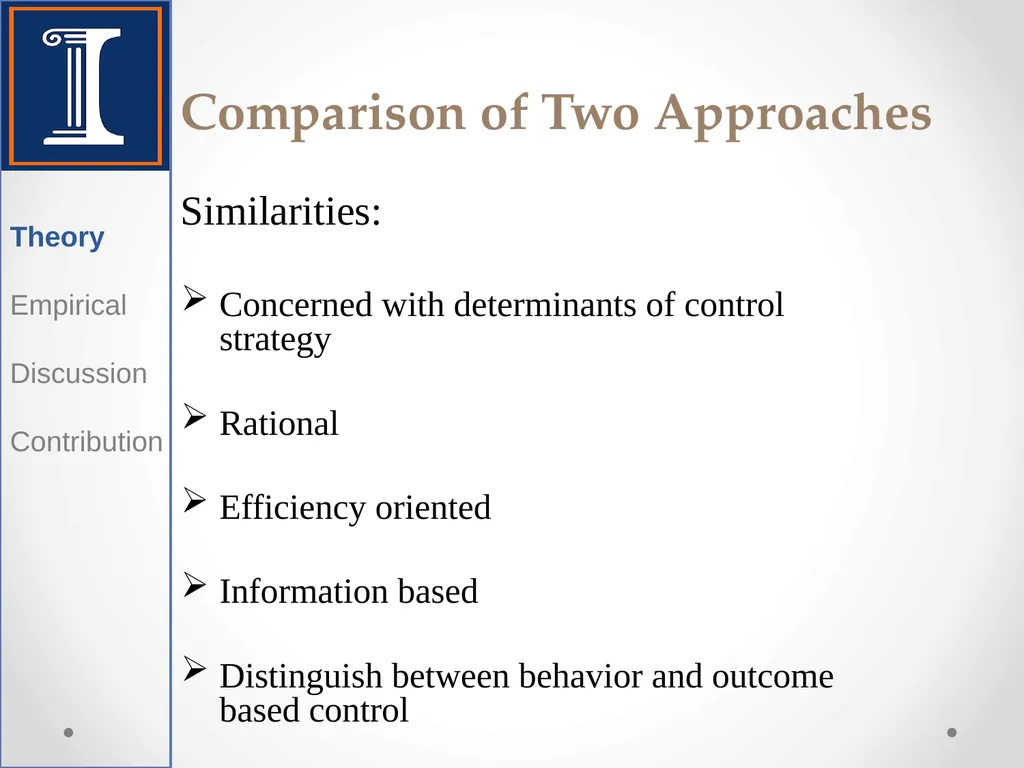
Comparison of Two Approaches Similarities:
Concerned with determinants of control strategy
Rational
Efficiency oriented
Information based
Distinguish between behavior and outcome based control Theory
Empirical
Discussion
Contribution<br>
06
Theory
Empirical
Discussion
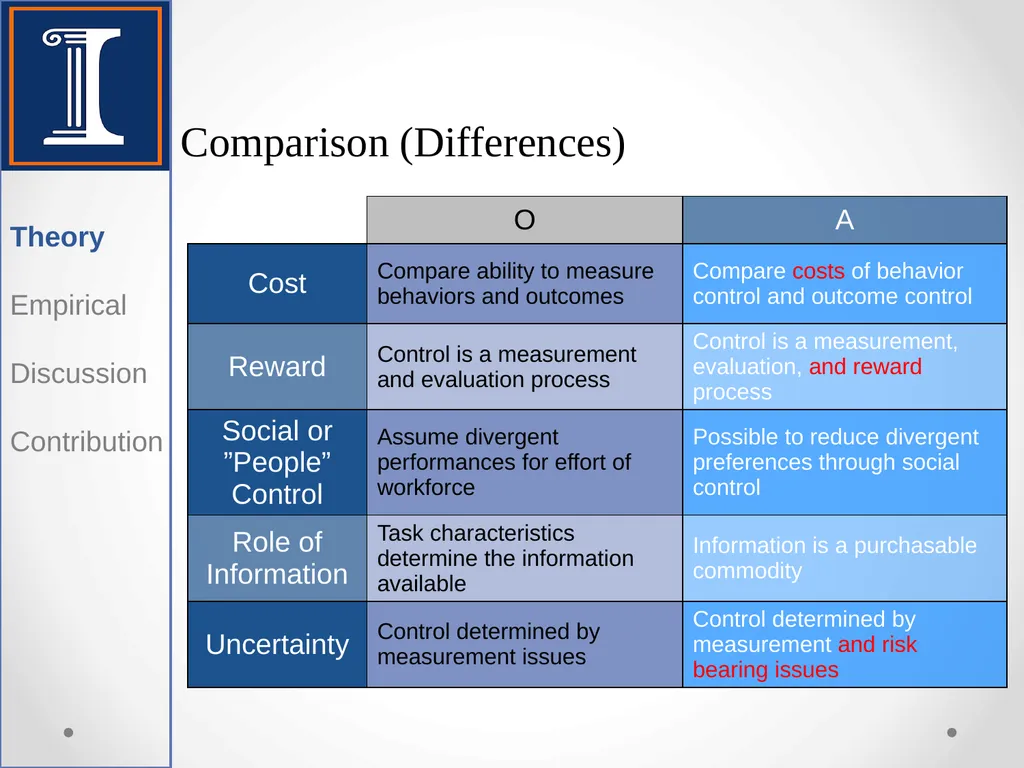
Contribution Comparison (Differences)<br>
07
Theory
Empirical
Discussion
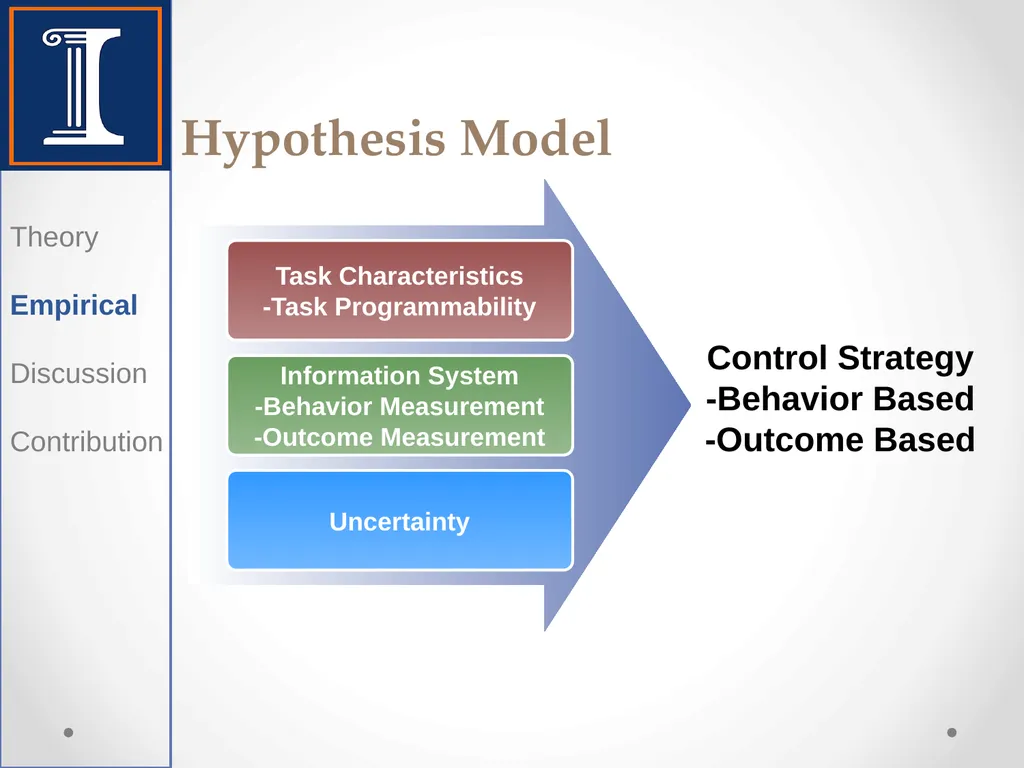
Contribution Hypothesis Model Control Strategy
-Behavior Based
-Outcome Based<br>
08
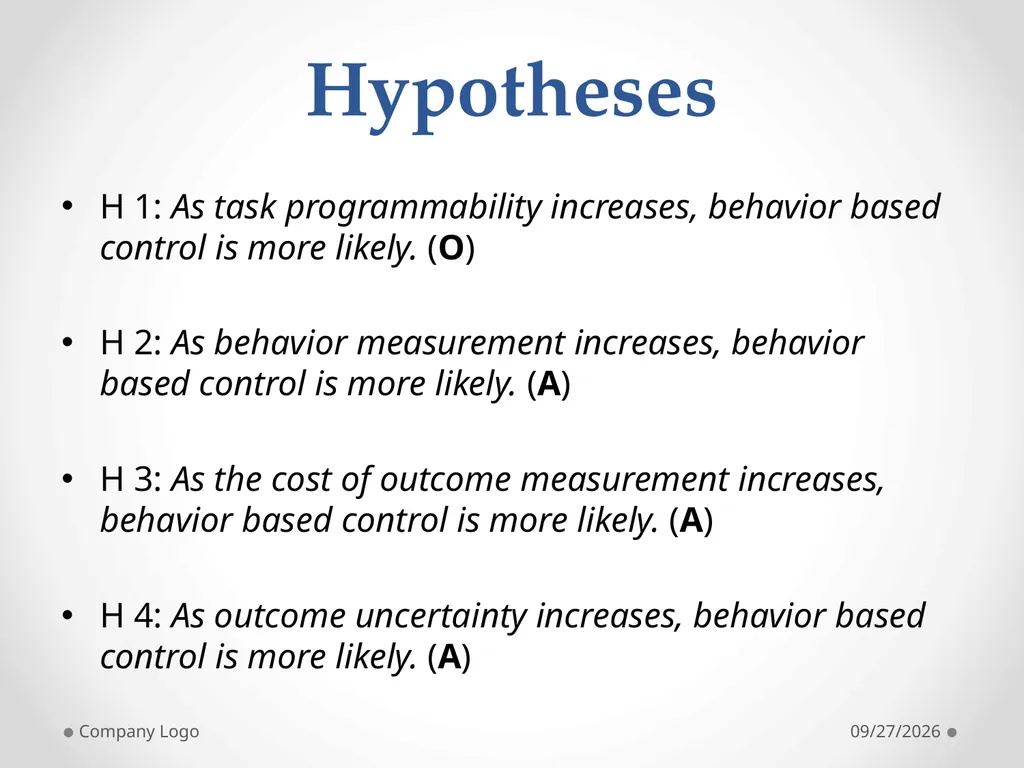
Hypotheses H 1: As task programmability increases, behavior based control is more likely. (O)
H 2: As behavior measurement increases, behavior based control is more likely. (A)
H 3: As the cost of outcome measurement increases, behavior based control is more likely. (A)
H 4: As outcome uncertainty increases, behavior based control is more likely. (A) 9/22/2014 Company Logo<br>
09
Organization Sampling& Methods Sample: 95 specialty stores in a Suburban Bay Area shopping center (54 out 95 usable)
Definition: Stores with less than 8,000 square feet of selling space
Characteristics: Small size and high turnover
Instrument: a questionnaire completed by each store manager Theory
Empirical
Discussion
Contribution<br>
10
Measures Task Programmability
Behavior Measurement
Outcome Uncertainty
Cost of outcome Measurement
Control
Alternative Explanations Theory
Empirical
Discussion
Contribution<br>
11
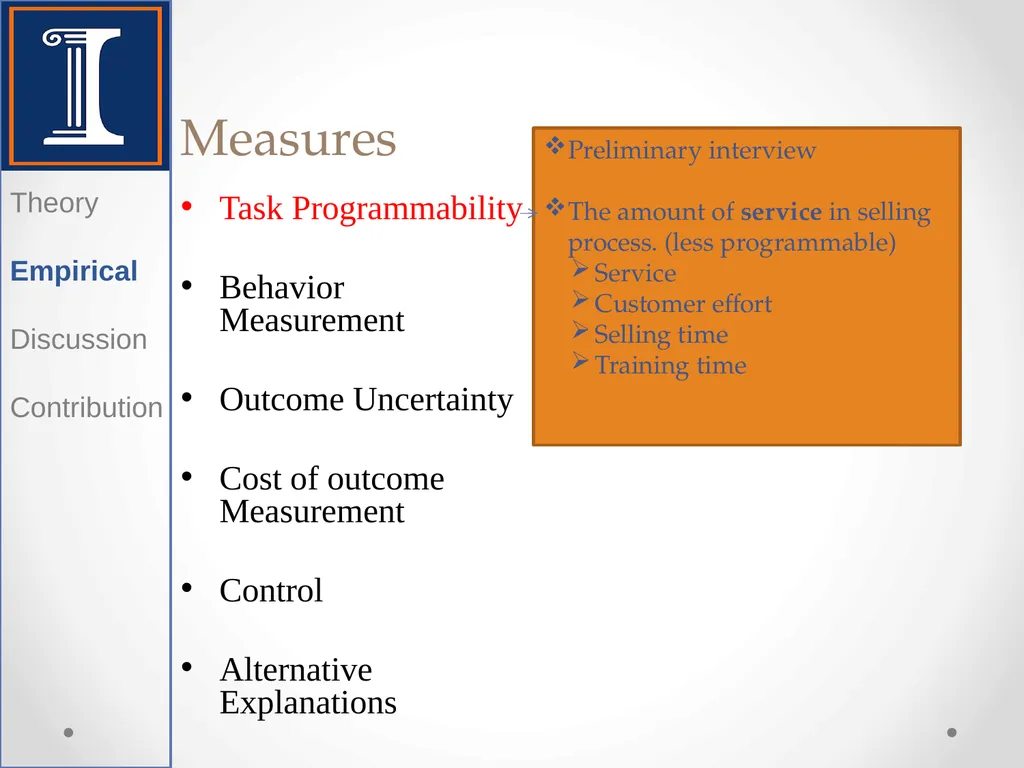
Measures Task Programmability
Behavior Measurement
Outcome Uncertainty
Cost of outcome Measurement
Control
Alternative Explanations Theory
Empirical
Discussion
Contribution Preliminary interview
The amount of service in selling process. (less programmable)
Service
Customer effort
Selling time
Training time<br>
12
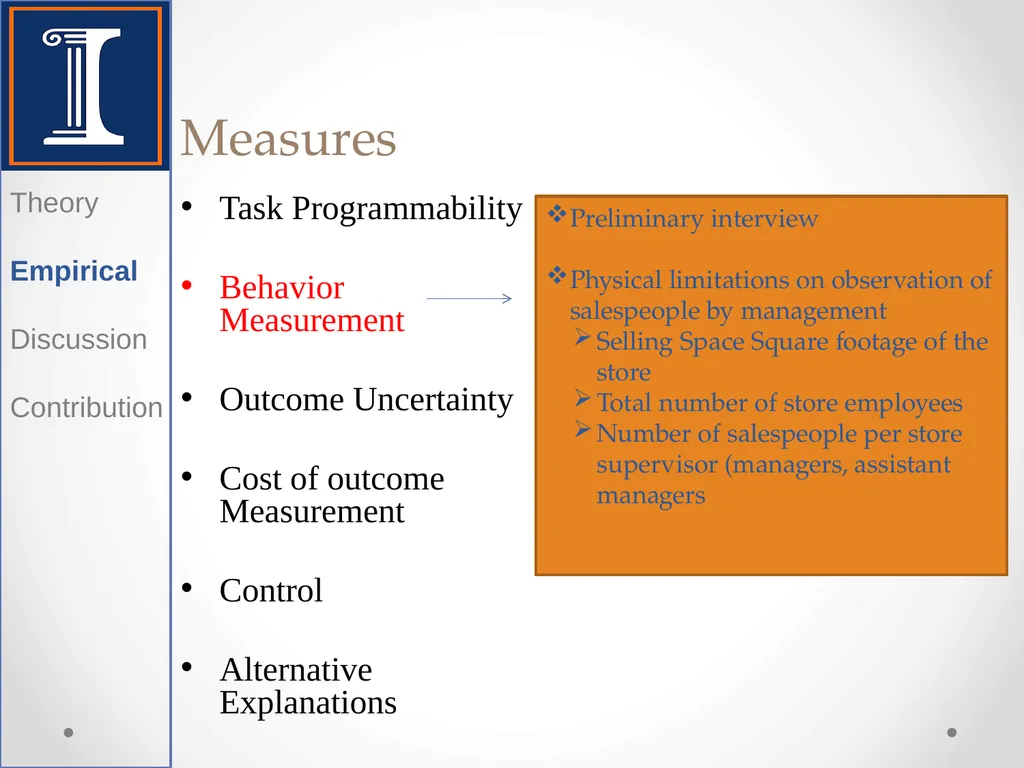
Measures Task Programmability
Behavior Measurement
Outcome Uncertainty
Cost of outcome Measurement
Control
Alternative Explanations Theory
Empirical
Discussion
Contribution Preliminary interview
Physical limitations on observation of salespeople by management
Selling Space Square footage of the store
Total number of store employees
Number of salespeople per store supervisor (managers, assistant managers<br>
13
Measures Task Programmability
Behavior Measurement
Outcome Uncertainty
Cost of outcome Measurement
Control
Alternative Explanations Theory
Empirical
Discussion
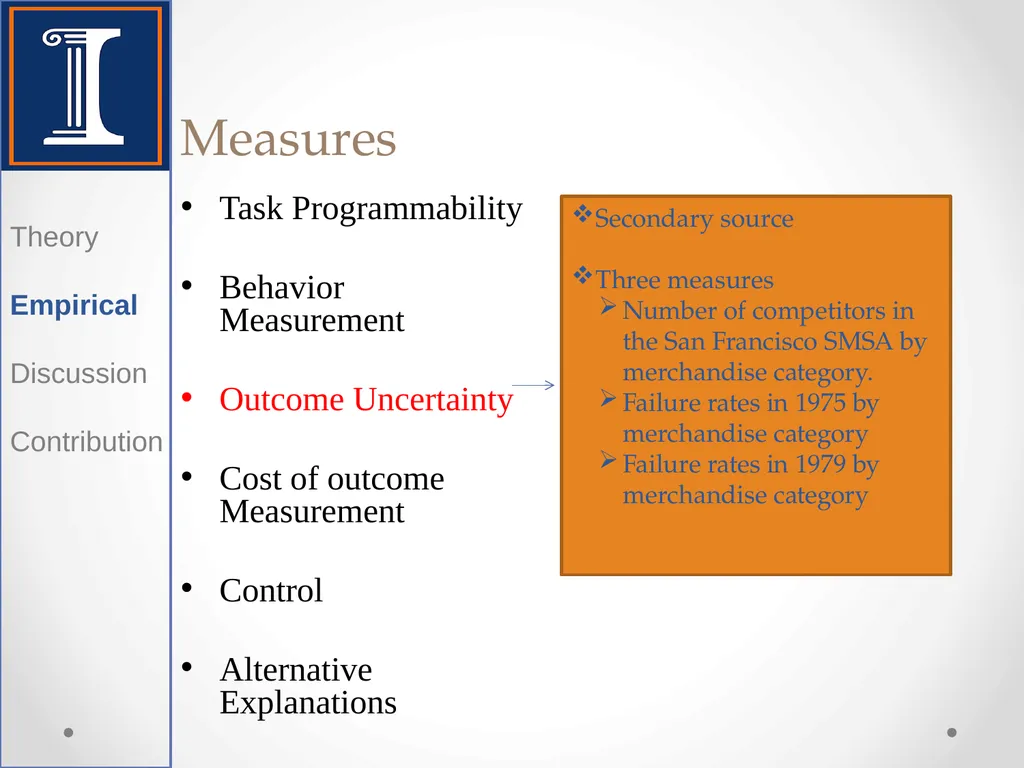
Contribution Secondary source
Three measures
Number of competitors in the San Francisco SMSA by merchandise category.
Failure rates in 1975 by merchandise category
Failure rates in 1979 by merchandise category<br>
14
Measures Task Programmability
Behavior Measurement
Outcome Uncertainty
Cost of outcome Measurement
Control
Alternative Explanations Theory
Empirical
Discussion
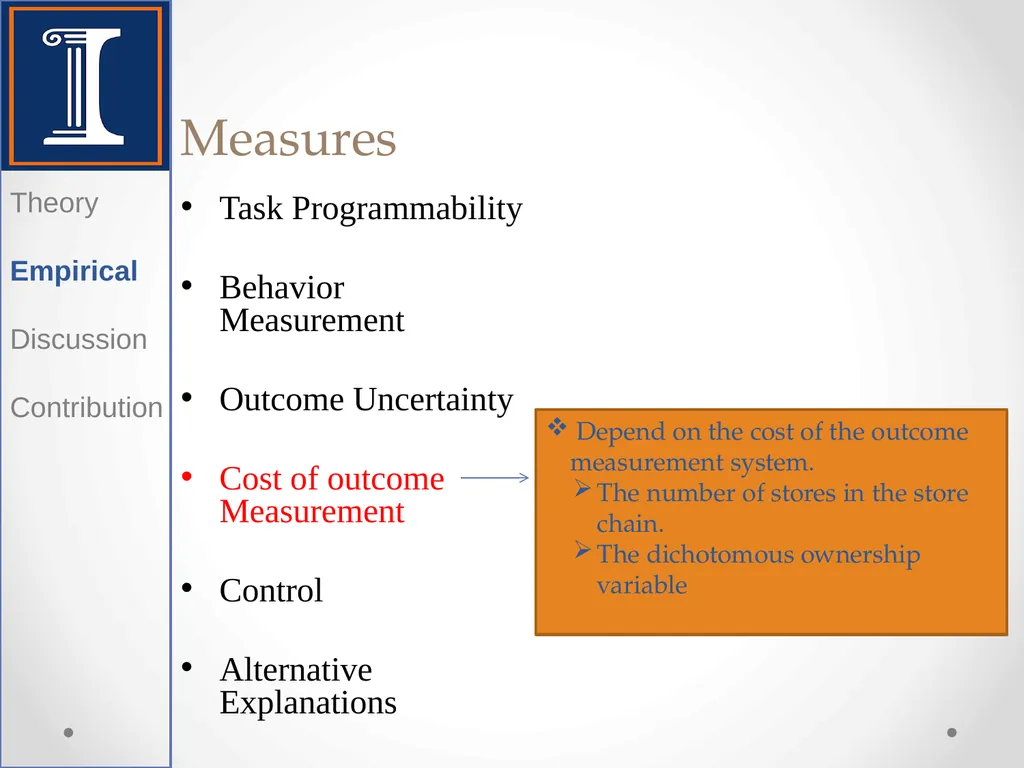
Contribution Depend on the cost of the outcome measurement system.
The number of stores in the store chain.
The dichotomous ownership variable<br>
15
Measures Task Programmability
Behavior Measurement
Outcome Uncertainty
Cost of outcome Measurement
Control
Alternative Explanations Theory
Empirical
Discussion
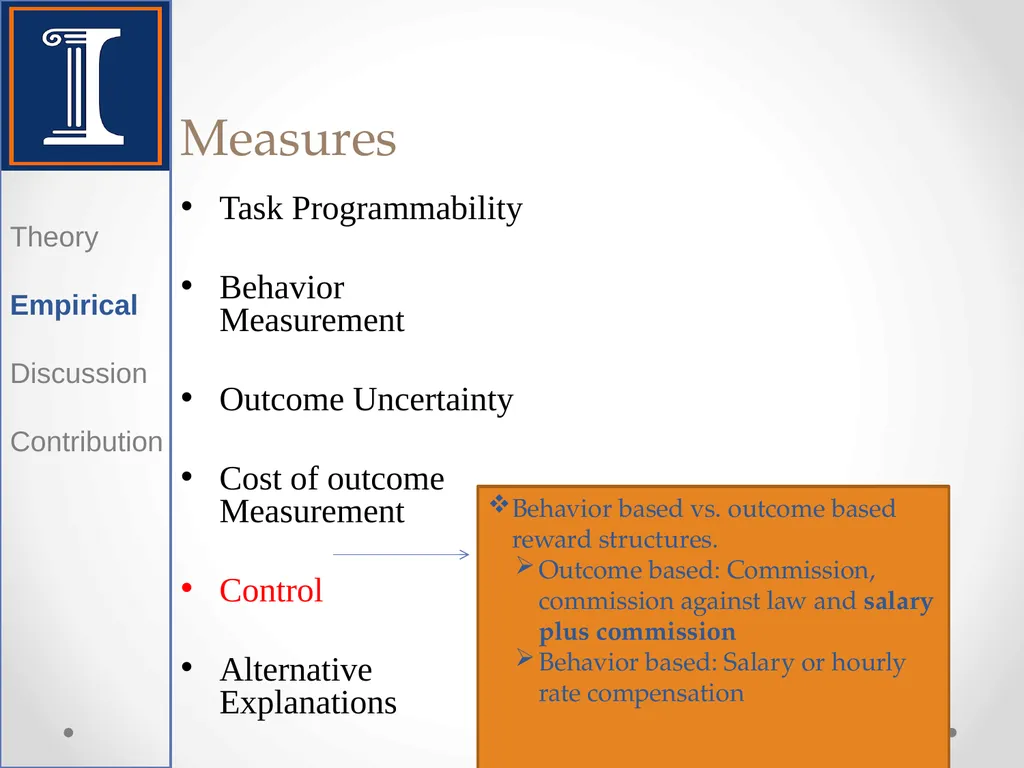
Contribution Behavior based vs. outcome based reward structures.
Outcome based: Commission, commission against law and salary plus commission
Behavior based: Salary or hourly rate compensation<br>
16
Measures Task Programmability
Behavior Measurement
Outcome Uncertainty
Cost of outcome Measurement
Control
Alternative Explanations Theory
Empirical
Discussion
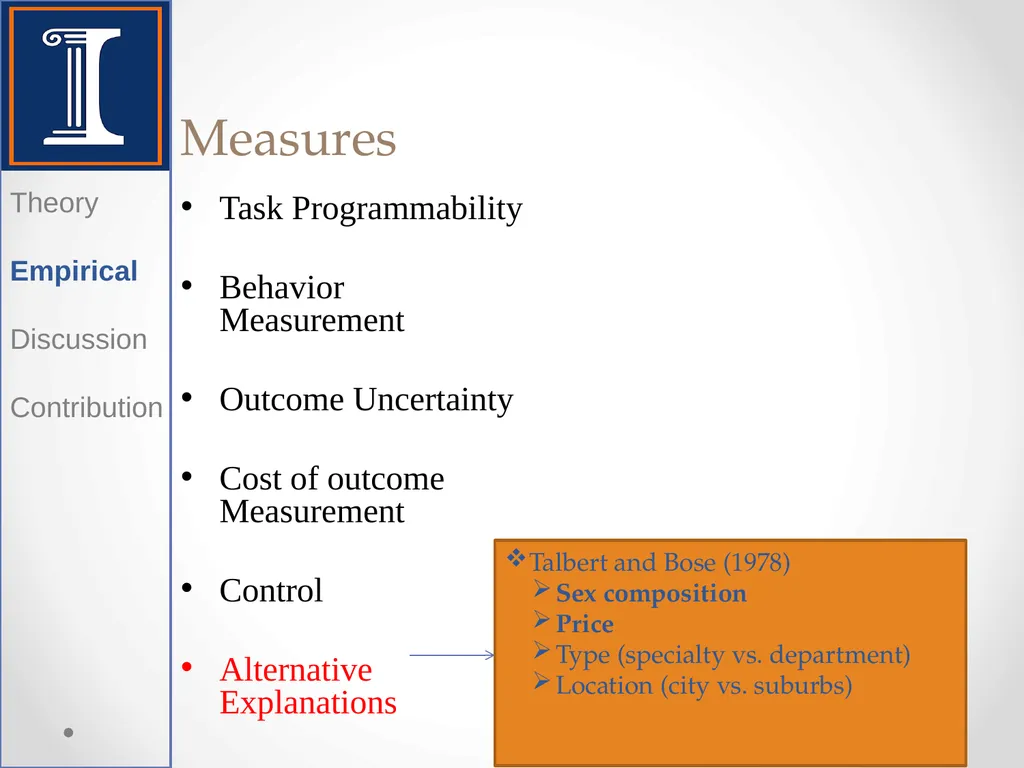
Contribution Talbert and Bose (1978)
Sex composition
Price
Type (specialty vs. department)
Location (city vs. suburbs)<br>
17
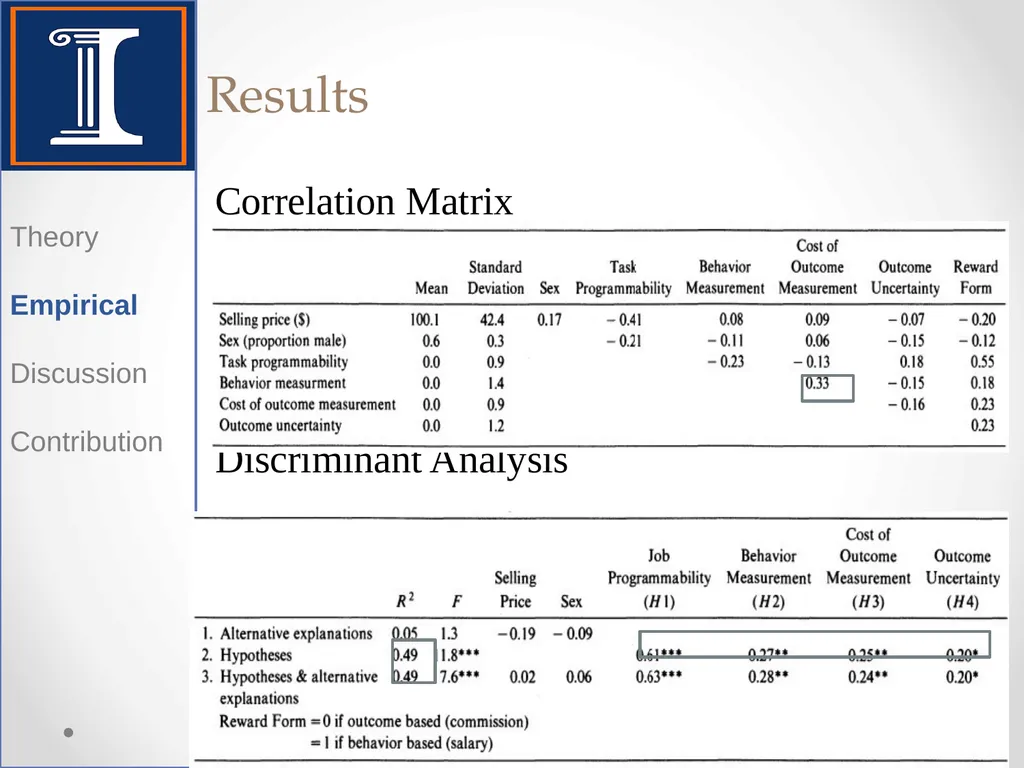
Results Correlation Matrix
Discriminant Analysis Theory
Empirical
Discussion
Contribution<br>
18
Discussion & Implications The organizational and economic perspective are complementary in terms of control strategy.
Task characteristics contribute relatively more explanatory power than do measurement system.
The information economics of performance measurement are relatively more important than the economics of risk bearing as measured by outcome uncertainty.
Job boredom is more like an issue of direction and evaluation under uncertainty than a purely motivation problem.
Responsibility needs not match controllability. Theory
Empirical
Discussion
Contribution<br>
19
Organization Design Framework Design simple and routine job (behavior based control by job design)
Deign a more complex and interesting job (behavior based control by information systems)
Design the more complex and interesting job using a much simpler evaluation scheme such as profitability (outcome based control)
Employ people whose preferences align with those of management (selection, training and socialization) Theory