
Conversations for Change A Systems Change Project
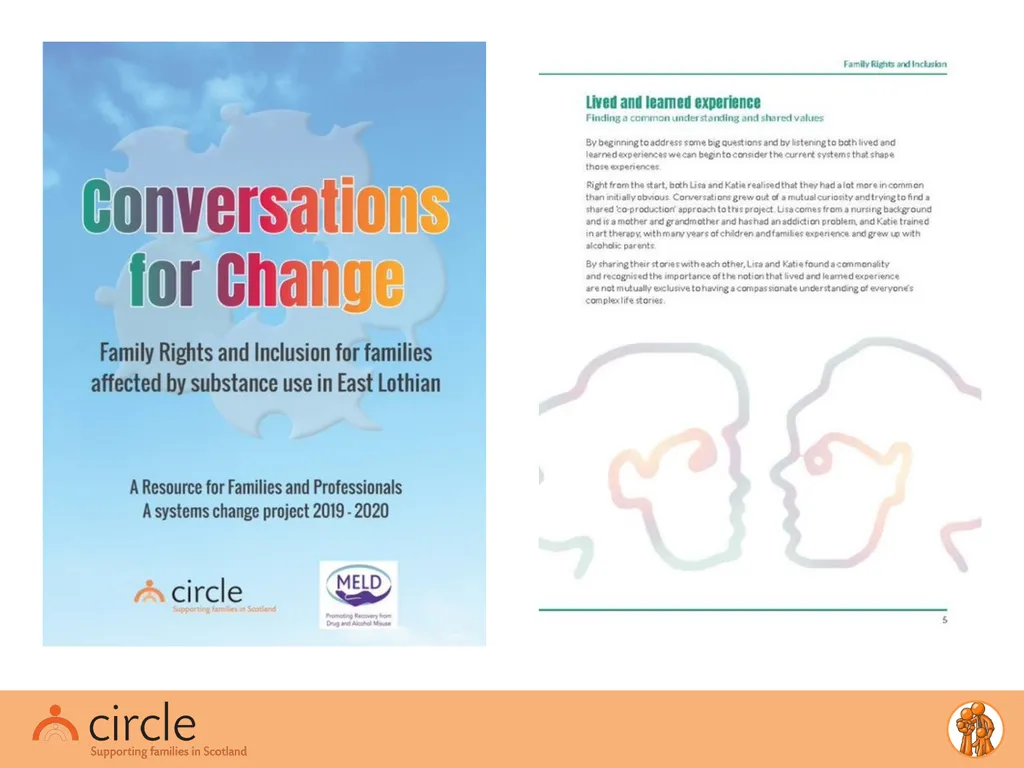
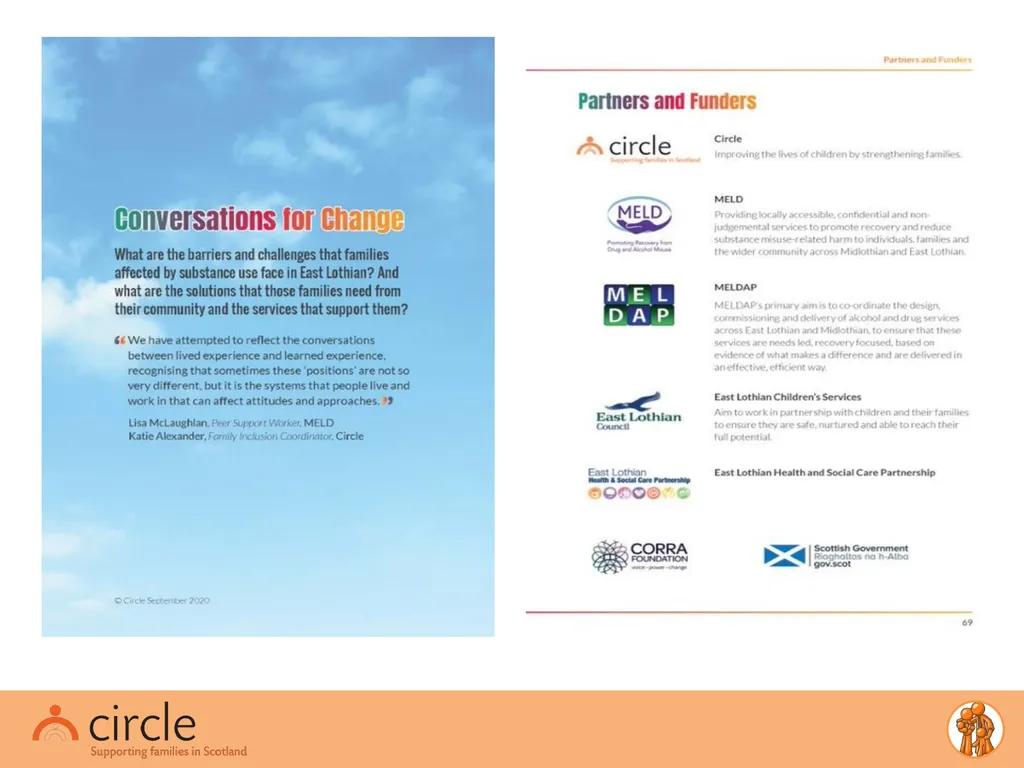




Description: Conversations for Change A Systems Change Project Promoting Family Inclusive Practice Across Recovery and Children Families Services Angela Gentile Project Manager 040621 Context Test of change over one year, Aug 2019 - Sep 2020
Related Topics
Download Presentation
"Conversations for Change A Systems Change Project" is the property of its rightful owner. Permission is granted to download and print the materials on this website for personal, non-commercial use only, and to display it on your personal computer provided you do not modify the materials and that you retain all copyright notices contained in the materials. By downloading content from our website, you accept the terms of this agreement.
Presentation Transcript
slide1. Conversations for Change
A Systems Change Project
Promoting Family Inclusive Practice
Across Recovery and Children & Families Services
Angela Gentile
Project Manager
04/06/21<br>
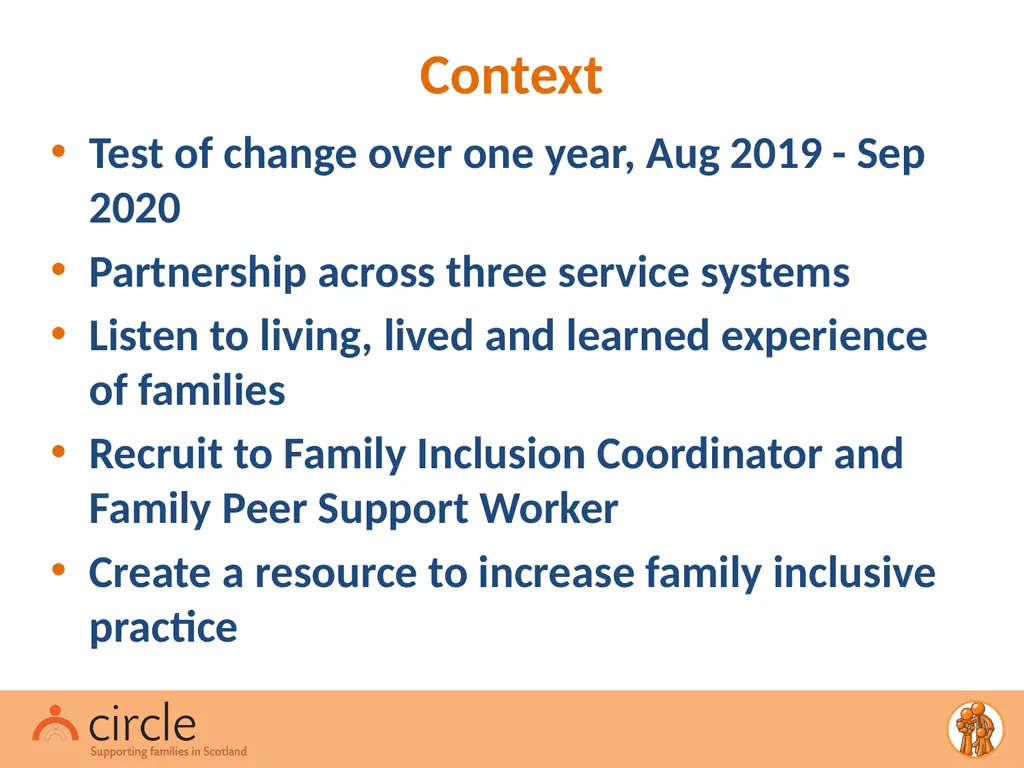
slide2. Context Test of change over one year, Aug 2019 - Sep 2020
Partnership across three service systems
Listen to living, lived and learned experience of families
Recruit to Family Inclusion Coordinator and Family Peer Support Worker
Create a resource to increase family inclusive practice<br>
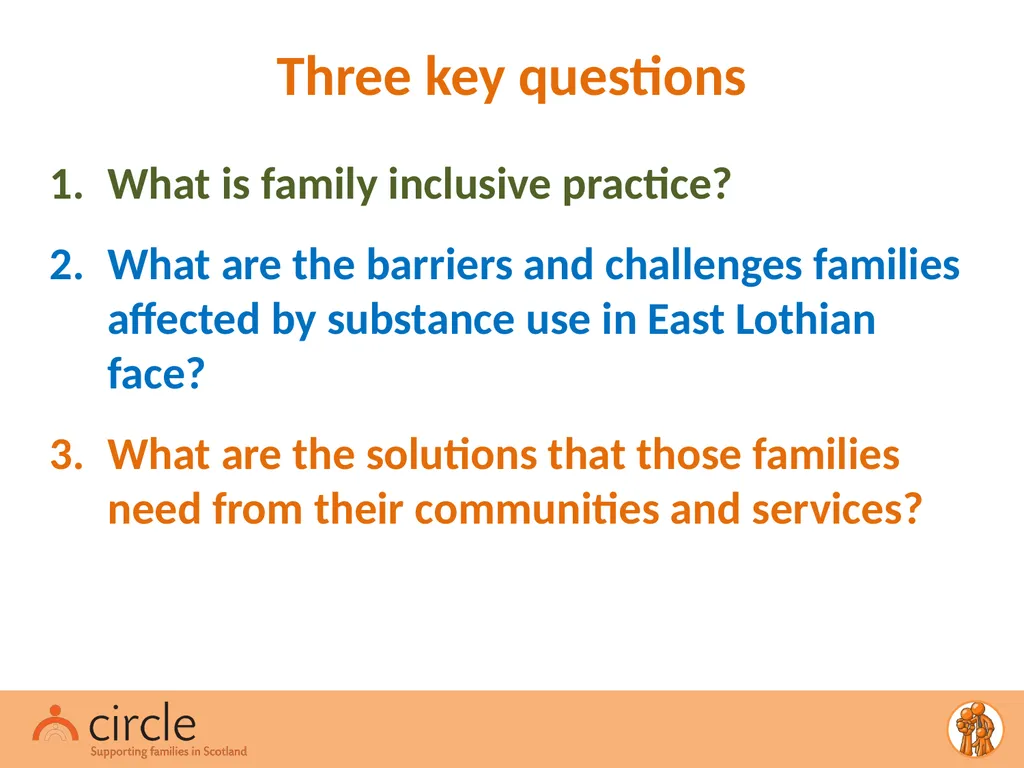
slide3. Three key questions What is family inclusive practice?
What are the barriers and challenges families affected by substance use in East Lothian face?
What are the solutions that those families need from their communities and services?<br>
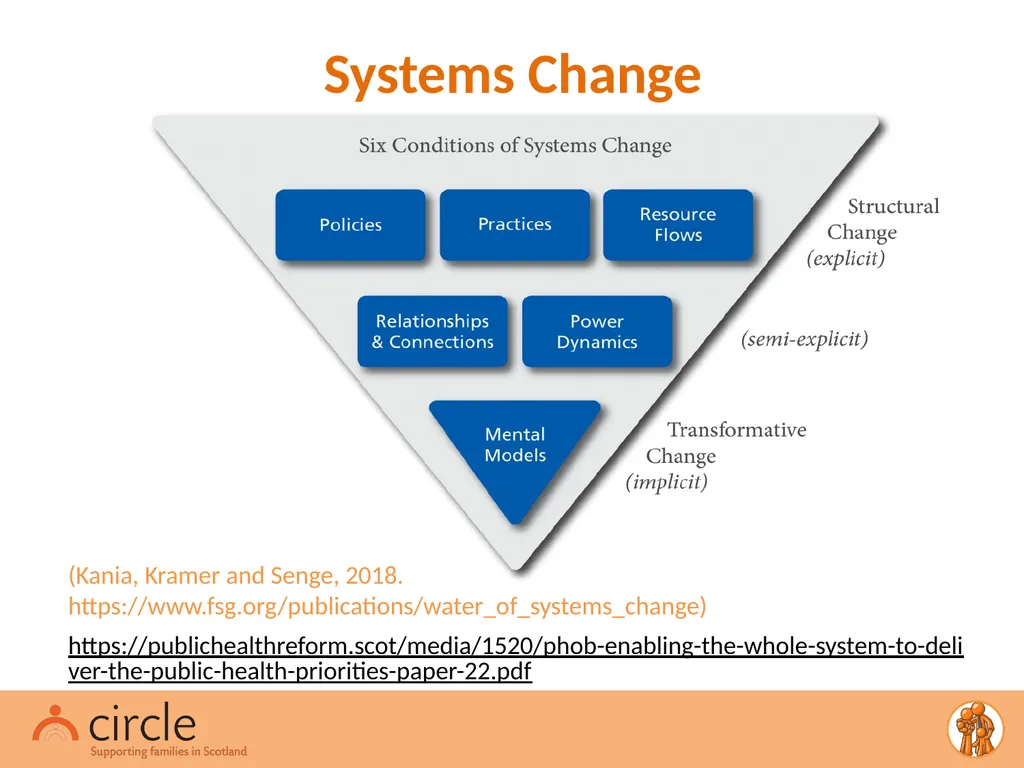
slide6. Systems Change (Kania, Kramer and Senge, 2018. https://www.fsg.org/publications/water_of_systems_change)
https://publichealthreform.scot/media/1520/phob-enabling-the-whole-system-to-deliver-the-public-health-priorities-paper-22.pdf<br>
slide7. 1. Who is family? ‘The definition of ‘family’ means anyone who is affected by a loved one’s alcohol or drug use, including family members, partners, carers, friends, neighbours, work colleagues or concerned significant others…it is most often the family who is there 24/7 and are the first point of support…it is vital to support families in their own right, at any stage of the journey’
Rights, Respect and Recovery, 2019, p41<br>
slide8. 1. What is family inclusive practice? Evidence supports the importance of family in alcohol and drug assessment and treatment, highlighting the increased emphasis on the role of families and wider social networks can:
Assist in getting individuals to treatment and maintain engagement in treatment
Improve both alcohol and drug related outcomes and family functioning
Lead to a reduction of impacts and harm for family members and other’s affected
‘There is highly processed and review level evidence that involving families in recovery care plans for affected individuals and providing support for family members themselves is beneficial to improve outcomes for both parties.’
NHS Scotland Outcomes Framework for Problem Drug Use, 2014
Scottish Families Affected by Alcohol and Drugs 2014 www.sfad.org.uk/training<br>
slide9. A Guide to Evaluating Drug and Alcohol Services Using Quality Indicators (2016) We actively support and encourage individuals to involve relevant people who play a significant role in their recovery if they want them to be…information is provided about drug treatment.
We help individuals to minimise the impact that their drug and alcohol use may have on those around them through effective family-based interventions that involves a whole family approach.
We are aware of the needs of other family that those receiving service may live with and we seek support for them if this is needed.
We have effective joint working protocols with children’s and adult services including health.
We promptly share all relevant information with colleagues in other services, including Named Persons and jointly consider what action we need to take in their best interests.
https://hub.careinspectorate.com/media/1537/indicators-of-good-practice-in-drug-and-alcohol-services.pdf
https://www.gov.scot/publications/health-social-care-standards-support-life/<br>
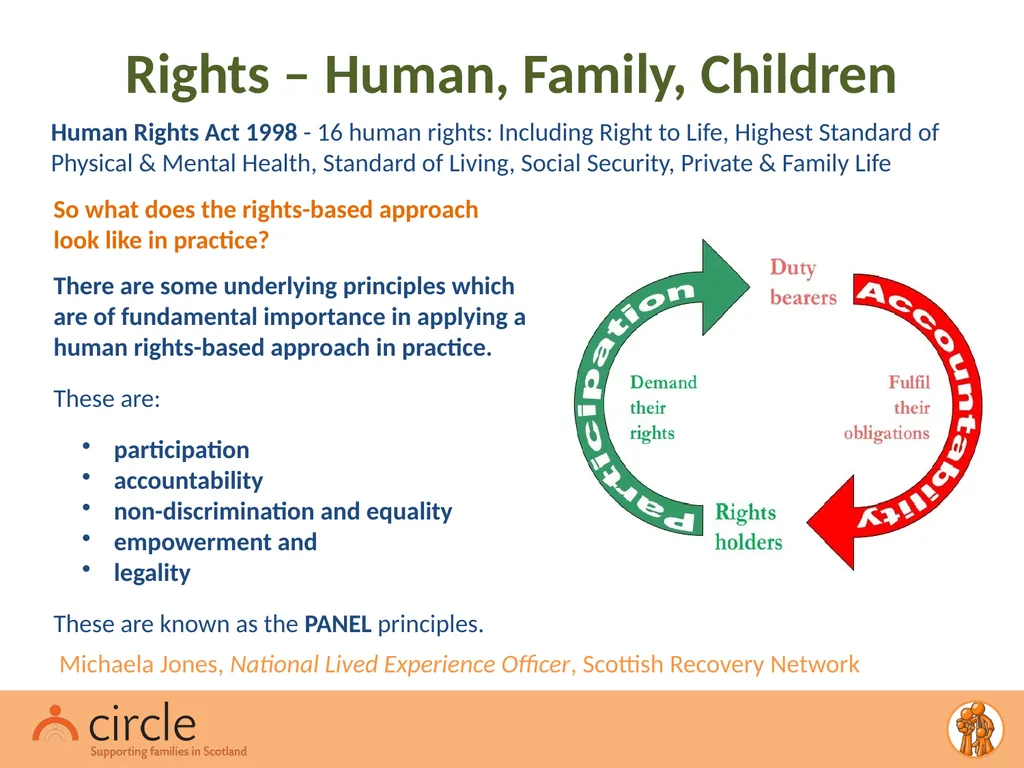
slide10. Rights – Human, Family, Children So what does the rights-based approach look like in practice?
There are some underlying principles which are of fundamental importance in applying a human rights-based approach in practice.
These are:
participation
accountability
non-discrimination and equality
empowerment and
legality
These are known as the PANEL principles. Human Rights Act 1998 - 16 human rights: Including Right to Life, Highest Standard of Physical & Mental Health, Standard of Living, Social Security, Private & Family Life Michaela Jones, National Lived Experience Officer, Scottish Recovery Network<br>
slide11. Family Rights In ‘Rights, Respect and Recovery' Scotland’s strategy to improve health by preventing and reducing alcohol and drug use, harm and related deaths’ we now have a commitment to:
Ensure family members have access to support in their own right and, where appropriate, to be included in their loved one’s treatment and support
Ensure all families have access to services (both statutory and third sector) provided through a whole family approach, in line with the values, principles and core components of GIRFEC
Involve children, parents and other family members in the planning, development and delivery of services at a local, regional and national level’
https://www.gov.scot/publications/rights-respect-recovery/
Scottish Government, Chapter 6 ‘Getting it right for children, young people and families’, p40<br>
slide12. Children's Rights UNCRC
Article 2 - (non-discrimination) The Convention applies to every child without discrimination, whatever their ethnicity, gender, religion, language, abilities or any other status, whatever they think or say, whatever their family background
Article 3 - Children's best interests
Article 12 - Children's views in decisions that affect them
Article 5 - In keeping with the capacities of the child
Article 6 - Right to life, survival and healthy development
Article 19 - State Parties must have proper laws in place to prohibit violence, but it also requires States to implement administrative, social and educational measures to protect children. All forms of violence, both physical and mental.
Article 28 - Right to education
Article 33 - Right to be free from harms from dangerous substance use
https://cypcs.org.uk/rights/uncrc/articles/<br>
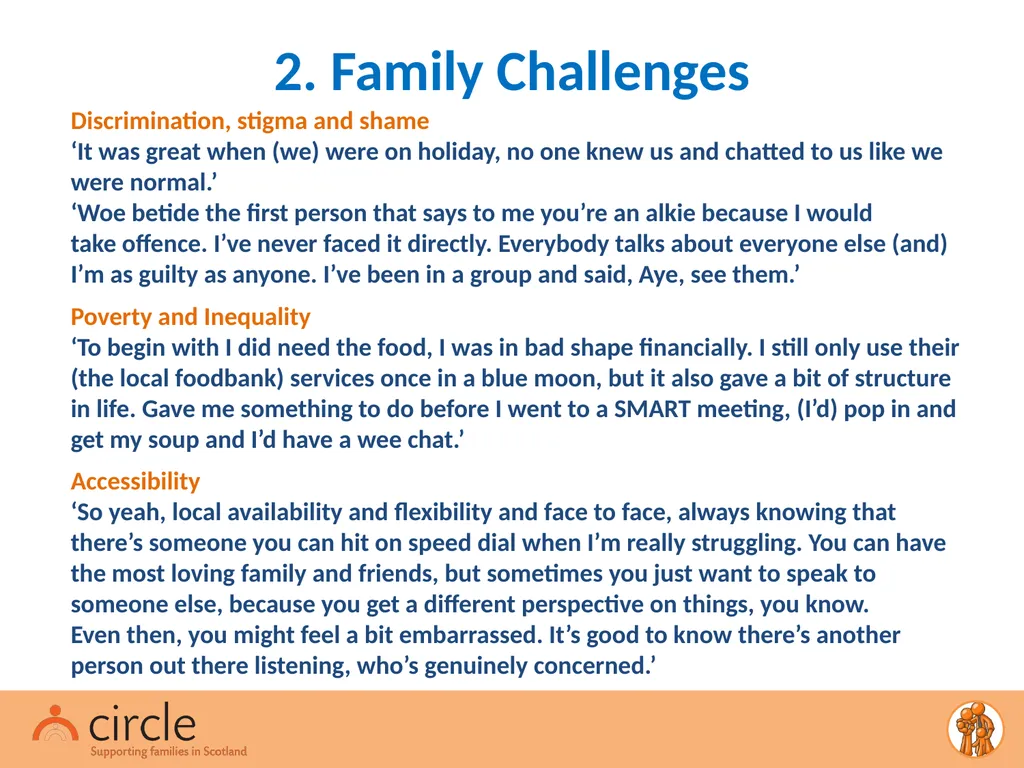
slide13. 2. Family Challenges Discrimination, stigma and shame
‘It was great when (we) were on holiday, no one knew us and chatted to us like we were normal.’
‘Woe betide the first person that says to me you’re an alkie because I would take offence. I’ve never faced it directly. Everybody talks about everyone else (and) I’m as guilty as anyone. I’ve been in a group and said, Aye, see them.’
Poverty and Inequality
‘To begin with I did need the food, I was in bad shape financially. I still only use their (the local foodbank) services once in a blue moon, but it also gave a bit of structure in life. Gave me something to do before I went to a SMART meeting, (I’d) pop in and get my soup and I’d have a wee chat.’
Accessibility
‘So yeah, local availability and flexibility and face to face, always knowing that there’s someone you can hit on speed dial when I’m really struggling. You can have the most loving family and friends, but sometimes you just want to speak to someone else, because you get a different perspective on things, you know. Even then, you might feel a bit embarrassed. It’s good to know there’s another person out there listening, who’s genuinely concerned.’<br>
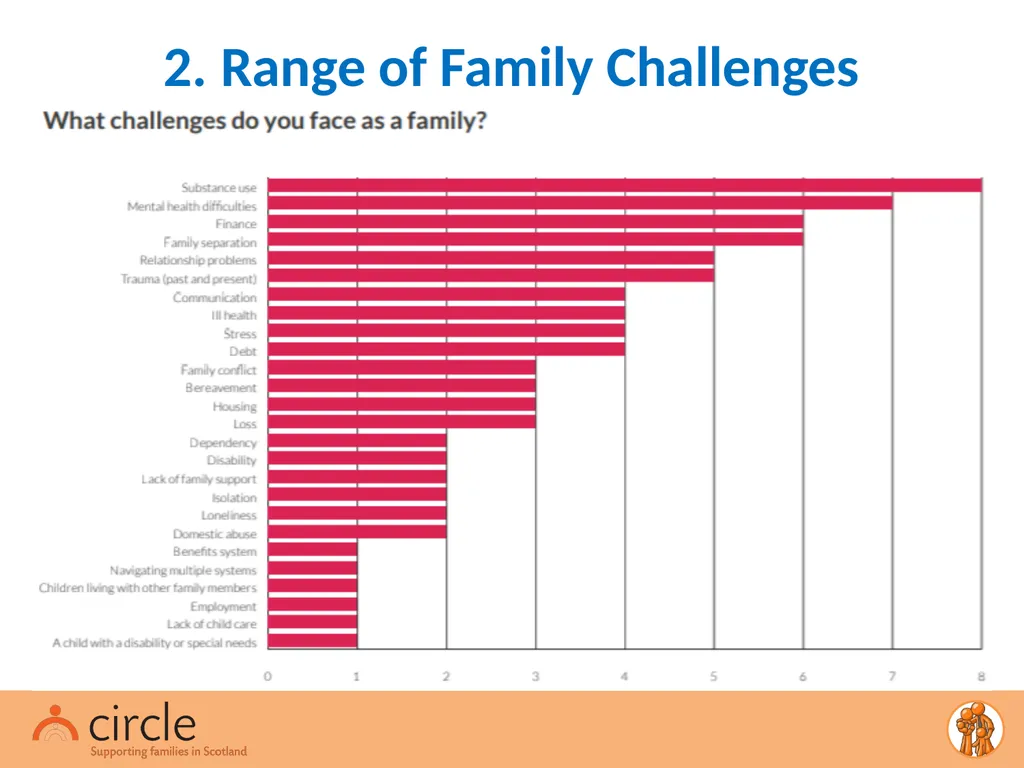
slide14. 2. Range of Family Challenges<br>
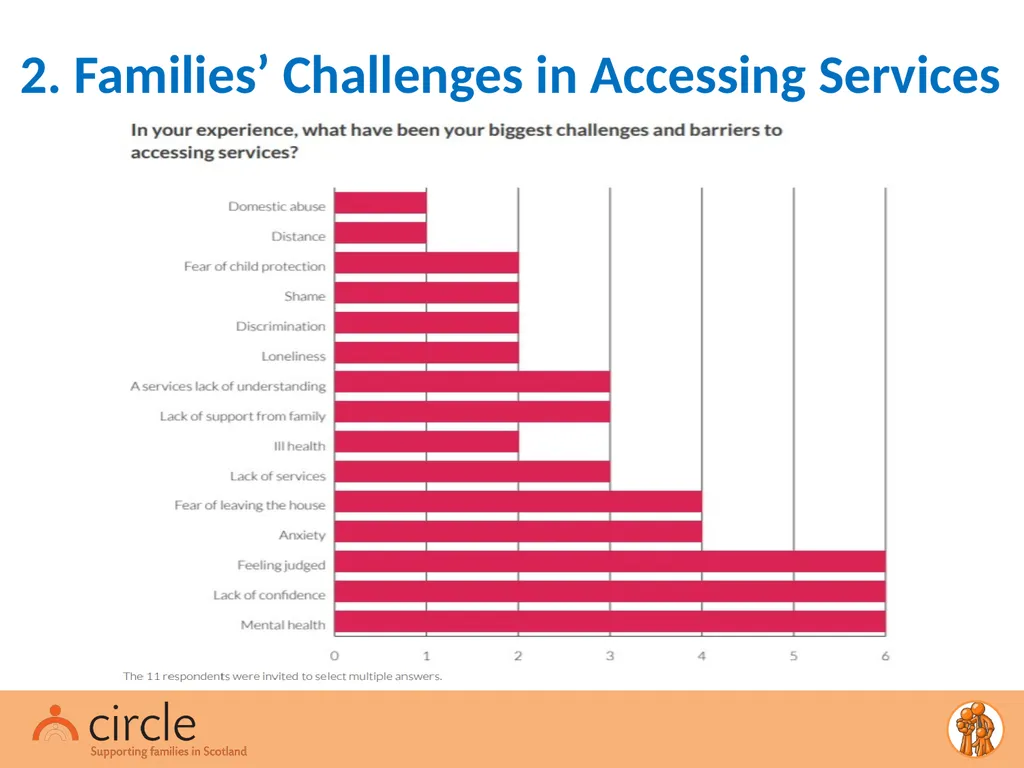
slide15. 2. Families’ Challenges in Accessing Services<br>
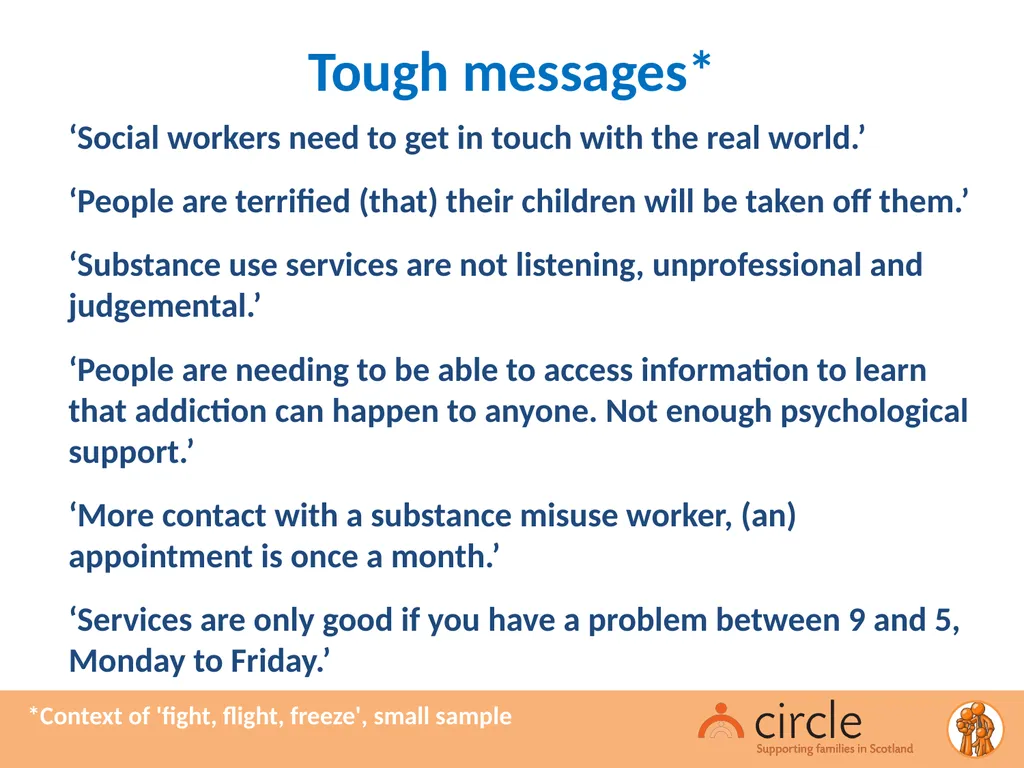
slide16. Tough messages* *Context of 'fight, flight, freeze', small sample ‘Social workers need to get in touch with the real world.’
‘People are terrified (that) their children will be taken off them.’
‘Substance use services are not listening, unprofessional and judgemental.’
‘People are needing to be able to access information to learn that addiction can happen to anyone. Not enough psychological support.’
‘More contact with a substance misuse worker, (an) appointment is once a month.’
‘Services are only good if you have a problem between 9 and 5, Monday to Friday.’<br>
slide17. ‘So really top of my list of wants would be phone support,
even if it was just for 10 minutes. In that 10 minutes I could let it out of my system. Remember sometimes people need to get it out of their system, a good moan, a bit of a greet. They feel better afterwards.’
‘Helpful support comes from people who have experienced the issues concerned.’
‘More peer support.’ 3. Families' Solutions Are family and friends aware that they are entitled to support? I think it’s the friends and families that don’t realise they’ve got this. I have hinted very heavily, especially my brother, if ever you want to talk to someone about this you can speak to them. My sister would be the type of person that would do it off her own back, but no I think a lot of family and friends don’t realise this. To be able to take (my) dog to services when (I’m) having a bad day.
Get more complete support for family members.
To attend groups together to work as one complete unit.
More things for couples and families to go to.
Available 24/7, 365 days a year.<br>
slide18. 3. Findings - Professionals A third of respondents informed us that between 50% and 100% of their client group were not in contact with recovery services, suggesting referral routes and protocols could be better developed for these agencies.
Just under a third (29%) felt that they had a good understanding of family inclusive practice, while 18% felt they did not and almost all (94%) indicated that they would benefit from having more information. Many also cited the need for training (41%), participation tools (35%) and practice tools (29%).
Almost half (47%) of the services felt that family inclusive practice was ‘a lot’ of a priority in their service, 29% felt it was ‘a little’ priority, while 65% of all services felt there was ‘room for improvement’.<br>
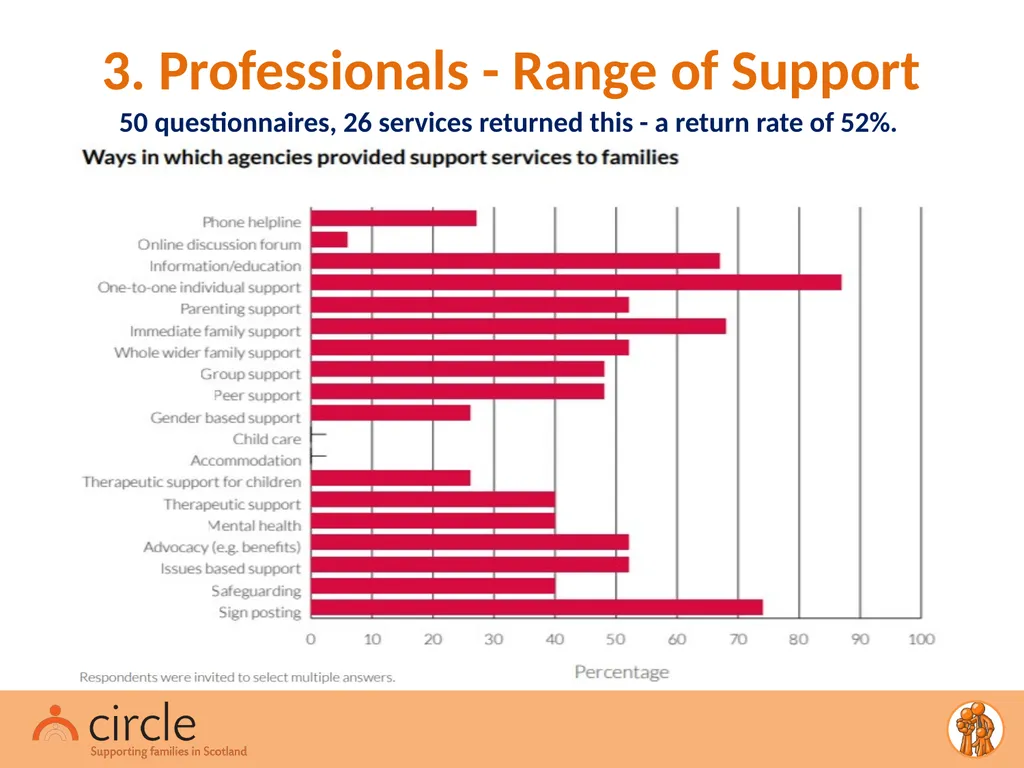
slide19. 3. Professionals - Range of Support 50 questionnaires, 26 services returned this - a return rate of 52%.<br>
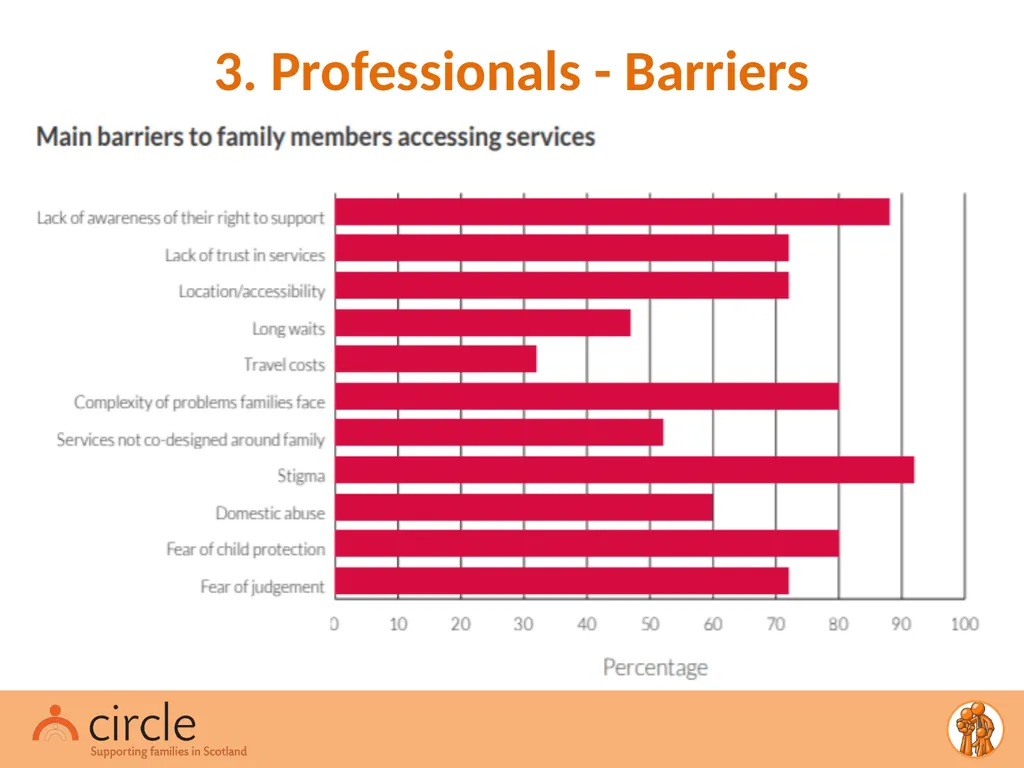
slide20. 3. Professionals - Barriers<br>
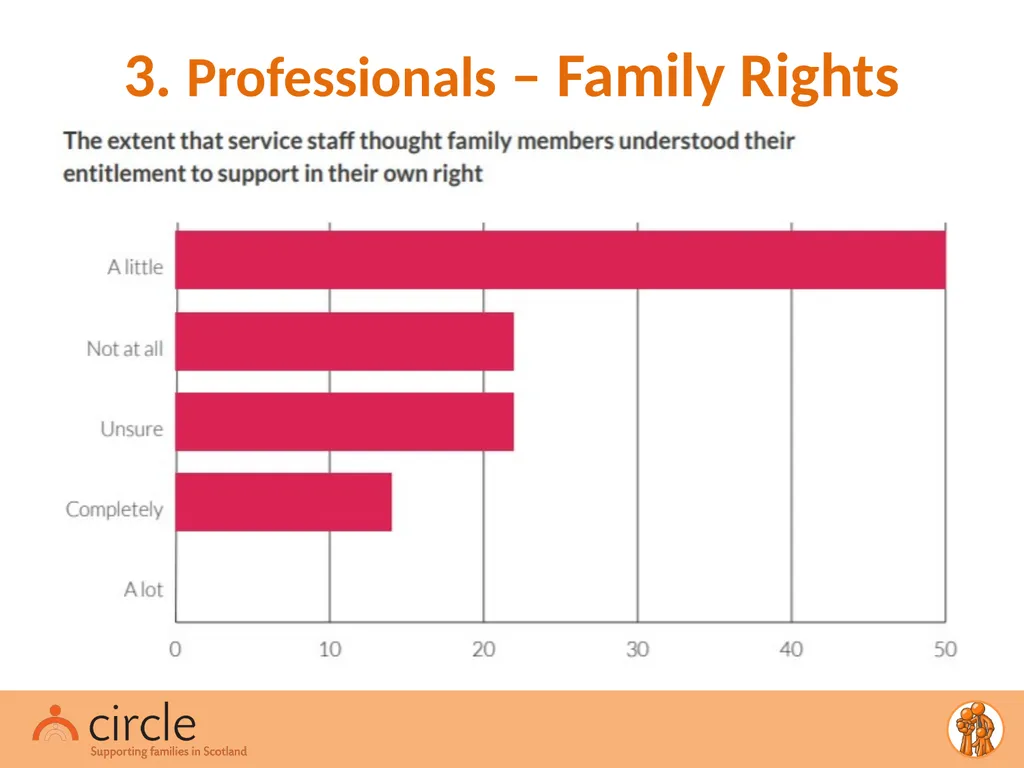
slide21. 3. Professionals – Family Rights<br>
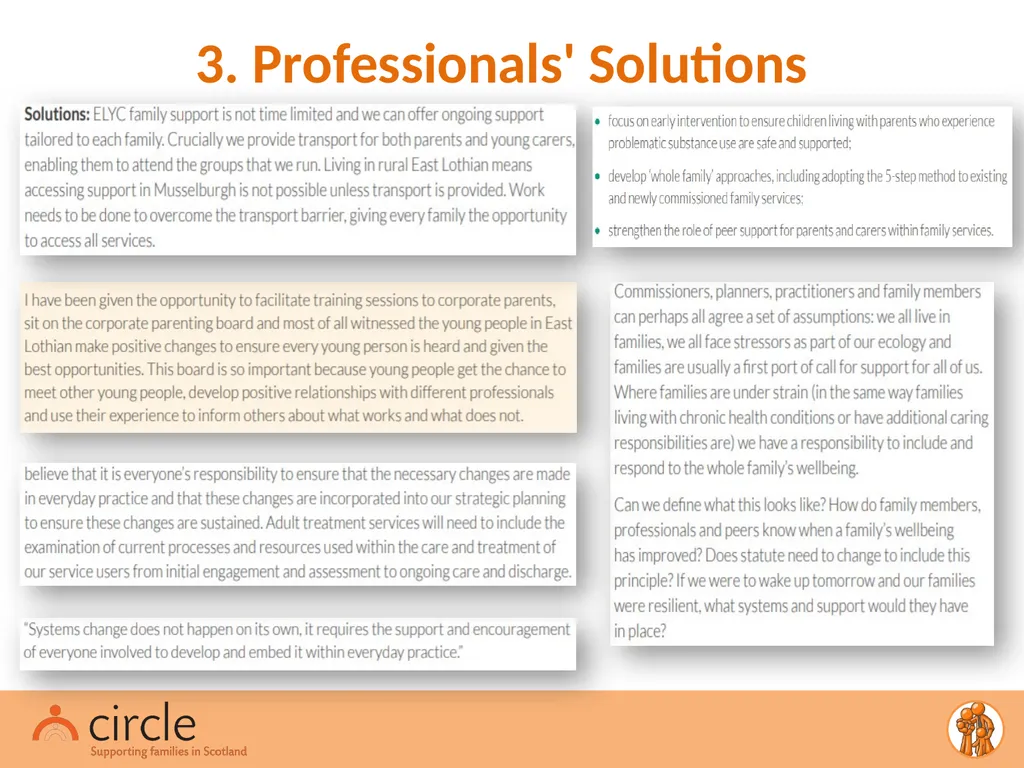
slide22. 3. Professionals' Solutions<br>
slide23. Key learning - practice Co-location is helpful for the provision of holistic support and professionals are working hard to transcend traditional silo-based models and to work collaboratively
A range of flexible services that change according to need are offered, but families have vocalised they would like to see more ‘family peer support’
Professionals felt trust in services was a prominent issue. Families also need support to access services, e.g. bus passes, childcare, ‘speed dial’ phone support
There are many ways to connect with families: food, music, poetry, art, tea, a smile and pets
The importance of places in the community to connect: Starfish Recovery Café, The Ridge
We must always ask the questions:
What are the rights of family members, human, family and children's rights?
What are the views and needs within this family, individually, interpersonally and in terms of family functioning?
What is getting in the way of support in the family system, the service system and the wider ecology?
How can we help this family become more resilient and importantly, stick with them through crisis?
What resources and advocacy might they need?<br>
slide24. Increase awareness of families’ rights to health, free from harms caused by substance use and to support in their own right
Agree ways to co-produce solutions across service systems alongside families
Develop a guiding set of values, principles and assumptions to underpin family rights, family inclusive practice and whole family approaches
Families should be able to ‘reach in’, not be ‘referred to’ support in a timely and accessible manner
Values of dignity, respect, fairness, non-judgmental support, solidarity going the extra mile and never giving up. This needs to be factored into workforce development and commissioning
Stigma and feelings of shame affect the whole family and how powerlessness is played out - in and between - informal and formal systems
Families turn to their family first and in the absence of family then community groups help tackle social isolation Key learning – practice (cont.)<br>
slide25. Trauma, adverse childhood experiences and the importance of trusted attachment and trauma-informed relationships, supported by service structures and workforce development, are highlighted. Just under half of professionals want more training
Tools already available to us: Signs of Safety, Parents Under Pressure, Video Interaction Guidance, Craft. Around a third of professionals would like more. Professionals want more information on family rights and inclusive practice
Frameworks that seek to work with the whole family in the context of domestic abuse, e.g. Safe and Together, The Caledonian System
Gender element and positive discrimination e.g. fathers’ workers and women’s drop-in groups
Participatory approaches to change e.g. Independent Care Review, local Champions Board, existing peer support to really value the living and lived experience. This way of working can act as a significant catalyst for change Key learning – practice (cont.)<br>
slide26. Key learning - scaling up 'test of change' Recruiting and supporting staff with lived experience
Values clarification at beginning e.g. strengths-based, family rights and inclusion, solution-focused
Defining ‘family’ in the widest terms and the importance of ‘loved ones’
A strong partnership agreement with committed members, an open mindset; an effective Chair; enlist added capacity e.g. volunteers
Placing families at the heart of change and facilitate live ‘conversations’ wherever possible
Continuing to map levels of support and reference family inclusive practice
Developing tools alongside family members e.g. family leaflet, survey
Regularly revisiting the original ‘test of change’ questions
Involving wider partners as it became clear family inclusive practice is reflected in a variety of ways
Acknowledging shortcomings - we have not reflected all universal services offered
Identifying specific workforce development, practice tools and participation structures
Documenting meetings and groups as part of evidence
Sharing results and raising awareness along the way<br>
slide2. Context Test of change over one year, Aug 2019 - Sep 2020
Partnership across three service systems
Listen to living, lived and learned experience of families
Recruit to Family Inclusion Coordinator and Family Peer Support Worker
Create a resource to increase family inclusive practice<br>
slide3. Three key questions What is family inclusive practice?
What are the barriers and challenges families affected by substance use in East Lothian face?
What are the solutions that those families need from their communities and services?<br>
slide6. Systems Change (Kania, Kramer and Senge, 2018. https://www.fsg.org/publications/water_of_systems_change)
https://publichealthreform.scot/media/1520/phob-enabling-the-whole-system-to-deliver-the-public-health-priorities-paper-22.pdf<br>
slide7. 1. Who is family? ‘The definition of ‘family’ means anyone who is affected by a loved one’s alcohol or drug use, including family members, partners, carers, friends, neighbours, work colleagues or concerned significant others…it is most often the family who is there 24/7 and are the first point of support…it is vital to support families in their own right, at any stage of the journey’
Rights, Respect and Recovery, 2019, p41<br>
slide8. 1. What is family inclusive practice? Evidence supports the importance of family in alcohol and drug assessment and treatment, highlighting the increased emphasis on the role of families and wider social networks can:
Assist in getting individuals to treatment and maintain engagement in treatment
Improve both alcohol and drug related outcomes and family functioning
Lead to a reduction of impacts and harm for family members and other’s affected
‘There is highly processed and review level evidence that involving families in recovery care plans for affected individuals and providing support for family members themselves is beneficial to improve outcomes for both parties.’
NHS Scotland Outcomes Framework for Problem Drug Use, 2014
Scottish Families Affected by Alcohol and Drugs 2014 www.sfad.org.uk/training<br>
slide9. A Guide to Evaluating Drug and Alcohol Services Using Quality Indicators (2016) We actively support and encourage individuals to involve relevant people who play a significant role in their recovery if they want them to be…information is provided about drug treatment.
We help individuals to minimise the impact that their drug and alcohol use may have on those around them through effective family-based interventions that involves a whole family approach.
We are aware of the needs of other family that those receiving service may live with and we seek support for them if this is needed.
We have effective joint working protocols with children’s and adult services including health.
We promptly share all relevant information with colleagues in other services, including Named Persons and jointly consider what action we need to take in their best interests.
https://hub.careinspectorate.com/media/1537/indicators-of-good-practice-in-drug-and-alcohol-services.pdf
https://www.gov.scot/publications/health-social-care-standards-support-life/<br>
slide10. Rights – Human, Family, Children So what does the rights-based approach look like in practice?
There are some underlying principles which are of fundamental importance in applying a human rights-based approach in practice.
These are:
participation
accountability
non-discrimination and equality
empowerment and
legality
These are known as the PANEL principles. Human Rights Act 1998 - 16 human rights: Including Right to Life, Highest Standard of Physical & Mental Health, Standard of Living, Social Security, Private & Family Life Michaela Jones, National Lived Experience Officer, Scottish Recovery Network<br>
slide11. Family Rights In ‘Rights, Respect and Recovery' Scotland’s strategy to improve health by preventing and reducing alcohol and drug use, harm and related deaths’ we now have a commitment to:
Ensure family members have access to support in their own right and, where appropriate, to be included in their loved one’s treatment and support
Ensure all families have access to services (both statutory and third sector) provided through a whole family approach, in line with the values, principles and core components of GIRFEC
Involve children, parents and other family members in the planning, development and delivery of services at a local, regional and national level’
https://www.gov.scot/publications/rights-respect-recovery/
Scottish Government, Chapter 6 ‘Getting it right for children, young people and families’, p40<br>
slide12. Children's Rights UNCRC
Article 2 - (non-discrimination) The Convention applies to every child without discrimination, whatever their ethnicity, gender, religion, language, abilities or any other status, whatever they think or say, whatever their family background
Article 3 - Children's best interests
Article 12 - Children's views in decisions that affect them
Article 5 - In keeping with the capacities of the child
Article 6 - Right to life, survival and healthy development
Article 19 - State Parties must have proper laws in place to prohibit violence, but it also requires States to implement administrative, social and educational measures to protect children. All forms of violence, both physical and mental.
Article 28 - Right to education
Article 33 - Right to be free from harms from dangerous substance use
https://cypcs.org.uk/rights/uncrc/articles/<br>
slide13. 2. Family Challenges Discrimination, stigma and shame
‘It was great when (we) were on holiday, no one knew us and chatted to us like we were normal.’
‘Woe betide the first person that says to me you’re an alkie because I would take offence. I’ve never faced it directly. Everybody talks about everyone else (and) I’m as guilty as anyone. I’ve been in a group and said, Aye, see them.’
Poverty and Inequality
‘To begin with I did need the food, I was in bad shape financially. I still only use their (the local foodbank) services once in a blue moon, but it also gave a bit of structure in life. Gave me something to do before I went to a SMART meeting, (I’d) pop in and get my soup and I’d have a wee chat.’
Accessibility
‘So yeah, local availability and flexibility and face to face, always knowing that there’s someone you can hit on speed dial when I’m really struggling. You can have the most loving family and friends, but sometimes you just want to speak to someone else, because you get a different perspective on things, you know. Even then, you might feel a bit embarrassed. It’s good to know there’s another person out there listening, who’s genuinely concerned.’<br>
slide14. 2. Range of Family Challenges<br>
slide15. 2. Families’ Challenges in Accessing Services<br>
slide16. Tough messages* *Context of 'fight, flight, freeze', small sample ‘Social workers need to get in touch with the real world.’
‘People are terrified (that) their children will be taken off them.’
‘Substance use services are not listening, unprofessional and judgemental.’
‘People are needing to be able to access information to learn that addiction can happen to anyone. Not enough psychological support.’
‘More contact with a substance misuse worker, (an) appointment is once a month.’
‘Services are only good if you have a problem between 9 and 5, Monday to Friday.’<br>
slide17. ‘So really top of my list of wants would be phone support,
even if it was just for 10 minutes. In that 10 minutes I could let it out of my system. Remember sometimes people need to get it out of their system, a good moan, a bit of a greet. They feel better afterwards.’
‘Helpful support comes from people who have experienced the issues concerned.’
‘More peer support.’ 3. Families' Solutions Are family and friends aware that they are entitled to support? I think it’s the friends and families that don’t realise they’ve got this. I have hinted very heavily, especially my brother, if ever you want to talk to someone about this you can speak to them. My sister would be the type of person that would do it off her own back, but no I think a lot of family and friends don’t realise this. To be able to take (my) dog to services when (I’m) having a bad day.
Get more complete support for family members.
To attend groups together to work as one complete unit.
More things for couples and families to go to.
Available 24/7, 365 days a year.<br>
slide18. 3. Findings - Professionals A third of respondents informed us that between 50% and 100% of their client group were not in contact with recovery services, suggesting referral routes and protocols could be better developed for these agencies.
Just under a third (29%) felt that they had a good understanding of family inclusive practice, while 18% felt they did not and almost all (94%) indicated that they would benefit from having more information. Many also cited the need for training (41%), participation tools (35%) and practice tools (29%).
Almost half (47%) of the services felt that family inclusive practice was ‘a lot’ of a priority in their service, 29% felt it was ‘a little’ priority, while 65% of all services felt there was ‘room for improvement’.<br>
slide19. 3. Professionals - Range of Support 50 questionnaires, 26 services returned this - a return rate of 52%.<br>
slide20. 3. Professionals - Barriers<br>
slide21. 3. Professionals – Family Rights<br>
slide22. 3. Professionals' Solutions<br>
slide23. Key learning - practice Co-location is helpful for the provision of holistic support and professionals are working hard to transcend traditional silo-based models and to work collaboratively
A range of flexible services that change according to need are offered, but families have vocalised they would like to see more ‘family peer support’
Professionals felt trust in services was a prominent issue. Families also need support to access services, e.g. bus passes, childcare, ‘speed dial’ phone support
There are many ways to connect with families: food, music, poetry, art, tea, a smile and pets
The importance of places in the community to connect: Starfish Recovery Café, The Ridge
We must always ask the questions:
What are the rights of family members, human, family and children's rights?
What are the views and needs within this family, individually, interpersonally and in terms of family functioning?
What is getting in the way of support in the family system, the service system and the wider ecology?
How can we help this family become more resilient and importantly, stick with them through crisis?
What resources and advocacy might they need?<br>
slide24. Increase awareness of families’ rights to health, free from harms caused by substance use and to support in their own right
Agree ways to co-produce solutions across service systems alongside families
Develop a guiding set of values, principles and assumptions to underpin family rights, family inclusive practice and whole family approaches
Families should be able to ‘reach in’, not be ‘referred to’ support in a timely and accessible manner
Values of dignity, respect, fairness, non-judgmental support, solidarity going the extra mile and never giving up. This needs to be factored into workforce development and commissioning
Stigma and feelings of shame affect the whole family and how powerlessness is played out - in and between - informal and formal systems
Families turn to their family first and in the absence of family then community groups help tackle social isolation Key learning – practice (cont.)<br>
slide25. Trauma, adverse childhood experiences and the importance of trusted attachment and trauma-informed relationships, supported by service structures and workforce development, are highlighted. Just under half of professionals want more training
Tools already available to us: Signs of Safety, Parents Under Pressure, Video Interaction Guidance, Craft. Around a third of professionals would like more. Professionals want more information on family rights and inclusive practice
Frameworks that seek to work with the whole family in the context of domestic abuse, e.g. Safe and Together, The Caledonian System
Gender element and positive discrimination e.g. fathers’ workers and women’s drop-in groups
Participatory approaches to change e.g. Independent Care Review, local Champions Board, existing peer support to really value the living and lived experience. This way of working can act as a significant catalyst for change Key learning – practice (cont.)<br>
slide26. Key learning - scaling up 'test of change' Recruiting and supporting staff with lived experience
Values clarification at beginning e.g. strengths-based, family rights and inclusion, solution-focused
Defining ‘family’ in the widest terms and the importance of ‘loved ones’
A strong partnership agreement with committed members, an open mindset; an effective Chair; enlist added capacity e.g. volunteers
Placing families at the heart of change and facilitate live ‘conversations’ wherever possible
Continuing to map levels of support and reference family inclusive practice
Developing tools alongside family members e.g. family leaflet, survey
Regularly revisiting the original ‘test of change’ questions
Involving wider partners as it became clear family inclusive practice is reflected in a variety of ways
Acknowledging shortcomings - we have not reflected all universal services offered
Identifying specific workforce development, practice tools and participation structures
Documenting meetings and groups as part of evidence
Sharing results and raising awareness along the way<br>