04
Basics of private equity 4 Private equity (PE) funds invest in private companies…
By means of a non-traded equity stake for a multiyear period;
With the aim to make a return by improving the investee companies’ performance; and
Exiting them at a profit
Formal private equity: a fund structure that raises capital from other investors
Informal private equity: invest their own money (angels, families, etc.)<br>
05
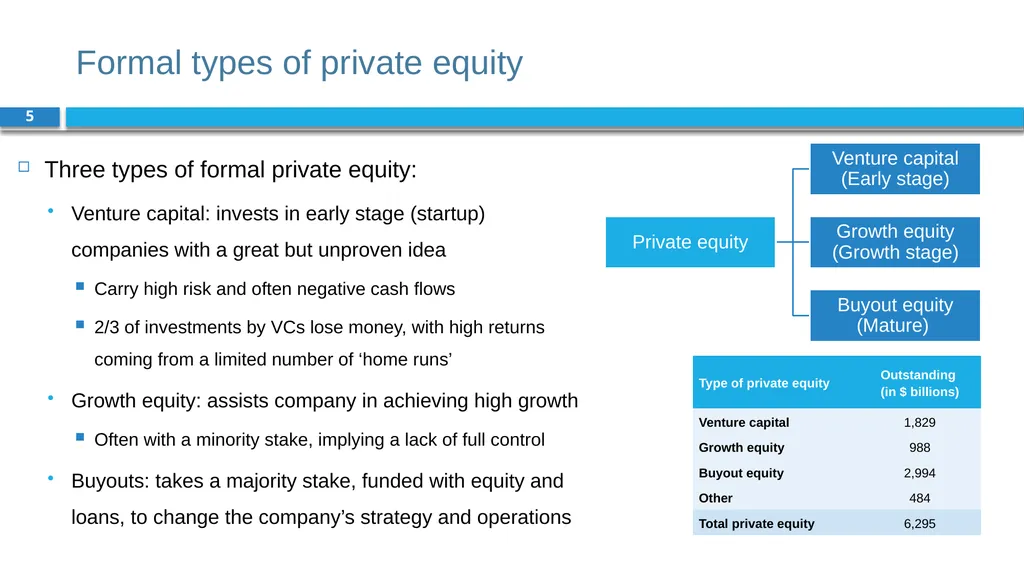
Formal types of private equity 5 Three types of formal private equity:
Venture capital: invests in early stage (startup) companies with a great but unproven idea
Carry high risk and often negative cash flows
2/3 of investments by VCs lose money, with high returns coming from a limited number of ‘home runs’
Growth equity: assists company in achieving high growth
Often with a minority stake, implying a lack of full control
Buyouts: takes a majority stake, funded with equity and loans, to change the company’s strategy and operations<br>
06
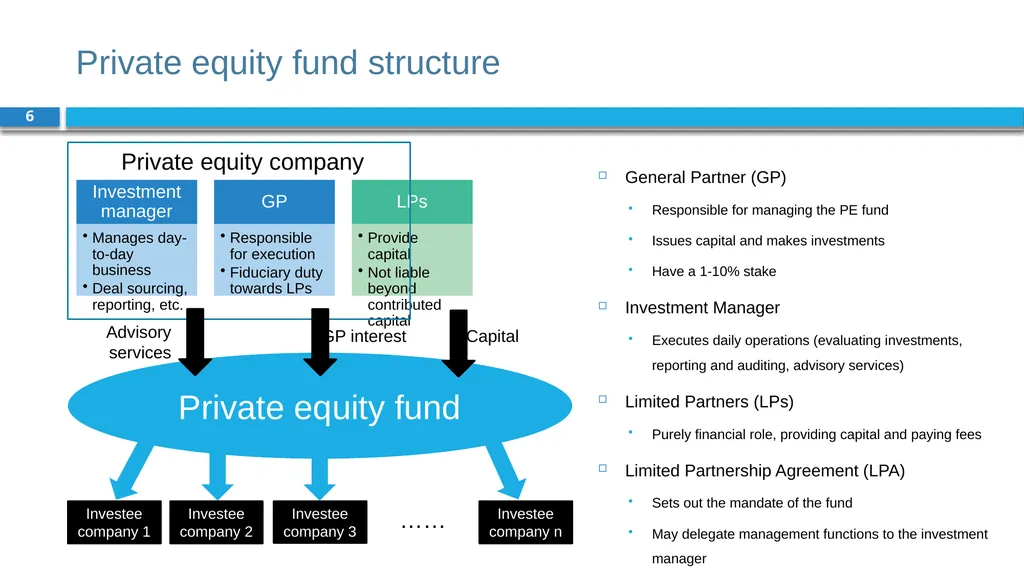
Private equity fund structure 6 General Partner (GP)
Responsible for managing the PE fund
Issues capital and makes investments
Have a 1-10% stake
Investment Manager
Executes daily operations (evaluating investments, reporting and auditing, advisory services)
Limited Partners (LPs)
Purely financial role, providing capital and paying fees
Limited Partnership Agreement (LPA)
Sets out the mandate of the fund
May delegate management functions to the investment manager<br>
07
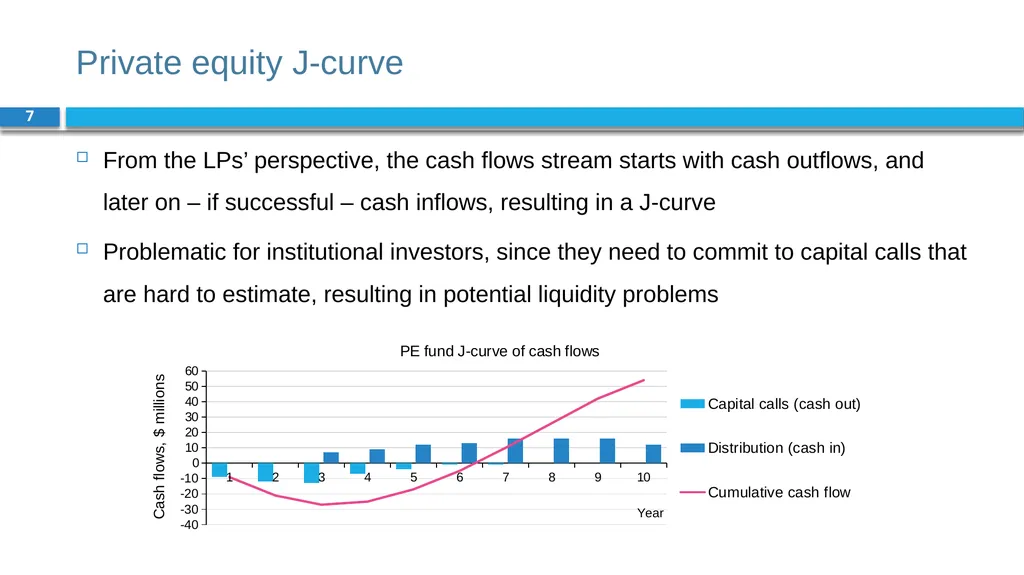
Private equity J-curve 7 From the LPs’ perspective, the cash flows stream starts with cash outflows, and later on – if successful – cash inflows, resulting in a J-curve
Problematic for institutional investors, since they need to commit to capital calls that are hard to estimate, resulting in potential liquidity problems<br>
08
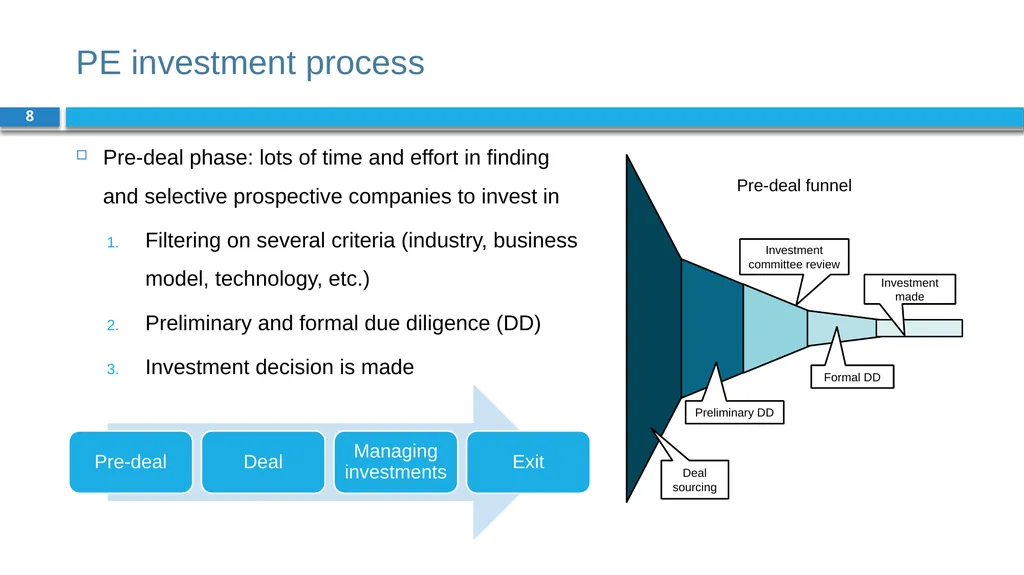
PE investment process 8 Pre-deal phase: lots of time and effort in finding and selective prospective companies to invest in
Filtering on several criteria (industry, business model, technology, etc.)
Preliminary and formal due diligence (DD)
Investment decision is made<br>
09
Leveraged buyouts (LBOs) 9 Leveraged buyouts (LBOs) use debt to take a majority stake in an investee company
LBO PE portfolio companies are found to enhance innovation
Kaplan and Strömberg (2009) distinguish three sources of value creation for LBOs:
Financial engineering: debt-financing increases leverage and thereby disciplines managers
Governance engineering: controlling the boards of their investee companies; management gets a larger stake to align their interests with the company
Operational engineering: the ratio of operating income to sales increases, but the ratio of capital expenditures to sales declines at LBOs<br>
10
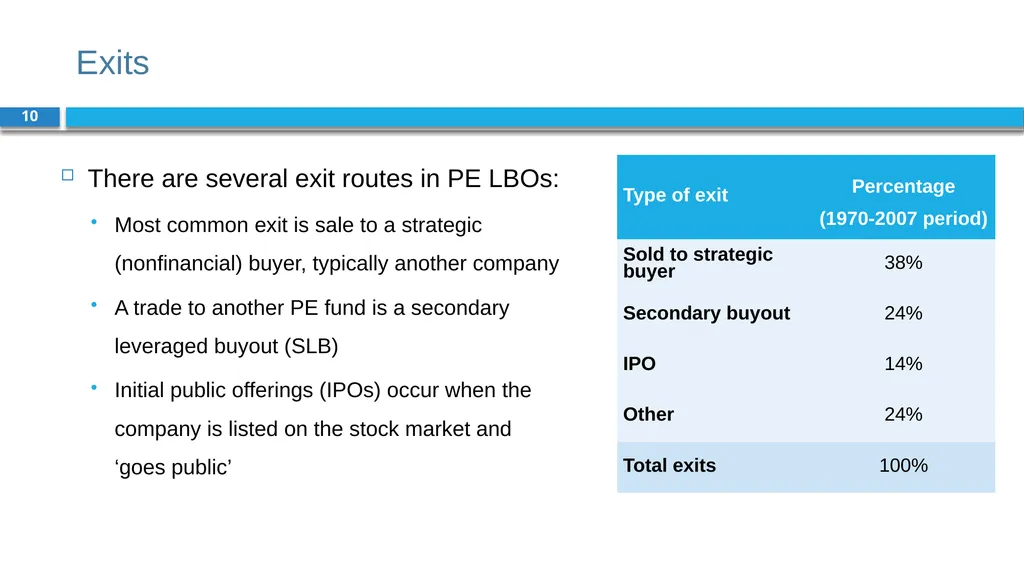
Exits 10 There are several exit routes in PE LBOs:
Most common exit is sale to a strategic (nonfinancial) buyer, typically another company
A trade to another PE fund is a secondary leveraged buyout (SLB)
Initial public offerings (IPOs) occur when the company is listed on the stock market and ‘goes public’<br>
11
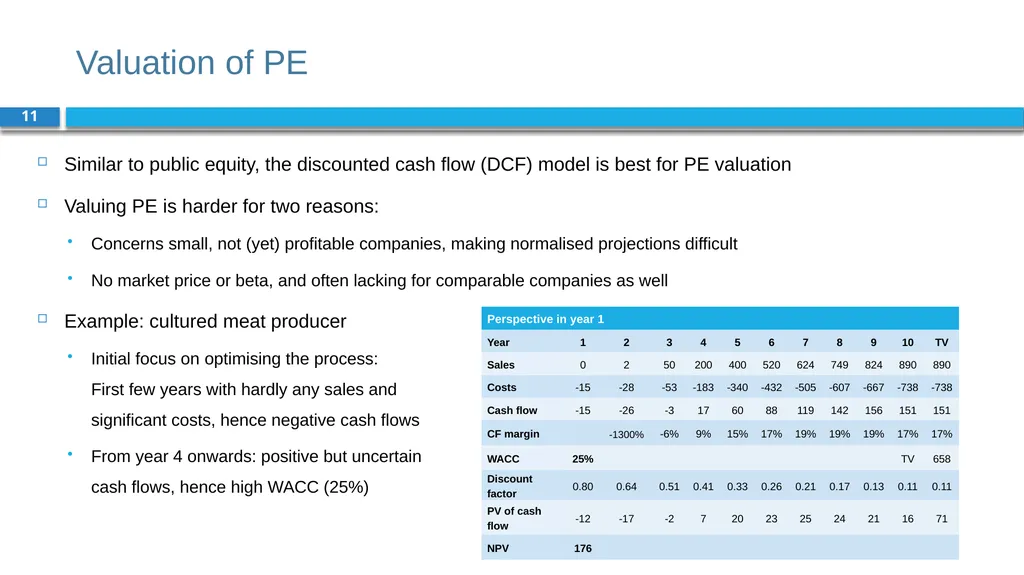
Valuation of PE 11 Similar to public equity, the discounted cash flow (DCF) model is best for PE valuation
Valuing PE is harder for two reasons:
Concerns small, not (yet) profitable companies, making normalised projections difficult
No market price or beta, and often lacking for comparable companies as well
Example: cultured meat producer
Initial focus on optimising the process:�First few years with hardly any sales and �significant costs, hence negative cash flows
From year 4 onwards: positive but uncertain�cash flows, hence high WACC (25%)<br>
12
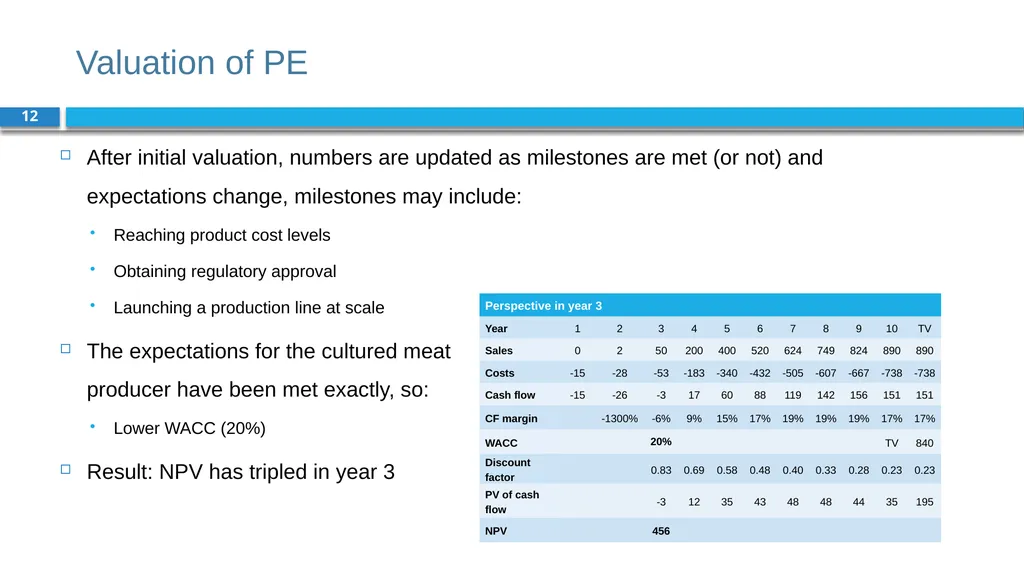
Valuation of PE 12 After initial valuation, numbers are updated as milestones are met (or not) and expectations change, milestones may include:
Reaching product cost levels
Obtaining regulatory approval
Launching a production line at scale
The expectations for the cultured meat�producer have been met exactly, so:
Lower WACC (20%)
Result: NPV has tripled in year 3<br>
13
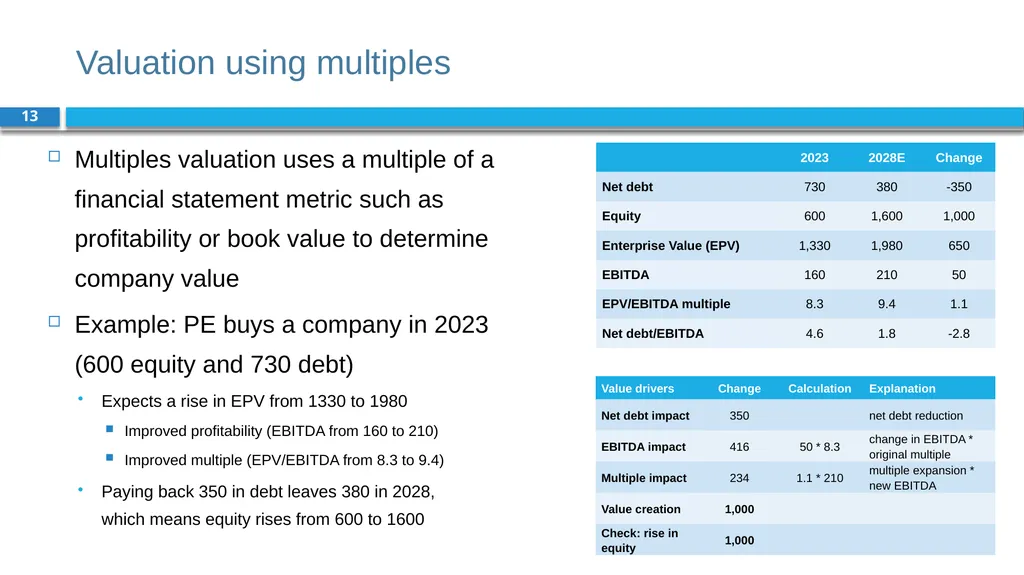
Valuation using multiples 13 Multiples valuation uses a multiple of a financial statement metric such as profitability or book value to determine company value
Example: PE buys a company in 2023�(600 equity and 730 debt)
Expects a rise in EPV from 1330 to 1980
Improved profitability (EBITDA from 160 to 210)
Improved multiple (EPV/EBITDA from 8.3 to 9.4)
Paying back 350 in debt leaves 380 in 2028,�which means equity rises from 600 to 1600<br>
14
Football field graph of valuation methods 14 PE companies also use other multiples:
Revenue multiples: EPV / Revenue
Earnings multiples: price-earnings (P/E) ratio
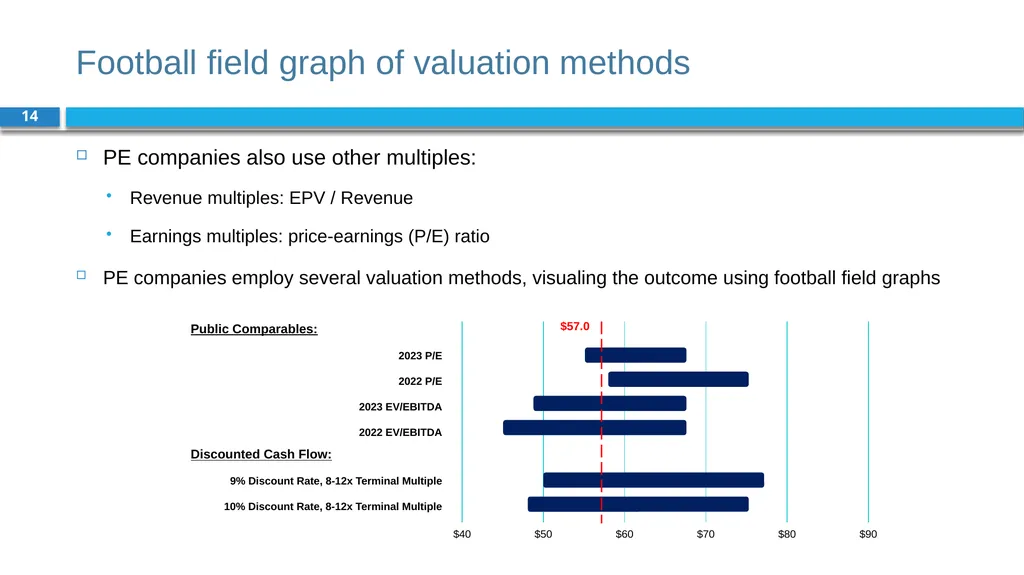
PE companies employ several valuation methods, visualing the outcome using football field graphs Public Comparables:
2023 P/E
2022 P/E
2023 EV/EBITDA
2022 EV/EBITDA
Discounted Cash Flow:
9% Discount Rate, 8-12x Terminal Multiple
10% Discount Rate, 8-12x Terminal Multiple<br>
15
Cost of capital 15 Since non-listed companies do not have past stock returns and no observable beta, the betas of comparable companies or industry betas can be used
However, such betas don’t reflect the extra risk of early-stage companies
Different approach: take high default cost of capital of 20% to 60%
Phalippou (2020) found that PE has not been as financially successful as often claimed: PE funds have generated returns (after fees for PE managers) that are similar to public equity indexes since at least 2006, although with higher risk
Conclusion: PE is particularly financially attractive for the PE managers<br>
16
ESG integration in PE 16 The practice of ESG integration in PE seems to be lagging compared to ESG integration in public equity investing
Mostly driven by the desire to comply with regulations and standards
ESG due diligence is typically performed by external advisors
Most PE companies do not have standardised ESG procedures
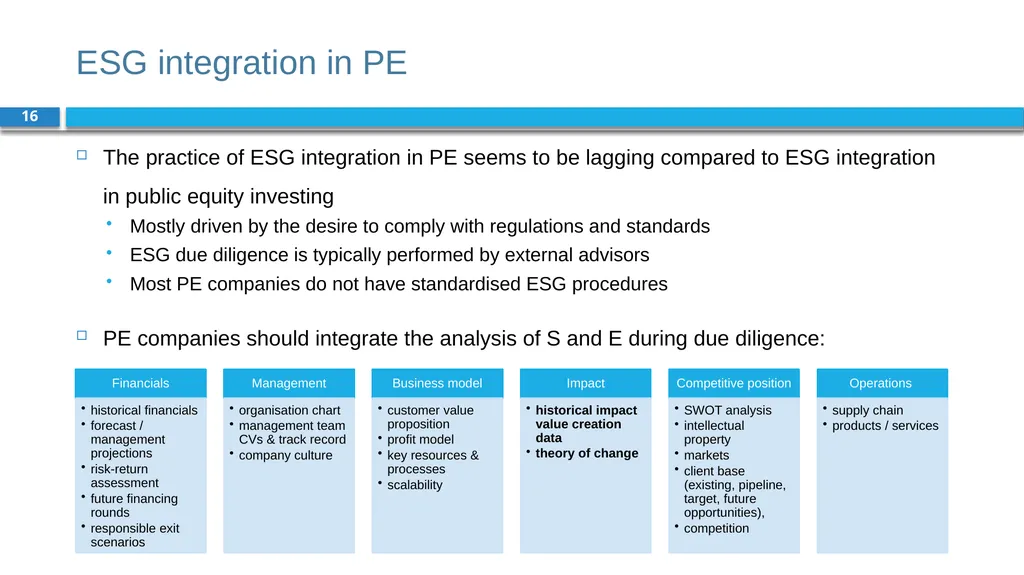
PE companies should integrate the analysis of S and E during due diligence:<br>
17
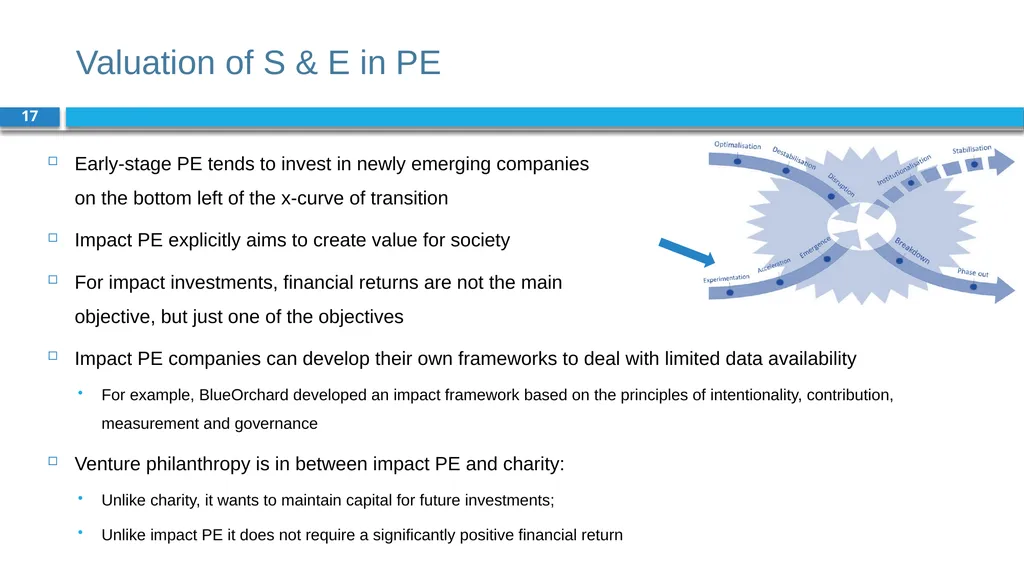
Valuation of S & E in PE 17 Early-stage PE tends to invest in newly emerging companies�on the bottom left of the x-curve of transition
Impact PE explicitly aims to create value for society
For impact investments, financial returns are not the main �objective, but just one of the objectives
Impact PE companies can develop their own frameworks to deal with limited data availability
For example, BlueOrchard developed an impact framework based on the principles of intentionality, contribution, measurement and governance
Venture philanthropy is in between impact PE and charity:
Unlike charity, it wants to maintain capital for future investments;
Unlike impact PE it does not require a significantly positive financial return<br>
18
Conclusions 18 Private equity funds are set up to invest in private companies for a predefined multiyear period, aiming to make a return by improving their investee companies’ performance and exiting them at a profit
Despite being well suited for sustainable investing, private equity lags the public equity space in the application of sustainability considerations
Given the active ownership role that private equity takes, value creation on E and S is potentially greater in private equity than in public equity
Value creation on E and S is more likely if private equity fund actually steers on impact<br>