
Corporate Finance for Long-Term Value Chapter 2:

Description: Corporate Finance for Long-Term Value Chapter 2: Integrated Value Creation Chapter 2: Integrated Value Creation Part 1: Why corporate finance for long-term value? The BIG Picture 3 Many companies are currently value destructive on SV and EV
Related Topics
Download Presentation
"Corporate Finance for Long-Term Value Chapter 2:" is the property of its rightful owner. Permission is granted to download and print the materials on this website for personal, non-commercial use only, and to display it on your personal computer provided you do not modify the materials and that you retain all copyright notices contained in the materials. By downloading content from our website, you accept the terms of this agreement.
Presentation Transcript
slide1. Corporate Finance for
Long-Term Value Chapter 2: Integrated Value Creation<br>
slide2. Chapter 2: Integrated Value Creation Part 1: Why corporate finance for long-term value?<br>
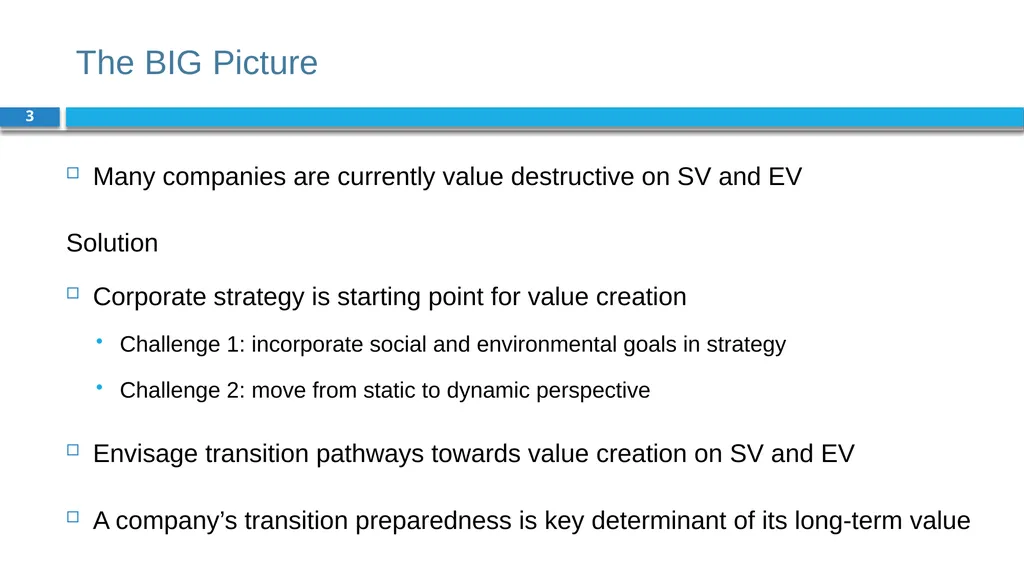
slide3. The BIG Picture 3 Many companies are currently value destructive on SV and EV
Solution
Corporate strategy is starting point for value creation
Challenge 1: incorporate social and environmental goals in strategy
Challenge 2: move from static to dynamic perspective
Envisage transition pathways towards value creation on SV and EV
A company’s transition preparedness is key determinant of its long-term value<br>
slide4. What is value creation? 4 In financial terms, value creation is defined as an increase in the net present value (NPV) of a company’s projects
FV is often generated at the expense of SV and EV as resources are depleted without sufficient investments in maintaining them
Responsible companies manage for integrated value creation (profit and impact) rather than merely shareholder value (profit)<br>
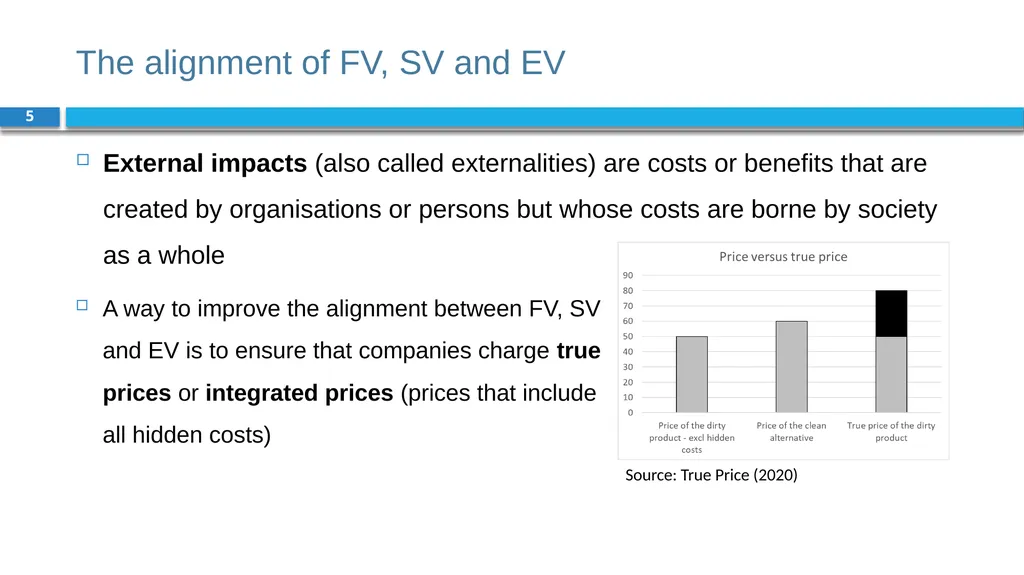
slide5. The alignment of FV, SV and EV 5 External impacts (also called externalities) are costs or benefits that are created by organisations or persons but whose costs are borne by society as a whole A way to improve the alignment between FV, SV and EV is to ensure that companies charge true prices or integrated prices (prices that include all hidden costs) Source: True Price (2020)<br>
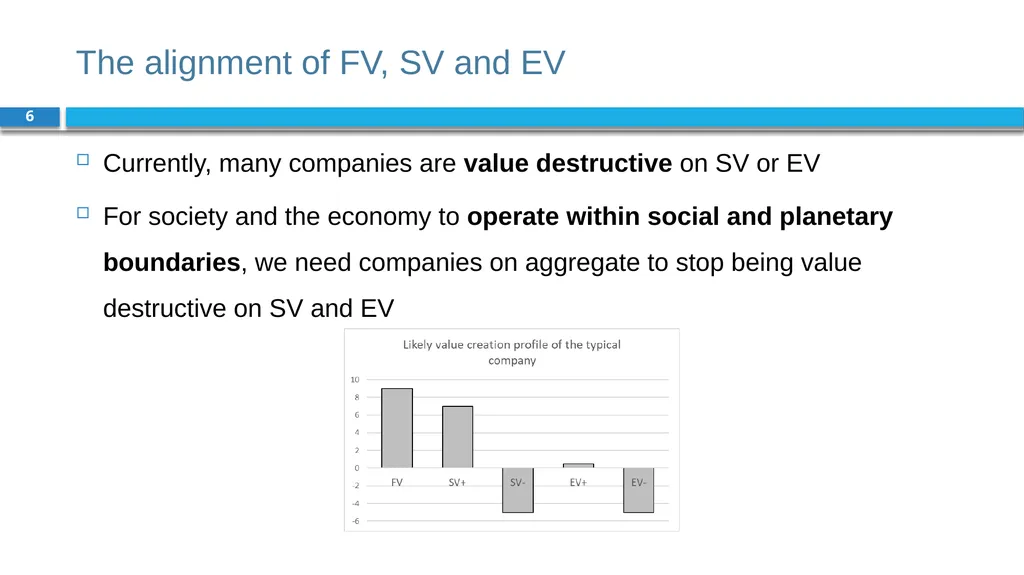
slide6. The alignment of FV, SV and EV 6 Currently, many companies are value destructive on SV or EV
For society and the economy to operate within social and planetary boundaries, we need companies on aggregate to stop being value destructive on SV and EV<br>
slide7. Why is it in companies’ interest to manage for integrated value? 7 If company management neglects SV or EV, that will hurt long-term FV as well
Ethical case - license to operate -> corporate responsibility
US survey shows that 63% of US citizens (including 71% of millennials) expect companies to contribute to social and environmental challenges (Cone Communications, 2017)
Companies that create FV at the expense of SV or EV are likely to lose their license to operate at some stage (Kurznack et al, 2021)
Business case – long-term value creation
Companies that create value on SV and EV are more likely to be value creative on FV in the long run as well
As external impacts are being internalised, they affect FV<br>
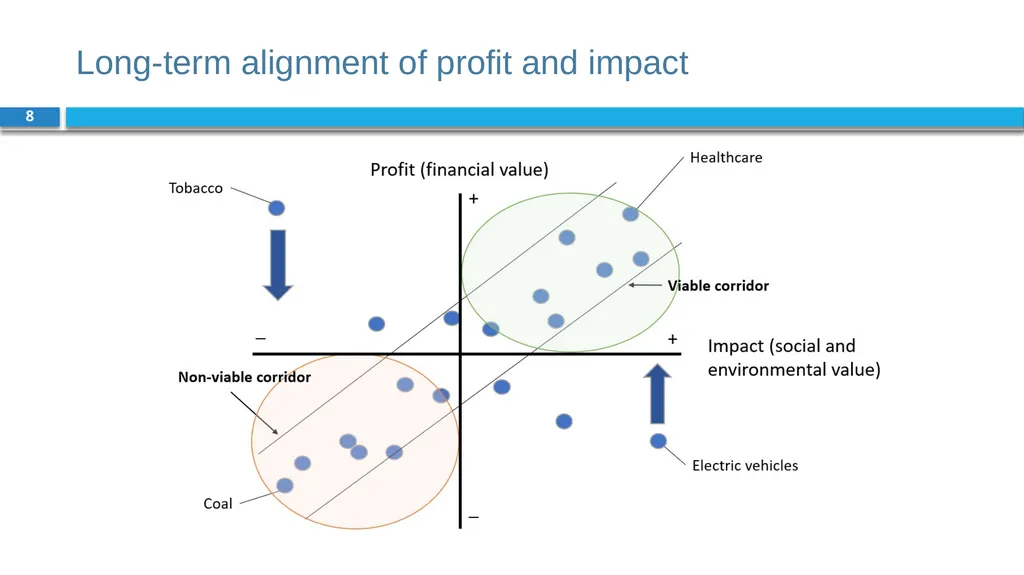
slide8. Long-term alignment of profit and impact 8<br>
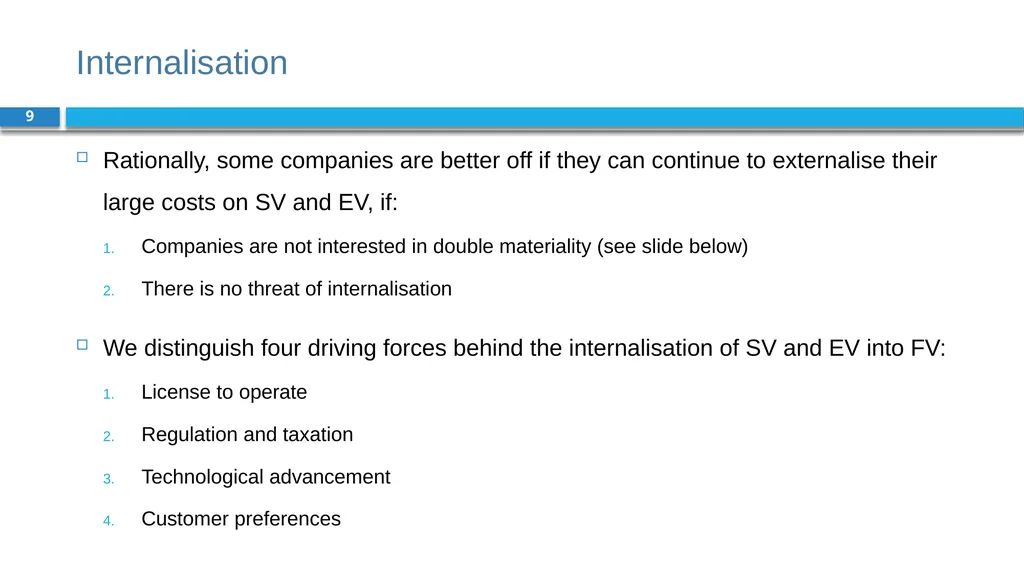
slide9. Internalisation 9 Rationally, some companies are better off if they can continue to externalise their large costs on SV and EV, if:
Companies are not interested in double materiality (see slide below)
There is no threat of internalisation
We distinguish four driving forces behind the internalisation of SV and EV into FV:
License to operate
Regulation and taxation
Technological advancement
Customer preferences<br>
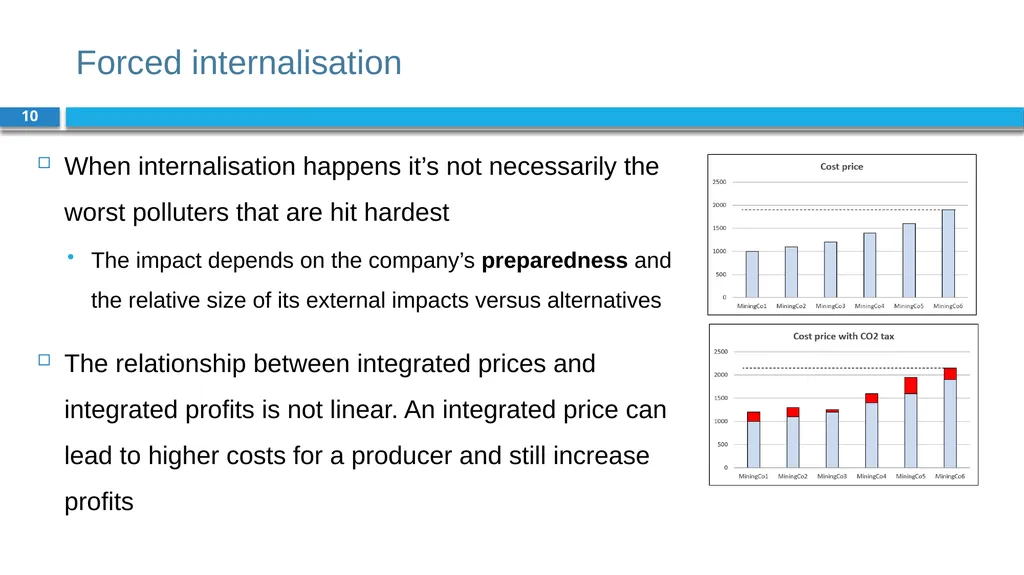
slide10. Forced internalisation 10 When internalisation happens it’s not necessarily the worst polluters that are hit hardest
The impact depends on the company’s preparedness and the relative size of its external impacts versus alternatives
The relationship between integrated prices and integrated profits is not linear. An integrated price can lead to higher costs for a producer and still increase profits<br>
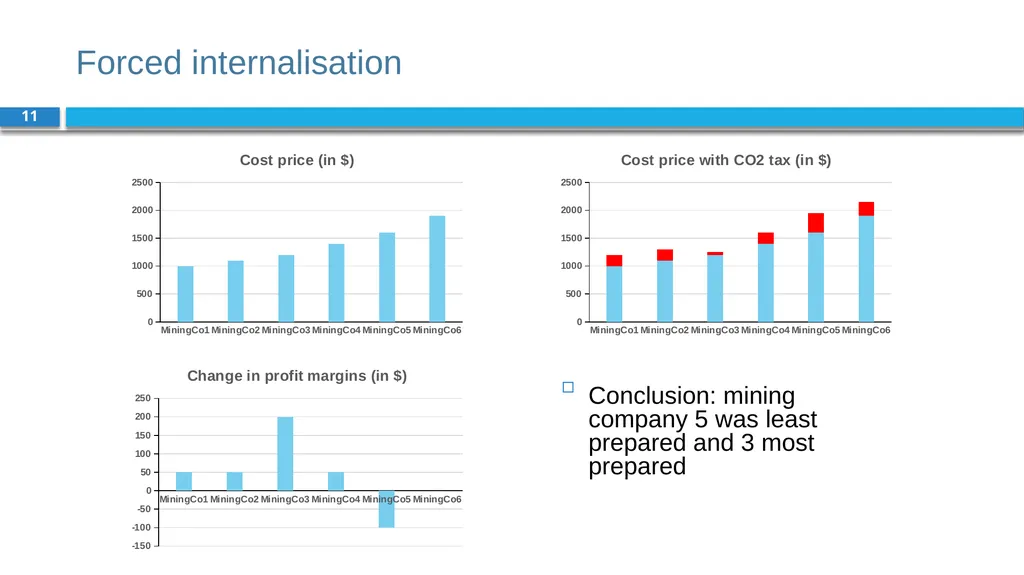
slide11. Forced internalisation 11 Conclusion: mining company 5 was least prepared and 3 most prepared<br>
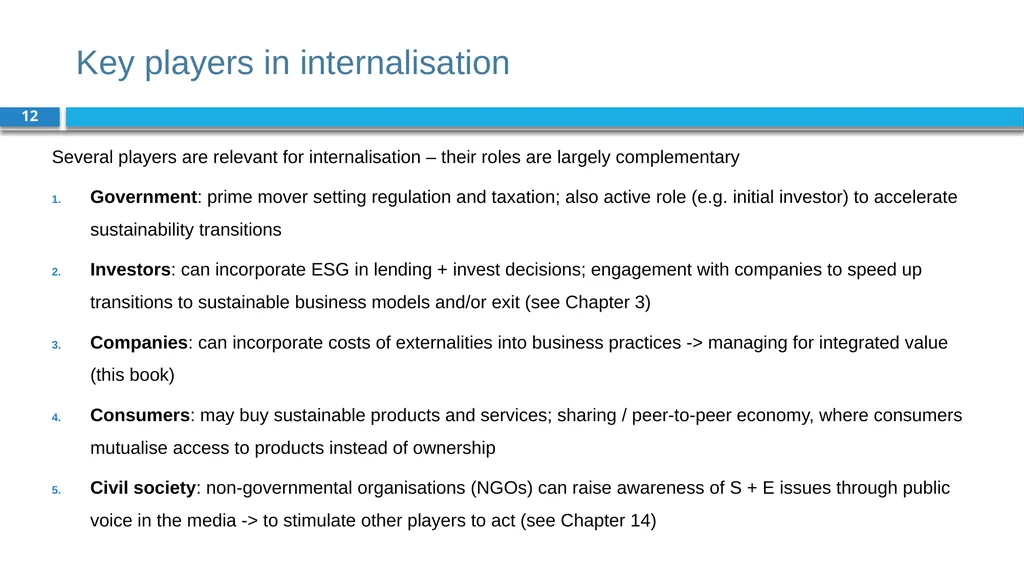
slide12. Key players in internalisation 12 Several players are relevant for internalisation – their roles are largely complementary
Government: prime mover setting regulation and taxation; also active role (e.g. initial investor) to accelerate sustainability transitions
Investors: can incorporate ESG in lending + invest decisions; engagement with companies to speed up transitions to sustainable business models and/or exit (see Chapter 3)
Companies: can incorporate costs of externalities into business practices -> managing for integrated value (this book)
Consumers: may buy sustainable products and services; sharing / peer-to-peer economy, where consumers mutualise access to products instead of ownership
Civil society: non-governmental organisations (NGOs) can raise awareness of S + E issues through public voice in the media -> to stimulate other players to act (see Chapter 14)<br>
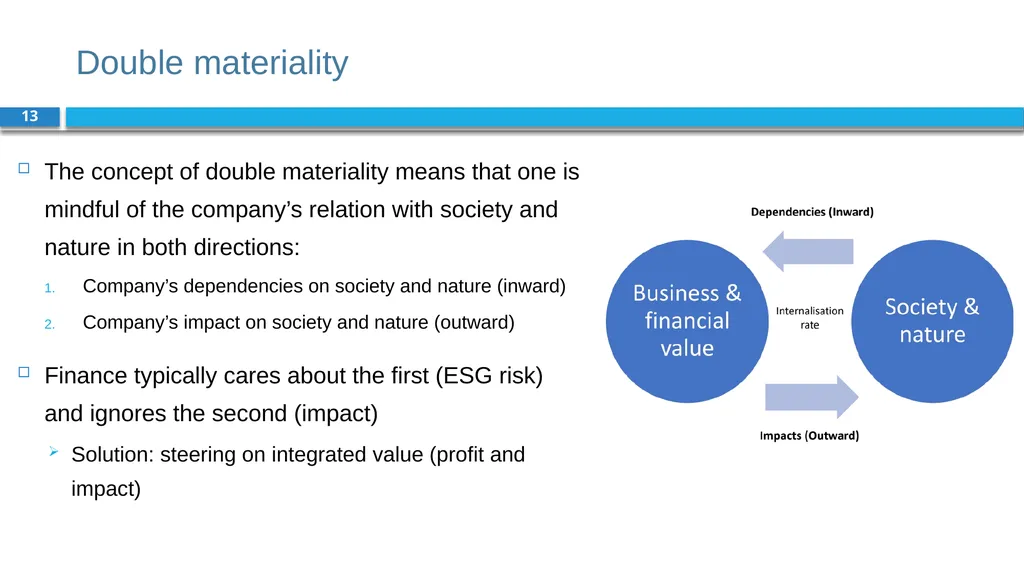
slide13. Double materiality 13 The concept of double materiality means that one is mindful of the company’s relation with society and nature in both directions:
Company’s dependencies on society and nature (inward)
Company’s impact on society and nature (outward)
Finance typically cares about the first (ESG risk) and ignores the second (impact)
Solution: steering on integrated value (profit and impact)<br>
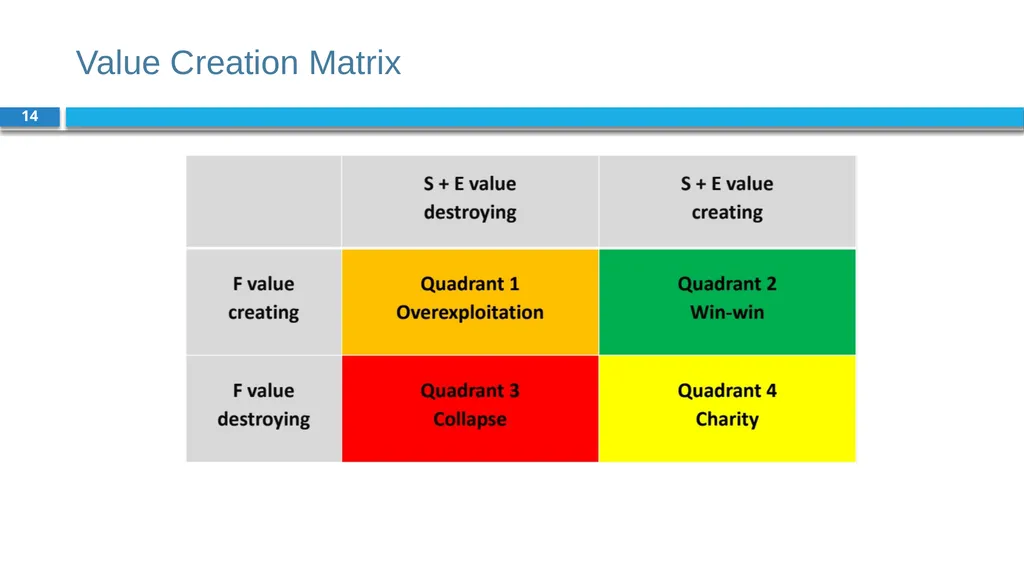
slide14. Value Creation Matrix 14<br>
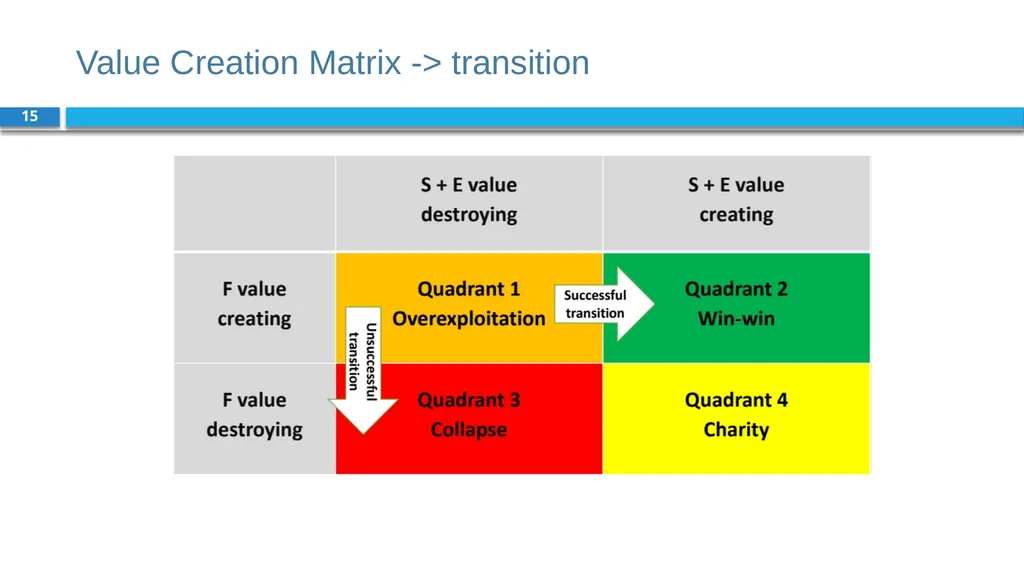
slide15. Value Creation Matrix -> transition 15<br>
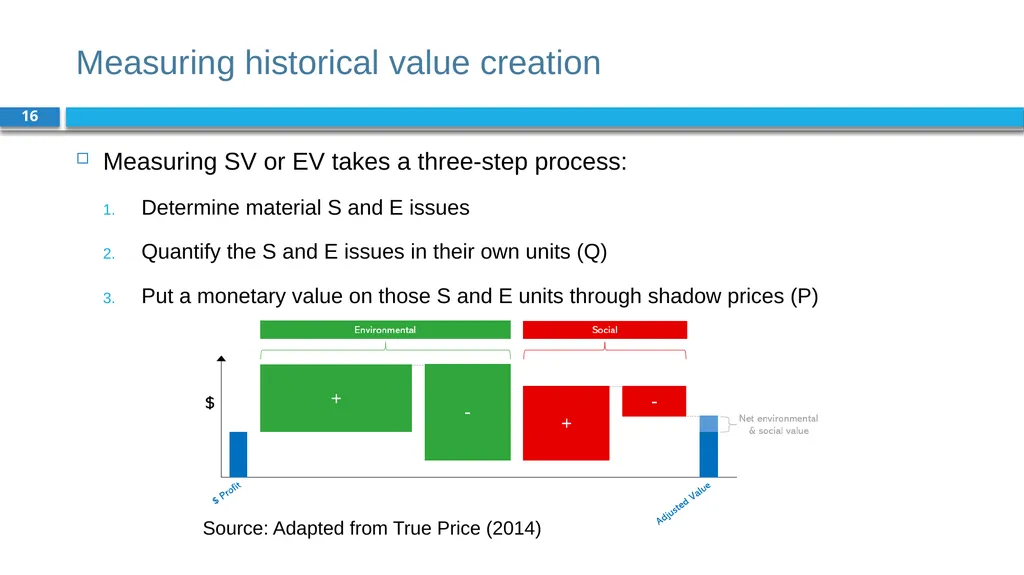
slide16. Measuring historical value creation 16 Measuring SV or EV takes a three-step process:
Determine material S and E issues
Quantify the S and E issues in their own units (Q)
Put a monetary value on those S and E units through shadow prices (P) Source: Adapted from True Price (2014)<br>
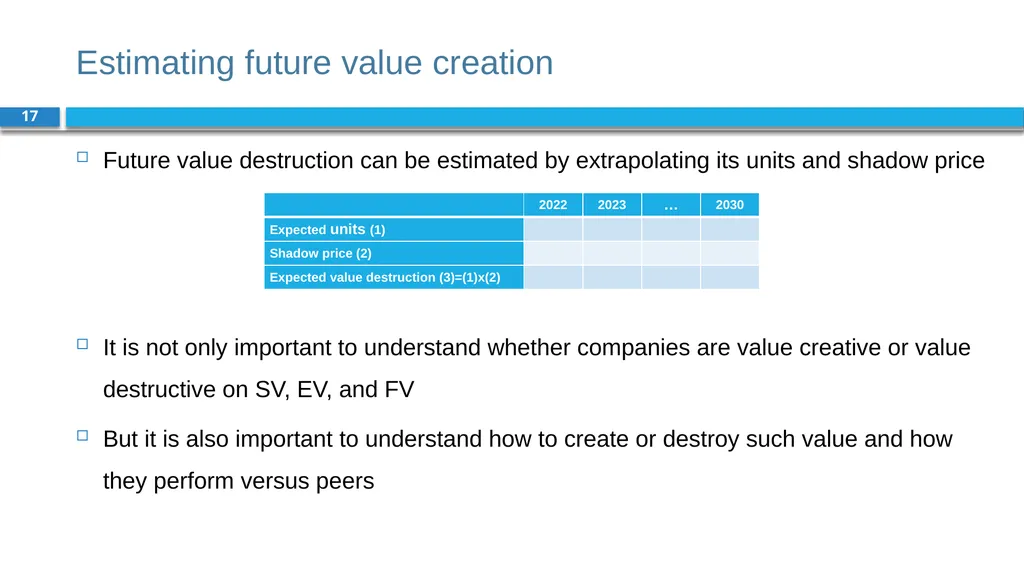
slide17. Estimating future value creation 17 Future value destruction can be estimated by extrapolating its units and shadow price
It is not only important to understand whether companies are value creative or value destructive on SV, EV, and FV
But it is also important to understand how to create or destroy such value and how they perform versus peers<br>
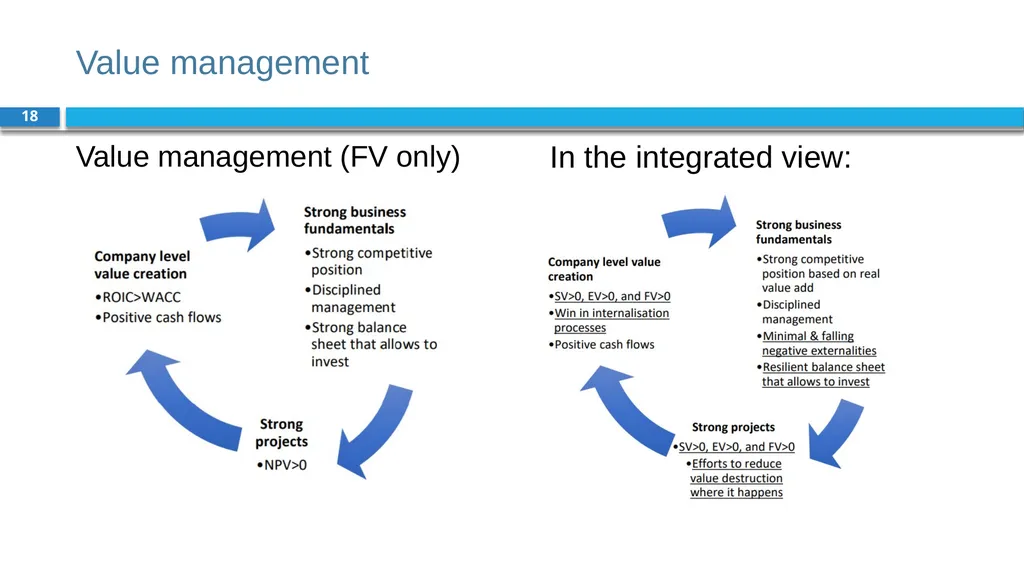
slide18. Value management Value management (FV only) In the integrated view: 18<br>
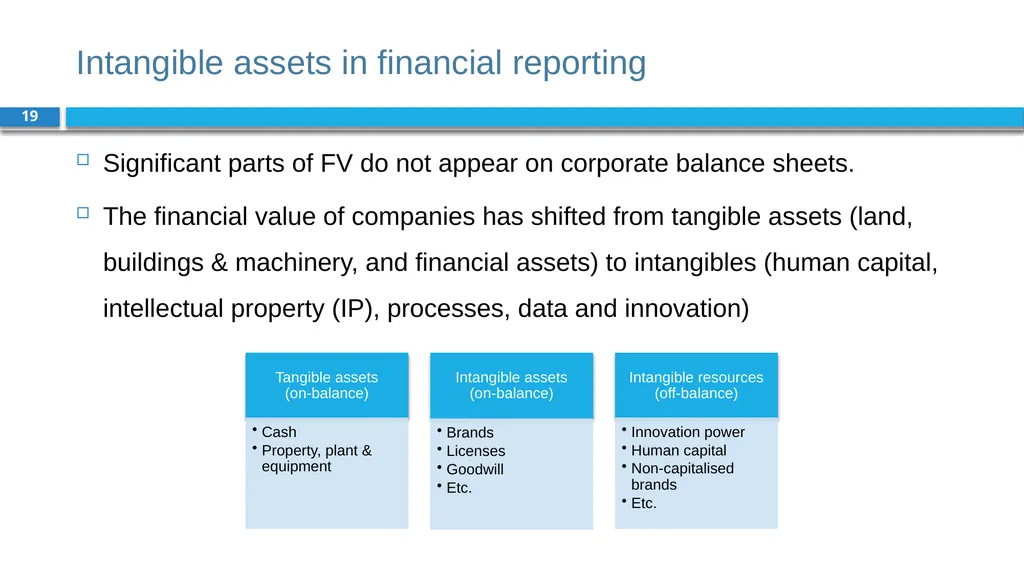
slide19. Intangible assets in financial reporting 19 Significant parts of FV do not appear on corporate balance sheets.
The financial value of companies has shifted from tangible assets (land, buildings & machinery, and financial assets) to intangibles (human capital, intellectual property (IP), processes, data and innovation)<br>
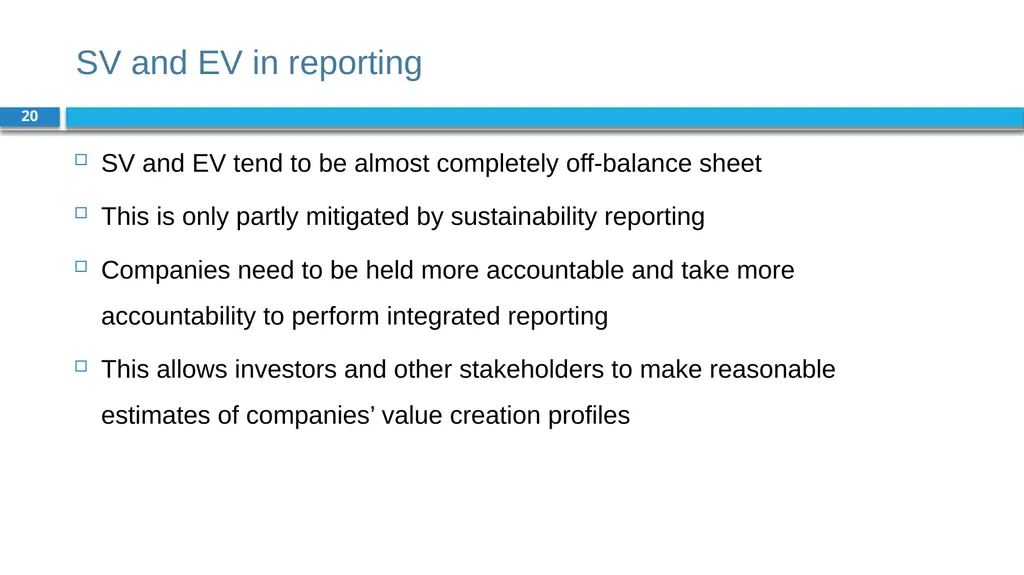
slide20. SV and EV in reporting 20 SV and EV tend to be almost completely off-balance sheet
This is only partly mitigated by sustainability reporting
Companies need to be held more accountable and take more accountability to perform integrated reporting
This allows investors and other stakeholders to make reasonable estimates of companies’ value creation profiles<br>
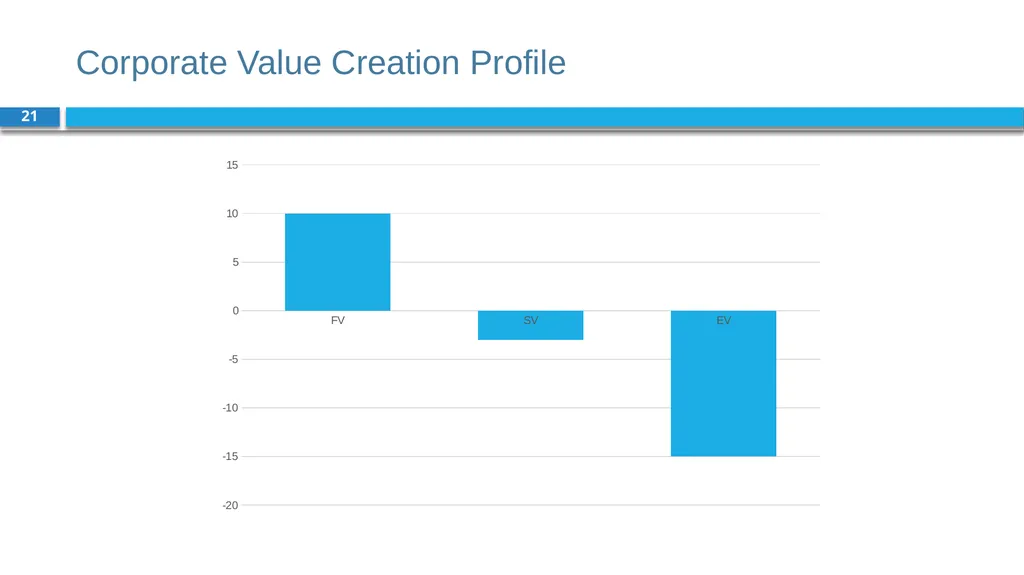
slide21. Corporate Value Creation Profile 21<br>
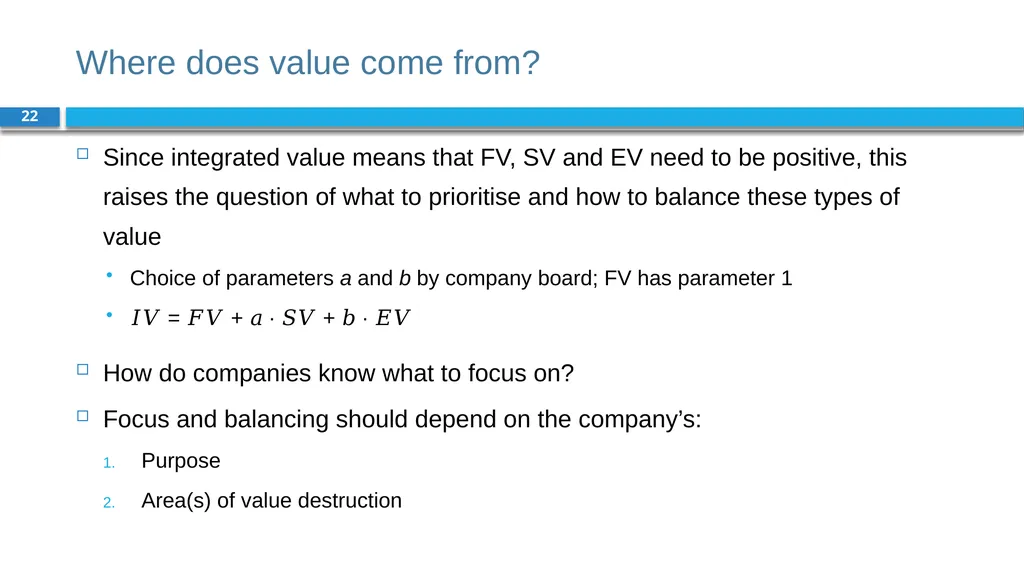
slide22. Where does value come from? 22 Since integrated value means that FV, SV and EV need to be positive, this raises the question of what to prioritise and how to balance these types of value
Choice of parameters a and b by company board; FV has parameter 1
𝐼𝑉 = 𝐹𝑉 + 𝑎 ∙ 𝑆𝑉 + 𝑏 ∙ 𝐸𝑉
How do companies know what to focus on?
Focus and balancing should depend on the company’s:
Purpose
Area(s) of value destruction<br>
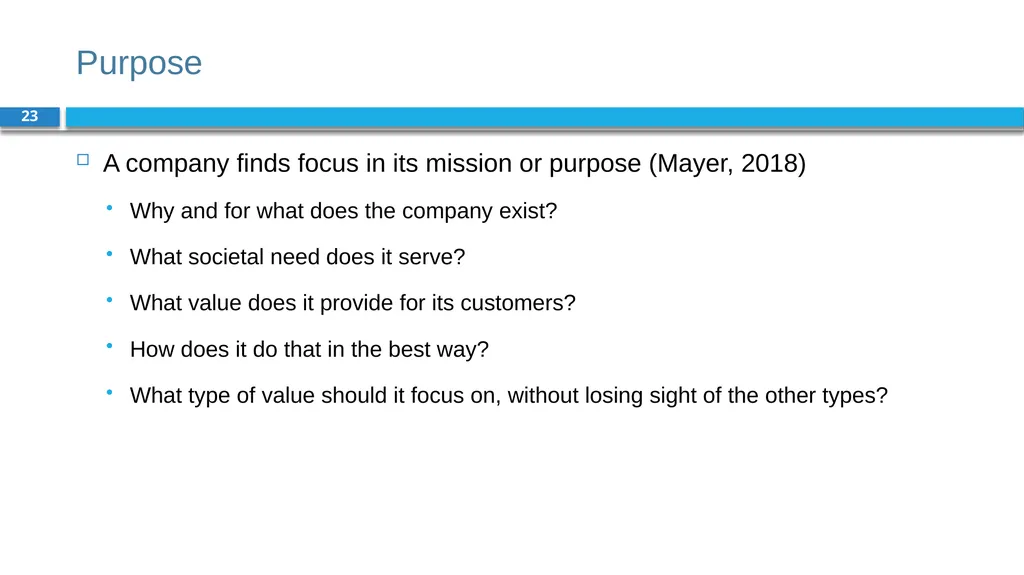
slide23. Purpose 23 A company finds focus in its mission or purpose (Mayer, 2018)
Why and for what does the company exist?
What societal need does it serve?
What value does it provide for its customers?
How does it do that in the best way?
What type of value should it focus on, without losing sight of the other types?<br>
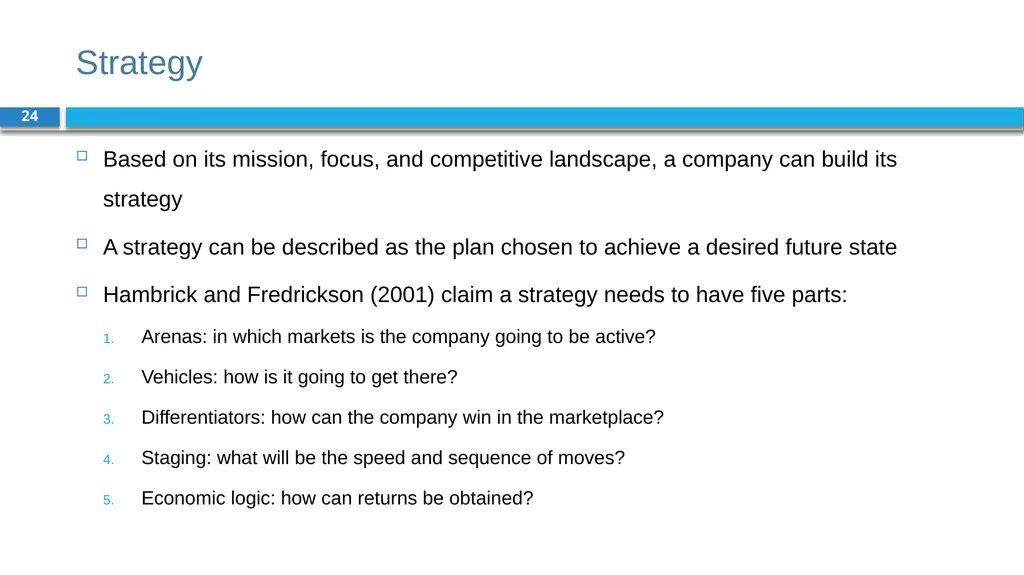
slide24. Strategy 24 Based on its mission, focus, and competitive landscape, a company can build its strategy
A strategy can be described as the plan chosen to achieve a desired future state
Hambrick and Fredrickson (2001) claim a strategy needs to have five parts:
Arenas: in which markets is the company going to be active?
Vehicles: how is it going to get there?
Differentiators: how can the company win in the marketplace?
Staging: what will be the speed and sequence of moves?
Economic logic: how can returns be obtained?<br>
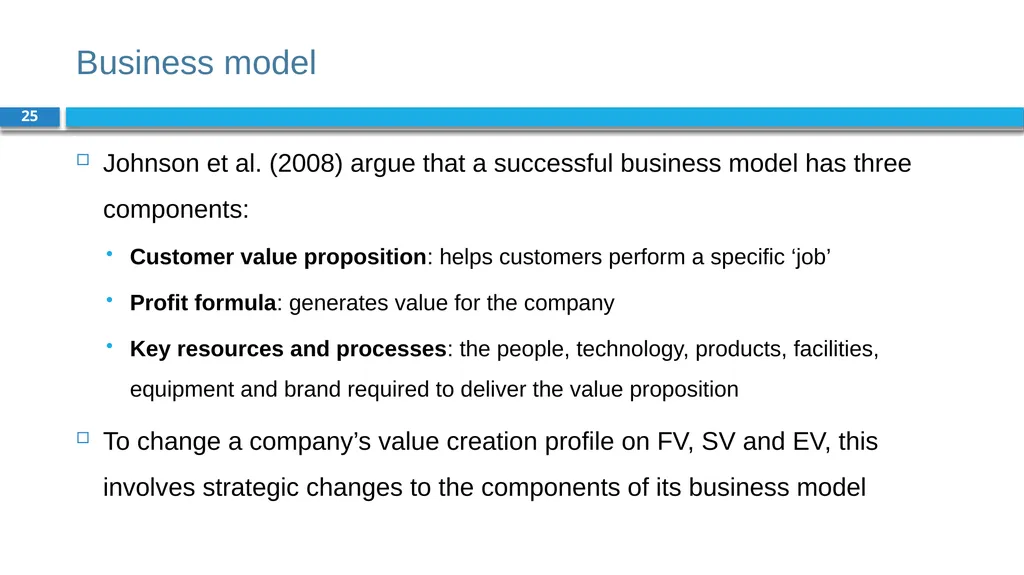
slide25. Business model 25 Johnson et al. (2008) argue that a successful business model has three components:
Customer value proposition: helps customers perform a specific ‘job’
Profit formula: generates value for the company
Key resources and processes: the people, technology, products, facilities, equipment and brand required to deliver the value proposition
To change a company’s value creation profile on FV, SV and EV, this involves strategic changes to the components of its business model<br>
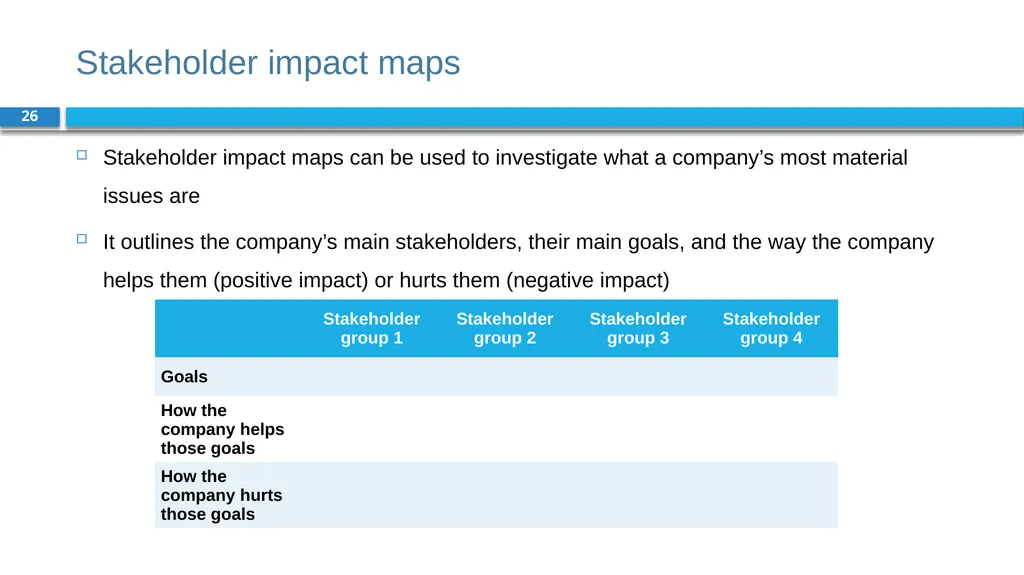
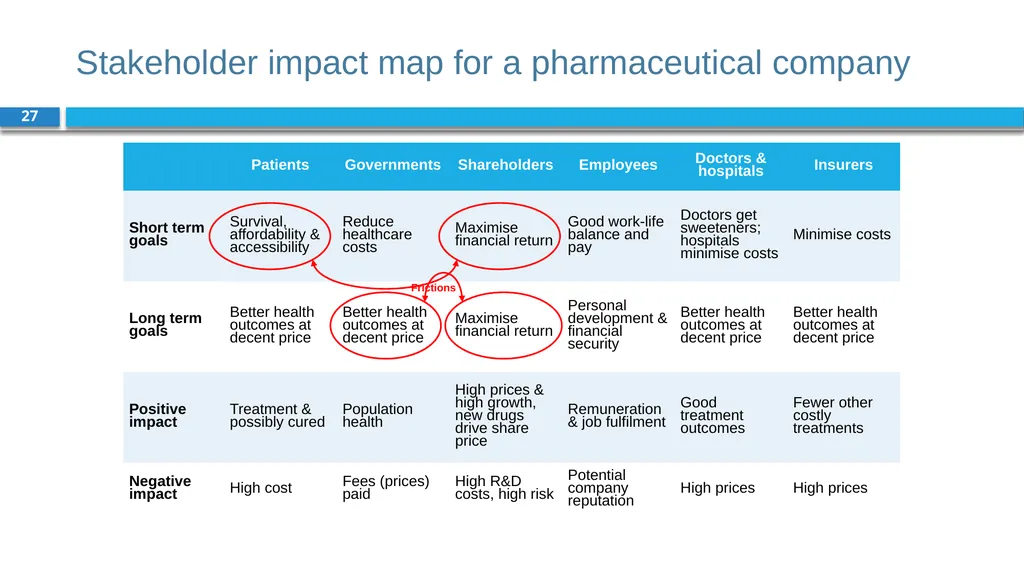
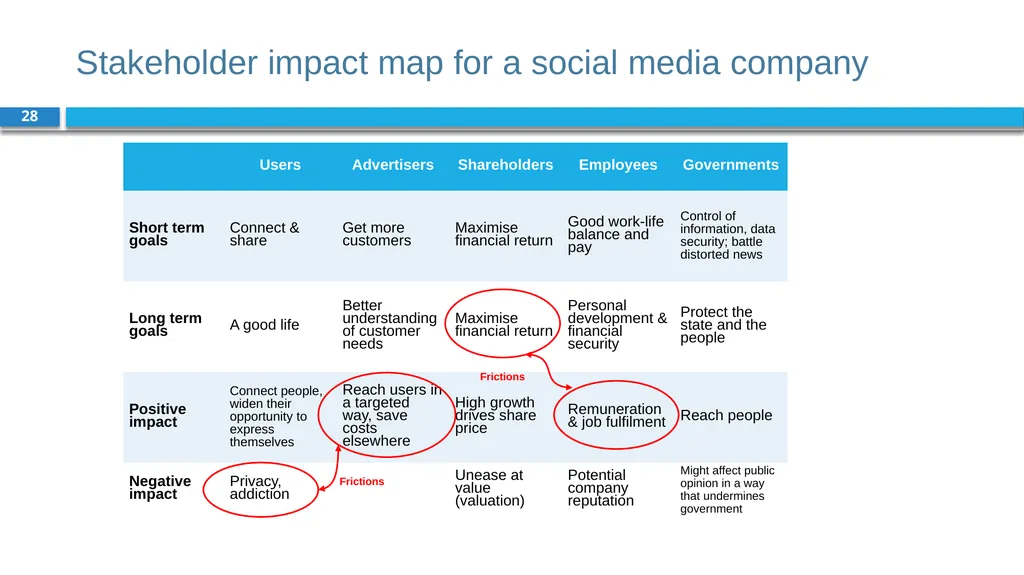
slide26. Stakeholder impact maps 26 Stakeholder impact maps can be used to investigate what a company’s most material issues are
It outlines the company’s main stakeholders, their main goals, and the way the company helps them (positive impact) or hurts them (negative impact)<br>
slide27. Stakeholder impact map for a pharmaceutical company 27 Frictions<br>
slide28. Stakeholder impact map for a social media company 28 Frictions Frictions<br>
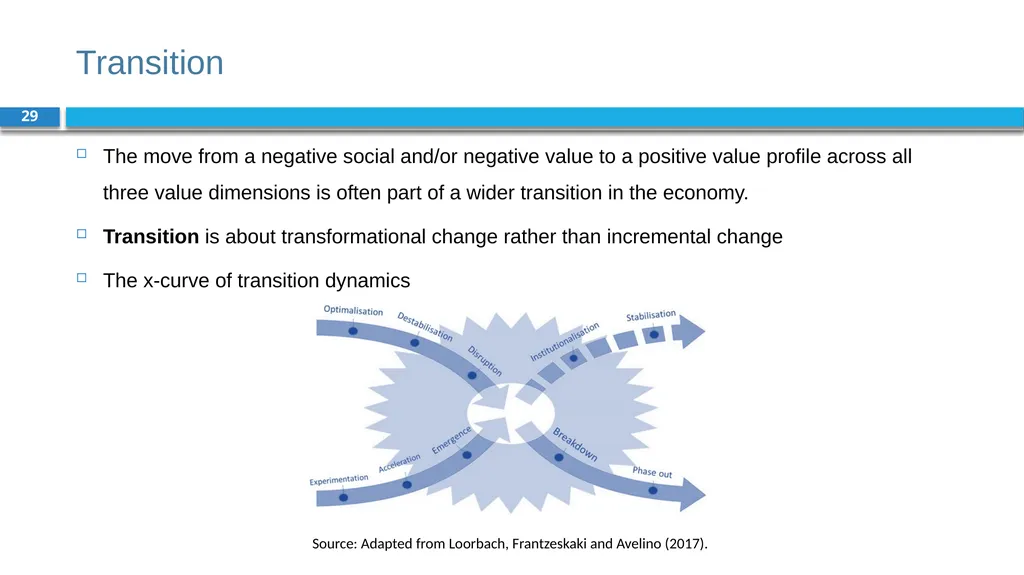
slide29. Transition 29 The move from a negative social and/or negative value to a positive value profile across all three value dimensions is often part of a wider transition in the economy.
Transition is about transformational change rather than incremental change
The x-curve of transition dynamics Source: Adapted from Loorbach, Frantzeskaki and Avelino (2017).<br>
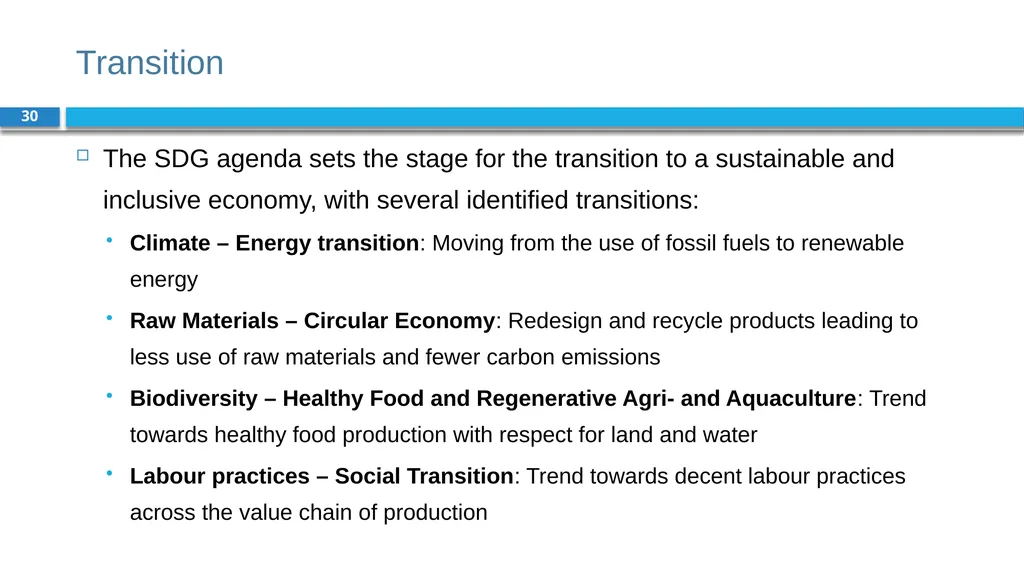
slide30. Transition 30 The SDG agenda sets the stage for the transition to a sustainable and inclusive economy, with several identified transitions:
Climate – Energy transition: Moving from the use of fossil fuels to renewable energy
Raw Materials – Circular Economy: Redesign and recycle products leading to less use of raw materials and fewer carbon emissions
Biodiversity – Healthy Food and Regenerative Agri- and Aquaculture: Trend towards healthy food production with respect for land and water
Labour practices – Social Transition: Trend towards decent labour practices across the value chain of production<br>
slide31. Transition and value 31 Transitions can have major implications for company value
A company that adapts in a timely manner to the new world can realise its integrated value potential
In contrast, a company that follows a business-as-usual path and fails to adapt can lose its value and go bankrupt<br>
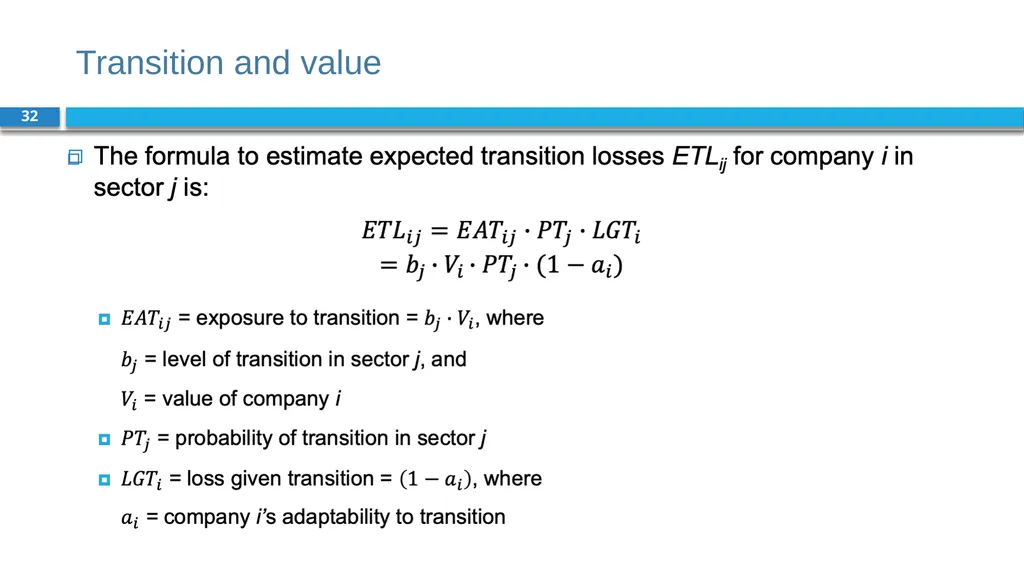
slide32. Transition and value 32<br>
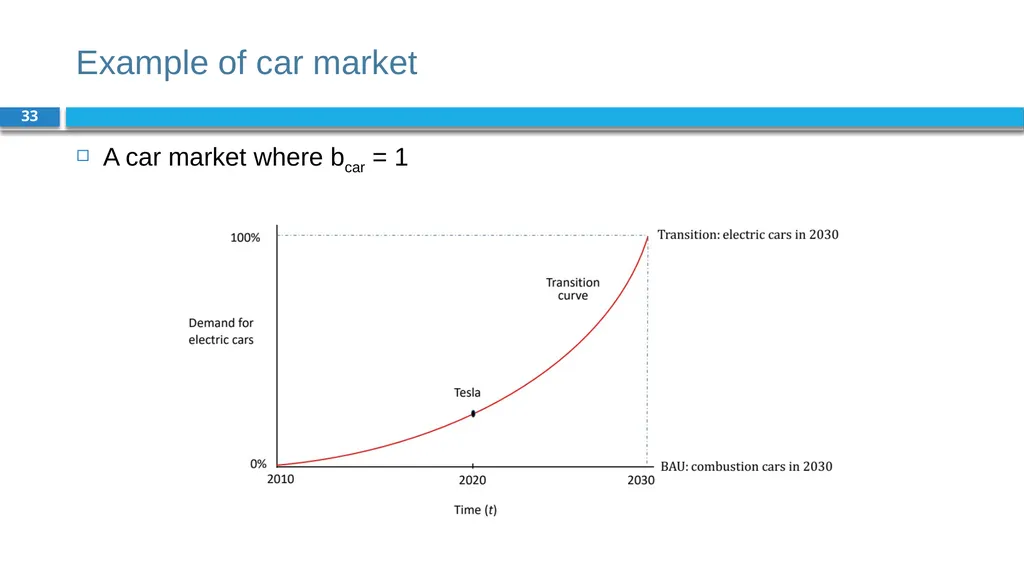
slide33. Example of car market 33 A car market where bcar = 1<br>
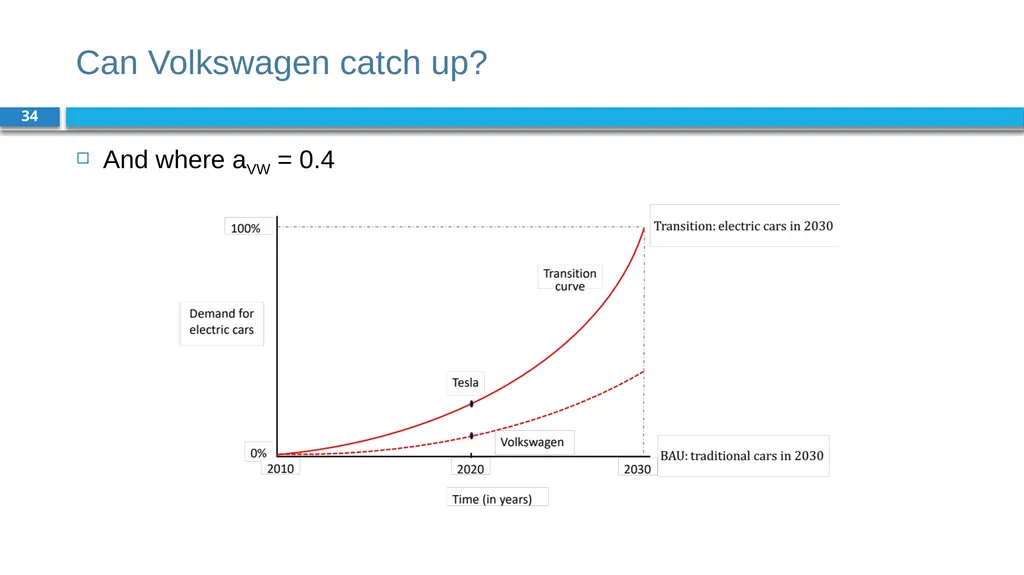
slide34. Can Volkswagen catch up? 34 And where aVW = 0.4<br>
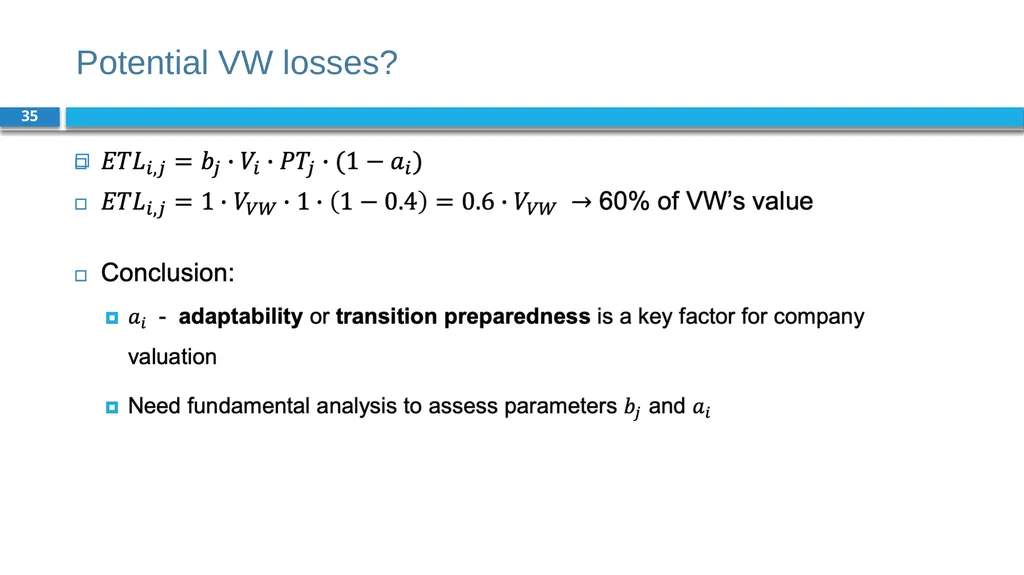
slide35. Potential VW losses? 35<br>
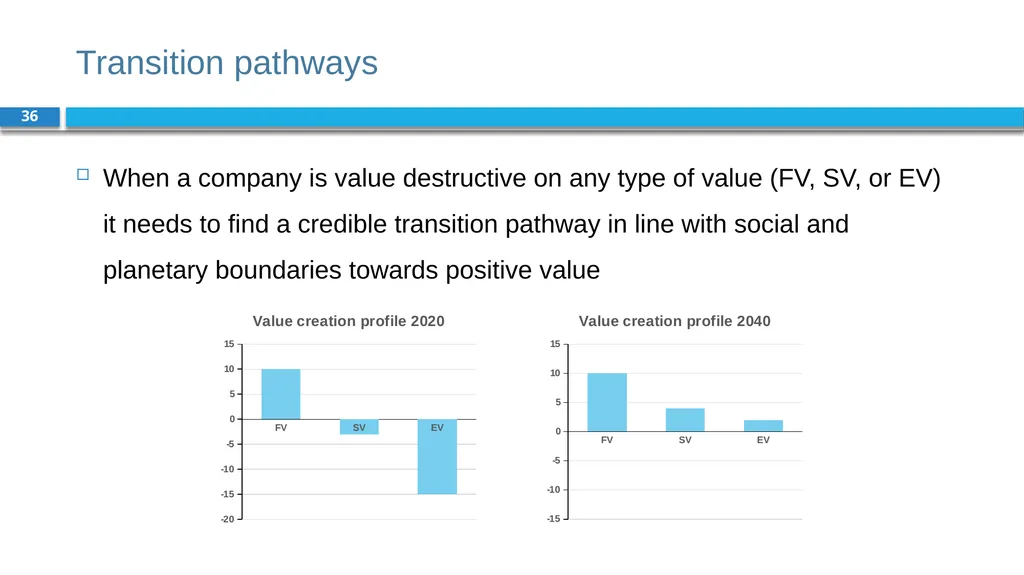
slide36. Transition pathways 36 When a company is value destructive on any type of value (FV, SV, or EV) it needs to find a credible transition pathway in line with social and planetary boundaries towards positive value<br>
slide37. Steering your company on integrated value 37 Goals: Companies should steer according to FV, SV and EV in an integrated way. This is the process of optimising the company’s integrated value.
Constraints: Companies need to survive the transitions in the market and also need to operate within social and planetary boundaries
With a future-proof business model, companies can attract funding and avoid bankruptcy<br>
slide38. Conclusions 38 Creating value on FV, SV and EV requires a clear view of all types of value creation
Internalisation shifts the burdens of externalities back from society to the companies
If companies’ FV depends on the exploitation of an external impact, that FV will be affected when internalisation occurs
Stakeholders can use the Value Creation Matrix to identify value creation on SV and EV
Based on companies’ purpose and area(s) of value destruction, companies can adjust their strategy and business model
In the case of serious value destruction, companies should be able to outline a credible transition pathway<br>
slide2. Chapter 2: Integrated Value Creation Part 1: Why corporate finance for long-term value?<br>
slide3. The BIG Picture 3 Many companies are currently value destructive on SV and EV
Solution
Corporate strategy is starting point for value creation
Challenge 1: incorporate social and environmental goals in strategy
Challenge 2: move from static to dynamic perspective
Envisage transition pathways towards value creation on SV and EV
A company’s transition preparedness is key determinant of its long-term value<br>
slide4. What is value creation? 4 In financial terms, value creation is defined as an increase in the net present value (NPV) of a company’s projects
FV is often generated at the expense of SV and EV as resources are depleted without sufficient investments in maintaining them
Responsible companies manage for integrated value creation (profit and impact) rather than merely shareholder value (profit)<br>
slide5. The alignment of FV, SV and EV 5 External impacts (also called externalities) are costs or benefits that are created by organisations or persons but whose costs are borne by society as a whole A way to improve the alignment between FV, SV and EV is to ensure that companies charge true prices or integrated prices (prices that include all hidden costs) Source: True Price (2020)<br>
slide6. The alignment of FV, SV and EV 6 Currently, many companies are value destructive on SV or EV
For society and the economy to operate within social and planetary boundaries, we need companies on aggregate to stop being value destructive on SV and EV<br>
slide7. Why is it in companies’ interest to manage for integrated value? 7 If company management neglects SV or EV, that will hurt long-term FV as well
Ethical case - license to operate -> corporate responsibility
US survey shows that 63% of US citizens (including 71% of millennials) expect companies to contribute to social and environmental challenges (Cone Communications, 2017)
Companies that create FV at the expense of SV or EV are likely to lose their license to operate at some stage (Kurznack et al, 2021)
Business case – long-term value creation
Companies that create value on SV and EV are more likely to be value creative on FV in the long run as well
As external impacts are being internalised, they affect FV<br>
slide8. Long-term alignment of profit and impact 8<br>
slide9. Internalisation 9 Rationally, some companies are better off if they can continue to externalise their large costs on SV and EV, if:
Companies are not interested in double materiality (see slide below)
There is no threat of internalisation
We distinguish four driving forces behind the internalisation of SV and EV into FV:
License to operate
Regulation and taxation
Technological advancement
Customer preferences<br>
slide10. Forced internalisation 10 When internalisation happens it’s not necessarily the worst polluters that are hit hardest
The impact depends on the company’s preparedness and the relative size of its external impacts versus alternatives
The relationship between integrated prices and integrated profits is not linear. An integrated price can lead to higher costs for a producer and still increase profits<br>
slide11. Forced internalisation 11 Conclusion: mining company 5 was least prepared and 3 most prepared<br>
slide12. Key players in internalisation 12 Several players are relevant for internalisation – their roles are largely complementary
Government: prime mover setting regulation and taxation; also active role (e.g. initial investor) to accelerate sustainability transitions
Investors: can incorporate ESG in lending + invest decisions; engagement with companies to speed up transitions to sustainable business models and/or exit (see Chapter 3)
Companies: can incorporate costs of externalities into business practices -> managing for integrated value (this book)
Consumers: may buy sustainable products and services; sharing / peer-to-peer economy, where consumers mutualise access to products instead of ownership
Civil society: non-governmental organisations (NGOs) can raise awareness of S + E issues through public voice in the media -> to stimulate other players to act (see Chapter 14)<br>
slide13. Double materiality 13 The concept of double materiality means that one is mindful of the company’s relation with society and nature in both directions:
Company’s dependencies on society and nature (inward)
Company’s impact on society and nature (outward)
Finance typically cares about the first (ESG risk) and ignores the second (impact)
Solution: steering on integrated value (profit and impact)<br>
slide14. Value Creation Matrix 14<br>
slide15. Value Creation Matrix -> transition 15<br>
slide16. Measuring historical value creation 16 Measuring SV or EV takes a three-step process:
Determine material S and E issues
Quantify the S and E issues in their own units (Q)
Put a monetary value on those S and E units through shadow prices (P) Source: Adapted from True Price (2014)<br>
slide17. Estimating future value creation 17 Future value destruction can be estimated by extrapolating its units and shadow price
It is not only important to understand whether companies are value creative or value destructive on SV, EV, and FV
But it is also important to understand how to create or destroy such value and how they perform versus peers<br>
slide18. Value management Value management (FV only) In the integrated view: 18<br>
slide19. Intangible assets in financial reporting 19 Significant parts of FV do not appear on corporate balance sheets.
The financial value of companies has shifted from tangible assets (land, buildings & machinery, and financial assets) to intangibles (human capital, intellectual property (IP), processes, data and innovation)<br>
slide20. SV and EV in reporting 20 SV and EV tend to be almost completely off-balance sheet
This is only partly mitigated by sustainability reporting
Companies need to be held more accountable and take more accountability to perform integrated reporting
This allows investors and other stakeholders to make reasonable estimates of companies’ value creation profiles<br>
slide21. Corporate Value Creation Profile 21<br>
slide22. Where does value come from? 22 Since integrated value means that FV, SV and EV need to be positive, this raises the question of what to prioritise and how to balance these types of value
Choice of parameters a and b by company board; FV has parameter 1
𝐼𝑉 = 𝐹𝑉 + 𝑎 ∙ 𝑆𝑉 + 𝑏 ∙ 𝐸𝑉
How do companies know what to focus on?
Focus and balancing should depend on the company’s:
Purpose
Area(s) of value destruction<br>
slide23. Purpose 23 A company finds focus in its mission or purpose (Mayer, 2018)
Why and for what does the company exist?
What societal need does it serve?
What value does it provide for its customers?
How does it do that in the best way?
What type of value should it focus on, without losing sight of the other types?<br>
slide24. Strategy 24 Based on its mission, focus, and competitive landscape, a company can build its strategy
A strategy can be described as the plan chosen to achieve a desired future state
Hambrick and Fredrickson (2001) claim a strategy needs to have five parts:
Arenas: in which markets is the company going to be active?
Vehicles: how is it going to get there?
Differentiators: how can the company win in the marketplace?
Staging: what will be the speed and sequence of moves?
Economic logic: how can returns be obtained?<br>
slide25. Business model 25 Johnson et al. (2008) argue that a successful business model has three components:
Customer value proposition: helps customers perform a specific ‘job’
Profit formula: generates value for the company
Key resources and processes: the people, technology, products, facilities, equipment and brand required to deliver the value proposition
To change a company’s value creation profile on FV, SV and EV, this involves strategic changes to the components of its business model<br>
slide26. Stakeholder impact maps 26 Stakeholder impact maps can be used to investigate what a company’s most material issues are
It outlines the company’s main stakeholders, their main goals, and the way the company helps them (positive impact) or hurts them (negative impact)<br>
slide27. Stakeholder impact map for a pharmaceutical company 27 Frictions<br>
slide28. Stakeholder impact map for a social media company 28 Frictions Frictions<br>
slide29. Transition 29 The move from a negative social and/or negative value to a positive value profile across all three value dimensions is often part of a wider transition in the economy.
Transition is about transformational change rather than incremental change
The x-curve of transition dynamics Source: Adapted from Loorbach, Frantzeskaki and Avelino (2017).<br>
slide30. Transition 30 The SDG agenda sets the stage for the transition to a sustainable and inclusive economy, with several identified transitions:
Climate – Energy transition: Moving from the use of fossil fuels to renewable energy
Raw Materials – Circular Economy: Redesign and recycle products leading to less use of raw materials and fewer carbon emissions
Biodiversity – Healthy Food and Regenerative Agri- and Aquaculture: Trend towards healthy food production with respect for land and water
Labour practices – Social Transition: Trend towards decent labour practices across the value chain of production<br>
slide31. Transition and value 31 Transitions can have major implications for company value
A company that adapts in a timely manner to the new world can realise its integrated value potential
In contrast, a company that follows a business-as-usual path and fails to adapt can lose its value and go bankrupt<br>
slide32. Transition and value 32<br>
slide33. Example of car market 33 A car market where bcar = 1<br>
slide34. Can Volkswagen catch up? 34 And where aVW = 0.4<br>
slide35. Potential VW losses? 35<br>
slide36. Transition pathways 36 When a company is value destructive on any type of value (FV, SV, or EV) it needs to find a credible transition pathway in line with social and planetary boundaries towards positive value<br>
slide37. Steering your company on integrated value 37 Goals: Companies should steer according to FV, SV and EV in an integrated way. This is the process of optimising the company’s integrated value.
Constraints: Companies need to survive the transitions in the market and also need to operate within social and planetary boundaries
With a future-proof business model, companies can attract funding and avoid bankruptcy<br>
slide38. Conclusions 38 Creating value on FV, SV and EV requires a clear view of all types of value creation
Internalisation shifts the burdens of externalities back from society to the companies
If companies’ FV depends on the exploitation of an external impact, that FV will be affected when internalisation occurs
Stakeholders can use the Value Creation Matrix to identify value creation on SV and EV
Based on companies’ purpose and area(s) of value destruction, companies can adjust their strategy and business model
In the case of serious value destruction, companies should be able to outline a credible transition pathway<br>