Course Information: GCSE Photography Photography is defined as the practice of creating durable static or moving images by recording light with light-sensitive materials such as photographic film or digitally by means of an image sensor.
"Course Information: GCSE Photography Photography" is the property of its rightful owner. Permission is granted to
download and print the materials on this website for personal, non-commercial use only, and to display it
on your personal computer provided you do not modify the materials and that you retain all copyright
notices contained in the materials. By downloading content from our website, you accept the terms of this
agreement.
Presentation Transcript
01
Course Information: GCSE Photography Photography is defined as the practice of creating durable static or moving images by recording light with light-sensitive materials such as photographic film or digitally by means of an image sensor. You will learn how to use a DSLR camera in Manual mode and control Exposure. As a result, by the end of the course you will have an understanding of how to control Aperture, Shutter Speed and ISO.
Learners will explore and develop skills, knowledge and understanding through the application of traditional and/or digital techniques and processes specific to their chosen area(s) of study of Photography. You will learn how to edit Photographs using Adobe Suite techniques. This course will provide learners with the opportunity to explore practical and relevant critical/contextual sources, such as the work of historical and contemporary photographers. For further information on this course please contact jordan.fowler@heritage.ttct.co.uk<br>
02
Assessment: GCSE Photography You will be assessed across two Components.
Component 1
This is worth 60% of your overall qualification. You will produce a portfolio of work, which demonstrates a variety of skills and knowledge. In addition, you will demonstrate that you can work towards a theme, investigate the work of other artists, develop the use of media/techniques and then present a final response.
Component 2
This is worth 40% of qualification. This section of the course is classed as the None Exam Assignment (NEA), which is split into two sections. Part 1:You will be given an assignment paper with 15 themes on from the 2nd of January in year 11. You must select one of these themes to respond to. You will then investigate appropriate artists and develop your own ideas in response to the theme. Part 2:You will then complete a 10-hour exam to create a final outcome/s. For further information on this course please contact jordan.fowler@heritage.ttct.co.uk<br>
03
Do’s and Don’ts: GCSE Photography For further information on this course please contact jordan.fowler@heritage.ttct.co.uk<br>
04
Beyond Heritage: GCSE Photography Problem solving- You will develop problem solving skills through your practice as a Photography student. For example, you will learn how to apply the correct manual settings on the DSLR camera to control exposure and movement effectively.
Organisation- you will need to be able to prioritize workflow and meet strict deadlines, including fulfilling GCSE criteria.
Creativity- You will respond to a selection of specific themes and produce a range of appropriate final outcomes. You will also learn how to present your portfolio in a professional and coherent manner.
Discipline- You need to follow the teacher’s expectations and respect the learning environment. This includes organising your time independently, using the equipment appropriately and behaving responsibly. For further information on this course please contact jordan.fowler@heritage.ttct.co.uk Life/Employability Skills<br>
05
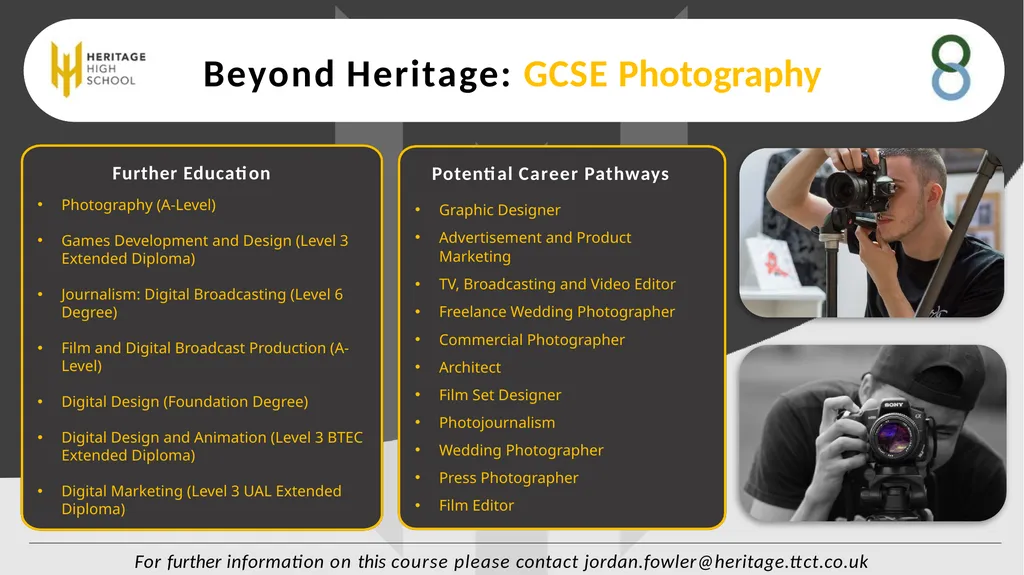
Beyond Heritage: GCSE Photography Potential Career Pathways Graphic Designer
Advertisement and Product Marketing
TV, Broadcasting and Video Editor
Freelance Wedding Photographer
Commercial Photographer
Architect
Film Set Designer
Photojournalism
Wedding Photographer
Press Photographer
Film Editor Further Education For further information on this course please contact jordan.fowler@heritage.ttct.co.uk Photography (A-Level)
Games Development and Design (Level 3 Extended Diploma)
Journalism: Digital Broadcasting (Level 6 Degree)
Film and Digital Broadcast Production (A-Level)
Digital Design (Foundation Degree)
Digital Design and Animation (Level 3 BTEC Extended Diploma)
Digital Marketing (Level 3 UAL Extended Diploma)<br>