CRIMINAL PROCEDURE Law and Practice Tenth Edition Rolando V. del Carmen and Craig Hemmens, Criminal Procedure: Law and Practice, 10th Edition. 2019 Cengage. All Rights Reserved. May not be scanned, copied or duplicated, or posted to a
"CRIMINAL PROCEDURE Law and Practice Tenth Edition" is the property of its rightful owner. Permission is granted to
download and print the materials on this website for personal, non-commercial use only, and to display it
on your personal computer provided you do not modify the materials and that you retain all copyright
notices contained in the materials. By downloading content from our website, you accept the terms of this
agreement.
Probable Cause and Reasonable Suspicion Chapter 3<br>
03
Learning Objectives (1 of 2) State what constitutes probable cause in your own words.
Define the legal definition of reasonable suspicion.
Describe the importance of probable cause in regards to both searches and seizures.
Discuss how probable cause can be developed.
Compare and contrast the legal concepts of reasonable suspicion and probable cause.<br>
04
Learning Objectives (2 of 2) Explain the legal concept of totality of circumstances as to its relation to probable cause and reasonable suspicion.
Evaluate the degree of proof required for action and the circumstances supporting the decision.
Illustrate the legal development of probable cause using court decisions to support their statements.
Illustrate the legal development of reasonable suspicion using court decisions to support their statements.
Explain the three methods in which probable cause can be established.<br>
05
The TOP 5 Important Cases Brinegar v. United States (1949)
Spinelli v. United States (1969)
Michigan v. Summers (1981)
Alabama v. White (1990)
Maryland v. Pringle (2003)<br>
06
Probable Cause (1 of 11) Probable cause has been defined by the Supreme Court as more than a bare suspicion.
The term “man of reasonable caution” refers to the average man or woman on the street who under the same circumstances, would believe that the person being arrested had committed the offense or that items to be seized would be found in a particular place.<br>
07
Probable Cause (2 of 11) Probable cause is required in four areas of police work:
Arrests with a warrant
Arrests without a warrant
Searches and seizures of property with a warrant
Searches and seizures of property without a warrant<br>
08
Probable Cause (3 of 11) Arrests
Whether an offense has been committed and whether the suspect did commit the offense
Search and Seizure
Whether the items to be seized are connected with criminal activity and whether they can be found in the place to be searched<br>
09
Probable Cause (4 of 11) Reasons to obtain a warrant
Presumption of probable cause
Defense against damages for constitutional right violations in civil cases<br>
10
Probable Cause (5 of 11) Arrests and searches with a warrant
Determination of probable cause made by a magistrate
Arrests and searches without a warrant
Determination of probable cause made by police officer<br>
11
Probable Cause (6 of 11) The Fourth Amendment does not require an offense establishing probable cause to be “closely related” to or even “based on” the same conduct as the offense initially identified by the officer.<br>
12
Probable Cause (7 of 11) If no probable cause existed at the time the officer took action, the fact that probable cause is later established does not make the act legal.
The evidence obtained cannot be used in court.<br>
13
Probable Cause (8 of 11) Probable cause exists when an officer has trustworthy evidence sufficient to make “a reasonable person” think it more likely than not that the proposed arrest or search is justified.<br>
14
Probable Cause (9 of 11) In establishing probable cause, the officer may use any trustworthy information even if the rules of evidence prohibit its admission during the trial.<br>
15
Probable Cause (10 of 11) Probable cause can be established in three ways:
Through the officer’s own knowledge of particular facts and circumstances
Through information given by a reliable third person (an informant)
Through information plus corroboration by the officer<br>
16
Probable Cause (11 of 11) Can the police arrest the passenger of a motor vehicle if they have probable cause to arrest the driver?
Maryland v. Pringle, 540 U.S. 366 (2003)<br>
17
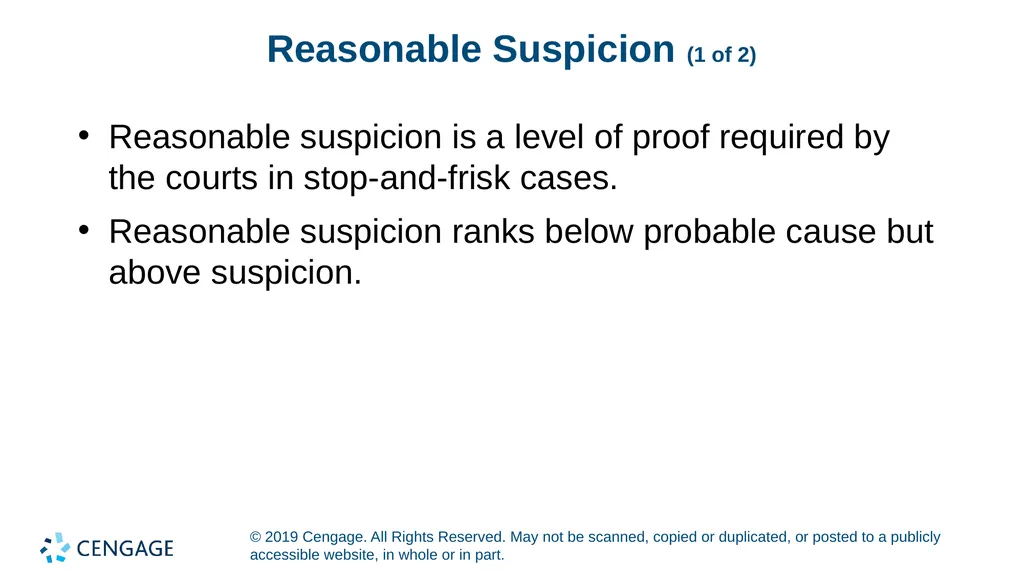
Reasonable Suspicion (1 of 2) Reasonable suspicion is a level of proof required by the courts in stop-and-frisk cases.
Reasonable suspicion ranks below probable cause but above suspicion.<br>
18
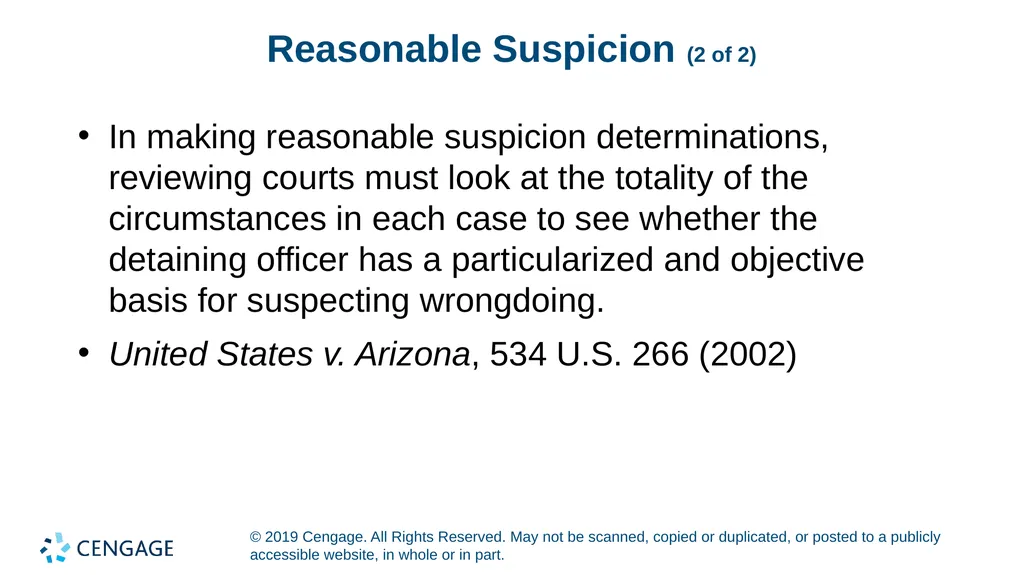
Reasonable Suspicion (2 of 2) In making reasonable suspicion determinations, reviewing courts must look at the totality of the circumstances in each case to see whether the detaining officer has a particularized and objective basis for suspecting wrongdoing.
United States v. Arizona, 534 U.S. 266 (2002)<br>
19
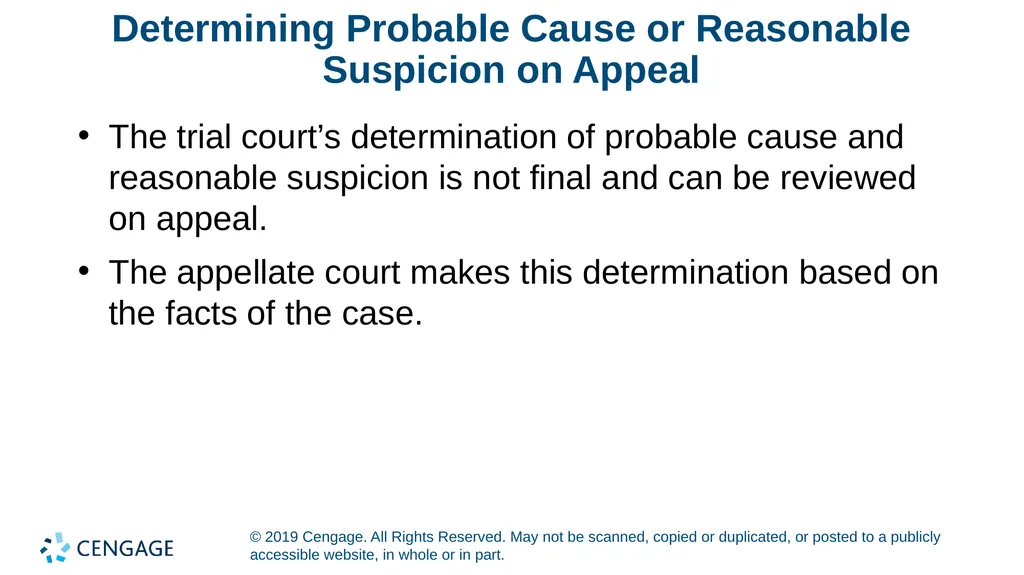
Determining Probable Cause or Reasonable Suspicion on Appeal The trial court’s determination of probable cause and reasonable suspicion is not final and can be reviewed on appeal.
The appellate court makes this determination based on the facts of the case.<br>