
CS 4700: Foundations of Artificial Intelligence
T
Published · 44 slides · 0 views
1 / 1



Description
CS 4700: Foundations of Artificial Intelligence Bart Selman selmancs.cornell.edu Local Search Readings RN: Chapter 4:1 and 6:4 So far: methods that systematically explore the search space, possibly using principled pruning (e.g., A)
Related Topics
Share
Embed code
Download this presentation From Below
"CS 4700: Foundations of Artificial Intelligence" is the property of its rightful owner. Permission is granted to download and print the materials on this website for personal, non-commercial use only, and to display it on your personal computer provided you do not modify the materials and that you retain all copyright notices contained in the materials. By downloading content from our website, you accept the terms of this agreement.
Presentation Transcript
01
CS 4700:
Foundations of Artificial Intelligence Bart Selman
selman@cs.cornell.edu
Local Search
Readings R&N: Chapter 4:1 and 6:4<br>
selman@cs.cornell.edu
Local Search
Readings R&N: Chapter 4:1 and 6:4<br>
02
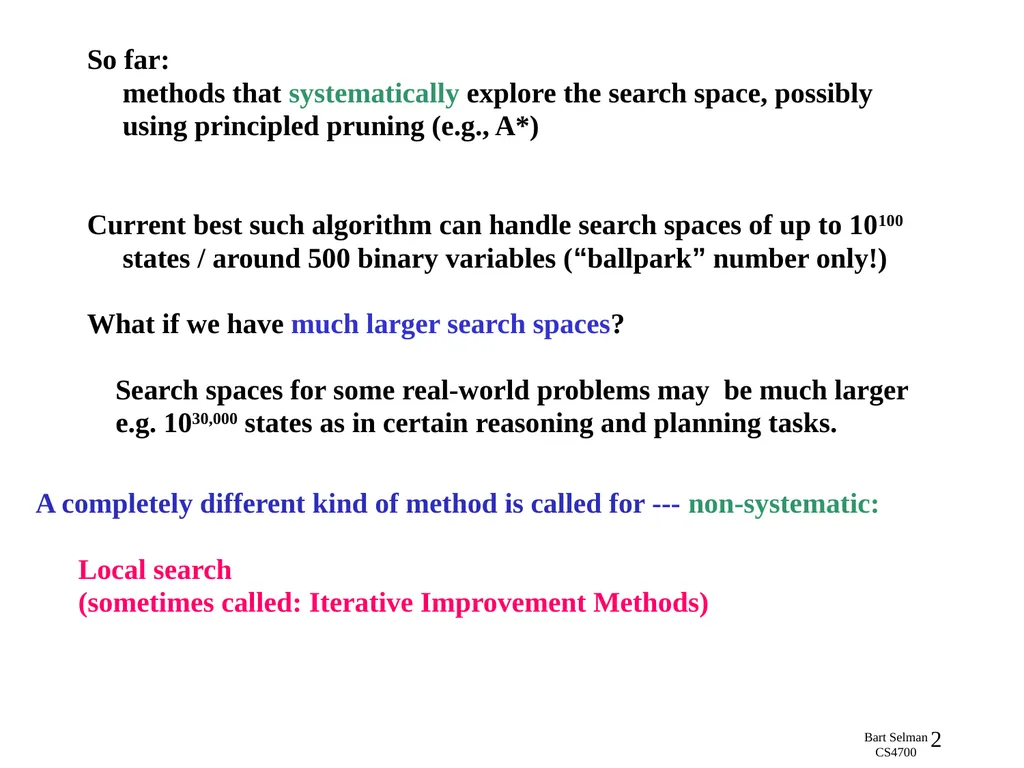
So far:
methods that systematically explore the search space, possibly
using principled pruning (e.g., A*)
Current best such algorithm can handle search spaces of up to 10100
states / around 500 binary variables (“ballpark” number only!)
What if we have much larger search spaces?
Search spaces for some real-world problems may be much larger
e.g. 1030,000 states as in certain reasoning and planning tasks. A completely different kind of method is called for --- non-systematic:
Local search
(sometimes called: Iterative Improvement Methods)<br>
methods that systematically explore the search space, possibly
using principled pruning (e.g., A*)
Current best such algorithm can handle search spaces of up to 10100
states / around 500 binary variables (“ballpark” number only!)
What if we have much larger search spaces?
Search spaces for some real-world problems may be much larger
e.g. 1030,000 states as in certain reasoning and planning tasks. A completely different kind of method is called for --- non-systematic:
Local search
(sometimes called: Iterative Improvement Methods)<br>
03
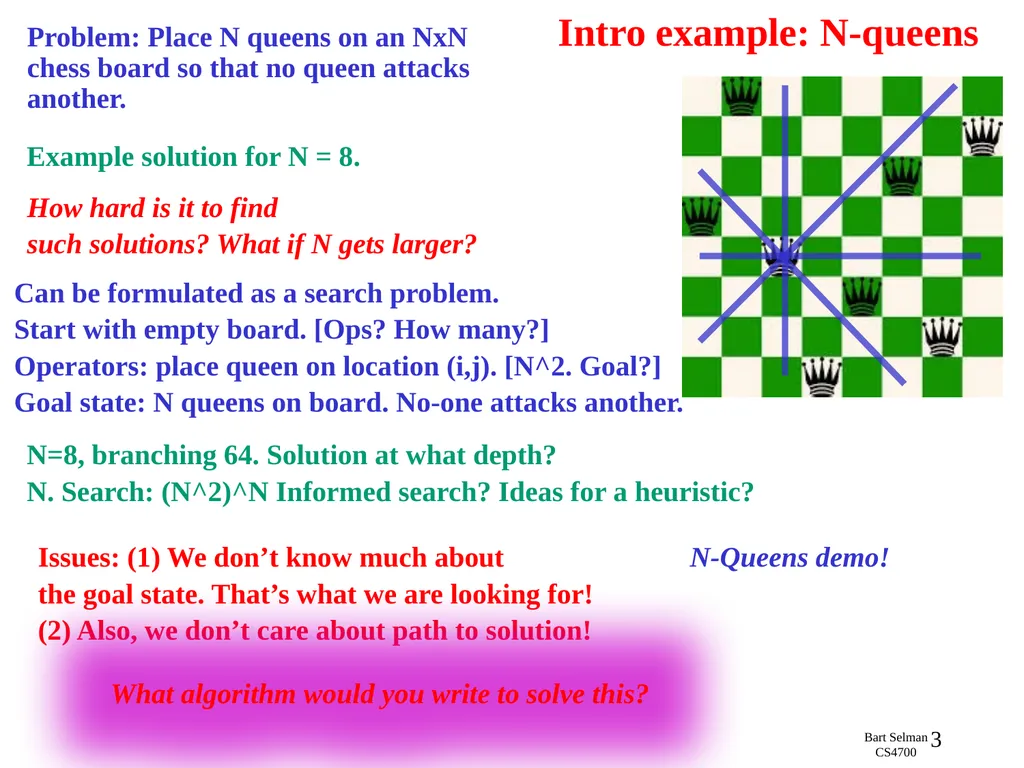
Intro example: N-queens Problem: Place N queens on an NxN chess board so that no queen attacks another. Example solution for N = 8. How hard is it to find
such solutions? What if N gets larger? Can be formulated as a search problem.
Start with empty board. [Ops? How many?]
Operators: place queen on location (i,j). [N^2. Goal?]
Goal state: N queens on board. No-one attacks another. N=8, branching 64. Solution at what depth?
N. Search: (N^2)^N Informed search? Ideas for a heuristic? Issues: (1) We don’t know much about
the goal state. That’s what we are looking for!
(2) Also, we don’t care about path to solution! What algorithm would you write to solve this? N-Queens demo!<br>
such solutions? What if N gets larger? Can be formulated as a search problem.
Start with empty board. [Ops? How many?]
Operators: place queen on location (i,j). [N^2. Goal?]
Goal state: N queens on board. No-one attacks another. N=8, branching 64. Solution at what depth?
N. Search: (N^2)^N Informed search? Ideas for a heuristic? Issues: (1) We don’t know much about
the goal state. That’s what we are looking for!
(2) Also, we don’t care about path to solution! What algorithm would you write to solve this? N-Queens demo!<br>
04
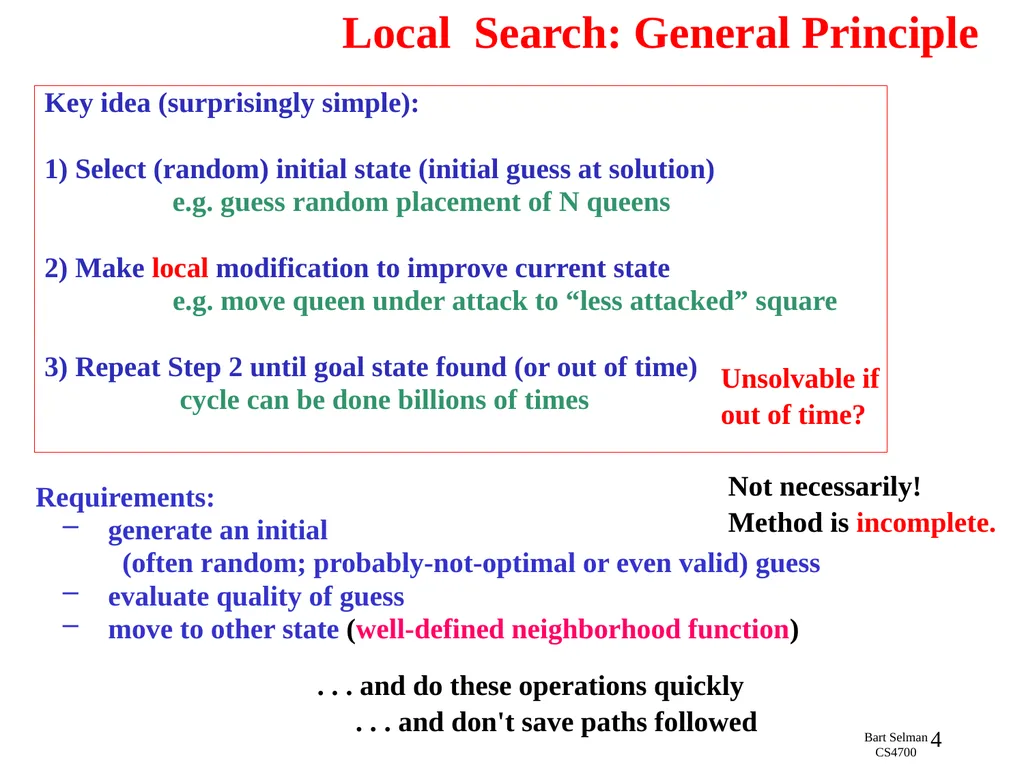
Local Search: General Principle Key idea (surprisingly simple):
1) Select (random) initial state (initial guess at solution)
e.g. guess random placement of N queens
2) Make local modification to improve current state
e.g. move queen under attack to “less attacked” square
3) Repeat Step 2 until goal state found (or out of time)
cycle can be done billions of times Requirements:
generate an initial
(often random; probably-not-optimal or even valid) guess
evaluate quality of guess
move to other state (well-defined neighborhood function) . . . and do these operations quickly
. . . and don't save paths followed Unsolvable if
out of time? Not necessarily!
Method is incomplete.<br>
1) Select (random) initial state (initial guess at solution)
e.g. guess random placement of N queens
2) Make local modification to improve current state
e.g. move queen under attack to “less attacked” square
3) Repeat Step 2 until goal state found (or out of time)
cycle can be done billions of times Requirements:
generate an initial
(often random; probably-not-optimal or even valid) guess
evaluate quality of guess
move to other state (well-defined neighborhood function) . . . and do these operations quickly
. . . and don't save paths followed Unsolvable if
out of time? Not necessarily!
Method is incomplete.<br>
05
Local Search Hill-climbing search or greedy local search
Simulated annealing
Local beam search
Genetic algorithms (related: genetic programming)
Tabu search (not covered)<br>
Simulated annealing
Local beam search
Genetic algorithms (related: genetic programming)
Tabu search (not covered)<br>
06
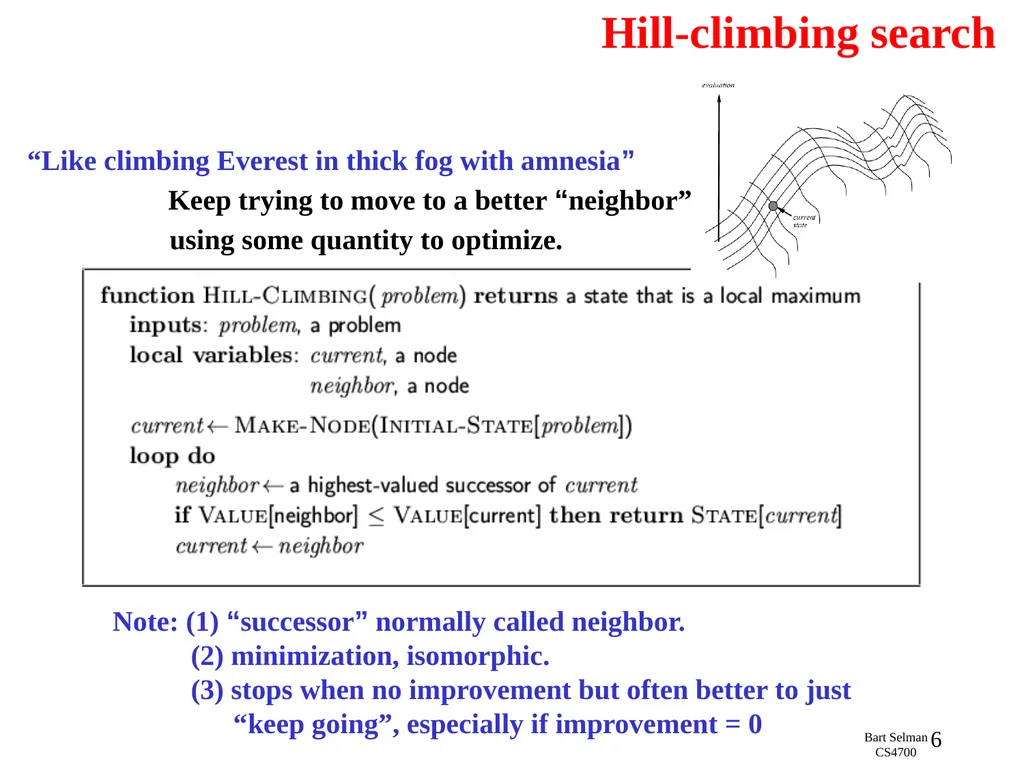
Hill-climbing search “Like climbing Everest in thick fog with amnesia”
Keep trying to move to a better “neighbor”,
using some quantity to optimize. Note: (1) “successor” normally called neighbor.
(2) minimization, isomorphic.
(3) stops when no improvement but often better to just
“keep going”, especially if improvement = 0<br>
Keep trying to move to a better “neighbor”,
using some quantity to optimize. Note: (1) “successor” normally called neighbor.
(2) minimization, isomorphic.
(3) stops when no improvement but often better to just
“keep going”, especially if improvement = 0<br>
07
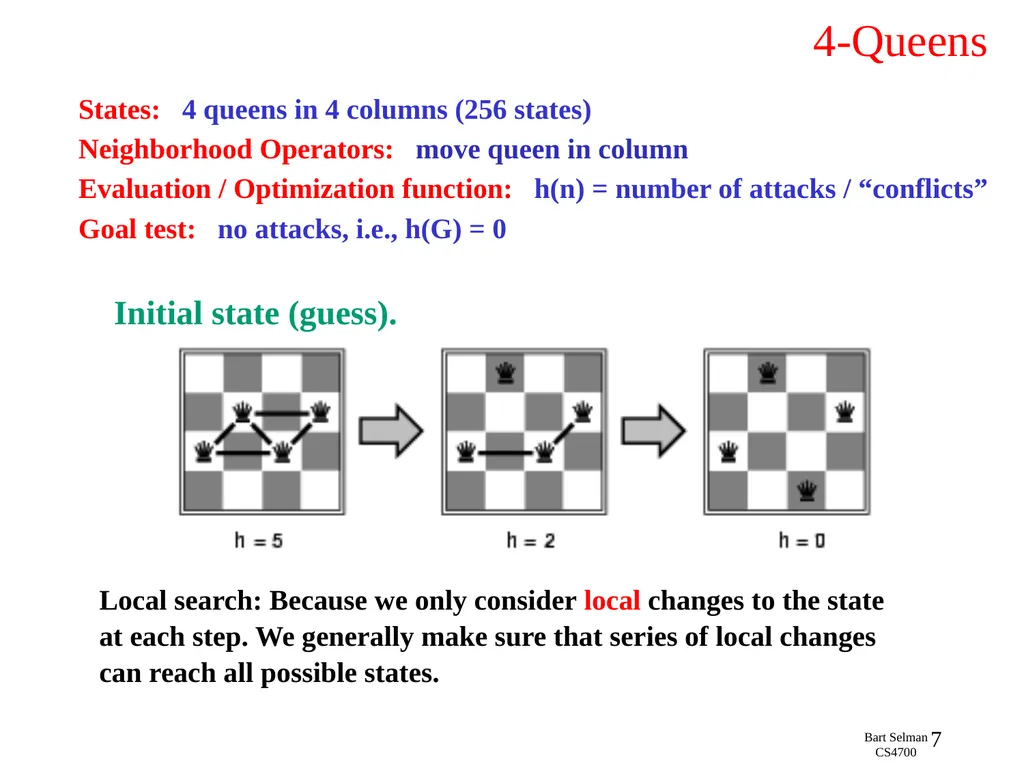
4-Queens States: 4 queens in 4 columns (256 states)
Neighborhood Operators: move queen in column
Evaluation / Optimization function: h(n) = number of attacks / “conflicts”
Goal test: no attacks, i.e., h(G) = 0 Local search: Because we only consider local changes to the state
at each step. We generally make sure that series of local changes
can reach all possible states. Initial state (guess).<br>
Neighborhood Operators: move queen in column
Evaluation / Optimization function: h(n) = number of attacks / “conflicts”
Goal test: no attacks, i.e., h(G) = 0 Local search: Because we only consider local changes to the state
at each step. We generally make sure that series of local changes
can reach all possible states. Initial state (guess).<br>
08
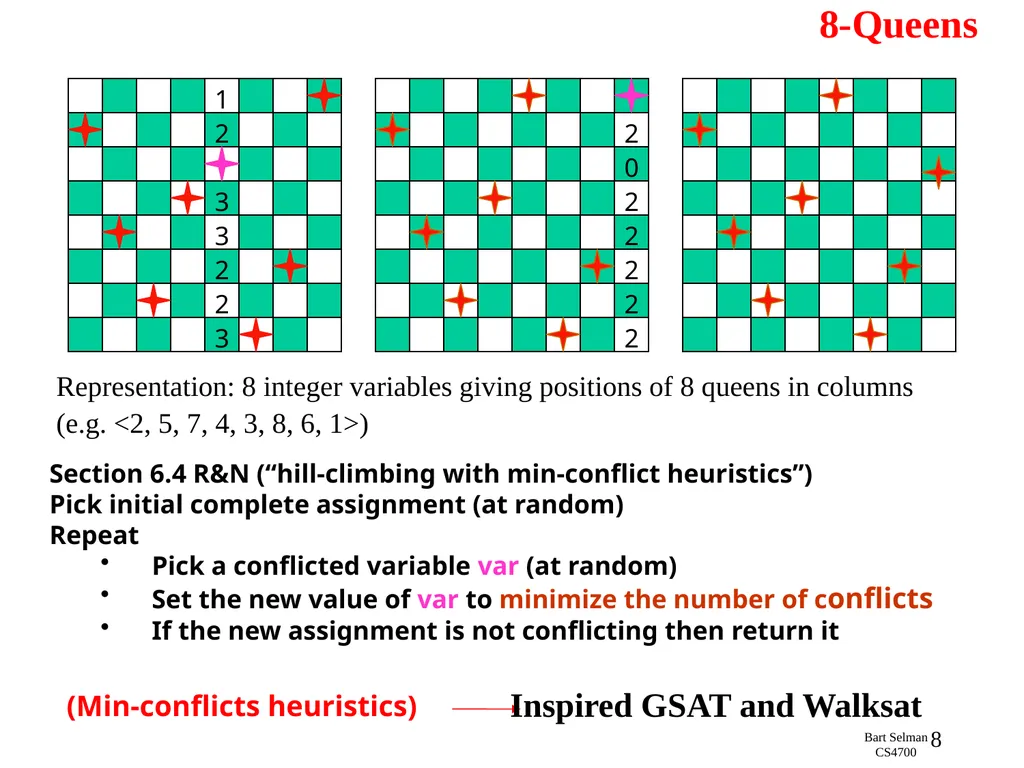
8-Queens Section 6.4 R&N (“hill-climbing with min-conflict heuristics”)
Pick initial complete assignment (at random)
Repeat
Pick a conflicted variable var (at random)
Set the new value of var to minimize the number of conflicts
If the new assignment is not conflicting then return it (Min-conflicts heuristics) Representation: 8 integer variables giving positions of 8 queens in columns
(e.g. <2, 5, 7, 4, 3, 8, 6, 1>)<br>
Pick initial complete assignment (at random)
Repeat
Pick a conflicted variable var (at random)
Set the new value of var to minimize the number of conflicts
If the new assignment is not conflicting then return it (Min-conflicts heuristics) Representation: 8 integer variables giving positions of 8 queens in columns
(e.g. <2, 5, 7, 4, 3, 8, 6, 1>)<br>
09
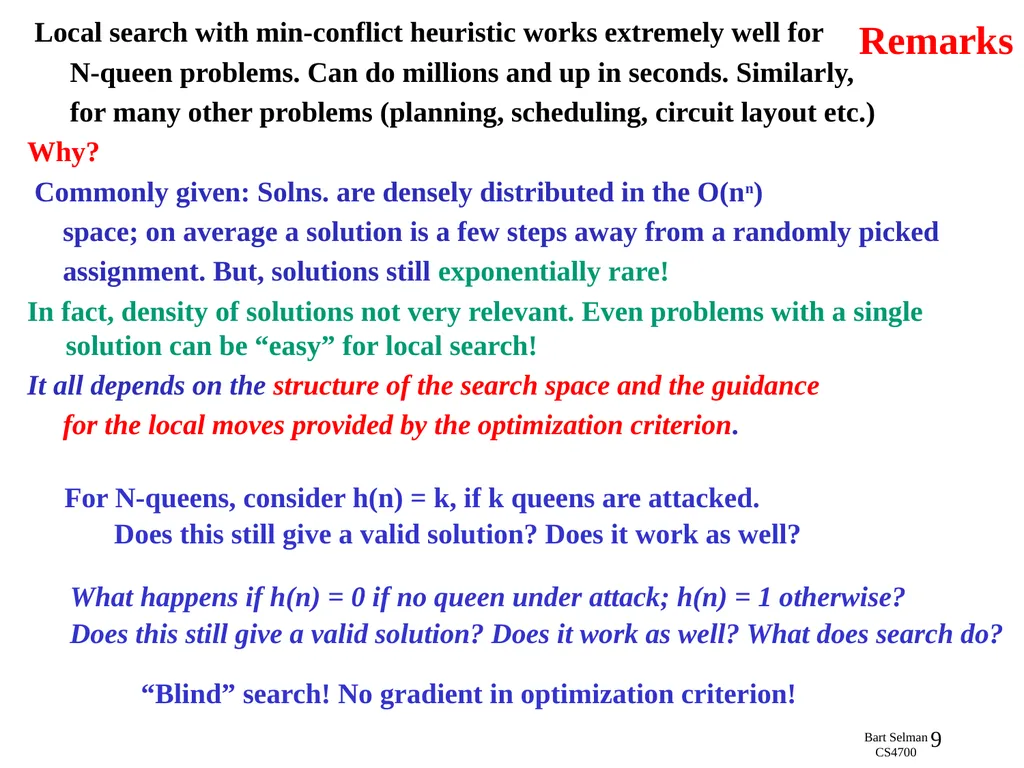
Remarks Local search with min-conflict heuristic works extremely well for
N-queen problems. Can do millions and up in seconds. Similarly,
for many other problems (planning, scheduling, circuit layout etc.)
Why?
Commonly given: Solns. are densely distributed in the O(nn)
space; on average a solution is a few steps away from a randomly picked
assignment. But, solutions still exponentially rare!
In fact, density of solutions not very relevant. Even problems with a single solution can be “easy” for local search!
It all depends on the structure of the search space and the guidance
for the local moves provided by the optimization criterion. For N-queens, consider h(n) = k, if k queens are attacked.
Does this still give a valid solution? Does it work as well? What happens if h(n) = 0 if no queen under attack; h(n) = 1 otherwise?
Does this still give a valid solution? Does it work as well? What does search do? “Blind” search! No gradient in optimization criterion!<br>
N-queen problems. Can do millions and up in seconds. Similarly,
for many other problems (planning, scheduling, circuit layout etc.)
Why?
Commonly given: Solns. are densely distributed in the O(nn)
space; on average a solution is a few steps away from a randomly picked
assignment. But, solutions still exponentially rare!
In fact, density of solutions not very relevant. Even problems with a single solution can be “easy” for local search!
It all depends on the structure of the search space and the guidance
for the local moves provided by the optimization criterion. For N-queens, consider h(n) = k, if k queens are attacked.
Does this still give a valid solution? Does it work as well? What happens if h(n) = 0 if no queen under attack; h(n) = 1 otherwise?
Does this still give a valid solution? Does it work as well? What does search do? “Blind” search! No gradient in optimization criterion!<br>
10
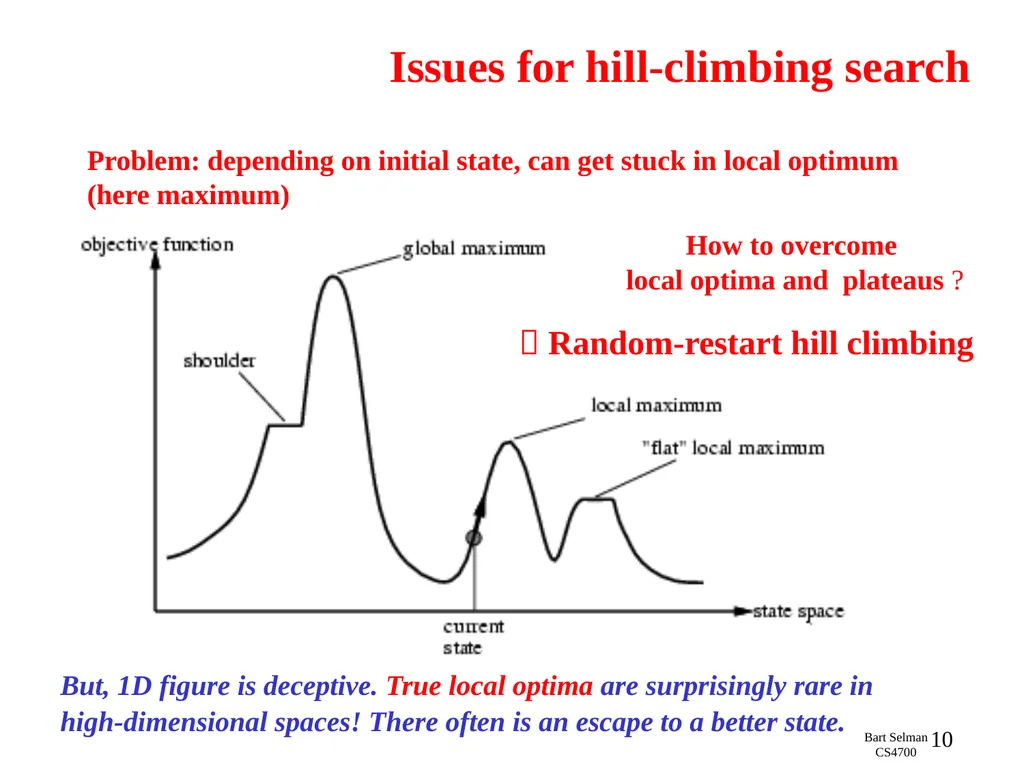
Issues for hill-climbing search Problem: depending on initial state, can get stuck in local optimum (here maximum) How to overcome
local optima and plateaus ? Random-restart hill climbing But, 1D figure is deceptive. True local optima are surprisingly rare in
high-dimensional spaces! There often is an escape to a better state.<br>
local optima and plateaus ? Random-restart hill climbing But, 1D figure is deceptive. True local optima are surprisingly rare in
high-dimensional spaces! There often is an escape to a better state.<br>
11
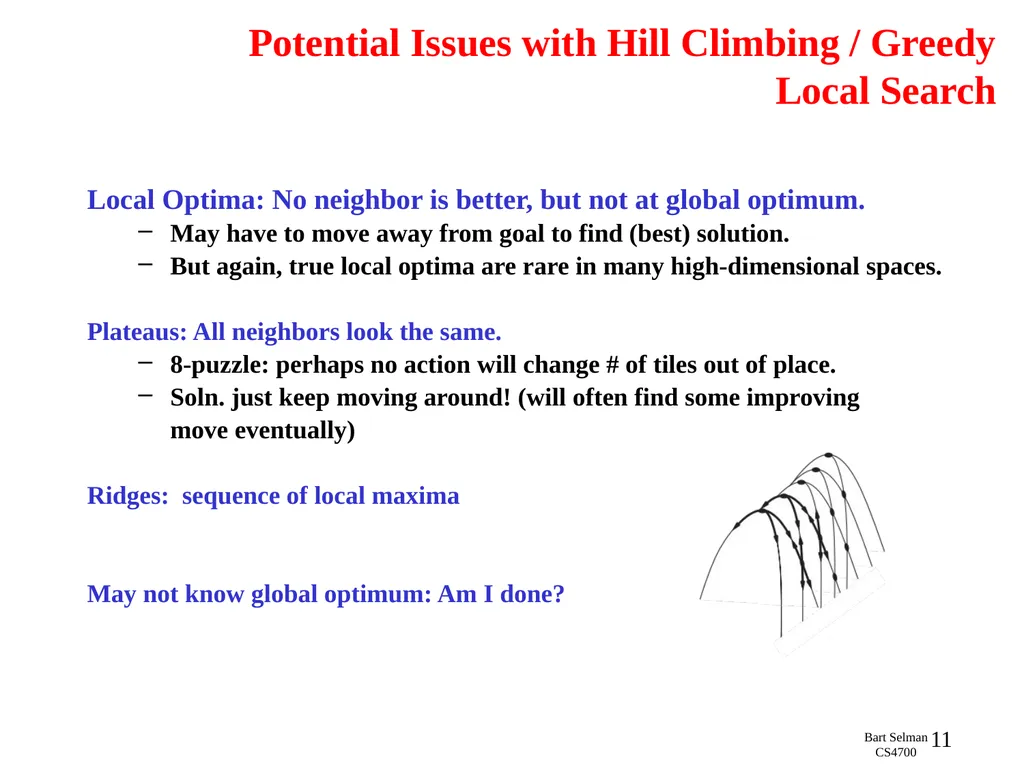
Potential Issues with Hill Climbing / Greedy Local Search Local Optima: No neighbor is better, but not at global optimum.
May have to move away from goal to find (best) solution.
But again, true local optima are rare in many high-dimensional spaces.
Plateaus: All neighbors look the same.
8-puzzle: perhaps no action will change # of tiles out of place.
Soln. just keep moving around! (will often find some improving
move eventually)
Ridges: sequence of local maxima
May not know global optimum: Am I done?<br>
May have to move away from goal to find (best) solution.
But again, true local optima are rare in many high-dimensional spaces.
Plateaus: All neighbors look the same.
8-puzzle: perhaps no action will change # of tiles out of place.
Soln. just keep moving around! (will often find some improving
move eventually)
Ridges: sequence of local maxima
May not know global optimum: Am I done?<br>
12
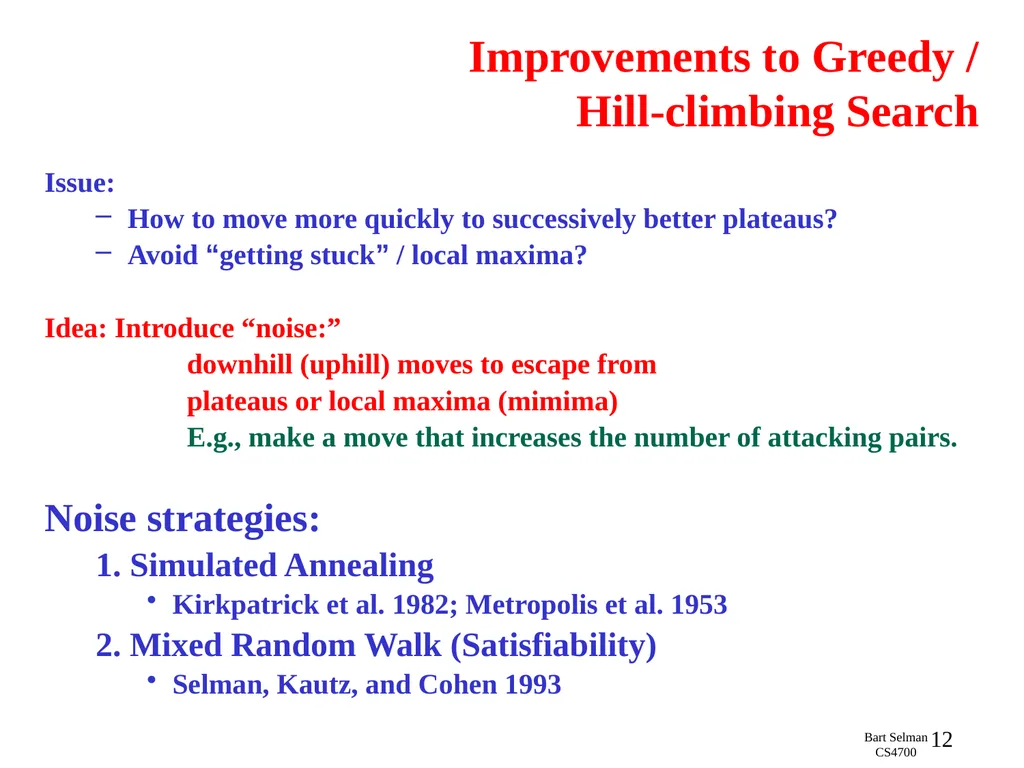
Improvements to Greedy /
Hill-climbing Search Issue:
How to move more quickly to successively better plateaus?
Avoid “getting stuck” / local maxima?
Idea: Introduce “noise:”
downhill (uphill) moves to escape from
plateaus or local maxima (mimima)
E.g., make a move that increases the number of attacking pairs.
Noise strategies:
1. Simulated Annealing
Kirkpatrick et al. 1982; Metropolis et al. 1953
2. Mixed Random Walk (Satisfiability)
Selman, Kautz, and Cohen 1993<br>
How to move more quickly to successively better plateaus?
Avoid “getting stuck” / local maxima?
Idea: Introduce “noise:”
downhill (uphill) moves to escape from
plateaus or local maxima (mimima)
E.g., make a move that increases the number of attacking pairs.
Noise strategies:
1. Simulated Annealing
Kirkpatrick et al. 1982; Metropolis et al. 1953
2. Mixed Random Walk (Satisfiability)
Selman, Kautz, and Cohen 1993<br>
13
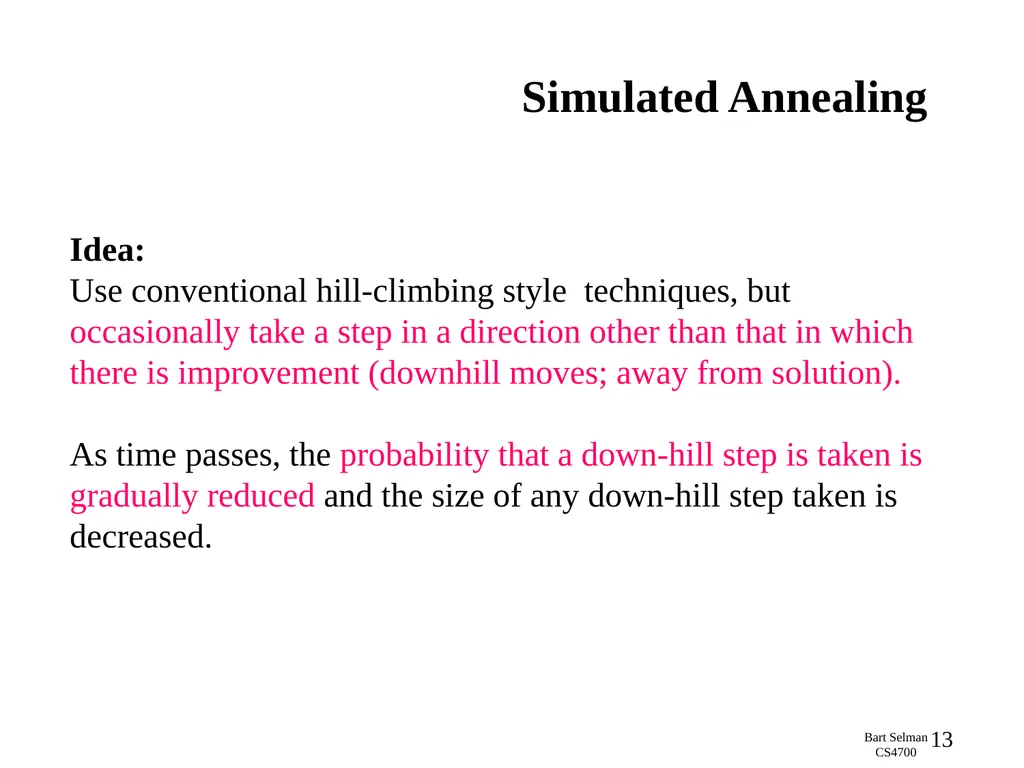
Simulated Annealing Idea:
Use conventional hill-climbing style techniques, but
occasionally take a step in a direction other than that in which there is improvement (downhill moves; away from solution).
As time passes, the probability that a down-hill step is taken is
gradually reduced and the size of any down-hill step taken is
decreased.<br>
Use conventional hill-climbing style techniques, but
occasionally take a step in a direction other than that in which there is improvement (downhill moves; away from solution).
As time passes, the probability that a down-hill step is taken is
gradually reduced and the size of any down-hill step taken is
decreased.<br>
14
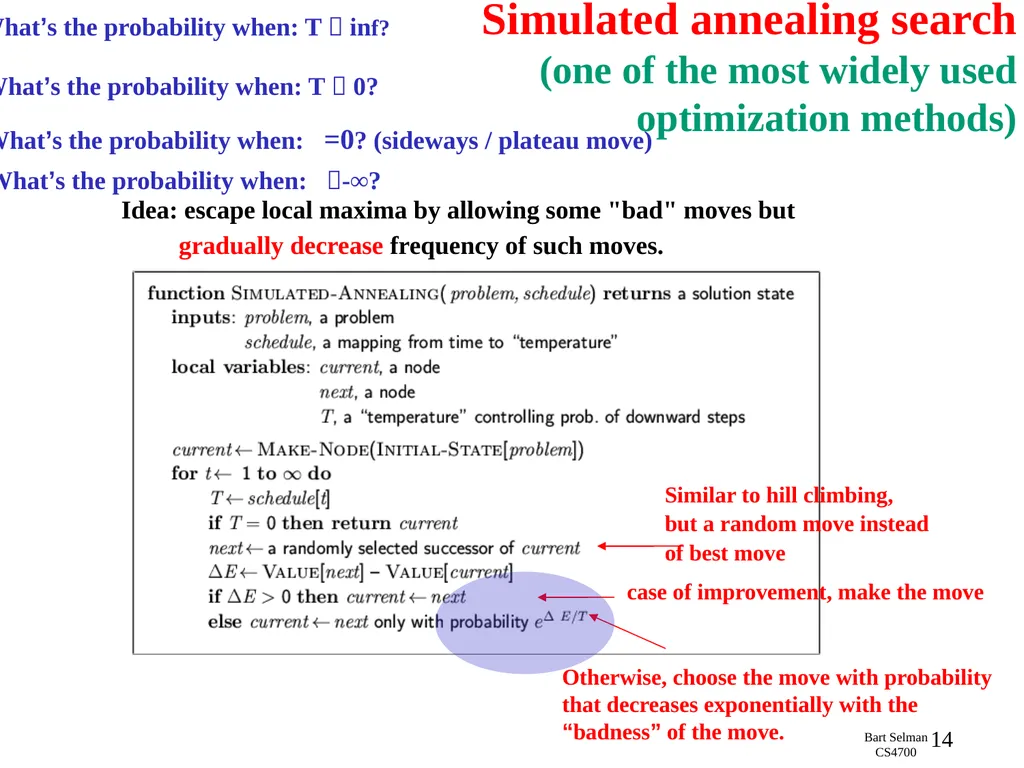
Simulated annealing search
(one of the most widely used optimization methods) Idea: escape local maxima by allowing some "bad" moves but
gradually decrease frequency of such moves.
their frequency What’s the probability when: T inf? What’s the probability when: T 0? What’s the probability when: =0? (sideways / plateau move) What’s the probability when: -∞?<br>
gradually decrease frequency of such moves.
their frequency What’s the probability when: T inf? What’s the probability when: T 0? What’s the probability when: =0? (sideways / plateau move) What’s the probability when: -∞?<br>
15
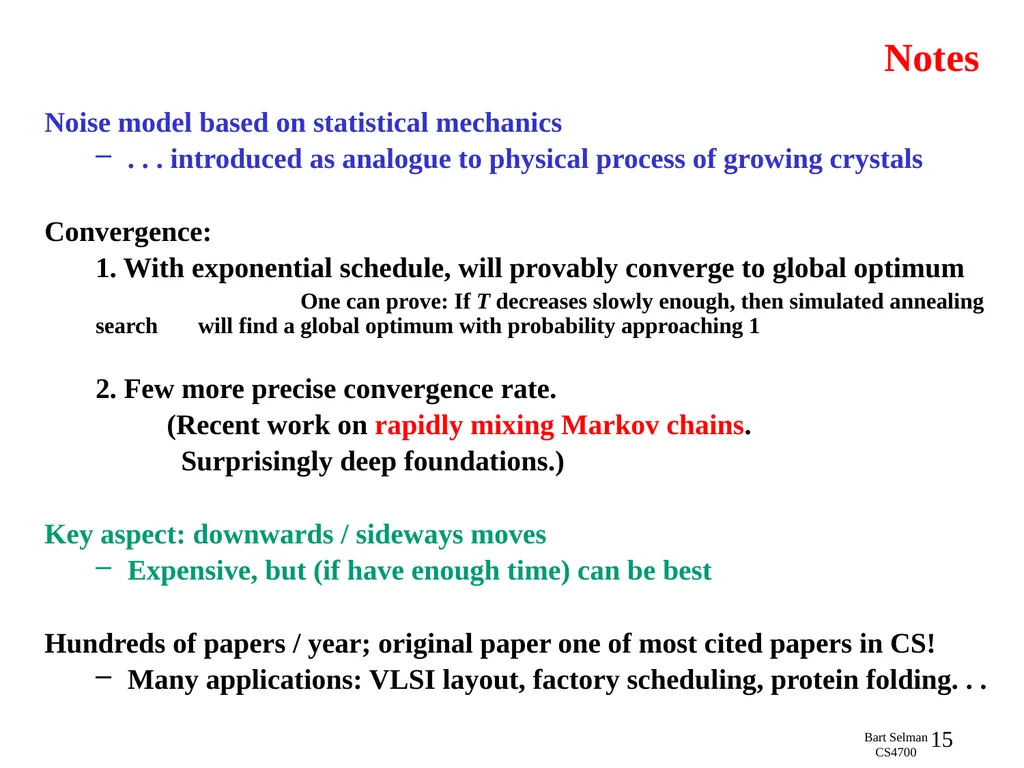
Notes Noise model based on statistical mechanics
. . . introduced as analogue to physical process of growing crystals
Convergence:
1. With exponential schedule, will provably converge to global optimum
One can prove: If T decreases slowly enough, then simulated annealing search will find a global optimum with probability approaching 1
2. Few more precise convergence rate.
(Recent work on rapidly mixing Markov chains.
Surprisingly deep foundations.)
Key aspect: downwards / sideways moves
Expensive, but (if have enough time) can be best
Hundreds of papers / year; original paper one of most cited papers in CS!
Many applications: VLSI layout, factory scheduling, protein folding. . .<br>
. . . introduced as analogue to physical process of growing crystals
Convergence:
1. With exponential schedule, will provably converge to global optimum
One can prove: If T decreases slowly enough, then simulated annealing search will find a global optimum with probability approaching 1
2. Few more precise convergence rate.
(Recent work on rapidly mixing Markov chains.
Surprisingly deep foundations.)
Key aspect: downwards / sideways moves
Expensive, but (if have enough time) can be best
Hundreds of papers / year; original paper one of most cited papers in CS!
Many applications: VLSI layout, factory scheduling, protein folding. . .<br>
16
Simulated Annealing (SA) --- Foundations Superficially: SA is local search with some noise added. Noise starts high and is slowly decreased.
True story is much more principled:
SA is a general sampling strategy to sample from a combinatorial space according to a well-defined probability distribution.
Sampling strategy models the way physical systems, such as gases, sample from their statistical equilibrium distributions. Order 10^23 particles. Studied in the field of statistical physics.
We will sketch the core idea.<br>
True story is much more principled:
SA is a general sampling strategy to sample from a combinatorial space according to a well-defined probability distribution.
Sampling strategy models the way physical systems, such as gases, sample from their statistical equilibrium distributions. Order 10^23 particles. Studied in the field of statistical physics.
We will sketch the core idea.<br>
17
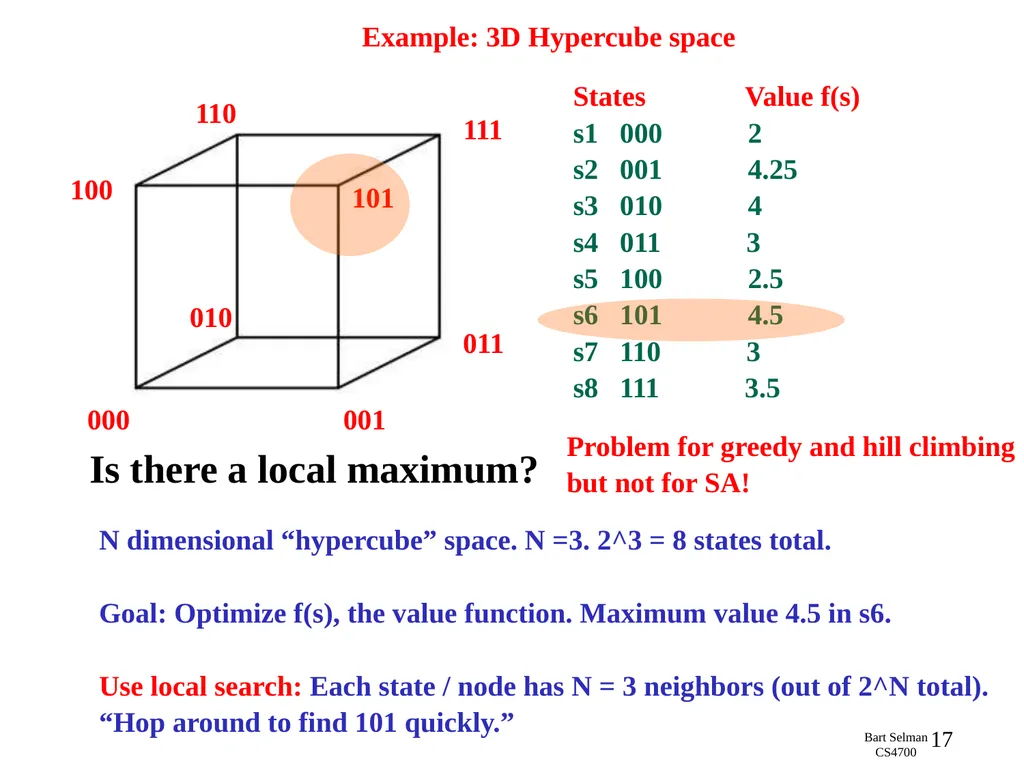
Example: 3D Hypercube space States Value f(s)
s1 000 2
s2 001 4.25
s3 010 4
s4 011 3
s5 100 2.5
s6 101 4.5
s7 110 3
s8 111 3.5 N dimensional “hypercube” space. N =3. 2^3 = 8 states total.
Goal: Optimize f(s), the value function. Maximum value 4.5 in s6.
Use local search: Each state / node has N = 3 neighbors (out of 2^N total).
“Hop around to find 101 quickly.” Is there a local maximum? Problem for greedy and hill climbing
but not for SA!<br>
s1 000 2
s2 001 4.25
s3 010 4
s4 011 3
s5 100 2.5
s6 101 4.5
s7 110 3
s8 111 3.5 N dimensional “hypercube” space. N =3. 2^3 = 8 states total.
Goal: Optimize f(s), the value function. Maximum value 4.5 in s6.
Use local search: Each state / node has N = 3 neighbors (out of 2^N total).
“Hop around to find 101 quickly.” Is there a local maximum? Problem for greedy and hill climbing
but not for SA!<br>
18
Of course, real interest in large N… Spaces with 2^N states and each state with N neighbors. 7D hypercube; 128 states.
Every node, connected to 7 others.
Max distance between two nodes: 7. 9D hypercube; 512 states.
How many steps to go from any
state to any state? Practical reasoning problem: N = 1,000,000. 2^N = 10^300,000<br>
Every node, connected to 7 others.
Max distance between two nodes: 7. 9D hypercube; 512 states.
How many steps to go from any
state to any state? Practical reasoning problem: N = 1,000,000. 2^N = 10^300,000<br>
19
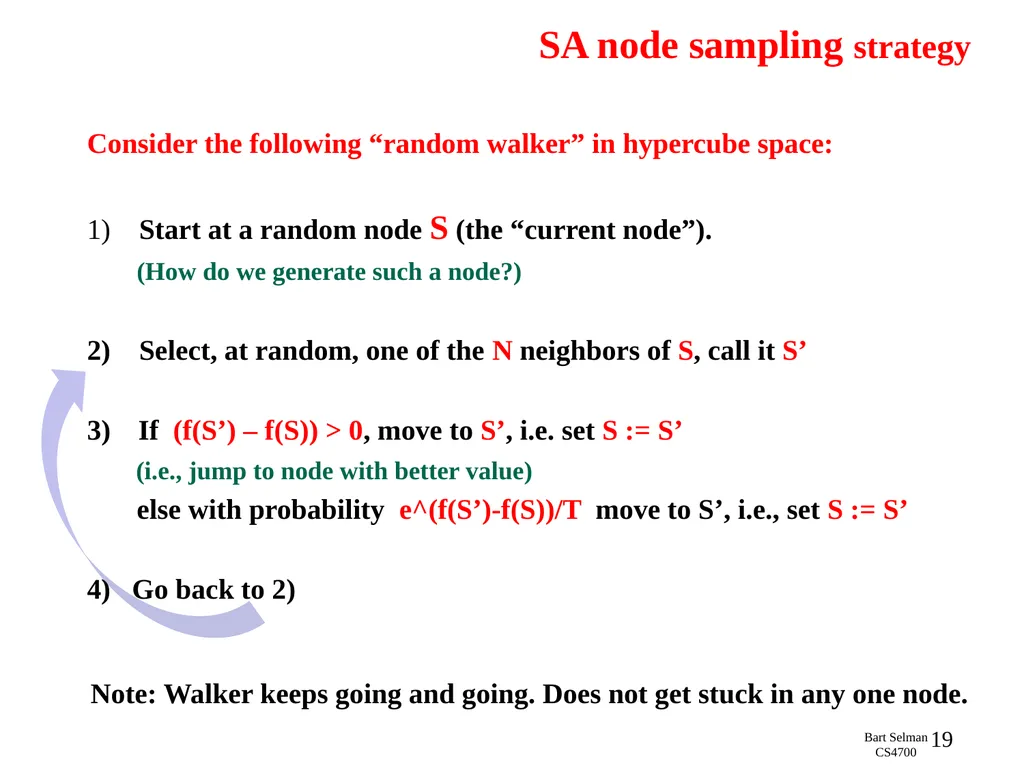
SA node sampling strategy Consider the following “random walker” in hypercube space:
1) Start at a random node S (the “current node”).
(How do we generate such a node?)
2) Select, at random, one of the N neighbors of S, call it S’
If (f(S’) – f(S)) > 0, move to S’, i.e. set S := S’
(i.e., jump to node with better value)
else with probability e^(f(S’)-f(S))/T move to S’, i.e., set S := S’
4) Go back to 2) Note: Walker keeps going and going. Does not get stuck in any one node.<br>
1) Start at a random node S (the “current node”).
(How do we generate such a node?)
2) Select, at random, one of the N neighbors of S, call it S’
If (f(S’) – f(S)) > 0, move to S’, i.e. set S := S’
(i.e., jump to node with better value)
else with probability e^(f(S’)-f(S))/T move to S’, i.e., set S := S’
4) Go back to 2) Note: Walker keeps going and going. Does not get stuck in any one node.<br>
20
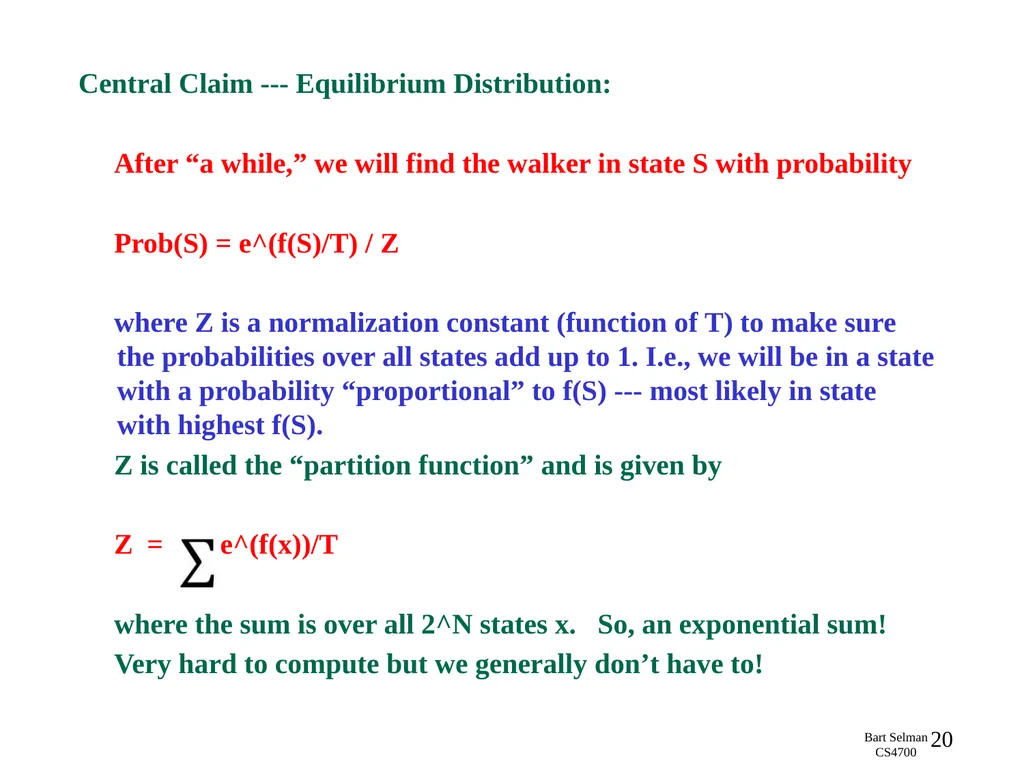
Central Claim --- Equilibrium Distribution:
After “a while,” we will find the walker in state S with probability
Prob(S) = e^(f(S)/T) / Z
where Z is a normalization constant (function of T) to make sure the probabilities over all states add up to 1. I.e., we will be in a state with a probability “proportional” to f(S) --- most likely in state with highest f(S).
Z is called the “partition function” and is given by
Z = e^(f(x))/T
where the sum is over all 2^N states x. So, an exponential sum!
Very hard to compute but we generally don’t have to!<br>
After “a while,” we will find the walker in state S with probability
Prob(S) = e^(f(S)/T) / Z
where Z is a normalization constant (function of T) to make sure the probabilities over all states add up to 1. I.e., we will be in a state with a probability “proportional” to f(S) --- most likely in state with highest f(S).
Z is called the “partition function” and is given by
Z = e^(f(x))/T
where the sum is over all 2^N states x. So, an exponential sum!
Very hard to compute but we generally don’t have to!<br>
21
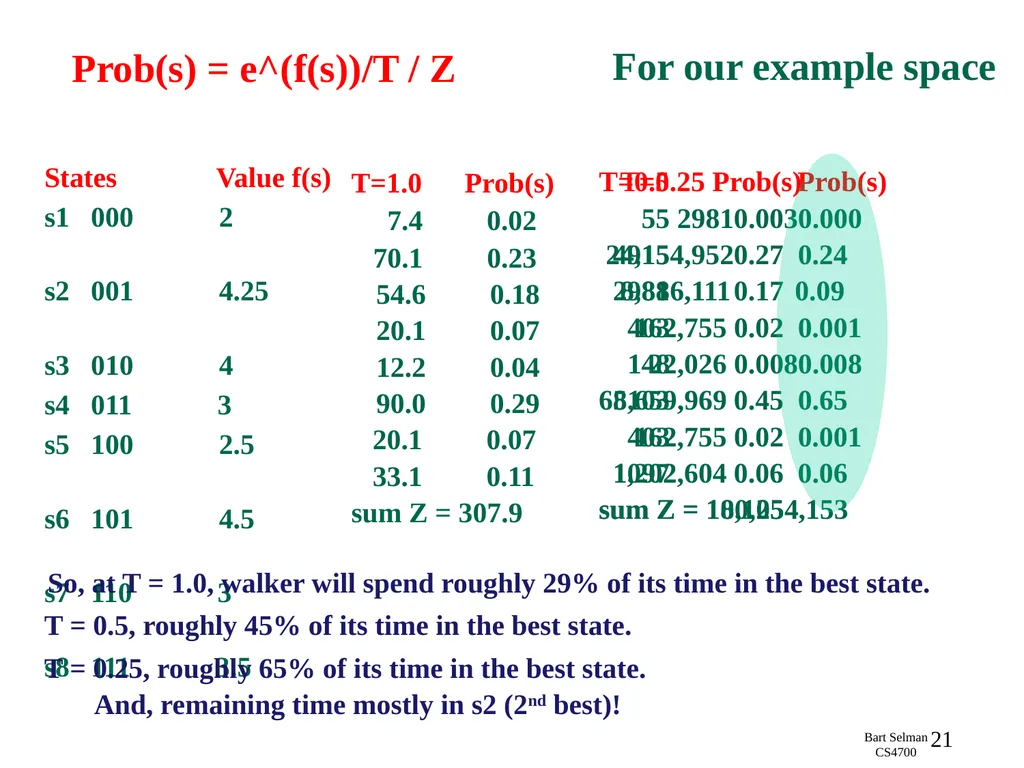
For our example space States Value f(s)
s1 000 2
s2 001 4.25
s3 010 4
s4 011 3
s5 100 2.5
s6 101 4.5
s7 110 3
s8 111 3.5 Prob(s) = e^(f(s))/T / Z So, at T = 1.0, walker will spend roughly 29% of its time in the best state. T=1.0 Prob(s)
7.4 0.02
70.1 0.23
54.6 0.18
20.1 0.07
12.2 0.04
90.0 0.29
20.1 0.07
33.1 0.11
sum Z = 307.9 T=0.5 Prob(s)
55 0.003
4915 0.27
2981 0.17
403 0.02
148 0.008
8103 0.45
403 0.02
1097 0.06
sum Z = 18,105 T=0.25 Prob(s)
2981 0.000
24,154,952 0.24
8,886,111 0.09
162,755 0.001
22,026 0.008
65,659,969 0.65
162,755 0.001
1,202,604 0.06
sum Z = 100,254,153 T = 0.5, roughly 45% of its time in the best state. T = 0.25, roughly 65% of its time in the best state.
And, remaining time mostly in s2 (2nd best)!<br>
s1 000 2
s2 001 4.25
s3 010 4
s4 011 3
s5 100 2.5
s6 101 4.5
s7 110 3
s8 111 3.5 Prob(s) = e^(f(s))/T / Z So, at T = 1.0, walker will spend roughly 29% of its time in the best state. T=1.0 Prob(s)
7.4 0.02
70.1 0.23
54.6 0.18
20.1 0.07
12.2 0.04
90.0 0.29
20.1 0.07
33.1 0.11
sum Z = 307.9 T=0.5 Prob(s)
55 0.003
4915 0.27
2981 0.17
403 0.02
148 0.008
8103 0.45
403 0.02
1097 0.06
sum Z = 18,105 T=0.25 Prob(s)
2981 0.000
24,154,952 0.24
8,886,111 0.09
162,755 0.001
22,026 0.008
65,659,969 0.65
162,755 0.001
1,202,604 0.06
sum Z = 100,254,153 T = 0.5, roughly 45% of its time in the best state. T = 0.25, roughly 65% of its time in the best state.
And, remaining time mostly in s2 (2nd best)!<br>
22
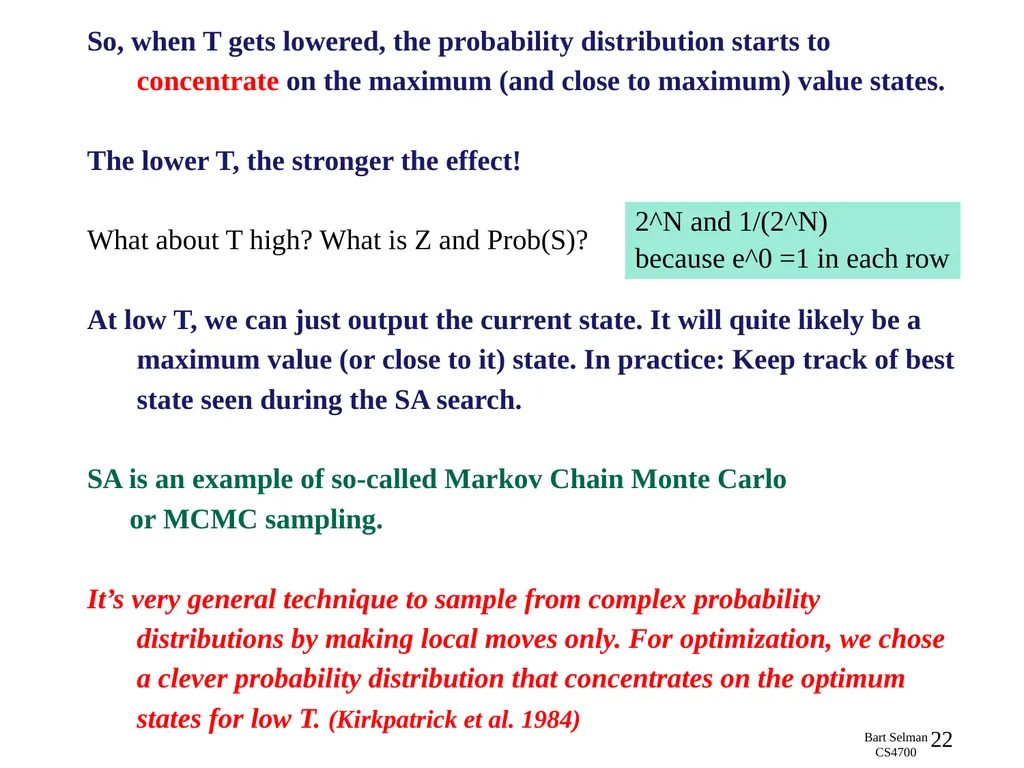
So, when T gets lowered, the probability distribution starts to
concentrate on the maximum (and close to maximum) value states.
The lower T, the stronger the effect!
What about T high? What is Z and Prob(S)?
At low T, we can just output the current state. It will quite likely be a
maximum value (or close to it) state. In practice: Keep track of best
state seen during the SA search.
SA is an example of so-called Markov Chain Monte Carlo
or MCMC sampling.
It’s very general technique to sample from complex probability
distributions by making local moves only. For optimization, we chose
a clever probability distribution that concentrates on the optimum
states for low T. (Kirkpatrick et al. 1984) 2^N and 1/(2^N)
because e^0 =1 in each row<br>
concentrate on the maximum (and close to maximum) value states.
The lower T, the stronger the effect!
What about T high? What is Z and Prob(S)?
At low T, we can just output the current state. It will quite likely be a
maximum value (or close to it) state. In practice: Keep track of best
state seen during the SA search.
SA is an example of so-called Markov Chain Monte Carlo
or MCMC sampling.
It’s very general technique to sample from complex probability
distributions by making local moves only. For optimization, we chose
a clever probability distribution that concentrates on the optimum
states for low T. (Kirkpatrick et al. 1984) 2^N and 1/(2^N)
because e^0 =1 in each row<br>
23
Some final notes on SA:
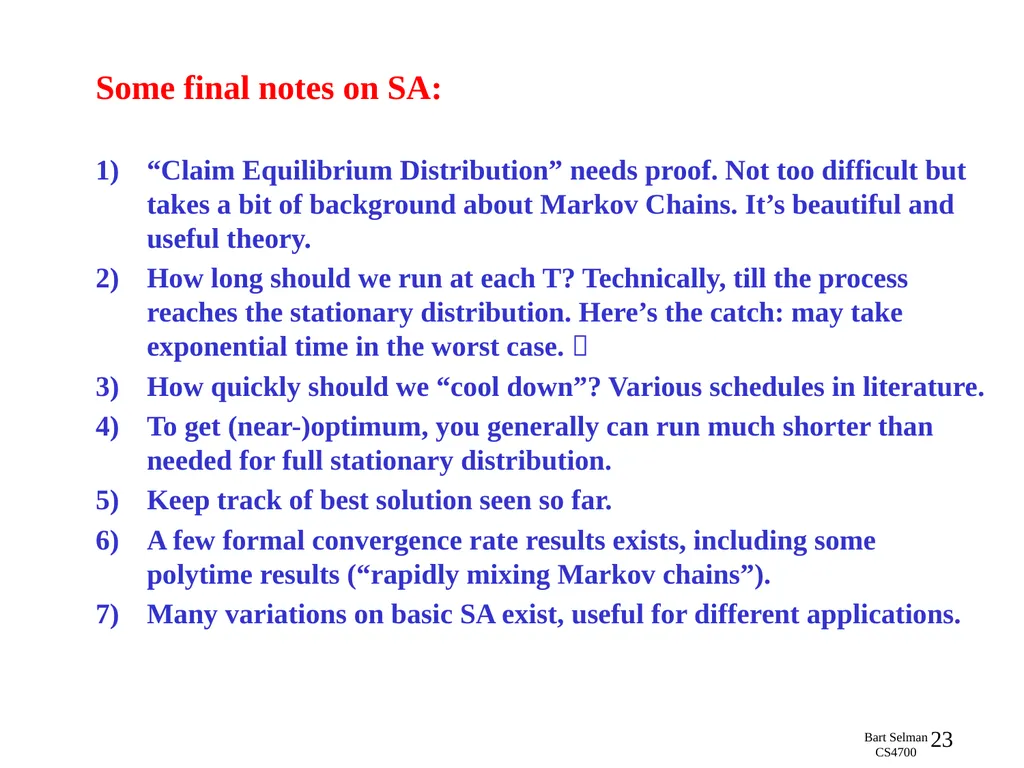
“Claim Equilibrium Distribution” needs proof. Not too difficult but takes a bit of background about Markov Chains. It’s beautiful and useful theory.
How long should we run at each T? Technically, till the process reaches the stationary distribution. Here’s the catch: may take exponential time in the worst case.
How quickly should we “cool down”? Various schedules in literature.
To get (near-)optimum, you generally can run much shorter than needed for full stationary distribution.
Keep track of best solution seen so far.
A few formal convergence rate results exists, including some polytime results (“rapidly mixing Markov chains”).
Many variations on basic SA exist, useful for different applications.<br>
“Claim Equilibrium Distribution” needs proof. Not too difficult but takes a bit of background about Markov Chains. It’s beautiful and useful theory.
How long should we run at each T? Technically, till the process reaches the stationary distribution. Here’s the catch: may take exponential time in the worst case.
How quickly should we “cool down”? Various schedules in literature.
To get (near-)optimum, you generally can run much shorter than needed for full stationary distribution.
Keep track of best solution seen so far.
A few formal convergence rate results exists, including some polytime results (“rapidly mixing Markov chains”).
Many variations on basic SA exist, useful for different applications.<br>
24
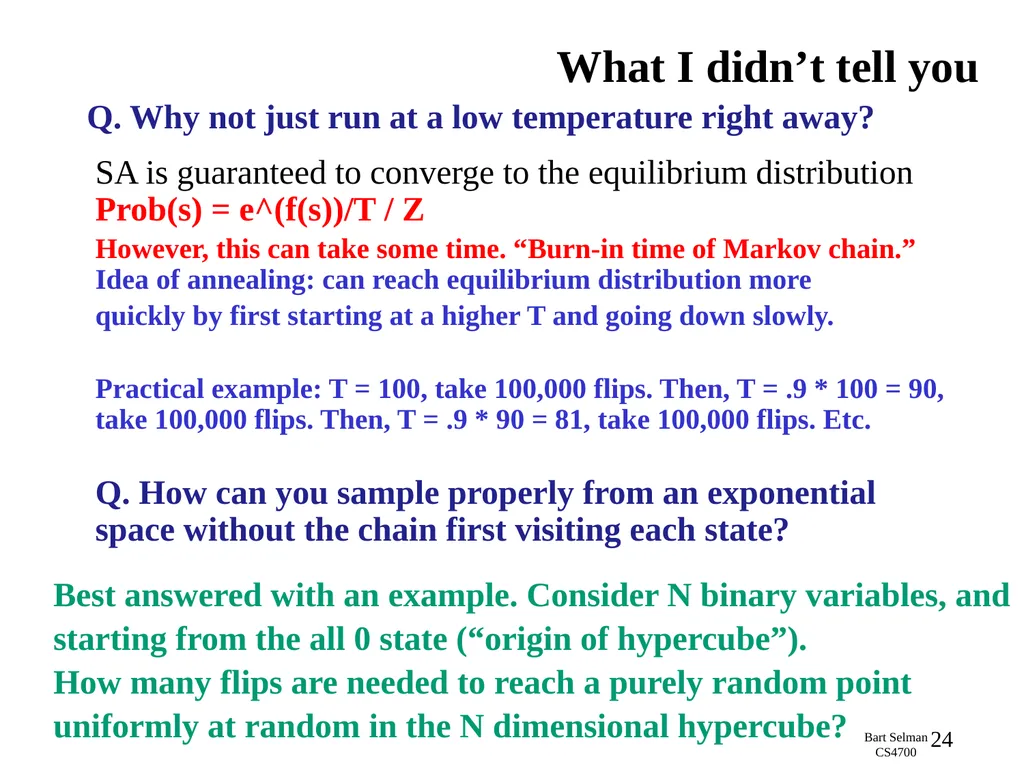
What I didn’t tell you Q. Why not just run at a low temperature right away? SA is guaranteed to converge to the equilibrium distribution Prob(s) = e^(f(s))/T / Z
However, this can take some time. “Burn-in time of Markov chain.” Idea of annealing: can reach equilibrium distribution more
quickly by first starting at a higher T and going down slowly.
Practical example: T = 100, take 100,000 flips. Then, T = .9 * 100 = 90, take 100,000 flips. Then, T = .9 * 90 = 81, take 100,000 flips. Etc. Q. How can you sample properly from an exponential space without the chain first visiting each state? Best answered with an example. Consider N binary variables, and
starting from the all 0 state (“origin of hypercube”).
How many flips are needed to reach a purely random point
uniformly at random in the N dimensional hypercube?<br>
However, this can take some time. “Burn-in time of Markov chain.” Idea of annealing: can reach equilibrium distribution more
quickly by first starting at a higher T and going down slowly.
Practical example: T = 100, take 100,000 flips. Then, T = .9 * 100 = 90, take 100,000 flips. Then, T = .9 * 90 = 81, take 100,000 flips. Etc. Q. How can you sample properly from an exponential space without the chain first visiting each state? Best answered with an example. Consider N binary variables, and
starting from the all 0 state (“origin of hypercube”).
How many flips are needed to reach a purely random point
uniformly at random in the N dimensional hypercube?<br>
25
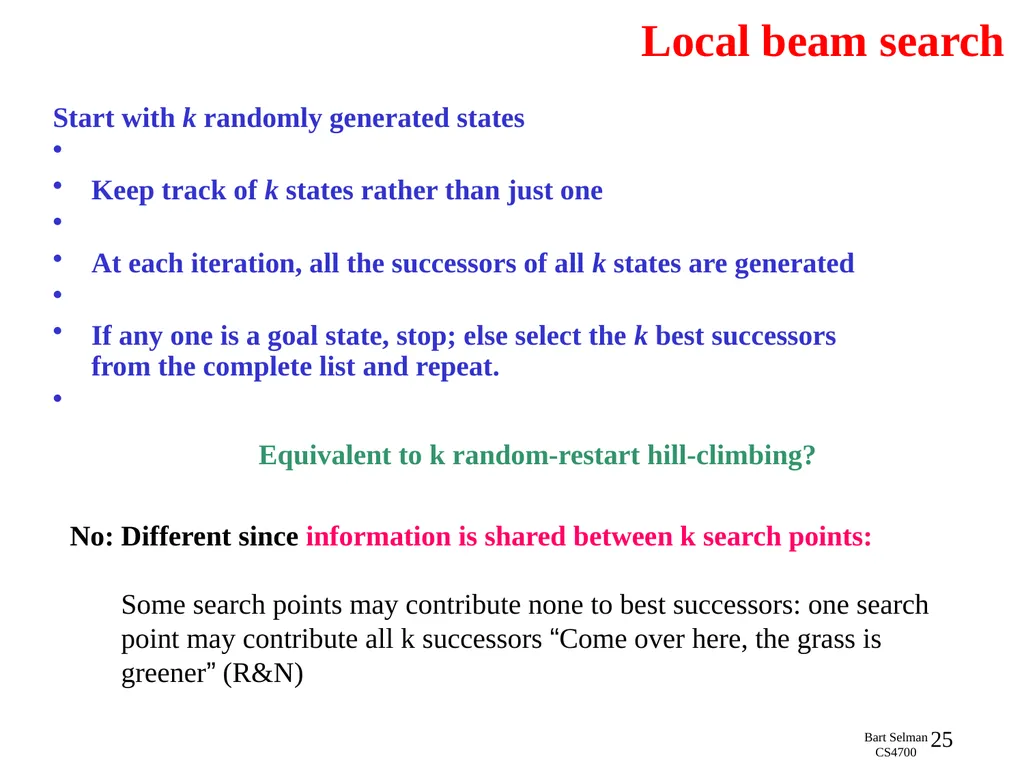
Local beam search Start with k randomly generated states
Keep track of k states rather than just one
At each iteration, all the successors of all k states are generated
If any one is a goal state, stop; else select the k best successors from the complete list and repeat. No: Different since information is shared between k search points:
Some search points may contribute none to best successors: one search point may contribute all k successors “Come over here, the grass is greener” (R&N) Equivalent to k random-restart hill-climbing?<br>
Keep track of k states rather than just one
At each iteration, all the successors of all k states are generated
If any one is a goal state, stop; else select the k best successors from the complete list and repeat. No: Different since information is shared between k search points:
Some search points may contribute none to best successors: one search point may contribute all k successors “Come over here, the grass is greener” (R&N) Equivalent to k random-restart hill-climbing?<br>
26
Genetic Algorithms<br>
27
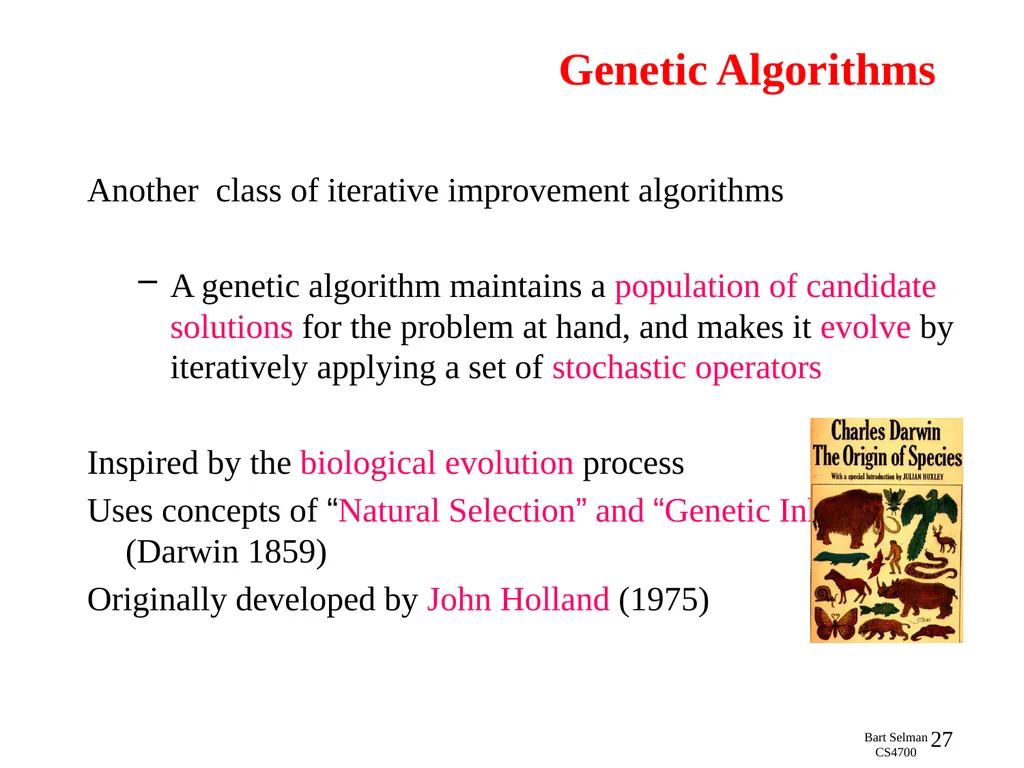
Genetic Algorithms Another class of iterative improvement algorithms
A genetic algorithm maintains a population of candidate solutions for the problem at hand, and makes it evolve by iteratively applying a set of stochastic operators
Inspired by the biological evolution process
Uses concepts of “Natural Selection” and “Genetic Inheritance” (Darwin 1859)
Originally developed by John Holland (1975)<br>
A genetic algorithm maintains a population of candidate solutions for the problem at hand, and makes it evolve by iteratively applying a set of stochastic operators
Inspired by the biological evolution process
Uses concepts of “Natural Selection” and “Genetic Inheritance” (Darwin 1859)
Originally developed by John Holland (1975)<br>
28
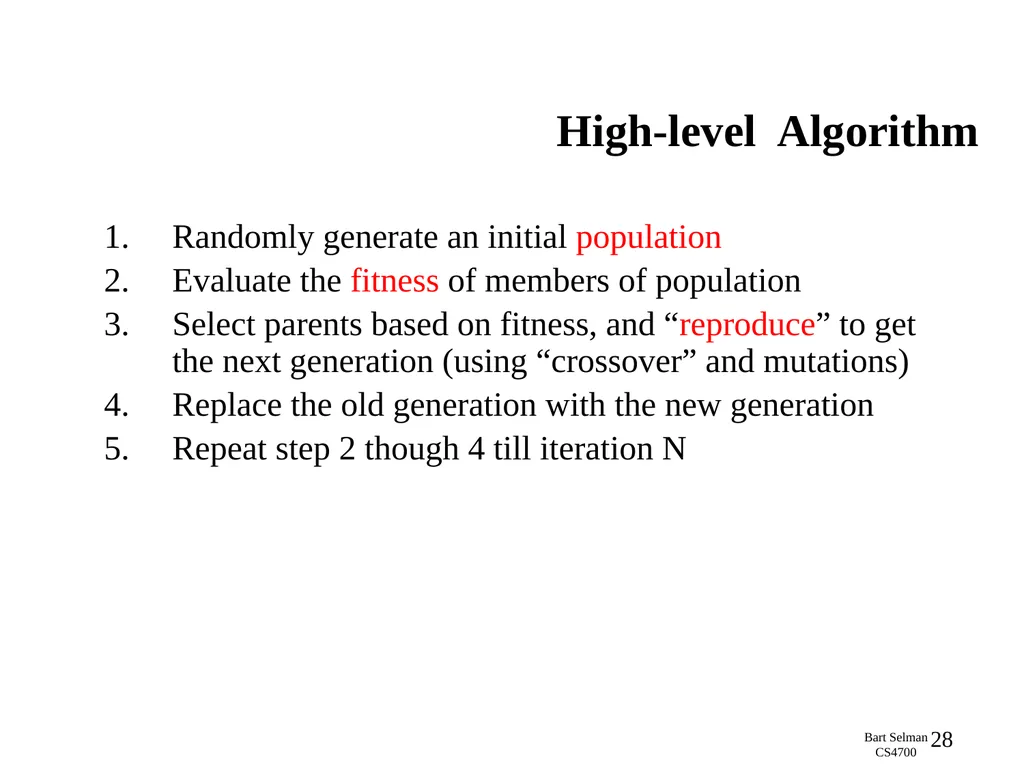
High-level Algorithm Randomly generate an initial population
Evaluate the fitness of members of population
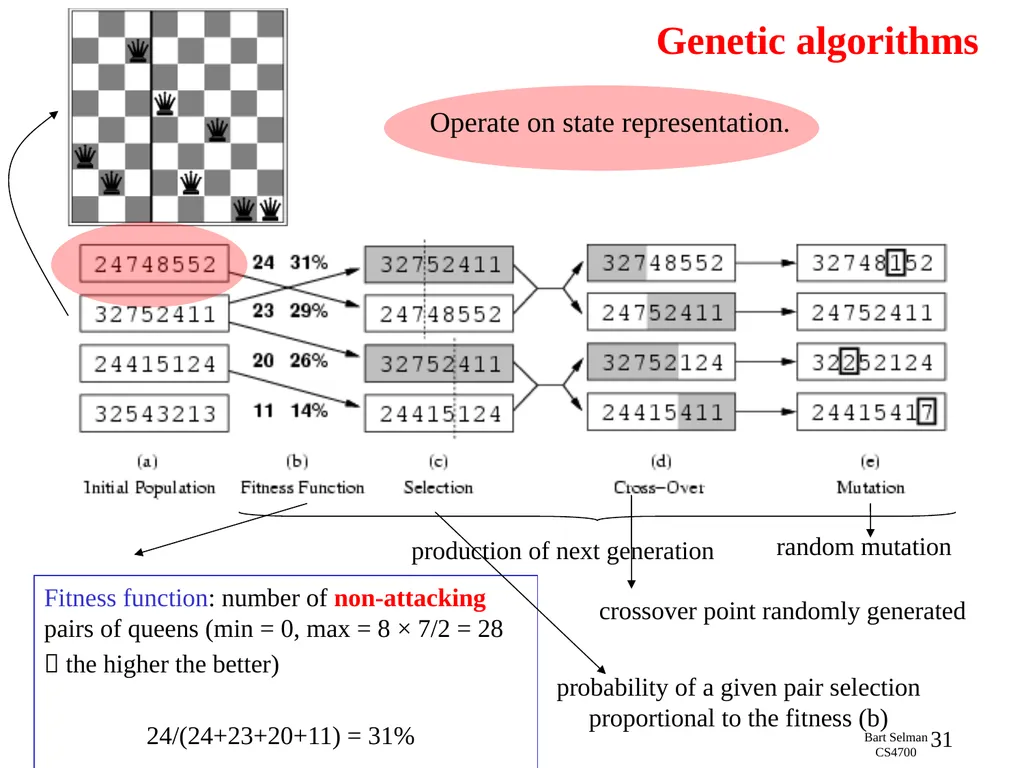
Select parents based on fitness, and “reproduce” to get the next generation (using “crossover” and mutations)
Replace the old generation with the new generation
Repeat step 2 though 4 till iteration N<br>
Evaluate the fitness of members of population
Select parents based on fitness, and “reproduce” to get the next generation (using “crossover” and mutations)
Replace the old generation with the new generation
Repeat step 2 though 4 till iteration N<br>
29
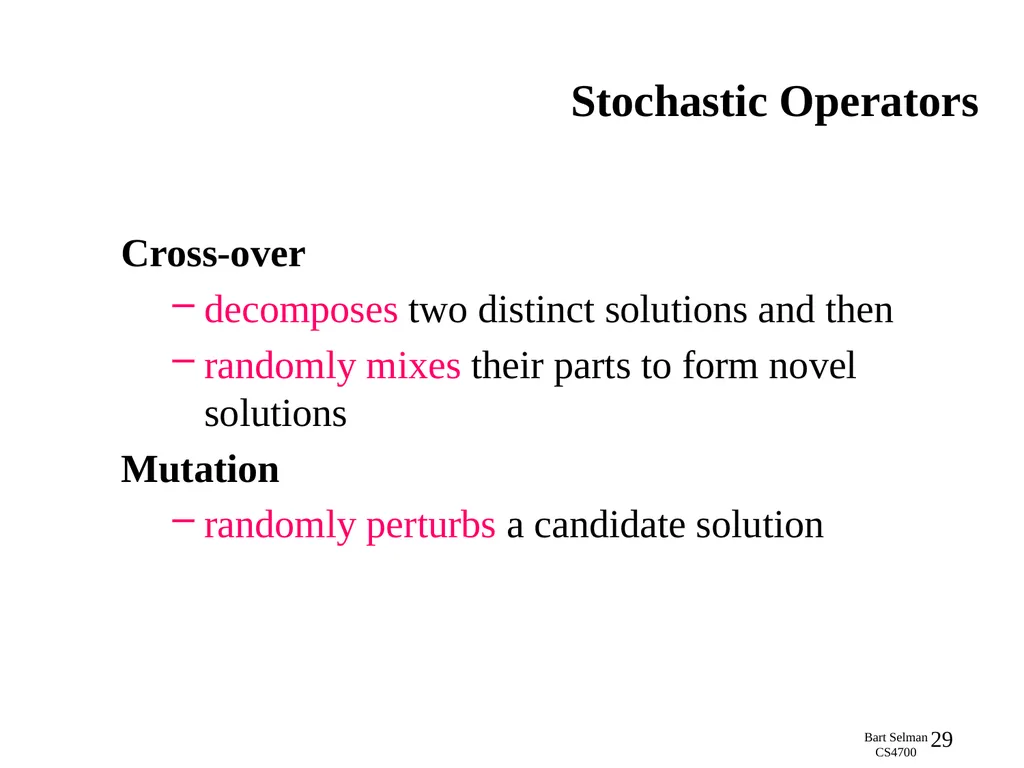
Stochastic Operators Cross-over
decomposes two distinct solutions and then
randomly mixes their parts to form novel solutions
Mutation
randomly perturbs a candidate solution<br>
decomposes two distinct solutions and then
randomly mixes their parts to form novel solutions
Mutation
randomly perturbs a candidate solution<br>
30
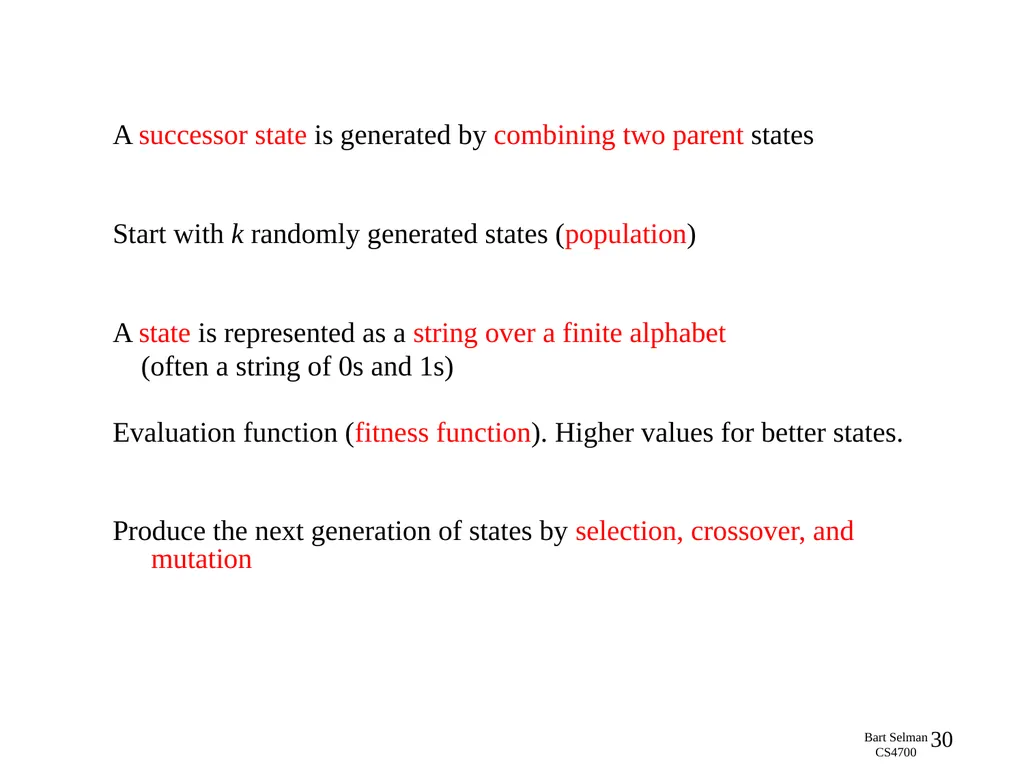
A successor state is generated by combining two parent states
Start with k randomly generated states (population)
A state is represented as a string over a finite alphabet
(often a string of 0s and 1s)
Evaluation function (fitness function). Higher values for better states.
Produce the next generation of states by selection, crossover, and mutation<br>
Start with k randomly generated states (population)
A state is represented as a string over a finite alphabet
(often a string of 0s and 1s)
Evaluation function (fitness function). Higher values for better states.
Produce the next generation of states by selection, crossover, and mutation<br>
31
Genetic algorithms Fitness function: number of non-attacking pairs of queens (min = 0, max = 8 × 7/2 = 28
the higher the better)
24/(24+23+20+11) = 31%
23/(24+23+20+11) = 29% etc Operate on state representation.<br>
the higher the better)
24/(24+23+20+11) = 31%
23/(24+23+20+11) = 29% etc Operate on state representation.<br>
32
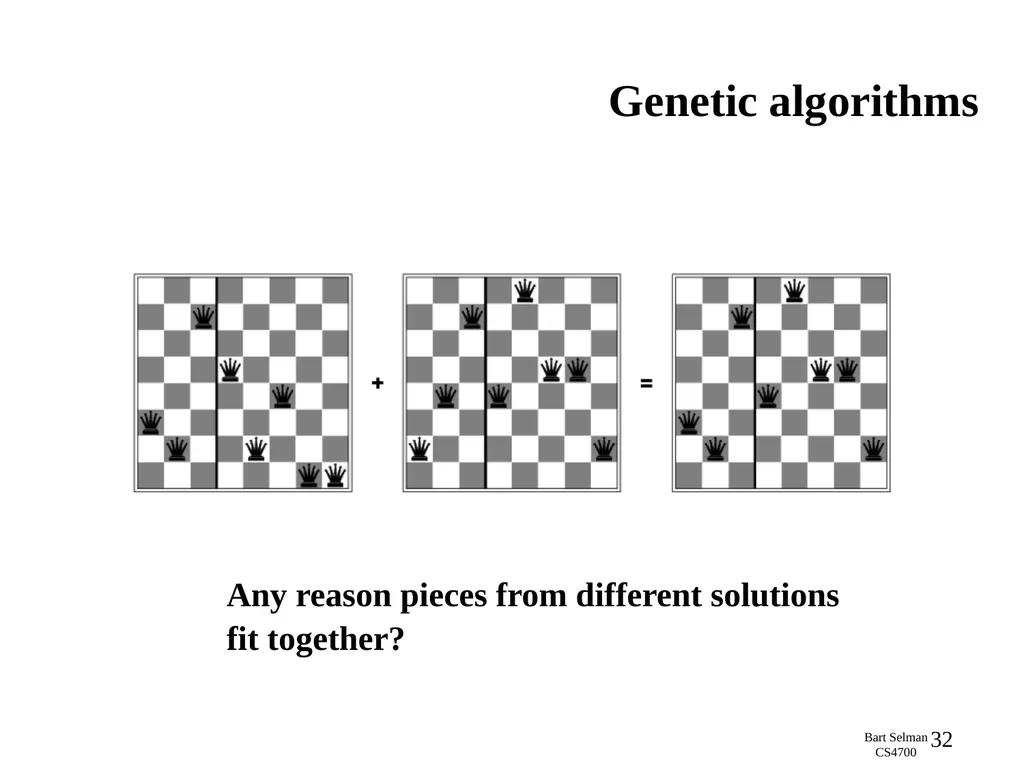
Genetic algorithms Any reason pieces from different solutions
fit together?<br>
fit together?<br>
33
Lots of variants of genetic algorithms with different selection, crossover, and mutation rules.
GAs have a wide application in optimization – e.g., circuit layout and job shop scheduling
Much work remains to be done to formally understand GAs and to identify the conditions under which they perform well.<br>
GAs have a wide application in optimization – e.g., circuit layout and job shop scheduling
Much work remains to be done to formally understand GAs and to identify the conditions under which they perform well.<br>
34
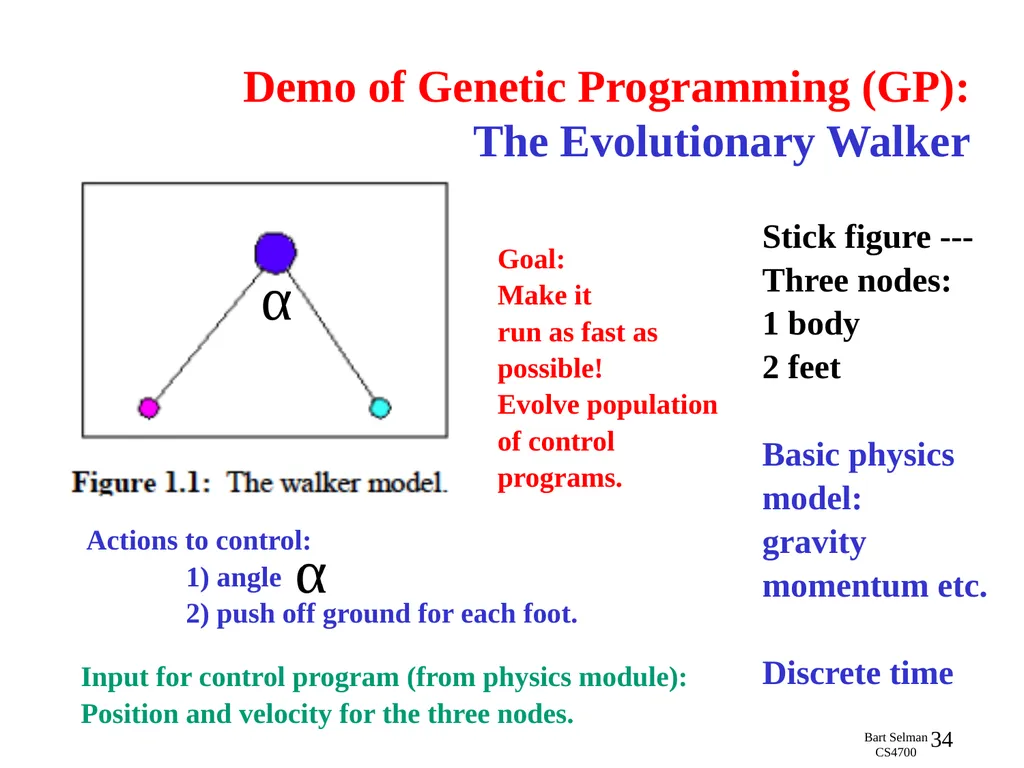
Demo of Genetic Programming (GP):
The Evolutionary Walker Stick figure ---
Three nodes:
1 body
2 feet
Basic physics
model:
gravity
momentum etc.
Discrete time Input for control program (from physics module):
Position and velocity for the three nodes. Goal:
Make it
run as fast as
possible!
Evolve population
of control
programs.<br>
Three nodes:
1 body
2 feet
Basic physics
model:
gravity
momentum etc.
Discrete time Input for control program (from physics module):
Position and velocity for the three nodes. Goal:
Make it
run as fast as
possible!
Evolve population
of control
programs.<br>
35
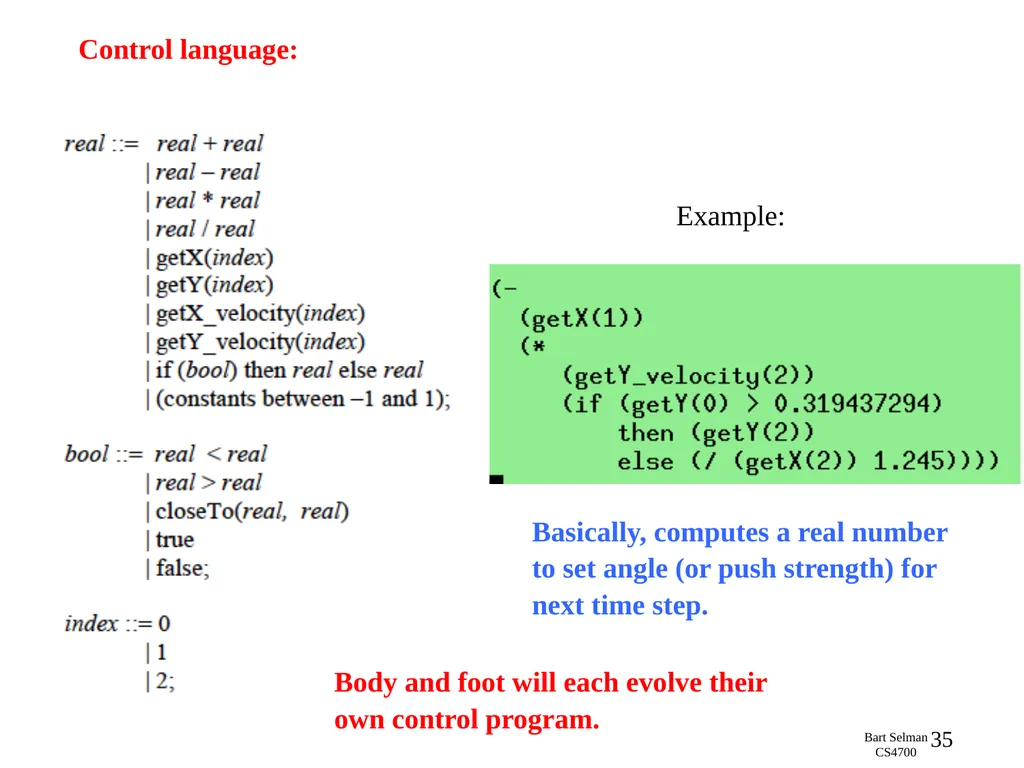
Control language: Example: Basically, computes a real number
to set angle (or push strength) for
next time step. Body and foot will each evolve their
own control program.<br>
to set angle (or push strength) for
next time step. Body and foot will each evolve their
own control program.<br>
36
Population of control programs is maintained and evolved.
Fitness determined by measuring how far the walker gets in T time
units (T fixed).
Evolution through parent selection based on fitness.
Followed by
crossover (swap parts of control programs, i.e., arithmetic expression
trees) and
mutations (randomly generate new parts of control program).<br>
Fitness determined by measuring how far the walker gets in T time
units (T fixed).
Evolution through parent selection based on fitness.
Followed by
crossover (swap parts of control programs, i.e., arithmetic expression
trees) and
mutations (randomly generate new parts of control program).<br>
37
Can this work? How well?
Would it be hard to program directly? Think about it…
Demo<br>
Would it be hard to program directly? Think about it…
Demo<br>
38
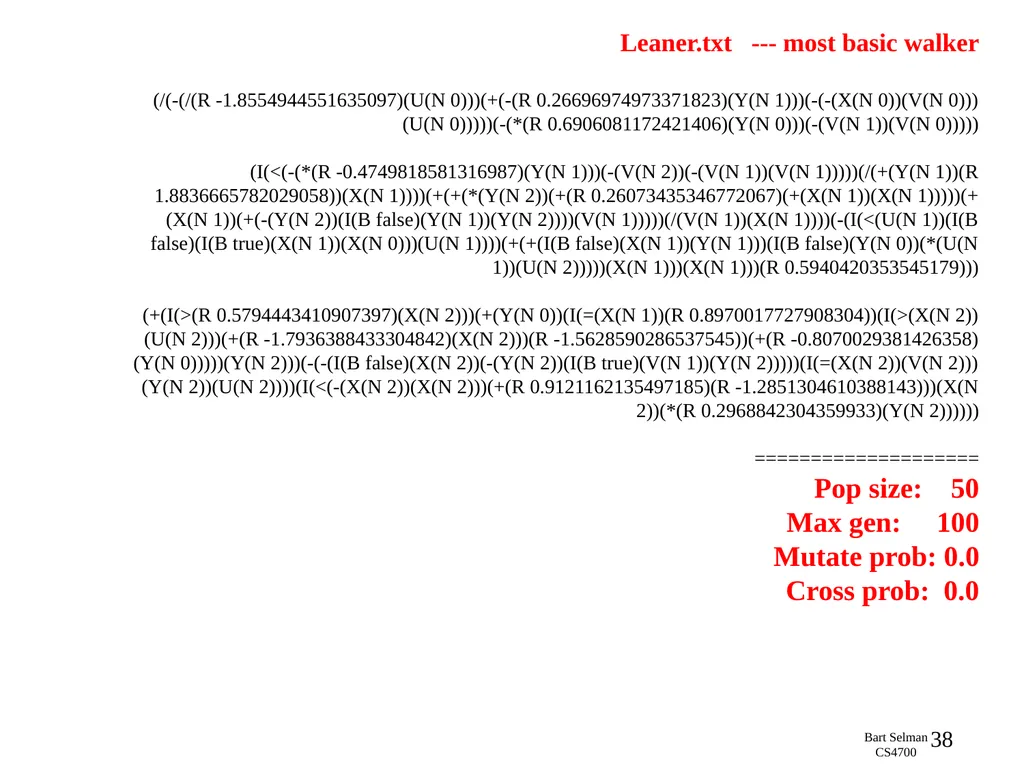
Leaner.txt --- most basic walker
(/(-(/(R -1.8554944551635097)(U(N 0)))(+(-(R 0.26696974973371823)(Y(N 1)))(-(-(X(N 0))(V(N 0)))(U(N 0)))))(-(*(R 0.6906081172421406)(Y(N 0)))(-(V(N 1))(V(N 0)))))
(I(<(-(*(R -0.4749818581316987)(Y(N 1)))(-(V(N 2))(-(V(N 1))(V(N 1)))))(/(+(Y(N 1))(R 1.8836665782029058))(X(N 1))))(+(+(*(Y(N 2))(+(R 0.26073435346772067)(+(X(N 1))(X(N 1)))))(+(X(N 1))(+(-(Y(N 2))(I(B false)(Y(N 1))(Y(N 2))))(V(N 1)))))(/(V(N 1))(X(N 1))))(-(I(<(U(N 1))(I(B false)(I(B true)(X(N 1))(X(N 0)))(U(N 1))))(+(+(I(B false)(X(N 1))(Y(N 1)))(I(B false)(Y(N 0))(*(U(N 1))(U(N 2)))))(X(N 1)))(X(N 1)))(R 0.5940420353545179)))
(+(I(>(R 0.5794443410907397)(X(N 2)))(+(Y(N 0))(I(=(X(N 1))(R 0.8970017727908304))(I(>(X(N 2))(U(N 2)))(+(R -1.7936388433304842)(X(N 2)))(R -1.5628590286537545))(+(R -0.8070029381426358)(Y(N 0)))))(Y(N 2)))(-(-(I(B false)(X(N 2))(-(Y(N 2))(I(B true)(V(N 1))(Y(N 2)))))(I(=(X(N 2))(V(N 2)))(Y(N 2))(U(N 2))))(I(<(-(X(N 2))(X(N 2)))(+(R 0.9121162135497185)(R -1.2851304610388143)))(X(N 2))(*(R 0.2968842304359933)(Y(N 2))))))
====================
Pop size: 50
Max gen: 100
Mutate prob: 0.0
Cross prob: 0.0<br>
39
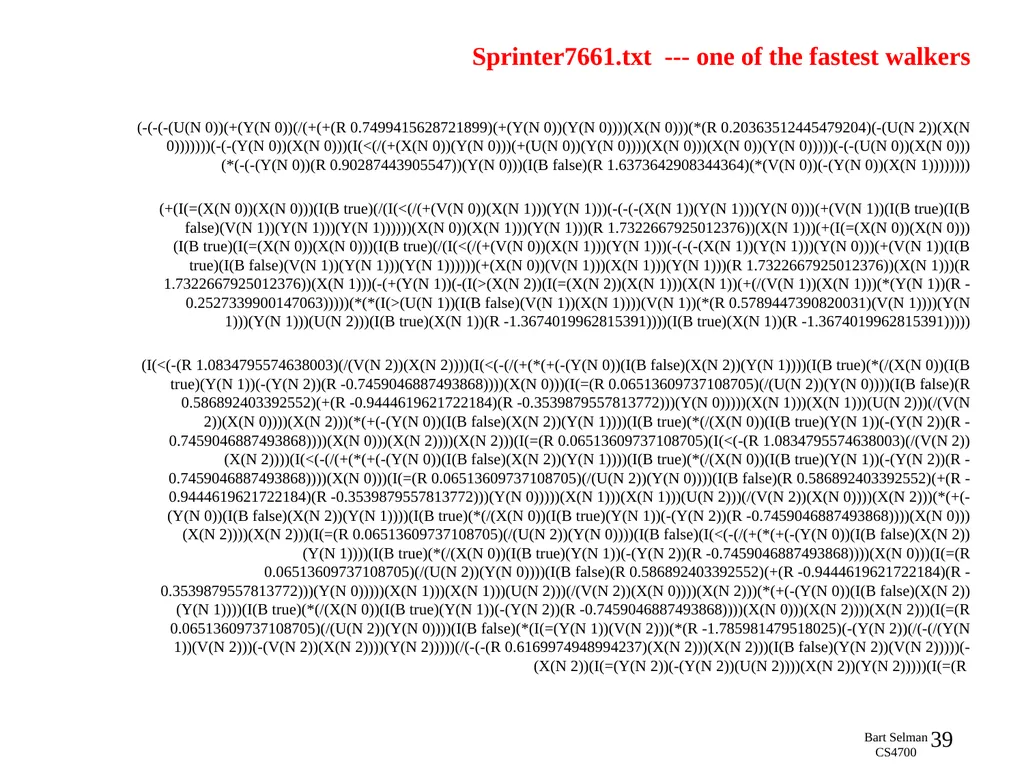
Sprinter7661.txt --- one of the fastest walkers
(-(-(-(U(N 0))(+(Y(N 0))(/(+(+(R 0.7499415628721899)(+(Y(N 0))(Y(N 0))))(X(N 0)))(*(R 0.20363512445479204)(-(U(N 2))(X(N 0)))))))(-(-(Y(N 0))(X(N 0)))(I(<(/(+(X(N 0))(Y(N 0)))(+(U(N 0))(Y(N 0))))(X(N 0)))(X(N 0))(Y(N 0)))))(-(-(U(N 0))(X(N 0)))(*(-(-(Y(N 0))(R 0.90287443905547))(Y(N 0)))(I(B false)(R 1.6373642908344364)(*(V(N 0))(-(Y(N 0))(X(N 1))))))))
(+(I(=(X(N 0))(X(N 0)))(I(B true)(/(I(<(/(+(V(N 0))(X(N 1)))(Y(N 1)))(-(-(-(X(N 1))(Y(N 1)))(Y(N 0)))(+(V(N 1))(I(B true)(I(B false)(V(N 1))(Y(N 1)))(Y(N 1))))))(X(N 0))(X(N 1)))(Y(N 1)))(R 1.7322667925012376))(X(N 1)))(+(I(=(X(N 0))(X(N 0)))(I(B true)(I(=(X(N 0))(X(N 0)))(I(B true)(/(I(<(/(+(V(N 0))(X(N 1)))(Y(N 1)))(-(-(-(X(N 1))(Y(N 1)))(Y(N 0)))(+(V(N 1))(I(B true)(I(B false)(V(N 1))(Y(N 1)))(Y(N 1))))))(+(X(N 0))(V(N 1)))(X(N 1)))(Y(N 1)))(R 1.7322667925012376))(X(N 1)))(R 1.7322667925012376))(X(N 1)))(-(+(Y(N 1))(-(I(>(X(N 2))(I(=(X(N 2))(X(N 1)))(X(N 1))(+(/(V(N 1))(X(N 1)))(*(Y(N 1))(R -0.2527339900147063)))))(*(*(I(>(U(N 1))(I(B false)(V(N 1))(X(N 1))))(V(N 1))(*(R 0.5789447390820031)(V(N 1))))(Y(N 1)))(Y(N 1)))(U(N 2)))(I(B true)(X(N 1))(R -1.3674019962815391))))(I(B true)(X(N 1))(R -1.3674019962815391)))))
(I(<(-(R 1.0834795574638003)(/(V(N 2))(X(N 2))))(I(<(-(/(+(*(+(-(Y(N 0))(I(B false)(X(N 2))(Y(N 1))))(I(B true)(*(/(X(N 0))(I(B true)(Y(N 1))(-(Y(N 2))(R -0.7459046887493868))))(X(N 0)))(I(=(R 0.06513609737108705)(/(U(N 2))(Y(N 0))))(I(B false)(R 0.586892403392552)(+(R -0.9444619621722184)(R -0.3539879557813772)))(Y(N 0)))))(X(N 1)))(X(N 1)))(U(N 2)))(/(V(N 2))(X(N 0))))(X(N 2)))(*(+(-(Y(N 0))(I(B false)(X(N 2))(Y(N 1))))(I(B true)(*(/(X(N 0))(I(B true)(Y(N 1))(-(Y(N 2))(R -0.7459046887493868))))(X(N 0)))(X(N 2))))(X(N 2)))(I(=(R 0.06513609737108705)(I(<(-(R 1.0834795574638003)(/(V(N 2))(X(N 2))))(I(<(-(/(+(*(+(-(Y(N 0))(I(B false)(X(N 2))(Y(N 1))))(I(B true)(*(/(X(N 0))(I(B true)(Y(N 1))(-(Y(N 2))(R -0.7459046887493868))))(X(N 0)))(I(=(R 0.06513609737108705)(/(U(N 2))(Y(N 0))))(I(B false)(R 0.586892403392552)(+(R -0.9444619621722184)(R -0.3539879557813772)))(Y(N 0)))))(X(N 1)))(X(N 1)))(U(N 2)))(/(V(N 2))(X(N 0))))(X(N 2)))(*(+(-(Y(N 0))(I(B false)(X(N 2))(Y(N 1))))(I(B true)(*(/(X(N 0))(I(B true)(Y(N 1))(-(Y(N 2))(R -0.7459046887493868))))(X(N 0)))(X(N 2))))(X(N 2)))(I(=(R 0.06513609737108705)(/(U(N 2))(Y(N 0))))(I(B false)(I(<(-(/(+(*(+(-(Y(N 0))(I(B false)(X(N 2))(Y(N 1))))(I(B true)(*(/(X(N 0))(I(B true)(Y(N 1))(-(Y(N 2))(R -0.7459046887493868))))(X(N 0)))(I(=(R 0.06513609737108705)(/(U(N 2))(Y(N 0))))(I(B false)(R 0.586892403392552)(+(R -0.9444619621722184)(R -0.3539879557813772)))(Y(N 0)))))(X(N 1)))(X(N 1)))(U(N 2)))(/(V(N 2))(X(N 0))))(X(N 2)))(*(+(-(Y(N 0))(I(B false)(X(N 2))(Y(N 1))))(I(B true)(*(/(X(N 0))(I(B true)(Y(N 1))(-(Y(N 2))(R -0.7459046887493868))))(X(N 0)))(X(N 2))))(X(N 2)))(I(=(R 0.06513609737108705)(/(U(N 2))(Y(N 0))))(I(B false)(*(I(=(Y(N 1))(V(N 2)))(*(R -1.785981479518025)(-(Y(N 2))(/(-(/(Y(N 1))(V(N 2)))(-(V(N 2))(X(N 2))))(Y(N 2)))))(/(-(-(R 0.6169974948994237)(X(N 2)))(X(N 2)))(I(B false)(Y(N 2))(V(N 2)))))(-(X(N 2))(I(=(Y(N 2))(-(Y(N 2))(U(N 2))))(X(N 2))(Y(N 2)))))(I(=(R<br>
(-(-(-(U(N 0))(+(Y(N 0))(/(+(+(R 0.7499415628721899)(+(Y(N 0))(Y(N 0))))(X(N 0)))(*(R 0.20363512445479204)(-(U(N 2))(X(N 0)))))))(-(-(Y(N 0))(X(N 0)))(I(<(/(+(X(N 0))(Y(N 0)))(+(U(N 0))(Y(N 0))))(X(N 0)))(X(N 0))(Y(N 0)))))(-(-(U(N 0))(X(N 0)))(*(-(-(Y(N 0))(R 0.90287443905547))(Y(N 0)))(I(B false)(R 1.6373642908344364)(*(V(N 0))(-(Y(N 0))(X(N 1))))))))
(+(I(=(X(N 0))(X(N 0)))(I(B true)(/(I(<(/(+(V(N 0))(X(N 1)))(Y(N 1)))(-(-(-(X(N 1))(Y(N 1)))(Y(N 0)))(+(V(N 1))(I(B true)(I(B false)(V(N 1))(Y(N 1)))(Y(N 1))))))(X(N 0))(X(N 1)))(Y(N 1)))(R 1.7322667925012376))(X(N 1)))(+(I(=(X(N 0))(X(N 0)))(I(B true)(I(=(X(N 0))(X(N 0)))(I(B true)(/(I(<(/(+(V(N 0))(X(N 1)))(Y(N 1)))(-(-(-(X(N 1))(Y(N 1)))(Y(N 0)))(+(V(N 1))(I(B true)(I(B false)(V(N 1))(Y(N 1)))(Y(N 1))))))(+(X(N 0))(V(N 1)))(X(N 1)))(Y(N 1)))(R 1.7322667925012376))(X(N 1)))(R 1.7322667925012376))(X(N 1)))(-(+(Y(N 1))(-(I(>(X(N 2))(I(=(X(N 2))(X(N 1)))(X(N 1))(+(/(V(N 1))(X(N 1)))(*(Y(N 1))(R -0.2527339900147063)))))(*(*(I(>(U(N 1))(I(B false)(V(N 1))(X(N 1))))(V(N 1))(*(R 0.5789447390820031)(V(N 1))))(Y(N 1)))(Y(N 1)))(U(N 2)))(I(B true)(X(N 1))(R -1.3674019962815391))))(I(B true)(X(N 1))(R -1.3674019962815391)))))
(I(<(-(R 1.0834795574638003)(/(V(N 2))(X(N 2))))(I(<(-(/(+(*(+(-(Y(N 0))(I(B false)(X(N 2))(Y(N 1))))(I(B true)(*(/(X(N 0))(I(B true)(Y(N 1))(-(Y(N 2))(R -0.7459046887493868))))(X(N 0)))(I(=(R 0.06513609737108705)(/(U(N 2))(Y(N 0))))(I(B false)(R 0.586892403392552)(+(R -0.9444619621722184)(R -0.3539879557813772)))(Y(N 0)))))(X(N 1)))(X(N 1)))(U(N 2)))(/(V(N 2))(X(N 0))))(X(N 2)))(*(+(-(Y(N 0))(I(B false)(X(N 2))(Y(N 1))))(I(B true)(*(/(X(N 0))(I(B true)(Y(N 1))(-(Y(N 2))(R -0.7459046887493868))))(X(N 0)))(X(N 2))))(X(N 2)))(I(=(R 0.06513609737108705)(I(<(-(R 1.0834795574638003)(/(V(N 2))(X(N 2))))(I(<(-(/(+(*(+(-(Y(N 0))(I(B false)(X(N 2))(Y(N 1))))(I(B true)(*(/(X(N 0))(I(B true)(Y(N 1))(-(Y(N 2))(R -0.7459046887493868))))(X(N 0)))(I(=(R 0.06513609737108705)(/(U(N 2))(Y(N 0))))(I(B false)(R 0.586892403392552)(+(R -0.9444619621722184)(R -0.3539879557813772)))(Y(N 0)))))(X(N 1)))(X(N 1)))(U(N 2)))(/(V(N 2))(X(N 0))))(X(N 2)))(*(+(-(Y(N 0))(I(B false)(X(N 2))(Y(N 1))))(I(B true)(*(/(X(N 0))(I(B true)(Y(N 1))(-(Y(N 2))(R -0.7459046887493868))))(X(N 0)))(X(N 2))))(X(N 2)))(I(=(R 0.06513609737108705)(/(U(N 2))(Y(N 0))))(I(B false)(I(<(-(/(+(*(+(-(Y(N 0))(I(B false)(X(N 2))(Y(N 1))))(I(B true)(*(/(X(N 0))(I(B true)(Y(N 1))(-(Y(N 2))(R -0.7459046887493868))))(X(N 0)))(I(=(R 0.06513609737108705)(/(U(N 2))(Y(N 0))))(I(B false)(R 0.586892403392552)(+(R -0.9444619621722184)(R -0.3539879557813772)))(Y(N 0)))))(X(N 1)))(X(N 1)))(U(N 2)))(/(V(N 2))(X(N 0))))(X(N 2)))(*(+(-(Y(N 0))(I(B false)(X(N 2))(Y(N 1))))(I(B true)(*(/(X(N 0))(I(B true)(Y(N 1))(-(Y(N 2))(R -0.7459046887493868))))(X(N 0)))(X(N 2))))(X(N 2)))(I(=(R 0.06513609737108705)(/(U(N 2))(Y(N 0))))(I(B false)(*(I(=(Y(N 1))(V(N 2)))(*(R -1.785981479518025)(-(Y(N 2))(/(-(/(Y(N 1))(V(N 2)))(-(V(N 2))(X(N 2))))(Y(N 2)))))(/(-(-(R 0.6169974948994237)(X(N 2)))(X(N 2)))(I(B false)(Y(N 2))(V(N 2)))))(-(X(N 2))(I(=(Y(N 2))(-(Y(N 2))(U(N 2))))(X(N 2))(Y(N 2)))))(I(=(R<br>
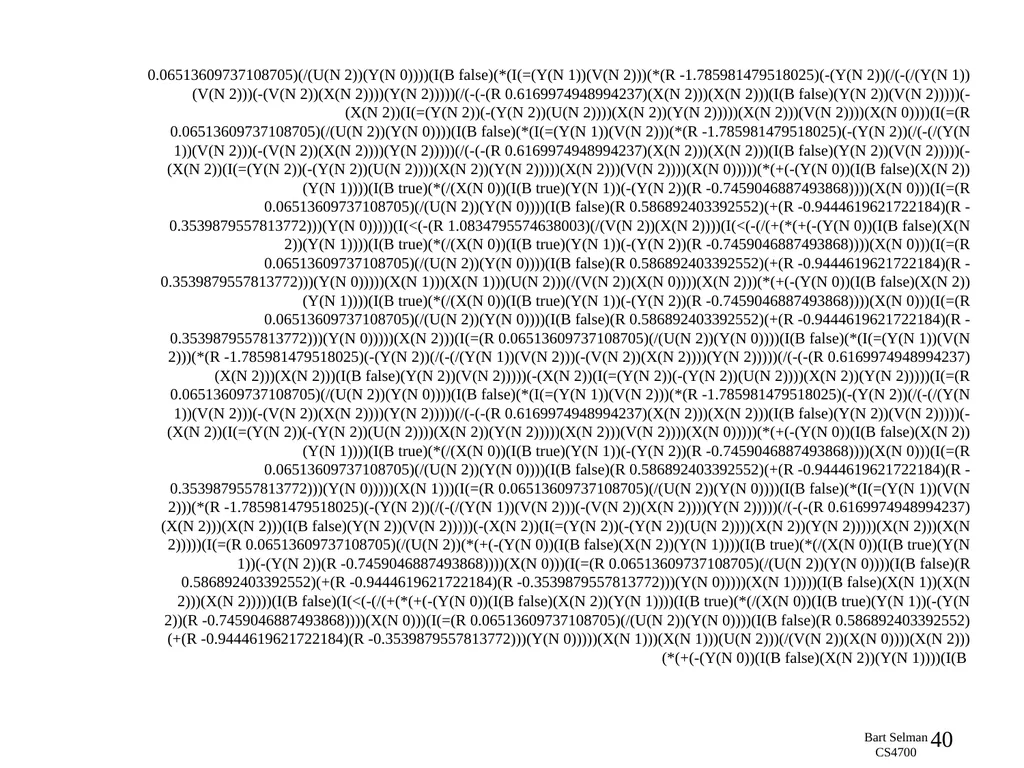
40
0.06513609737108705)(/(U(N 2))(Y(N 0))))(I(B false)(*(I(=(Y(N 1))(V(N 2)))(*(R -1.785981479518025)(-(Y(N 2))(/(-(/(Y(N 1))(V(N 2)))(-(V(N 2))(X(N 2))))(Y(N 2)))))(/(-(-(R 0.6169974948994237)(X(N 2)))(X(N 2)))(I(B false)(Y(N 2))(V(N 2)))))(-(X(N 2))(I(=(Y(N 2))(-(Y(N 2))(U(N 2))))(X(N 2))(Y(N 2)))))(X(N 2)))(V(N 2))))(X(N 0))))(I(=(R 0.06513609737108705)(/(U(N 2))(Y(N 0))))(I(B false)(*(I(=(Y(N 1))(V(N 2)))(*(R -1.785981479518025)(-(Y(N 2))(/(-(/(Y(N 1))(V(N 2)))(-(V(N 2))(X(N 2))))(Y(N 2)))))(/(-(-(R 0.6169974948994237)(X(N 2)))(X(N 2)))(I(B false)(Y(N 2))(V(N 2)))))(-(X(N 2))(I(=(Y(N 2))(-(Y(N 2))(U(N 2))))(X(N 2))(Y(N 2)))))(X(N 2)))(V(N 2))))(X(N 0)))))(*(+(-(Y(N 0))(I(B false)(X(N 2))(Y(N 1))))(I(B true)(*(/(X(N 0))(I(B true)(Y(N 1))(-(Y(N 2))(R -0.7459046887493868))))(X(N 0)))(I(=(R 0.06513609737108705)(/(U(N 2))(Y(N 0))))(I(B false)(R 0.586892403392552)(+(R -0.9444619621722184)(R -0.3539879557813772)))(Y(N 0)))))(I(<(-(R 1.0834795574638003)(/(V(N 2))(X(N 2))))(I(<(-(/(+(*(+(-(Y(N 0))(I(B false)(X(N 2))(Y(N 1))))(I(B true)(*(/(X(N 0))(I(B true)(Y(N 1))(-(Y(N 2))(R -0.7459046887493868))))(X(N 0)))(I(=(R 0.06513609737108705)(/(U(N 2))(Y(N 0))))(I(B false)(R 0.586892403392552)(+(R -0.9444619621722184)(R -0.3539879557813772)))(Y(N 0)))))(X(N 1)))(X(N 1)))(U(N 2)))(/(V(N 2))(X(N 0))))(X(N 2)))(*(+(-(Y(N 0))(I(B false)(X(N 2))(Y(N 1))))(I(B true)(*(/(X(N 0))(I(B true)(Y(N 1))(-(Y(N 2))(R -0.7459046887493868))))(X(N 0)))(I(=(R 0.06513609737108705)(/(U(N 2))(Y(N 0))))(I(B false)(R 0.586892403392552)(+(R -0.9444619621722184)(R -0.3539879557813772)))(Y(N 0)))))(X(N 2)))(I(=(R 0.06513609737108705)(/(U(N 2))(Y(N 0))))(I(B false)(*(I(=(Y(N 1))(V(N 2)))(*(R -1.785981479518025)(-(Y(N 2))(/(-(/(Y(N 1))(V(N 2)))(-(V(N 2))(X(N 2))))(Y(N 2)))))(/(-(-(R 0.6169974948994237)(X(N 2)))(X(N 2)))(I(B false)(Y(N 2))(V(N 2)))))(-(X(N 2))(I(=(Y(N 2))(-(Y(N 2))(U(N 2))))(X(N 2))(Y(N 2)))))(I(=(R 0.06513609737108705)(/(U(N 2))(Y(N 0))))(I(B false)(*(I(=(Y(N 1))(V(N 2)))(*(R -1.785981479518025)(-(Y(N 2))(/(-(/(Y(N 1))(V(N 2)))(-(V(N 2))(X(N 2))))(Y(N 2)))))(/(-(-(R 0.6169974948994237)(X(N 2)))(X(N 2)))(I(B false)(Y(N 2))(V(N 2)))))(-(X(N 2))(I(=(Y(N 2))(-(Y(N 2))(U(N 2))))(X(N 2))(Y(N 2)))))(X(N 2)))(V(N 2))))(X(N 0)))))(*(+(-(Y(N 0))(I(B false)(X(N 2))(Y(N 1))))(I(B true)(*(/(X(N 0))(I(B true)(Y(N 1))(-(Y(N 2))(R -0.7459046887493868))))(X(N 0)))(I(=(R 0.06513609737108705)(/(U(N 2))(Y(N 0))))(I(B false)(R 0.586892403392552)(+(R -0.9444619621722184)(R -0.3539879557813772)))(Y(N 0)))))(X(N 1)))(I(=(R 0.06513609737108705)(/(U(N 2))(Y(N 0))))(I(B false)(*(I(=(Y(N 1))(V(N 2)))(*(R -1.785981479518025)(-(Y(N 2))(/(-(/(Y(N 1))(V(N 2)))(-(V(N 2))(X(N 2))))(Y(N 2)))))(/(-(-(R 0.6169974948994237)(X(N 2)))(X(N 2)))(I(B false)(Y(N 2))(V(N 2)))))(-(X(N 2))(I(=(Y(N 2))(-(Y(N 2))(U(N 2))))(X(N 2))(Y(N 2)))))(X(N 2)))(X(N 2)))))(I(=(R 0.06513609737108705)(/(U(N 2))(*(+(-(Y(N 0))(I(B false)(X(N 2))(Y(N 1))))(I(B true)(*(/(X(N 0))(I(B true)(Y(N 1))(-(Y(N 2))(R -0.7459046887493868))))(X(N 0)))(I(=(R 0.06513609737108705)(/(U(N 2))(Y(N 0))))(I(B false)(R 0.586892403392552)(+(R -0.9444619621722184)(R -0.3539879557813772)))(Y(N 0)))))(X(N 1)))))(I(B false)(X(N 1))(X(N 2)))(X(N 2)))))(I(B false)(I(<(-(/(+(*(+(-(Y(N 0))(I(B false)(X(N 2))(Y(N 1))))(I(B true)(*(/(X(N 0))(I(B true)(Y(N 1))(-(Y(N 2))(R -0.7459046887493868))))(X(N 0)))(I(=(R 0.06513609737108705)(/(U(N 2))(Y(N 0))))(I(B false)(R 0.586892403392552)(+(R -0.9444619621722184)(R -0.3539879557813772)))(Y(N 0)))))(X(N 1)))(X(N 1)))(U(N 2)))(/(V(N 2))(X(N 0))))(X(N 2)))(*(+(-(Y(N 0))(I(B false)(X(N 2))(Y(N 1))))(I(B<br>
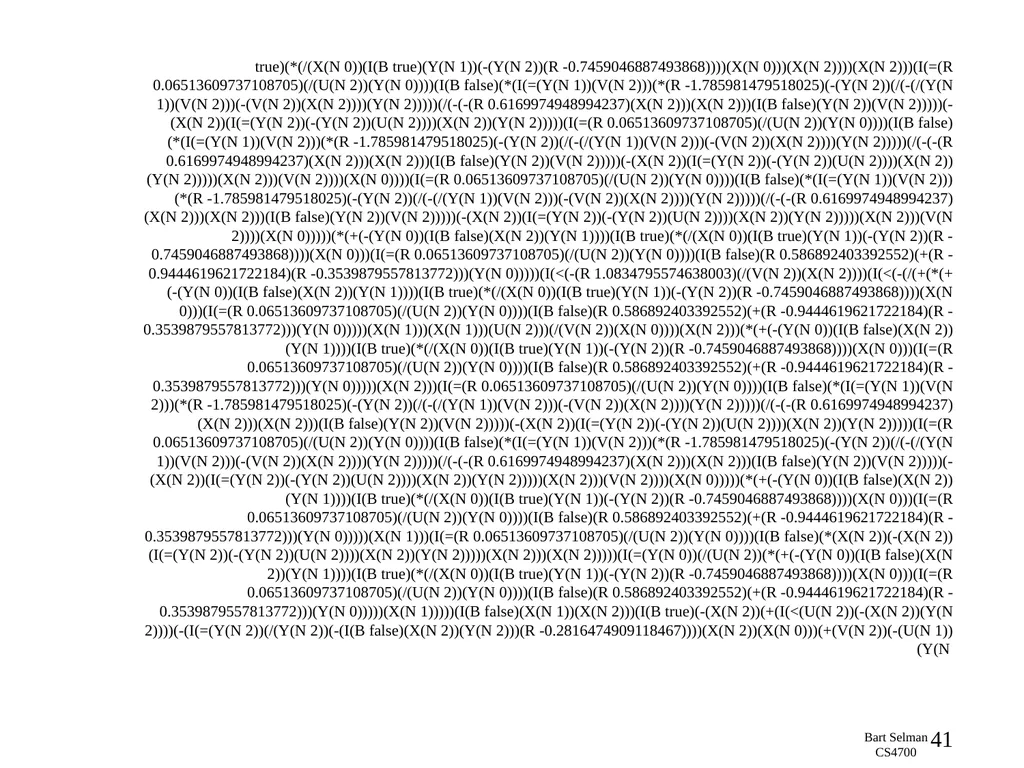
41
true)(*(/(X(N 0))(I(B true)(Y(N 1))(-(Y(N 2))(R -0.7459046887493868))))(X(N 0)))(X(N 2))))(X(N 2)))(I(=(R 0.06513609737108705)(/(U(N 2))(Y(N 0))))(I(B false)(*(I(=(Y(N 1))(V(N 2)))(*(R -1.785981479518025)(-(Y(N 2))(/(-(/(Y(N 1))(V(N 2)))(-(V(N 2))(X(N 2))))(Y(N 2)))))(/(-(-(R 0.6169974948994237)(X(N 2)))(X(N 2)))(I(B false)(Y(N 2))(V(N 2)))))(-(X(N 2))(I(=(Y(N 2))(-(Y(N 2))(U(N 2))))(X(N 2))(Y(N 2)))))(I(=(R 0.06513609737108705)(/(U(N 2))(Y(N 0))))(I(B false)(*(I(=(Y(N 1))(V(N 2)))(*(R -1.785981479518025)(-(Y(N 2))(/(-(/(Y(N 1))(V(N 2)))(-(V(N 2))(X(N 2))))(Y(N 2)))))(/(-(-(R 0.6169974948994237)(X(N 2)))(X(N 2)))(I(B false)(Y(N 2))(V(N 2)))))(-(X(N 2))(I(=(Y(N 2))(-(Y(N 2))(U(N 2))))(X(N 2))(Y(N 2)))))(X(N 2)))(V(N 2))))(X(N 0))))(I(=(R 0.06513609737108705)(/(U(N 2))(Y(N 0))))(I(B false)(*(I(=(Y(N 1))(V(N 2)))(*(R -1.785981479518025)(-(Y(N 2))(/(-(/(Y(N 1))(V(N 2)))(-(V(N 2))(X(N 2))))(Y(N 2)))))(/(-(-(R 0.6169974948994237)(X(N 2)))(X(N 2)))(I(B false)(Y(N 2))(V(N 2)))))(-(X(N 2))(I(=(Y(N 2))(-(Y(N 2))(U(N 2))))(X(N 2))(Y(N 2)))))(X(N 2)))(V(N 2))))(X(N 0)))))(*(+(-(Y(N 0))(I(B false)(X(N 2))(Y(N 1))))(I(B true)(*(/(X(N 0))(I(B true)(Y(N 1))(-(Y(N 2))(R -0.7459046887493868))))(X(N 0)))(I(=(R 0.06513609737108705)(/(U(N 2))(Y(N 0))))(I(B false)(R 0.586892403392552)(+(R -0.9444619621722184)(R -0.3539879557813772)))(Y(N 0)))))(I(<(-(R 1.0834795574638003)(/(V(N 2))(X(N 2))))(I(<(-(/(+(*(+(-(Y(N 0))(I(B false)(X(N 2))(Y(N 1))))(I(B true)(*(/(X(N 0))(I(B true)(Y(N 1))(-(Y(N 2))(R -0.7459046887493868))))(X(N 0)))(I(=(R 0.06513609737108705)(/(U(N 2))(Y(N 0))))(I(B false)(R 0.586892403392552)(+(R -0.9444619621722184)(R -0.3539879557813772)))(Y(N 0)))))(X(N 1)))(X(N 1)))(U(N 2)))(/(V(N 2))(X(N 0))))(X(N 2)))(*(+(-(Y(N 0))(I(B false)(X(N 2))(Y(N 1))))(I(B true)(*(/(X(N 0))(I(B true)(Y(N 1))(-(Y(N 2))(R -0.7459046887493868))))(X(N 0)))(I(=(R 0.06513609737108705)(/(U(N 2))(Y(N 0))))(I(B false)(R 0.586892403392552)(+(R -0.9444619621722184)(R -0.3539879557813772)))(Y(N 0)))))(X(N 2)))(I(=(R 0.06513609737108705)(/(U(N 2))(Y(N 0))))(I(B false)(*(I(=(Y(N 1))(V(N 2)))(*(R -1.785981479518025)(-(Y(N 2))(/(-(/(Y(N 1))(V(N 2)))(-(V(N 2))(X(N 2))))(Y(N 2)))))(/(-(-(R 0.6169974948994237)(X(N 2)))(X(N 2)))(I(B false)(Y(N 2))(V(N 2)))))(-(X(N 2))(I(=(Y(N 2))(-(Y(N 2))(U(N 2))))(X(N 2))(Y(N 2)))))(I(=(R 0.06513609737108705)(/(U(N 2))(Y(N 0))))(I(B false)(*(I(=(Y(N 1))(V(N 2)))(*(R -1.785981479518025)(-(Y(N 2))(/(-(/(Y(N 1))(V(N 2)))(-(V(N 2))(X(N 2))))(Y(N 2)))))(/(-(-(R 0.6169974948994237)(X(N 2)))(X(N 2)))(I(B false)(Y(N 2))(V(N 2)))))(-(X(N 2))(I(=(Y(N 2))(-(Y(N 2))(U(N 2))))(X(N 2))(Y(N 2)))))(X(N 2)))(V(N 2))))(X(N 0)))))(*(+(-(Y(N 0))(I(B false)(X(N 2))(Y(N 1))))(I(B true)(*(/(X(N 0))(I(B true)(Y(N 1))(-(Y(N 2))(R -0.7459046887493868))))(X(N 0)))(I(=(R 0.06513609737108705)(/(U(N 2))(Y(N 0))))(I(B false)(R 0.586892403392552)(+(R -0.9444619621722184)(R -0.3539879557813772)))(Y(N 0)))))(X(N 1)))(I(=(R 0.06513609737108705)(/(U(N 2))(Y(N 0))))(I(B false)(*(X(N 2))(-(X(N 2))(I(=(Y(N 2))(-(Y(N 2))(U(N 2))))(X(N 2))(Y(N 2)))))(X(N 2)))(X(N 2)))))(I(=(Y(N 0))(/(U(N 2))(*(+(-(Y(N 0))(I(B false)(X(N 2))(Y(N 1))))(I(B true)(*(/(X(N 0))(I(B true)(Y(N 1))(-(Y(N 2))(R -0.7459046887493868))))(X(N 0)))(I(=(R 0.06513609737108705)(/(U(N 2))(Y(N 0))))(I(B false)(R 0.586892403392552)(+(R -0.9444619621722184)(R -0.3539879557813772)))(Y(N 0)))))(X(N 1)))))(I(B false)(X(N 1))(X(N 2)))(I(B true)(-(X(N 2))(+(I(<(U(N 2))(-(X(N 2))(Y(N 2))))(-(I(=(Y(N 2))(/(Y(N 2))(-(I(B false)(X(N 2))(Y(N 2)))(R -0.2816474909118467))))(X(N 2))(X(N 0)))(+(V(N 2))(-(U(N 1))(Y(N<br>
42
2)))))(+(Y(N 2))(R -1.6972810613722311)))(-(Y(N 2))(+(X(N 2))(-(U(N 0))(-(Y(N 2))(U(N 2))))))))(I(=(/(Y(N 2))(/(Y(N 1))(+(I(B false)(X(N 2))(X(N 2)))(+(Y(N 2))(I(>(V(N 2))(-(Y(N 0))(X(N 2))))(R 1.442859722538481)(X(N 1)))))))(-(R -0.8609985653714518)(Y(N 1))))(V(N 2))(+(*(V(N 2))(Y(N 2)))(X(N 0)))))))
====================
Pop size: 100
Max gen: 50000
Mutate prob: 0.9
Cross prob: 0.9<br>
====================
Pop size: 100
Max gen: 50000
Mutate prob: 0.9
Cross prob: 0.9<br>
43
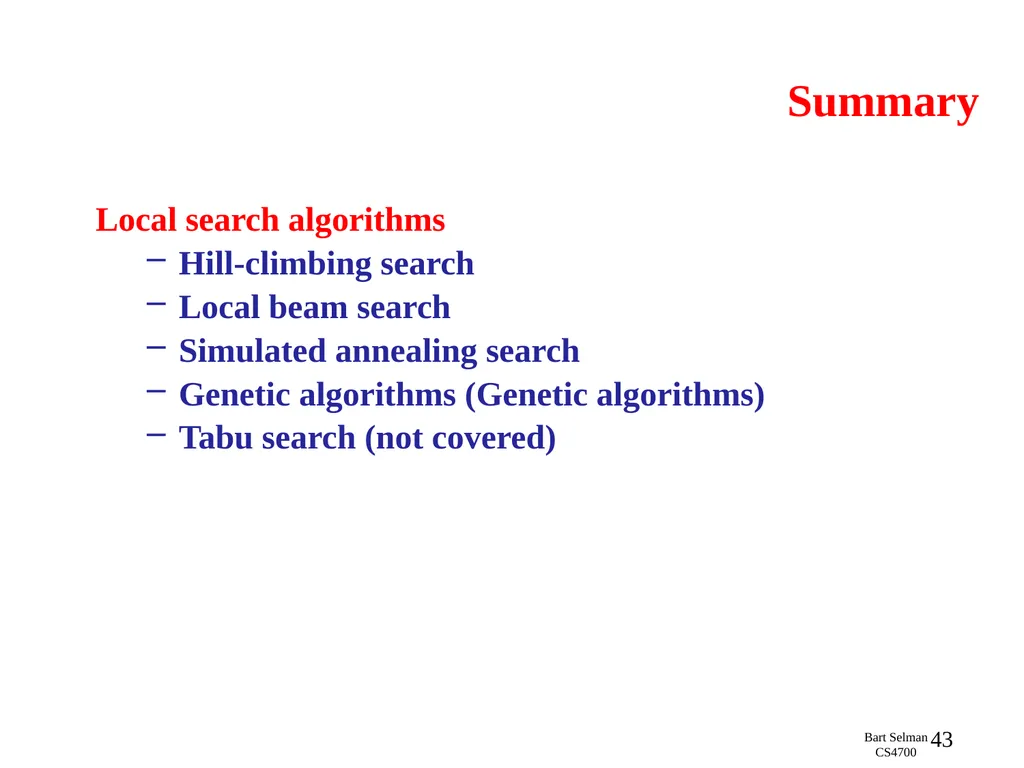
Summary Local search algorithms
Hill-climbing search
Local beam search
Simulated annealing search
Genetic algorithms (Genetic algorithms)
Tabu search (not covered)<br>
Hill-climbing search
Local beam search
Simulated annealing search
Genetic algorithms (Genetic algorithms)
Tabu search (not covered)<br>
44
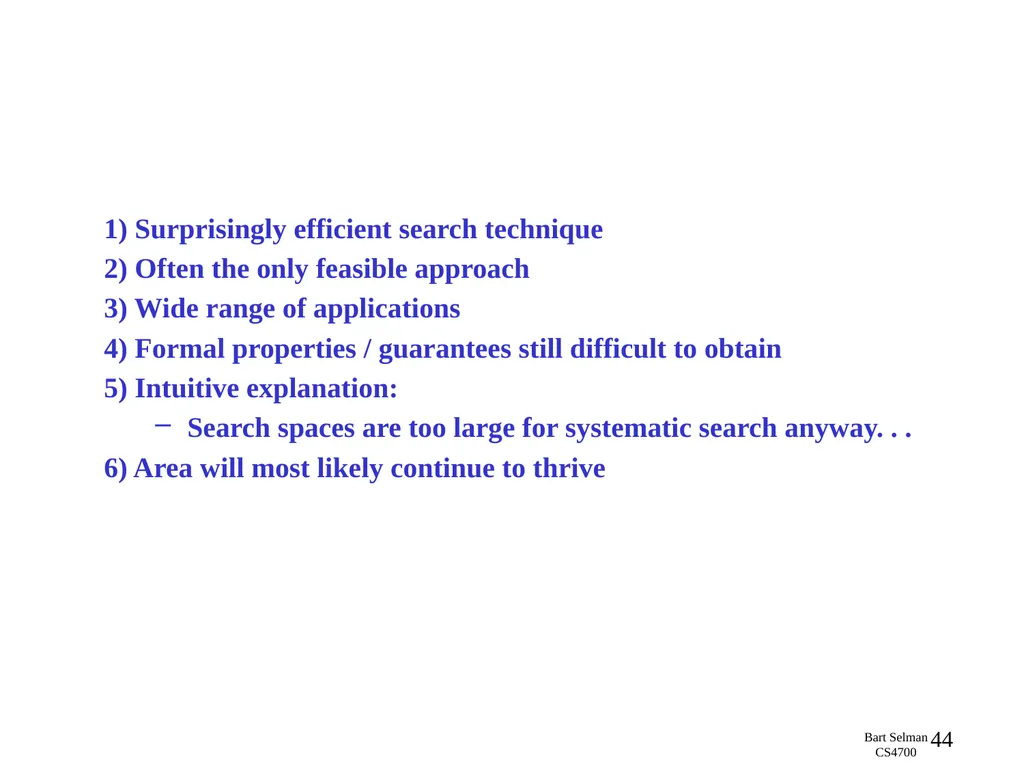
1) Surprisingly efficient search technique
2) Often the only feasible approach
3) Wide range of applications
4) Formal properties / guarantees still difficult to obtain
5) Intuitive explanation:
Search spaces are too large for systematic search anyway. . .
6) Area will most likely continue to thrive<br>
2) Often the only feasible approach
3) Wide range of applications
4) Formal properties / guarantees still difficult to obtain
5) Intuitive explanation:
Search spaces are too large for systematic search anyway. . .
6) Area will most likely continue to thrive<br>