CS 4700: Foundations of Artificial Intelligence Prof. Bart Selman selmancs.cornell.edu Machine Learning: Decision Trees --- Generalization and Overfitting Russell Norvig: 18.3.5, 18.3.6 18.4 Extensions of the Decision Tree Learning
"CS 4700: Foundations of Artificial Intelligence" is the property of its rightful owner. Permission is granted to
download and print the materials on this website for personal, non-commercial use only, and to display it
on your personal computer provided you do not modify the materials and that you retain all copyright
notices contained in the materials. By downloading content from our website, you accept the terms of this
agreement.
Presentation Transcript
01
CS 4700: Foundations of Artificial Intelligence Prof. Bart Selman
selman@cs.cornell.edu
Machine Learning:
Decision Trees ---
Generalization and Overfitting
Russell & Norvig: 18.3.5, 18.3.6 & 18.4<br>
02
Extensions of the Decision Tree Learning Algorithm (Briefly) Noisy data
Overfitting and Model Selection
Cross Validation
Missing Data (R&N, Section 18.3.6)
Using gain ratios (R&N, Section 18.3.6)
Real-valued data (R&N, Section 18.3.6)
Generation of rules and pruning<br>
03
Machine Learning: Noisy data Many kinds of "noise" that could occur in the examples:
Two examples have same attribute/value pairs (“feature values”), but different classifications
report majority classification for the examples corresponding to the node
deterministic hypothesis.
report estimated probabilities of each classification using the relative frequency (if considering stochastic hypotheses)
Some values of attributes are incorrect because of errors in the data acquisition process or the preprocessing phase
The classification is wrong (e.g., + instead of -) because of some error Given noisy data (unavoidable) --- make sure you don’t “overfit” your learned model.<br>
04
Overfitting Ex.: Problem of trying to predict the roll of a die. The experiment data include features:
(1) Day of the week
(2) Month of the week
(3) Color of the die
….
DTL may find an hypothesis that fits the data but with irrelevant attributes. Some attributes are irrelevant to the decision-making process, e.g., color
of a die is irrelevant to its outcome but they are used to differentiate examples Overfitting. Overfitting means fitting the training set “too well”
performance on the test set degrades.
I.e. validation error goes up!<br>
05
If the hypothesis space has many dimensions because of a large number of
attributes, we may find meaningless regularity in the data that is irrelevant
to the true, important, distinguishing features.
Fix by pruning to lower # nodes in the decision tree or put a
limit on number of nodes created.
For example, if Gain of the best attribute at a node is below a threshold, stop and make this node a leaf rather than generating children nodes. Overfitting is a key problem in machine learning. There are formal results on the number of examples needed to properly train an hypothesis of a certain complexity (“number of parameters” or # nodes in DT). The more params, the more data is needed.
Neural nets: Choosing the right number of layers and nodes in layers.<br>
06
Overfitting Let’s consider D, the entire distribution of data, and T, the training set.
Hypothesis h H overfits D if
h’ h H such that
(1) errorT(h) < errorT(h’) [i.e. doing well on training set] but
(2) errorD(h) > errorD(h’)
What do we care about most (1) or (2)?
Estimate error on full distribution by using test data set.
Error on test data: Generalization error (want it low!!)
Generalization to unseen examples/data is what we care about.<br>
07
Data overfitting is the arguably the most common pitfall in
machine learning.
Why?
Temptation to use as much data as possible to train on. (“Ignore test till end.” Test set too small.) Data “peeking” not noticed.
Temptation to fit very complex hypothesis (e.g. large decision tree). In general, the larger the tree, the better the fit to the training data.
It’s hard to think of a better fit to the training data as a “worse”
result. Often difficult to fit training data well, so it seems that
“a good fit to the training data means a good result.” Note: Modern “savior:” Massive amounts of data to train on!
Somewhat characteristic of ML AI community vs. traditional
statistics community.<br>
08
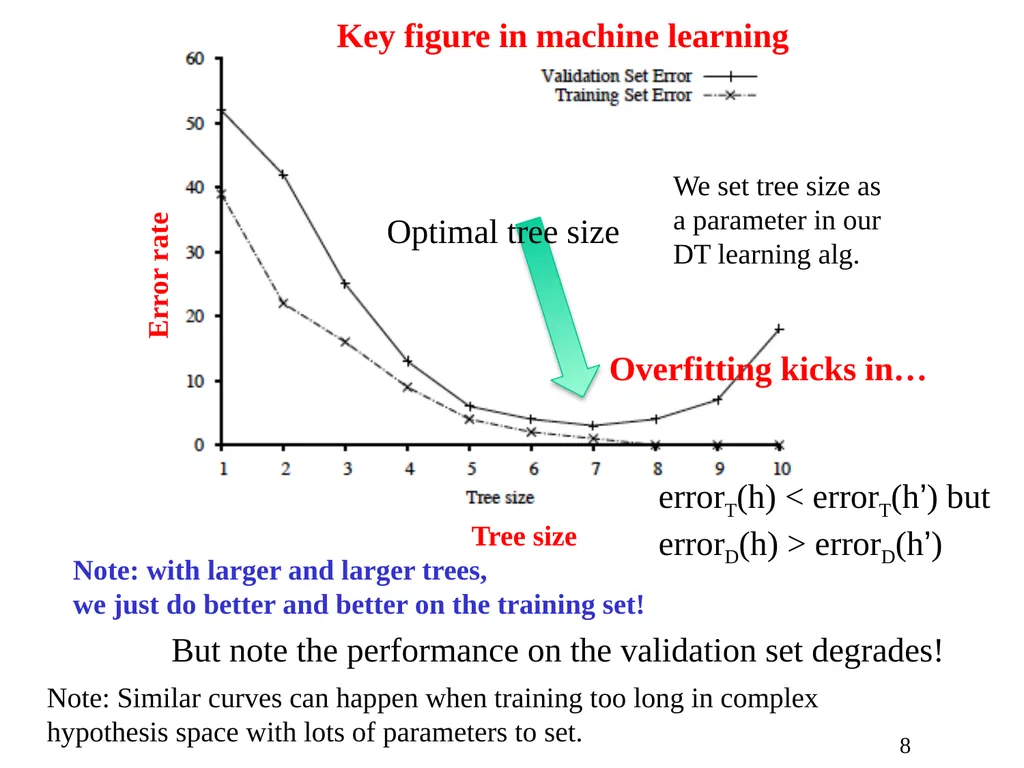
Key figure in machine learning Note: with larger and larger trees,
we just do better and better on the training set! We set tree size as
a parameter in our
DT learning alg. But note the performance on the validation set degrades! Tree size Error rate Overfitting kicks in… Optimal tree size errorT(h) < errorT(h’) but
errorD(h) > errorD(h’) Note: Similar curves can happen when training too long in complex
hypothesis space with lots of parameters to set.<br>
09
Aside: From intro lecture: Is this an example of overfitting or something else?<br>
10
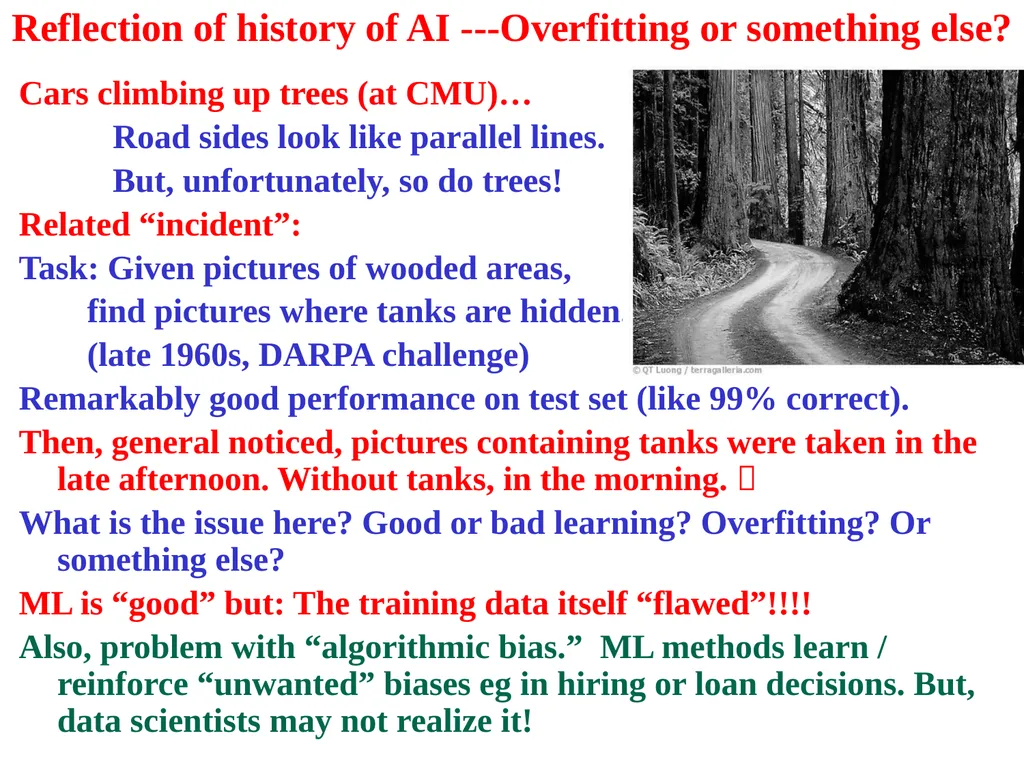
Reflection of history of AI ---Overfitting or something else? Cars climbing up trees (at CMU)…
Road sides look like parallel lines.
But, unfortunately, so do trees!
Related “incident”:
Task: Given pictures of wooded areas,
find pictures where tanks are hidden.
(late 1960s, DARPA challenge)
Remarkably good performance on test set (like 99% correct).
Then, general noticed, pictures containing tanks were taken in the late afternoon. Without tanks, in the morning.
What is the issue here? Good or bad learning? Overfitting? Or something else?
ML is “good” but: The training data itself “flawed”!!!!
Also, problem with “algorithmic bias.” ML methods learn / reinforce “unwanted” biases eg in hiring or loan decisions. But, data scientists may not realize it!<br>
11
Procedure for finding the optimal tree size is called “model selection.”
See section 18.4.1 R&N and Fig. 18.8.
To determine validation error for each tree size, use k-fold cross-validation. (Uses the data better than “holdout cross-validation.”)
Uses “all data - test set” --- k times splits that set into a training
set and a validation set.
After right decision tree size is found from the error rate curve on
validation data, train on all training data to get final decision tree
(of the right size).
Finally, evaluate tree on the test data (not used before) to get
true generalization error (to unseen examples).<br>
12
Summary: When to use Decision Trees Instances presented as attribute / feature - value pairs
Method of approximating discrete-valued functions
Target function has discrete values: classification problems
Robust to noisy data:
Training data may contain
errors
missing attribute values
Typical bias: prefer smaller trees (Ockham's razor ) Widely used, practical and easy to interpret results<br>
13
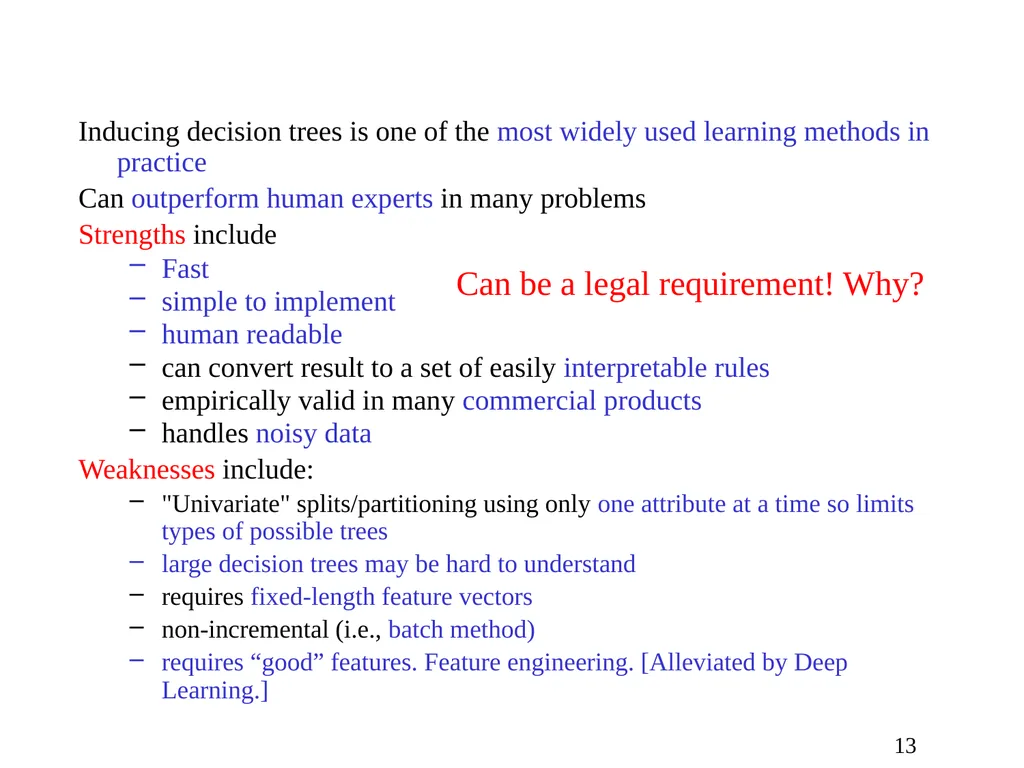
Inducing decision trees is one of the most widely used learning methods in practice
Can outperform human experts in many problems
Strengths include
Fast
simple to implement
human readable
can convert result to a set of easily interpretable rules
empirically valid in many commercial products
handles noisy data
Weaknesses include:
"Univariate" splits/partitioning using only one attribute at a time so limits types of possible trees
large decision trees may be hard to understand
requires fixed-length feature vectors
non-incremental (i.e., batch method)
requires “good” features. Feature engineering. [Alleviated by Deep Learning.] Can be a legal requirement! Why?<br>