
CS344: Introduction to Artificial Intelligence

Description: CS344: Introduction to Artificial Intelligence Pushpak Bhattacharyya CSE Dept., IIT Bombay Lecture 20-21 Natural Language Parsing Parsing of Sentences Are sentences flat linear structures? Why tree? Is there a principle in branching When
Related Topics
Download Presentation
"CS344: Introduction to Artificial Intelligence" is the property of its rightful owner. Permission is granted to download and print the materials on this website for personal, non-commercial use only, and to display it on your personal computer provided you do not modify the materials and that you retain all copyright notices contained in the materials. By downloading content from our website, you accept the terms of this agreement.
Presentation Transcript
slide1. CS344: Introduction to Artificial Intelligence Pushpak Bhattacharyya
CSE Dept.,
IIT Bombay
Lecture 20-21– Natural Language Parsing<br>
slide2. Parsing of Sentences<br>
slide3. Are sentences flat linear structures? Why tree? Is there a principle in branching
When should the constituent give rise to children?
What is the hierarchy building principle?<br>
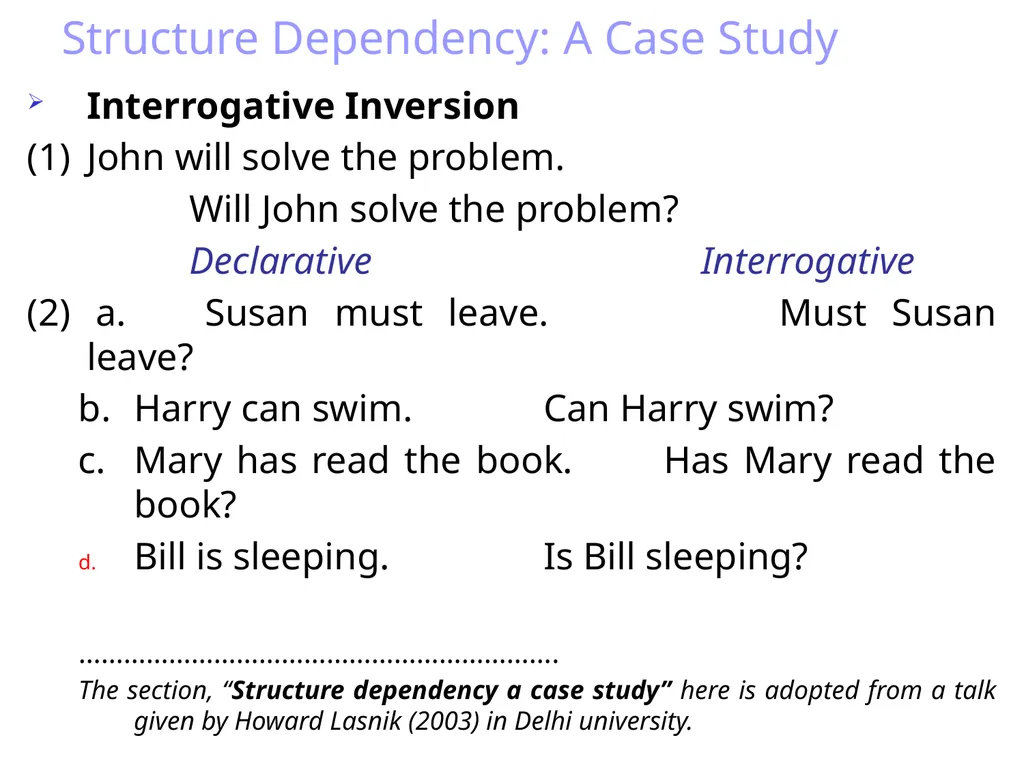
slide4. Structure Dependency: A Case Study Interrogative Inversion
(1) John will solve the problem.
Will John solve the problem?
Declarative Interrogative
(2) a. Susan must leave. Must Susan leave?
b. Harry can swim. Can Harry swim?
c. Mary has read the book. Has Mary read the book?
Bill is sleeping. Is Bill sleeping?
……………………………………………………….
The section, “Structure dependency a case study” here is adopted from a talk given by Howard Lasnik (2003) in Delhi university.<br>
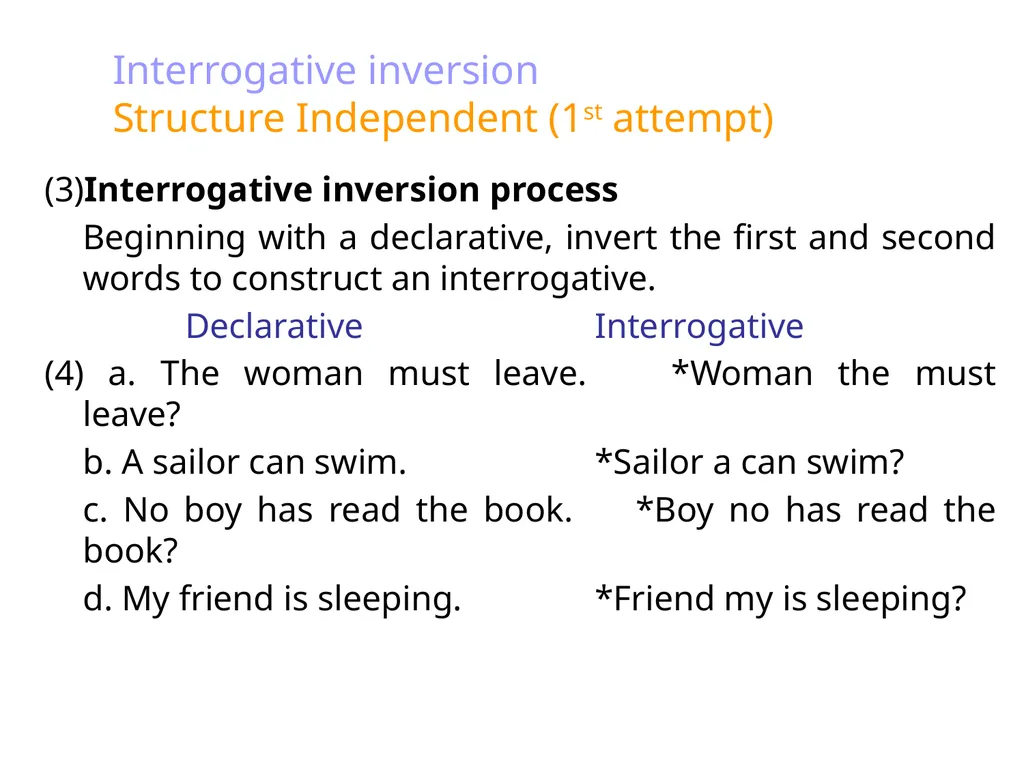
slide5. Interrogative inversion Structure Independent (1st attempt) (3)Interrogative inversion process
Beginning with a declarative, invert the first and second words to construct an interrogative.
Declarative Interrogative
(4) a. The woman must leave. *Woman the must leave?
b. A sailor can swim. *Sailor a can swim?
c. No boy has read the book. *Boy no has read the book?
d. My friend is sleeping. *Friend my is sleeping?<br>
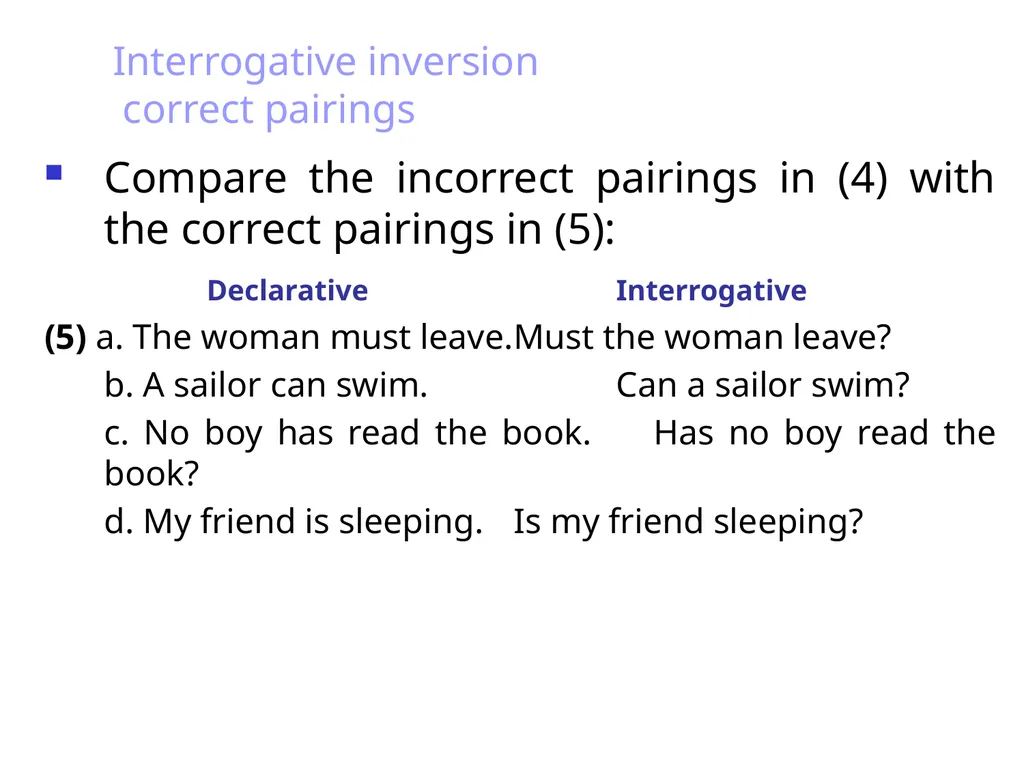
slide6. Interrogative inversion correct pairings Compare the incorrect pairings in (4) with the correct pairings in (5):
Declarative Interrogative
(5) a. The woman must leave. Must the woman leave?
b. A sailor can swim. Can a sailor swim?
c. No boy has read the book. Has no boy read the book?
d. My friend is sleeping. Is my friend sleeping?<br>
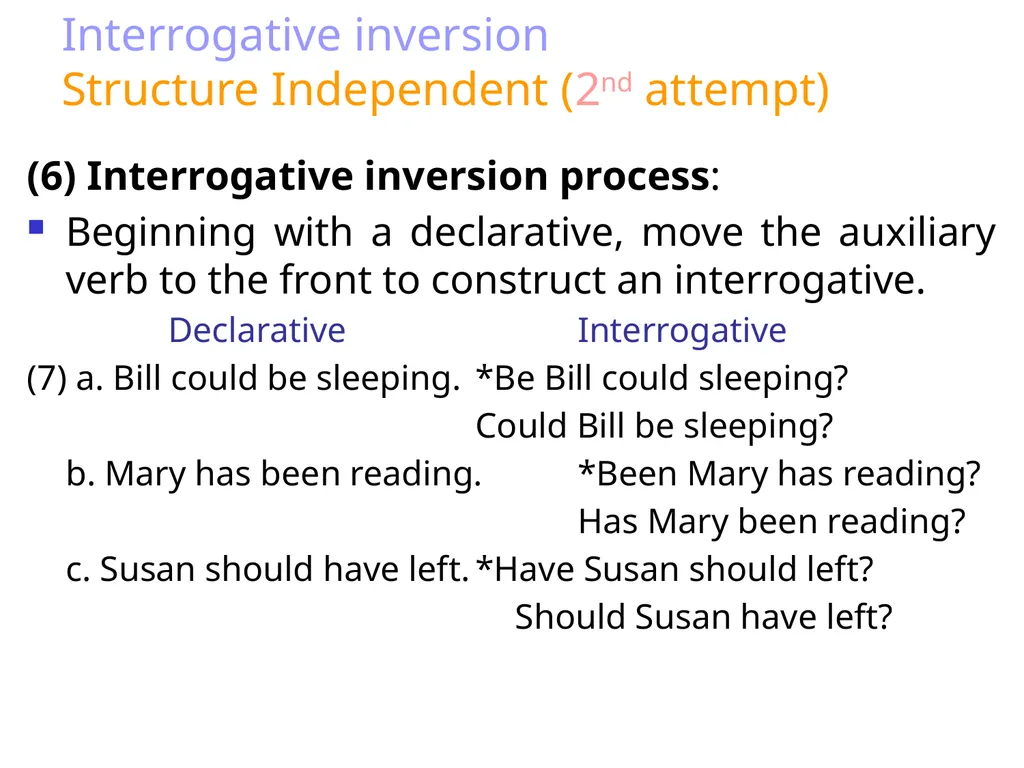
slide7. Interrogative inversion Structure Independent (2nd attempt) (6) Interrogative inversion process:
Beginning with a declarative, move the auxiliary verb to the front to construct an interrogative.
Declarative Interrogative
(7) a. Bill could be sleeping. *Be Bill could sleeping?
Could Bill be sleeping?
b. Mary has been reading. *Been Mary has reading?
Has Mary been reading?
c. Susan should have left. *Have Susan should left?
Should Susan have left?<br>
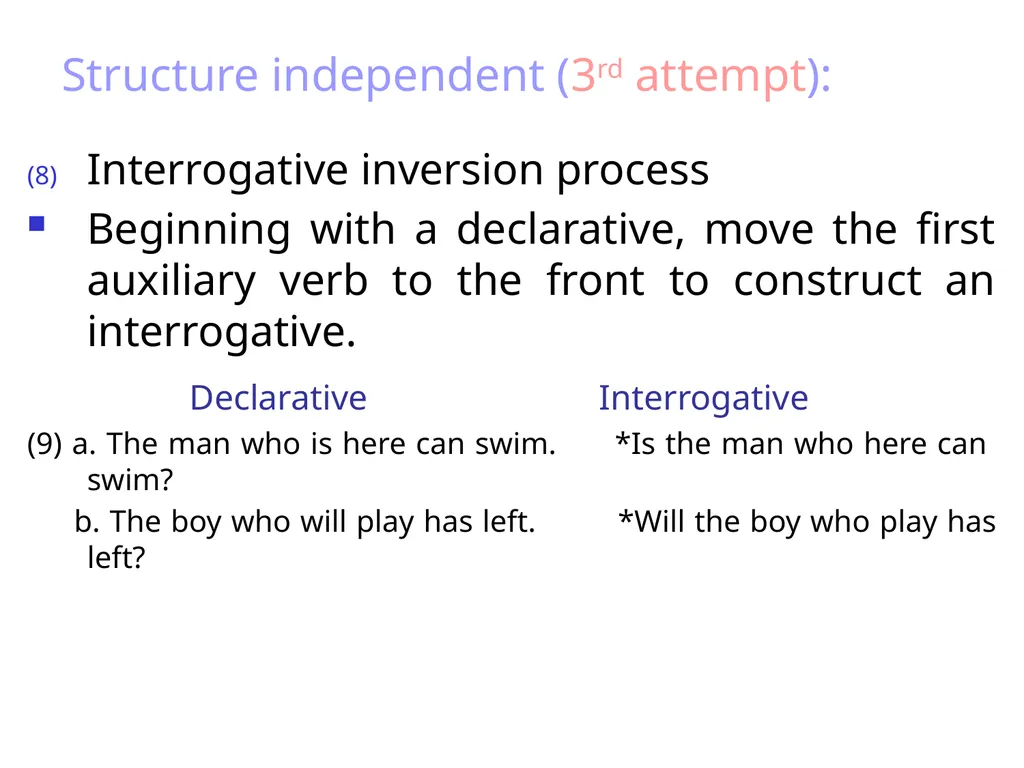
slide8. Structure independent (3rd attempt): Interrogative inversion process
Beginning with a declarative, move the first auxiliary verb to the front to construct an interrogative.
Declarative Interrogative
(9) a. The man who is here can swim. *Is the man who here can swim?
b. The boy who will play has left. *Will the boy who play has left?<br>
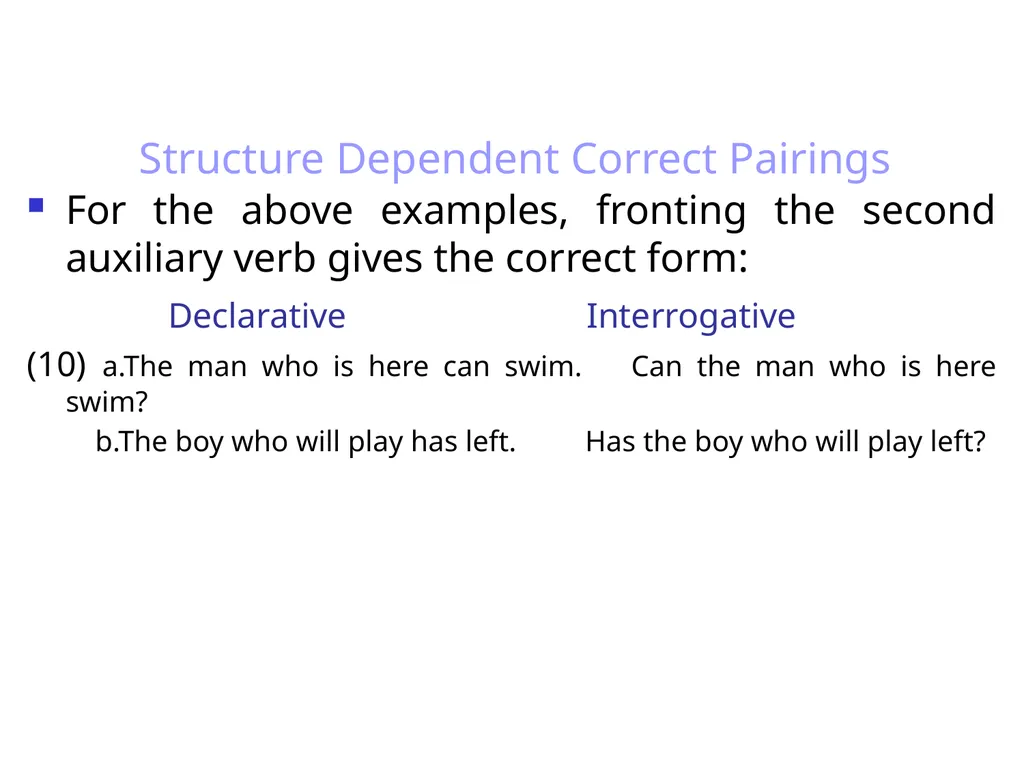
slide9. Structure Dependent Correct Pairings For the above examples, fronting the second auxiliary verb gives the correct form:
Declarative Interrogative
(10) a.The man who is here can swim. Can the man who is here swim?
b.The boy who will play has left. Has the boy who will play left?<br>
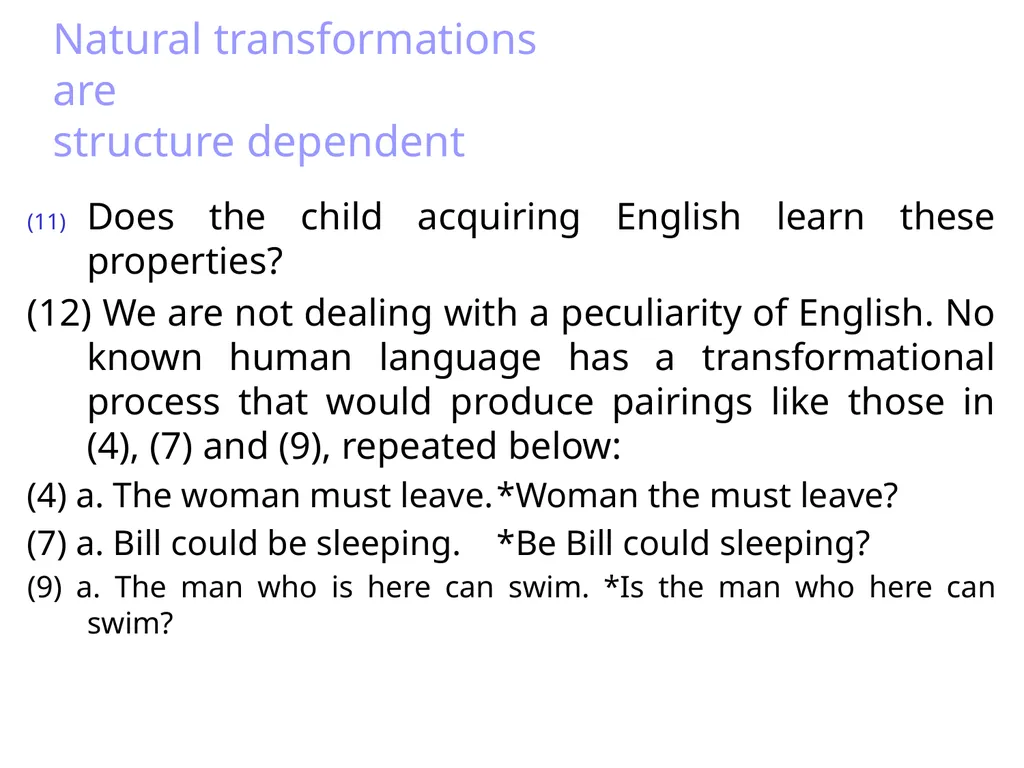
slide10. Natural transformations are structure dependent Does the child acquiring English learn these properties?
(12) We are not dealing with a peculiarity of English. No known human language has a transformational process that would produce pairings like those in (4), (7) and (9), repeated below:
(4) a. The woman must leave. *Woman the must leave?
(7) a. Bill could be sleeping. *Be Bill could sleeping?
(9) a. The man who is here can swim. *Is the man who here can swim?<br>
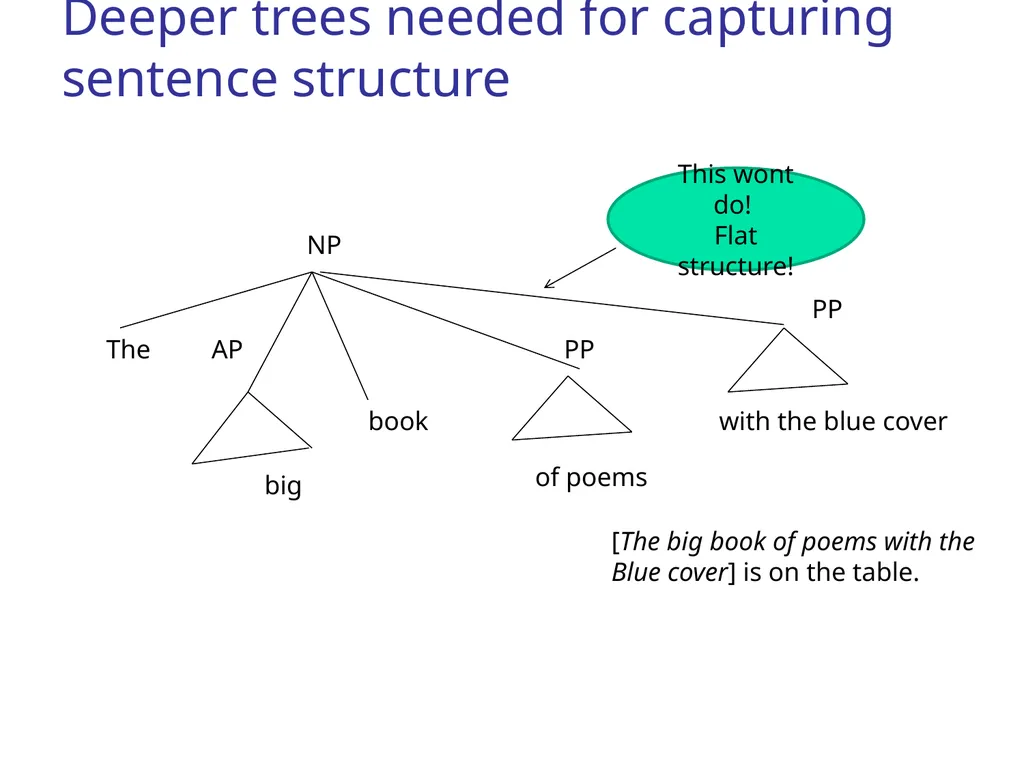
slide11. Deeper trees needed for capturing sentence structure NP PP AP big The of poems with the blue cover [The big book of poems with the
Blue cover] is on the table. book This wont do!
Flat structure! PP<br>
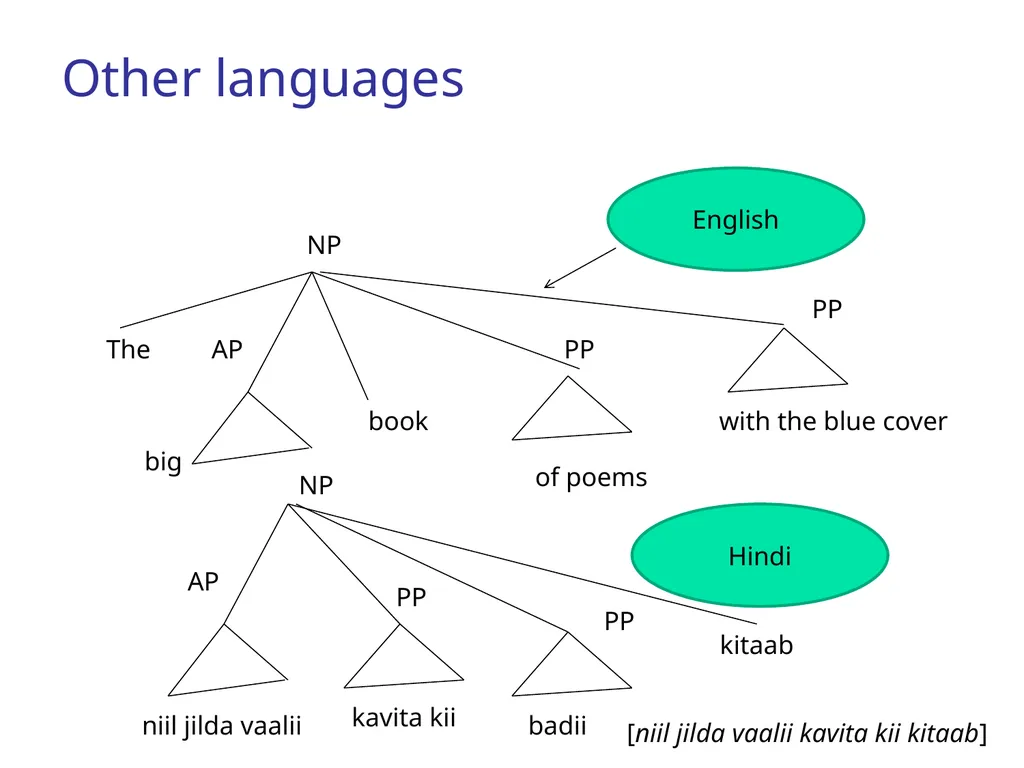
slide12. Other languages NP PP AP big The of poems with the blue cover [niil jilda vaalii kavita kii kitaab] book English NP PP AP niil jilda vaalii kavita kii kitaab PP badii Hindi PP<br>
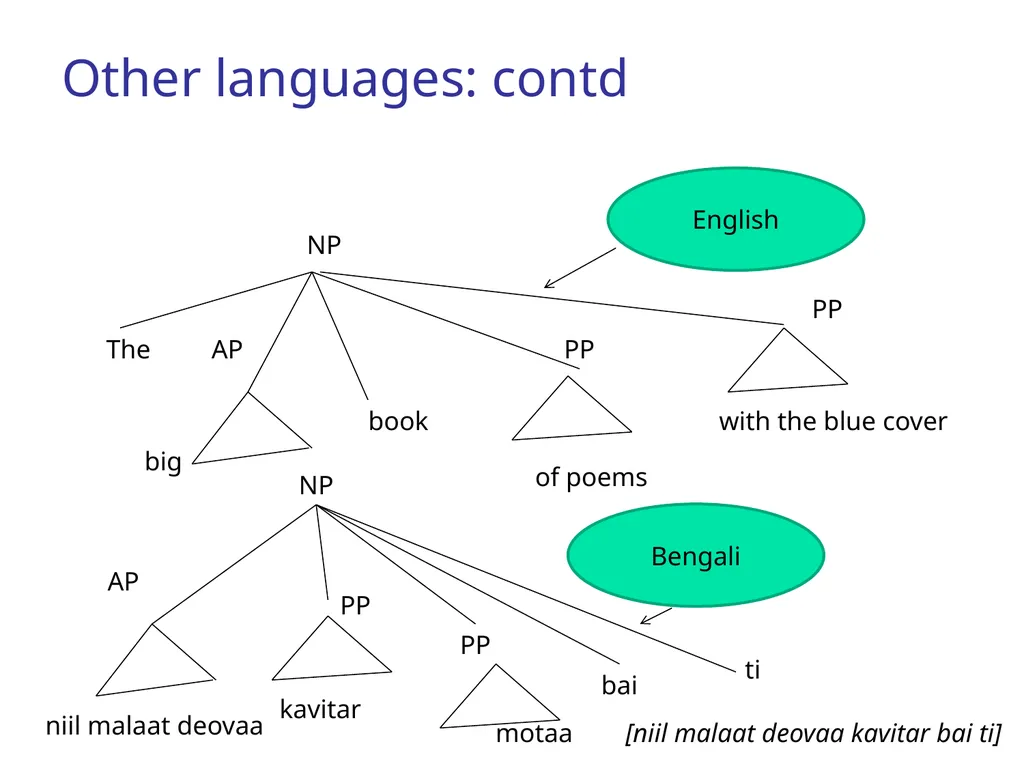
slide13. Other languages: contd NP PP AP big The of poems with the blue cover [niil malaat deovaa kavitar bai ti] book English NP PP AP niil malaat deovaa kavitar bai PP motaa Bengali PP ti<br>
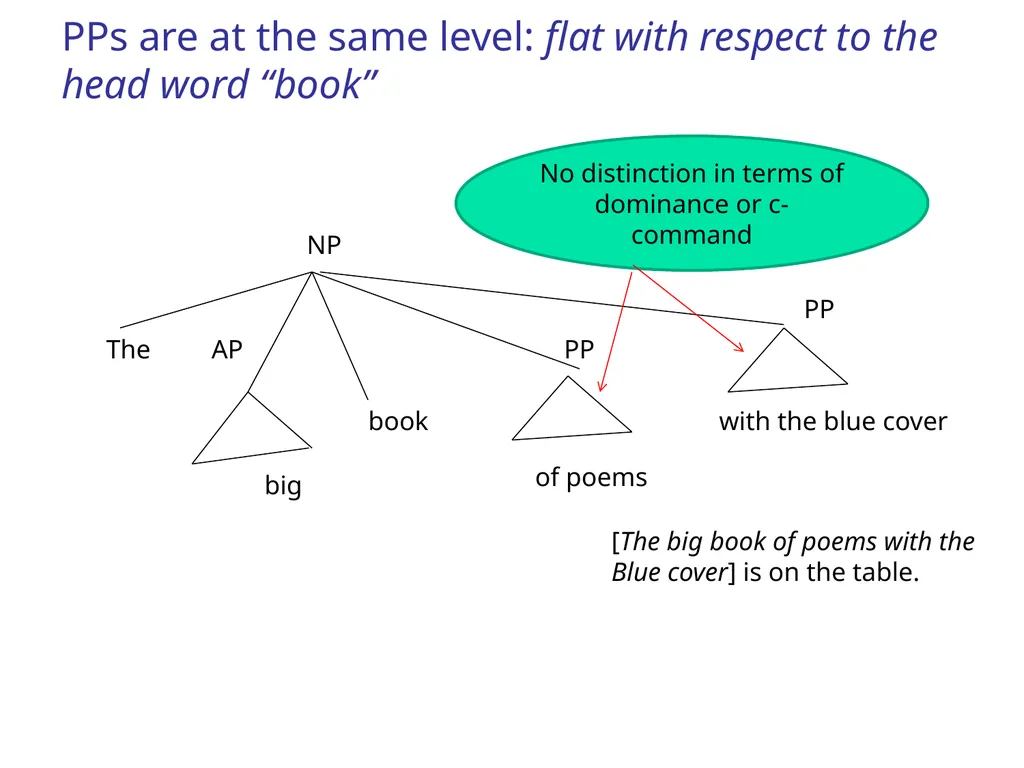
slide14. PPs are at the same level: flat with respect to the head word “book” NP PP AP big The of poems with the blue cover [The big book of poems with the
Blue cover] is on the table. book No distinction in terms of dominance or c-command PP<br>
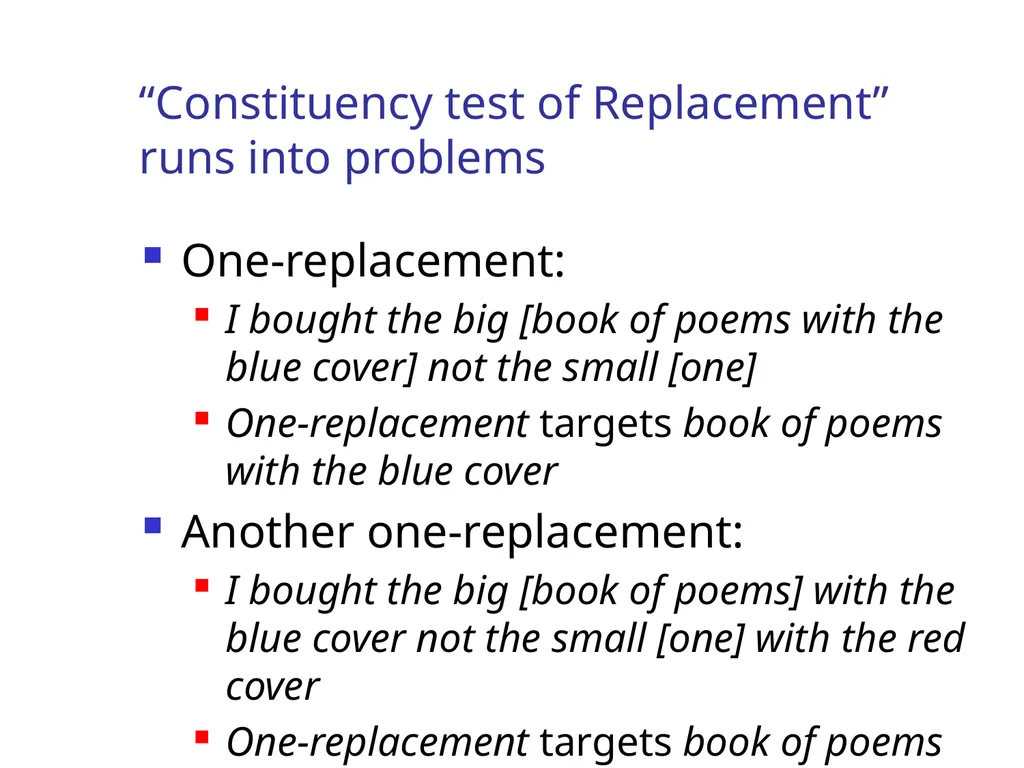
slide15. “Constituency test of Replacement” runs into problems One-replacement:
I bought the big [book of poems with the blue cover] not the small [one]
One-replacement targets book of poems with the blue cover
Another one-replacement:
I bought the big [book of poems] with the blue cover not the small [one] with the red cover
One-replacement targets book of poems<br>
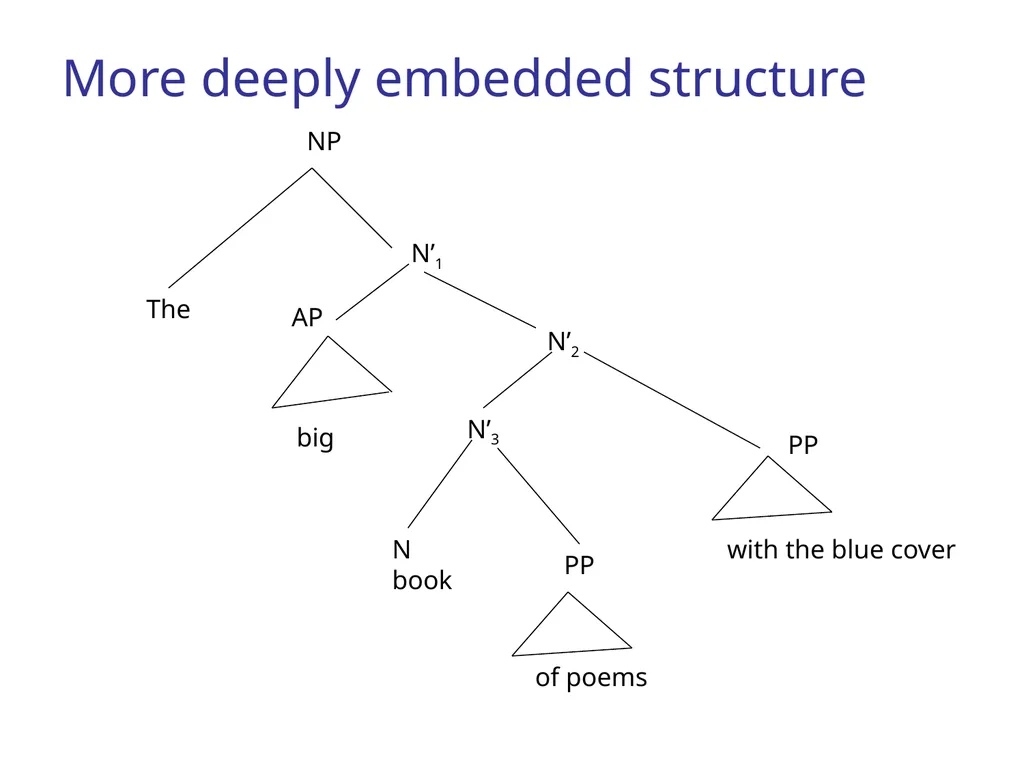
slide16. More deeply embedded structure NP PP AP big The of poems with the blue cover N’1 N
book PP N’2 N’3<br>
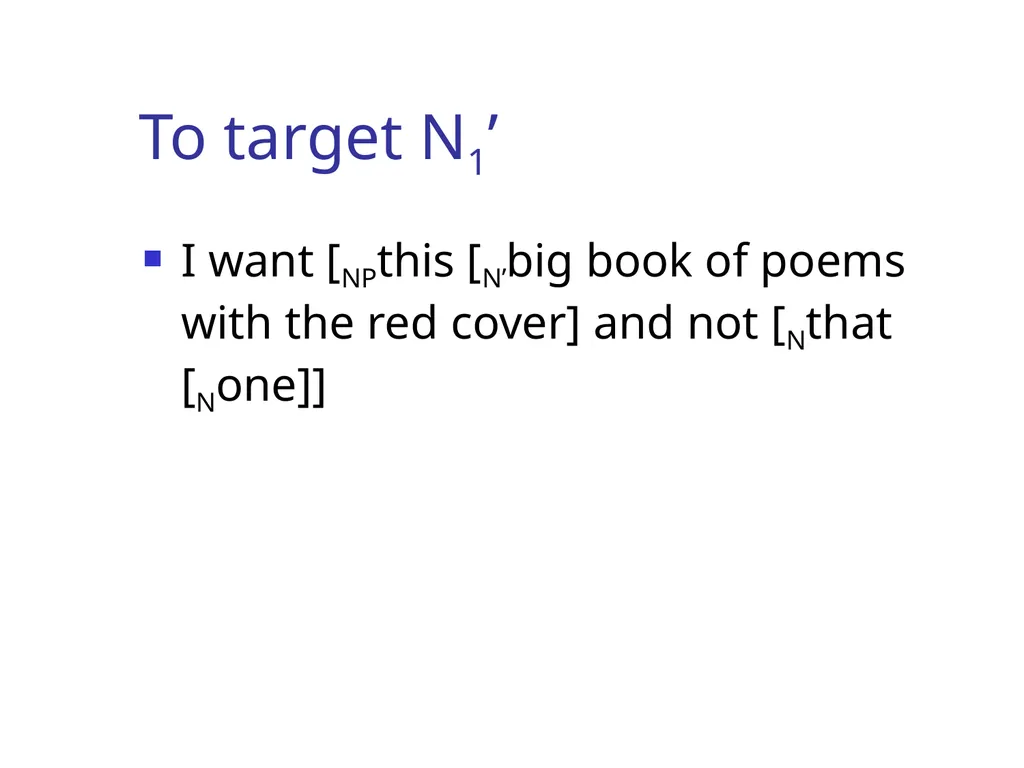
slide17. To target N1’ I want [NPthis [N’big book of poems with the red cover] and not [Nthat [None]]<br>
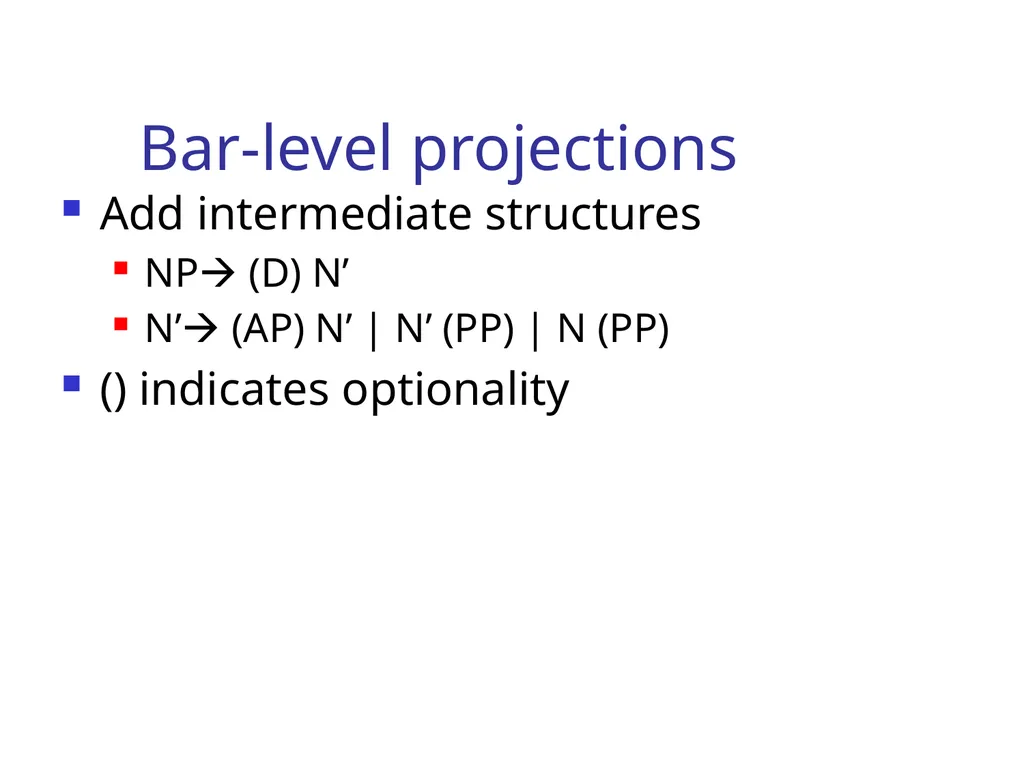
slide18. Bar-level projections Add intermediate structures
NP (D) N’
N’ (AP) N’ | N’ (PP) | N (PP)
() indicates optionality<br>
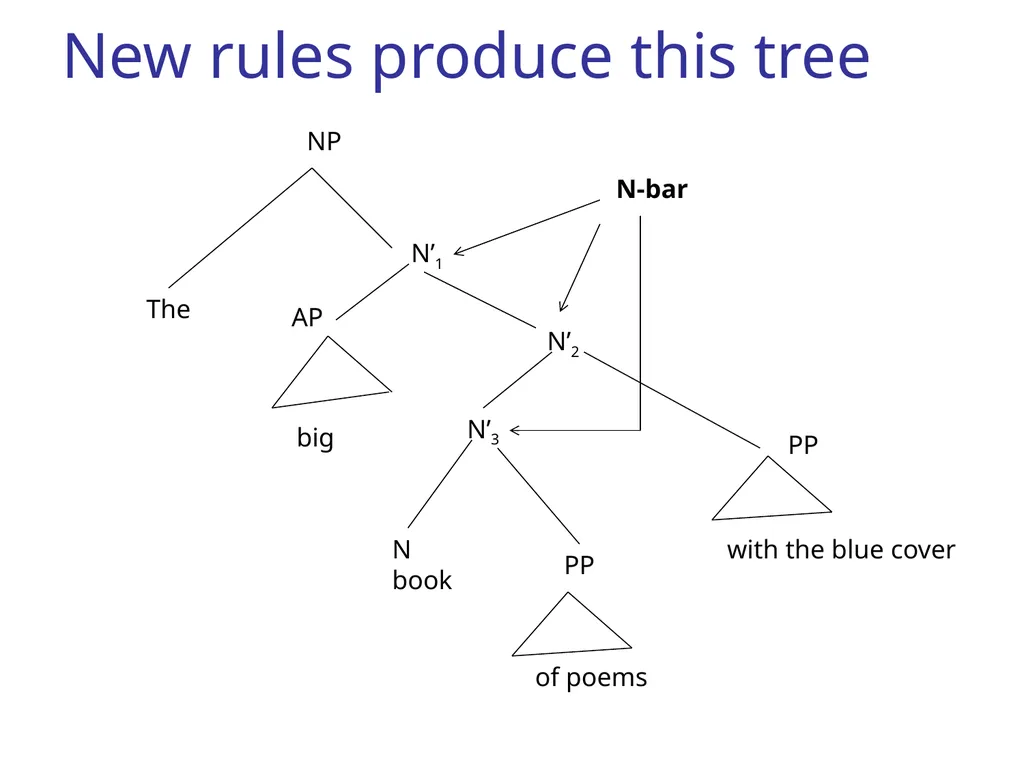
slide19. New rules produce this tree NP PP AP big The of poems with the blue cover N’1 N
book PP N’2 N’3 N-bar<br>
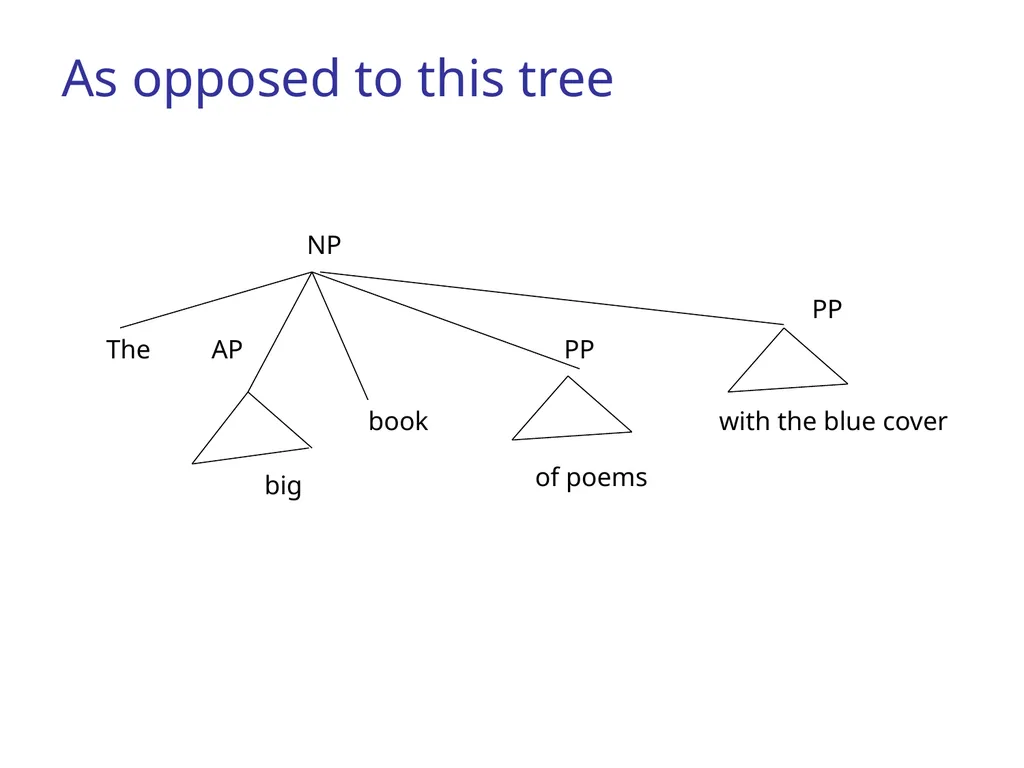
slide20. As opposed to this tree NP PP AP big The of poems with the blue cover book PP<br>
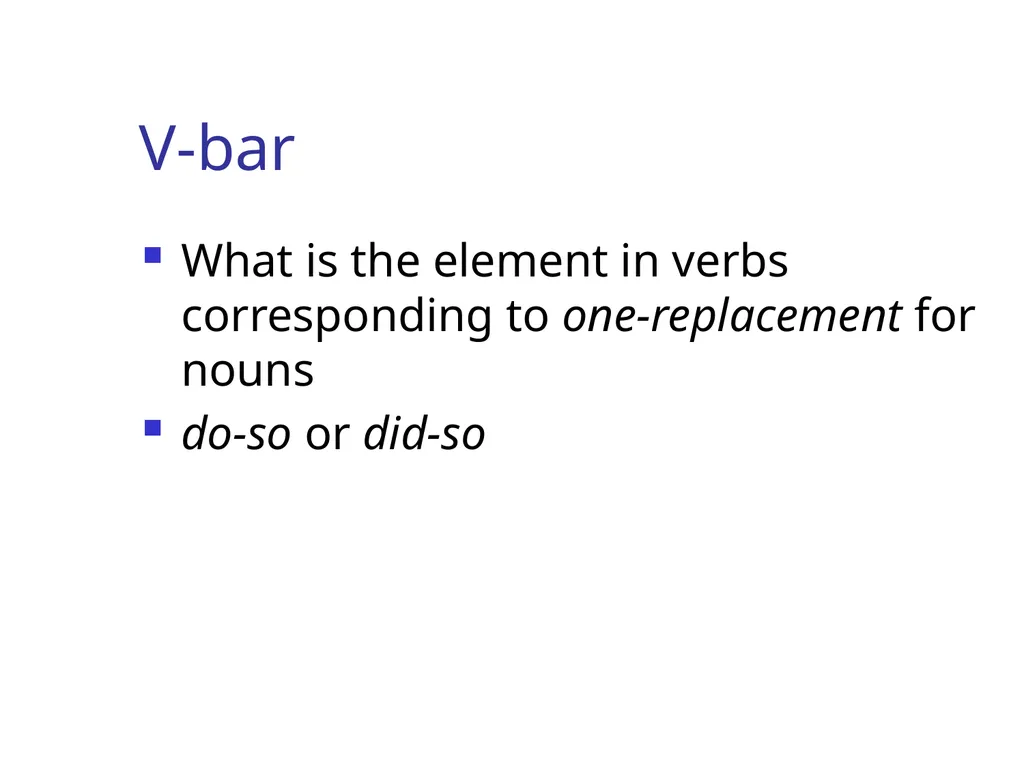
slide21. V-bar What is the element in verbs corresponding to one-replacement for nouns
do-so or did-so<br>
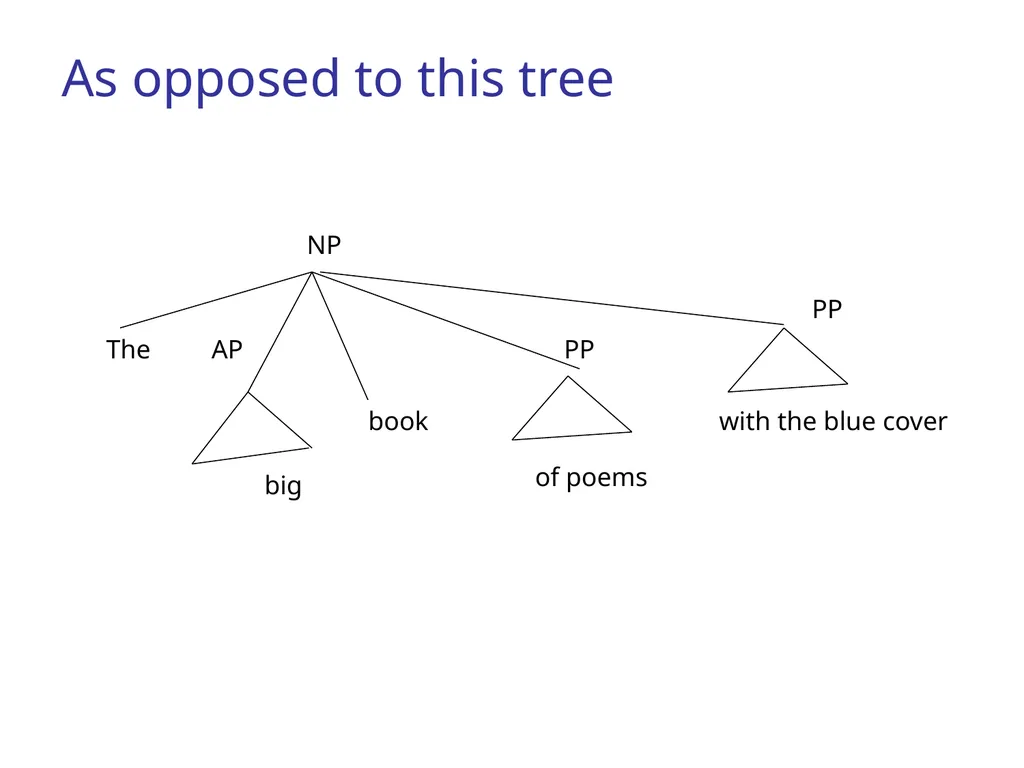
slide22. As opposed to this tree NP PP AP big The of poems with the blue cover book PP<br>
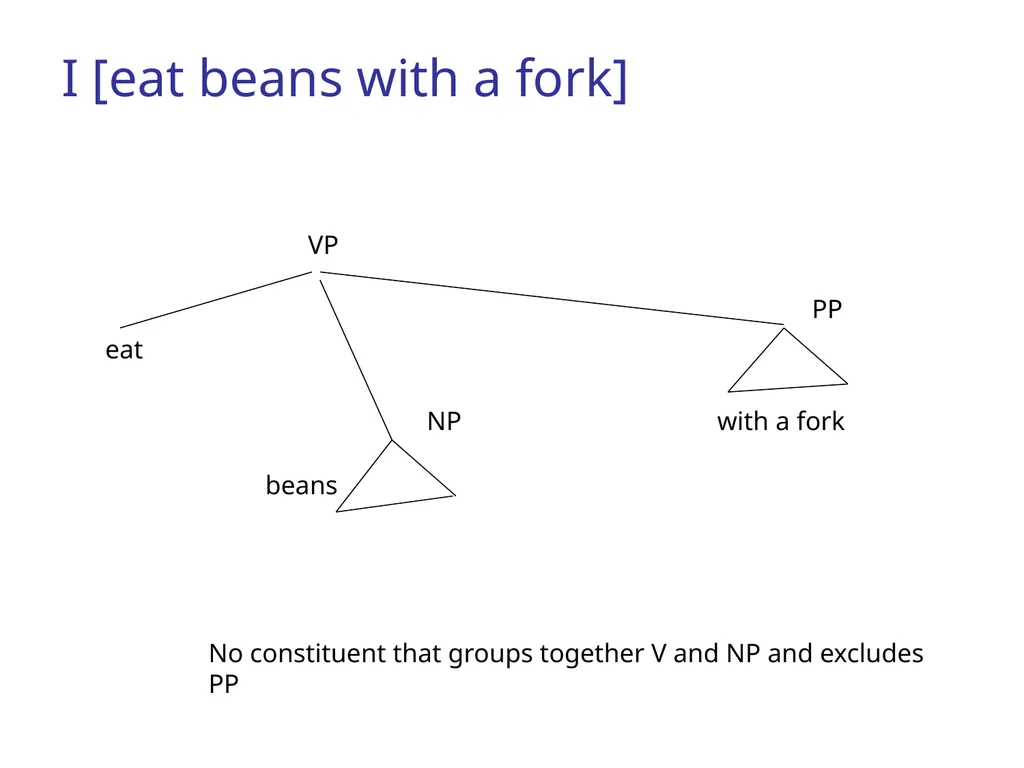
slide23. I [eat beans with a fork] VP NP beans eat with a fork PP No constituent that groups together V and NP and excludes
PP<br>
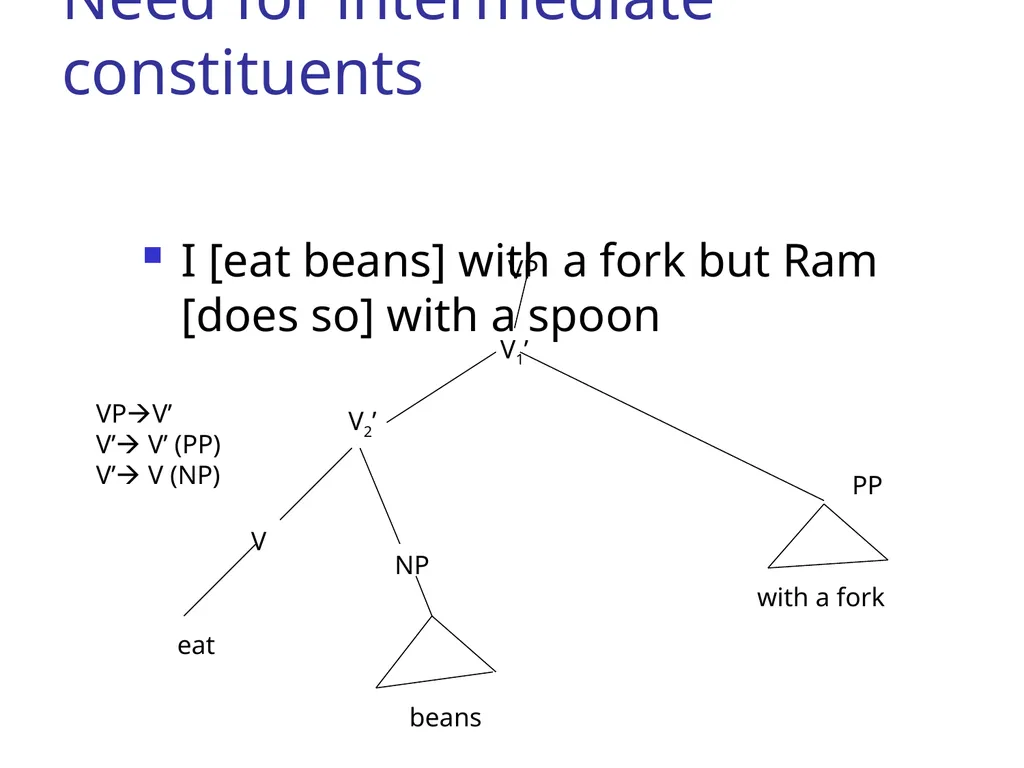
slide24. Need for intermediate constituents I [eat beans] with a fork but Ram [does so] with a spoon V2’ NP beans eat with a fork PP VP V1’ V VPV’
V’ V’ (PP)
V’ V (NP)<br>
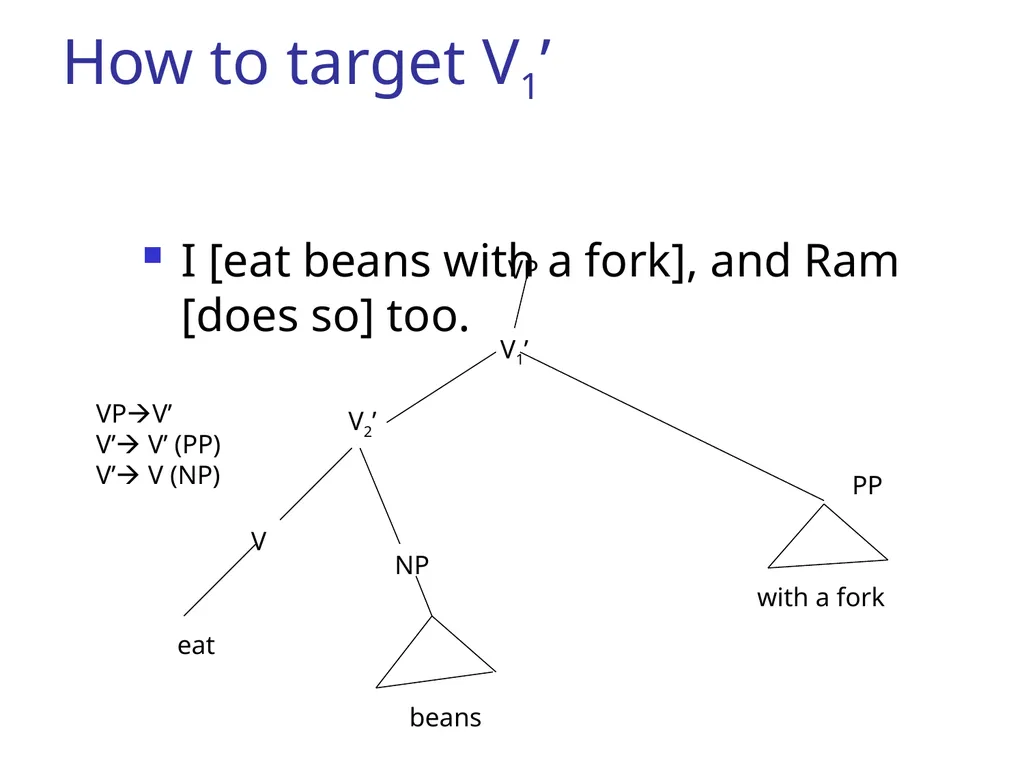
slide25. How to target V1’ I [eat beans with a fork], and Ram [does so] too. V2’ NP beans eat with a fork PP VP V1’ V VPV’
V’ V’ (PP)
V’ V (NP)<br>
slide26. Parsing Algorithms<br>
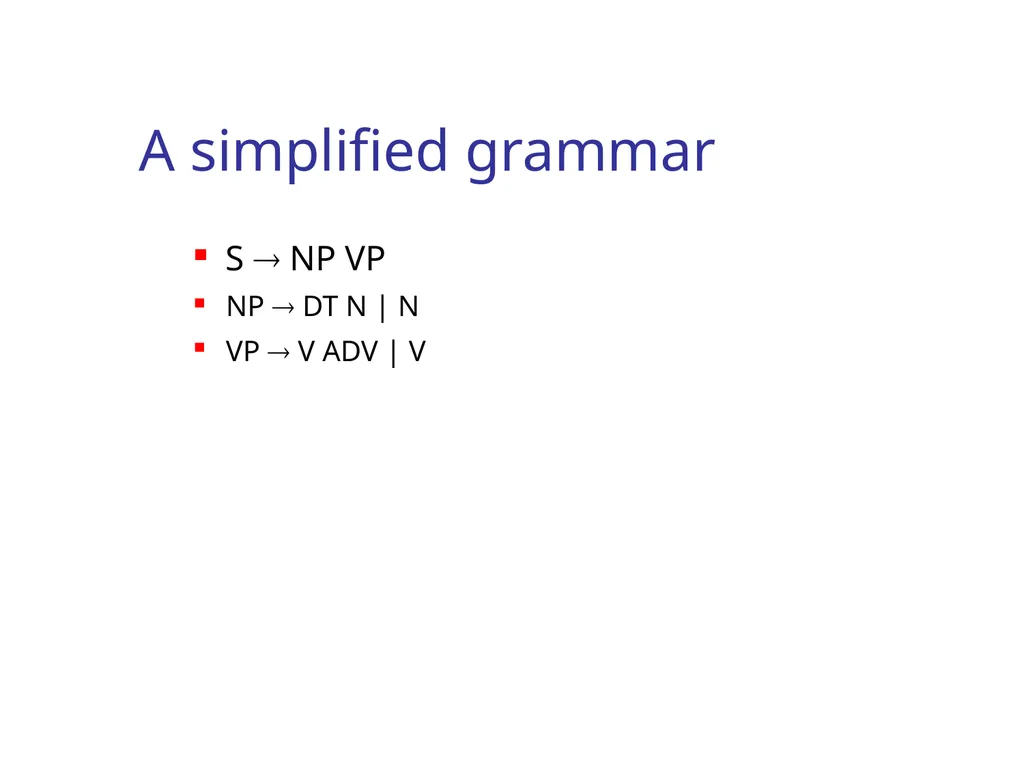
slide27. A simplified grammar S NP VP
NP DT N | N
VP V ADV | V<br>
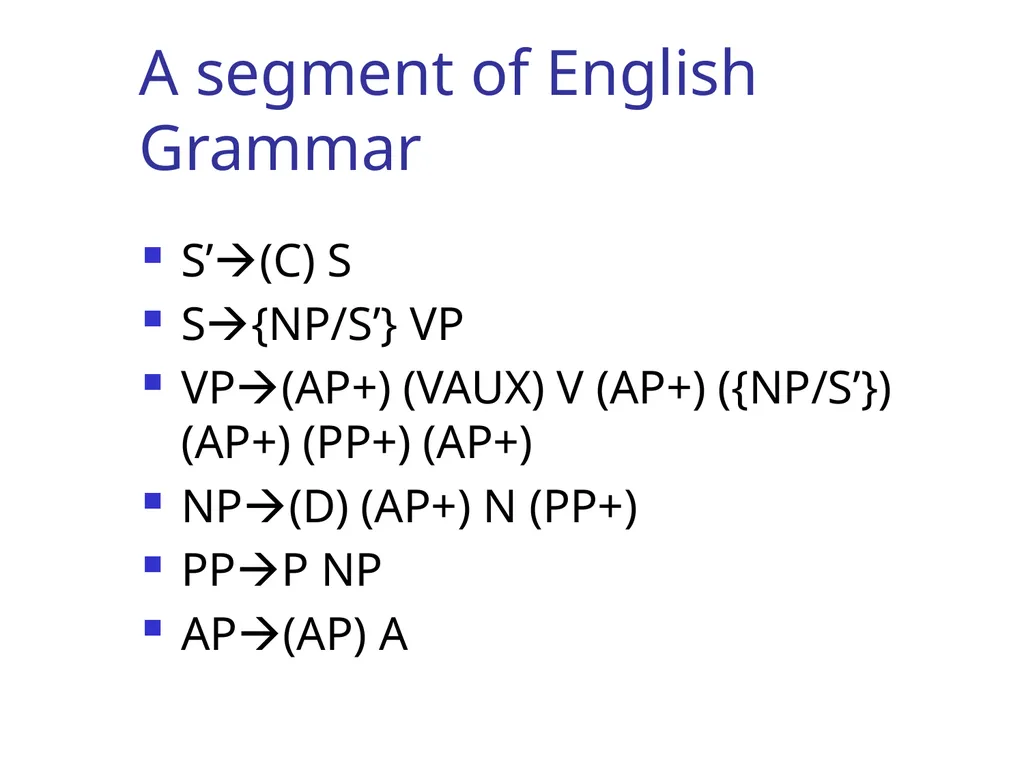
slide28. A segment of English Grammar S’(C) S
S{NP/S’} VP
VP(AP+) (VAUX) V (AP+) ({NP/S’}) (AP+) (PP+) (AP+)
NP(D) (AP+) N (PP+)
PPP NP
AP(AP) A<br>
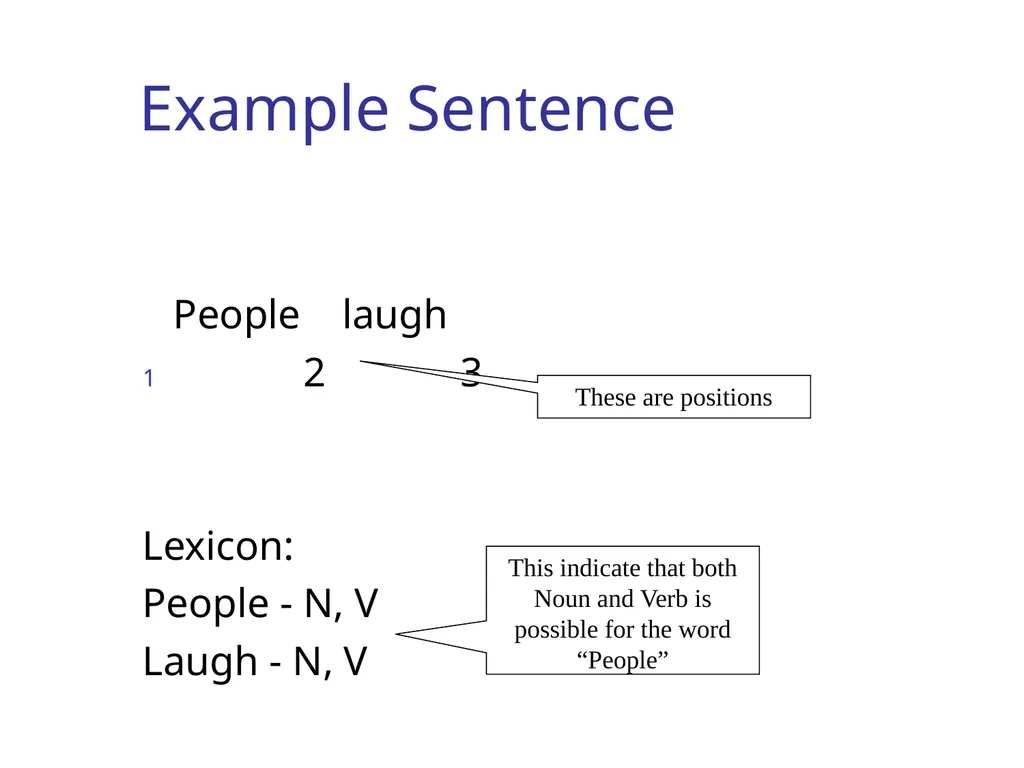
slide29. Example Sentence People laugh
2 3
Lexicon:
People - N, V
Laugh - N, V These are positions This indicate that both Noun and Verb is possible for the word “People”<br>
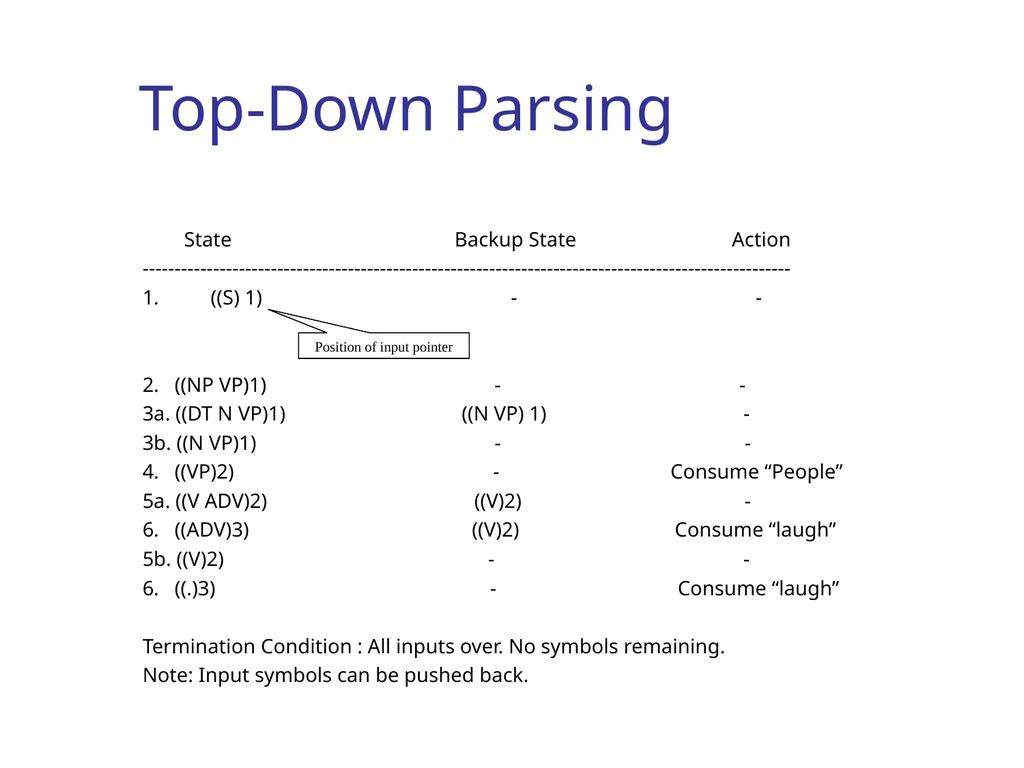
slide30. Top-Down Parsing State Backup State Action
-----------------------------------------------------------------------------------------------------
1. ((S) 1) - -
2. ((NP VP)1) - -
3a. ((DT N VP)1) ((N VP) 1) -
3b. ((N VP)1) - -
4. ((VP)2) - Consume “People”
5a. ((V ADV)2) ((V)2) -
6. ((ADV)3) ((V)2) Consume “laugh”
5b. ((V)2) - -
6. ((.)3) - Consume “laugh”
Termination Condition : All inputs over. No symbols remaining.
Note: Input symbols can be pushed back. Position of input pointer<br>
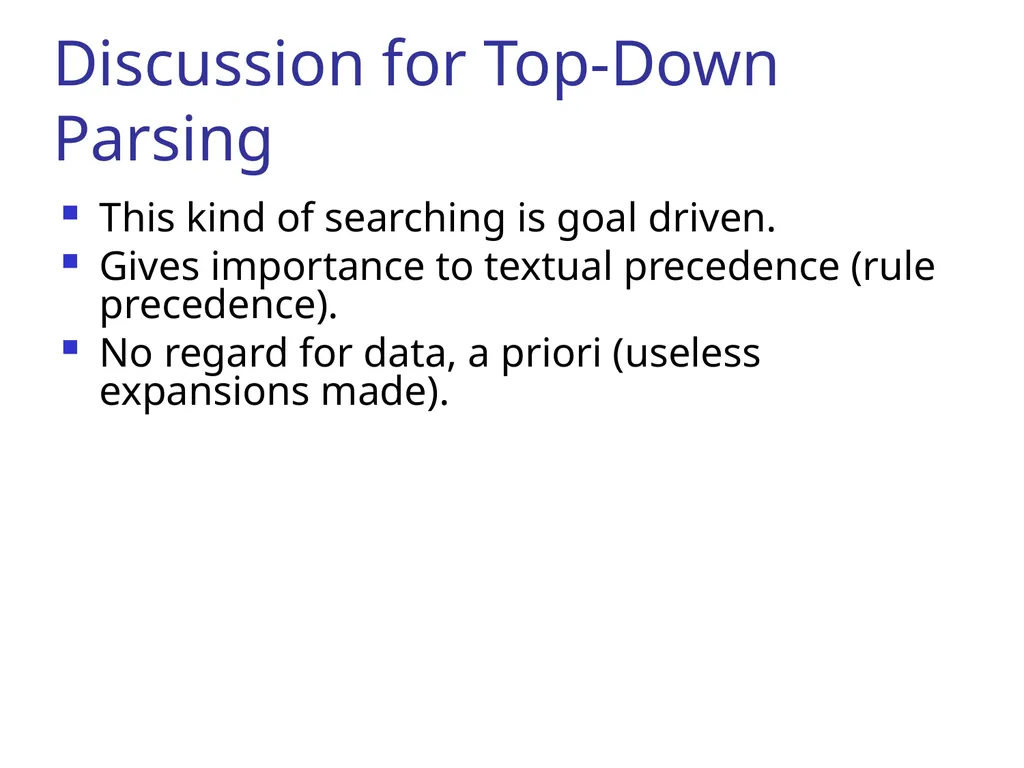
slide31. Discussion for Top-Down Parsing This kind of searching is goal driven.
Gives importance to textual precedence (rule precedence).
No regard for data, a priori (useless expansions made).<br>
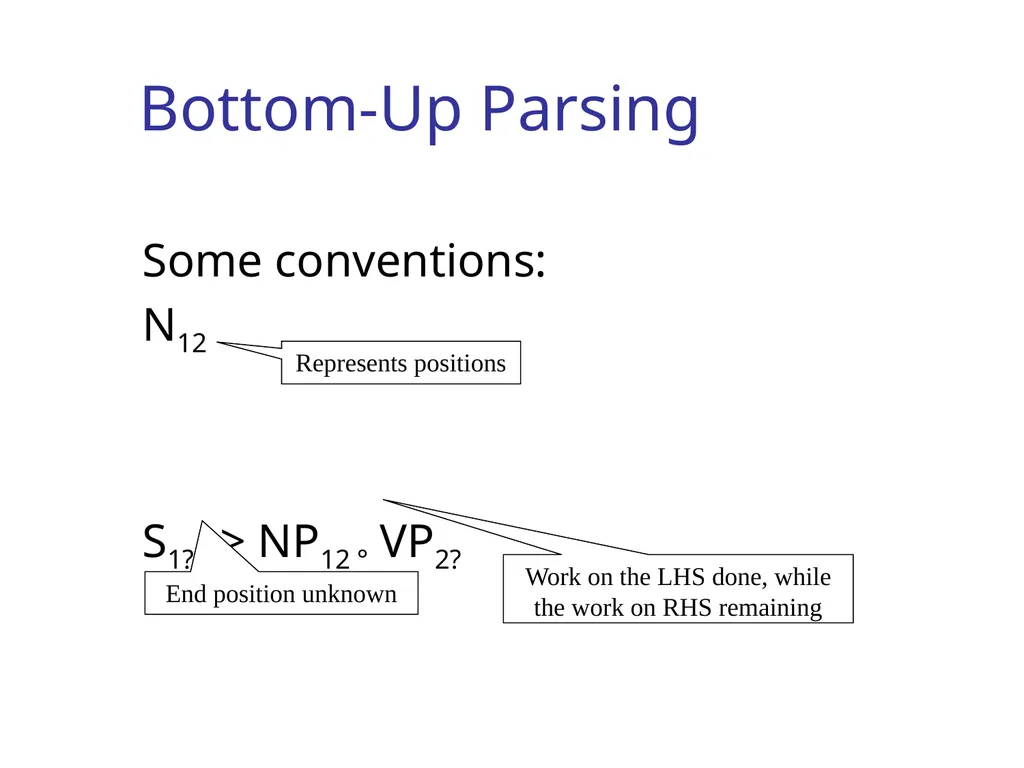
slide32. Bottom-Up Parsing Some conventions:
N12
S1? -> NP12 ° VP2? Represents positions End position unknown Work on the LHS done, while the work on RHS remaining<br>
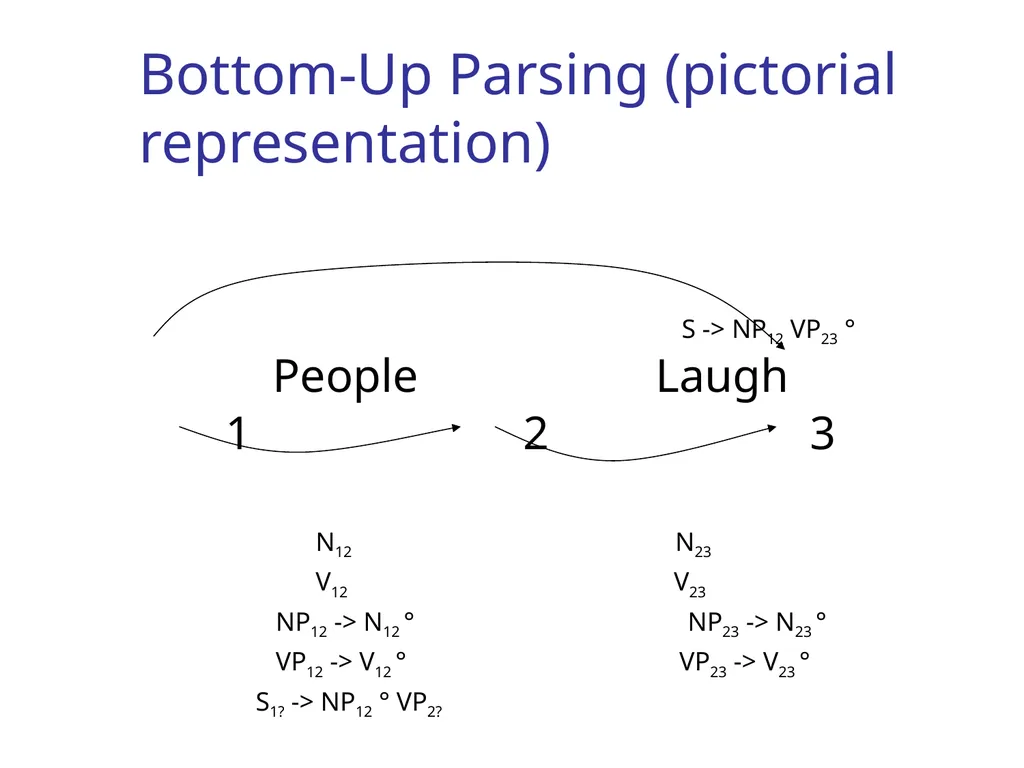
slide33. Bottom-Up Parsing (pictorial representation) S -> NP12 VP23 °
People Laugh
1 2 3
N12 N23
V12 V23
NP12 -> N12 ° NP23 -> N23 °
VP12 -> V12 ° VP23 -> V23 °
S1? -> NP12 ° VP2?<br>
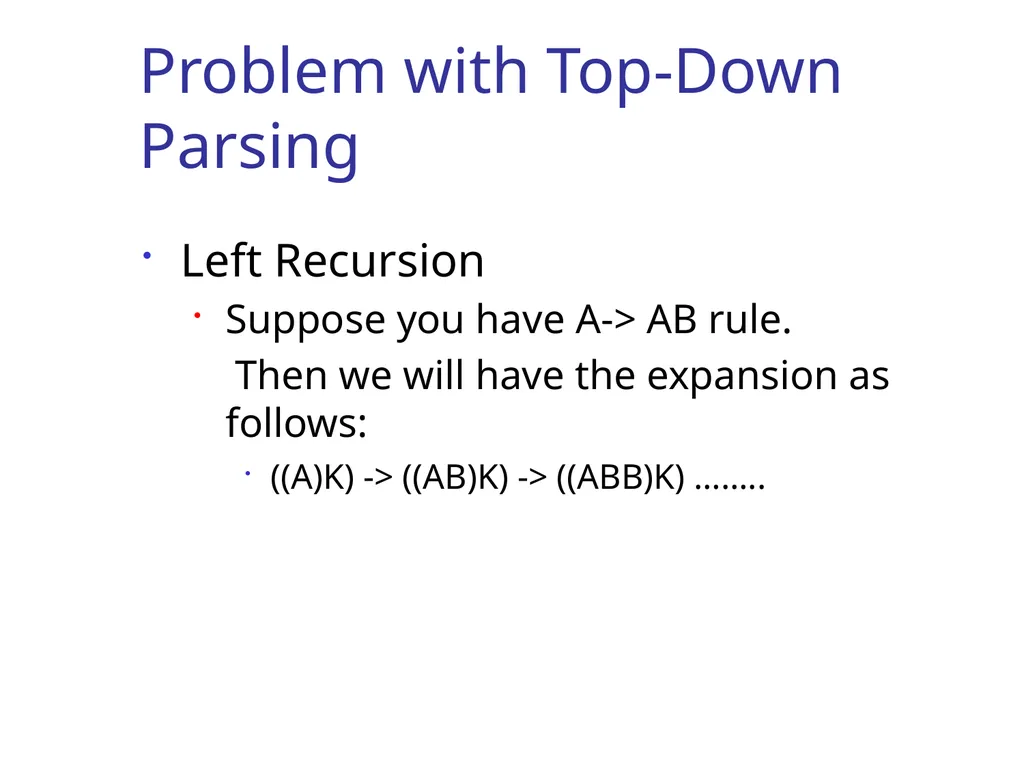
slide34. Problem with Top-Down Parsing Left Recursion
Suppose you have A-> AB rule.
Then we will have the expansion as follows:
((A)K) -> ((AB)K) -> ((ABB)K) ……..<br>
slide35. Combining top-down and bottom-up strategies<br>
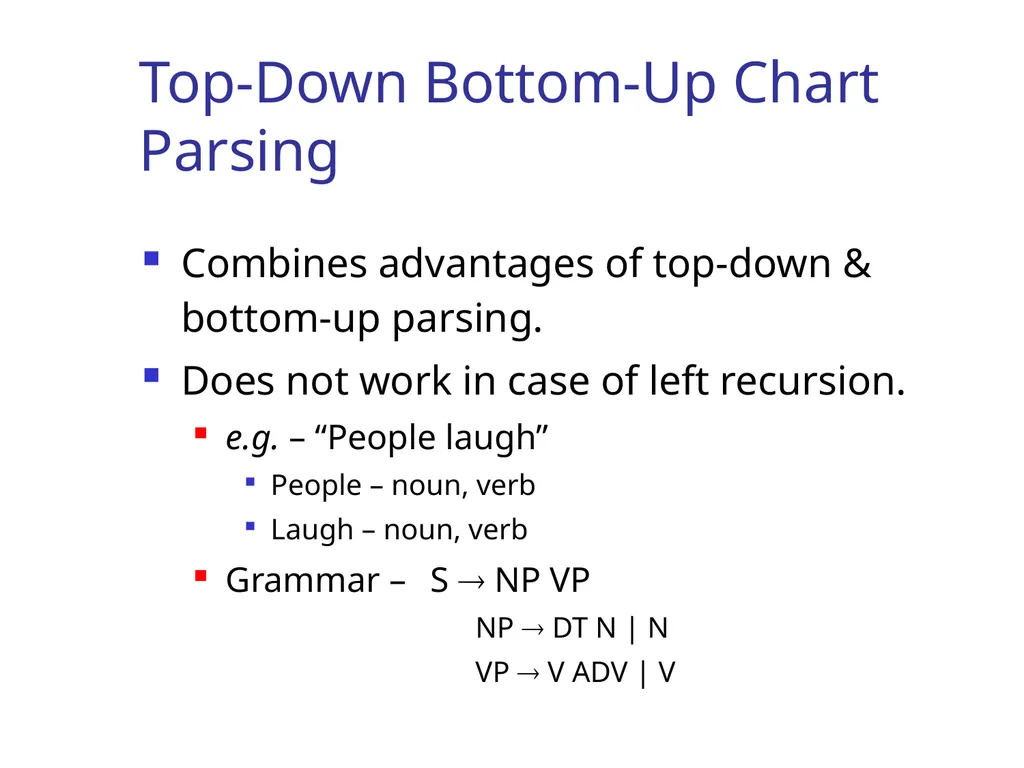
slide36. Top-Down Bottom-Up Chart Parsing Combines advantages of top-down & bottom-up parsing.
Does not work in case of left recursion.
e.g. – “People laugh”
People – noun, verb
Laugh – noun, verb
Grammar – S NP VP
NP DT N | N
VP V ADV | V<br>
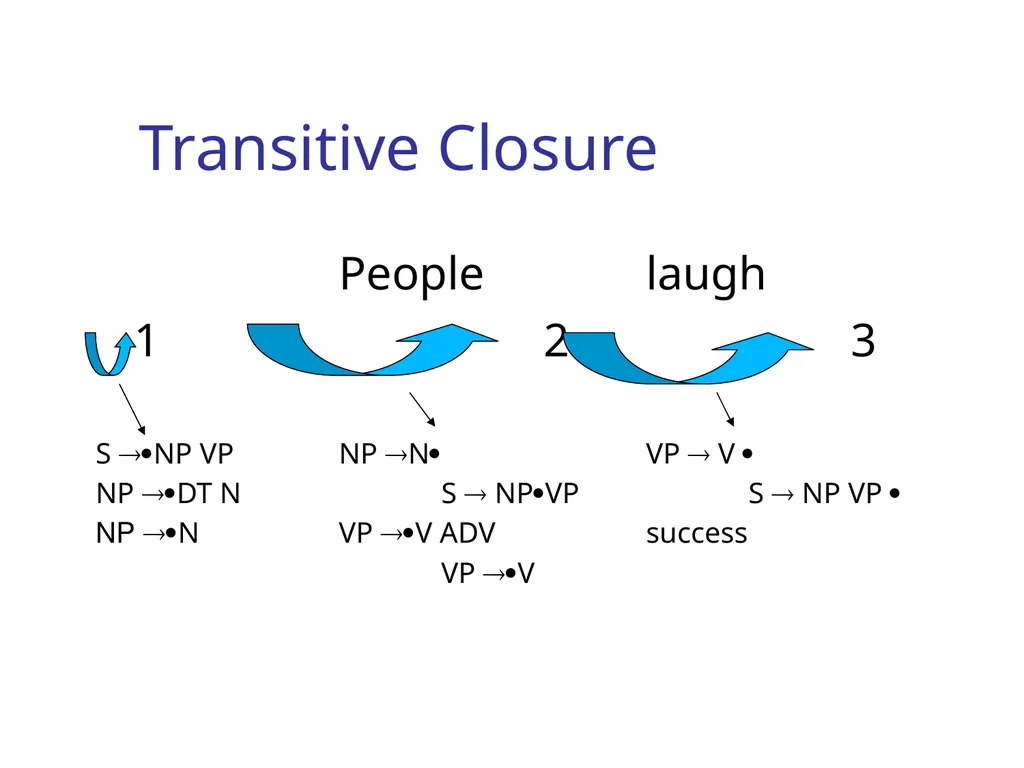
slide37. Transitive Closure People laugh
1 2 3
S NP VP NP N VP V
NP DT N S NPVP S NP VP
NP N VP V ADV success
VP V<br>
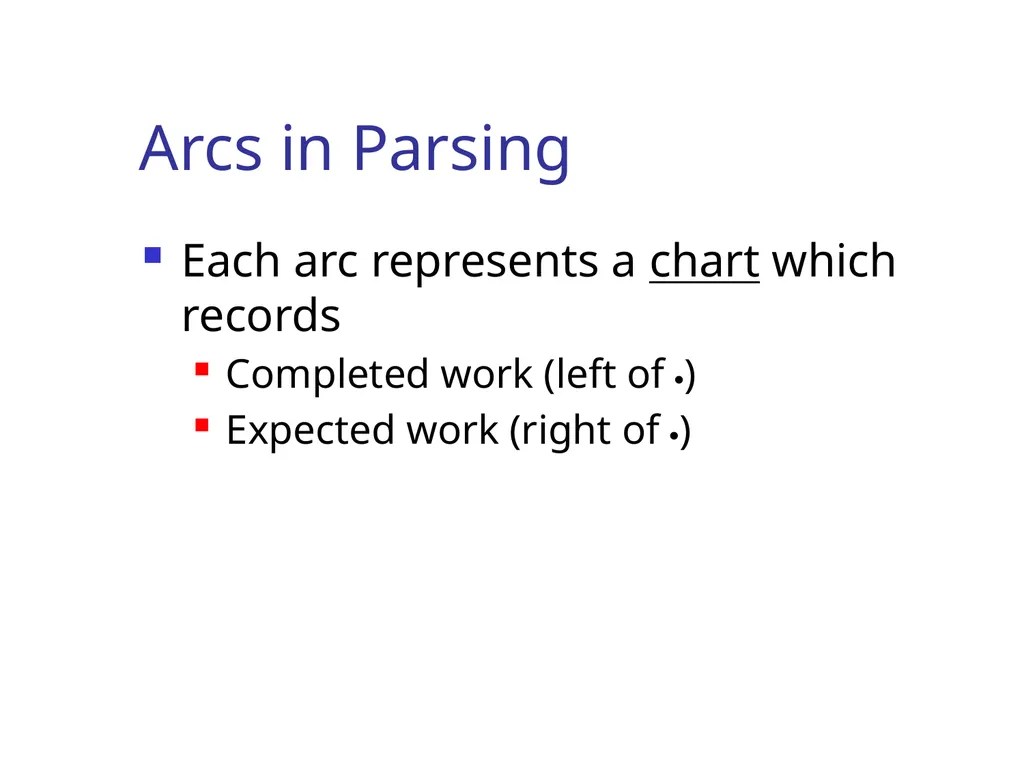
slide38. Arcs in Parsing Each arc represents a chart which records
Completed work (left of )
Expected work (right of )<br>
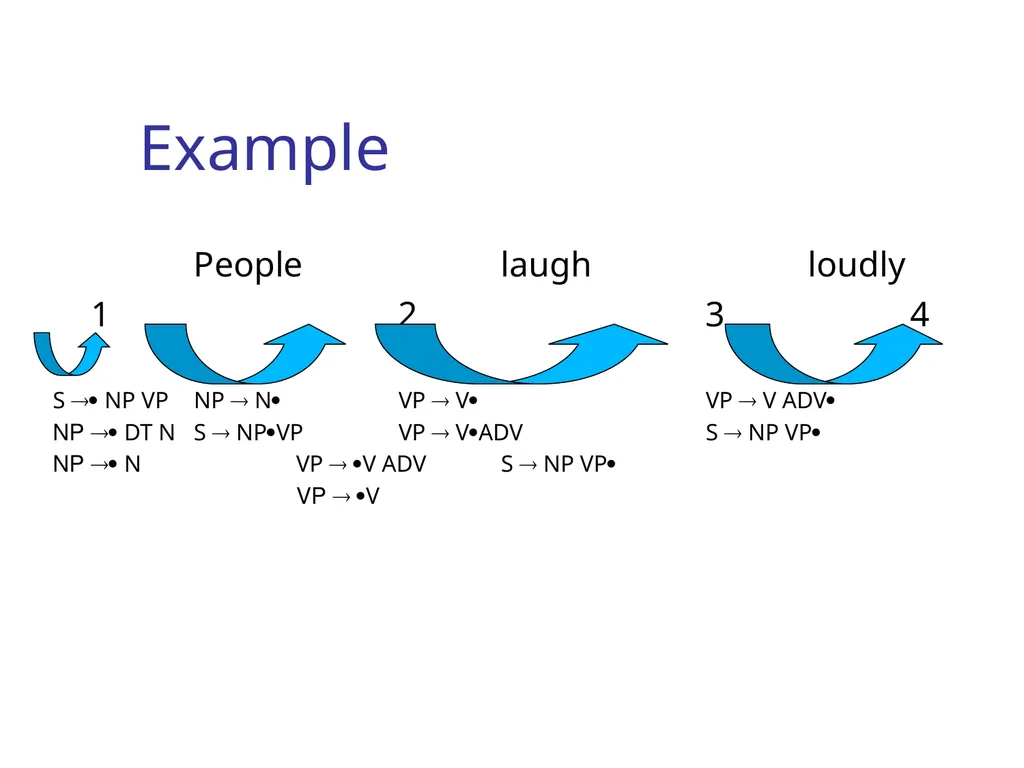
slide39. Example People laugh loudly
1 2 3 4
S NP VP NP N VP V VP V ADV
NP DT N S NPVP VP VADV S NP VP
NP N VP V ADV S NP VP
VP V<br>
slide40. Dealing With Structural Ambiguity Multiple parses for a sentence
The man saw the boy with a telescope.
The man saw the mountain with a telescope.
The man saw the boy with the ponytail.
At the level of syntax, all these sentences are ambiguous. But semantics can disambiguate 2nd & 3rd sentence.<br>
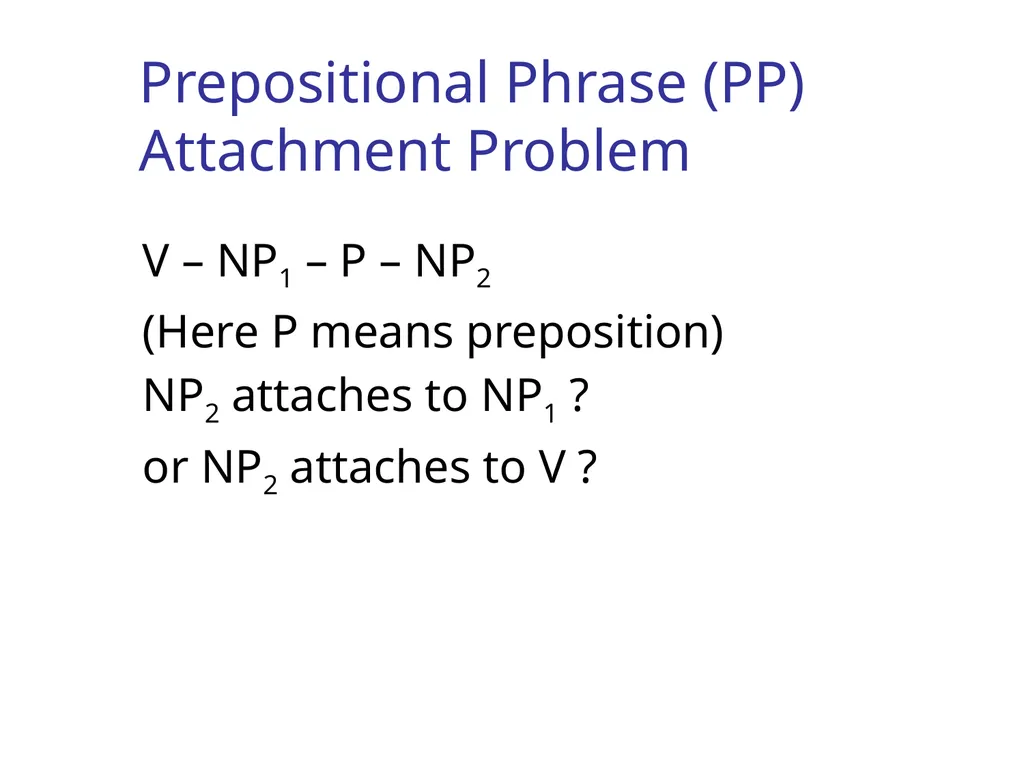
slide41. Prepositional Phrase (PP) Attachment Problem V – NP1 – P – NP2
(Here P means preposition)
NP2 attaches to NP1 ?
or NP2 attaches to V ?<br>
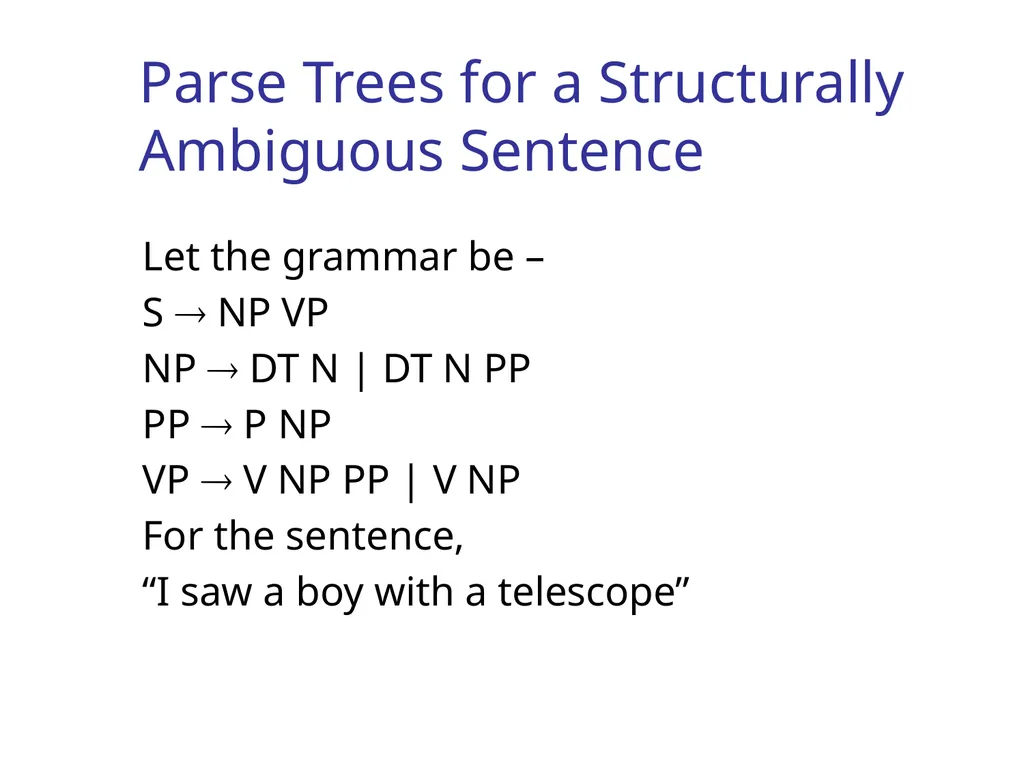
slide42. Parse Trees for a Structurally Ambiguous Sentence Let the grammar be –
S NP VP
NP DT N | DT N PP
PP P NP
VP V NP PP | V NP
For the sentence,
“I saw a boy with a telescope”<br>
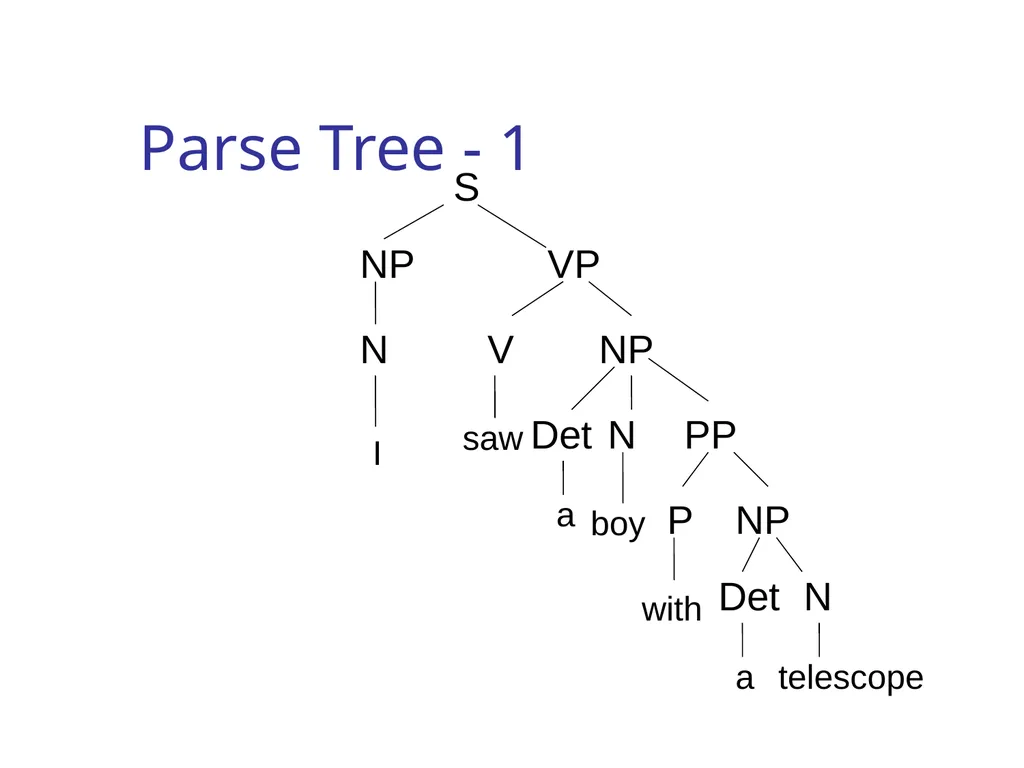
slide43. Parse Tree - 1 S NP VP N V NP Det N PP P NP Det N I saw a boy with a telescope<br>
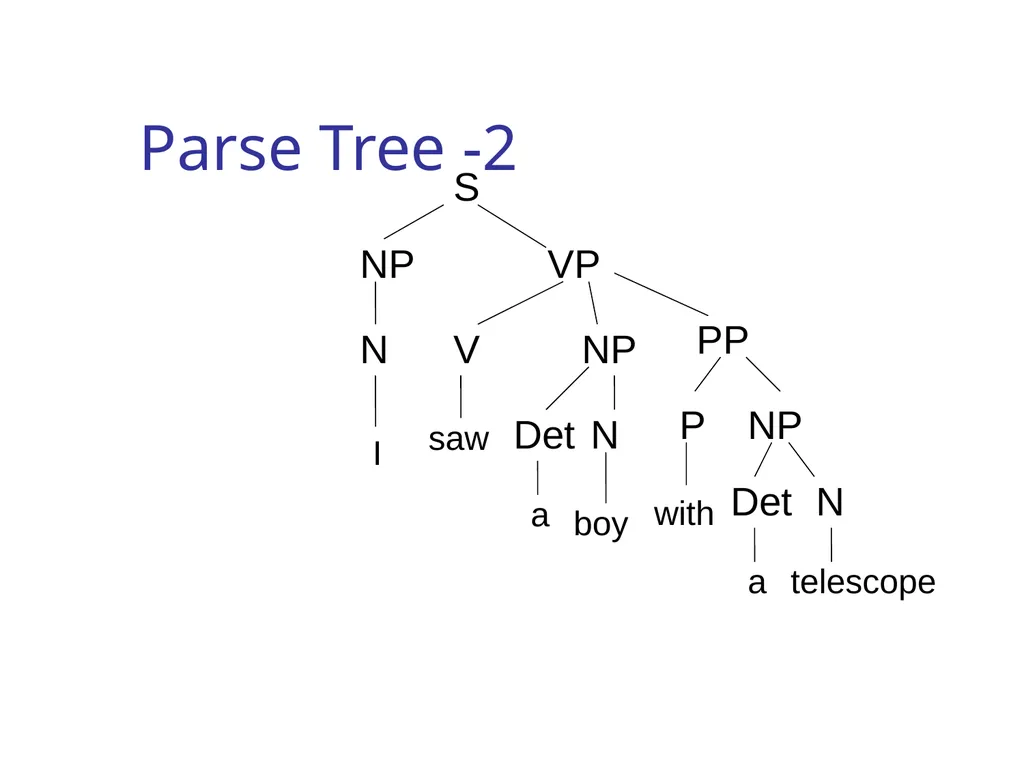
slide44. Parse Tree -2 S NP VP N V NP Det N PP P NP Det N I saw a boy with a telescope<br>
Lecture 20-21– Natural Language Parsing<br>
slide2. Parsing of Sentences<br>
slide3. Are sentences flat linear structures? Why tree? Is there a principle in branching
When should the constituent give rise to children?
What is the hierarchy building principle?<br>
slide4. Structure Dependency: A Case Study Interrogative Inversion
(1) John will solve the problem.
Will John solve the problem?
Declarative Interrogative
(2) a. Susan must leave. Must Susan leave?
b. Harry can swim. Can Harry swim?
c. Mary has read the book. Has Mary read the book?
Bill is sleeping. Is Bill sleeping?
……………………………………………………….
The section, “Structure dependency a case study” here is adopted from a talk given by Howard Lasnik (2003) in Delhi university.<br>
slide5. Interrogative inversion Structure Independent (1st attempt) (3)Interrogative inversion process
Beginning with a declarative, invert the first and second words to construct an interrogative.
Declarative Interrogative
(4) a. The woman must leave. *Woman the must leave?
b. A sailor can swim. *Sailor a can swim?
c. No boy has read the book. *Boy no has read the book?
d. My friend is sleeping. *Friend my is sleeping?<br>
slide6. Interrogative inversion correct pairings Compare the incorrect pairings in (4) with the correct pairings in (5):
Declarative Interrogative
(5) a. The woman must leave. Must the woman leave?
b. A sailor can swim. Can a sailor swim?
c. No boy has read the book. Has no boy read the book?
d. My friend is sleeping. Is my friend sleeping?<br>
slide7. Interrogative inversion Structure Independent (2nd attempt) (6) Interrogative inversion process:
Beginning with a declarative, move the auxiliary verb to the front to construct an interrogative.
Declarative Interrogative
(7) a. Bill could be sleeping. *Be Bill could sleeping?
Could Bill be sleeping?
b. Mary has been reading. *Been Mary has reading?
Has Mary been reading?
c. Susan should have left. *Have Susan should left?
Should Susan have left?<br>
slide8. Structure independent (3rd attempt): Interrogative inversion process
Beginning with a declarative, move the first auxiliary verb to the front to construct an interrogative.
Declarative Interrogative
(9) a. The man who is here can swim. *Is the man who here can swim?
b. The boy who will play has left. *Will the boy who play has left?<br>
slide9. Structure Dependent Correct Pairings For the above examples, fronting the second auxiliary verb gives the correct form:
Declarative Interrogative
(10) a.The man who is here can swim. Can the man who is here swim?
b.The boy who will play has left. Has the boy who will play left?<br>
slide10. Natural transformations are structure dependent Does the child acquiring English learn these properties?
(12) We are not dealing with a peculiarity of English. No known human language has a transformational process that would produce pairings like those in (4), (7) and (9), repeated below:
(4) a. The woman must leave. *Woman the must leave?
(7) a. Bill could be sleeping. *Be Bill could sleeping?
(9) a. The man who is here can swim. *Is the man who here can swim?<br>
slide11. Deeper trees needed for capturing sentence structure NP PP AP big The of poems with the blue cover [The big book of poems with the
Blue cover] is on the table. book This wont do!
Flat structure! PP<br>
slide12. Other languages NP PP AP big The of poems with the blue cover [niil jilda vaalii kavita kii kitaab] book English NP PP AP niil jilda vaalii kavita kii kitaab PP badii Hindi PP<br>
slide13. Other languages: contd NP PP AP big The of poems with the blue cover [niil malaat deovaa kavitar bai ti] book English NP PP AP niil malaat deovaa kavitar bai PP motaa Bengali PP ti<br>
slide14. PPs are at the same level: flat with respect to the head word “book” NP PP AP big The of poems with the blue cover [The big book of poems with the
Blue cover] is on the table. book No distinction in terms of dominance or c-command PP<br>
slide15. “Constituency test of Replacement” runs into problems One-replacement:
I bought the big [book of poems with the blue cover] not the small [one]
One-replacement targets book of poems with the blue cover
Another one-replacement:
I bought the big [book of poems] with the blue cover not the small [one] with the red cover
One-replacement targets book of poems<br>
slide16. More deeply embedded structure NP PP AP big The of poems with the blue cover N’1 N
book PP N’2 N’3<br>
slide17. To target N1’ I want [NPthis [N’big book of poems with the red cover] and not [Nthat [None]]<br>
slide18. Bar-level projections Add intermediate structures
NP (D) N’
N’ (AP) N’ | N’ (PP) | N (PP)
() indicates optionality<br>
slide19. New rules produce this tree NP PP AP big The of poems with the blue cover N’1 N
book PP N’2 N’3 N-bar<br>
slide20. As opposed to this tree NP PP AP big The of poems with the blue cover book PP<br>
slide21. V-bar What is the element in verbs corresponding to one-replacement for nouns
do-so or did-so<br>
slide22. As opposed to this tree NP PP AP big The of poems with the blue cover book PP<br>
slide23. I [eat beans with a fork] VP NP beans eat with a fork PP No constituent that groups together V and NP and excludes
PP<br>
slide24. Need for intermediate constituents I [eat beans] with a fork but Ram [does so] with a spoon V2’ NP beans eat with a fork PP VP V1’ V VPV’
V’ V’ (PP)
V’ V (NP)<br>
slide25. How to target V1’ I [eat beans with a fork], and Ram [does so] too. V2’ NP beans eat with a fork PP VP V1’ V VPV’
V’ V’ (PP)
V’ V (NP)<br>
slide26. Parsing Algorithms<br>
slide27. A simplified grammar S NP VP
NP DT N | N
VP V ADV | V<br>
slide28. A segment of English Grammar S’(C) S
S{NP/S’} VP
VP(AP+) (VAUX) V (AP+) ({NP/S’}) (AP+) (PP+) (AP+)
NP(D) (AP+) N (PP+)
PPP NP
AP(AP) A<br>
slide29. Example Sentence People laugh
2 3
Lexicon:
People - N, V
Laugh - N, V These are positions This indicate that both Noun and Verb is possible for the word “People”<br>
slide30. Top-Down Parsing State Backup State Action
-----------------------------------------------------------------------------------------------------
1. ((S) 1) - -
2. ((NP VP)1) - -
3a. ((DT N VP)1) ((N VP) 1) -
3b. ((N VP)1) - -
4. ((VP)2) - Consume “People”
5a. ((V ADV)2) ((V)2) -
6. ((ADV)3) ((V)2) Consume “laugh”
5b. ((V)2) - -
6. ((.)3) - Consume “laugh”
Termination Condition : All inputs over. No symbols remaining.
Note: Input symbols can be pushed back. Position of input pointer<br>
slide31. Discussion for Top-Down Parsing This kind of searching is goal driven.
Gives importance to textual precedence (rule precedence).
No regard for data, a priori (useless expansions made).<br>
slide32. Bottom-Up Parsing Some conventions:
N12
S1? -> NP12 ° VP2? Represents positions End position unknown Work on the LHS done, while the work on RHS remaining<br>
slide33. Bottom-Up Parsing (pictorial representation) S -> NP12 VP23 °
People Laugh
1 2 3
N12 N23
V12 V23
NP12 -> N12 ° NP23 -> N23 °
VP12 -> V12 ° VP23 -> V23 °
S1? -> NP12 ° VP2?<br>
slide34. Problem with Top-Down Parsing Left Recursion
Suppose you have A-> AB rule.
Then we will have the expansion as follows:
((A)K) -> ((AB)K) -> ((ABB)K) ……..<br>
slide35. Combining top-down and bottom-up strategies<br>
slide36. Top-Down Bottom-Up Chart Parsing Combines advantages of top-down & bottom-up parsing.
Does not work in case of left recursion.
e.g. – “People laugh”
People – noun, verb
Laugh – noun, verb
Grammar – S NP VP
NP DT N | N
VP V ADV | V<br>
slide37. Transitive Closure People laugh
1 2 3
S NP VP NP N VP V
NP DT N S NPVP S NP VP
NP N VP V ADV success
VP V<br>
slide38. Arcs in Parsing Each arc represents a chart which records
Completed work (left of )
Expected work (right of )<br>
slide39. Example People laugh loudly
1 2 3 4
S NP VP NP N VP V VP V ADV
NP DT N S NPVP VP VADV S NP VP
NP N VP V ADV S NP VP
VP V<br>
slide40. Dealing With Structural Ambiguity Multiple parses for a sentence
The man saw the boy with a telescope.
The man saw the mountain with a telescope.
The man saw the boy with the ponytail.
At the level of syntax, all these sentences are ambiguous. But semantics can disambiguate 2nd & 3rd sentence.<br>
slide41. Prepositional Phrase (PP) Attachment Problem V – NP1 – P – NP2
(Here P means preposition)
NP2 attaches to NP1 ?
or NP2 attaches to V ?<br>
slide42. Parse Trees for a Structurally Ambiguous Sentence Let the grammar be –
S NP VP
NP DT N | DT N PP
PP P NP
VP V NP PP | V NP
For the sentence,
“I saw a boy with a telescope”<br>
slide43. Parse Tree - 1 S NP VP N V NP Det N PP P NP Det N I saw a boy with a telescope<br>
slide44. Parse Tree -2 S NP VP N V NP Det N PP P NP Det N I saw a boy with a telescope<br>