CS344: Introduction to Artificial Intelligence
Description: CS344: Introduction to Artificial Intelligence Pushpak Bhattacharyya CSE Dept., IIT Bombay Lecture 7 Predicate Calculus and Knowledge Representation Logic and inferencing Vision NLP Expert Systems Planning Robotics Search Reasoning
Related Topics
Download Presentation
"CS344: Introduction to Artificial Intelligence" is the property of its rightful owner. Permission is granted to download and print the materials on this website for personal, non-commercial use only, and to display it on your personal computer provided you do not modify the materials and that you retain all copyright notices contained in the materials. By downloading content from our website, you accept the terms of this agreement.
Presentation Transcript
slide1. CS344: Introduction to Artificial Intelligence Pushpak BhattacharyyaCSE Dept., IIT Bombay
Lecture 7– Predicate Calculus and Knowledge Representation<br>
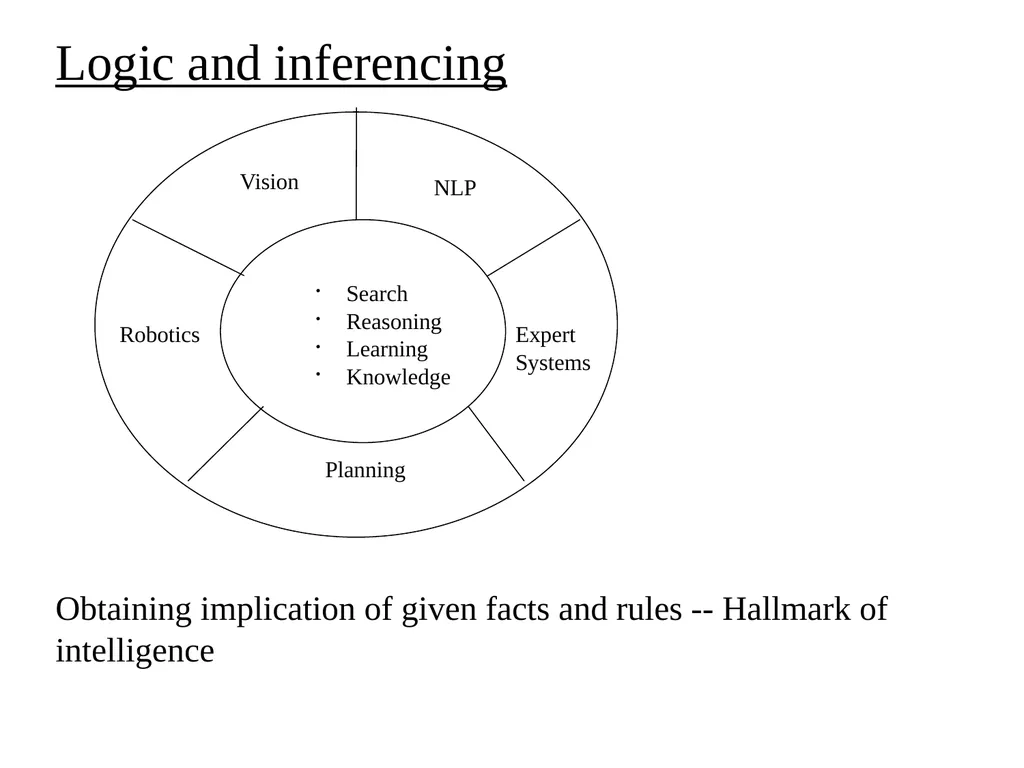
slide2. Logic and inferencing Vision NLP Expert Systems Planning Robotics Search
Reasoning
Learning
Knowledge Obtaining implication of given facts and rules -- Hallmark of intelligence<br>
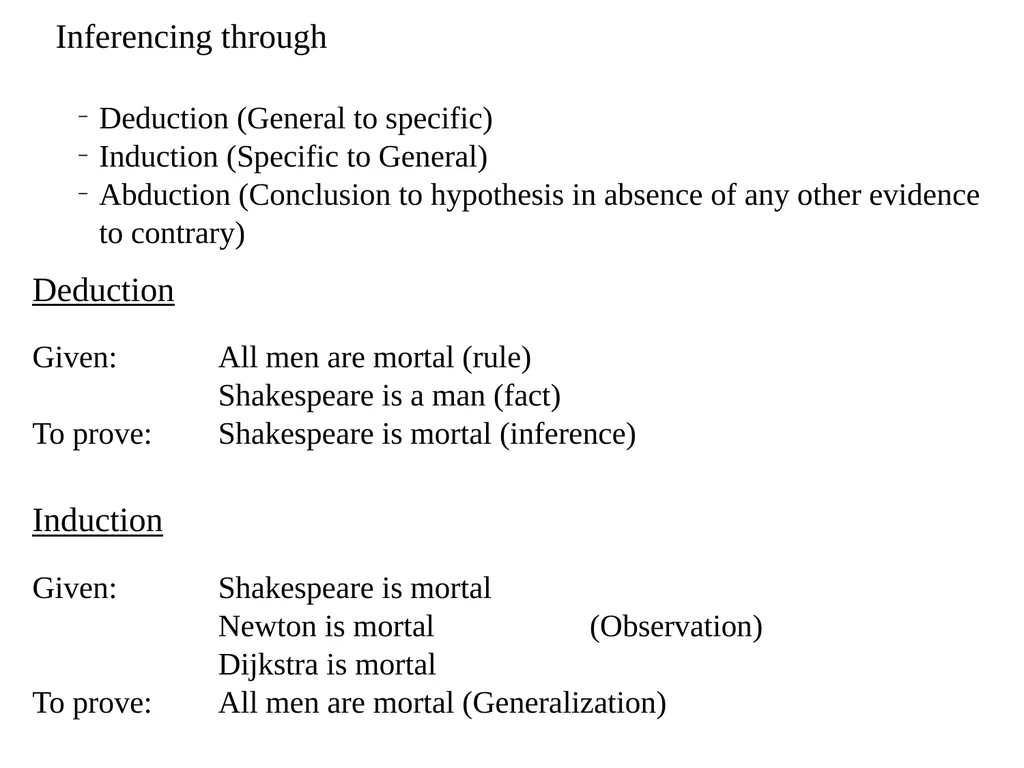
slide3. Inferencing through
Deduction (General to specific)
Induction (Specific to General)
Abduction (Conclusion to hypothesis in absence of any other evidence to contrary) Deduction
Given: All men are mortal (rule)
Shakespeare is a man (fact)
To prove: Shakespeare is mortal (inference) Induction
Given: Shakespeare is mortal
Newton is mortal (Observation)
Dijkstra is mortal
To prove: All men are mortal (Generalization)<br>
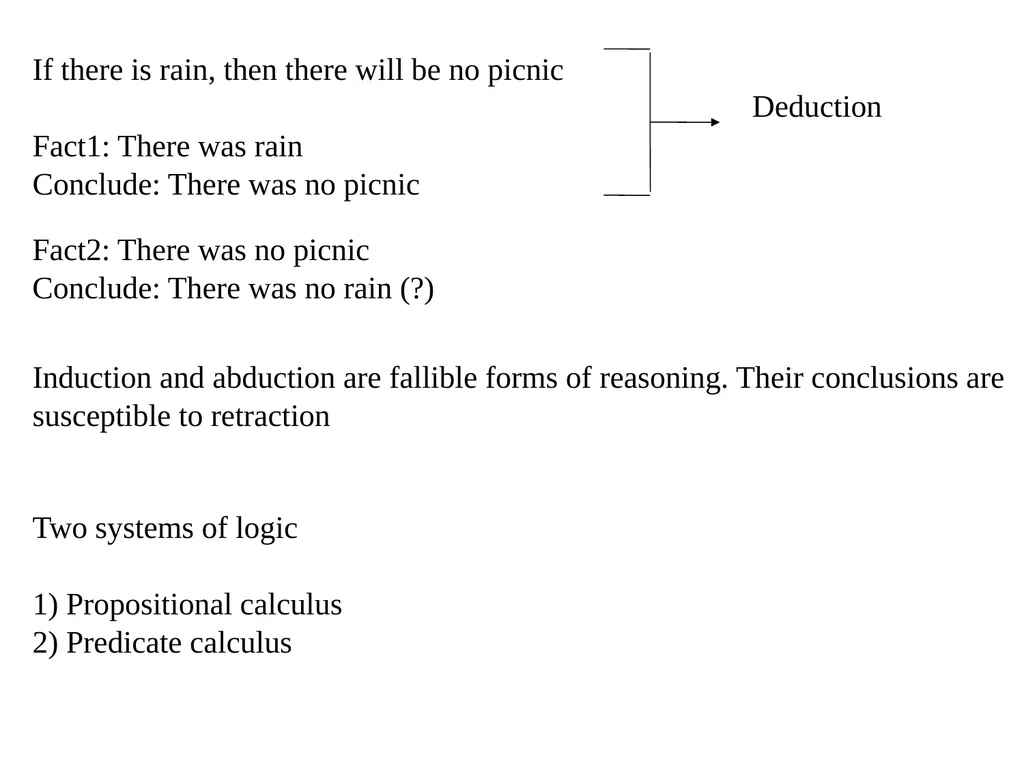
slide4. If there is rain, then there will be no picnic
Fact1: There was rain
Conclude: There was no picnic Deduction Fact2: There was no picnic
Conclude: There was no rain (?) Induction and abduction are fallible forms of reasoning. Their conclusions are susceptible to retraction Two systems of logic
1) Propositional calculus
2) Predicate calculus<br>
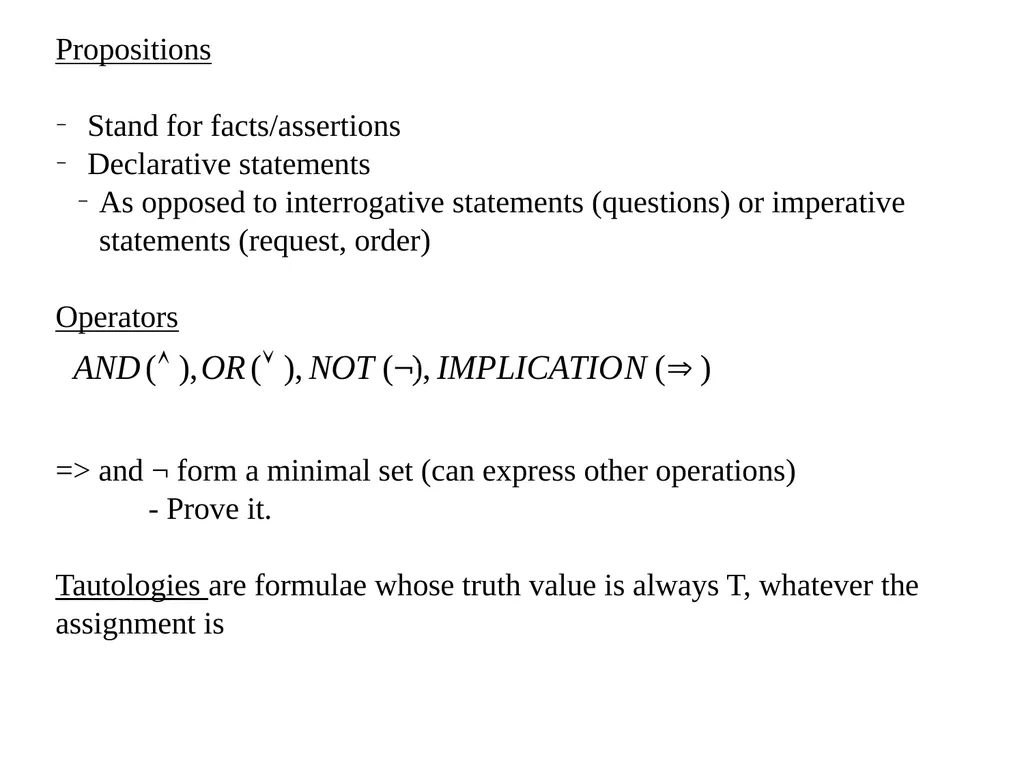
slide5. Propositions
Stand for facts/assertions
Declarative statements
As opposed to interrogative statements (questions) or imperative statements (request, order)
Operators
=> and ¬ form a minimal set (can express other operations)
- Prove it.
Tautologies are formulae whose truth value is always T, whatever the assignment is<br>
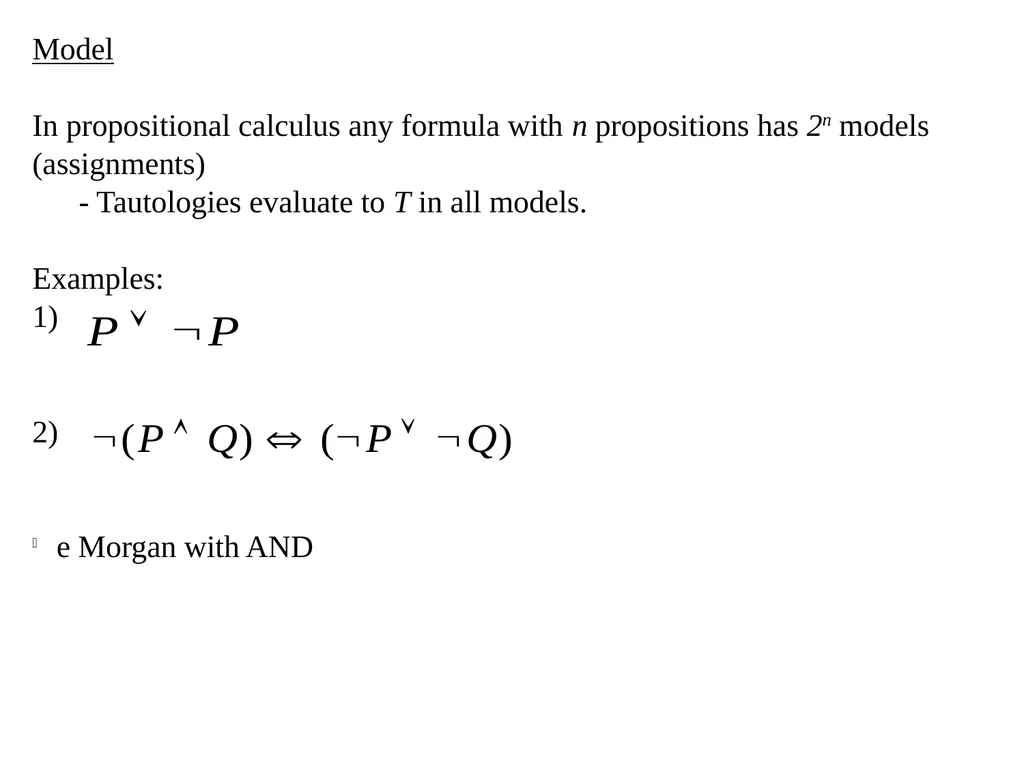
slide6. Model
In propositional calculus any formula with n propositions has 2n models (assignments)
- Tautologies evaluate to T in all models.
Examples:
1)
2)
e Morgan with AND<br>
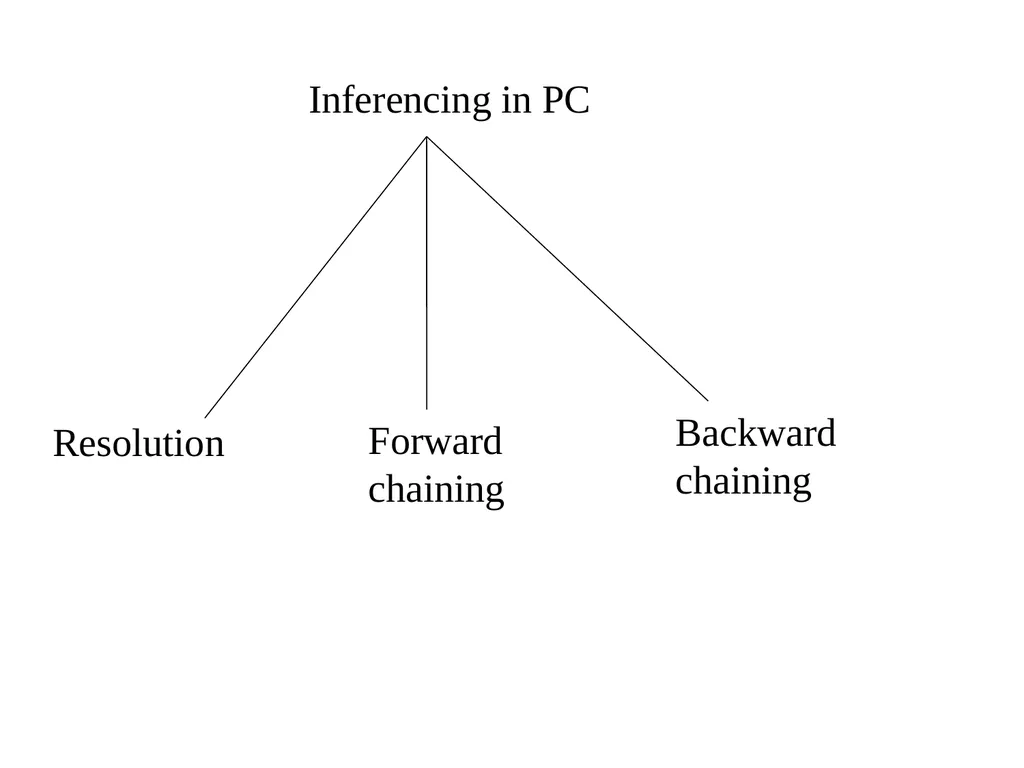
slide7. Inferencing in PC Resolution Forward chaining Backward chaining<br>
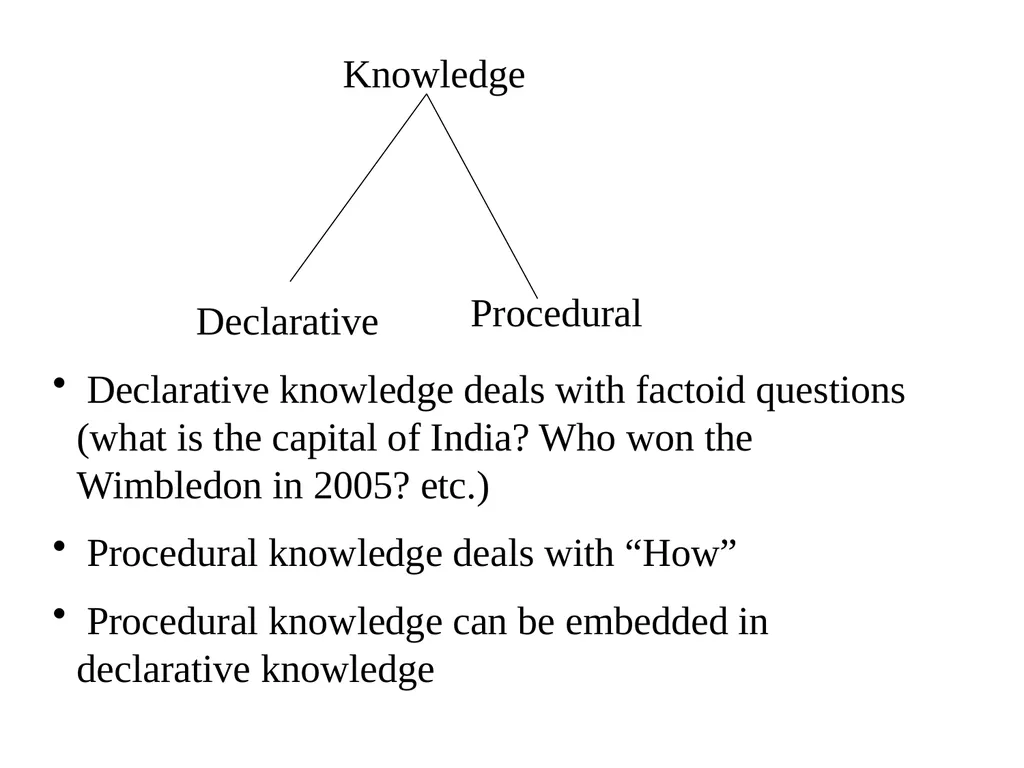
slide8. Knowledge Declarative Procedural Declarative knowledge deals with factoid questions (what is the capital of India? Who won the Wimbledon in 2005? etc.)
Procedural knowledge deals with “How”
Procedural knowledge can be embedded in declarative knowledge<br>
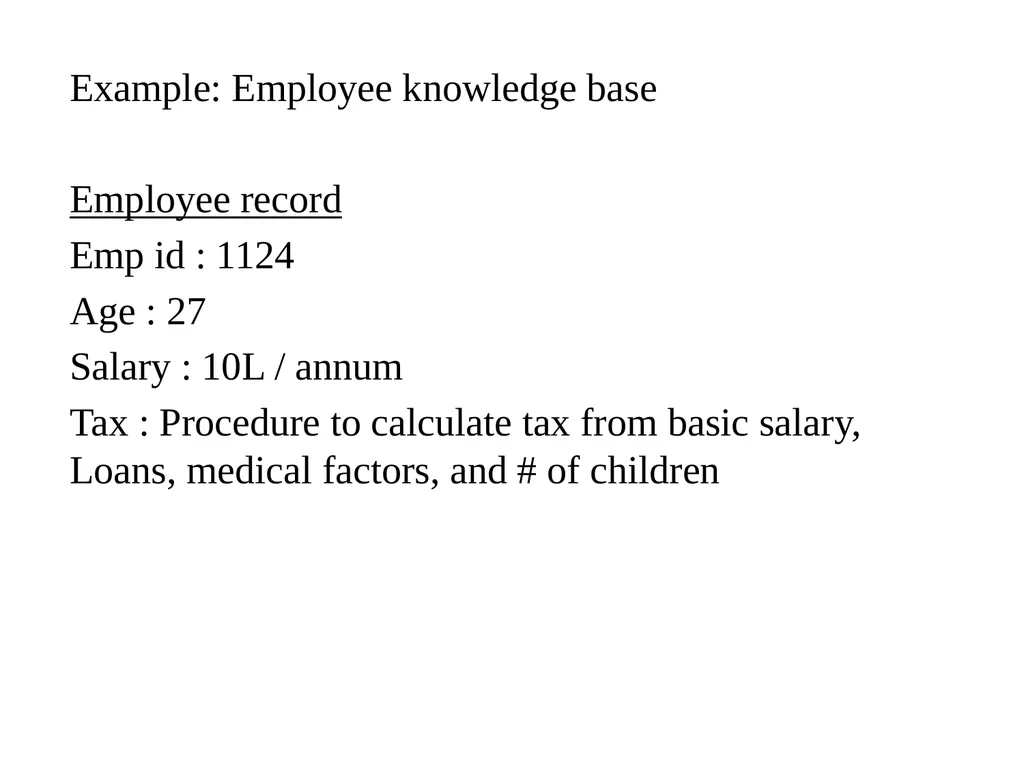
slide9. Example: Employee knowledge base
Employee record
Emp id : 1124
Age : 27
Salary : 10L / annum
Tax : Procedure to calculate tax from basic salary, Loans, medical factors, and # of children<br>
slide10. Predicate Calculus<br>
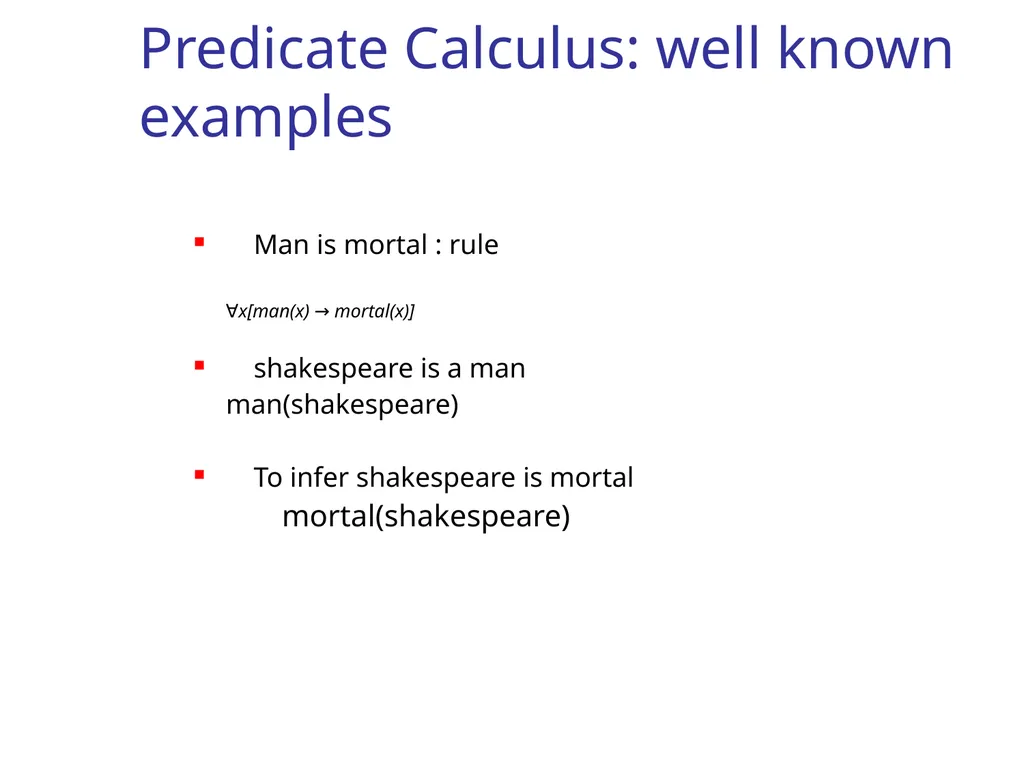
slide11. Predicate Calculus: well known examples Man is mortal : rule
∀x[man(x) → mortal(x)]
shakespeare is a man
man(shakespeare)
To infer shakespeare is mortal
mortal(shakespeare)<br>
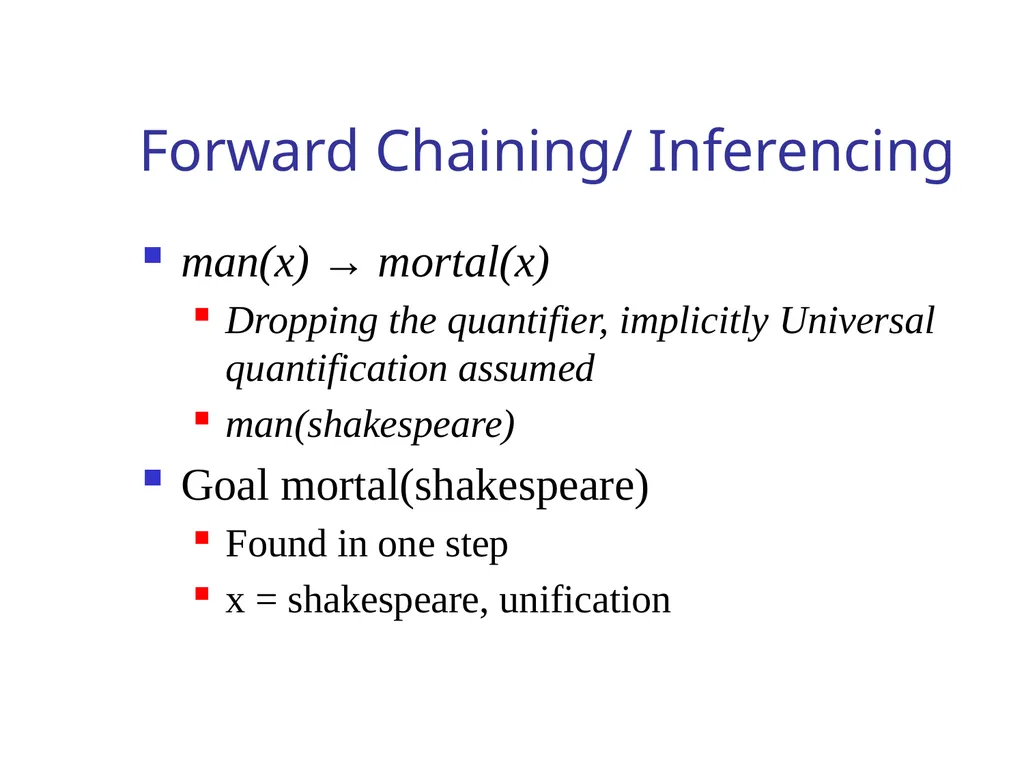
slide12. Forward Chaining/ Inferencing man(x) → mortal(x)
Dropping the quantifier, implicitly Universal quantification assumed
man(shakespeare)
Goal mortal(shakespeare)
Found in one step
x = shakespeare, unification<br>
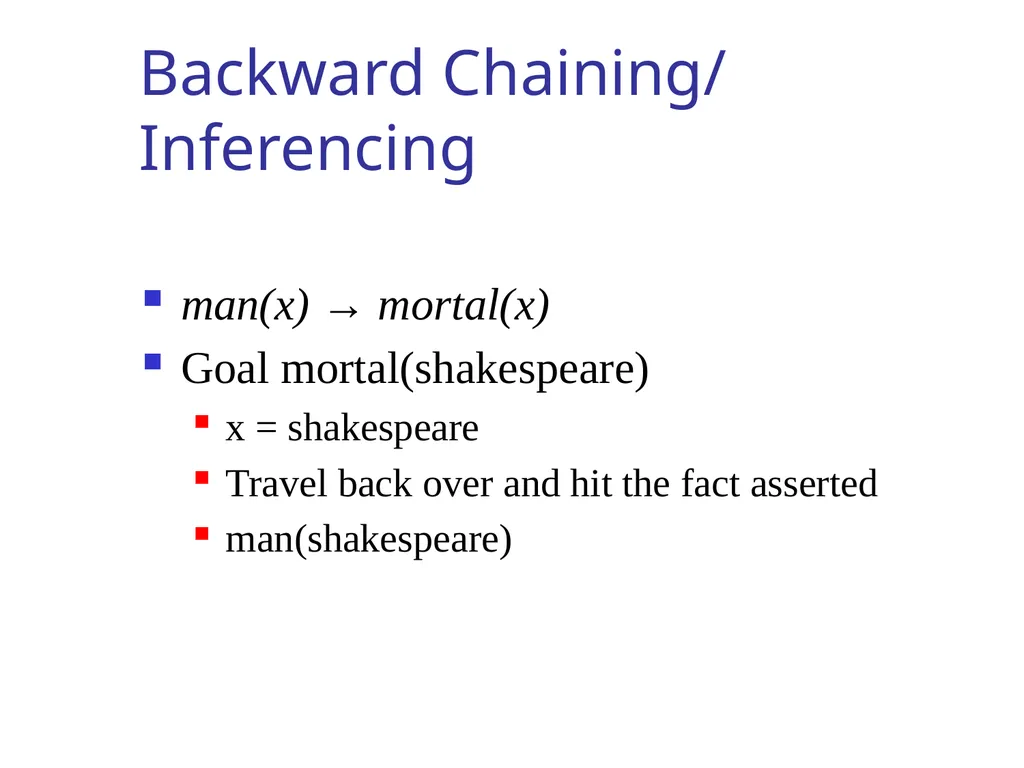
slide13. Backward Chaining/ Inferencing man(x) → mortal(x)
Goal mortal(shakespeare)
x = shakespeare
Travel back over and hit the fact asserted
man(shakespeare)<br>
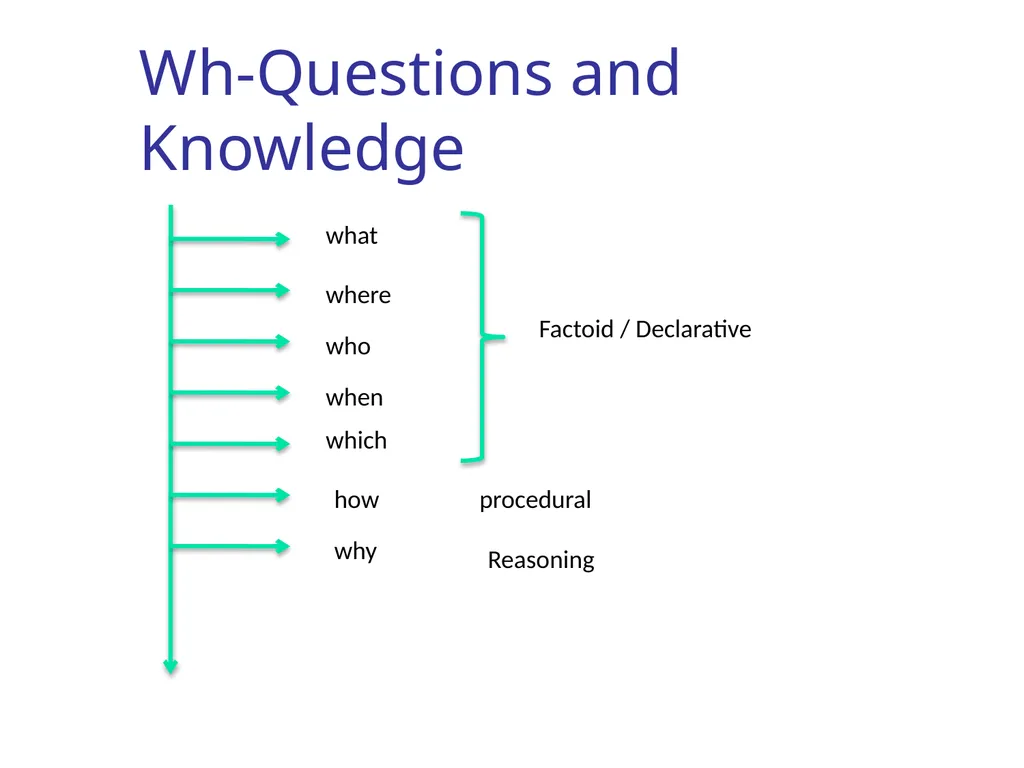
slide14. Wh-Questions and Knowledge what how why where which who when Factoid / Declarative procedural Reasoning<br>

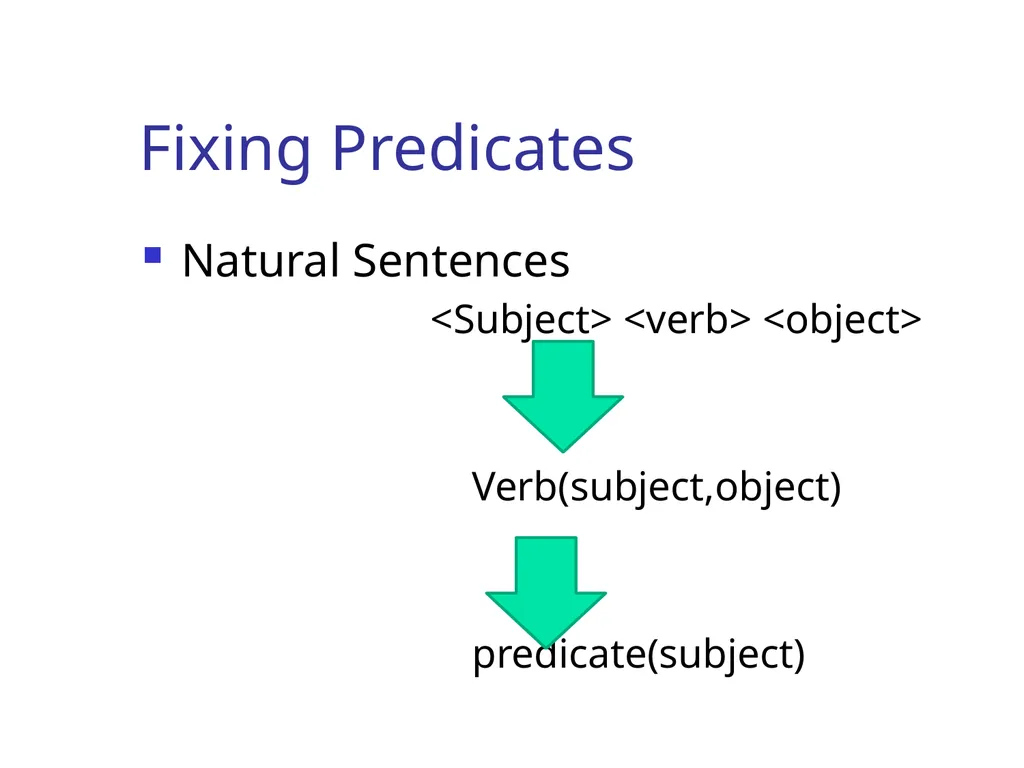
slide15. Fixing Predicates Natural Sentences
<Subject> <verb> <object>
Verb(subject,object)
predicate(subject)<br>
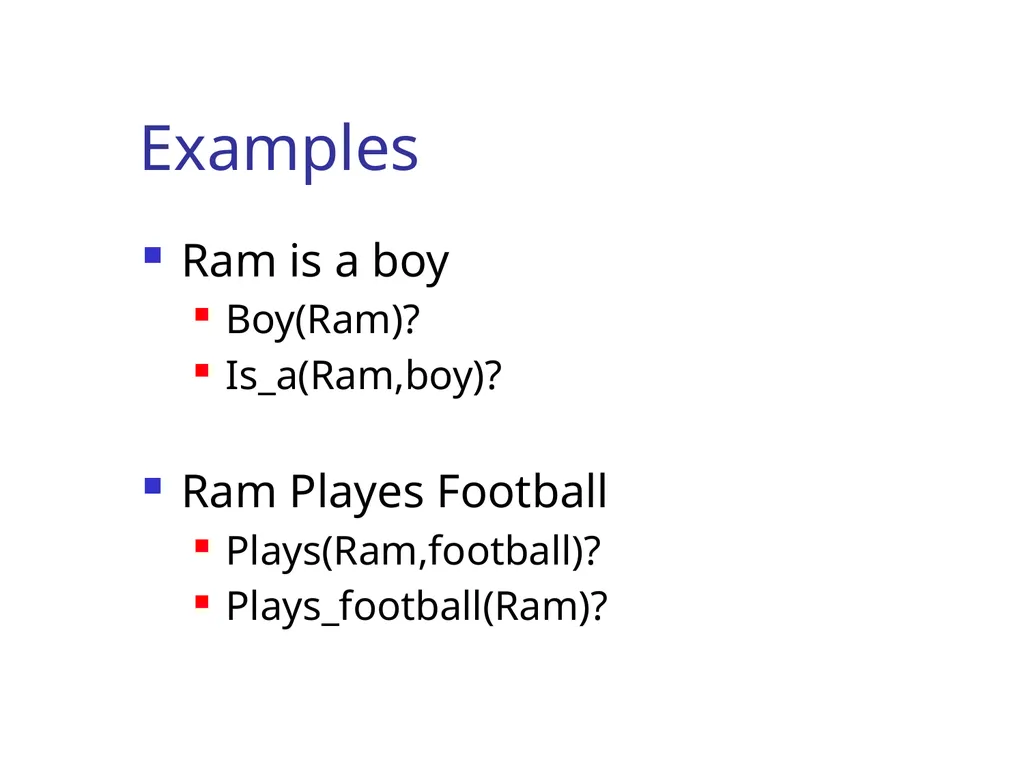
slide16. Examples Ram is a boy
Boy(Ram)?
Is_a(Ram,boy)?
Ram Playes Football
Plays(Ram,football)?
Plays_football(Ram)?<br>
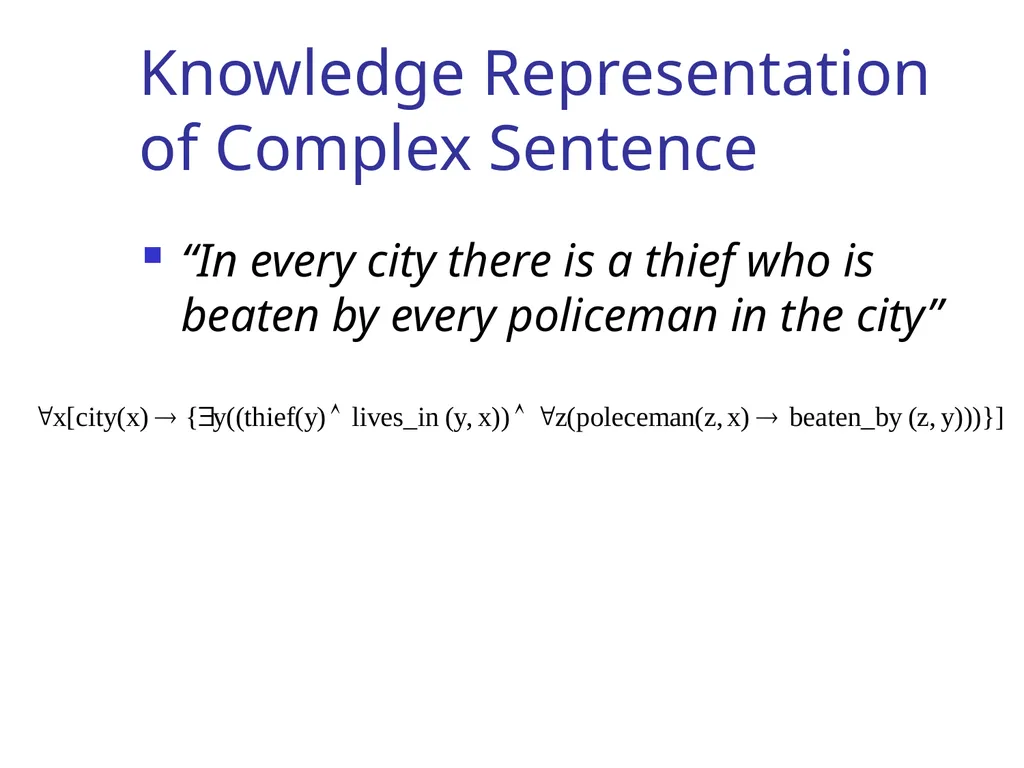
slide17. Knowledge Representation of Complex Sentence “In every city there is a thief who is beaten by every policeman in the city”<br>
Lecture 7– Predicate Calculus and Knowledge Representation<br>
slide2. Logic and inferencing Vision NLP Expert Systems Planning Robotics Search
Reasoning
Learning
Knowledge Obtaining implication of given facts and rules -- Hallmark of intelligence<br>
slide3. Inferencing through
Deduction (General to specific)
Induction (Specific to General)
Abduction (Conclusion to hypothesis in absence of any other evidence to contrary) Deduction
Given: All men are mortal (rule)
Shakespeare is a man (fact)
To prove: Shakespeare is mortal (inference) Induction
Given: Shakespeare is mortal
Newton is mortal (Observation)
Dijkstra is mortal
To prove: All men are mortal (Generalization)<br>
slide4. If there is rain, then there will be no picnic
Fact1: There was rain
Conclude: There was no picnic Deduction Fact2: There was no picnic
Conclude: There was no rain (?) Induction and abduction are fallible forms of reasoning. Their conclusions are susceptible to retraction Two systems of logic
1) Propositional calculus
2) Predicate calculus<br>
slide5. Propositions
Stand for facts/assertions
Declarative statements
As opposed to interrogative statements (questions) or imperative statements (request, order)
Operators
=> and ¬ form a minimal set (can express other operations)
- Prove it.
Tautologies are formulae whose truth value is always T, whatever the assignment is<br>
slide6. Model
In propositional calculus any formula with n propositions has 2n models (assignments)
- Tautologies evaluate to T in all models.
Examples:
1)
2)
e Morgan with AND<br>
slide7. Inferencing in PC Resolution Forward chaining Backward chaining<br>
slide8. Knowledge Declarative Procedural Declarative knowledge deals with factoid questions (what is the capital of India? Who won the Wimbledon in 2005? etc.)
Procedural knowledge deals with “How”
Procedural knowledge can be embedded in declarative knowledge<br>
slide9. Example: Employee knowledge base
Employee record
Emp id : 1124
Age : 27
Salary : 10L / annum
Tax : Procedure to calculate tax from basic salary, Loans, medical factors, and # of children<br>
slide10. Predicate Calculus<br>
slide11. Predicate Calculus: well known examples Man is mortal : rule
∀x[man(x) → mortal(x)]
shakespeare is a man
man(shakespeare)
To infer shakespeare is mortal
mortal(shakespeare)<br>
slide12. Forward Chaining/ Inferencing man(x) → mortal(x)
Dropping the quantifier, implicitly Universal quantification assumed
man(shakespeare)
Goal mortal(shakespeare)
Found in one step
x = shakespeare, unification<br>
slide13. Backward Chaining/ Inferencing man(x) → mortal(x)
Goal mortal(shakespeare)
x = shakespeare
Travel back over and hit the fact asserted
man(shakespeare)<br>
slide14. Wh-Questions and Knowledge what how why where which who when Factoid / Declarative procedural Reasoning<br>
slide15. Fixing Predicates Natural Sentences
<Subject> <verb> <object>
Verb(subject,object)
predicate(subject)<br>
slide16. Examples Ram is a boy
Boy(Ram)?
Is_a(Ram,boy)?
Ram Playes Football
Plays(Ram,football)?
Plays_football(Ram)?<br>
slide17. Knowledge Representation of Complex Sentence “In every city there is a thief who is beaten by every policeman in the city”<br>