
Cultural Competency Training for Providers — 2025
CP
Published · 31 slides · 0 views

1 / 1
Description
Cultural Competency Training for Providers 2025 Training for Providers Cultural Competency Cultural Competency Training for Providers 2025 Cultural competency training programs are developed to increase cultural awareness, knowledge,
Related Topics
Share
Embed code
Download this presentation From Below
"Cultural Competency Training for Providers — 2025" is the property of its rightful owner. Permission is granted to download and print the materials on this website for personal, non-commercial use only, and to display it on your personal computer provided you do not modify the materials and that you retain all copyright notices contained in the materials. By downloading content from our website, you accept the terms of this agreement.
Presentation Transcript
01
Cultural Competency Training for Providers — 2025 Training for Providers Cultural Competency<br>
02
Cultural Competency Training for Providers — 2025 Cultural competency training programs are developed to increase cultural awareness, knowledge, and skills, leading to changes in staff behavior and member-staff interactions.
Training provides a way to redirect problems stemming from the cultural mismatches that result whenever members and staff do not share a common subculture and mutual understanding of each other’s health beliefs. Purpose of Training<br>
Training provides a way to redirect problems stemming from the cultural mismatches that result whenever members and staff do not share a common subculture and mutual understanding of each other’s health beliefs. Purpose of Training<br>
03
Cultural Competency Training for Providers — 2025 An Annual Population Assessment reviews Quality Improvement Referrals, Provider Satisfaction results, and Translator service request to identify any opportunities related to providing a sufficient provider network to support the linguistic, race, ethnicity, and gender needs of the patient/beneficiary population.
The Organization does not discriminate against employees, patients/beneficiaries, or providers, based on age, race, sex, religion, sexual preference/orientation, or any protected status.
NM 9002 – Cultural Competency, Attachment A list actions needed to relay the information to the health plans if a provider elects not to provide a service within the scope of the detailed Covered Services, because of an objection on moral or religious grounds. Provider Network<br>
The Organization does not discriminate against employees, patients/beneficiaries, or providers, based on age, race, sex, religion, sexual preference/orientation, or any protected status.
NM 9002 – Cultural Competency, Attachment A list actions needed to relay the information to the health plans if a provider elects not to provide a service within the scope of the detailed Covered Services, because of an objection on moral or religious grounds. Provider Network<br>
04
Cultural Competency Training for Providers — 2025 An integrated pattern of learned beliefs and behaviors that can be shared among groups.
It includes thoughts, style of communication, language, ways of interacting, views on roles and relationships, values, practices, and customs. Culture<br>
It includes thoughts, style of communication, language, ways of interacting, views on roles and relationships, values, practices, and customs. Culture<br>
05
Cultural Competency Training for Providers — 2025 The ability of systems to provide care to members with diverse values, beliefs, and behaviors, including tailoring delivery to meet the members social, cultural, and linguistic needs. Culture Competence in Health Care<br>
06
Cultural Competency Training for Providers — 2025 Health literacy is the degree to which individuals have the capacity to obtain, process and understand basic health information needed to make appropriate health decisions.
Members health literacy may be affected if they have:
Health care providers who use words that members don’t understand
Low educational skills
Cultural barriers to health care
Limited English Proficiency (LEP) Health Literacy<br>
Members health literacy may be affected if they have:
Health care providers who use words that members don’t understand
Low educational skills
Cultural barriers to health care
Limited English Proficiency (LEP) Health Literacy<br>
07
Cultural Competency Training for Providers — 2025 In 2000, the U.S. Department of Health and Human Services, Office of Minority Health first published the National Standards for Culturally and Linguistically Appropriate Services in Health Care.
Principal Standard: Provide effective, equitable, understandable, and respectful quality care and services that are responsive to diverse cultural health beliefs and practices, preferred languages, health literacy, and other communication needs.
A significant number of states including Florida are actively implementing the National CLAS Standards by integrating the National CLAS Standards into their strategic plans. National Standards for Culturally and Linguistically Appropriate Services (CLAS) in Health Care<br>
Principal Standard: Provide effective, equitable, understandable, and respectful quality care and services that are responsive to diverse cultural health beliefs and practices, preferred languages, health literacy, and other communication needs.
A significant number of states including Florida are actively implementing the National CLAS Standards by integrating the National CLAS Standards into their strategic plans. National Standards for Culturally and Linguistically Appropriate Services (CLAS) in Health Care<br>
08
Cultural Competency Training for Providers — 2025 How does culture impact the outcome of treatment?
How is the illness perceived
Community environment
Behavior/habits
A Member’s attitude about Providers & Health care can have an impact on compliance with treatment Beliefs<br>
How is the illness perceived
Community environment
Behavior/habits
A Member’s attitude about Providers & Health care can have an impact on compliance with treatment Beliefs<br>
09
Cultural Competency Training for Providers — 2025 Communication is vital for the patient to receive adequate care
Limited English Proficiency (LEP) - describes someone who has limited or inability to speak, read, write, or understand the English language.
The organization will provide language assistance services to individuals with Limited English Proficiency (LEP) and facilitate effective communication for the patient.
The organization will provide notice about the availability of language assistance services and auxiliary aids and services to patients at no extra cost. For individuals with disabilities, and the Dual Eligible Special Needs Plans (D-SNPs) population who require auxiliary aids and services, these notices will be provided in alternative formats to ensure effective communication to patients at no extra cost.
The notices will be provided annually, upon request, with a visible location on the organization’s websites. Communication<br>
Limited English Proficiency (LEP) - describes someone who has limited or inability to speak, read, write, or understand the English language.
The organization will provide language assistance services to individuals with Limited English Proficiency (LEP) and facilitate effective communication for the patient.
The organization will provide notice about the availability of language assistance services and auxiliary aids and services to patients at no extra cost. For individuals with disabilities, and the Dual Eligible Special Needs Plans (D-SNPs) population who require auxiliary aids and services, these notices will be provided in alternative formats to ensure effective communication to patients at no extra cost.
The notices will be provided annually, upon request, with a visible location on the organization’s websites. Communication<br>
10
Cultural Competency Training for Providers — 2025 Patients with LEP may not understand health information concerning their care.
A translation service will be used for members unable to speak English, if the enrollee’s spoken language is outside of organizations in-house capabilities, which include: Spanish, Creole, and French.
The UM staff will notify providers and members of the availability of oral interpretation services and inform them how to access oral interpretation services, regardless of whether an Enrollee speaks a language that meets the threshold of a prevalent non-English language. There will be no charge to the member for translation services.
TTY/TDD services are available Communication (Cont.)<br>
A translation service will be used for members unable to speak English, if the enrollee’s spoken language is outside of organizations in-house capabilities, which include: Spanish, Creole, and French.
The UM staff will notify providers and members of the availability of oral interpretation services and inform them how to access oral interpretation services, regardless of whether an Enrollee speaks a language that meets the threshold of a prevalent non-English language. There will be no charge to the member for translation services.
TTY/TDD services are available Communication (Cont.)<br>
11
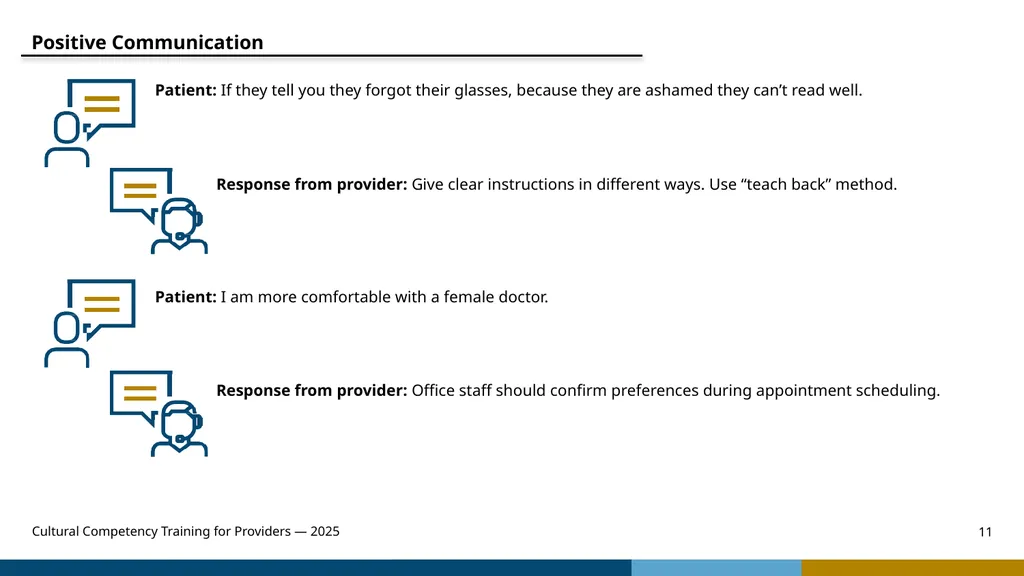
Cultural Competency Training for Providers — 2025 Patient: If they tell you they forgot their glasses, because they are ashamed they can’t read well.
Response from provider: Give clear instructions in different ways. Use “teach back” method.
Patient: I am more comfortable with a female doctor.
Response from provider: Office staff should confirm preferences during appointment scheduling. Positive Communication<br>
Response from provider: Give clear instructions in different ways. Use “teach back” method.
Patient: I am more comfortable with a female doctor.
Response from provider: Office staff should confirm preferences during appointment scheduling. Positive Communication<br>
12
Cultural Competency Training for Providers — 2025 Emotional intelligence (EQ) is the ability to identify, use, understand, and manage your own emotions in positive ways to relieve stress, communicate effectively, empathize with others, overcome challenges and defuse conflict.
By understanding your emotions and how to control them, you’re better able to express how you feel and understand how others are feeling.
This allows you to communicate more effectively and forge stronger relationships, both at work and in your personal life. Emotional Intelligence<br>
By understanding your emotions and how to control them, you’re better able to express how you feel and understand how others are feeling.
This allows you to communicate more effectively and forge stronger relationships, both at work and in your personal life. Emotional Intelligence<br>
13
Cultural Competency Training for Providers — 2025 Speak up on the spot, saying that such jokes are inappropriate and will not be tolerated in your organization. You are a manager in an organization or practice owner that is trying to encourage respect for racial and ethnic diversity. You overhear someone telling a racist joke. What do you do?
The most effective way to create an atmosphere that welcomes diversity is to make clear in public that the social norms of your organization do not tolerate such expressions. Confronting the behavior privately lets the individual know the behavior is unacceptable but does not communicate it to the team. Instead of trying to change prejudices (a much harder task), keep people from acting on them. Emotional Intelligence at work<br>
The most effective way to create an atmosphere that welcomes diversity is to make clear in public that the social norms of your organization do not tolerate such expressions. Confronting the behavior privately lets the individual know the behavior is unacceptable but does not communicate it to the team. Instead of trying to change prejudices (a much harder task), keep people from acting on them. Emotional Intelligence at work<br>
14
Cultural Competency Training for Providers — 2025 Teach back method is a way of confirming the patient understands by asking the patient to state in their own words what they need to know or do about their health, which:
Improves patient understanding and adherence
Decrease call backs & cancelled appointments
Improve outcomes and satisfaction
Use clear plain language when talking to patients Tools<br>
Improves patient understanding and adherence
Decrease call backs & cancelled appointments
Improve outcomes and satisfaction
Use clear plain language when talking to patients Tools<br>
15
Cultural Competency Training for Providers — 2025 A subculture is an ethnic, regional, economic, or social group
Cross-cultural health care teaches people in the health care industry how to relate to people of different sections of society.
Cultural differences, it is important to understand and respect the values, beliefs, and customs, norms, and traditions of different people.
Consider the person’s cultural views concerning
Eye contact
Personal space
Respect for authority Subculture<br>
Cross-cultural health care teaches people in the health care industry how to relate to people of different sections of society.
Cultural differences, it is important to understand and respect the values, beliefs, and customs, norms, and traditions of different people.
Consider the person’s cultural views concerning
Eye contact
Personal space
Respect for authority Subculture<br>
16
Cultural Competency Training for Providers — 2025 Ask a person with a disability first before providing assistance like holding their arm to help them out of a chair. When dealing with seniors, consider the possible challenges and impairments:
Hearing
Visual
Cognitive
Physical
Taking multiple medications
Dependent on care givers Seniors & People with Disabilities<br>
Hearing
Visual
Cognitive
Physical
Taking multiple medications
Dependent on care givers Seniors & People with Disabilities<br>
17
Cultural Competency Training for Providers — 2025 Lack of diversity in leadership
System not designed to meet the needs of a diverse population
Poor communication between providers and patients of different cultural backgrounds Possible Barriers to Cultural Competency<br>
System not designed to meet the needs of a diverse population
Poor communication between providers and patients of different cultural backgrounds Possible Barriers to Cultural Competency<br>
18
Cultural Competency Training for Providers — 2025 Healthcare experts identified a connection between cultural competence and quality improvement, and the elimination of racial and ethnic disparities. Benefits of Cultural Competency<br>
19
Cultural Competency Training for Providers — 2025 To know the regulatory and legal basis that supports anti-discrimination efforts based on sexual orientation and gender identity.
To distinguish among sexual orientation and gender identity
To know a basic guideline which provides tools to handle with sensibility the LBGTT+ population when requesting health care services. Objectives Handling with sensibility the LGBTT+ population when requesting health care related services. LGBTT+ Cultural Competence training<br>
To distinguish among sexual orientation and gender identity
To know a basic guideline which provides tools to handle with sensibility the LBGTT+ population when requesting health care services. Objectives Handling with sensibility the LGBTT+ population when requesting health care related services. LGBTT+ Cultural Competence training<br>
20
Cultural Competency Training for Providers — 2025 Sexual Orientation tells you how a person characterizes their sexual and emotional attraction to others.
Gender Identity is a person’s internal sense of being a man, woman, both, neither, or another gender. Most people have a gender identity that is the same as the sex they were assigned at birth. However, some people have a gender identity that does not correspond to the sex they were assigned at birth. The term transgender is used to describe these individuals. Sexual Orientation and Gender Identity are two different concepts<br>
Gender Identity is a person’s internal sense of being a man, woman, both, neither, or another gender. Most people have a gender identity that is the same as the sex they were assigned at birth. However, some people have a gender identity that does not correspond to the sex they were assigned at birth. The term transgender is used to describe these individuals. Sexual Orientation and Gender Identity are two different concepts<br>
21
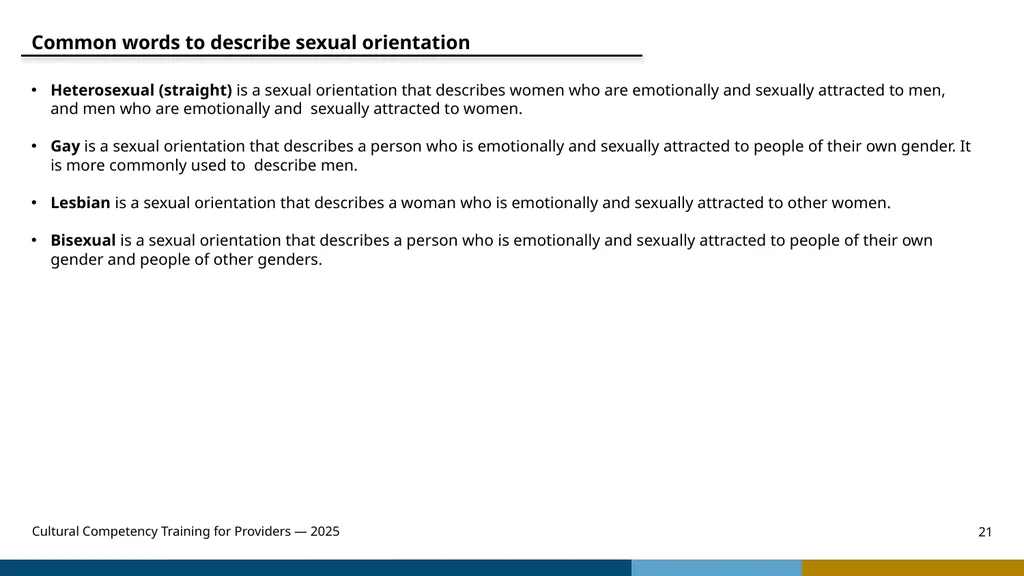
Cultural Competency Training for Providers — 2025 Heterosexual (straight) is a sexual orientation that describes women who are emotionally and sexually attracted to men, and men who are emotionally and sexually attracted to women.
Gay is a sexual orientation that describes a person who is emotionally and sexually attracted to people of their own gender. It is more commonly used to describe men.
Lesbian is a sexual orientation that describes a woman who is emotionally and sexually attracted to other women.
Bisexual is a sexual orientation that describes a person who is emotionally and sexually attracted to people of their own gender and people of other genders. Common words to describe sexual orientation<br>
Gay is a sexual orientation that describes a person who is emotionally and sexually attracted to people of their own gender. It is more commonly used to describe men.
Lesbian is a sexual orientation that describes a woman who is emotionally and sexually attracted to other women.
Bisexual is a sexual orientation that describes a person who is emotionally and sexually attracted to people of their own gender and people of other genders. Common words to describe sexual orientation<br>
22
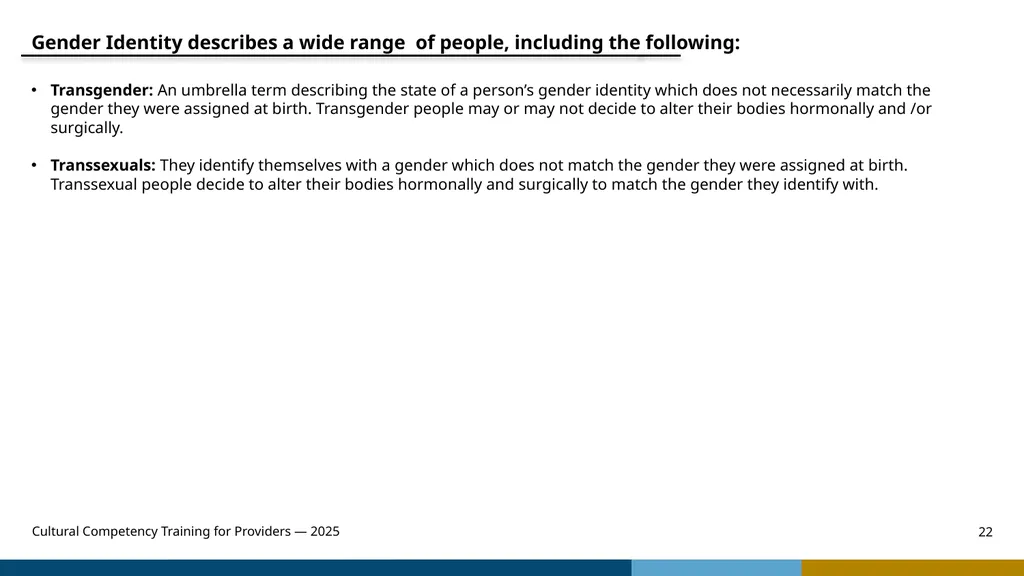
Cultural Competency Training for Providers — 2025 Transgender: An umbrella term describing the state of a person’s gender identity which does not necessarily match the gender they were assigned at birth. Transgender people may or may not decide to alter their bodies hormonally and /or surgically.
Transsexuals: They identify themselves with a gender which does not match the gender they were assigned at birth. Transsexual people decide to alter their bodies hormonally and surgically to match the gender they identify with. Gender Identity describes a wide range of people, including the following:<br>
Transsexuals: They identify themselves with a gender which does not match the gender they were assigned at birth. Transsexual people decide to alter their bodies hormonally and surgically to match the gender they identify with. Gender Identity describes a wide range of people, including the following:<br>
23
Cultural Competency Training for Providers — 2025 There are different reasons why LGBTT+ people may have difficulty accessing health care services, among those are: Discrimination and/or unnecessary expressions toward them.
In some cases, health care services could be denied to them, which can cause serious and catastrophic consequences to their health. Barriers when receiving health care services<br>
In some cases, health care services could be denied to them, which can cause serious and catastrophic consequences to their health. Barriers when receiving health care services<br>
24
Basic guidelines to handle with sensibility to the LGBTT+ population when they request health care related services<br>
25
Cultural Competency Training for Providers — 2025 Cultural Competence is about being respectful and receptive towards the beliefs, practices, and needs of the diverse groups of the population being able to interact effectively with the different groups that composed our society.
Diversity is what makes us unique. Which aspects are included on diversity? Race, color, religion, age, socio-economic status, sexual orientation, gender, identity, nationality, and disability among others. Cultural Competence and Sensibility<br>
Diversity is what makes us unique. Which aspects are included on diversity? Race, color, religion, age, socio-economic status, sexual orientation, gender, identity, nationality, and disability among others. Cultural Competence and Sensibility<br>
26
Cultural Competency Training for Providers — 2025 Respect diversity. Make others feels safe in a comfortable and open environment.
Treat others with courtesy.
Be inclusive, give equal services to all people without distinctions or discriminatory attitudes.
Listen carefully to all client’s needs, when they call or visit the office.
Go the extra mile when attending to the person.
Don’t promise what you can’t accomplish.
Be creative so you can be able to offer a good service, by making sure that you follow the established policies and procedures.
Use a simple, respectful and easy to understand language.
Use the words “Thank you”, “good morning” etc. when attending to people.
Avoid the use of slang.
Recognize each individual’s identity, listen to how the person refers to himself/herself/themselves. What can you do to render a service with sensibility?<br>
Treat others with courtesy.
Be inclusive, give equal services to all people without distinctions or discriminatory attitudes.
Listen carefully to all client’s needs, when they call or visit the office.
Go the extra mile when attending to the person.
Don’t promise what you can’t accomplish.
Be creative so you can be able to offer a good service, by making sure that you follow the established policies and procedures.
Use a simple, respectful and easy to understand language.
Use the words “Thank you”, “good morning” etc. when attending to people.
Avoid the use of slang.
Recognize each individual’s identity, listen to how the person refers to himself/herself/themselves. What can you do to render a service with sensibility?<br>
27
Cultural Competency Training for Providers — 2025 Do not make assumptions about people’s gender identity or sexual orientation.
Be flexible and nonjudgmental.
Familiarize with LGBTT+ concepts.
Do not ask unnecessary questions, ask yourself before asking any questions, if the requested information is important to provide health care services.
Keep in mind that different gender identity or sexual orientation expressions exist.
Do not demonstrate surprise or disapproval to an affiliate’s sexual orientation or gender identity. What can you do to render a service with sensibility? (Cont.)<br>
Be flexible and nonjudgmental.
Familiarize with LGBTT+ concepts.
Do not ask unnecessary questions, ask yourself before asking any questions, if the requested information is important to provide health care services.
Keep in mind that different gender identity or sexual orientation expressions exist.
Do not demonstrate surprise or disapproval to an affiliate’s sexual orientation or gender identity. What can you do to render a service with sensibility? (Cont.)<br>
28
Cultural Competency Training for Providers — 2025 When we create an environment free of discrimination, everything around us becomes more sensible and inclusive by making people feel more comfortable when asking for health care related services without any fear of being judged or rejected by others.
Health Network One, complies with applicable Federal civil rights laws and does not discriminate on the basis of race, color, national origin, age, disability, or sex. Cultural Competency's Mission<br>
Health Network One, complies with applicable Federal civil rights laws and does not discriminate on the basis of race, color, national origin, age, disability, or sex. Cultural Competency's Mission<br>
29
Cultural Competency Training for Providers — 2025 If a person believes that Health Network One. has failed to provide these services or discriminated in another way on the basis of race, color national origin, age, disability, or sex, you can file a grievance:
Quality Improvement Department: 305-614-0100 Ext. 4701
File an anonymous report
You can mail your report to: Pamela Owens, 2001 S. Andrews Avenue, Fort Lauderdale, Florida 33316
You can fax your report attention: Pamela Owens, Fax: 305-614-0364
You can email your report to: QI@healthnetworkone.com Reporting<br>
Quality Improvement Department: 305-614-0100 Ext. 4701
File an anonymous report
You can mail your report to: Pamela Owens, 2001 S. Andrews Avenue, Fort Lauderdale, Florida 33316
You can fax your report attention: Pamela Owens, Fax: 305-614-0364
You can email your report to: QI@healthnetworkone.com Reporting<br>
30
Cultural Competency Training for Providers — 2025 Weinick, R.M., Zuvekas, S.H., Cohen, J.W. (2000 ). Racial and ethnic differences in access and use of health care services, 1977-1996. Medical Care Research and Review, 57 (supplement 1), 36-54 .
Brach, C. & Fraserirector, I. (2000 ).Can cultural competency reduce racial and ethnic health disparities? A review and conceptual model. Medical Care Research and Review, 57 (supplement 1), 181-217.
National Standards for Culturally and Linguistically Appropriate Services in Health Care. (2001, March). Retrieved May 15 , 2005 , from http://www.omhrc.gov/omh/programs/2pgprograms/finalreport.pdf
Cross, T., Bazron, B., Dennis, K., & Isaacs, M. (1989). Towards a culturally competent system of care (Vol. 1). Washington, D.C.: Georgetown University Child Development Center, CASSP Technical Assistance Center.
Saha, S., Taggart, S. H., Komarony, M., & Bindman, A. B. (2000 ). Do patients choose physicians of their own race? Health Affairs, 19(4 ),
76-83.
Doutrich, Dawn and Marni Storey. “Education and Practice: Dynamic Partners for Improving Cultural Competence in Public Health.” Family Community Health, Vol. 27 , No. 4 , 2004 , pp. 298 - 307.
Joseph R. Betancourt, A. R. (2002). Cultural Competence In Health Care: Emerging Frameworks And Practical Approaches. Field Report, 1- 24 .
Gulliford, R. (2003 ). CDH S Research Foundation of SUNY BSC. Retrieved July 2016, from Emotional Intelligence: How Your Emotions Influence Your Life at Work and at Home: www.bsc-cdhs.org References<br>
Brach, C. & Fraserirector, I. (2000 ).Can cultural competency reduce racial and ethnic health disparities? A review and conceptual model. Medical Care Research and Review, 57 (supplement 1), 181-217.
National Standards for Culturally and Linguistically Appropriate Services in Health Care. (2001, March). Retrieved May 15 , 2005 , from http://www.omhrc.gov/omh/programs/2pgprograms/finalreport.pdf
Cross, T., Bazron, B., Dennis, K., & Isaacs, M. (1989). Towards a culturally competent system of care (Vol. 1). Washington, D.C.: Georgetown University Child Development Center, CASSP Technical Assistance Center.
Saha, S., Taggart, S. H., Komarony, M., & Bindman, A. B. (2000 ). Do patients choose physicians of their own race? Health Affairs, 19(4 ),
76-83.
Doutrich, Dawn and Marni Storey. “Education and Practice: Dynamic Partners for Improving Cultural Competence in Public Health.” Family Community Health, Vol. 27 , No. 4 , 2004 , pp. 298 - 307.
Joseph R. Betancourt, A. R. (2002). Cultural Competence In Health Care: Emerging Frameworks And Practical Approaches. Field Report, 1- 24 .
Gulliford, R. (2003 ). CDH S Research Foundation of SUNY BSC. Retrieved July 2016, from Emotional Intelligence: How Your Emotions Influence Your Life at Work and at Home: www.bsc-cdhs.org References<br>
31
Cultural Competency Training for Providers — 2025 Please send any questions to the Quality Team at QI@healthnetworkone.com Questions?<br>