Descartes trademark argument Michael Lacewing The trademark argument Descartes tries to prove that God exists just from the fact that we have a concept of GOD. This concept, which he argues is innate, is like a trademark that our creator
"Descartes’ trademark argument Michael Lacewing The" is the property of its rightful owner. Permission is granted to
download and print the materials on this website for personal, non-commercial use only, and to display it
on your personal computer provided you do not modify the materials and that you retain all copyright
notices contained in the materials. By downloading content from our website, you accept the terms of this
agreement.
Presentation Transcript
01
Descartes’ trademark argument Michael Lacewing<br>
02
The trademark argument Descartes tries to prove that God exists just from the fact that we have a concept of GOD.
This concept, which he argues is innate, is like a ‘trademark’ that our creator has stamped on our minds.<br>
03
The sources of ideas An idea can derive from something outside my mind, e.g. through sense perception.
I can invent ideas.
Ideas can be innate.
Where does the idea GOD originate?
Descartes’ argument uses some medieval metaphysics.<br>
04
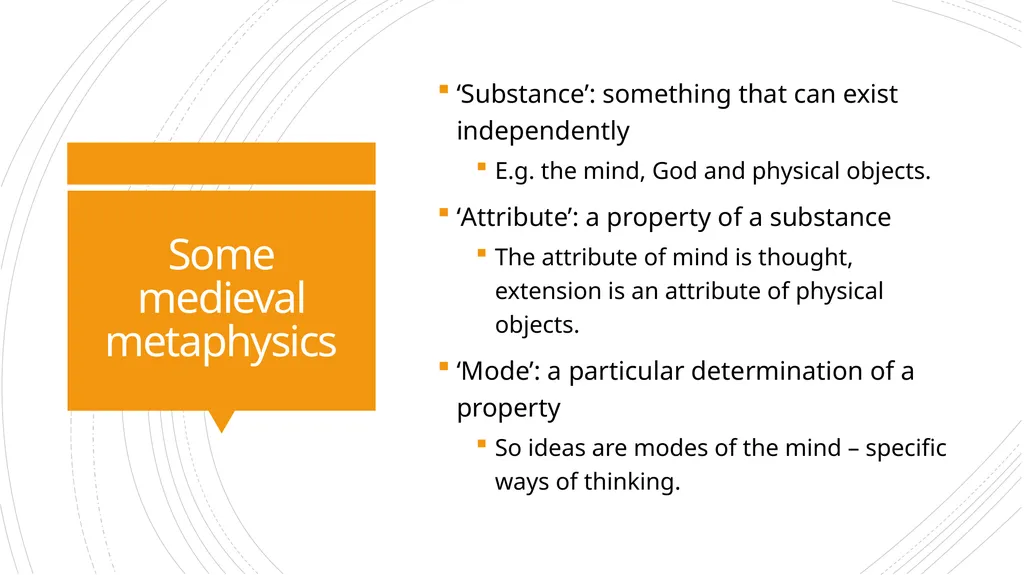
Some medieval metaphysics ‘Substance’: something that can exist independently
E.g. the mind, God and physical objects.
‘Attribute’: a property of a substance
The attribute of mind is thought, extension is an attribute of physical objects.
‘Mode’: a particular determination of a property
So ideas are modes of the mind – specific ways of thinking.<br>
05
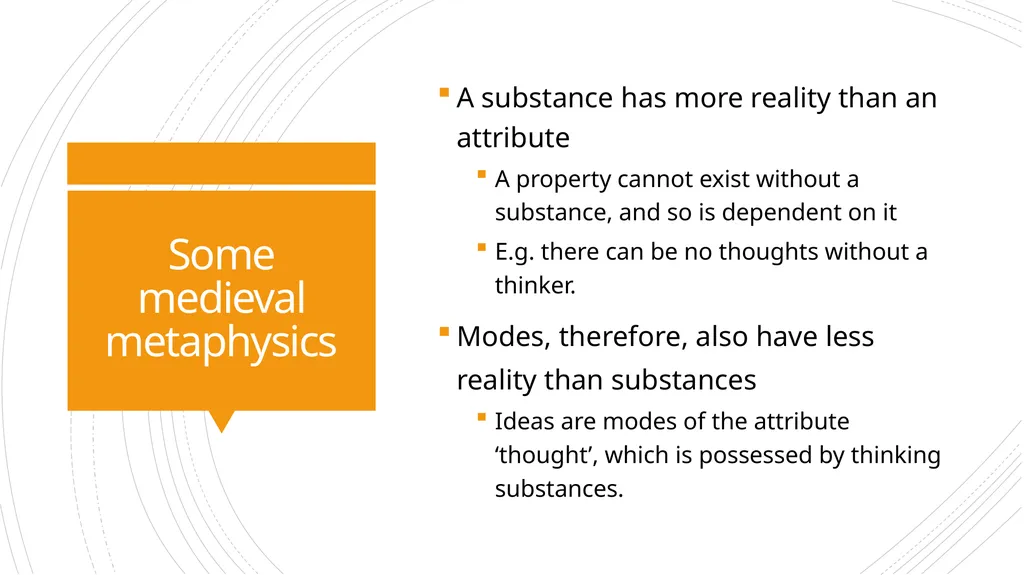
Some medieval metaphysics A substance has more reality than an attribute
A property cannot exist without a substance, and so is dependent on it
E.g. there can be no thoughts without a thinker.
Modes, therefore, also have less reality than substances
Ideas are modes of the attribute ‘thought’, which is possessed by thinking substances.<br>
06
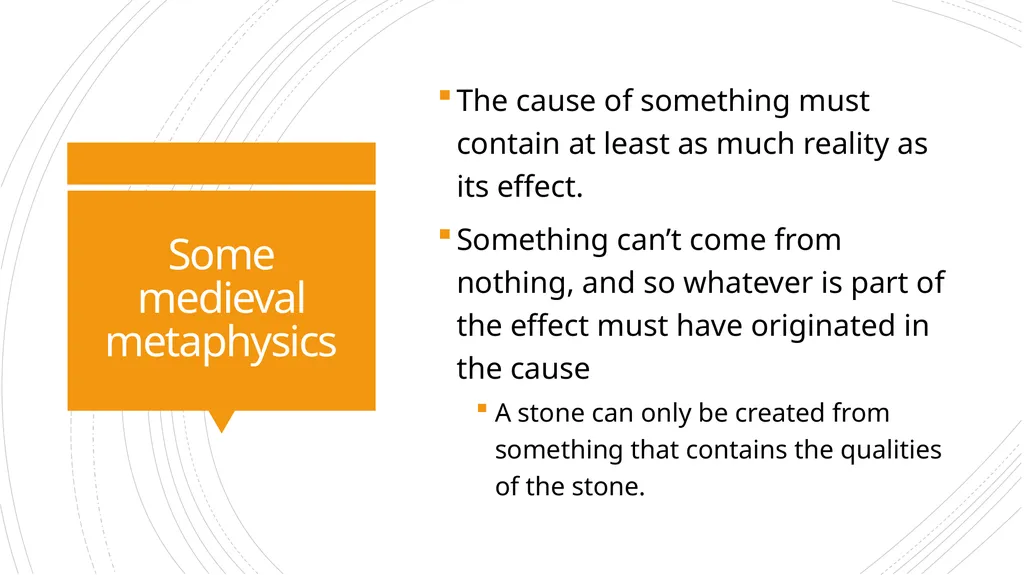
Some medieval metaphysics The cause of something must contain at least as much reality as its effect.
Something can’t come from nothing, and so whatever is part of the effect must have originated in the cause
A stone can only be created from something that contains the qualities of the stone.<br>
07
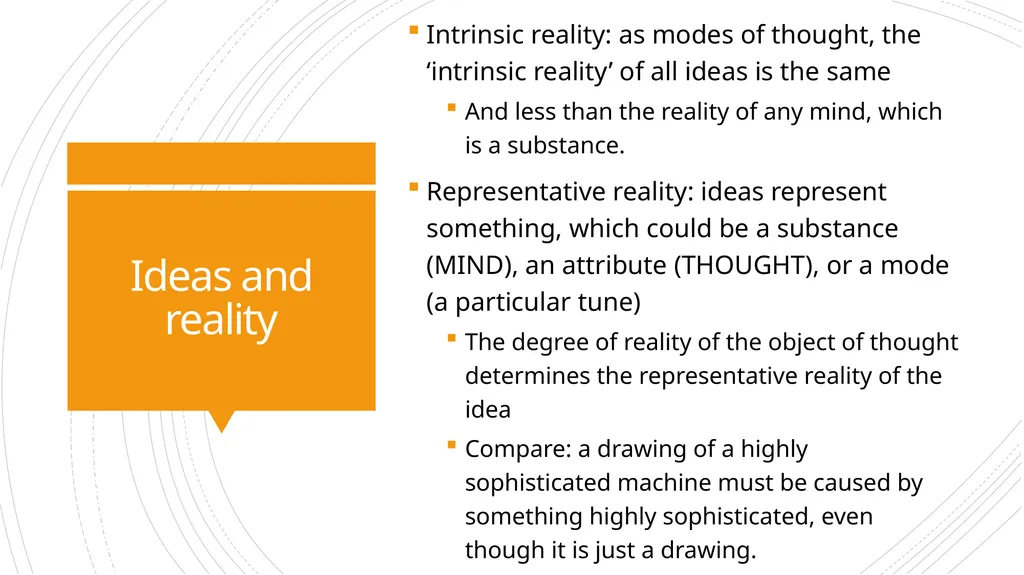
Ideas and reality Intrinsic reality: as modes of thought, the ‘intrinsic reality’ of all ideas is the same
And less than the reality of any mind, which is a substance.
Representative reality: ideas represent something, which could be a substance (MIND), an attribute (THOUGHT), or a mode (a particular tune)
The degree of reality of the object of thought determines the representative reality of the idea
Compare: a drawing of a highly sophisticated machine must be caused by something highly sophisticated, even though it is just a drawing.<br>
08
The idea of God The representative reality of the idea must derive from the cause of the idea
The cause of an idea must have as much reality as the representative reality of the idea.
GOD: an idea of a substance, so can’t my mind cause it?
No, because it is an idea of a substance that is infinite and perfect – which my mind is not
The representative reality of the concept GOD is greater than the reality of my mind.
Therefore, only God can cause the idea of God.<br>
09
The argument I have the concept GOD.
The concept GOD is a concept of something infinite and perfect (pp. 11–12).
As a mind, a thinking substance, I can think up (create) many ideas, including ideas of people and physical objects (pp. 13–14).
But I am finite, while the concept GOD is of something infinite (p. 14).
Therefore, it is a concept of something with more reality than my own mind.<br>
10
The argument The cause of the concept GOD must have as much reality as what the concept is of.
Therefore, my mind could not have created it.
The only possible cause is God.
Therefore, God exists.
We can also add that the idea doesn’t derive from the senses. Therefore, it is innate.<br>
11
God and infinity We can object that we can form the concept of GOD from experience by abstraction and negation
Infinite: not finite; perfect: not imperfect
(Negative concepts of infinity/perfection).
Reply: the concept of imperfection depends on the concept of perfection
We cannot recognize imperfection without a standard of perfection
(Positive concepts of infinity/perfection.)<br>
12
God and infinity PERFECTION and INFINITY are arguably challenging and unclear concepts
What is it, exactly, to think not merely of the absence of limits, but of something for which there could be no limits?
Descartes needs these concepts to be clear and distinct.<br>
13
Assumptions We can object to the claims that
All ideas have a cause
A cause must have as much reality as its effect.
Neither claim is analytic nor can experience show that they are universally true.
Unless we can establish these premises, the argument does not go through.<br>