
Design thinking for circular products Content Part
SN
Published · 57 slides · 0 views
1 / 1
Description
Design thinking for circular products Content Part 1: Design Thinking (45 minutes) What is Design Thinking? The principles of Design Thinking Part 2: Circular products (45 minutes) What is a circular product? Application of Design Thinking
Related Topics
Share
Embed code
Download this presentation From Below
"Design thinking for circular products Content Part" is the property of its rightful owner. Permission is granted to download and print the materials on this website for personal, non-commercial use only, and to display it on your personal computer provided you do not modify the materials and that you retain all copyright notices contained in the materials. By downloading content from our website, you accept the terms of this agreement.
Presentation Transcript
01
Design thinking for circular products<br>
02
Content Part 1: Design Thinking (45 minutes)
What is Design Thinking?
The principles of Design Thinking
Part 2: Circular products (45 minutes)
What is a circular product?
Application of Design Thinking for circular products
Makers and Design Thinking for circular products
Part 3: Workshop (150 minutes) ©Pixabay<br>
What is Design Thinking?
The principles of Design Thinking
Part 2: Circular products (45 minutes)
What is a circular product?
Application of Design Thinking for circular products
Makers and Design Thinking for circular products
Part 3: Workshop (150 minutes) ©Pixabay<br>
03
Part 1: Design Thinking<br>
04
What is Design Thinking anyway?<br>
05
What is Design Thinking anyway? Design thinking is a name given to the workflow of designers. The methodology and
principles of design thinking originates from academia where it was developed as early as
the 1970s by studying how designers work. The concept has become increasingly popular
over the last few decades.<br>
principles of design thinking originates from academia where it was developed as early as
the 1970s by studying how designers work. The concept has become increasingly popular
over the last few decades.<br>
06
What is Design Thinking anyway? The company Ideo was one of the first to promote design thinking as a concept. Tim Brown,
executive chair of Ideo, defines Design Thinking this way:
“Design thinking is a human-centered approach to innovation that draws from the designer’s
toolkit to integrate the needs of people, the possibilities of technology, and the requirements
for business success.”
This means design thinking is an approach, a way of thinking, a mindset when innovating.<br>
executive chair of Ideo, defines Design Thinking this way:
“Design thinking is a human-centered approach to innovation that draws from the designer’s
toolkit to integrate the needs of people, the possibilities of technology, and the requirements
for business success.”
This means design thinking is an approach, a way of thinking, a mindset when innovating.<br>
07
What is Design Thinking anyway? Design thinking is also a methodology for the creative process with some defined steps.
However, as Ideo notes on their web page, “There’s no one-size-fits-all methodology or set
approach to bringing new ideas in the world.“ The authors of the article “Designers in design
thinking” warn against diluting the role of the designer by reducing design thinking to a few
simple steps. They describe the designer as “the expert capable of navigating, managing
and leveraging opportunities from the creative challenge”, and point out that a designer’s
creative process “is iterative, messy, uncertain, and often leads to failed attempts and
frustration”.<br>
However, as Ideo notes on their web page, “There’s no one-size-fits-all methodology or set
approach to bringing new ideas in the world.“ The authors of the article “Designers in design
thinking” warn against diluting the role of the designer by reducing design thinking to a few
simple steps. They describe the designer as “the expert capable of navigating, managing
and leveraging opportunities from the creative challenge”, and point out that a designer’s
creative process “is iterative, messy, uncertain, and often leads to failed attempts and
frustration”.<br>
08
What is Design Thinking anyway? With that in mind, the objective of this course is not primarily focused on teaching design
thinking. Instead, it aims to draw on principles from design thinking to encourage reflection
on crafting more circular products.<br>
thinking. Instead, it aims to draw on principles from design thinking to encourage reflection
on crafting more circular products.<br>
09
The principles of Design Thinking<br>
10
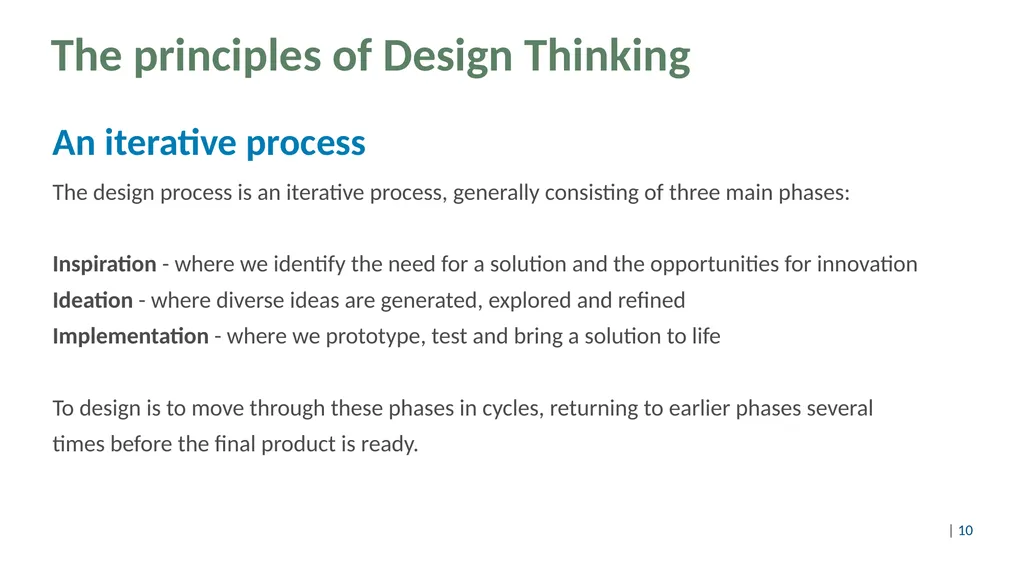
The principles of Design Thinking An iterative process The design process is an iterative process, generally consisting of three main phases:
Inspiration - where we identify the need for a solution and the opportunities for innovation
Ideation - where diverse ideas are generated, explored and refined
Implementation - where we prototype, test and bring a solution to life
To design is to move through these phases in cycles, returning to earlier phases several
times before the final product is ready.<br>
Inspiration - where we identify the need for a solution and the opportunities for innovation
Ideation - where diverse ideas are generated, explored and refined
Implementation - where we prototype, test and bring a solution to life
To design is to move through these phases in cycles, returning to earlier phases several
times before the final product is ready.<br>
11
The principles of Design Thinking Human-centered design An important aspect of design thinking is that it is human-centered.
In “The field guide to human-centered design”, Ideo writes:
“Being a human-centered designer is about believing that as long as you stay grounded in
what you’ve learned from people, your team can arrive at new solutions that the world
needs.”<br>
In “The field guide to human-centered design”, Ideo writes:
“Being a human-centered designer is about believing that as long as you stay grounded in
what you’ve learned from people, your team can arrive at new solutions that the world
needs.”<br>
12
The principles of Design Thinking To make the design process human-centered, they suggest beginning the creative process
by focusing on humans:
Inspiration - Observe their lives, hear their hopes and desires, learn to understand them
better
Ideation - Make sense of what you heard and from that generate tons of ideas for your
product
Implementation - Bring your solution to the market and maximize its impact in the world<br>
by focusing on humans:
Inspiration - Observe their lives, hear their hopes and desires, learn to understand them
better
Ideation - Make sense of what you heard and from that generate tons of ideas for your
product
Implementation - Bring your solution to the market and maximize its impact in the world<br>
13
The principles of Design Thinking The field guide explains that human-centered designers always start from the place of not
knowing the answer to the problem they’re looking to solve. This approach can be
uncomfortable, but it makes us listen to others and it promotes creativity.<br>
knowing the answer to the problem they’re looking to solve. This approach can be
uncomfortable, but it makes us listen to others and it promotes creativity.<br>
14
The five phases of Design Thinking<br>
15
The five phases of Design Thinking The Interaction Design Foundation further delves into the innovation process in the article
“Five phases of design thinking.” This is a non-linear, iterative process, and the phases can
be revisited many times, in parallel and in any order. The five stages are defined as:
Stage 1: Empathize—Research Your Users' Needs Stage 2: Define—State Your Users' Needs and Problems Stage 3: Ideate—Challenge Assumptions and Create Ideas Stage 4: Prototype—Start to Create Solutions Stage 5: Test—Try Your Solutions Out<br>
“Five phases of design thinking.” This is a non-linear, iterative process, and the phases can
be revisited many times, in parallel and in any order. The five stages are defined as:
Stage 1: Empathize—Research Your Users' Needs Stage 2: Define—State Your Users' Needs and Problems Stage 3: Ideate—Challenge Assumptions and Create Ideas Stage 4: Prototype—Start to Create Solutions Stage 5: Test—Try Your Solutions Out<br>
16
The five phases of Design Thinking Stage 1: Empathize—Research Your Users' Needs The goal in this phase is to set aside your own assumptions, and gain real insight into users
and their needs. Consult experts and observe and engage with your users. You may also
want to immerse yourself in your users’ physical environment to get a better understanding
of their challenges.<br>
and their needs. Consult experts and observe and engage with your users. You may also
want to immerse yourself in your users’ physical environment to get a better understanding
of their challenges.<br>
17
The five phases of Design Thinking Stage 2: Define—State Your Users' Needs and Problems Analyze and organize the information you gathered in the Empathize stage. Define the core
problem. This must be done in a human-centered manner, based on your end user’s
experiences and needs.<br>
problem. This must be done in a human-centered manner, based on your end user’s
experiences and needs.<br>
18
The five phases of Design Thinking Stage 3: Ideate—Challenge Assumptions and Create Ideas Look at the problem from different perspectives. Come up with ideas to solve the problem.
Use your favorite techniques to stimulate free thinking, and generate as many ideas as
possible. Then choose the best ideas to move forward with.<br>
Use your favorite techniques to stimulate free thinking, and generate as many ideas as
possible. Then choose the best ideas to move forward with.<br>
19
The five phases of Design Thinking Stage 4: Prototype—Start to Create Solutions Prototype the product or the features of the product that can solve the problem. Prototypes
are inexpensive, scaled-down versions of the product or product feature, and you can make
a number of them. This is an experimental phase. The aim is to identify the best possible
solution for the problems identified in the earlier stages.<br>
are inexpensive, scaled-down versions of the product or product feature, and you can make
a number of them. This is an experimental phase. The aim is to identify the best possible
solution for the problems identified in the earlier stages.<br>
20
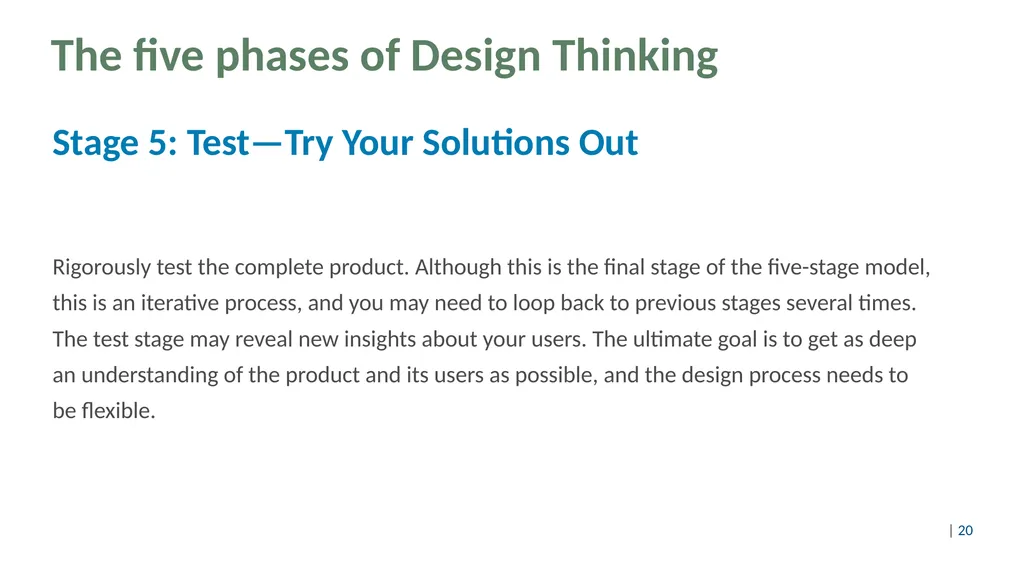
The five phases of Design Thinking Stage 5: Test—Try Your Solutions Out Rigorously test the complete product. Although this is the final stage of the five-stage model,
this is an iterative process, and you may need to loop back to previous stages several times.
The test stage may reveal new insights about your users. The ultimate goal is to get as deep
an understanding of the product and its users as possible, and the design process needs to
be flexible.<br>
this is an iterative process, and you may need to loop back to previous stages several times.
The test stage may reveal new insights about your users. The ultimate goal is to get as deep
an understanding of the product and its users as possible, and the design process needs to
be flexible.<br>
21
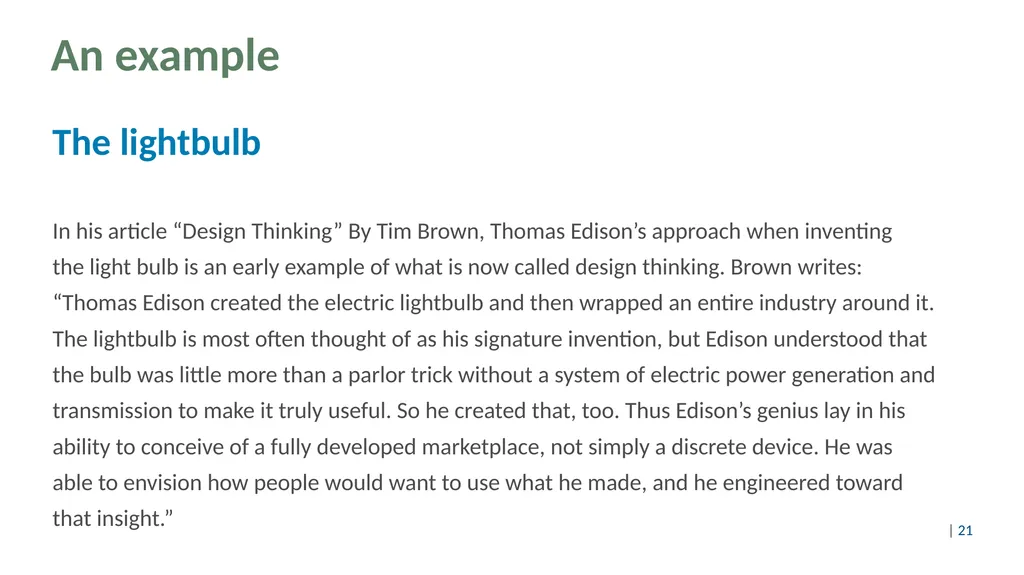
An example The lightbulb In his article “Design Thinking” By Tim Brown, Thomas Edison’s approach when inventing
the light bulb is an early example of what is now called design thinking. Brown writes:
“Thomas Edison created the electric lightbulb and then wrapped an entire industry around it.
The lightbulb is most often thought of as his signature invention, but Edison understood that
the bulb was little more than a parlor trick without a system of electric power generation and
transmission to make it truly useful. So he created that, too. Thus Edison’s genius lay in his
ability to conceive of a fully developed marketplace, not simply a discrete device. He was
able to envision how people would want to use what he made, and he engineered toward
that insight.”<br>
the light bulb is an early example of what is now called design thinking. Brown writes:
“Thomas Edison created the electric lightbulb and then wrapped an entire industry around it.
The lightbulb is most often thought of as his signature invention, but Edison understood that
the bulb was little more than a parlor trick without a system of electric power generation and
transmission to make it truly useful. So he created that, too. Thus Edison’s genius lay in his
ability to conceive of a fully developed marketplace, not simply a discrete device. He was
able to envision how people would want to use what he made, and he engineered toward
that insight.”<br>
22
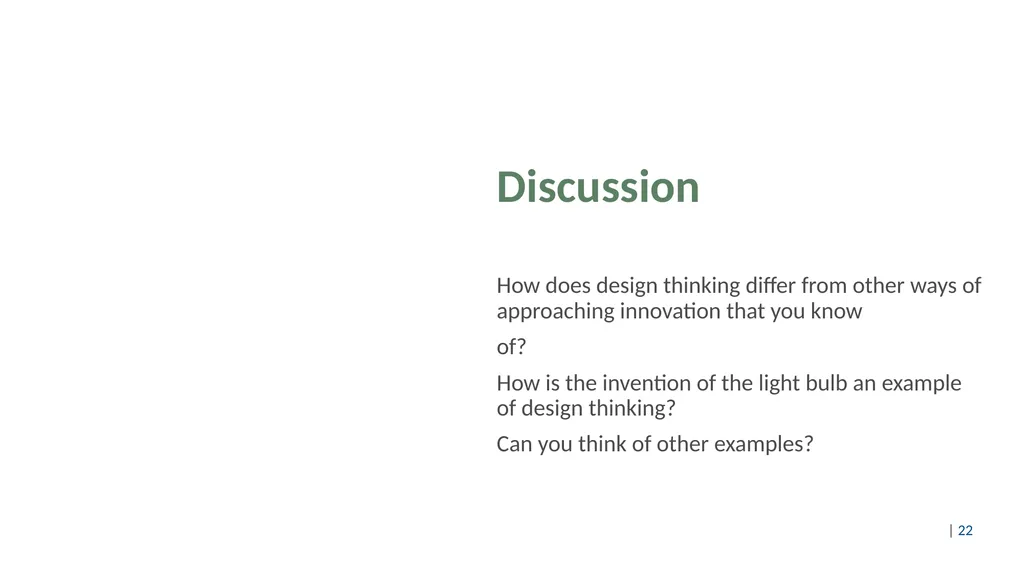
Discussion How does design thinking differ from other ways of approaching innovation that you know
of?
How is the invention of the light bulb an example of design thinking?
Can you think of other examples?<br>
of?
How is the invention of the light bulb an example of design thinking?
Can you think of other examples?<br>
23
Part 2: Circular products<br>
24
What is a circular product?<br>
25
What is a circular product? A circular product refers to a product designed and produced with the principles of a circular
economy in mind. The concept of a circular economy is an alternative to the traditional linear
economy, which follows a "take, make, dispose" model. Products for a circular economy are
designed to be more durable, repairable, and recyclable, and to reduce their environmental
impact.
Of course, by this definition circular products are nothing new. Planned obsolescence is a
term used to describe the phenomenon where products are sometimes deliberately
designed with a limited lifespan to encourage frequent replacement, where in the past
products were often built to last.<br>
economy in mind. The concept of a circular economy is an alternative to the traditional linear
economy, which follows a "take, make, dispose" model. Products for a circular economy are
designed to be more durable, repairable, and recyclable, and to reduce their environmental
impact.
Of course, by this definition circular products are nothing new. Planned obsolescence is a
term used to describe the phenomenon where products are sometimes deliberately
designed with a limited lifespan to encourage frequent replacement, where in the past
products were often built to last.<br>
26
What is a circular product? This practice can be driven solely by profit motives, wherein a durable product that once
satisfied consumers is replaced to prompt them to spend more on something with a shorter
lifespan. At times, it stems from the prevailing consumer mindset, which has become
accustomed to and seeks new technology and innovations. This inclination, in turn,
influences the market to produce less durable items, anticipating that they will be replaced
within a relatively brief timeframe.<br>
satisfied consumers is replaced to prompt them to spend more on something with a shorter
lifespan. At times, it stems from the prevailing consumer mindset, which has become
accustomed to and seeks new technology and innovations. This inclination, in turn,
influences the market to produce less durable items, anticipating that they will be replaced
within a relatively brief timeframe.<br>
27
An example A different lightbulb In 2014, IEEE Spectrum, the world’s leading engineering magazine published an article by
Markus Krajewski with the intriguing headline: “The great lightbulb conspiracy”.
It lays out how the Phoebus cartel engineered a shorter-lived lightbulb and gave birth to
planned obsolescence.<br>
Markus Krajewski with the intriguing headline: “The great lightbulb conspiracy”.
It lays out how the Phoebus cartel engineered a shorter-lived lightbulb and gave birth to
planned obsolescence.<br>
28
An example A different lightbulb Krajewski writes:
“The cartel’s grip on the lightbulb market lasted only into the 1930s. Its far more enduring
legacy was to engineer a shorter life span for the incandescent lightbulb. By early 1925, this
became codified at 1,000 hours for a pear-shaped household bulb, a marked reduction from
the 1,500 to 2,000 hours that had previously been common. Cartel members rationalized this
approach as a trade-off: Their lightbulbs were of a higher quality, more efficient, and brighter
burning than other bulbs. They also cost a lot more. Indeed, all evidence points to the
cartel’s being motivated by profits and increased sales, not by what was best for the
consumer. In carefully crafting a lightbulb with a relatively short life span, the cartel thus
hatched the industrial strategy now known as planned obsolescence.”<br>
“The cartel’s grip on the lightbulb market lasted only into the 1930s. Its far more enduring
legacy was to engineer a shorter life span for the incandescent lightbulb. By early 1925, this
became codified at 1,000 hours for a pear-shaped household bulb, a marked reduction from
the 1,500 to 2,000 hours that had previously been common. Cartel members rationalized this
approach as a trade-off: Their lightbulbs were of a higher quality, more efficient, and brighter
burning than other bulbs. They also cost a lot more. Indeed, all evidence points to the
cartel’s being motivated by profits and increased sales, not by what was best for the
consumer. In carefully crafting a lightbulb with a relatively short life span, the cartel thus
hatched the industrial strategy now known as planned obsolescence.”<br>
29
Circular products and the EU<br>
30
Circular products and the EU The European Commission intends to make sustainable products the new norm in the EU.
They want products to last longer, use energy and resources more efficiently, be easier to
repair and recycle, contain fewer substances of concern and include more recycled content.<br>
They want products to last longer, use energy and resources more efficiently, be easier to
repair and recycle, contain fewer substances of concern and include more recycled content.<br>
31
Circular products and the EU Of special importance is the aim to boost circularity, and the EU Ecodesign requirements
cover:
● product durability, reusability, upgradability, and repairability
● presence of chemical substances that inhibit reuse and recycling of materials
● energy and resource efficiency
● recycled content
● carbon and environmental footprints
● available product information, in particular a Digital Product Passport<br>
cover:
● product durability, reusability, upgradability, and repairability
● presence of chemical substances that inhibit reuse and recycling of materials
● energy and resource efficiency
● recycled content
● carbon and environmental footprints
● available product information, in particular a Digital Product Passport<br>
32
Application of Design Thinking for circular products<br>
33
Application of Design Thinking for circular products In designing circular products through the lens of design thinking, our goal is to employ a
human-centered creation process to develop a solution for their problems, while ensuring
that the resulting products are sustainable.
Some key considerations in the design phases may include:<br>
human-centered creation process to develop a solution for their problems, while ensuring
that the resulting products are sustainable.
Some key considerations in the design phases may include:<br>
34
Application of Design Thinking for circular products Stage 1: Empathize—Research Your Users' Needs As you research the users’ needs, take the broader ecological impact into consideration.
How long do they expect to use the product? What are their preferences regarding
eco-friendly materials? If they do not plan to keep the product for a long time, what will
happen to it? Who will the next users be - are you designing for them as well?<br>
How long do they expect to use the product? What are their preferences regarding
eco-friendly materials? If they do not plan to keep the product for a long time, what will
happen to it? Who will the next users be - are you designing for them as well?<br>
35
Application of Design Thinking for circular products Stage 2: Define—State Your Users' Needs and Problems In addition to stating your users’ needs in a human-centered way, based on your research
describe the broader ecological impact you expect the solution’s product to have.<br>
describe the broader ecological impact you expect the solution’s product to have.<br>
36
Application of Design Thinking for circular products Stage 3: Ideate—Challenge Assumptions and Create Ideas Come up with different ideas to solve the problem. When you sort through your ideas in
preparation for the prototyping phase, choose to go forward with the ones that both solve the
users’ problems and that show most promise in resulting in sustainable products. Do you
have any ideas on how to make the product more energy and material effective? How can
the product be designed to make it easier to recycle? Can it be designed with future
upgrades in mind to make the product in the future to make it last longer? What attributes
would make the product easier to repair?<br>
preparation for the prototyping phase, choose to go forward with the ones that both solve the
users’ problems and that show most promise in resulting in sustainable products. Do you
have any ideas on how to make the product more energy and material effective? How can
the product be designed to make it easier to recycle? Can it be designed with future
upgrades in mind to make the product in the future to make it last longer? What attributes
would make the product easier to repair?<br>
37
Application of Design Thinking for circular products Stage 4: Prototype—Start to Create Solutions In this experimental phase, are there ways to create prototypes that can make the product
more sustainable, for example through reuse or choosing more durable materials?<br>
more sustainable, for example through reuse or choosing more durable materials?<br>
38
Application of Design Thinking for circular products Stage 5: Test—Try Your Solutions Out Test the products rigorously. The goal is to get a greater awareness of whether the solution
solves your users’ problems as well as a better understanding of this products’ ecological
impact. Let both be a consideration before deciding on a solution to go forward with, and
remember that this is an iterative process.<br>
solves your users’ problems as well as a better understanding of this products’ ecological
impact. Let both be a consideration before deciding on a solution to go forward with, and
remember that this is an iterative process.<br>
39
Makers and design thinking for circular products<br>
40
Makers and design thinking for circular products Makers often have a different approach than designers. Problems don't necessarily stem
from the same sources as those in a commercial setting. While the goal in a profit-oriented
context often aligns the origins of problems, makers have a different incentive or lack thereof
that propels them. Let us consider a general difference between designers and engineers as
follows:
Designer = Form over function (or at least biased toward form)
Engineer = Function over form (or at least biased toward function)<br>
from the same sources as those in a commercial setting. While the goal in a profit-oriented
context often aligns the origins of problems, makers have a different incentive or lack thereof
that propels them. Let us consider a general difference between designers and engineers as
follows:
Designer = Form over function (or at least biased toward form)
Engineer = Function over form (or at least biased toward function)<br>
41
Makers and design thinking for circular products Makers are simply defined as someone who makes things. They can come from any
background, and pop up anywhere in the process. A maker sometimes lean more towards
the design/form side of the creation process, and sometimes more towards the
engineer/function-side.
Makers tend to encounter very localized problems, applicable only to them and a handful of
others. These are often issues that wouldn't make sense as a business venture, but the
maker finds satisfaction in solving them.<br>
background, and pop up anywhere in the process. A maker sometimes lean more towards
the design/form side of the creation process, and sometimes more towards the
engineer/function-side.
Makers tend to encounter very localized problems, applicable only to them and a handful of
others. These are often issues that wouldn't make sense as a business venture, but the
maker finds satisfaction in solving them.<br>
42
Makers and design thinking for circular products An example can be that the maker has several tools or items, and wants to create handles,
hangers and/or organizers for them.
Another example can be when a maker prints a spare part on a 3D printer and uses it to
repair a broken appliance.<br>
hangers and/or organizers for them.
Another example can be when a maker prints a spare part on a 3D printer and uses it to
repair a broken appliance.<br>
43
Makers and design thinking for circular products There are also instances where problems for makers manifest like this:
"I ended up with three pallets of this thing for some reason. What can I solve with this?"
Here the maker’s creative process begins when the maker decides to turn the waste material
into something useful. This is a step in a bigger, circular process, since the waste material
reached the end of a different process before it ended up in the maker’s hands.<br>
"I ended up with three pallets of this thing for some reason. What can I solve with this?"
Here the maker’s creative process begins when the maker decides to turn the waste material
into something useful. This is a step in a bigger, circular process, since the waste material
reached the end of a different process before it ended up in the maker’s hands.<br>
44
Makers and design thinking for circular products In an ideal world, the market will provide the environment where these processes
self-improve both internally and in relation to each other. If for example a company creates
products that have parts that can be reused with some work, another person or company
can use these parts to create different products. With awareness, the first company can
ensure that the parts are easily recyclable.<br>
self-improve both internally and in relation to each other. If for example a company creates
products that have parts that can be reused with some work, another person or company
can use these parts to create different products. With awareness, the first company can
ensure that the parts are easily recyclable.<br>
45
Discussion A maker in a prototype workshop is often not focused on creating commercial products, but on solving specific problems, for example related to extending a product’s lifetime. Which aspects of the design thinking process can be valuable for a maker?
What are some examples of eco-friendly products with a great design?<br>
What are some examples of eco-friendly products with a great design?<br>
46
Discussion What are some products that are not generally eco-friendly today, that you think could be with better design?
When creating new products for our society, to what extent do you think the users’ needs will align with the eco-friendliness of a product, and to what extent do you think they will clash?<br>
When creating new products for our society, to what extent do you think the users’ needs will align with the eco-friendliness of a product, and to what extent do you think they will clash?<br>
47
Part 3: Workshop<br>
48
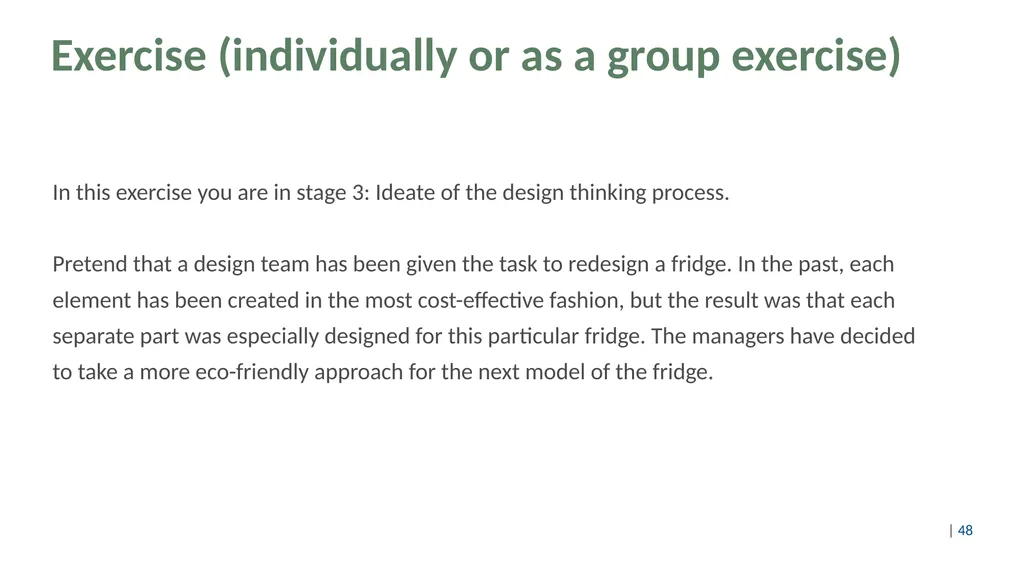
Exercise (individually or as a group exercise) In this exercise you are in stage 3: Ideate of the design thinking process.
Pretend that a design team has been given the task to redesign a fridge. In the past, each
element has been created in the most cost-effective fashion, but the result was that each
separate part was especially designed for this particular fridge. The managers have decided
to take a more eco-friendly approach for the next model of the fridge.<br>
Pretend that a design team has been given the task to redesign a fridge. In the past, each
element has been created in the most cost-effective fashion, but the result was that each
separate part was especially designed for this particular fridge. The managers have decided
to take a more eco-friendly approach for the next model of the fridge.<br>
49
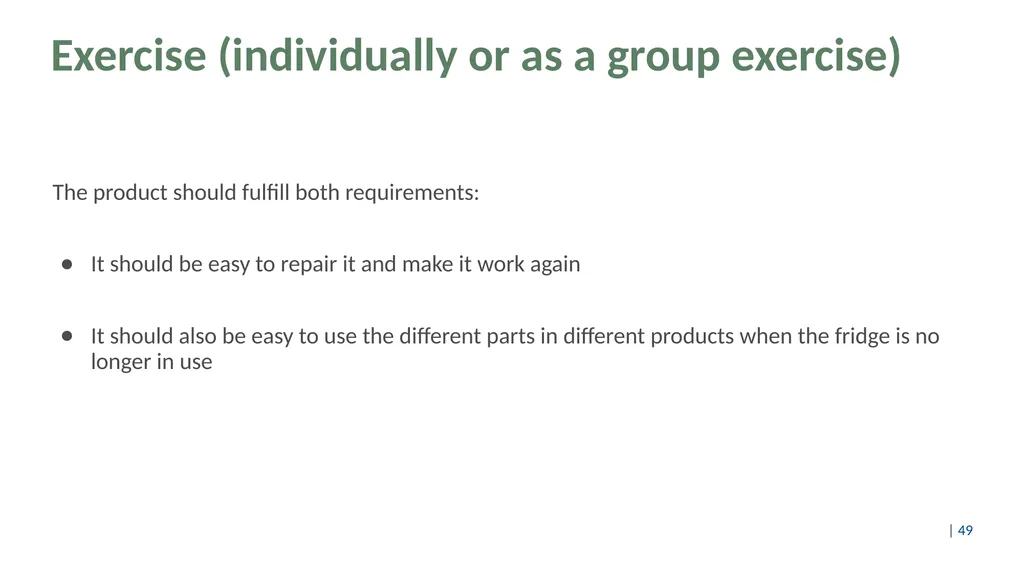
Exercise (individually or as a group exercise) The product should fulfill both requirements:
It should be easy to repair it and make it work again
It should also be easy to use the different parts in different products when the fridge is no longer in use<br>
It should be easy to repair it and make it work again
It should also be easy to use the different parts in different products when the fridge is no longer in use<br>
50
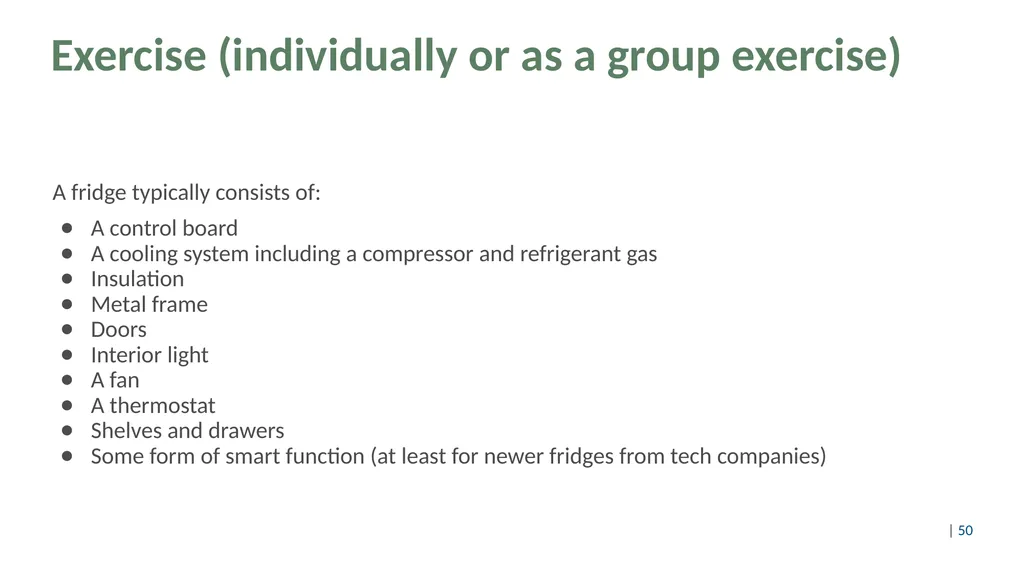
Exercise (individually or as a group exercise) A fridge typically consists of:
A control board
A cooling system including a compressor and refrigerant gas
Insulation
Metal frame
Doors
Interior light
A fan
A thermostat
Shelves and drawers
Some form of smart function (at least for newer fridges from tech companies)<br>
A control board
A cooling system including a compressor and refrigerant gas
Insulation
Metal frame
Doors
Interior light
A fan
A thermostat
Shelves and drawers
Some form of smart function (at least for newer fridges from tech companies)<br>
51
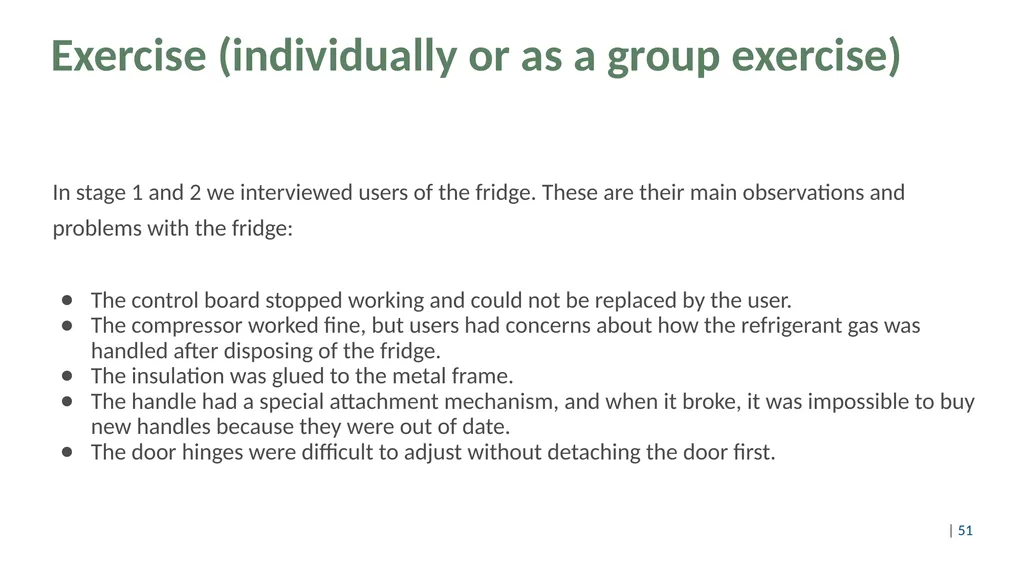
Exercise (individually or as a group exercise) In stage 1 and 2 we interviewed users of the fridge. These are their main observations and
problems with the fridge:
The control board stopped working and could not be replaced by the user.
The compressor worked fine, but users had concerns about how the refrigerant gas was handled after disposing of the fridge.
The insulation was glued to the metal frame.
The handle had a special attachment mechanism, and when it broke, it was impossible to buy new handles because they were out of date.
The door hinges were difficult to adjust without detaching the door first.<br>
problems with the fridge:
The control board stopped working and could not be replaced by the user.
The compressor worked fine, but users had concerns about how the refrigerant gas was handled after disposing of the fridge.
The insulation was glued to the metal frame.
The handle had a special attachment mechanism, and when it broke, it was impossible to buy new handles because they were out of date.
The door hinges were difficult to adjust without detaching the door first.<br>
52
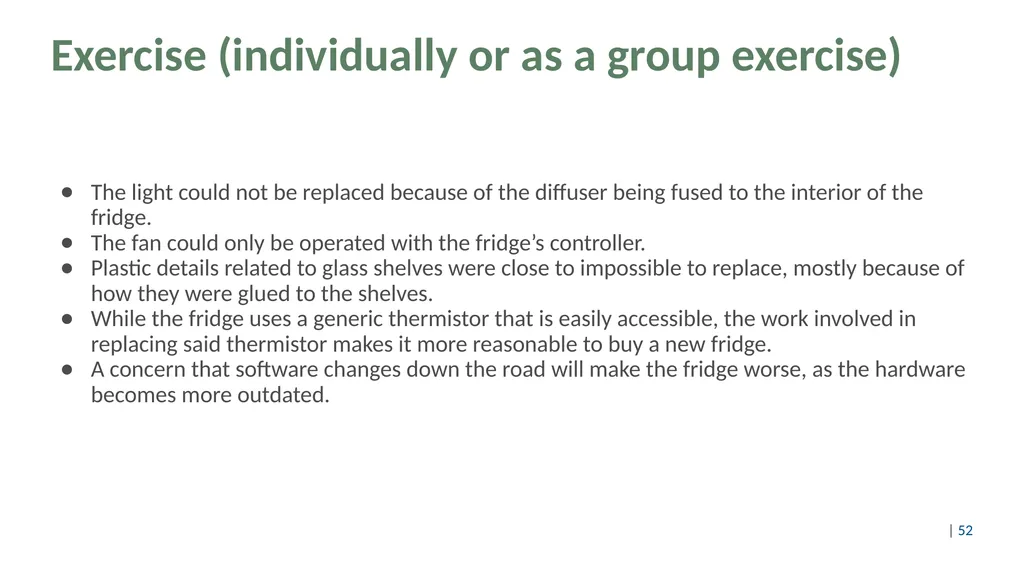
Exercise (individually or as a group exercise) The light could not be replaced because of the diffuser being fused to the interior of the fridge.
The fan could only be operated with the fridge’s controller.
Plastic details related to glass shelves were close to impossible to replace, mostly because of how they were glued to the shelves.
While the fridge uses a generic thermistor that is easily accessible, the work involved in replacing said thermistor makes it more reasonable to buy a new fridge.
A concern that software changes down the road will make the fridge worse, as the hardware becomes more outdated.<br>
The fan could only be operated with the fridge’s controller.
Plastic details related to glass shelves were close to impossible to replace, mostly because of how they were glued to the shelves.
While the fridge uses a generic thermistor that is easily accessible, the work involved in replacing said thermistor makes it more reasonable to buy a new fridge.
A concern that software changes down the road will make the fridge worse, as the hardware becomes more outdated.<br>
53
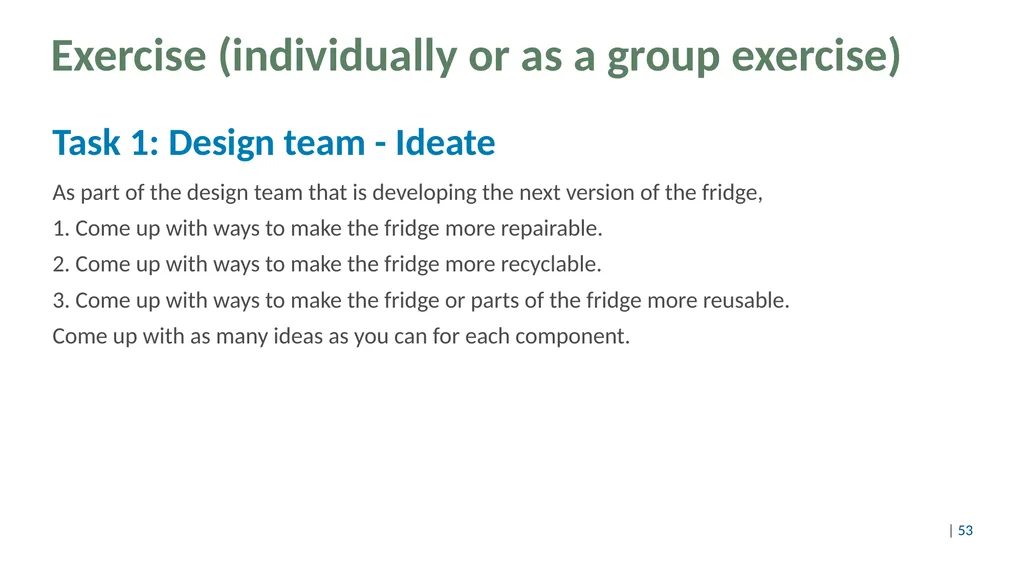
Exercise (individually or as a group exercise) Task 1: Design team - Ideate As part of the design team that is developing the next version of the fridge,
1. Come up with ways to make the fridge more repairable.
2. Come up with ways to make the fridge more recyclable.
3. Come up with ways to make the fridge or parts of the fridge more reusable.
Come up with as many ideas as you can for each component.<br>
1. Come up with ways to make the fridge more repairable.
2. Come up with ways to make the fridge more recyclable.
3. Come up with ways to make the fridge or parts of the fridge more reusable.
Come up with as many ideas as you can for each component.<br>
54
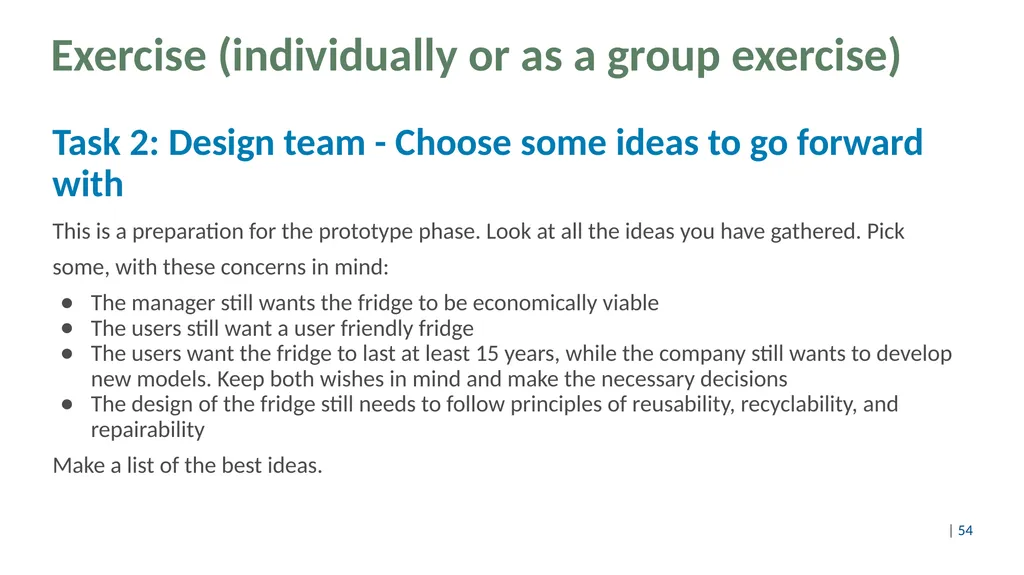
Exercise (individually or as a group exercise) Task 2: Design team - Choose some ideas to go forward with This is a preparation for the prototype phase. Look at all the ideas you have gathered. Pick
some, with these concerns in mind:
The manager still wants the fridge to be economically viable
The users still want a user friendly fridge
The users want the fridge to last at least 15 years, while the company still wants to develop new models. Keep both wishes in mind and make the necessary decisions
The design of the fridge still needs to follow principles of reusability, recyclability, and repairability
Make a list of the best ideas.<br>
some, with these concerns in mind:
The manager still wants the fridge to be economically viable
The users still want a user friendly fridge
The users want the fridge to last at least 15 years, while the company still wants to develop new models. Keep both wishes in mind and make the necessary decisions
The design of the fridge still needs to follow principles of reusability, recyclability, and repairability
Make a list of the best ideas.<br>
55
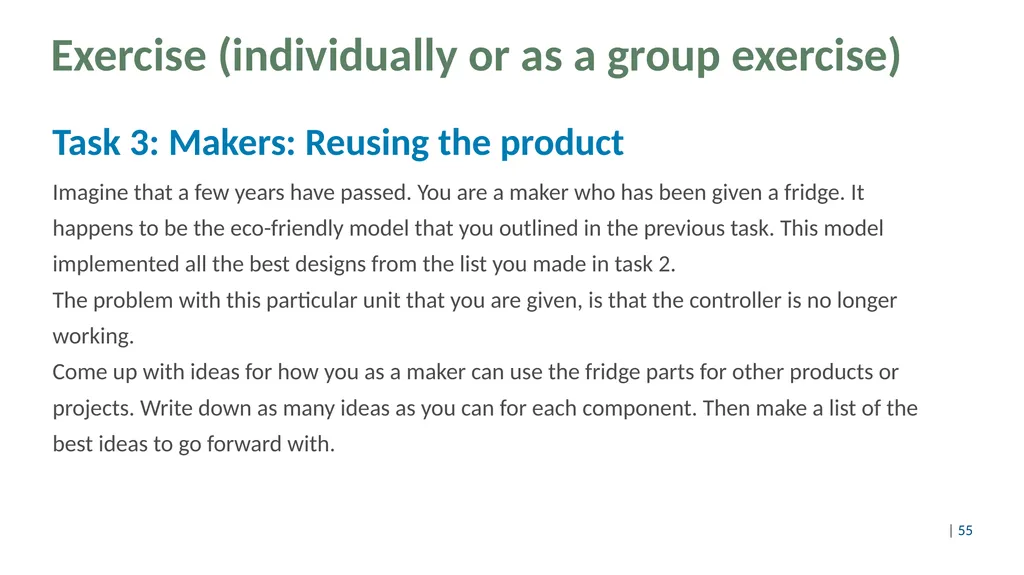
Exercise (individually or as a group exercise) Task 3: Makers: Reusing the product Imagine that a few years have passed. You are a maker who has been given a fridge. It
happens to be the eco-friendly model that you outlined in the previous task. This model
implemented all the best designs from the list you made in task 2.
The problem with this particular unit that you are given, is that the controller is no longer
working.
Come up with ideas for how you as a maker can use the fridge parts for other products or
projects. Write down as many ideas as you can for each component. Then make a list of the
best ideas to go forward with.<br>
happens to be the eco-friendly model that you outlined in the previous task. This model
implemented all the best designs from the list you made in task 2.
The problem with this particular unit that you are given, is that the controller is no longer
working.
Come up with ideas for how you as a maker can use the fridge parts for other products or
projects. Write down as many ideas as you can for each component. Then make a list of the
best ideas to go forward with.<br>
56
Exercise (individually or as a group exercise) Task 4 (optional, if you have time): Begin the prototype phase Choose one of the ideas from task 2-3 and start making a sketch for the prototype phase.<br>
57
Resources Ideo’s web page on design thinking: https://designthinking.ideo.com/
“Design Thinking” by Tim Brown: https://hbr.org/2008/06/design-thinking
(Free to read: https://designthinkingmeite.web.unc.edu/wp-content/uploads/sites/22337/2020/02/Tim-Brown-Design-Thinking.pdf )
The Field Guide to Human Centered Design by Ideo: https://design-kit-production.s3.us-west-1.amazonaws.com/Field_Guides/Field+Guide+to+Human-Centered+Design_IDEOorg_English.pdf
“What is design thinking?” by the Interaction Design Foundation https://www.interaction-design.org/literature/article/what-is-design-thinking-and-why-is-it-so-popular
“The five stages in the Design Thinking process” by Rikke Friis-Dam / the Interaction Design Foundation
https://www.interaction-design.org/literature/article/5-stages-in-the-design-thinking-process
Course on design thinking by University of North Carolina at Chapel Hill https://designthinkingmeite.web.unc.edu/
“Designers in design thinking” INTERNATIONAL CONFERENCE ON ENGINEERING AND PRODUCT DESIGN EDUCATION 4 & 5 SEPTEMBER 2014, UNIVERSITY OF TWENTE, THE NETHERLANDS DESIGNERS IN DESIGN THINKING Erika BRAUN, Jessica MORELAND, Emma SANDERS and Carolina GILL The Ohio State University, Department of Design
https://www.designsociety.org/publication/35899/Designers+in+Design+Thinking
Press release from the European Commission: “Commission welcomes provisional agreement for more sustainable repairable and circular products” https://ec.europa.eu/commission/presscorner/detail/en/ip_23_6257
“The great lightbulb conspiracy” by Markus Krajewski, 2014 https://spectrum.ieee.org/the-great-lightbulb-conspiracy
The circular design guide by Ideo: https://www.circulardesignguide.com/
“Design and the circular economy - deep dive” by the Ellen MacArthur Foundation https://www.ellenmacarthurfoundation.org/design-and-the-circular-economy-deep-dive ©Pixabay<br>
“Design Thinking” by Tim Brown: https://hbr.org/2008/06/design-thinking
(Free to read: https://designthinkingmeite.web.unc.edu/wp-content/uploads/sites/22337/2020/02/Tim-Brown-Design-Thinking.pdf )
The Field Guide to Human Centered Design by Ideo: https://design-kit-production.s3.us-west-1.amazonaws.com/Field_Guides/Field+Guide+to+Human-Centered+Design_IDEOorg_English.pdf
“What is design thinking?” by the Interaction Design Foundation https://www.interaction-design.org/literature/article/what-is-design-thinking-and-why-is-it-so-popular
“The five stages in the Design Thinking process” by Rikke Friis-Dam / the Interaction Design Foundation
https://www.interaction-design.org/literature/article/5-stages-in-the-design-thinking-process
Course on design thinking by University of North Carolina at Chapel Hill https://designthinkingmeite.web.unc.edu/
“Designers in design thinking” INTERNATIONAL CONFERENCE ON ENGINEERING AND PRODUCT DESIGN EDUCATION 4 & 5 SEPTEMBER 2014, UNIVERSITY OF TWENTE, THE NETHERLANDS DESIGNERS IN DESIGN THINKING Erika BRAUN, Jessica MORELAND, Emma SANDERS and Carolina GILL The Ohio State University, Department of Design
https://www.designsociety.org/publication/35899/Designers+in+Design+Thinking
Press release from the European Commission: “Commission welcomes provisional agreement for more sustainable repairable and circular products” https://ec.europa.eu/commission/presscorner/detail/en/ip_23_6257
“The great lightbulb conspiracy” by Markus Krajewski, 2014 https://spectrum.ieee.org/the-great-lightbulb-conspiracy
The circular design guide by Ideo: https://www.circulardesignguide.com/
“Design and the circular economy - deep dive” by the Ellen MacArthur Foundation https://www.ellenmacarthurfoundation.org/design-and-the-circular-economy-deep-dive ©Pixabay<br>