Determining the Root Cause and Corrective Action of a Problem World Class Solutions for Global Applications Riverhawk 3312016 Why Determine Root Cause? Prevent problems from recurring Reduce possible injury to personnel Reduce rework and
"Determining the Root Cause and Corrective Action" is the property of its rightful owner. Permission is granted to
download and print the materials on this website for personal, non-commercial use only, and to display it
on your personal computer provided you do not modify the materials and that you retain all copyright
notices contained in the materials. By downloading content from our website, you accept the terms of this
agreement.
Presentation Transcript
01
Determining the Root Cause and Corrective Action of a Problem World Class Solutions for Global Applications Riverhawk 3/31/2016<br>
02
Why Determine Root Cause? Prevent problems from recurring
Reduce possible injury to personnel
Reduce rework and scrap
Increase competitiveness
Promote happy customers
Ultimately, reduce cost and save money 3/31/2016<br>
03
Look Beyond the Obvious Invariably, the root cause of a problem is not the initial reaction
It is not just restating the Finding or Symptom 3/31/2016<br>
04
Often the Stated Root Cause is the Quick, but Incorrect Answer For example, a normal response is:
Equipment Failure
Human Error
Initial response is usually the symptom, not the root cause of the problem. This is why Root Cause Analysis is a very useful and productive tool. 3/31/2016<br>
05
Most Times Root Cause Turns Out to be Much More Such as:
Process or program failure
System or organization failure
Poorly written work instructions
Lack of training 3/31/2016<br>
06
What is Root Cause Analysis? Root Cause Analysis is an in-depth process or technique for identifying the most basic factor(s) underlying a (problem).
Focus is on systems and processes
Focus is not on individuals 3/31/2016<br>
07
When Should Root Cause Analysis be Performed? Significant or consequential events
Repetitive human errors are occurring during a specific process
Repetitive equipment failures associated with a specific process
Performance is generally below desired standard
May be MRR/SCAR driven 3/31/2016<br>
08
How to Determine the Real Root Cause? Assign the task to a person/team knowledgeable of the systems and processes involved
Define the problem
Collect and analyze facts and data
Develop theories and possible causes - there may be multiple causes that are interrelated
Systematically reduce the possible theories and possible causes using the facts 3/31/2016<br>
09
How to Determine the Real Root Cause? (continued) Develop possible solutions
Define and implement an action plan (e.g., improve communication, revise processes or procedures or work instructions, perform additional training, etc.)
Monitor and assess results of the action plan for appropriateness and effectiveness
Repeat analysis if problem persists- if it persists, did we get to the root cause? 3/31/2016<br>
10
Useful Tools For Determining Root Cause are: The “5 Whys”
Pareto Analysis (Vital Few, Trivial Many)
Brainstorming
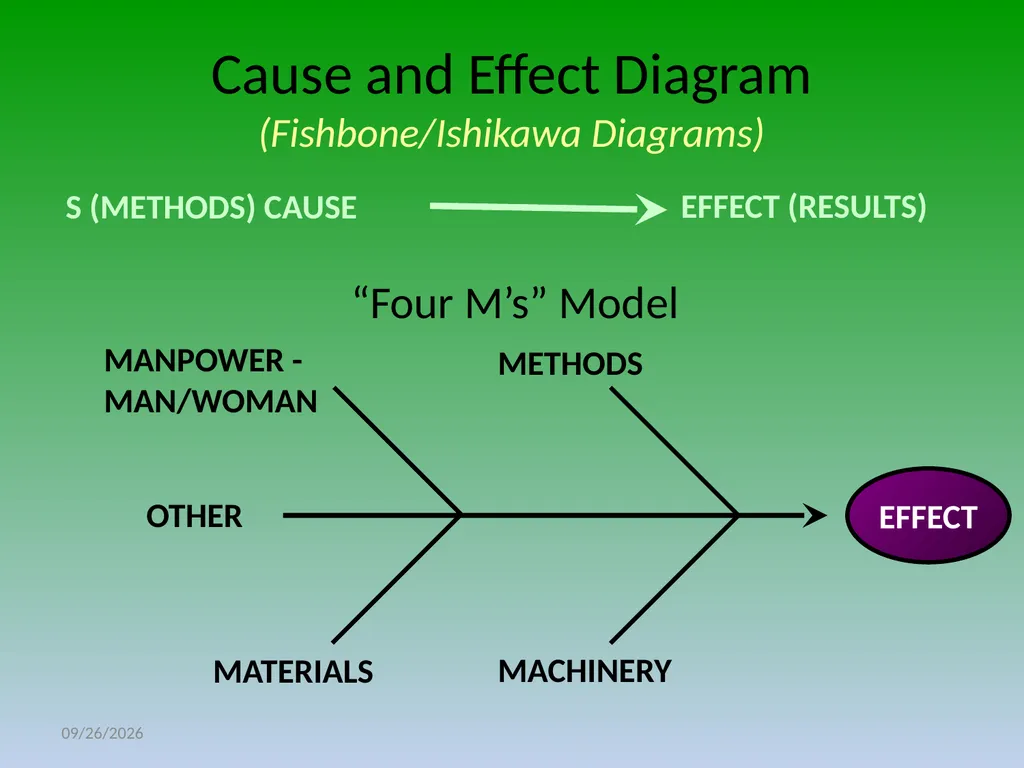
Cause and Effect Diagram (4 M’S)
Tree Diagram
Benchmarking (after Root Cause is found) 3/31/2016<br>
11
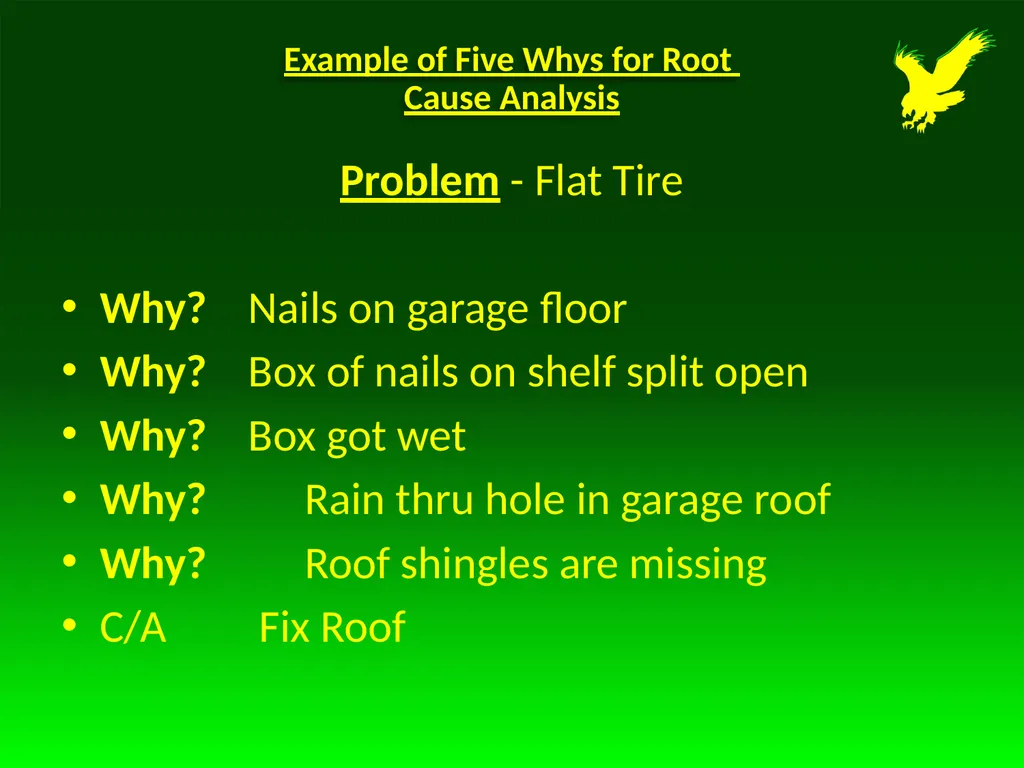
Example of Five Whys for Root Cause Analysis Problem - Flat Tire
Why? Nails on garage floor
Why? Box of nails on shelf split open
Why? Box got wet
Why? Rain thru hole in garage roof
Why? Roof shingles are missing
C/A Fix Roof 3/31/2016<br>
12
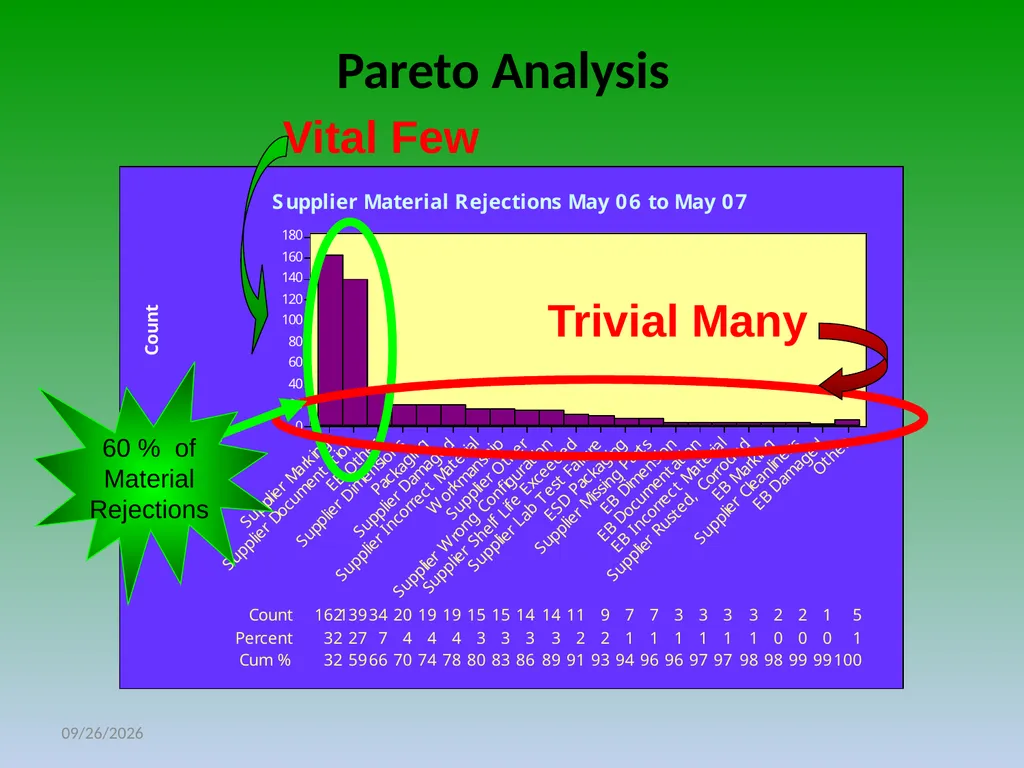
Pareto Analysis Vital Few Trivial Many 60 % of Material Rejections 3/31/2016<br>
13
Brainstorming Sit down as a group and review all ideas
Assign someone to capture the thoughts (Whiteboard)
Everyone participates until no one can think of another “Why” to ask
Don’t jump to conclusions too quickly 3/31/2016<br>
14
Cause and Effect Diagram (Fishbone/Ishikawa Diagrams) EFFECT S (METHODS) CAUSE EFFECT (RESULTS) “Four M’s” Model MANPOWER - MAN/WOMAN METHODS MATERIALS MACHINERY OTHER 3/31/2016<br>
15
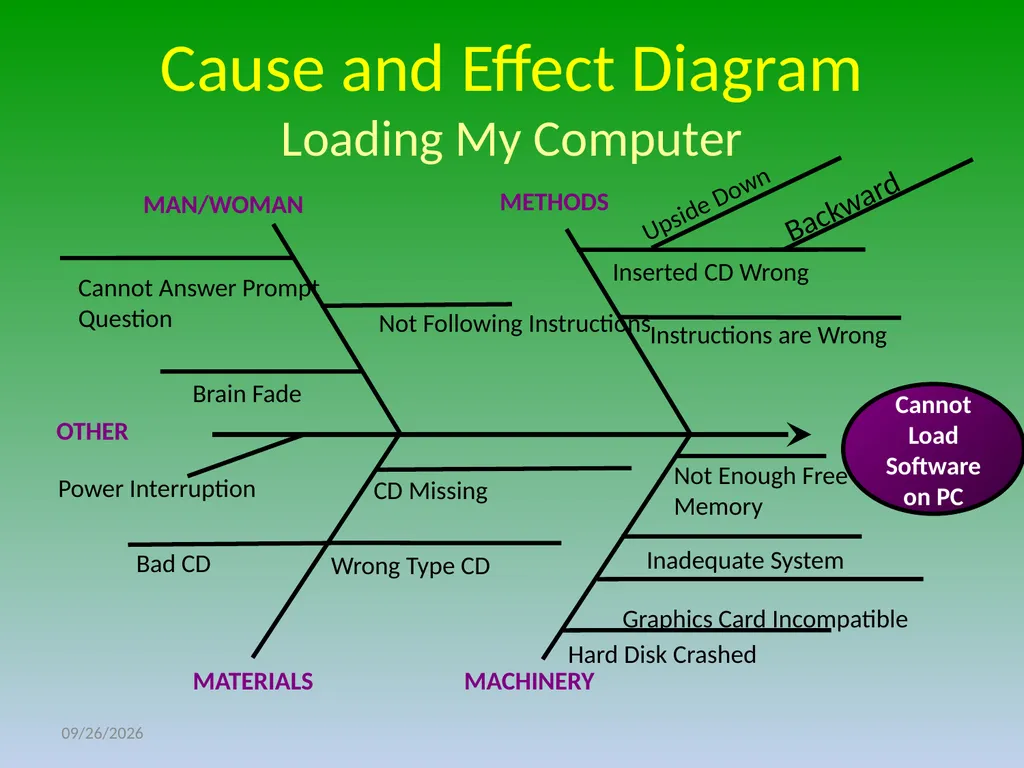
Cause and Effect Diagram Loading My Computer MAN/WOMAN METHODS MATERIALS MACHINERY OTHER Cannot Load Software on PC Inserted CD Wrong Instructions are Wrong Upside Down Backward Not Enough Free Memory Inadequate System Graphics Card Incompatible Hard Disk Crashed Not Following Instructions Cannot Answer Prompt Question Brain Fade CD Missing Wrong Type CD Bad CD Power Interruption 3/31/2016<br>
16
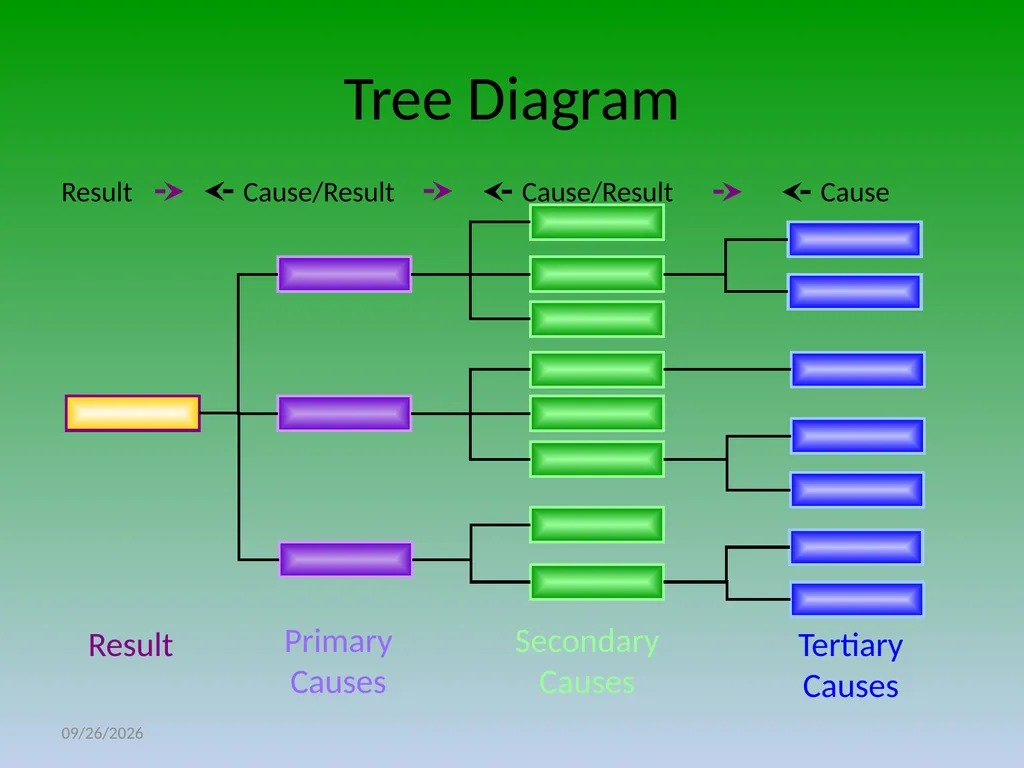
Tree Diagram Result Cause/Result Cause/Result Cause Result Primary Causes Secondary Causes Tertiary Causes 3/31/2016<br>
17
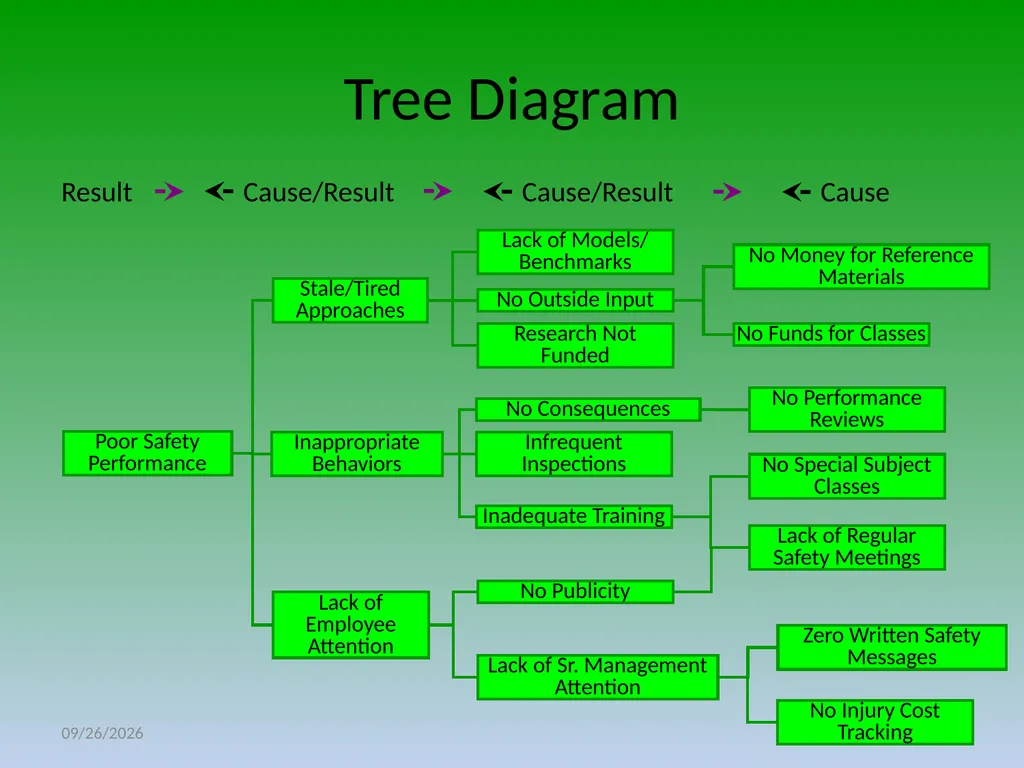
Tree Diagram Poor Safety Performance Stale/Tired Approaches Inappropriate Behaviors Lack of Employee Attention Lack of Models/ Benchmarks No Outside Input Research Not Funded No Money for Reference Materials No Funds for Classes No Consequences Infrequent Inspections Inadequate Training No Publicity Lack of Sr. Management Attention No Performance Reviews No Special Subject Classes Lack of Regular Safety Meetings Zero Written Safety Messages No Injury Cost Tracking Result Cause/Result Cause/Result Cause 3/31/2016<br>
18
Bench Marking Benchmarking: What is it?
"... benchmarking ...[is] ...'the process of identifying, understanding, and adapting outstanding practices and processes from organizations anywhere in the world to help your organization improve its performance.'" —American Productivity & Quality Center
"... benchmarking ...[is]... an on-going outreach activity; the goal of the outreach is identification of best operating practices that, when implemented, produce superior performance." —Bogan and English, Benchmarking for Best Practices
Benchmark refers to a measure of best practice performance. Benchmarking refers to the search for the best practices that yields the benchmark performance, with emphasis on how you can apply the process to achieve superior results. 3/31/2016<br>
19
Bench Marking All process improvement efforts require a sound methodology and implementation, and benchmarking is no different. You need to:
Identify benchmarking partners
Select a benchmarking approach
Gather information (research, surveys, benchmarking visits)
Distill the learning
Select ideas to implement
Pilot
Implement 3/31/2016<br>
20
Goal Successful application of the analysis and determination of the Root Cause should result in elimination of the problem 3/31/2016<br>
21
Common Errors of Root Cause Ending analysis at a symptomatic cause
Assigning as the cause of the problem the “why” event that preceded the real cause
Looking for a single cause- often 2 or 3 which contribute and may be interacting 3/31/2016<br>
22
SUMMARY Why determine Root Cause?
What Is Root Cause Analysis?
When Should Root Cause Analysis be performed?
How to determine Root Cause
Useful Tools to Determine Root Cause
Five Whys
Pareto Analysis
Brainstorming
Cause & Effect Diagram
Tree Diagram
Benchmarking
Common Errors of Root Cause 3/31/2016<br>