
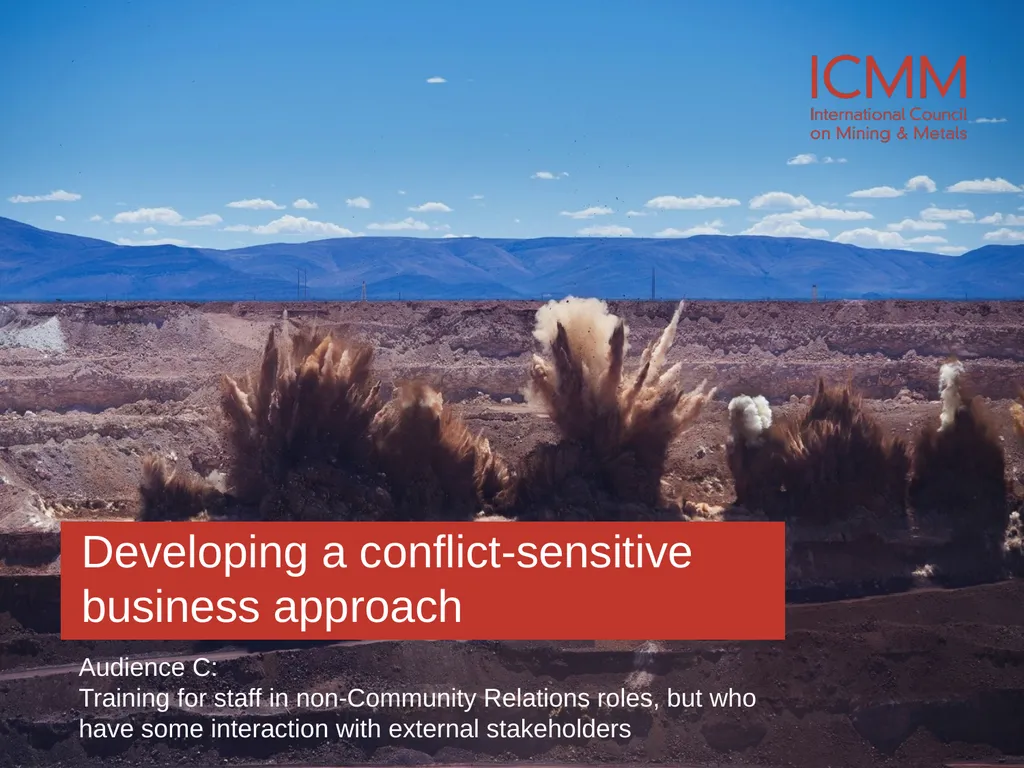
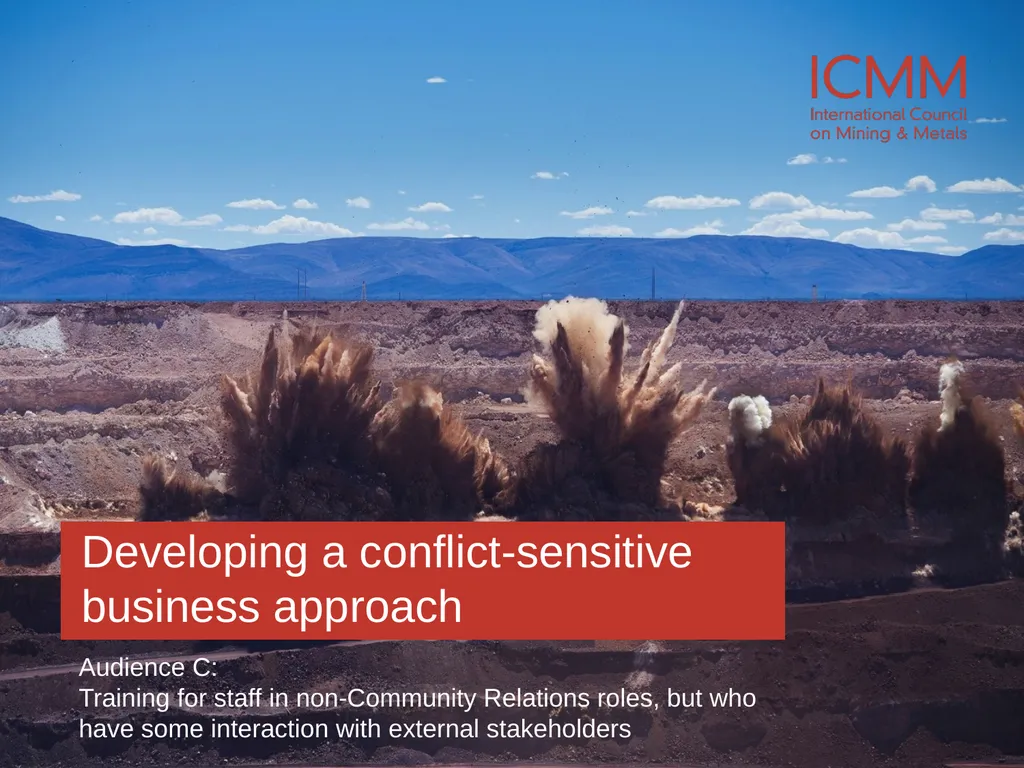
Developing a conflict-sensitive business approach

Description: Developing a conflict-sensitive business approach Audience C: Training for staff in non-Community Relations roles, but who have some interaction with external stakeholders Aims and objectives of this session 2 What do we mean by conflict?
Related Topics
Download Presentation
"Developing a conflict-sensitive business approach" is the property of its rightful owner. Permission is granted to download and print the materials on this website for personal, non-commercial use only, and to display it on your personal computer provided you do not modify the materials and that you retain all copyright notices contained in the materials. By downloading content from our website, you accept the terms of this agreement.
Presentation Transcript
slide1. Developing a conflict-sensitive business approach Audience C:
Training for staff in non-Community Relations roles, but who have some interaction with external stakeholders<br>
slide2. Aims and objectives of this session 2<br>
slide3. What do we mean by “conflict”? Understanding the terminology we use<br>
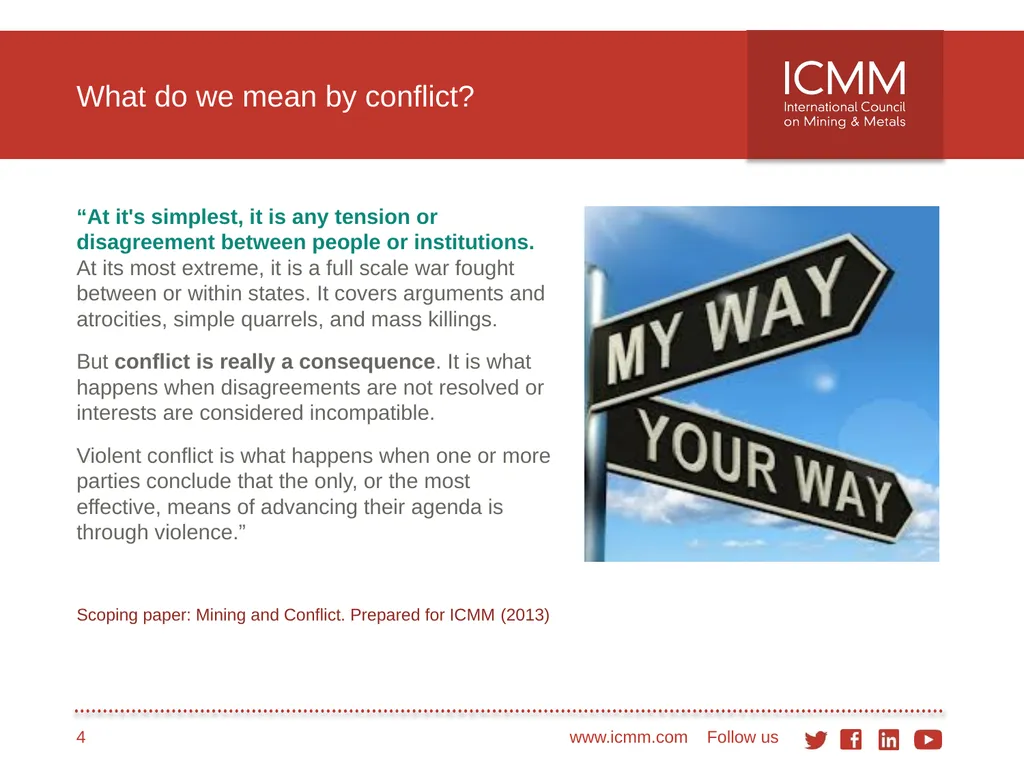
slide4. What do we mean by conflict? “At it's simplest, it is any tension or disagreement between people or institutions. At its most extreme, it is a full scale war fought between or within states. It covers arguments and atrocities, simple quarrels, and mass killings.
But conflict is really a consequence. It is what happens when disagreements are not resolved or interests are considered incompatible.
Violent conflict is what happens when one or more parties conclude that the only, or the most effective, means of advancing their agenda is through violence.”
Scoping paper: Mining and Conflict. Prepared for ICMM (2013) 4<br>
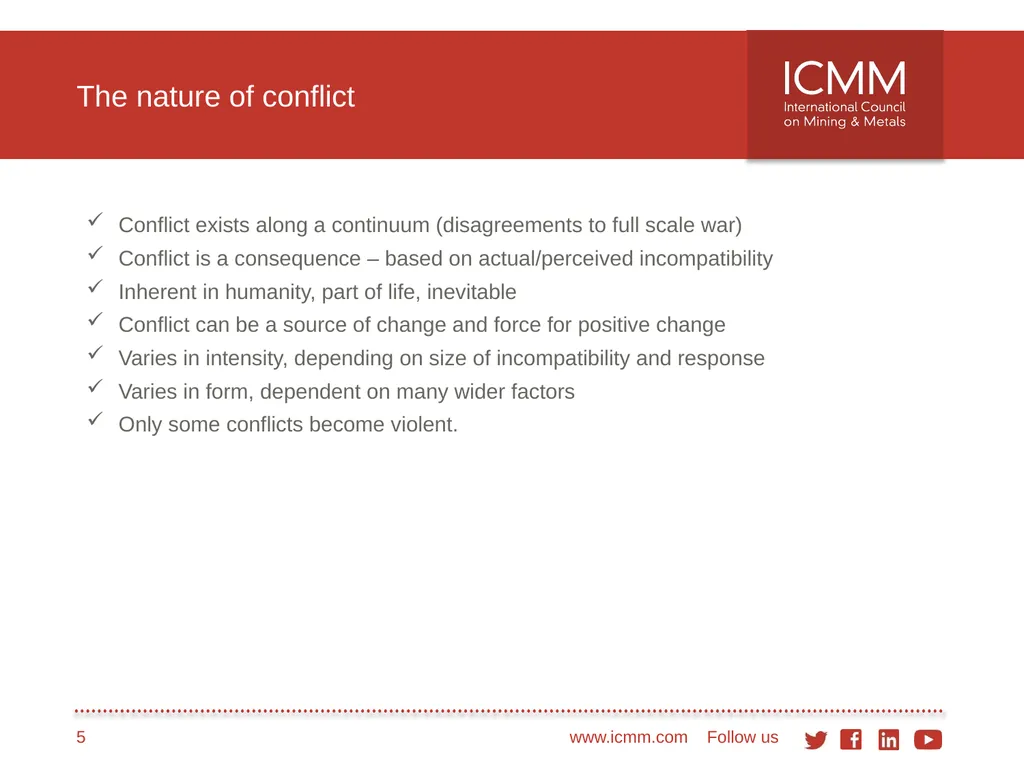
slide5. The nature of conflict Conflict exists along a continuum (disagreements to full scale war)
Conflict is a consequence – based on actual/perceived incompatibility
Inherent in humanity, part of life, inevitable
Conflict can be a source of change and force for positive change
Varies in intensity, depending on size of incompatibility and response
Varies in form, dependent on many wider factors
Only some conflicts become violent. 5<br>
slide6. Exercise What examples do you have of conflict associated with your department and/or operation?
In what way has it affected your operation or department, and you personally? 6<br>
slide7. The relevance of conflict to business<br>
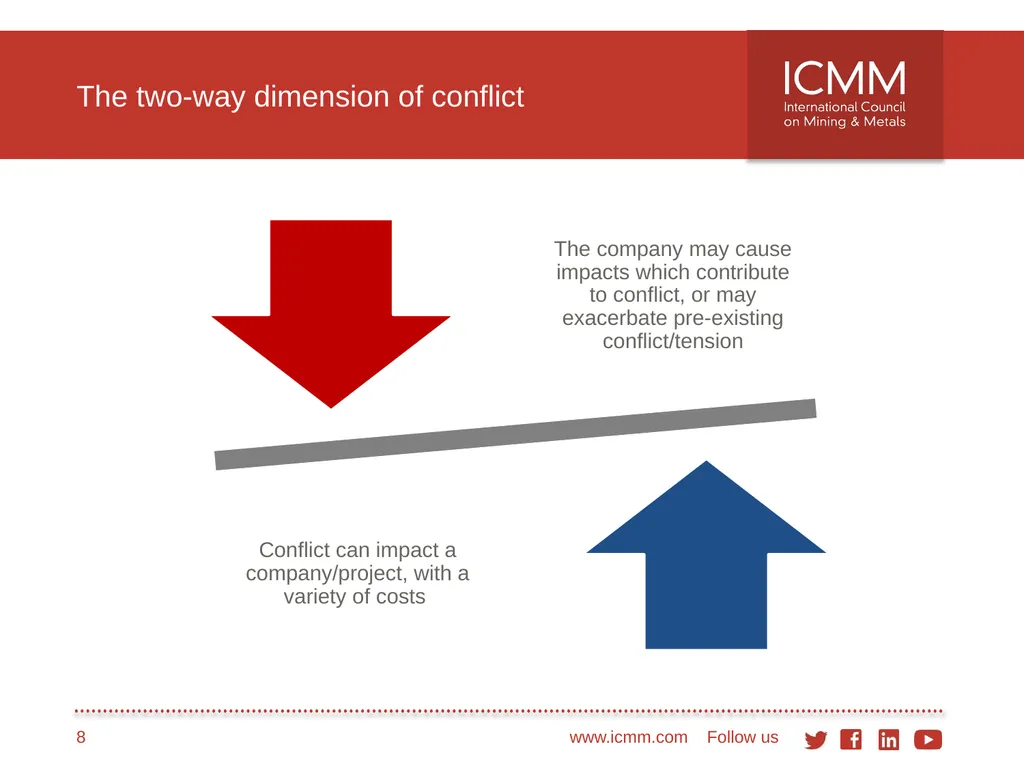
slide8. The two-way dimension of conflict 8<br>
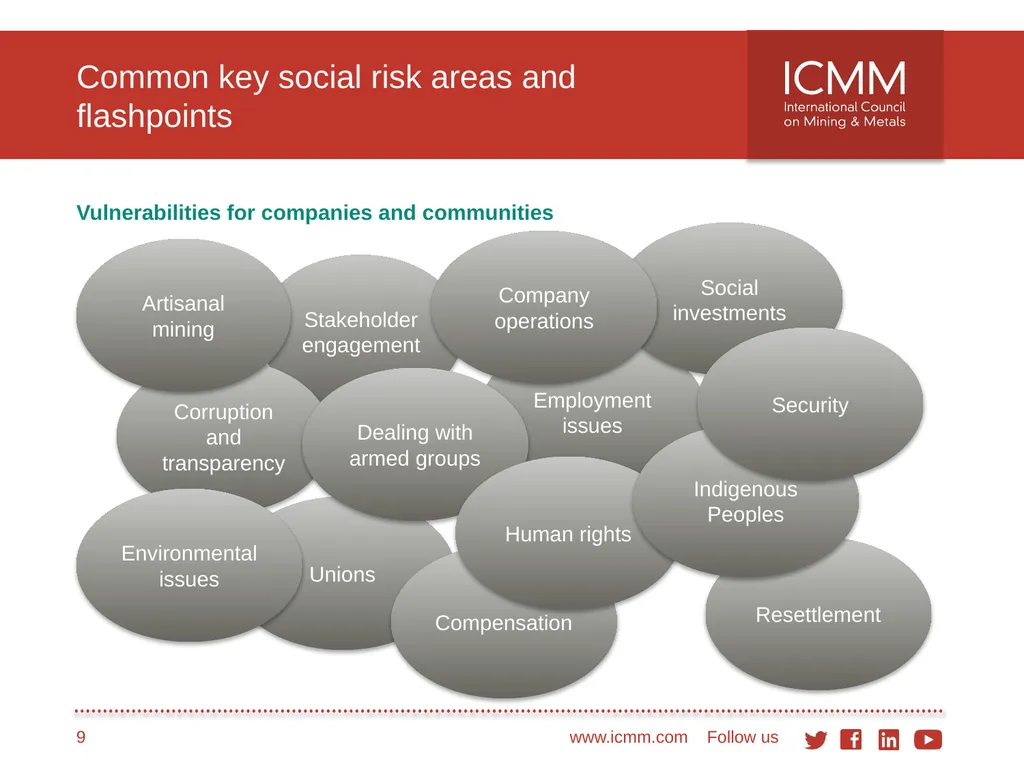
slide9. Common key social risk areas and flashpoints Vulnerabilities for companies and communities 9<br>
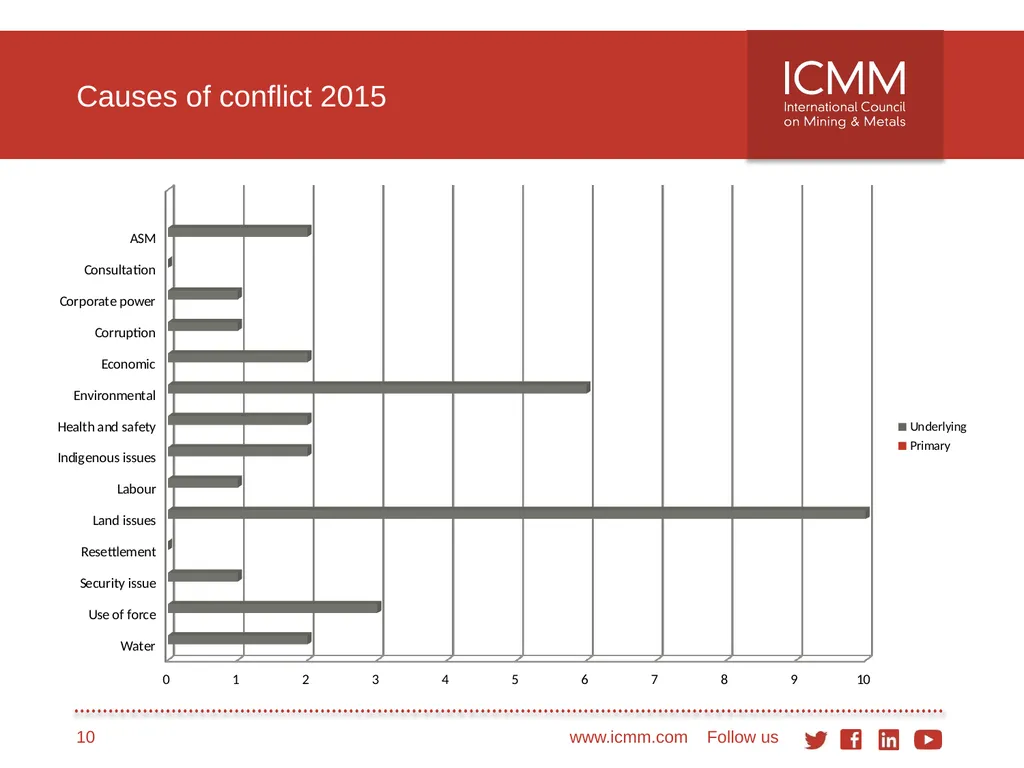
slide10. Causes of conflict 2015 10<br>
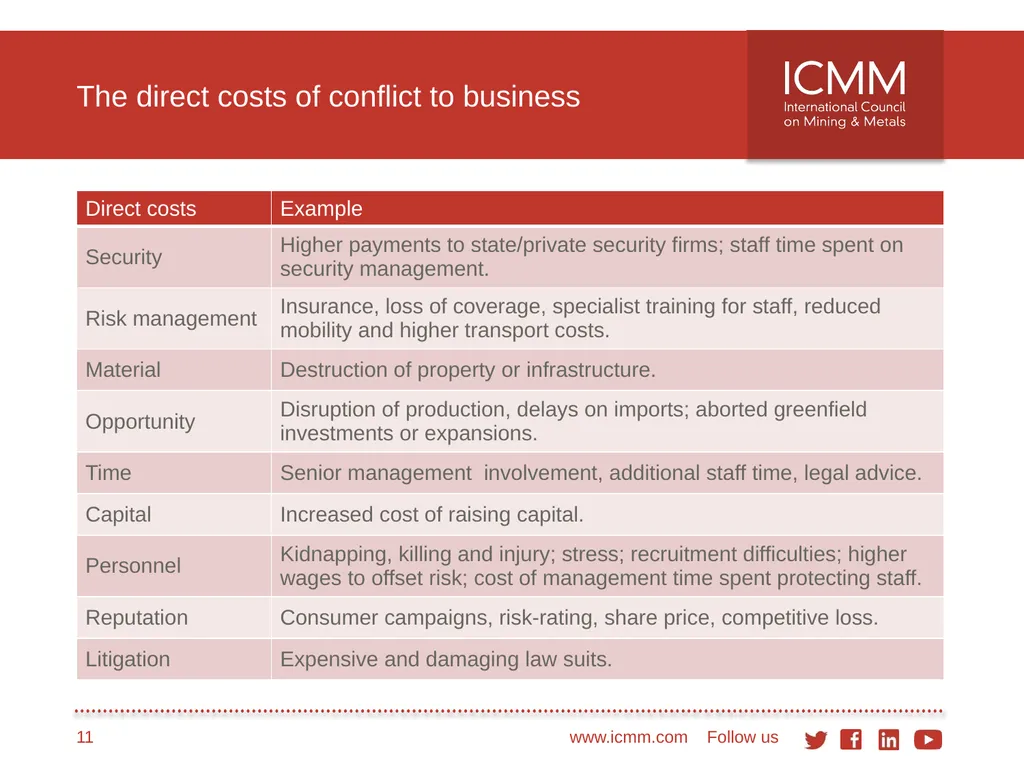
slide11. The direct costs of conflict to business 11<br>
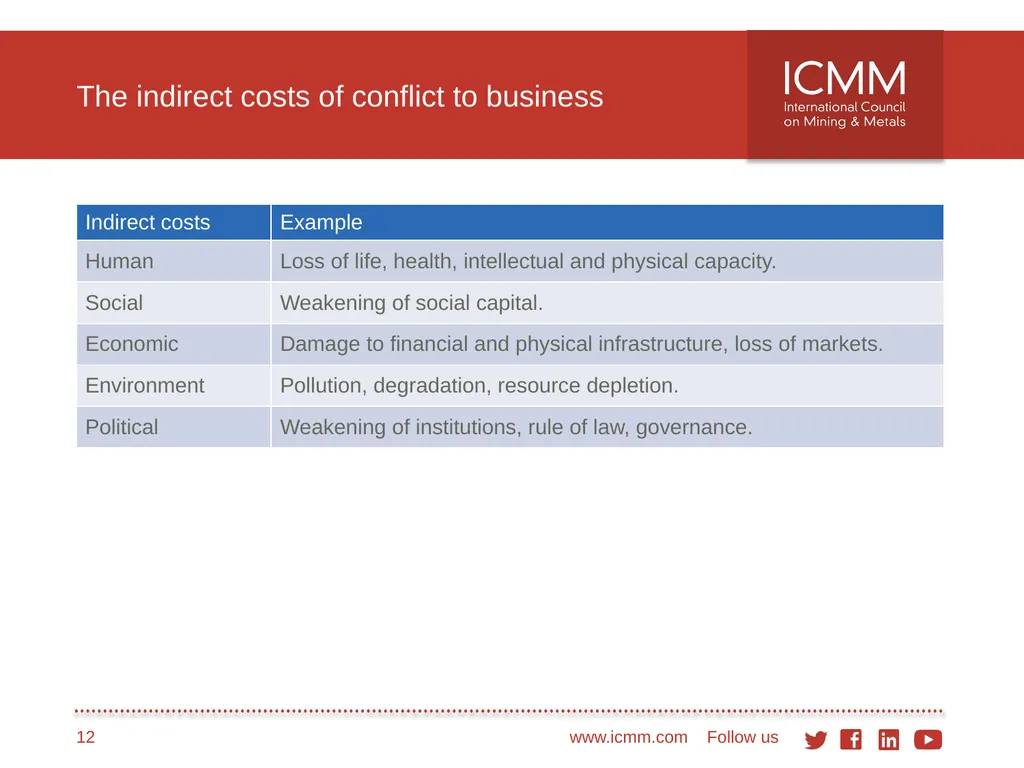
slide12. The indirect costs of conflict to business 12<br>
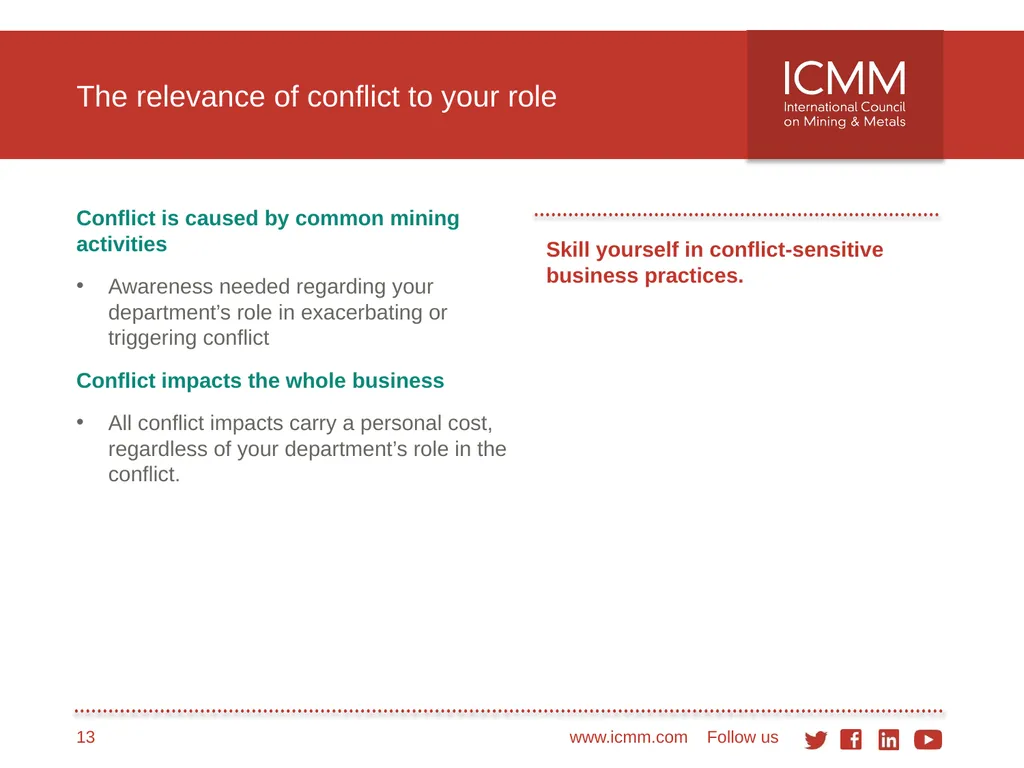
slide13. The relevance of conflict to your role 13 Conflict is caused by common mining activities
Awareness needed regarding your department’s role in exacerbating or triggering conflict
Conflict impacts the whole business
All conflict impacts carry a personal cost, regardless of your department’s role in the conflict. Skill yourself in conflict-sensitive business practices.<br>
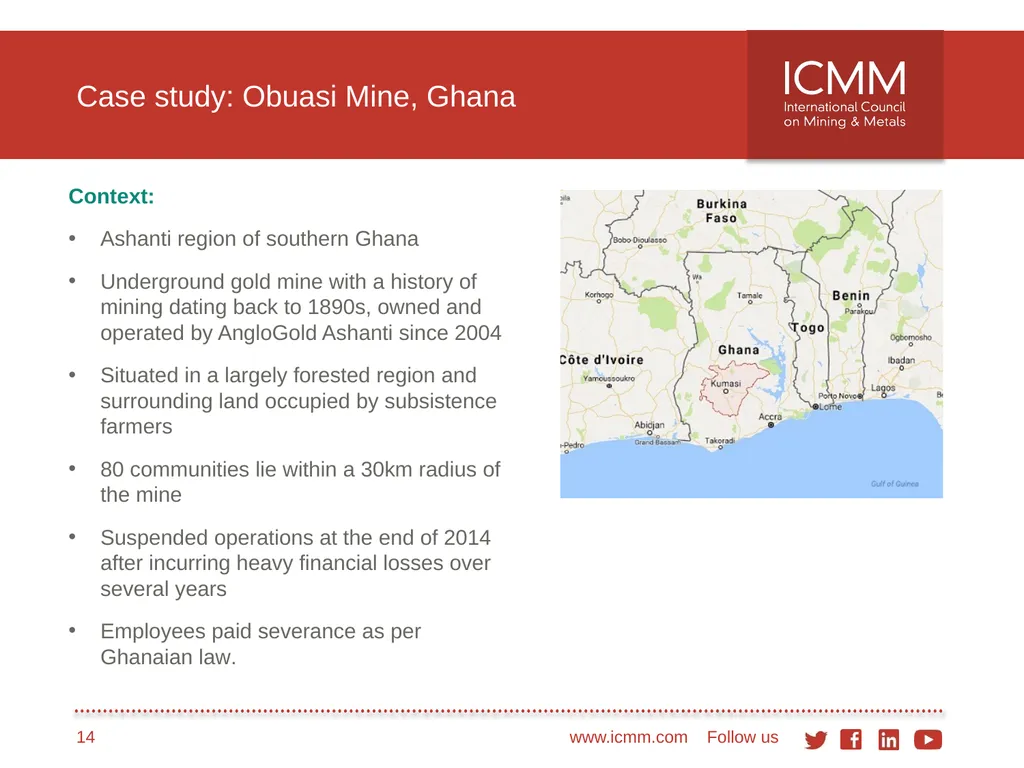
slide14. Case study: Obuasi Mine, Ghana Context:
Ashanti region of southern Ghana
Underground gold mine with a history of mining dating back to 1890s, owned and operated by AngloGold Ashanti since 2004
Situated in a largely forested region and surrounding land occupied by subsistence farmers
80 communities lie within a 30km radius of the mine
Suspended operations at the end of 2014 after incurring heavy financial losses over several years
Employees paid severance as per Ghanaian law. 14<br>
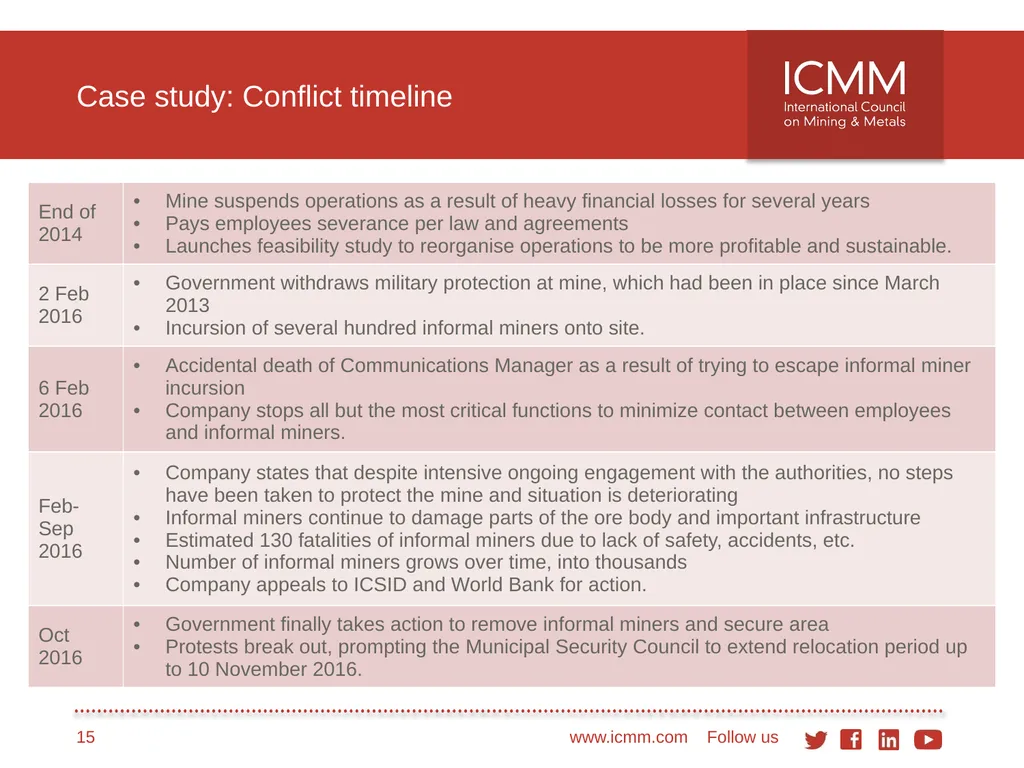
slide15. Case study: Conflict timeline 15<br>
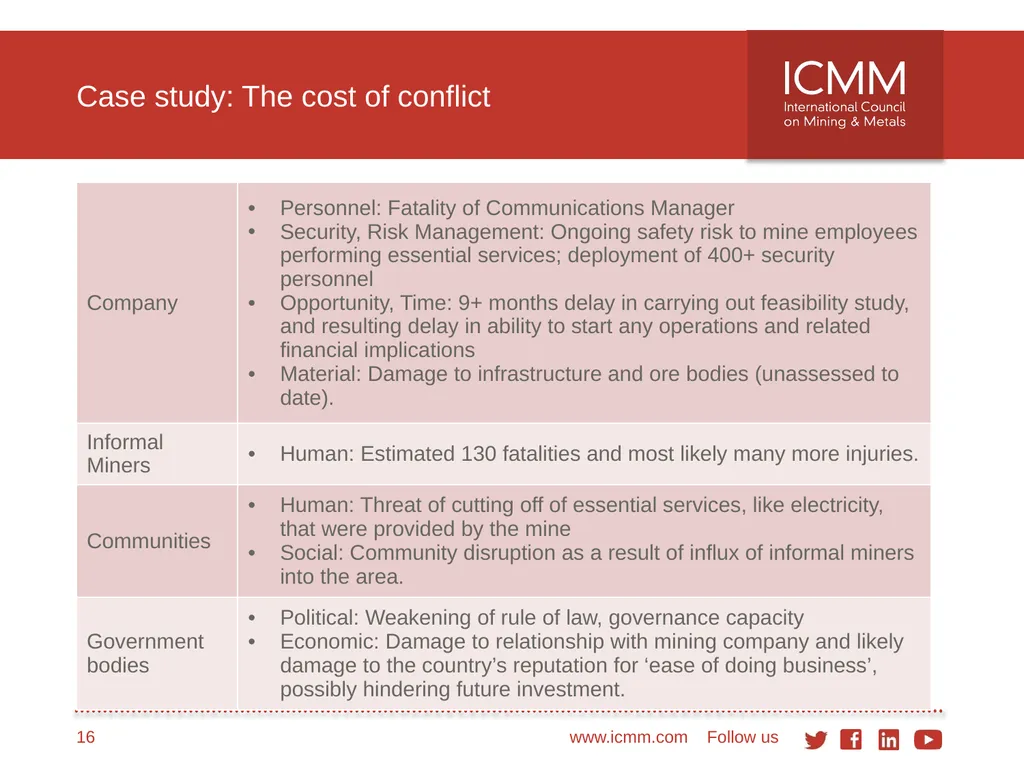
slide16. Case study: The cost of conflict 16<br>
slide17. A conflict-sensitive approach to business Looking at what this means in practice<br>
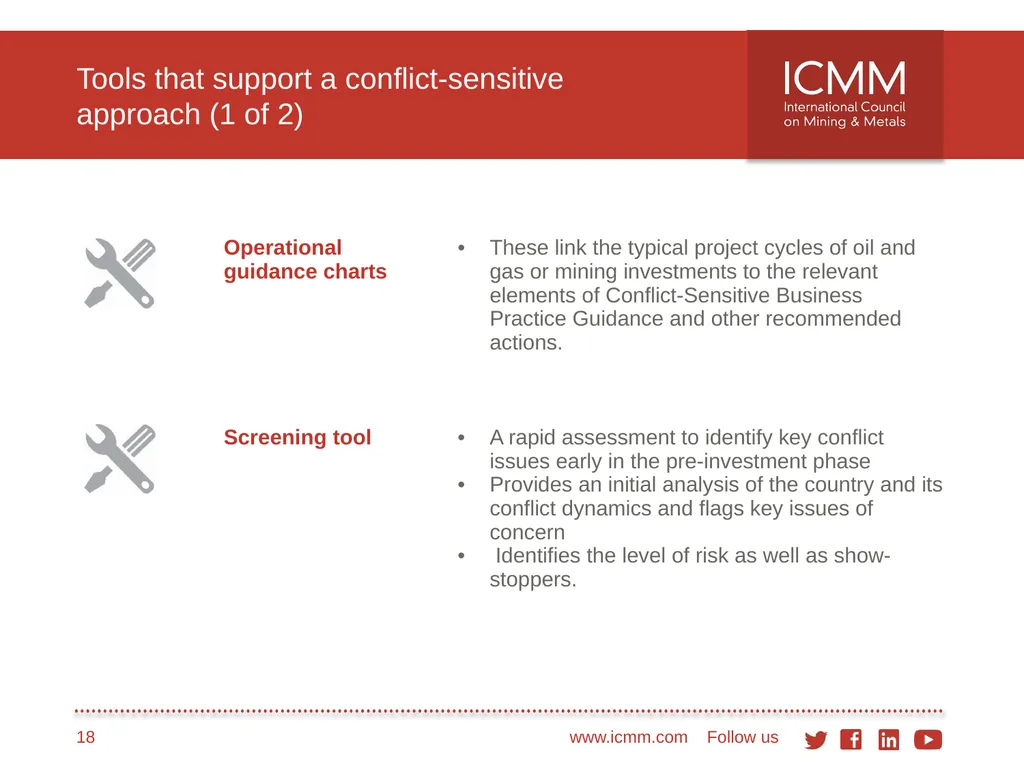
slide18. Tools that support a conflict-sensitive approach (1 of 2) 18<br>
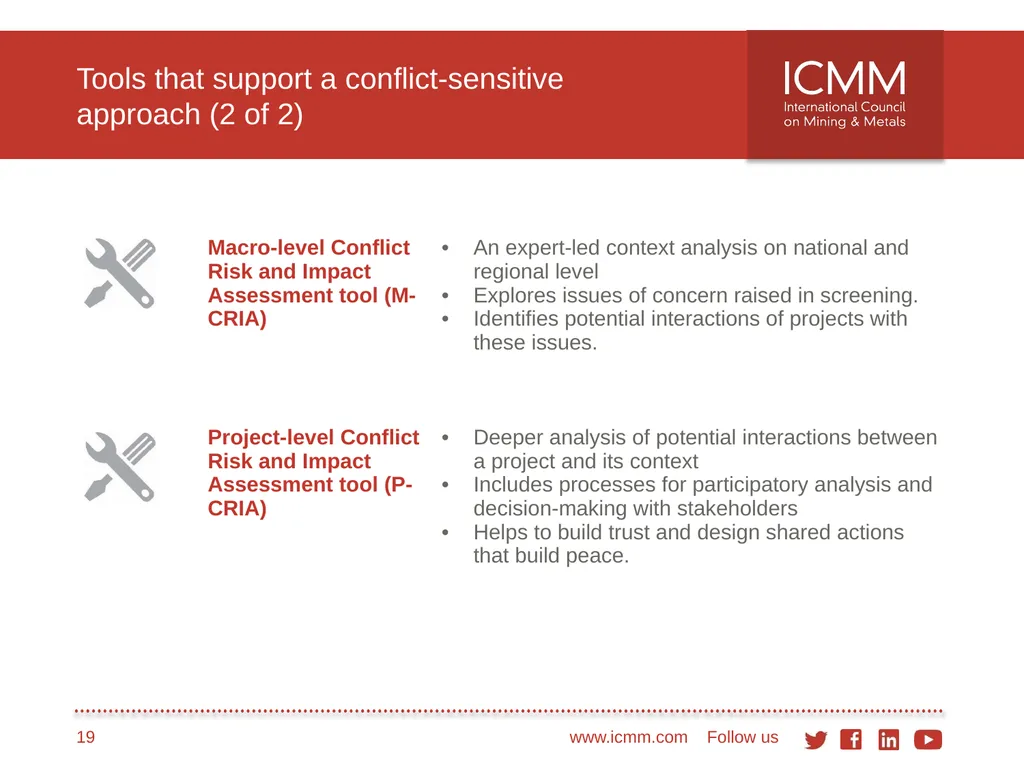
slide19. Tools that support a conflict-sensitive approach (2 of 2) 19<br>
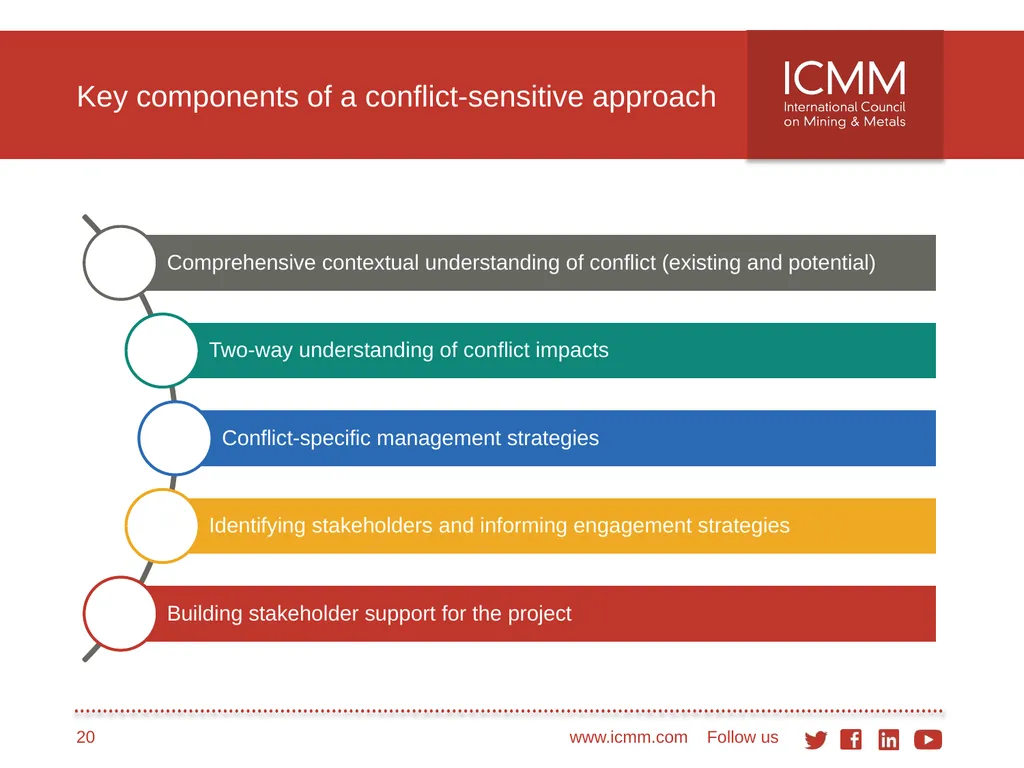
slide20. Key components of a conflict-sensitive approach 20<br>
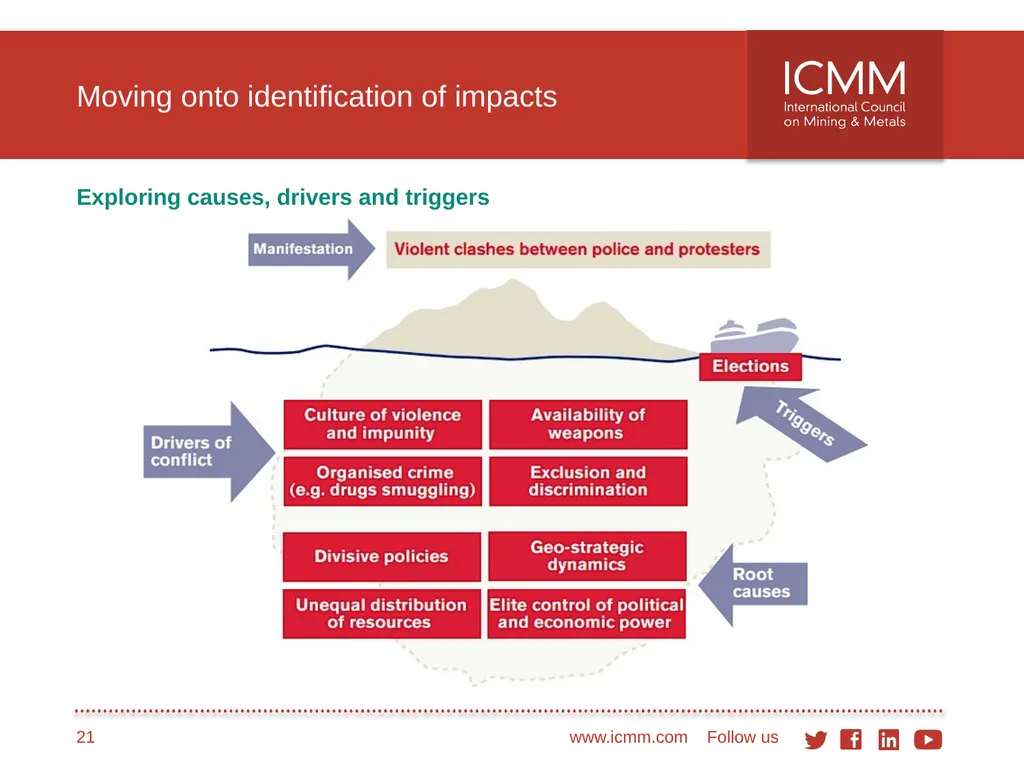
slide21. Moving onto identification of impacts Exploring causes, drivers and triggers 21<br>
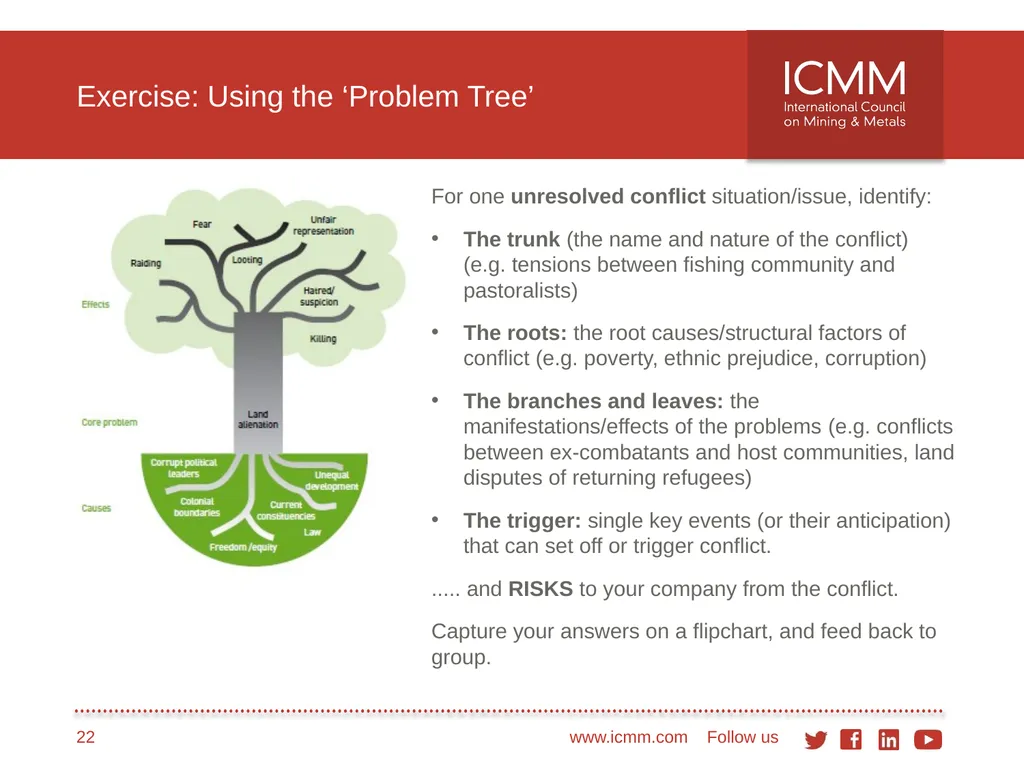
slide22. Exercise: Using the ‘Problem Tree’ For one unresolved conflict situation/issue, identify:
The trunk (the name and nature of the conflict) (e.g. tensions between fishing community and pastoralists)
The roots: the root causes/structural factors of conflict (e.g. poverty, ethnic prejudice, corruption)
The branches and leaves: the manifestations/effects of the problems (e.g. conflicts between ex-combatants and host communities, land disputes of returning refugees)
The trigger: single key events (or their anticipation) that can set off or trigger conflict.
..... and RISKS to your company from the conflict.
Capture your answers on a flipchart, and feed back to group. 22<br>
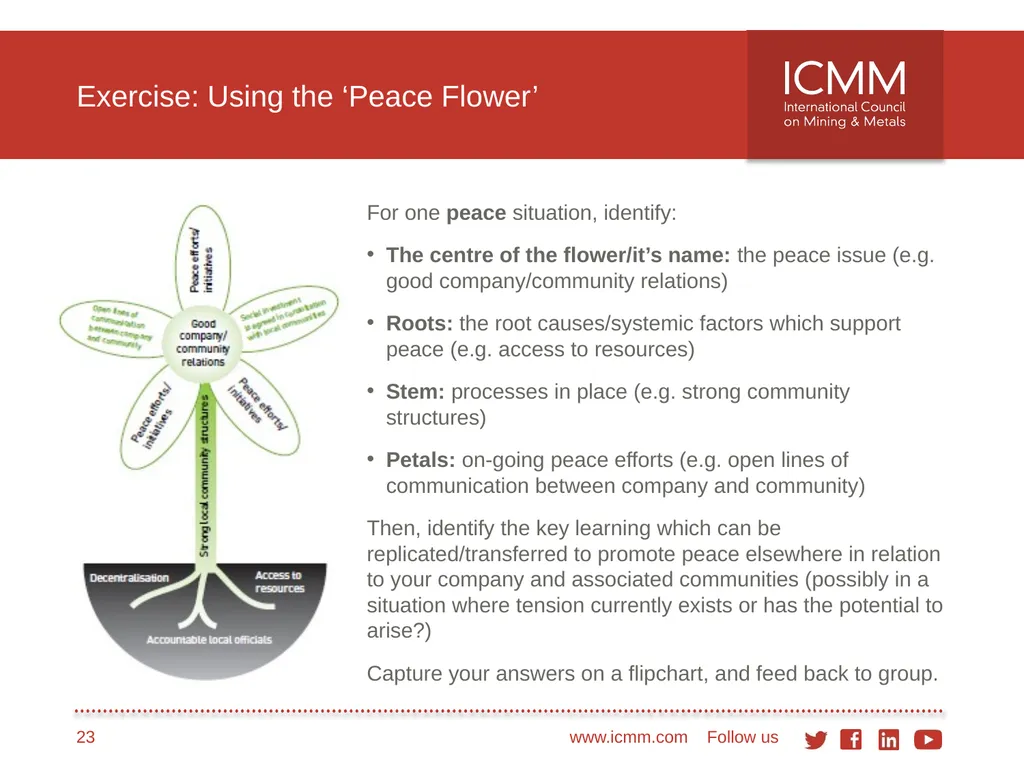
slide23. Exercise: Using the ‘Peace Flower’ For one peace situation, identify:
The centre of the flower/it’s name: the peace issue (e.g. good company/community relations)
Roots: the root causes/systemic factors which support peace (e.g. access to resources)
Stem: processes in place (e.g. strong community structures)
Petals: on-going peace efforts (e.g. open lines of communication between company and community)
Then, identify the key learning which can be replicated/transferred to promote peace elsewhere in relation to your company and associated communities (possibly in a situation where tension currently exists or has the potential to arise?)
Capture your answers on a flipchart, and feed back to group. 23<br>
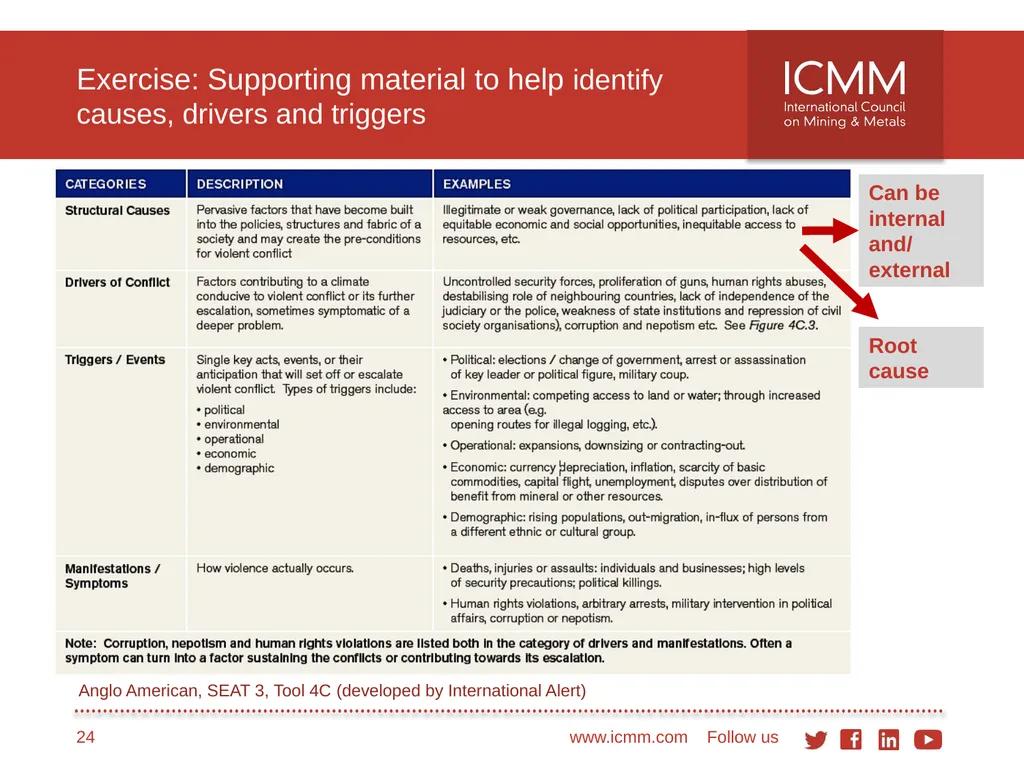
slide24. Exercise: Supporting material to help identify causes, drivers and triggers Anglo American, SEAT 3, Tool 4C (developed by International Alert) Can be internal and/ external Root cause 24<br>
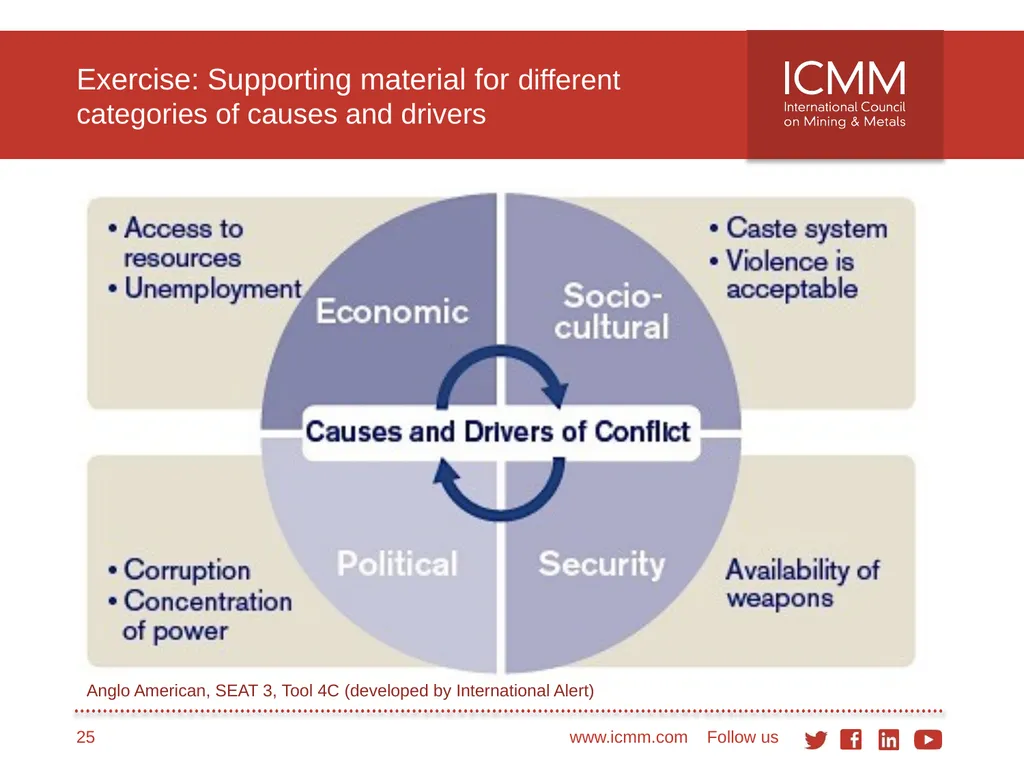
slide25. Exercise: Supporting material for different categories of causes and drivers Anglo American, SEAT 3, Tool 4C (developed by International Alert) 25<br>
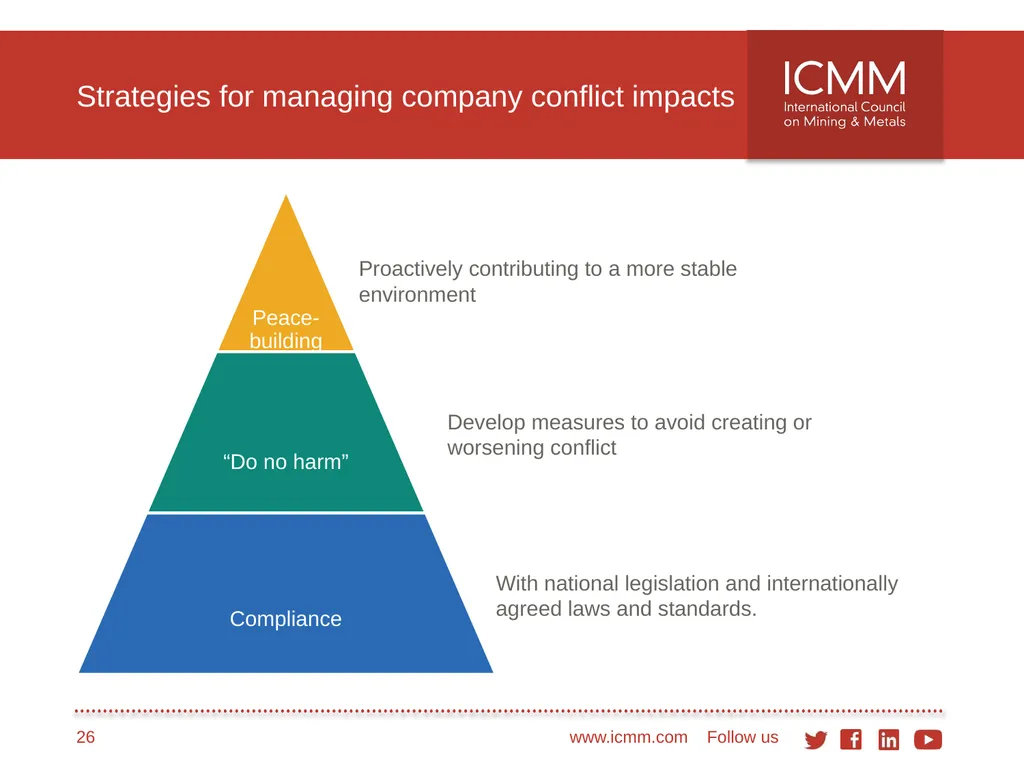
slide26. Strategies for managing company conflict impacts With national legislation and internationally agreed laws and standards. Develop measures to avoid creating or worsening conflict Proactively contributing to a more stable environment 26<br>
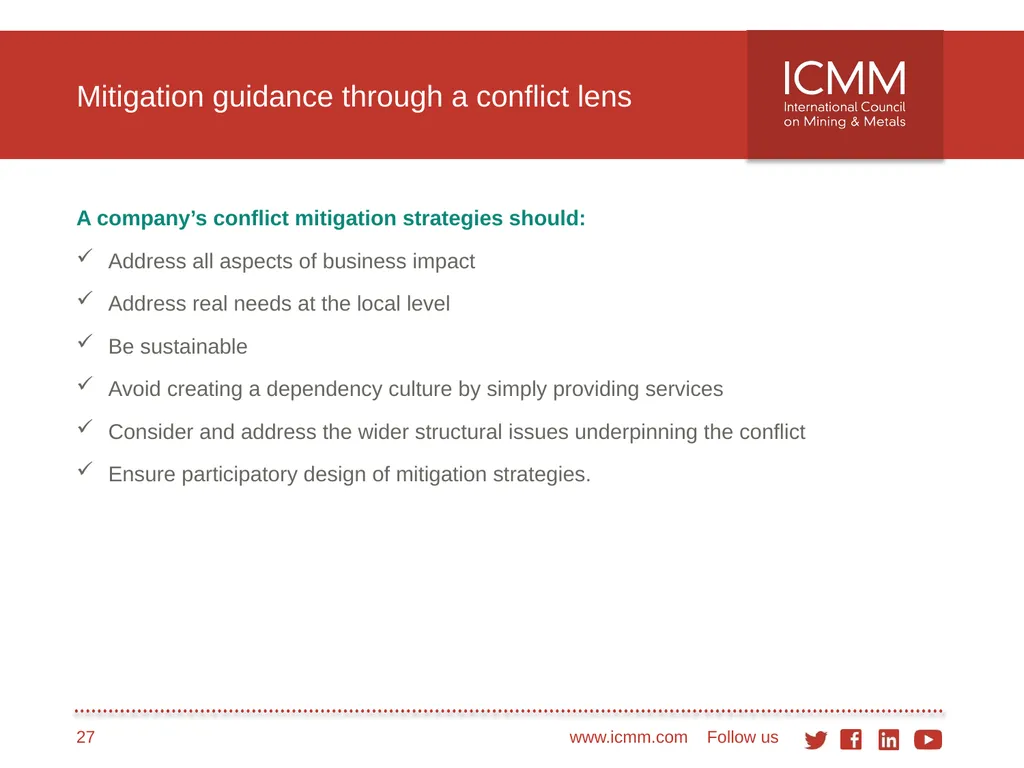
slide27. Mitigation guidance through a conflict lens A company’s conflict mitigation strategies should:
Address all aspects of business impact
Address real needs at the local level
Be sustainable
Avoid creating a dependency culture by simply providing services
Consider and address the wider structural issues underpinning the conflict
Ensure participatory design of mitigation strategies. 27<br>
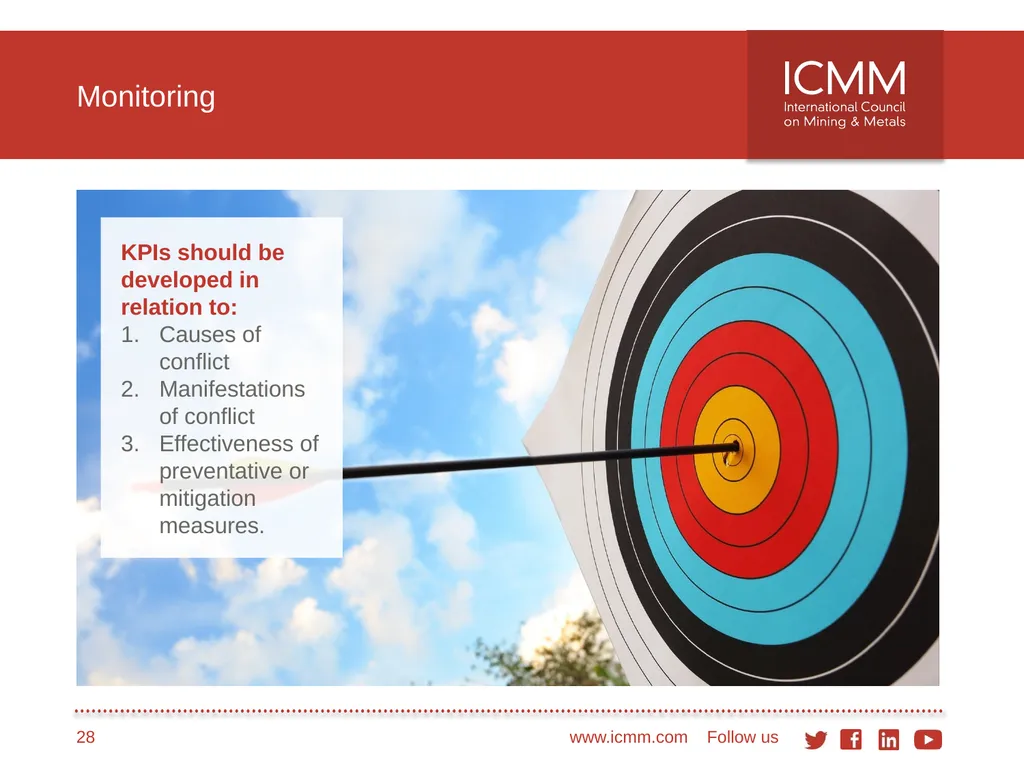
slide28. Monitoring KPIs should be developed in relation to:
Causes of conflict
Manifestations of conflict
Effectiveness of preventative or mitigation measures. 28<br>
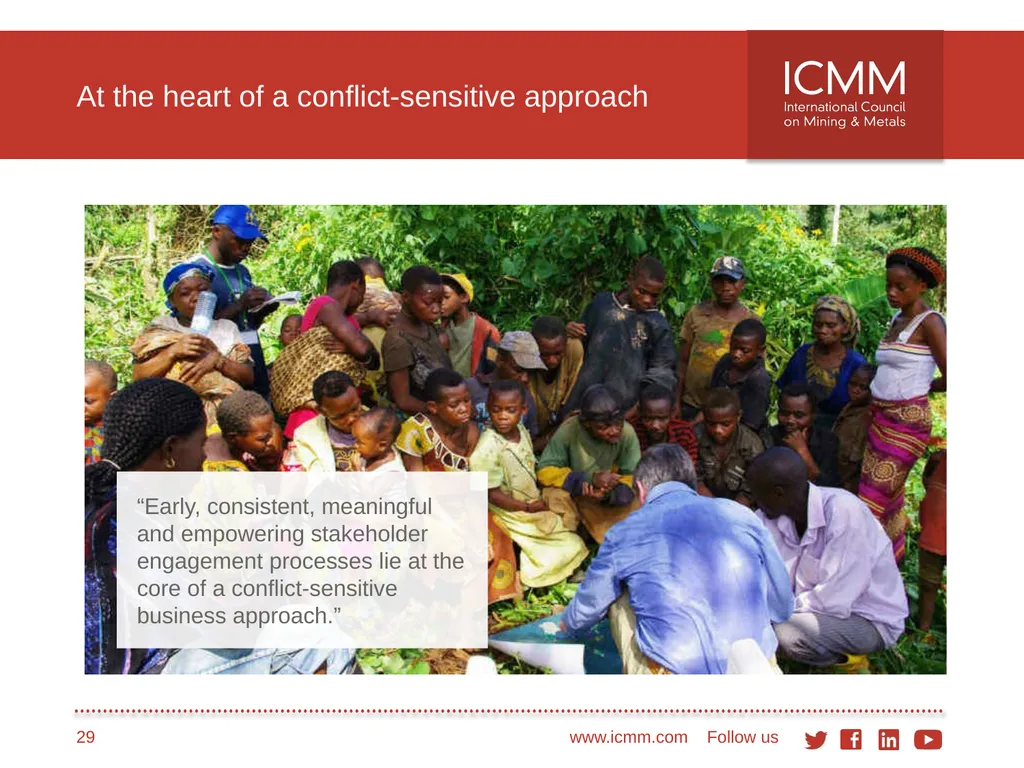
slide29. At the heart of a conflict-sensitive approach “Early, consistent, meaningful and empowering stakeholder engagement processes lie at the core of a conflict-sensitive business approach.” 29<br>
slide30. In conclusion: An overview Conflict is inevitable, and can be a force for positive change
It should therefore not be avoided at all costs
However, conflict has negative consequences for both business and associated communities
A conflict-sensitive approach is thus essential
This understanding forms the basis of your interventions. 30 At the heart of this approach is meaningful stakeholder engagement, and developing an understanding of the conflict - the context, issues, stakeholders, and company’s role in the conflict.<br>
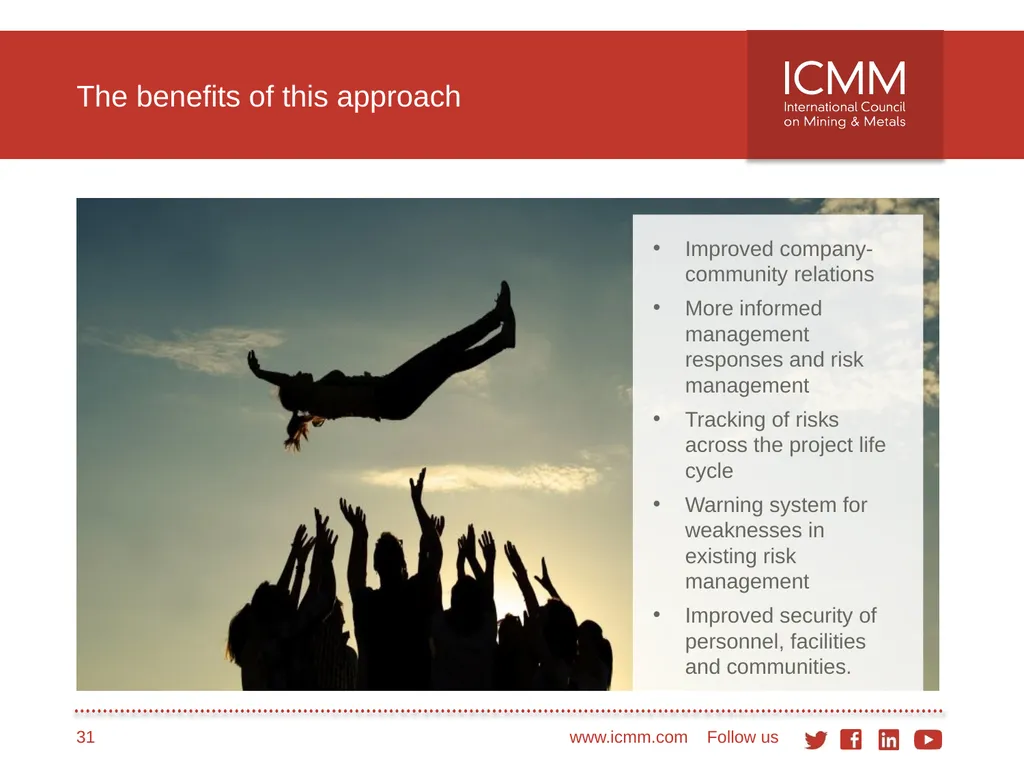
slide31. The benefits of this approach Improved company-community relations
More informed management responses and risk management
Tracking of risks across the project life cycle
Warning system for weaknesses in existing risk management
Improved security of personnel, facilities and communities. 31<br>
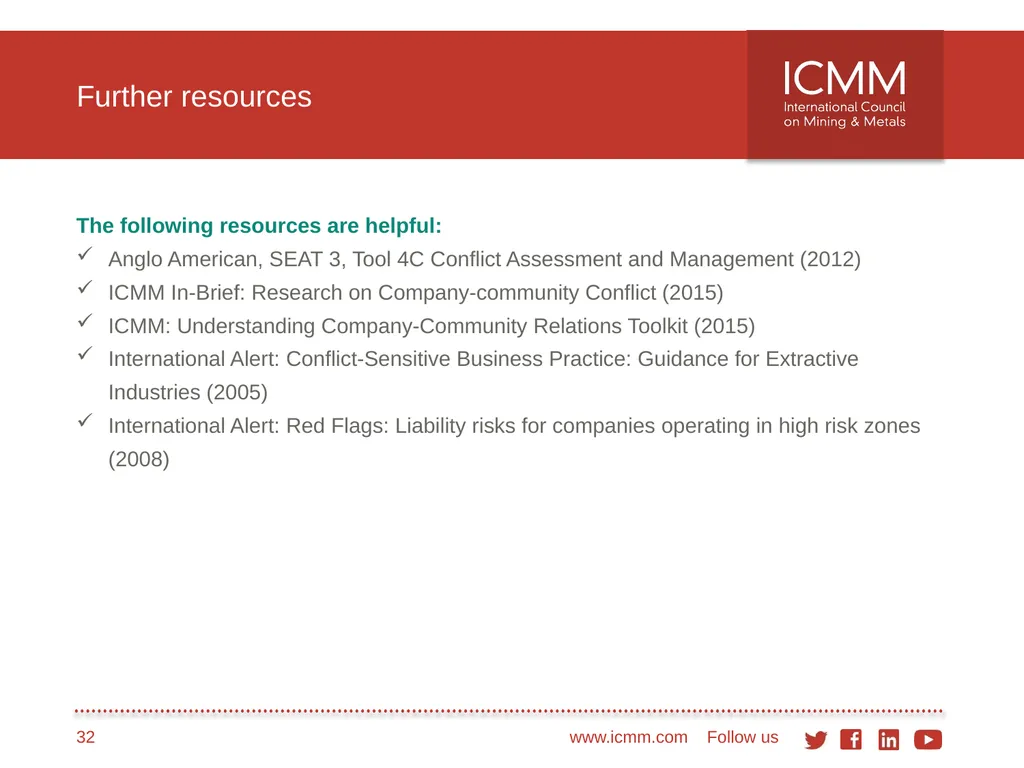
slide32. Further resources The following resources are helpful:
Anglo American, SEAT 3, Tool 4C Conflict Assessment and Management (2012)
ICMM In-Brief: Research on Company-community Conflict (2015)
ICMM: Understanding Company-Community Relations Toolkit (2015)
International Alert: Conflict-Sensitive Business Practice: Guidance for Extractive Industries (2005)
International Alert: Red Flags: Liability risks for companies operating in high risk zones (2008) 32<br>
slide33. International Council on Mining and Metals (ICMM) 35/38 Portman Square London W1H 6LR United Kingdom Switchboard: +44 (0) 20 7467 5070 Main Fax: +44 (0) 20 7467 5071 E-mail: info@icmm.com www.icmm.com<br>
Training for staff in non-Community Relations roles, but who have some interaction with external stakeholders<br>
slide2. Aims and objectives of this session 2<br>
slide3. What do we mean by “conflict”? Understanding the terminology we use<br>
slide4. What do we mean by conflict? “At it's simplest, it is any tension or disagreement between people or institutions. At its most extreme, it is a full scale war fought between or within states. It covers arguments and atrocities, simple quarrels, and mass killings.
But conflict is really a consequence. It is what happens when disagreements are not resolved or interests are considered incompatible.
Violent conflict is what happens when one or more parties conclude that the only, or the most effective, means of advancing their agenda is through violence.”
Scoping paper: Mining and Conflict. Prepared for ICMM (2013) 4<br>
slide5. The nature of conflict Conflict exists along a continuum (disagreements to full scale war)
Conflict is a consequence – based on actual/perceived incompatibility
Inherent in humanity, part of life, inevitable
Conflict can be a source of change and force for positive change
Varies in intensity, depending on size of incompatibility and response
Varies in form, dependent on many wider factors
Only some conflicts become violent. 5<br>
slide6. Exercise What examples do you have of conflict associated with your department and/or operation?
In what way has it affected your operation or department, and you personally? 6<br>
slide7. The relevance of conflict to business<br>
slide8. The two-way dimension of conflict 8<br>
slide9. Common key social risk areas and flashpoints Vulnerabilities for companies and communities 9<br>
slide10. Causes of conflict 2015 10<br>
slide11. The direct costs of conflict to business 11<br>
slide12. The indirect costs of conflict to business 12<br>
slide13. The relevance of conflict to your role 13 Conflict is caused by common mining activities
Awareness needed regarding your department’s role in exacerbating or triggering conflict
Conflict impacts the whole business
All conflict impacts carry a personal cost, regardless of your department’s role in the conflict. Skill yourself in conflict-sensitive business practices.<br>
slide14. Case study: Obuasi Mine, Ghana Context:
Ashanti region of southern Ghana
Underground gold mine with a history of mining dating back to 1890s, owned and operated by AngloGold Ashanti since 2004
Situated in a largely forested region and surrounding land occupied by subsistence farmers
80 communities lie within a 30km radius of the mine
Suspended operations at the end of 2014 after incurring heavy financial losses over several years
Employees paid severance as per Ghanaian law. 14<br>
slide15. Case study: Conflict timeline 15<br>
slide16. Case study: The cost of conflict 16<br>
slide17. A conflict-sensitive approach to business Looking at what this means in practice<br>
slide18. Tools that support a conflict-sensitive approach (1 of 2) 18<br>
slide19. Tools that support a conflict-sensitive approach (2 of 2) 19<br>
slide20. Key components of a conflict-sensitive approach 20<br>
slide21. Moving onto identification of impacts Exploring causes, drivers and triggers 21<br>
slide22. Exercise: Using the ‘Problem Tree’ For one unresolved conflict situation/issue, identify:
The trunk (the name and nature of the conflict) (e.g. tensions between fishing community and pastoralists)
The roots: the root causes/structural factors of conflict (e.g. poverty, ethnic prejudice, corruption)
The branches and leaves: the manifestations/effects of the problems (e.g. conflicts between ex-combatants and host communities, land disputes of returning refugees)
The trigger: single key events (or their anticipation) that can set off or trigger conflict.
..... and RISKS to your company from the conflict.
Capture your answers on a flipchart, and feed back to group. 22<br>
slide23. Exercise: Using the ‘Peace Flower’ For one peace situation, identify:
The centre of the flower/it’s name: the peace issue (e.g. good company/community relations)
Roots: the root causes/systemic factors which support peace (e.g. access to resources)
Stem: processes in place (e.g. strong community structures)
Petals: on-going peace efforts (e.g. open lines of communication between company and community)
Then, identify the key learning which can be replicated/transferred to promote peace elsewhere in relation to your company and associated communities (possibly in a situation where tension currently exists or has the potential to arise?)
Capture your answers on a flipchart, and feed back to group. 23<br>
slide24. Exercise: Supporting material to help identify causes, drivers and triggers Anglo American, SEAT 3, Tool 4C (developed by International Alert) Can be internal and/ external Root cause 24<br>
slide25. Exercise: Supporting material for different categories of causes and drivers Anglo American, SEAT 3, Tool 4C (developed by International Alert) 25<br>
slide26. Strategies for managing company conflict impacts With national legislation and internationally agreed laws and standards. Develop measures to avoid creating or worsening conflict Proactively contributing to a more stable environment 26<br>
slide27. Mitigation guidance through a conflict lens A company’s conflict mitigation strategies should:
Address all aspects of business impact
Address real needs at the local level
Be sustainable
Avoid creating a dependency culture by simply providing services
Consider and address the wider structural issues underpinning the conflict
Ensure participatory design of mitigation strategies. 27<br>
slide28. Monitoring KPIs should be developed in relation to:
Causes of conflict
Manifestations of conflict
Effectiveness of preventative or mitigation measures. 28<br>
slide29. At the heart of a conflict-sensitive approach “Early, consistent, meaningful and empowering stakeholder engagement processes lie at the core of a conflict-sensitive business approach.” 29<br>
slide30. In conclusion: An overview Conflict is inevitable, and can be a force for positive change
It should therefore not be avoided at all costs
However, conflict has negative consequences for both business and associated communities
A conflict-sensitive approach is thus essential
This understanding forms the basis of your interventions. 30 At the heart of this approach is meaningful stakeholder engagement, and developing an understanding of the conflict - the context, issues, stakeholders, and company’s role in the conflict.<br>
slide31. The benefits of this approach Improved company-community relations
More informed management responses and risk management
Tracking of risks across the project life cycle
Warning system for weaknesses in existing risk management
Improved security of personnel, facilities and communities. 31<br>
slide32. Further resources The following resources are helpful:
Anglo American, SEAT 3, Tool 4C Conflict Assessment and Management (2012)
ICMM In-Brief: Research on Company-community Conflict (2015)
ICMM: Understanding Company-Community Relations Toolkit (2015)
International Alert: Conflict-Sensitive Business Practice: Guidance for Extractive Industries (2005)
International Alert: Red Flags: Liability risks for companies operating in high risk zones (2008) 32<br>
slide33. International Council on Mining and Metals (ICMM) 35/38 Portman Square London W1H 6LR United Kingdom Switchboard: +44 (0) 20 7467 5070 Main Fax: +44 (0) 20 7467 5071 E-mail: info@icmm.com www.icmm.com<br>