Developing Effective Listening Skills To understand how listening is different from hearing. To learn about the different types of listening so that you can use them effectively, as and when required. To identify the major causes of poor
"Developing Effective Listening Skills To" is the property of its rightful owner. Permission is granted to
download and print the materials on this website for personal, non-commercial use only, and to display it
on your personal computer provided you do not modify the materials and that you retain all copyright
notices contained in the materials. By downloading content from our website, you accept the terms of this
agreement.
Presentation Transcript
01
Developing Effective Listening Skills<br>
02
To understand how listening is different from hearing.
To learn about the different types of listening so that you can use them effectively, as and when required.
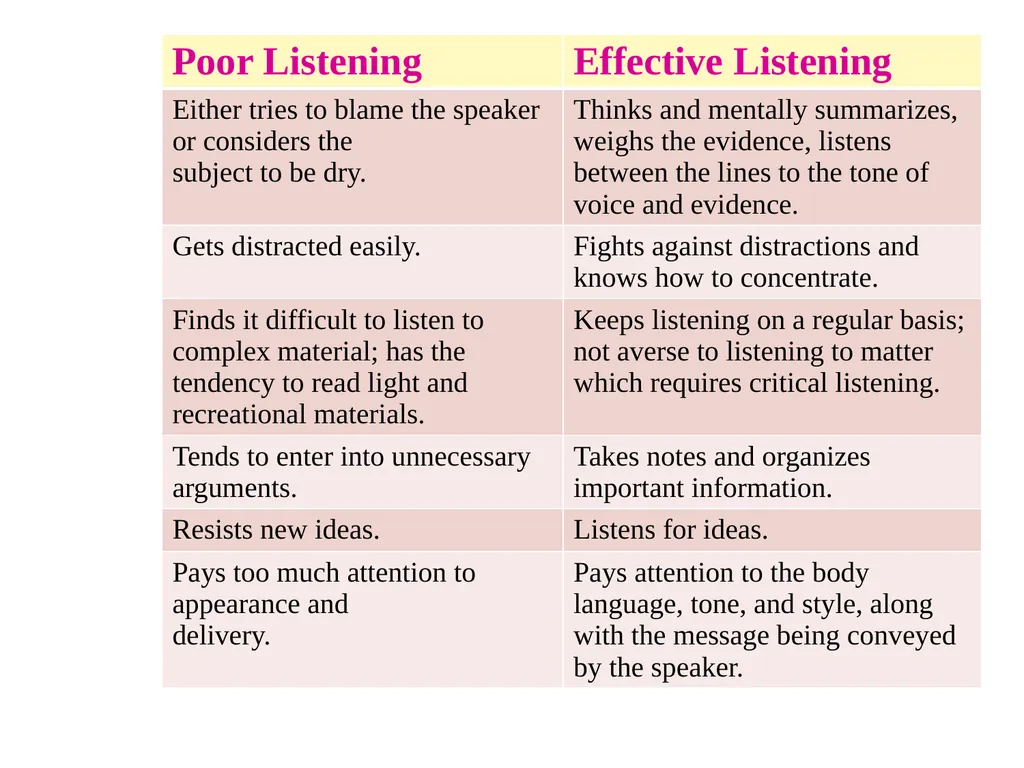
To identify the major causes of poor listening.
To know the various techniques to improve your listening skills. Learning Objectives<br>
03
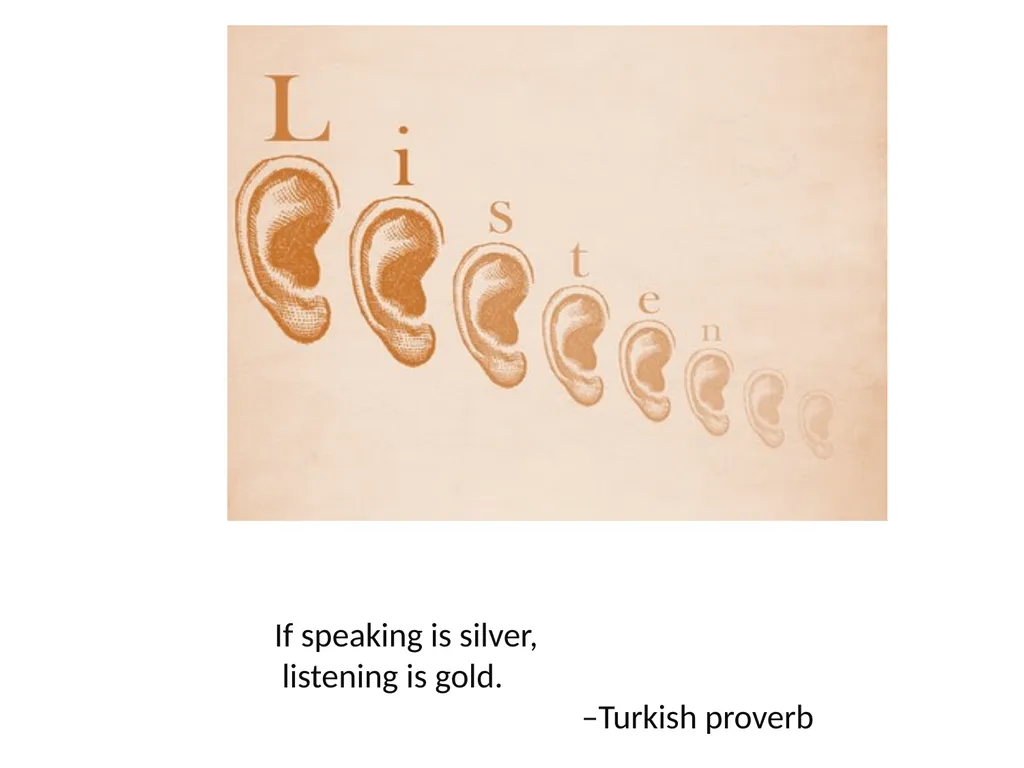
If speaking is silver,
listening is gold.
–Turkish proverb<br>
04
Rose, Siddhartha, Ishita, and Dushyant attended an expert lecture on ‘Soft Skills for Entrepreneurs’ delivered by Paul Kimura, a management guru.
While talking about the role of IQ and EQ he said, ‘IQ represents abstract intelligence which gets the entrepreneurs started, whereas EQ helps them become successful.’
After the lecture, Ishita shared the idea that the statement is applicable in every field of life.
Siddhartha endorsed the idea and told them that besides IQ and EQ, HQ is also becoming very essential, and he referred to an article that he had read in the open page of The Hindu sometime back. Rose remarked that she had found the lecture quite boring, and that she had in fact ‘dozed off for a while.’ Dushyant said, ‘I do not even know what you are talking about.’ Example<br>
05
Why? Ishita and Siddhartha shared ideas during seminar.
But Rose and Dushyant didn’t participated. Listening Contd<br>
06
We spend more time listening than speaking.
It is the most used skill, but we get little training in this.
We are formally trained in other three language skills, namely speaking, reading, and writing.
We utilize only 25 percent of our brain capacity while listening as compared to speaking. Consequently more interested in speaking. Listening: An Art<br>
07
Failure to listen brings unfortunate results!
Human beings want to express themselves, to be heard.
Listening can de-escalate situations. Why is It Important to Listen?<br>
08
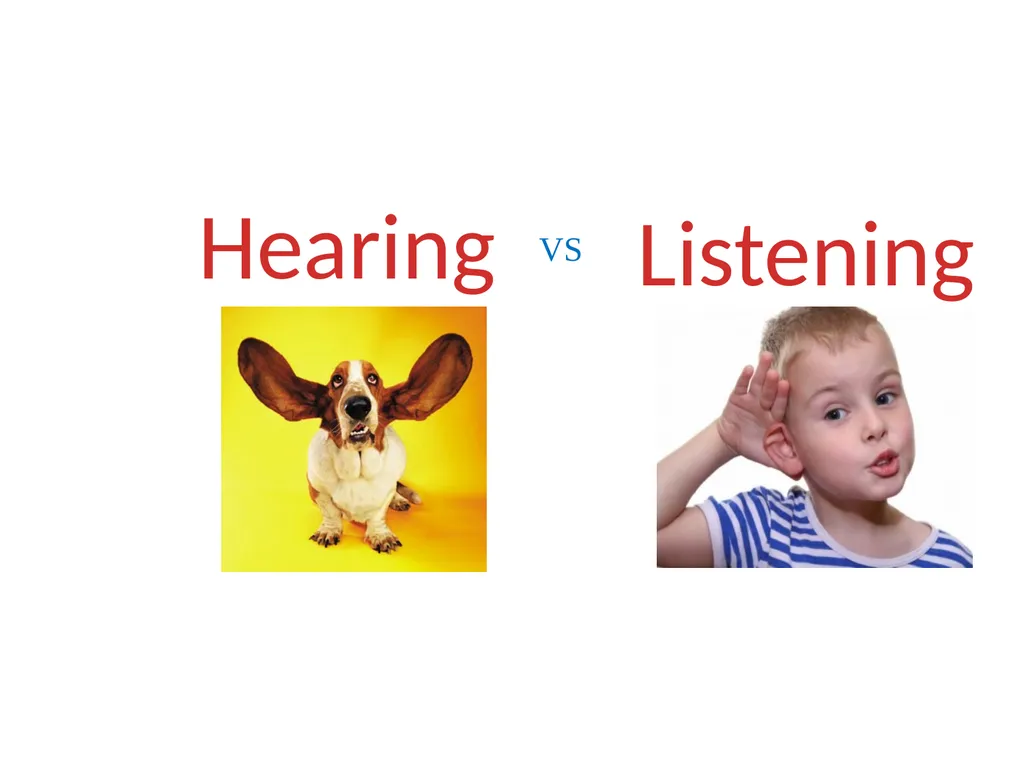
VS Hearing Listening<br>
09
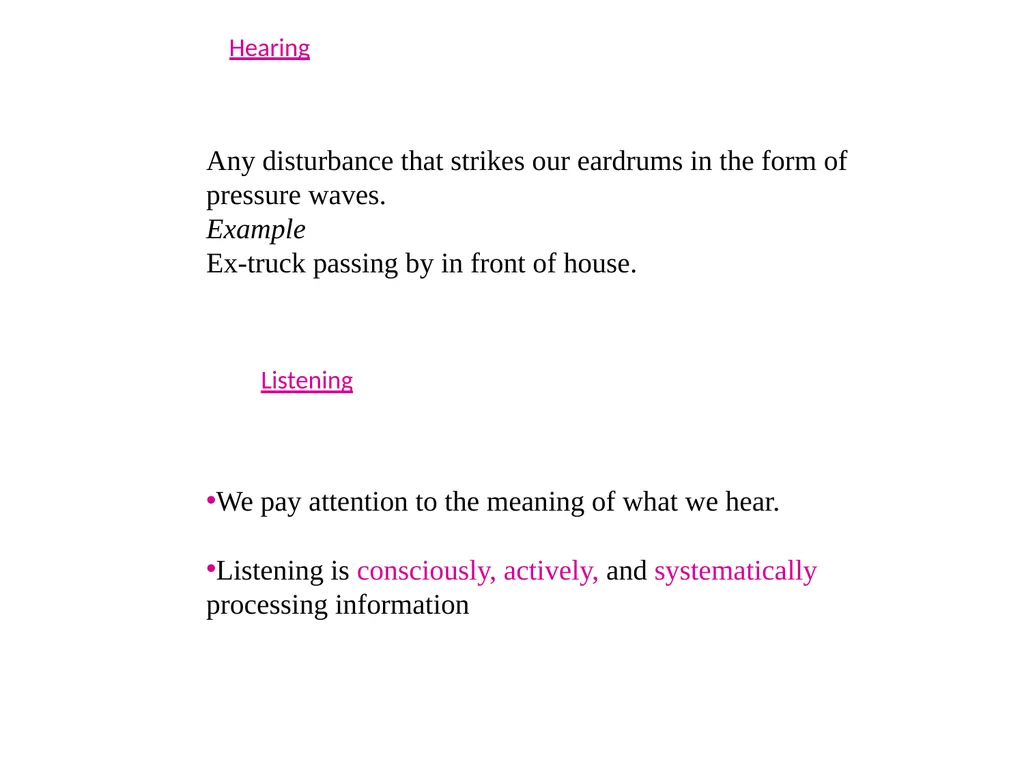
Any disturbance that strikes our eardrums in the form of pressure waves.
Example
Ex-truck passing by in front of house. We pay attention to the meaning of what we hear.
Listening is consciously, actively, and systematically processing information Hearing Listening<br>
10
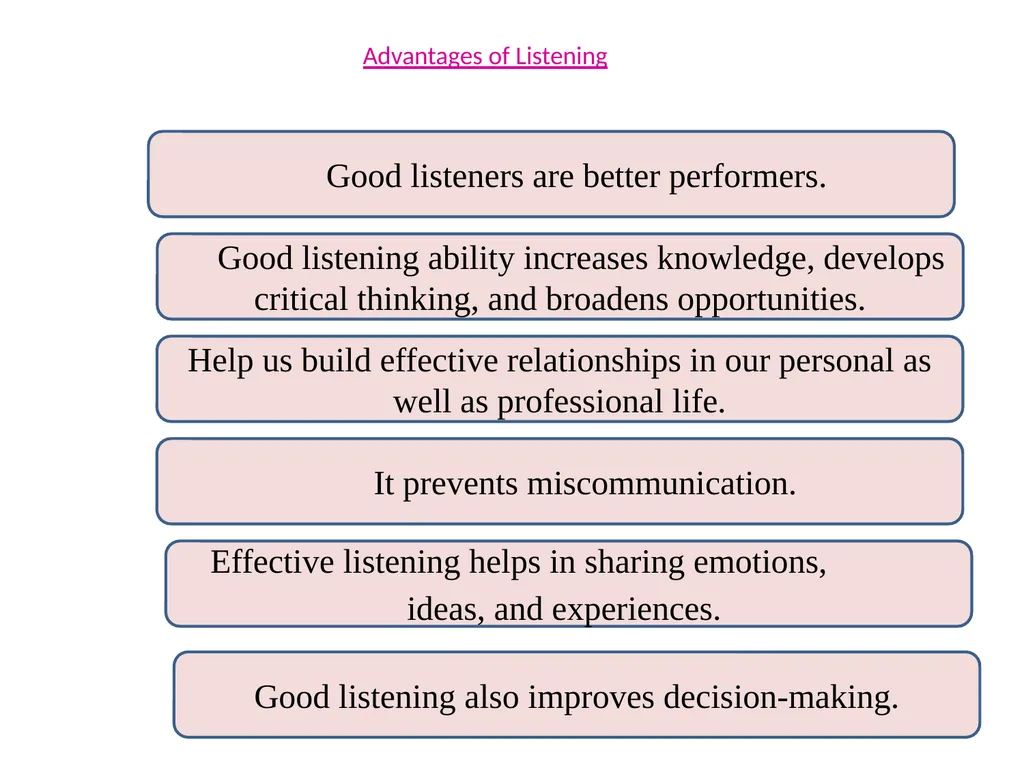
Good listening ability increases knowledge, develops critical thinking, and broadens opportunities. Help us build effective relationships in our personal as well as professional life. It prevents miscommunication. Effective listening helps in sharing emotions, ideas, and experiences. Good listeners are better performers. Good listening also improves decision-making. Advantages of Listening<br>
11
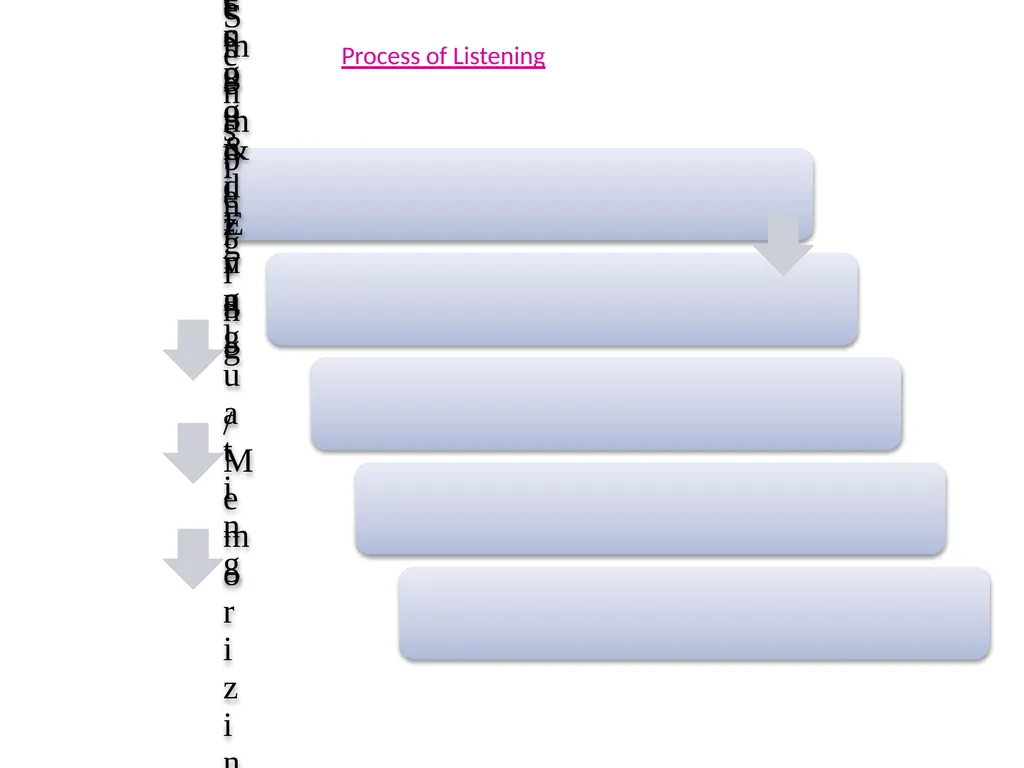
Process of Listening<br>
12
Types of Listening<br>
13
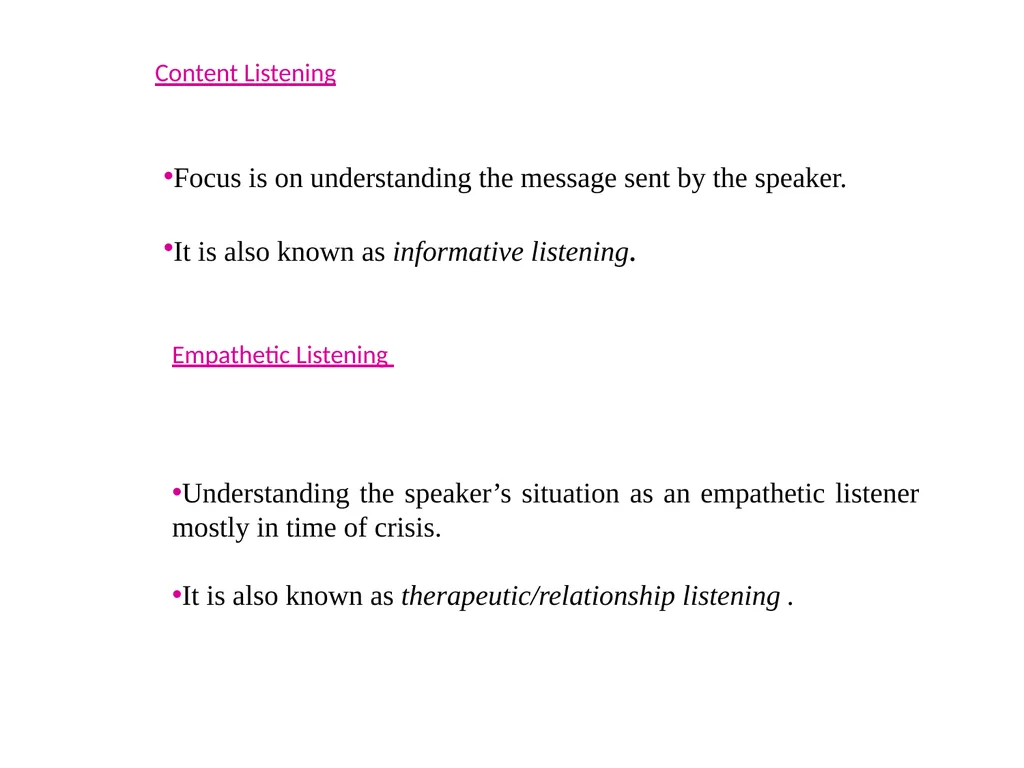
Content Listening Focus is on understanding the message sent by the speaker.
It is also known as informative listening. Empathetic Listening Understanding the speaker’s situation as an empathetic listener mostly in time of crisis.
It is also known as therapeutic/relationship listening .<br>
14
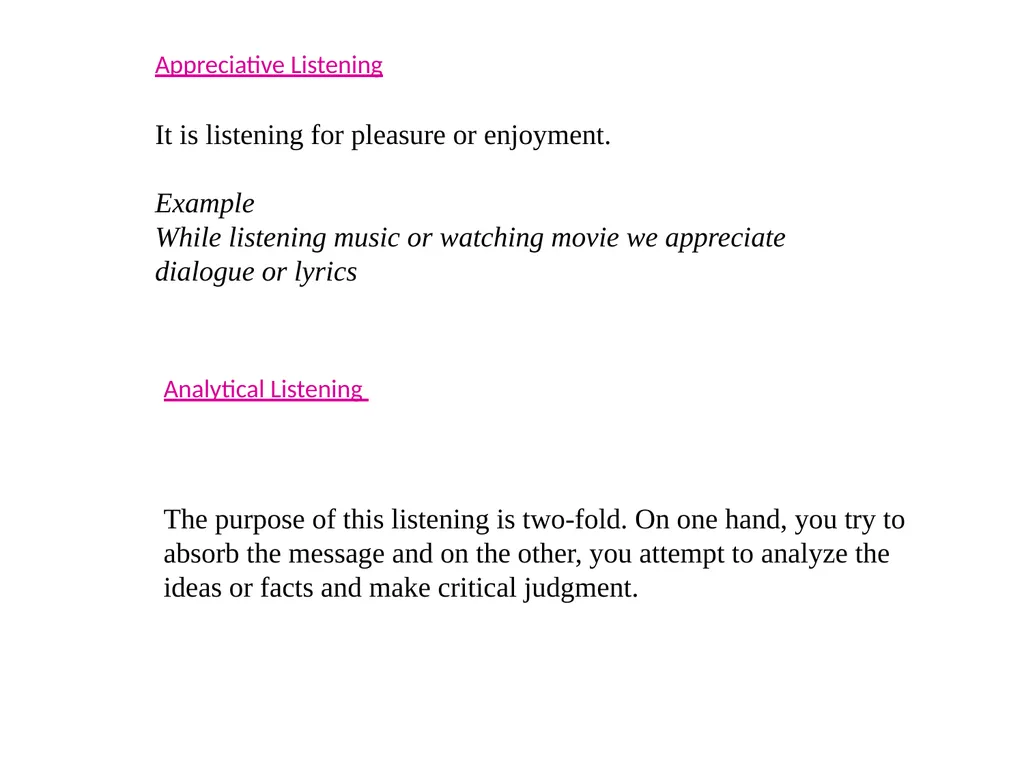
Appreciative Listening Analytical Listening It is listening for pleasure or enjoyment.
Example
While listening music or watching movie we appreciate dialogue or lyrics The purpose of this listening is two-fold. On one hand, you try to absorb the message and on the other, you attempt to analyze the ideas or facts and make critical judgment.<br>
15
Listening to a small amount of material a number of times
When you listen, you concentrate and keep your mind focused on the text.
For example, when you listen to a recorded lesson again and again, you may be able to acquire the correct pronunciation or intonation, or understand the hidden meaning of the text. It gives you the opportunity to hear different voices and different styles.
This also helps in developing effortless listening, since listeners listen to the ideas and opinions on a wide range of topics. Intensive Listening Extensive Listening<br>
16
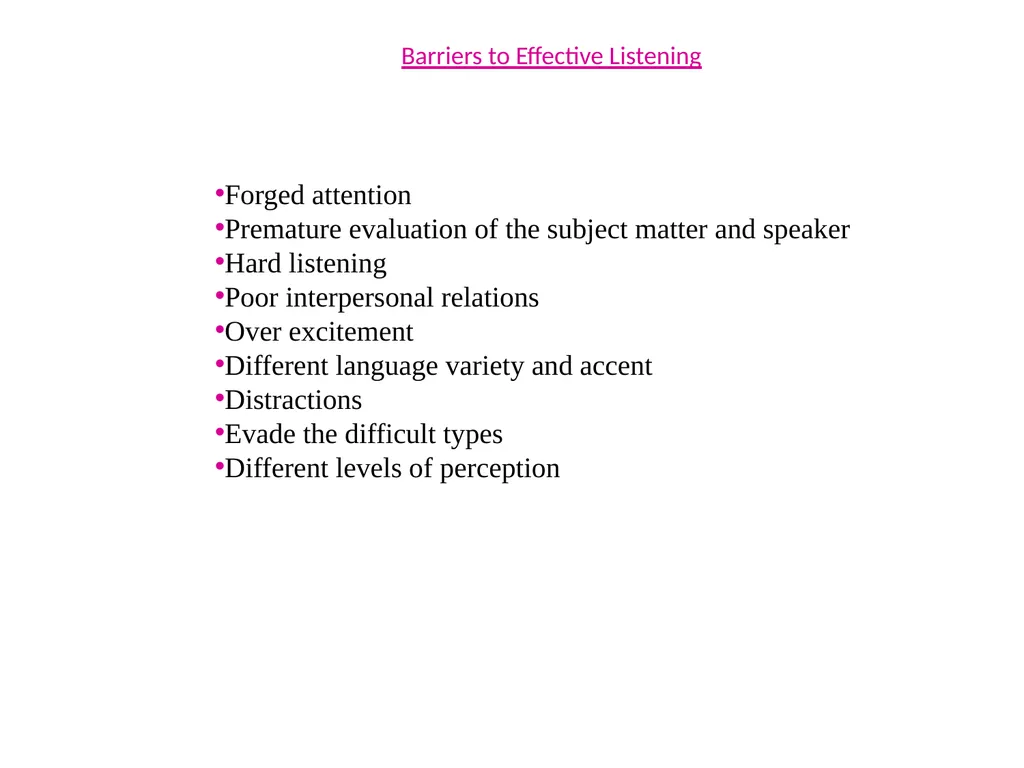
Forged attention
Premature evaluation of the subject matter and speaker
Hard listening
Poor interpersonal relations
Over excitement
Different language variety and accent
Distractions
Evade the difficult types
Different levels of perception Barriers to Effective Listening<br>
17
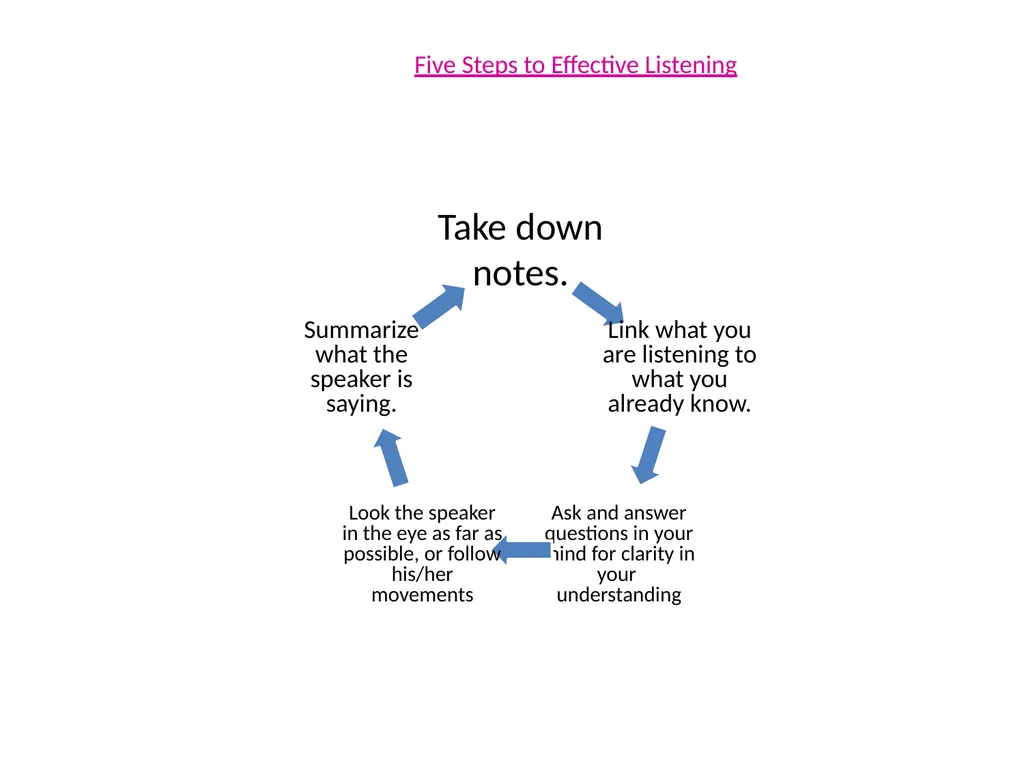
Five Steps to Effective Listening<br>
18
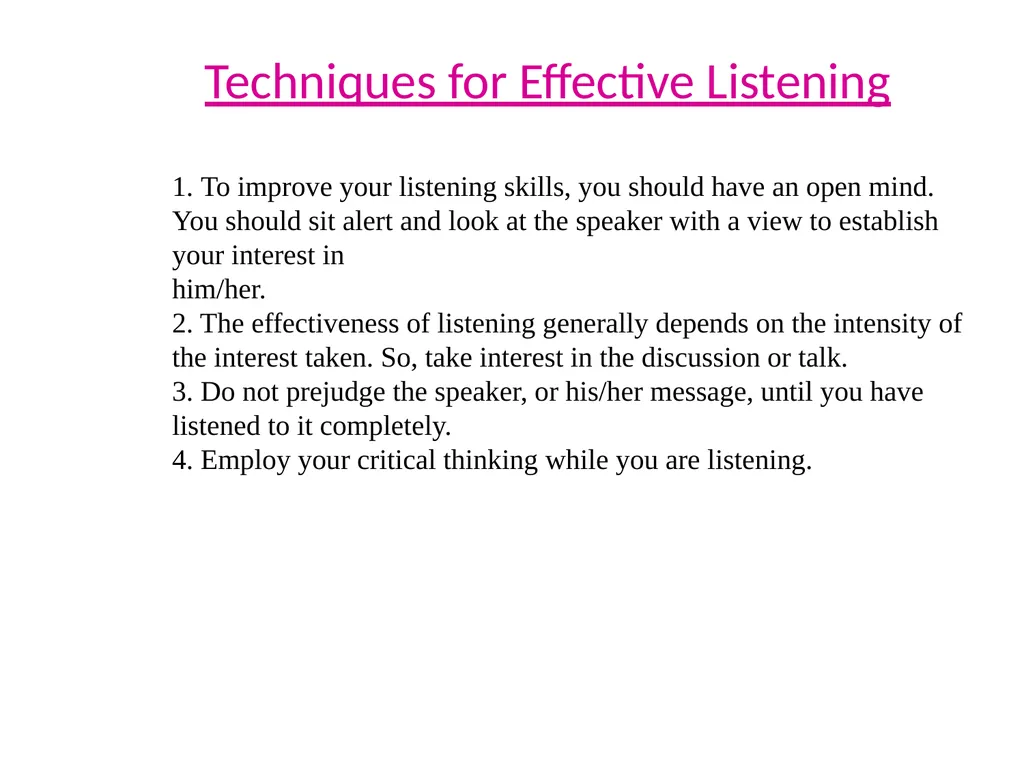
1. To improve your listening skills, you should have an open mind.
You should sit alert and look at the speaker with a view to establish your interest in
him/her.
2. The effectiveness of listening generally depends on the intensity of the interest taken. So, take interest in the discussion or talk.
3. Do not prejudge the speaker, or his/her message, until you have listened to it completely.
4. Employ your critical thinking while you are listening. Techniques for Effective Listening<br>
19
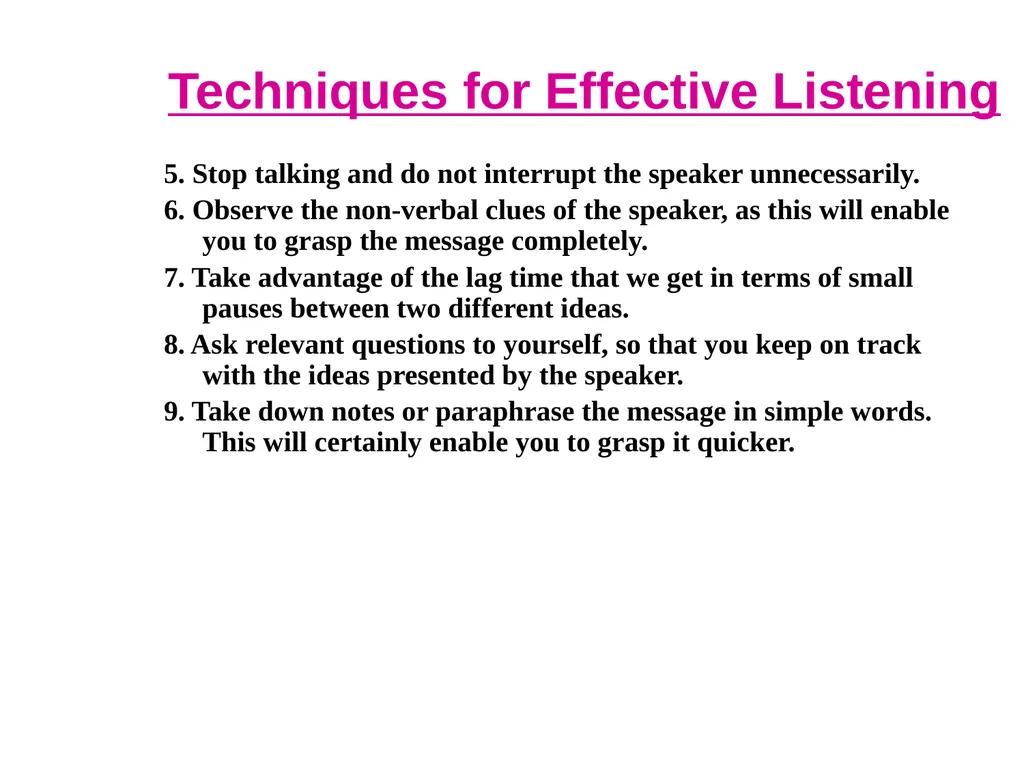
Techniques for Effective Listening 5. Stop talking and do not interrupt the speaker unnecessarily.
6. Observe the non-verbal clues of the speaker, as this will enable you to grasp the message completely.
7. Take advantage of the lag time that we get in terms of small pauses between two different ideas.
8. Ask relevant questions to yourself, so that you keep on track with the ideas presented by the speaker.
9. Take down notes or paraphrase the message in simple words. This will certainly enable you to grasp it quicker.<br>
20
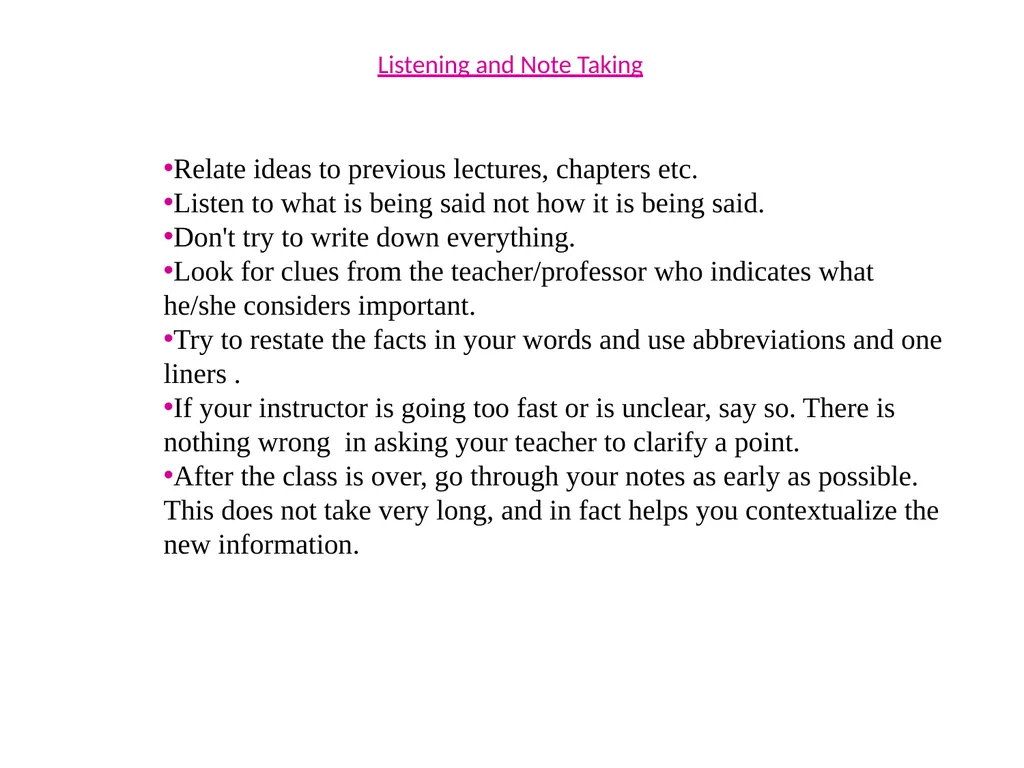
Relate ideas to previous lectures, chapters etc.
Listen to what is being said not how it is being said.
Don't try to write down everything.
Look for clues from the teacher/professor who indicates what he/she considers important.
Try to restate the facts in your words and use abbreviations and one liners .
If your instructor is going too fast or is unclear, say so. There is nothing wrong in asking your teacher to clarify a point.
After the class is over, go through your notes as early as possible. This does not take very long, and in fact helps you contextualize the new information. Listening and Note Taking<br>
21
If you really want to listen, you will act like a good listener. Good listeners are like good catchers because they give their speakers a target and then move that target to capture the information that is being sent.<br>