
Development implications of the Digital economies:
TD
Published · 24 slides · 0 views

1 / 1




Description
Development implications of the Digital economies: the case of Egypt 11 April 2018 By Dr Nagwa Elshenawi Prof of Economics Outline Digital Economy Definition Critical implications to digital economy Investing in smart infrastructure.
Related Topics
Share
Embed code
Download this presentation From Below
"Development implications of the Digital economies:" is the property of its rightful owner. Permission is granted to download and print the materials on this website for personal, non-commercial use only, and to display it on your personal computer provided you do not modify the materials and that you retain all copyright notices contained in the materials. By downloading content from our website, you accept the terms of this agreement.
Presentation Transcript
01
Development implications of the Digital economies:
the case of Egypt 11 April 2018 By Dr Nagwa Elshenawi
Prof of Economics<br>
Prof of Economics<br>
02
Outline Digital Economy Definition
Critical implications to digital economy
Investing in smart infrastructure.
Empowering society.
Unleashing innovation.
Delivering growth and jobs.
Wave of Transformation to Digital Economy
Required Digital economy policies
Conclusion<br>
Critical implications to digital economy
Investing in smart infrastructure.
Empowering society.
Unleashing innovation.
Delivering growth and jobs.
Wave of Transformation to Digital Economy
Required Digital economy policies
Conclusion<br>
03
Digital Economy Definition The OECD defines the digital economy, known also as internet economy in academia, as the part of an economy that enables and conducts the trade of goods and services through electronic commerce on the Internet. The digital economy is perceived as a very substantial driver of economic growth and an increasing source of work for competition authorities.
The impact of the digital economy extends beyond information, goods and services to other areas of the economy as well as lifestyles more generally.<br>
The impact of the digital economy extends beyond information, goods and services to other areas of the economy as well as lifestyles more generally.<br>
04
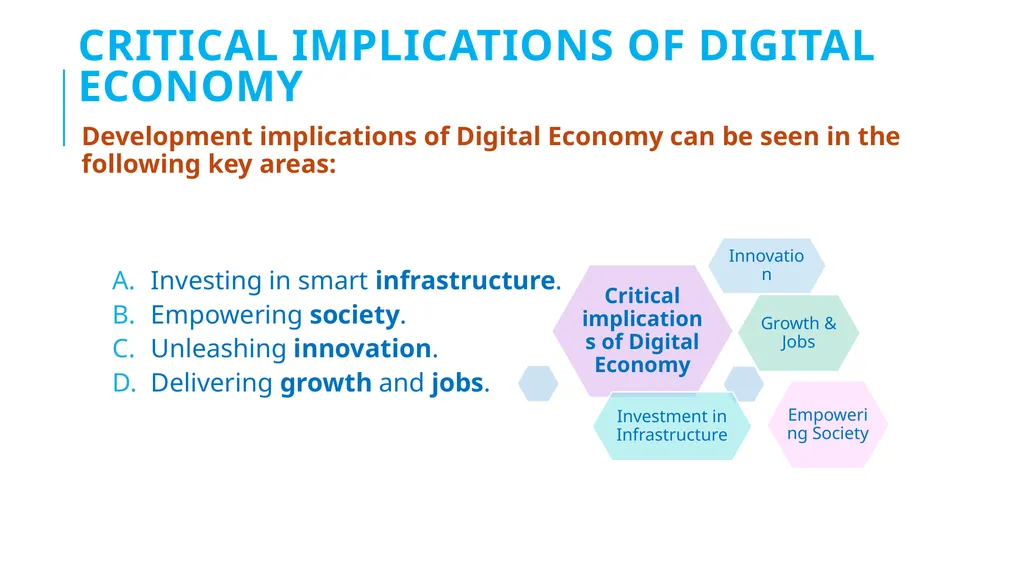
critical implications of digital economy Development implications of Digital Economy can be seen in the following key areas:
Investing in smart infrastructure.
Empowering society.
Unleashing innovation.
Delivering growth and jobs.<br>
Investing in smart infrastructure.
Empowering society.
Unleashing innovation.
Delivering growth and jobs.<br>
05
A) Investing in Smart Infrastructure
Investing in smart infrastructure includes is an important implication for transformation into the digital economy including 1)high broadband penetration rate, 2)more mobile data communications, 3)higher tiers of internet speeds, 4)lower prices for communications services, 5)more connected devices, 6)more across borders eCommerce activities, 7)more sophisticated security methods to online activities.
B) empowering society
Digital economy empowers the society in several ways starting by empowering ICT users in different ages with different educational levels engaging in different online activities e.g mobile banking especially “internet natives” who engaged into internet usage at relatively earlier ages. ICT empowers students at schools, workers in their workplaces, online buyers, readers searching for foreign content, individuals seeking a governmental service and better health seeker<br>
Investing in smart infrastructure includes is an important implication for transformation into the digital economy including 1)high broadband penetration rate, 2)more mobile data communications, 3)higher tiers of internet speeds, 4)lower prices for communications services, 5)more connected devices, 6)more across borders eCommerce activities, 7)more sophisticated security methods to online activities.
B) empowering society
Digital economy empowers the society in several ways starting by empowering ICT users in different ages with different educational levels engaging in different online activities e.g mobile banking especially “internet natives” who engaged into internet usage at relatively earlier ages. ICT empowers students at schools, workers in their workplaces, online buyers, readers searching for foreign content, individuals seeking a governmental service and better health seeker<br>
06
C) Innovation and Entrepreneurship Support
One important implication for the digital economy is unleashing innovation, allowing for more research and development activities among enterprises, the uptake of ICT tools in business like websites and resource planning tools, filing for more patents, designs, and trademarks and businesses engaging in collaboration on innovation and co-inventions.
D) Delivering growth and jobs
Digital economy brings about more ICT investments, value added, affects labor productivity, creates new markets via eCommerce and labor supply of technical ICT fields, and most importantly it creates jobs in ICT field. Furthermore, the digital economy contributes to trade competitiveness and global value chains.<br>
One important implication for the digital economy is unleashing innovation, allowing for more research and development activities among enterprises, the uptake of ICT tools in business like websites and resource planning tools, filing for more patents, designs, and trademarks and businesses engaging in collaboration on innovation and co-inventions.
D) Delivering growth and jobs
Digital economy brings about more ICT investments, value added, affects labor productivity, creates new markets via eCommerce and labor supply of technical ICT fields, and most importantly it creates jobs in ICT field. Furthermore, the digital economy contributes to trade competitiveness and global value chains.<br>
07
Egypt’s Status?<br>
08
A) Investing in smart infrastructure The fourth generation
The National Telecom Regulatory Authority (NTRA) approved, in 2017, the regulatory framework of the Egyptian telecommunications market, including the fourth generation (4G) services, allowing mobile operators to offer the same services to end users. The NTRA recently granted the 4G mobile services license to the four main telecom operators. This step should shift the digital economy to a higher level and greatly empowers the ICT industry in Egypt.
New tier of internet speed
The declaration of the introduction of the new tier of entry speed of fixed internet with a minimum speed 4 Mbits/s up from 512 kb/s. It is worth mentioning that 30 Mbits/s is the highest tier of speed available for public for the fixed broadband internet.<br>
The National Telecom Regulatory Authority (NTRA) approved, in 2017, the regulatory framework of the Egyptian telecommunications market, including the fourth generation (4G) services, allowing mobile operators to offer the same services to end users. The NTRA recently granted the 4G mobile services license to the four main telecom operators. This step should shift the digital economy to a higher level and greatly empowers the ICT industry in Egypt.
New tier of internet speed
The declaration of the introduction of the new tier of entry speed of fixed internet with a minimum speed 4 Mbits/s up from 512 kb/s. It is worth mentioning that 30 Mbits/s is the highest tier of speed available for public for the fixed broadband internet.<br>
09
Data Centers/ big data/cloud computing
Egypt strongly supports the expansion of giant data centers, aspiring to make the country a global hub. Egypt now has 17 Data centers co., 6 amongst are Egyptian. In January 2017, NTRA and GPX Global Systems—specialized in the field of designing, constructing and managing advanced data and information centers—signed a five-year renewal license, through which the company can develop its business, pump new investments in the Egyptian market and provide new job opportunities for young people in the field of building and managing data and information centers.
Cybersecurity
Egypt’s Prime Minister issued a decree to establish the Executive Bureau and the Technical Committee of the Egyptian Supreme Cybersecurity Council (ESCC) of the Cabinet of Ministers. Chaired by the ICT Minister, ESCC is the national supreme council for cybersecurity, with members representing relevant national security agencies and critical sectors. Its mandate is to formulate a national cybersecurity strategy, and to oversee the implementation of related initiatives and programs. It is worth mentioning that cyber security regulation has been passed by the parliament in March 2018.
Legislations
Egypt already has its e-signature law which can help boost eCommerce activities and cyber crime related legislation is being discussed in the Egyptian Parliament. A) Investing in smart infrastructure- Cont.<br>
Egypt strongly supports the expansion of giant data centers, aspiring to make the country a global hub. Egypt now has 17 Data centers co., 6 amongst are Egyptian. In January 2017, NTRA and GPX Global Systems—specialized in the field of designing, constructing and managing advanced data and information centers—signed a five-year renewal license, through which the company can develop its business, pump new investments in the Egyptian market and provide new job opportunities for young people in the field of building and managing data and information centers.
Cybersecurity
Egypt’s Prime Minister issued a decree to establish the Executive Bureau and the Technical Committee of the Egyptian Supreme Cybersecurity Council (ESCC) of the Cabinet of Ministers. Chaired by the ICT Minister, ESCC is the national supreme council for cybersecurity, with members representing relevant national security agencies and critical sectors. Its mandate is to formulate a national cybersecurity strategy, and to oversee the implementation of related initiatives and programs. It is worth mentioning that cyber security regulation has been passed by the parliament in March 2018.
Legislations
Egypt already has its e-signature law which can help boost eCommerce activities and cyber crime related legislation is being discussed in the Egyptian Parliament. A) Investing in smart infrastructure- Cont.<br>
10
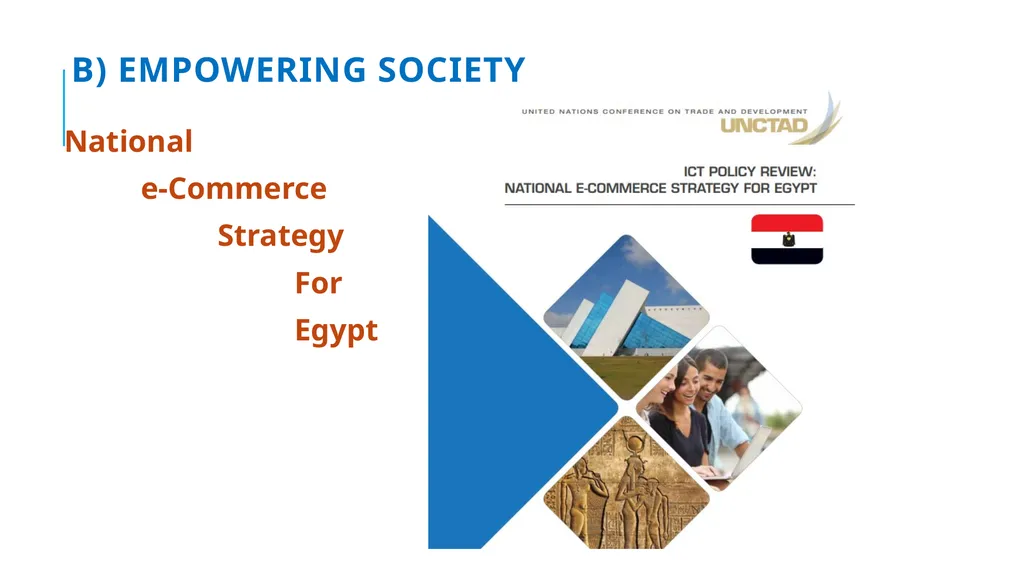
B) empowering society National
e-Commerce
Strategy
For
Egypt<br>
e-Commerce
Strategy
For
Egypt<br>
11
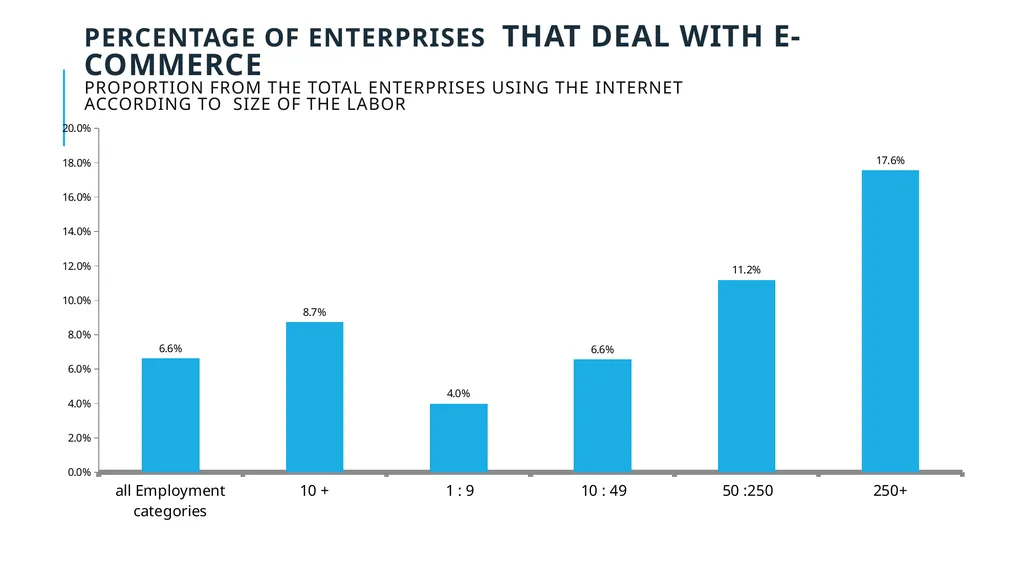
Percentage of Enterprises that deal with e-commerce
Proportion from the total Enterprises using the Internet
According to size of the labor<br>
12
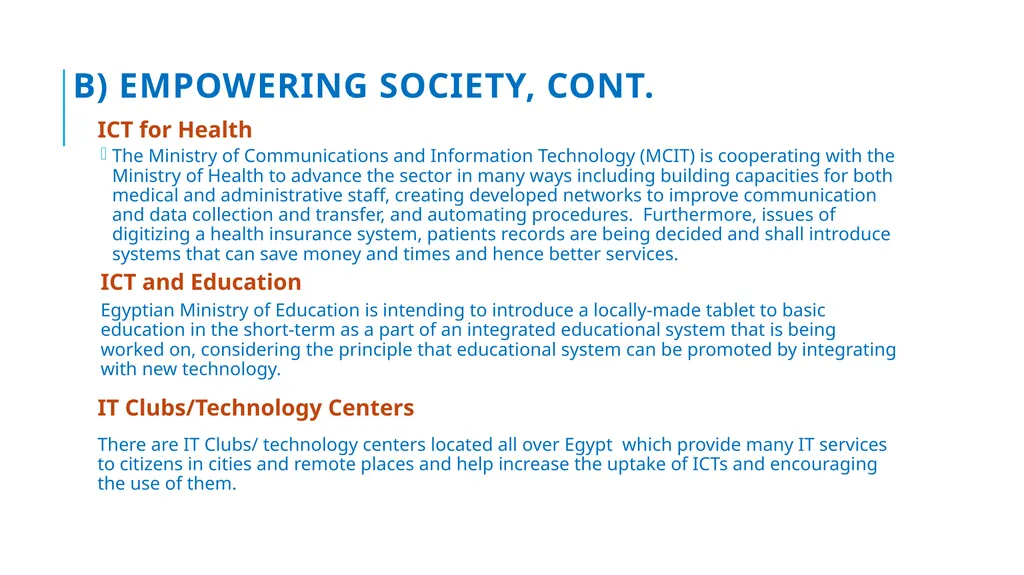
B) empowering society, CONT. ICT for Health
The Ministry of Communications and Information Technology (MCIT) is cooperating with the Ministry of Health to advance the sector in many ways including building capacities for both medical and administrative staff, creating developed networks to improve communication and data collection and transfer, and automating procedures. Furthermore, issues of digitizing a health insurance system, patients records are being decided and shall introduce systems that can save money and times and hence better services.
ICT and Education
Egyptian Ministry of Education is intending to introduce a locally-made tablet to basic education in the short-term as a part of an integrated educational system that is being worked on, considering the principle that educational system can be promoted by integrating with new technology.
IT Clubs/Technology Centers
There are IT Clubs/ technology centers located all over Egypt which provide many IT services to citizens in cities and remote places and help increase the uptake of ICTs and encouraging the use of them.<br>
The Ministry of Communications and Information Technology (MCIT) is cooperating with the Ministry of Health to advance the sector in many ways including building capacities for both medical and administrative staff, creating developed networks to improve communication and data collection and transfer, and automating procedures. Furthermore, issues of digitizing a health insurance system, patients records are being decided and shall introduce systems that can save money and times and hence better services.
ICT and Education
Egyptian Ministry of Education is intending to introduce a locally-made tablet to basic education in the short-term as a part of an integrated educational system that is being worked on, considering the principle that educational system can be promoted by integrating with new technology.
IT Clubs/Technology Centers
There are IT Clubs/ technology centers located all over Egypt which provide many IT services to citizens in cities and remote places and help increase the uptake of ICTs and encouraging the use of them.<br>
13
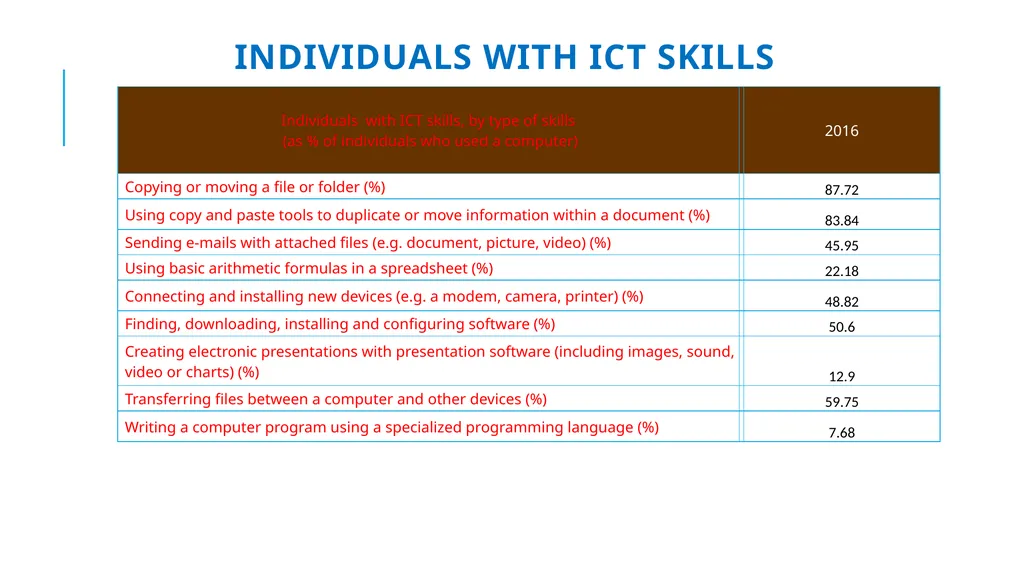
Individuals with ICT skills<br>
14
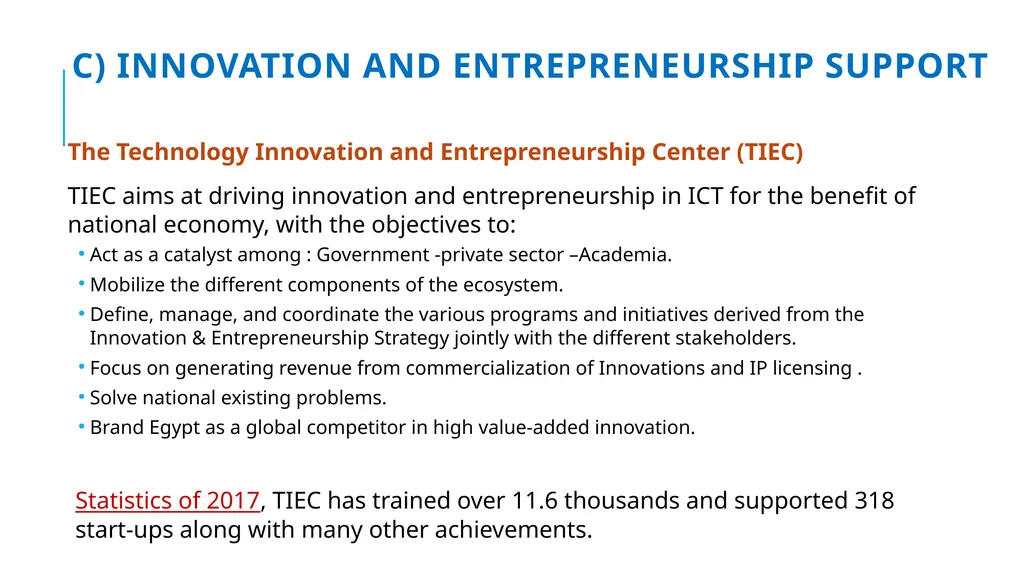
C) Innovation and Entrepreneurship Support The Technology Innovation and Entrepreneurship Center (TIEC)
TIEC aims at driving innovation and entrepreneurship in ICT for the benefit of national economy, with the objectives to:
Act as a catalyst among : Government -private sector –Academia.
Mobilize the different components of the ecosystem.
Define, manage, and coordinate the various programs and initiatives derived from the Innovation & Entrepreneurship Strategy jointly with the different stakeholders.
Focus on generating revenue from commercialization of Innovations and IP licensing .
Solve national existing problems.
Brand Egypt as a global competitor in high value-added innovation.
Statistics of 2017, TIEC has trained over 11.6 thousands and supported 318 start-ups along with many other achievements.<br>
TIEC aims at driving innovation and entrepreneurship in ICT for the benefit of national economy, with the objectives to:
Act as a catalyst among : Government -private sector –Academia.
Mobilize the different components of the ecosystem.
Define, manage, and coordinate the various programs and initiatives derived from the Innovation & Entrepreneurship Strategy jointly with the different stakeholders.
Focus on generating revenue from commercialization of Innovations and IP licensing .
Solve national existing problems.
Brand Egypt as a global competitor in high value-added innovation.
Statistics of 2017, TIEC has trained over 11.6 thousands and supported 318 start-ups along with many other achievements.<br>
15
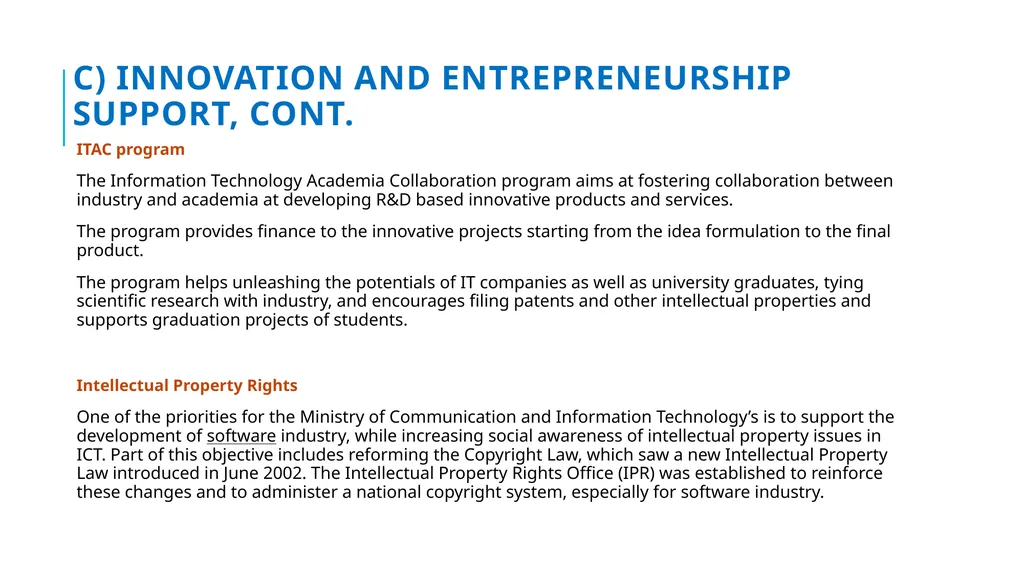
C) Innovation and Entrepreneurship Support, cont. ITAC program
The Information Technology Academia Collaboration program aims at fostering collaboration between industry and academia at developing R&D based innovative products and services.
The program provides finance to the innovative projects starting from the idea formulation to the final product.
The program helps unleashing the potentials of IT companies as well as university graduates, tying scientific research with industry, and encourages filing patents and other intellectual properties and supports graduation projects of students.
Intellectual Property Rights
One of the priorities for the Ministry of Communication and Information Technology’s is to support the development of software industry, while increasing social awareness of intellectual property issues in ICT. Part of this objective includes reforming the Copyright Law, which saw a new Intellectual Property Law introduced in June 2002. The Intellectual Property Rights Office (IPR) was established to reinforce these changes and to administer a national copyright system, especially for software industry.<br>
The Information Technology Academia Collaboration program aims at fostering collaboration between industry and academia at developing R&D based innovative products and services.
The program provides finance to the innovative projects starting from the idea formulation to the final product.
The program helps unleashing the potentials of IT companies as well as university graduates, tying scientific research with industry, and encourages filing patents and other intellectual properties and supports graduation projects of students.
Intellectual Property Rights
One of the priorities for the Ministry of Communication and Information Technology’s is to support the development of software industry, while increasing social awareness of intellectual property issues in ICT. Part of this objective includes reforming the Copyright Law, which saw a new Intellectual Property Law introduced in June 2002. The Intellectual Property Rights Office (IPR) was established to reinforce these changes and to administer a national copyright system, especially for software industry.<br>
16
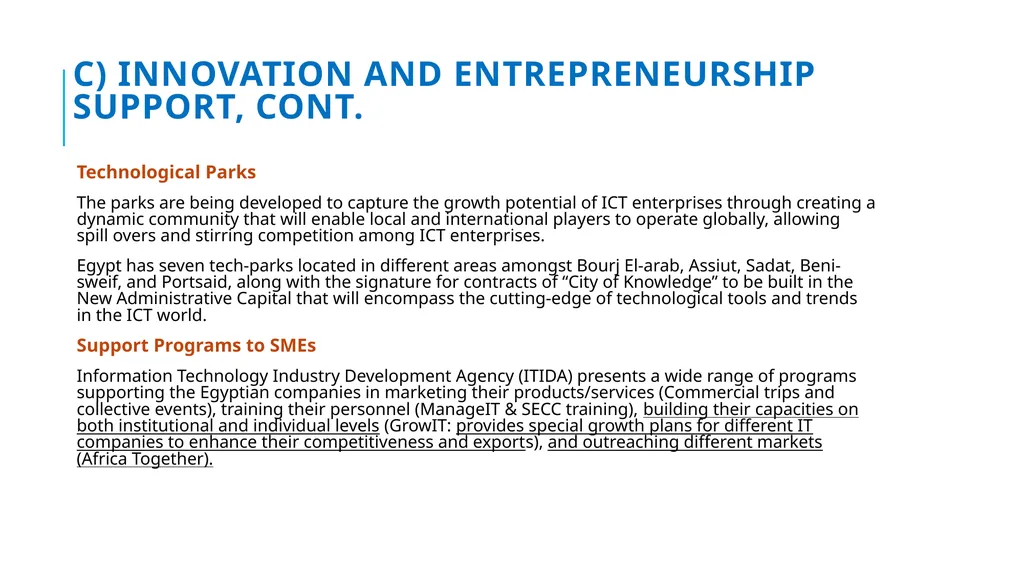
C) Innovation and Entrepreneurship Support, cont. Technological Parks
The parks are being developed to capture the growth potential of ICT enterprises through creating a dynamic community that will enable local and international players to operate globally, allowing spill overs and stirring competition among ICT enterprises.
Egypt has seven tech-parks located in different areas amongst Bourj El-arab, Assiut, Sadat, Beni-sweif, and Portsaid, along with the signature for contracts of “City of Knowledge” to be built in the New Administrative Capital that will encompass the cutting-edge of technological tools and trends in the ICT world.
Support Programs to SMEs
Information Technology Industry Development Agency (ITIDA) presents a wide range of programs supporting the Egyptian companies in marketing their products/services (Commercial trips and collective events), training their personnel (ManageIT & SECC training), building their capacities on both institutional and individual levels (GrowIT: provides special growth plans for different IT companies to enhance their competitiveness and exports), and outreaching different markets (Africa Together).<br>
The parks are being developed to capture the growth potential of ICT enterprises through creating a dynamic community that will enable local and international players to operate globally, allowing spill overs and stirring competition among ICT enterprises.
Egypt has seven tech-parks located in different areas amongst Bourj El-arab, Assiut, Sadat, Beni-sweif, and Portsaid, along with the signature for contracts of “City of Knowledge” to be built in the New Administrative Capital that will encompass the cutting-edge of technological tools and trends in the ICT world.
Support Programs to SMEs
Information Technology Industry Development Agency (ITIDA) presents a wide range of programs supporting the Egyptian companies in marketing their products/services (Commercial trips and collective events), training their personnel (ManageIT & SECC training), building their capacities on both institutional and individual levels (GrowIT: provides special growth plans for different IT companies to enhance their competitiveness and exports), and outreaching different markets (Africa Together).<br>
17
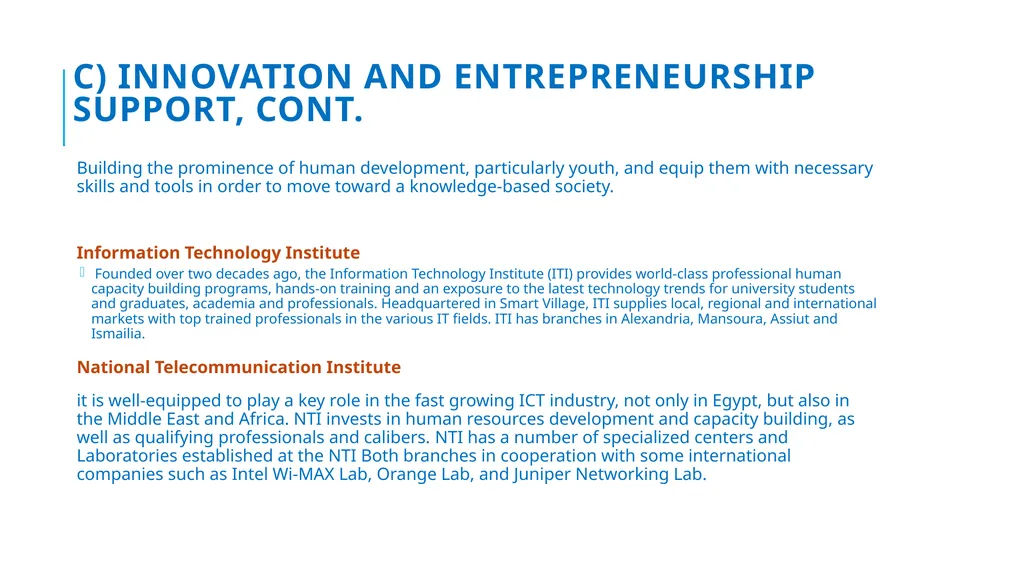
C) Innovation and Entrepreneurship Support, cont. Building the prominence of human development, particularly youth, and equip them with necessary skills and tools in order to move toward a knowledge-based society.
Information Technology Institute
Founded over two decades ago, the Information Technology Institute (ITI) provides world-class professional human capacity building programs, hands-on training and an exposure to the latest technology trends for university students and graduates, academia and professionals. Headquartered in Smart Village, ITI supplies local, regional and international markets with top trained professionals in the various IT fields. ITI has branches in Alexandria, Mansoura, Assiut and Ismailia.
National Telecommunication Institute
it is well-equipped to play a key role in the fast growing ICT industry, not only in Egypt, but also in the Middle East and Africa. NTI invests in human resources development and capacity building, as well as qualifying professionals and calibers. NTI has a number of specialized centers and Laboratories established at the NTI Both branches in cooperation with some international companies such as Intel Wi-MAX Lab, Orange Lab, and Juniper Networking Lab.<br>
Information Technology Institute
Founded over two decades ago, the Information Technology Institute (ITI) provides world-class professional human capacity building programs, hands-on training and an exposure to the latest technology trends for university students and graduates, academia and professionals. Headquartered in Smart Village, ITI supplies local, regional and international markets with top trained professionals in the various IT fields. ITI has branches in Alexandria, Mansoura, Assiut and Ismailia.
National Telecommunication Institute
it is well-equipped to play a key role in the fast growing ICT industry, not only in Egypt, but also in the Middle East and Africa. NTI invests in human resources development and capacity building, as well as qualifying professionals and calibers. NTI has a number of specialized centers and Laboratories established at the NTI Both branches in cooperation with some international companies such as Intel Wi-MAX Lab, Orange Lab, and Juniper Networking Lab.<br>
18
D) Delivering growth and jobs Digital economy brings about more ICT investments, value added, affects labor productivity, creates new markets via eCommerce and labor supply of technical ICT fields, and most importantly it creates jobs in ICT field. Furthermore, the digital economy contributes to trade competitiveness and global value chains.
ICT Value Added In 2016/2017 Egyptian ICT sector has contributed by almost 3.2% to the Egyptian GDP and by 0.37 percentage points to its growth. The sector has been providing between 90 to 95 thousands jobs only in outsourcing industry. Outsourcing industry is also estimated to have generated around USD 1.87 billion of exports in 2017.<br>
ICT Value Added In 2016/2017 Egyptian ICT sector has contributed by almost 3.2% to the Egyptian GDP and by 0.37 percentage points to its growth. The sector has been providing between 90 to 95 thousands jobs only in outsourcing industry. Outsourcing industry is also estimated to have generated around USD 1.87 billion of exports in 2017.<br>
19
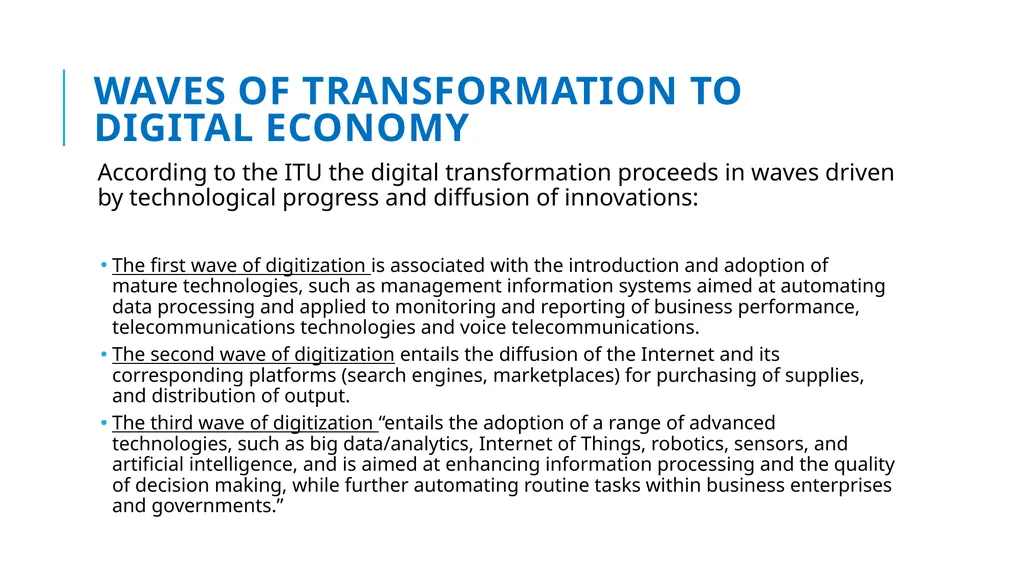
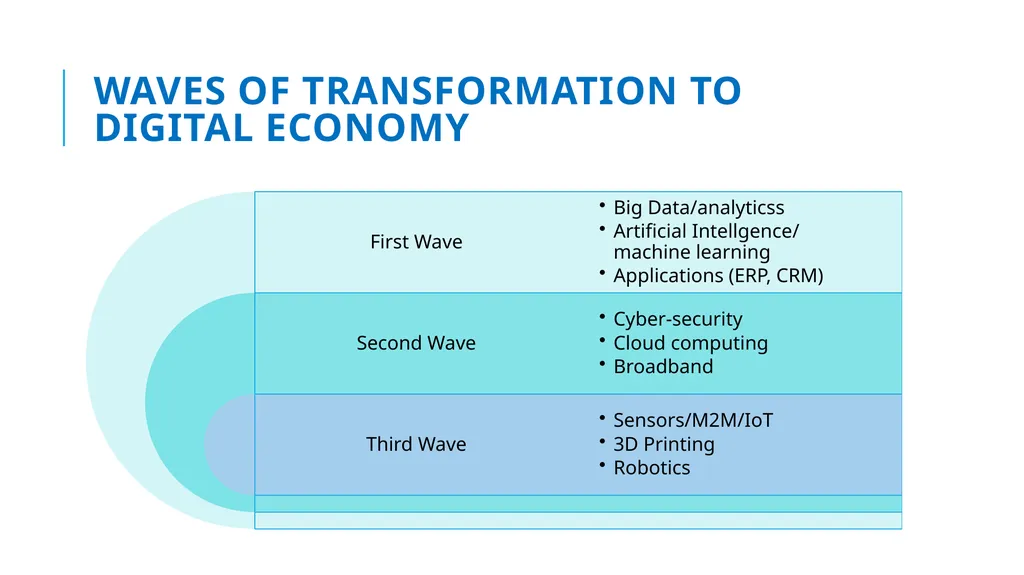
Waves of transformation to digital economy According to the ITU the digital transformation proceeds in waves driven by technological progress and diffusion of innovations:
The first wave of digitization is associated with the introduction and adoption of mature technologies, such as management information systems aimed at automating data processing and applied to monitoring and reporting of business performance, telecommunications technologies and voice telecommunications.
The second wave of digitization entails the diffusion of the Internet and its corresponding platforms (search engines, marketplaces) for purchasing of supplies, and distribution of output.
The third wave of digitization “entails the adoption of a range of advanced technologies, such as big data/analytics, Internet of Things, robotics, sensors, and artificial intelligence, and is aimed at enhancing information processing and the quality of decision making, while further automating routine tasks within business enterprises and governments.”<br>
The first wave of digitization is associated with the introduction and adoption of mature technologies, such as management information systems aimed at automating data processing and applied to monitoring and reporting of business performance, telecommunications technologies and voice telecommunications.
The second wave of digitization entails the diffusion of the Internet and its corresponding platforms (search engines, marketplaces) for purchasing of supplies, and distribution of output.
The third wave of digitization “entails the adoption of a range of advanced technologies, such as big data/analytics, Internet of Things, robotics, sensors, and artificial intelligence, and is aimed at enhancing information processing and the quality of decision making, while further automating routine tasks within business enterprises and governments.”<br>
20
Waves of transformation to digital economy<br>
21
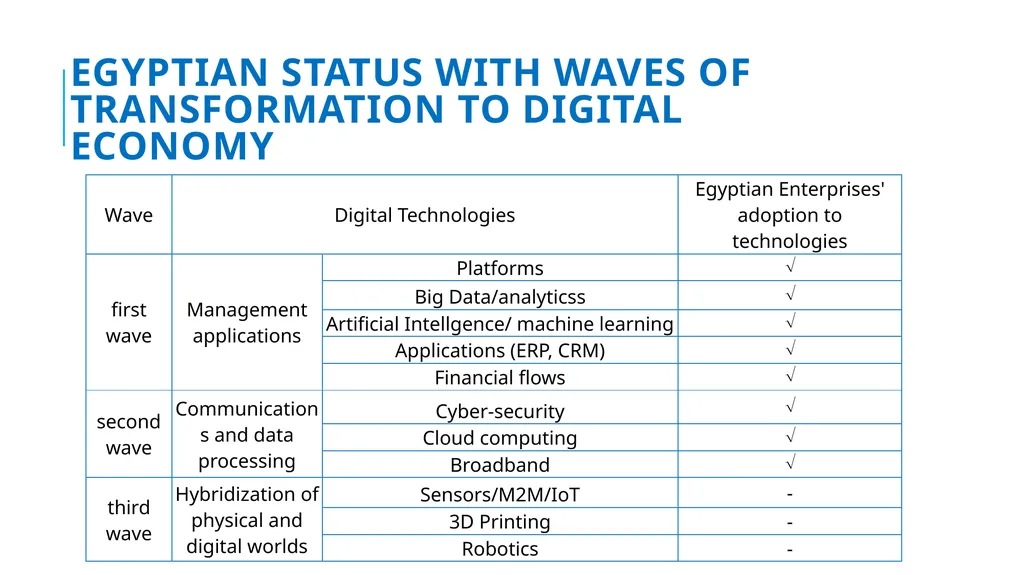
Egyptian status with waves of transformation to digital economy<br>
22
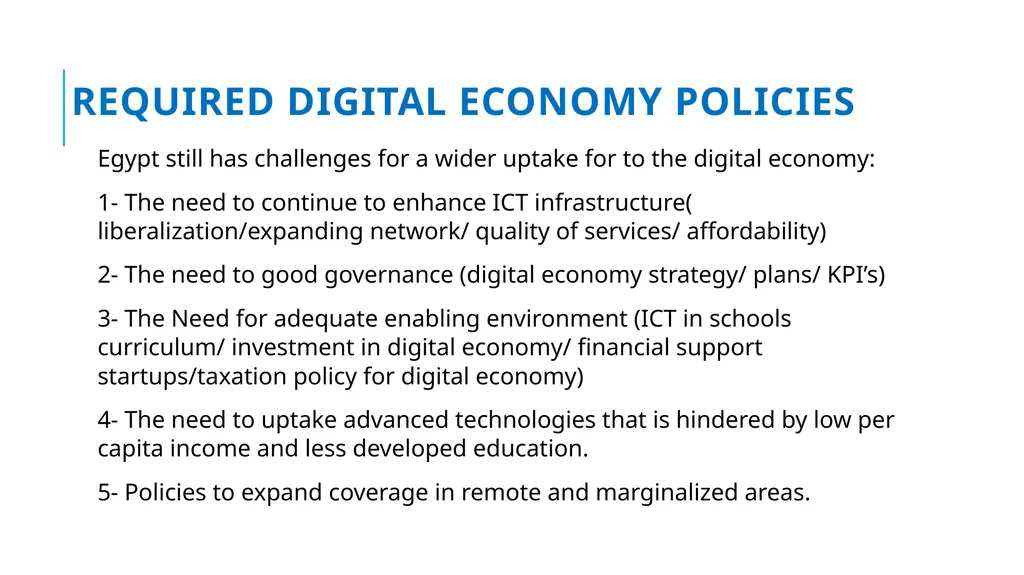
Required Digital economy policies Egypt still has challenges for a wider uptake for to the digital economy:
1- The need to continue to enhance ICT infrastructure( liberalization/expanding network/ quality of services/ affordability)
2- The need to good governance (digital economy strategy/ plans/ KPI’s)
3- The Need for adequate enabling environment (ICT in schools curriculum/ investment in digital economy/ financial support startups/taxation policy for digital economy)
4- The need to uptake advanced technologies that is hindered by low per capita income and less developed education.
5- Policies to expand coverage in remote and marginalized areas.<br>
1- The need to continue to enhance ICT infrastructure( liberalization/expanding network/ quality of services/ affordability)
2- The need to good governance (digital economy strategy/ plans/ KPI’s)
3- The Need for adequate enabling environment (ICT in schools curriculum/ investment in digital economy/ financial support startups/taxation policy for digital economy)
4- The need to uptake advanced technologies that is hindered by low per capita income and less developed education.
5- Policies to expand coverage in remote and marginalized areas.<br>
23
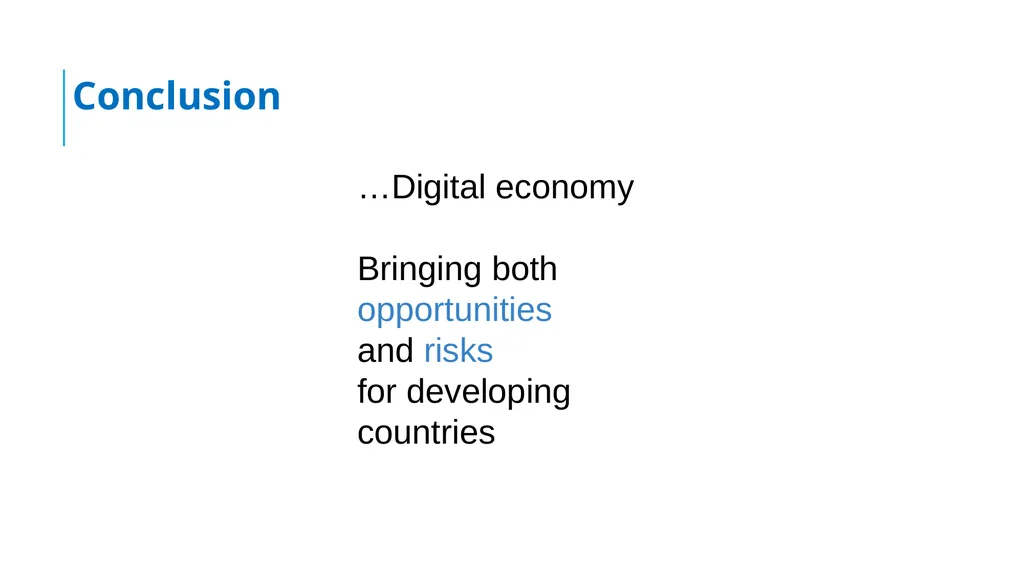
…Digital economy
Bringing both
opportunities
and risks for developing
countries Conclusion<br>
Bringing both
opportunities
and risks for developing
countries Conclusion<br>
24
For more information
nagwash2004@yahoo.com<br>