
Developmental Language Disorder What every class

Description: Developmental Language Disorder What every class teacher needs to know Raising Awareness of Developmental Language Disorder (RADLD) radld.org Presenters name What is Developmental Language Disorder? Developmental Language Disorder (DLD) is
Related Topics
Download Presentation
"Developmental Language Disorder What every class" is the property of its rightful owner. Permission is granted to download and print the materials on this website for personal, non-commercial use only, and to display it on your personal computer provided you do not modify the materials and that you retain all copyright notices contained in the materials. By downloading content from our website, you accept the terms of this agreement.
Presentation Transcript
slide1. Developmental Language Disorder What every class teacher needs to know
Raising Awareness of Developmental Language Disorder (RADLD)
radld.org
Presenter’s name<br>
slide2. What is Developmental Language Disorder? Developmental Language Disorder (DLD) is when a child (over 5) or adult has difficulties talking and/or understanding language.
These difficulties impact on education and social interactions
The difficulties exist without another biomedical condition such as autism or intellectual disability.<br>
slide3. Noticing Developmental Language Disorder You might notice that a student speaks in shorter sentences or uses less sophisticated vocabulary than other classmates.
Less obvious is when students are not understanding what is said. They often get told ‘you weren’t paying attention’ when in fact they were paying attention, but could not understand the language.
Some students with DLD may be over literal or have difficulties with conversational skills<br>
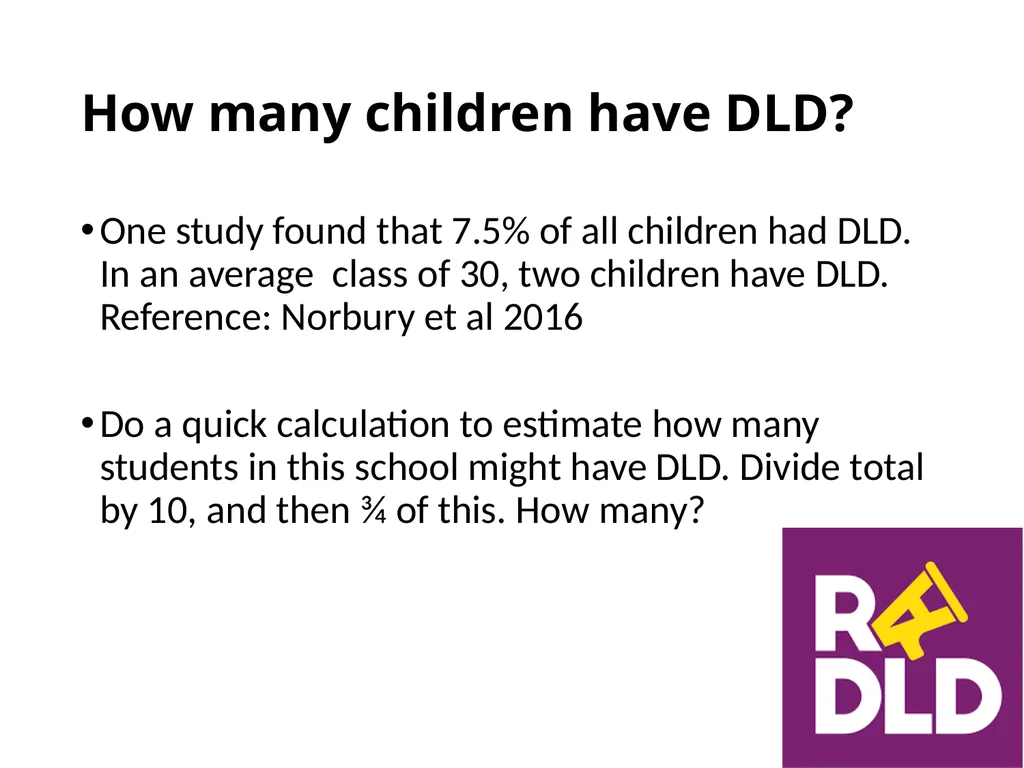
slide4. How many children have DLD? One study found that 7.5% of all children had DLD. In an average class of 30, two children have DLD. Reference: Norbury et al 2016
Do a quick calculation to estimate how many students in this school might have DLD. Divide total by 10, and then ¾ of this. How many?<br>
slide5. The impacts of DLD DLD is a life long condition: children don’t grow out of it. It impacts on:
Reading
Learning
Social interaction
Behaviour
Mental health<br>
slide6. DLD and reading To become a good reader students need good language skills
Students need to know the vocabulary and grammar, and to be able to understand how it fits together.
That student that is struggling to read may have DLD.<br>
slide7. DLD impacts directly on learning Following instructions
Engaging in class discussion
Answering questions
Group work
All of the above require language skills, so a student with DLD will struggle with learning also.
That student who is struggling to keep up
may have DLD.<br>
slide8. Social impacts of DLD Students with DLD may struggle to keep up with the nuances of peer interactions and so get left out
One study found 81% of all students with SEMH (social, emotional and mental health) needs had language needs. Reference: Hollo et al 2014
And a student who does not know they have DLD may think of themselves as ‘stupid’, which may then
in turn impact on mental health.<br>
slide9. What can you do? Take a closer look at students with reading, learning or social difficulties
Just ask ‘could it be language?’
Chat to the student one to one
Observe their responses to whole class instructions
Students with DLD may be good at copying others’ leads, and so their difficulties may NOT be obvious<br>
slide10. Take action Talk to parents
But because there is low awareness of DLD many parents may also not be aware
Talk to your school special education lead/ specialist/SENCO
Refer to specialist services, such as Speech and Language Therapy / Speech-Language Pathology
The right support can make a difference<br>
slide11. What children and young people with DLD say Select a video from the RADLD YouTube ‘DLD and me’ section<br>
slide12. Learn more Radld.org
Dldandme.org
naplic.org.uk/dld
Any other local websites
Questions?<br>
slide13. References Norbury, C. F., Gooch, D., Wray, C., Baird, G., Charman, T., Simonoff, E., … Pickles, A. (2016). The impact of nonverbal ability on prevalence and clinical presentation of language disorder: evidence from a population study. Journal of Child Psychology and Psychiatry. https://doi.org/10.1111/jcpp.12573
Hollo A, Wehby JH, Oliver RM. (2014) Unidentified Language Deficits in Children with Emotional and Behavioral Disorders: A Meta-Analysis. Exceptional Children; 80(2): 169-186.<br>
Raising Awareness of Developmental Language Disorder (RADLD)
radld.org
Presenter’s name<br>
slide2. What is Developmental Language Disorder? Developmental Language Disorder (DLD) is when a child (over 5) or adult has difficulties talking and/or understanding language.
These difficulties impact on education and social interactions
The difficulties exist without another biomedical condition such as autism or intellectual disability.<br>
slide3. Noticing Developmental Language Disorder You might notice that a student speaks in shorter sentences or uses less sophisticated vocabulary than other classmates.
Less obvious is when students are not understanding what is said. They often get told ‘you weren’t paying attention’ when in fact they were paying attention, but could not understand the language.
Some students with DLD may be over literal or have difficulties with conversational skills<br>
slide4. How many children have DLD? One study found that 7.5% of all children had DLD. In an average class of 30, two children have DLD. Reference: Norbury et al 2016
Do a quick calculation to estimate how many students in this school might have DLD. Divide total by 10, and then ¾ of this. How many?<br>
slide5. The impacts of DLD DLD is a life long condition: children don’t grow out of it. It impacts on:
Reading
Learning
Social interaction
Behaviour
Mental health<br>
slide6. DLD and reading To become a good reader students need good language skills
Students need to know the vocabulary and grammar, and to be able to understand how it fits together.
That student that is struggling to read may have DLD.<br>
slide7. DLD impacts directly on learning Following instructions
Engaging in class discussion
Answering questions
Group work
All of the above require language skills, so a student with DLD will struggle with learning also.
That student who is struggling to keep up
may have DLD.<br>
slide8. Social impacts of DLD Students with DLD may struggle to keep up with the nuances of peer interactions and so get left out
One study found 81% of all students with SEMH (social, emotional and mental health) needs had language needs. Reference: Hollo et al 2014
And a student who does not know they have DLD may think of themselves as ‘stupid’, which may then
in turn impact on mental health.<br>
slide9. What can you do? Take a closer look at students with reading, learning or social difficulties
Just ask ‘could it be language?’
Chat to the student one to one
Observe their responses to whole class instructions
Students with DLD may be good at copying others’ leads, and so their difficulties may NOT be obvious<br>
slide10. Take action Talk to parents
But because there is low awareness of DLD many parents may also not be aware
Talk to your school special education lead/ specialist/SENCO
Refer to specialist services, such as Speech and Language Therapy / Speech-Language Pathology
The right support can make a difference<br>
slide11. What children and young people with DLD say Select a video from the RADLD YouTube ‘DLD and me’ section<br>
slide12. Learn more Radld.org
Dldandme.org
naplic.org.uk/dld
Any other local websites
Questions?<br>
slide13. References Norbury, C. F., Gooch, D., Wray, C., Baird, G., Charman, T., Simonoff, E., … Pickles, A. (2016). The impact of nonverbal ability on prevalence and clinical presentation of language disorder: evidence from a population study. Journal of Child Psychology and Psychiatry. https://doi.org/10.1111/jcpp.12573
Hollo A, Wehby JH, Oliver RM. (2014) Unidentified Language Deficits in Children with Emotional and Behavioral Disorders: A Meta-Analysis. Exceptional Children; 80(2): 169-186.<br>