
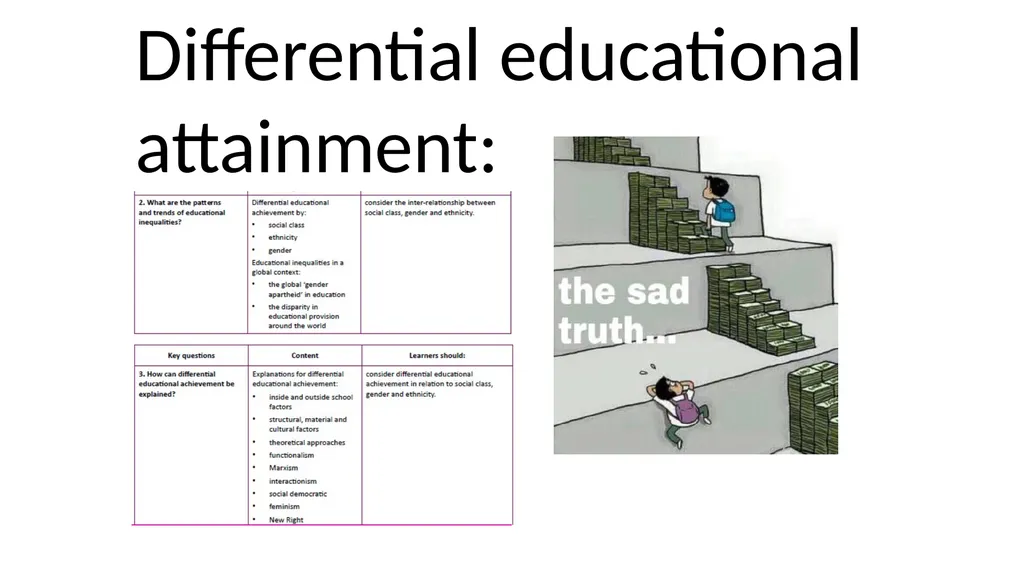
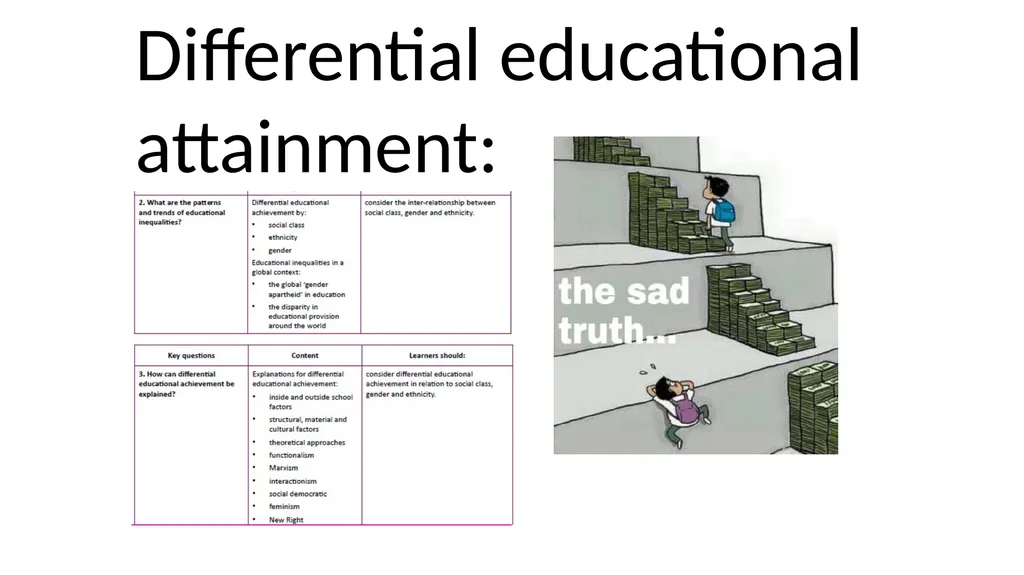
Differential educational attainment: Educational







Description: Differential educational attainment: Educational inequalities in a global context: Global gender inequalities in education: Read the information on pages 147-151 1. Explain what is meant by global gender apartheid 2. Explain the aims and
Related Topics
Download Presentation
"Differential educational attainment: Educational" is the property of its rightful owner. Permission is granted to download and print the materials on this website for personal, non-commercial use only, and to display it on your personal computer provided you do not modify the materials and that you retain all copyright notices contained in the materials. By downloading content from our website, you accept the terms of this agreement.
Presentation Transcript
slide1. Differential educational attainment:<br>
slide2. Educational inequalities in a global context: Global gender inequalities in education: Read the information on pages 147-151
1. Explain what is meant by ‘global gender apartheid’
2. Explain the aims and findings of the UN regarding this
3. Explain the feminist criticisms of the UN’s approach<br>
slide3. How is gender apartheid measured?
Summarise the reasons identified by UNESCO for gender inequalities.
6. Summarise the evaluative points<br>
slide4. Complete the activity on page 149<br>
slide5. Educational inequalities in a global context: Inequalities in educational provision Read the information on pages 147-151
Summarise the evidence of inequalities globally relating to:
Poverty and education
Ethnic inequalities
Locality<br>
slide6. 2. Complete the activity on page 151.<br>
slide7. Differential educational attainment by class: Explanations<br>
slide8. Class inequalities in education: Key themes
Read the information on page 114
Explain what is meant by ‘equality of opportunity’ and why this is considered important
Explain how quantitative data have been used to measure class and educational attainment
Explain the interpretivist criticisms of this.<br>
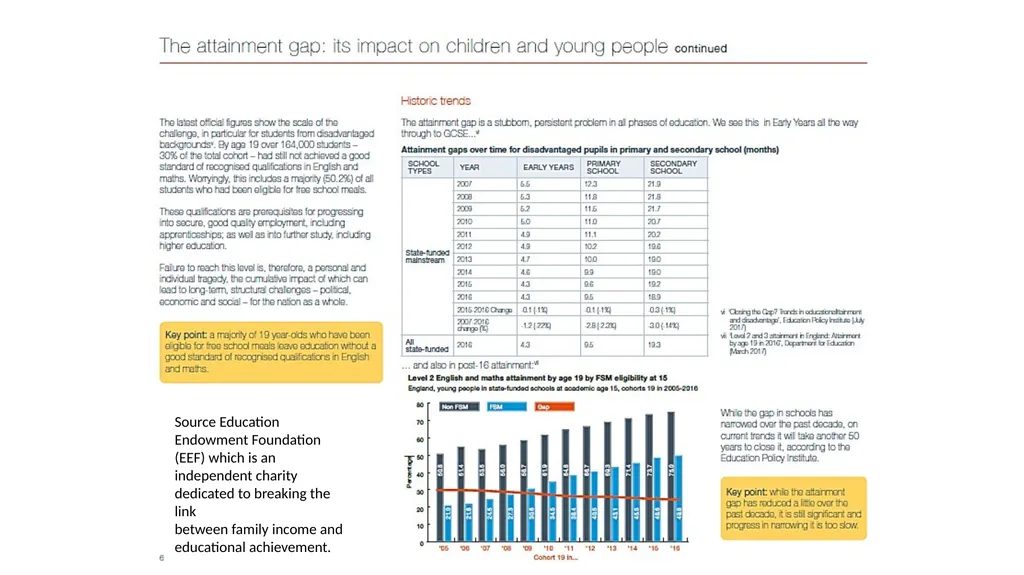
slide9. Source Education Endowment Foundation
(EEF) which is an
independent charity dedicated to breaking the link
between family income and educational achievement.<br>
slide10. Evidence of differential education by class:<br>
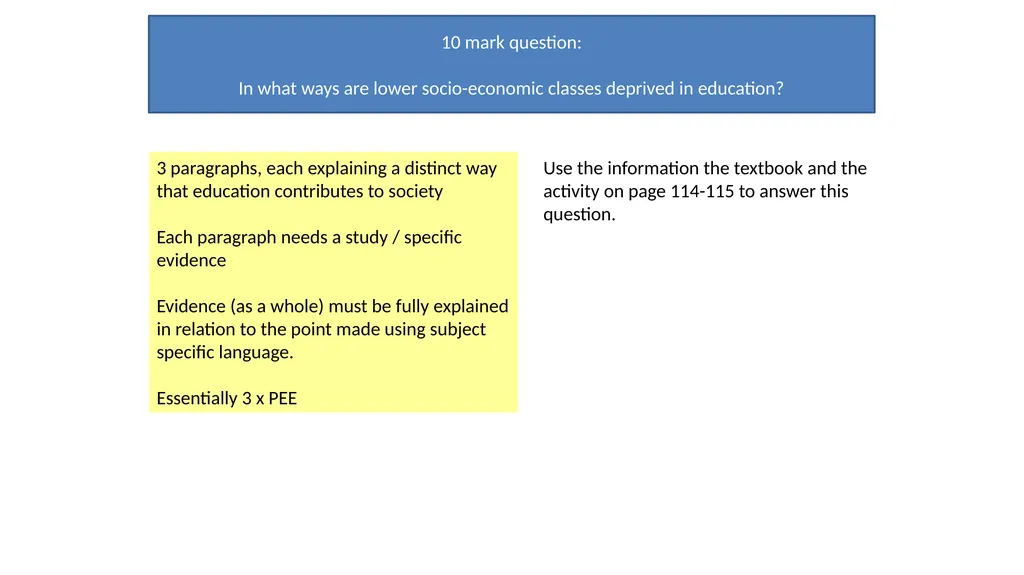
slide11. 10 mark question:
In what ways are lower socio-economic classes deprived in education? 3 paragraphs, each explaining a distinct way that education contributes to society
Each paragraph needs a study / specific evidence
Evidence (as a whole) must be fully explained in relation to the point made using subject specific language.
Essentially 3 x PEE Use the information the textbook and the activity on page 114-115 to answer this question.<br>
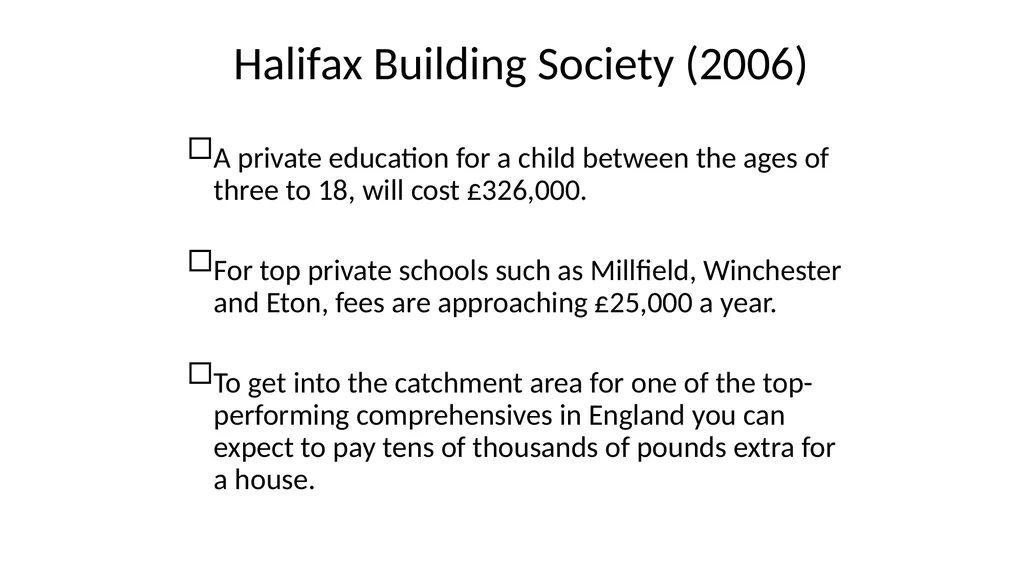
slide12. Halifax Building Society (2006) A private education for a child between the ages of three to 18, will cost £326,000.
For top private schools such as Millfield, Winchester and Eton, fees are approaching £25,000 a year.
To get into the catchment area for one of the top-performing comprehensives in England you can expect to pay tens of thousands of pounds extra for a house.<br>
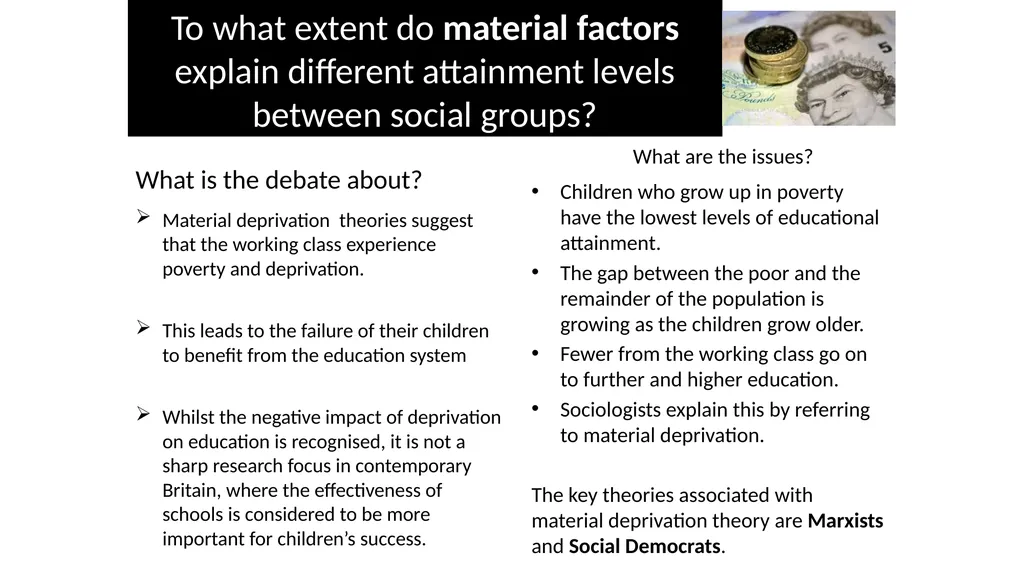
slide13. What is the debate about? Material deprivation theories suggest that the working class experience poverty and deprivation.
This leads to the failure of their children to benefit from the education system
Whilst the negative impact of deprivation on education is recognised, it is not a sharp research focus in contemporary Britain, where the effectiveness of schools is considered to be more important for children’s success. To what extent do material factors explain different attainment levels between social groups? What are the issues? Children who grow up in poverty have the lowest levels of educational attainment.
The gap between the poor and the remainder of the population is growing as the children grow older.
Fewer from the working class go on to further and higher education.
Sociologists explain this by referring to material deprivation.
The key theories associated with material deprivation theory are Marxists and Social Democrats.<br>
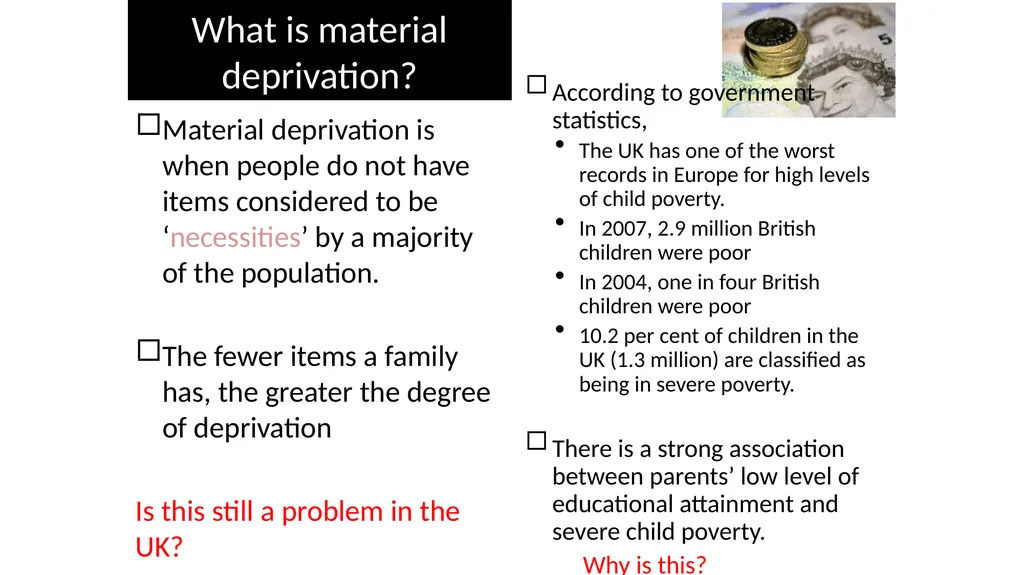
slide14. What is material deprivation? Material deprivation is when people do not have items considered to be ‘necessities’ by a majority of the population.
The fewer items a family has, the greater the degree of deprivation
Is this still a problem in the UK? According to government statistics,
The UK has one of the worst records in Europe for high levels of child poverty.
In 2007, 2.9 million British children were poor
In 2004, one in four British children were poor
10.2 per cent of children in the UK (1.3 million) are classified as being in severe poverty.
There is a strong association between parents’ low level of educational attainment and severe child poverty.
Why is this?<br>
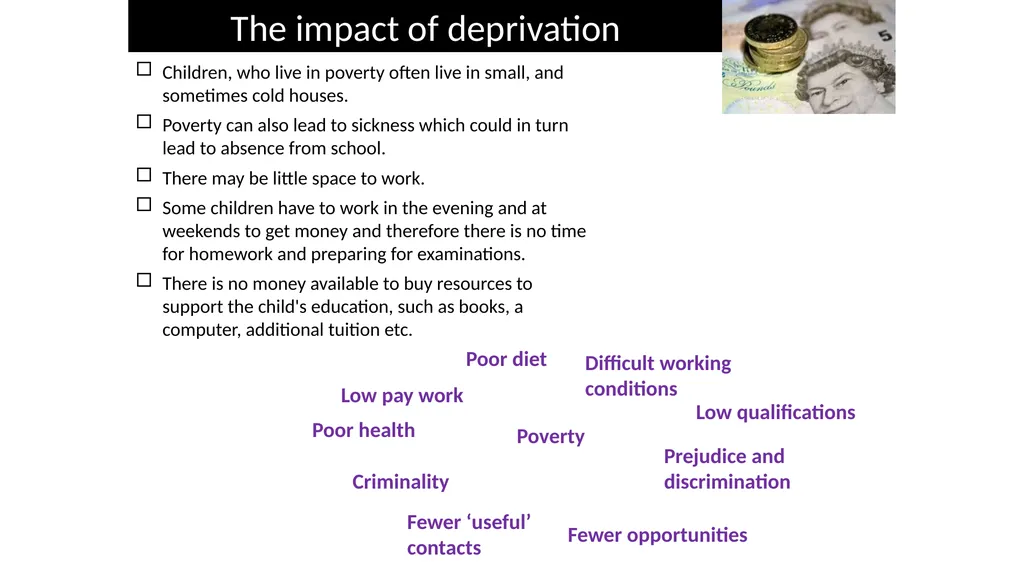
slide15. The impact of deprivation Children, who live in poverty often live in small, and sometimes cold houses.
Poverty can also lead to sickness which could in turn lead to absence from school.
There may be little space to work.
Some children have to work in the evening and at weekends to get money and therefore there is no time for homework and preparing for examinations.
There is no money available to buy resources to support the child's education, such as books, a computer, additional tuition etc. Low pay work Poor diet Poor health Criminality Difficult working conditions Low qualifications Prejudice and discrimination Fewer ‘useful’ contacts Fewer opportunities Poverty<br>
slide16. Halsey, Heath and Ridge (1980s) Published the famous longitudinal study Origins and Destinations.
Poverty was identified as a critical factor in school failure.
(Halsey identified as a socialist but essentially comes under the Marxist heading) Wedge and Prosser (1974) Longitudinal study of children born in one week in 1958.
They were studied at age 11.
Poor children are disadvantaged in terms of
low income
poor housing
family composition (single parent or many siblings)
Such children are more often ill, lighter at birth, and do less well in school compared with advantaged children.<br>
slide17. Smith and Noble (1995) There are a number of additional hidden costs that are part of maintaining a child's education,
school uniform,
school dinners,
travelling to school,
necessary equipment,
educational trips with the school<br>
slide18. Labour Force Survey (1999) 80% of those from professional social classes go on to higher education.
14% of those from unskilled backgrounds go on to higher education.
When higher education opportunities expand, it is the middle classes who are more likely to take advantage of the increased investment by government.
Fewer than 1% of those in unskilled work have a degree or higher qualification.
66% of professional people have a university degree.<br>
slide19. Fernstein (2003) The educational achievement of a 26 year old could be accurately predicted by the wealth of the household when the child was 22 months.
Gaps were already opening up in attainment levels between children of different social background before they had all of their first teeth. Hutchings (2003) If students from low-income families went to university, they often had to get evening jobs in order to pay for their course.
This may then possibly have the effect of them obtaining a lower degree or even having to leave the course before completing it.<br>
slide20. Kingdon and Cassen (2007) Factors associated with poverty such as free school meals, low levels of family employment, single parent families and poor educational qualifications of parents all contributed to low achievement.
Disadvantaged children also attend schools that rate low in the league tables.<br>
slide21. Government policies designed to support poor children in education Funding
The government has persisted in tackling problems of underachievement by creating policies that are directed at changing schools and teachers.
School funding under the New Right was directed towards high achieving schools because it was believed that if schools were in competition for funding, they would all improve. EMA
In 2002, the British government announced that it was providing a grant of £30 per week from September 2004 onwards to help some 16-19 year old students to stay in education.
This scheme had already been piloted in some parts of the country and evidence showed a 6% increase in those who had stayed on in education. (DfES 2002)
Unfortunately, these grants were small, and therefore there was insufficient assistance available for all those who wished to continue their education.
2010 – New Conservative government abolished EMA. Pupil premium:
Introduced by Liberal Democrats in coalition government
Extra money is provided for students who qualify for free school meals (FSM)
This is intended to be used to provide equipment, trips etc in order to make up the gap between rich and poor.
Difficult to determine success – evidence suggests that the attainment gap between PP and non-PP students hasn’t closed (by some measures increased).<br>
slide22. 2016 – Conservative government proposes reintroduction of grammar schools to help ‘poor’ children Arguments for: Arguments against:<br>
slide23. How does a higher family income assist a pupil from a middle class background? Staying rich and comfortable<br>
slide24. Summary of key points Poverty has a negative impact on school attainment
Education is a route to a comfortable and healthy life
Many children in the UK are poor and will not achieve their full potential in education
Rich people have strategies to avoid their children becoming poor – education is part of that process<br>
slide25. Evaluation:
Read the evaluation of material factors on page 118. Summarise the arguments.<br>
slide26. Task:
Read the items in the activity on pages 118-119. Answer the questions at the end of the activity.<br>
slide27. To what extent do cultural factors explain different attainment levels between social groups? Do the working classes have a culture that leads to educational failure? What is the debate about?
Cultural deficit theories suggest that the working class have a culture which leads to educational failure for its children. They tend to claim that:
The working class put less emphasis on formal education as a means of personal achievement, and see less value in staying on at school beyond the school-leaving age.
Members of the working class place less value on attaining a higher occupational status than the middle class.
There are cultural differences between the classes which act as a barrier to success for some children.<br>
slide28. To what extent do cultural factors explain different attainment levels between social groups? Do the working classes have a culture that leads to educational failure? What are the issues?
Is there a culture or cycle of disadvantage affecting working class children?
Is the culture of working class people different or deficient in some way from the culture of the middle classes? Cultural explanations are usually associated with
- Functionalist theorists
- New Right theorists
(and criticised by Marxists...)<br>
slide29. Oscar Lewis (1950s) Introduced the idea of the culture of poverty.
Poor people develop distinct sub-cultural values to enable them to survive poverty, but which disadvantaged their children in school.
As individuals, people feel helpless and disempowered.
By the age of six or seven, children have absorbed the values of their culture and cannot take advantage of opportunities that may occur. F<br>
slide30. J W B Douglas (1964) Douglas says that middle class parents show a greater interest in the education of their children.
There is an emphasis on high attainment in middle class homes.
Middle class parents keep in touch with the educational progress of their children.
Working class parents do not feel at ease in a middle class situation such as a school. F<br>
slide31. Hyman (1960s) Members of the working class believe that there is less opportunity for personal advancement for them.
This belief is likely to be the basis for the low value put on education and a higher occupational status.
It is a realistic assessment of the situation - the working class has less opportunity – however, the belief itself further reduces the opportunity. F<br>
slide32. Connor et al (2001) conducted focus group interviews with 230 students from 4 different FE colleges from a range of class backgrounds, some of whom had chosen to go to university and some who had not chosen to go to University.
The main findings were that working class pupils are discouraged from going to university for three main reasons:
Firstly, such candidates want ‘immediate gratification’. They want to earn money and be independent at an earlier age. This is because they are aware of their parents having struggled for money and wish to avoid debt themselves
Secondly, they realise that their parents cannot afford to support them during Higher Education and did not like the possibility of them getting into debt
Thirdly, they have less confidence in their ability to succeed in HE. Connor et al (2001)<br>
slide33. Basil Bernstein (1970s) There are two language patterns in daily use - limited codes and extended codes.
Limited code is everyday spoken language. Short simple sentences are used and often details and explanations are omitted.
Extended code explains things in greater detail and uses long, complex sentences.
Both languages are familiar to the middle class but only the limited code is used by the working class.
Teachers in school use the extended code and therefore working class children are at a disadvantage from the outset. A linguist not a sociologist<br>
slide34. Leon Fenstein Identified link between low income was related to the restricted speech code.
Children of working-class parents tend to be more passive; less engaged in the world around them and have a more limited vocabulary.
Children from middle-class households had a wider vocabulary, better understanding of how to talk to other people and were more skilled at manipulating objects.<br>
slide35. Read the information on Bernstein.
Summarise the criticisms of Bernstein’s work
Read the activity on pages 122-123. Answer the questions at the end of the activity<br>
slide37. Charles Murray believes that children brought up in single parent families lack a male role model.
Discipline in families has decreased. Young men are not correctly socialised.
A culture develops that has these characteristics:
Neglect and abuse of children
Broken relationships
Victimization by crime
Despair and fatalism The New Right This view is very critical of working class culture, viewing them as agents of their own destruction. N.R. Underclass theories (1990s)<br>
slide38. Dalrymple (2001) The British underclass have developed a culture of:
Passive thinking
Denial of agency and personal responsibility
Dishonesty and self-deception
Rationalizations for self-induced helplessness, such as "addiction"
Perverse, primitive, valueless sexualization
Absolute refusal to apply or accept judgment N.R.<br>
slide39. However, from the Marxists Cultural deprivation is viewed in a different way; the working class are victims of the system C. Wright-Mills (1950s)
Elite self-recruitment.
Members of the highest sectors of society prevent educational failure and protect their interests and those of their children by sending their children to the best public schools.
This allows them the chance to acquire the social skills and background to rise to the best and most powerful positions. Pierre Bourdieu (1977)
The middle and upper classes have cultural capital as well as financial capital.
They have an advantage over the working class because their parents give them support in terms of books and reading, literature, art, classical music, visits to museums, theatres and art galleries.
This culture is closer to the culture of the school, and therefore they are more likely to be successful. M<br>
slide40. Bourdieu: Cultural Capital Theory (p. 124-125) Why does Bourdieu reject cultural deprivation theory?
Explain what Bourdieu suggests is the main role of education (explain cultural reproduction)
What does Bourdieu mean by cultural capital?
How does the possession of cultural capital benefit the middle and upper classes in terms of education M<br>
slide41. 5. Explain what Bourdieu means when he suggests that one role of education is the ‘social function of elimination’
6. Identify strengths of Bourdieu’s work
7. Identify criticisms of Bourdieu’s work Bourdieu: Cultural Capital Theory (p. 124-125) M<br>
slide42. Activity:<br>
slide43. Comparison: New Right and New Left views of cultural deprivation New Right New Left The poor are to blame
Poor people have developed a culture that is negative and selfish
If the poor fail, it is their own responsibility. The structure of society is to blame.
Poor people did not choose to live in poor surroundings
If the poor fail, it is the responsibility of the culture we have created.<br>
slide44. Evaluation of cultural deficit theory: There is little evidence to support the underclass thesis.
Most social scientists tend to see the problems of the working class as being related to the structures of society.
It makes the working class take the blame for their own failure in education.
There is little that is practical that governments or schools can do to solve the problem of working class underattainment Those who are at the bottom of the class system do not have the values, attitudes and special skills that are essential for educational success.
Children and their families are to blame for educational failure.
Children who are culturally deprived are lacking in essential skills, attitudes and values.
A number of researchers have alleged that there are patterns of class differences. Summary of key points<br>
slide45. Writers within the interpretive or interactional tradition of sociology (social action theory) are interested in the processes within schools which lead some children to failure. How do processes within school affect educational attainment? What is interactionism (social action theory):
Interactionism is also called interpretivism.
The methodology used is generally ethnomethodological
It originated with the work of George H Mead.
It looks at the detailed interaction between people.<br>
slide46. Writers within the interpretive or interactional tradition of sociology (social action theory) are interested in the processes within schools which lead some children to failure. How do processes within school affect educational attainment? Herbert Blumer (1969)
"Human beings act toward things on the basis of the meanings they ascribe to those things."
"The meaning of such things is derived from, or arises out of, the social interaction that one has with others and the society."
"These meanings are handled in, and modified through, an interpretive process used by the person in dealing with the things he/she encounters."<br>
slide47. Writers within the interpretive or interactional tradition of sociology (social action theory) are interested in the processes within schools which lead some children to failure. How do processes within school affect educational attainment? Master status:
A person's master status is the most obvious thing about that person.
It controls the way they are identified in public.
The master status becomes a label we attach to people. Attitudes:
AWe have a tendency to behave in a certain way toward some people.
It can be both negative or positive
Teachers have attitudes built up over years of experience How does this apply to schools?<br>
slide48. Self-fulfilling Prophecies This occurs when our beliefs and expectations create reality
Our beliefs and expectations influence our behaviour and others’
‘Pygmalion’ effect
person A believes that person B has a particular characteristic
person B may begin to behave in accordance with that characteristic<br>
slide49. Rosenthal & Jacobson (1964) Went to a school and did IQ tests with kids and told teachers that the test was a “spurters” test
Randomly selected several kids and told the teacher they were “spurters”
Did another IQ test at end of year, “spurters” showed significant improvements in their IQ scores
It is argued that this is because of their teachers’ expectations of them The study was unethical and cannot be repeated.
The methodology was not reliable
Teachers could not remember the names of the ‘spurters’
The theory is not well supported by the statistics in the study<br>
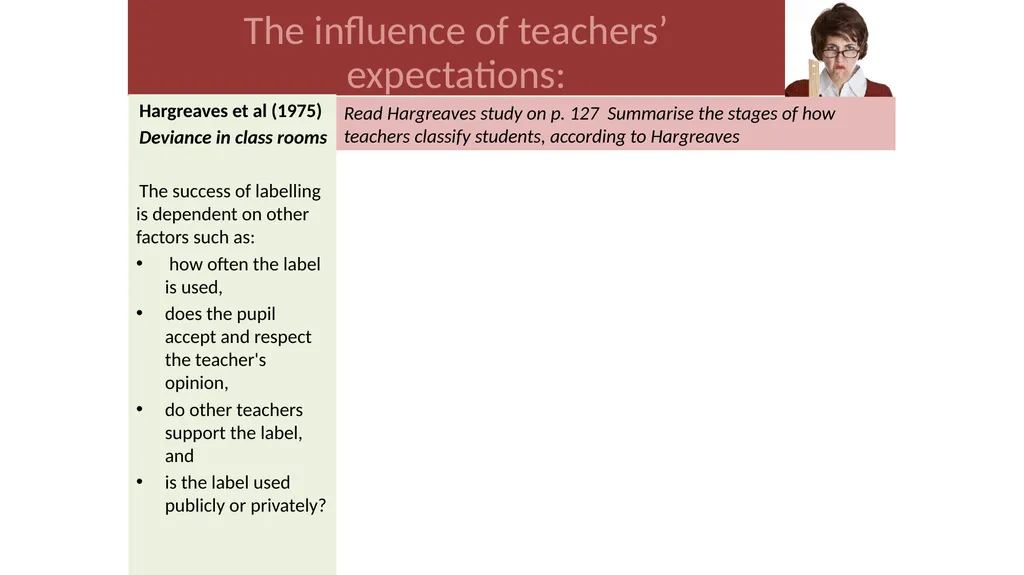
slide50. The influence of teachers’ expectations: Hargreaves et al (1975)
Deviance in class rooms
The success of labelling is dependent on other factors such as:
how often the label is used,
does the pupil accept and respect the teacher's opinion,
do other teachers support the label, and
is the label used publicly or privately? Read Hargreaves study on p. 127 Summarise the stages of how teachers classify students, according to Hargreaves<br>
slide51. Gillborn & Youdell (2001)
Dunne & Gazeley (2009)<br>
slide52. Lacey Pupils have different experiences of school. They are labelled and are often placed in different bands and sets.
Schools set definite standards and expect pupils to behave in a particular way.
Pupils see different meanings to their education and discover different ways of relating.
Not every pupil is willing to conform to the images of an ideal pupil. If they fail to do this, pupils then form their own subcultures which reject some of the school's values.<br>
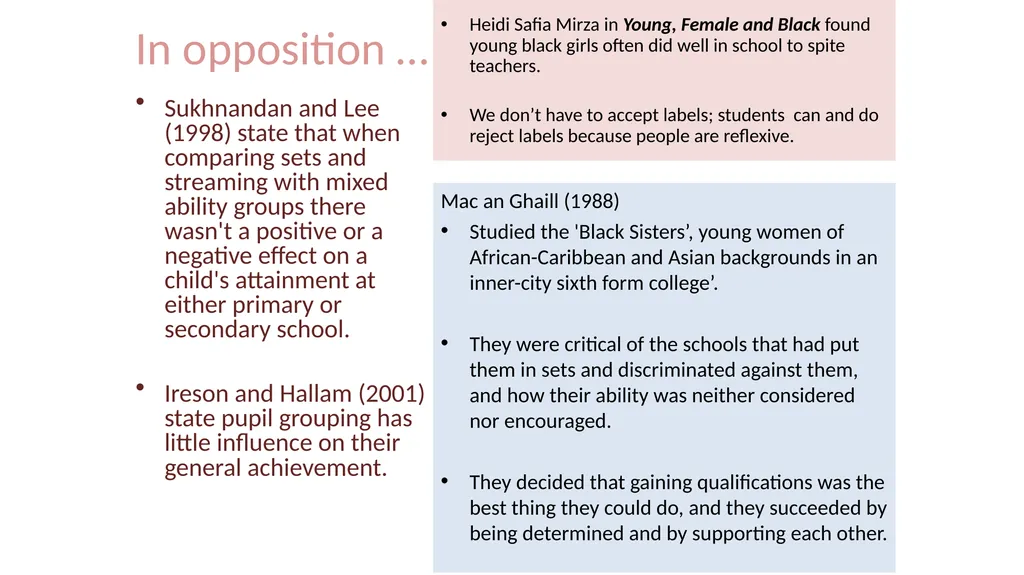
slide53. In opposition … Sukhnandan and Lee (1998) state that when comparing sets and streaming with mixed ability groups there wasn't a positive or a negative effect on a child's attainment at either primary or secondary school.
Ireson and Hallam (2001) state pupil grouping has little influence on their general achievement. Heidi Safia Mirza in Young, Female and Black found young black girls often did well in school to spite teachers.
We don’t have to accept labels; students can and do reject labels because people are reflexive. Mac an Ghaill (1988)
Studied the 'Black Sisters’, young women of African-Caribbean and Asian backgrounds in an inner-city sixth form college’.
They were critical of the schools that had put them in sets and discriminated against them, and how their ability was neither considered nor encouraged.
They decided that gaining qualifications was the best thing they could do, and they succeeded by being determined and by supporting each other.<br>
slide2. Educational inequalities in a global context: Global gender inequalities in education: Read the information on pages 147-151
1. Explain what is meant by ‘global gender apartheid’
2. Explain the aims and findings of the UN regarding this
3. Explain the feminist criticisms of the UN’s approach<br>
slide3. How is gender apartheid measured?
Summarise the reasons identified by UNESCO for gender inequalities.
6. Summarise the evaluative points<br>
slide4. Complete the activity on page 149<br>
slide5. Educational inequalities in a global context: Inequalities in educational provision Read the information on pages 147-151
Summarise the evidence of inequalities globally relating to:
Poverty and education
Ethnic inequalities
Locality<br>
slide6. 2. Complete the activity on page 151.<br>
slide7. Differential educational attainment by class: Explanations<br>
slide8. Class inequalities in education: Key themes
Read the information on page 114
Explain what is meant by ‘equality of opportunity’ and why this is considered important
Explain how quantitative data have been used to measure class and educational attainment
Explain the interpretivist criticisms of this.<br>
slide9. Source Education Endowment Foundation
(EEF) which is an
independent charity dedicated to breaking the link
between family income and educational achievement.<br>
slide10. Evidence of differential education by class:<br>
slide11. 10 mark question:
In what ways are lower socio-economic classes deprived in education? 3 paragraphs, each explaining a distinct way that education contributes to society
Each paragraph needs a study / specific evidence
Evidence (as a whole) must be fully explained in relation to the point made using subject specific language.
Essentially 3 x PEE Use the information the textbook and the activity on page 114-115 to answer this question.<br>
slide12. Halifax Building Society (2006) A private education for a child between the ages of three to 18, will cost £326,000.
For top private schools such as Millfield, Winchester and Eton, fees are approaching £25,000 a year.
To get into the catchment area for one of the top-performing comprehensives in England you can expect to pay tens of thousands of pounds extra for a house.<br>
slide13. What is the debate about? Material deprivation theories suggest that the working class experience poverty and deprivation.
This leads to the failure of their children to benefit from the education system
Whilst the negative impact of deprivation on education is recognised, it is not a sharp research focus in contemporary Britain, where the effectiveness of schools is considered to be more important for children’s success. To what extent do material factors explain different attainment levels between social groups? What are the issues? Children who grow up in poverty have the lowest levels of educational attainment.
The gap between the poor and the remainder of the population is growing as the children grow older.
Fewer from the working class go on to further and higher education.
Sociologists explain this by referring to material deprivation.
The key theories associated with material deprivation theory are Marxists and Social Democrats.<br>
slide14. What is material deprivation? Material deprivation is when people do not have items considered to be ‘necessities’ by a majority of the population.
The fewer items a family has, the greater the degree of deprivation
Is this still a problem in the UK? According to government statistics,
The UK has one of the worst records in Europe for high levels of child poverty.
In 2007, 2.9 million British children were poor
In 2004, one in four British children were poor
10.2 per cent of children in the UK (1.3 million) are classified as being in severe poverty.
There is a strong association between parents’ low level of educational attainment and severe child poverty.
Why is this?<br>
slide15. The impact of deprivation Children, who live in poverty often live in small, and sometimes cold houses.
Poverty can also lead to sickness which could in turn lead to absence from school.
There may be little space to work.
Some children have to work in the evening and at weekends to get money and therefore there is no time for homework and preparing for examinations.
There is no money available to buy resources to support the child's education, such as books, a computer, additional tuition etc. Low pay work Poor diet Poor health Criminality Difficult working conditions Low qualifications Prejudice and discrimination Fewer ‘useful’ contacts Fewer opportunities Poverty<br>
slide16. Halsey, Heath and Ridge (1980s) Published the famous longitudinal study Origins and Destinations.
Poverty was identified as a critical factor in school failure.
(Halsey identified as a socialist but essentially comes under the Marxist heading) Wedge and Prosser (1974) Longitudinal study of children born in one week in 1958.
They were studied at age 11.
Poor children are disadvantaged in terms of
low income
poor housing
family composition (single parent or many siblings)
Such children are more often ill, lighter at birth, and do less well in school compared with advantaged children.<br>
slide17. Smith and Noble (1995) There are a number of additional hidden costs that are part of maintaining a child's education,
school uniform,
school dinners,
travelling to school,
necessary equipment,
educational trips with the school<br>
slide18. Labour Force Survey (1999) 80% of those from professional social classes go on to higher education.
14% of those from unskilled backgrounds go on to higher education.
When higher education opportunities expand, it is the middle classes who are more likely to take advantage of the increased investment by government.
Fewer than 1% of those in unskilled work have a degree or higher qualification.
66% of professional people have a university degree.<br>
slide19. Fernstein (2003) The educational achievement of a 26 year old could be accurately predicted by the wealth of the household when the child was 22 months.
Gaps were already opening up in attainment levels between children of different social background before they had all of their first teeth. Hutchings (2003) If students from low-income families went to university, they often had to get evening jobs in order to pay for their course.
This may then possibly have the effect of them obtaining a lower degree or even having to leave the course before completing it.<br>
slide20. Kingdon and Cassen (2007) Factors associated with poverty such as free school meals, low levels of family employment, single parent families and poor educational qualifications of parents all contributed to low achievement.
Disadvantaged children also attend schools that rate low in the league tables.<br>
slide21. Government policies designed to support poor children in education Funding
The government has persisted in tackling problems of underachievement by creating policies that are directed at changing schools and teachers.
School funding under the New Right was directed towards high achieving schools because it was believed that if schools were in competition for funding, they would all improve. EMA
In 2002, the British government announced that it was providing a grant of £30 per week from September 2004 onwards to help some 16-19 year old students to stay in education.
This scheme had already been piloted in some parts of the country and evidence showed a 6% increase in those who had stayed on in education. (DfES 2002)
Unfortunately, these grants were small, and therefore there was insufficient assistance available for all those who wished to continue their education.
2010 – New Conservative government abolished EMA. Pupil premium:
Introduced by Liberal Democrats in coalition government
Extra money is provided for students who qualify for free school meals (FSM)
This is intended to be used to provide equipment, trips etc in order to make up the gap between rich and poor.
Difficult to determine success – evidence suggests that the attainment gap between PP and non-PP students hasn’t closed (by some measures increased).<br>
slide22. 2016 – Conservative government proposes reintroduction of grammar schools to help ‘poor’ children Arguments for: Arguments against:<br>
slide23. How does a higher family income assist a pupil from a middle class background? Staying rich and comfortable<br>
slide24. Summary of key points Poverty has a negative impact on school attainment
Education is a route to a comfortable and healthy life
Many children in the UK are poor and will not achieve their full potential in education
Rich people have strategies to avoid their children becoming poor – education is part of that process<br>
slide25. Evaluation:
Read the evaluation of material factors on page 118. Summarise the arguments.<br>
slide26. Task:
Read the items in the activity on pages 118-119. Answer the questions at the end of the activity.<br>
slide27. To what extent do cultural factors explain different attainment levels between social groups? Do the working classes have a culture that leads to educational failure? What is the debate about?
Cultural deficit theories suggest that the working class have a culture which leads to educational failure for its children. They tend to claim that:
The working class put less emphasis on formal education as a means of personal achievement, and see less value in staying on at school beyond the school-leaving age.
Members of the working class place less value on attaining a higher occupational status than the middle class.
There are cultural differences between the classes which act as a barrier to success for some children.<br>
slide28. To what extent do cultural factors explain different attainment levels between social groups? Do the working classes have a culture that leads to educational failure? What are the issues?
Is there a culture or cycle of disadvantage affecting working class children?
Is the culture of working class people different or deficient in some way from the culture of the middle classes? Cultural explanations are usually associated with
- Functionalist theorists
- New Right theorists
(and criticised by Marxists...)<br>
slide29. Oscar Lewis (1950s) Introduced the idea of the culture of poverty.
Poor people develop distinct sub-cultural values to enable them to survive poverty, but which disadvantaged their children in school.
As individuals, people feel helpless and disempowered.
By the age of six or seven, children have absorbed the values of their culture and cannot take advantage of opportunities that may occur. F<br>
slide30. J W B Douglas (1964) Douglas says that middle class parents show a greater interest in the education of their children.
There is an emphasis on high attainment in middle class homes.
Middle class parents keep in touch with the educational progress of their children.
Working class parents do not feel at ease in a middle class situation such as a school. F<br>
slide31. Hyman (1960s) Members of the working class believe that there is less opportunity for personal advancement for them.
This belief is likely to be the basis for the low value put on education and a higher occupational status.
It is a realistic assessment of the situation - the working class has less opportunity – however, the belief itself further reduces the opportunity. F<br>
slide32. Connor et al (2001) conducted focus group interviews with 230 students from 4 different FE colleges from a range of class backgrounds, some of whom had chosen to go to university and some who had not chosen to go to University.
The main findings were that working class pupils are discouraged from going to university for three main reasons:
Firstly, such candidates want ‘immediate gratification’. They want to earn money and be independent at an earlier age. This is because they are aware of their parents having struggled for money and wish to avoid debt themselves
Secondly, they realise that their parents cannot afford to support them during Higher Education and did not like the possibility of them getting into debt
Thirdly, they have less confidence in their ability to succeed in HE. Connor et al (2001)<br>
slide33. Basil Bernstein (1970s) There are two language patterns in daily use - limited codes and extended codes.
Limited code is everyday spoken language. Short simple sentences are used and often details and explanations are omitted.
Extended code explains things in greater detail and uses long, complex sentences.
Both languages are familiar to the middle class but only the limited code is used by the working class.
Teachers in school use the extended code and therefore working class children are at a disadvantage from the outset. A linguist not a sociologist<br>
slide34. Leon Fenstein Identified link between low income was related to the restricted speech code.
Children of working-class parents tend to be more passive; less engaged in the world around them and have a more limited vocabulary.
Children from middle-class households had a wider vocabulary, better understanding of how to talk to other people and were more skilled at manipulating objects.<br>
slide35. Read the information on Bernstein.
Summarise the criticisms of Bernstein’s work
Read the activity on pages 122-123. Answer the questions at the end of the activity<br>
slide37. Charles Murray believes that children brought up in single parent families lack a male role model.
Discipline in families has decreased. Young men are not correctly socialised.
A culture develops that has these characteristics:
Neglect and abuse of children
Broken relationships
Victimization by crime
Despair and fatalism The New Right This view is very critical of working class culture, viewing them as agents of their own destruction. N.R. Underclass theories (1990s)<br>
slide38. Dalrymple (2001) The British underclass have developed a culture of:
Passive thinking
Denial of agency and personal responsibility
Dishonesty and self-deception
Rationalizations for self-induced helplessness, such as "addiction"
Perverse, primitive, valueless sexualization
Absolute refusal to apply or accept judgment N.R.<br>
slide39. However, from the Marxists Cultural deprivation is viewed in a different way; the working class are victims of the system C. Wright-Mills (1950s)
Elite self-recruitment.
Members of the highest sectors of society prevent educational failure and protect their interests and those of their children by sending their children to the best public schools.
This allows them the chance to acquire the social skills and background to rise to the best and most powerful positions. Pierre Bourdieu (1977)
The middle and upper classes have cultural capital as well as financial capital.
They have an advantage over the working class because their parents give them support in terms of books and reading, literature, art, classical music, visits to museums, theatres and art galleries.
This culture is closer to the culture of the school, and therefore they are more likely to be successful. M<br>
slide40. Bourdieu: Cultural Capital Theory (p. 124-125) Why does Bourdieu reject cultural deprivation theory?
Explain what Bourdieu suggests is the main role of education (explain cultural reproduction)
What does Bourdieu mean by cultural capital?
How does the possession of cultural capital benefit the middle and upper classes in terms of education M<br>
slide41. 5. Explain what Bourdieu means when he suggests that one role of education is the ‘social function of elimination’
6. Identify strengths of Bourdieu’s work
7. Identify criticisms of Bourdieu’s work Bourdieu: Cultural Capital Theory (p. 124-125) M<br>
slide42. Activity:<br>
slide43. Comparison: New Right and New Left views of cultural deprivation New Right New Left The poor are to blame
Poor people have developed a culture that is negative and selfish
If the poor fail, it is their own responsibility. The structure of society is to blame.
Poor people did not choose to live in poor surroundings
If the poor fail, it is the responsibility of the culture we have created.<br>
slide44. Evaluation of cultural deficit theory: There is little evidence to support the underclass thesis.
Most social scientists tend to see the problems of the working class as being related to the structures of society.
It makes the working class take the blame for their own failure in education.
There is little that is practical that governments or schools can do to solve the problem of working class underattainment Those who are at the bottom of the class system do not have the values, attitudes and special skills that are essential for educational success.
Children and their families are to blame for educational failure.
Children who are culturally deprived are lacking in essential skills, attitudes and values.
A number of researchers have alleged that there are patterns of class differences. Summary of key points<br>
slide45. Writers within the interpretive or interactional tradition of sociology (social action theory) are interested in the processes within schools which lead some children to failure. How do processes within school affect educational attainment? What is interactionism (social action theory):
Interactionism is also called interpretivism.
The methodology used is generally ethnomethodological
It originated with the work of George H Mead.
It looks at the detailed interaction between people.<br>
slide46. Writers within the interpretive or interactional tradition of sociology (social action theory) are interested in the processes within schools which lead some children to failure. How do processes within school affect educational attainment? Herbert Blumer (1969)
"Human beings act toward things on the basis of the meanings they ascribe to those things."
"The meaning of such things is derived from, or arises out of, the social interaction that one has with others and the society."
"These meanings are handled in, and modified through, an interpretive process used by the person in dealing with the things he/she encounters."<br>
slide47. Writers within the interpretive or interactional tradition of sociology (social action theory) are interested in the processes within schools which lead some children to failure. How do processes within school affect educational attainment? Master status:
A person's master status is the most obvious thing about that person.
It controls the way they are identified in public.
The master status becomes a label we attach to people. Attitudes:
AWe have a tendency to behave in a certain way toward some people.
It can be both negative or positive
Teachers have attitudes built up over years of experience How does this apply to schools?<br>
slide48. Self-fulfilling Prophecies This occurs when our beliefs and expectations create reality
Our beliefs and expectations influence our behaviour and others’
‘Pygmalion’ effect
person A believes that person B has a particular characteristic
person B may begin to behave in accordance with that characteristic<br>
slide49. Rosenthal & Jacobson (1964) Went to a school and did IQ tests with kids and told teachers that the test was a “spurters” test
Randomly selected several kids and told the teacher they were “spurters”
Did another IQ test at end of year, “spurters” showed significant improvements in their IQ scores
It is argued that this is because of their teachers’ expectations of them The study was unethical and cannot be repeated.
The methodology was not reliable
Teachers could not remember the names of the ‘spurters’
The theory is not well supported by the statistics in the study<br>
slide50. The influence of teachers’ expectations: Hargreaves et al (1975)
Deviance in class rooms
The success of labelling is dependent on other factors such as:
how often the label is used,
does the pupil accept and respect the teacher's opinion,
do other teachers support the label, and
is the label used publicly or privately? Read Hargreaves study on p. 127 Summarise the stages of how teachers classify students, according to Hargreaves<br>
slide51. Gillborn & Youdell (2001)
Dunne & Gazeley (2009)<br>
slide52. Lacey Pupils have different experiences of school. They are labelled and are often placed in different bands and sets.
Schools set definite standards and expect pupils to behave in a particular way.
Pupils see different meanings to their education and discover different ways of relating.
Not every pupil is willing to conform to the images of an ideal pupil. If they fail to do this, pupils then form their own subcultures which reject some of the school's values.<br>
slide53. In opposition … Sukhnandan and Lee (1998) state that when comparing sets and streaming with mixed ability groups there wasn't a positive or a negative effect on a child's attainment at either primary or secondary school.
Ireson and Hallam (2001) state pupil grouping has little influence on their general achievement. Heidi Safia Mirza in Young, Female and Black found young black girls often did well in school to spite teachers.
We don’t have to accept labels; students can and do reject labels because people are reflexive. Mac an Ghaill (1988)
Studied the 'Black Sisters’, young women of African-Caribbean and Asian backgrounds in an inner-city sixth form college’.
They were critical of the schools that had put them in sets and discriminated against them, and how their ability was neither considered nor encouraged.
They decided that gaining qualifications was the best thing they could do, and they succeeded by being determined and by supporting each other.<br>