02
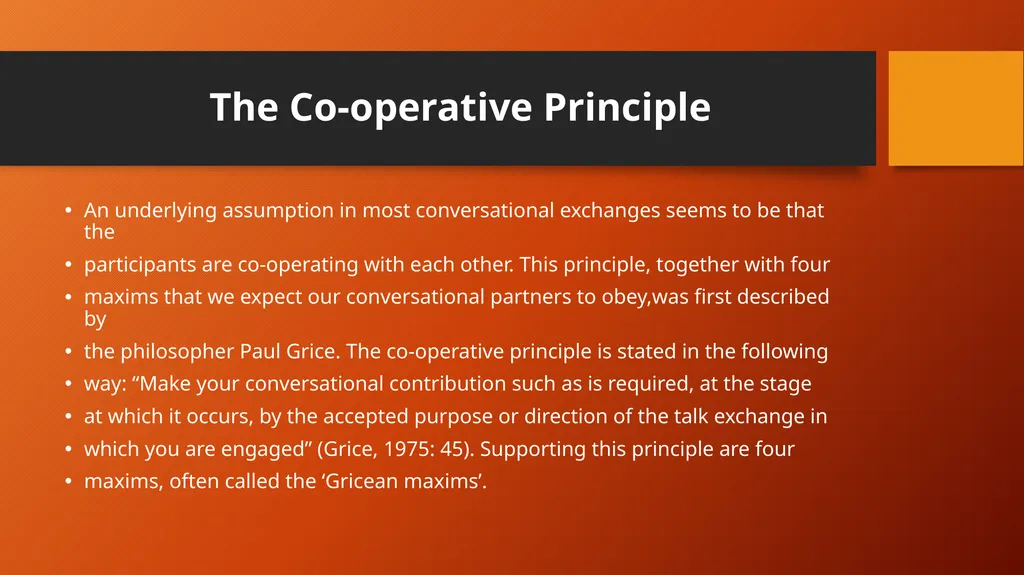
The Co-operative Principle An underlying assumption in most conversational exchanges seems to be that the
participants are co-operating with each other. This principle, together with four
maxims that we expect our conversational partners to obey,was first described by
the philosopher Paul Grice. The co-operative principle is stated in the following
way: “Make your conversational contribution such as is required, at the stage
at which it occurs, by the accepted purpose or direction of the talk exchange in
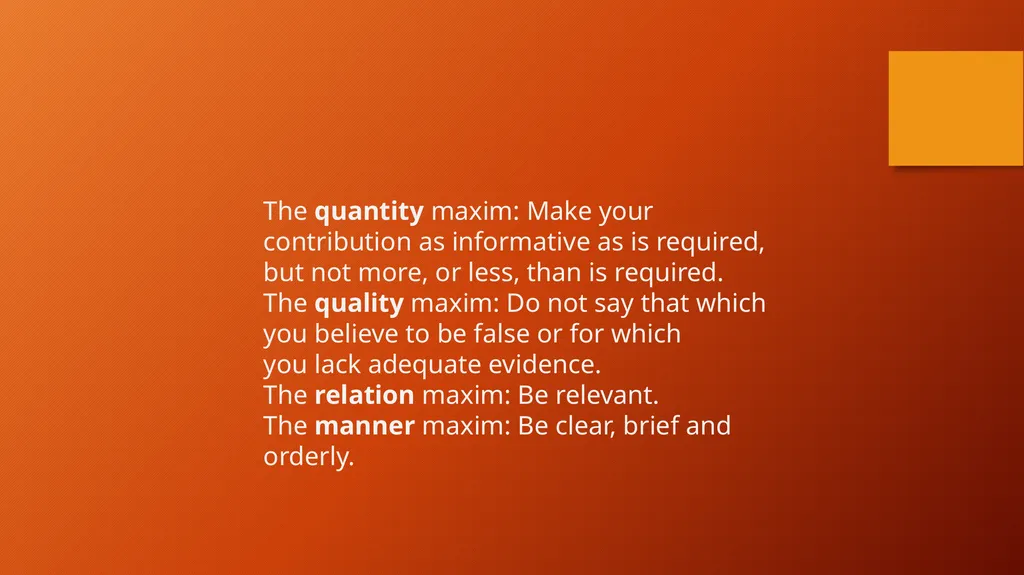
which you are engaged” (Grice, 1975: 45). Supporting this principle are four
maxims, often called the ‘Gricean maxims’.<br>
04
It is certainly true that, on occasion,we can experience conversational exchanges
in which the co-operative principle may not seem to be in operation. However,
this general description of the normal expectations we have in conversation
helps to explain a number of regular features in the way people say things<br>
05
For
example, during their lunch break, one woman asks another how she likes the
sandwich she is eating and receives the following answer
.
Oh, a sandwich is a sandwich.<br>
06
In logical terms, this reply appears to have no communicative value since it states
something obvious and doesn’t seem to be informative at all. However, if the
woman is being co-operative and adhering to the quantity maxim about being
“as informative as is required”, then the listener must assume that her friend
is communicating something.<br>
07
Hedges We use certain types of expressions, called hedges, to show that we are concerned
about following the maxims while being co-operative participants in
conversation. Hedges can be defined as words or phrases used to indicate that
we’re not really sure that what we’re saying is sufficiently correct or complete.
We can use sort of or kind of as hedges on the accuracy of our statements, as
in descriptions such as His hair was kind of long or The book cover is sort of
yellow (rather than It is yellow). These are examples of hedges on the quality
maxim. Other examples would include the expressions listed below that people
sometimes put at the beginning of their conversational contributions<br>
08
As far as I know . . . ,
Now, correct me if I’m wrong, but . . .
I’m not absolutely sure, but. .<br>
09
We also take care to indicate that what we report is something we think or
feel (not know), is possible or likely (not certain), and may or could (not must)
happen. Hence the difference between saying Jackson is guilty and I think it’s possible that Jackson may be guilty. In the first version, we will be assumed to
have very good evidence for the statement<br>
10
Implicature When we try to analyze how hedges work, we usually talk about speakers
implying something that is not said. Similarly, in considering what the woman
meant by a sandwich is a sandwich, we decided that she was implying that
the sandwich wasn’t worth talking about. With the co-operative principle and
the maxims as guides, we can start to work out how people actually decide
that someone is ‘implying’ something in conversation. Consider the following
example.<br>
11
Carol: Are you coming to the party tonight?
Lara: I’ve got an exam tomorrow.<br>
12
On the face of it, Lara’s statement is not an answer to Carol’s question. Lara
doesn’t say Yes or No. Yet Carol will immediately interpret the statement as
meaning ‘No’ or ‘Probably not’. How can we account for this ability to grasp
one meaning from a sentence that, in a literal sense, means something else? It
seems to depend, at least partially, on the assumption that Lara is being relevant
and informative, adhering to the maxims of relation and quantity.<br>
13
It is noticeable that, in order to describe the conversational implicature
involved in Lara’s statement, we had to appeal to some background knowledge
(about exams, studying and partying) that must be shared by the conversational
participants. Investigating how we use our background knowledge to arrive at
interpretations of what we hear and read is a critical part of doing discourse
analysis<br>
14
Background Knowledge A particularly good example of the processes involved in using background
knowledge was provided by Sanford & Garrod (1981), who presented readers
with a short text, one sentence at a time. Their text begins with the following
two sentences.
John was on his way to school last Friday.
He was really worried about the math lesson.<br>
15
Most people who are asked to read these sentences report that they think John
is probably a schoolboy. Since this piece of information is not directly stated
in the text, it must be an inference. Other inferences, for different readers, are
that John is walking or that he is on a bus. These inferences are clearly derived
from our conventional knowledge, in our culture, about ‘going to school’, and
no reader has ever suggested that John is swimming or on a boat, though both
are physically possible, if unlikely, interpretations<br>
16
likely or possible interpretations that readers will quickly abandon if they do
not fit in with some subsequent information. Here is the next sentence in the
text.
Last week he had been unable to control the class.
On encountering this sentence, most readers decide that John is, in fact, a teacher
and that he is not very happy. Many report that he is probably driving a car to
school. Then the next sentence is presented.
It was unfair of the math teacher to leave him in charge<br>
17
Schema A schema is a general term for a conventional knowledge structure that exists in
memory. We were using our conventional knowledge of what a school classroom
is like, or a ‘classroom schema’, as we tried to make sense of the previous
example. We have many schemas (or schemata) that are used in the interpretation
of what we experience and what we hear or read about. If you hear someone
describe what happened during a visit to a supermarket, you don’t have to be
told what is normally found in a supermarket. You already have a ‘supermarket
schema’ (food displayed on shelves, arranged in aisles, shopping carts and
baskets, check-out counter, and other conventional features) as part of your
background knowledge.<br>
18
Script Similar in many ways to a schema is a script. A script is essentially a dynamic
schema. That is, instead of the set of typical fixed features in a schema, a script has a series of conventional actions that take place. You have a script for ‘Going
to the dentist’ and another script for ‘Going to the movies. We all have versions
of an ‘Eating in a restaurant’ script, which we can activate to make sense of the
following discourse<br>
19
On the basis of our restaurant script, we would be able to say a number of things
about the scene and events briefly described in this short text. For example,
although the text doesn’t have this information, we would assume that Suzy
opened a door to get into the restaurant, that there were tables there, that she
ate the sandwich, then she paid for it, and so on.<br>
20
Indeed, crucial information is sometimes omitted from important instructions
on the assumption that everybody knows the script. Think carefully about the
following instructions from a bottle of cough syrup.
Fill measure cup to line
and repeat every 2 to 3 hours.<br>