
DRAMA Understanding Drama Section A: Dramatic
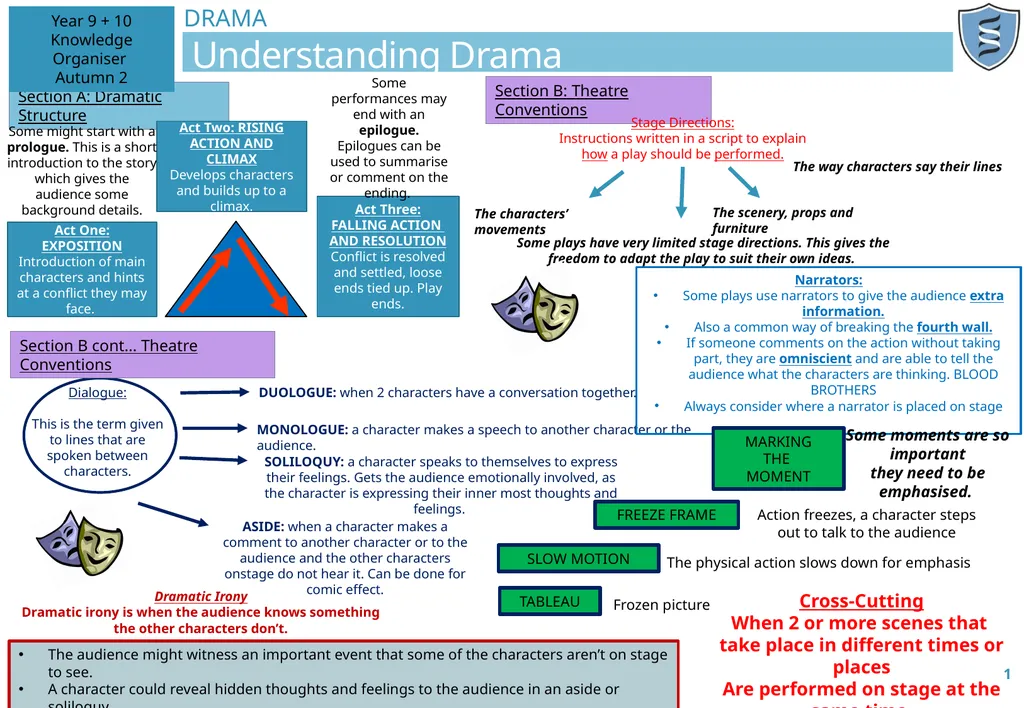
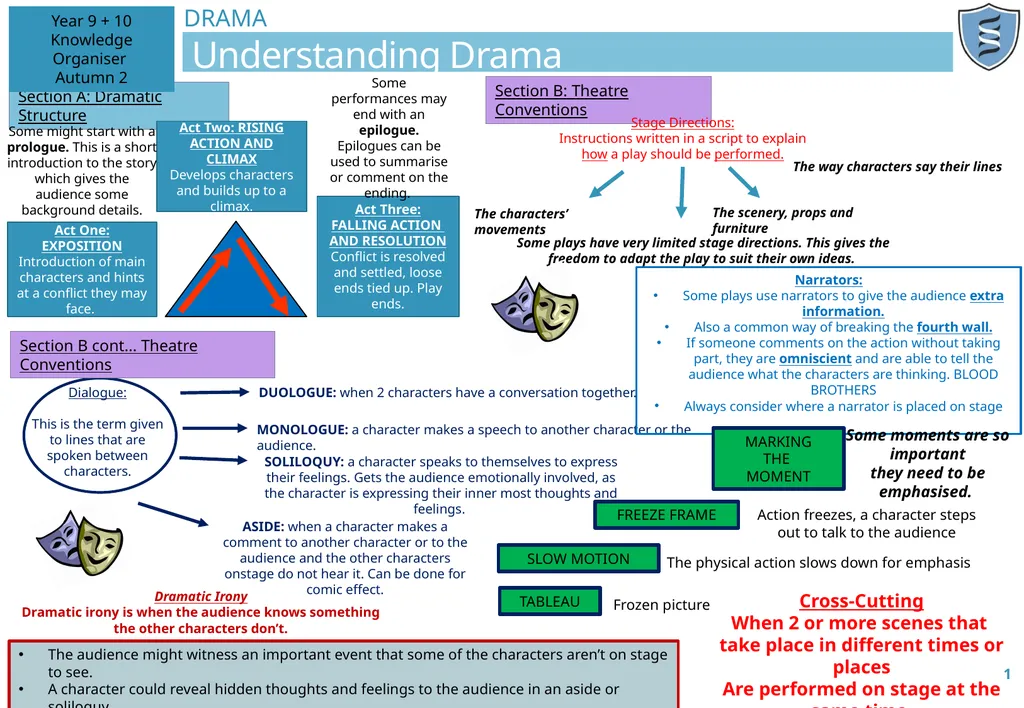
Description: DRAMA Understanding Drama Section A: Dramatic Structure 1 Year 9 10 Knowledge Organiser Autumn 2 Act One: EXPOSITION Introduction of main characters and hints at a conflict they may face. Act Two: RISING ACTION AND CLIMAX Develops
Related Topics
Download Presentation
"DRAMA Understanding Drama Section A: Dramatic" is the property of its rightful owner. Permission is granted to download and print the materials on this website for personal, non-commercial use only, and to display it on your personal computer provided you do not modify the materials and that you retain all copyright notices contained in the materials. By downloading content from our website, you accept the terms of this agreement.
Presentation Transcript
slide1. DRAMA Understanding Drama Section A: Dramatic Structure 1 Year 9 + 10 Knowledge Organiser
Autumn 2 Act One: EXPOSITION
Introduction of main characters and hints at a conflict they may face. Act Two: RISING ACTION AND CLIMAX
Develops characters and builds up to a climax. Act Three: FALLING ACTION AND RESOLUTION
Conflict is resolved and settled, loose ends tied up. Play ends. Some might start with a prologue. This is a short introduction to the story which gives the audience some background details. Some performances may end with an epilogue. Epilogues can be used to summarise or comment on the ending. Section B: Theatre Conventions The scenery, props and furniture Some plays have very limited stage directions. This gives the freedom to adapt the play to suit their own ideas. DUOLOGUE: when 2 characters have a conversation together. MONOLOGUE: a character makes a speech to another character or the audience. SOLILOQUY: a character speaks to themselves to express their feelings. Gets the audience emotionally involved, as the character is expressing their inner most thoughts and feelings. ASIDE: when a character makes a comment to another character or to the audience and the other characters onstage do not hear it. Can be done for comic effect. Narrators:
Some plays use narrators to give the audience extra information.
Also a common way of breaking the fourth wall.
If someone comments on the action without taking part, they are omniscient and are able to tell the audience what the characters are thinking. BLOOD BROTHERS
Always consider where a narrator is placed on stage The characters’ movements Section B cont… Theatre Conventions Dramatic Irony
Dramatic irony is when the audience knows something the other characters don’t. The audience might witness an important event that some of the characters aren’t on stage to see.
A character could reveal hidden thoughts and feelings to the audience in an aside or soliloquy.
Disguises allow the characters to hide their true identity but the audience can see through them. MARKING
THE
MOMENT Some moments are so important
they need to be emphasised. TABLEAU FREEZE FRAME SLOW MOTION Frozen picture Action freezes, a character steps out to talk to the audience The physical action slows down for emphasis Cross-Cutting
When 2 or more scenes that
take place in different times or places
Are performed on stage at the same time.<br>
slide2. DRAMA Understanding Drama 2 Year 9+10 Knowledge Organiser
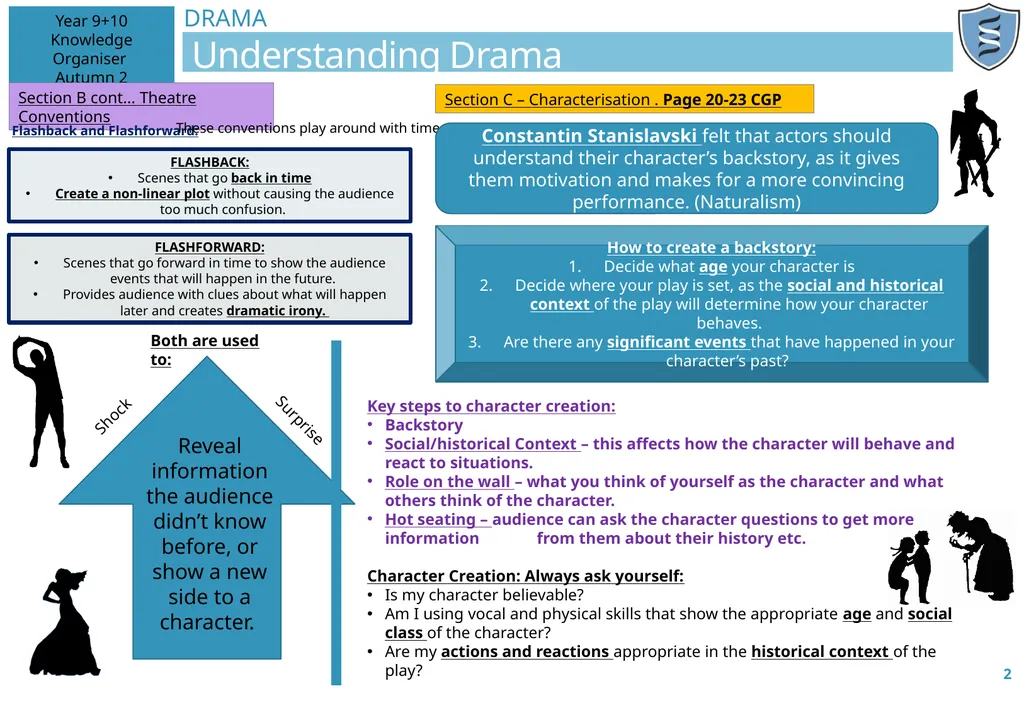
Autumn 2 Section B cont… Theatre Conventions Flashback and Flashforward: These conventions play around with time. FLASHFORWARD:
Scenes that go forward in time to show the audience events that will happen in the future.
Provides audience with clues about what will happen later and creates dramatic irony. FLASHBACK:
Scenes that go back in time
Create a non-linear plot without causing the audience too much confusion. Both are used to: Section C – Characterisation . Page 20-23 CGP How to create a backstory:
Decide what age your character is
Decide where your play is set, as the social and historical context of the play will determine how your character behaves.
Are there any significant events that have happened in your character’s past? Constantin Stanislavski felt that actors should understand their character’s backstory, as it gives them motivation and makes for a more convincing performance. (Naturalism) Key steps to character creation:
Backstory
Social/historical Context – this affects how the character will behave and react to situations.
Role on the wall – what you think of yourself as the character and what others think of the character.
Hot seating – audience can ask the character questions to get more information from them about their history etc. Character Creation: Always ask yourself:
Is my character believable?
Am I using vocal and physical skills that show the appropriate age and social class of the character?
Are my actions and reactions appropriate in the historical context of the play?<br>
slide3. DRAMA Understanding Drama 3 Year 9+10 Knowledge Organiser
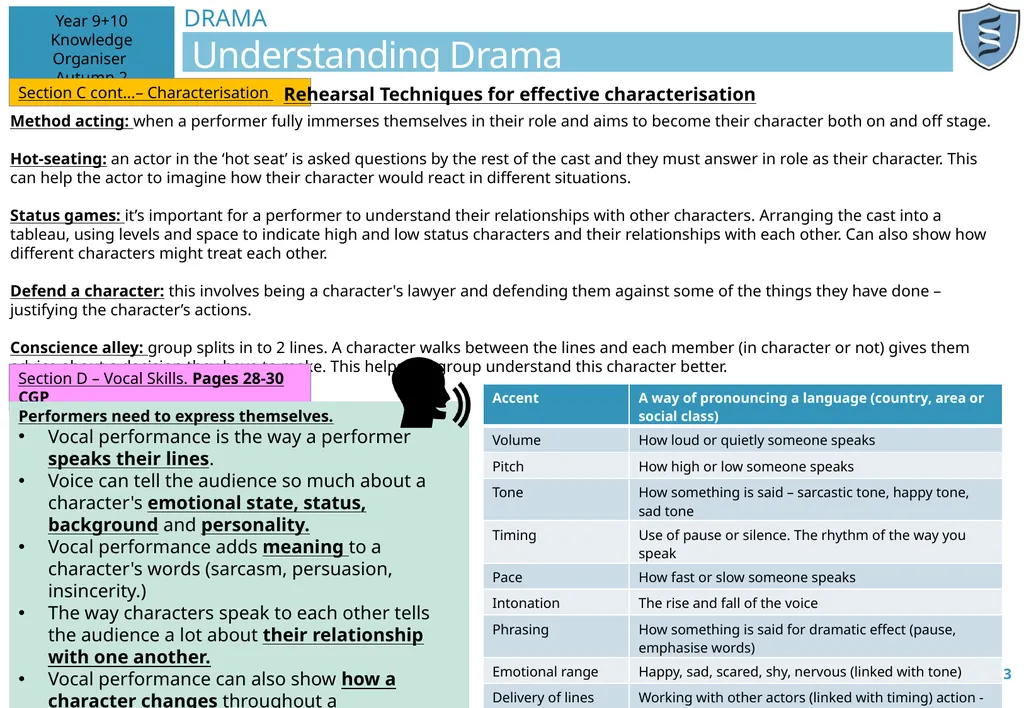
Autumn 2 Method acting: when a performer fully immerses themselves in their role and aims to become their character both on and off stage.
Hot-seating: an actor in the ‘hot seat’ is asked questions by the rest of the cast and they must answer in role as their character. This can help the actor to imagine how their character would react in different situations.
Status games: it’s important for a performer to understand their relationships with other characters. Arranging the cast into a tableau, using levels and space to indicate high and low status characters and their relationships with each other. Can also show how different characters might treat each other.
Defend a character: this involves being a character's lawyer and defending them against some of the things they have done – justifying the character’s actions.
Conscience alley: group splits in to 2 lines. A character walks between the lines and each member (in character or not) gives them advice about a decision they have to make. This helps the group understand this character better. Section C cont...– Characterisation Rehearsal Techniques for effective characterisation Section D – Vocal Skills. Pages 28-30 CGP Performers need to express themselves.
Vocal performance is the way a performer speaks their lines.
Voice can tell the audience so much about a character's emotional state, status, background and personality.
Vocal performance adds meaning to a character's words (sarcasm, persuasion, insincerity.)
The way characters speak to each other tells the audience a lot about their relationship with one another.
Vocal performance can also show how a character changes throughout a performance.<br>
slide4. DRAMA Understanding Drama 4 Year 9+10 Knowledge Organiser
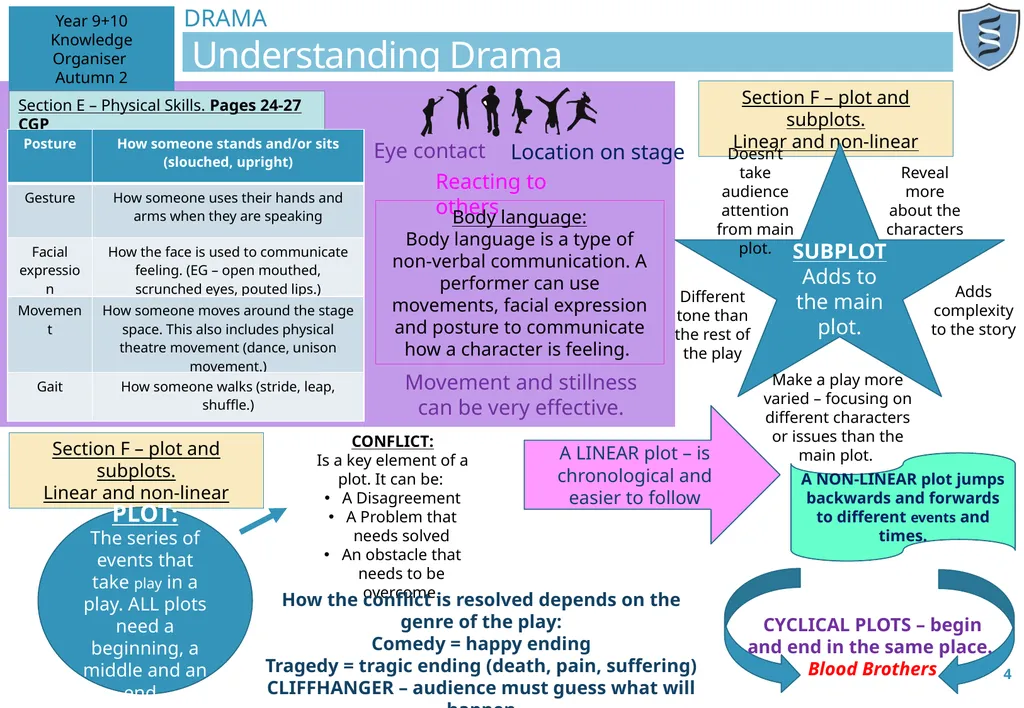
Autumn 2 Section E – Physical Skills. Pages 24-27 CGP Movement and stillness can be very effective. Location on stage Eye contact Reacting to others Body language:
Body language is a type of non-verbal communication. A performer can use movements, facial expression and posture to communicate how a character is feeling. Section F – plot and subplots.
Linear and non-linear PLOT:
The series of events that take play in a play. ALL plots need a beginning, a middle and an end. CONFLICT:
Is a key element of a plot. It can be:
A Disagreement
A Problem that needs solved
An obstacle that needs to be overcome. How the conflict is resolved depends on the genre of the play:
Comedy = happy ending
Tragedy = tragic ending (death, pain, suffering)
CLIFFHANGER – audience must guess what will happen Section F – plot and subplots.
Linear and non-linear SUBPLOT
Adds to the main plot. Doesn’t take audience attention from main plot. Reveal more about the characters Different tone than the rest of the play Adds complexity to the story A LINEAR plot – is chronological and easier to follow Make a play more varied – focusing on different characters or issues than the main plot. CYCLICAL PLOTS – begin and end in the same place.
Blood Brothers A NON-LINEAR plot jumps backwards and forwards to different events and times.<br>
Autumn 2 Act One: EXPOSITION
Introduction of main characters and hints at a conflict they may face. Act Two: RISING ACTION AND CLIMAX
Develops characters and builds up to a climax. Act Three: FALLING ACTION AND RESOLUTION
Conflict is resolved and settled, loose ends tied up. Play ends. Some might start with a prologue. This is a short introduction to the story which gives the audience some background details. Some performances may end with an epilogue. Epilogues can be used to summarise or comment on the ending. Section B: Theatre Conventions The scenery, props and furniture Some plays have very limited stage directions. This gives the freedom to adapt the play to suit their own ideas. DUOLOGUE: when 2 characters have a conversation together. MONOLOGUE: a character makes a speech to another character or the audience. SOLILOQUY: a character speaks to themselves to express their feelings. Gets the audience emotionally involved, as the character is expressing their inner most thoughts and feelings. ASIDE: when a character makes a comment to another character or to the audience and the other characters onstage do not hear it. Can be done for comic effect. Narrators:
Some plays use narrators to give the audience extra information.
Also a common way of breaking the fourth wall.
If someone comments on the action without taking part, they are omniscient and are able to tell the audience what the characters are thinking. BLOOD BROTHERS
Always consider where a narrator is placed on stage The characters’ movements Section B cont… Theatre Conventions Dramatic Irony
Dramatic irony is when the audience knows something the other characters don’t. The audience might witness an important event that some of the characters aren’t on stage to see.
A character could reveal hidden thoughts and feelings to the audience in an aside or soliloquy.
Disguises allow the characters to hide their true identity but the audience can see through them. MARKING
THE
MOMENT Some moments are so important
they need to be emphasised. TABLEAU FREEZE FRAME SLOW MOTION Frozen picture Action freezes, a character steps out to talk to the audience The physical action slows down for emphasis Cross-Cutting
When 2 or more scenes that
take place in different times or places
Are performed on stage at the same time.<br>
slide2. DRAMA Understanding Drama 2 Year 9+10 Knowledge Organiser
Autumn 2 Section B cont… Theatre Conventions Flashback and Flashforward: These conventions play around with time. FLASHFORWARD:
Scenes that go forward in time to show the audience events that will happen in the future.
Provides audience with clues about what will happen later and creates dramatic irony. FLASHBACK:
Scenes that go back in time
Create a non-linear plot without causing the audience too much confusion. Both are used to: Section C – Characterisation . Page 20-23 CGP How to create a backstory:
Decide what age your character is
Decide where your play is set, as the social and historical context of the play will determine how your character behaves.
Are there any significant events that have happened in your character’s past? Constantin Stanislavski felt that actors should understand their character’s backstory, as it gives them motivation and makes for a more convincing performance. (Naturalism) Key steps to character creation:
Backstory
Social/historical Context – this affects how the character will behave and react to situations.
Role on the wall – what you think of yourself as the character and what others think of the character.
Hot seating – audience can ask the character questions to get more information from them about their history etc. Character Creation: Always ask yourself:
Is my character believable?
Am I using vocal and physical skills that show the appropriate age and social class of the character?
Are my actions and reactions appropriate in the historical context of the play?<br>
slide3. DRAMA Understanding Drama 3 Year 9+10 Knowledge Organiser
Autumn 2 Method acting: when a performer fully immerses themselves in their role and aims to become their character both on and off stage.
Hot-seating: an actor in the ‘hot seat’ is asked questions by the rest of the cast and they must answer in role as their character. This can help the actor to imagine how their character would react in different situations.
Status games: it’s important for a performer to understand their relationships with other characters. Arranging the cast into a tableau, using levels and space to indicate high and low status characters and their relationships with each other. Can also show how different characters might treat each other.
Defend a character: this involves being a character's lawyer and defending them against some of the things they have done – justifying the character’s actions.
Conscience alley: group splits in to 2 lines. A character walks between the lines and each member (in character or not) gives them advice about a decision they have to make. This helps the group understand this character better. Section C cont...– Characterisation Rehearsal Techniques for effective characterisation Section D – Vocal Skills. Pages 28-30 CGP Performers need to express themselves.
Vocal performance is the way a performer speaks their lines.
Voice can tell the audience so much about a character's emotional state, status, background and personality.
Vocal performance adds meaning to a character's words (sarcasm, persuasion, insincerity.)
The way characters speak to each other tells the audience a lot about their relationship with one another.
Vocal performance can also show how a character changes throughout a performance.<br>
slide4. DRAMA Understanding Drama 4 Year 9+10 Knowledge Organiser
Autumn 2 Section E – Physical Skills. Pages 24-27 CGP Movement and stillness can be very effective. Location on stage Eye contact Reacting to others Body language:
Body language is a type of non-verbal communication. A performer can use movements, facial expression and posture to communicate how a character is feeling. Section F – plot and subplots.
Linear and non-linear PLOT:
The series of events that take play in a play. ALL plots need a beginning, a middle and an end. CONFLICT:
Is a key element of a plot. It can be:
A Disagreement
A Problem that needs solved
An obstacle that needs to be overcome. How the conflict is resolved depends on the genre of the play:
Comedy = happy ending
Tragedy = tragic ending (death, pain, suffering)
CLIFFHANGER – audience must guess what will happen Section F – plot and subplots.
Linear and non-linear SUBPLOT
Adds to the main plot. Doesn’t take audience attention from main plot. Reveal more about the characters Different tone than the rest of the play Adds complexity to the story A LINEAR plot – is chronological and easier to follow Make a play more varied – focusing on different characters or issues than the main plot. CYCLICAL PLOTS – begin and end in the same place.
Blood Brothers A NON-LINEAR plot jumps backwards and forwards to different events and times.<br>