
Drug Advertising & Promotion: A Practical Guide to
LD
Published · 47 slides · 0 views

1 / 1
Description
Drug Advertising Promotion: A Practical Guide to Compliance Philip Katz October 20, 2011 Partner Hogan Lovells US LLP 2 2 Agenda Back to Basics FDA Enforcement Preapproval Promotion Disease Awareness Internet Social Media Digital
Related Topics
Share
Embed code
Download this presentation From Below
"Drug Advertising & Promotion: A Practical Guide to" is the property of its rightful owner. Permission is granted to download and print the materials on this website for personal, non-commercial use only, and to display it on your personal computer provided you do not modify the materials and that you retain all copyright notices contained in the materials. By downloading content from our website, you accept the terms of this agreement.
Presentation Transcript
01
Drug Advertising & Promotion:
A Practical Guide to Compliance Philip Katz October 20, 2011
Partner
Hogan Lovells US LLP<br>
Partner
Hogan Lovells US LLP<br>
02
2 2 Agenda Back to Basics
FDA Enforcement
Preapproval Promotion
Disease Awareness
Internet / Social Media / Digital Media
Television Ads
Reminder Ads
Economic Information<br>
FDA Enforcement
Preapproval Promotion
Disease Awareness
Internet / Social Media / Digital Media
Television Ads
Reminder Ads
Economic Information<br>
03
3 Back to Basics<br>
04
4 4 Food, Drug, and Cosmetic Act Prohibits promotion of unapproved uses
Cannot introduce into commerce a “new drug” that does not have an approved application
A “new drug” can include an approved product that is intended:
To treat a different disease/condition than that for which it has been approved
For use in a patient population other than what has been approved
For use at a different dose than has been approved<br>
Cannot introduce into commerce a “new drug” that does not have an approved application
A “new drug” can include an approved product that is intended:
To treat a different disease/condition than that for which it has been approved
For use in a patient population other than what has been approved
For use at a different dose than has been approved<br>
05
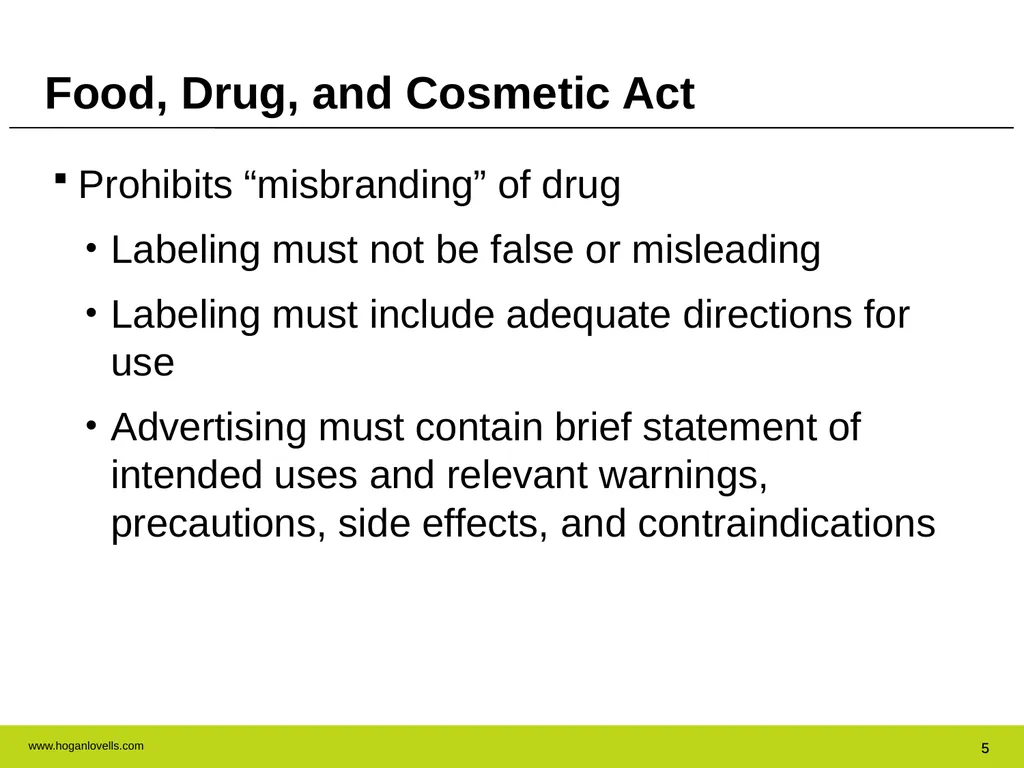
5 5 Food, Drug, and Cosmetic Act Prohibits “misbranding” of drug
Labeling must not be false or misleading
Labeling must include adequate directions for use
Advertising must contain brief statement of intended uses and relevant warnings, precautions, side effects, and contraindications<br>
Labeling must not be false or misleading
Labeling must include adequate directions for use
Advertising must contain brief statement of intended uses and relevant warnings, precautions, side effects, and contraindications<br>
06
6 FDA Enforcement<br>
07
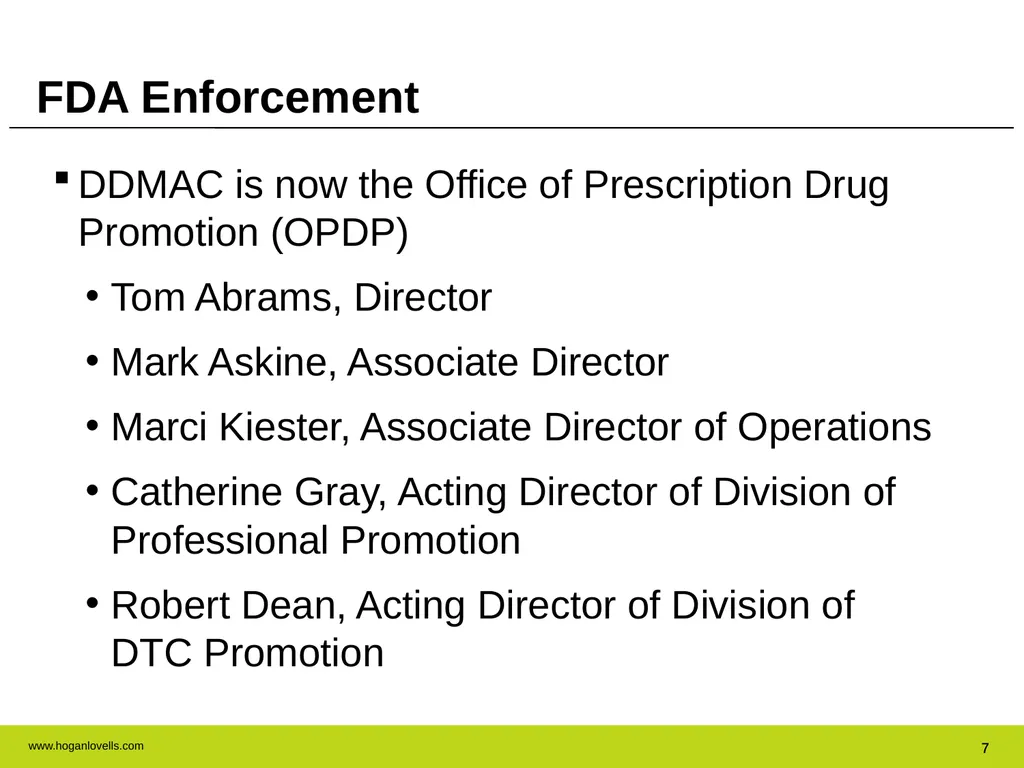
7 7 FDA Enforcement DDMAC is now the Office of Prescription Drug Promotion (OPDP)
Tom Abrams, Director
Mark Askine, Associate Director
Marci Kiester, Associate Director of Operations
Catherine Gray, Acting Director of Division of Professional Promotion
Robert Dean, Acting Director of Division of DTC Promotion<br>
Tom Abrams, Director
Mark Askine, Associate Director
Marci Kiester, Associate Director of Operations
Catherine Gray, Acting Director of Division of Professional Promotion
Robert Dean, Acting Director of Division of DTC Promotion<br>
08
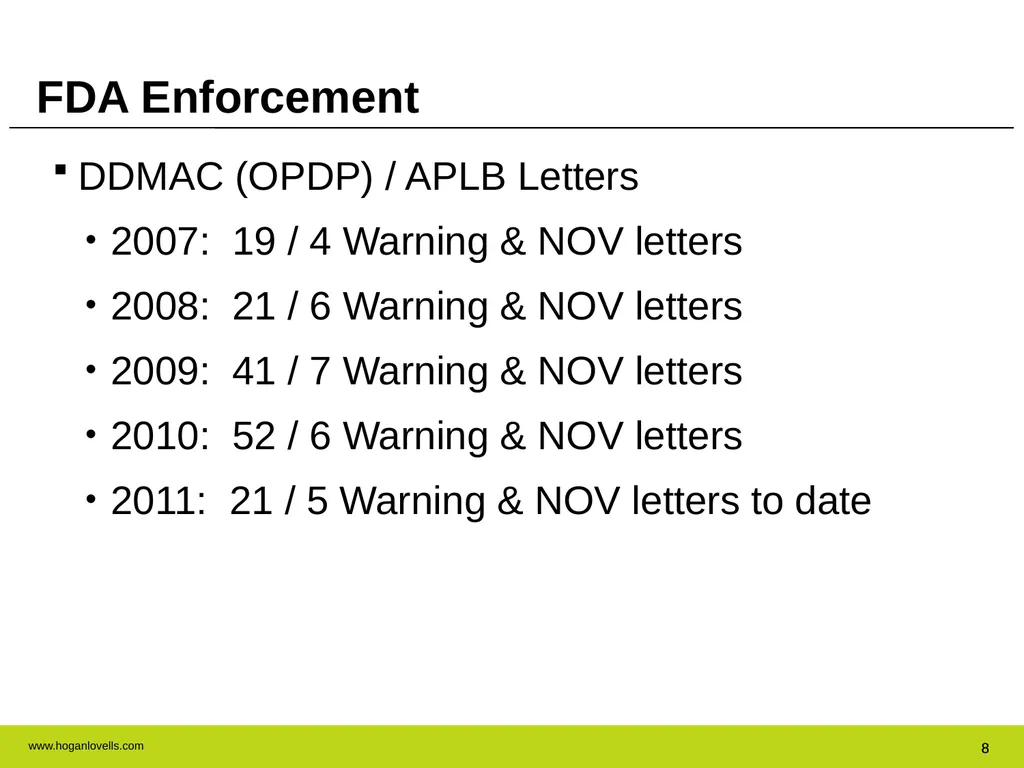
8 8 FDA Enforcement DDMAC (OPDP) / APLB Letters
2007: 19 / 4 Warning & NOV letters
2008: 21 / 6 Warning & NOV letters
2009: 41 / 7 Warning & NOV letters
2010: 52 / 6 Warning & NOV letters
2011: 21 / 5 Warning & NOV letters to date<br>
2007: 19 / 4 Warning & NOV letters
2008: 21 / 6 Warning & NOV letters
2009: 41 / 7 Warning & NOV letters
2010: 52 / 6 Warning & NOV letters
2011: 21 / 5 Warning & NOV letters to date<br>
09
9 9 FDA Enforcement “Bad Ad” Program launched in May 2010
Encourages health care professionals to report false or misleading promotional materials or activities
300+ reports from health care professionals, consumers, industry reps
Led to 6 Warning/NOV letters, including websites, pharmacist mailer, oral statement by sales rep, YouTube video<br>
Encourages health care professionals to report false or misleading promotional materials or activities
300+ reports from health care professionals, consumers, industry reps
Led to 6 Warning/NOV letters, including websites, pharmacist mailer, oral statement by sales rep, YouTube video<br>
10
10 10 FDA Enforcement FDA intends to expand the “Bad Ad” program
May include web-based continuing education
Will focus on educating medical students via collaborations with medical, pharmacy, and nursing schools
OPDP representatives will be available at medical conferences<br>
May include web-based continuing education
Will focus on educating medical students via collaborations with medical, pharmacy, and nursing schools
OPDP representatives will be available at medical conferences<br>
11
11 Preapproval Promotion<br>
12
12 Five enforcement letters since January 2010 suggest increased enforcement priority
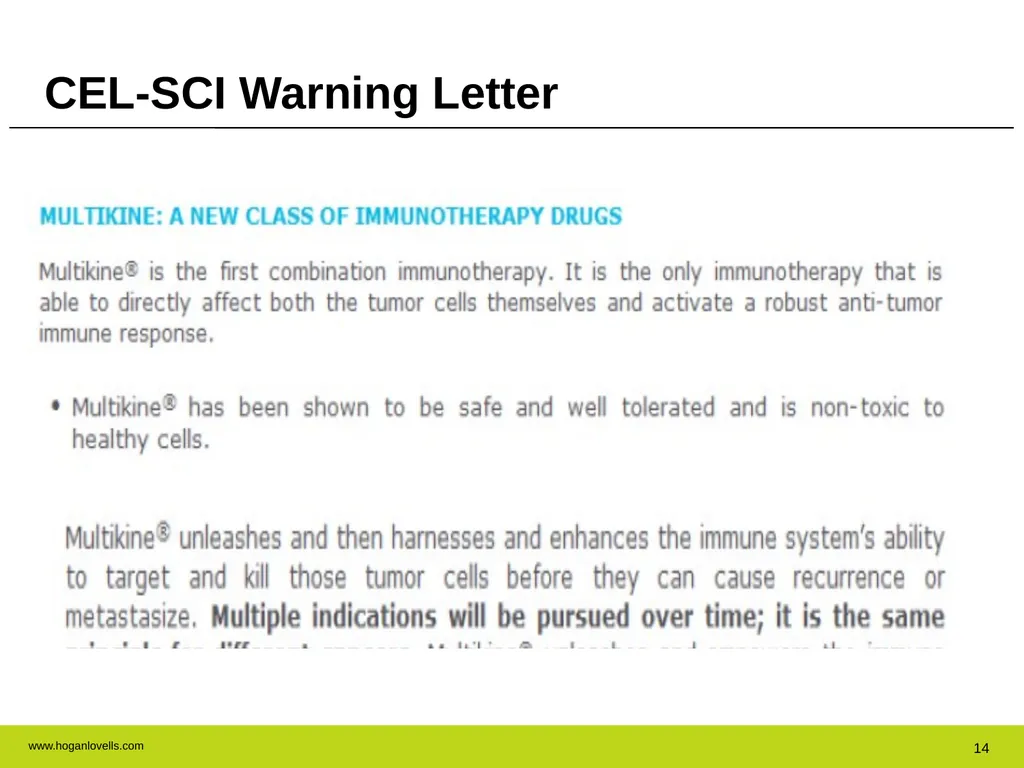
Earlier this year, CEL-SCI Corporation received the first warning letter for preapproval promotion in recent years
Website said product is “safe and well tolerated and is non-toxic to healthy cells” and the “only immunotherapy that is able to directly affect both the tumor cells themselves and activate a robust anti-tumor immune response.” Preapproval Promotion<br>
Earlier this year, CEL-SCI Corporation received the first warning letter for preapproval promotion in recent years
Website said product is “safe and well tolerated and is non-toxic to healthy cells” and the “only immunotherapy that is able to directly affect both the tumor cells themselves and activate a robust anti-tumor immune response.” Preapproval Promotion<br>
13
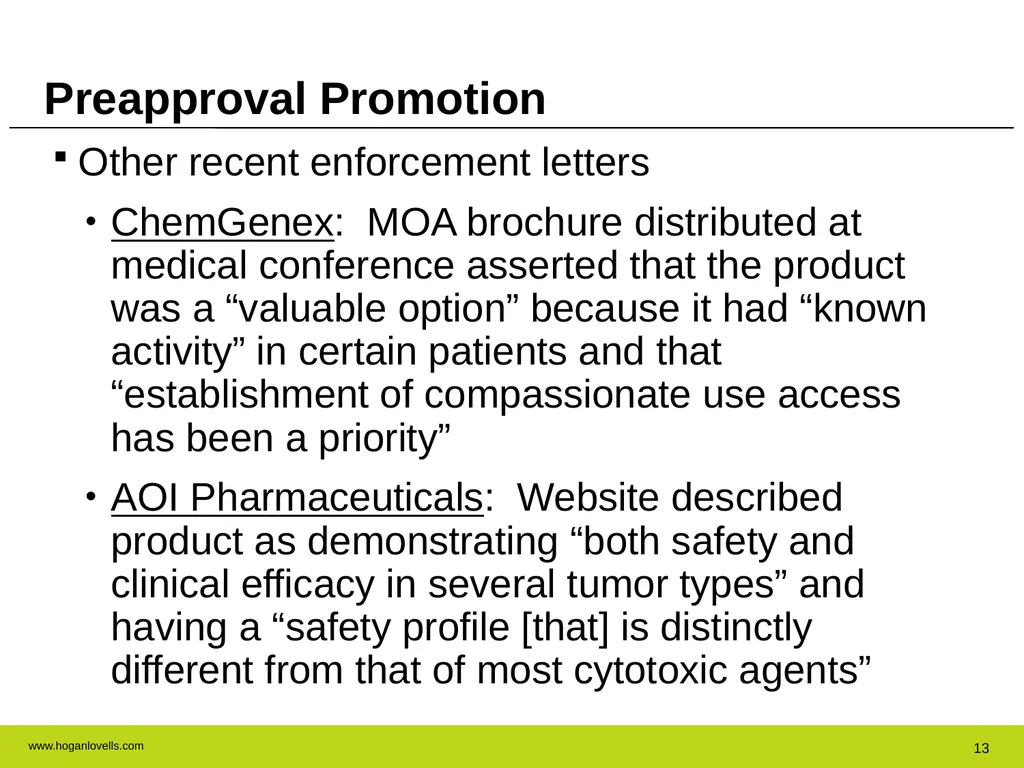
13 Other recent enforcement letters
ChemGenex: MOA brochure distributed at medical conference asserted that the product was a “valuable option” because it had “known activity” in certain patients and that “establishment of compassionate use access has been a priority”
AOI Pharmaceuticals: Website described product as demonstrating “both safety and clinical efficacy in several tumor types” and having a “safety profile [that] is distinctly different from that of most cytotoxic agents” Preapproval Promotion<br>
ChemGenex: MOA brochure distributed at medical conference asserted that the product was a “valuable option” because it had “known activity” in certain patients and that “establishment of compassionate use access has been a priority”
AOI Pharmaceuticals: Website described product as demonstrating “both safety and clinical efficacy in several tumor types” and having a “safety profile [that] is distinctly different from that of most cytotoxic agents” Preapproval Promotion<br>
14
14 CEL-SCI Warning Letter<br>
15
15 CEL-SCI Warning Letter<br>
16
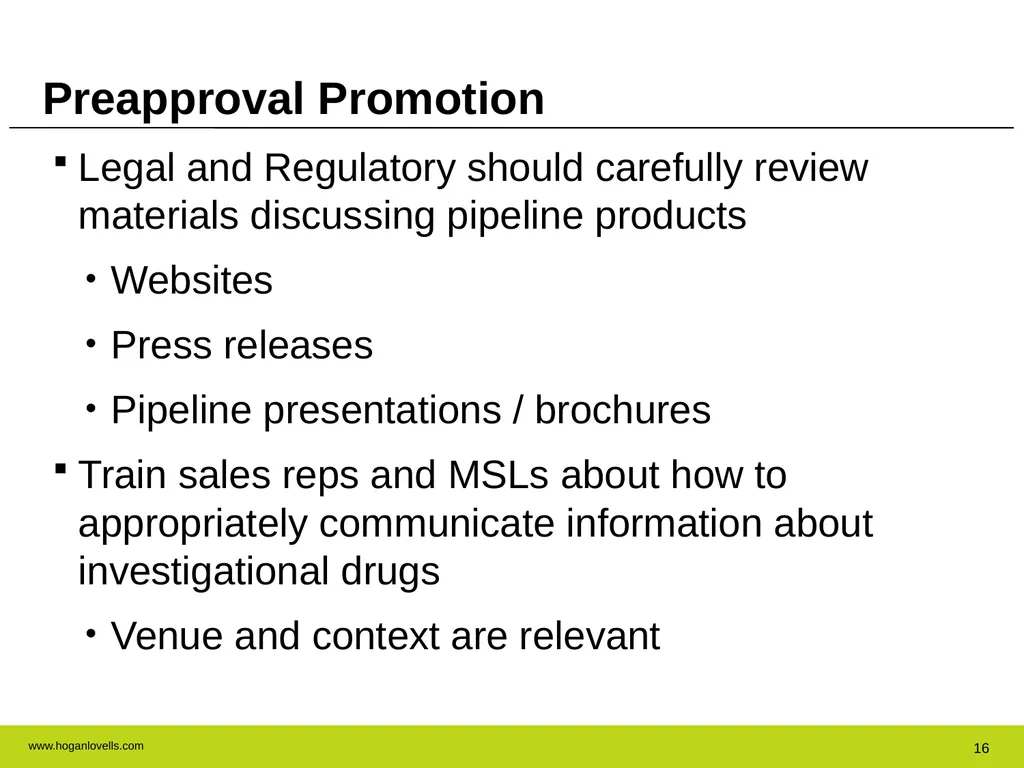
16 Legal and Regulatory should carefully review materials discussing pipeline products
Websites
Press releases
Pipeline presentations / brochures
Train sales reps and MSLs about how to appropriately communicate information about investigational drugs
Venue and context are relevant Preapproval Promotion<br>
Websites
Press releases
Pipeline presentations / brochures
Train sales reps and MSLs about how to appropriately communicate information about investigational drugs
Venue and context are relevant Preapproval Promotion<br>
17
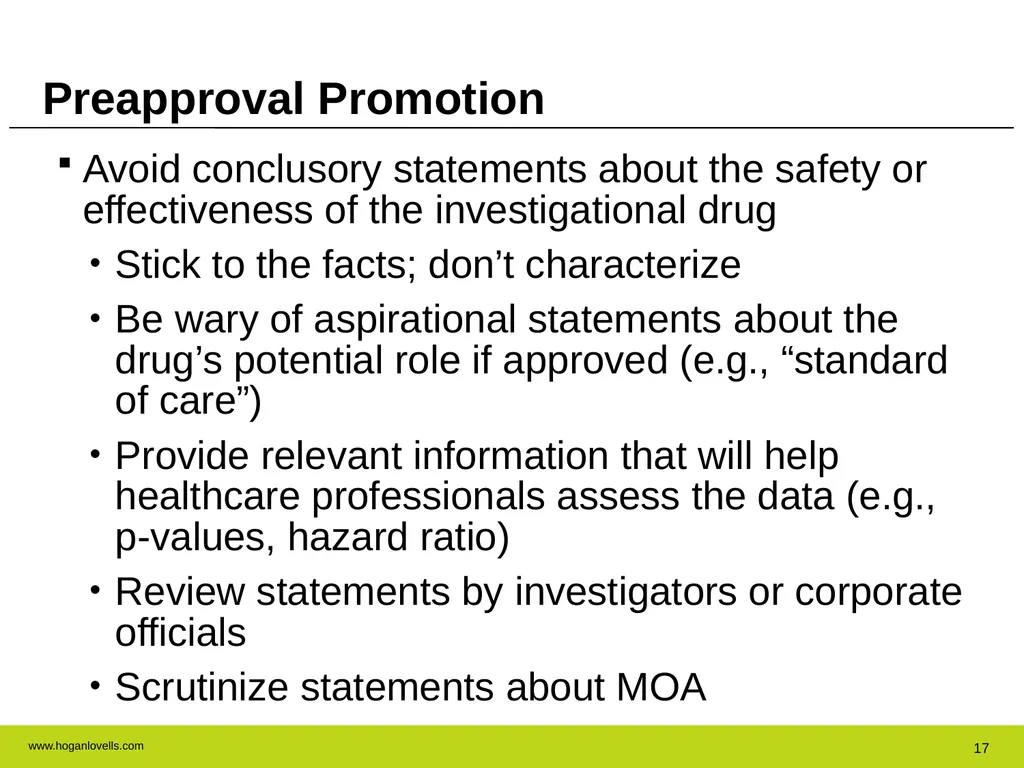
17 Avoid conclusory statements about the safety or effectiveness of the investigational drug
Stick to the facts; don’t characterize
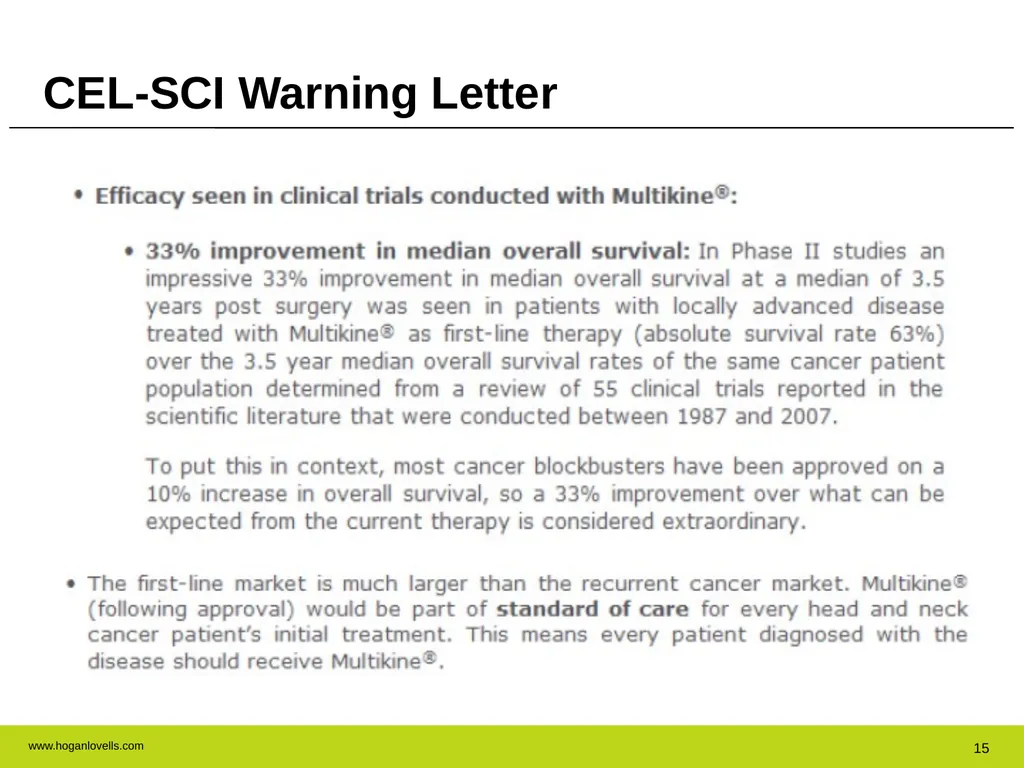
Be wary of aspirational statements about the drug’s potential role if approved (e.g., “standard of care”)
Provide relevant information that will help healthcare professionals assess the data (e.g., p-values, hazard ratio)
Review statements by investigators or corporate officials
Scrutinize statements about MOA Preapproval Promotion<br>
Stick to the facts; don’t characterize
Be wary of aspirational statements about the drug’s potential role if approved (e.g., “standard of care”)
Provide relevant information that will help healthcare professionals assess the data (e.g., p-values, hazard ratio)
Review statements by investigators or corporate officials
Scrutinize statements about MOA Preapproval Promotion<br>
18
18 Disease Awareness<br>
19
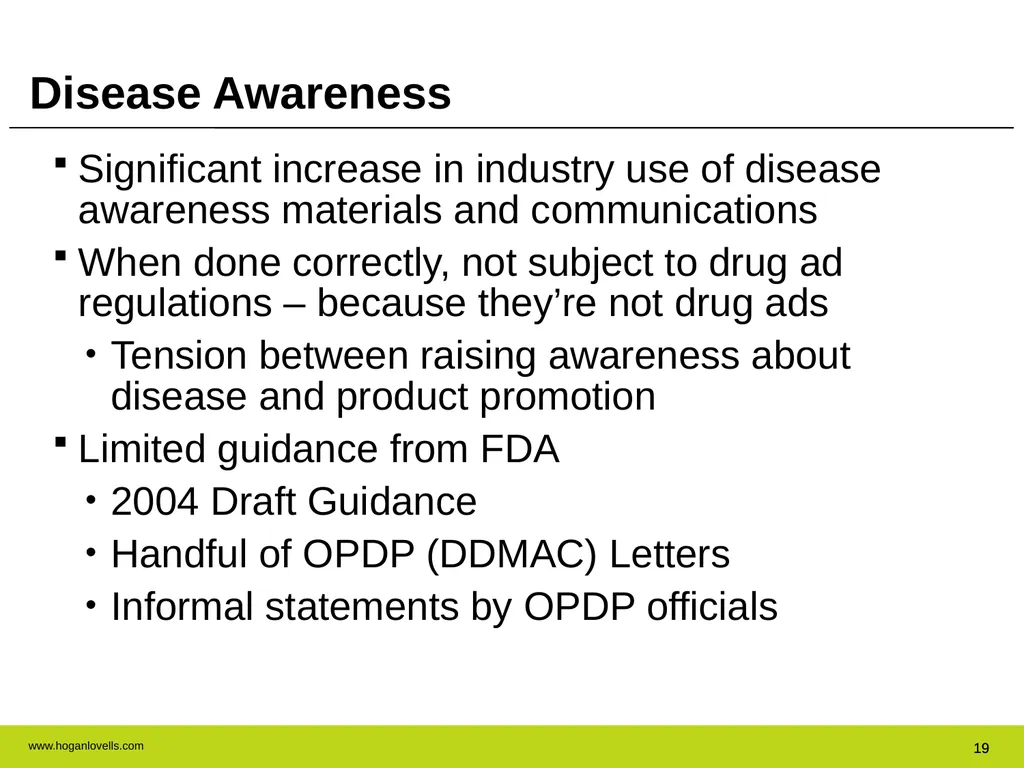
19 19 Disease Awareness Significant increase in industry use of disease awareness materials and communications
When done correctly, not subject to drug ad regulations – because they’re not drug ads
Tension between raising awareness about disease and product promotion
Limited guidance from FDA
2004 Draft Guidance
Handful of OPDP (DDMAC) Letters
Informal statements by OPDP officials<br>
When done correctly, not subject to drug ad regulations – because they’re not drug ads
Tension between raising awareness about disease and product promotion
Limited guidance from FDA
2004 Draft Guidance
Handful of OPDP (DDMAC) Letters
Informal statements by OPDP officials<br>
20
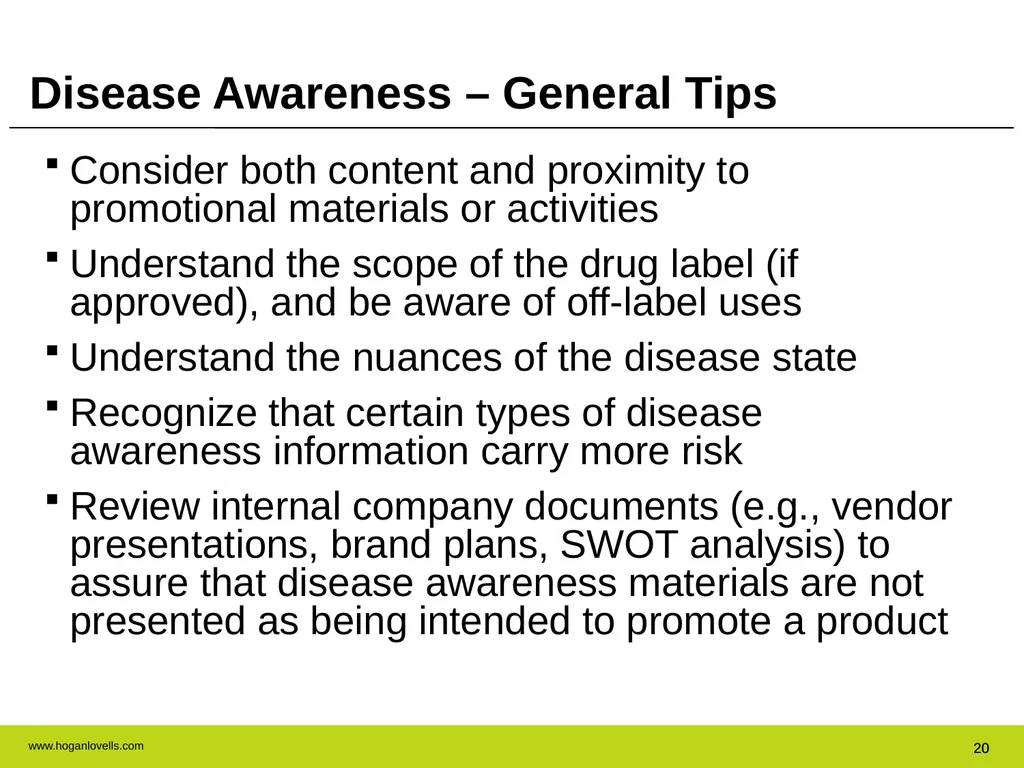
20 20 Disease Awareness – General Tips Consider both content and proximity to promotional materials or activities
Understand the scope of the drug label (if approved), and be aware of off-label uses
Understand the nuances of the disease state
Recognize that certain types of disease awareness information carry more risk
Review internal company documents (e.g., vendor presentations, brand plans, SWOT analysis) to assure that disease awareness materials are not presented as being intended to promote a product<br>
Understand the scope of the drug label (if approved), and be aware of off-label uses
Understand the nuances of the disease state
Recognize that certain types of disease awareness information carry more risk
Review internal company documents (e.g., vendor presentations, brand plans, SWOT analysis) to assure that disease awareness materials are not presented as being intended to promote a product<br>
21
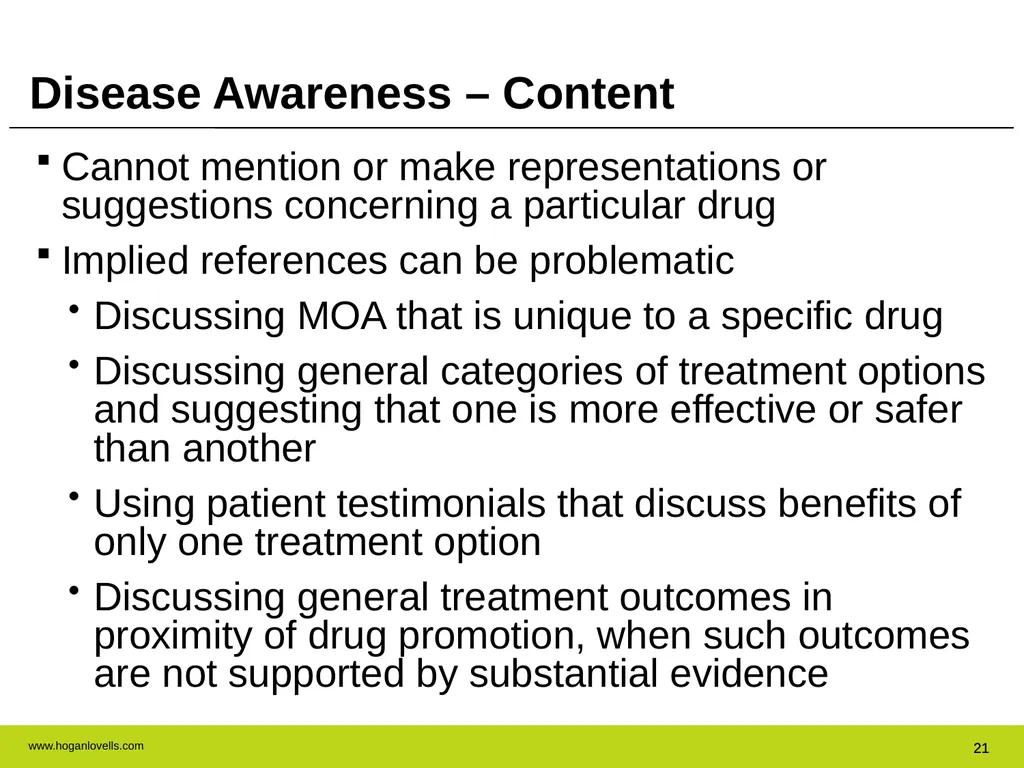
21 21 Disease Awareness – Content Cannot mention or make representations or suggestions concerning a particular drug
Implied references can be problematic
Discussing MOA that is unique to a specific drug
Discussing general categories of treatment options and suggesting that one is more effective or safer than another
Using patient testimonials that discuss benefits of only one treatment option
Discussing general treatment outcomes in proximity of drug promotion, when such outcomes are not supported by substantial evidence<br>
Implied references can be problematic
Discussing MOA that is unique to a specific drug
Discussing general categories of treatment options and suggesting that one is more effective or safer than another
Using patient testimonials that discuss benefits of only one treatment option
Discussing general treatment outcomes in proximity of drug promotion, when such outcomes are not supported by substantial evidence<br>
22
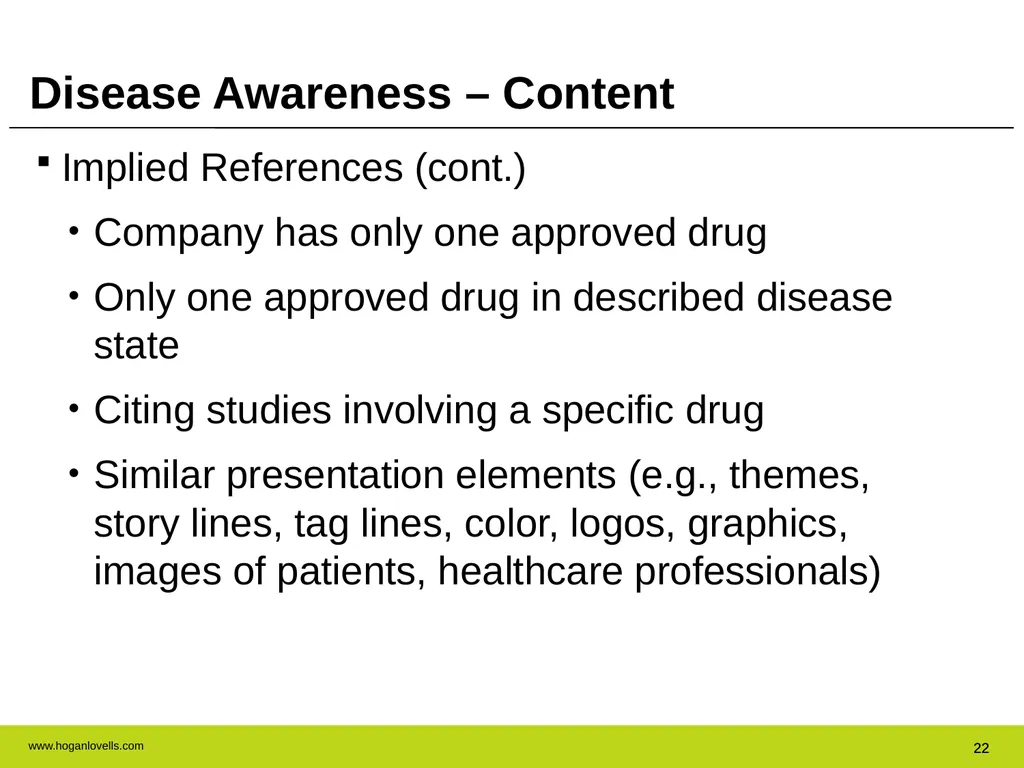
22 22 Disease Awareness – Content Implied References (cont.)
Company has only one approved drug
Only one approved drug in described disease state
Citing studies involving a specific drug
Similar presentation elements (e.g., themes, story lines, tag lines, color, logos, graphics, images of patients, healthcare professionals)<br>
Company has only one approved drug
Only one approved drug in described disease state
Citing studies involving a specific drug
Similar presentation elements (e.g., themes, story lines, tag lines, color, logos, graphics, images of patients, healthcare professionals)<br>
23
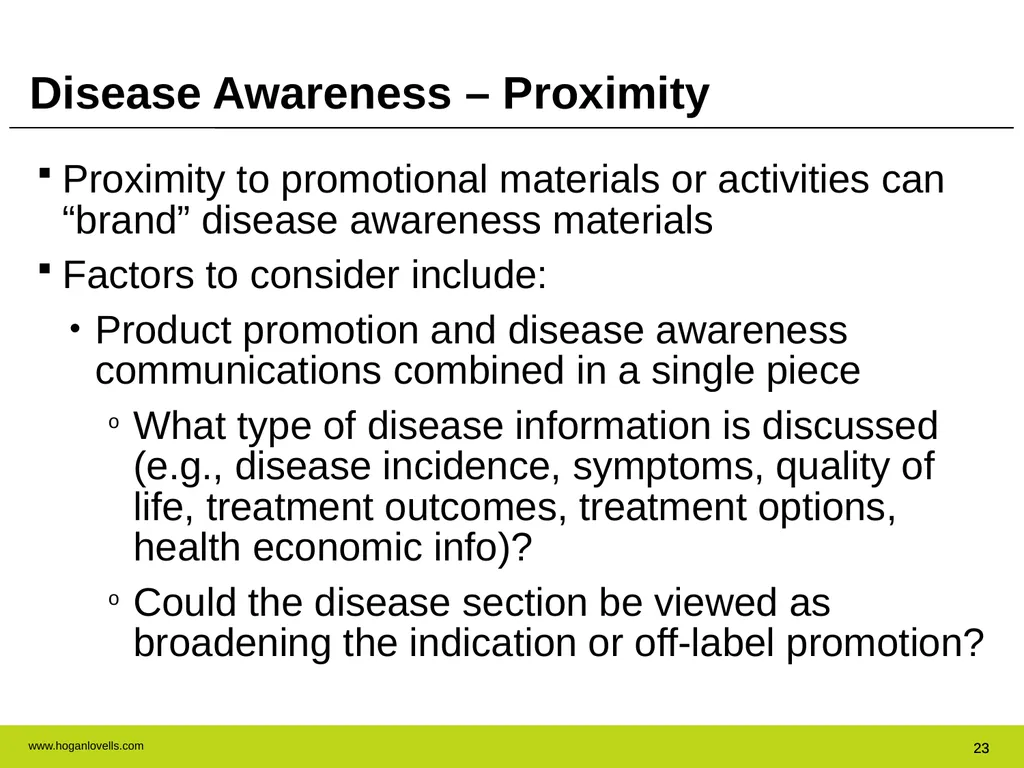
23 23 Disease Awareness – Proximity Proximity to promotional materials or activities can “brand” disease awareness materials
Factors to consider include:
Product promotion and disease awareness communications combined in a single piece
What type of disease information is discussed (e.g., disease incidence, symptoms, quality of life, treatment outcomes, treatment options, health economic info)?
Could the disease section be viewed as broadening the indication or off-label promotion?<br>
Factors to consider include:
Product promotion and disease awareness communications combined in a single piece
What type of disease information is discussed (e.g., disease incidence, symptoms, quality of life, treatment outcomes, treatment options, health economic info)?
Could the disease section be viewed as broadening the indication or off-label promotion?<br>
24
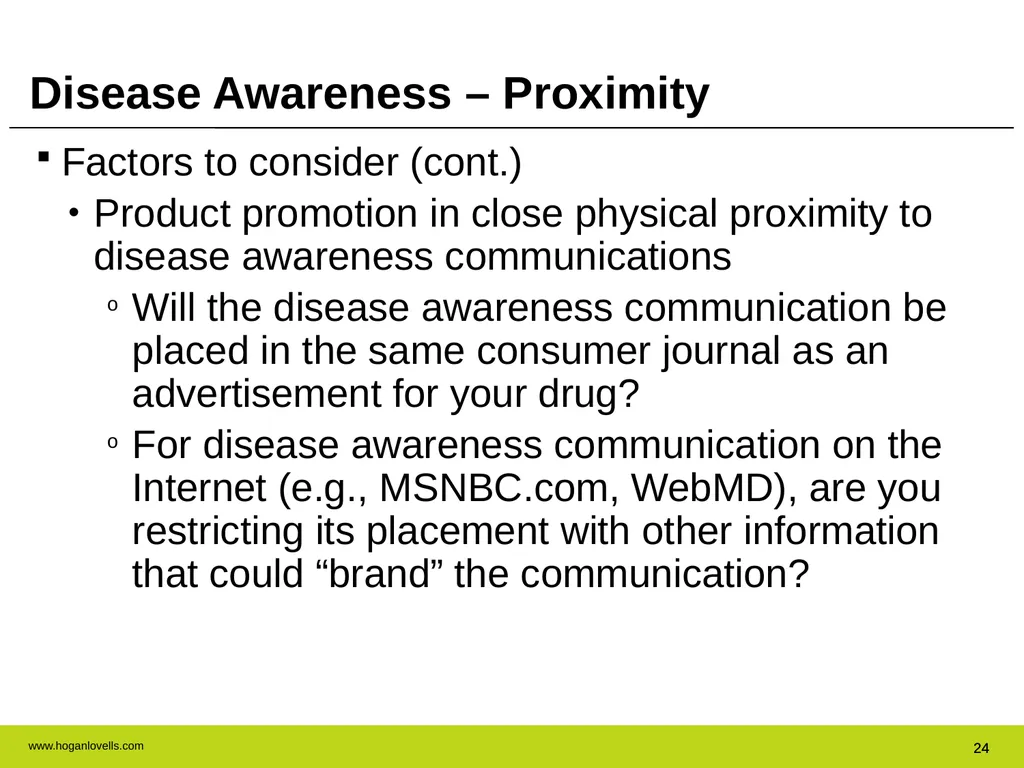
24 24 Disease Awareness – Proximity Factors to consider (cont.)
Product promotion in close physical proximity to disease awareness communications
Will the disease awareness communication be placed in the same consumer journal as an advertisement for your drug?
For disease awareness communication on the Internet (e.g., MSNBC.com, WebMD), are you restricting its placement with other information that could “brand” the communication?<br>
Product promotion in close physical proximity to disease awareness communications
Will the disease awareness communication be placed in the same consumer journal as an advertisement for your drug?
For disease awareness communication on the Internet (e.g., MSNBC.com, WebMD), are you restricting its placement with other information that could “brand” the communication?<br>
25
25 25 Disease Awareness – Proximity Issues of application include:
If using social media, what are the logistics of how the communication can be forwarded?
For a link from disease awareness website to product promotion website, does the connecting url include the product name? Is there a landing page?
If consumers ask for more information via a disease awareness website, will promotional materials be provided?
How are sales reps trained to use disease awareness materials?<br>
If using social media, what are the logistics of how the communication can be forwarded?
For a link from disease awareness website to product promotion website, does the connecting url include the product name? Is there a landing page?
If consumers ask for more information via a disease awareness website, will promotional materials be provided?
How are sales reps trained to use disease awareness materials?<br>
26
26 Internet / Social Media / Digital Media<br>
27
27 Unclear when/if FDA will issue the much-anticipated guidance on using social media
DDMAC/OPDP enforcement letters provide some landmarks
2011 NOV Letter to Pfizer: No “one-click” rule
2010 NOV Letter to Novartis: Facebook widget
2009 NOV Letter to GSK: Banner ad
2009 NOV Letters to 14 companies: Sponsored links
2009 Warning Letter to J&J: DTC webcast video
2008 NOV Letter to Novartis: Banner ad Internet / Social Media / Digital Media<br>
DDMAC/OPDP enforcement letters provide some landmarks
2011 NOV Letter to Pfizer: No “one-click” rule
2010 NOV Letter to Novartis: Facebook widget
2009 NOV Letter to GSK: Banner ad
2009 NOV Letters to 14 companies: Sponsored links
2009 Warning Letter to J&J: DTC webcast video
2008 NOV Letter to Novartis: Banner ad Internet / Social Media / Digital Media<br>
28
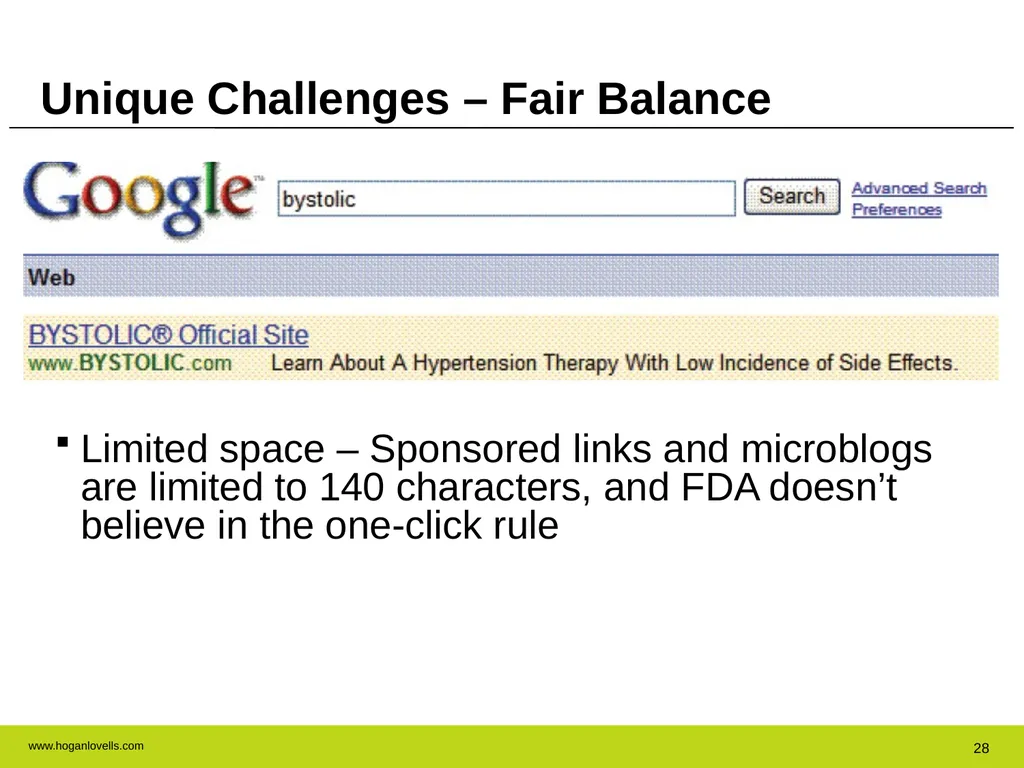
28 Limited space – Sponsored links and microblogs are limited to 140 characters, and FDA doesn’t believe in the one-click rule Unique Challenges – Fair Balance<br>
29
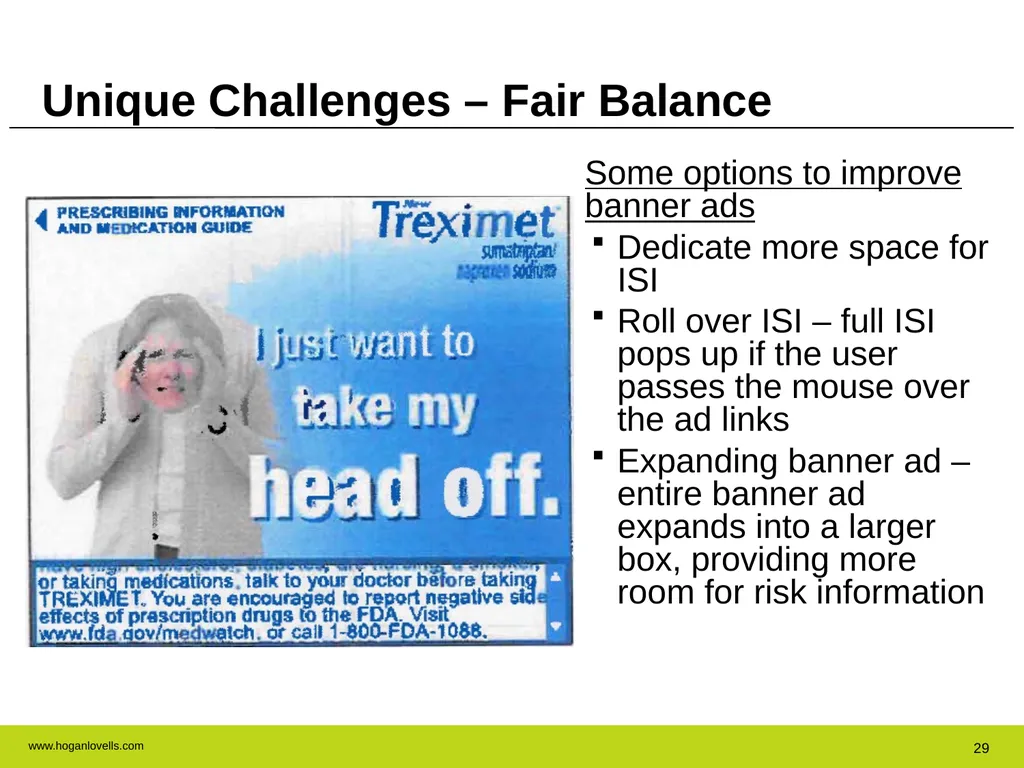
29 Unique Challenges – Fair Balance Some options to improve banner ads
Dedicate more space for ISI
Roll over ISI – full ISI pops up if the user passes the mouse over the ad links
Expanding banner ad – entire banner ad expands into a larger box, providing more room for risk information<br>
Dedicate more space for ISI
Roll over ISI – full ISI pops up if the user passes the mouse over the ad links
Expanding banner ad – entire banner ad expands into a larger box, providing more room for risk information<br>
30
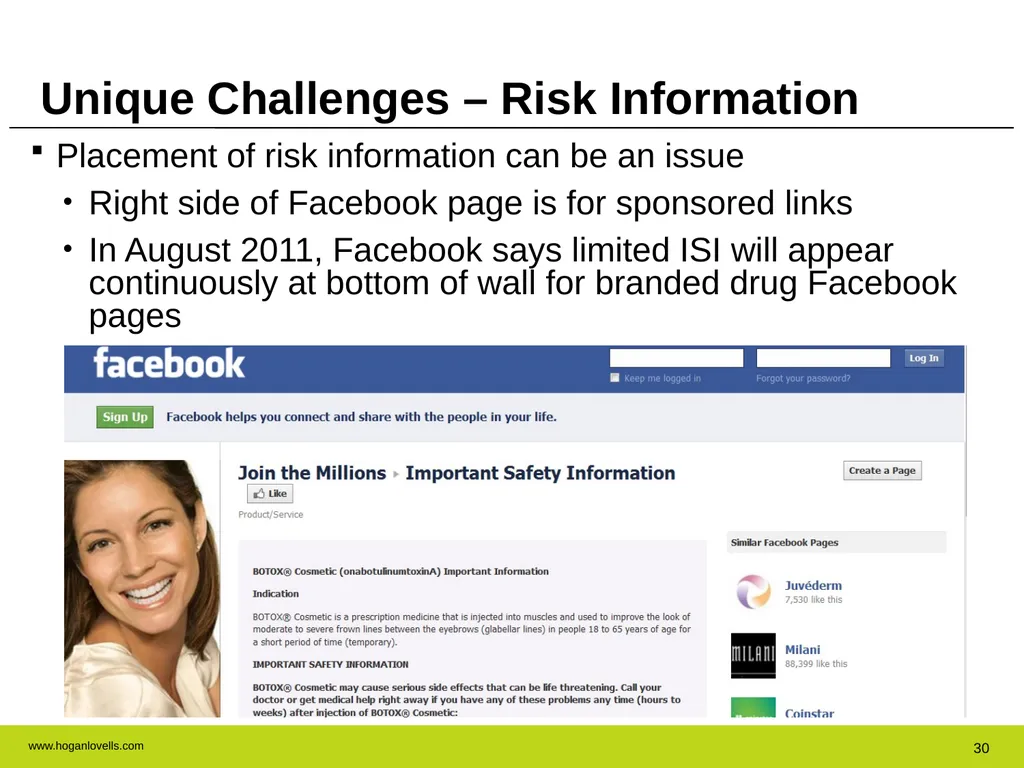
30 Placement of risk information can be an issue
Right side of Facebook page is for sponsored links
In August 2011, Facebook says limited ISI will appear continuously at bottom of wall for branded drug Facebook pages Unique Challenges – Risk Information<br>
Right side of Facebook page is for sponsored links
In August 2011, Facebook says limited ISI will appear continuously at bottom of wall for branded drug Facebook pages Unique Challenges – Risk Information<br>
31
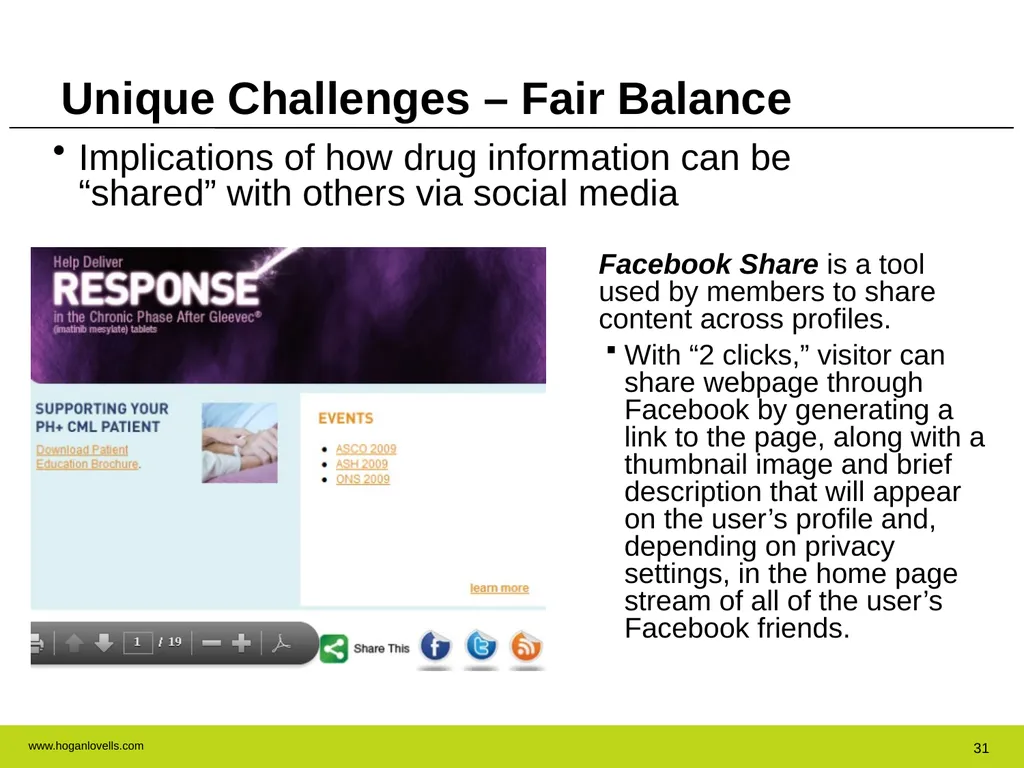
31 Implications of how drug information can be “shared” with others via social media Unique Challenges – Fair Balance Facebook Share is a tool used by members to share content across profiles.
With “2 clicks,” visitor can share webpage through Facebook by generating a link to the page, along with a thumbnail image and brief description that will appear on the user’s profile and, depending on privacy settings, in the home page stream of all of the user’s Facebook friends.<br>
With “2 clicks,” visitor can share webpage through Facebook by generating a link to the page, along with a thumbnail image and brief description that will appear on the user’s profile and, depending on privacy settings, in the home page stream of all of the user’s Facebook friends.<br>
32
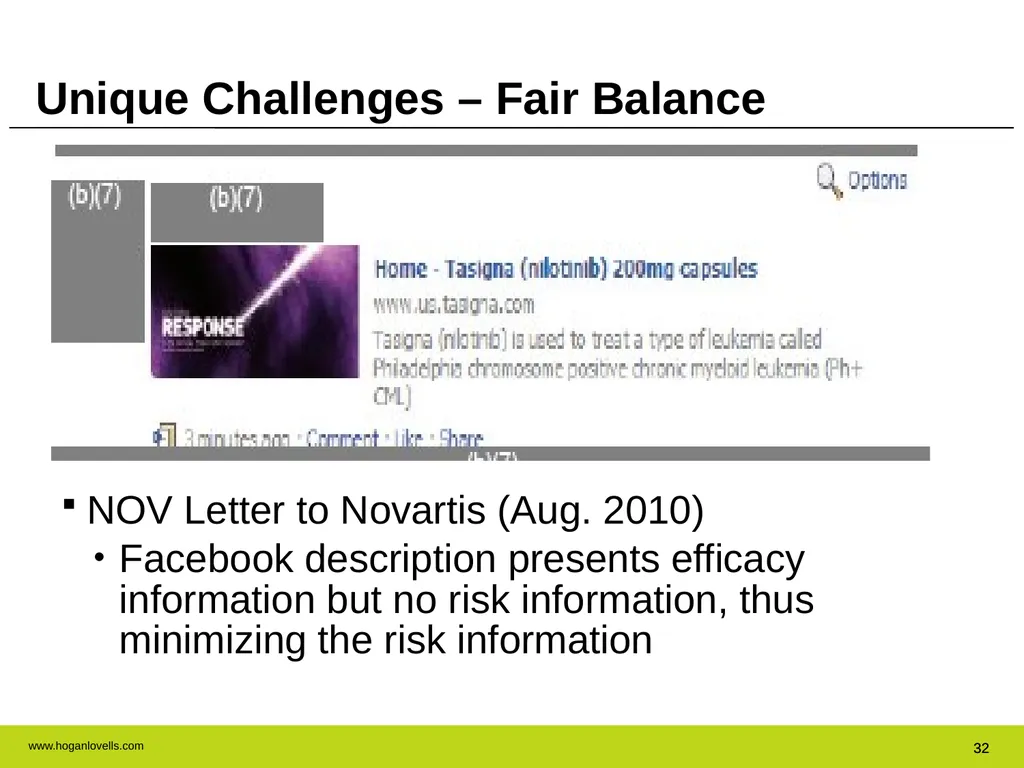
32 32 NOV Letter to Novartis (Aug. 2010)
Facebook description presents efficacy information but no risk information, thus minimizing the risk information Unique Challenges – Fair Balance<br>
Facebook description presents efficacy information but no risk information, thus minimizing the risk information Unique Challenges – Fair Balance<br>
33
33 Hyperlinks allow a product website to include much information, but create challenges for website review
Issues of application include:
Reviewing content available via each hyperlink, including links to 3rd party websites, which can misbrand a drug
Having risk information incorporated within embedded videos
Understanding how the “share” feature or other social media features work
Understanding how consumers or health care professionals can navigate through the website Unique Challenges – Product Websites<br>
Issues of application include:
Reviewing content available via each hyperlink, including links to 3rd party websites, which can misbrand a drug
Having risk information incorporated within embedded videos
Understanding how the “share” feature or other social media features work
Understanding how consumers or health care professionals can navigate through the website Unique Challenges – Product Websites<br>
34
34 1997 FDA guidance says an adverse events must be reported when the company has these data elements:
Identifiable patient
Suspect drug product
Identifiable reporter
Adverse event or fatal outcome
No obligation to monitor potential adverse events that arise on the Internet or user-generated forums, unless the site is controlled or influenced by the company
What if user sends an e-mail with adverse event information or posts comments to Sidewiki? Unique Challenges – Adverse Event Reporting<br>
Identifiable patient
Suspect drug product
Identifiable reporter
Adverse event or fatal outcome
No obligation to monitor potential adverse events that arise on the Internet or user-generated forums, unless the site is controlled or influenced by the company
What if user sends an e-mail with adverse event information or posts comments to Sidewiki? Unique Challenges – Adverse Event Reporting<br>
35
35 Issues of application include:
Is there an option to disable “Comments” on user-generated sites (e.g., Facebook, blogs)?
Recent Facebook policy change now requires comments to be enabled on disease awareness pages
If comments are enabled, does the company have policies and procedures to continuously monitor sites for potential adverse events? Unique Challenges – Adverse Event Reporting<br>
Is there an option to disable “Comments” on user-generated sites (e.g., Facebook, blogs)?
Recent Facebook policy change now requires comments to be enabled on disease awareness pages
If comments are enabled, does the company have policies and procedures to continuously monitor sites for potential adverse events? Unique Challenges – Adverse Event Reporting<br>
36
36 Issues of application (cont.)
Monitoring of sites for potential adverse events raises many issues, including:
Significant resources often required
Privacy issues may preclude company from attempting to obtain follow-up information
Company must decide whether to review all comments before posting them
Does the company have the ability to remove comments?
Who monitors the sites, the company or a vendor? Unique Challenges – Adverse Event Reporting<br>
Monitoring of sites for potential adverse events raises many issues, including:
Significant resources often required
Privacy issues may preclude company from attempting to obtain follow-up information
Company must decide whether to review all comments before posting them
Does the company have the ability to remove comments?
Who monitors the sites, the company or a vendor? Unique Challenges – Adverse Event Reporting<br>
37
37 Television Ads<br>
38
38 Balancing safety and efficacy information is challenging, given the limited amount of time available
Issues of application include:
Proportion of time spent on efficacy and risk information
It’s helpful if storyboard displays the amount of time each fame will appear on screen
Images can create/imply a claim
2010 untitled letter said images of Alzheimer patient with a distant, blank stare who later actively interacts with family members overstated the product’s efficacy Direct-to-Consumer Broadcast Ads<br>
Issues of application include:
Proportion of time spent on efficacy and risk information
It’s helpful if storyboard displays the amount of time each fame will appear on screen
Images can create/imply a claim
2010 untitled letter said images of Alzheimer patient with a distant, blank stare who later actively interacts with family members overstated the product’s efficacy Direct-to-Consumer Broadcast Ads<br>
39
39 Issues of application (cont.)
Use of voiceovers and supers to present efficacy and risk information
Supers generally are not as prominent as voiceovers
Potential distracting elements when risk information is presented
Importance of reviewing concepts, draft and final storyboards, final layout, and video
Consider submitting to FDA for advisory comments, per PhRMA guidelines Direct-to-Consumer Broadcast Ads<br>
Use of voiceovers and supers to present efficacy and risk information
Supers generally are not as prominent as voiceovers
Potential distracting elements when risk information is presented
Importance of reviewing concepts, draft and final storyboards, final layout, and video
Consider submitting to FDA for advisory comments, per PhRMA guidelines Direct-to-Consumer Broadcast Ads<br>
40
40 Reminder Ads<br>
41
41 41 Reminder Ads Reminder ads may mention the drug name, but may not contain any claims, express or implied, about the drug’s use
A reminder ad is a drug ad, but it is not required include the “brief summary” of risk information
Issues of application include:
Reminder ads cannot be used for a drug with a boxed warning
Images can make an implied efficacy claim
Proximity to other materials that contain statements of the drug’s use can be problematic<br>
A reminder ad is a drug ad, but it is not required include the “brief summary” of risk information
Issues of application include:
Reminder ads cannot be used for a drug with a boxed warning
Images can make an implied efficacy claim
Proximity to other materials that contain statements of the drug’s use can be problematic<br>
42
42 Economic Information<br>
43
43 Economic Information Promotional materials may contain economic information, which often consists of assertions about the economic consequences of using a drug
At times, the information is comparative of the costs of using different products
FDA often considers such economic comparisons to be based on an implied representation that the products are comparable in safety and effectiveness, which requires “substantial evidence,” typically in the form of data from head-to-head clinical trials 43<br>
At times, the information is comparative of the costs of using different products
FDA often considers such economic comparisons to be based on an implied representation that the products are comparable in safety and effectiveness, which requires “substantial evidence,” typically in the form of data from head-to-head clinical trials 43<br>
44
44 Health Care Economic Information (HCEI) FDCA specifically provides for sharing HCEI with formulary committees and similar entities
Such information is required to meet a lesser standard of substantiation than is required of efficacy or safety claims
“Competent and reliable scientific evidence,” rather than “substantial evidence”
Key issues:
HCEI must directly relate to an approved indication
FDA often sees implied clinical claims in economic claims 44<br>
Such information is required to meet a lesser standard of substantiation than is required of efficacy or safety claims
“Competent and reliable scientific evidence,” rather than “substantial evidence”
Key issues:
HCEI must directly relate to an approved indication
FDA often sees implied clinical claims in economic claims 44<br>
45
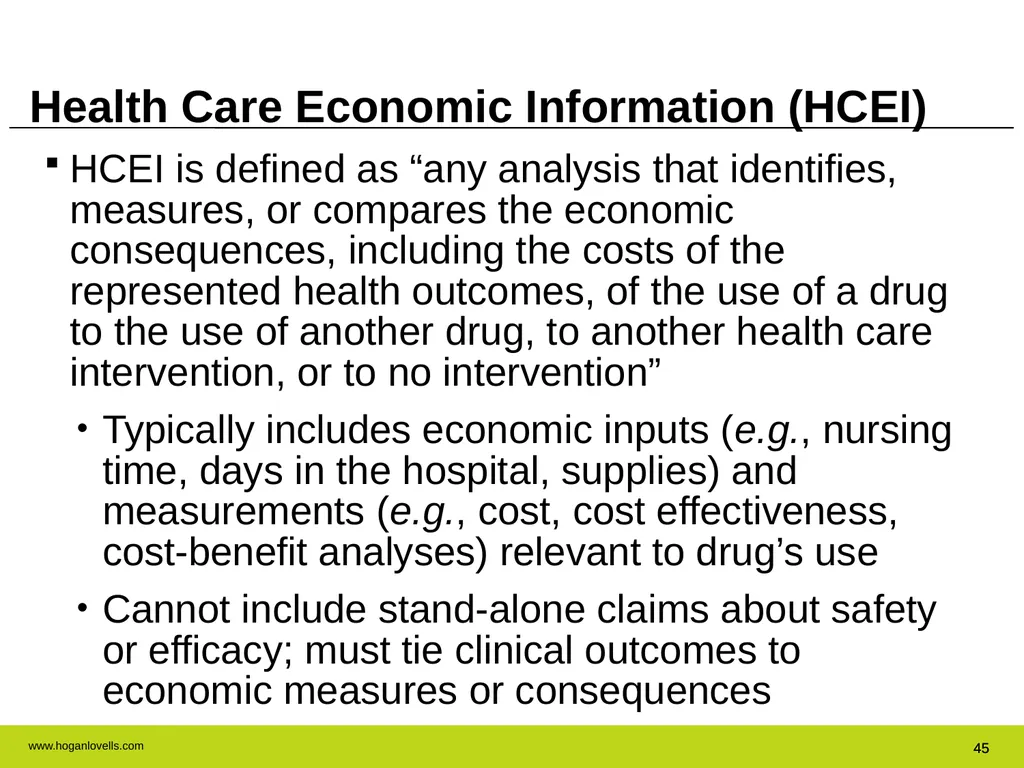
45 Health Care Economic Information (HCEI) HCEI is defined as “any analysis that identifies, measures, or compares the economic consequences, including the costs of the represented health outcomes, of the use of a drug to the use of another drug, to another health care intervention, or to no intervention”
Typically includes economic inputs (e.g., nursing time, days in the hospital, supplies) and measurements (e.g., cost, cost effectiveness, cost-benefit analyses) relevant to drug’s use
Cannot include stand-alone claims about safety or efficacy; must tie clinical outcomes to economic measures or consequences 45<br>
Typically includes economic inputs (e.g., nursing time, days in the hospital, supplies) and measurements (e.g., cost, cost effectiveness, cost-benefit analyses) relevant to drug’s use
Cannot include stand-alone claims about safety or efficacy; must tie clinical outcomes to economic measures or consequences 45<br>
46
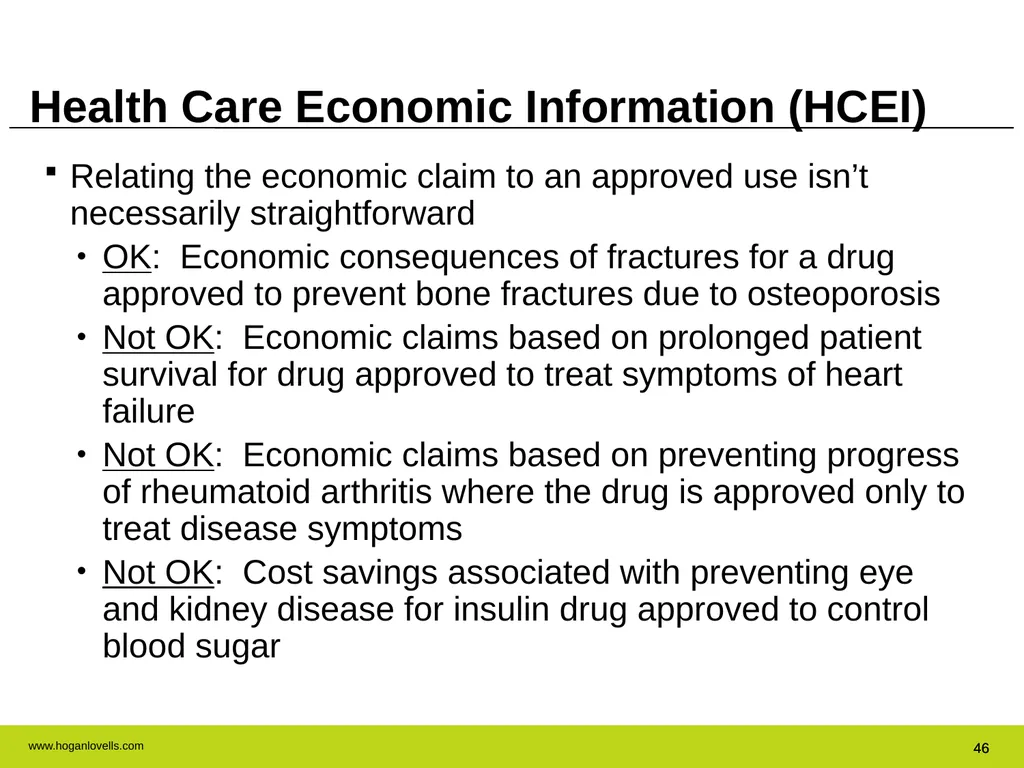
46 Health Care Economic Information (HCEI) Relating the economic claim to an approved use isn’t necessarily straightforward
OK: Economic consequences of fractures for a drug approved to prevent bone fractures due to osteoporosis
Not OK: Economic claims based on prolonged patient survival for drug approved to treat symptoms of heart failure
Not OK: Economic claims based on preventing progress of rheumatoid arthritis where the drug is approved only to treat disease symptoms
Not OK: Cost savings associated with preventing eye and kidney disease for insulin drug approved to control blood sugar 46<br>
OK: Economic consequences of fractures for a drug approved to prevent bone fractures due to osteoporosis
Not OK: Economic claims based on prolonged patient survival for drug approved to treat symptoms of heart failure
Not OK: Economic claims based on preventing progress of rheumatoid arthritis where the drug is approved only to treat disease symptoms
Not OK: Cost savings associated with preventing eye and kidney disease for insulin drug approved to control blood sugar 46<br>
47
47 www.hoganlovells.com Hogan Lovells has offices in: Abu Dhabi
Alicante
Amsterdam
Baltimore
Beijing
Berlin
Brussels
Budapest*
Caracas Colorado Springs
Denver
Dubai
Dusseldorf
Frankfurt
Hamburg
Hanoi
Ho Chi Minh City
Hong Kong Houston
Jeddah*
London
Los Angeles
Madrid
Miami
Milan
Moscow
Munich New York
Northern Virginia
Paris
Philadelphia
Prague
Riyadh*
Rome
San Francisco
Shanghai Silicon Valley
Singapore
Tokyo
Ulaanbaatar*
Warsaw
Washington DC
Zagreb* "Hogan Lovells" or the "firm" refers to the international legal practice comprising Hogan Lovells International LLP, Hogan Lovells US LLP, Hogan Lovells Worldwide Group (a Swiss Verein), and their affiliated businesses, each of which is a separate legal entity. Hogan Lovells International LLP is a limited liability partnership registered in England and Wales with registered number OC323639. Registered office and principal place of business: Atlantic House, Holborn Viaduct, London EC1A 2FG. Hogan Lovells US LLP is a limited liability partnership registered in the District of Columbia.
The word "partner" is used to refer to a member of Hogan Lovells International LLP or a partner of Hogan Lovells US LLP, or an employee or consultant with equivalent standing and qualifications, and to a partner, member, employee or consultant in any of their affiliated businesses who has equivalent standing. Rankings and quotes from legal directories and other sources may refer to the former firms of Hogan & Hartson LLP and Lovells LLP. Where case studies are included, results achieved do not guarantee similar outcomes for other clients. New York State Notice: Attorney Advertising.
© Hogan Lovells 2011. All rights reserved.
* Associated offices Philip Katz
philip.katz@hoganlovells.com
+1.202.637.5632<br>
Alicante
Amsterdam
Baltimore
Beijing
Berlin
Brussels
Budapest*
Caracas Colorado Springs
Denver
Dubai
Dusseldorf
Frankfurt
Hamburg
Hanoi
Ho Chi Minh City
Hong Kong Houston
Jeddah*
London
Los Angeles
Madrid
Miami
Milan
Moscow
Munich New York
Northern Virginia
Paris
Philadelphia
Prague
Riyadh*
Rome
San Francisco
Shanghai Silicon Valley
Singapore
Tokyo
Ulaanbaatar*
Warsaw
Washington DC
Zagreb* "Hogan Lovells" or the "firm" refers to the international legal practice comprising Hogan Lovells International LLP, Hogan Lovells US LLP, Hogan Lovells Worldwide Group (a Swiss Verein), and their affiliated businesses, each of which is a separate legal entity. Hogan Lovells International LLP is a limited liability partnership registered in England and Wales with registered number OC323639. Registered office and principal place of business: Atlantic House, Holborn Viaduct, London EC1A 2FG. Hogan Lovells US LLP is a limited liability partnership registered in the District of Columbia.
The word "partner" is used to refer to a member of Hogan Lovells International LLP or a partner of Hogan Lovells US LLP, or an employee or consultant with equivalent standing and qualifications, and to a partner, member, employee or consultant in any of their affiliated businesses who has equivalent standing. Rankings and quotes from legal directories and other sources may refer to the former firms of Hogan & Hartson LLP and Lovells LLP. Where case studies are included, results achieved do not guarantee similar outcomes for other clients. New York State Notice: Attorney Advertising.
© Hogan Lovells 2011. All rights reserved.
* Associated offices Philip Katz
philip.katz@hoganlovells.com
+1.202.637.5632<br>