
Early-warning Indicators, Supervisory Intervention
CS
Published · 22 slides · 0 views
1 / 1
Description
Early-warning Indicators, Supervisory Intervention and Cross-border Resolution of Insurance Groups Regional Seminar on Supervision of Insurance Groups Santiago, Chile, 19-21 November 2013 Gunilla Löfvendahl Senior Financial Sector
Related Topics
Share
Embed code
Download this presentation From Below
"Early-warning Indicators, Supervisory Intervention" is the property of its rightful owner. Permission is granted to download and print the materials on this website for personal, non-commercial use only, and to display it on your personal computer provided you do not modify the materials and that you retain all copyright notices contained in the materials. By downloading content from our website, you accept the terms of this agreement.
Presentation Transcript
01
Early-warning Indicators, Supervisory Intervention and Cross-border Resolution of Insurance Groups Regional Seminar on Supervision of Insurance Groups
Santiago, Chile, 19-21 November 2013
Gunilla Löfvendahl
Senior Financial Sector Specialist<br>
Santiago, Chile, 19-21 November 2013
Gunilla Löfvendahl
Senior Financial Sector Specialist<br>
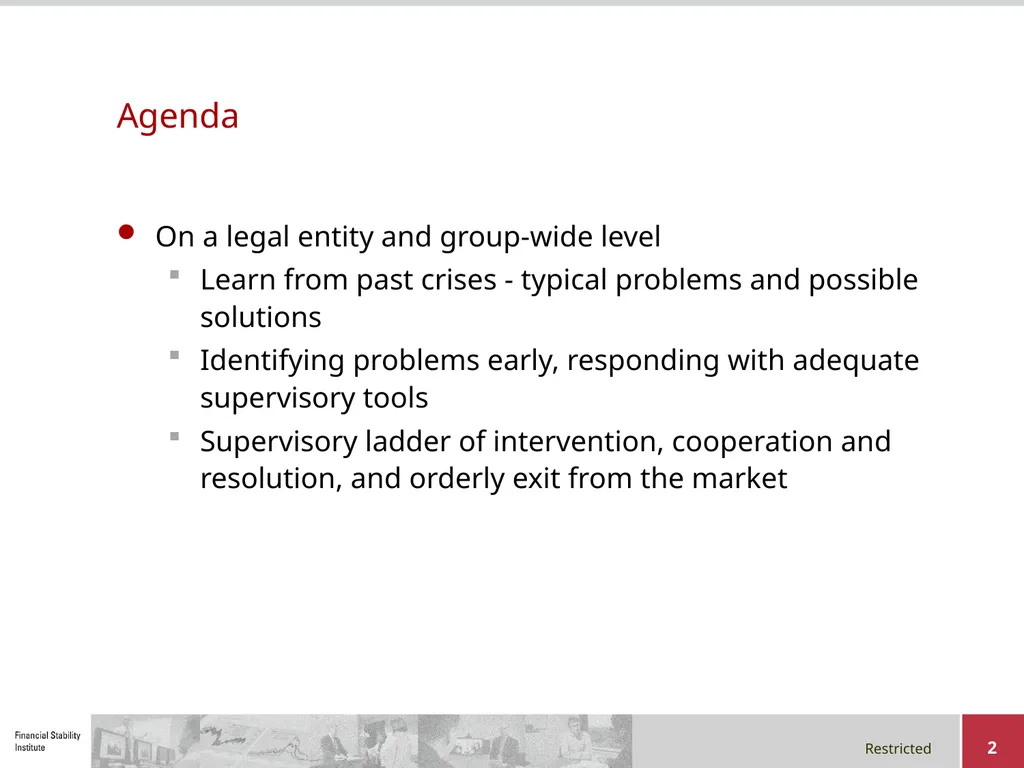
02
2 Agenda On a legal entity and group-wide level
Learn from past crises - typical problems and possible solutions
Identifying problems early, responding with adequate supervisory tools
Supervisory ladder of intervention, cooperation and resolution, and orderly exit from the market<br>
Learn from past crises - typical problems and possible solutions
Identifying problems early, responding with adequate supervisory tools
Supervisory ladder of intervention, cooperation and resolution, and orderly exit from the market<br>
03
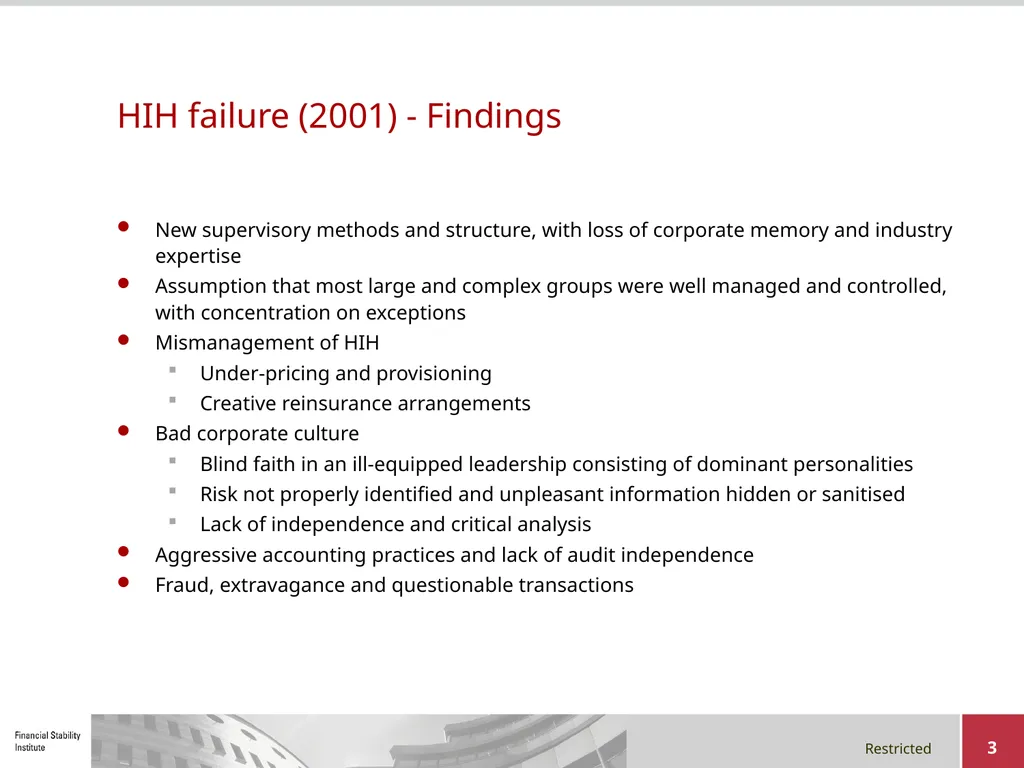
3 HIH failure (2001) - Findings New supervisory methods and structure, with loss of corporate memory and industry expertise
Assumption that most large and complex groups were well managed and controlled, with concentration on exceptions
Mismanagement of HIH
Under-pricing and provisioning
Creative reinsurance arrangements
Bad corporate culture
Blind faith in an ill-equipped leadership consisting of dominant personalities
Risk not properly identified and unpleasant information hidden or sanitised
Lack of independence and critical analysis
Aggressive accounting practices and lack of audit independence
Fraud, extravagance and questionable transactions<br>
Assumption that most large and complex groups were well managed and controlled, with concentration on exceptions
Mismanagement of HIH
Under-pricing and provisioning
Creative reinsurance arrangements
Bad corporate culture
Blind faith in an ill-equipped leadership consisting of dominant personalities
Risk not properly identified and unpleasant information hidden or sanitised
Lack of independence and critical analysis
Aggressive accounting practices and lack of audit independence
Fraud, extravagance and questionable transactions<br>
04
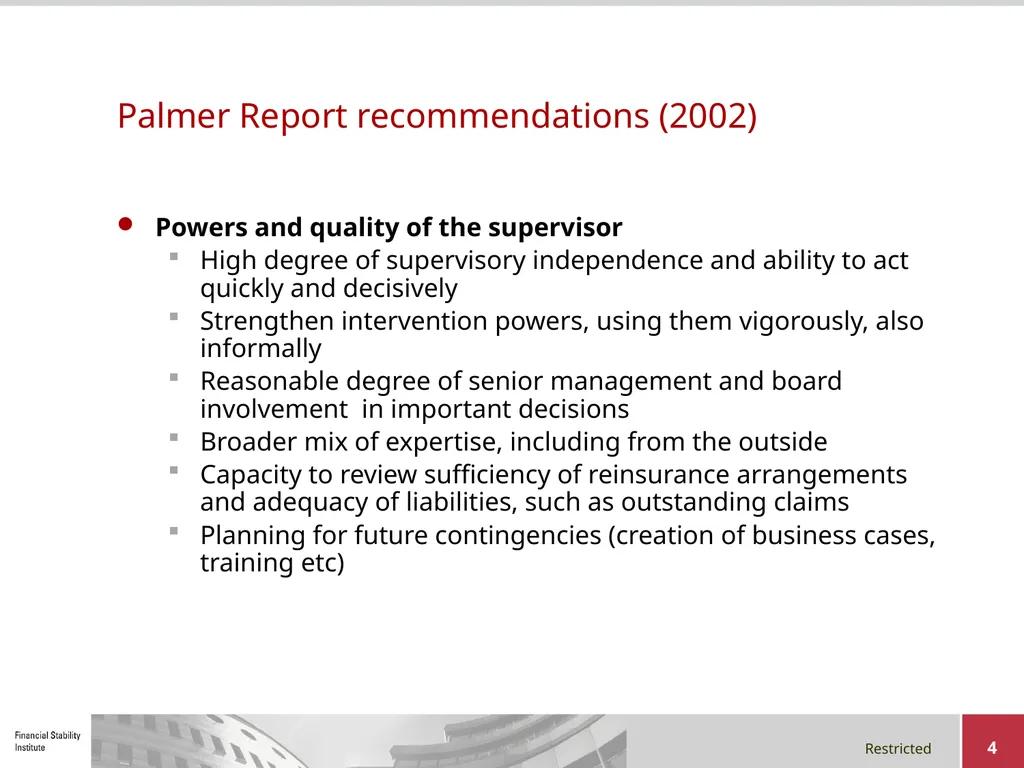
4 Palmer Report recommendations (2002) Powers and quality of the supervisor
High degree of supervisory independence and ability to act quickly and decisively
Strengthen intervention powers, using them vigorously, also informally
Reasonable degree of senior management and board involvement in important decisions
Broader mix of expertise, including from the outside
Capacity to review sufficiency of reinsurance arrangements and adequacy of liabilities, such as outstanding claims
Planning for future contingencies (creation of business cases, training etc)<br>
High degree of supervisory independence and ability to act quickly and decisively
Strengthen intervention powers, using them vigorously, also informally
Reasonable degree of senior management and board involvement in important decisions
Broader mix of expertise, including from the outside
Capacity to review sufficiency of reinsurance arrangements and adequacy of liabilities, such as outstanding claims
Planning for future contingencies (creation of business cases, training etc)<br>
05
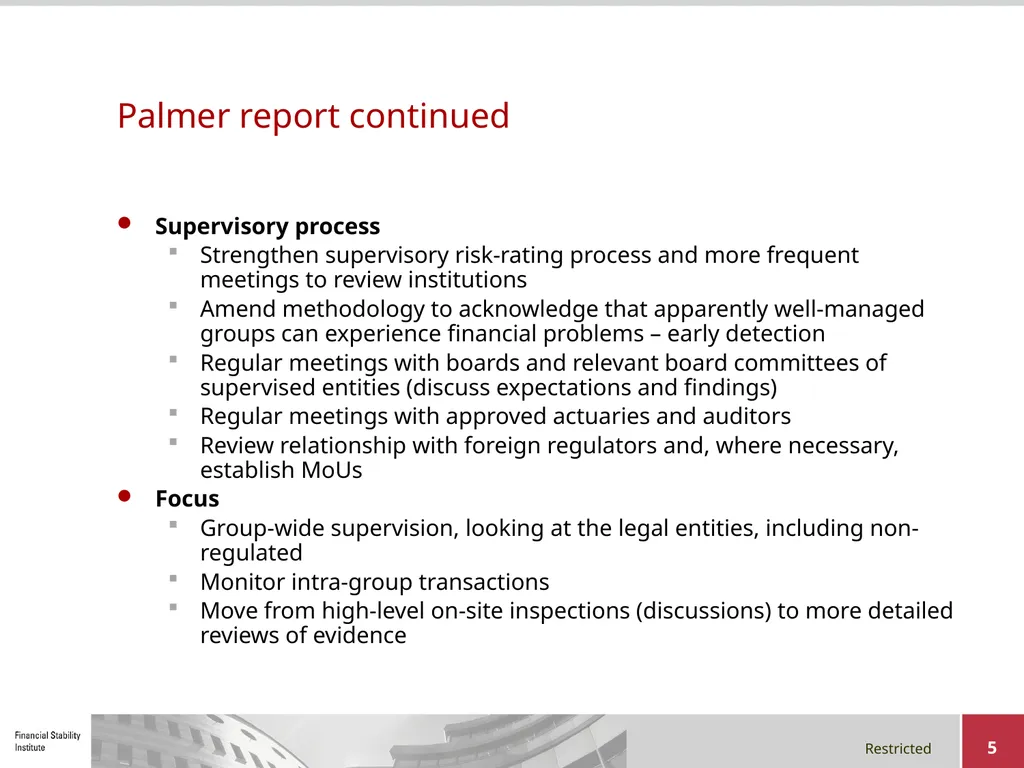
5 Palmer report continued Supervisory process
Strengthen supervisory risk-rating process and more frequent meetings to review institutions
Amend methodology to acknowledge that apparently well-managed groups can experience financial problems – early detection
Regular meetings with boards and relevant board committees of supervised entities (discuss expectations and findings)
Regular meetings with approved actuaries and auditors
Review relationship with foreign regulators and, where necessary, establish MoUs
Focus
Group-wide supervision, looking at the legal entities, including non-regulated
Monitor intra-group transactions
Move from high-level on-site inspections (discussions) to more detailed reviews of evidence<br>
Strengthen supervisory risk-rating process and more frequent meetings to review institutions
Amend methodology to acknowledge that apparently well-managed groups can experience financial problems – early detection
Regular meetings with boards and relevant board committees of supervised entities (discuss expectations and findings)
Regular meetings with approved actuaries and auditors
Review relationship with foreign regulators and, where necessary, establish MoUs
Focus
Group-wide supervision, looking at the legal entities, including non-regulated
Monitor intra-group transactions
Move from high-level on-site inspections (discussions) to more detailed reviews of evidence<br>
06
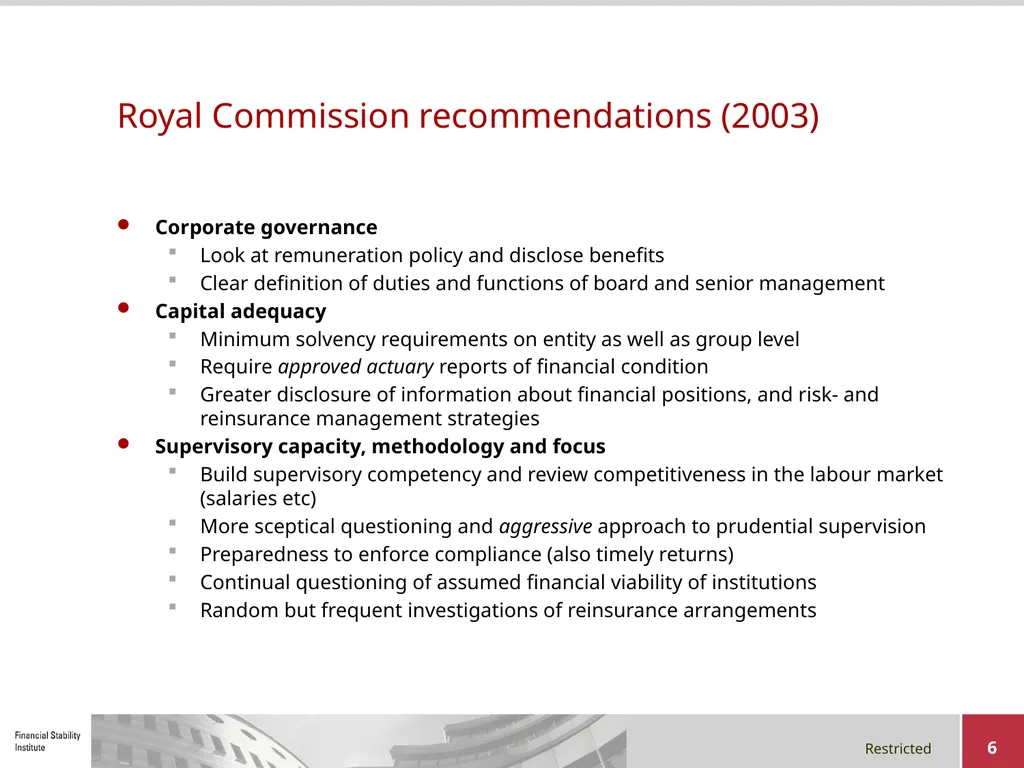
6 Royal Commission recommendations (2003) Corporate governance
Look at remuneration policy and disclose benefits
Clear definition of duties and functions of board and senior management
Capital adequacy
Minimum solvency requirements on entity as well as group level
Require approved actuary reports of financial condition
Greater disclosure of information about financial positions, and risk- and reinsurance management strategies
Supervisory capacity, methodology and focus
Build supervisory competency and review competitiveness in the labour market (salaries etc)
More sceptical questioning and aggressive approach to prudential supervision
Preparedness to enforce compliance (also timely returns)
Continual questioning of assumed financial viability of institutions
Random but frequent investigations of reinsurance arrangements<br>
Look at remuneration policy and disclose benefits
Clear definition of duties and functions of board and senior management
Capital adequacy
Minimum solvency requirements on entity as well as group level
Require approved actuary reports of financial condition
Greater disclosure of information about financial positions, and risk- and reinsurance management strategies
Supervisory capacity, methodology and focus
Build supervisory competency and review competitiveness in the labour market (salaries etc)
More sceptical questioning and aggressive approach to prudential supervision
Preparedness to enforce compliance (also timely returns)
Continual questioning of assumed financial viability of institutions
Random but frequent investigations of reinsurance arrangements<br>
07
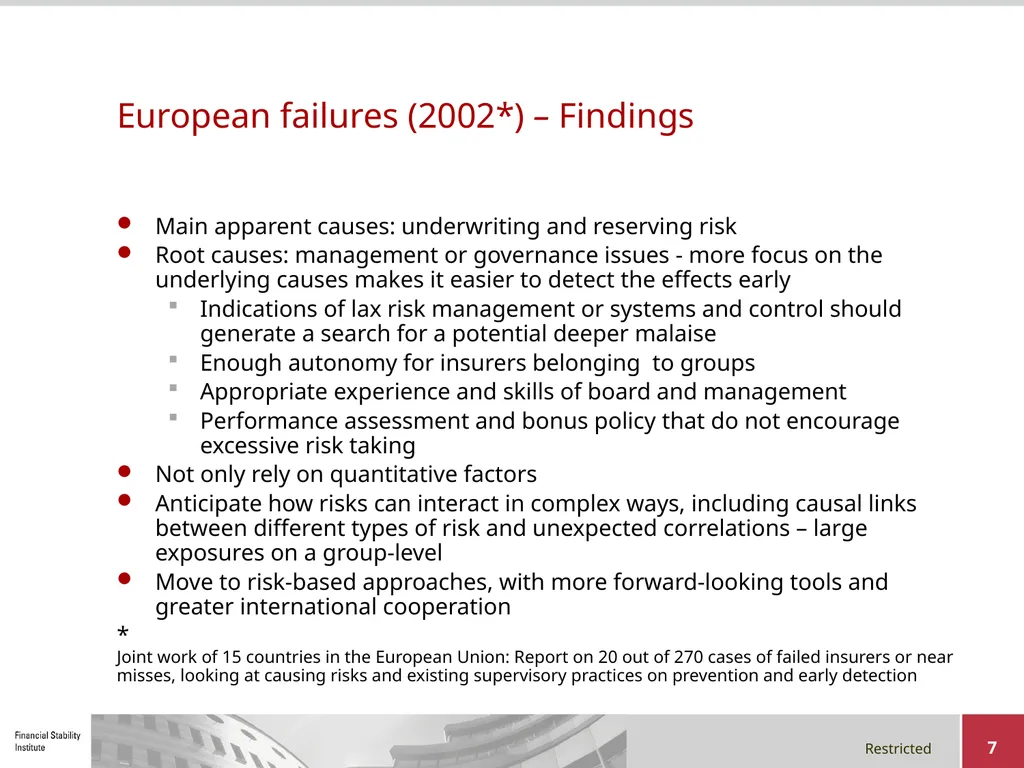
7 European failures (2002*) – Findings Main apparent causes: underwriting and reserving risk
Root causes: management or governance issues - more focus on the underlying causes makes it easier to detect the effects early
Indications of lax risk management or systems and control should generate a search for a potential deeper malaise
Enough autonomy for insurers belonging to groups
Appropriate experience and skills of board and management
Performance assessment and bonus policy that do not encourage excessive risk taking
Not only rely on quantitative factors
Anticipate how risks can interact in complex ways, including causal links between different types of risk and unexpected correlations – large exposures on a group-level
Move to risk-based approaches, with more forward-looking tools and greater international cooperation
* Joint work of 15 countries in the European Union: Report on 20 out of 270 cases of failed insurers or near misses, looking at causing risks and existing supervisory practices on prevention and early detection<br>
Root causes: management or governance issues - more focus on the underlying causes makes it easier to detect the effects early
Indications of lax risk management or systems and control should generate a search for a potential deeper malaise
Enough autonomy for insurers belonging to groups
Appropriate experience and skills of board and management
Performance assessment and bonus policy that do not encourage excessive risk taking
Not only rely on quantitative factors
Anticipate how risks can interact in complex ways, including causal links between different types of risk and unexpected correlations – large exposures on a group-level
Move to risk-based approaches, with more forward-looking tools and greater international cooperation
* Joint work of 15 countries in the European Union: Report on 20 out of 270 cases of failed insurers or near misses, looking at causing risks and existing supervisory practices on prevention and early detection<br>
08
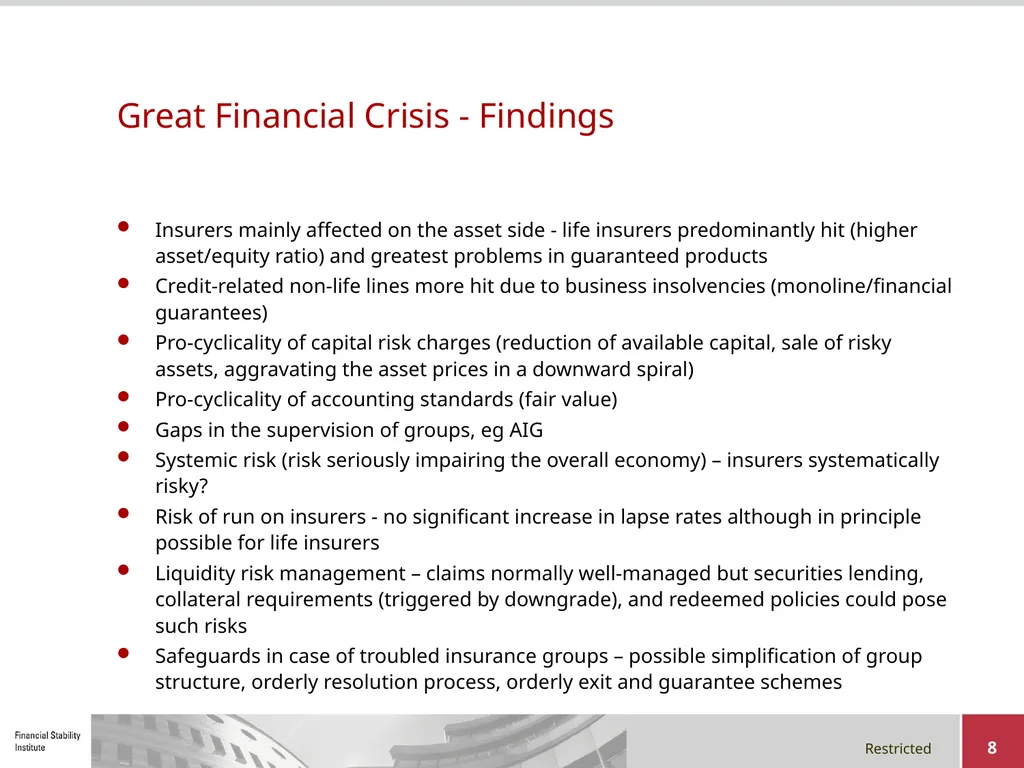
8 Great Financial Crisis - Findings Insurers mainly affected on the asset side - life insurers predominantly hit (higher asset/equity ratio) and greatest problems in guaranteed products
Credit-related non-life lines more hit due to business insolvencies (monoline/financial guarantees)
Pro-cyclicality of capital risk charges (reduction of available capital, sale of risky assets, aggravating the asset prices in a downward spiral)
Pro-cyclicality of accounting standards (fair value)
Gaps in the supervision of groups, eg AIG
Systemic risk (risk seriously impairing the overall economy) – insurers systematically risky?
Risk of run on insurers - no significant increase in lapse rates although in principle possible for life insurers
Liquidity risk management – claims normally well-managed but securities lending, collateral requirements (triggered by downgrade), and redeemed policies could pose such risks
Safeguards in case of troubled insurance groups – possible simplification of group structure, orderly resolution process, orderly exit and guarantee schemes<br>
Credit-related non-life lines more hit due to business insolvencies (monoline/financial guarantees)
Pro-cyclicality of capital risk charges (reduction of available capital, sale of risky assets, aggravating the asset prices in a downward spiral)
Pro-cyclicality of accounting standards (fair value)
Gaps in the supervision of groups, eg AIG
Systemic risk (risk seriously impairing the overall economy) – insurers systematically risky?
Risk of run on insurers - no significant increase in lapse rates although in principle possible for life insurers
Liquidity risk management – claims normally well-managed but securities lending, collateral requirements (triggered by downgrade), and redeemed policies could pose such risks
Safeguards in case of troubled insurance groups – possible simplification of group structure, orderly resolution process, orderly exit and guarantee schemes<br>
09
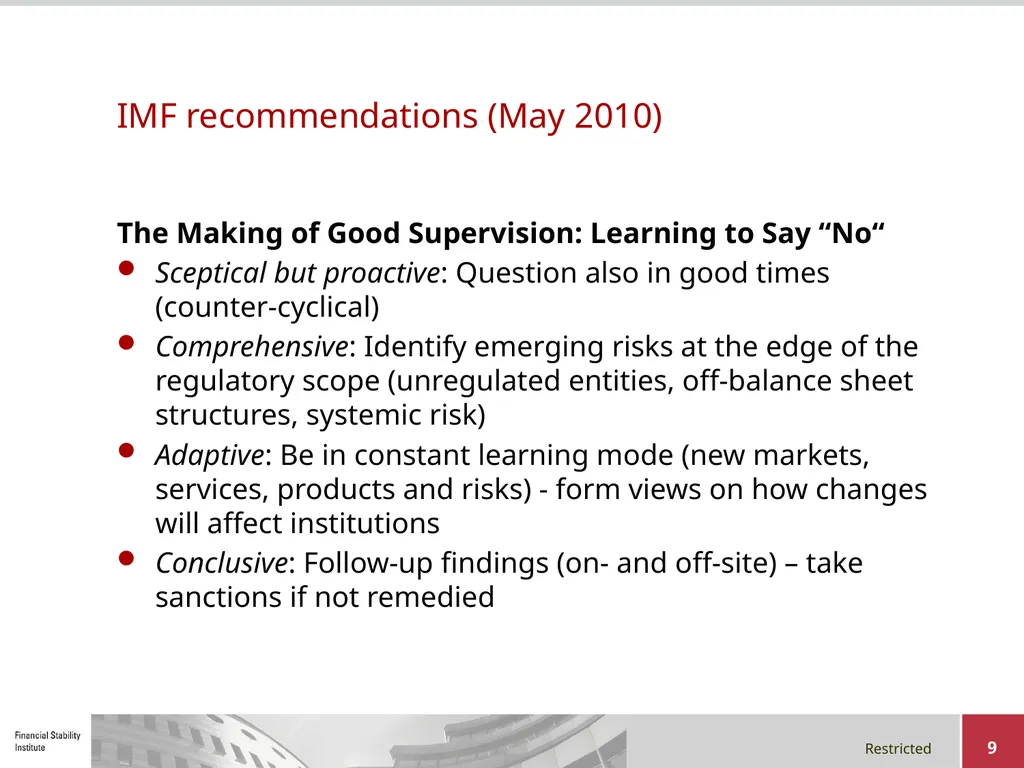
9 IMF recommendations (May 2010) The Making of Good Supervision: Learning to Say “No“
Sceptical but proactive: Question also in good times (counter-cyclical)
Comprehensive: Identify emerging risks at the edge of the regulatory scope (unregulated entities, off-balance sheet structures, systemic risk)
Adaptive: Be in constant learning mode (new markets, services, products and risks) - form views on how changes will affect institutions
Conclusive: Follow-up findings (on- and off-site) – take sanctions if not remedied<br>
Sceptical but proactive: Question also in good times (counter-cyclical)
Comprehensive: Identify emerging risks at the edge of the regulatory scope (unregulated entities, off-balance sheet structures, systemic risk)
Adaptive: Be in constant learning mode (new markets, services, products and risks) - form views on how changes will affect institutions
Conclusive: Follow-up findings (on- and off-site) – take sanctions if not remedied<br>
10
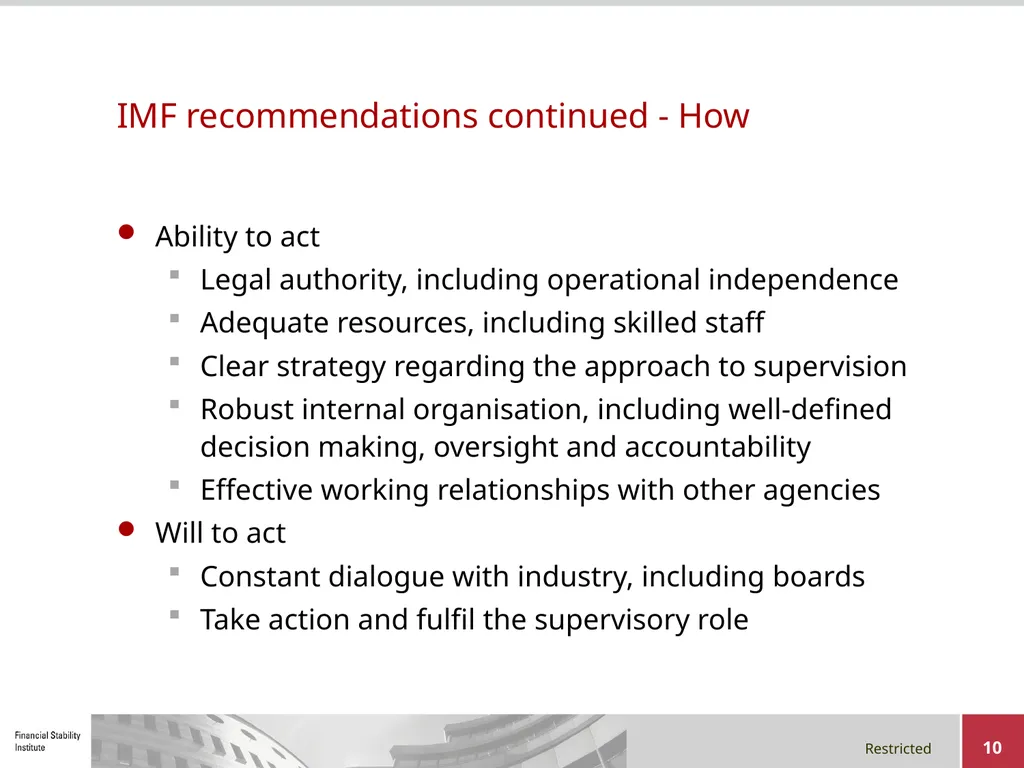
10 IMF recommendations continued - How Ability to act
Legal authority, including operational independence
Adequate resources, including skilled staff
Clear strategy regarding the approach to supervision
Robust internal organisation, including well-defined decision making, oversight and accountability
Effective working relationships with other agencies
Will to act
Constant dialogue with industry, including boards
Take action and fulfil the supervisory role<br>
Legal authority, including operational independence
Adequate resources, including skilled staff
Clear strategy regarding the approach to supervision
Robust internal organisation, including well-defined decision making, oversight and accountability
Effective working relationships with other agencies
Will to act
Constant dialogue with industry, including boards
Take action and fulfil the supervisory role<br>
11
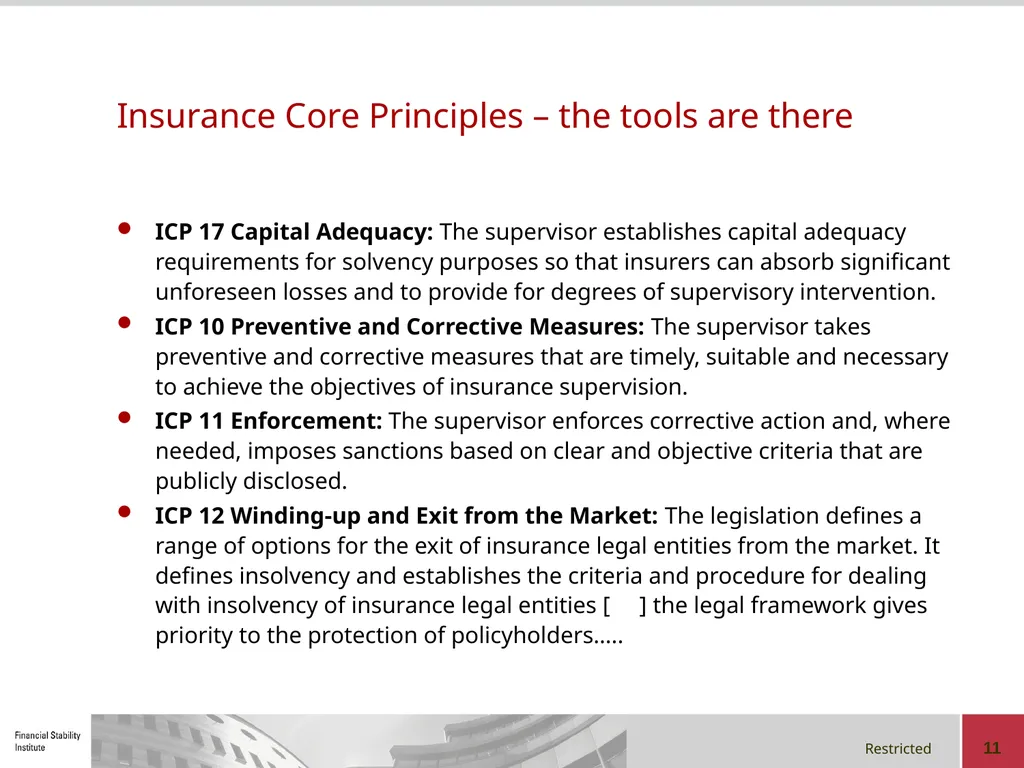
11 Insurance Core Principles – the tools are there ICP 17 Capital Adequacy: The supervisor establishes capital adequacy requirements for solvency purposes so that insurers can absorb significant unforeseen losses and to provide for degrees of supervisory intervention.
ICP 10 Preventive and Corrective Measures: The supervisor takes preventive and corrective measures that are timely, suitable and necessary to achieve the objectives of insurance supervision.
ICP 11 Enforcement: The supervisor enforces corrective action and, where needed, imposes sanctions based on clear and objective criteria that are publicly disclosed.
ICP 12 Winding-up and Exit from the Market: The legislation defines a range of options for the exit of insurance legal entities from the market. It defines insolvency and establishes the criteria and procedure for dealing with insolvency of insurance legal entities [ ] the legal framework gives priority to the protection of policyholders…..<br>
ICP 10 Preventive and Corrective Measures: The supervisor takes preventive and corrective measures that are timely, suitable and necessary to achieve the objectives of insurance supervision.
ICP 11 Enforcement: The supervisor enforces corrective action and, where needed, imposes sanctions based on clear and objective criteria that are publicly disclosed.
ICP 12 Winding-up and Exit from the Market: The legislation defines a range of options for the exit of insurance legal entities from the market. It defines insolvency and establishes the criteria and procedure for dealing with insolvency of insurance legal entities [ ] the legal framework gives priority to the protection of policyholders…..<br>
12
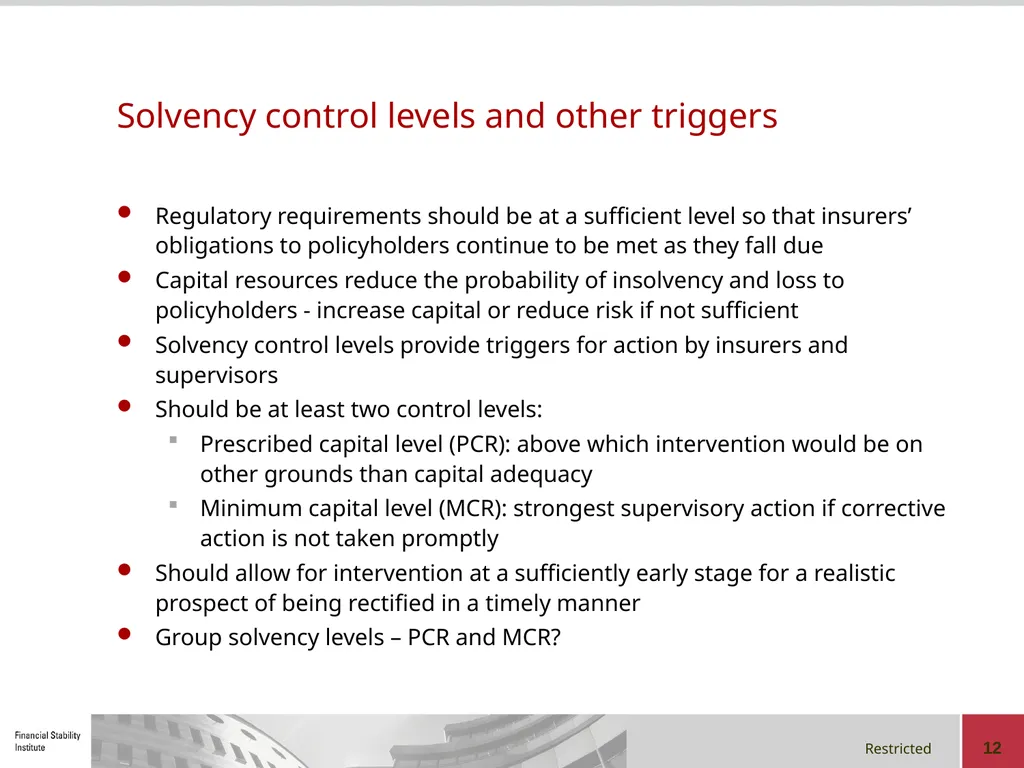
12 Solvency control levels and other triggers Regulatory requirements should be at a sufficient level so that insurers’ obligations to policyholders continue to be met as they fall due
Capital resources reduce the probability of insolvency and loss to policyholders - increase capital or reduce risk if not sufficient
Solvency control levels provide triggers for action by insurers and supervisors
Should be at least two control levels:
Prescribed capital level (PCR): above which intervention would be on other grounds than capital adequacy
Minimum capital level (MCR): strongest supervisory action if corrective action is not taken promptly
Should allow for intervention at a sufficiently early stage for a realistic prospect of being rectified in a timely manner
Group solvency levels – PCR and MCR?<br>
Capital resources reduce the probability of insolvency and loss to policyholders - increase capital or reduce risk if not sufficient
Solvency control levels provide triggers for action by insurers and supervisors
Should be at least two control levels:
Prescribed capital level (PCR): above which intervention would be on other grounds than capital adequacy
Minimum capital level (MCR): strongest supervisory action if corrective action is not taken promptly
Should allow for intervention at a sufficiently early stage for a realistic prospect of being rectified in a timely manner
Group solvency levels – PCR and MCR?<br>
13
13 Early-warning indicators Capital is not everything – have a range of early-warning indicators, both quantitative and qualitative that should trigger action
Examples of indicators?
How could they be identified?<br>
Examples of indicators?
How could they be identified?<br>
14
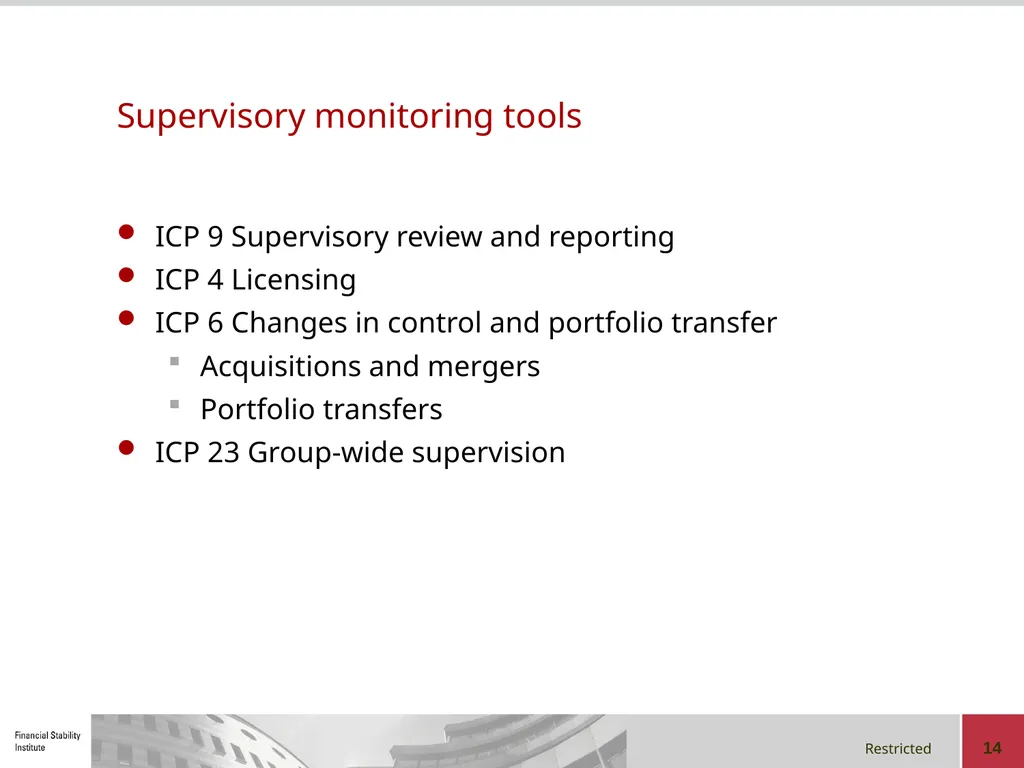
14 Supervisory monitoring tools ICP 9 Supervisory review and reporting
ICP 4 Licensing
ICP 6 Changes in control and portfolio transfer
Acquisitions and mergers
Portfolio transfers
ICP 23 Group-wide supervision<br>
ICP 4 Licensing
ICP 6 Changes in control and portfolio transfer
Acquisitions and mergers
Portfolio transfers
ICP 23 Group-wide supervision<br>
15
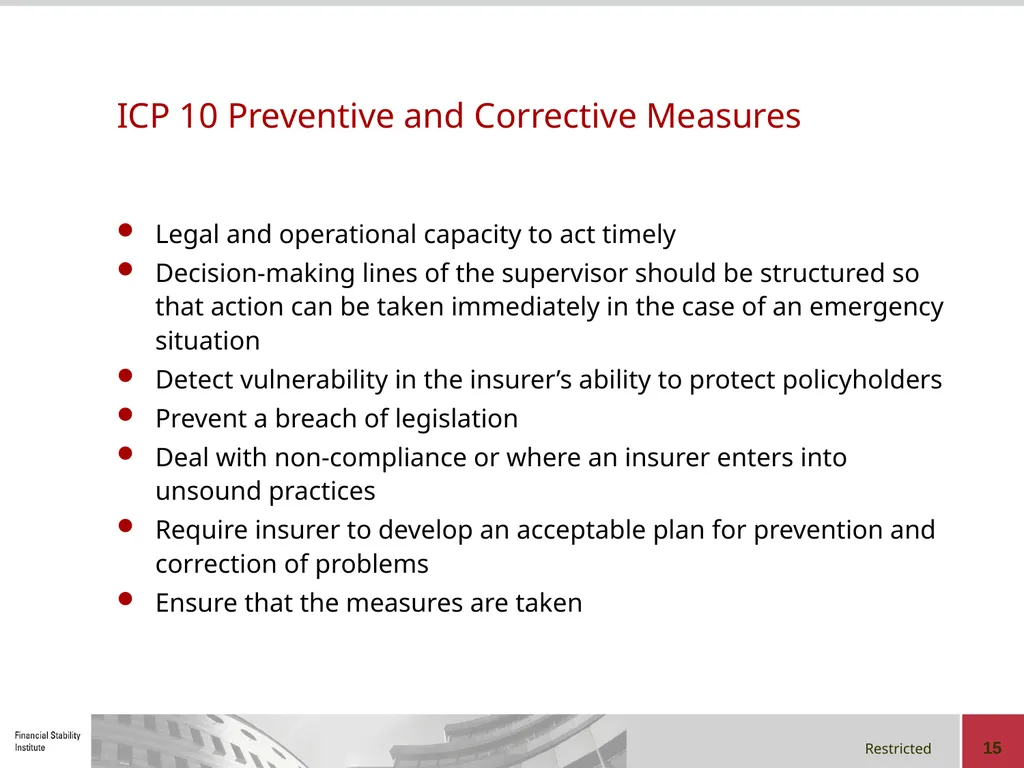
15 ICP 10 Preventive and Corrective Measures Legal and operational capacity to act timely
Decision-making lines of the supervisor should be structured so that action can be taken immediately in the case of an emergency situation
Detect vulnerability in the insurer’s ability to protect policyholders
Prevent a breach of legislation
Deal with non-compliance or where an insurer enters into unsound practices
Require insurer to develop an acceptable plan for prevention and correction of problems
Ensure that the measures are taken<br>
Decision-making lines of the supervisor should be structured so that action can be taken immediately in the case of an emergency situation
Detect vulnerability in the insurer’s ability to protect policyholders
Prevent a breach of legislation
Deal with non-compliance or where an insurer enters into unsound practices
Require insurer to develop an acceptable plan for prevention and correction of problems
Ensure that the measures are taken<br>
16
16 Early prevention and detection tools Activities subject to prior approval
Continual fit and proper requirements
Requirements of sound corporate governance, internal control and risk management
Prospective reporting and analysis
Business plan and strategy for new business
Established contacts with other involved supervisors
Informal contacts with management
Public disclosure/transparency<br>
Continual fit and proper requirements
Requirements of sound corporate governance, internal control and risk management
Prospective reporting and analysis
Business plan and strategy for new business
Established contacts with other involved supervisors
Informal contacts with management
Public disclosure/transparency<br>
17
17 Preventive and corrective supervisory measures Increased supervisory activity or reporting
Independent review by auditors or actuaries
Correction of reporting errors
Capital and business plan for restoration of capital resources
Measures to reduce risk (eg reinsurance)
Strengthen or replace the insurer’s management and/or risk management framework and governance<br>
Independent review by auditors or actuaries
Correction of reporting errors
Capital and business plan for restoration of capital resources
Measures to reduce risk (eg reinsurance)
Strengthen or replace the insurer’s management and/or risk management framework and governance<br>
18
18 ICP 11 Enforcement Formal directions to take (or desist) actions - failure to comply should have serious consequences (combine with fines and punitive actions)
Should at a minimum include
Restrictions on business activities
Measures to reinforce the financial position of the insurer
Consequences when failing to provide information in a timely fashion, withhold information or provide information that is intended to mislead
Should not delay necessary preventive or corrective measures to be taken
Powerful supervisory tools that should be used in a fair and equal manner
Not sufficient to have powers delegated under legislation (powerful tools are only powerful if used) – will to act
Issues related to groups?
Determine that the insurer is complying with the measures once action has been taken or measures have been imposed<br>
Should at a minimum include
Restrictions on business activities
Measures to reinforce the financial position of the insurer
Consequences when failing to provide information in a timely fashion, withhold information or provide information that is intended to mislead
Should not delay necessary preventive or corrective measures to be taken
Powerful supervisory tools that should be used in a fair and equal manner
Not sufficient to have powers delegated under legislation (powerful tools are only powerful if used) – will to act
Issues related to groups?
Determine that the insurer is complying with the measures once action has been taken or measures have been imposed<br>
19
19 Enforcement or sanction measures Restrict business activities
Stop the writing of new business
Withhold approval for new activities or acquisitions
Restrict the transfer of assets
Directions to reinforce financial position
Require capital levels to be increased or measures that reduce or mitigate risks
Restrict disposal of insurer’s assets
Restrict/suspend dividend or other payments to shareholders
Remove directors and managers - bar individuals from acting in responsible capacities in the future
Compulsory portfolio transfer or conservatorship
Revoke the licence – require the company to wind-up
Direct a company to stop unlicensed business<br>
Stop the writing of new business
Withhold approval for new activities or acquisitions
Restrict the transfer of assets
Directions to reinforce financial position
Require capital levels to be increased or measures that reduce or mitigate risks
Restrict disposal of insurer’s assets
Restrict/suspend dividend or other payments to shareholders
Remove directors and managers - bar individuals from acting in responsible capacities in the future
Compulsory portfolio transfer or conservatorship
Revoke the licence – require the company to wind-up
Direct a company to stop unlicensed business<br>
20
20 Resolution and G-SIIs Define insolvency and the limit when it is no longer permissible to continue business
Resolution could be used for cross-border groups before that point is reached – should be used for G-SIIs, which need to be resolvable
Orderly resolution requires appropriate actions prior to the non-viability stage – on-going cooperation and information sharing
Normal resolution tools that can be used on all insurers (enough for G-SIIs?):
Portfolio transfer
Run off
Establish resolution authorities and cross-border management groups (CMGs) – top level or resolution powers in more than one part of the group
Appropriate powers to intervene at holding company level
Powers to terminate large volumes of financial contracts – insurance policies?
Ensure continuation of non-insurance operational business that is significant to the systemic function
Temporary public financial support may be needed<br>
Resolution could be used for cross-border groups before that point is reached – should be used for G-SIIs, which need to be resolvable
Orderly resolution requires appropriate actions prior to the non-viability stage – on-going cooperation and information sharing
Normal resolution tools that can be used on all insurers (enough for G-SIIs?):
Portfolio transfer
Run off
Establish resolution authorities and cross-border management groups (CMGs) – top level or resolution powers in more than one part of the group
Appropriate powers to intervene at holding company level
Powers to terminate large volumes of financial contracts – insurance policies?
Ensure continuation of non-insurance operational business that is significant to the systemic function
Temporary public financial support may be needed<br>
21
21 ICP 12 Winding-up and Exit from the Market Procedure for dealing with winding-up and insolvency
Appoint administrator or liquidator to take over the roles and duties of board and senior management
Run-off with supervisory involvement
Liquidation in court procedure
Protect the rights and entitlements of policyholders/beneficiaries in the event of insolvency
Protection scheme/guarantee fund
Preferential rights<br>
Appoint administrator or liquidator to take over the roles and duties of board and senior management
Run-off with supervisory involvement
Liquidation in court procedure
Protect the rights and entitlements of policyholders/beneficiaries in the event of insolvency
Protection scheme/guarantee fund
Preferential rights<br>
22
22 Conclusions Independence and resources
Comprehensive supervision, including group and macroprudential level
Early identification and intervention
Power and will to act using adequate tools<br>
Comprehensive supervision, including group and macroprudential level
Early identification and intervention
Power and will to act using adequate tools<br>