
EEO 101: REASONABLE ACCOMMODATIONS Presented by:
DP
Published · 40 slides · 0 views
1 / 1



Description
EEO 101: REASONABLE ACCOMMODATIONS Presented by: Jennifer Shaw, Esq. November 2, 2022 Jennifer Shaw Jennifer Shaw is the founder of Shaw Law Group. A well-respected expert in employment law for more than 25 years, employers rely on Jennifer
Related Topics
Download this presentation From Below
"EEO 101: REASONABLE ACCOMMODATIONS Presented by:" is the property of its rightful owner. Permission is granted to download and print the materials on this website for personal, non-commercial use only, and to display it on your personal computer provided you do not modify the materials and that you retain all copyright notices contained in the materials. By downloading content from our website, you accept the terms of this agreement.
Share
Embed code
Presentation Transcript
01
EEO 101:
REASONABLE ACCOMMODATIONS Presented by: Jennifer Shaw, Esq. November 2, 2022<br>
02
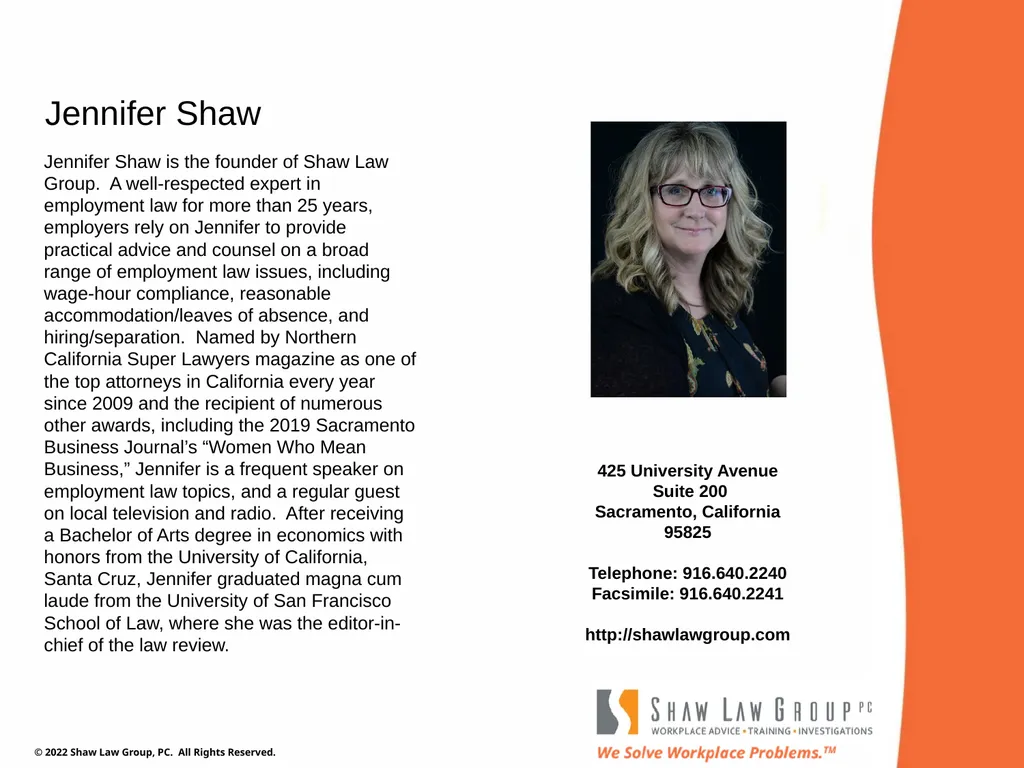
Jennifer Shaw Jennifer Shaw is the founder of Shaw Law Group. A well-respected expert in employment law for more than 25 years, employers rely on Jennifer to provide practical advice and counsel on a broad range of employment law issues, including wage-hour compliance, reasonable accommodation/leaves of absence, and hiring/separation. Named by Northern California Super Lawyers magazine as one of the top attorneys in California every year since 2009 and the recipient of numerous other awards, including the 2019 Sacramento Business Journal’s “Women Who Mean Business,” Jennifer is a frequent speaker on employment law topics, and a regular guest on local television and radio. After receiving a Bachelor of Arts degree in economics with honors from the University of California, Santa Cruz, Jennifer graduated magna cum laude from the University of San Francisco School of Law, where she was the editor-in-chief of the law review.<br>
03
The Disclaimer This program is intended to be a general overview, and should not be considered legal advice regarding your specific situation
Consult with your regular employment law counsel before making any changes to your practices<br>
Consult with your regular employment law counsel before making any changes to your practices<br>
04
An Overview of Reasonable Accommodations<br>
05
Key Disability Laws Americans With Disabilities Act
Fair Employment and Housing Act<br>
Fair Employment and Housing Act<br>
06
Who Is Protected? Individual who:
Have a physical or mental impairment that limits a major life activity; or
Have a “record” of such an impairment; or
Are “regarded” or “perceived” as having such an impairment or having a “perceived potential impairment”; or
Have a “relationship or association with” a person with a known impairment<br>
Have a physical or mental impairment that limits a major life activity; or
Have a “record” of such an impairment; or
Are “regarded” or “perceived” as having such an impairment or having a “perceived potential impairment”; or
Have a “relationship or association with” a person with a known impairment<br>
07
Who Is a “Qualified Individual With a Disability”? A qualified individual with a disability is an individual who, with or without reasonable accommodation, can perform the essential functions of the job in question
To be protected, individuals must be qualified to do their jobs<br>
To be protected, individuals must be qualified to do their jobs<br>
08
To Determine the “Essential Functions” of a Position Consider whether:
The position exists specifically to perform the function
There are a limited number of other employees available to perform the function, or among whom the function may be distributed
The function is highly specialized, and employee was hired for particular expertise and ability
Describe essential functions in duty statements/job descriptions, and reference in performance reviews<br>
The position exists specifically to perform the function
There are a limited number of other employees available to perform the function, or among whom the function may be distributed
The function is highly specialized, and employee was hired for particular expertise and ability
Describe essential functions in duty statements/job descriptions, and reference in performance reviews<br>
09
What Is a “Reasonable Accommodation”? “Modifications or adjustments that are…effective in enabling an employee to perform the essential functions of the job [or] to enjoy equivalent benefits and privileges of employment as are enjoyed by similarly situated employees without disabilities.”
(2 C.C.R. § 11065)<br>
(2 C.C.R. § 11065)<br>
10
The Elements of a Reasonable Accommodation Accommodations are only “reasonable” if:
They are medically necessary, as determined by a healthcare provider
Will be effective in enabling the individual to perform the essential functions of the job
They do not impose an undue hardship or burden on the employer<br>
They are medically necessary, as determined by a healthcare provider
Will be effective in enabling the individual to perform the essential functions of the job
They do not impose an undue hardship or burden on the employer<br>
11
The Basic Principles of Reasonable Accommodation The employer and employee must engage in a timely, good faith interactive process
Management must be pro-active in assessing the need for an accommodation
A reasonable accommodation is intended to reduce the barriers to employment and enable a qualified person with a disability to perform the essential functions of his/her position<br>
Management must be pro-active in assessing the need for an accommodation
A reasonable accommodation is intended to reduce the barriers to employment and enable a qualified person with a disability to perform the essential functions of his/her position<br>
12
What Triggers the Interactive Process Requirement? We know, reasonably should know, or learn that a reasonable accommodation may be required or requested (so, don’t wait for a leave request form), including at the conclusion of CFRA/FMLA leave, or when it learns of the need from third parties
An employee with a record of a disability may be entitled to reasonable accommodation related to the residual effects of the disability (e.g., follow-up treatment)<br>
An employee with a record of a disability may be entitled to reasonable accommodation related to the residual effects of the disability (e.g., follow-up treatment)<br>
13
What Triggers the Interactive Process Requirement? (cont.) Applicant or employee requests a reasonable accommodation, specifically or by reference to limitations in performing job functions (no “magic words” are required)
Management observes barriers or limitations to employee’s performance<br>
Management observes barriers or limitations to employee’s performance<br>
14
Who Chooses the Accommodation? The employer has ultimate discretion to choose between effective accommodations, but must consider all reasonable accommodations and employee’s preference
The employer may choose less expensive accommodation or one that is most appropriate from the employer’s perspective, so long as accommodation is effective
The employee may reject an effective accommodation, but then may be unable to perform the essential functions of the job<br>
The employer may choose less expensive accommodation or one that is most appropriate from the employer’s perspective, so long as accommodation is effective
The employee may reject an effective accommodation, but then may be unable to perform the essential functions of the job<br>
15
Examples of Reasonable Accommodations Allowing assistive animals (not just dogs)
Making facilities accessible (e.g., providing break rooms or reserved parking; acquiring or modifying furniture, etc.)
Restructuring a position to eliminate “marginal” functions
Modifying a work schedule
Adjusting or modifying examinations, training, policies, etc.
Acquiring assistive devices<br>
Making facilities accessible (e.g., providing break rooms or reserved parking; acquiring or modifying furniture, etc.)
Restructuring a position to eliminate “marginal” functions
Modifying a work schedule
Adjusting or modifying examinations, training, policies, etc.
Acquiring assistive devices<br>
16
Examples of Reasonable Accommodations (cont.) Providing qualified readers or interpreters
Temporary light/modified duty
Telecommuting
Transfer
Leaves of absence<br>
Temporary light/modified duty
Telecommuting
Transfer
Leaves of absence<br>
17
Resources for Identifying Potential Accommodations Equal Employment Opportunity Commission (www.eeoc.gov)
Job Accommodation Network (www.jan.wvu.edu)
Our policies and past practices/experiences with other employees
DFEH
Employee’s health care provider<br>
Job Accommodation Network (www.jan.wvu.edu)
Our policies and past practices/experiences with other employees
DFEH
Employee’s health care provider<br>
18
What Is “Undue Hardship”? Undue hardship means an action requiring significant difficulty or expense, when considered in light of the following factors:
The nature and cost of the accommodation
The overall financial resources of the employer
The type of operations, including the composition, structure, and functions of the workforce
Undue hardship must be assessed in each case (there is no blanket rule), only after engaging in the interactive process<br>
The nature and cost of the accommodation
The overall financial resources of the employer
The type of operations, including the composition, structure, and functions of the workforce
Undue hardship must be assessed in each case (there is no blanket rule), only after engaging in the interactive process<br>
19
What About the “Direct Threat” Exception? An employer is not required to accommodate employees who pose a “direct threat” at work
This exception only applies to situations in which there is direct medical evidence of the threat
There must be an “individualized, objective inquiry” based on the most recent medical knowledge
An employer may not raise health and safety as a defense without engaging in the interactive process<br>
This exception only applies to situations in which there is direct medical evidence of the threat
There must be an “individualized, objective inquiry” based on the most recent medical knowledge
An employer may not raise health and safety as a defense without engaging in the interactive process<br>
20
What About the “Direct Threat” Exception? (cont.) Employer need not rely on the information provided by employee’s healthcare provider, and may require employee to undergo a “fitness-for-duty” examination if “job-related and consistent with business necessity”
Employer may not raise direct threat as a defense without engaging in the interactive process<br>
Employer may not raise direct threat as a defense without engaging in the interactive process<br>
21
What Does Leave Have to Do With Reasonable Accommodation? Leave is one potential reasonable accommodation
It doesn’t matter if employee has already taken FMLA/CFRA leave (but always consider statutory leave before granting leave as an accommodation)<br>
It doesn’t matter if employee has already taken FMLA/CFRA leave (but always consider statutory leave before granting leave as an accommodation)<br>
22
Leave as a Reasonable Accommodation “When the employee cannot presently perform the essential functions of the job, or otherwise needs time away from the job for treatment and recovery, holding a job open for an employee on a leave of absence or extending a leave provided by the CFRA, the FMLA, other leave laws, or an employer’s leave plan may be a reasonable accommodation provided that the leave is likely to be effective in allowing the employee to return to work at the end of the leave, with or without further reasonable accommodation, and does not create an undue hardship for the employer.”
(2 C.C.R. § 11068)<br>
(2 C.C.R. § 11068)<br>
23
Leave as a Reasonable Accommodation (cont.) “An employer, however, is not required to provide an indefinite leave of absence as a reasonable accommodation.” (2 C.C.R. § 11068)
The leave must be “effective” at returning employee to work (with or without additional accommodations)
Employer may not require employee to take leave when employee can continue working with an alternative accommodation<br>
The leave must be “effective” at returning employee to work (with or without additional accommodations)
Employer may not require employee to take leave when employee can continue working with an alternative accommodation<br>
24
Leave as a Reasonable Accommodation (cont.) Must evaluate on a case-by-case analysis
Leave “caps” are unlawful<br>
Leave “caps” are unlawful<br>
25
Available Wage Replacement Benefits During Leave Employer-provided paid time off
Employer may require or employee may elect to use
If employee receives other wage replacement benefits, do not require use of time off
California Healthy Workplaces, Healthy Families Act sick leave (“PSL”)
Never require employees to use PSL<br>
Employer may require or employee may elect to use
If employee receives other wage replacement benefits, do not require use of time off
California Healthy Workplaces, Healthy Families Act sick leave (“PSL”)
Never require employees to use PSL<br>
26
Available Wage Replacement Benefits During Leave (cont.) Workers’ compensation benefits
State Disability Insurance (“SDI”)/ Nonindustrial Disability Insurance (“NDI”) (don’t forget to coordinate!)<br>
State Disability Insurance (“SDI”)/ Nonindustrial Disability Insurance (“NDI”) (don’t forget to coordinate!)<br>
27
The Administration Process<br>
28
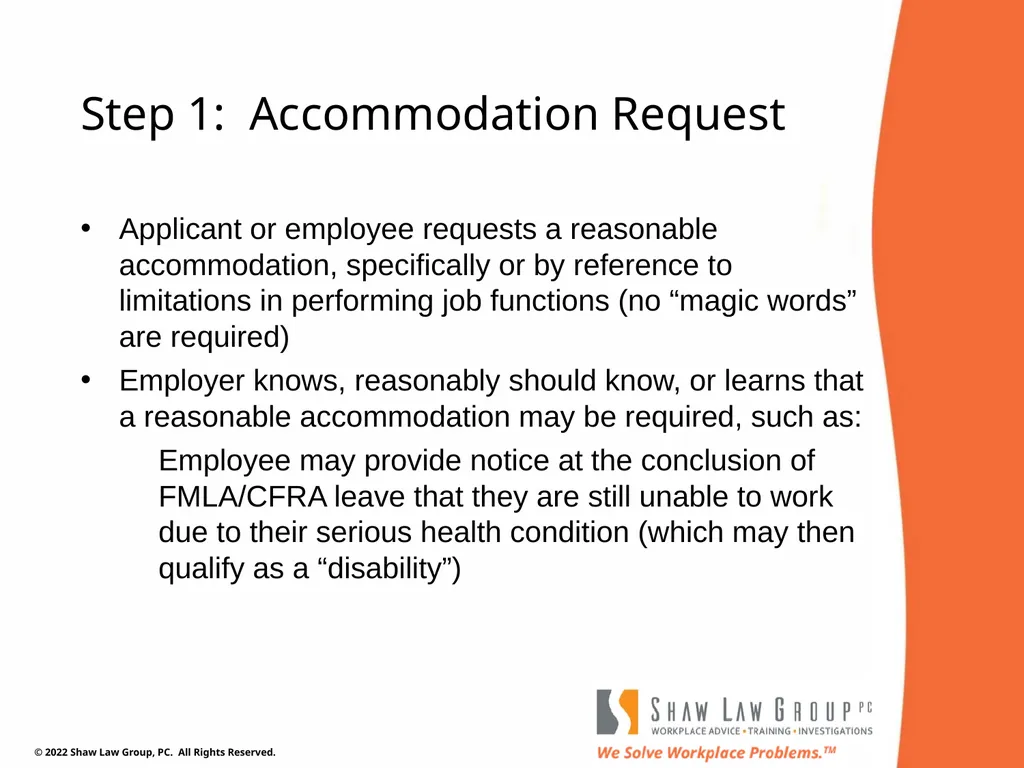
Step 1: Accommodation Request Applicant or employee requests a reasonable accommodation, specifically or by reference to limitations in performing job functions (no “magic words” are required)
Employer knows, reasonably should know, or learns that a reasonable accommodation may be required, such as:
Employee may provide notice at the conclusion of FMLA/CFRA leave that they are still unable to work due to their serious health condition (which may then qualify as a “disability”)<br>
Employer knows, reasonably should know, or learns that a reasonable accommodation may be required, such as:
Employee may provide notice at the conclusion of FMLA/CFRA leave that they are still unable to work due to their serious health condition (which may then qualify as a “disability”)<br>
29
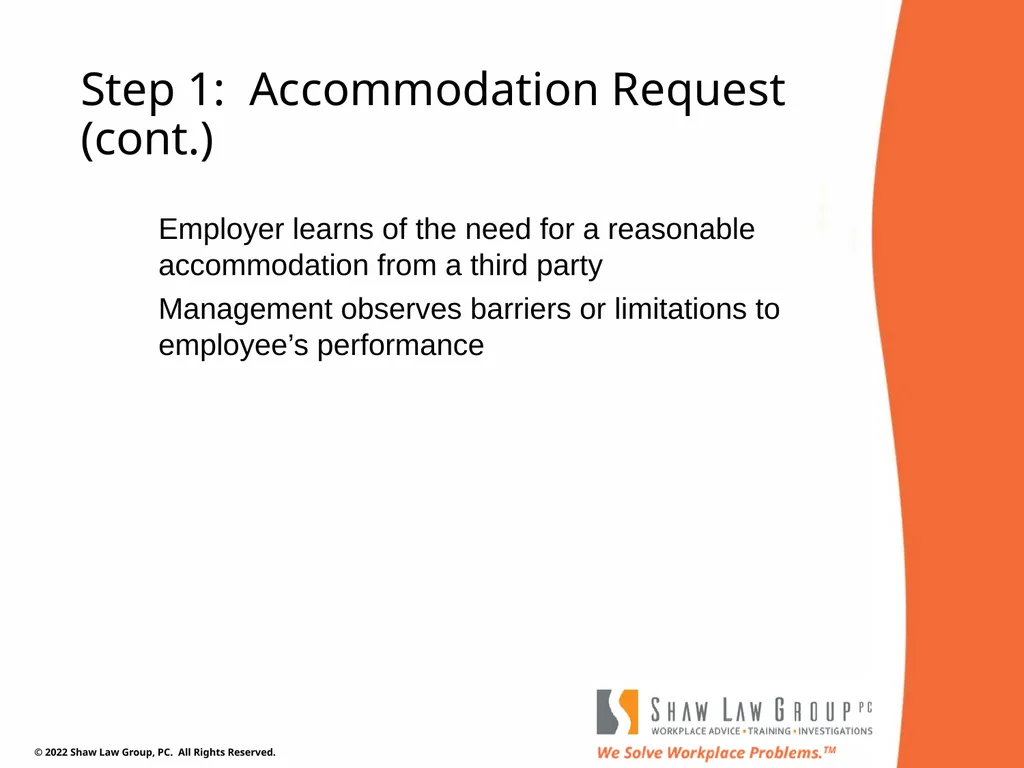
Step 1: Accommodation Request (cont.) Employer learns of the need for a reasonable accommodation from a third party
Management observes barriers or limitations to employee’s performance<br>
Management observes barriers or limitations to employee’s performance<br>
30
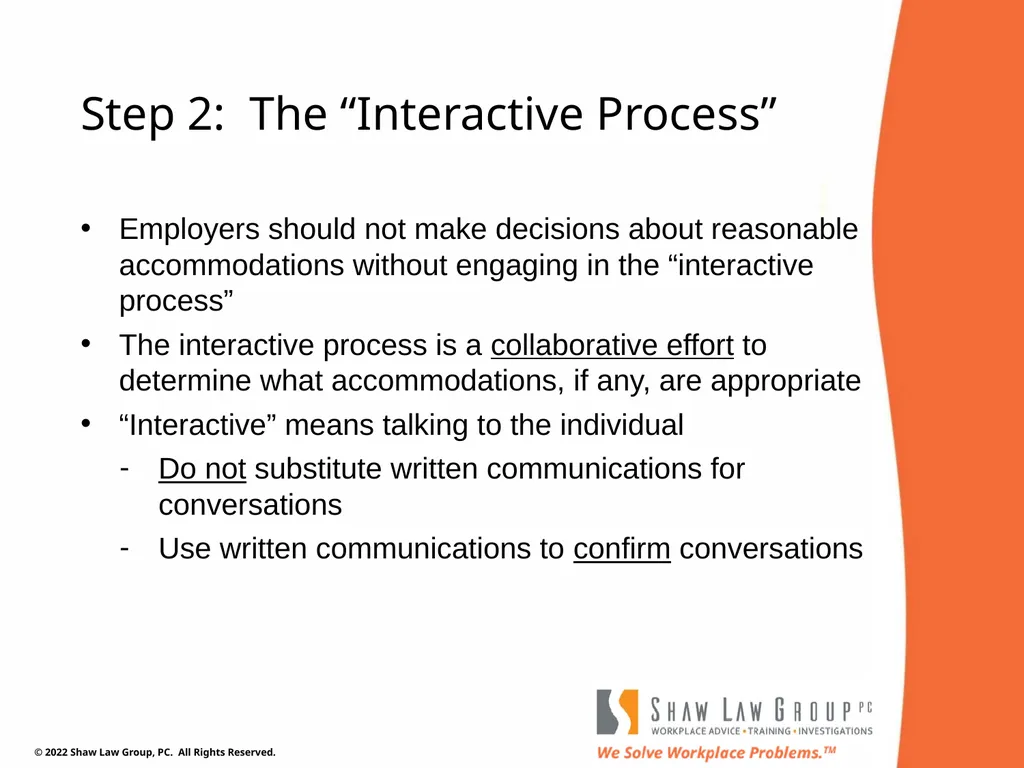
Step 2: The “Interactive Process” Employers should not make decisions about reasonable accommodations without engaging in the “interactive process”
The interactive process is a collaborative effort to determine what accommodations, if any, are appropriate
“Interactive” means talking to the individual
Do not substitute written communications for conversations
Use written communications to confirm conversations<br>
The interactive process is a collaborative effort to determine what accommodations, if any, are appropriate
“Interactive” means talking to the individual
Do not substitute written communications for conversations
Use written communications to confirm conversations<br>
31
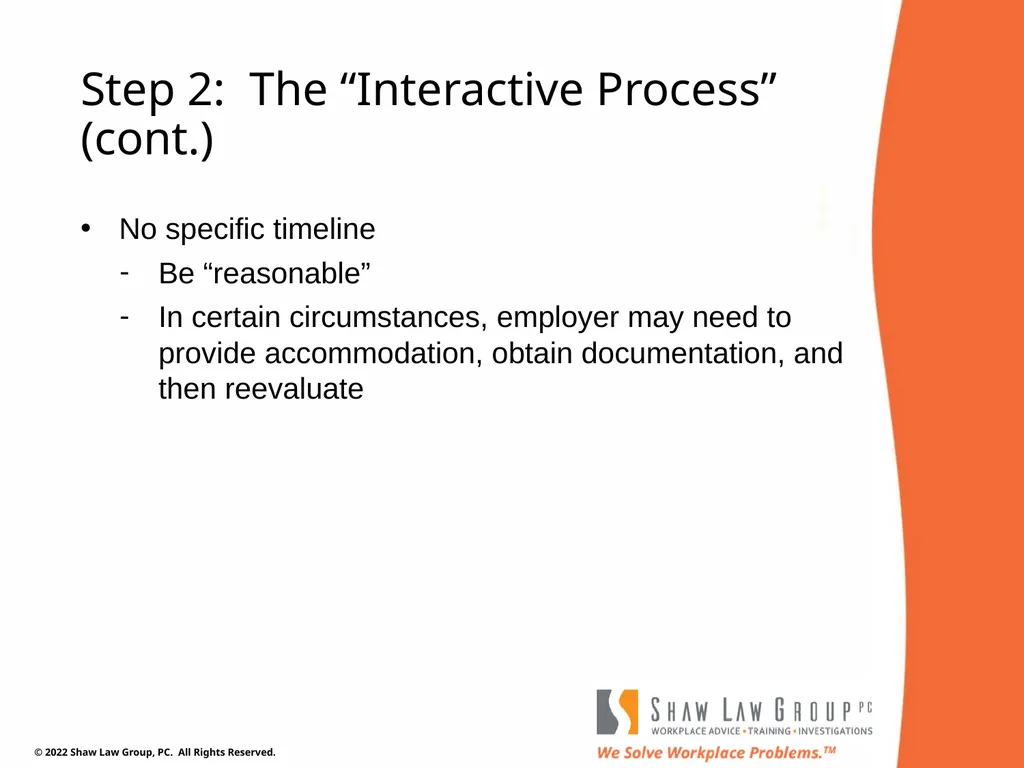
Step 2: The “Interactive Process” (cont.) No specific timeline
Be “reasonable”
In certain circumstances, employer may need to provide accommodation, obtain documentation, and then reevaluate<br>
Be “reasonable”
In certain circumstances, employer may need to provide accommodation, obtain documentation, and then reevaluate<br>
32
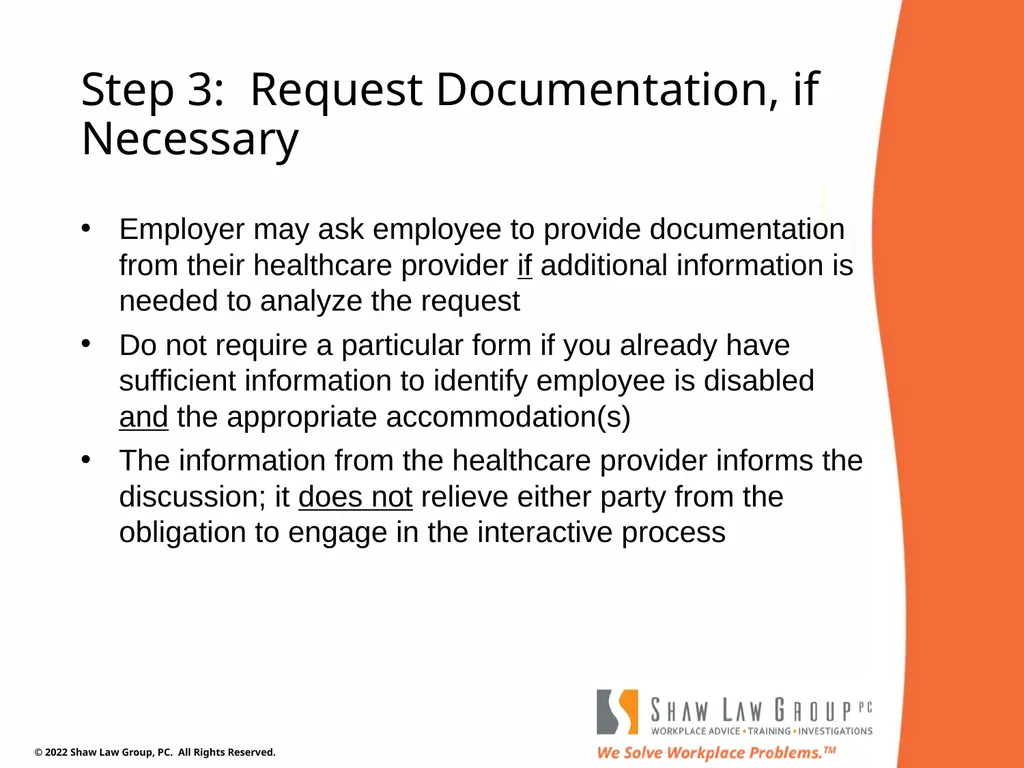
Step 3: Request Documentation, if Necessary Employer may ask employee to provide documentation from their healthcare provider if additional information is needed to analyze the request
Do not require a particular form if you already have sufficient information to identify employee is disabled and the appropriate accommodation(s)
The information from the healthcare provider informs the discussion; it does not relieve either party from the obligation to engage in the interactive process<br>
Do not require a particular form if you already have sufficient information to identify employee is disabled and the appropriate accommodation(s)
The information from the healthcare provider informs the discussion; it does not relieve either party from the obligation to engage in the interactive process<br>
33
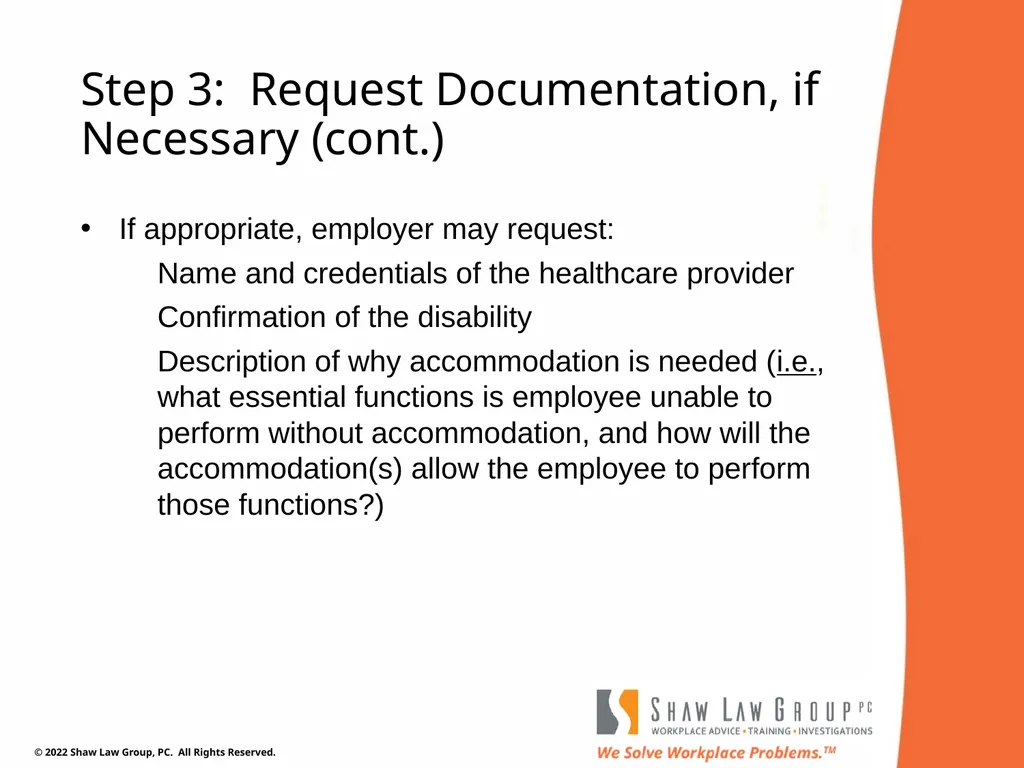
Step 3: Request Documentation, if Necessary (cont.) If appropriate, employer may request:
Name and credentials of the healthcare provider
Confirmation of the disability
Description of why accommodation is needed (i.e., what essential functions is employee unable to perform without accommodation, and how will the accommodation(s) allow the employee to perform those functions?)<br>
Name and credentials of the healthcare provider
Confirmation of the disability
Description of why accommodation is needed (i.e., what essential functions is employee unable to perform without accommodation, and how will the accommodation(s) allow the employee to perform those functions?)<br>
34
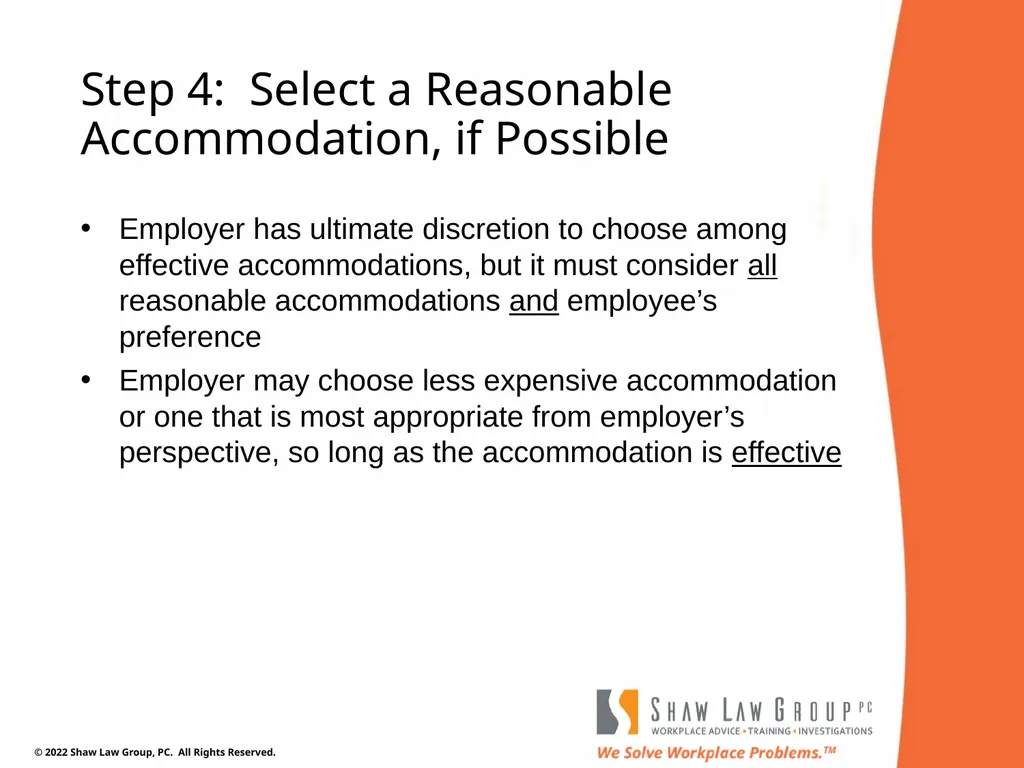
Step 4: Select a Reasonable Accommodation, if Possible Employer has ultimate discretion to choose among effective accommodations, but it must consider all reasonable accommodations and employee’s preference
Employer may choose less expensive accommodation or one that is most appropriate from employer’s perspective, so long as the accommodation is effective<br>
Employer may choose less expensive accommodation or one that is most appropriate from employer’s perspective, so long as the accommodation is effective<br>
35
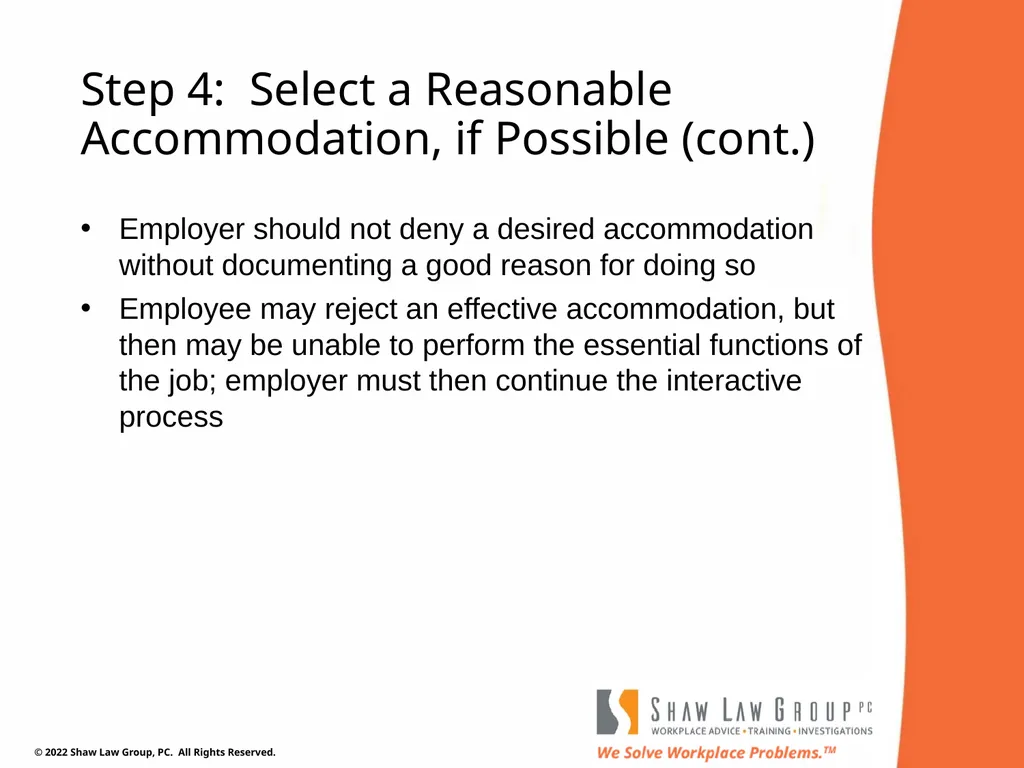
Step 4: Select a Reasonable Accommodation, if Possible (cont.) Employer should not deny a desired accommodation without documenting a good reason for doing so
Employee may reject an effective accommodation, but then may be unable to perform the essential functions of the job; employer must then continue the interactive process<br>
Employee may reject an effective accommodation, but then may be unable to perform the essential functions of the job; employer must then continue the interactive process<br>
36
The Most Important Thing to Remember… Treat the applicant of employee like they are your favorite person in the world
Do not allow anyone’s personal feelings about the applicant or employee cloud your judgment about what constitutes a reasonable accommodation<br>
Do not allow anyone’s personal feelings about the applicant or employee cloud your judgment about what constitutes a reasonable accommodation<br>
37
“Workplace Wake-Up With Jen” Podcast Join us for a new episode every Wednesday morning
Listen, subscribe, and comment where you get your podcasts<br>
Listen, subscribe, and comment where you get your podcasts<br>
38
2022 Upcoming Webinars The California Privacy Rights Act: Navigating Your Obligations in 2023
November 16
Annual Employment Law Update (2023)
December 1
December 13
January 10, 2023
Sexual Harassment Prevention and Other EEO Issues
(AB 1825/SB 1343 Compliance Training for “Supervisors”/All Employees)
December 8
Sexual Harassment Prevention and Other EEO Issues (SB 1343 Compliance Training for Staff)
December 6<br>
November 16
Annual Employment Law Update (2023)
December 1
December 13
January 10, 2023
Sexual Harassment Prevention and Other EEO Issues
(AB 1825/SB 1343 Compliance Training for “Supervisors”/All Employees)
December 8
Sexual Harassment Prevention and Other EEO Issues (SB 1343 Compliance Training for Staff)
December 6<br>
39
Our Partnership with California Civil Rights Department (formerly DFEH) “Workplace Insights with Shaw Law and the CRD!”
Every month, Erika and Rashida Harmon, Senior Counsel of the CRD’s Outreach and Education Unit, cover a key employment law topic and answer your questions! Topics TBA as developments dictate.
Check out dates and topics here:
https://shawlawgroup.com/employment-law-training-calendar/<br>
Every month, Erika and Rashida Harmon, Senior Counsel of the CRD’s Outreach and Education Unit, cover a key employment law topic and answer your questions! Topics TBA as developments dictate.
Check out dates and topics here:
https://shawlawgroup.com/employment-law-training-calendar/<br>
40
Thank You! 425 University Ave, Suite 200
Sacramento, California 95825
Telephone: 916.640.2240
Facsimile: 916.640.2241
Email: info@shawlawgroup.com
Website: http://shawlawgroup.com<br>
Sacramento, California 95825
Telephone: 916.640.2240
Facsimile: 916.640.2241
Email: info@shawlawgroup.com
Website: http://shawlawgroup.com<br>