
Eicosanoids (Prostaglandins, Leukotrienes) and
T
Published · 31 slides · 0 views

1 / 1




Description
Eicosanoids (Prostaglandins, Leukotrienes) and Platelet Activating Factor SUHAS AGEY Asst professor, Dept of Pharmacology Hrpiper, Shirpur Contents Introduction Chemistry, biosynthesis COX pathways Prostaglandins Classification Pcological
Related Topics
Share
Embed code
Download this presentation From Below
"Eicosanoids (Prostaglandins, Leukotrienes) and" is the property of its rightful owner. Permission is granted to download and print the materials on this website for personal, non-commercial use only, and to display it on your personal computer provided you do not modify the materials and that you retain all copyright notices contained in the materials. By downloading content from our website, you accept the terms of this agreement.
Presentation Transcript
01
Eicosanoids
(Prostaglandins, Leukotrienes) and Platelet Activating Factor SUHAS AGEY
Asst professor,
Dept of Pharmacology
Hrpiper, Shirpur<br>
Asst professor,
Dept of Pharmacology
Hrpiper, Shirpur<br>
02
Contents Introduction
Chemistry, biosynthesis
COX pathways
Prostaglandins
Classification
P’cological and patho. role
T. Uses Leukotrienes
Lipoxygenase pathway
P. and P. role
LT antagonists
Platelets activating factors
Synthesis and degradation
Pharmacological Action
PAF antagonists<br>
Chemistry, biosynthesis
COX pathways
Prostaglandins
Classification
P’cological and patho. role
T. Uses Leukotrienes
Lipoxygenase pathway
P. and P. role
LT antagonists
Platelets activating factors
Synthesis and degradation
Pharmacological Action
PAF antagonists<br>
03
EICOSANOIDS Prostaglandins (PGs) and Leukotrienes (LTs) are biologically active derivatives of 20 carbon atom polyunsaturated essential fatty acids that are released from cell membrane phospholipids.
PGs, TXs and LTs are all derived from eicosa (referring to 20 C atoms) tri/tetra/pentaenoic acids. Therefore, they can be collectively called eicosanoids.
Major source: 5,8,11,14 eicosa tetraenoic acid (arachidonic acid).
The term prostanoid encompasses both prostaglandins and thromboxane.<br>
PGs, TXs and LTs are all derived from eicosa (referring to 20 C atoms) tri/tetra/pentaenoic acids. Therefore, they can be collectively called eicosanoids.
Major source: 5,8,11,14 eicosa tetraenoic acid (arachidonic acid).
The term prostanoid encompasses both prostaglandins and thromboxane.<br>
04
CHEMISTRY, BIOSYNTHESIS AND DEGRADATION Chemically, PGs may be considered to be derivatives of prostanoic acid
Leukotrienes are so named because they were first obtained from leukocytes (leuko) and have 3 conjugated double bonds (triene).
During PG, TX and prostacyclin synthesis, 2 of the 4 double bonds of arachidonic acid get saturated in the process of cyclization, leaving 2 double bonds in the side chain. Thus, subscript 2 PGs. e.g. PGE2, PGF2 TXA2.
No cyclization or reduction of double bonds occurs during LT synthesis- the LTs of biological importance are LTB4, LTC4 and LTD4.<br>
Leukotrienes are so named because they were first obtained from leukocytes (leuko) and have 3 conjugated double bonds (triene).
During PG, TX and prostacyclin synthesis, 2 of the 4 double bonds of arachidonic acid get saturated in the process of cyclization, leaving 2 double bonds in the side chain. Thus, subscript 2 PGs. e.g. PGE2, PGF2 TXA2.
No cyclization or reduction of double bonds occurs during LT synthesis- the LTs of biological importance are LTB4, LTC4 and LTD4.<br>
05
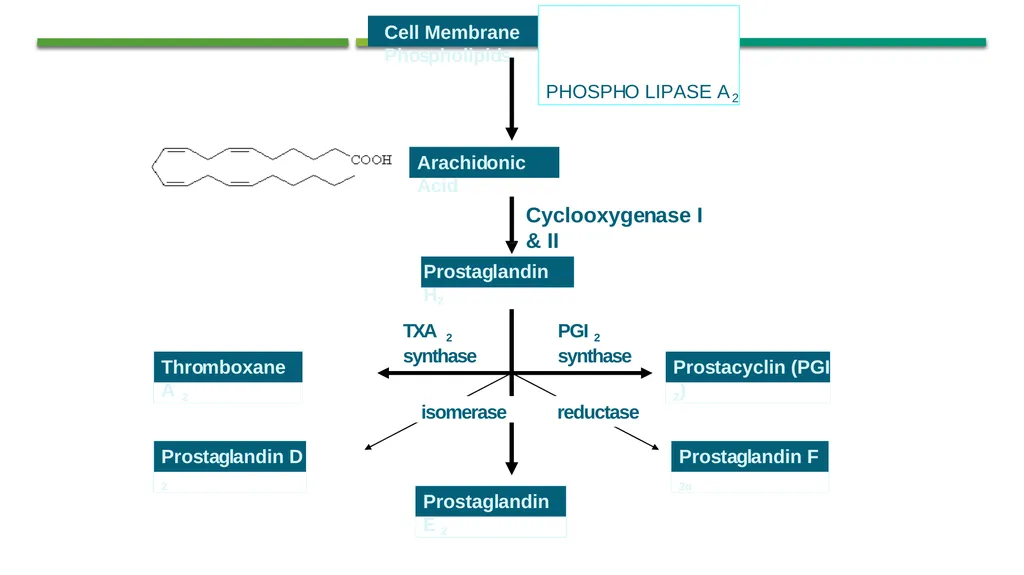
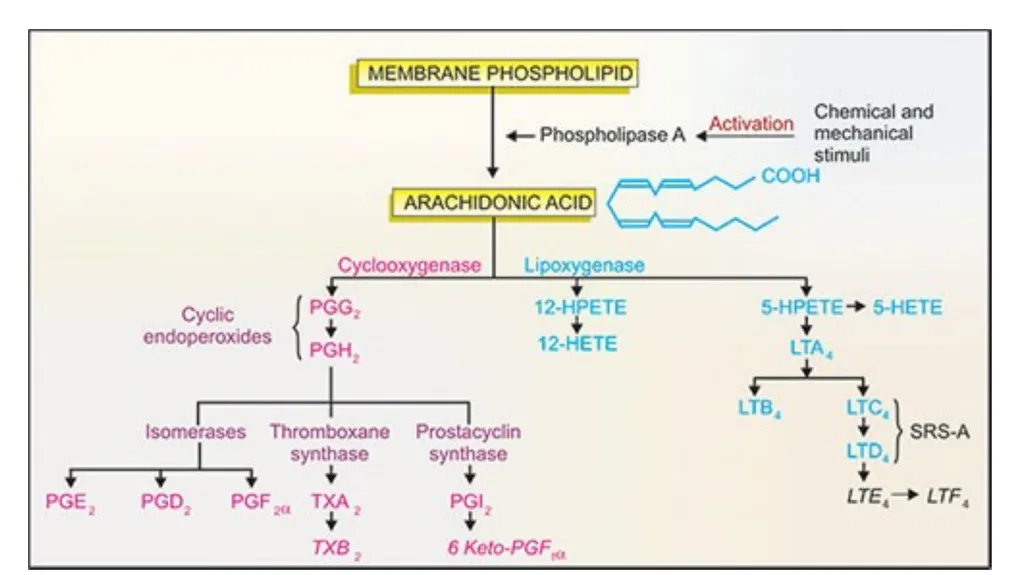
Cyclooxygenase (COX) Pathways COX- It generates eicosanoids with a ring structure (PGs, TXs, prostacyclin) while lipoxygenase (LOX) produces open-chain compounds (LTs).
All tissues have COX-can form cyclic endoperoxides PGG2 and PGH2 which are unstable compounds.
Further course in a particular tissue depends on the type of isomerases or other enzymes present in it. PGE2 and PGF20 are the primary prostaglandins
Platelets primarily synthesize TXA2 which is- chemically unstable, spontaneously changes to TXB2
Endothelium mainly generates prostacyclin (PGI 2).
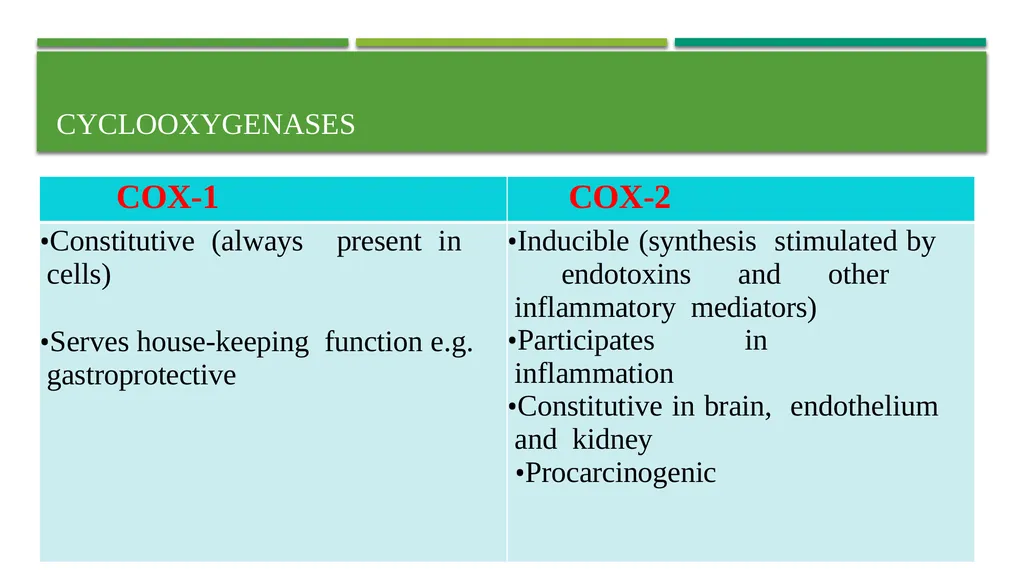
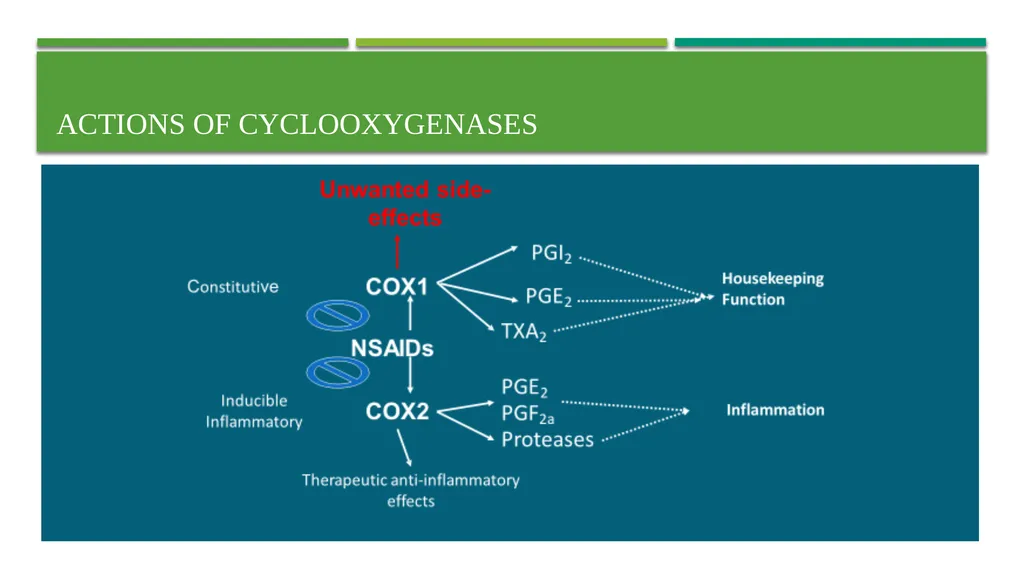
Cyclo-oxygenase (COX)- Two main isoforms exist, COX-1 and COX-2<br>
All tissues have COX-can form cyclic endoperoxides PGG2 and PGH2 which are unstable compounds.
Further course in a particular tissue depends on the type of isomerases or other enzymes present in it. PGE2 and PGF20 are the primary prostaglandins
Platelets primarily synthesize TXA2 which is- chemically unstable, spontaneously changes to TXB2
Endothelium mainly generates prostacyclin (PGI 2).
Cyclo-oxygenase (COX)- Two main isoforms exist, COX-1 and COX-2<br>
06
Cell Membrane Phospholipids Arachidonic Acid Prostaglandin H2 Thromboxane A 2 Prostaglandin E 2 Prostaglandin D 2 Prostacyclin (PGI 2) Prostaglandin F 2α Phospho lipase A 2 Cyclooxygenase I & II isomerase TXA 2
synthase PGI 2
synthase reductase 6<br>
synthase PGI 2
synthase reductase 6<br>
07
CYCLOOXYGENASES<br>
08
Actions of Cyclooxygenases<br>
09
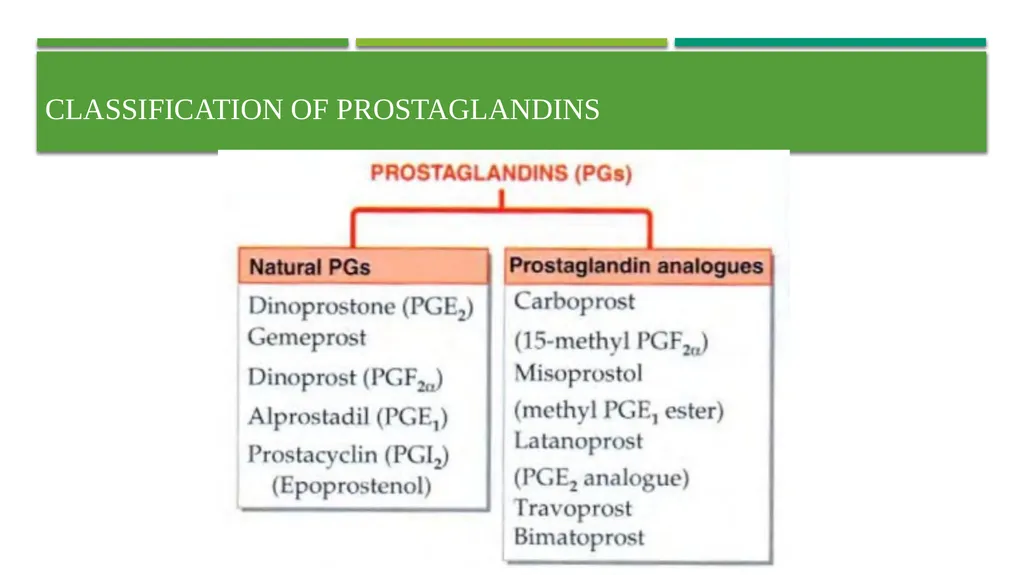
Classification of Prostaglandins<br>
10
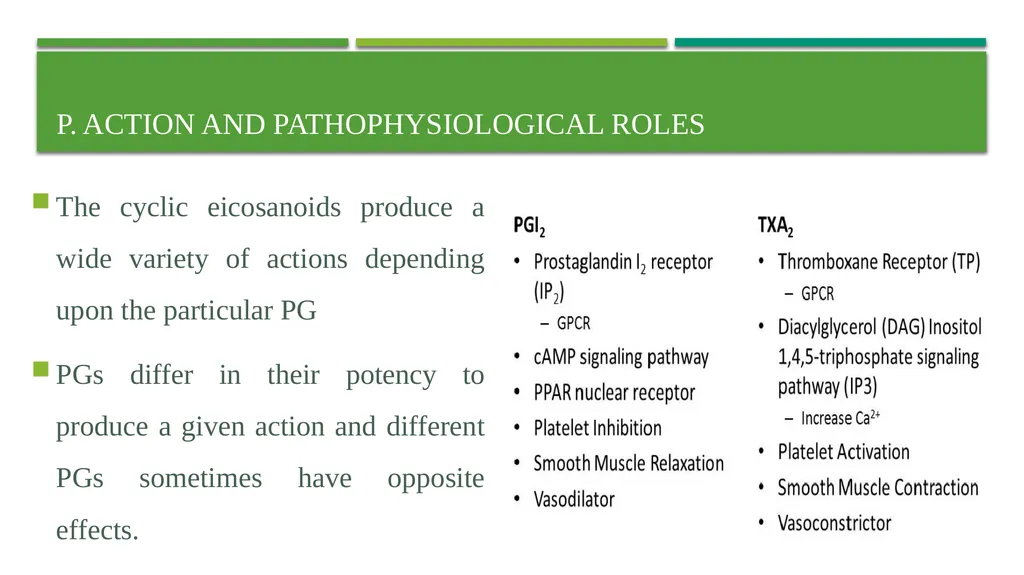
P. Action and Pathophysiological Roles The cyclic eicosanoids produce a wide variety of actions depending upon the particular PG
PGs differ in their potency to produce a given action and different PGs sometimes have opposite effects.<br>
PGs differ in their potency to produce a given action and different PGs sometimes have opposite effects.<br>
11
P. Action and Pathophysiological Roles CVS
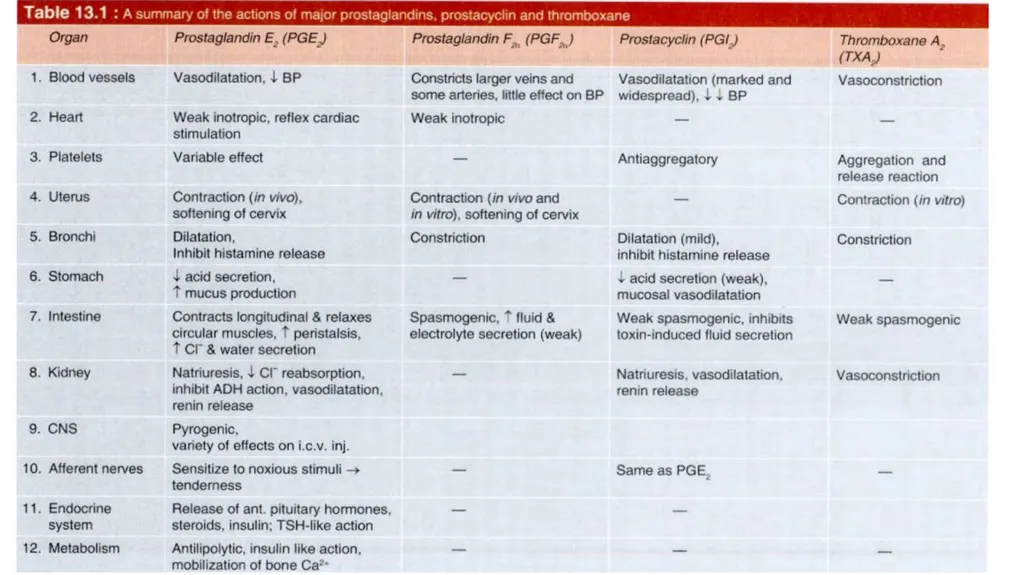
PGE2, PGI2 are vasodilators whereas and TXA2 are vasoconstrictor agents.
PGI2 is used in pulmonary hypertension
PGE2 increases capillary permeability.
PLATELETS
Platelets TXA2, which can be produced locally by platelets, is a potent inducer of aggregation and release reaction.
On the other hand PGI2 (generated by vascular endothelium) is a potent inhibitor of platelet aggregation.<br>
PGE2, PGI2 are vasodilators whereas and TXA2 are vasoconstrictor agents.
PGI2 is used in pulmonary hypertension
PGE2 increases capillary permeability.
PLATELETS
Platelets TXA2, which can be produced locally by platelets, is a potent inducer of aggregation and release reaction.
On the other hand PGI2 (generated by vascular endothelium) is a potent inhibitor of platelet aggregation.<br>
12
P. Action and Pathophysiological Roles CNS
PGE1 and PGE2 are pyrogenic and cause fever.
NSAIDs act as antipyretic agents by inhibiting these PGs.
Peripheral Nerve Endings
PGE2 and PGI2 sensitize pain receptors to various mediators.
NSAIDs act as analgesics by decreasing the synthesis of PGs.<br>
PGE1 and PGE2 are pyrogenic and cause fever.
NSAIDs act as antipyretic agents by inhibiting these PGs.
Peripheral Nerve Endings
PGE2 and PGI2 sensitize pain receptors to various mediators.
NSAIDs act as analgesics by decreasing the synthesis of PGs.<br>
13
UTERUS
PGE2 and PGF2 a consistently contract human uterus in vivo, both pregnant as well as nonpregnant.
The sensitivity is higher during pregnancy and there is a progressive modest increase with the advance of pregnancy.
BRONCHIAL MUSCLE
PGF-2α PGD2 and TXA2 are potent bronchoconstrictors while PGE2 is a powerful bronchodilator. PGl 2 produces mild dilatation.<br>
PGE2 and PGF2 a consistently contract human uterus in vivo, both pregnant as well as nonpregnant.
The sensitivity is higher during pregnancy and there is a progressive modest increase with the advance of pregnancy.
BRONCHIAL MUSCLE
PGF-2α PGD2 and TXA2 are potent bronchoconstrictors while PGE2 is a powerful bronchodilator. PGl 2 produces mild dilatation.<br>
14
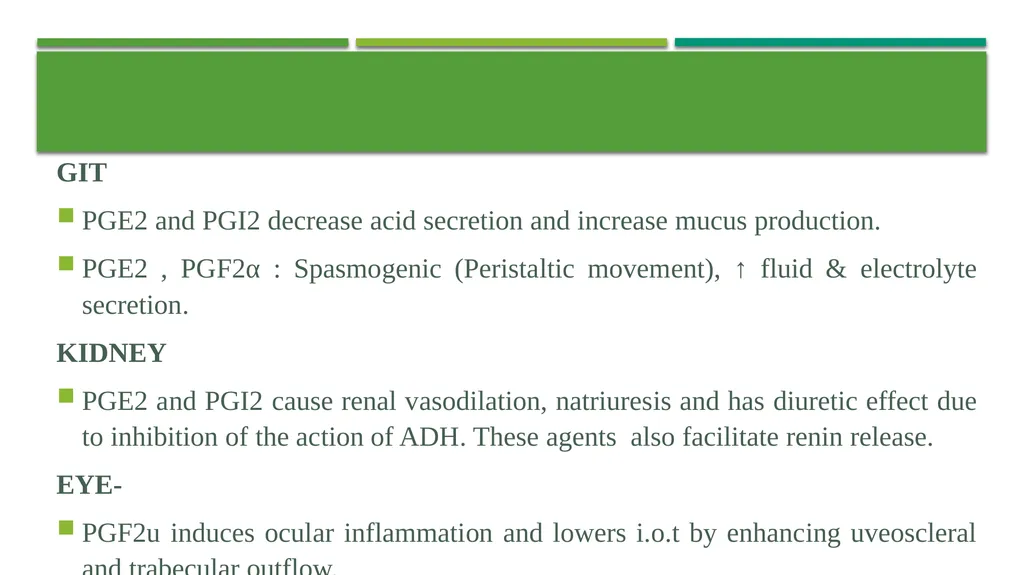
GIT
PGE2 and PGI2 decrease acid secretion and increase mucus production.
PGE2 , PGF2α : Spasmogenic (Peristaltic movement), ↑ fluid & electrolyte secretion.
KIDNEY
PGE2 and PGI2 cause renal vasodilation, natriuresis and has diuretic effect due to inhibition of the action of ADH. These agents also facilitate renin release.
EYE-
PGF2u induces ocular inflammation and lowers i.o.t by enhancing uveoscleral and trabecular outflow.<br>
PGE2 and PGI2 decrease acid secretion and increase mucus production.
PGE2 , PGF2α : Spasmogenic (Peristaltic movement), ↑ fluid & electrolyte secretion.
KIDNEY
PGE2 and PGI2 cause renal vasodilation, natriuresis and has diuretic effect due to inhibition of the action of ADH. These agents also facilitate renin release.
EYE-
PGF2u induces ocular inflammation and lowers i.o.t by enhancing uveoscleral and trabecular outflow.<br>
15
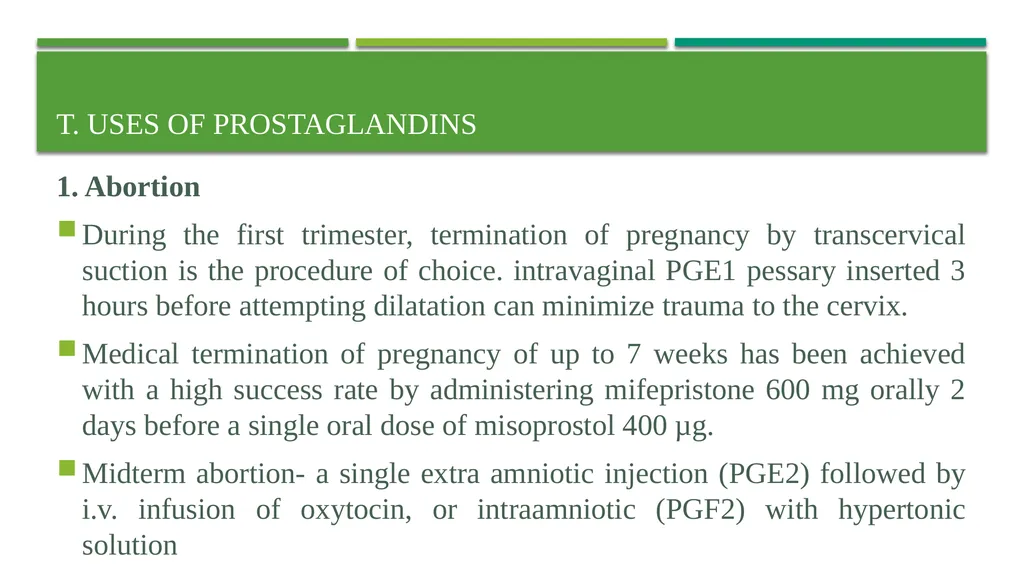
T. Uses of prostaglandins 1. Abortion
During the first trimester, termination of pregnancy by transcervical suction is the procedure of choice. intravaginal PGE1 pessary inserted 3 hours before attempting dilatation can minimize trauma to the cervix.
Medical termination of pregnancy of up to 7 weeks has been achieved with a high success rate by administering mifepristone 600 mg orally 2 days before a single oral dose of misoprostol 400 µg.
Midterm abortion- a single extra amniotic injection (PGE2) followed by i.v. infusion of oxytocin, or intraamniotic (PGF2) with hypertonic solution<br>
During the first trimester, termination of pregnancy by transcervical suction is the procedure of choice. intravaginal PGE1 pessary inserted 3 hours before attempting dilatation can minimize trauma to the cervix.
Medical termination of pregnancy of up to 7 weeks has been achieved with a high success rate by administering mifepristone 600 mg orally 2 days before a single oral dose of misoprostol 400 µg.
Midterm abortion- a single extra amniotic injection (PGE2) followed by i.v. infusion of oxytocin, or intraamniotic (PGF2) with hypertonic solution<br>
16
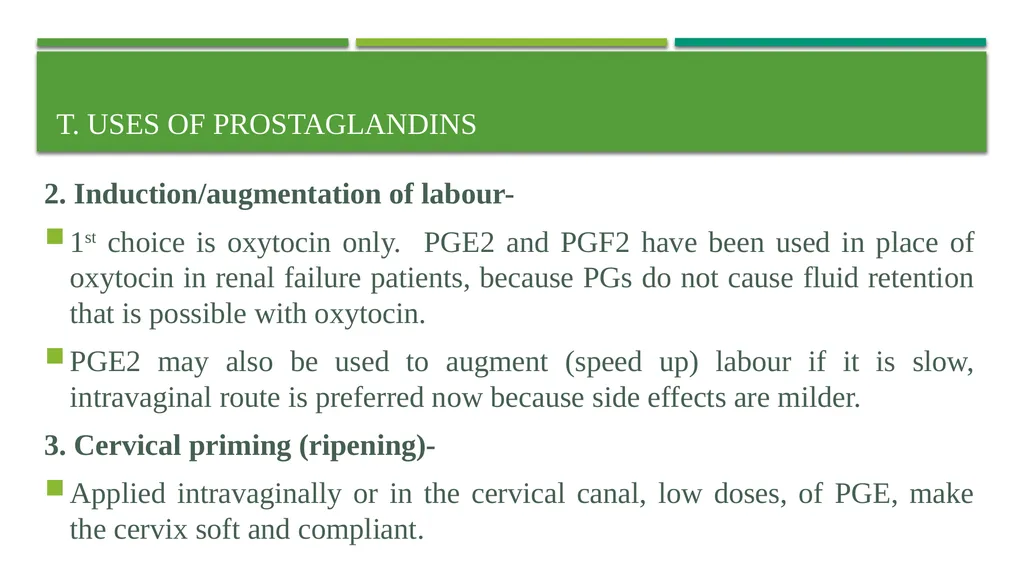
T. Uses of prostaglandins 2. Induction/augmentation of labour-
1st choice is oxytocin only. PGE2 and PGF2 have been used in place of oxytocin in renal failure patients, because PGs do not cause fluid retention that is possible with oxytocin.
PGE2 may also be used to augment (speed up) labour if it is slow, intravaginal route is preferred now because side effects are milder.
3. Cervical priming (ripening)-
Applied intravaginally or in the cervical canal, low doses, of PGE, make the cervix soft and compliant.<br>
1st choice is oxytocin only. PGE2 and PGF2 have been used in place of oxytocin in renal failure patients, because PGs do not cause fluid retention that is possible with oxytocin.
PGE2 may also be used to augment (speed up) labour if it is slow, intravaginal route is preferred now because side effects are milder.
3. Cervical priming (ripening)-
Applied intravaginally or in the cervical canal, low doses, of PGE, make the cervix soft and compliant.<br>
17
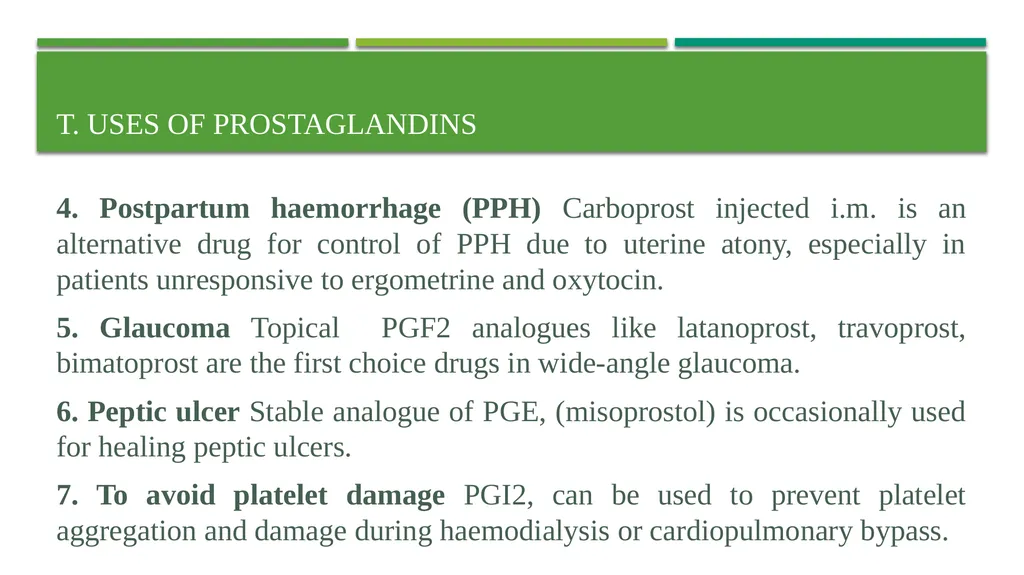
T. Uses of prostaglandins 4. Postpartum haemorrhage (PPH) Carboprost injected i.m. is an alternative drug for control of PPH due to uterine atony, especially in patients unresponsive to ergometrine and oxytocin.
5. Glaucoma Topical PGF2 analogues like latanoprost, travoprost, bimatoprost are the first choice drugs in wide-angle glaucoma.
6. Peptic ulcer Stable analogue of PGE, (misoprostol) is occasionally used for healing peptic ulcers.
7. To avoid platelet damage PGI2, can be used to prevent platelet aggregation and damage during haemodialysis or cardiopulmonary bypass.<br>
5. Glaucoma Topical PGF2 analogues like latanoprost, travoprost, bimatoprost are the first choice drugs in wide-angle glaucoma.
6. Peptic ulcer Stable analogue of PGE, (misoprostol) is occasionally used for healing peptic ulcers.
7. To avoid platelet damage PGI2, can be used to prevent platelet aggregation and damage during haemodialysis or cardiopulmonary bypass.<br>
18
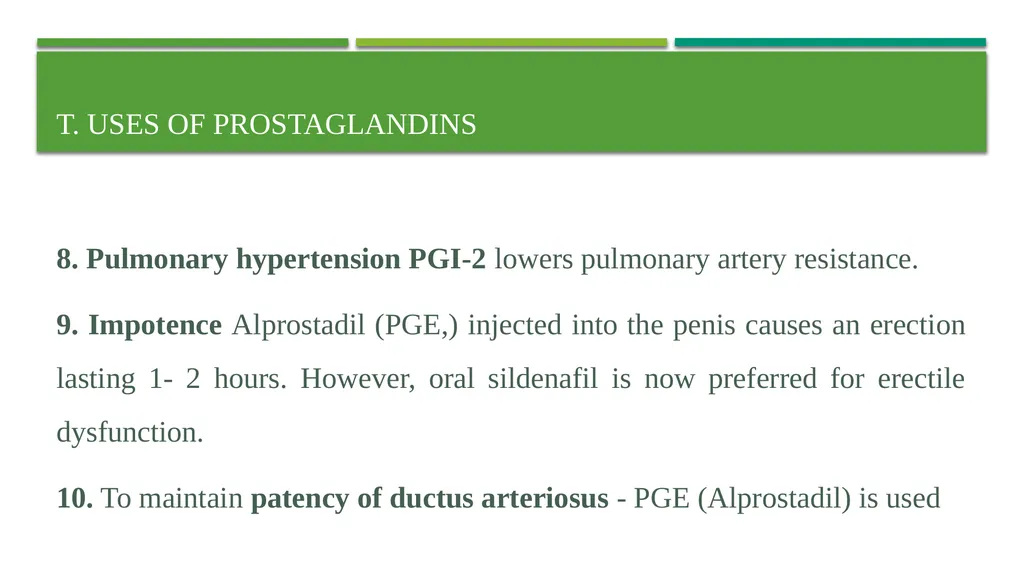
T. Uses of prostaglandins 8. Pulmonary hypertension PGI-2 lowers pulmonary artery resistance.
9. Impotence Alprostadil (PGE,) injected into the penis causes an erection lasting 1- 2 hours. However, oral sildenafil is now preferred for erectile dysfunction.
10. To maintain patency of ductus arteriosus - PGE (Alprostadil) is used<br>
9. Impotence Alprostadil (PGE,) injected into the penis causes an erection lasting 1- 2 hours. However, oral sildenafil is now preferred for erectile dysfunction.
10. To maintain patency of ductus arteriosus - PGE (Alprostadil) is used<br>
19
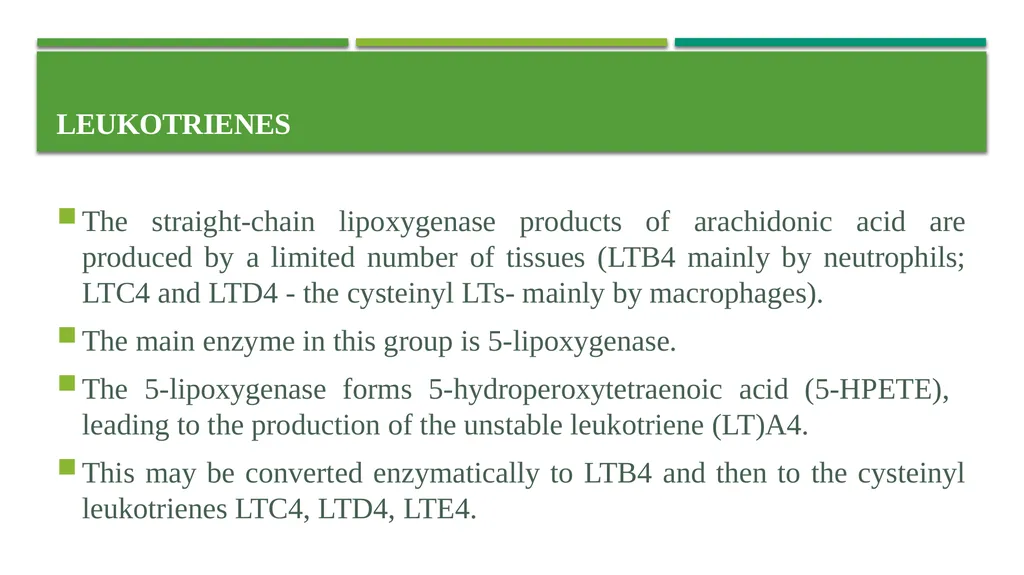
LEUKOTRIENES The straight-chain lipoxygenase products of arachidonic acid are produced by a limited number of tissues (LTB4 mainly by neutrophils; LTC4 and LTD4 - the cysteinyl LTs- mainly by macrophages).
The main enzyme in this group is 5-lipoxygenase.
The 5-lipoxygenase forms 5-hydroperoxytetraenoic acid (5-HPETE), leading to the production of the unstable leukotriene (LT)A4.
This may be converted enzymatically to LTB4 and then to the cysteinyl leukotrienes LTC4, LTD4, LTE4.<br>
The main enzyme in this group is 5-lipoxygenase.
The 5-lipoxygenase forms 5-hydroperoxytetraenoic acid (5-HPETE), leading to the production of the unstable leukotriene (LT)A4.
This may be converted enzymatically to LTB4 and then to the cysteinyl leukotrienes LTC4, LTD4, LTE4.<br>
20
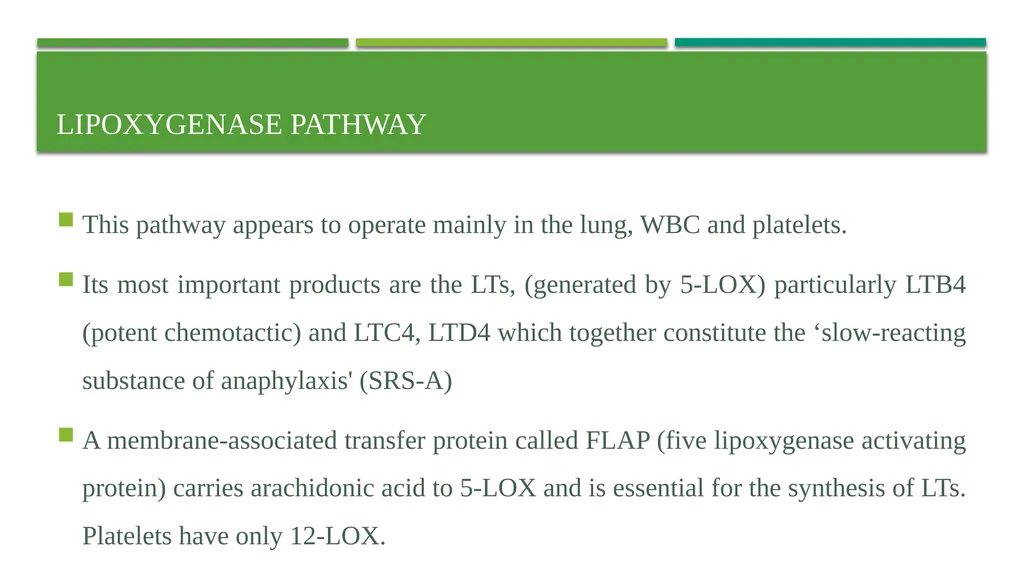
Lipoxygenase pathway This pathway appears to operate mainly in the lung, WBC and platelets.
Its most important products are the LTs, (generated by 5-LOX) particularly LTB4 (potent chemotactic) and LTC4, LTD4 which together constitute the ‘slow-reacting substance of anaphylaxis' (SRS-A)
A membrane-associated transfer protein called FLAP (five lipoxygenase activating protein) carries arachidonic acid to 5-LOX and is essential for the synthesis of LTs. Platelets have only 12-LOX.<br>
Its most important products are the LTs, (generated by 5-LOX) particularly LTB4 (potent chemotactic) and LTC4, LTD4 which together constitute the ‘slow-reacting substance of anaphylaxis' (SRS-A)
A membrane-associated transfer protein called FLAP (five lipoxygenase activating protein) carries arachidonic acid to 5-LOX and is essential for the synthesis of LTs. Platelets have only 12-LOX.<br>
21
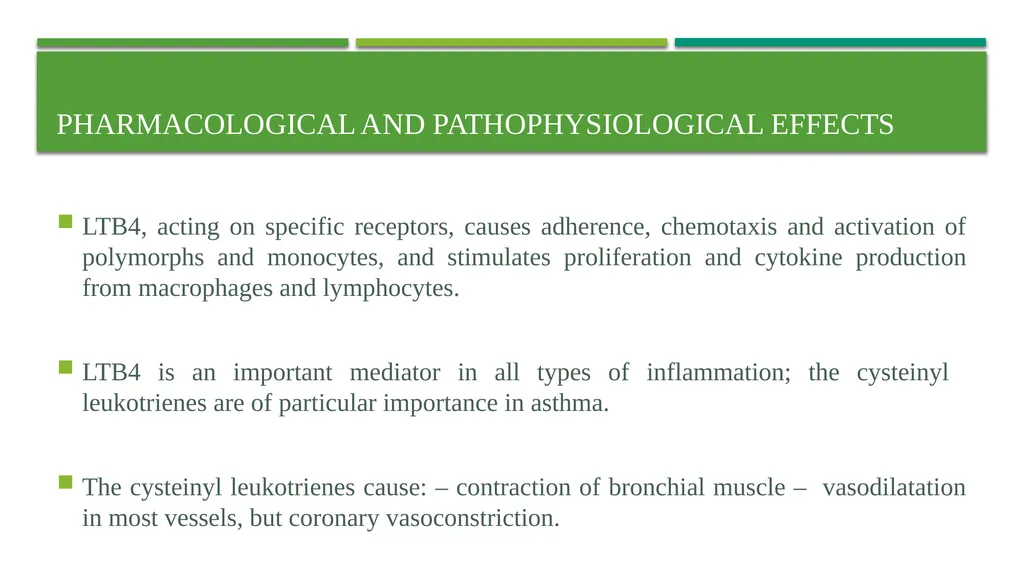
Pharmacological and pathophysiological effects LTB4, acting on specific receptors, causes adherence, chemotaxis and activation of polymorphs and monocytes, and stimulates proliferation and cytokine production from macrophages and lymphocytes.
LTB4 is an important mediator in all types of inflammation; the cysteinyl leukotrienes are of particular importance in asthma.
The cysteinyl leukotrienes cause: – contraction of bronchial muscle – vasodilatation in most vessels, but coronary vasoconstriction.<br>
LTB4 is an important mediator in all types of inflammation; the cysteinyl leukotrienes are of particular importance in asthma.
The cysteinyl leukotrienes cause: – contraction of bronchial muscle – vasodilatation in most vessels, but coronary vasoconstriction.<br>
22
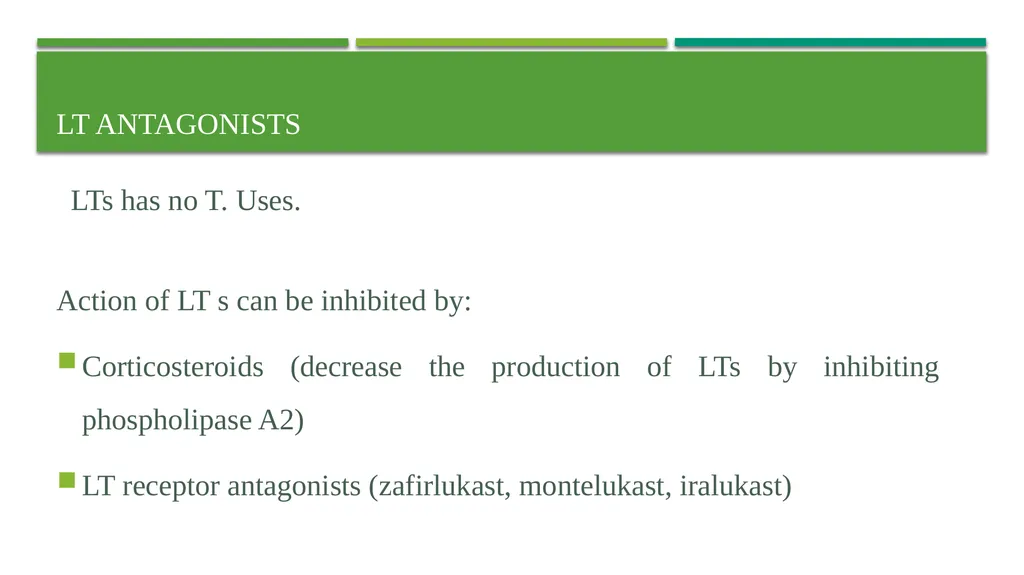
LT antagonists Action of LT s can be inhibited by:
Corticosteroids (decrease the production of LTs by inhibiting phospholipase A2)
LT receptor antagonists (zafirlukast, montelukast, iralukast) LTs has no T. Uses.<br>
Corticosteroids (decrease the production of LTs by inhibiting phospholipase A2)
LT receptor antagonists (zafirlukast, montelukast, iralukast) LTs has no T. Uses.<br>
23
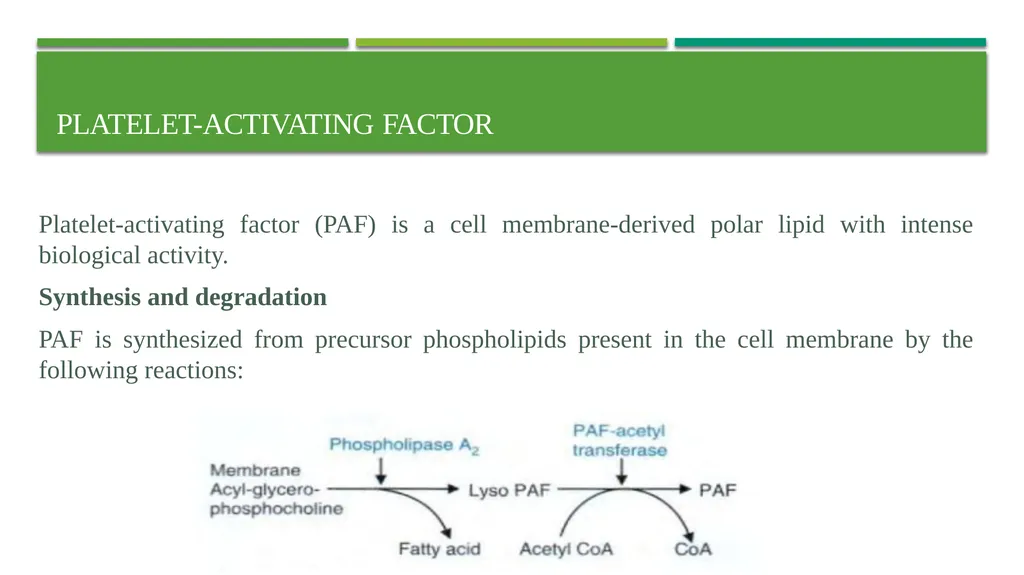
PLATELET-ACTIVATING FACTOR Platelet-activating factor (PAF) is a cell membrane-derived polar lipid with intense biological activity.
Synthesis and degradation
PAF is synthesized from precursor phospholipids present in the cell membrane by the following reactions:<br>
Synthesis and degradation
PAF is synthesized from precursor phospholipids present in the cell membrane by the following reactions:<br>
24
Antigen-antibody reaction and a variety of mediators stimulate PAF synthesis
There are no preformed stores of PAF. In contrast to eicosanoids, the types of cells which synthesize PAF is quite limited- mainly WBC, platelets, vascular endothelium and few kidney cells.<br>
There are no preformed stores of PAF. In contrast to eicosanoids, the types of cells which synthesize PAF is quite limited- mainly WBC, platelets, vascular endothelium and few kidney cells.<br>
25
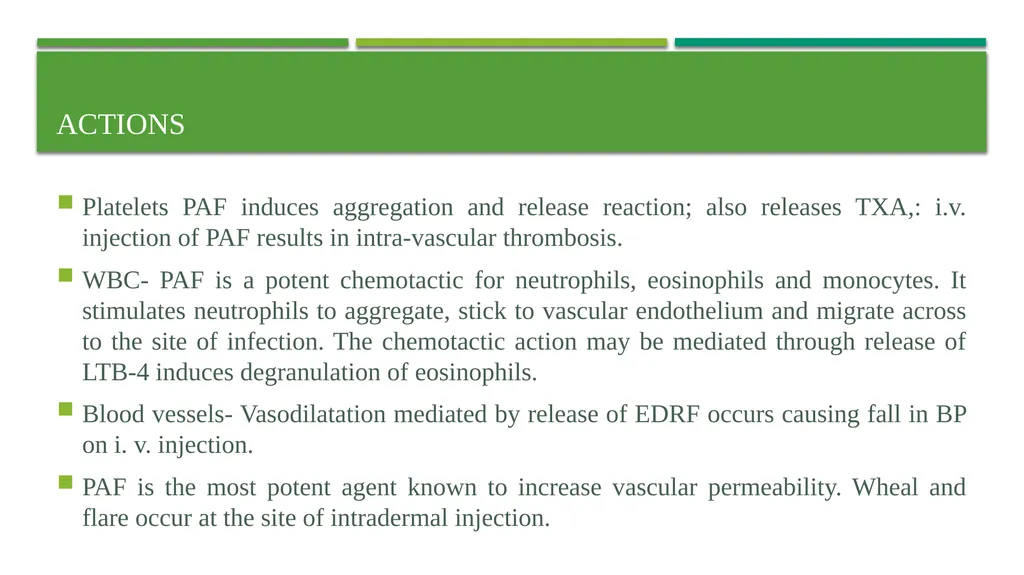
Actions Platelets PAF induces aggregation and release reaction; also releases TXA,: i.v. injection of PAF results in intra-vascular thrombosis.
WBC- PAF is a potent chemotactic for neutrophils, eosinophils and monocytes. It stimulates neutrophils to aggregate, stick to vascular endothelium and migrate across to the site of infection. The chemotactic action may be mediated through release of LTB-4 induces degranulation of eosinophils.
Blood vessels- Vasodilatation mediated by release of EDRF occurs causing fall in BP on i. v. injection.
PAF is the most potent agent known to increase vascular permeability. Wheal and flare occur at the site of intradermal injection.<br>
WBC- PAF is a potent chemotactic for neutrophils, eosinophils and monocytes. It stimulates neutrophils to aggregate, stick to vascular endothelium and migrate across to the site of infection. The chemotactic action may be mediated through release of LTB-4 induces degranulation of eosinophils.
Blood vessels- Vasodilatation mediated by release of EDRF occurs causing fall in BP on i. v. injection.
PAF is the most potent agent known to increase vascular permeability. Wheal and flare occur at the site of intradermal injection.<br>
26
Actions Visceral smooth muscle contraction occurs by direct action as well as through release of LTC4, TXA2, and PGs. Aerosolized PAF is a potent bronchoconstrictor. In addition, it produces mucosal edema, secretion and a delayed and long-lasting bronchial hyper-responsiveness. It also stimulates intestinal and uterine smooth muscle.
In stomach PAF is highly ulcerogenic: erosions and mucosal bleeding occurs shortly afler i.v. injection of PAF. The gastric smooth muscle contracts.<br>
In stomach PAF is highly ulcerogenic: erosions and mucosal bleeding occurs shortly afler i.v. injection of PAF. The gastric smooth muscle contracts.<br>
27
Pathophysiological roles 1. Inflammation: Generated by leukocytes at the site of inflammation PAF appears to participate in the causation of vasodilatation, exudation, cellular infiltration and hyperalgesia.
2. Bronchial asthma: PAF appears to play a major role by causing bronchoconstriction, mucosal oedema, recruiting eosinophils and provoking secretions. It is unique in producing prolonged airway hyper-reactivity. (Asthma)
3. Anaphylactic shock conditions: are associated with high circulating PAF levels.
4.Haemostasias and thrombosis: PAF may participate by promoting platelet aggregation.
5. PAF may also play a role in implantation of a fertilized ovum, ischaemic states of brain, heart and g.i.t., including g.i. ulceration.<br>
2. Bronchial asthma: PAF appears to play a major role by causing bronchoconstriction, mucosal oedema, recruiting eosinophils and provoking secretions. It is unique in producing prolonged airway hyper-reactivity. (Asthma)
3. Anaphylactic shock conditions: are associated with high circulating PAF levels.
4.Haemostasias and thrombosis: PAF may participate by promoting platelet aggregation.
5. PAF may also play a role in implantation of a fertilized ovum, ischaemic states of brain, heart and g.i.t., including g.i. ulceration.<br>
28
PAF has no T. Uses.
PAF antagonist
Rupatidine is a combined H1 and PAF antagonist that is used for treating allergic symptoms
Lexipafant (PAF antagonist) is in clinical trial in the treatment of acute pancreatitis.
Alprazolam and triazolam antagonize some actions of PAF.<br>
PAF antagonist
Rupatidine is a combined H1 and PAF antagonist that is used for treating allergic symptoms
Lexipafant (PAF antagonist) is in clinical trial in the treatment of acute pancreatitis.
Alprazolam and triazolam antagonize some actions of PAF.<br>