
Emotional Intelligence & Motivational
LV
Published · 32 slides · 0 views
1 / 1
Description
Emotional Intelligence Motivational Interviewing: Essentials for Nurses Presented by: Dr. Ruth L.M. Burkhart, DNP, MSN, MA, RN-BC, LPCC Director of Nursing Ottawa University Participants: Please note that it should take approximately 150
Related Topics
Share
Embed code
Download this presentation From Below
"Emotional Intelligence & Motivational" is the property of its rightful owner. Permission is granted to download and print the materials on this website for personal, non-commercial use only, and to display it on your personal computer provided you do not modify the materials and that you retain all copyright notices contained in the materials. By downloading content from our website, you accept the terms of this agreement.
Presentation Transcript
01
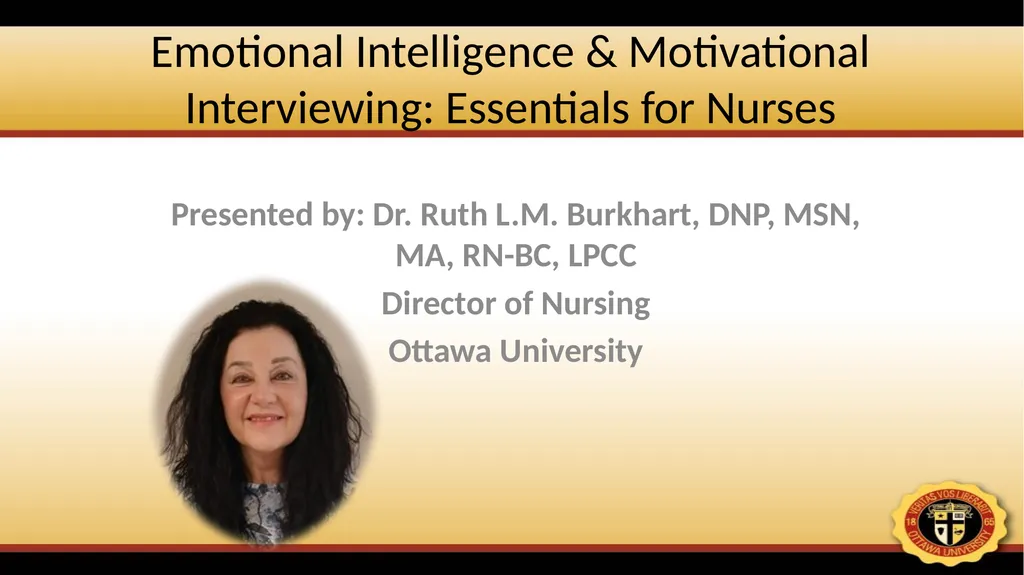
Emotional Intelligence & Motivational Interviewing: Essentials for Nurses Presented by: Dr. Ruth L.M. Burkhart, DNP, MSN, MA, RN-BC, LPCC
Director of Nursing
Ottawa University<br>
Director of Nursing
Ottawa University<br>
02
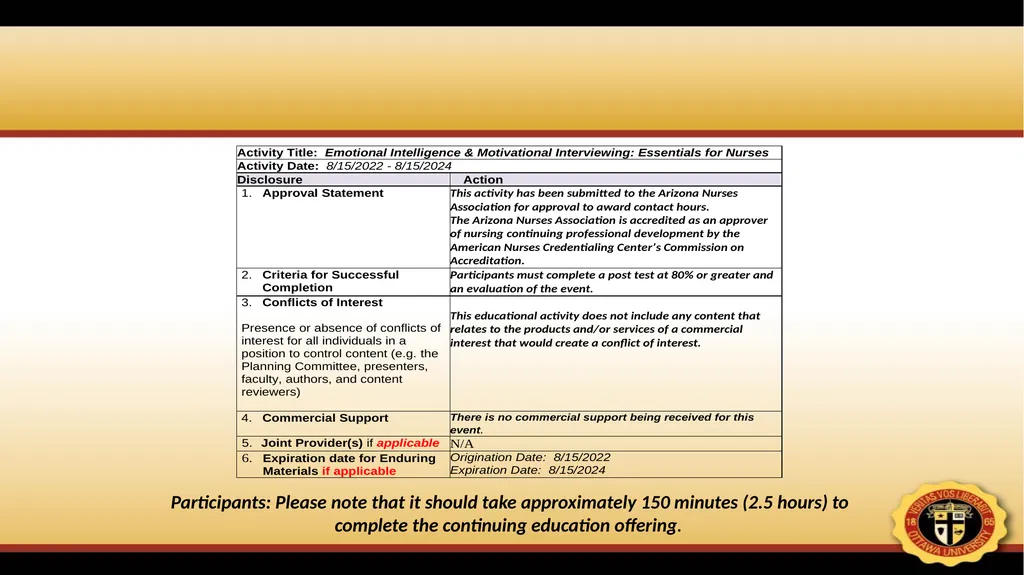
Participants: Please note that it should take approximately 150 minutes (2.5 hours) to complete the continuing education offering.<br>
03
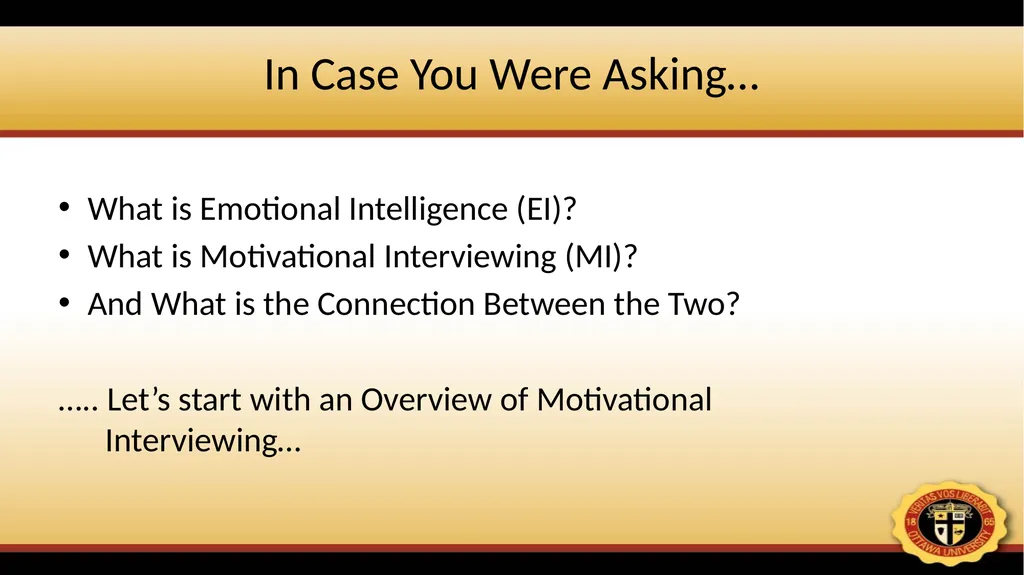
In Case You Were Asking… What is Emotional Intelligence (EI)?
What is Motivational Interviewing (MI)?
And What is the Connection Between the Two?
….. Let’s start with an Overview of Motivational Interviewing…<br>
What is Motivational Interviewing (MI)?
And What is the Connection Between the Two?
….. Let’s start with an Overview of Motivational Interviewing…<br>
04
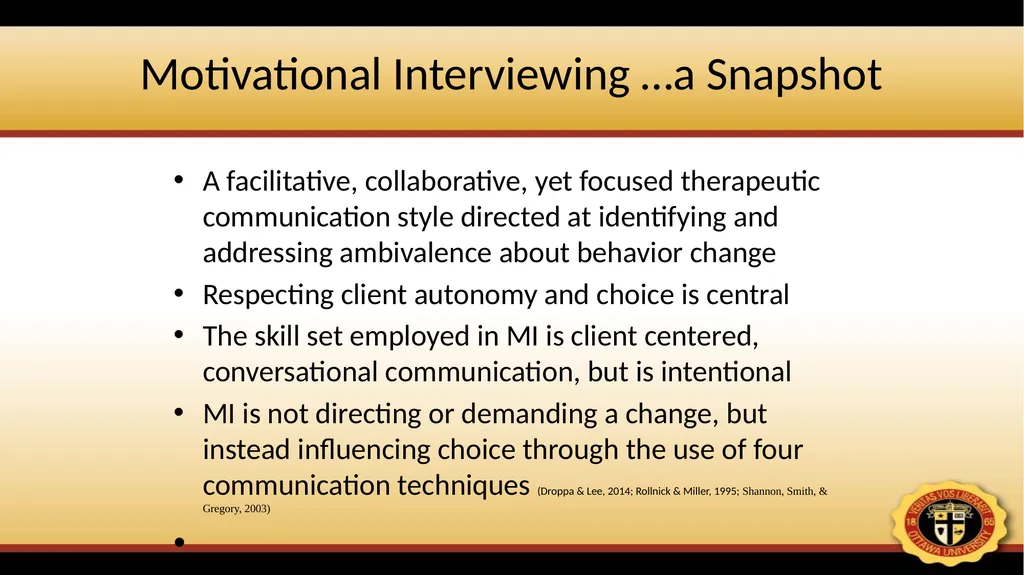
Motivational Interviewing …a Snapshot A facilitative, collaborative, yet focused therapeutic communication style directed at identifying and addressing ambivalence about behavior change
Respecting client autonomy and choice is central
The skill set employed in MI is client centered, conversational communication, but is intentional
MI is not directing or demanding a change, but instead influencing choice through the use of four communication techniques (Droppa & Lee, 2014; Rollnick & Miller, 1995; Shannon, Smith, & Gregory, 2003)<br>
Respecting client autonomy and choice is central
The skill set employed in MI is client centered, conversational communication, but is intentional
MI is not directing or demanding a change, but instead influencing choice through the use of four communication techniques (Droppa & Lee, 2014; Rollnick & Miller, 1995; Shannon, Smith, & Gregory, 2003)<br>
05
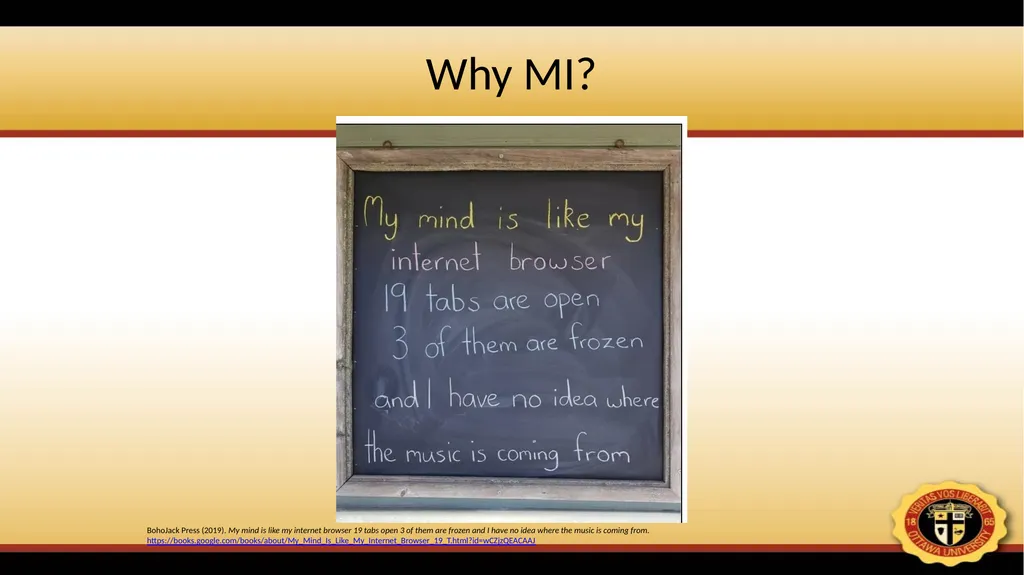
Why MI? BohoJack Press (2019). My mind is like my internet browser 19 tabs open 3 of them are frozen and I have no idea where the music is coming from. https://books.google.com/books/about/My_Mind_Is_Like_My_Internet_Browser_19_T.html?id=wCZjzQEACAAJ<br>
06
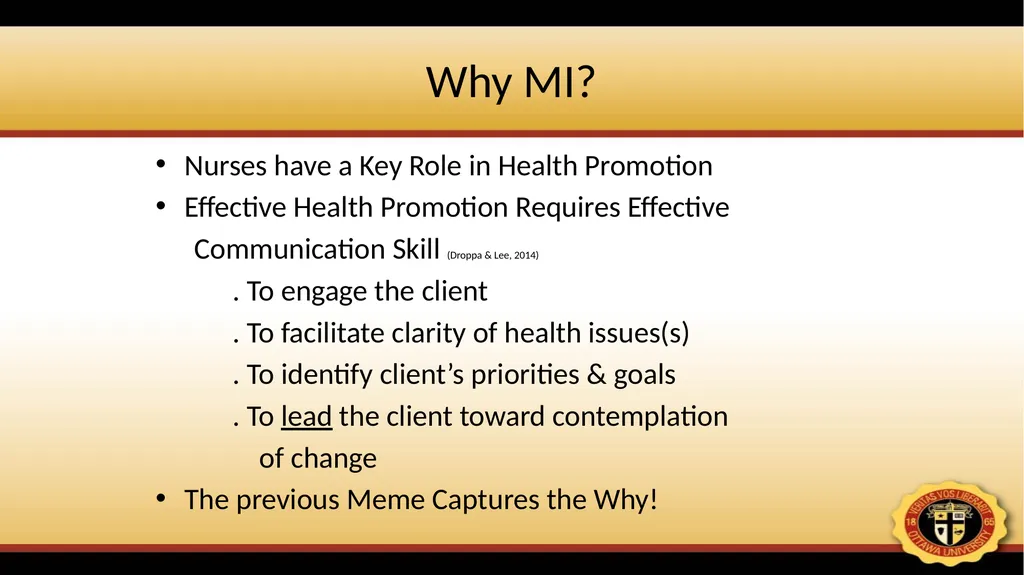
Why MI? Nurses have a Key Role in Health Promotion
Effective Health Promotion Requires Effective
Communication Skill (Droppa & Lee, 2014)
. To engage the client
. To facilitate clarity of health issues(s)
. To identify client’s priorities & goals
. To lead the client toward contemplation
of change
The previous Meme Captures the Why!<br>
Effective Health Promotion Requires Effective
Communication Skill (Droppa & Lee, 2014)
. To engage the client
. To facilitate clarity of health issues(s)
. To identify client’s priorities & goals
. To lead the client toward contemplation
of change
The previous Meme Captures the Why!<br>
07
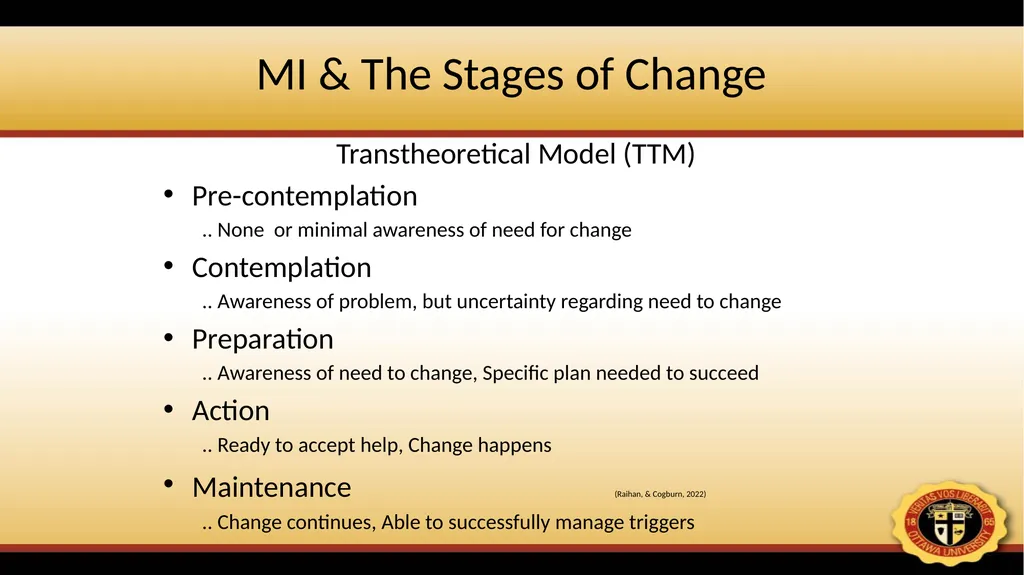
MI & The Stages of Change Transtheoretical Model (TTM)
Pre-contemplation
.. None or minimal awareness of need for change
Contemplation
.. Awareness of problem, but uncertainty regarding need to change
Preparation
.. Awareness of need to change, Specific plan needed to succeed
Action
.. Ready to accept help, Change happens
Maintenance (Raihan, & Cogburn, 2022)
.. Change continues, Able to successfully manage triggers<br>
Pre-contemplation
.. None or minimal awareness of need for change
Contemplation
.. Awareness of problem, but uncertainty regarding need to change
Preparation
.. Awareness of need to change, Specific plan needed to succeed
Action
.. Ready to accept help, Change happens
Maintenance (Raihan, & Cogburn, 2022)
.. Change continues, Able to successfully manage triggers<br>
08
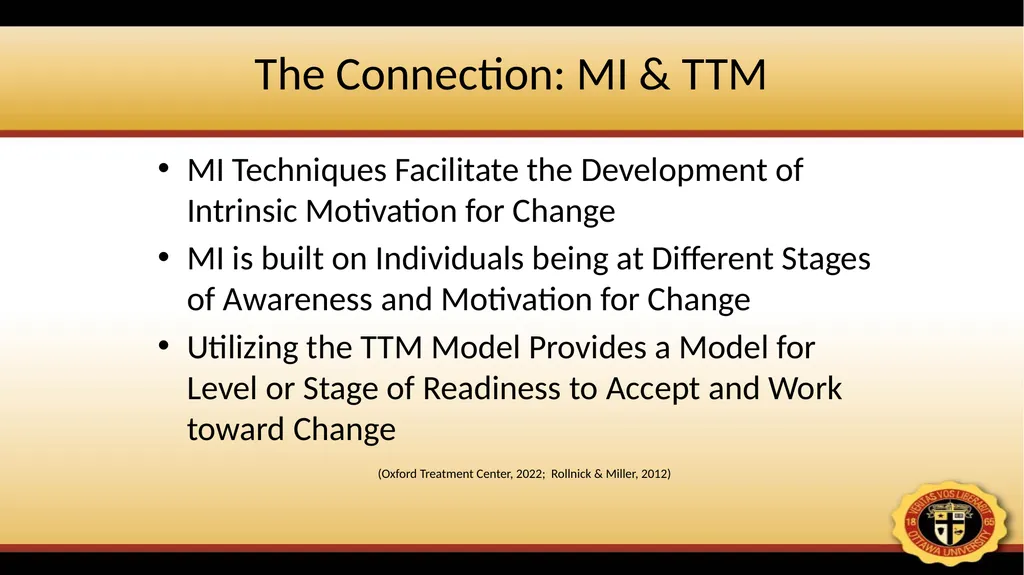
The Connection: MI & TTM MI Techniques Facilitate the Development of Intrinsic Motivation for Change
MI is built on Individuals being at Different Stages of Awareness and Motivation for Change
Utilizing the TTM Model Provides a Model for Level or Stage of Readiness to Accept and Work toward Change
(Oxford Treatment Center, 2022; Rollnick & Miller, 2012)<br>
MI is built on Individuals being at Different Stages of Awareness and Motivation for Change
Utilizing the TTM Model Provides a Model for Level or Stage of Readiness to Accept and Work toward Change
(Oxford Treatment Center, 2022; Rollnick & Miller, 2012)<br>
09
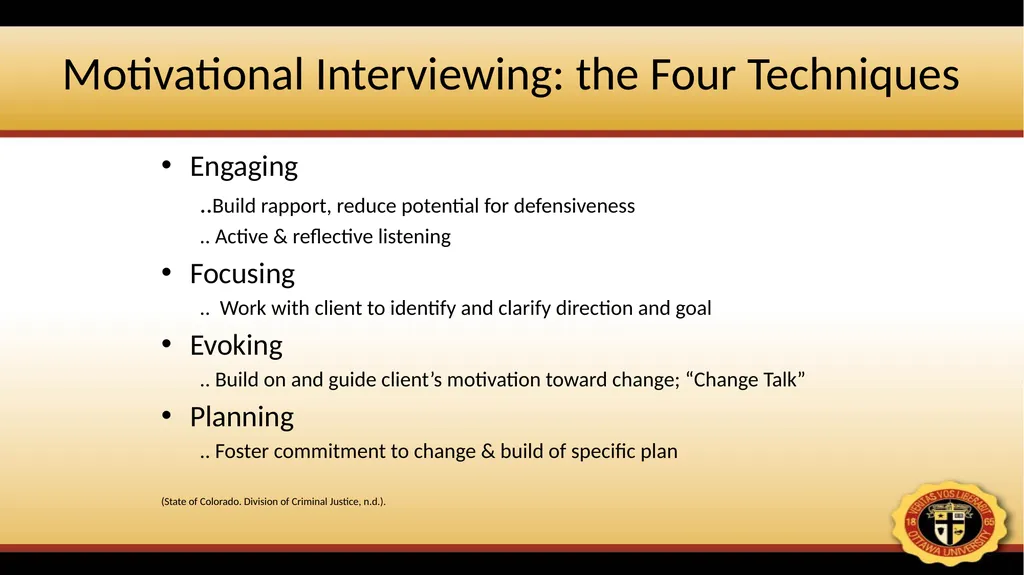
Motivational Interviewing: the Four Techniques Engaging
..Build rapport, reduce potential for defensiveness
.. Active & reflective listening
Focusing
.. Work with client to identify and clarify direction and goal
Evoking
.. Build on and guide client’s motivation toward change; “Change Talk”
Planning
.. Foster commitment to change & build of specific plan
(State of Colorado. Division of Criminal Justice, n.d.).<br>
..Build rapport, reduce potential for defensiveness
.. Active & reflective listening
Focusing
.. Work with client to identify and clarify direction and goal
Evoking
.. Build on and guide client’s motivation toward change; “Change Talk”
Planning
.. Foster commitment to change & build of specific plan
(State of Colorado. Division of Criminal Justice, n.d.).<br>
10
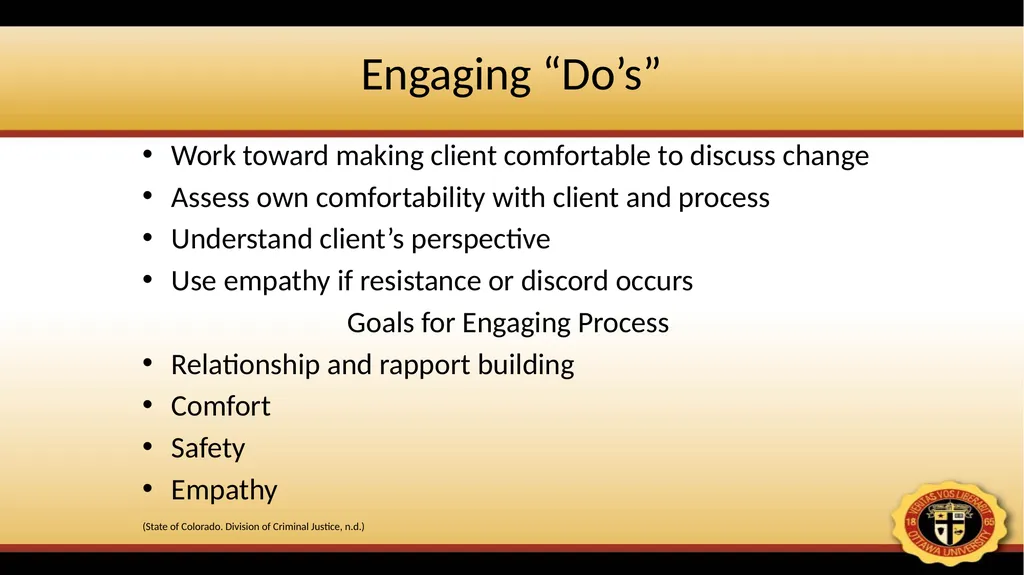
Engaging “Do’s” Work toward making client comfortable to discuss change
Assess own comfortability with client and process
Understand client’s perspective
Use empathy if resistance or discord occurs
Goals for Engaging Process
Relationship and rapport building
Comfort
Safety
Empathy
(State of Colorado. Division of Criminal Justice, n.d.)<br>
Assess own comfortability with client and process
Understand client’s perspective
Use empathy if resistance or discord occurs
Goals for Engaging Process
Relationship and rapport building
Comfort
Safety
Empathy
(State of Colorado. Division of Criminal Justice, n.d.)<br>
11
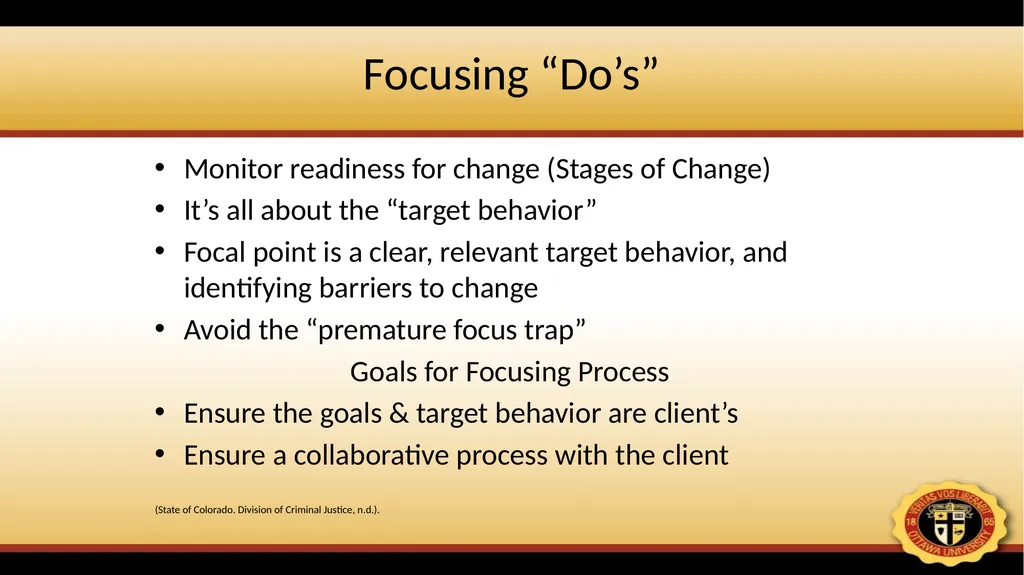
Focusing “Do’s” Monitor readiness for change (Stages of Change)
It’s all about the “target behavior”
Focal point is a clear, relevant target behavior, and identifying barriers to change
Avoid the “premature focus trap”
Goals for Focusing Process
Ensure the goals & target behavior are client’s
Ensure a collaborative process with the client
(State of Colorado. Division of Criminal Justice, n.d.).<br>
It’s all about the “target behavior”
Focal point is a clear, relevant target behavior, and identifying barriers to change
Avoid the “premature focus trap”
Goals for Focusing Process
Ensure the goals & target behavior are client’s
Ensure a collaborative process with the client
(State of Colorado. Division of Criminal Justice, n.d.).<br>
12
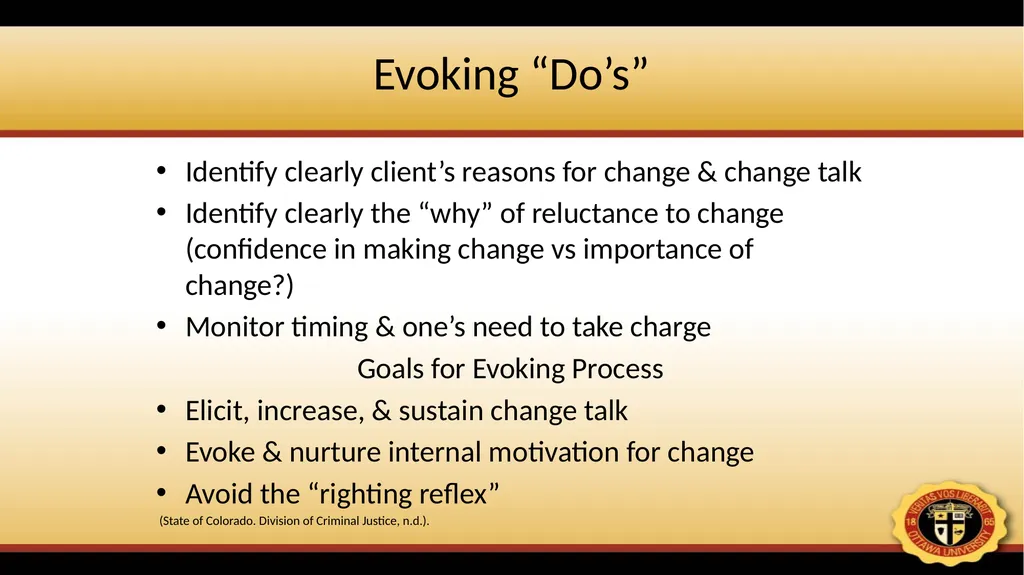
Evoking “Do’s” Identify clearly client’s reasons for change & change talk
Identify clearly the “why” of reluctance to change (confidence in making change vs importance of change?)
Monitor timing & one’s need to take charge
Goals for Evoking Process
Elicit, increase, & sustain change talk
Evoke & nurture internal motivation for change
Avoid the “righting reflex”
(State of Colorado. Division of Criminal Justice, n.d.).<br>
Identify clearly the “why” of reluctance to change (confidence in making change vs importance of change?)
Monitor timing & one’s need to take charge
Goals for Evoking Process
Elicit, increase, & sustain change talk
Evoke & nurture internal motivation for change
Avoid the “righting reflex”
(State of Colorado. Division of Criminal Justice, n.d.).<br>
13
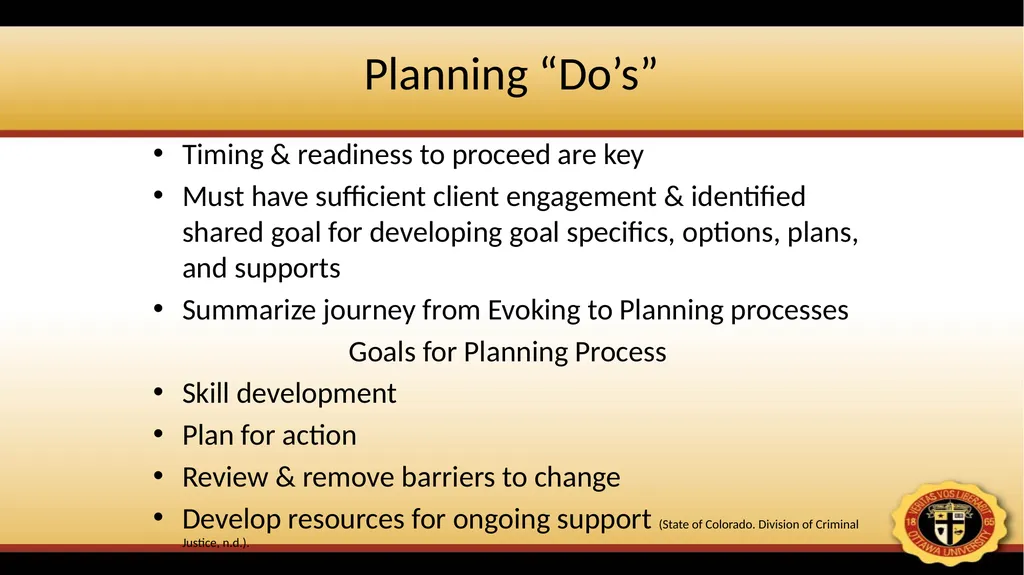
Planning “Do’s” Timing & readiness to proceed are key
Must have sufficient client engagement & identified shared goal for developing goal specifics, options, plans, and supports
Summarize journey from Evoking to Planning processes
Goals for Planning Process
Skill development
Plan for action
Review & remove barriers to change
Develop resources for ongoing support (State of Colorado. Division of Criminal Justice, n.d.).<br>
Must have sufficient client engagement & identified shared goal for developing goal specifics, options, plans, and supports
Summarize journey from Evoking to Planning processes
Goals for Planning Process
Skill development
Plan for action
Review & remove barriers to change
Develop resources for ongoing support (State of Colorado. Division of Criminal Justice, n.d.).<br>
14
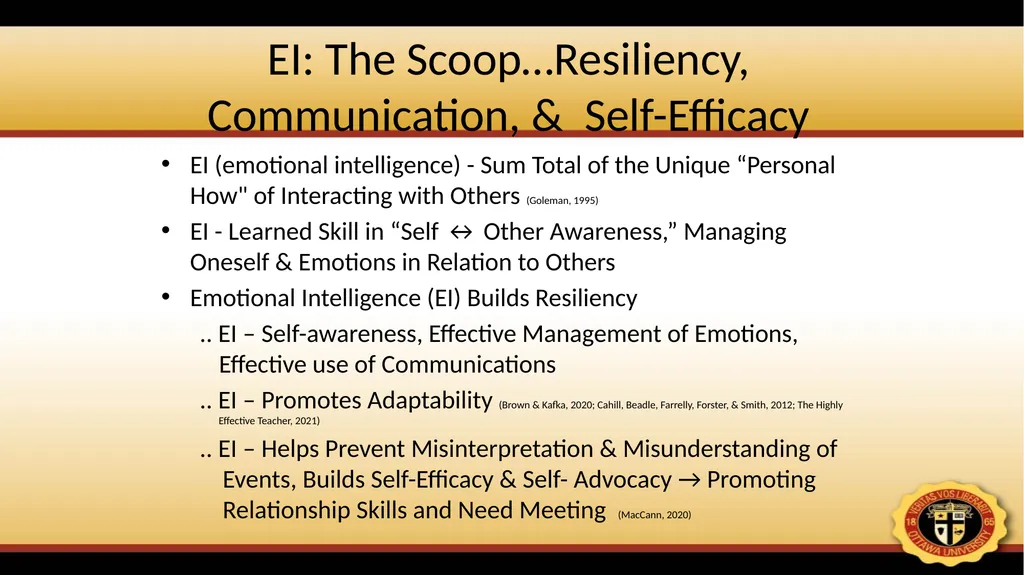
EI: The Scoop…Resiliency, Communication, & Self-Efficacy EI (emotional intelligence) - Sum Total of the Unique “Personal How" of Interacting with Others (Goleman, 1995)
EI - Learned Skill in “Self ↔ Other Awareness,” Managing Oneself & Emotions in Relation to Others
Emotional Intelligence (EI) Builds Resiliency
.. EI – Self-awareness, Effective Management of Emotions, Effective use of Communications
.. EI – Promotes Adaptability (Brown & Kafka, 2020; Cahill, Beadle, Farrelly, Forster, & Smith, 2012; The Highly Effective Teacher, 2021)
.. EI – Helps Prevent Misinterpretation & Misunderstanding of Events, Builds Self-Efficacy & Self- Advocacy → Promoting Relationship Skills and Need Meeting (MacCann, 2020)<br>
EI - Learned Skill in “Self ↔ Other Awareness,” Managing Oneself & Emotions in Relation to Others
Emotional Intelligence (EI) Builds Resiliency
.. EI – Self-awareness, Effective Management of Emotions, Effective use of Communications
.. EI – Promotes Adaptability (Brown & Kafka, 2020; Cahill, Beadle, Farrelly, Forster, & Smith, 2012; The Highly Effective Teacher, 2021)
.. EI – Helps Prevent Misinterpretation & Misunderstanding of Events, Builds Self-Efficacy & Self- Advocacy → Promoting Relationship Skills and Need Meeting (MacCann, 2020)<br>
15
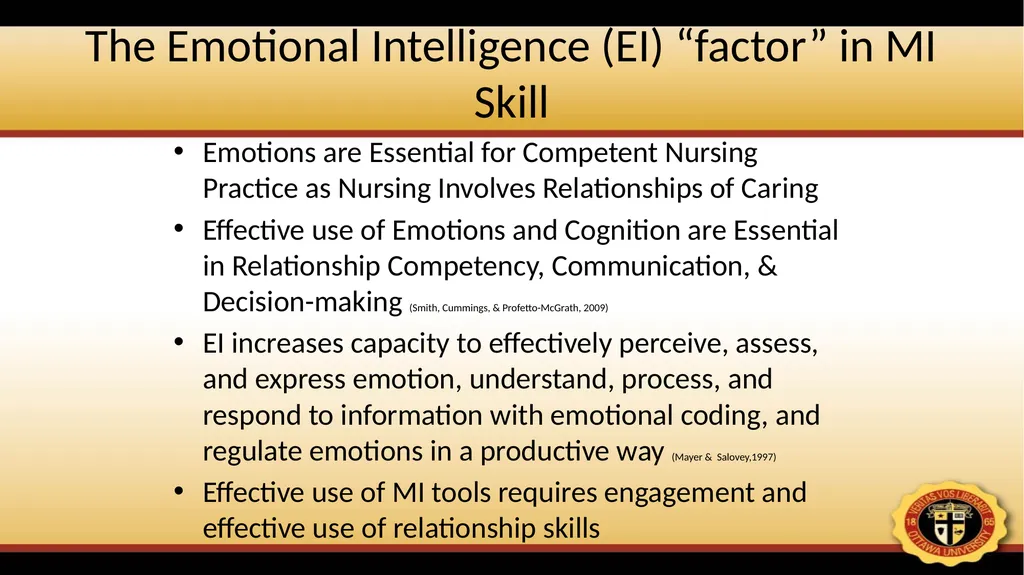
The Emotional Intelligence (EI) “factor” in MI Skill Emotions are Essential for Competent Nursing Practice as Nursing Involves Relationships of Caring
Effective use of Emotions and Cognition are Essential in Relationship Competency, Communication, & Decision-making (Smith, Cummings, & Profetto-McGrath, 2009)
EI increases capacity to effectively perceive, assess, and express emotion, understand, process, and respond to information with emotional coding, and regulate emotions in a productive way (Mayer & Salovey,1997)
Effective use of MI tools requires engagement and effective use of relationship skills<br>
Effective use of Emotions and Cognition are Essential in Relationship Competency, Communication, & Decision-making (Smith, Cummings, & Profetto-McGrath, 2009)
EI increases capacity to effectively perceive, assess, and express emotion, understand, process, and respond to information with emotional coding, and regulate emotions in a productive way (Mayer & Salovey,1997)
Effective use of MI tools requires engagement and effective use of relationship skills<br>
16
EI/MI & Nursing The Fit
Nurse Health Promotion and Patient Education Role MI)
The Nurse Self-Management Role (EI)
Both EI & MI Facilitate Effective Communication
Effective use of MI Requires EI Training for Nurses
First Step of Improving EI is Awareness…MI requires Self & Other Awareness in “real time”
Free Online EI information & quiz via website below
Craig, H. (2019). 17 Emotional Intelligence Tests and Assessments. https://positivepsychology.com/emotional-intelligence-tests/<br>
Nurse Health Promotion and Patient Education Role MI)
The Nurse Self-Management Role (EI)
Both EI & MI Facilitate Effective Communication
Effective use of MI Requires EI Training for Nurses
First Step of Improving EI is Awareness…MI requires Self & Other Awareness in “real time”
Free Online EI information & quiz via website below
Craig, H. (2019). 17 Emotional Intelligence Tests and Assessments. https://positivepsychology.com/emotional-intelligence-tests/<br>
17
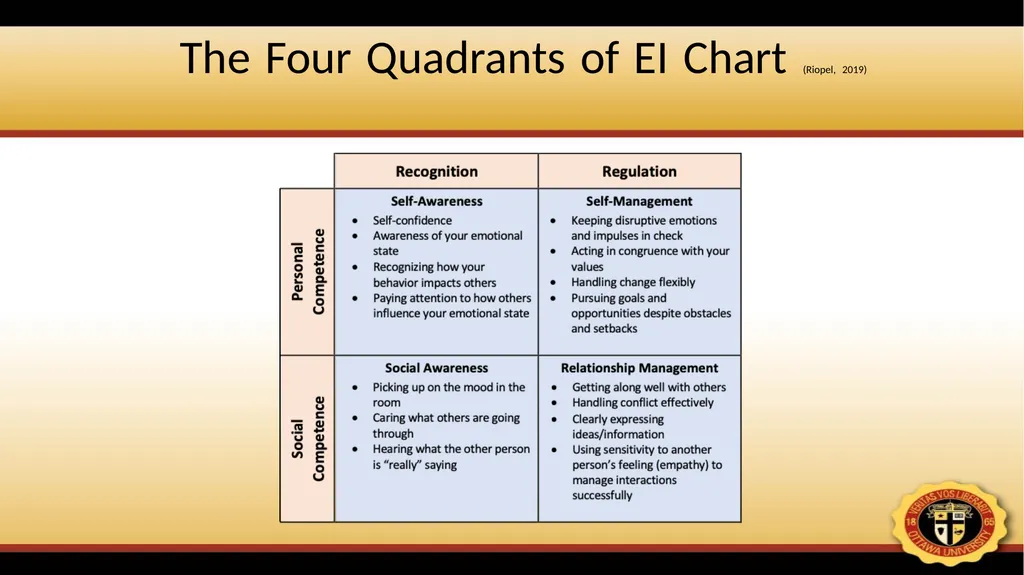
The Four Quadrants of EI Self-awareness - awareness of, and accurate perception of, emotions in real time
Self-management – ability to use awareness and perception of emotions to be flexible and respond effectively
Social-awareness – ability to perceive and understand other’s emotions accurately
Relationship management – ability to effectively manage self and others in social interactions (Riopel, 2019)<br>
Self-management – ability to use awareness and perception of emotions to be flexible and respond effectively
Social-awareness – ability to perceive and understand other’s emotions accurately
Relationship management – ability to effectively manage self and others in social interactions (Riopel, 2019)<br>
18
The Four Quadrants of EI Chart (Riopel, 2019)<br>
19
EI Training Components of EI training
.. Identify strengths & weaknesses, ways to improve
.. Build self-awareness by tuning in to feelings | of discomfort, anxiety, upset
.. Find a self-alert tool to “slow it down” and take a time-out to process
.. Identify antecedents and triggers to discomfort
.. Identify nature of discomfort
.. Increase awareness of expectations of self/others ( (DePaul University, n.d.)
D<br>
.. Identify strengths & weaknesses, ways to improve
.. Build self-awareness by tuning in to feelings | of discomfort, anxiety, upset
.. Find a self-alert tool to “slow it down” and take a time-out to process
.. Identify antecedents and triggers to discomfort
.. Identify nature of discomfort
.. Increase awareness of expectations of self/others ( (DePaul University, n.d.)
D<br>
20
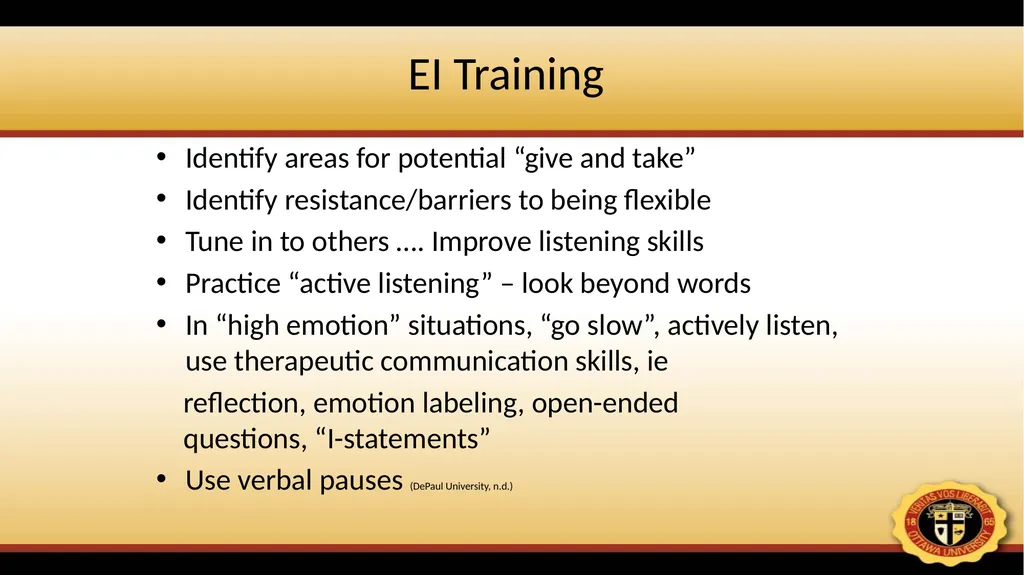
EI Training Identify areas for potential “give and take”
Identify resistance/barriers to being flexible
Tune in to others …. Improve listening skills
Practice “active listening” – look beyond words
In “high emotion” situations, “go slow”, actively listen, use therapeutic communication skills, ie
reflection, emotion labeling, open-ended questions, “I-statements”
Use verbal pauses (DePaul University, n.d.)<br>
Identify resistance/barriers to being flexible
Tune in to others …. Improve listening skills
Practice “active listening” – look beyond words
In “high emotion” situations, “go slow”, actively listen, use therapeutic communication skills, ie
reflection, emotion labeling, open-ended questions, “I-statements”
Use verbal pauses (DePaul University, n.d.)<br>
21
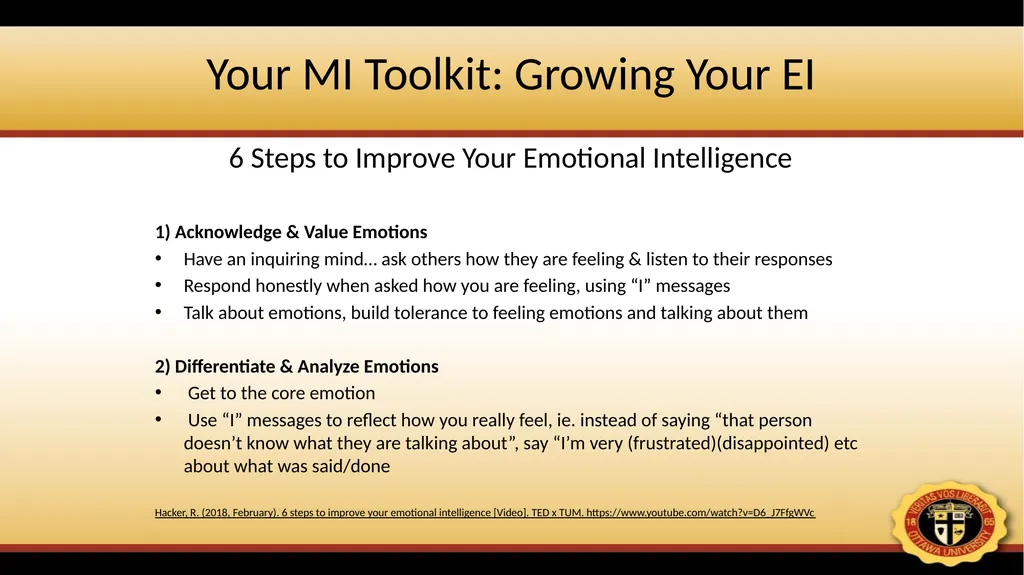
Your MI Toolkit: Growing Your EI 6 Steps to Improve Your Emotional Intelligence
1) Acknowledge & Value Emotions
Have an inquiring mind… ask others how they are feeling & listen to their responses
Respond honestly when asked how you are feeling, using “I” messages
Talk about emotions, build tolerance to feeling emotions and talking about them
2) Differentiate & Analyze Emotions
Get to the core emotion
Use “I” messages to reflect how you really feel, ie. instead of saying “that person doesn’t know what they are talking about”, say “I’m very (frustrated)(disappointed) etc about what was said/done
Hacker, R. (2018, February). 6 steps to improve your emotional intelligence [Video]. TED x TUM. https://www.youtube.com/watch?v=D6_J7FfgWVc<br>
1) Acknowledge & Value Emotions
Have an inquiring mind… ask others how they are feeling & listen to their responses
Respond honestly when asked how you are feeling, using “I” messages
Talk about emotions, build tolerance to feeling emotions and talking about them
2) Differentiate & Analyze Emotions
Get to the core emotion
Use “I” messages to reflect how you really feel, ie. instead of saying “that person doesn’t know what they are talking about”, say “I’m very (frustrated)(disappointed) etc about what was said/done
Hacker, R. (2018, February). 6 steps to improve your emotional intelligence [Video]. TED x TUM. https://www.youtube.com/watch?v=D6_J7FfgWVc<br>
22
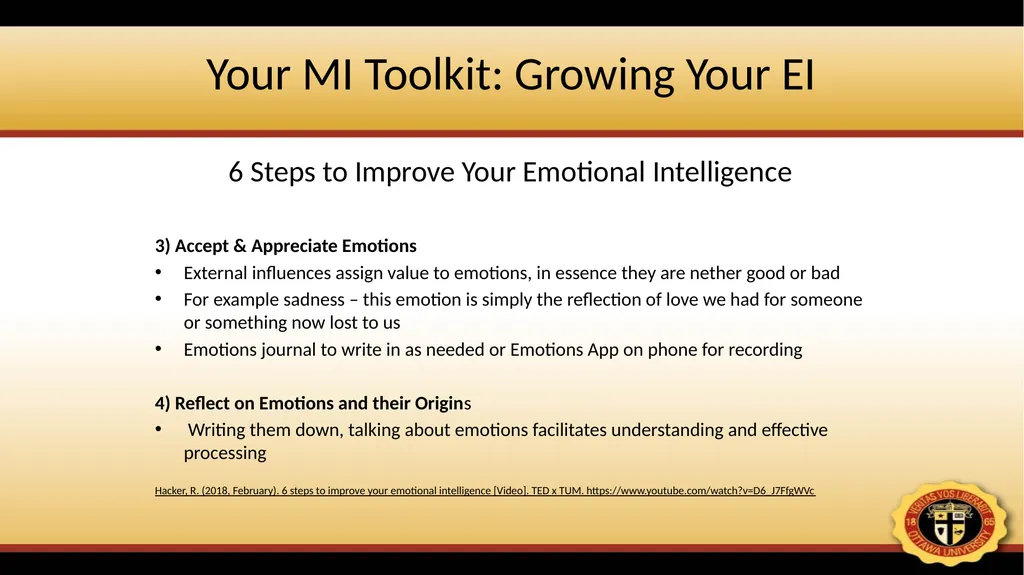
Your MI Toolkit: Growing Your EI 6 Steps to Improve Your Emotional Intelligence
3) Accept & Appreciate Emotions
External influences assign value to emotions, in essence they are nether good or bad
For example sadness – this emotion is simply the reflection of love we had for someone or something now lost to us
Emotions journal to write in as needed or Emotions App on phone for recording
4) Reflect on Emotions and their Origins
Writing them down, talking about emotions facilitates understanding and effective processing
Hacker, R. (2018, February). 6 steps to improve your emotional intelligence [Video]. TED x TUM. https://www.youtube.com/watch?v=D6_J7FfgWVc<br>
3) Accept & Appreciate Emotions
External influences assign value to emotions, in essence they are nether good or bad
For example sadness – this emotion is simply the reflection of love we had for someone or something now lost to us
Emotions journal to write in as needed or Emotions App on phone for recording
4) Reflect on Emotions and their Origins
Writing them down, talking about emotions facilitates understanding and effective processing
Hacker, R. (2018, February). 6 steps to improve your emotional intelligence [Video]. TED x TUM. https://www.youtube.com/watch?v=D6_J7FfgWVc<br>
23
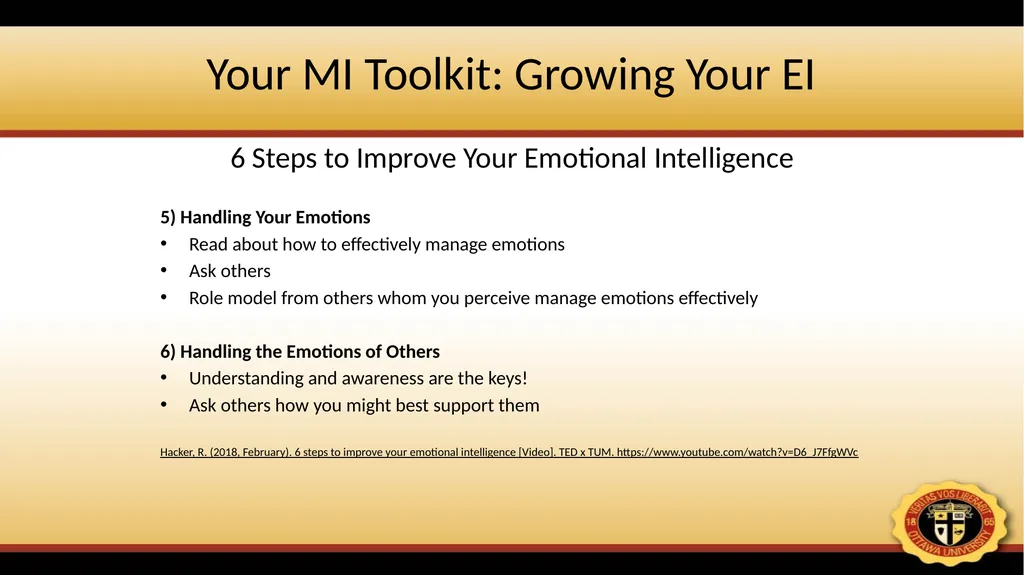
Your MI Toolkit: Growing Your EI 6 Steps to Improve Your Emotional Intelligence
5) Handling Your Emotions
Read about how to effectively manage emotions
Ask others
Role model from others whom you perceive manage emotions effectively
6) Handling the Emotions of Others
Understanding and awareness are the keys!
Ask others how you might best support them
Hacker, R. (2018, February). 6 steps to improve your emotional intelligence [Video]. TED x TUM. https://www.youtube.com/watch?v=D6_J7FfgWVc<br>
5) Handling Your Emotions
Read about how to effectively manage emotions
Ask others
Role model from others whom you perceive manage emotions effectively
6) Handling the Emotions of Others
Understanding and awareness are the keys!
Ask others how you might best support them
Hacker, R. (2018, February). 6 steps to improve your emotional intelligence [Video]. TED x TUM. https://www.youtube.com/watch?v=D6_J7FfgWVc<br>
24
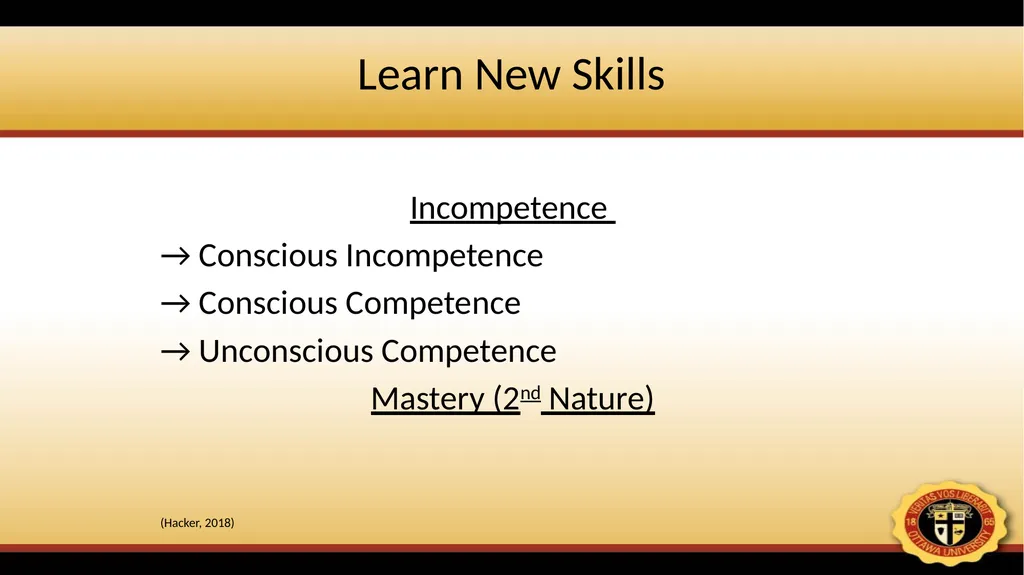
Learn New Skills Incompetence
→ Conscious Incompetence
→ Conscious Competence
→ Unconscious Competence
Mastery (2nd Nature)
(Hacker, 2018)<br>
→ Conscious Incompetence
→ Conscious Competence
→ Unconscious Competence
Mastery (2nd Nature)
(Hacker, 2018)<br>
25
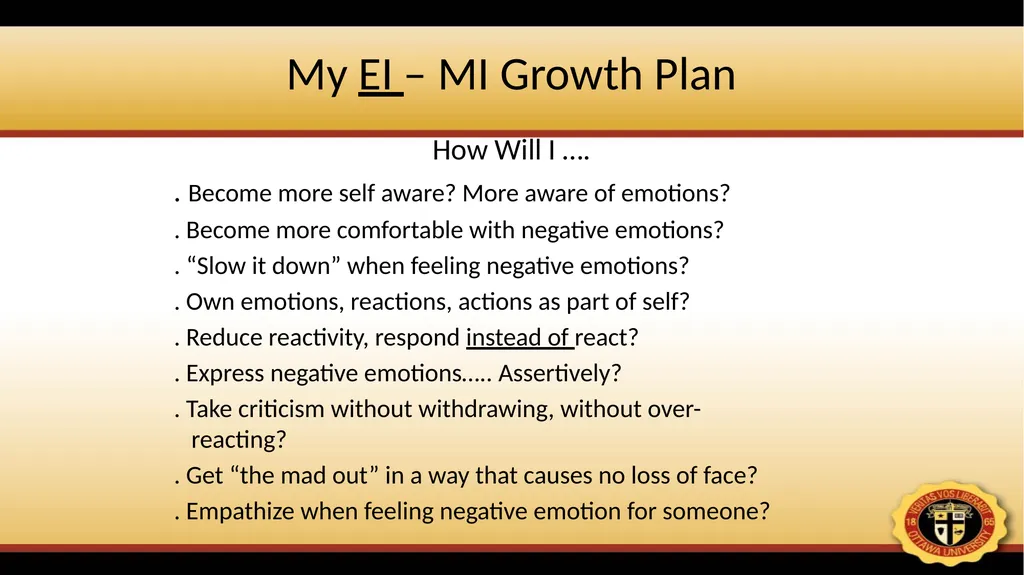
My EI – MI Growth Plan How Will I ….
. Become more self aware? More aware of emotions?
. Become more comfortable with negative emotions?
. “Slow it down” when feeling negative emotions?
. Own emotions, reactions, actions as part of self?
. Reduce reactivity, respond instead of react?
. Express negative emotions….. Assertively?
. Take criticism without withdrawing, without over- reacting?
. Get “the mad out” in a way that causes no loss of face?
. Empathize when feeling negative emotion for someone?<br>
. Become more self aware? More aware of emotions?
. Become more comfortable with negative emotions?
. “Slow it down” when feeling negative emotions?
. Own emotions, reactions, actions as part of self?
. Reduce reactivity, respond instead of react?
. Express negative emotions….. Assertively?
. Take criticism without withdrawing, without over- reacting?
. Get “the mad out” in a way that causes no loss of face?
. Empathize when feeling negative emotion for someone?<br>
26
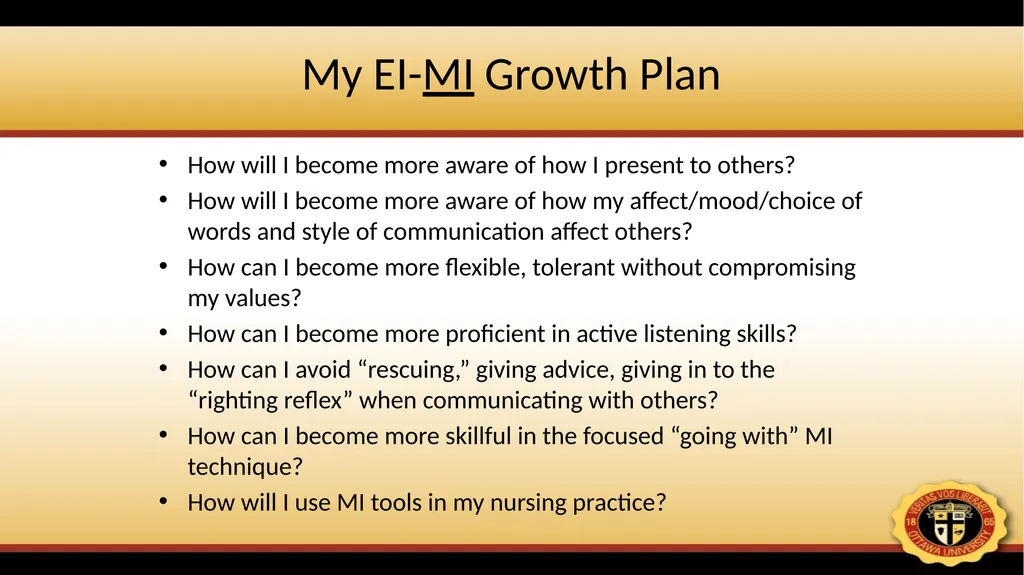
My EI-MI Growth Plan How will I become more aware of how I present to others?
How will I become more aware of how my affect/mood/choice of words and style of communication affect others?
How can I become more flexible, tolerant without compromising my values?
How can I become more proficient in active listening skills?
How can I avoid “rescuing,” giving advice, giving in to the “righting reflex” when communicating with others?
How can I become more skillful in the focused “going with” MI technique?
How will I use MI tools in my nursing practice?<br>
How will I become more aware of how my affect/mood/choice of words and style of communication affect others?
How can I become more flexible, tolerant without compromising my values?
How can I become more proficient in active listening skills?
How can I avoid “rescuing,” giving advice, giving in to the “righting reflex” when communicating with others?
How can I become more skillful in the focused “going with” MI technique?
How will I use MI tools in my nursing practice?<br>
27
Post-test Survey Link Please complete the Post-test for the “Emotional Intelligence & Motivational Interviewing: Essentials for Nurses” CNE at the Survey Planet link below, and upon completion, proceed to the next slide for Evaluation Survey instructions:
https://s.surveyplanet.com/99ux3sgt<br>
https://s.surveyplanet.com/99ux3sgt<br>
28
Evaluation Survey Link Please complete the Evaluation Survey for “Emotional Intelligence & Motivational Interviewing: Essentials for Nurses” CNE at the SurveyPlanet link below:
https://s.surveyplanet.com/8cgd3q1x<br>
https://s.surveyplanet.com/8cgd3q1x<br>
29
References Ackerman, C.E. (2018). How to improve emotional intelligence in the workplace. https://positivepsychology.com/emotional-intelligence-workplace/
BohoJack Press (2019). My mind is like my internet browser 19 tabs open 3 of them are frozen and I have no idea where the music is coming from. https://books.google.com/books/about/My_Mind_Is_Like_My_Internet_Browser_19_T.html?id=wCZjzQEACAAJ
Brown, S., & Kafka, A. (2020, July 2023). Covid-19 has worsened the student mental-health crisis. Can resilience training fix it? https://www.chronicle.com/article/covid-19-has-worsened-the-student-mental-health-crisis-can-resilience-training-fix-it/
Cahill, H., Beadle, S., Farrelly, A., Forster, R., and Smith, K. (2012). Building resilience in children and young people. https://www.education.vic.gov.au/Documents/about/department/resiliencelitreview.pdf
Craig, H. (2019). 17 Emotional Intelligence Tests and Assessments. https://positivepsychology.com/emotional-intelligence-tests/
DePaul University (n.d.). Emotional intelligence in the workplace. https://snlapps.depaul.edu/writing/Emotional%20Intelligence%20Training%20Manual.pdf
Droppa, M., & Lee, H. (2014). Motivational interviewing: A journey to improve health. Nursing 2014, 44(3), 40-45.
Goleman, D. (1995). Emotional intelligence. Bantam Books, New York.
Good Therapy (2022). Emotional Intelligence test | Online EQ test (free and paid). https://www.goodtherapy.org/tests/emotional-intelligence.html<br>
BohoJack Press (2019). My mind is like my internet browser 19 tabs open 3 of them are frozen and I have no idea where the music is coming from. https://books.google.com/books/about/My_Mind_Is_Like_My_Internet_Browser_19_T.html?id=wCZjzQEACAAJ
Brown, S., & Kafka, A. (2020, July 2023). Covid-19 has worsened the student mental-health crisis. Can resilience training fix it? https://www.chronicle.com/article/covid-19-has-worsened-the-student-mental-health-crisis-can-resilience-training-fix-it/
Cahill, H., Beadle, S., Farrelly, A., Forster, R., and Smith, K. (2012). Building resilience in children and young people. https://www.education.vic.gov.au/Documents/about/department/resiliencelitreview.pdf
Craig, H. (2019). 17 Emotional Intelligence Tests and Assessments. https://positivepsychology.com/emotional-intelligence-tests/
DePaul University (n.d.). Emotional intelligence in the workplace. https://snlapps.depaul.edu/writing/Emotional%20Intelligence%20Training%20Manual.pdf
Droppa, M., & Lee, H. (2014). Motivational interviewing: A journey to improve health. Nursing 2014, 44(3), 40-45.
Goleman, D. (1995). Emotional intelligence. Bantam Books, New York.
Good Therapy (2022). Emotional Intelligence test | Online EQ test (free and paid). https://www.goodtherapy.org/tests/emotional-intelligence.html<br>
30
References Hacker, R. (2018, February). 6 steps to improve your emotional intelligence [Video]. TED x TUM. https://www.youtube.com/watch?v=D6_J7FfgWVc
MacCann, C. (2020). Why you need emotional intelligence to succeed at school. https://www.psychologytoday.com/us/blog/dealing-emotions/202006/why-you-need-emotional-intelligence-succeed-school
Mayer, J.D., Salovey, P. (1997). What is emotional intelligence? In: Salovey, P., Sluyter, D.J. (Eds.), What is Emotional Intelligence? Basic Books, New York
Raihan, N., & Cogburn, M. (2022, update). Stages of change. Stat Pearls. https://www.ncbi.nlm.nih.gov/books/NBK556005/
Riopel, L. (2019). Emotional intelligence framework, charts, diagrams, and graphs. https://positivepsychology.com/emotional-intelligence-frameworks/
Rollnick, S., Miller, & W. R. (1995). What is Motivational Interviewing?". Behavioural and Cognitive Psychotherapy, 23(4), 325-334.
Shannon, S, Smith, V. J., & Gregory, J.W. (2003). A pilot study of motivational interviewing in adolescents with diabetes. Archives of Disease in Childhood, 88(8), 680-683.
Smith, K.B., Cummings, G.G., & Profetto-McGrath (2009). Emotional intelligence and nursing: An integrative review. International Journal of Nursing Studies, 46, 1624-1636.
State of Colorado. Division of Criminal Justice (n.d.). The 4 processes of MI. https://cdpsdocs.state.co.us/epic/epicwebsite/resources/mi_communities_of_practice/4_processes/4_processes.pdf<br>
MacCann, C. (2020). Why you need emotional intelligence to succeed at school. https://www.psychologytoday.com/us/blog/dealing-emotions/202006/why-you-need-emotional-intelligence-succeed-school
Mayer, J.D., Salovey, P. (1997). What is emotional intelligence? In: Salovey, P., Sluyter, D.J. (Eds.), What is Emotional Intelligence? Basic Books, New York
Raihan, N., & Cogburn, M. (2022, update). Stages of change. Stat Pearls. https://www.ncbi.nlm.nih.gov/books/NBK556005/
Riopel, L. (2019). Emotional intelligence framework, charts, diagrams, and graphs. https://positivepsychology.com/emotional-intelligence-frameworks/
Rollnick, S., Miller, & W. R. (1995). What is Motivational Interviewing?". Behavioural and Cognitive Psychotherapy, 23(4), 325-334.
Shannon, S, Smith, V. J., & Gregory, J.W. (2003). A pilot study of motivational interviewing in adolescents with diabetes. Archives of Disease in Childhood, 88(8), 680-683.
Smith, K.B., Cummings, G.G., & Profetto-McGrath (2009). Emotional intelligence and nursing: An integrative review. International Journal of Nursing Studies, 46, 1624-1636.
State of Colorado. Division of Criminal Justice (n.d.). The 4 processes of MI. https://cdpsdocs.state.co.us/epic/epicwebsite/resources/mi_communities_of_practice/4_processes/4_processes.pdf<br>
31
References The Highly Effective Teacher. (2021). Is resilience the key to student success? https://thehighlyeffectiveteacher.com/how-to-promote-resilience-in-your-students/<br>
32
Instructions for CNE Certificate Your certificate will be emailed to you upon completion of the post test and evaluation
Thank you for participating!
We wish you the very best<br>
Thank you for participating!
We wish you the very best<br>