
Engaged qualitative research: Epistemologies
LS
Published · 29 slides · 0 views

1 / 1









Description
Engaged qualitative research: Epistemologies Silvia Masiero silvimaifi.uio.no IN4340 Engaged Qualitative Research Methods 30.08.2023 From last week bring-your-own-lunch class! Open-door office hours - NEMKO, room HBU036 Or drop me an
Related Topics
Share
Embed code
Download this presentation From Below
"Engaged qualitative research: Epistemologies" is the property of its rightful owner. Permission is granted to download and print the materials on this website for personal, non-commercial use only, and to display it on your personal computer provided you do not modify the materials and that you retain all copyright notices contained in the materials. By downloading content from our website, you accept the terms of this agreement.
Presentation Transcript
01
Engaged qualitative research: Epistemologies Silvia Masiero
silvima@ifi.uio.no IN4340 – Engaged Qualitative Research Methods
30.08.2023<br>
silvima@ifi.uio.no IN4340 – Engaged Qualitative Research Methods
30.08.2023<br>
02
From last week… …bring-your-own-lunch class!
Open-door office hours - NEMKO, room HBU036
Or drop me an email: silvima@ifi.uio.no<br>
Open-door office hours - NEMKO, room HBU036
Or drop me an email: silvima@ifi.uio.no<br>
03
Overview What is epistemology?
The structuring elements of social research
Epistemology: three core paradigms
How does epistemology inform research?<br>
The structuring elements of social research
Epistemology: three core paradigms
How does epistemology inform research?<br>
04
After this lecture, you can… Define epistemology and explain its importance in the context of research design
Distinguish the three main epistemologies of social research, and discuss the tenets and core assumptions associated to each of them
Reflect on your own epistemological position, and use such a reflection to make fundamental choices on the methodology of your research.<br>
Distinguish the three main epistemologies of social research, and discuss the tenets and core assumptions associated to each of them
Reflect on your own epistemological position, and use such a reflection to make fundamental choices on the methodology of your research.<br>
05
What is epistemology?<br>
06
What is epistemology? Epistemology: our assumptions about knowledge and how it can be obtained (Myers, 1997)
What do we consider to be valid knowledge?<br>
What do we consider to be valid knowledge?<br>
07
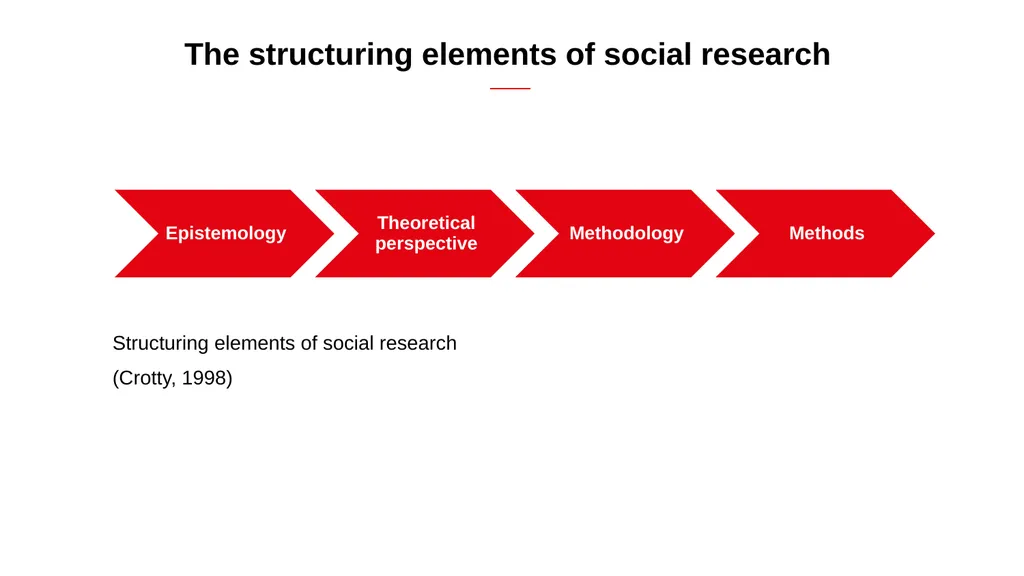
The structuring elements of social research Structuring elements of social research
(Crotty, 1998)<br>
(Crotty, 1998)<br>
08
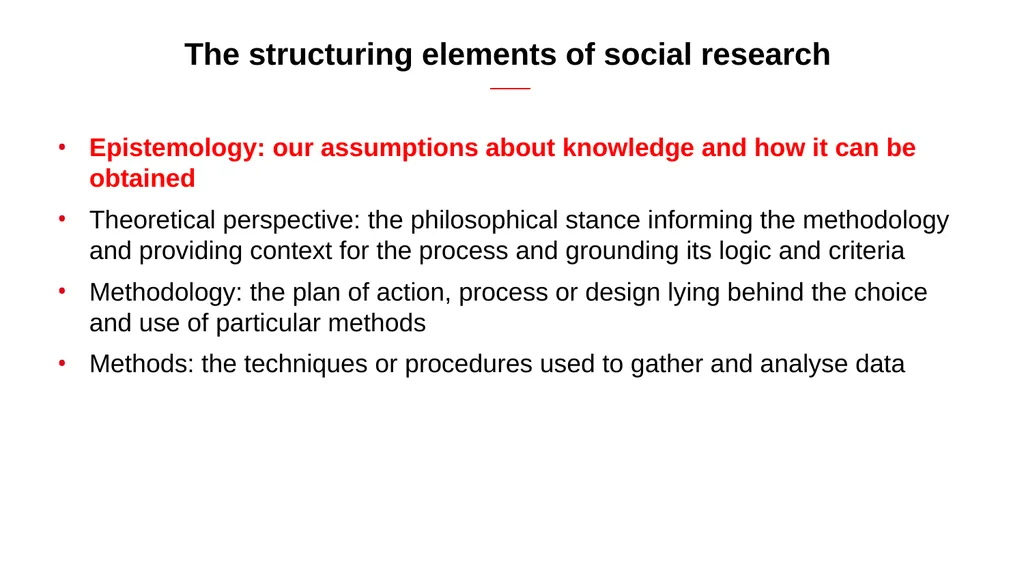
The structuring elements of social research Epistemology: our assumptions about knowledge and how it can be obtained
Theoretical perspective: the philosophical stance informing the methodology and providing context for the process and grounding its logic and criteria
Methodology: the plan of action, process or design lying behind the choice and use of particular methods
Methods: the techniques or procedures used to gather and analyse data<br>
Theoretical perspective: the philosophical stance informing the methodology and providing context for the process and grounding its logic and criteria
Methodology: the plan of action, process or design lying behind the choice and use of particular methods
Methods: the techniques or procedures used to gather and analyse data<br>
09
So… All research is based on some underlying assumptions about what constitutes valid knowledge and which research methods are appropriate.
Epistemology specifies such assumptions and therefore, needs to be clarified before deciding on the methodology of our research.<br>
Epistemology specifies such assumptions and therefore, needs to be clarified before deciding on the methodology of our research.<br>
10
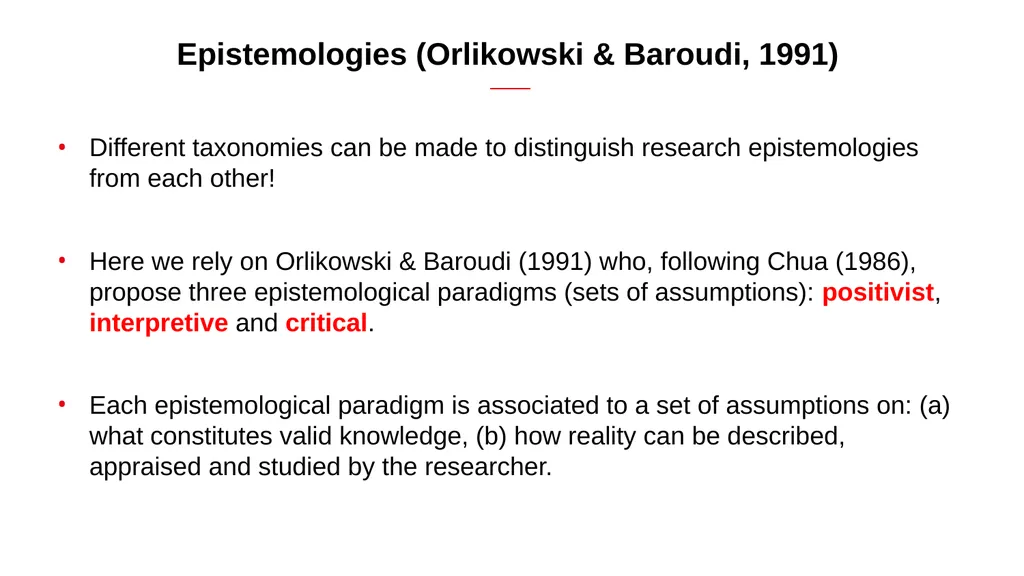
Epistemologies (Orlikowski & Baroudi, 1991) Different taxonomies can be made to distinguish research epistemologies from each other!
Here we rely on Orlikowski & Baroudi (1991) who, following Chua (1986), propose three epistemological paradigms (sets of assumptions): positivist, interpretive and critical.
Each epistemological paradigm is associated to a set of assumptions on: (a) what constitutes valid knowledge, (b) how reality can be described, appraised and studied by the researcher.<br>
Here we rely on Orlikowski & Baroudi (1991) who, following Chua (1986), propose three epistemological paradigms (sets of assumptions): positivist, interpretive and critical.
Each epistemological paradigm is associated to a set of assumptions on: (a) what constitutes valid knowledge, (b) how reality can be described, appraised and studied by the researcher.<br>
11
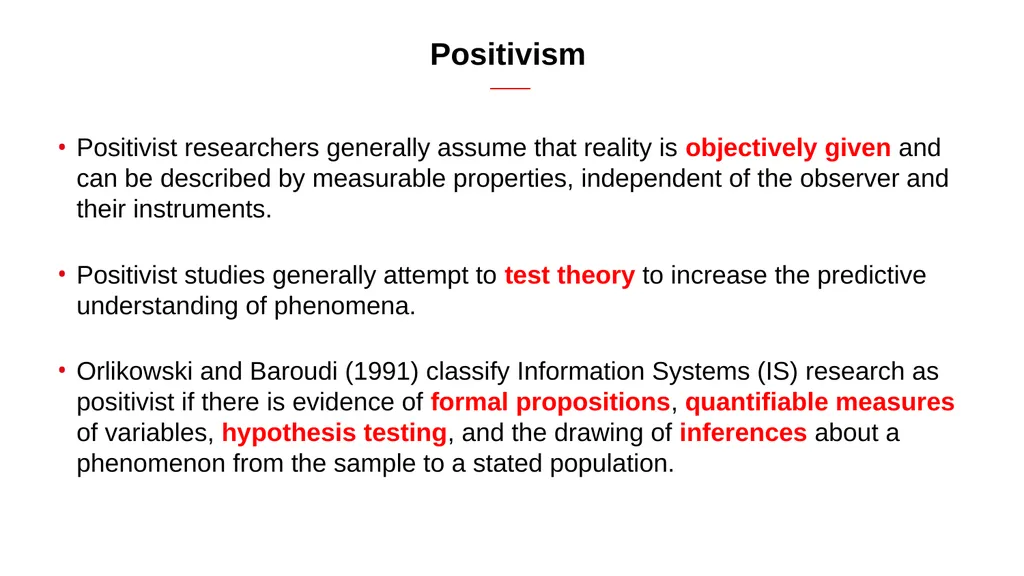
Positivism Positivist researchers generally assume that reality is objectively given and can be described by measurable properties, independent of the observer and their instruments.
Positivist studies generally attempt to test theory to increase the predictive understanding of phenomena.
Orlikowski and Baroudi (1991) classify Information Systems (IS) research as positivist if there is evidence of formal propositions, quantifiable measures of variables, hypothesis testing, and the drawing of inferences about a phenomenon from the sample to a stated population.<br>
Positivist studies generally attempt to test theory to increase the predictive understanding of phenomena.
Orlikowski and Baroudi (1991) classify Information Systems (IS) research as positivist if there is evidence of formal propositions, quantifiable measures of variables, hypothesis testing, and the drawing of inferences about a phenomenon from the sample to a stated population.<br>
12
Interpretivism Interpretive researchers start out with the assumption that access to reality (given or socially constructed) is only through social constructions such as language, consciousness and shared meanings.
Interpretive studies generally attempt to understand phenomena through the meanings that people assign to them: “what we call our data are really our own constructions of other people’s constructions of what they and their compatriots are up to” (Geertz, 1973, cited in Walsham, 2006: 320).
An interpretive epistemology is associated to methodologies that allow researchers to access such interpretations.<br>
Interpretive studies generally attempt to understand phenomena through the meanings that people assign to them: “what we call our data are really our own constructions of other people’s constructions of what they and their compatriots are up to” (Geertz, 1973, cited in Walsham, 2006: 320).
An interpretive epistemology is associated to methodologies that allow researchers to access such interpretations.<br>
13
Critical Critical researchers assume that social reality is historically constituted and that it is produced and reproduced by people.
Although people can consciously act to change their social and economic circumstances, critical researchers recognise that their ability to do so is constrained by forms of social, cultural and political domination.
The core task of critical research is seen as being one of theorisation and transformation, where the restrictive and alienating conditions of the status quo are brought to light and challenged.<br>
Although people can consciously act to change their social and economic circumstances, critical researchers recognise that their ability to do so is constrained by forms of social, cultural and political domination.
The core task of critical research is seen as being one of theorisation and transformation, where the restrictive and alienating conditions of the status quo are brought to light and challenged.<br>
14
…a clear distinction?<br>
15
To recap… To answer the question on “which methodology” to use in our research, we first need to clarify our assumptions on what constitutes valid knowledge and how it is produced.
Here we follow the IS field convention (Orlikowski & Baroudi, 1991) that identifies three main epistemologies: positivist, interpretive and critical.
Our choices in terms of methodology – and, flowing from it, the methods for data collection and analysis – will be developed in coherence with our epistemological views.<br>
Here we follow the IS field convention (Orlikowski & Baroudi, 1991) that identifies three main epistemologies: positivist, interpretive and critical.
Our choices in terms of methodology – and, flowing from it, the methods for data collection and analysis – will be developed in coherence with our epistemological views.<br>
16
HISP MSc Theses Past MSc theses at HISP: https://www.mn.uio.no/ifi/english/research/groups/is/research-library/masters-theses/index.html
HISP Research Library:
https://www.mn.uio.no/ifi/english/research/groups/is/research-library/<br>
HISP Research Library:
https://www.mn.uio.no/ifi/english/research/groups/is/research-library/<br>
17
How does epistemology inform research?<br>
18
Introducing digital health research<br>
19
Introducing digital health research Digital health: a research field dedicated to realising digital technologies' potential in relation to health, and developing knowledge about their feasibility and impacts (Nielsen & Sahay, 2022)
Issue-oriented rather than theory-driven: the research field is defined by its objects of interest rather that its theories.
This makes digital health a heterogeneous field, characterised by multidisciplinary journals and a plethora of research topics, drawn together by a common interest in the relation between health and digital technology.
For a review of the digital health field: Nielsen & Sahay, 2022<br>
Issue-oriented rather than theory-driven: the research field is defined by its objects of interest rather that its theories.
This makes digital health a heterogeneous field, characterised by multidisciplinary journals and a plethora of research topics, drawn together by a common interest in the relation between health and digital technology.
For a review of the digital health field: Nielsen & Sahay, 2022<br>
20
Digital health: a positivist study Plenty of instances of positivist digital health research!
An example: “The Impact of Health Information Sharing on Duplicate Testing”, Ayabakan et al. (2017), MIS Quarterly
Motivation: healthcare reform has focused on reducing excessive waste in the U.S. healthcare system, largely caused by duplicate testing
Hypothesis: health information sharing technologies will reduce the duplication rate, more for radiology tests compared to laboratory tests
Data: panel dataset of 39,600 patient visits from 2005 to 2012
Results: usage of information sharing technologies is associated with lower duplication rates, and reduction in duplicate tests is more pronounced among radiology tests compared to laboratory tests.<br>
An example: “The Impact of Health Information Sharing on Duplicate Testing”, Ayabakan et al. (2017), MIS Quarterly
Motivation: healthcare reform has focused on reducing excessive waste in the U.S. healthcare system, largely caused by duplicate testing
Hypothesis: health information sharing technologies will reduce the duplication rate, more for radiology tests compared to laboratory tests
Data: panel dataset of 39,600 patient visits from 2005 to 2012
Results: usage of information sharing technologies is associated with lower duplication rates, and reduction in duplicate tests is more pronounced among radiology tests compared to laboratory tests.<br>
21
Digital health: a positivist study Here we have…
Formal propositions
Quantifiable measures of variables
Hypothesis testing
Inferences drawn from a sample to a population
Object of the study described by measurable properties<br>
Formal propositions
Quantifiable measures of variables
Hypothesis testing
Inferences drawn from a sample to a population
Object of the study described by measurable properties<br>
22
Digital health: an interpretive study The predominant approach at the HISP centre!
An example: “Introducing online training for health staff: An institutional perspective”, Chrysantina, Sæbø & Kaasbøll (2022), Electronic Journal of Information Systems in Developing Countries
Motivation: study of how the introduction of online training in health centres in Indonesia affected changes to training practices
Data: engagement of the first author with three projects centered on the introduction of a software platform to strengthen health information management systems in Indonesia
Close engagement of the first author with the research object: active participation in the implementation project, interviews with key actors, direct interaction with the ecosystem where the project was implemented.<br>
An example: “Introducing online training for health staff: An institutional perspective”, Chrysantina, Sæbø & Kaasbøll (2022), Electronic Journal of Information Systems in Developing Countries
Motivation: study of how the introduction of online training in health centres in Indonesia affected changes to training practices
Data: engagement of the first author with three projects centered on the introduction of a software platform to strengthen health information management systems in Indonesia
Close engagement of the first author with the research object: active participation in the implementation project, interviews with key actors, direct interaction with the ecosystem where the project was implemented.<br>
23
Here we have… Phenomena understood through the meanings that people assign to them: long conversations with the implementers, direct observation of training and of the reaction of participants to the introduction of a new technology
A direct window on the reality perceived by participants: deep immersion in the field context, close appraisal of the lived experience of implementation.<br>
A direct window on the reality perceived by participants: deep immersion in the field context, close appraisal of the lived experience of implementation.<br>
24
Digital health: a critical study Directly engages the alienating, oppressing conditions of the status quo
An example: “Power and resistance in the implementation of a medical management information system”, Doolin (2004), Information Systems Journal
Motivation: diffusion of information systems that scrutinise the work of doctors, resulting in potentially unfair surveillance practices
Study: direct engagement of the author, through fieldwork, with the new forms of surveillance encountered by doctors, but also with the new forms of resistance with which these were met.
Explicitly critical of the surveillance structures imposed over doctors’ work, challenging a status quo perceived as oppressive.<br>
An example: “Power and resistance in the implementation of a medical management information system”, Doolin (2004), Information Systems Journal
Motivation: diffusion of information systems that scrutinise the work of doctors, resulting in potentially unfair surveillance practices
Study: direct engagement of the author, through fieldwork, with the new forms of surveillance encountered by doctors, but also with the new forms of resistance with which these were met.
Explicitly critical of the surveillance structures imposed over doctors’ work, challenging a status quo perceived as oppressive.<br>
25
…what about you?<br>
26
Epistemological journeys! Sometimes research leads us to transition from an epistemology to the other, as a result of increased awareness of the object of our research.
For example, a researcher initially adopting an interpretive epistemology may move towards a critical one, if they recognise fundamental issues of oppression and alienation in the systems they research.<br>
For example, a researcher initially adopting an interpretive epistemology may move towards a critical one, if they recognise fundamental issues of oppression and alienation in the systems they research.<br>
27
To recap… In this lecture we have met a core component of research design, epistemology, and discussed its importance in establishing what we consider to be valid knowledge.
We have introduced the three main paradigms of positivist, interpretivist and critical research, with their core assumptions and the implications of each for how research is made.
This knowledge will equip us to study research methodologies, and it prepares you to reflect on the epistemological position that you will adopt in your research!<br>
We have introduced the three main paradigms of positivist, interpretivist and critical research, with their core assumptions and the implications of each for how research is made.
This knowledge will equip us to study research methodologies, and it prepares you to reflect on the epistemological position that you will adopt in your research!<br>
28
Thank you! silvima@ifi.uio.no<br>
29
Readings Core Reading
Myers, M. D. (1997). Qualitative Research in Information Systems. MISQ Discovery, 1-18.
Orlikowski, W. J., & Baroudi, J. J. (1991). Studying information technology in organizations: Research approaches and assumptions. Information Systems Research, 2(1), 1-28.
Supplementary Reading
Myers, M. D., & Avison, D. (Eds.). (2002). Qualitative Research in Information Systems: A Reader. London: Sage. Chapter 4.
Crotty, M. (1998). The foundations of social research: Meaning and perspective in the research process. Thousand Oaks: Sage. Chapter 1.<br>
Myers, M. D. (1997). Qualitative Research in Information Systems. MISQ Discovery, 1-18.
Orlikowski, W. J., & Baroudi, J. J. (1991). Studying information technology in organizations: Research approaches and assumptions. Information Systems Research, 2(1), 1-28.
Supplementary Reading
Myers, M. D., & Avison, D. (Eds.). (2002). Qualitative Research in Information Systems: A Reader. London: Sage. Chapter 4.
Crotty, M. (1998). The foundations of social research: Meaning and perspective in the research process. Thousand Oaks: Sage. Chapter 1.<br>