
English Language Live Lesson Lesson 5 Creating an
GB
Published · 53 slides · 0 views

1 / 1



Description
English Language Live Lesson Lesson 5 Creating an Effective Narrative June 2020 1 Introduction I am Rebecca White and I will be hosting the session today. I am a Head of English and my aim is help you develop your narrative writing skills.
Related Topics
Share
Embed code
Download this presentation From Below
"English Language Live Lesson Lesson 5 Creating an" is the property of its rightful owner. Permission is granted to download and print the materials on this website for personal, non-commercial use only, and to display it on your personal computer provided you do not modify the materials and that you retain all copyright notices contained in the materials. By downloading content from our website, you accept the terms of this agreement.
Presentation Transcript
01
English Language
Live Lesson
Lesson 5
Creating an Effective Narrative June 2020 1<br>
02
Introduction I am Rebecca White and I will be hosting the session today. I am a Head of English and my aim is help you develop your narrative writing skills.
For today’s session all you will need is a pen and some paper.
You may also find it useful to have a dictionary to hand. 2<br>
For today’s session all you will need is a pen and some paper.
You may also find it useful to have a dictionary to hand. 2<br>
03
Community Rules We take safe-guarding seriously and we expect everyone to treat each other with respect.
We will take appropriate actions if we feel this is needed. 3<br>
We will take appropriate actions if we feel this is needed. 3<br>
04
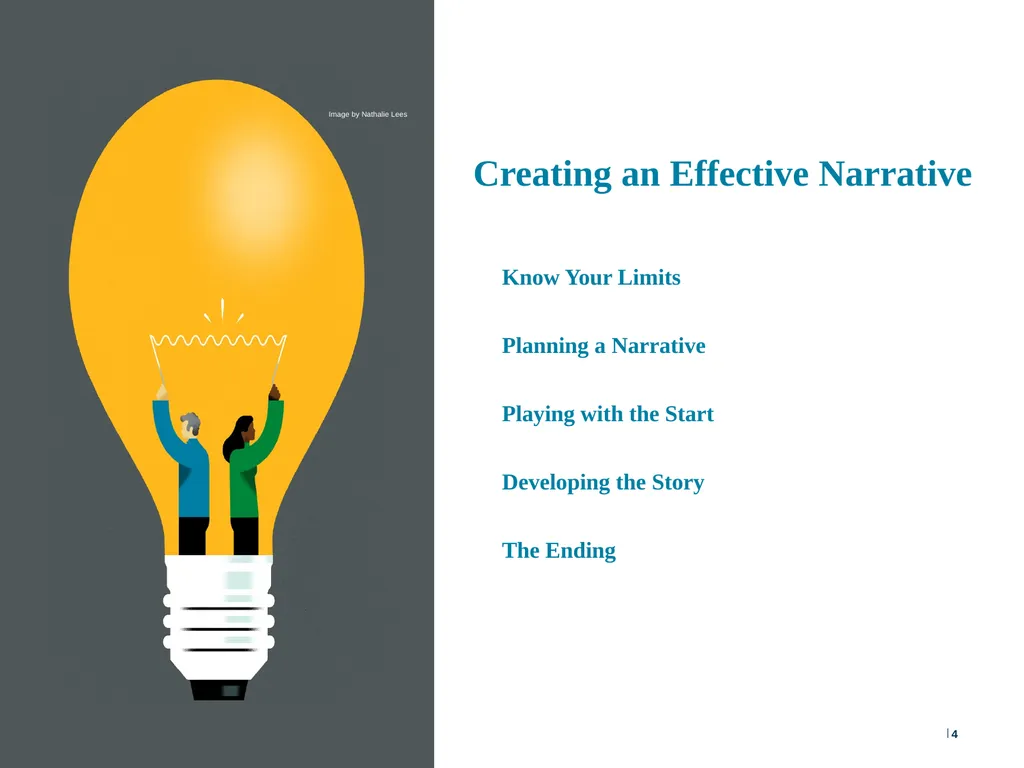
Creating an Effective Narrative Know Your Limits
Planning a Narrative
Playing with the Start
Developing the Story
The Ending 4 Image by Nathalie Lees<br>
Planning a Narrative
Playing with the Start
Developing the Story
The Ending 4 Image by Nathalie Lees<br>
05
How this will work…. Any sentence written in blue indicates an activity for you to do. For example:
Write down a list of what you think makes a good story.
2) Any task written in purple is designed to be more of an extension task. These are tasks that are more challenging and ones you may want to revisit after the lesson.
3) Key terms will be written in red. There will be a glossary of these terms at the end of each lesson as well as explanations as we go along. 5<br>
Write down a list of what you think makes a good story.
2) Any task written in purple is designed to be more of an extension task. These are tasks that are more challenging and ones you may want to revisit after the lesson.
3) Key terms will be written in red. There will be a glossary of these terms at the end of each lesson as well as explanations as we go along. 5<br>
06
Today’s Tasks Write a narrative inspired by an image of your choice.
Write a story with the title ‘The Silent Writer’
Write about a time when you did something that made you feel proud. 6<br>
Write a story with the title ‘The Silent Writer’
Write about a time when you did something that made you feel proud. 6<br>
07
Know Your Limits<br>
08
Know Your Limits In your exam, you will have to plan, write, proof-read and edit an entire narrative under fairly restrictive time conditions.
You MUST take this into account before you start writing. 8<br>
You MUST take this into account before you start writing. 8<br>
09
Characters You will not have time to do multiple characters justice.
Try and stick with one or two main characters only.
Think about the following scene: An alien spaceship has landed in the centre of town.
What would people say about it?
How would this scene look in a piece of
narrative writing?
Clearly, with several characters, it would
take a lot of words to convey all their opinions. 9<br>
Try and stick with one or two main characters only.
Think about the following scene: An alien spaceship has landed in the centre of town.
What would people say about it?
How would this scene look in a piece of
narrative writing?
Clearly, with several characters, it would
take a lot of words to convey all their opinions. 9<br>
10
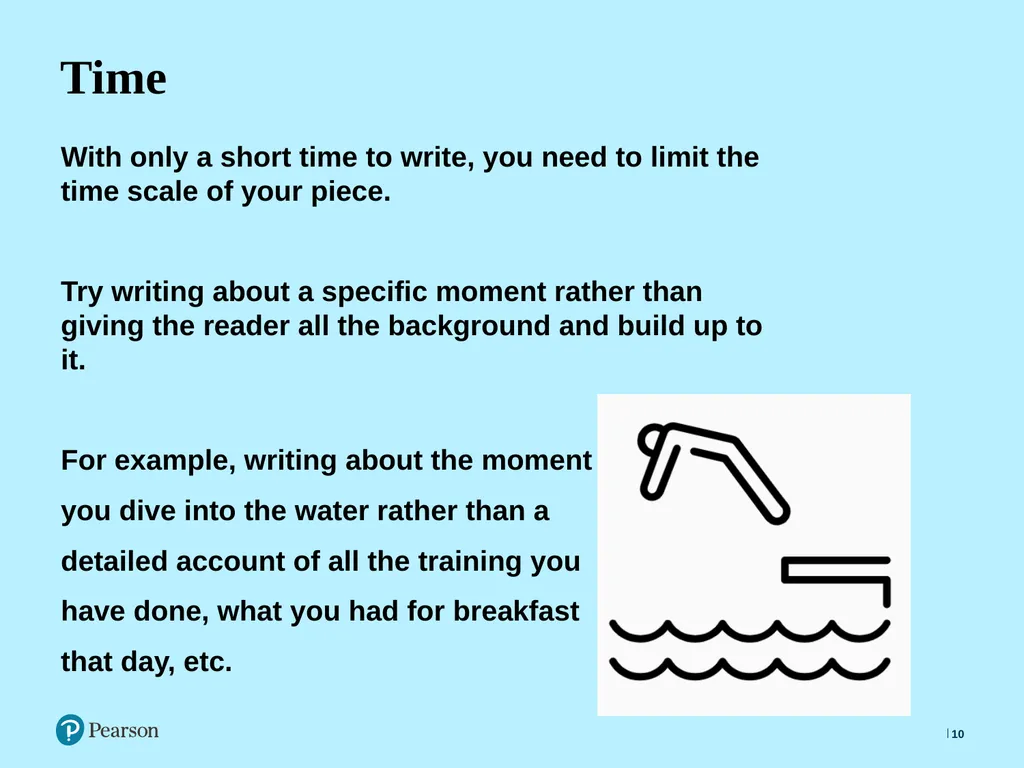
Time With only a short time to write, you need to limit the time scale of your piece.
Try writing about a specific moment rather than giving the reader all the background and build up to it.
For example, writing about the moment
you dive into the water rather than a
detailed account of all the training you
have done, what you had for breakfast
that day, etc. 10<br>
Try writing about a specific moment rather than giving the reader all the background and build up to it.
For example, writing about the moment
you dive into the water rather than a
detailed account of all the training you
have done, what you had for breakfast
that day, etc. 10<br>
11
Events Limit the number of main events within your story.
You won’t have the time to cover multiple events with enough detail to make them compelling.
Sticking with the diving example, you only want to focus on the dive of your main character rather than trying to describe the dives of the competition in detail. 11<br>
You won’t have the time to cover multiple events with enough detail to make them compelling.
Sticking with the diving example, you only want to focus on the dive of your main character rather than trying to describe the dives of the competition in detail. 11<br>
12
Settings As with the other elements, you will not have time to cover a multitude of settings.
Stick with one or two and make sure they are the most relevant settings to your story.
Think about how much detail you need to describe the setting.
Can you describe your character’s reaction to the setting? 12<br>
Stick with one or two and make sure they are the most relevant settings to your story.
Think about how much detail you need to describe the setting.
Can you describe your character’s reaction to the setting? 12<br>
13
Read Flash Fiction Flash Fiction - extremely short stories.
Looking at how other writers create complete narratives in few words is a really useful way of stealing ideas for your own narratives.
Make sure you select versions that are suitable for your exam.
Some Flash Fiction examples are only a handful of words long – obviously, this wouldn’t be appropriate. 13<br>
Looking at how other writers create complete narratives in few words is a really useful way of stealing ideas for your own narratives.
Make sure you select versions that are suitable for your exam.
Some Flash Fiction examples are only a handful of words long – obviously, this wouldn’t be appropriate. 13<br>
14
Planning a Narrative<br>
15
Make a list of all the things you have to think about when writing a narrative.
Clearly, with so much to think about, having a plan becomes essential. 15 Writing an Effective Narrative<br>
Clearly, with so much to think about, having a plan becomes essential. 15 Writing an Effective Narrative<br>
16
For your exam piece, you will need to produce a complete narrative.
Before you begin writing, you need to be confident about how the story will end so that you have something to drive towards in your narrative.
Your planning should sketch out the start, middle and end of your piece. 16 Planning - Plot<br>
Before you begin writing, you need to be confident about how the story will end so that you have something to drive towards in your narrative.
Your planning should sketch out the start, middle and end of your piece. 16 Planning - Plot<br>
17
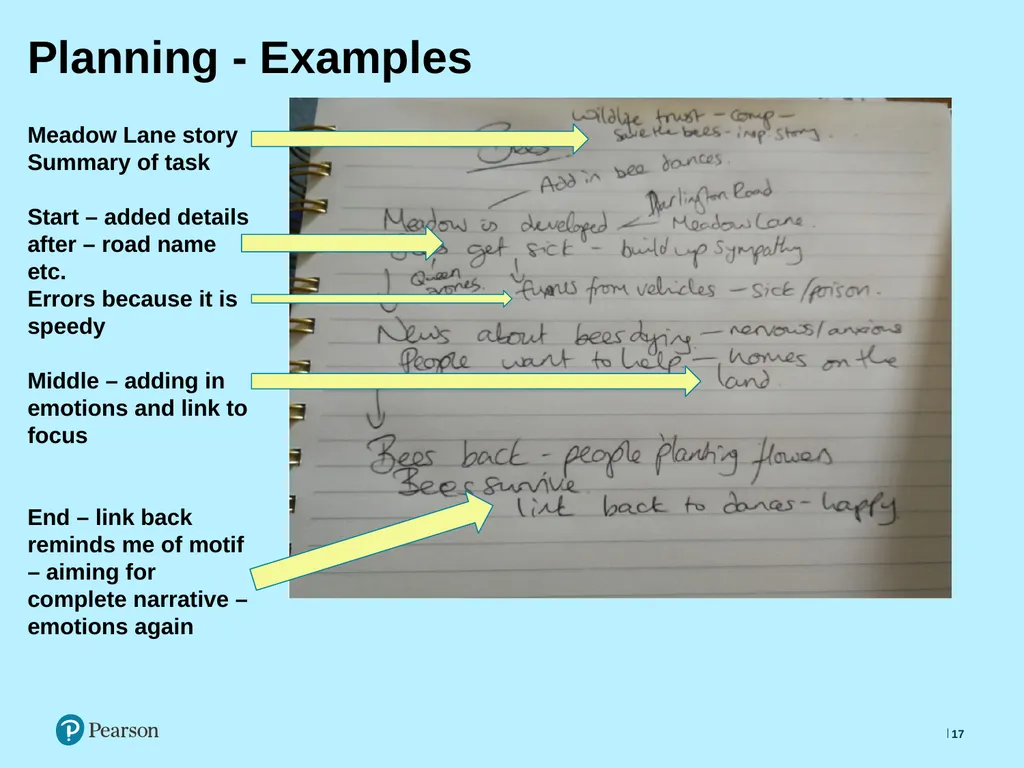
17 Planning - Examples Meadow Lane story
Summary of task
Start – added details after – road name etc.
Errors because it is speedy
Middle – adding in emotions and link to focus
End – link back reminds me of motif – aiming for complete narrative – emotions again<br>
Summary of task
Start – added details after – road name etc.
Errors because it is speedy
Middle – adding in emotions and link to focus
End – link back reminds me of motif – aiming for complete narrative – emotions again<br>
18
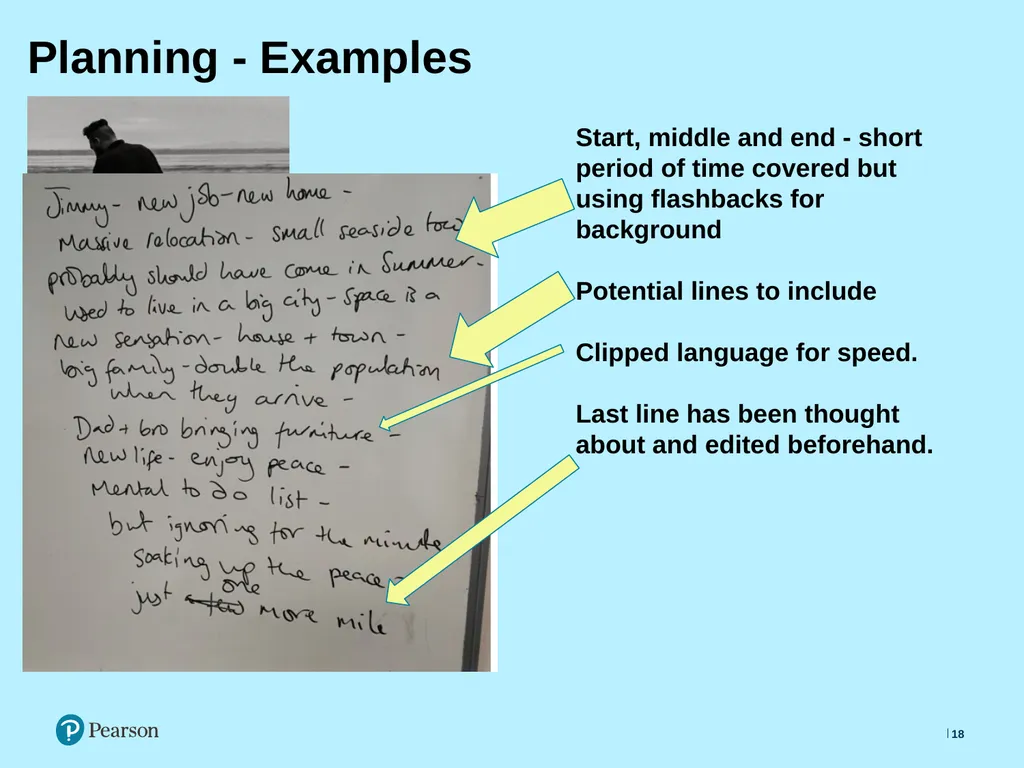
18 Planning - Examples Image from Unsplash.com Start, middle and end - short period of time covered but using flashbacks for background
Potential lines to include
Clipped language for speed.
Last line has been thought about and edited beforehand.<br>
Potential lines to include
Clipped language for speed.
Last line has been thought about and edited beforehand.<br>
19
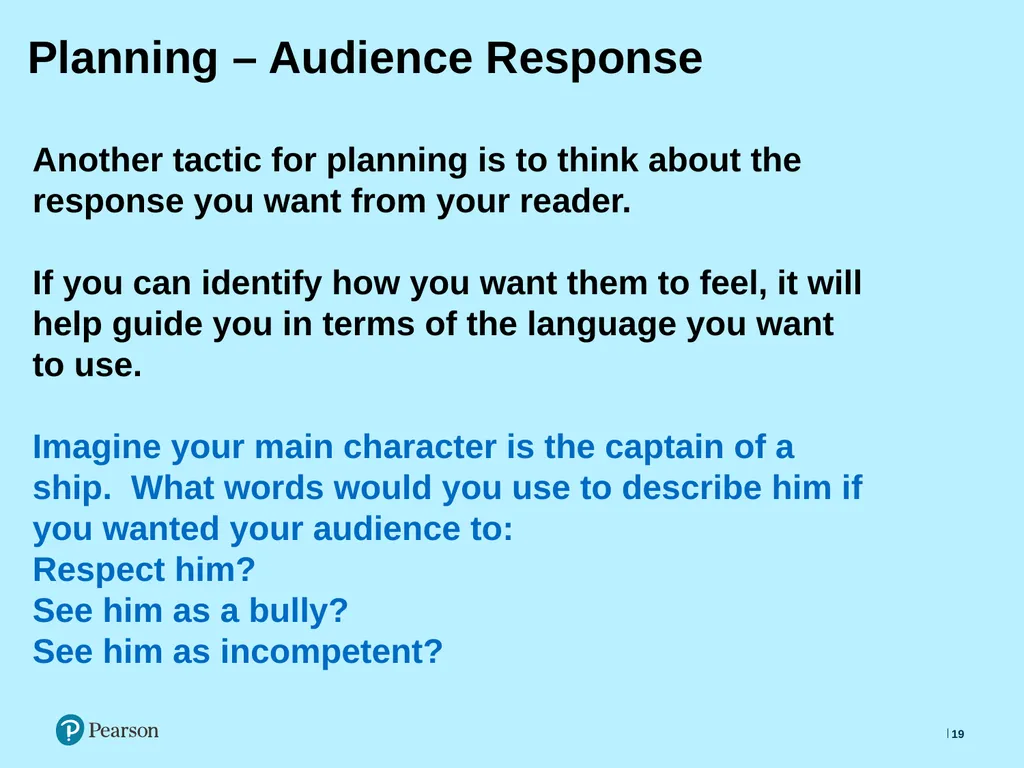
Another tactic for planning is to think about the response you want from your reader.
If you can identify how you want them to feel, it will help guide you in terms of the language you want to use.
Imagine your main character is the captain of a ship. What words would you use to describe him if you wanted your audience to:
Respect him?
See him as a bully?
See him as incompetent? 19 Planning – Audience Response<br>
If you can identify how you want them to feel, it will help guide you in terms of the language you want to use.
Imagine your main character is the captain of a ship. What words would you use to describe him if you wanted your audience to:
Respect him?
See him as a bully?
See him as incompetent? 19 Planning – Audience Response<br>
20
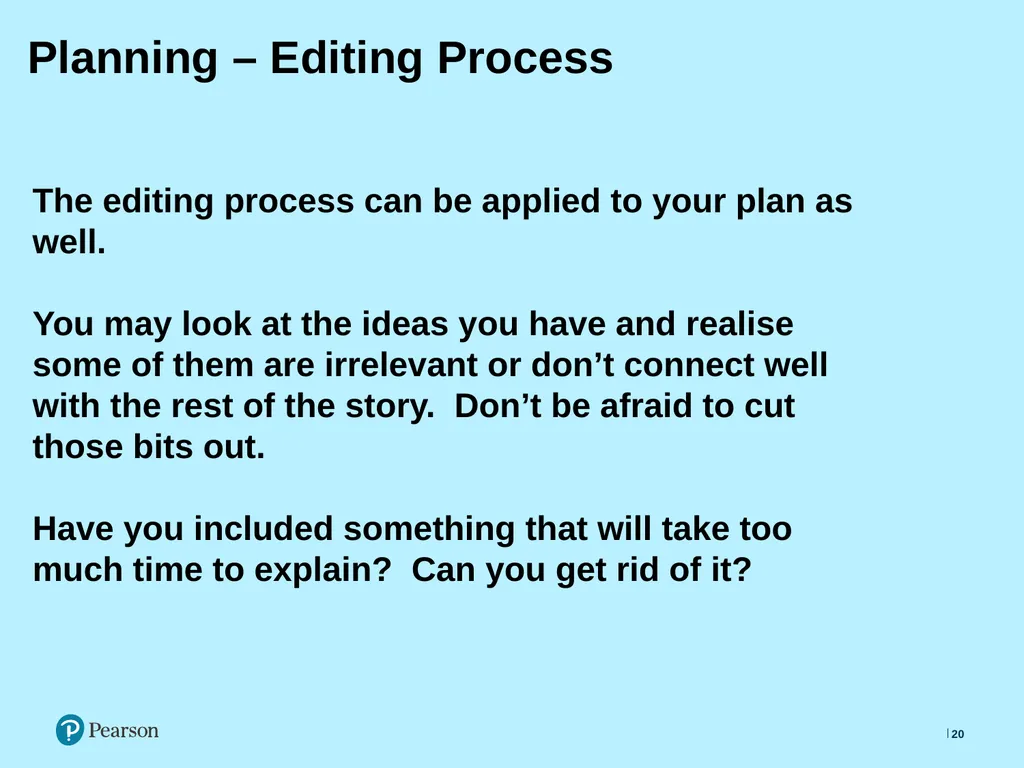
The editing process can be applied to your plan as well.
You may look at the ideas you have and realise some of them are irrelevant or don’t connect well with the rest of the story. Don’t be afraid to cut those bits out.
Have you included something that will take too much time to explain? Can you get rid of it? 20 Planning – Editing Process<br>
You may look at the ideas you have and realise some of them are irrelevant or don’t connect well with the rest of the story. Don’t be afraid to cut those bits out.
Have you included something that will take too much time to explain? Can you get rid of it? 20 Planning – Editing Process<br>
21
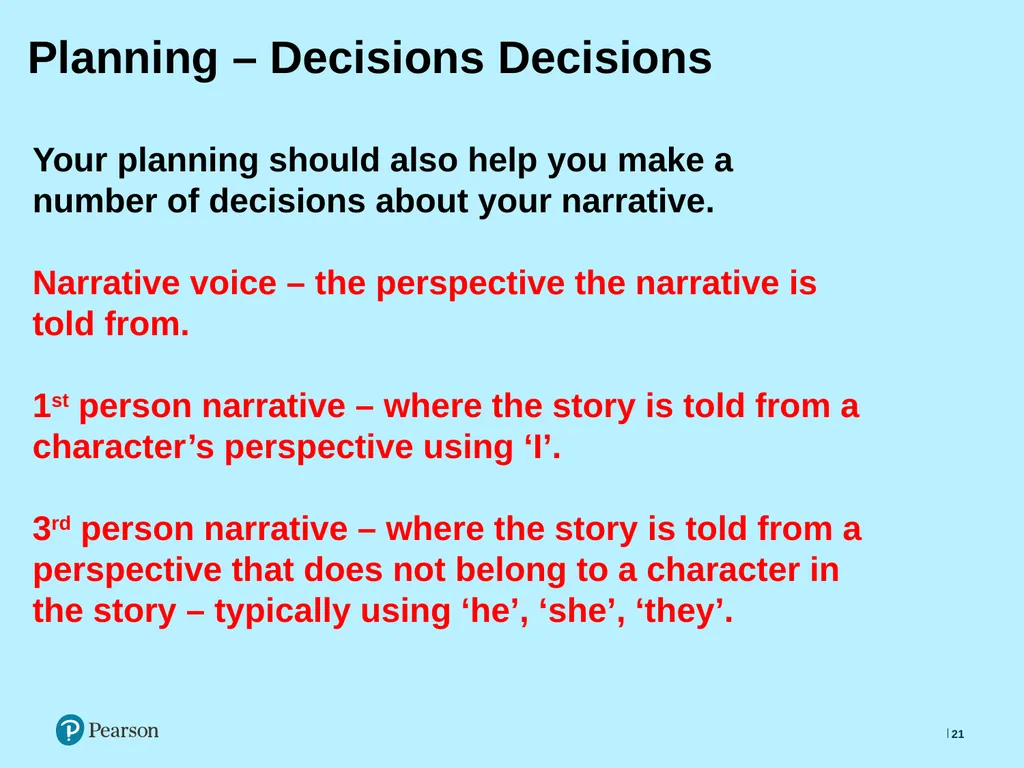
Your planning should also help you make a number of decisions about your narrative.
Narrative voice – the perspective the narrative is told from.
1st person narrative – where the story is told from a character’s perspective using ‘I’.
3rd person narrative – where the story is told from a perspective that does not belong to a character in the story – typically using ‘he’, ‘she’, ‘they’. 21 Planning – Decisions Decisions<br>
Narrative voice – the perspective the narrative is told from.
1st person narrative – where the story is told from a character’s perspective using ‘I’.
3rd person narrative – where the story is told from a perspective that does not belong to a character in the story – typically using ‘he’, ‘she’, ‘they’. 21 Planning – Decisions Decisions<br>
22
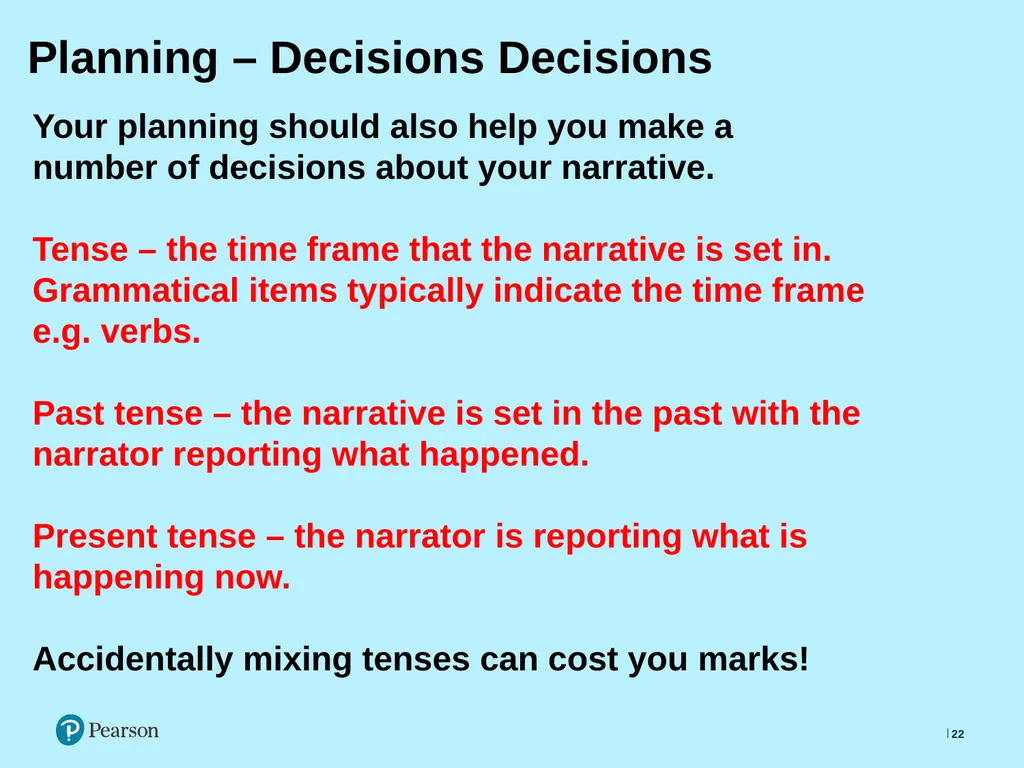
Your planning should also help you make a number of decisions about your narrative.
Tense – the time frame that the narrative is set in. Grammatical items typically indicate the time frame e.g. verbs.
Past tense – the narrative is set in the past with the narrator reporting what happened.
Present tense – the narrator is reporting what is happening now.
Accidentally mixing tenses can cost you marks! 22 Planning – Decisions Decisions<br>
Tense – the time frame that the narrative is set in. Grammatical items typically indicate the time frame e.g. verbs.
Past tense – the narrative is set in the past with the narrator reporting what happened.
Present tense – the narrator is reporting what is happening now.
Accidentally mixing tenses can cost you marks! 22 Planning – Decisions Decisions<br>
23
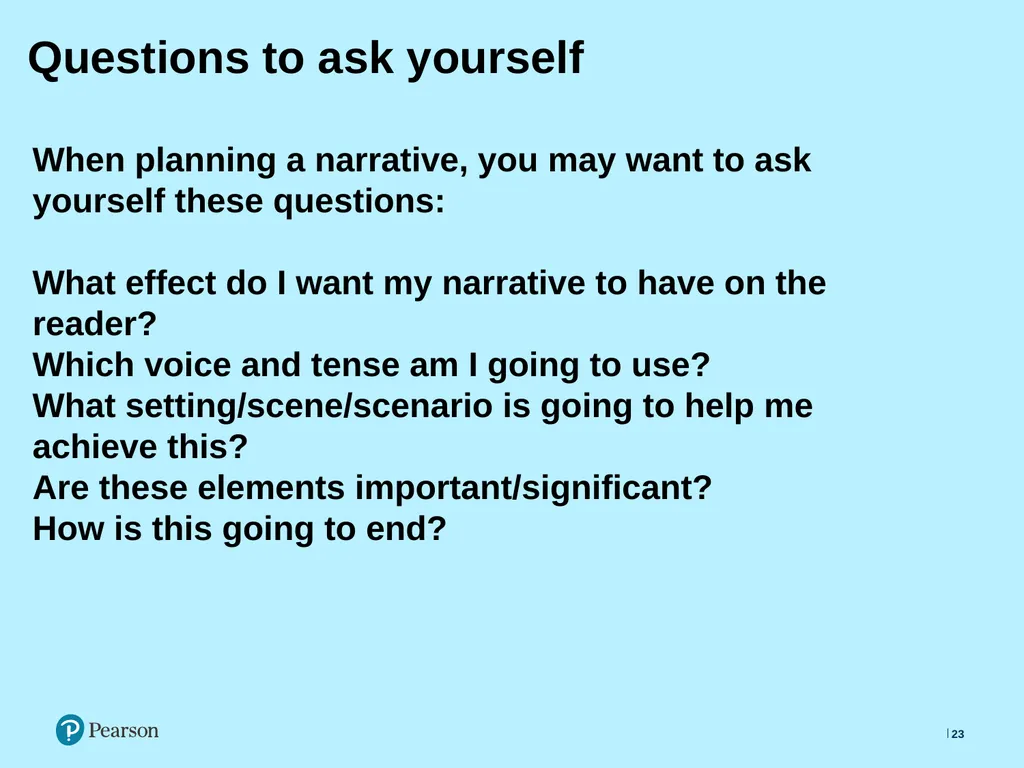
When planning a narrative, you may want to ask yourself these questions:
What effect do I want my narrative to have on the reader?
Which voice and tense am I going to use?
What setting/scene/scenario is going to help me achieve this?
Are these elements important/significant?
How is this going to end? 23 Questions to ask yourself<br>
What effect do I want my narrative to have on the reader?
Which voice and tense am I going to use?
What setting/scene/scenario is going to help me achieve this?
Are these elements important/significant?
How is this going to end? 23 Questions to ask yourself<br>
24
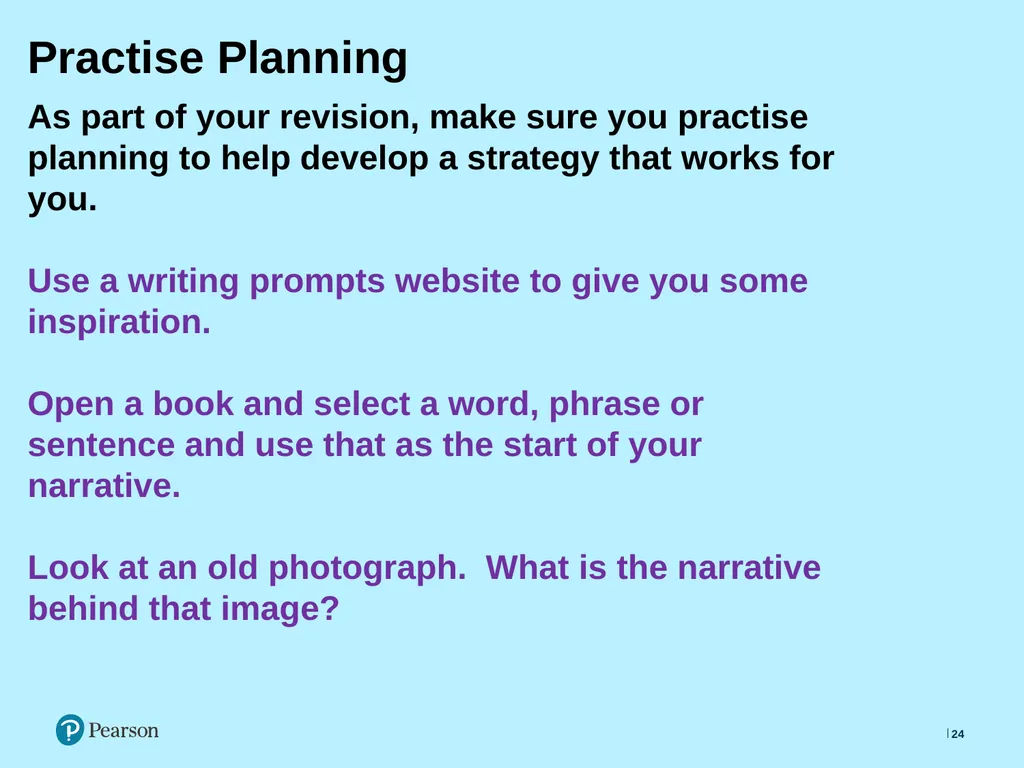
As part of your revision, make sure you practise planning to help develop a strategy that works for you.
Use a writing prompts website to give you some inspiration.
Open a book and select a word, phrase or sentence and use that as the start of your narrative.
Look at an old photograph. What is the narrative behind that image? 24 Practise Planning<br>
Use a writing prompts website to give you some inspiration.
Open a book and select a word, phrase or sentence and use that as the start of your narrative.
Look at an old photograph. What is the narrative behind that image? 24 Practise Planning<br>
25
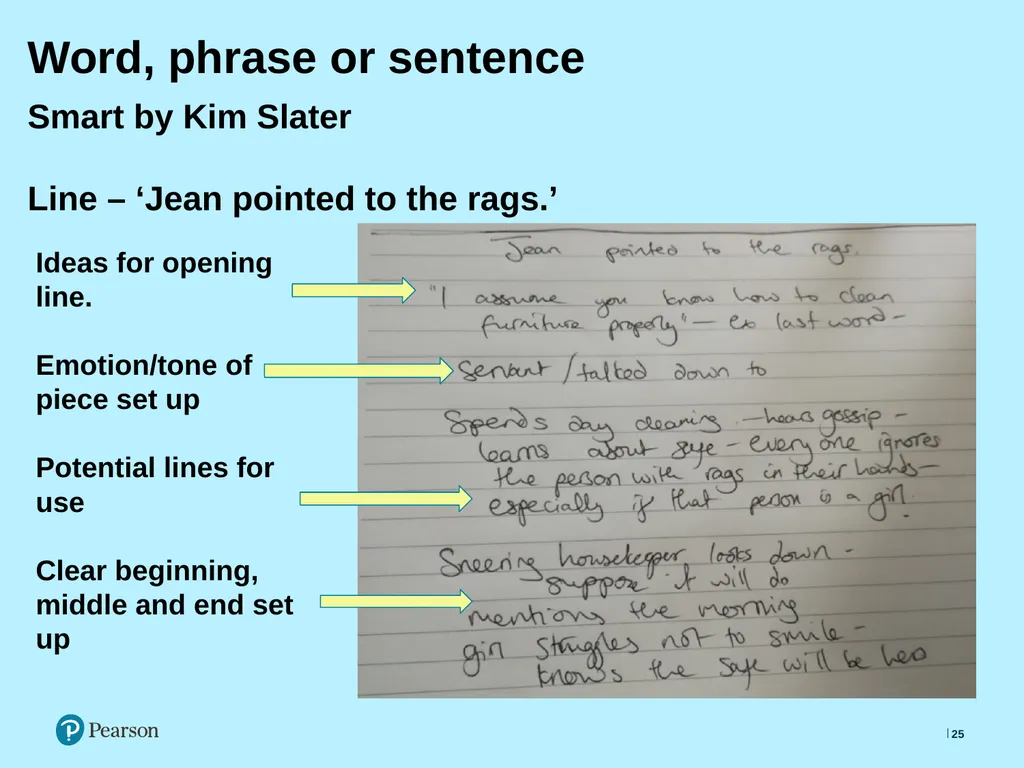
Smart by Kim Slater
Line – ‘Jean pointed to the rags.’ 25 Word, phrase or sentence Ideas for opening line.
Emotion/tone of piece set up
Potential lines for use
Clear beginning, middle and end set up<br>
Line – ‘Jean pointed to the rags.’ 25 Word, phrase or sentence Ideas for opening line.
Emotion/tone of piece set up
Potential lines for use
Clear beginning, middle and end set up<br>
26
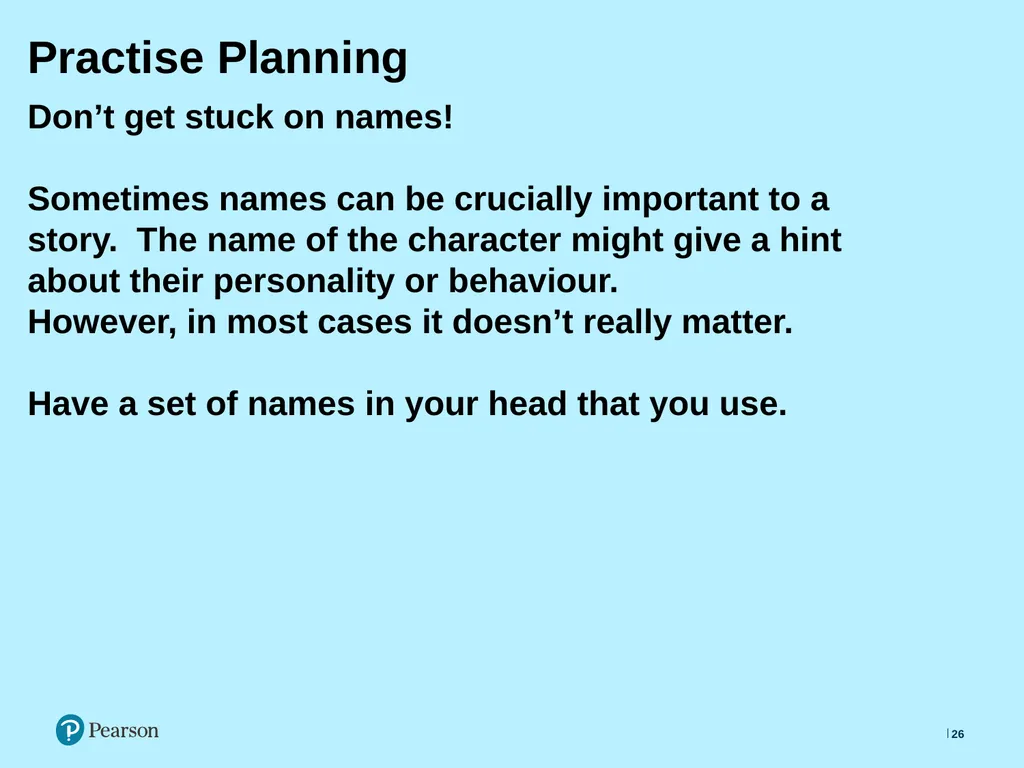
Don’t get stuck on names!
Sometimes names can be crucially important to a story. The name of the character might give a hint about their personality or behaviour.
However, in most cases it doesn’t really matter.
Have a set of names in your head that you use. 26 Practise Planning<br>
Sometimes names can be crucially important to a story. The name of the character might give a hint about their personality or behaviour.
However, in most cases it doesn’t really matter.
Have a set of names in your head that you use. 26 Practise Planning<br>
27
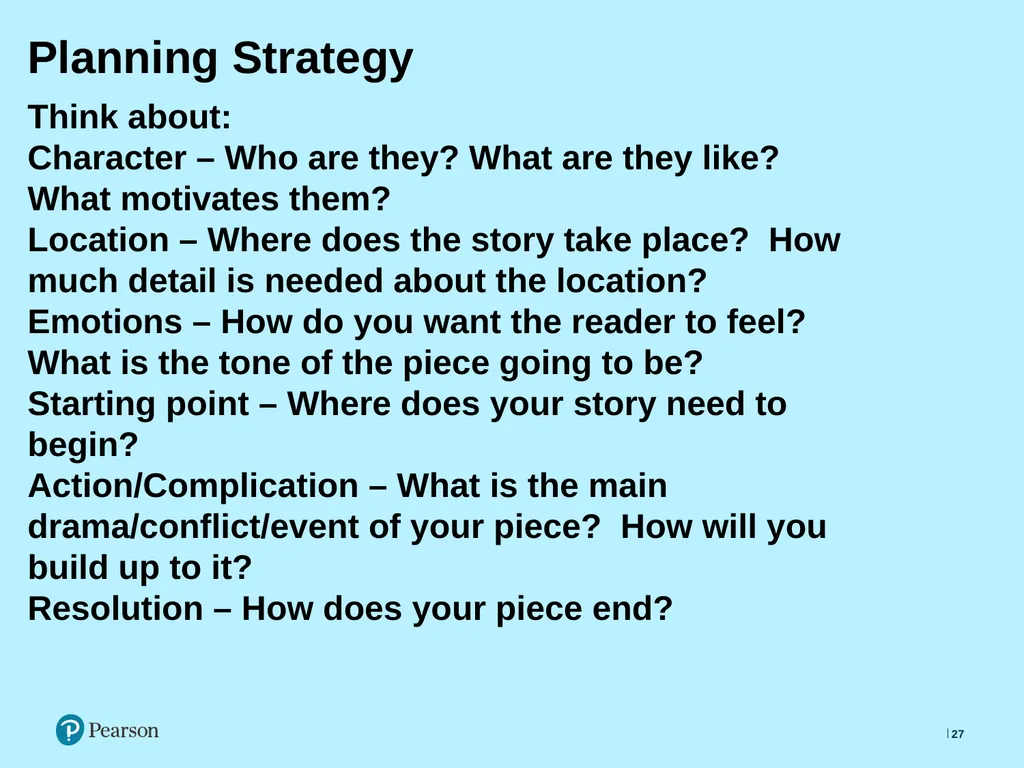
Think about:
Character – Who are they? What are they like? What motivates them?
Location – Where does the story take place? How much detail is needed about the location?
Emotions – How do you want the reader to feel? What is the tone of the piece going to be?
Starting point – Where does your story need to begin?
Action/Complication – What is the main drama/conflict/event of your piece? How will you build up to it?
Resolution – How does your piece end? 27 Planning Strategy<br>
Character – Who are they? What are they like? What motivates them?
Location – Where does the story take place? How much detail is needed about the location?
Emotions – How do you want the reader to feel? What is the tone of the piece going to be?
Starting point – Where does your story need to begin?
Action/Complication – What is the main drama/conflict/event of your piece? How will you build up to it?
Resolution – How does your piece end? 27 Planning Strategy<br>
28
Playing with the Start<br>
29
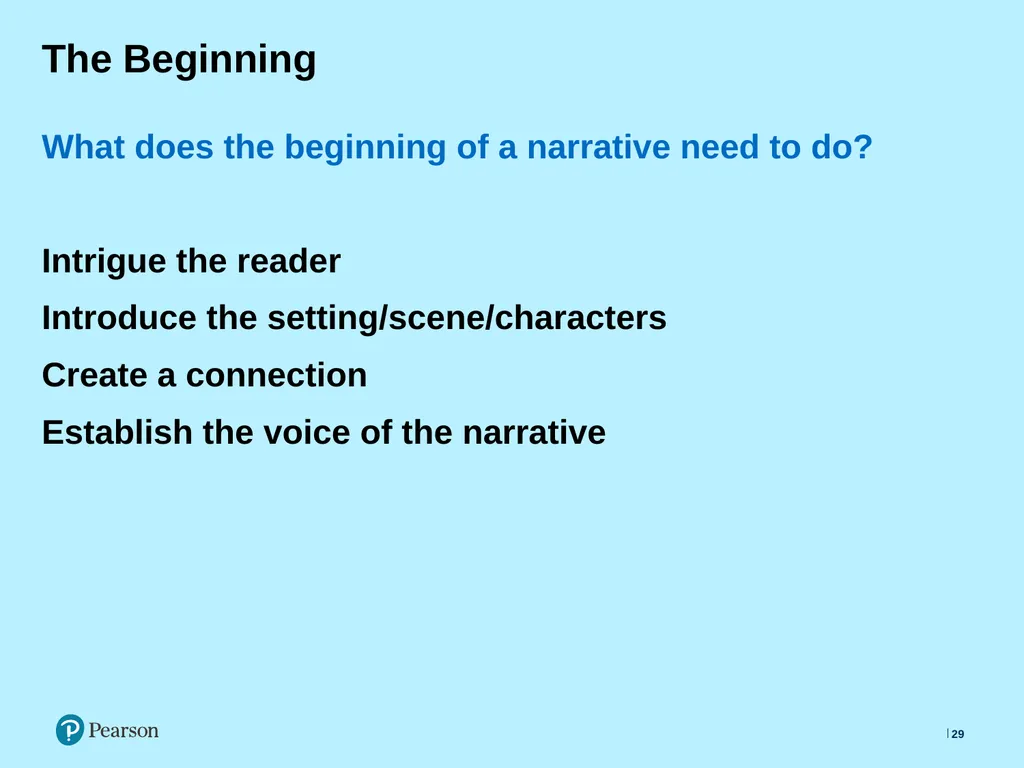
The Beginning What does the beginning of a narrative need to do?
Intrigue the reader
Introduce the setting/scene/characters
Create a connection
Establish the voice of the narrative 29<br>
Intrigue the reader
Introduce the setting/scene/characters
Create a connection
Establish the voice of the narrative 29<br>
30
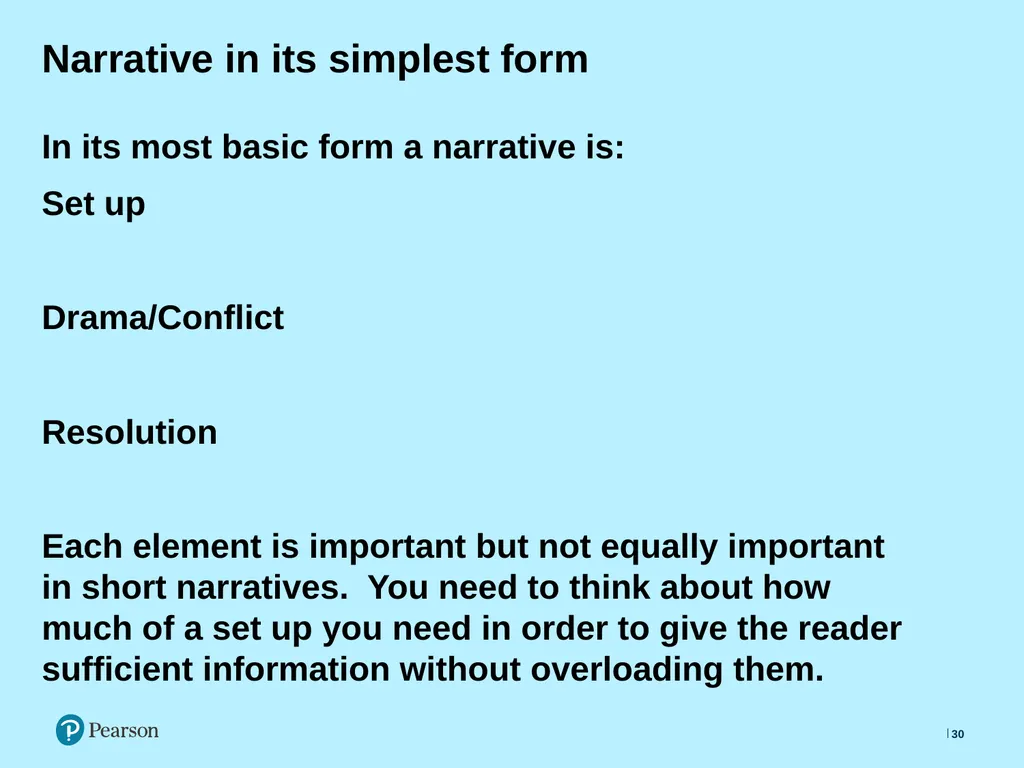
Narrative in its simplest form In its most basic form a narrative is:
Set up
Drama/Conflict
Resolution
Each element is important but not equally important in short narratives. You need to think about how much of a set up you need in order to give the reader sufficient information without overloading them. 30<br>
Set up
Drama/Conflict
Resolution
Each element is important but not equally important in short narratives. You need to think about how much of a set up you need in order to give the reader sufficient information without overloading them. 30<br>
31
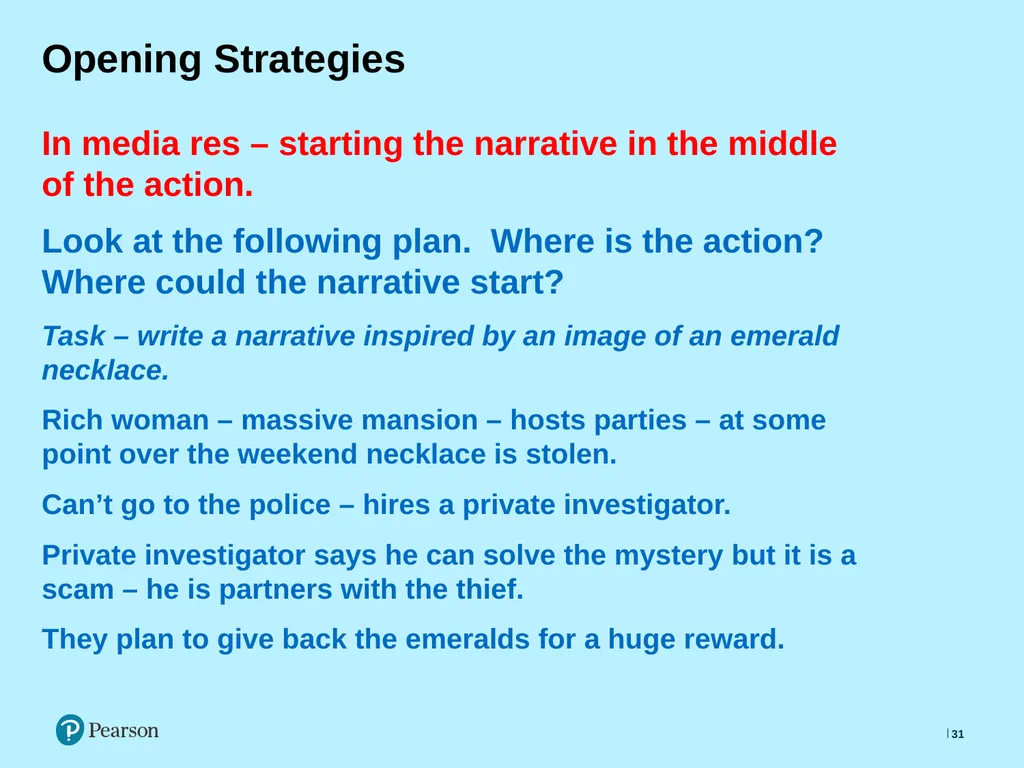
Opening Strategies In media res – starting the narrative in the middle of the action.
Look at the following plan. Where is the action? Where could the narrative start?
Task – write a narrative inspired by an image of an emerald necklace.
Rich woman – massive mansion – hosts parties – at some point over the weekend necklace is stolen.
Can’t go to the police – hires a private investigator.
Private investigator says he can solve the mystery but it is a scam – he is partners with the thief.
They plan to give back the emeralds for a huge reward. 31<br>
Look at the following plan. Where is the action? Where could the narrative start?
Task – write a narrative inspired by an image of an emerald necklace.
Rich woman – massive mansion – hosts parties – at some point over the weekend necklace is stolen.
Can’t go to the police – hires a private investigator.
Private investigator says he can solve the mystery but it is a scam – he is partners with the thief.
They plan to give back the emeralds for a huge reward. 31<br>
32
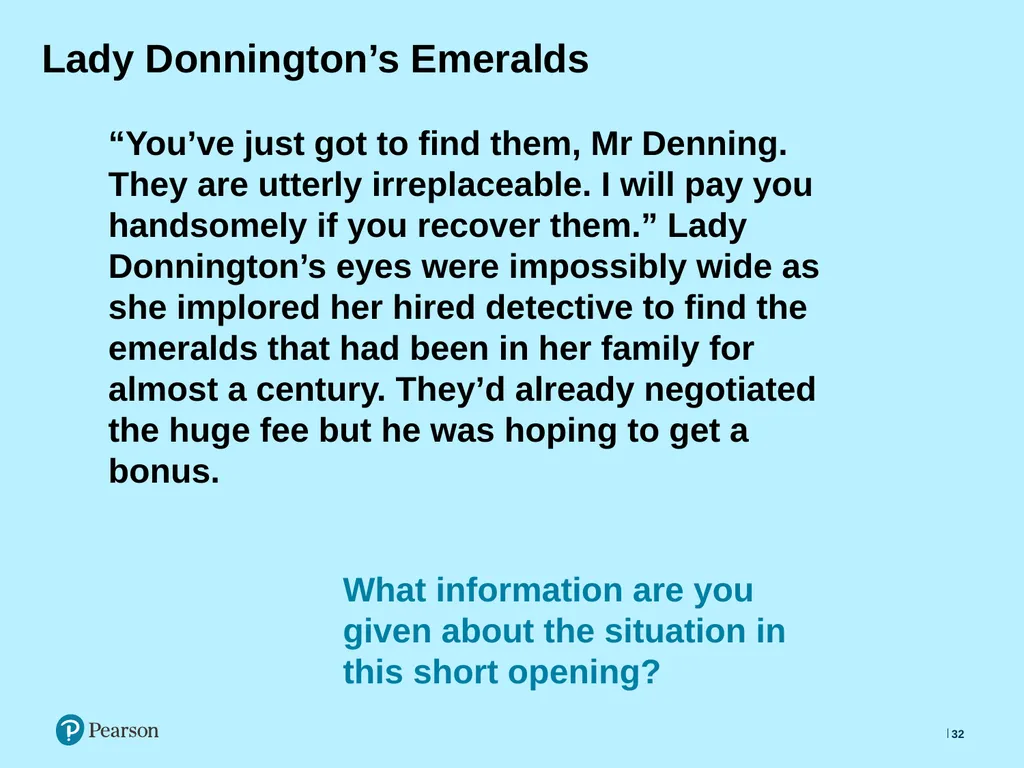
Lady Donnington’s Emeralds “You’ve just got to find them, Mr Denning. They are utterly irreplaceable. I will pay you handsomely if you recover them.” Lady Donnington’s eyes were impossibly wide as she implored her hired detective to find the emeralds that had been in her family for almost a century. They’d already negotiated the huge fee but he was hoping to get a bonus. 32 What information are you given about the situation in this short opening?<br>
33
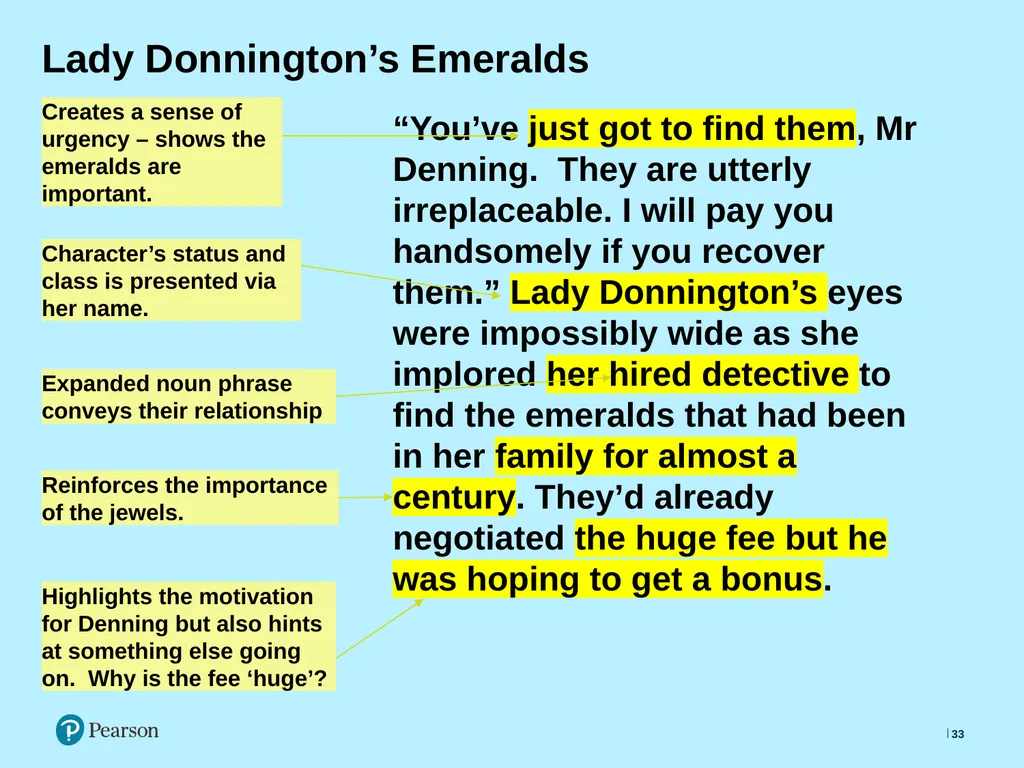
Lady Donnington’s Emeralds “You’ve just got to find them, Mr Denning. They are utterly irreplaceable. I will pay you handsomely if you recover them.” Lady Donnington’s eyes were impossibly wide as she implored her hired detective to find the emeralds that had been in her family for almost a century. They’d already negotiated the huge fee but he was hoping to get a bonus. 33 Creates a sense of urgency – shows the emeralds are important. Character’s status and class is presented via her name. Expanded noun phrase conveys their relationship Reinforces the importance of the jewels. Highlights the motivation for Denning but also hints at something else going on. Why is the fee ‘huge’?<br>
34
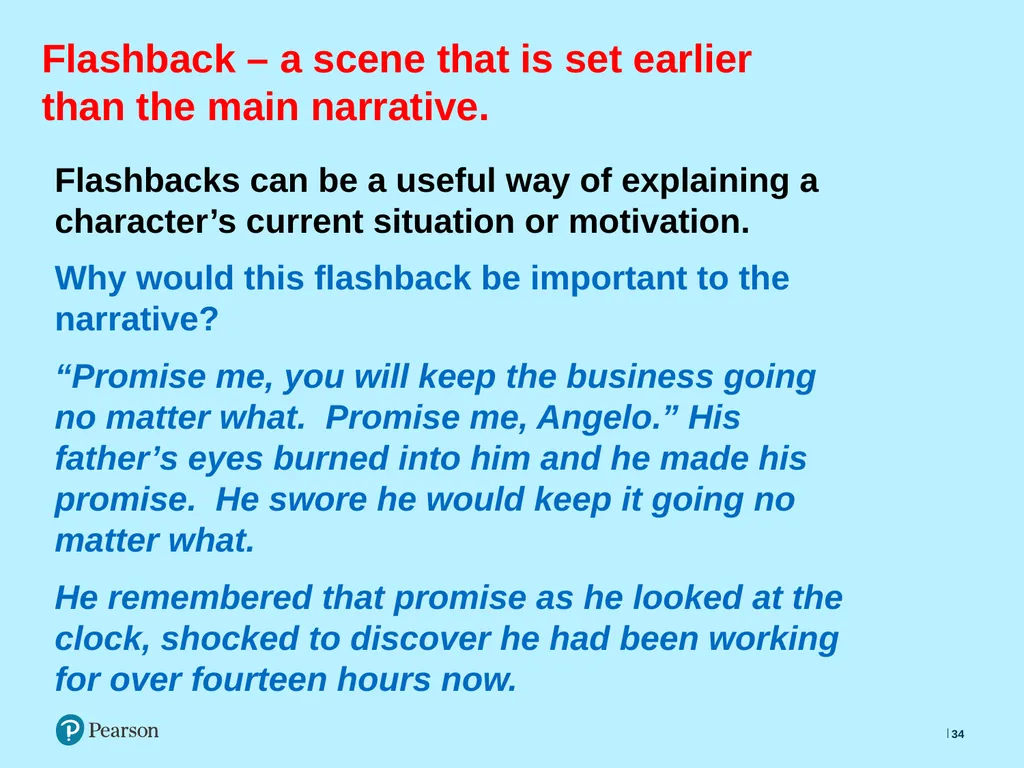
Flashback – a scene that is set earlier than the main narrative. Flashbacks can be a useful way of explaining a character’s current situation or motivation.
Why would this flashback be important to the narrative?
“Promise me, you will keep the business going no matter what. Promise me, Angelo.” His father’s eyes burned into him and he made his promise. He swore he would keep it going no matter what.
He remembered that promise as he looked at the clock, shocked to discover he had been working for over fourteen hours now. 34<br>
Why would this flashback be important to the narrative?
“Promise me, you will keep the business going no matter what. Promise me, Angelo.” His father’s eyes burned into him and he made his promise. He swore he would keep it going no matter what.
He remembered that promise as he looked at the clock, shocked to discover he had been working for over fourteen hours now. 34<br>
35
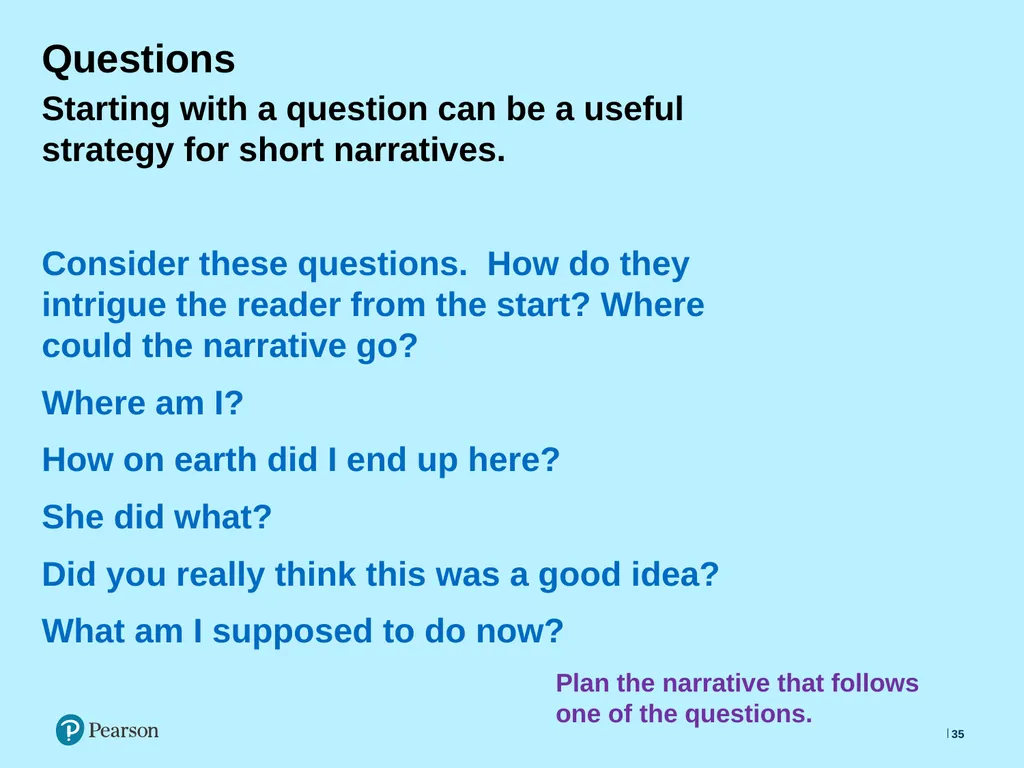
Questions Starting with a question can be a useful strategy for short narratives.
Consider these questions. How do they intrigue the reader from the start? Where could the narrative go?
Where am I?
How on earth did I end up here?
She did what?
Did you really think this was a good idea?
What am I supposed to do now? 35 Plan the narrative that follows one of the questions.<br>
Consider these questions. How do they intrigue the reader from the start? Where could the narrative go?
Where am I?
How on earth did I end up here?
She did what?
Did you really think this was a good idea?
What am I supposed to do now? 35 Plan the narrative that follows one of the questions.<br>
36
Developing the Narrative<br>
37
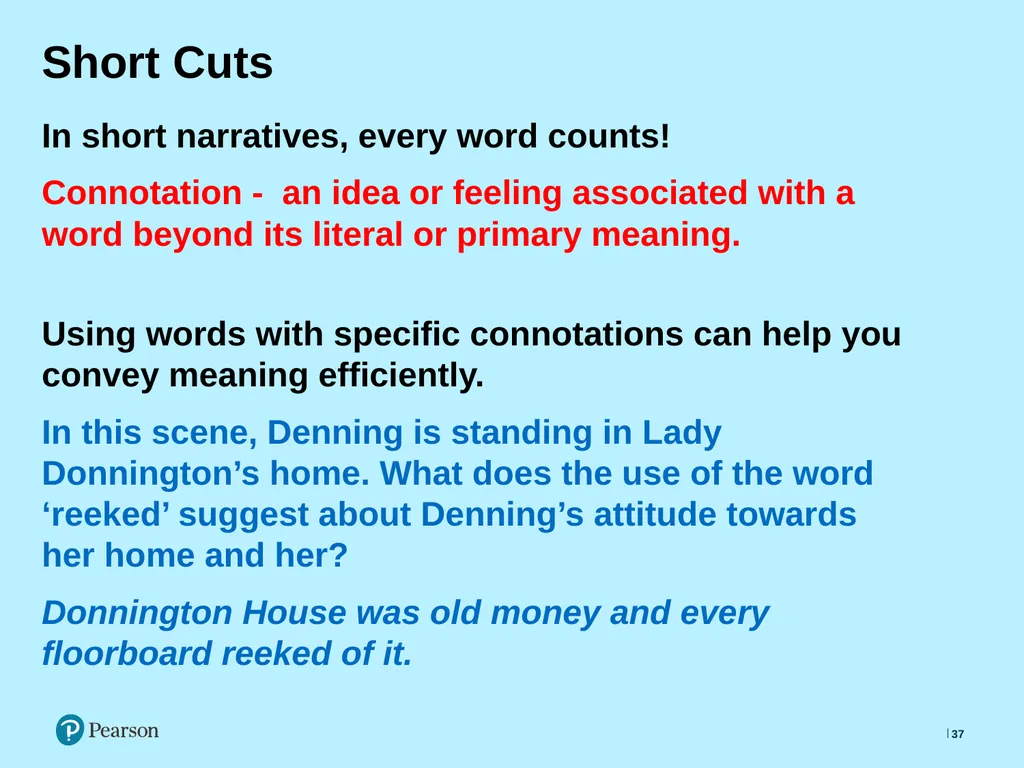
Short Cuts In short narratives, every word counts!
Connotation - an idea or feeling associated with a word beyond its literal or primary meaning.
Using words with specific connotations can help you convey meaning efficiently.
In this scene, Denning is standing in Lady Donnington’s home. What does the use of the word ‘reeked’ suggest about Denning’s attitude towards her home and her?
Donnington House was old money and every floorboard reeked of it. 37<br>
Connotation - an idea or feeling associated with a word beyond its literal or primary meaning.
Using words with specific connotations can help you convey meaning efficiently.
In this scene, Denning is standing in Lady Donnington’s home. What does the use of the word ‘reeked’ suggest about Denning’s attitude towards her home and her?
Donnington House was old money and every floorboard reeked of it. 37<br>
38
Logical Action When writing your narrative, ensure that the action is logical. Again, planning is vital.
What are the issues with these narratives?
A character drives his car off the road and into a ditch. Four weeks later, he decides to leave the car to try and find some help.
Best friends are in the woods together. One cannot find the other. He goes home and never mentions it again.
A character has never ever been swimming before but wins a competition the first time he enters the water. 38<br>
What are the issues with these narratives?
A character drives his car off the road and into a ditch. Four weeks later, he decides to leave the car to try and find some help.
Best friends are in the woods together. One cannot find the other. He goes home and never mentions it again.
A character has never ever been swimming before but wins a competition the first time he enters the water. 38<br>
39
Character Behaviour If you have established your characters in a certain way, you need to think about sustaining their behaviour or, if it changes, offering a reasonable explanation why it has changed.
Think about a character who never exercises, eats loads of junk food, does nothing all day except watch television. Why would they suddenly decide to change that behaviour?
Think about the title from the task list – The Silent Writer – how might this character’s behaviour change? Why might it have changed? 39<br>
Think about a character who never exercises, eats loads of junk food, does nothing all day except watch television. Why would they suddenly decide to change that behaviour?
Think about the title from the task list – The Silent Writer – how might this character’s behaviour change? Why might it have changed? 39<br>
40
Constructing the Narrative Cohesion – the use of language and grammar devices that hold a text together.
You need to think about ways of moving the plot forward but still maintaining a sense of cohesion.
One way to do this is through the use of motifs.
Motif – a dominant or recurring image within the narrative.
Think about the story with the title ‘The Silent Writer.’ What motifs could you use in that story? Try to think of three things. 40<br>
You need to think about ways of moving the plot forward but still maintaining a sense of cohesion.
One way to do this is through the use of motifs.
Motif – a dominant or recurring image within the narrative.
Think about the story with the title ‘The Silent Writer.’ What motifs could you use in that story? Try to think of three things. 40<br>
41
The Ending<br>
42
Greatest Endings 42 Think about a film, book or TV show that has a brilliant ending. What made it such a memorable ending?
How can you recreate that sort of feeling in a short piece of fiction?<br>
How can you recreate that sort of feeling in a short piece of fiction?<br>
43
Avoid Clichés
Cliché – a device which has been overused and suggests a lack of original thought
It was all a dream.
And then…
The world went dark. 43<br>
44
Emotional Endings
You want your reader to be affected by your writing. It is important that the ending is strong enough to have an impact.
It can be satisfying, disturbing,
thought-provoking, funny, upsetting etc. but it should leave your reader feeling something. 44<br>
45
Zoom out and walk away
One potential strategy in short narratives is to ‘zoom out’ of the action that has occurred and give the impression of walking away from it. You may need to change narrative viewpoints to make this work effectively.
Think about the diving story. If the whole narrative was from the perspective of the diver, the final lines might be from the perspective of a loved one watching them. 45<br>
46
Believable Twists
Having a twist at the end of the story only works if there is some believable elements to it.
In ‘Lady Donnington’s Emeralds,’ the thief is the caterer for one of her parties. He is friends with the detective and they have run this scam a number of times. The caterer gives the detectives the emeralds and they share a drink together. 46 Why does this twist work more effectively than having Denning be the thief?<br>
47
Review<br>
48
What to consider… Read Flash Fiction
Practise regularly
Know your limits
Plan carefully
Start in a powerful way
Develop your narrative
Ensure you have a strong ending 48<br>
Practise regularly
Know your limits
Plan carefully
Start in a powerful way
Develop your narrative
Ensure you have a strong ending 48<br>
49
Glossary of Key Terms - 1 1. Flash Fiction - extremely short stories.
2. Narrative voice – the perspective the narrative is told from.
3. 1st person narrative – where the story is told from a character’s perspective using ‘I’.
4. 3rd person narrative – where the story is told from a perspective that does not belong to a character in the story – typically using ‘he’, ‘she’, ‘they’.
5. Tense – the time frame that the narrative is set in. Grammatical items typically indicate the time frame e.g. verbs.
6. Past tense – the narrative is set in the past with the narrator reporting what happened.
7. Present tense – the narrator is reporting what is happening now.
8. In media res – starting the narrative in the middle of the action.
9. Flashback – a scene that is set earlier than the main narrative.
10. Connotation - an idea or feeling associated with a word beyond its literal or primary meaning. 49<br>
2. Narrative voice – the perspective the narrative is told from.
3. 1st person narrative – where the story is told from a character’s perspective using ‘I’.
4. 3rd person narrative – where the story is told from a perspective that does not belong to a character in the story – typically using ‘he’, ‘she’, ‘they’.
5. Tense – the time frame that the narrative is set in. Grammatical items typically indicate the time frame e.g. verbs.
6. Past tense – the narrative is set in the past with the narrator reporting what happened.
7. Present tense – the narrator is reporting what is happening now.
8. In media res – starting the narrative in the middle of the action.
9. Flashback – a scene that is set earlier than the main narrative.
10. Connotation - an idea or feeling associated with a word beyond its literal or primary meaning. 49<br>
50
Glossary of Key Terms - 2 11. Cohesion – the use of language and grammar devices that hold a text together.
12. Motif – a dominant or recurring image within the narrative.
13. Cliché – a device which has been overused and suggests a lack of original thought 50<br>
12. Motif – a dominant or recurring image within the narrative.
13. Cliché – a device which has been overused and suggests a lack of original thought 50<br>
51
Feedback Form Please complete the feedback form – you will find the link in the description for this video or you can use the QR code.<br>
52
See you next time! 11am
8th July
Technical
Accuracy
For Effect 52<br>
8th July
Technical
Accuracy
For Effect 52<br>