
Enhancing Comprehension for English Language
TF
Published · 73 slides · 0 views
1 / 1








Description
Enhancing Comprehension for English Language LearnersMultilingual Language Learners This is the third presentation in a series of 3 sponsored by the New York State Education Department Office of Bilingual Education and World Languages
Related Topics
Share
Embed code
Download this presentation From Below
"Enhancing Comprehension for English Language" is the property of its rightful owner. Permission is granted to download and print the materials on this website for personal, non-commercial use only, and to display it on your personal computer provided you do not modify the materials and that you retain all copyright notices contained in the materials. By downloading content from our website, you accept the terms of this agreement.
Presentation Transcript
01
Enhancing Comprehension for English Language Learners/Multilingual Language Learners<br>
02
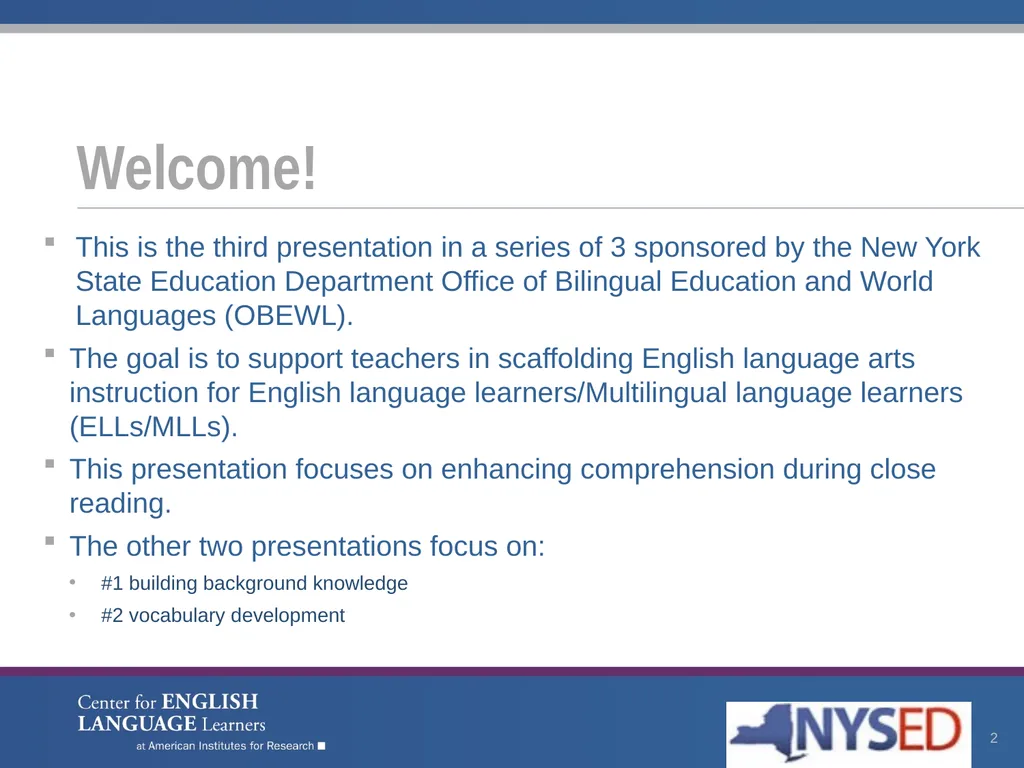
This is the third presentation in a series of 3 sponsored by the New York State Education Department Office of Bilingual Education and World Languages (OBEWL).
The goal is to support teachers in scaffolding English language arts instruction for English language learners/Multilingual language learners (ELLs/MLLs).
This presentation focuses on enhancing comprehension during close reading.
The other two presentations focus on:
#1 building background knowledge
#2 vocabulary development Welcome! 2<br>
The goal is to support teachers in scaffolding English language arts instruction for English language learners/Multilingual language learners (ELLs/MLLs).
This presentation focuses on enhancing comprehension during close reading.
The other two presentations focus on:
#1 building background knowledge
#2 vocabulary development Welcome! 2<br>
03
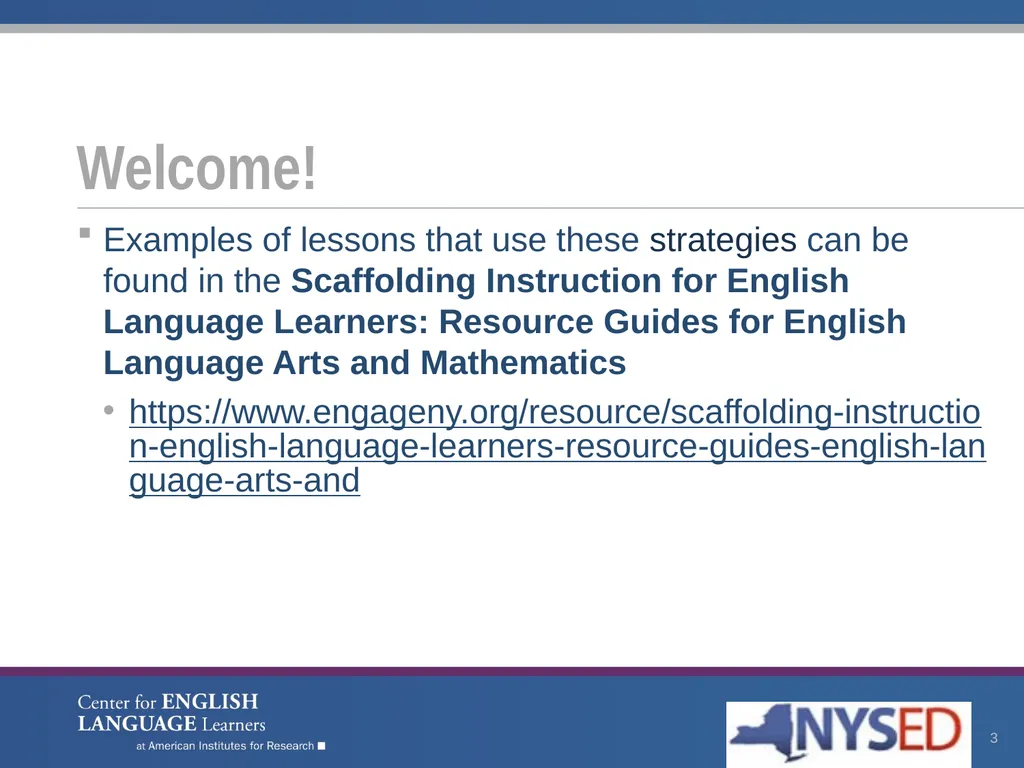
Examples of lessons that use these strategies can be found in the Scaffolding Instruction for English Language Learners: Resource Guides for English Language Arts and Mathematics
https://www.engageny.org/resource/scaffolding-instruction-english-language-learners-resource-guides-english-language-arts-and Welcome! 3<br>
https://www.engageny.org/resource/scaffolding-instruction-english-language-learners-resource-guides-english-language-arts-and Welcome! 3<br>
04
Ideally, you will view this presentation as part of a school-based professional learning community (PLC).
This in an interactive presentation that includes several activities and partner talks.
When you see the following image, pause the webinar and complete the activity or partner talk as a small group or with a partner. Welcome! 4<br>
This in an interactive presentation that includes several activities and partner talks.
When you see the following image, pause the webinar and complete the activity or partner talk as a small group or with a partner. Welcome! 4<br>
05
Familiarize yourself with other members of your group.
Share with each other the following information:
What grade(s) do you teach?
Approximately how many ELLs/MLLs do you serve?
What are the English proficiency levels of the ELLs/MLLs that you provide services to? 5 Partner Talk<br>
Share with each other the following information:
What grade(s) do you teach?
Approximately how many ELLs/MLLs do you serve?
What are the English proficiency levels of the ELLs/MLLs that you provide services to? 5 Partner Talk<br>
06
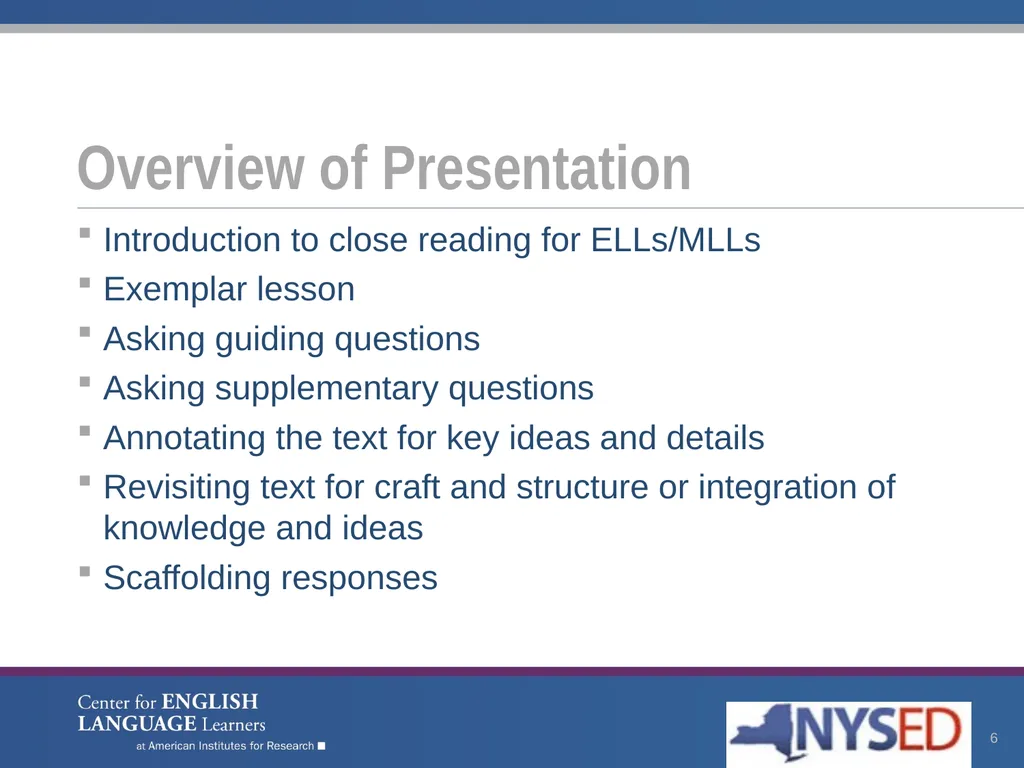
Introduction to close reading for ELLs/MLLs
Exemplar lesson
Asking guiding questions
Asking supplementary questions
Annotating the text for key ideas and details
Revisiting text for craft and structure or integration of knowledge and ideas
Scaffolding responses Overview of Presentation 6<br>
Exemplar lesson
Asking guiding questions
Asking supplementary questions
Annotating the text for key ideas and details
Revisiting text for craft and structure or integration of knowledge and ideas
Scaffolding responses Overview of Presentation 6<br>
07
Introduction to Enhancing Comprehension During Close Reading 7<br>
08
Next Generation Learning Standards
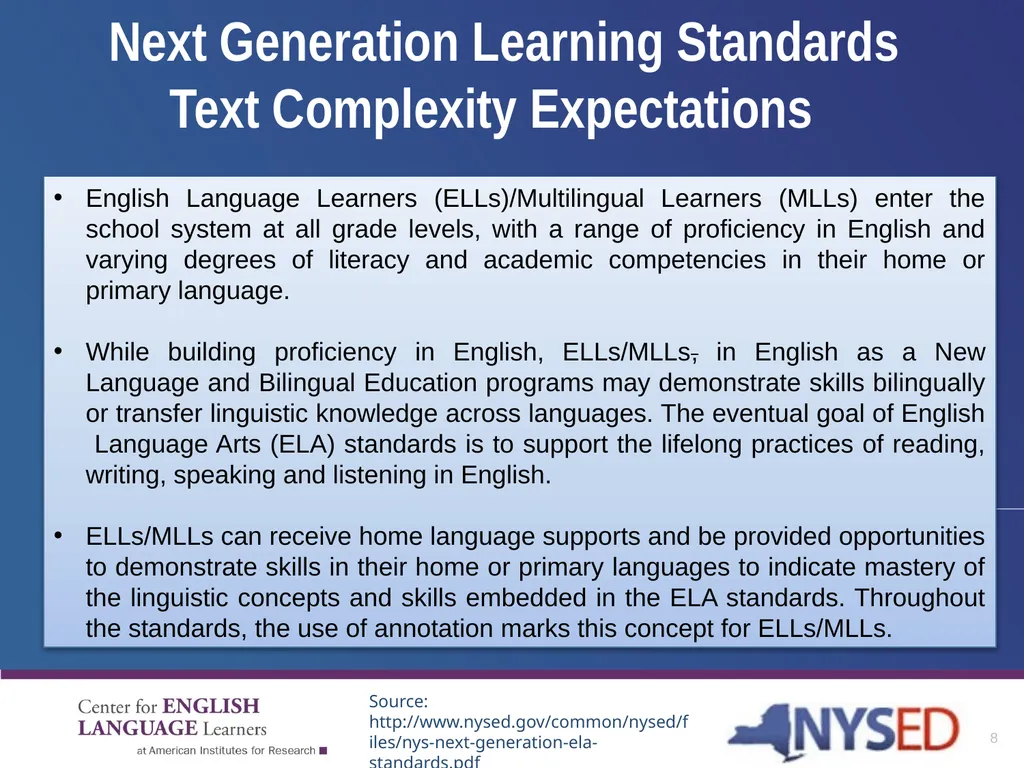
Text Complexity Expectations 8 English Language Learners (ELLs)/Multilingual Learners (MLLs) enter the school system at all grade levels, with a range of proficiency in English and varying degrees of literacy and academic competencies in their home or primary language.
While building proficiency in English, ELLs/MLLs, in English as a New Language and Bilingual Education programs may demonstrate skills bilingually or transfer linguistic knowledge across languages. The eventual goal of English Language Arts (ELA) standards is to support the lifelong practices of reading, writing, speaking and listening in English.
ELLs/MLLs can receive home language supports and be provided opportunities to demonstrate skills in their home or primary languages to indicate mastery of the linguistic concepts and skills embedded in the ELA standards. Throughout the standards, the use of annotation marks this concept for ELLs/MLLs. Source: http://www.nysed.gov/common/nysed/files/nys-next-generation-ela-standards.pdf<br>
While building proficiency in English, ELLs/MLLs, in English as a New Language and Bilingual Education programs may demonstrate skills bilingually or transfer linguistic knowledge across languages. The eventual goal of English Language Arts (ELA) standards is to support the lifelong practices of reading, writing, speaking and listening in English.
ELLs/MLLs can receive home language supports and be provided opportunities to demonstrate skills in their home or primary languages to indicate mastery of the linguistic concepts and skills embedded in the ELA standards. Throughout the standards, the use of annotation marks this concept for ELLs/MLLs. Source: http://www.nysed.gov/common/nysed/files/nys-next-generation-ela-standards.pdf<br>
09
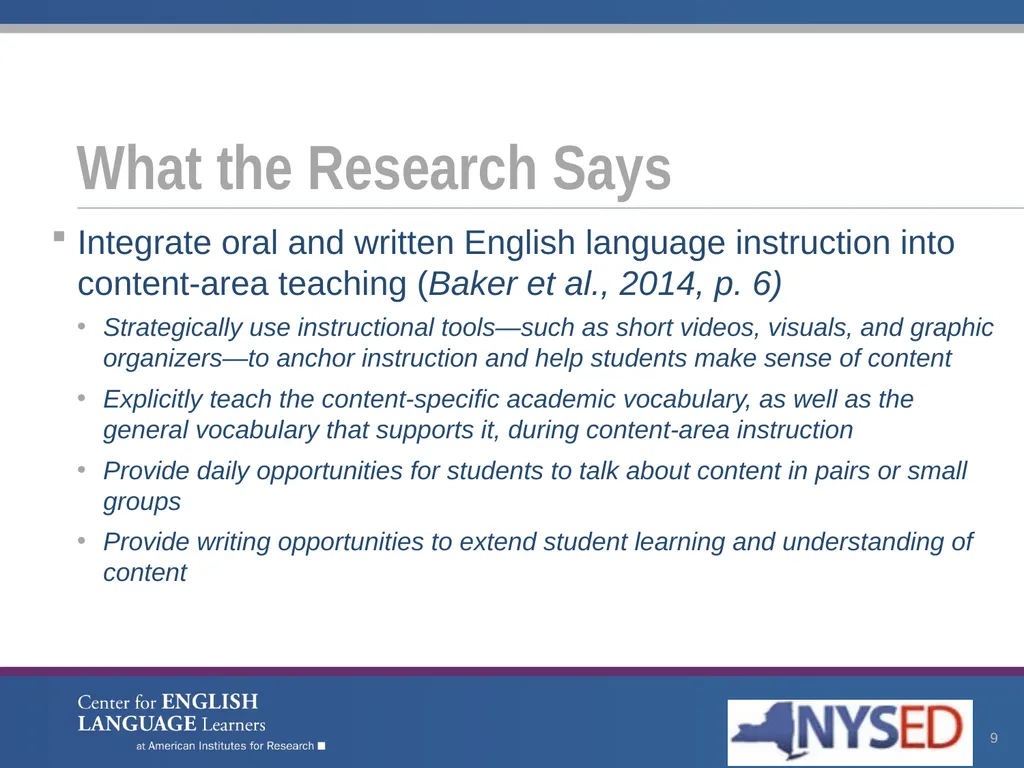
9 What the Research Says Integrate oral and written English language instruction into content-area teaching (Baker et al., 2014, p. 6)
Strategically use instructional tools—such as short videos, visuals, and graphic organizers—to anchor instruction and help students make sense of content
Explicitly teach the content-specific academic vocabulary, as well as the general vocabulary that supports it, during content-area instruction
Provide daily opportunities for students to talk about content in pairs or small groups
Provide writing opportunities to extend student learning and understanding of content<br>
Strategically use instructional tools—such as short videos, visuals, and graphic organizers—to anchor instruction and help students make sense of content
Explicitly teach the content-specific academic vocabulary, as well as the general vocabulary that supports it, during content-area instruction
Provide daily opportunities for students to talk about content in pairs or small groups
Provide writing opportunities to extend student learning and understanding of content<br>
10
Exemplar Lesson The Value of Sports in People’s Lives 10<br>
11
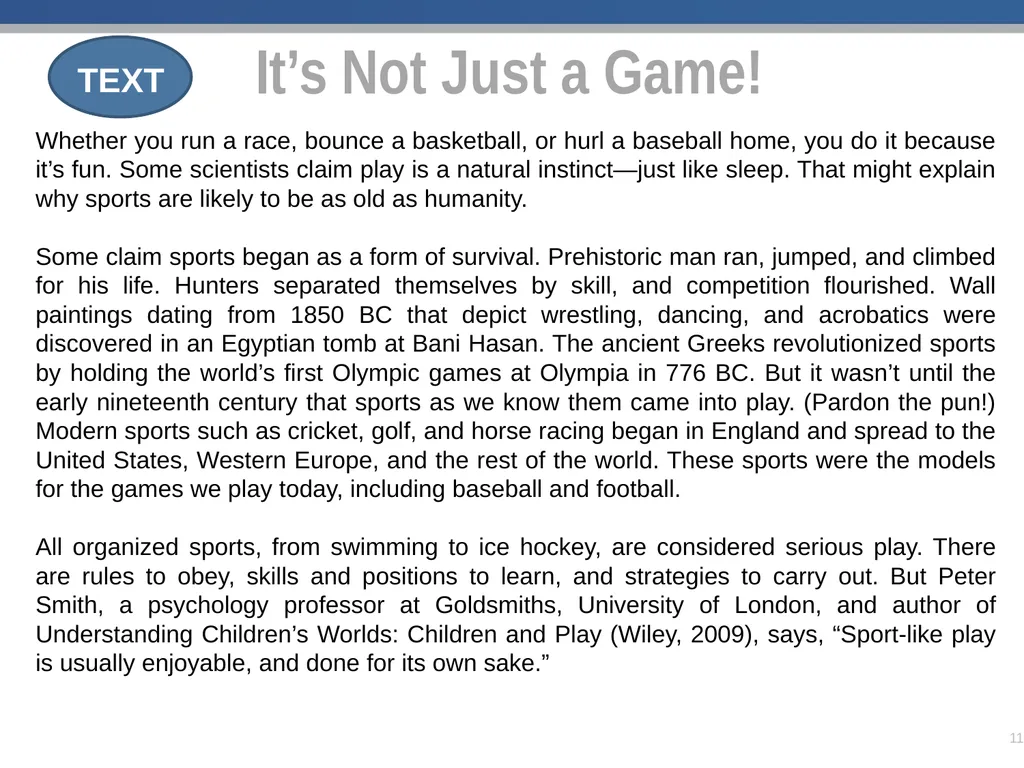
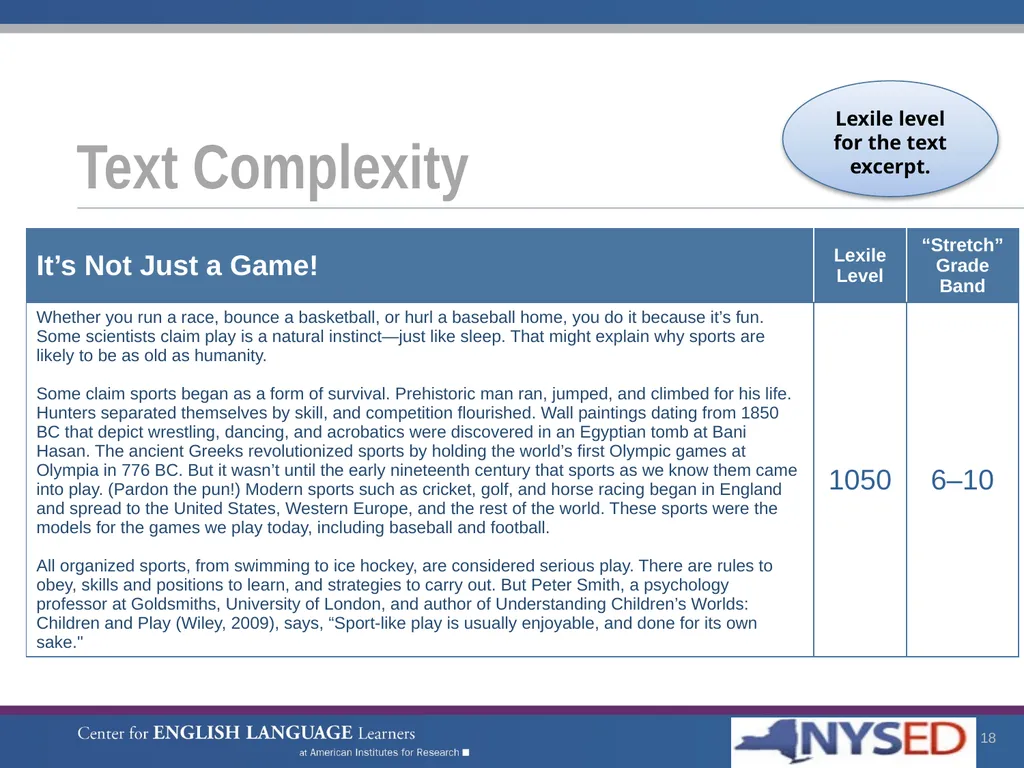
11 Whether you run a race, bounce a basketball, or hurl a baseball home, you do it because it’s fun. Some scientists claim play is a natural instinct—just like sleep. That might explain why sports are likely to be as old as humanity.
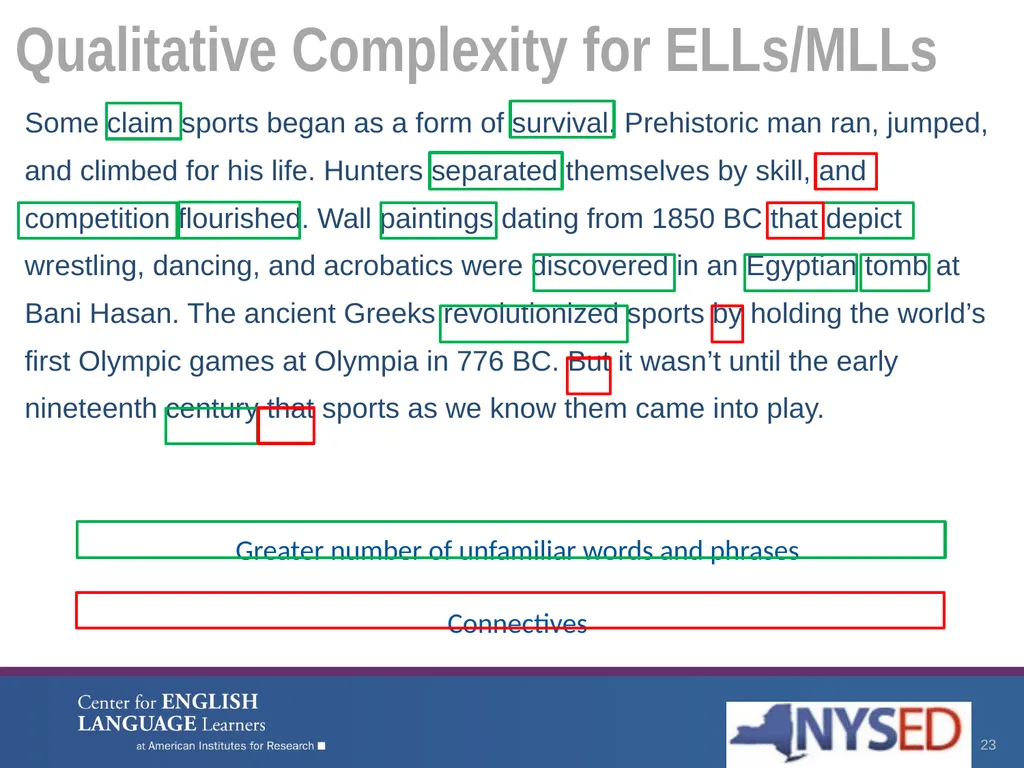
Some claim sports began as a form of survival. Prehistoric man ran, jumped, and climbed for his life. Hunters separated themselves by skill, and competition flourished. Wall paintings dating from 1850 BC that depict wrestling, dancing, and acrobatics were discovered in an Egyptian tomb at Bani Hasan. The ancient Greeks revolutionized sports by holding the world’s first Olympic games at Olympia in 776 BC. But it wasn’t until the early nineteenth century that sports as we know them came into play. (Pardon the pun!) Modern sports such as cricket, golf, and horse racing began in England and spread to the United States, Western Europe, and the rest of the world. These sports were the models for the games we play today, including baseball and football.
All organized sports, from swimming to ice hockey, are considered serious play. There are rules to obey, skills and positions to learn, and strategies to carry out. But Peter Smith, a psychology professor at Goldsmiths, University of London, and author of Understanding Children’s Worlds: Children and Play (Wiley, 2009), says, “Sport-like play is usually enjoyable, and done for its own sake.” It’s Not Just a Game!<br>
Some claim sports began as a form of survival. Prehistoric man ran, jumped, and climbed for his life. Hunters separated themselves by skill, and competition flourished. Wall paintings dating from 1850 BC that depict wrestling, dancing, and acrobatics were discovered in an Egyptian tomb at Bani Hasan. The ancient Greeks revolutionized sports by holding the world’s first Olympic games at Olympia in 776 BC. But it wasn’t until the early nineteenth century that sports as we know them came into play. (Pardon the pun!) Modern sports such as cricket, golf, and horse racing began in England and spread to the United States, Western Europe, and the rest of the world. These sports were the models for the games we play today, including baseball and football.
All organized sports, from swimming to ice hockey, are considered serious play. There are rules to obey, skills and positions to learn, and strategies to carry out. But Peter Smith, a psychology professor at Goldsmiths, University of London, and author of Understanding Children’s Worlds: Children and Play (Wiley, 2009), says, “Sport-like play is usually enjoyable, and done for its own sake.” It’s Not Just a Game!<br>
12
Text Complexity Why Comprehension Can Be Challenging? 12<br>
13
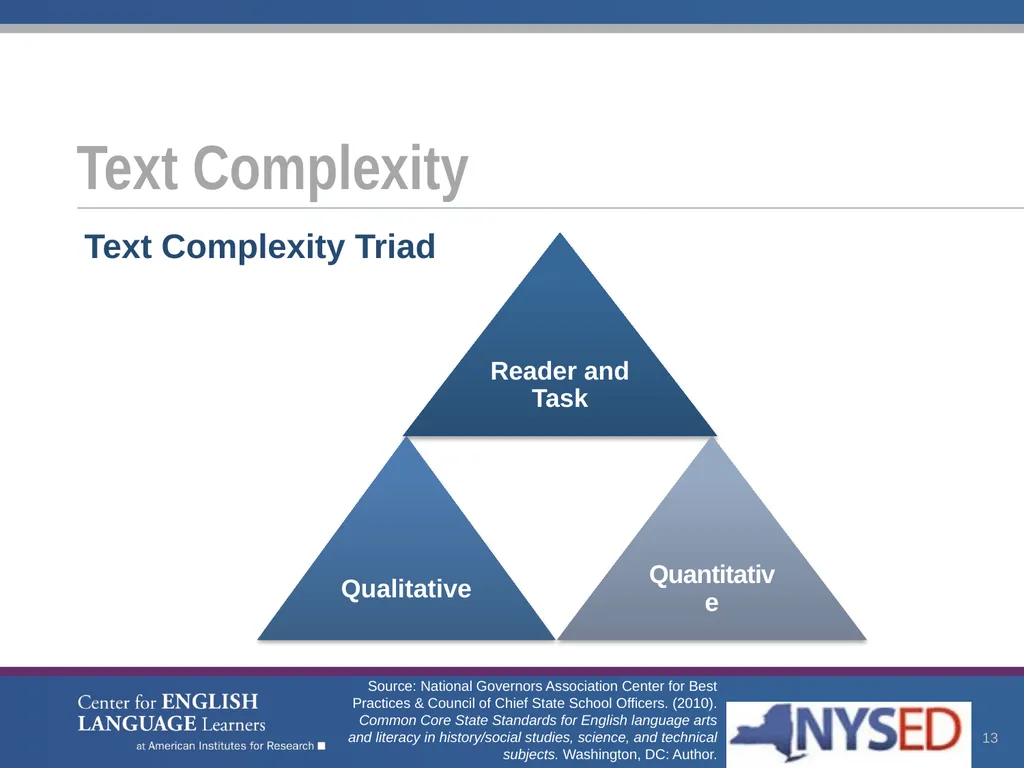
Text Complexity Source: National Governors Association Center for Best Practices & Council of Chief State School Officers. (2010). Common Core State Standards for English language arts and literacy in history/social studies, science, and technical subjects. Washington, DC: Author. 13 Text Complexity Triad<br>
14
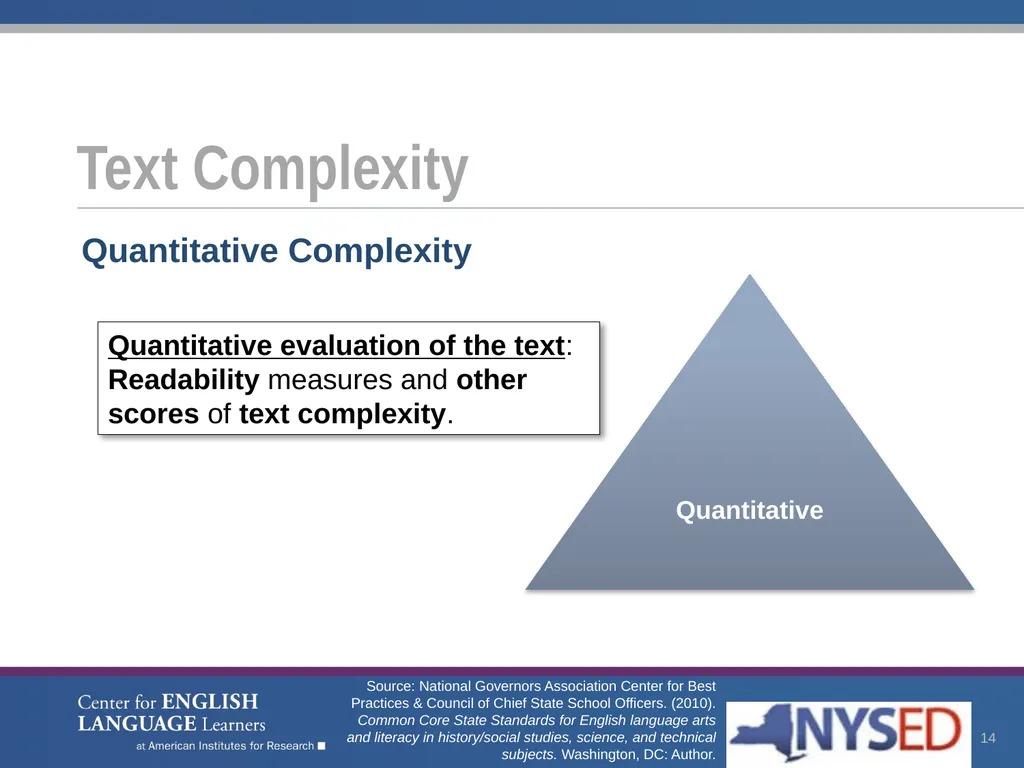
Text Complexity 14 Quantitative evaluation of the text: Readability measures and other scores of text complexity. Source: National Governors Association Center for Best Practices & Council of Chief State School Officers. (2010). Common Core State Standards for English language arts and literacy in history/social studies, science, and technical subjects. Washington, DC: Author. Quantitative Complexity<br>
15
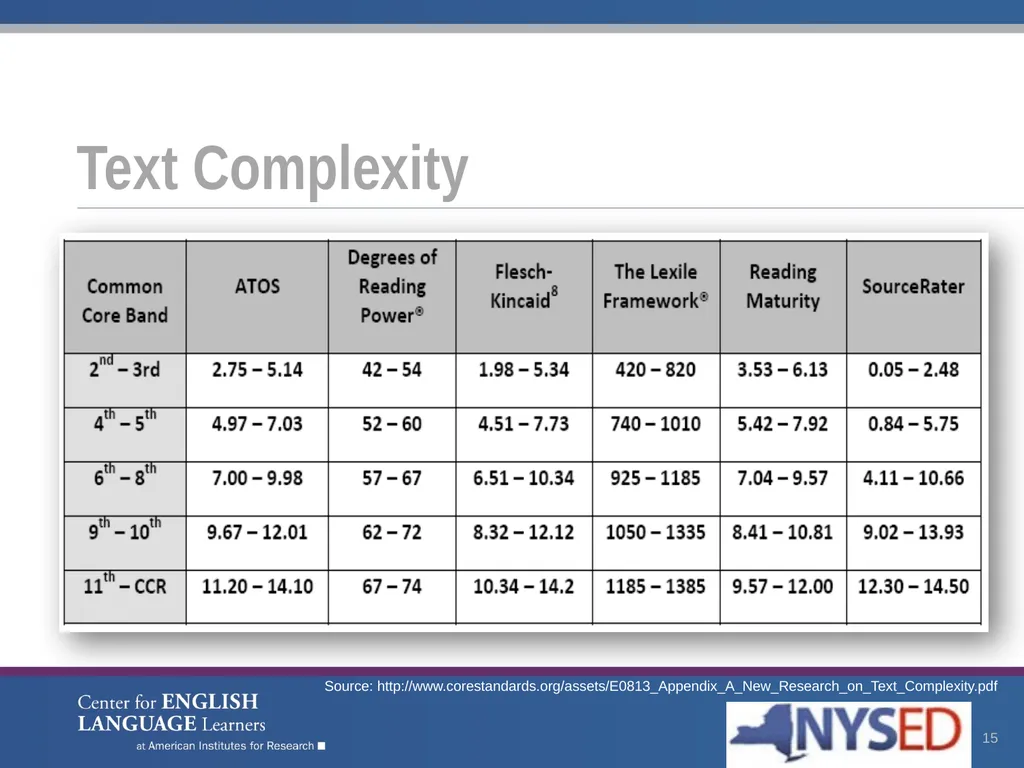
Text Complexity 15 Source: http://www.corestandards.org/assets/E0813_Appendix_A_New_Research_on_Text_Complexity.pdf<br>
16
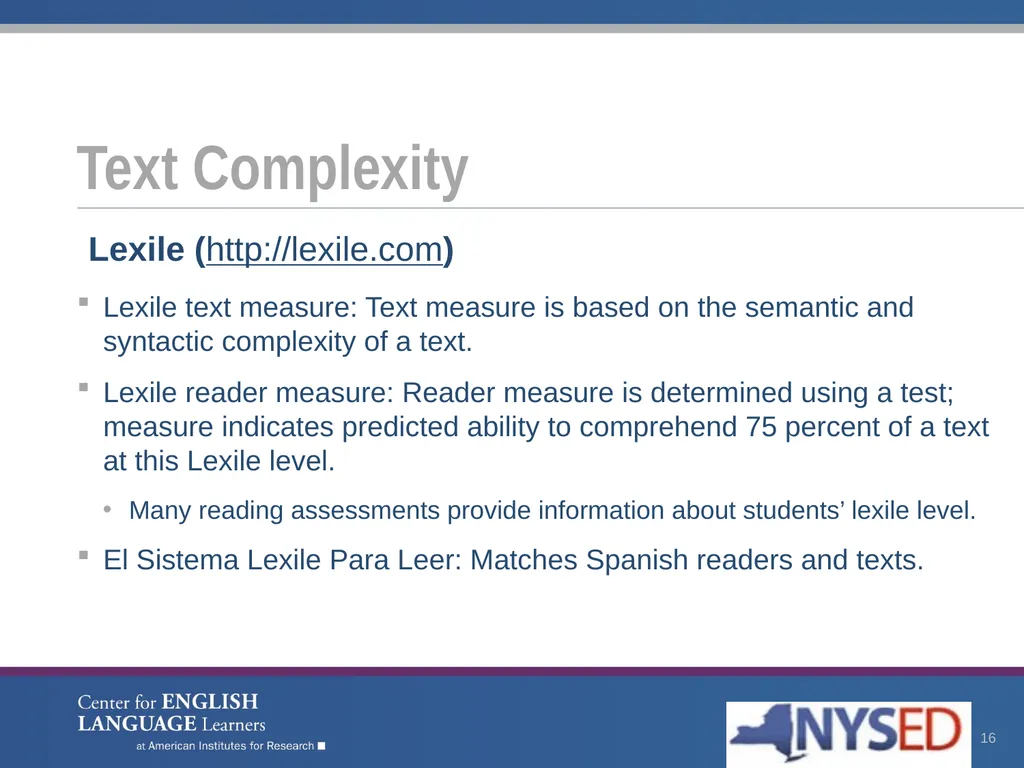
Lexile text measure: Text measure is based on the semantic and syntactic complexity of a text.
Lexile reader measure: Reader measure is determined using a test; measure indicates predicted ability to comprehend 75 percent of a text at this Lexile level.
Many reading assessments provide information about students’ lexile level.
El Sistema Lexile Para Leer: Matches Spanish readers and texts. Text Complexity 16 Lexile (http://lexile.com)<br>
Lexile reader measure: Reader measure is determined using a test; measure indicates predicted ability to comprehend 75 percent of a text at this Lexile level.
Many reading assessments provide information about students’ lexile level.
El Sistema Lexile Para Leer: Matches Spanish readers and texts. Text Complexity 16 Lexile (http://lexile.com)<br>
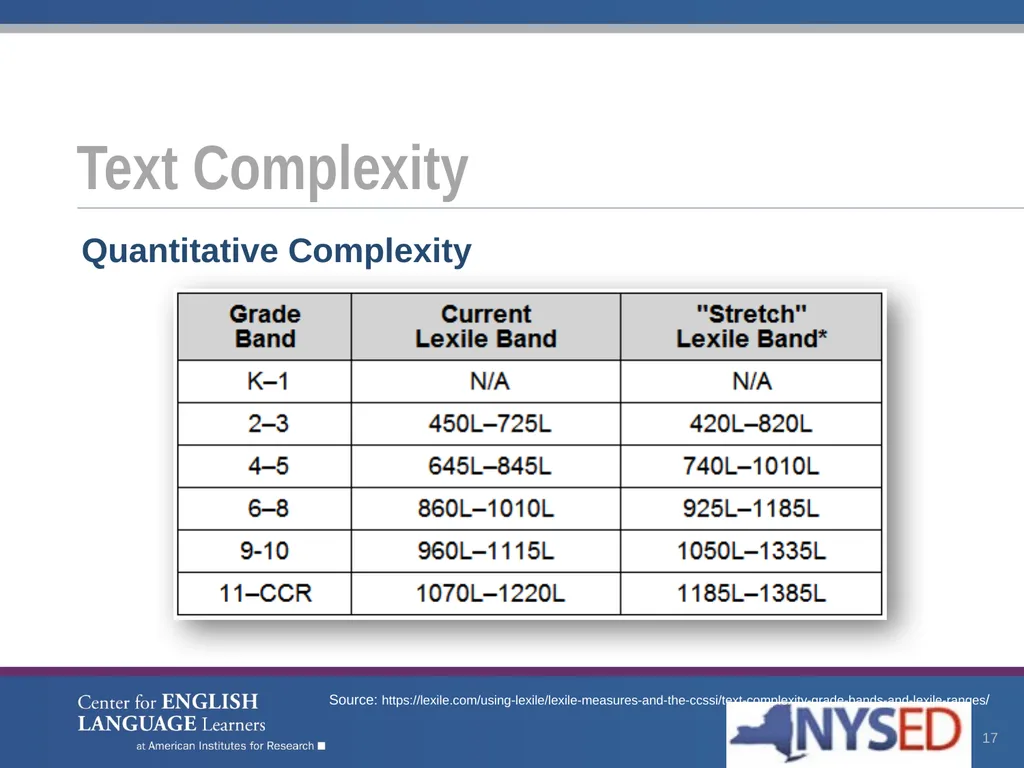
17
Source: https://lexile.com/using-lexile/lexile-measures-and-the-ccssi/text-complexity-grade-bands-and-lexile-ranges/ Text Complexity 17 Quantitative Complexity<br>
18
Text Complexity 18 Lexile level for the text excerpt.<br>
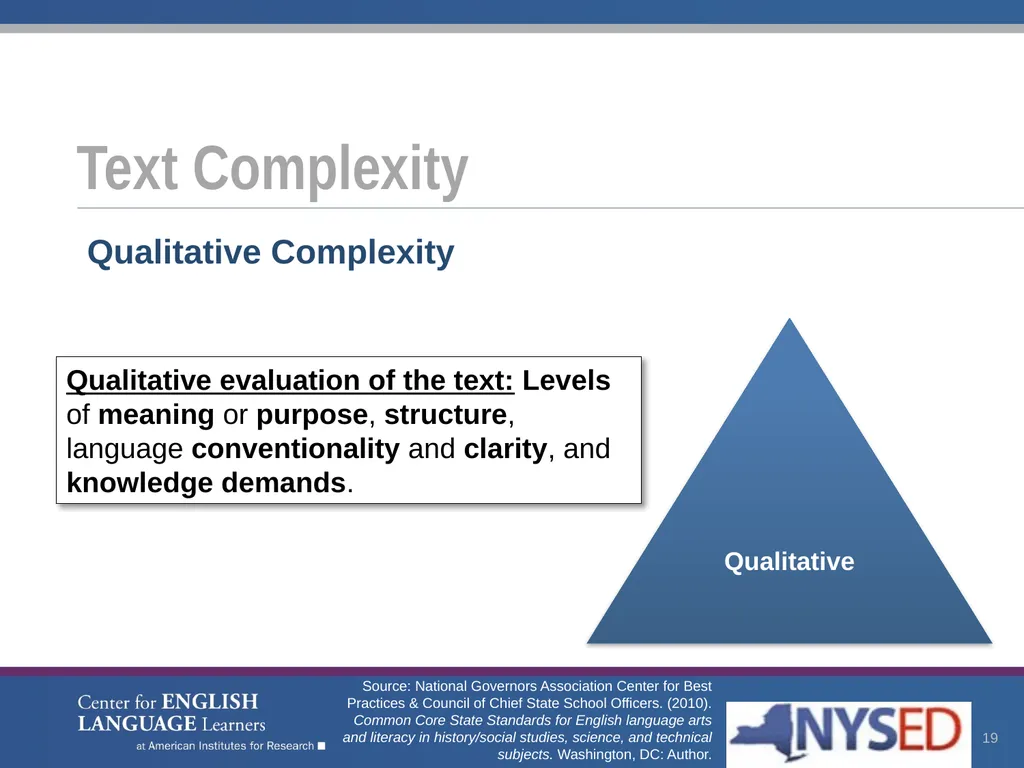
19
Text Complexity Qualitative evaluation of the text: Levels of meaning or purpose, structure, language conventionality and clarity, and knowledge demands. 19 Source: National Governors Association Center for Best Practices & Council of Chief State School Officers. (2010). Common Core State Standards for English language arts and literacy in history/social studies, science, and technical subjects. Washington, DC: Author. Qualitative Complexity<br>
20
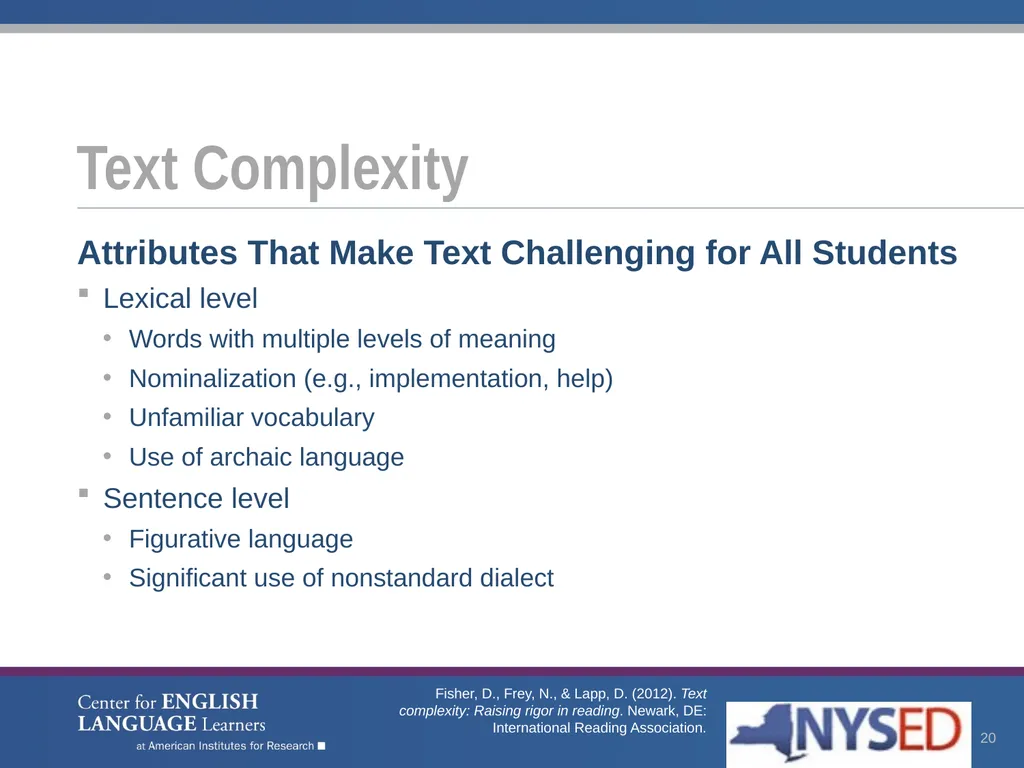
Attributes That Make Text Challenging for All Students
Lexical level
Words with multiple levels of meaning
Nominalization (e.g., implementation, help)
Unfamiliar vocabulary
Use of archaic language
Sentence level
Figurative language
Significant use of nonstandard dialect Text Complexity 20 Fisher, D., Frey, N., & Lapp, D. (2012). Text complexity: Raising rigor in reading. Newark, DE: International Reading Association.<br>
Lexical level
Words with multiple levels of meaning
Nominalization (e.g., implementation, help)
Unfamiliar vocabulary
Use of archaic language
Sentence level
Figurative language
Significant use of nonstandard dialect Text Complexity 20 Fisher, D., Frey, N., & Lapp, D. (2012). Text complexity: Raising rigor in reading. Newark, DE: International Reading Association.<br>
21
Attributes That Make Text Challenging for All Students (continued)
Discourse level
Text with multiple levels of meaning
Distortions in organization of text (e.g., time sequences)
Specialized content knowledge required
Limited use of text features and graphics Text Complexity 21 Fisher, D., Frey, N., & Lapp, D. (2012). Text complexity: Raising rigor in reading. Newark, DE: International Reading Association.<br>
Discourse level
Text with multiple levels of meaning
Distortions in organization of text (e.g., time sequences)
Specialized content knowledge required
Limited use of text features and graphics Text Complexity 21 Fisher, D., Frey, N., & Lapp, D. (2012). Text complexity: Raising rigor in reading. Newark, DE: International Reading Association.<br>
22
Additional Attributes That Make Text Challenging for ELLs
Lexical level
Greater number of unfamiliar words and phrases
Connectives Text Complexity 22<br>
Lexical level
Greater number of unfamiliar words and phrases
Connectives Text Complexity 22<br>
23
Greater number of unfamiliar words and phrases
Connectives 23 Qualitative Complexity for ELLs/MLLs<br>
Connectives 23 Qualitative Complexity for ELLs/MLLs<br>
24
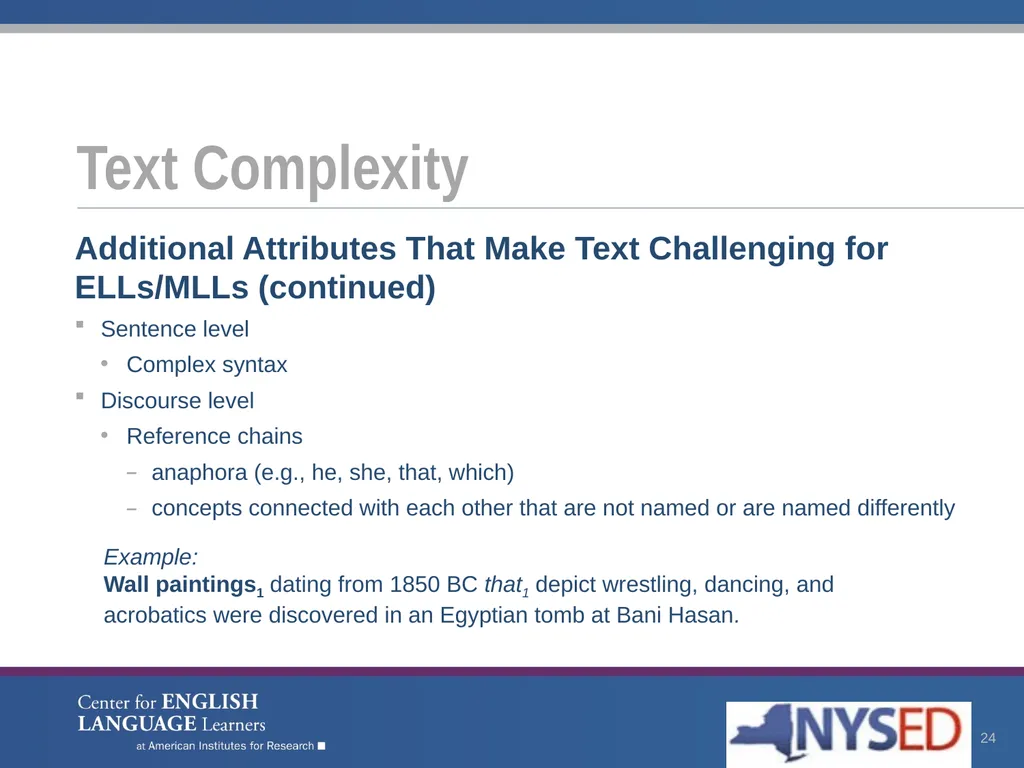
Additional Attributes That Make Text Challenging for ELLs/MLLs (continued)
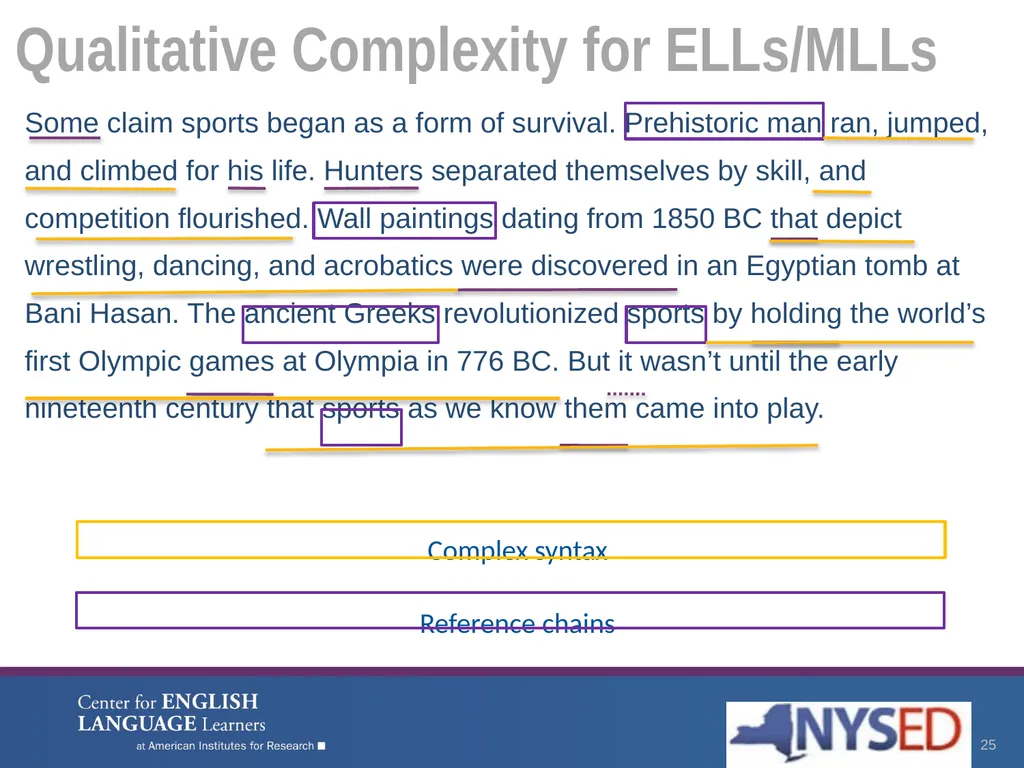
Sentence level
Complex syntax
Discourse level
Reference chains
anaphora (e.g., he, she, that, which)
concepts connected with each other that are not named or are named differently Text Complexity 24 Example: Wall paintings1 dating from 1850 BC that1 depict wrestling, dancing, and acrobatics were discovered in an Egyptian tomb at Bani Hasan.<br>
Sentence level
Complex syntax
Discourse level
Reference chains
anaphora (e.g., he, she, that, which)
concepts connected with each other that are not named or are named differently Text Complexity 24 Example: Wall paintings1 dating from 1850 BC that1 depict wrestling, dancing, and acrobatics were discovered in an Egyptian tomb at Bani Hasan.<br>
25
Complex syntax
Reference chains 25 Qualitative Complexity for ELLs/MLLs<br>
Reference chains 25 Qualitative Complexity for ELLs/MLLs<br>
26
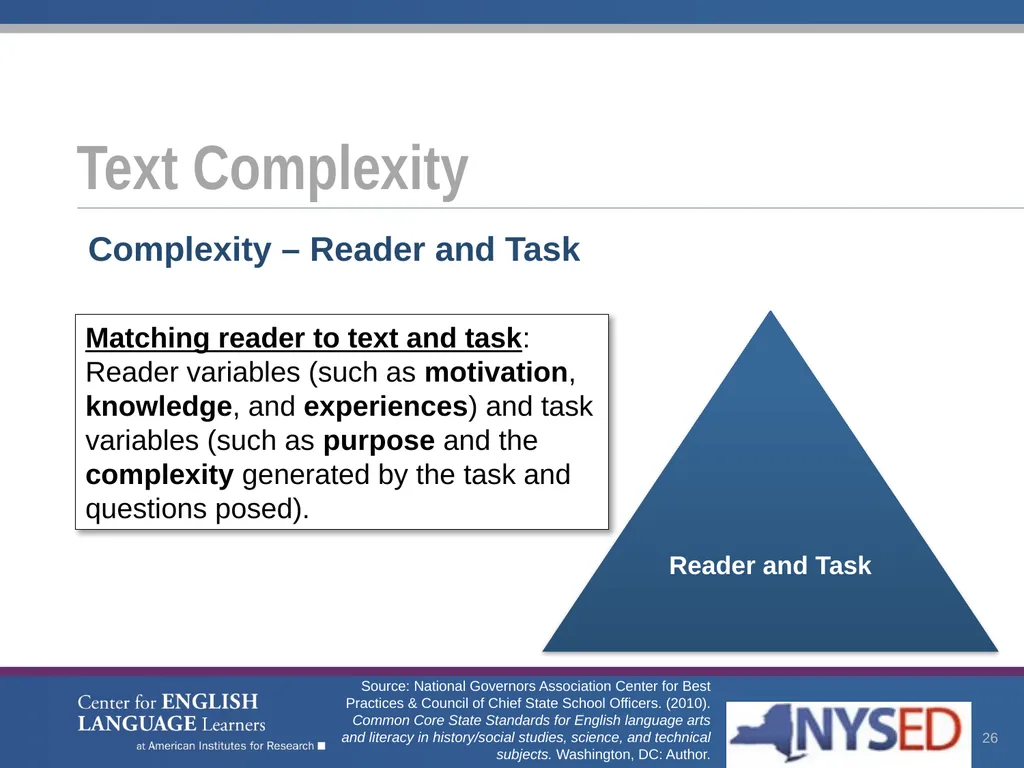
Text Complexity Matching reader to text and task: Reader variables (such as motivation, knowledge, and experiences) and task variables (such as purpose and the complexity generated by the task and questions posed). 26 Source: National Governors Association Center for Best Practices & Council of Chief State School Officers. (2010). Common Core State Standards for English language arts and literacy in history/social studies, science, and technical subjects. Washington, DC: Author. Complexity – Reader and Task<br>
27
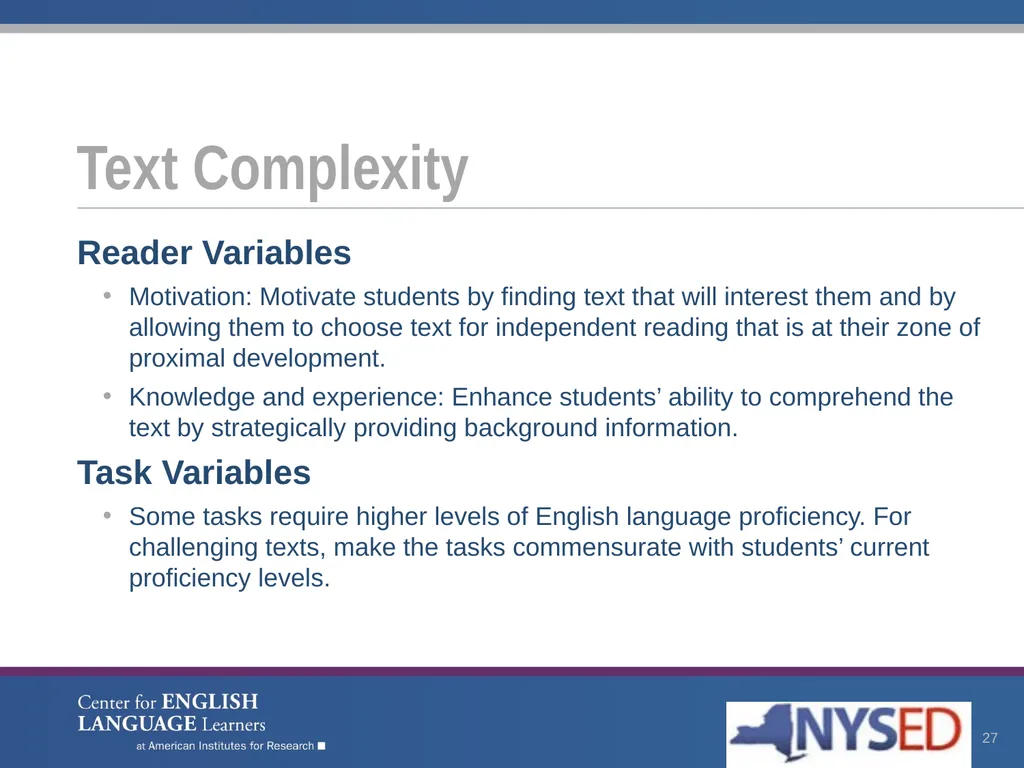
Reader Variables
Motivation: Motivate students by finding text that will interest them and by allowing them to choose text for independent reading that is at their zone of proximal development.
Knowledge and experience: Enhance students’ ability to comprehend the text by strategically providing background information.
Task Variables
Some tasks require higher levels of English language proficiency. For challenging texts, make the tasks commensurate with students’ current proficiency levels. Text Complexity 27<br>
Motivation: Motivate students by finding text that will interest them and by allowing them to choose text for independent reading that is at their zone of proximal development.
Knowledge and experience: Enhance students’ ability to comprehend the text by strategically providing background information.
Task Variables
Some tasks require higher levels of English language proficiency. For challenging texts, make the tasks commensurate with students’ current proficiency levels. Text Complexity 27<br>
28
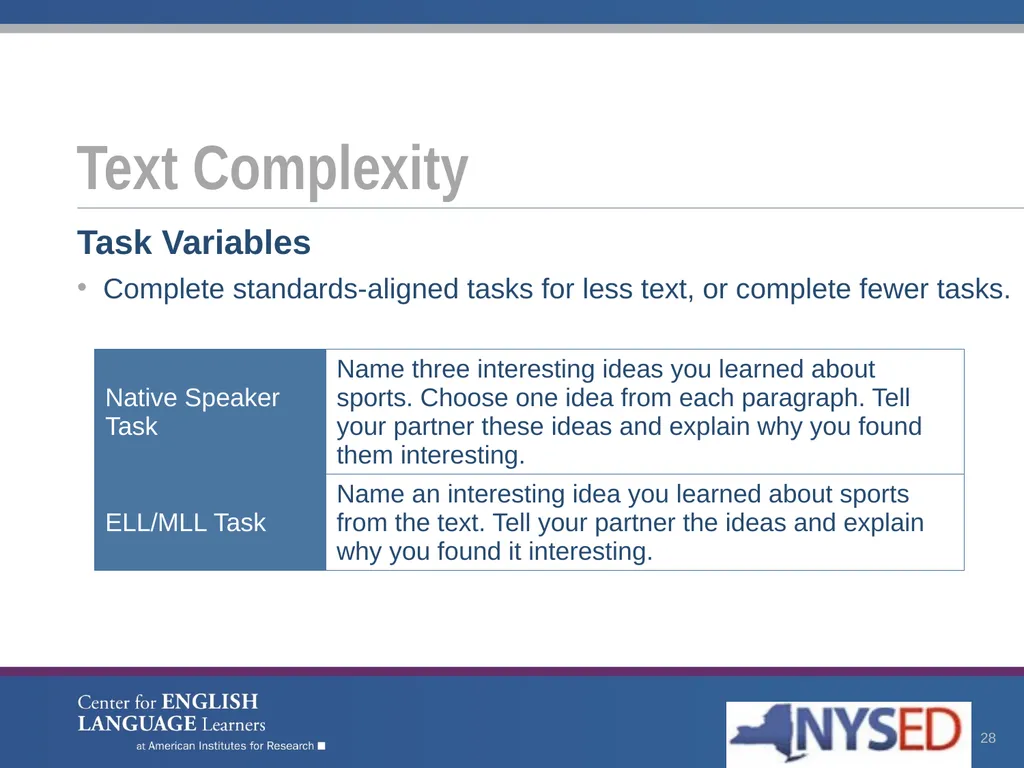
Task Variables
Complete standards-aligned tasks for less text, or complete fewer tasks. Text Complexity 28<br>
Complete standards-aligned tasks for less text, or complete fewer tasks. Text Complexity 28<br>
29
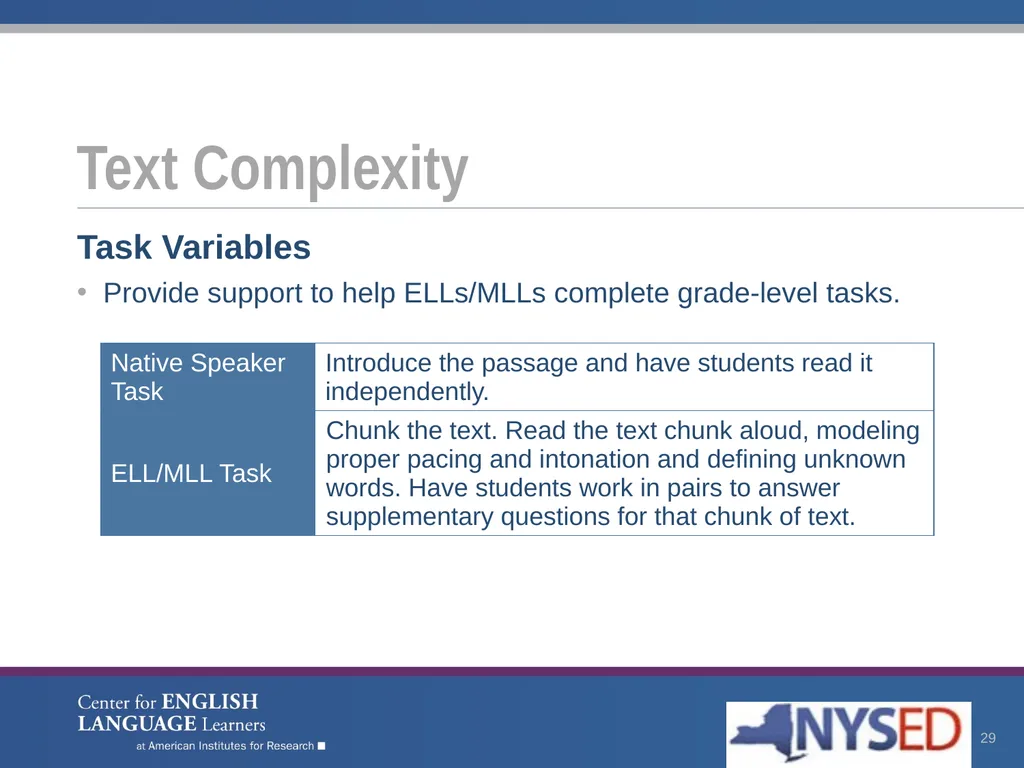
Task Variables
Provide support to help ELLs/MLLs complete grade-level tasks. Text Complexity 29<br>
Provide support to help ELLs/MLLs complete grade-level tasks. Text Complexity 29<br>
30
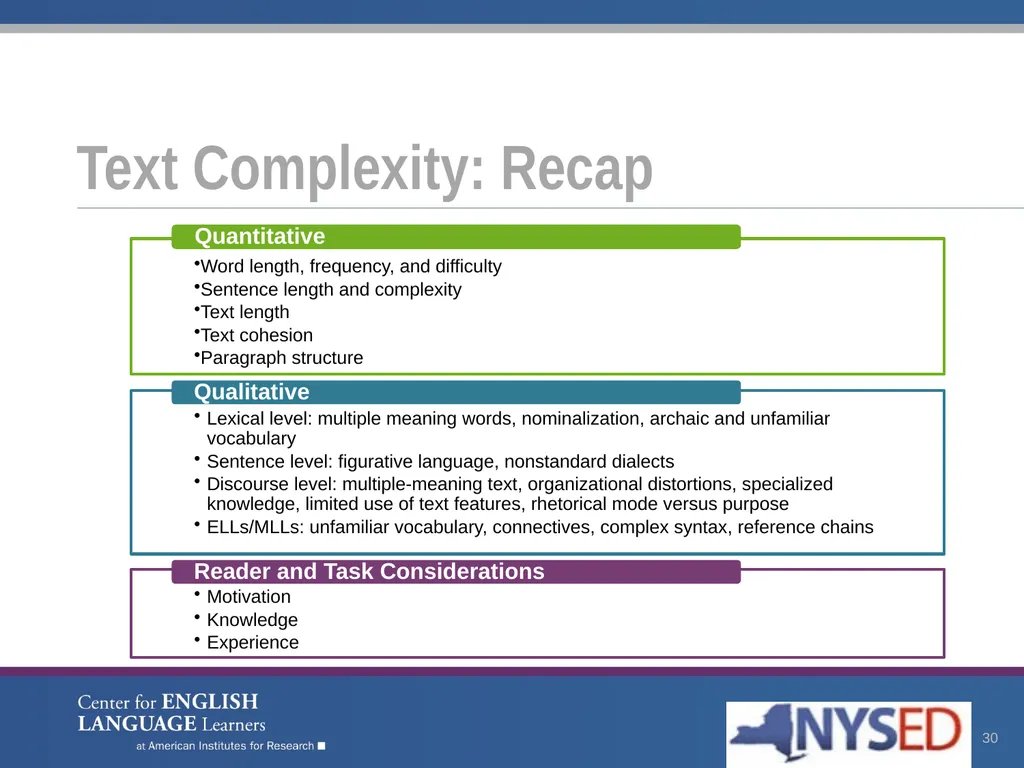
Text Complexity: Recap 30<br>
31
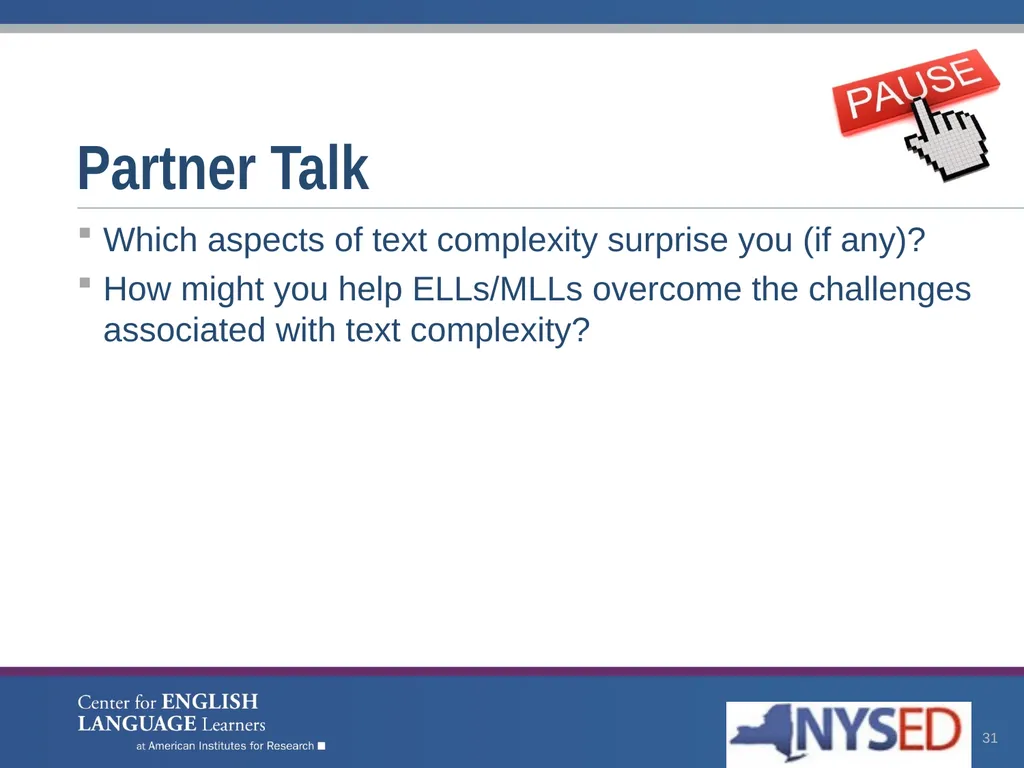
Which aspects of text complexity surprise you (if any)?
How might you help ELLs/MLLs overcome the challenges associated with text complexity? 31 Partner Talk<br>
How might you help ELLs/MLLs overcome the challenges associated with text complexity? 31 Partner Talk<br>
32
Multiple Readings Engage Students in Multiple Readings 32<br>
33
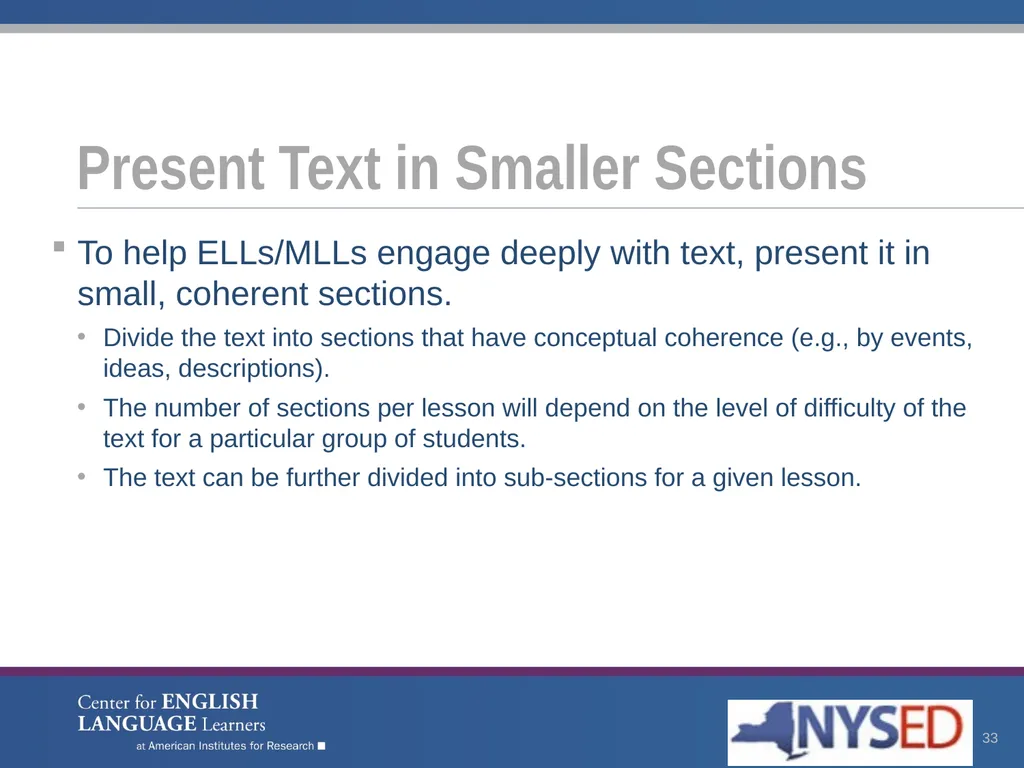
33 To help ELLs/MLLs engage deeply with text, present it in small, coherent sections.
Divide the text into sections that have conceptual coherence (e.g., by events, ideas, descriptions).
The number of sections per lesson will depend on the level of difficulty of the text for a particular group of students.
The text can be further divided into sub-sections for a given lesson. Present Text in Smaller Sections<br>
Divide the text into sections that have conceptual coherence (e.g., by events, ideas, descriptions).
The number of sections per lesson will depend on the level of difficulty of the text for a particular group of students.
The text can be further divided into sub-sections for a given lesson. Present Text in Smaller Sections<br>
34
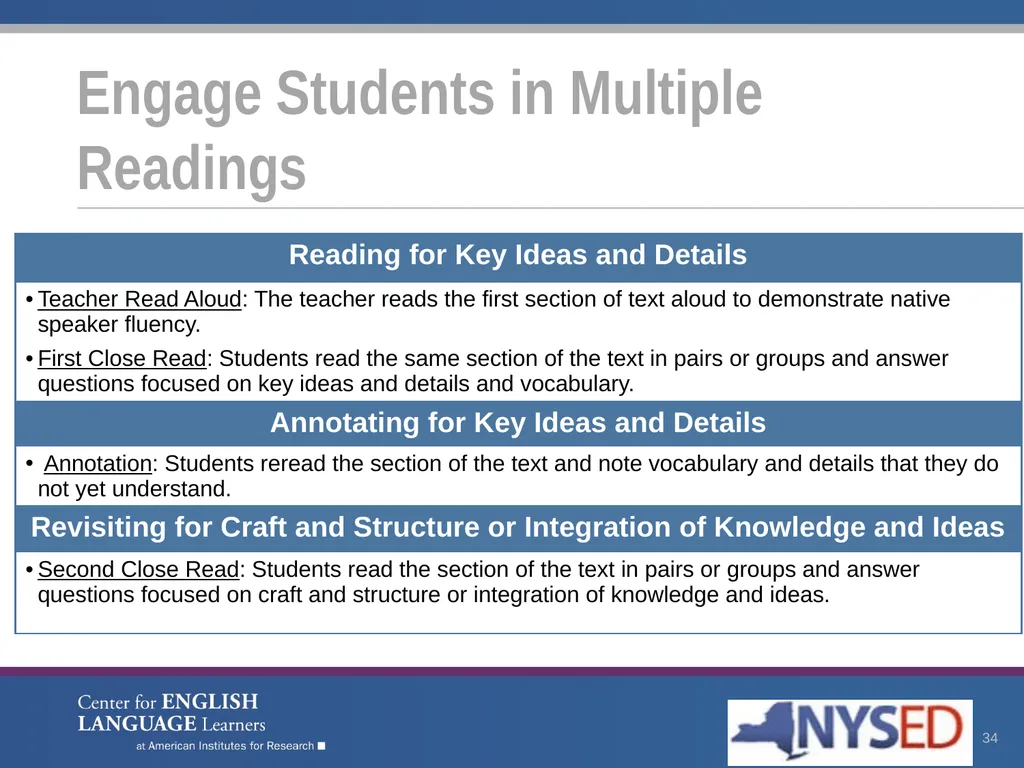
34 Engage Students in Multiple Readings<br>
35
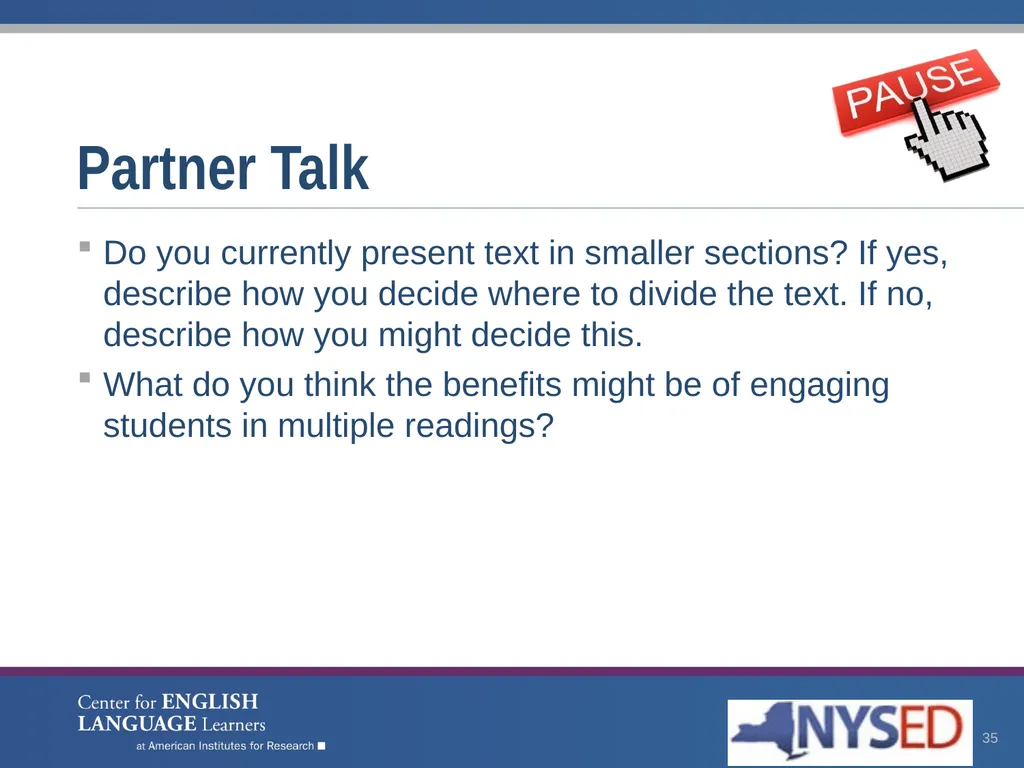
Do you currently present text in smaller sections? If yes, describe how you decide where to divide the text. If no, describe how you might decide this.
What do you think the benefits might be of engaging students in multiple readings? 35 Partner Talk<br>
What do you think the benefits might be of engaging students in multiple readings? 35 Partner Talk<br>
36
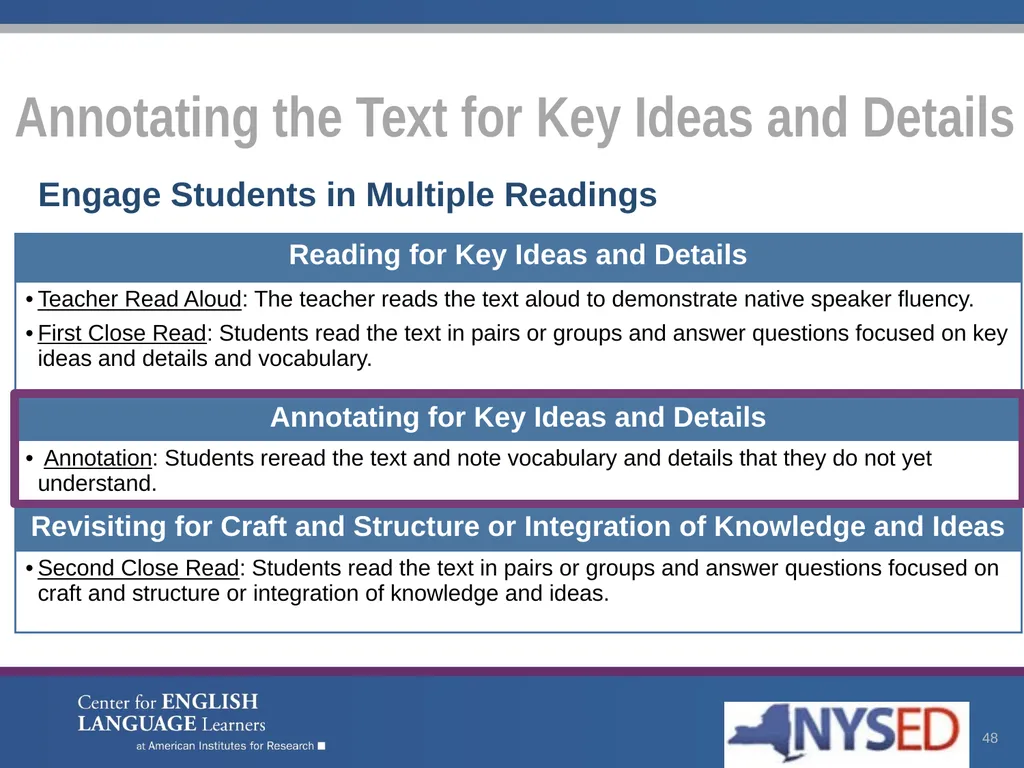
Reading for Key Ideas and Details 36<br>
37
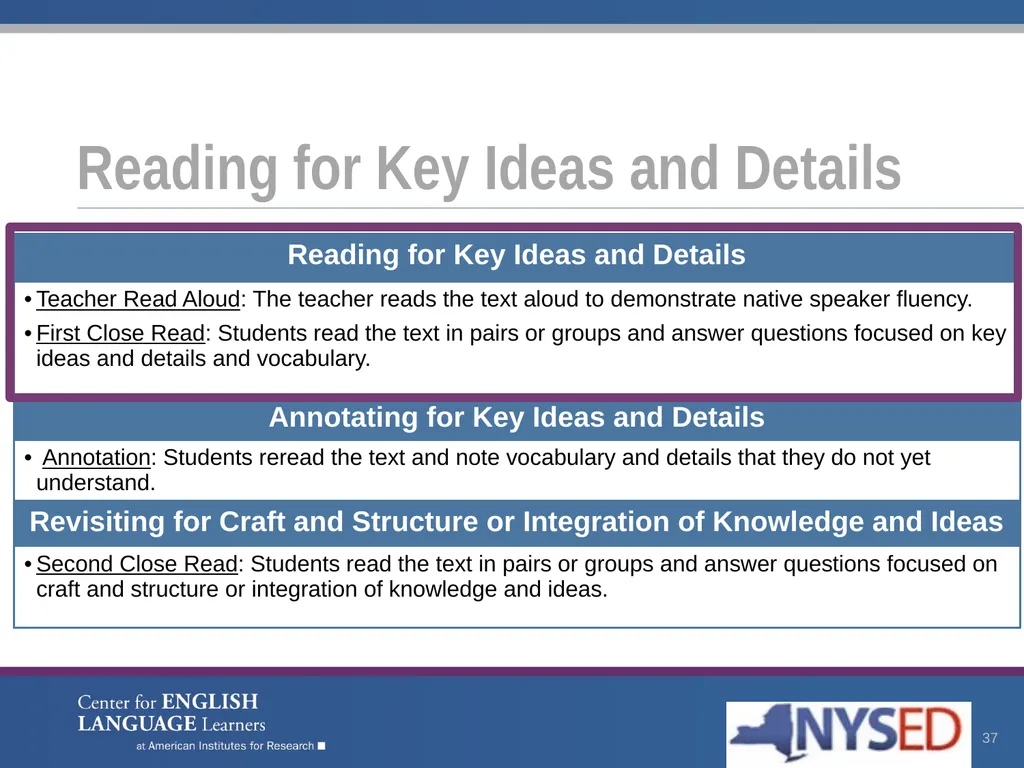
37 Reading for Key Ideas and Details<br>
38
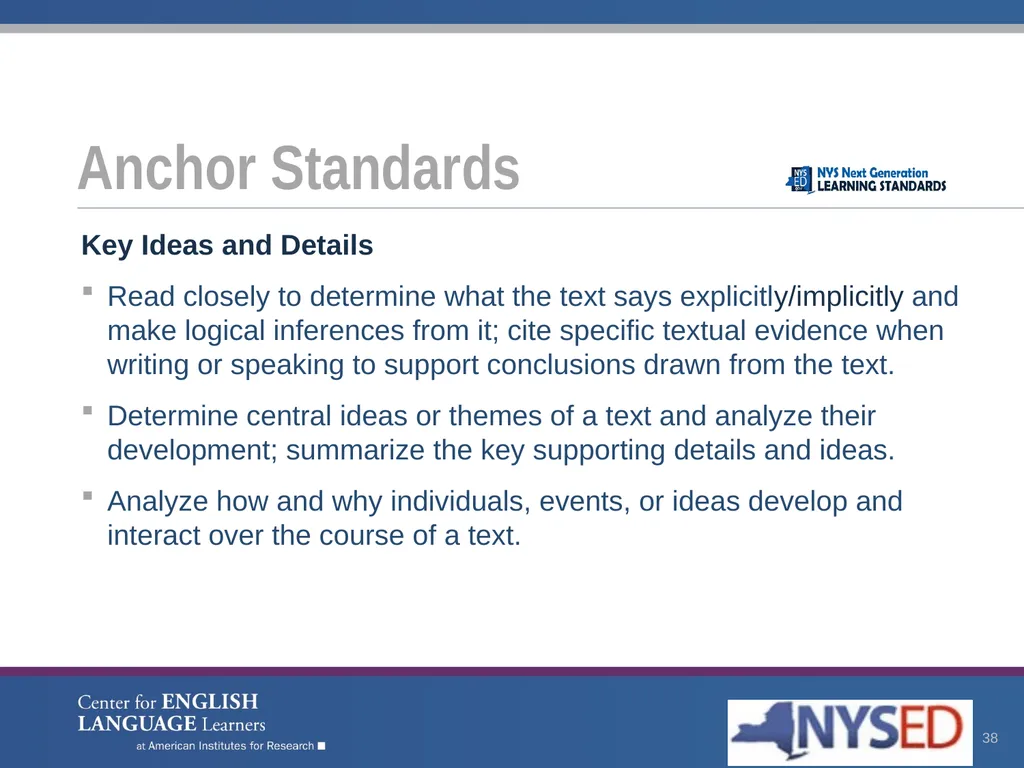
Anchor Standards 38 Key Ideas and Details
Read closely to determine what the text says explicitly/implicitly and make logical inferences from it; cite specific textual evidence when writing or speaking to support conclusions drawn from the text.
Determine central ideas or themes of a text and analyze their development; summarize the key supporting details and ideas.
Analyze how and why individuals, events, or ideas develop and interact over the course of a text.<br>
Read closely to determine what the text says explicitly/implicitly and make logical inferences from it; cite specific textual evidence when writing or speaking to support conclusions drawn from the text.
Determine central ideas or themes of a text and analyze their development; summarize the key supporting details and ideas.
Analyze how and why individuals, events, or ideas develop and interact over the course of a text.<br>
39
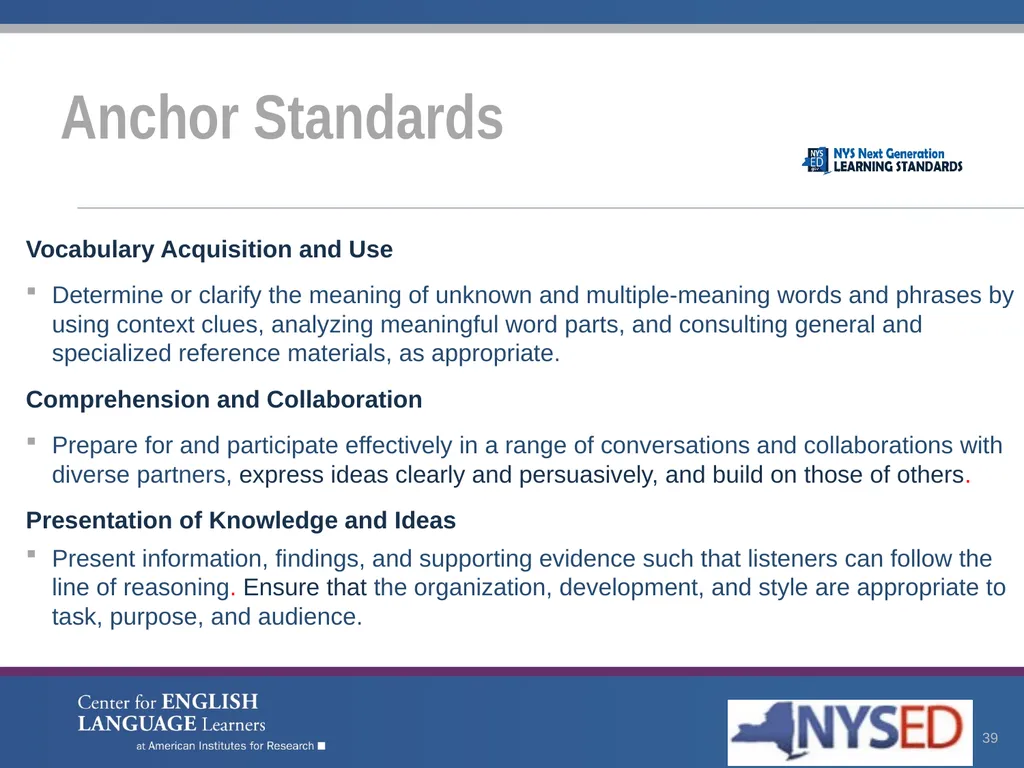
Anchor Standards 39 Vocabulary Acquisition and Use
Determine or clarify the meaning of unknown and multiple-meaning words and phrases by using context clues, analyzing meaningful word parts, and consulting general and specialized reference materials, as appropriate.
Comprehension and Collaboration
Prepare for and participate effectively in a range of conversations and collaborations with diverse partners, express ideas clearly and persuasively, and build on those of others.
Presentation of Knowledge and Ideas
Present information, findings, and supporting evidence such that listeners can follow the line of reasoning. Ensure that the organization, development, and style are appropriate to task, purpose, and audience.<br>
Determine or clarify the meaning of unknown and multiple-meaning words and phrases by using context clues, analyzing meaningful word parts, and consulting general and specialized reference materials, as appropriate.
Comprehension and Collaboration
Prepare for and participate effectively in a range of conversations and collaborations with diverse partners, express ideas clearly and persuasively, and build on those of others.
Presentation of Knowledge and Ideas
Present information, findings, and supporting evidence such that listeners can follow the line of reasoning. Ensure that the organization, development, and style are appropriate to task, purpose, and audience.<br>
40
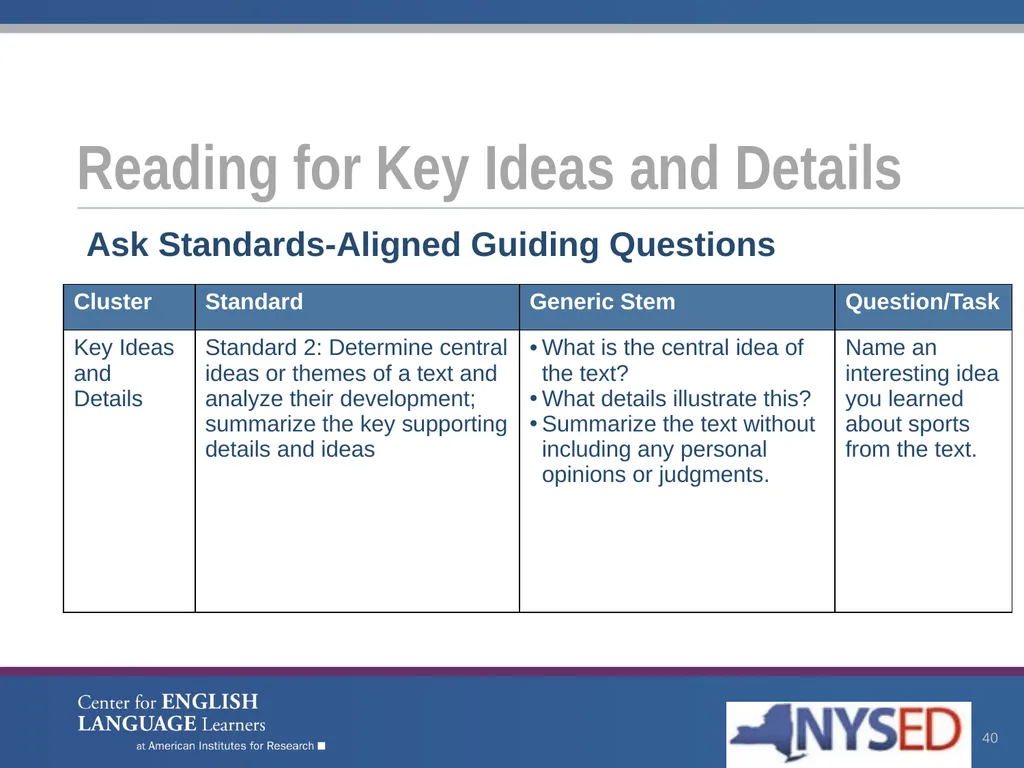
Reading for Key Ideas and Details 40 Ask Standards-Aligned Guiding Questions<br>
41
Open your handout and go to Activity 1 on page 2.
Work with your partner to write a standards-aligned guiding question.
Be sure your question aligns with the “key ideas and details” question stems (see the grade-level question stems handout for assistance). ACTIVITY 1: Guiding Questions 41<br>
Work with your partner to write a standards-aligned guiding question.
Be sure your question aligns with the “key ideas and details” question stems (see the grade-level question stems handout for assistance). ACTIVITY 1: Guiding Questions 41<br>
42
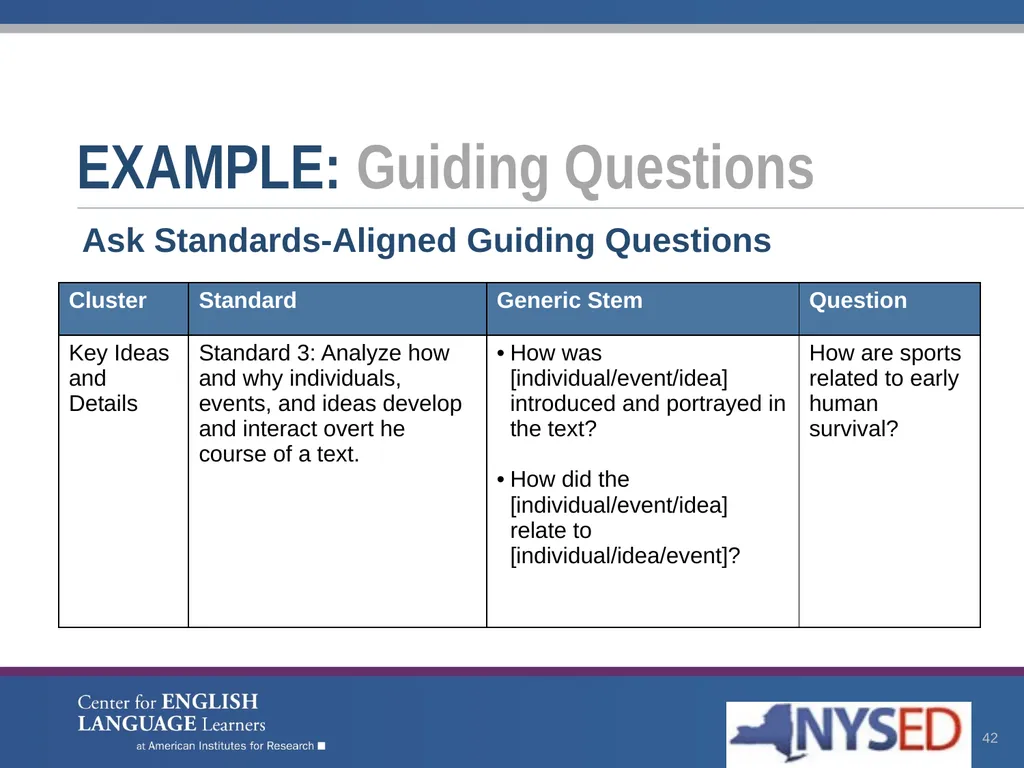
EXAMPLE: Guiding Questions 42 Ask Standards-Aligned Guiding Questions<br>
43
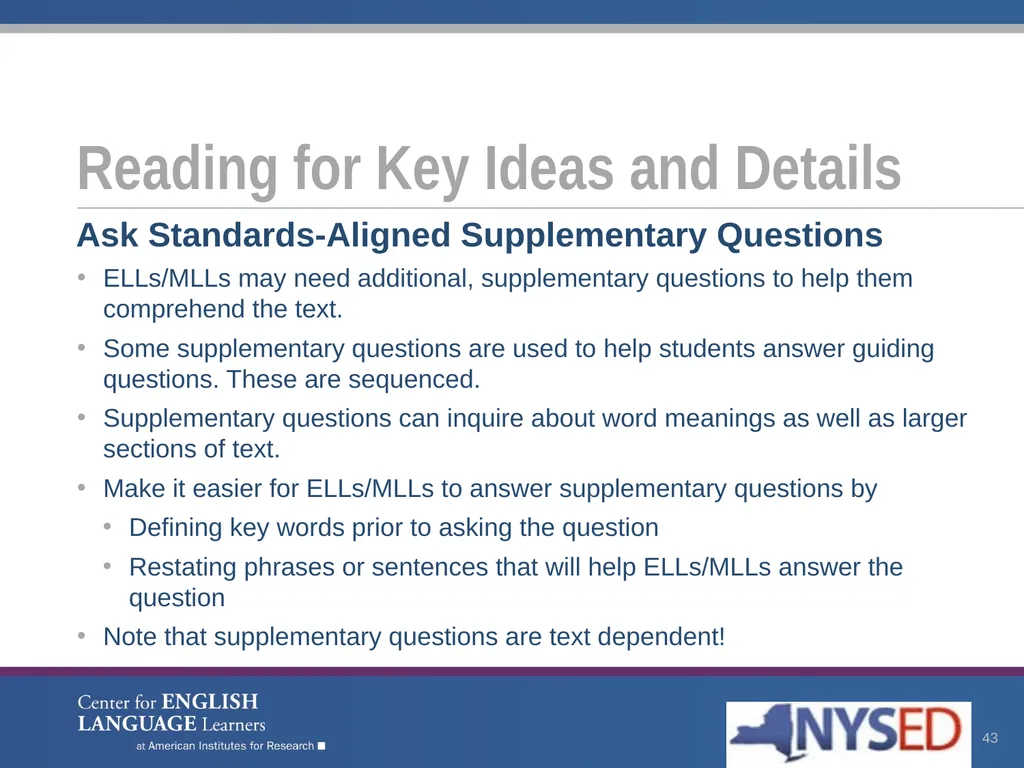
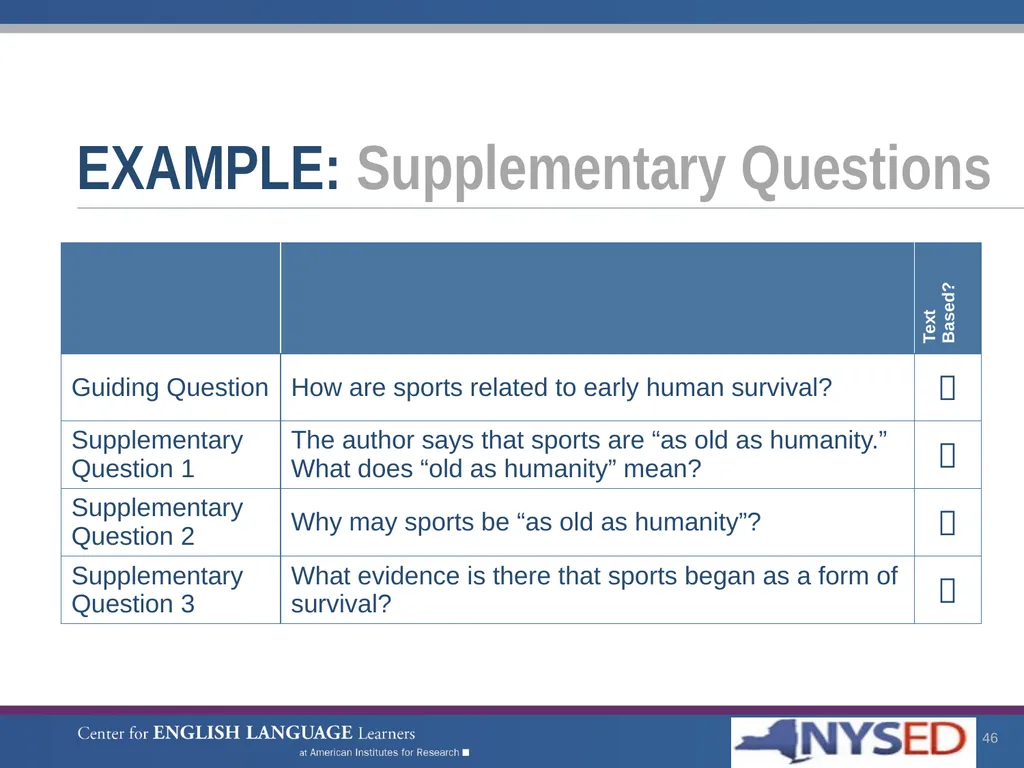
ELLs/MLLs may need additional, supplementary questions to help them comprehend the text.
Some supplementary questions are used to help students answer guiding questions. These are sequenced.
Supplementary questions can inquire about word meanings as well as larger sections of text.
Make it easier for ELLs/MLLs to answer supplementary questions by
Defining key words prior to asking the question
Restating phrases or sentences that will help ELLs/MLLs answer the question
Note that supplementary questions are text dependent! Reading for Key Ideas and Details 43 Ask Standards-Aligned Supplementary Questions<br>
Some supplementary questions are used to help students answer guiding questions. These are sequenced.
Supplementary questions can inquire about word meanings as well as larger sections of text.
Make it easier for ELLs/MLLs to answer supplementary questions by
Defining key words prior to asking the question
Restating phrases or sentences that will help ELLs/MLLs answer the question
Note that supplementary questions are text dependent! Reading for Key Ideas and Details 43 Ask Standards-Aligned Supplementary Questions<br>
44
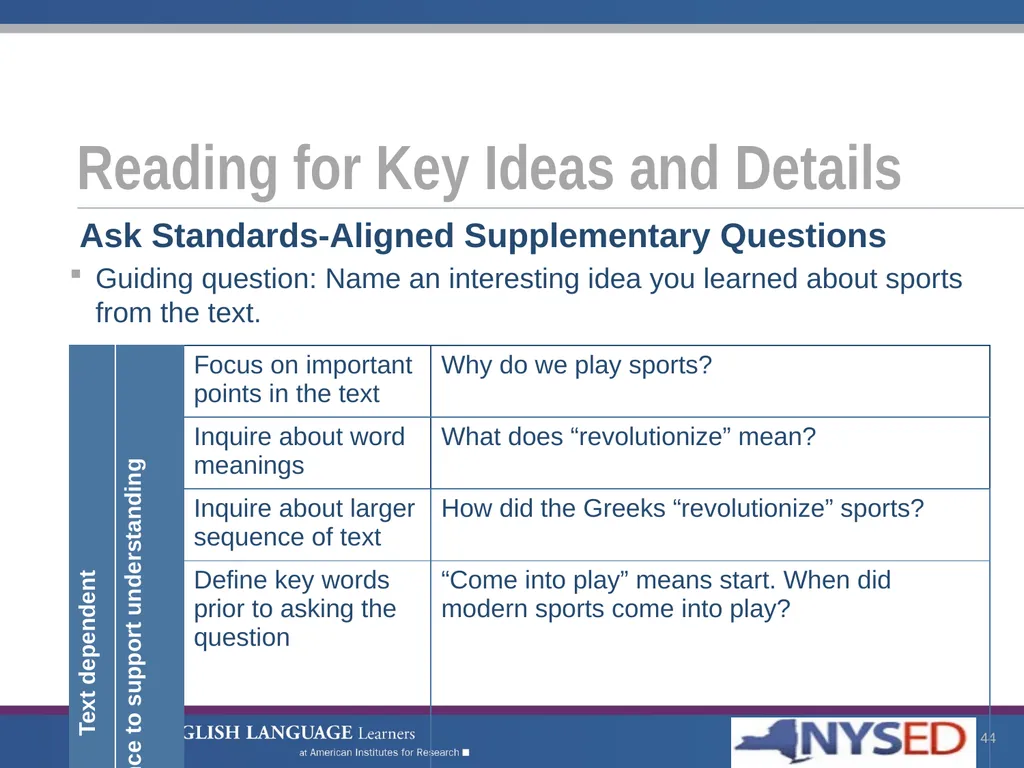
Guiding question: Name an interesting idea you learned about sports from the text. 44 Ask Standards-Aligned Supplementary Questions Reading for Key Ideas and Details<br>
45
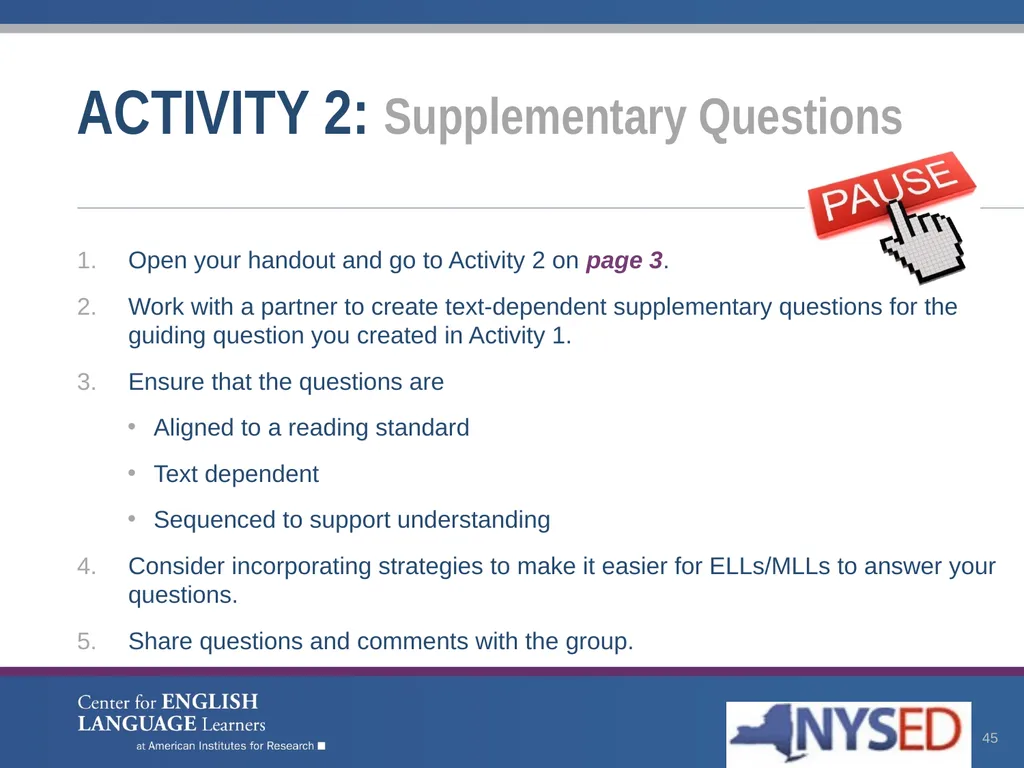
Open your handout and go to Activity 2 on page 3.
Work with a partner to create text-dependent supplementary questions for the guiding question you created in Activity 1.
Ensure that the questions are
Aligned to a reading standard
Text dependent
Sequenced to support understanding
Consider incorporating strategies to make it easier for ELLs/MLLs to answer your questions.
Share questions and comments with the group. ACTIVITY 2: Supplementary Questions 45<br>
Work with a partner to create text-dependent supplementary questions for the guiding question you created in Activity 1.
Ensure that the questions are
Aligned to a reading standard
Text dependent
Sequenced to support understanding
Consider incorporating strategies to make it easier for ELLs/MLLs to answer your questions.
Share questions and comments with the group. ACTIVITY 2: Supplementary Questions 45<br>
46
EXAMPLE: Supplementary Questions 46<br>
47
Annotating the Text for Key Ideas and Details 47<br>
48
Annotating the Text for Key Ideas and Details 48 Engage Students in Multiple Readings<br>
49
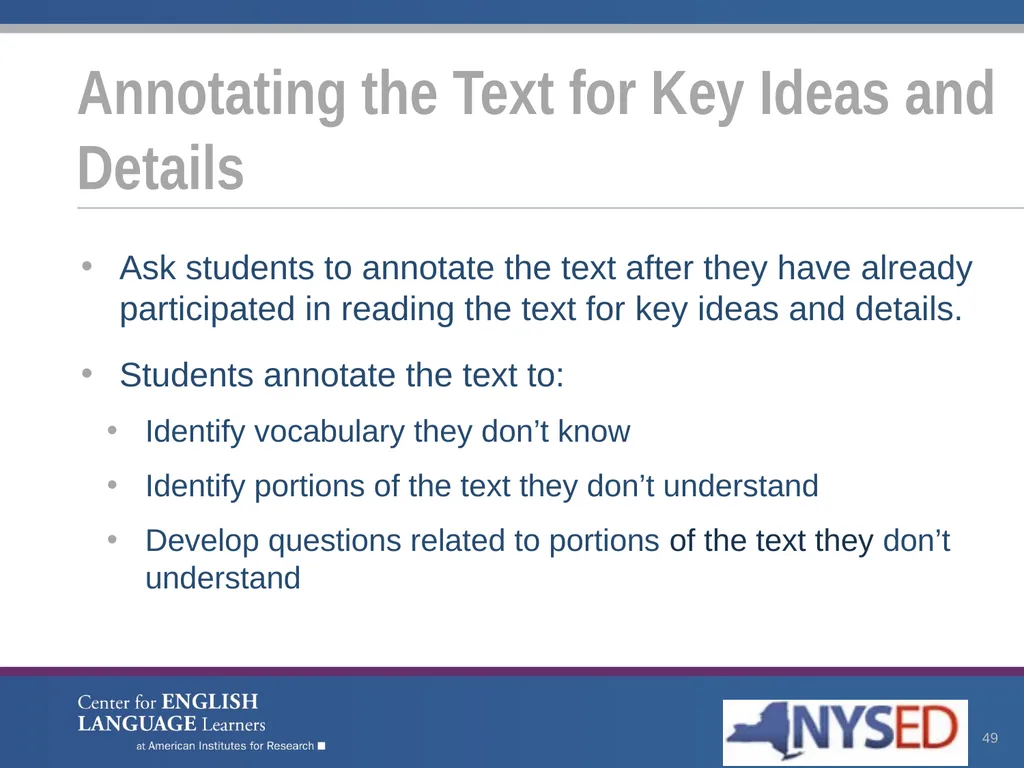
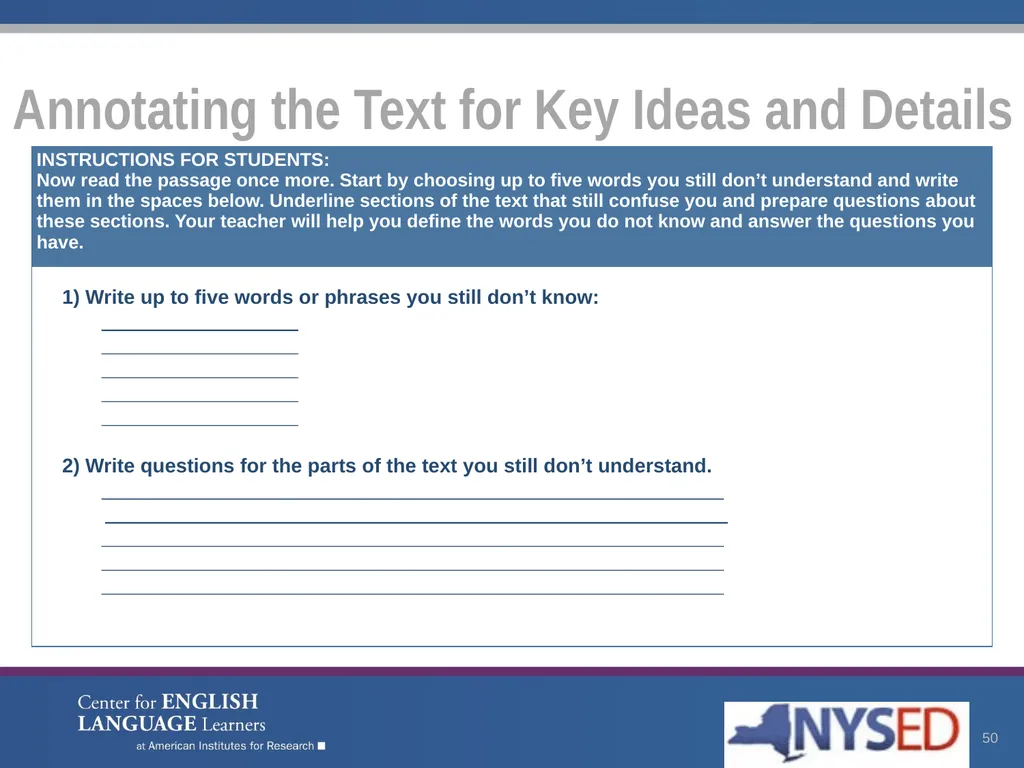
Annotating the Text for Key Ideas and Details 49 Ask students to annotate the text after they have already participated in reading the text for key ideas and details.
Students annotate the text to:
Identify vocabulary they don’t know
Identify portions of the text they don’t understand
Develop questions related to portions of the text they don’t understand<br>
Students annotate the text to:
Identify vocabulary they don’t know
Identify portions of the text they don’t understand
Develop questions related to portions of the text they don’t understand<br>
50
50 Annotating the Text for Key Ideas and Details<br>
51
Revisiting the Text for Craft and Structure and Integration of Knowledge and Ideas 51<br>
52
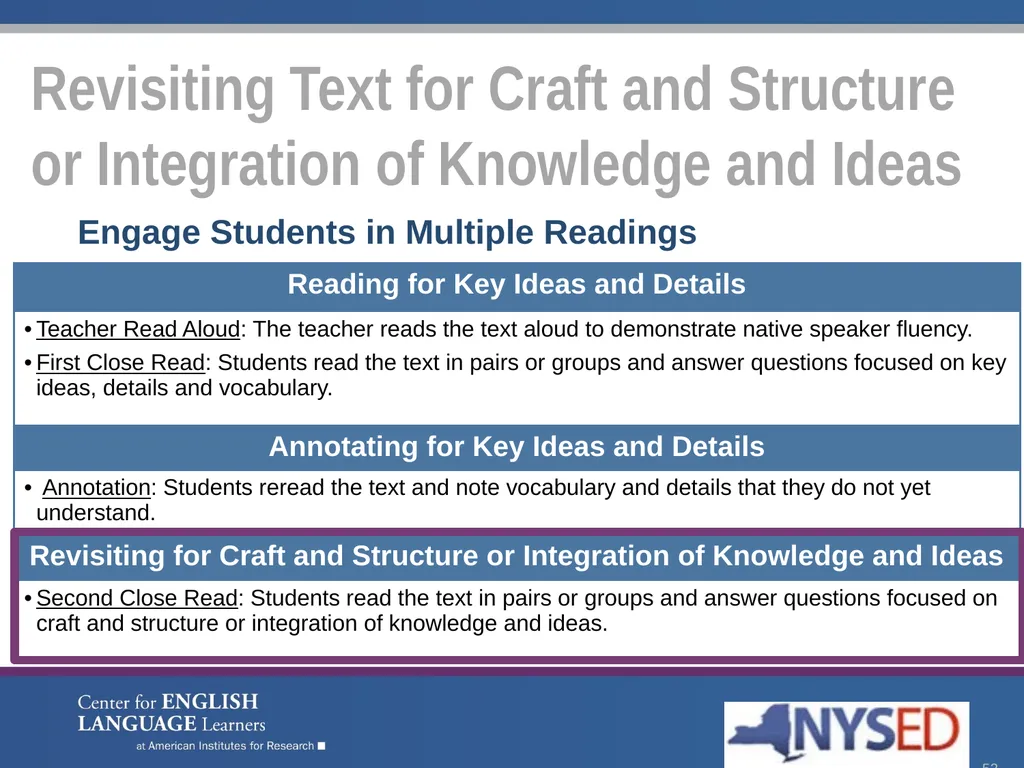
Revisiting Text for Craft and Structure or Integration of Knowledge and Ideas 52 Engage Students in Multiple Readings<br>
53
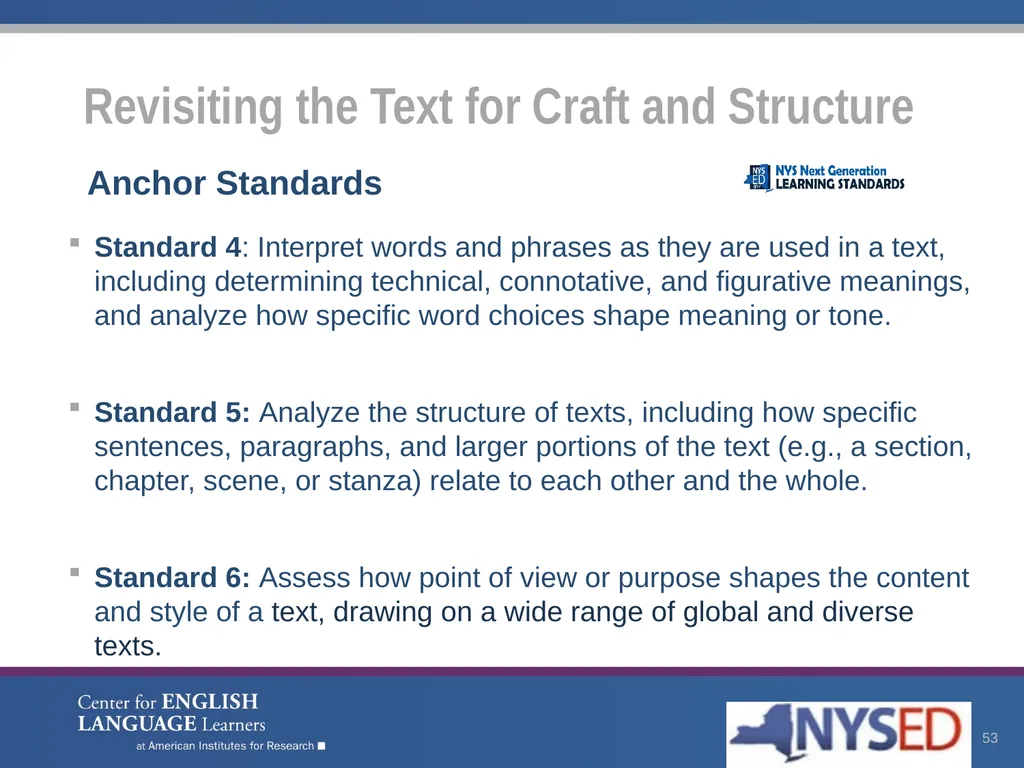
Standard 4: Interpret words and phrases as they are used in a text, including determining technical, connotative, and figurative meanings, and analyze how specific word choices shape meaning or tone.
Standard 5: Analyze the structure of texts, including how specific sentences, paragraphs, and larger portions of the text (e.g., a section, chapter, scene, or stanza) relate to each other and the whole.
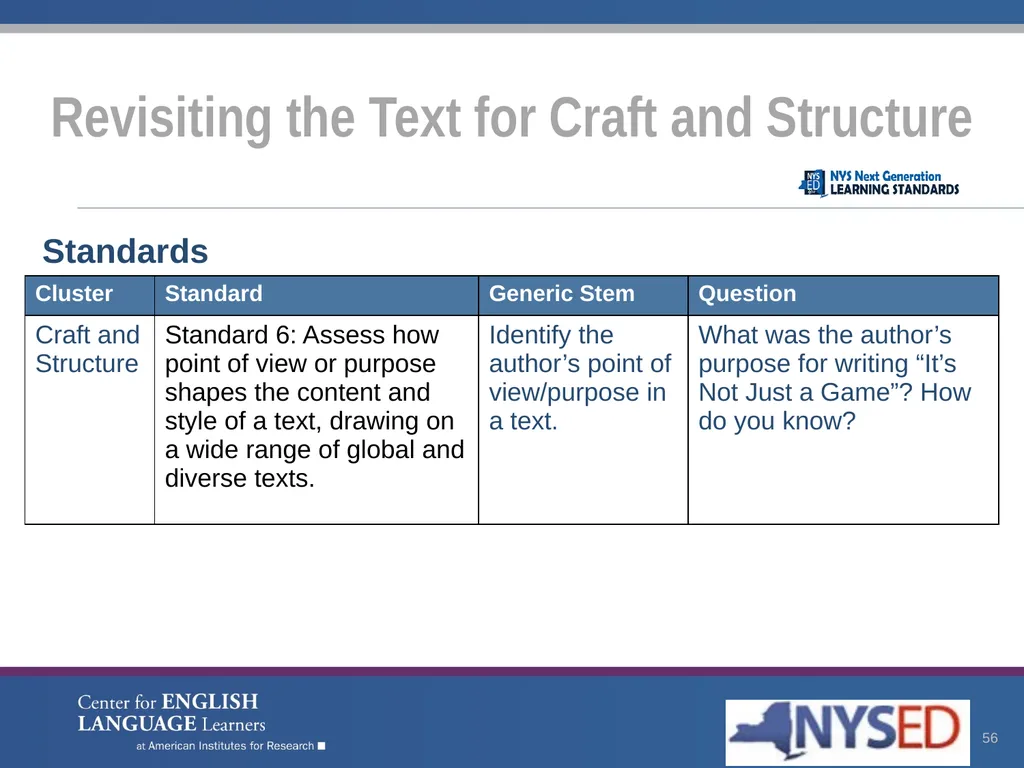
Standard 6: Assess how point of view or purpose shapes the content and style of a text, drawing on a wide range of global and diverse texts. 53 Anchor Standards Revisiting the Text for Craft and Structure<br>
Standard 5: Analyze the structure of texts, including how specific sentences, paragraphs, and larger portions of the text (e.g., a section, chapter, scene, or stanza) relate to each other and the whole.
Standard 6: Assess how point of view or purpose shapes the content and style of a text, drawing on a wide range of global and diverse texts. 53 Anchor Standards Revisiting the Text for Craft and Structure<br>
54
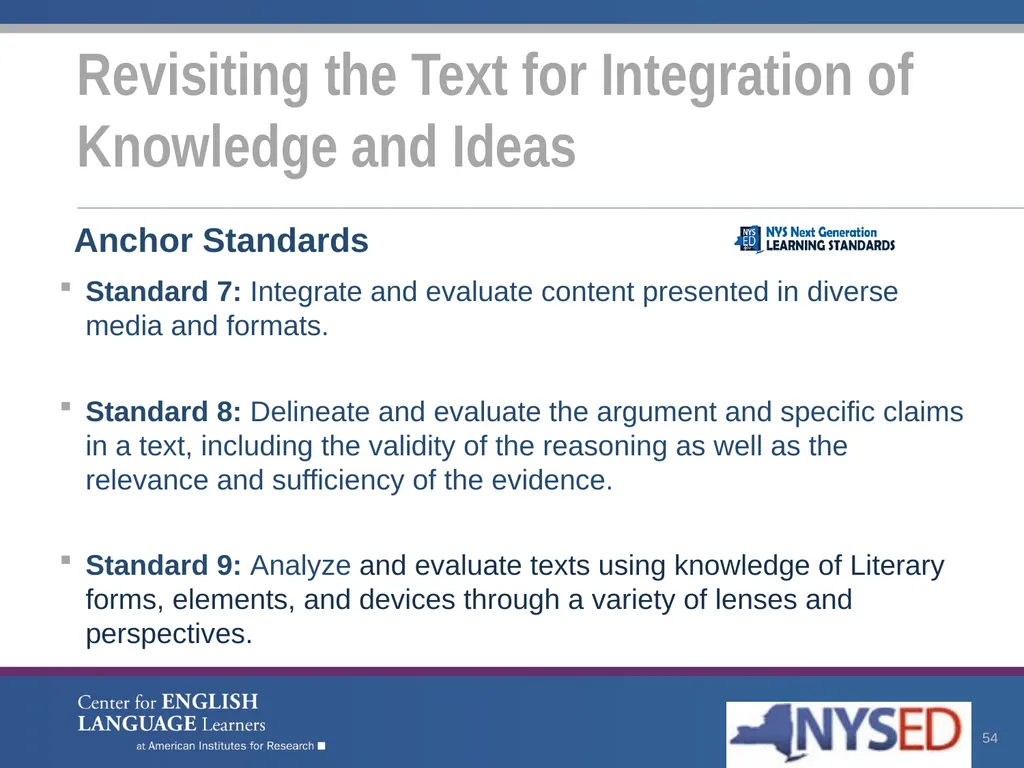
Standard 7: Integrate and evaluate content presented in diverse media and formats.
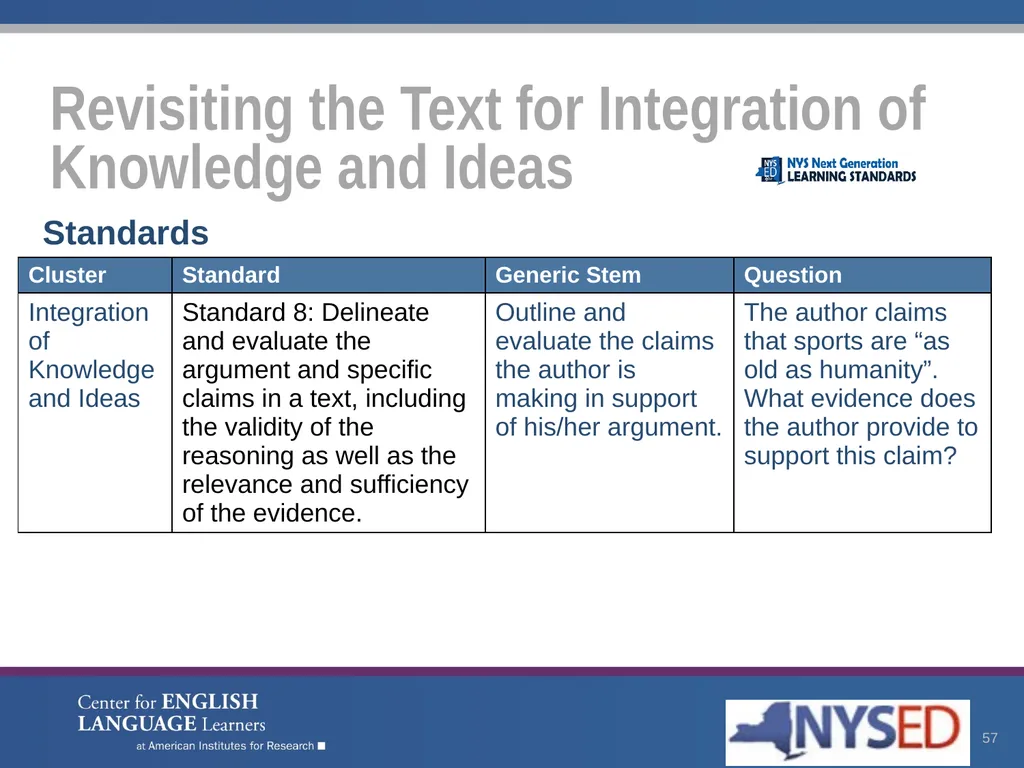
Standard 8: Delineate and evaluate the argument and specific claims in a text, including the validity of the reasoning as well as the relevance and sufficiency of the evidence.
Standard 9: Analyze and evaluate texts using knowledge of Literary forms, elements, and devices through a variety of lenses and perspectives. 54 Revisiting the Text for Integration of Knowledge and Ideas Anchor Standards<br>
Standard 8: Delineate and evaluate the argument and specific claims in a text, including the validity of the reasoning as well as the relevance and sufficiency of the evidence.
Standard 9: Analyze and evaluate texts using knowledge of Literary forms, elements, and devices through a variety of lenses and perspectives. 54 Revisiting the Text for Integration of Knowledge and Ideas Anchor Standards<br>
55
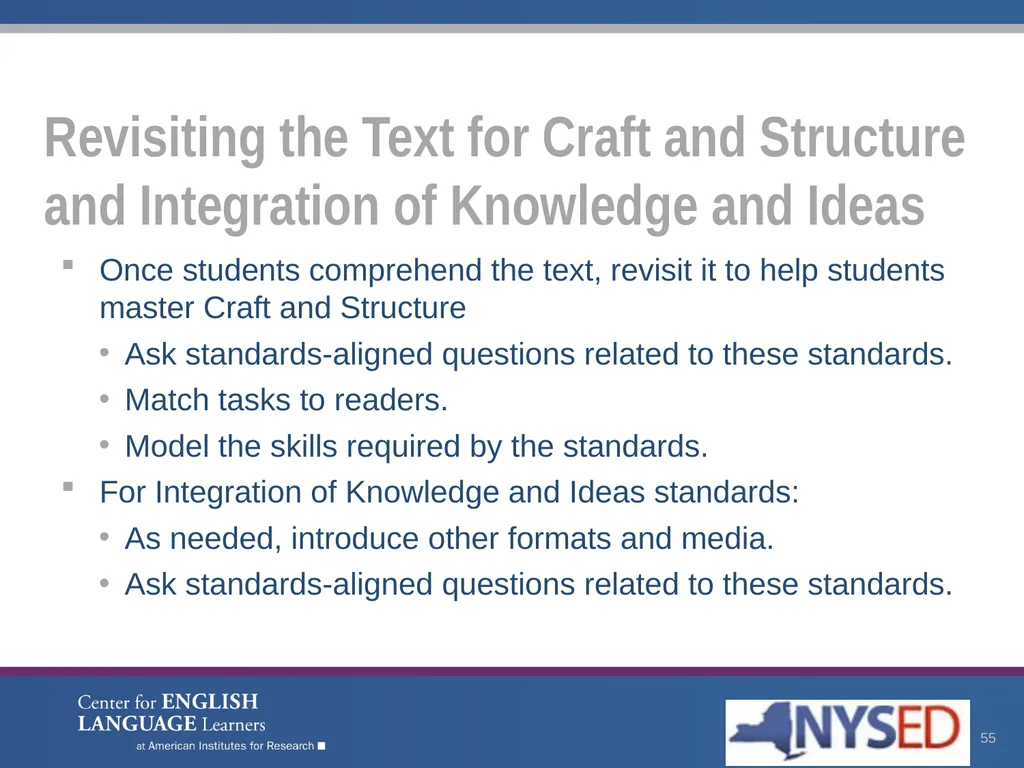
Once students comprehend the text, revisit it to help students master Craft and Structure
Ask standards-aligned questions related to these standards.
Match tasks to readers.
Model the skills required by the standards.
For Integration of Knowledge and Ideas standards:
As needed, introduce other formats and media.
Ask standards-aligned questions related to these standards. Revisiting the Text for Craft and Structure and Integration of Knowledge and Ideas 55<br>
Ask standards-aligned questions related to these standards.
Match tasks to readers.
Model the skills required by the standards.
For Integration of Knowledge and Ideas standards:
As needed, introduce other formats and media.
Ask standards-aligned questions related to these standards. Revisiting the Text for Craft and Structure and Integration of Knowledge and Ideas 55<br>
56
56 Standards Revisiting the Text for Craft and Structure<br>
57
57 Standards Revisiting the Text for Integration of Knowledge and Ideas<br>
58
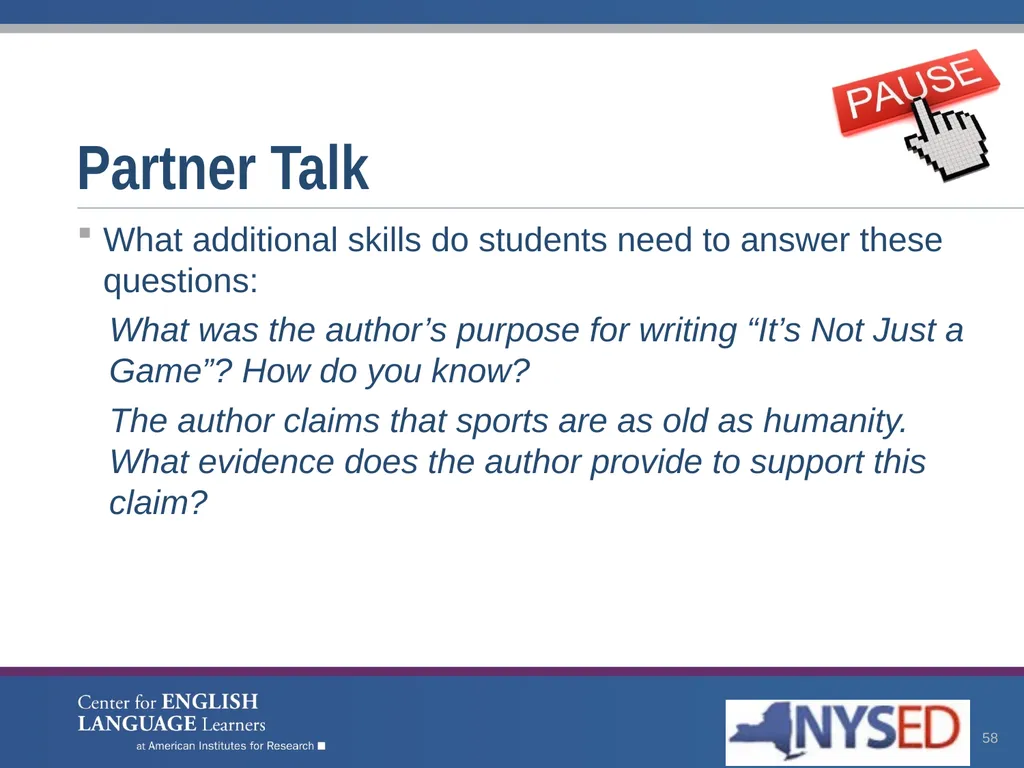
What additional skills do students need to answer these questions:
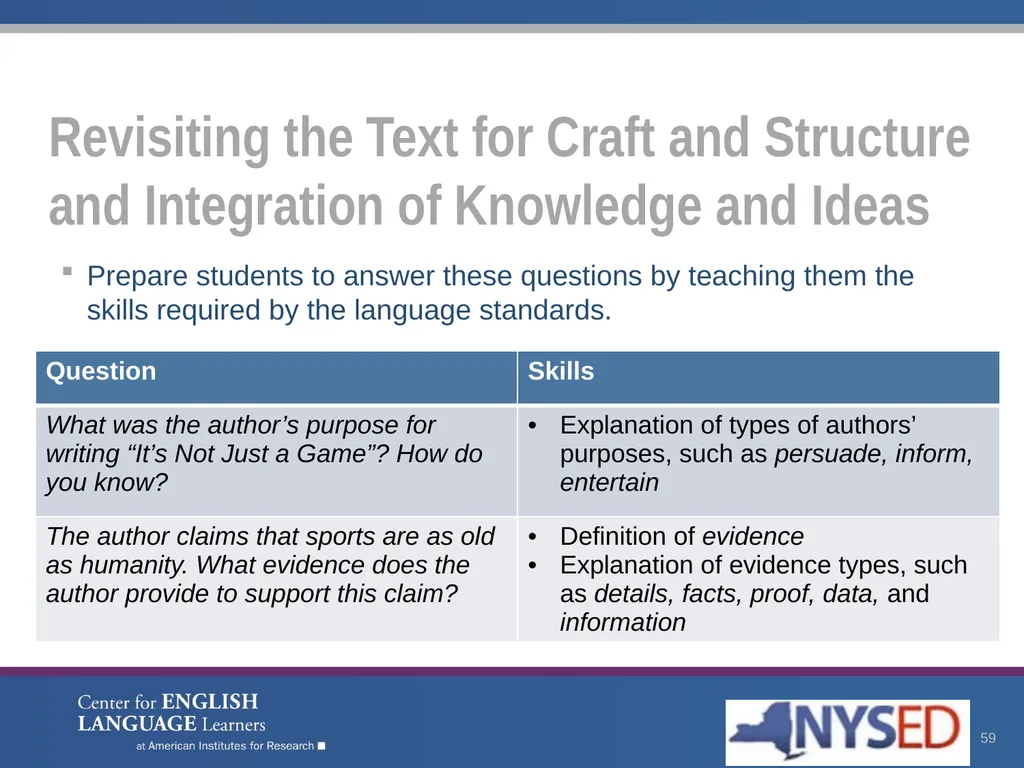
What was the author’s purpose for writing “It’s Not Just a Game”? How do you know?
The author claims that sports are as old as humanity. What evidence does the author provide to support this claim? 58 Partner Talk<br>
What was the author’s purpose for writing “It’s Not Just a Game”? How do you know?
The author claims that sports are as old as humanity. What evidence does the author provide to support this claim? 58 Partner Talk<br>
59
Revisiting the Text for Craft and Structure and Integration of Knowledge and Ideas 59 Prepare students to answer these questions by teaching them the skills required by the language standards.<br>
60
Scaffolding Responses 60<br>
61
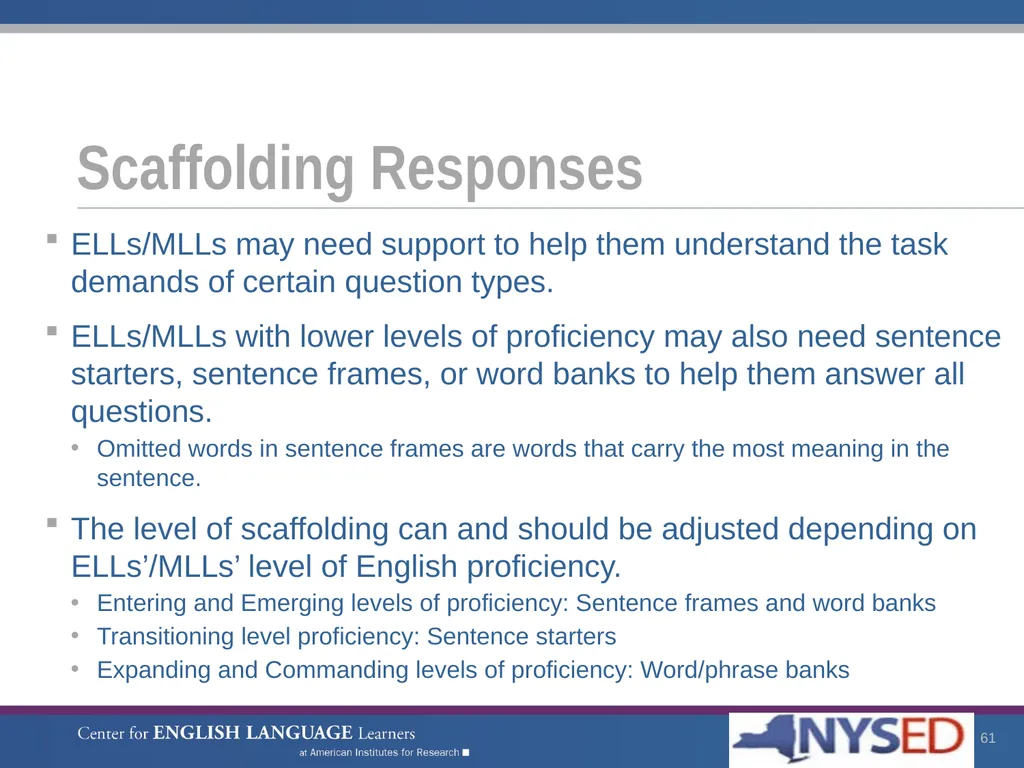
ELLs/MLLs may need support to help them understand the task demands of certain question types.
ELLs/MLLs with lower levels of proficiency may also need sentence starters, sentence frames, or word banks to help them answer all questions.
Omitted words in sentence frames are words that carry the most meaning in the sentence.
The level of scaffolding can and should be adjusted depending on ELLs’/MLLs’ level of English proficiency.
Entering and Emerging levels of proficiency: Sentence frames and word banks
Transitioning level proficiency: Sentence starters
Expanding and Commanding levels of proficiency: Word/phrase banks Scaffolding Responses 61<br>
ELLs/MLLs with lower levels of proficiency may also need sentence starters, sentence frames, or word banks to help them answer all questions.
Omitted words in sentence frames are words that carry the most meaning in the sentence.
The level of scaffolding can and should be adjusted depending on ELLs’/MLLs’ level of English proficiency.
Entering and Emerging levels of proficiency: Sentence frames and word banks
Transitioning level proficiency: Sentence starters
Expanding and Commanding levels of proficiency: Word/phrase banks Scaffolding Responses 61<br>
62
Why do we play sports?
We play sports because they are _____.
What does “revolutionize” mean?
“Revolutionize” means to _______ something in a big way.
How did the Greeks “revolutionize” sports?
The Greeks held the world’s first _______ _____.
“Come into play” means start. When did modern sports come into play?
Modern sports came into play in the _________ ______. 62 fun change Entering and Emerging Scaffolding Responses Olympic games nineteenth century<br>
We play sports because they are _____.
What does “revolutionize” mean?
“Revolutionize” means to _______ something in a big way.
How did the Greeks “revolutionize” sports?
The Greeks held the world’s first _______ _____.
“Come into play” means start. When did modern sports come into play?
Modern sports came into play in the _________ ______. 62 fun change Entering and Emerging Scaffolding Responses Olympic games nineteenth century<br>
63
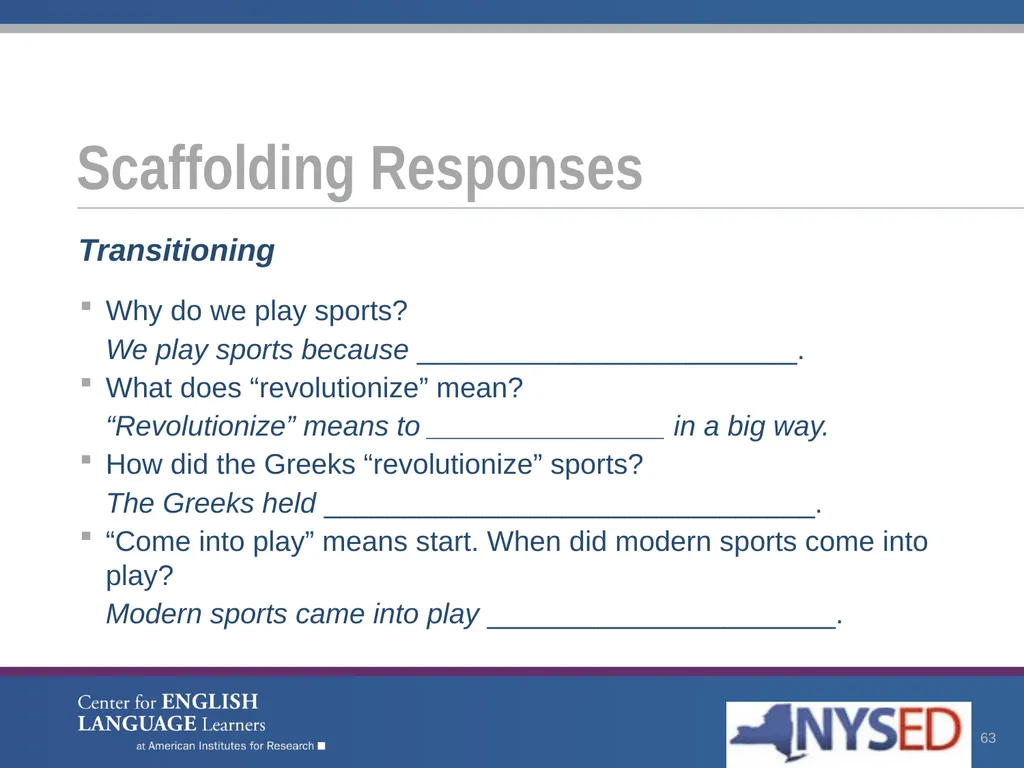
63 Transitioning Scaffolding Responses Why do we play sports?
We play sports because ________________________.
What does “revolutionize” mean?
“Revolutionize” means to _______________ in a big way.
How did the Greeks “revolutionize” sports?
The Greeks held _______________________________.
“Come into play” means start. When did modern sports come into play?
Modern sports came into play ______________________.<br>
We play sports because ________________________.
What does “revolutionize” mean?
“Revolutionize” means to _______________ in a big way.
How did the Greeks “revolutionize” sports?
The Greeks held _______________________________.
“Come into play” means start. When did modern sports come into play?
Modern sports came into play ______________________.<br>
64
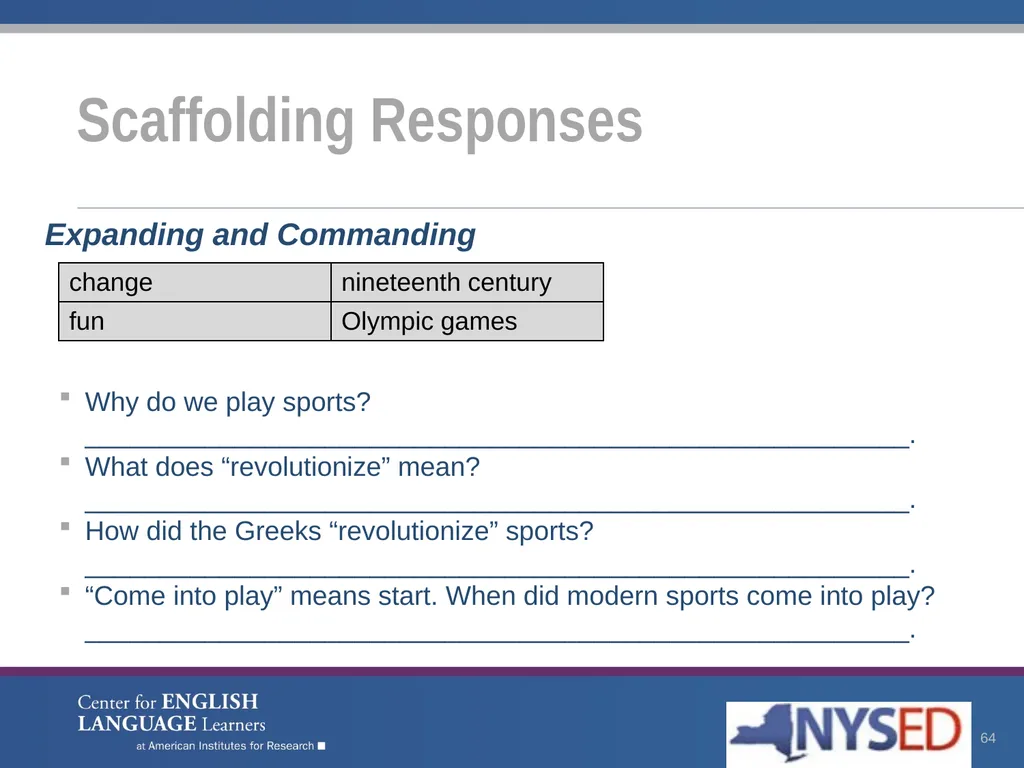
64 Expanding and Commanding Scaffolding Responses Why do we play sports?
_______________________________________________________.
What does “revolutionize” mean?
_______________________________________________________.
How did the Greeks “revolutionize” sports?
_______________________________________________________.
“Come into play” means start. When did modern sports come into play?
_______________________________________________________.<br>
_______________________________________________________.
What does “revolutionize” mean?
_______________________________________________________.
How did the Greeks “revolutionize” sports?
_______________________________________________________.
“Come into play” means start. When did modern sports come into play?
_______________________________________________________.<br>
65
Open your handout and go to Activity 3 on page 4.
Work with your partner to create Entering/Emerging levels of scaffolding (i.e., sentence frames and a word bank) for each of your supplementary questions from Activity 2.
Discuss with your group how you would modify the scaffolding for transitioning and Expanding/Commanding levels of proficiency in ELLs/MLLs. ACTIVITY 3: Scaffolding Responses 65<br>
Work with your partner to create Entering/Emerging levels of scaffolding (i.e., sentence frames and a word bank) for each of your supplementary questions from Activity 2.
Discuss with your group how you would modify the scaffolding for transitioning and Expanding/Commanding levels of proficiency in ELLs/MLLs. ACTIVITY 3: Scaffolding Responses 65<br>
66
The author says that sports are “as old as humanity.” What does “as old as humanity” mean?
“as old as humanity” means as long as _______ have ______.
Why may sports be “as old as humanity”?
Sports may be “as old as humanity” because play may be a ______ _______.
What evidence is there that sports began as a form of survival?
Prehistoric man ____, _______, and _______ for his life. EXAMPLE: Scaffolding Responses 66 humans existed natural instinct ran jumped climbed<br>
“as old as humanity” means as long as _______ have ______.
Why may sports be “as old as humanity”?
Sports may be “as old as humanity” because play may be a ______ _______.
What evidence is there that sports began as a form of survival?
Prehistoric man ____, _______, and _______ for his life. EXAMPLE: Scaffolding Responses 66 humans existed natural instinct ran jumped climbed<br>
67
Providing Wide Reading Opportunities Reading at Home and Beyond 67<br>
68
English Reading Opportunities
Determine the reading level of your students. Usually district assessments provide this information along with students’ reading scores.
Give ELLs/MLLs access to texts that are closer to their zone of proximal development (i.e., comprehensible but challenging).
However, use grade-level standards.
Home Language Reading Opportunities
Make home-language literature available to ELLs/MLLs who are literate in their home language.
Make home-language videos and audio tapes available to all ELLs/MLLs to the extent practicable. Wide Reading Opportunities 68<br>
Determine the reading level of your students. Usually district assessments provide this information along with students’ reading scores.
Give ELLs/MLLs access to texts that are closer to their zone of proximal development (i.e., comprehensible but challenging).
However, use grade-level standards.
Home Language Reading Opportunities
Make home-language literature available to ELLs/MLLs who are literate in their home language.
Make home-language videos and audio tapes available to all ELLs/MLLs to the extent practicable. Wide Reading Opportunities 68<br>
69
Lexile Find-A-Book https://fab.lexile.com/
Lexile text analyzer https://lexile.com/analyzer/
Accelerated Reader BookFinder http://www.arbookfind.com/
Questar Analyzer https://textcomplexity.questarai.com/getdrp/
Common Core State Standards Appendix B: Text Exemplars and Sample Performance Tasks (http://www.corestandards.org/assets/Appendix_B.pdf) Wide Reading Opportunities 69 Resources Related to Leveled Texts<br>
Lexile text analyzer https://lexile.com/analyzer/
Accelerated Reader BookFinder http://www.arbookfind.com/
Questar Analyzer https://textcomplexity.questarai.com/getdrp/
Common Core State Standards Appendix B: Text Exemplars and Sample Performance Tasks (http://www.corestandards.org/assets/Appendix_B.pdf) Wide Reading Opportunities 69 Resources Related to Leveled Texts<br>
70
Newsela.com
Provides real-world news for students at 5 different Lexile levels.
Free for students; teacher can subscribe to Newsela Pro, which includes additional resources.
Readworks.org
Provides research-based units (K, 2–6), lessons, and authentic, leveled non-fiction and literary passages directly to educators online. Wide Reading Opportunities 70 Resources for Finding Leveled Texts<br>
Provides real-world news for students at 5 different Lexile levels.
Free for students; teacher can subscribe to Newsela Pro, which includes additional resources.
Readworks.org
Provides research-based units (K, 2–6), lessons, and authentic, leveled non-fiction and literary passages directly to educators online. Wide Reading Opportunities 70 Resources for Finding Leveled Texts<br>
71
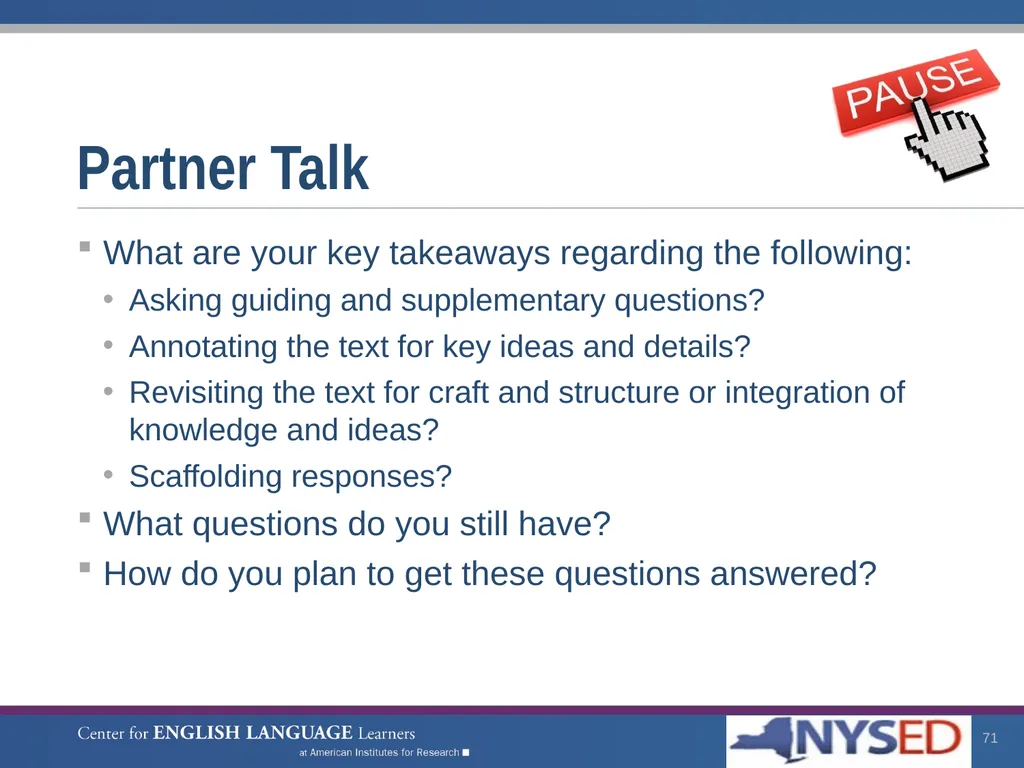
What are your key takeaways regarding the following:
Asking guiding and supplementary questions?
Annotating the text for key ideas and details?
Revisiting the text for craft and structure or integration of knowledge and ideas?
Scaffolding responses?
What questions do you still have?
How do you plan to get these questions answered? Partner Talk 71<br>
Asking guiding and supplementary questions?
Annotating the text for key ideas and details?
Revisiting the text for craft and structure or integration of knowledge and ideas?
Scaffolding responses?
What questions do you still have?
How do you plan to get these questions answered? Partner Talk 71<br>
72
Baker, S., Lesaux, N. Jayanthi, M., Dimino, J. Proctor, C. P., Morris, & J. Newman-Gonchar, R. (2014). Teaching academic content and literacy to English learners in elementary and middle school (NCEE 2014-4012). Washington, DC: U.S. Department of Education, Institute for Education Sciences, National Center for Education Evaluation and Regional Assistance.
URL: http://ies.ed.gov/ncee/wwc/PracticeGuide.aspx?sid=19 retrieved 8-24-15 References<br>
URL: http://ies.ed.gov/ncee/wwc/PracticeGuide.aspx?sid=19 retrieved 8-24-15 References<br>
73
73 http://www.nysed.gov/program-offices/office-bilingual-education-and-world-languages-obewl<br>