
Enterprise Risk Management 2019 Massachusetts
NS
Published · 17 slides · 0 views

1 / 1
Description
Enterprise Risk Management 2019 Massachusetts Trustees Conference March 28, 2019 Amanda Robbins: CSVP Advisor, Department of Higher Education Patricia Gentile: President, North Shore Community College Kevin Foley: Board of Trustees,
Related Topics
Share
Embed code
Download this presentation From Below
"Enterprise Risk Management 2019 Massachusetts" is the property of its rightful owner. Permission is granted to download and print the materials on this website for personal, non-commercial use only, and to display it on your personal computer provided you do not modify the materials and that you retain all copyright notices contained in the materials. By downloading content from our website, you accept the terms of this agreement.
Presentation Transcript
01
Enterprise Risk Management 2019 Massachusetts Trustees Conference | March 28, 2019<br>
02
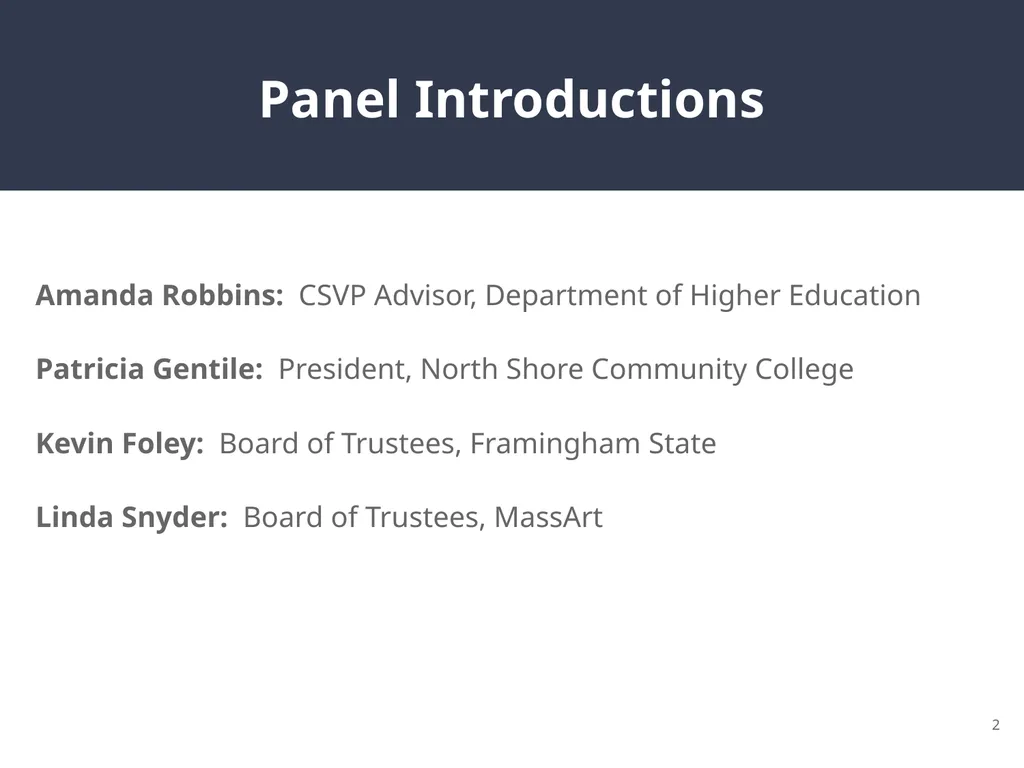
Amanda Robbins: CSVP Advisor, Department of Higher Education
Patricia Gentile: President, North Shore Community College
Kevin Foley: Board of Trustees, Framingham State
Linda Snyder: Board of Trustees, MassArt Panel Introductions 2<br>
Patricia Gentile: President, North Shore Community College
Kevin Foley: Board of Trustees, Framingham State
Linda Snyder: Board of Trustees, MassArt Panel Introductions 2<br>
03
Introductions
Overview of Enterprise Risk Management (ERM)
Panel Discussion
Questions & Answers Summary of Presentation 3<br>
Overview of Enterprise Risk Management (ERM)
Panel Discussion
Questions & Answers Summary of Presentation 3<br>
04
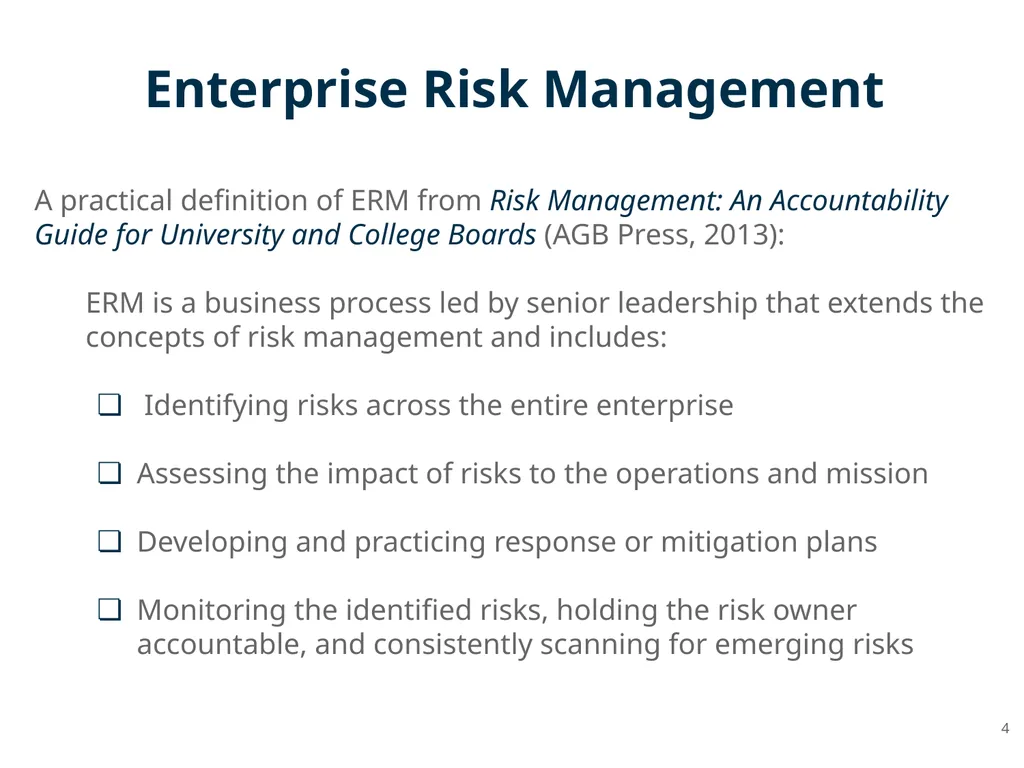
A practical definition of ERM from Risk Management: An Accountability Guide for University and College Boards (AGB Press, 2013):
ERM is a business process led by senior leadership that extends the concepts of risk management and includes:
Identifying risks across the entire enterprise
Assessing the impact of risks to the operations and mission
Developing and practicing response or mitigation plans
Monitoring the identified risks, holding the risk owner accountable, and consistently scanning for emerging risks Enterprise Risk Management 4<br>
ERM is a business process led by senior leadership that extends the concepts of risk management and includes:
Identifying risks across the entire enterprise
Assessing the impact of risks to the operations and mission
Developing and practicing response or mitigation plans
Monitoring the identified risks, holding the risk owner accountable, and consistently scanning for emerging risks Enterprise Risk Management 4<br>
05
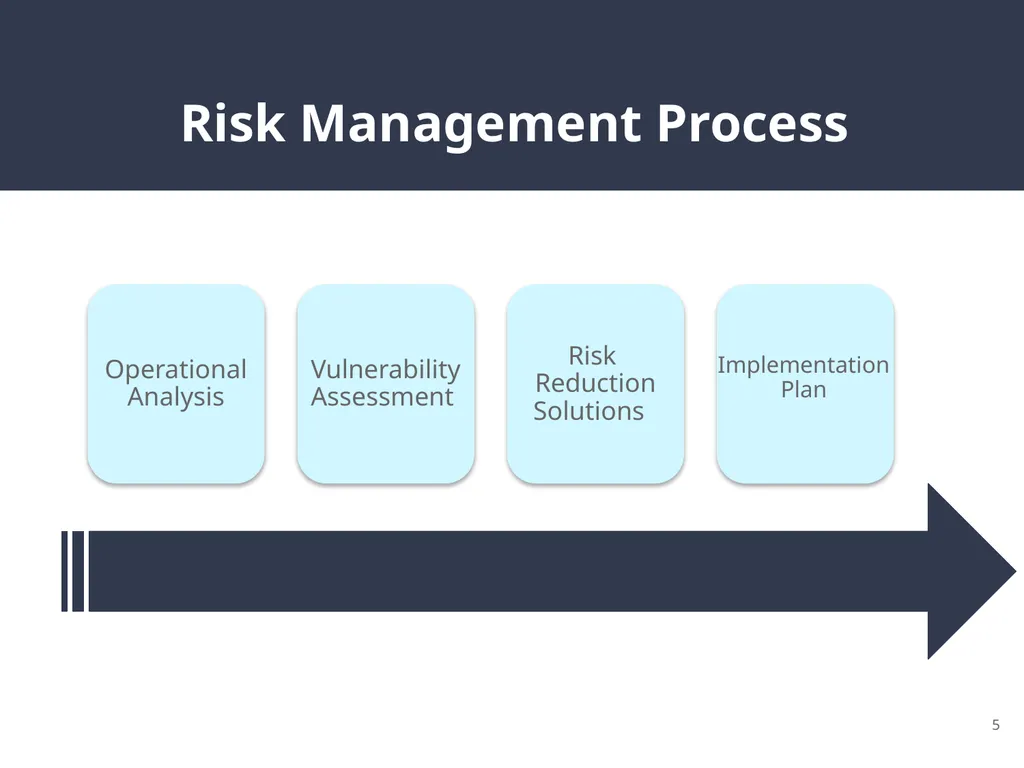
Risk Management Process Operational Analysis Vulnerability Assessment Risk
Reduction Solutions Implementation
Plan 5<br>
Reduction Solutions Implementation
Plan 5<br>
06
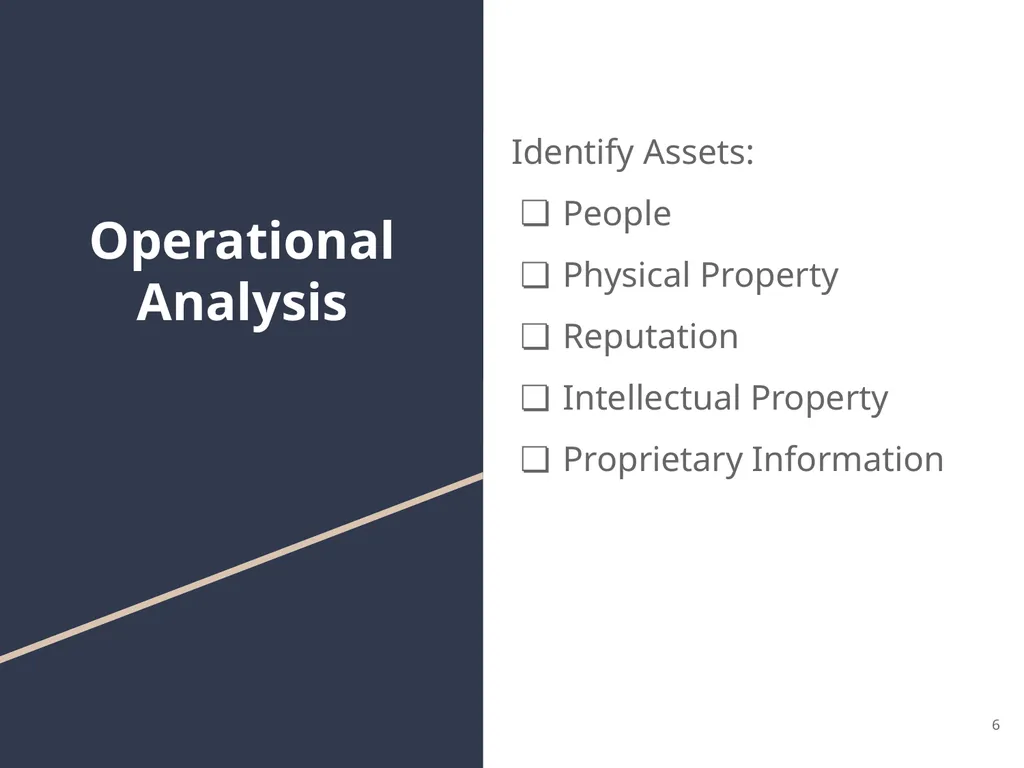
Operational Analysis Identify Assets:
People
Physical Property
Reputation
Intellectual Property
Proprietary Information 6<br>
People
Physical Property
Reputation
Intellectual Property
Proprietary Information 6<br>
07
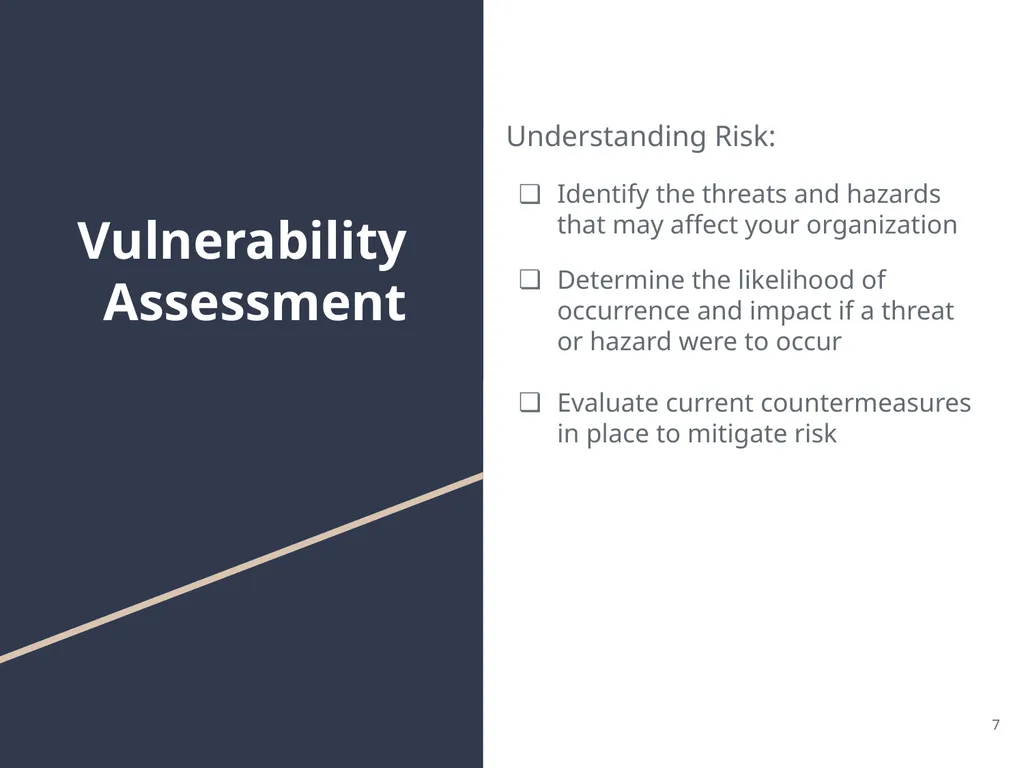
Vulnerability
Assessment Understanding Risk:
Identify the threats and hazards that may affect your organization
Determine the likelihood of occurrence and impact if a threat or hazard were to occur
Evaluate current countermeasures in place to mitigate risk 7<br>
Assessment Understanding Risk:
Identify the threats and hazards that may affect your organization
Determine the likelihood of occurrence and impact if a threat or hazard were to occur
Evaluate current countermeasures in place to mitigate risk 7<br>
08
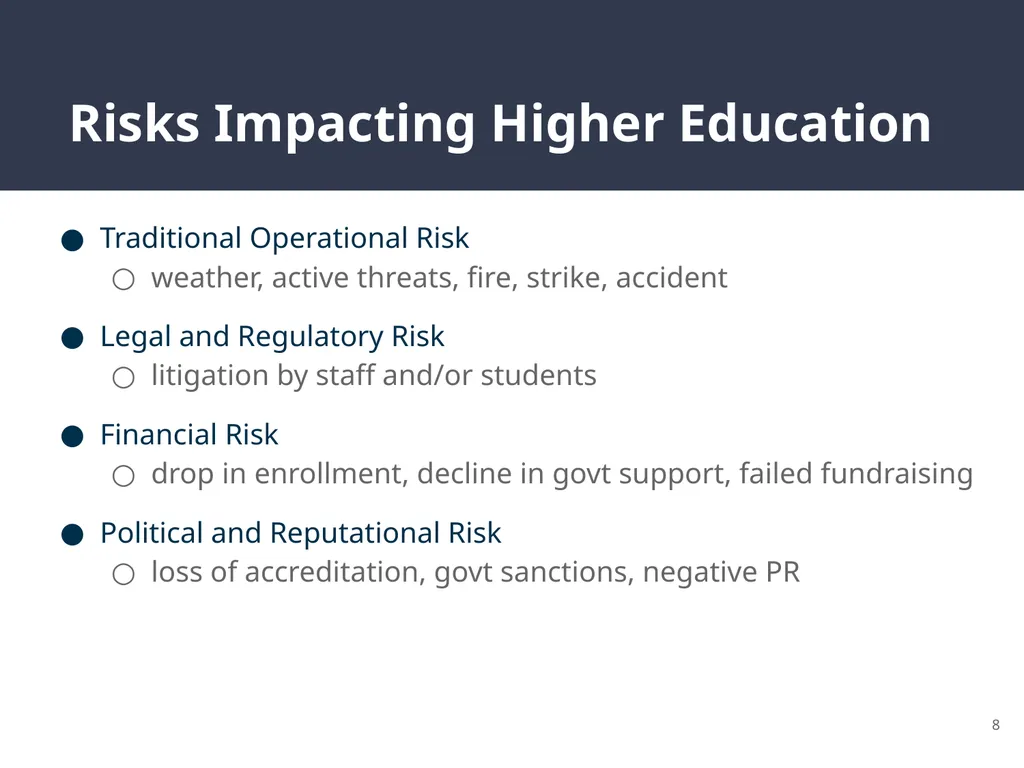
Traditional Operational Risk
weather, active threats, fire, strike, accident
Legal and Regulatory Risk
litigation by staff and/or students
Financial Risk
drop in enrollment, decline in govt support, failed fundraising
Political and Reputational Risk
loss of accreditation, govt sanctions, negative PR Risks Impacting Higher Education 8<br>
weather, active threats, fire, strike, accident
Legal and Regulatory Risk
litigation by staff and/or students
Financial Risk
drop in enrollment, decline in govt support, failed fundraising
Political and Reputational Risk
loss of accreditation, govt sanctions, negative PR Risks Impacting Higher Education 8<br>
09
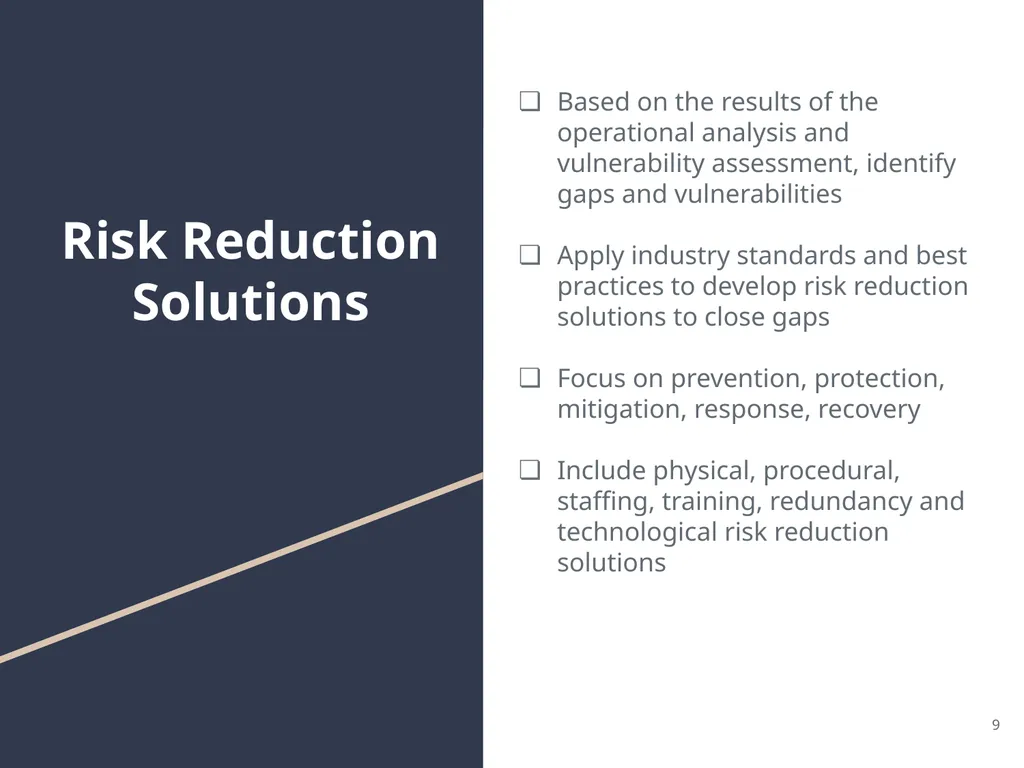
Risk Reduction Solutions Based on the results of the operational analysis and vulnerability assessment, identify gaps and vulnerabilities
Apply industry standards and best practices to develop risk reduction solutions to close gaps
Focus on prevention, protection, mitigation, response, recovery
Include physical, procedural, staffing, training, redundancy and technological risk reduction solutions 9<br>
Apply industry standards and best practices to develop risk reduction solutions to close gaps
Focus on prevention, protection, mitigation, response, recovery
Include physical, procedural, staffing, training, redundancy and technological risk reduction solutions 9<br>
10
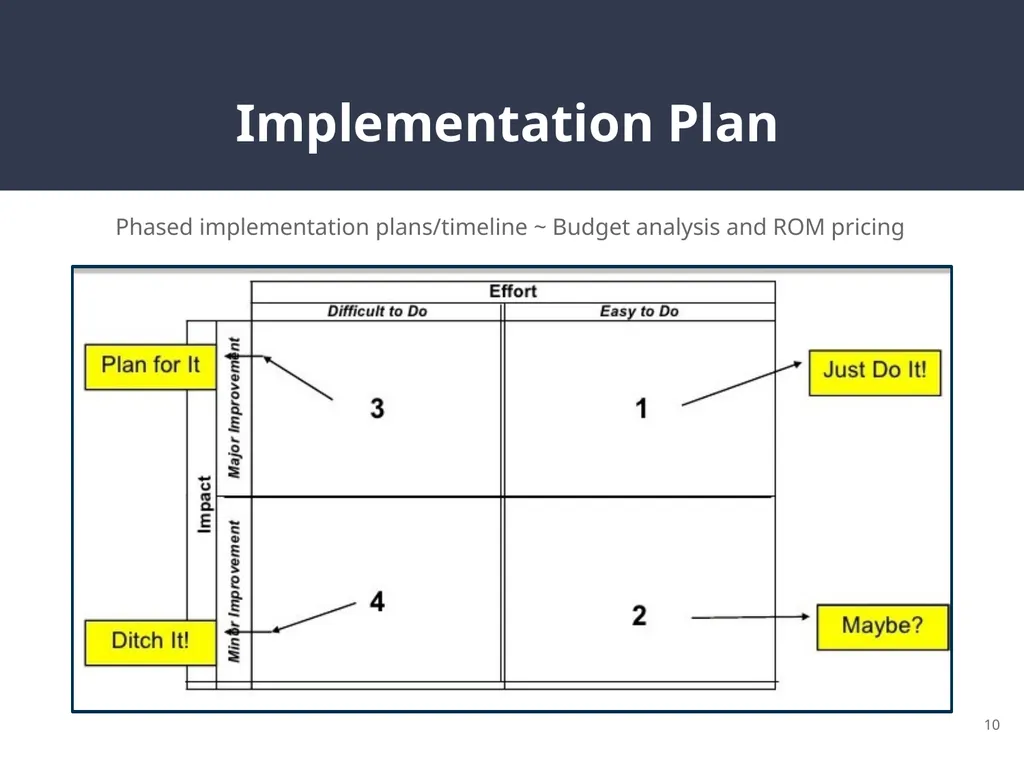
Phased implementation plans/timeline ~ Budget analysis and ROM pricing Implementation Plan 10<br>
11
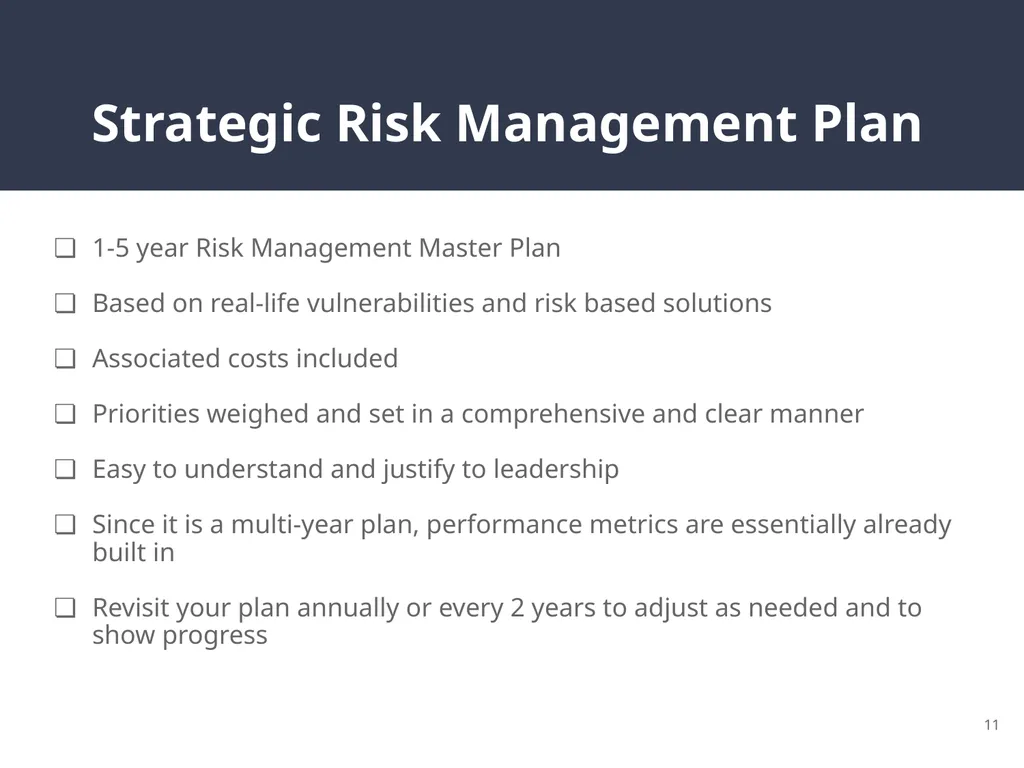
1-5 year Risk Management Master Plan
Based on real-life vulnerabilities and risk based solutions
Associated costs included
Priorities weighed and set in a comprehensive and clear manner
Easy to understand and justify to leadership
Since it is a multi-year plan, performance metrics are essentially already built in
Revisit your plan annually or every 2 years to adjust as needed and to show progress Strategic Risk Management Plan 11<br>
Based on real-life vulnerabilities and risk based solutions
Associated costs included
Priorities weighed and set in a comprehensive and clear manner
Easy to understand and justify to leadership
Since it is a multi-year plan, performance metrics are essentially already built in
Revisit your plan annually or every 2 years to adjust as needed and to show progress Strategic Risk Management Plan 11<br>
12
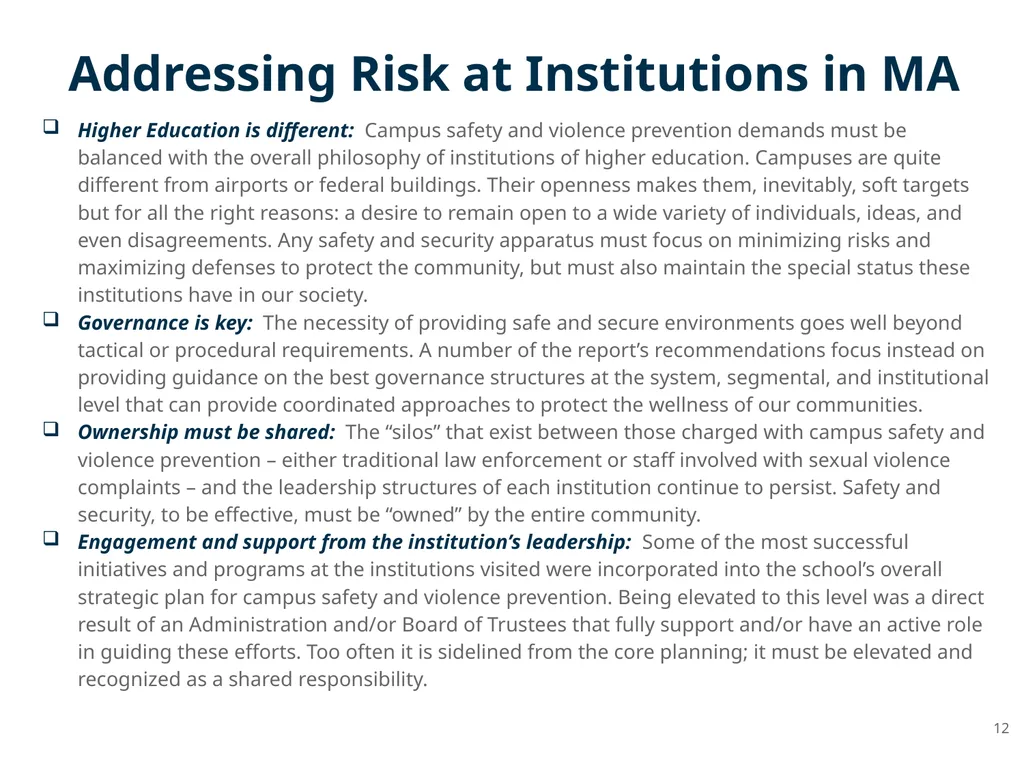
Higher Education is different: Campus safety and violence prevention demands must be balanced with the overall philosophy of institutions of higher education. Campuses are quite different from airports or federal buildings. Their openness makes them, inevitably, soft targets but for all the right reasons: a desire to remain open to a wide variety of individuals, ideas, and even disagreements. Any safety and security apparatus must focus on minimizing risks and maximizing defenses to protect the community, but must also maintain the special status these institutions have in our society.
Governance is key: The necessity of providing safe and secure environments goes well beyond tactical or procedural requirements. A number of the report’s recommendations focus instead on providing guidance on the best governance structures at the system, segmental, and institutional level that can provide coordinated approaches to protect the wellness of our communities.
Ownership must be shared: The “silos” that exist between those charged with campus safety and violence prevention – either traditional law enforcement or staff involved with sexual violence complaints – and the leadership structures of each institution continue to persist. Safety and security, to be effective, must be “owned” by the entire community.
Engagement and support from the institution’s leadership: Some of the most successful initiatives and programs at the institutions visited were incorporated into the school’s overall strategic plan for campus safety and violence prevention. Being elevated to this level was a direct result of an Administration and/or Board of Trustees that fully support and/or have an active role in guiding these efforts. Too often it is sidelined from the core planning; it must be elevated and recognized as a shared responsibility. Addressing Risk at Institutions in MA 12<br>
Governance is key: The necessity of providing safe and secure environments goes well beyond tactical or procedural requirements. A number of the report’s recommendations focus instead on providing guidance on the best governance structures at the system, segmental, and institutional level that can provide coordinated approaches to protect the wellness of our communities.
Ownership must be shared: The “silos” that exist between those charged with campus safety and violence prevention – either traditional law enforcement or staff involved with sexual violence complaints – and the leadership structures of each institution continue to persist. Safety and security, to be effective, must be “owned” by the entire community.
Engagement and support from the institution’s leadership: Some of the most successful initiatives and programs at the institutions visited were incorporated into the school’s overall strategic plan for campus safety and violence prevention. Being elevated to this level was a direct result of an Administration and/or Board of Trustees that fully support and/or have an active role in guiding these efforts. Too often it is sidelined from the core planning; it must be elevated and recognized as a shared responsibility. Addressing Risk at Institutions in MA 12<br>
13
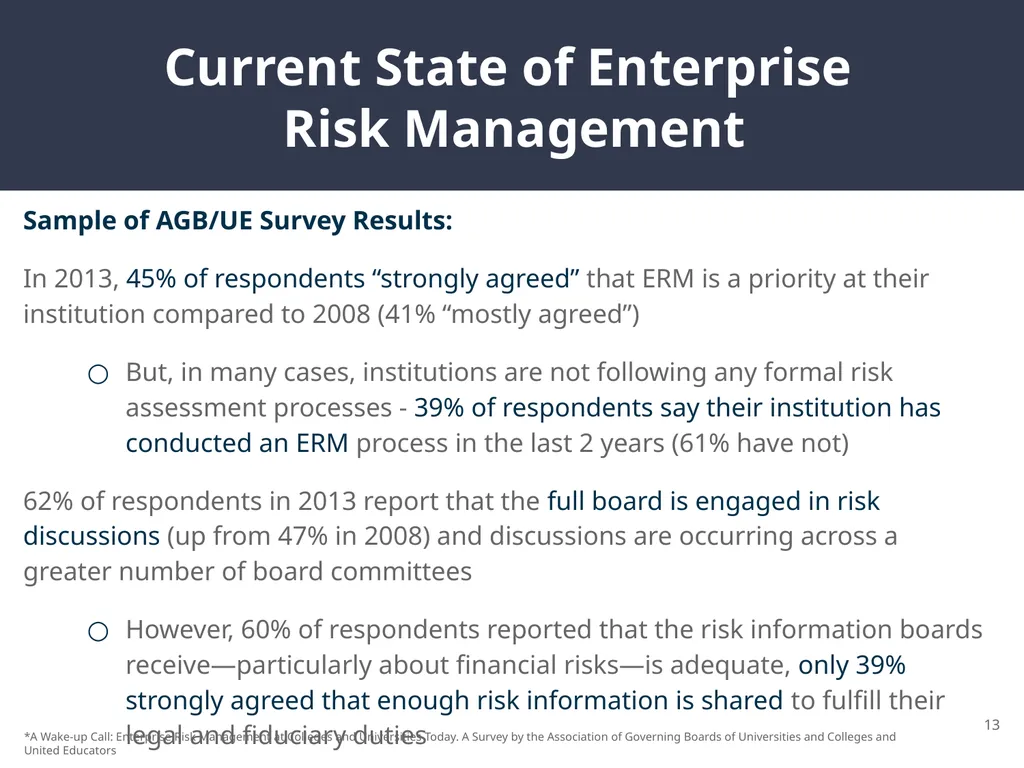
Sample of AGB/UE Survey Results:
In 2013, 45% of respondents “strongly agreed” that ERM is a priority at their institution compared to 2008 (41% “mostly agreed”)
But, in many cases, institutions are not following any formal risk assessment processes - 39% of respondents say their institution has conducted an ERM process in the last 2 years (61% have not)
62% of respondents in 2013 report that the full board is engaged in risk discussions (up from 47% in 2008) and discussions are occurring across a greater number of board committees
However, 60% of respondents reported that the risk information boards receive—particularly about financial risks—is adequate, only 39% strongly agreed that enough risk information is shared to fulfill their legal and fiduciary duties Current State of Enterprise
Risk Management *A Wake-up Call: Enterprise Risk Management at Colleges and Universities Today. A Survey by the Association of Governing Boards of Universities and Colleges and United Educators 13<br>
In 2013, 45% of respondents “strongly agreed” that ERM is a priority at their institution compared to 2008 (41% “mostly agreed”)
But, in many cases, institutions are not following any formal risk assessment processes - 39% of respondents say their institution has conducted an ERM process in the last 2 years (61% have not)
62% of respondents in 2013 report that the full board is engaged in risk discussions (up from 47% in 2008) and discussions are occurring across a greater number of board committees
However, 60% of respondents reported that the risk information boards receive—particularly about financial risks—is adequate, only 39% strongly agreed that enough risk information is shared to fulfill their legal and fiduciary duties Current State of Enterprise
Risk Management *A Wake-up Call: Enterprise Risk Management at Colleges and Universities Today. A Survey by the Association of Governing Boards of Universities and Colleges and United Educators 13<br>
14
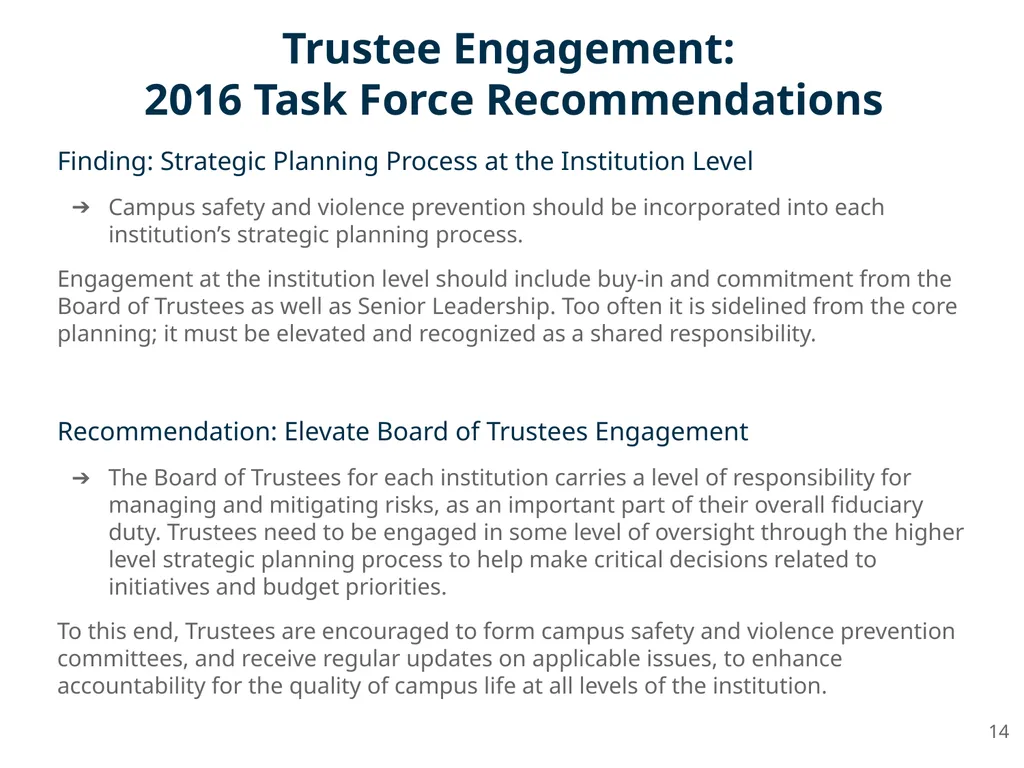
Finding: Strategic Planning Process at the Institution Level
Campus safety and violence prevention should be incorporated into each institution’s strategic planning process.
Engagement at the institution level should include buy-in and commitment from the Board of Trustees as well as Senior Leadership. Too often it is sidelined from the core planning; it must be elevated and recognized as a shared responsibility. Trustee Engagement:
2016 Task Force Recommendations Recommendation: Elevate Board of Trustees Engagement
The Board of Trustees for each institution carries a level of responsibility for managing and mitigating risks, as an important part of their overall fiduciary duty. Trustees need to be engaged in some level of oversight through the higher level strategic planning process to help make critical decisions related to initiatives and budget priorities.
To this end, Trustees are encouraged to form campus safety and violence prevention committees, and receive regular updates on applicable issues, to enhance accountability for the quality of campus life at all levels of the institution. 14<br>
Campus safety and violence prevention should be incorporated into each institution’s strategic planning process.
Engagement at the institution level should include buy-in and commitment from the Board of Trustees as well as Senior Leadership. Too often it is sidelined from the core planning; it must be elevated and recognized as a shared responsibility. Trustee Engagement:
2016 Task Force Recommendations Recommendation: Elevate Board of Trustees Engagement
The Board of Trustees for each institution carries a level of responsibility for managing and mitigating risks, as an important part of their overall fiduciary duty. Trustees need to be engaged in some level of oversight through the higher level strategic planning process to help make critical decisions related to initiatives and budget priorities.
To this end, Trustees are encouraged to form campus safety and violence prevention committees, and receive regular updates on applicable issues, to enhance accountability for the quality of campus life at all levels of the institution. 14<br>
15
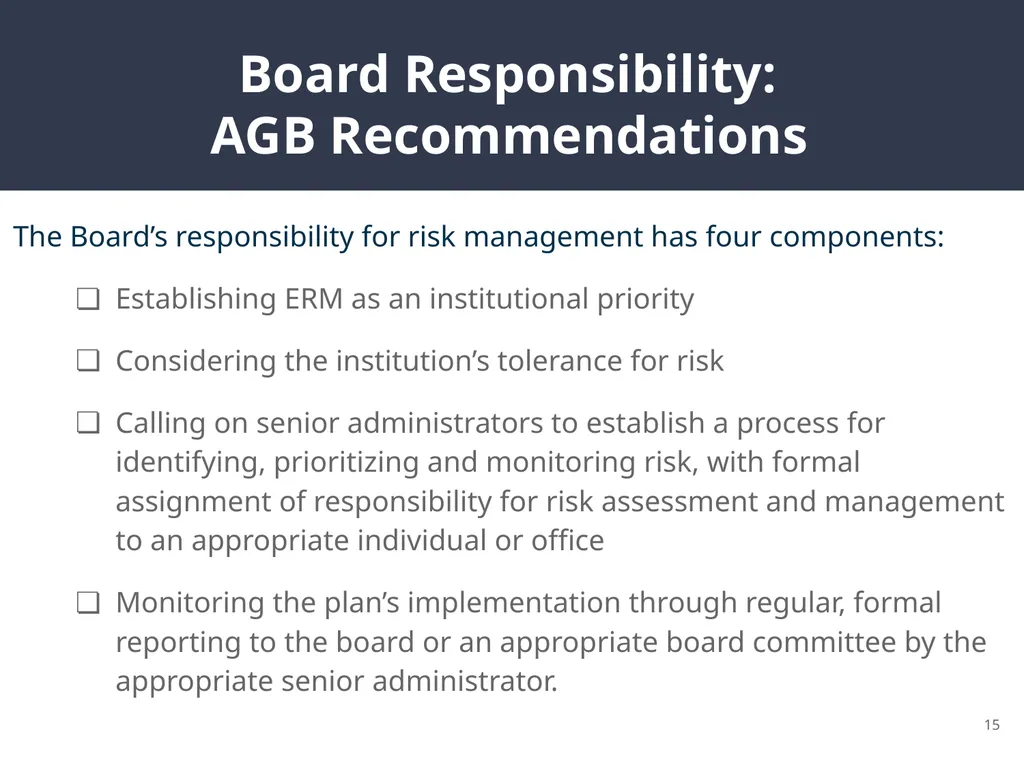
The Board’s responsibility for risk management has four components:
Establishing ERM as an institutional priority
Considering the institution’s tolerance for risk
Calling on senior administrators to establish a process for identifying, prioritizing and monitoring risk, with formal assignment of responsibility for risk assessment and management to an appropriate individual or office
Monitoring the plan’s implementation through regular, formal reporting to the board or an appropriate board committee by the appropriate senior administrator. Board Responsibility:
AGB Recommendations 15<br>
Establishing ERM as an institutional priority
Considering the institution’s tolerance for risk
Calling on senior administrators to establish a process for identifying, prioritizing and monitoring risk, with formal assignment of responsibility for risk assessment and management to an appropriate individual or office
Monitoring the plan’s implementation through regular, formal reporting to the board or an appropriate board committee by the appropriate senior administrator. Board Responsibility:
AGB Recommendations 15<br>
16
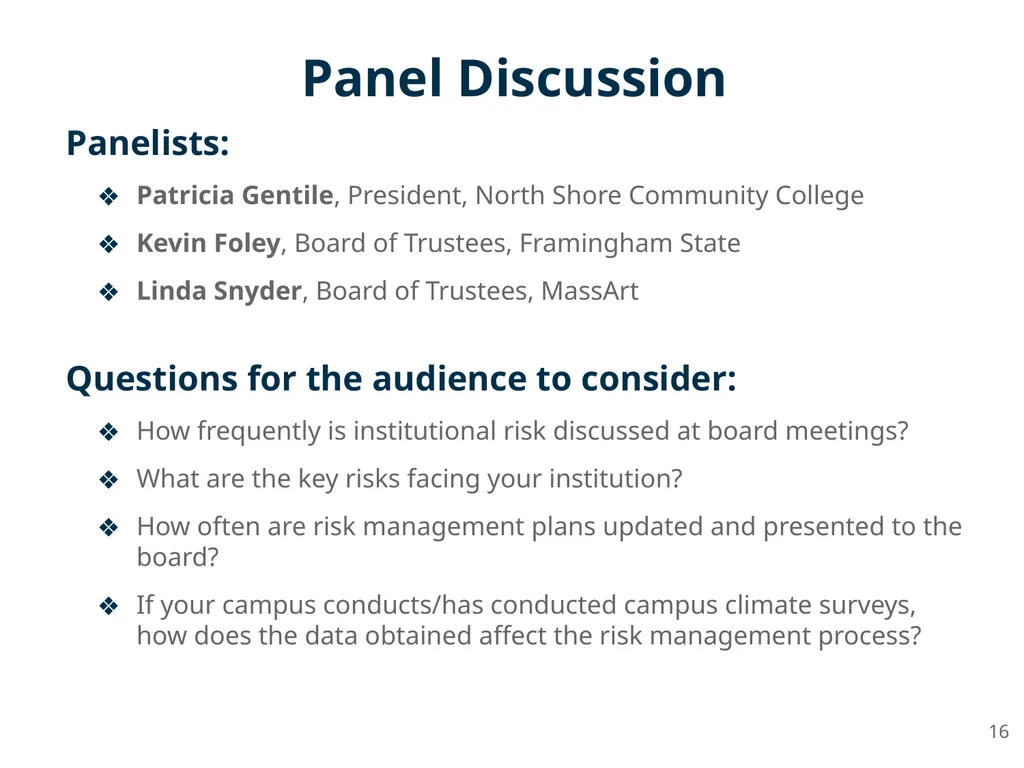
Panelists:
Patricia Gentile, President, North Shore Community College
Kevin Foley, Board of Trustees, Framingham State
Linda Snyder, Board of Trustees, MassArt
Questions for the audience to consider:
How frequently is institutional risk discussed at board meetings?
What are the key risks facing your institution?
How often are risk management plans updated and presented to the board?
If your campus conducts/has conducted campus climate surveys, how does the data obtained affect the risk management process? Panel Discussion 16<br>
Patricia Gentile, President, North Shore Community College
Kevin Foley, Board of Trustees, Framingham State
Linda Snyder, Board of Trustees, MassArt
Questions for the audience to consider:
How frequently is institutional risk discussed at board meetings?
What are the key risks facing your institution?
How often are risk management plans updated and presented to the board?
If your campus conducts/has conducted campus climate surveys, how does the data obtained affect the risk management process? Panel Discussion 16<br>
17
Amanda Botelho Robbins
Advisor, Campus Safety and Violence Prevention
MA Dept of Higher Education
arobbins@dhe.mass.edu
Please fill out the conference survey:
https://www.surveymonkey.com/r/2019Trustees Questions and Conference Survey 17<br>
Advisor, Campus Safety and Violence Prevention
MA Dept of Higher Education
arobbins@dhe.mass.edu
Please fill out the conference survey:
https://www.surveymonkey.com/r/2019Trustees Questions and Conference Survey 17<br>