
EU MIGRATION POLICY IN THE CONTEXT OF

Description: EU MIGRATION POLICY IN THE CONTEXT OF GLOBALIZATION OF THE WORLD ECONOMY Master students: Tatiana Poliakova Academic supervisor: Nataliia Bychkova Odesa І.І. Mechnikov National University Со-adviser from the FUB: prof. Dr. Theocharis
Related Topics
Download Presentation
"EU MIGRATION POLICY IN THE CONTEXT OF" is the property of its rightful owner. Permission is granted to download and print the materials on this website for personal, non-commercial use only, and to display it on your personal computer provided you do not modify the materials and that you retain all copyright notices contained in the materials. By downloading content from our website, you accept the terms of this agreement.
Presentation Transcript
slide1. EU MIGRATION POLICY IN THE CONTEXT OF GLOBALIZATION OF THE WORLD ECONOMY Master students: Tatiana Poliakova
Academic supervisor: Nataliia Bychkova
Odesa І.І. Mechnikov National University
Со-adviser from the FUB: prof. Dr. Theocharis Grigoriadis The research supporting this presentation was prepared within the project: “Socio-economic impact of the COVID-19 pandemic and Russia’s full-scale invasion on the development of EU and Ukraine: fostering research collaborations through establishing of a digital knowledge exchange platform”. This project has received funding from the European Union’s Horizon 2020 Research and Innovation programme under Grant Agreement no. 871072. Free University of Berlin - Odesa National University Round table:
Socio-Economic Challenges for the EU and Ukraine and Paths for Cooperation<br>
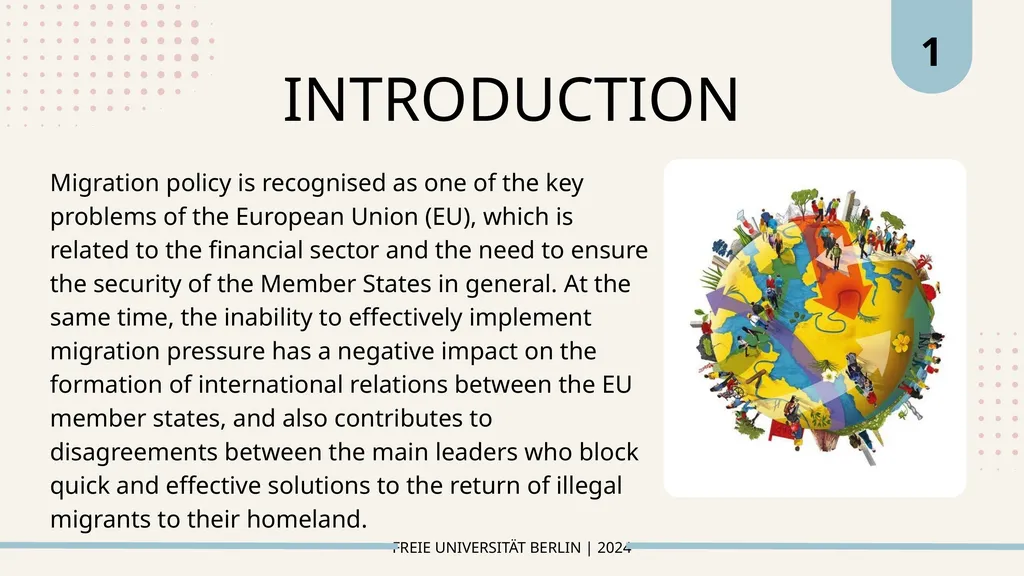
slide2. FREIE UNIVERSITÄT BERLIN | 2024 INTRODUCTION Migration policy is recognised as one of the key problems of the European Union (EU), which is related to the financial sector and the need to ensure the security of the Member States in general. At the same time, the inability to effectively implement migration pressure has a negative impact on the formation of international relations between the EU member states, and also contributes to disagreements between the main leaders who block quick and effective solutions to the return of illegal migrants to their homeland.<br>
slide3. LITERARY REVIEW 2 The article ‘Identifying Security Logics in the EU Policy Discourse: The Migration Crisis and the EU’ (2022), written by M. Stępka, demonstrates the complexity of the relationship between migration and security in the context of the EU policy discourse. The main emphasis is placed on the use of the concept of securitisation to explain how migration is interpreted and considered within the political framework of security. The article ‘Halting Ambition: EU Migration and Security Policy in the Sahel’ (2022) by Andrew Lebovic focuses on a comprehensive study of the European Union's (EU) strategy on migration and security policy in the Sahel region. It focuses on the problems of integrating security and development strategies, as well as assessing the effectiveness of these programmes in the context of the geopolitical complexity of the region. FREIE UNIVERSITÄT BERLIN| 2024<br>
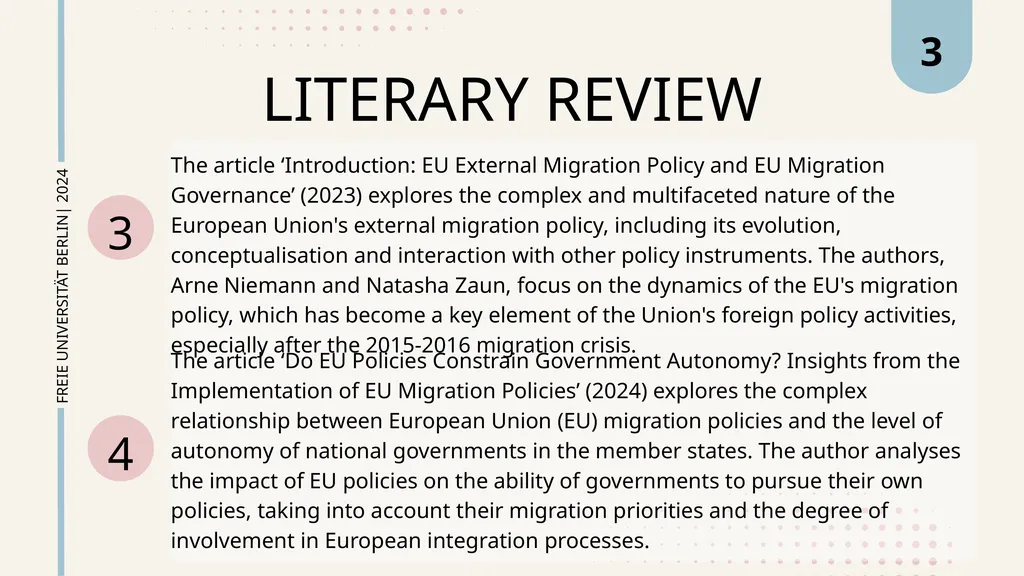
slide4. LITERARY REVIEW FREIE UNIVERSITÄT BERLIN| 2024 The article ‘Introduction: EU External Migration Policy and EU Migration Governance’ (2023) explores the complex and multifaceted nature of the European Union's external migration policy, including its evolution, conceptualisation and interaction with other policy instruments. The authors, Arne Niemann and Natasha Zaun, focus on the dynamics of the EU's migration policy, which has become a key element of the Union's foreign policy activities, especially after the 2015-2016 migration crisis. The article ‘Do EU Policies Constrain Government Autonomy? Insights from the Implementation of EU Migration Policies’ (2024) explores the complex relationship between European Union (EU) migration policies and the level of autonomy of national governments in the member states. The author analyses the impact of EU policies on the ability of governments to pursue their own policies, taking into account their migration priorities and the degree of involvement in European integration processes.<br>
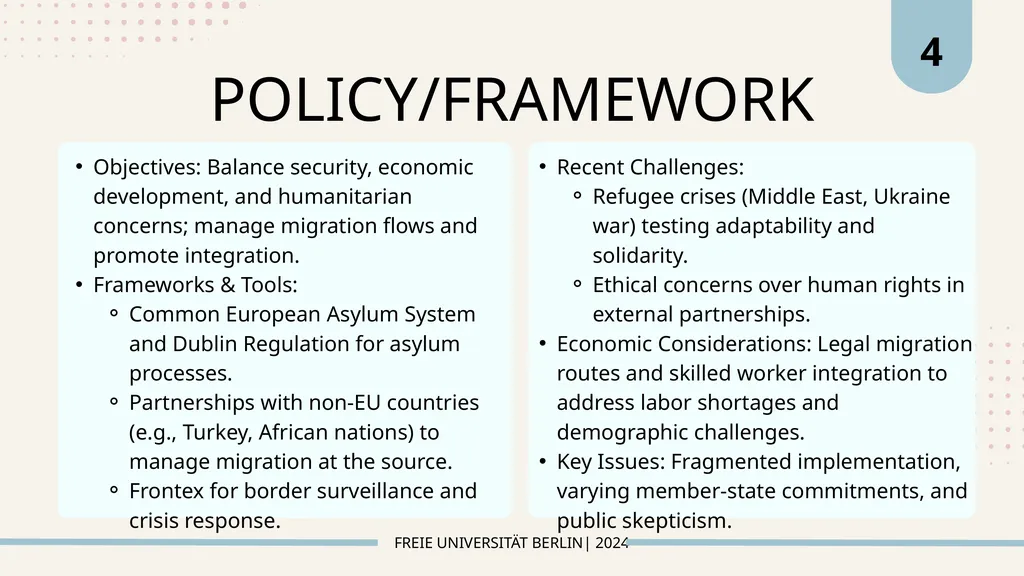
slide5. POLICY/FRAMEWORK FREIE UNIVERSITÄT BERLIN| 2024 Objectives: Balance security, economic development, and humanitarian concerns; manage migration flows and promote integration.
Frameworks & Tools:
Common European Asylum System and Dublin Regulation for asylum processes.
Partnerships with non-EU countries (e.g., Turkey, African nations) to manage migration at the source.
Frontex for border surveillance and crisis response. Recent Challenges:
Refugee crises (Middle East, Ukraine war) testing adaptability and solidarity.
Ethical concerns over human rights in external partnerships.
Economic Considerations: Legal migration routes and skilled worker integration to address labor shortages and demographic challenges.
Key Issues: Fragmented implementation, varying member-state commitments, and public skepticism.<br>
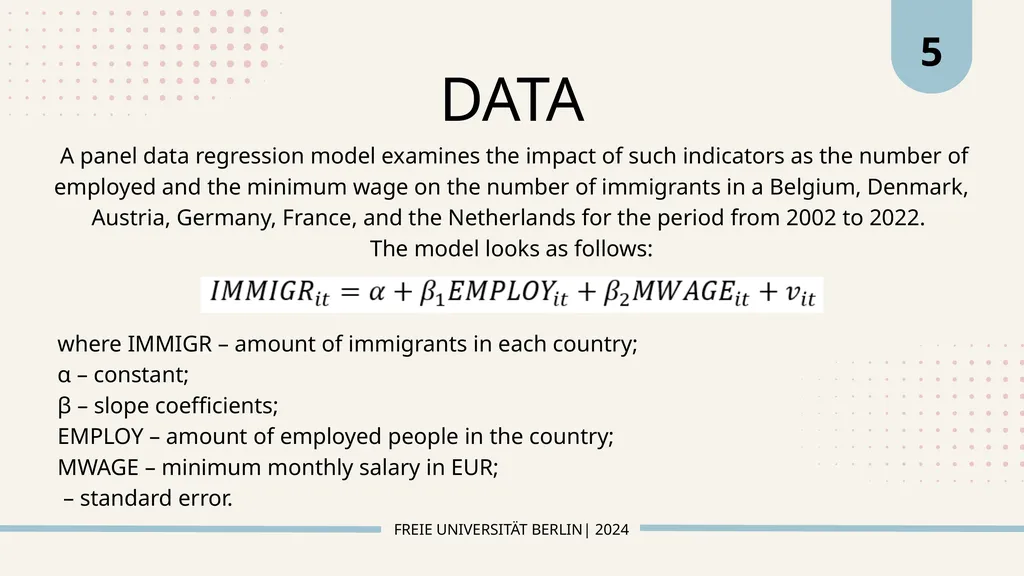
slide6. DATA FREIE UNIVERSITÄT BERLIN| 2024 A panel data regression model examines the impact of such indicators as the number of employed and the minimum wage on the number of immigrants in a Belgium, Denmark, Austria, Germany, France, and the Netherlands for the period from 2002 to 2022.
The model looks as follows: where IMMIGR – amount of immigrants in each country;
α – constant;
β – slope coefficients;
EMPLOY – amount of employed people in the country;
MWAGE – minimum monthly salary in EUR;
– standard error.<br>
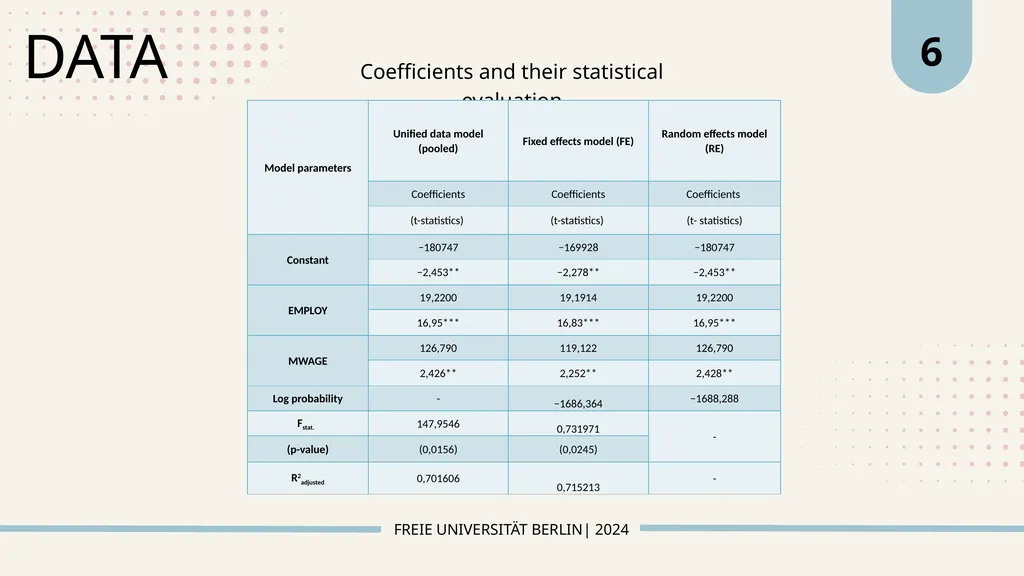
slide7. DATA FREIE UNIVERSITÄT BERLIN| 2024 Coefficients and their statistical evaluation<br>
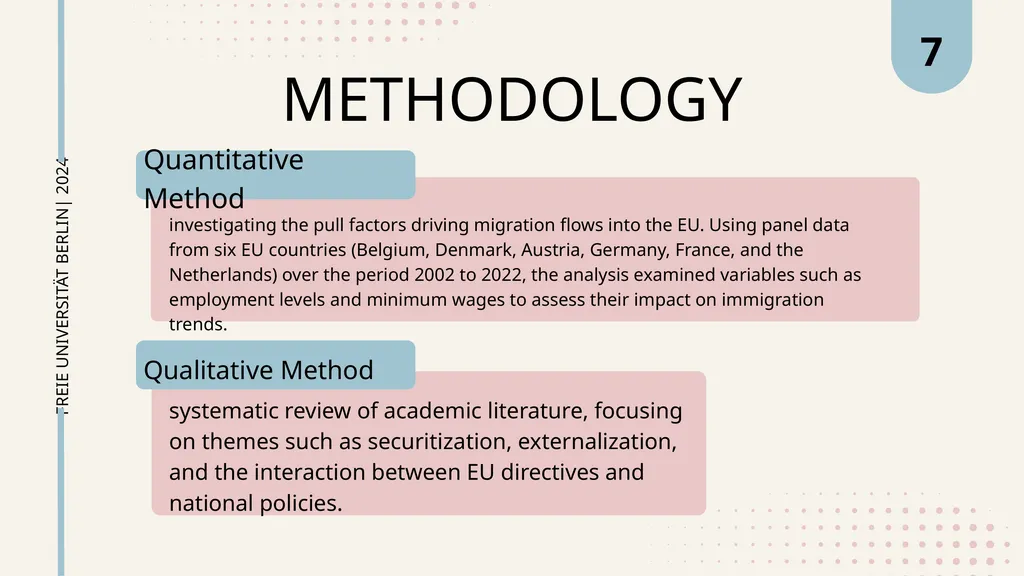
slide8. METHODOLOGY FREIE UNIVERSITÄT BERLIN| 2024 systematic review of academic literature, focusing on themes such as securitization, externalization, and the interaction between EU directives and national policies. investigating the pull factors driving migration flows into the EU. Using panel data from six EU countries (Belgium, Denmark, Austria, Germany, France, and the Netherlands) over the period 2002 to 2022, the analysis examined variables such as employment levels and minimum wages to assess their impact on immigration trends. Quantitative Method Qualitative Method<br>
slide9. THANK YOU FREIE UNIVERSITÄT BERLIN| 2024<br>
Academic supervisor: Nataliia Bychkova
Odesa І.І. Mechnikov National University
Со-adviser from the FUB: prof. Dr. Theocharis Grigoriadis The research supporting this presentation was prepared within the project: “Socio-economic impact of the COVID-19 pandemic and Russia’s full-scale invasion on the development of EU and Ukraine: fostering research collaborations through establishing of a digital knowledge exchange platform”. This project has received funding from the European Union’s Horizon 2020 Research and Innovation programme under Grant Agreement no. 871072. Free University of Berlin - Odesa National University Round table:
Socio-Economic Challenges for the EU and Ukraine and Paths for Cooperation<br>
slide2. FREIE UNIVERSITÄT BERLIN | 2024 INTRODUCTION Migration policy is recognised as one of the key problems of the European Union (EU), which is related to the financial sector and the need to ensure the security of the Member States in general. At the same time, the inability to effectively implement migration pressure has a negative impact on the formation of international relations between the EU member states, and also contributes to disagreements between the main leaders who block quick and effective solutions to the return of illegal migrants to their homeland.<br>
slide3. LITERARY REVIEW 2 The article ‘Identifying Security Logics in the EU Policy Discourse: The Migration Crisis and the EU’ (2022), written by M. Stępka, demonstrates the complexity of the relationship between migration and security in the context of the EU policy discourse. The main emphasis is placed on the use of the concept of securitisation to explain how migration is interpreted and considered within the political framework of security. The article ‘Halting Ambition: EU Migration and Security Policy in the Sahel’ (2022) by Andrew Lebovic focuses on a comprehensive study of the European Union's (EU) strategy on migration and security policy in the Sahel region. It focuses on the problems of integrating security and development strategies, as well as assessing the effectiveness of these programmes in the context of the geopolitical complexity of the region. FREIE UNIVERSITÄT BERLIN| 2024<br>
slide4. LITERARY REVIEW FREIE UNIVERSITÄT BERLIN| 2024 The article ‘Introduction: EU External Migration Policy and EU Migration Governance’ (2023) explores the complex and multifaceted nature of the European Union's external migration policy, including its evolution, conceptualisation and interaction with other policy instruments. The authors, Arne Niemann and Natasha Zaun, focus on the dynamics of the EU's migration policy, which has become a key element of the Union's foreign policy activities, especially after the 2015-2016 migration crisis. The article ‘Do EU Policies Constrain Government Autonomy? Insights from the Implementation of EU Migration Policies’ (2024) explores the complex relationship between European Union (EU) migration policies and the level of autonomy of national governments in the member states. The author analyses the impact of EU policies on the ability of governments to pursue their own policies, taking into account their migration priorities and the degree of involvement in European integration processes.<br>
slide5. POLICY/FRAMEWORK FREIE UNIVERSITÄT BERLIN| 2024 Objectives: Balance security, economic development, and humanitarian concerns; manage migration flows and promote integration.
Frameworks & Tools:
Common European Asylum System and Dublin Regulation for asylum processes.
Partnerships with non-EU countries (e.g., Turkey, African nations) to manage migration at the source.
Frontex for border surveillance and crisis response. Recent Challenges:
Refugee crises (Middle East, Ukraine war) testing adaptability and solidarity.
Ethical concerns over human rights in external partnerships.
Economic Considerations: Legal migration routes and skilled worker integration to address labor shortages and demographic challenges.
Key Issues: Fragmented implementation, varying member-state commitments, and public skepticism.<br>
slide6. DATA FREIE UNIVERSITÄT BERLIN| 2024 A panel data regression model examines the impact of such indicators as the number of employed and the minimum wage on the number of immigrants in a Belgium, Denmark, Austria, Germany, France, and the Netherlands for the period from 2002 to 2022.
The model looks as follows: where IMMIGR – amount of immigrants in each country;
α – constant;
β – slope coefficients;
EMPLOY – amount of employed people in the country;
MWAGE – minimum monthly salary in EUR;
– standard error.<br>
slide7. DATA FREIE UNIVERSITÄT BERLIN| 2024 Coefficients and their statistical evaluation<br>
slide8. METHODOLOGY FREIE UNIVERSITÄT BERLIN| 2024 systematic review of academic literature, focusing on themes such as securitization, externalization, and the interaction between EU directives and national policies. investigating the pull factors driving migration flows into the EU. Using panel data from six EU countries (Belgium, Denmark, Austria, Germany, France, and the Netherlands) over the period 2002 to 2022, the analysis examined variables such as employment levels and minimum wages to assess their impact on immigration trends. Quantitative Method Qualitative Method<br>
slide9. THANK YOU FREIE UNIVERSITÄT BERLIN| 2024<br>