
Evacuation Training Safety and Risk Services 2023


Description: Evacuation Training Safety and Risk Services 2023 Roles Responsibilities OVERVIEW Knowledge of assigned area and emergency procedures Be familiar with your assigned areas, including areas of refuge, to ensure a safe and orderly evacuation
Related Topics
Download Presentation
"Evacuation Training Safety and Risk Services 2023" is the property of its rightful owner. Permission is granted to download and print the materials on this website for personal, non-commercial use only, and to display it on your personal computer provided you do not modify the materials and that you retain all copyright notices contained in the materials. By downloading content from our website, you accept the terms of this agreement.
Presentation Transcript
slide1. Evacuation
Training Safety and Risk Services
2023<br>
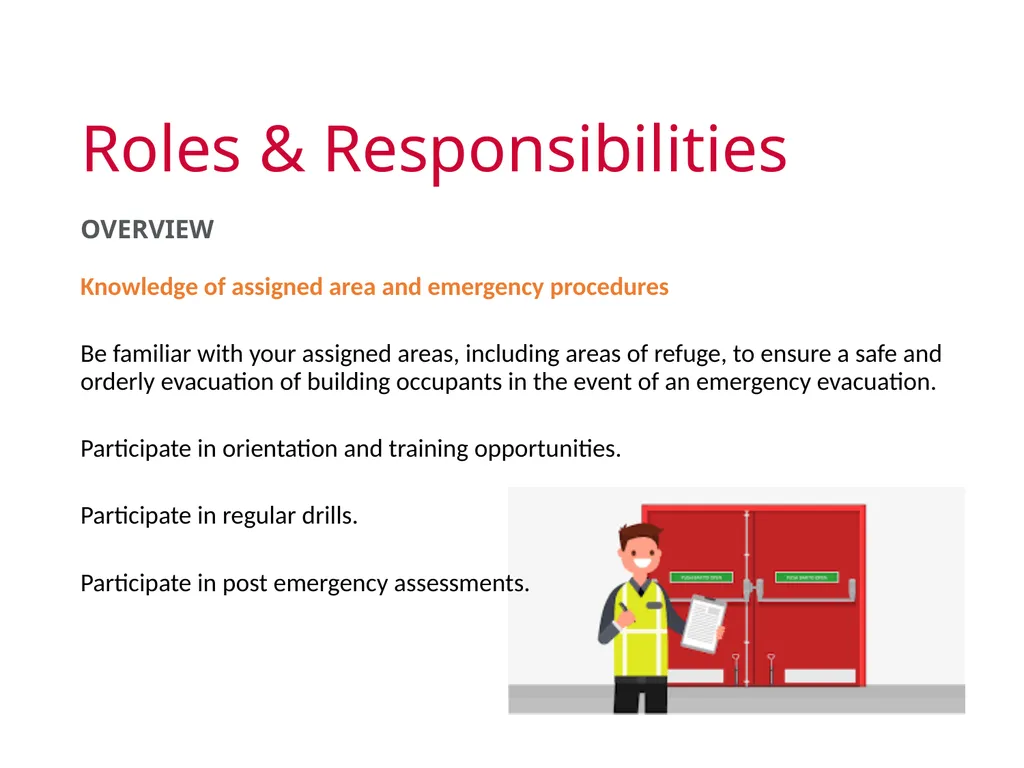
slide2. Roles & Responsibilities OVERVIEW Knowledge of assigned area and emergency procedures
Be familiar with your assigned areas, including areas of refuge, to ensure a safe and orderly evacuation of building occupants in the event of an emergency evacuation.
Participate in orientation and training opportunities.
Participate in regular drills.
Participate in post emergency assessments.<br>
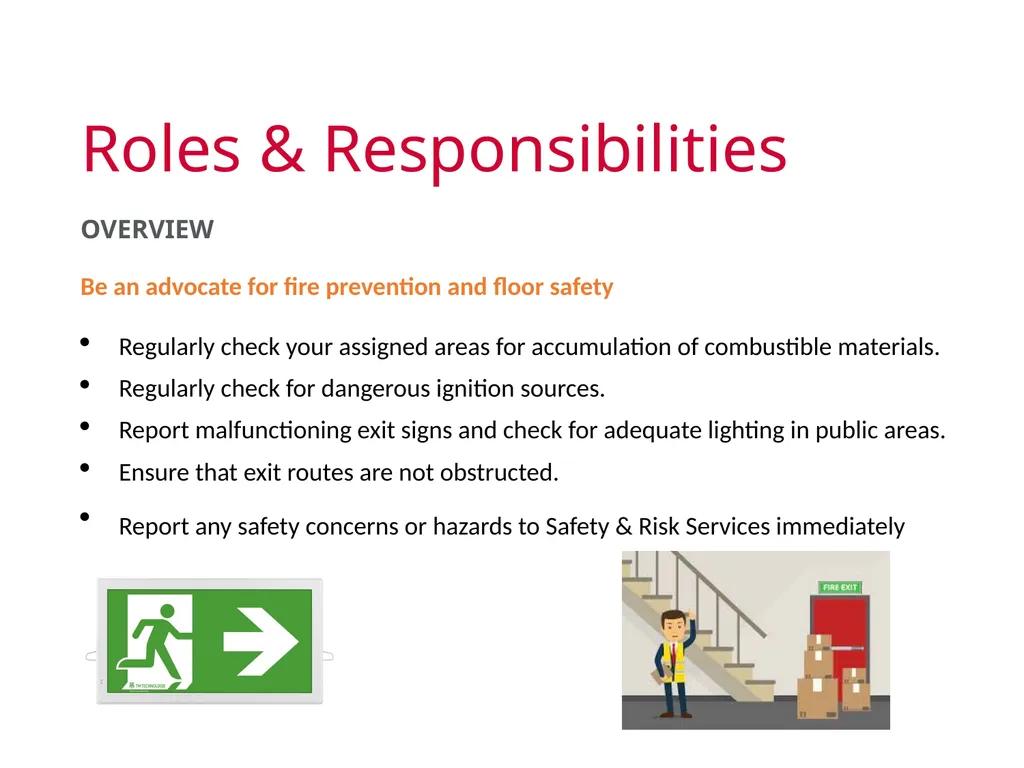
slide3. Roles & Responsibilities OVERVIEW Be an advocate for fire prevention and floor safety
Regularly check your assigned areas for accumulation of combustible materials.
Regularly check for dangerous ignition sources.
Report malfunctioning exit signs and check for adequate lighting in public areas.
Ensure that exit routes are not obstructed.
Report any safety concerns or hazards to Safety & Risk Services immediately<br>
slide4. Floor Wardens BEFORE AN ALARM Report any hazards and know the location of pull stations, fire extinguishers, emergency phones (if any), and all exits;
Know the building’s Assembly Point, Response Point (Fire Panel Location) and least 2 exits out of the building;<br>
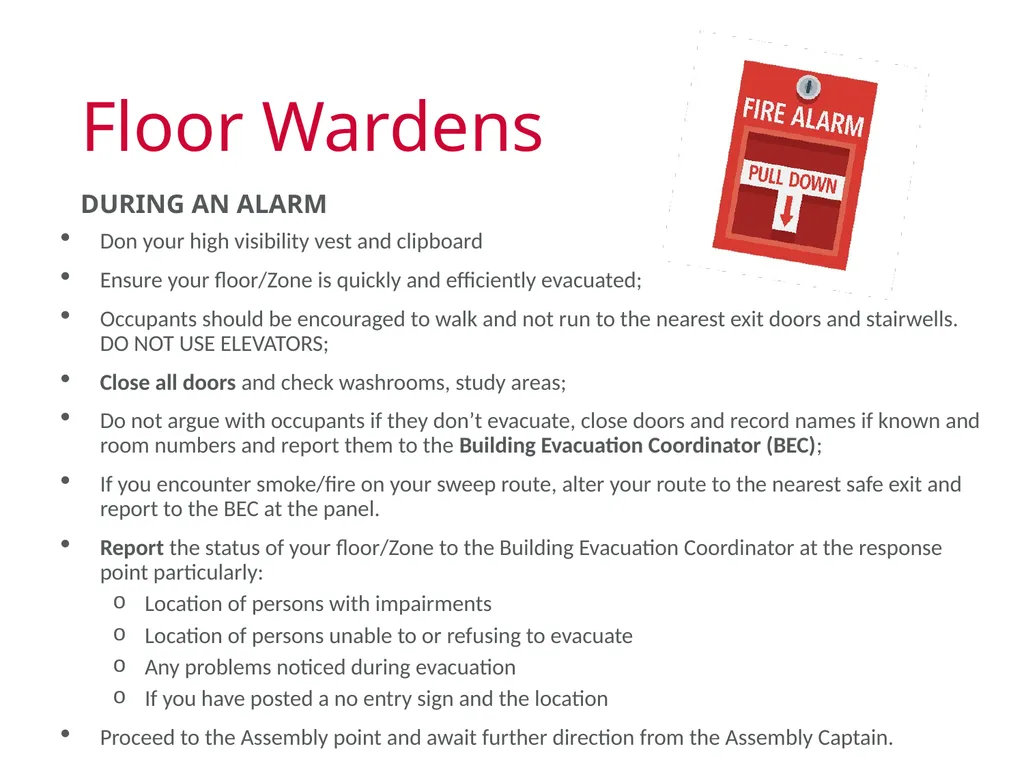
slide5. Floor Wardens Don your high visibility vest and clipboard
Ensure your floor/Zone is quickly and efficiently evacuated;
Occupants should be encouraged to walk and not run to the nearest exit doors and stairwells. DO NOT USE ELEVATORS;
Close all doors and check washrooms, study areas;
Do not argue with occupants if they don’t evacuate, close doors and record names if known and room numbers and report them to the Building Evacuation Coordinator (BEC);
If you encounter smoke/fire on your sweep route, alter your route to the nearest safe exit and report to the BEC at the panel.
Report the status of your floor/Zone to the Building Evacuation Coordinator at the response point particularly:
Location of persons with impairments
Location of persons unable to or refusing to evacuate
Any problems noticed during evacuation
If you have posted a no entry sign and the location
Proceed to the Assembly point and await further direction from the Assembly Captain. DURING AN ALARM<br>
slide6. Floor Wardens After the “all clear”, participate in the “After Action Review”;
Bring up any concerns and discuss ways the evacuation could have been improved with your BEC. AFTER AN ALARM<br>
slide7. Building Evacuation Coordinator Report any hazards and know the location of pull stations, fire extinguishers, emergency phones (if any), and the location of all emergency exits;
Know your building’s Assembly Point, Response Point (Fire Panel) and at least 2 exits out of the building;
Maintain an Floor Warden list for the building. Ensure it is kept current with contact information and floor/Zone assignments.
Identify persons with impairments.
Distribute and maintain the vests/equipment (clipboard and forms).
Prepare reports of alarm incidents and drills. BEFORE AN ALARM<br>
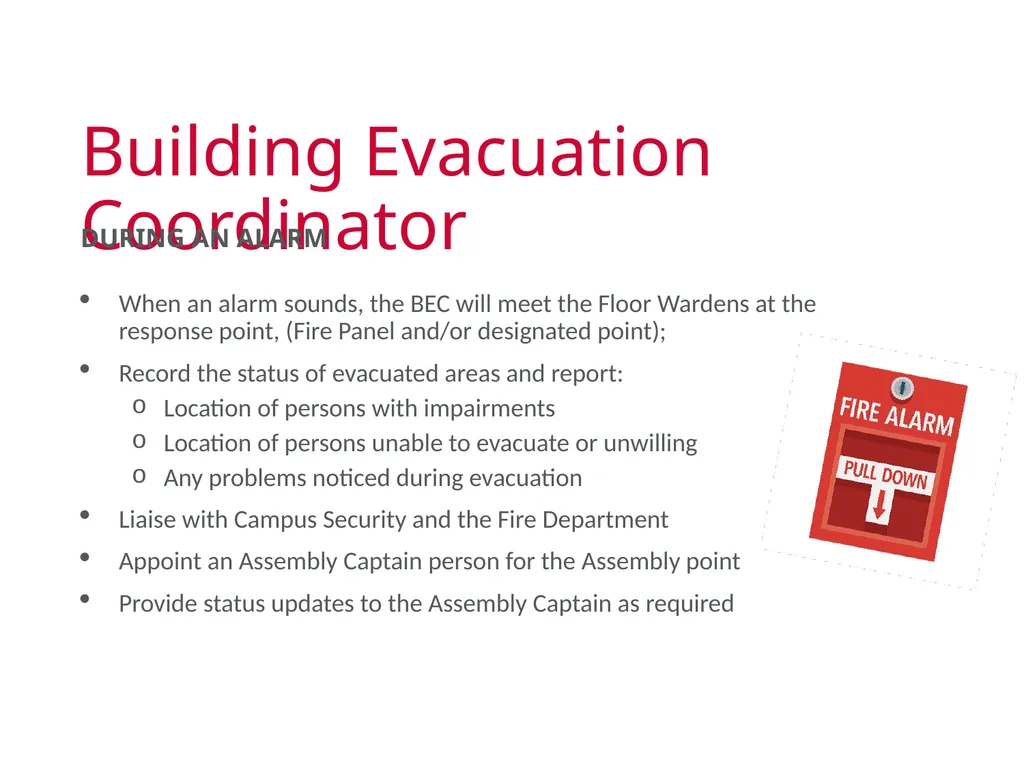
slide8. Building Evacuation Coordinator When an alarm sounds, the BEC will meet the Floor Wardens at the response point, (Fire Panel and/or designated point);
Record the status of evacuated areas and report:
Location of persons with impairments
Location of persons unable to evacuate or unwilling
Any problems noticed during evacuation
Liaise with Campus Security and the Fire Department
Appoint an Assembly Captain person for the Assembly point
Provide status updates to the Assembly Captain as required DURING AN ALARM<br>
slide9. Building Evacuation Coordinator When building is safe to re-enter communicate the “ALL CLEAR” to the Assembly Captain;
Participate in the “After Action Review”. Bring up any concerns and discuss ways the evacuation could have been improved. AFTER AN ALARM<br>
slide10. Assembly Captain Roles and Responsibilities
Will be appointed by BEC during the evacuation to any Floor Warden;
Ensures means of communication with BEC (e.g. cell, phone, radio, runner);
Updates evacuees at the Assembly point on status of evacuation or other pertinent information as received from the BEC (e.g. ALL CLEAR, delays etc.).
What if there is no BEC to report to?
In the event that no BEC’s are available, the first Emergency Warden at the response point will assume this role. If a Floor Warden is uncomfortable with this, ask another Floor Warden for support and assistance.<br>
slide11. Emergency Communication Alerts
SFU Alerts is a suite of urgent notification systems that allows the university to quickly notify students, faculty, and staff using a variety of methods including:
Alertus Desktop Notifications - Pop-up alerts on SFU-managed computers
SFU snap – Download SFU snap to receive push notifications on mobile devices.
Download on Google Play
Ensure that push notifications are enabled in your phone settings:
iPhone: Settings > SFU snap > Notifications > toggle on "Allow Notifications" Android: Settings > Apps > SFU snap > toggle off "Block", toggle on "Priority".
Download on the Apple App Store
SFU Twitter - @SFU
Note: you do not require a Twitter account to view messages
SFU Website – www.sfu.ca
Email messages - to staff, faculty, and registered SFU students
Campus digital screens – located across all three campuses<br>
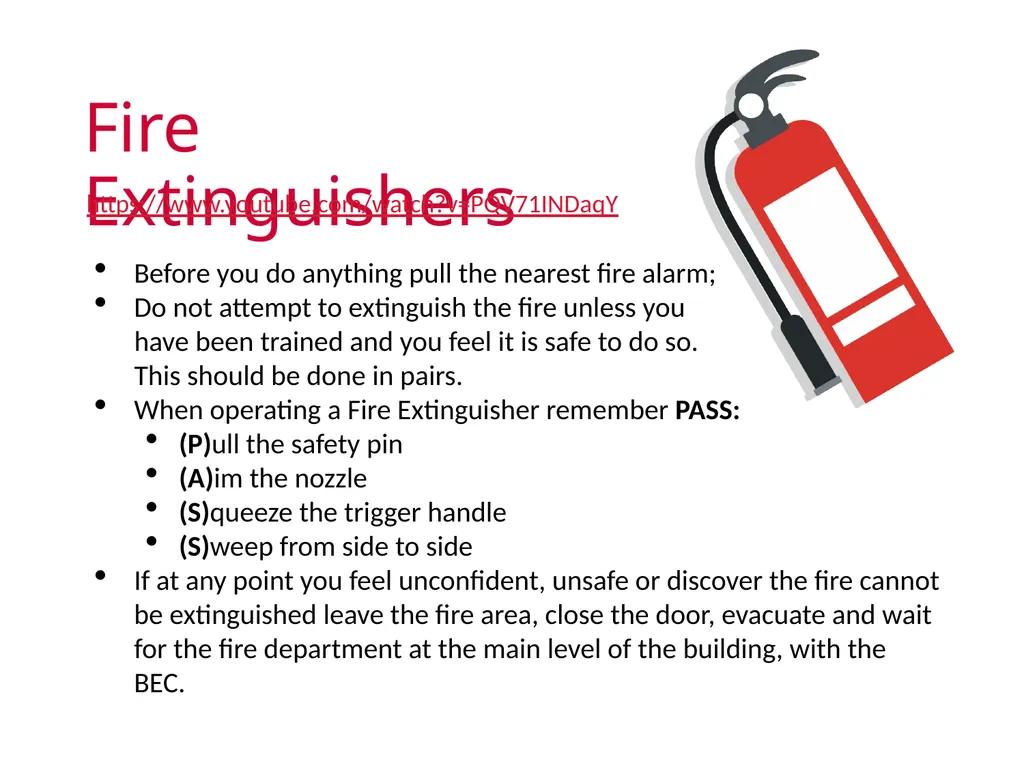
slide12. Fire Extinguishers https://www.youtube.com/watch?v=PQV71INDaqY Before you do anything pull the nearest fire alarm;
Do not attempt to extinguish the fire unless you
have been trained and you feel it is safe to do so.
This should be done in pairs.
When operating a Fire Extinguisher remember PASS:
(P)ull the safety pin
(A)im the nozzle
(S)queeze the trigger handle
(S)weep from side to side
If at any point you feel unconfident, unsafe or discover the fire cannot be extinguished leave the fire area, close the door, evacuate and wait for the fire department at the main level of the building, with the BEC.<br>
2023<br>
slide2. Roles & Responsibilities OVERVIEW Knowledge of assigned area and emergency procedures
Be familiar with your assigned areas, including areas of refuge, to ensure a safe and orderly evacuation of building occupants in the event of an emergency evacuation.
Participate in orientation and training opportunities.
Participate in regular drills.
Participate in post emergency assessments.<br>
slide3. Roles & Responsibilities OVERVIEW Be an advocate for fire prevention and floor safety
Regularly check your assigned areas for accumulation of combustible materials.
Regularly check for dangerous ignition sources.
Report malfunctioning exit signs and check for adequate lighting in public areas.
Ensure that exit routes are not obstructed.
Report any safety concerns or hazards to Safety & Risk Services immediately<br>
slide4. Floor Wardens BEFORE AN ALARM Report any hazards and know the location of pull stations, fire extinguishers, emergency phones (if any), and all exits;
Know the building’s Assembly Point, Response Point (Fire Panel Location) and least 2 exits out of the building;<br>
slide5. Floor Wardens Don your high visibility vest and clipboard
Ensure your floor/Zone is quickly and efficiently evacuated;
Occupants should be encouraged to walk and not run to the nearest exit doors and stairwells. DO NOT USE ELEVATORS;
Close all doors and check washrooms, study areas;
Do not argue with occupants if they don’t evacuate, close doors and record names if known and room numbers and report them to the Building Evacuation Coordinator (BEC);
If you encounter smoke/fire on your sweep route, alter your route to the nearest safe exit and report to the BEC at the panel.
Report the status of your floor/Zone to the Building Evacuation Coordinator at the response point particularly:
Location of persons with impairments
Location of persons unable to or refusing to evacuate
Any problems noticed during evacuation
If you have posted a no entry sign and the location
Proceed to the Assembly point and await further direction from the Assembly Captain. DURING AN ALARM<br>
slide6. Floor Wardens After the “all clear”, participate in the “After Action Review”;
Bring up any concerns and discuss ways the evacuation could have been improved with your BEC. AFTER AN ALARM<br>
slide7. Building Evacuation Coordinator Report any hazards and know the location of pull stations, fire extinguishers, emergency phones (if any), and the location of all emergency exits;
Know your building’s Assembly Point, Response Point (Fire Panel) and at least 2 exits out of the building;
Maintain an Floor Warden list for the building. Ensure it is kept current with contact information and floor/Zone assignments.
Identify persons with impairments.
Distribute and maintain the vests/equipment (clipboard and forms).
Prepare reports of alarm incidents and drills. BEFORE AN ALARM<br>
slide8. Building Evacuation Coordinator When an alarm sounds, the BEC will meet the Floor Wardens at the response point, (Fire Panel and/or designated point);
Record the status of evacuated areas and report:
Location of persons with impairments
Location of persons unable to evacuate or unwilling
Any problems noticed during evacuation
Liaise with Campus Security and the Fire Department
Appoint an Assembly Captain person for the Assembly point
Provide status updates to the Assembly Captain as required DURING AN ALARM<br>
slide9. Building Evacuation Coordinator When building is safe to re-enter communicate the “ALL CLEAR” to the Assembly Captain;
Participate in the “After Action Review”. Bring up any concerns and discuss ways the evacuation could have been improved. AFTER AN ALARM<br>
slide10. Assembly Captain Roles and Responsibilities
Will be appointed by BEC during the evacuation to any Floor Warden;
Ensures means of communication with BEC (e.g. cell, phone, radio, runner);
Updates evacuees at the Assembly point on status of evacuation or other pertinent information as received from the BEC (e.g. ALL CLEAR, delays etc.).
What if there is no BEC to report to?
In the event that no BEC’s are available, the first Emergency Warden at the response point will assume this role. If a Floor Warden is uncomfortable with this, ask another Floor Warden for support and assistance.<br>
slide11. Emergency Communication Alerts
SFU Alerts is a suite of urgent notification systems that allows the university to quickly notify students, faculty, and staff using a variety of methods including:
Alertus Desktop Notifications - Pop-up alerts on SFU-managed computers
SFU snap – Download SFU snap to receive push notifications on mobile devices.
Download on Google Play
Ensure that push notifications are enabled in your phone settings:
iPhone: Settings > SFU snap > Notifications > toggle on "Allow Notifications" Android: Settings > Apps > SFU snap > toggle off "Block", toggle on "Priority".
Download on the Apple App Store
SFU Twitter - @SFU
Note: you do not require a Twitter account to view messages
SFU Website – www.sfu.ca
Email messages - to staff, faculty, and registered SFU students
Campus digital screens – located across all three campuses<br>
slide12. Fire Extinguishers https://www.youtube.com/watch?v=PQV71INDaqY Before you do anything pull the nearest fire alarm;
Do not attempt to extinguish the fire unless you
have been trained and you feel it is safe to do so.
This should be done in pairs.
When operating a Fire Extinguisher remember PASS:
(P)ull the safety pin
(A)im the nozzle
(S)queeze the trigger handle
(S)weep from side to side
If at any point you feel unconfident, unsafe or discover the fire cannot be extinguished leave the fire area, close the door, evacuate and wait for the fire department at the main level of the building, with the BEC.<br>