
Exploiting Local Orientation Similarity for
CP
Published · 32 slides · 0 views
1 / 1

Description
Exploiting Local Orientation Similarity for Efficient Ray Traversal of Hair and Fur Sven Woop, Carsten Benthin, Ingo Wald, Gregory S. Johnson Intel Corporation Eric Tabellion DreamWorks Animation Legal Disclaimer and Optimization Notice
Related Topics
Share
Embed code
Download this presentation From Below
"Exploiting Local Orientation Similarity for" is the property of its rightful owner. Permission is granted to download and print the materials on this website for personal, non-commercial use only, and to display it on your personal computer provided you do not modify the materials and that you retain all copyright notices contained in the materials. By downloading content from our website, you accept the terms of this agreement.
Presentation Transcript
01
Exploiting Local Orientation Similarity for
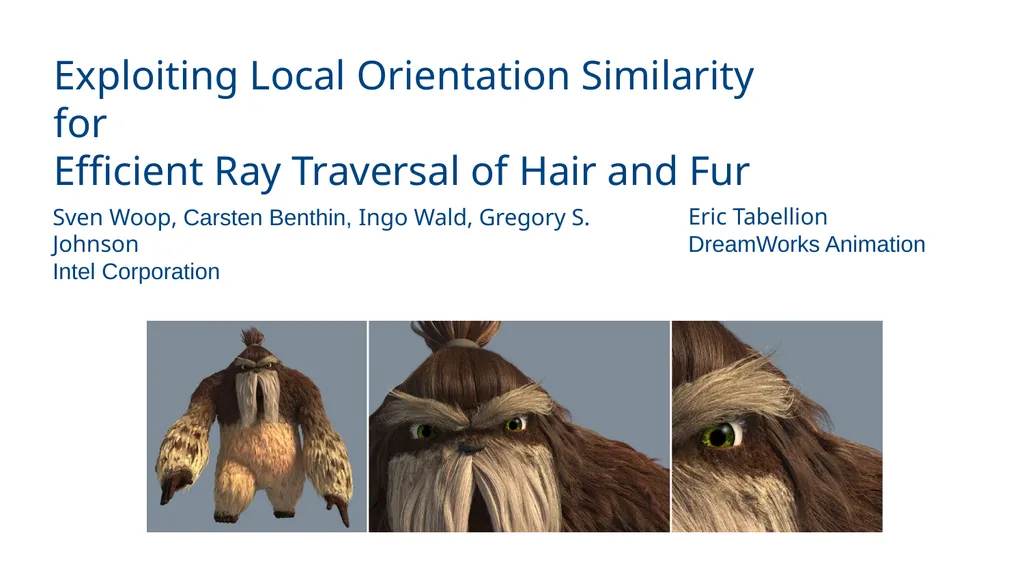
Efficient Ray Traversal of Hair and Fur Sven Woop, Carsten Benthin, Ingo Wald, Gregory S. Johnson
Intel Corporation Eric Tabellion
DreamWorks Animation<br>
Intel Corporation Eric Tabellion
DreamWorks Animation<br>
02
Legal Disclaimer and Optimization Notice INFORMATION IN THIS DOCUMENT IS PROVIDED “AS IS”. NO LICENSE, EXPRESS OR IMPLIED, BY ESTOPPEL OR OTHERWISE, TO ANY INTELLECTUAL PROPERTY RIGHTS IS GRANTED BY THIS DOCUMENT. INTEL ASSUMES NO LIABILITY WHATSOEVER AND INTEL DISCLAIMS ANY EXPRESS OR IMPLIED WARRANTY, RELATING TO THIS INFORMATION INCLUDING LIABILITY OR WARRANTIES RELATING TO FITNESS FOR A PARTICULAR PURPOSE, MERCHANTABILITY, OR INFRINGEMENT OF ANY PATENT, COPYRIGHT OR OTHER INTELLECTUAL PROPERTY RIGHT.
Software and workloads used in performance tests may have been optimized for performance only on Intel microprocessors. Performance tests, such as SYSmark and MobileMark, are measured using specific computer systems, components, software, operations and functions. Any change to any of those factors may cause the results to vary. You should consult other information and performance tests to assist you in fully evaluating your contemplated purchases, including the performance of that product when combined with other products.
Copyright © , Intel Corporation. All rights reserved. Intel, the Intel logo, Xeon, Core, VTune, and Cilk are trademarks of Intel Corporation in the U.S. and other countries.<br>
Software and workloads used in performance tests may have been optimized for performance only on Intel microprocessors. Performance tests, such as SYSmark and MobileMark, are measured using specific computer systems, components, software, operations and functions. Any change to any of those factors may cause the results to vary. You should consult other information and performance tests to assist you in fully evaluating your contemplated purchases, including the performance of that product when combined with other products.
Copyright © , Intel Corporation. All rights reserved. Intel, the Intel logo, Xeon, Core, VTune, and Cilk are trademarks of Intel Corporation in the U.S. and other countries.<br>
03
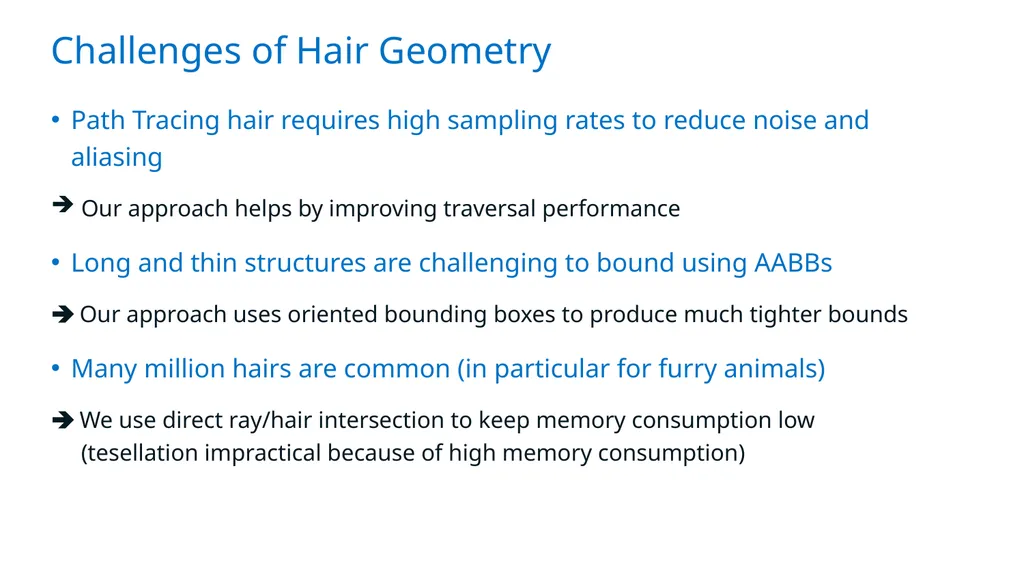
Challenges of Hair Geometry Path Tracing hair requires high sampling rates to reduce noise and aliasing
Our approach helps by improving traversal performance
Long and thin structures are challenging to bound using AABBs
Our approach uses oriented bounding boxes to produce much tighter bounds
Many million hairs are common (in particular for furry animals)
We use direct ray/hair intersection to keep memory consumption low (tesellation impractical because of high memory consumption)<br>
Our approach helps by improving traversal performance
Long and thin structures are challenging to bound using AABBs
Our approach uses oriented bounding boxes to produce much tighter bounds
Many million hairs are common (in particular for furry animals)
We use direct ray/hair intersection to keep memory consumption low (tesellation impractical because of high memory consumption)<br>
04
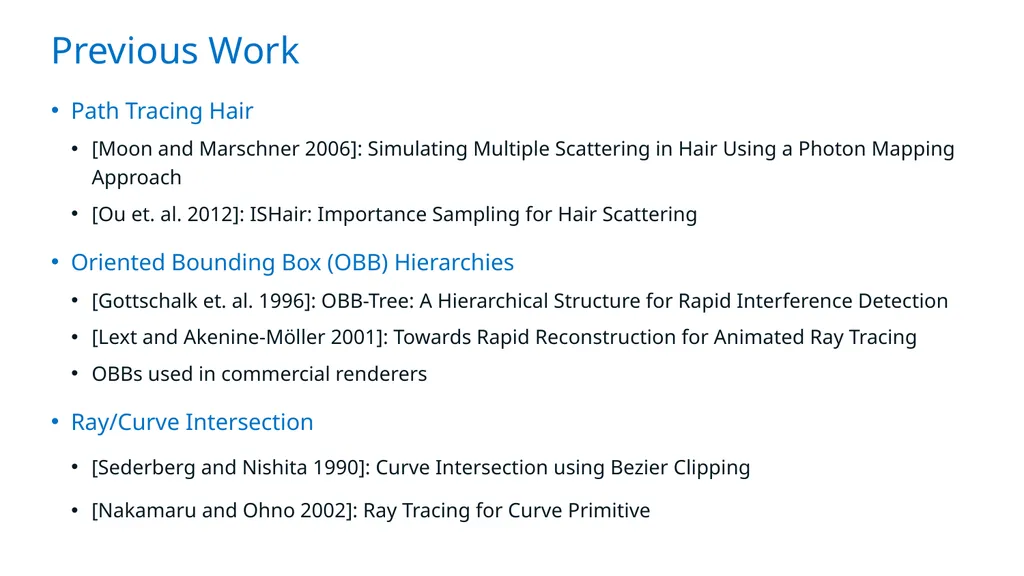
Previous Work Path Tracing Hair
[Moon and Marschner 2006]: Simulating Multiple Scattering in Hair Using a Photon Mapping Approach
[Ou et. al. 2012]: ISHair: Importance Sampling for Hair Scattering
Oriented Bounding Box (OBB) Hierarchies
[Gottschalk et. al. 1996]: OBB-Tree: A Hierarchical Structure for Rapid Interference Detection
[Lext and Akenine-Möller 2001]: Towards Rapid Reconstruction for Animated Ray Tracing
OBBs used in commercial renderers
Ray/Curve Intersection
[Sederberg and Nishita 1990]: Curve Intersection using Bezier Clipping
[Nakamaru and Ohno 2002]: Ray Tracing for Curve Primitive<br>
[Moon and Marschner 2006]: Simulating Multiple Scattering in Hair Using a Photon Mapping Approach
[Ou et. al. 2012]: ISHair: Importance Sampling for Hair Scattering
Oriented Bounding Box (OBB) Hierarchies
[Gottschalk et. al. 1996]: OBB-Tree: A Hierarchical Structure for Rapid Interference Detection
[Lext and Akenine-Möller 2001]: Towards Rapid Reconstruction for Animated Ray Tracing
OBBs used in commercial renderers
Ray/Curve Intersection
[Sederberg and Nishita 1990]: Curve Intersection using Bezier Clipping
[Nakamaru and Ohno 2002]: Ray Tracing for Curve Primitive<br>
05
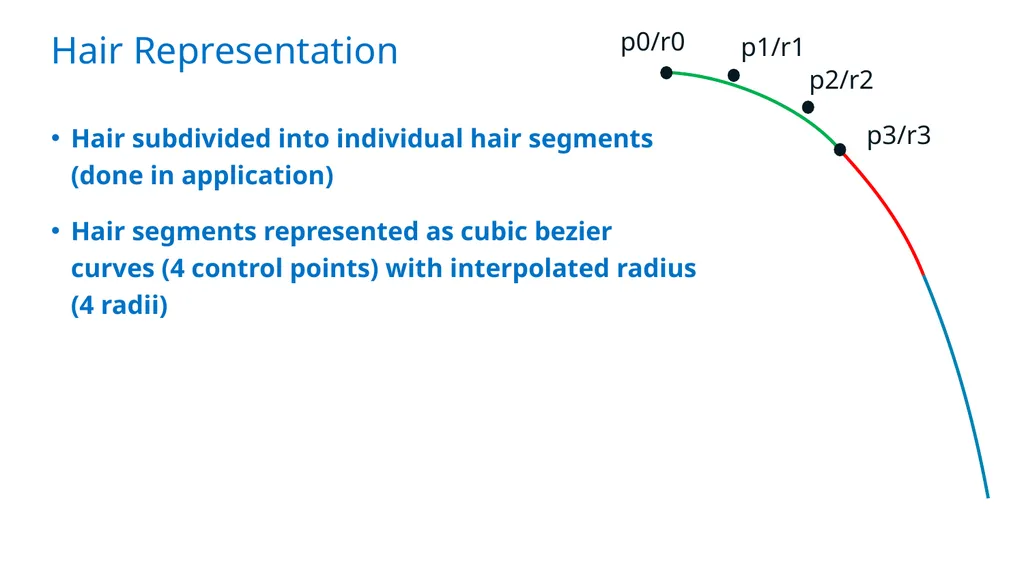
Hair Representation Hair subdivided into individual hair segments
(done in application)
Hair segments represented as cubic bezier curves (4 control points) with interpolated radius (4 radii) p0/r0 p1/r1 p2/r2 p3/r3<br>
Hair segments represented as cubic bezier curves (4 control points) with interpolated radius (4 radii) p0/r0 p1/r1 p2/r2 p3/r3<br>
06
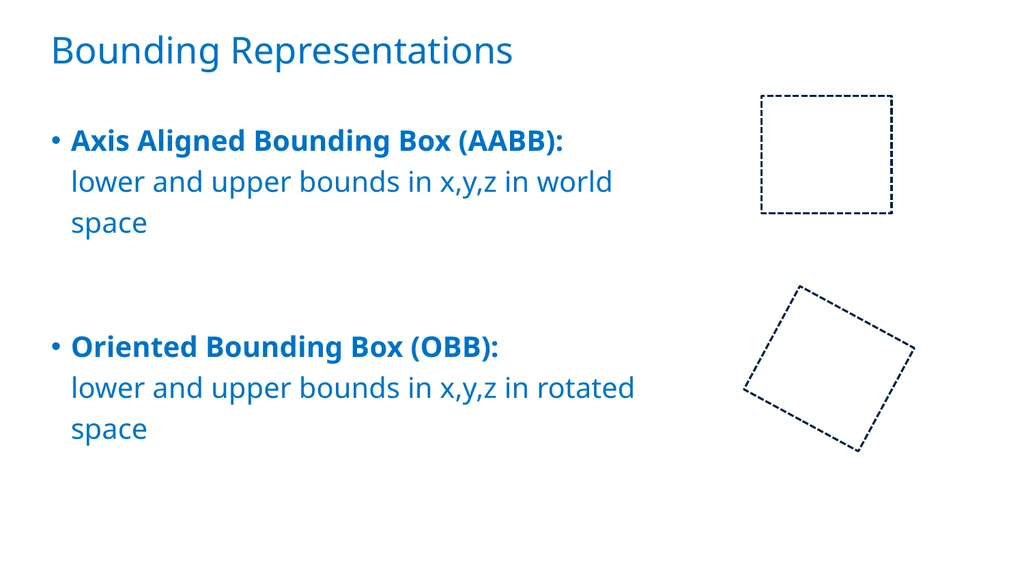
Bounding Representations Axis Aligned Bounding Box (AABB):
lower and upper bounds in x,y,z in world space
Oriented Bounding Box (OBB): lower and upper bounds in x,y,z in rotated space<br>
Oriented Bounding Box (OBB): lower and upper bounds in x,y,z in rotated space<br>
07
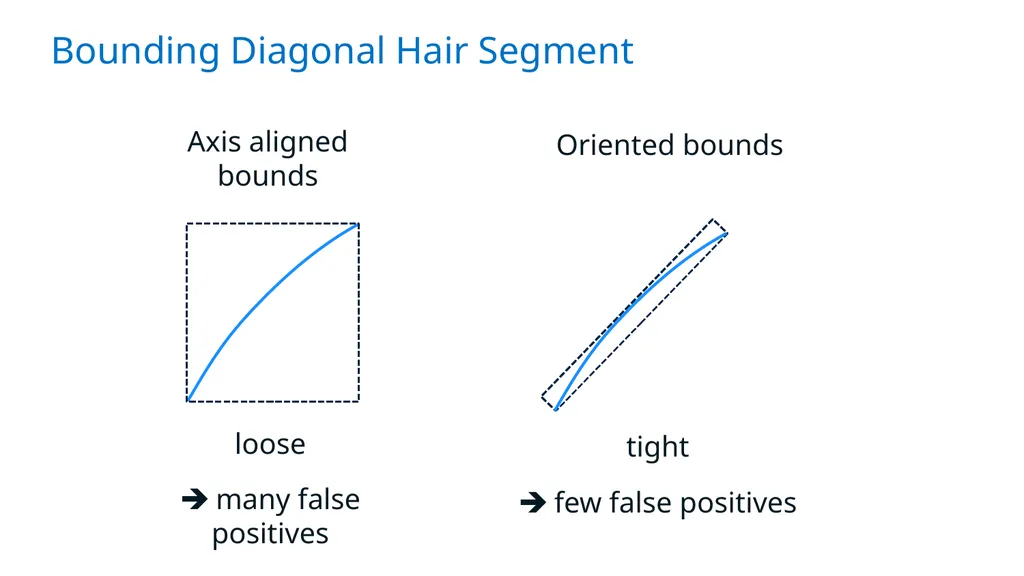
Bounding Diagonal Hair Segment loose
many false positives tight
few false positives Axis aligned bounds Oriented bounds<br>
many false positives tight
few false positives Axis aligned bounds Oriented bounds<br>
08
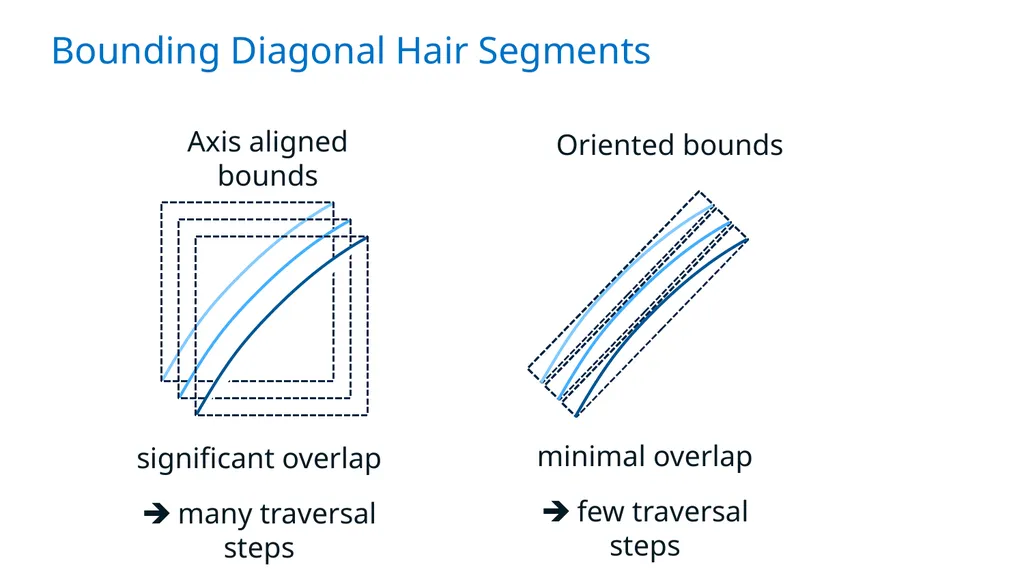
Bounding Diagonal Hair Segments significant overlap
many traversal steps minimal overlap
few traversal steps Axis aligned bounds Oriented bounds<br>
many traversal steps minimal overlap
few traversal steps Axis aligned bounds Oriented bounds<br>
09
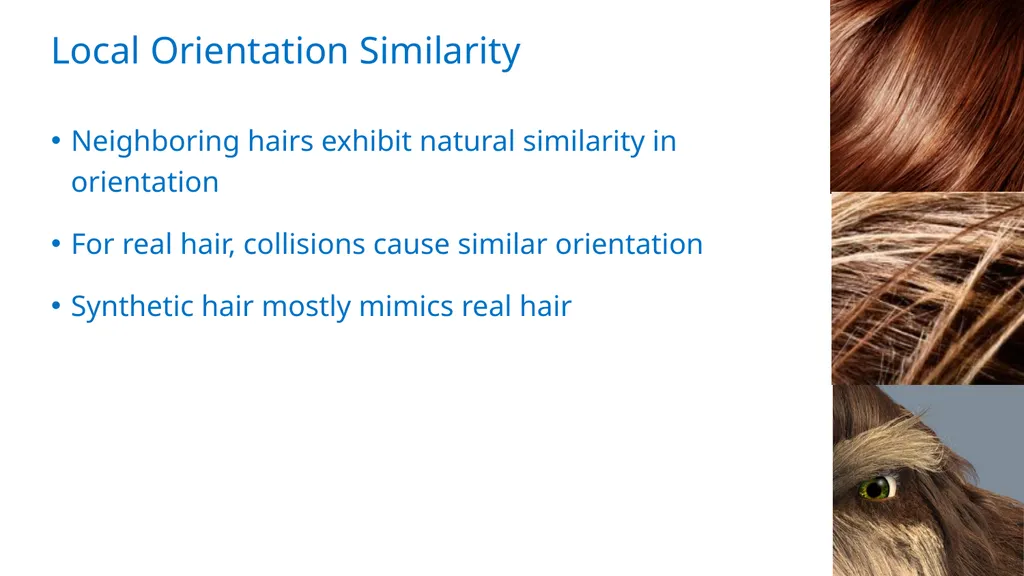
Local Orientation Similarity Neighboring hairs exhibit natural similarity in orientation
For real hair, collisions cause similar orientation
Synthetic hair mostly mimics real hair<br>
For real hair, collisions cause similar orientation
Synthetic hair mostly mimics real hair<br>
10
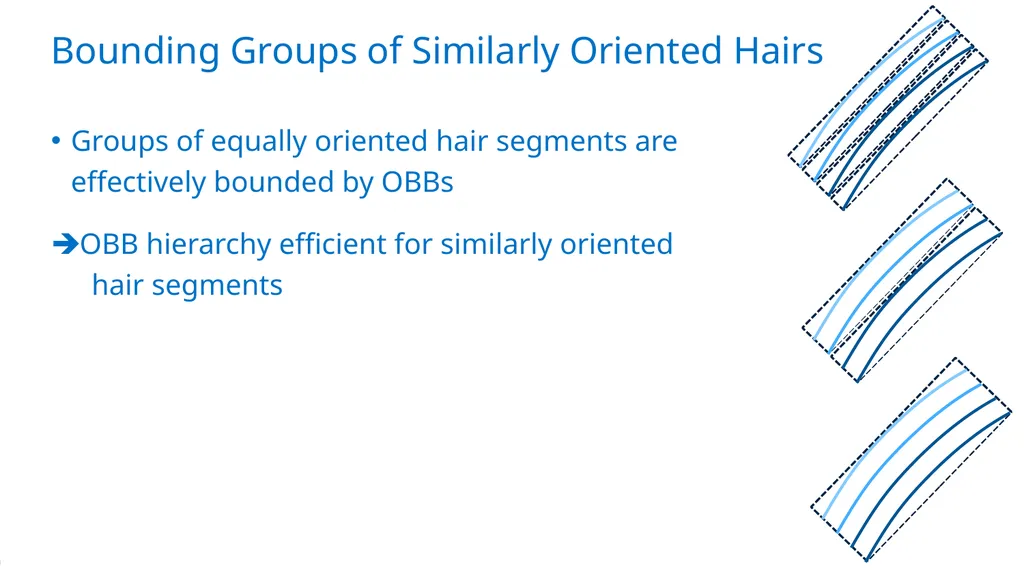
Bounding Groups of Similarly Oriented Hairs Groups of equally oriented hair segments are effectively bounded by OBBs
OBB hierarchy efficient for similarly oriented hair segments<br>
OBB hierarchy efficient for similarly oriented hair segments<br>
11
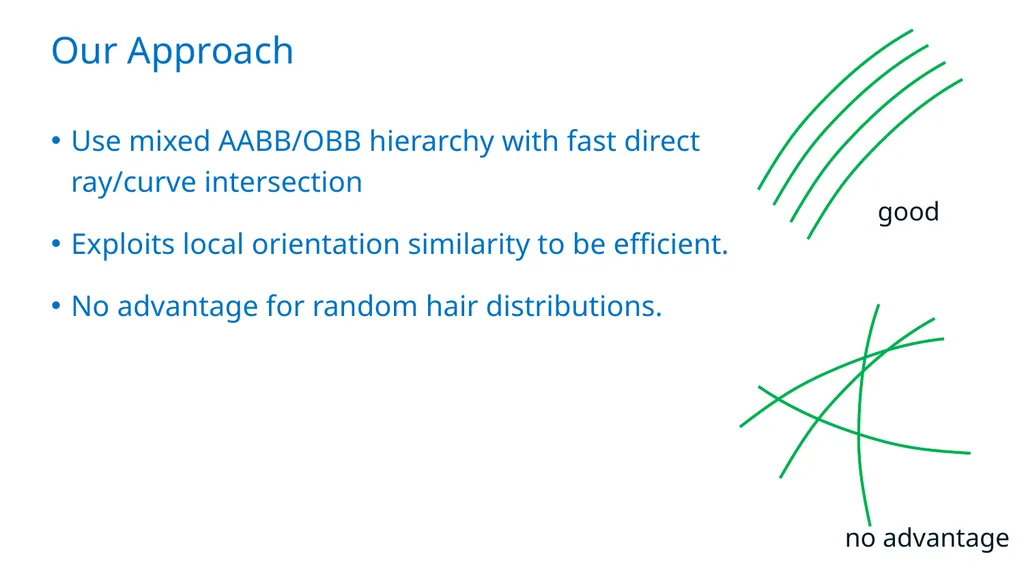
Our Approach Use mixed AABB/OBB hierarchy with fast direct ray/curve intersection
Exploits local orientation similarity to be efficient.
No advantage for random hair distributions. good no advantage<br>
Exploits local orientation similarity to be efficient.
No advantage for random hair distributions. good no advantage<br>
12
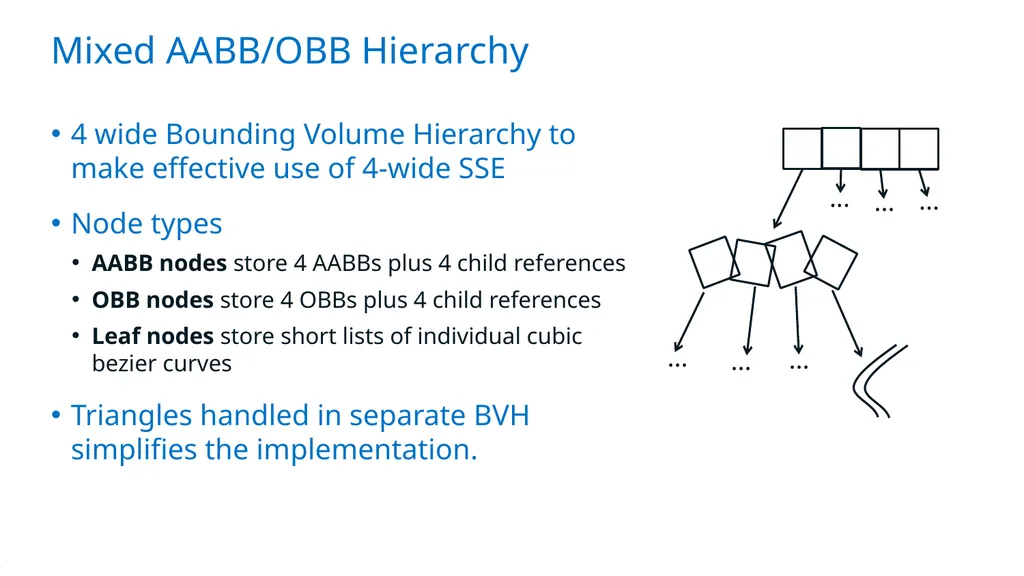
Mixed AABB/OBB Hierarchy 4 wide Bounding Volume Hierarchy to make effective use of 4-wide SSE
Node types
AABB nodes store 4 AABBs plus 4 child references
OBB nodes store 4 OBBs plus 4 child references
Leaf nodes store short lists of individual cubic bezier curves
Triangles handled in separate BVH simplifies the implementation. ... ... ... ... ... ...<br>
Node types
AABB nodes store 4 AABBs plus 4 child references
OBB nodes store 4 OBBs plus 4 child references
Leaf nodes store short lists of individual cubic bezier curves
Triangles handled in separate BVH simplifies the implementation. ... ... ... ... ... ...<br>
13
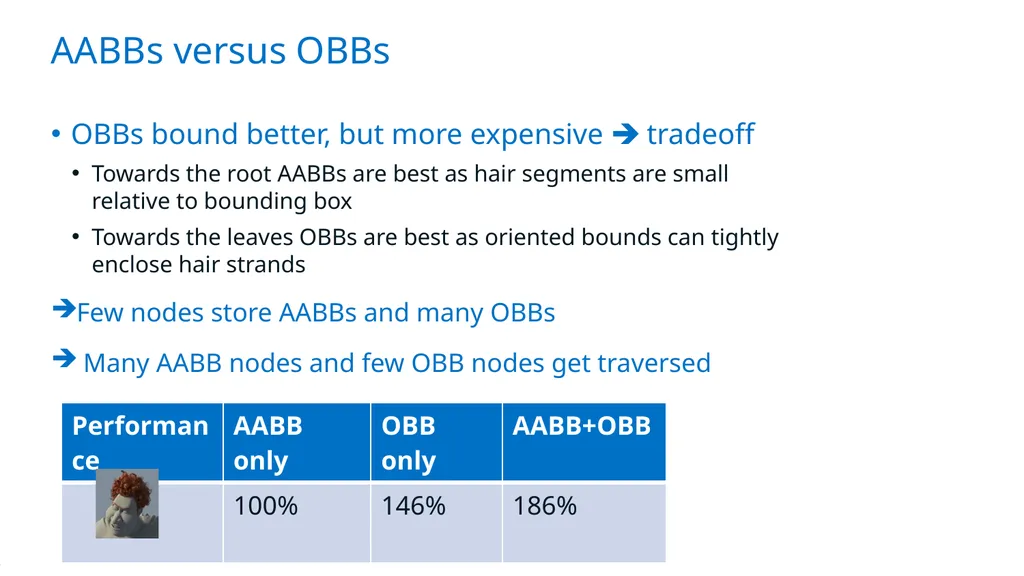
AABBs versus OBBs OBBs bound better, but more expensive tradeoff
Towards the root AABBs are best as hair segments are small relative to bounding box
Towards the leaves OBBs are best as oriented bounds can tightly enclose hair strands
Few nodes store AABBs and many OBBs
Many AABB nodes and few OBB nodes get traversed<br>
Towards the root AABBs are best as hair segments are small relative to bounding box
Towards the leaves OBBs are best as oriented bounds can tightly enclose hair strands
Few nodes store AABBs and many OBBs
Many AABB nodes and few OBB nodes get traversed<br>
14
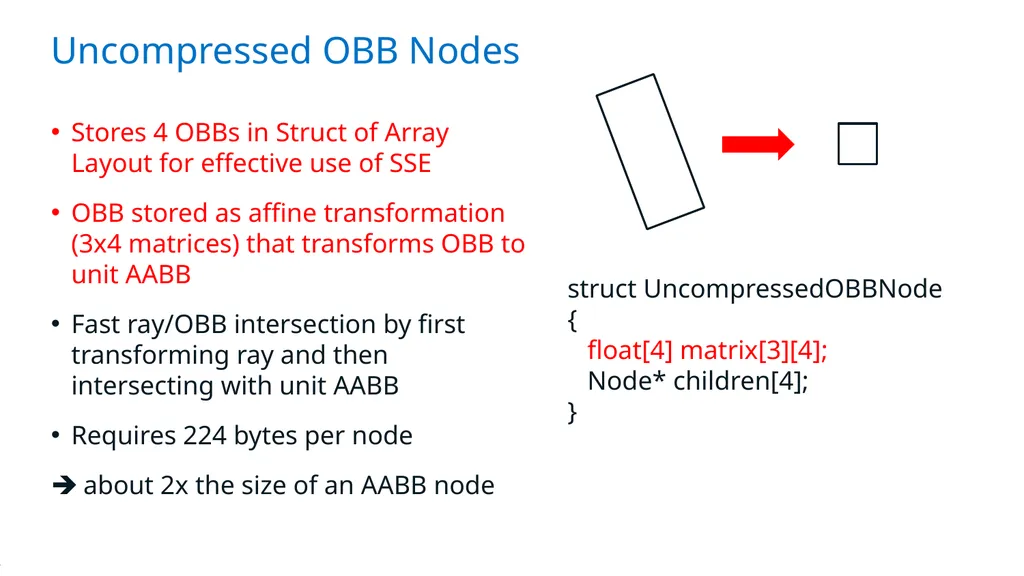
Uncompressed OBB Nodes Stores 4 OBBs in Struct of Array Layout for effective use of SSE
OBB stored as affine transformation (3x4 matrices) that transforms OBB to unit AABB
Fast ray/OBB intersection by first transforming ray and then intersecting with unit AABB
Requires 224 bytes per node
about 2x the size of an AABB node struct UncompressedOBBNode
{
float[4] matrix[3][4];
Node* children[4];
}<br>
OBB stored as affine transformation (3x4 matrices) that transforms OBB to unit AABB
Fast ray/OBB intersection by first transforming ray and then intersecting with unit AABB
Requires 224 bytes per node
about 2x the size of an AABB node struct UncompressedOBBNode
{
float[4] matrix[3][4];
Node* children[4];
}<br>
15
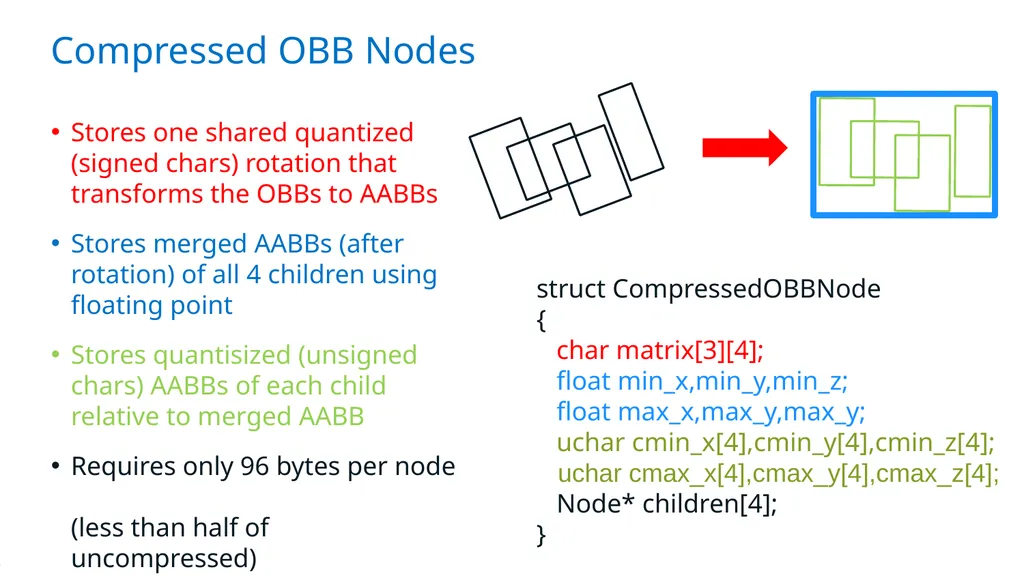
Compressed OBB Nodes Stores one shared quantized (signed chars) rotation that transforms the OBBs to AABBs
Stores merged AABBs (after rotation) of all 4 children using floating point
Stores quantisized (unsigned chars) AABBs of each child relative to merged AABB
Requires only 96 bytes per node (less than half of uncompressed) struct CompressedOBBNode
{
char matrix[3][4];
float min_x,min_y,min_z;
float max_x,max_y,max_y;
uchar cmin_x[4],cmin_y[4],cmin_z[4];
uchar cmax_x[4],cmax_y[4],cmax_z[4];
Node* children[4];
}<br>
Stores merged AABBs (after rotation) of all 4 children using floating point
Stores quantisized (unsigned chars) AABBs of each child relative to merged AABB
Requires only 96 bytes per node (less than half of uncompressed) struct CompressedOBBNode
{
char matrix[3][4];
float min_x,min_y,min_z;
float max_x,max_y,max_y;
uchar cmin_x[4],cmin_y[4],cmin_z[4];
uchar cmax_x[4],cmax_y[4],cmax_z[4];
Node* children[4];
}<br>
16
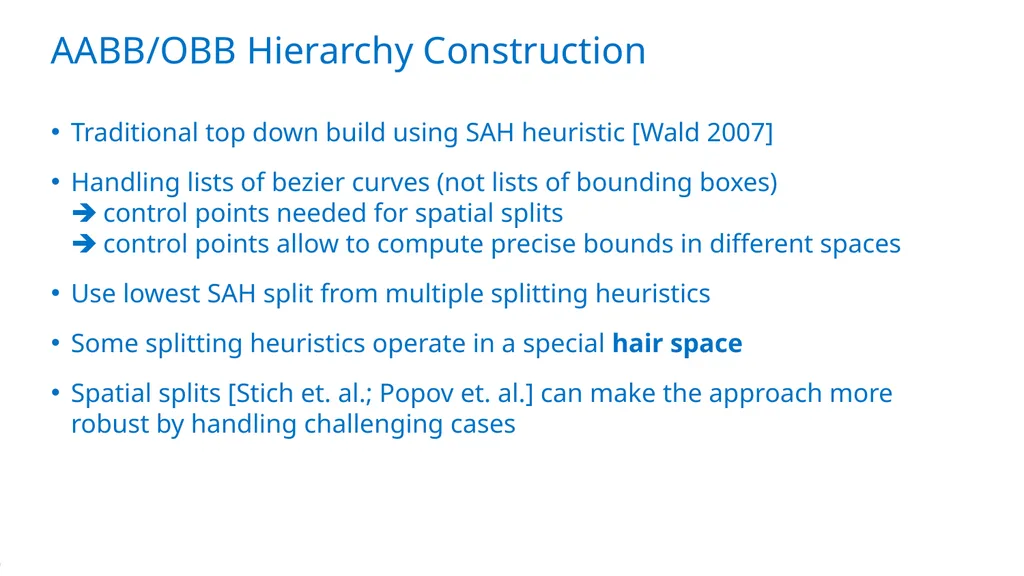
AABB/OBB Hierarchy Construction Traditional top down build using SAH heuristic [Wald 2007]
Handling lists of bezier curves (not lists of bounding boxes) control points needed for spatial splits control points allow to compute precise bounds in different spaces
Use lowest SAH split from multiple splitting heuristics
Some splitting heuristics operate in a special hair space
Spatial splits [Stich et. al.; Popov et. al.] can make the approach more robust by handling challenging cases<br>
Handling lists of bezier curves (not lists of bounding boxes) control points needed for spatial splits control points allow to compute precise bounds in different spaces
Use lowest SAH split from multiple splitting heuristics
Some splitting heuristics operate in a special hair space
Spatial splits [Stich et. al.; Popov et. al.] can make the approach more robust by handling challenging cases<br>
17
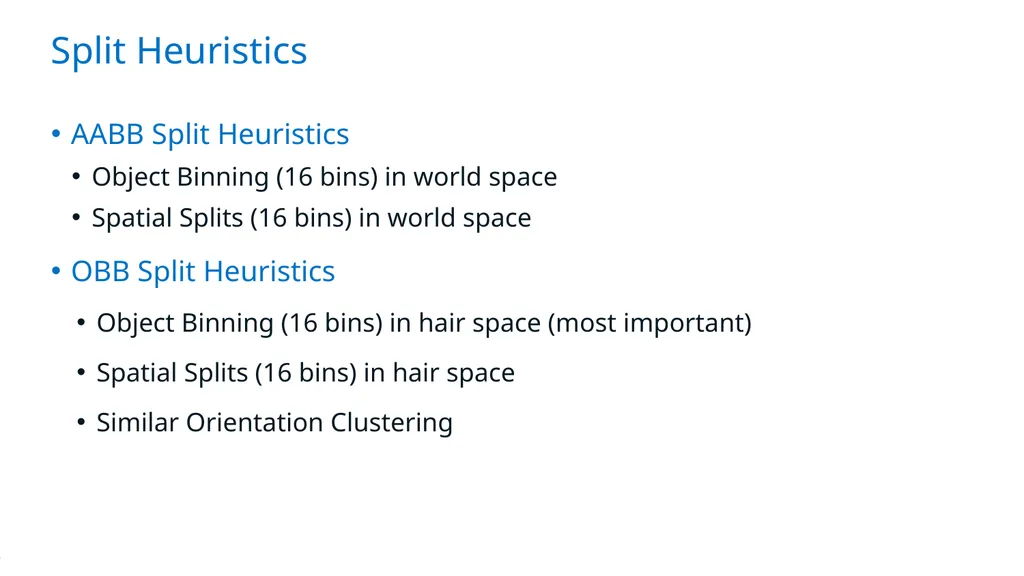
Split Heuristics AABB Split Heuristics
Object Binning (16 bins) in world space
Spatial Splits (16 bins) in world space
OBB Split Heuristics
Object Binning (16 bins) in hair space (most important)
Spatial Splits (16 bins) in hair space
Similar Orientation Clustering<br>
Object Binning (16 bins) in world space
Spatial Splits (16 bins) in world space
OBB Split Heuristics
Object Binning (16 bins) in hair space (most important)
Spatial Splits (16 bins) in hair space
Similar Orientation Clustering<br>
18
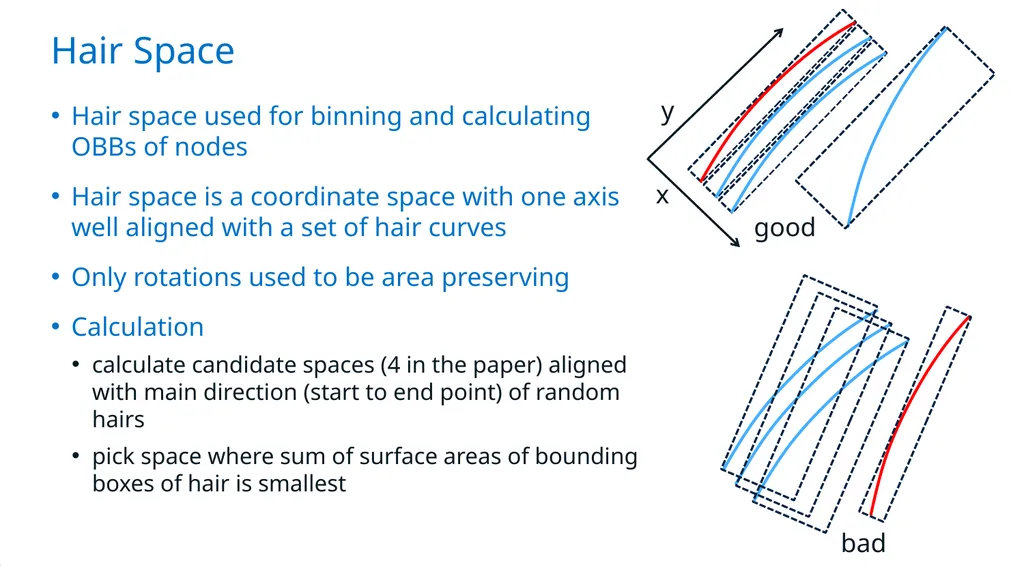
Hair Space Hair space used for binning and calculating OBBs of nodes
Hair space is a coordinate space with one axis well aligned with a set of hair curves
Only rotations used to be area preserving
Calculation
calculate candidate spaces (4 in the paper) aligned with main direction (start to end point) of random hairs
pick space where sum of surface areas of bounding boxes of hair is smallest good bad x y<br>
Hair space is a coordinate space with one axis well aligned with a set of hair curves
Only rotations used to be area preserving
Calculation
calculate candidate spaces (4 in the paper) aligned with main direction (start to end point) of random hairs
pick space where sum of surface areas of bounding boxes of hair is smallest good bad x y<br>
19
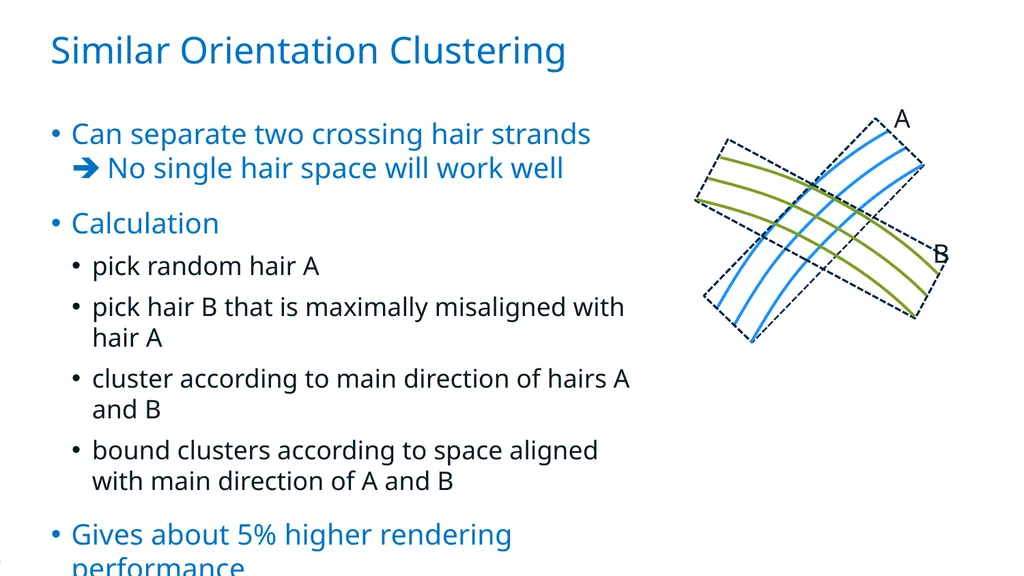
Similar Orientation Clustering Can separate two crossing hair strands
No single hair space will work well
Calculation
pick random hair A
pick hair B that is maximally misaligned with hair A
cluster according to main direction of hairs A and B
bound clusters according to space aligned with main direction of A and B
Gives about 5% higher rendering performance A B<br>
Calculation
pick random hair A
pick hair B that is maximally misaligned with hair A
cluster according to main direction of hairs A and B
bound clusters according to space aligned with main direction of A and B
Gives about 5% higher rendering performance A B<br>
20
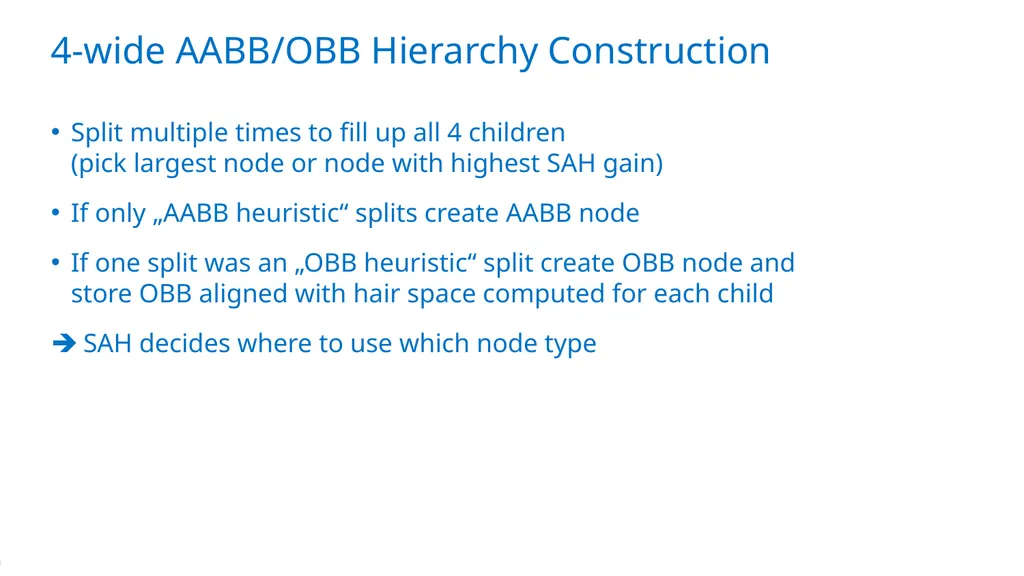
4-wide AABB/OBB Hierarchy Construction Split multiple times to fill up all 4 children
(pick largest node or node with highest SAH gain)
If only „AABB heuristic“ splits create AABB node
If one split was an „OBB heuristic“ split create OBB node and store OBB aligned with hair space computed for each child
SAH decides where to use which node type<br>
If only „AABB heuristic“ splits create AABB node
If one split was an „OBB heuristic“ split create OBB node and store OBB aligned with hair space computed for each child
SAH decides where to use which node type<br>
21
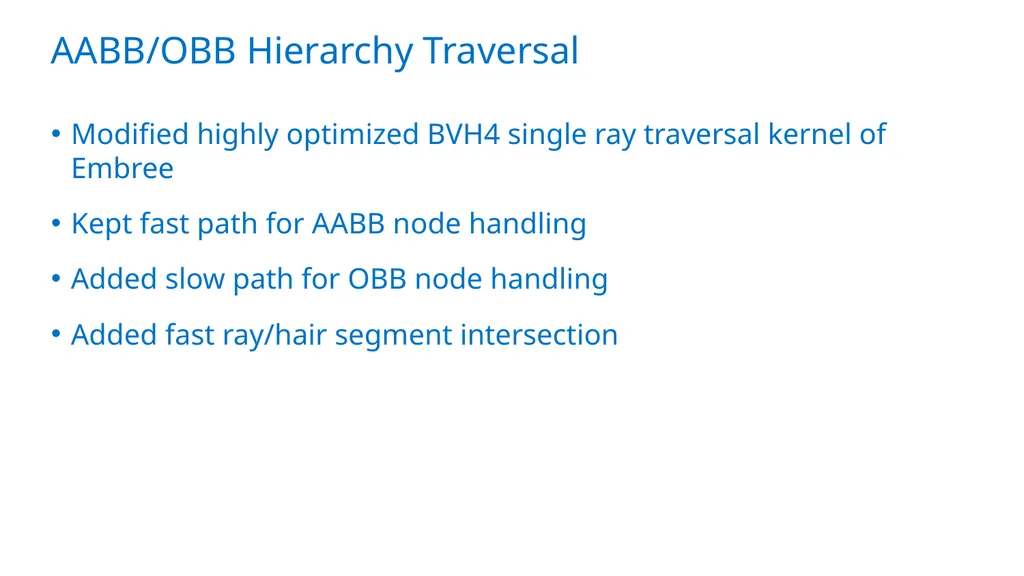
AABB/OBB Hierarchy Traversal Modified highly optimized BVH4 single ray traversal kernel of Embree
Kept fast path for AABB node handling
Added slow path for OBB node handling
Added fast ray/hair segment intersection<br>
Kept fast path for AABB node handling
Added slow path for OBB node handling
Added fast ray/hair segment intersection<br>
22
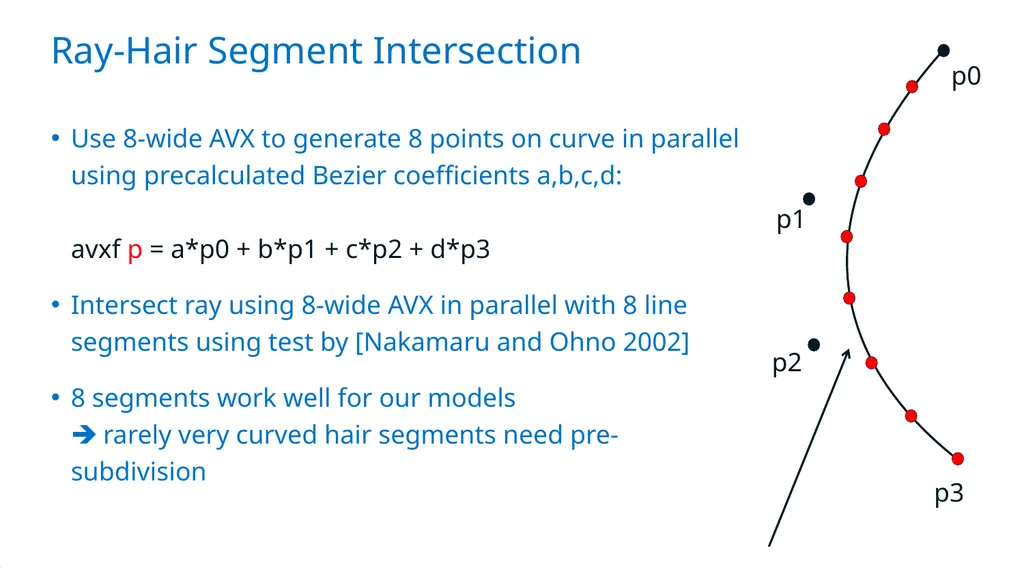
Ray-Hair Segment Intersection Use 8-wide AVX to generate 8 points on curve in parallel using precalculated Bezier coefficients a,b,c,d:
avxf p = a*p0 + b*p1 + c*p2 + d*p3
Intersect ray using 8-wide AVX in parallel with 8 line segments using test by [Nakamaru and Ohno 2002]
8 segments work well for our models rarely very curved hair segments need pre-subdivision p0 p1 p2 p3<br>
Intersect ray using 8-wide AVX in parallel with 8 line segments using test by [Nakamaru and Ohno 2002]
8 segments work well for our models rarely very curved hair segments need pre-subdivision p0 p1 p2 p3<br>
23
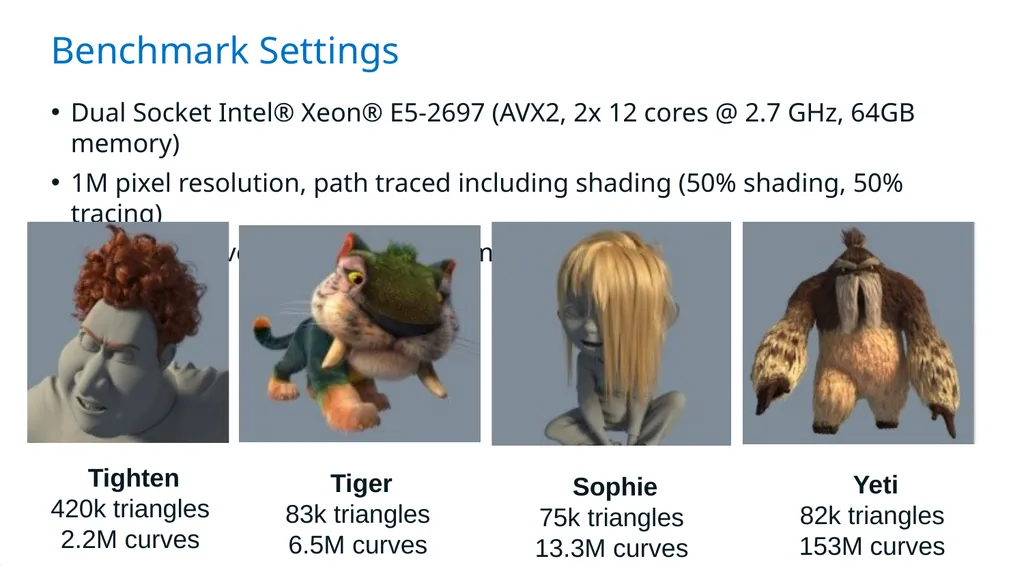
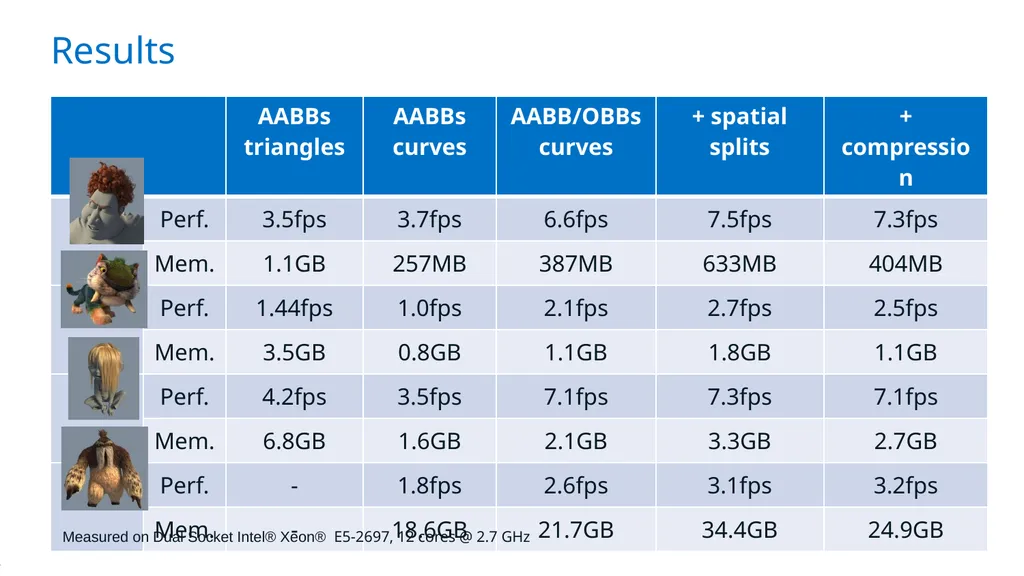
Benchmark Settings Dual Socket Intel® Xeon® E5-2697 (AVX2, 2x 12 cores @ 2.7 GHz, 64GB memory)
1M pixel resolution, path traced including shading (50% shading, 50% tracing)
Representative movie content from Dreamworks Tighten
420k triangles
2.2M curves Tiger
83k triangles
6.5M curves Sophie
75k triangles
13.3M curves Yeti
82k triangles
153M curves<br>
1M pixel resolution, path traced including shading (50% shading, 50% tracing)
Representative movie content from Dreamworks Tighten
420k triangles
2.2M curves Tiger
83k triangles
6.5M curves Sophie
75k triangles
13.3M curves Yeti
82k triangles
153M curves<br>
24
Results Measured on Dual Socket Intel® Xeon® E5-2697, 12 cores @ 2.7 GHz<br>
25
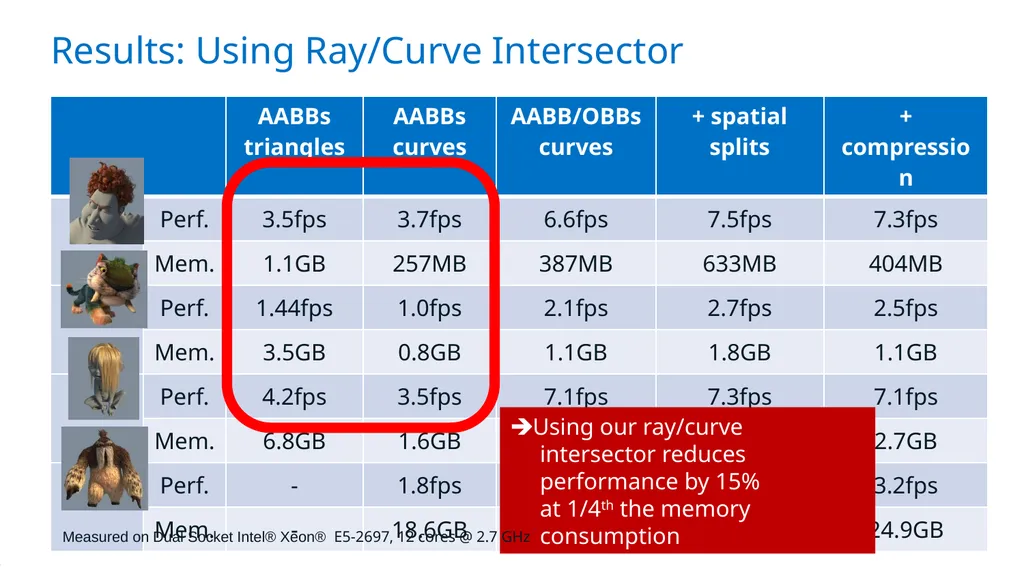
Results: Using Ray/Curve Intersector Using our ray/curve intersector reduces performance by 15%
at 1/4th the memory consumption Measured on Dual Socket Intel® Xeon® E5-2697, 12 cores @ 2.7 GHz<br>
26
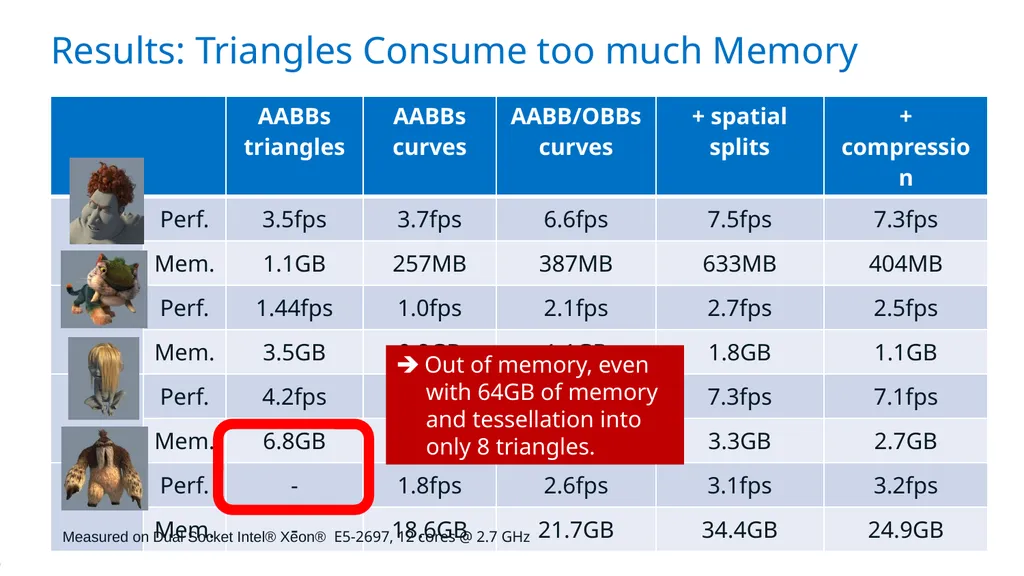
Results: Triangles Consume too much Memory Out of memory, even with 64GB of memory and tessellation into only 8 triangles. Measured on Dual Socket Intel® Xeon® E5-2697, 12 cores @ 2.7 GHz<br>
27
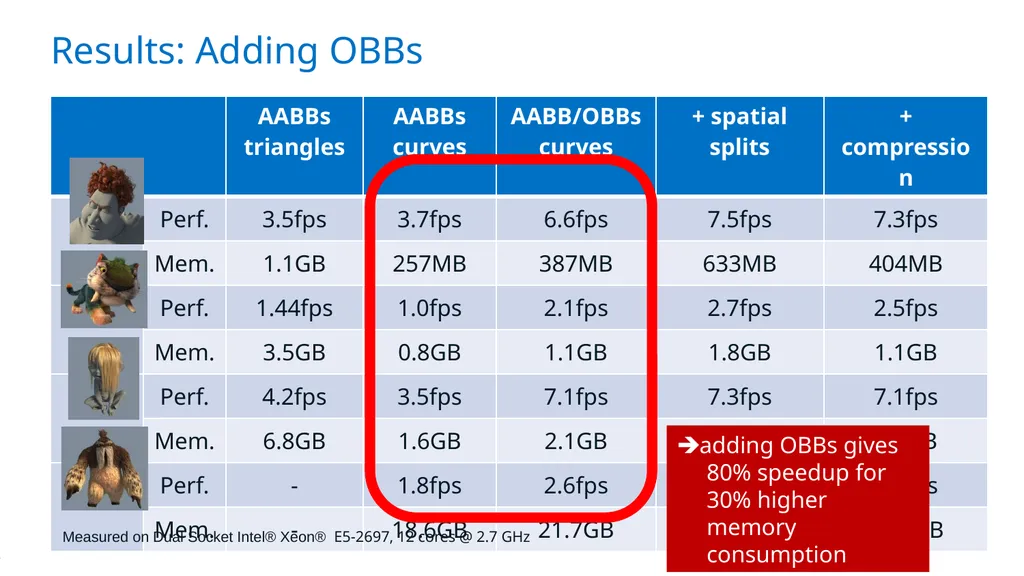
Results: Adding OBBs adding OBBs gives
80% speedup for
30% higher memory consumption Measured on Dual Socket Intel® Xeon® E5-2697, 12 cores @ 2.7 GHz<br>
28
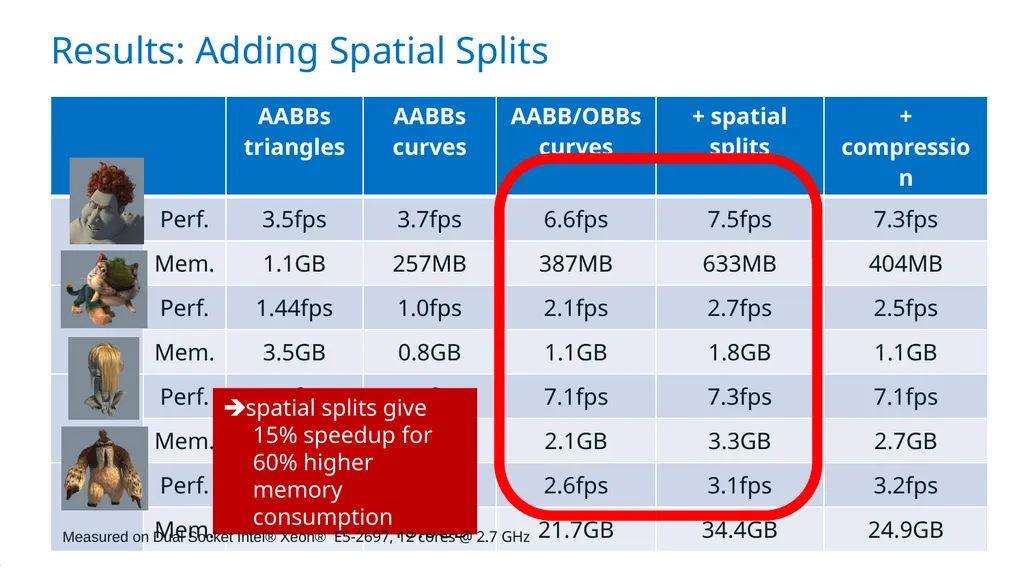
Results: Adding Spatial Splits spatial splits give
15% speedup for
60% higher memory consumption Measured on Dual Socket Intel® Xeon® E5-2697, 12 cores @ 2.7 GHz<br>
29
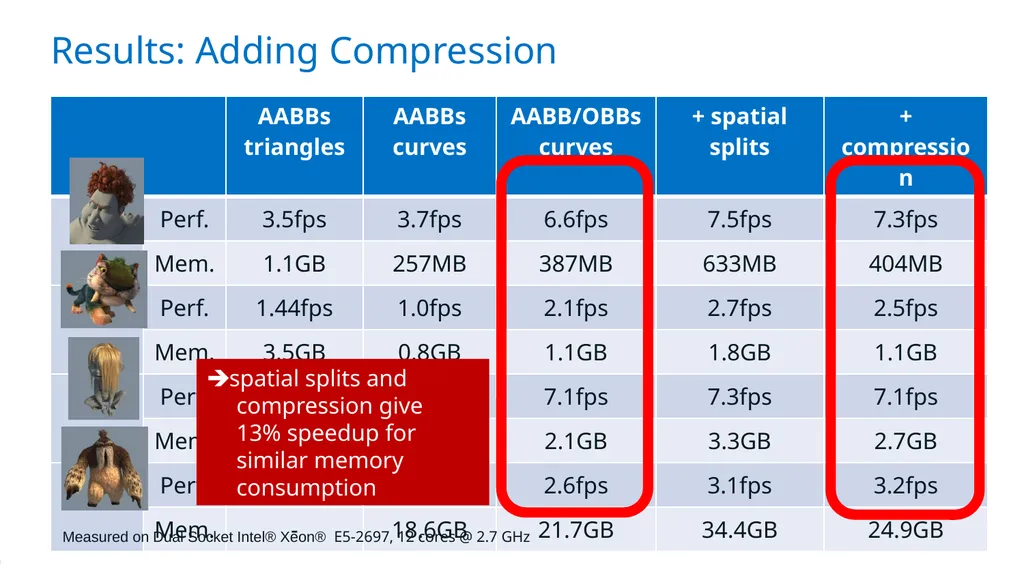
Results: Adding Compression spatial splits and compression give
13% speedup for
similar memory consumption Measured on Dual Socket Intel® Xeon® E5-2697, 12 cores @ 2.7 GHz<br>
30
Video Path tracing with up to 10 bounces @ about 1M pixels
2x Intel(R) Xeon(R) CPU E5-2687W @ 3.10GHz (16 cores total)<br>
2x Intel(R) Xeon(R) CPU E5-2687W @ 3.10GHz (16 cores total)<br>
31
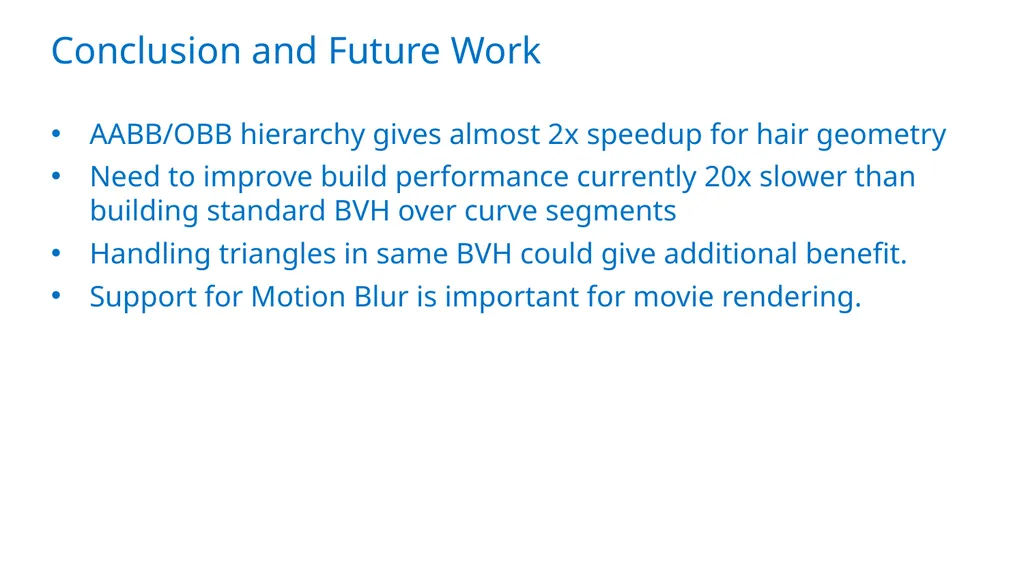
Conclusion and Future Work AABB/OBB hierarchy gives almost 2x speedup for hair geometry
Need to improve build performance currently 20x slower than building standard BVH over curve segments
Handling triangles in same BVH could give additional benefit.
Support for Motion Blur is important for movie rendering.<br>
Need to improve build performance currently 20x slower than building standard BVH over curve segments
Handling triangles in same BVH could give additional benefit.
Support for Motion Blur is important for movie rendering.<br>
32
Questions? Source code for Xeon and Xeon Phi
available as part of Embree 2.3.1,
https://embree.github.com<br>