
External Environment C1 External environment
LS
Published · 46 slides · 0 views
1 / 1

Description
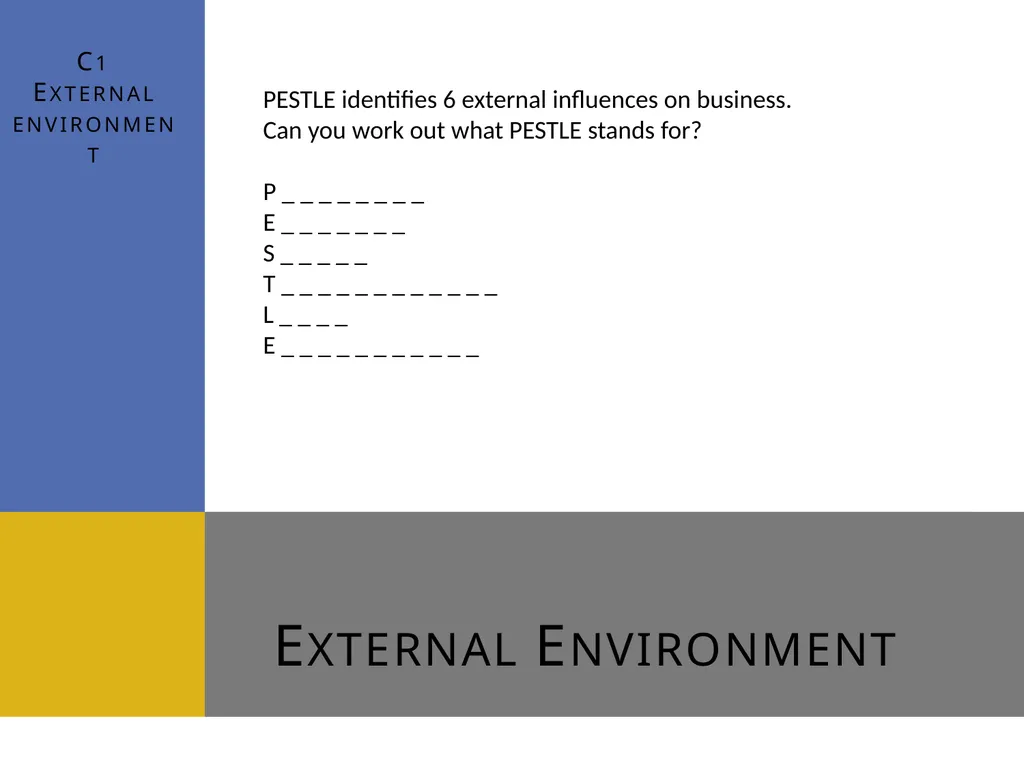
External Environment C1 External environment PESTLE identifies 6 external influences on business. Can you work out what PESTLE stands for? P E S T L
Related Topics
Share
Embed code
Download this presentation From Below
"External Environment C1 External environment" is the property of its rightful owner. Permission is granted to download and print the materials on this website for personal, non-commercial use only, and to display it on your personal computer provided you do not modify the materials and that you retain all copyright notices contained in the materials. By downloading content from our website, you accept the terms of this agreement.
Presentation Transcript
01
External Environment C1
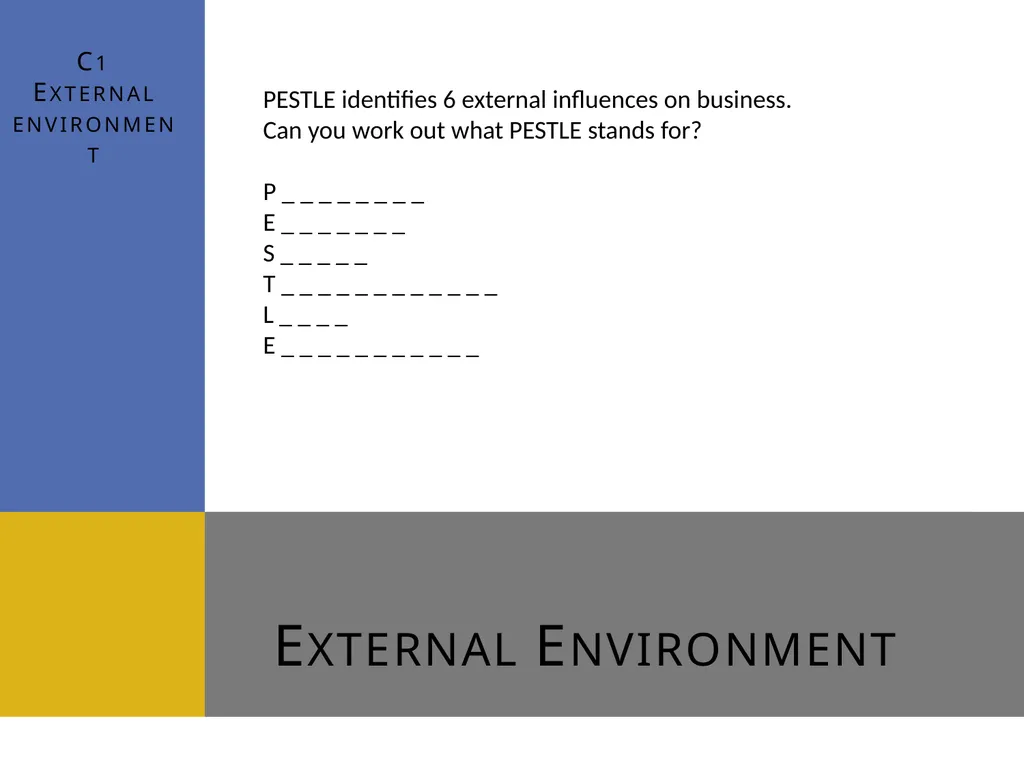
External environment PESTLE identifies 6 external influences on business.
Can you work out what PESTLE stands for?
P _ _ _ _ _ _ _ _
E _ _ _ _ _ _ _
S _ _ _ _ _
T _ _ _ _ _ _ _ _ _ _ _ _
L _ _ _ _
E _ _ _ _ _ _ _ _ _ _ _<br>
External environment PESTLE identifies 6 external influences on business.
Can you work out what PESTLE stands for?
P _ _ _ _ _ _ _ _
E _ _ _ _ _ _ _
S _ _ _ _ _
T _ _ _ _ _ _ _ _ _ _ _ _
L _ _ _ _
E _ _ _ _ _ _ _ _ _ _ _<br>
02
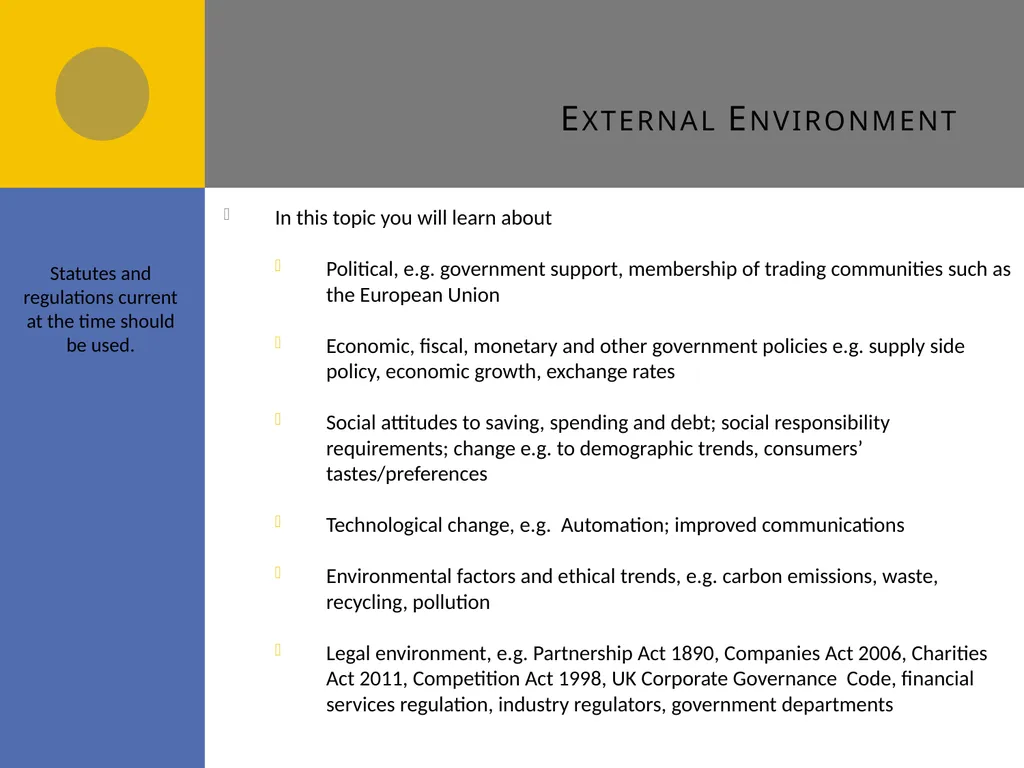
External Environment In this topic you will learn about
Political, e.g. government support, membership of trading communities such as the European Union
Economic, fiscal, monetary and other government policies e.g. supply side policy, economic growth, exchange rates
Social attitudes to saving, spending and debt; social responsibility requirements; change e.g. to demographic trends, consumers’ tastes/preferences
Technological change, e.g. Automation; improved communications
Environmental factors and ethical trends, e.g. carbon emissions, waste, recycling, pollution
Legal environment, e.g. Partnership Act 1890, Companies Act 2006, Charities Act 2011, Competition Act 1998, UK Corporate Governance Code, financial services regulation, industry regulators, government departments Statutes and regulations current at the time should be used.<br>
Political, e.g. government support, membership of trading communities such as the European Union
Economic, fiscal, monetary and other government policies e.g. supply side policy, economic growth, exchange rates
Social attitudes to saving, spending and debt; social responsibility requirements; change e.g. to demographic trends, consumers’ tastes/preferences
Technological change, e.g. Automation; improved communications
Environmental factors and ethical trends, e.g. carbon emissions, waste, recycling, pollution
Legal environment, e.g. Partnership Act 1890, Companies Act 2006, Charities Act 2011, Competition Act 1998, UK Corporate Governance Code, financial services regulation, industry regulators, government departments Statutes and regulations current at the time should be used.<br>
03
PESTLE The external environment is all of those factors outside of the control of a business that will impact on its day to day operations, decision making and strategies
This creates opportunities e.g. technological advancements and threats e.g. rising interest rates
One major change has been the vote in June 2016 for the UK to leave the EU The impact of Brexit on the UK. This is a big topic so you will have to be selective in identify those aspects that have the biggest influence on your chosen businesses.<br>
This creates opportunities e.g. technological advancements and threats e.g. rising interest rates
One major change has been the vote in June 2016 for the UK to leave the EU The impact of Brexit on the UK. This is a big topic so you will have to be selective in identify those aspects that have the biggest influence on your chosen businesses.<br>
04
Political environment The political environment is the government actions that impact on the strategic and functional decisions made by businesses
These actions can be by local, national or international authorities
They will impact heavily on the competitive environment and the infrastructure that allows businesses to operate effectively How the UK Government works.<br>
These actions can be by local, national or international authorities
They will impact heavily on the competitive environment and the infrastructure that allows businesses to operate effectively How the UK Government works.<br>
05
The government can provide grants to businesses for specific purposes e.g. relocation
Can be from Local, National or European Government
The government can provide training to start up businesses in a variety of areas:
Financial e.g. small business accounts
Marketing e.g. how to target market segments
Operations management e.g. advice on location
People e.g. how to recruit a suitable workforce Political environment - Government support<br>
Can be from Local, National or European Government
The government can provide training to start up businesses in a variety of areas:
Financial e.g. small business accounts
Marketing e.g. how to target market segments
Operations management e.g. advice on location
People e.g. how to recruit a suitable workforce Political environment - Government support<br>
06
Political environment -
enterprise Entrepreneurs and SMEs impact on businesses in a number of ways:
Create competition
Supply goods and services
Offer specialisms and expertise
Buy goods and services
Entrepreneurs and SMEs impact on the economy in a number of ways:
Provide employment
Pay taxes
Social benefits Why do you think that the Government has a target to spend 25% of its budget with SMEs? Welsh politicians argue that SMEs are the lifeblood of the welsh economy. How important are SMEs in your area?<br>
Create competition
Supply goods and services
Offer specialisms and expertise
Buy goods and services
Entrepreneurs and SMEs impact on the economy in a number of ways:
Provide employment
Pay taxes
Social benefits Why do you think that the Government has a target to spend 25% of its budget with SMEs? Welsh politicians argue that SMEs are the lifeblood of the welsh economy. How important are SMEs in your area?<br>
07
Regulation is undertaken by government to create competitive markets
The government believes that this will protect the interests of consumers so that they are not exploited by businesses
Effective regulation will lead to greater choice and lower prices
Regulation takes place in a number of industries such as telecoms, water and energy
A key reason for regulation is to create conditions for continued investment in infrastructure in important areas of the economy Political environment - Government support Preparing for assessment:
Are there any regulations that apply specifically to the actions of your businesses?<br>
The government believes that this will protect the interests of consumers so that they are not exploited by businesses
Effective regulation will lead to greater choice and lower prices
Regulation takes place in a number of industries such as telecoms, water and energy
A key reason for regulation is to create conditions for continued investment in infrastructure in important areas of the economy Political environment - Government support Preparing for assessment:
Are there any regulations that apply specifically to the actions of your businesses?<br>
08
De-regulation is the opening up of markets to new competition through the removal of rules and regulations that created barriers to entry
Arguments for de-regulation include:
The creation of competitive markets will lead to greater efficiency
Businesses strive to reduce costs in order to compete effectively
Businesses strive to meet consumer demand by reducing price and providing a greater range of products
Less government intervention allows firms to produce to the needs of the market Political environment - Government support<br>
Arguments for de-regulation include:
The creation of competitive markets will lead to greater efficiency
Businesses strive to reduce costs in order to compete effectively
Businesses strive to meet consumer demand by reducing price and providing a greater range of products
Less government intervention allows firms to produce to the needs of the market Political environment - Government support<br>
09
Governments will look to improve the infrastructure to help businesses operate more effectively.
This will include the:
Transport network
Improves ease and speed of connections e.g. rail, road and air
Provision of utilities
Ensuring electricity, gas, water etc. are adequately supplied
Provision of information
Ensuring access to fast information e.g. broadband Political environment - Government support Crossrail.<br>
This will include the:
Transport network
Improves ease and speed of connections e.g. rail, road and air
Provision of utilities
Ensuring electricity, gas, water etc. are adequately supplied
Provision of information
Ensuring access to fast information e.g. broadband Political environment - Government support Crossrail.<br>
10
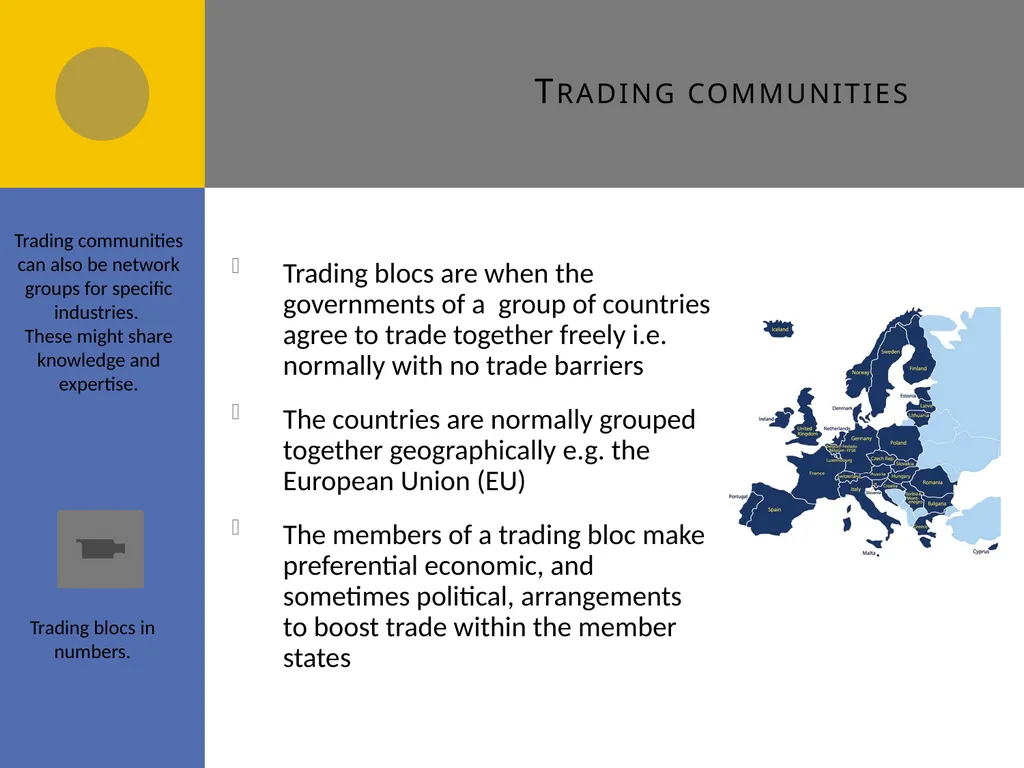
Trading communities Trading blocs are when the governments of a group of countries agree to trade together freely i.e. normally with no trade barriers
The countries are normally grouped together geographically e.g. the European Union (EU)
The members of a trading bloc make preferential economic, and sometimes political, arrangements to boost trade within the member states Trading communities can also be network groups for specific industries.
These might share knowledge and expertise. Trading blocs in numbers.<br>
The countries are normally grouped together geographically e.g. the European Union (EU)
The members of a trading bloc make preferential economic, and sometimes political, arrangements to boost trade within the member states Trading communities can also be network groups for specific industries.
These might share knowledge and expertise. Trading blocs in numbers.<br>
11
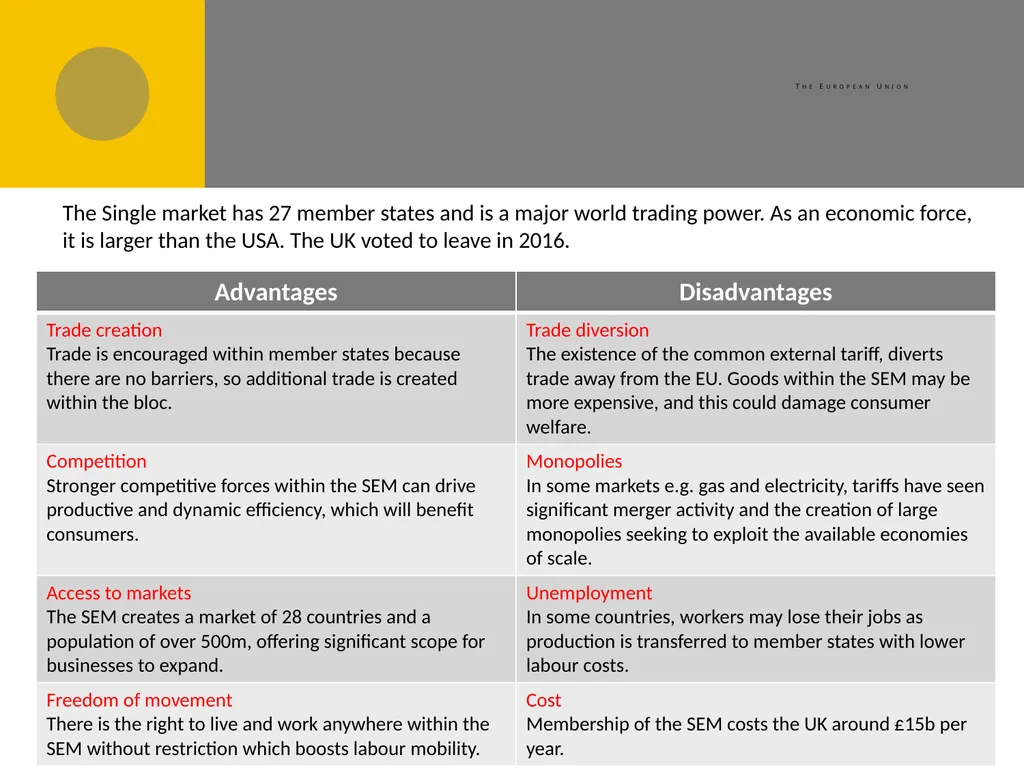
The European Union The Single market has 27 member states and is a major world trading power. As an economic force, it is larger than the USA. The UK voted to leave in 2016.<br>
12
Since its inception in 1958, the EU has grown from 6 to 28 member states, with Croatia the most recent country to join in 2013
In 2016 the UK voted to leave the EU
At the current time there are a further 5 candidate countries for EU membership i.e. Iceland, Macedonia, Montenegro, Serbia and Turkey
Potential positive implications of enlargement include:
EU enlargement has increased the potential for economies of scale and free trade across a larger geographical area and population
For consumers, the increased competition may drive down production costs leading to lower prices and increased choice and quality
For businesses, they will be able to take advantage of the relative low wages of new accession countries
However, there are some potential negatives to EU enlargement, which include:
Can the UK cope with the influx of migrant workers from new accession countries?
New countries may require additional support from the EU, which may be partly funded by stronger nations
EU enlargement may increase bureaucratic costs for all existing members In 2013 the EU restarted talks with Turkey after 3 years. EU enlargement<br>
In 2016 the UK voted to leave the EU
At the current time there are a further 5 candidate countries for EU membership i.e. Iceland, Macedonia, Montenegro, Serbia and Turkey
Potential positive implications of enlargement include:
EU enlargement has increased the potential for economies of scale and free trade across a larger geographical area and population
For consumers, the increased competition may drive down production costs leading to lower prices and increased choice and quality
For businesses, they will be able to take advantage of the relative low wages of new accession countries
However, there are some potential negatives to EU enlargement, which include:
Can the UK cope with the influx of migrant workers from new accession countries?
New countries may require additional support from the EU, which may be partly funded by stronger nations
EU enlargement may increase bureaucratic costs for all existing members In 2013 the EU restarted talks with Turkey after 3 years. EU enlargement<br>
13
Impact on businesses of trading communities There are a large number of potential impacts, both positive and negative. Some of these include:
Free trade within the bloc encouraging specialisation and trade
Easier access to knowledge, workers and components
Economies of scale
Take advantage of favourable differences between members e.g. taxes or labour costs
May reduce trade with countries outside of the bloc
Not all members may have same power
May damage domestic industries Does this impact on your chosen businesses?
Consider:
Do they buy or sell within Europe?
Is there competition from businesses in Europe?
Has EU membership affected the workforce?
Will they be affected by the BREXIT vote?<br>
Free trade within the bloc encouraging specialisation and trade
Easier access to knowledge, workers and components
Economies of scale
Take advantage of favourable differences between members e.g. taxes or labour costs
May reduce trade with countries outside of the bloc
Not all members may have same power
May damage domestic industries Does this impact on your chosen businesses?
Consider:
Do they buy or sell within Europe?
Is there competition from businesses in Europe?
Has EU membership affected the workforce?
Will they be affected by the BREXIT vote?<br>
14
Economic environment The economic environment consists of the key economic factors that influence the behaviour of businesses and their customers
The business cycle shows fluctuations in the level of economic activities
Economic activity is measured by GDP (Gross Domestic Product)
GDP is the total value of a country’s output in a year
These fluctuations affect both business and consumer confidence as well as ability and willingness to spend What is the current state of the UK economy?
How does this affect consumer spending?
How does this affect demand for your chosen businesses?
Consider whether your businesses sell luxury goods or necessities.
When money is tight do people still give to charity?<br>
The business cycle shows fluctuations in the level of economic activities
Economic activity is measured by GDP (Gross Domestic Product)
GDP is the total value of a country’s output in a year
These fluctuations affect both business and consumer confidence as well as ability and willingness to spend What is the current state of the UK economy?
How does this affect consumer spending?
How does this affect demand for your chosen businesses?
Consider whether your businesses sell luxury goods or necessities.
When money is tight do people still give to charity?<br>
15
Inflation A general rise in prices or a fall in the value of money
The rate of inflation shows how prices have changed based on the same period a year earlier
It is an indication of the cost of living changing
How will your businesses be affected?
Costs
Profits
Consumer spending What is the current rate of inflation in the UK?<br>
The rate of inflation shows how prices have changed based on the same period a year earlier
It is an indication of the cost of living changing
How will your businesses be affected?
Costs
Profits
Consumer spending What is the current rate of inflation in the UK?<br>
16
Inflation The effect on businesses
Increased costs due to higher inflation
can be passed onto the consumer if they would be willing to pay higher prices
if not the firm will have to try and absorb the increased costs through lower profit margins
this has an impact on the pricing strategy of a firm
some firms will reduce the supply of the product
it becomes increasingly difficult to maintain competitiveness
demand will fall if the firm has to raise price
if a firm exports then it will see customers move to companies abroad where prices are not rising as fast The Government have set an inflation target of 2%. The Bank of England’s Monetary Policy Committee (MPC) meet once a month to decide the Bank’s Rate of Interest. If CPI is too high they might raise interest rates to reduce the rate of inflation. Highlight which of these bullet points relate to your business.
Can you explain why?<br>
Increased costs due to higher inflation
can be passed onto the consumer if they would be willing to pay higher prices
if not the firm will have to try and absorb the increased costs through lower profit margins
this has an impact on the pricing strategy of a firm
some firms will reduce the supply of the product
it becomes increasingly difficult to maintain competitiveness
demand will fall if the firm has to raise price
if a firm exports then it will see customers move to companies abroad where prices are not rising as fast The Government have set an inflation target of 2%. The Bank of England’s Monetary Policy Committee (MPC) meet once a month to decide the Bank’s Rate of Interest. If CPI is too high they might raise interest rates to reduce the rate of inflation. Highlight which of these bullet points relate to your business.
Can you explain why?<br>
17
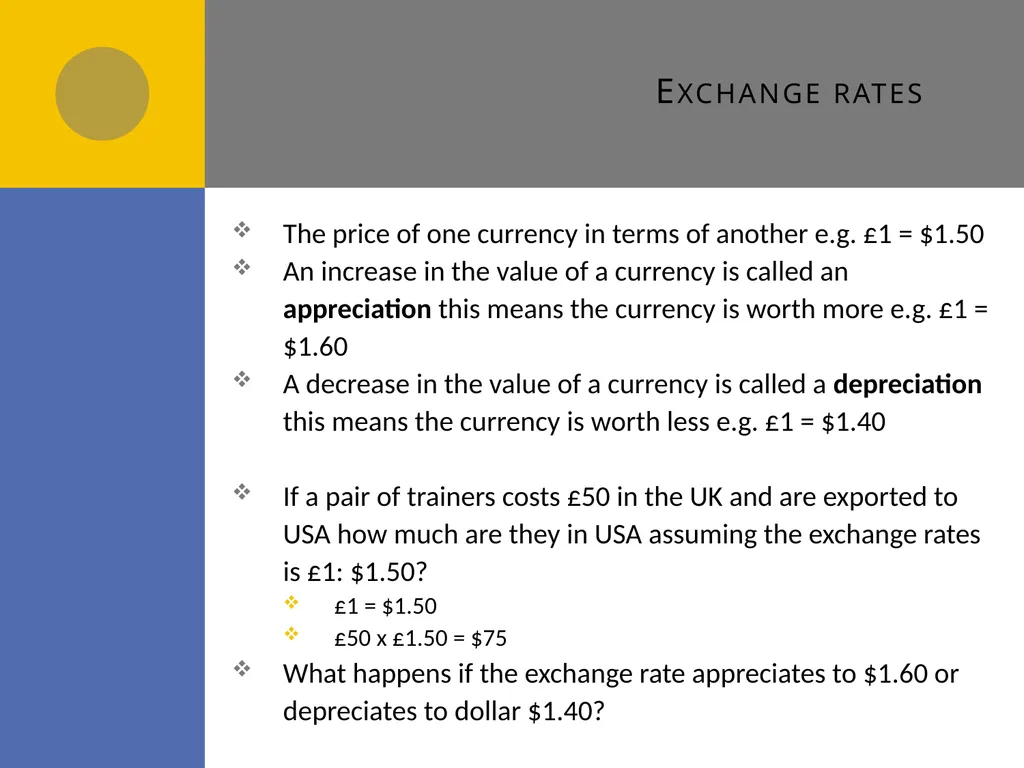
Exchange rates The price of one currency in terms of another e.g. £1 = $1.50
An increase in the value of a currency is called an appreciation this means the currency is worth more e.g. £1 = $1.60
A decrease in the value of a currency is called a depreciation this means the currency is worth less e.g. £1 = $1.40
If a pair of trainers costs £50 in the UK and are exported to USA how much are they in USA assuming the exchange rates is £1: $1.50?
£1 = $1.50
£50 x £1.50 = $75
What happens if the exchange rate appreciates to $1.60 or depreciates to dollar $1.40?<br>
An increase in the value of a currency is called an appreciation this means the currency is worth more e.g. £1 = $1.60
A decrease in the value of a currency is called a depreciation this means the currency is worth less e.g. £1 = $1.40
If a pair of trainers costs £50 in the UK and are exported to USA how much are they in USA assuming the exchange rates is £1: $1.50?
£1 = $1.50
£50 x £1.50 = $75
What happens if the exchange rate appreciates to $1.60 or depreciates to dollar $1.40?<br>
18
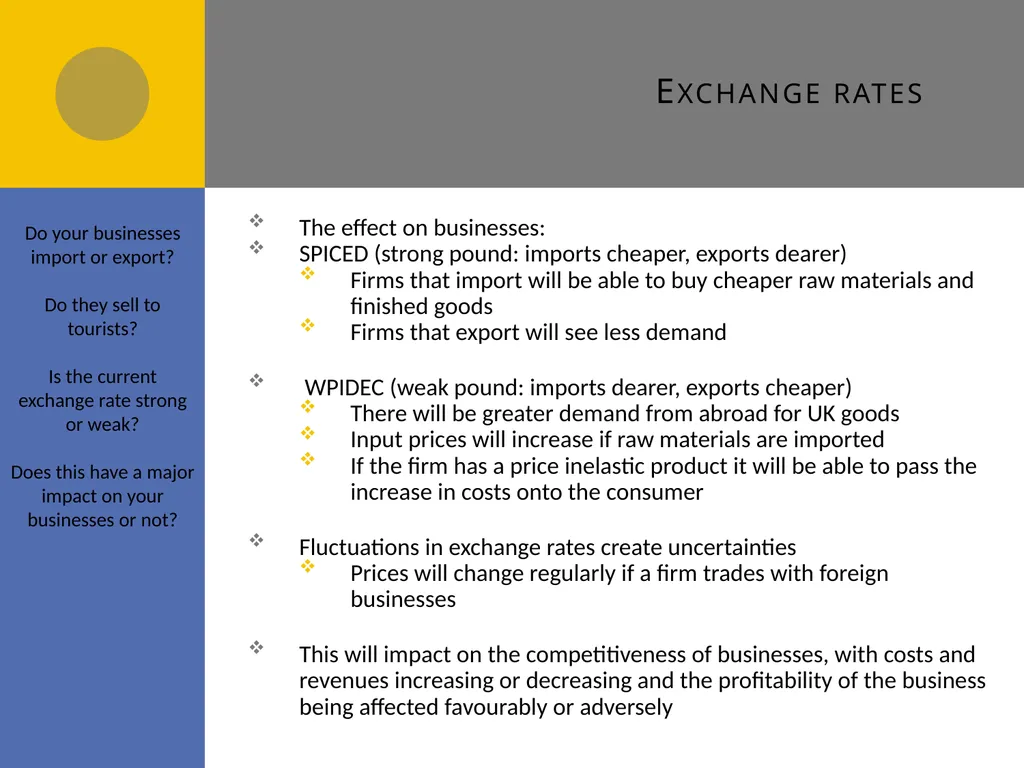
Exchange rates The effect on businesses:
SPICED (strong pound: imports cheaper, exports dearer)
Firms that import will be able to buy cheaper raw materials and finished goods
Firms that export will see less demand
WPIDEC (weak pound: imports dearer, exports cheaper)
There will be greater demand from abroad for UK goods
Input prices will increase if raw materials are imported
If the firm has a price inelastic product it will be able to pass the increase in costs onto the consumer
Fluctuations in exchange rates create uncertainties
Prices will change regularly if a firm trades with foreign businesses
This will impact on the competitiveness of businesses, with costs and revenues increasing or decreasing and the profitability of the business being affected favourably or adversely Do your businesses import or export?
Do they sell to tourists?
Is the current exchange rate strong or weak?
Does this have a major impact on your businesses or not?<br>
SPICED (strong pound: imports cheaper, exports dearer)
Firms that import will be able to buy cheaper raw materials and finished goods
Firms that export will see less demand
WPIDEC (weak pound: imports dearer, exports cheaper)
There will be greater demand from abroad for UK goods
Input prices will increase if raw materials are imported
If the firm has a price inelastic product it will be able to pass the increase in costs onto the consumer
Fluctuations in exchange rates create uncertainties
Prices will change regularly if a firm trades with foreign businesses
This will impact on the competitiveness of businesses, with costs and revenues increasing or decreasing and the profitability of the business being affected favourably or adversely Do your businesses import or export?
Do they sell to tourists?
Is the current exchange rate strong or weak?
Does this have a major impact on your businesses or not?<br>
19
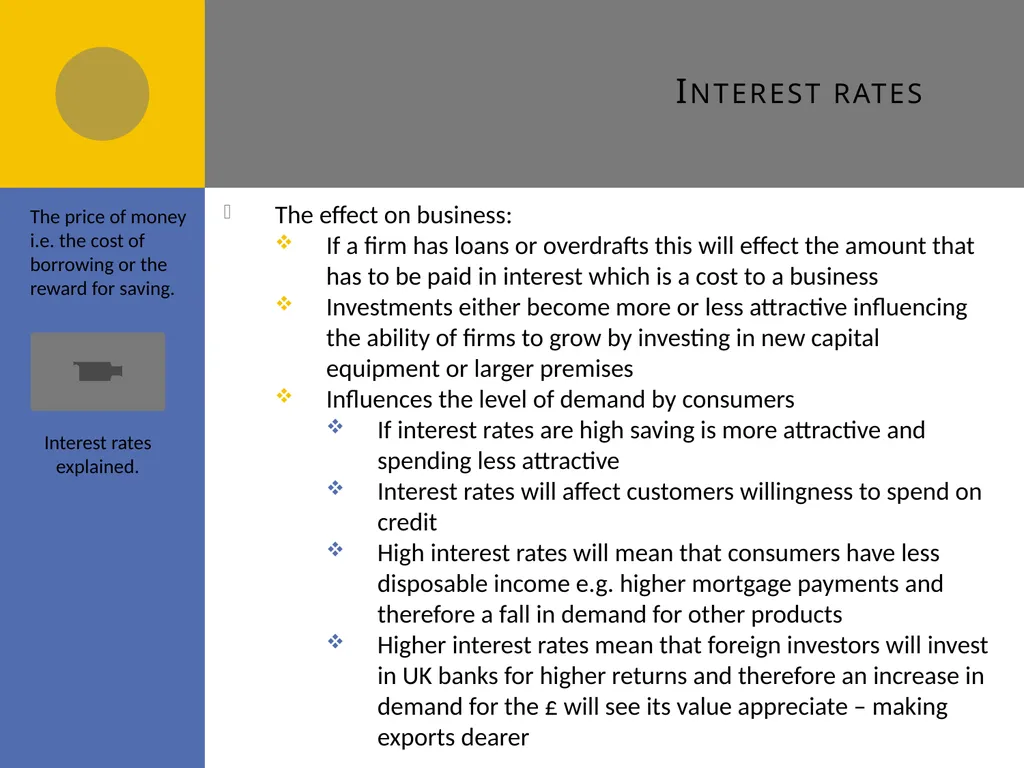
Interest rates The effect on business:
If a firm has loans or overdrafts this will effect the amount that has to be paid in interest which is a cost to a business
Investments either become more or less attractive influencing the ability of firms to grow by investing in new capital equipment or larger premises
Influences the level of demand by consumers
If interest rates are high saving is more attractive and spending less attractive
Interest rates will affect customers willingness to spend on credit
High interest rates will mean that consumers have less disposable income e.g. higher mortgage payments and therefore a fall in demand for other products
Higher interest rates mean that foreign investors will invest in UK banks for higher returns and therefore an increase in demand for the £ will see its value appreciate – making exports dearer Interest rates explained. The price of money i.e. the cost of borrowing or the reward for saving.<br>
If a firm has loans or overdrafts this will effect the amount that has to be paid in interest which is a cost to a business
Investments either become more or less attractive influencing the ability of firms to grow by investing in new capital equipment or larger premises
Influences the level of demand by consumers
If interest rates are high saving is more attractive and spending less attractive
Interest rates will affect customers willingness to spend on credit
High interest rates will mean that consumers have less disposable income e.g. higher mortgage payments and therefore a fall in demand for other products
Higher interest rates mean that foreign investors will invest in UK banks for higher returns and therefore an increase in demand for the £ will see its value appreciate – making exports dearer Interest rates explained. The price of money i.e. the cost of borrowing or the reward for saving.<br>
20
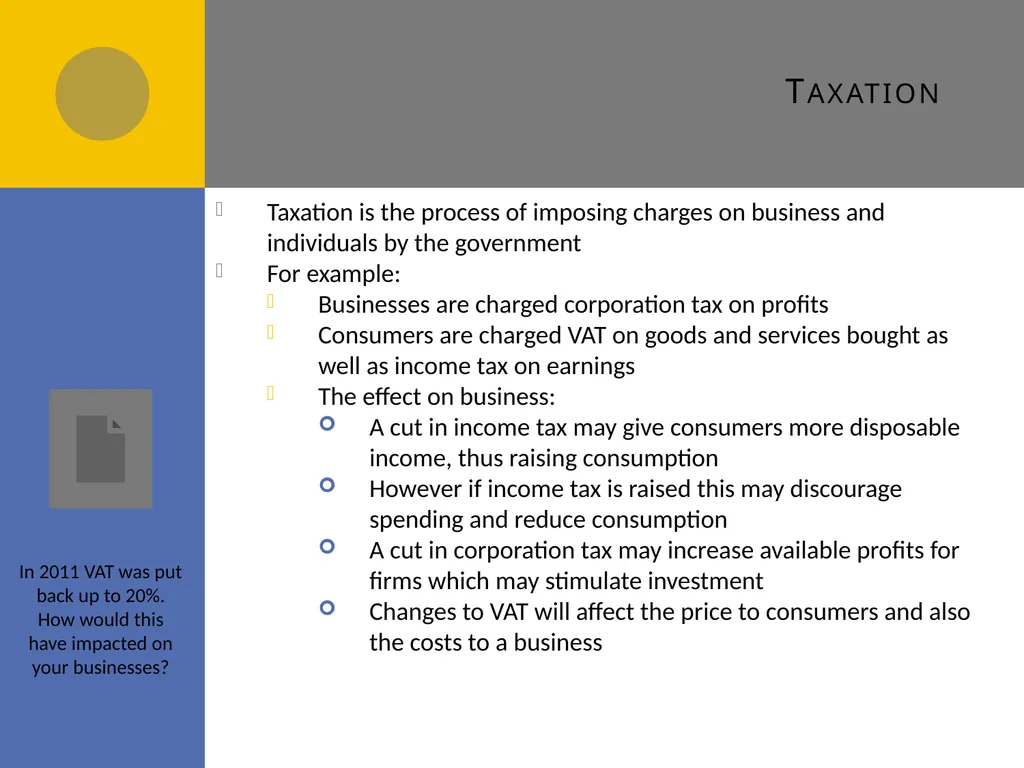
Taxation Taxation is the process of imposing charges on business and individuals by the government
For example:
Businesses are charged corporation tax on profits
Consumers are charged VAT on goods and services bought as well as income tax on earnings
The effect on business:
A cut in income tax may give consumers more disposable income, thus raising consumption
However if income tax is raised this may discourage spending and reduce consumption
A cut in corporation tax may increase available profits for firms which may stimulate investment
Changes to VAT will affect the price to consumers and also the costs to a business In 2011 VAT was put back up to 20%. How would this have impacted on your businesses?<br>
For example:
Businesses are charged corporation tax on profits
Consumers are charged VAT on goods and services bought as well as income tax on earnings
The effect on business:
A cut in income tax may give consumers more disposable income, thus raising consumption
However if income tax is raised this may discourage spending and reduce consumption
A cut in corporation tax may increase available profits for firms which may stimulate investment
Changes to VAT will affect the price to consumers and also the costs to a business In 2011 VAT was put back up to 20%. How would this have impacted on your businesses?<br>
21
Government spending The expenditure by the government on supplying goods and services to achieve economic and political objectives
The effect on business:
Budgets allocated to public sector organisations e.g. NHS, schools and armed forces will affect demand for suppliers to these organisations
Spending on infrastructure e.g. road repairs will generate employment increasing incomes and therefore general levels of demand
Benefits paid will affect levels of disposable income amongst recipients
Pay rates to public sector workers will affect levels of disposable income amongst recipients<br>
The effect on business:
Budgets allocated to public sector organisations e.g. NHS, schools and armed forces will affect demand for suppliers to these organisations
Spending on infrastructure e.g. road repairs will generate employment increasing incomes and therefore general levels of demand
Benefits paid will affect levels of disposable income amongst recipients
Pay rates to public sector workers will affect levels of disposable income amongst recipients<br>
22
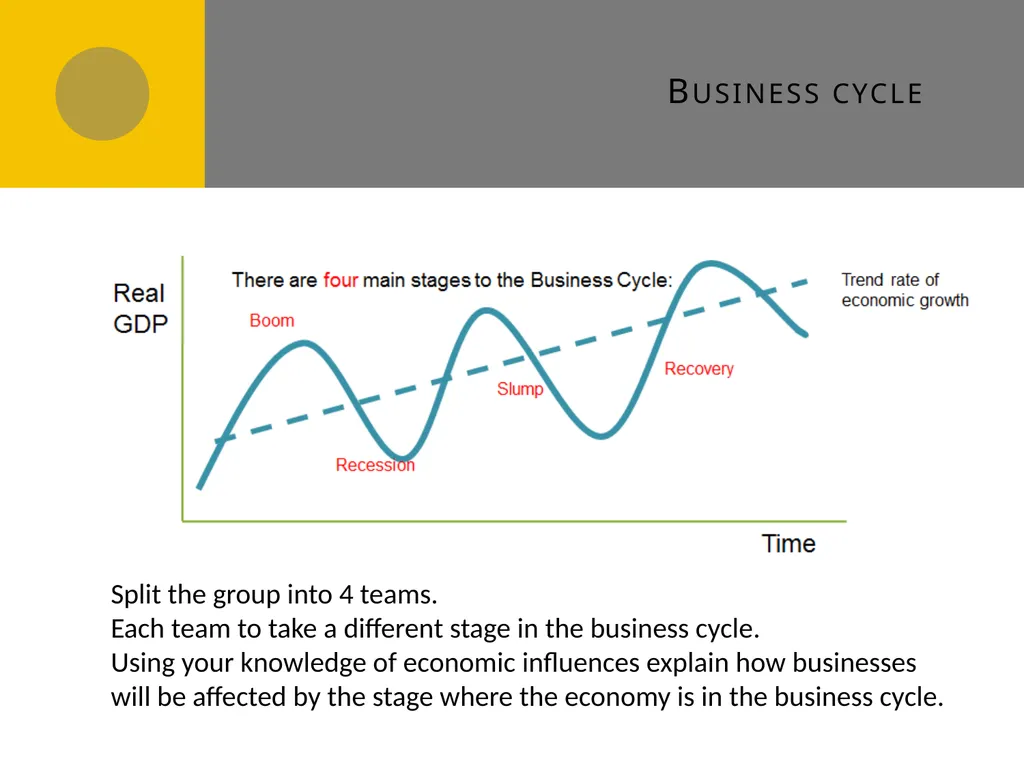
Business cycle Split the group into 4 teams.
Each team to take a different stage in the business cycle.
Using your knowledge of economic influences explain how businesses will be affected by the stage where the economy is in the business cycle.<br>
Each team to take a different stage in the business cycle.
Using your knowledge of economic influences explain how businesses will be affected by the stage where the economy is in the business cycle.<br>
23
Economic environment The economic influences are affected by government policy:
Fiscal policy is the manipulation of government spending, taxation and government borrowing to influence the level of economic activity
Monetary policy is the manipulation of the rate of interest, the money supply and exchange rates to influence the level of economic activity
Supply-side policy is the actions taken by the government to increase the productive capacity of the economy e.g. training and lower income tax<br>
Fiscal policy is the manipulation of government spending, taxation and government borrowing to influence the level of economic activity
Monetary policy is the manipulation of the rate of interest, the money supply and exchange rates to influence the level of economic activity
Supply-side policy is the actions taken by the government to increase the productive capacity of the economy e.g. training and lower income tax<br>
24
Social environment The social environment is influenced by the make up of humans within a specific area or business
This influences the behaviour of businesses and customers
Social change can occur as a result of demographic change
Demographics is the statistical study of human populations e.g. the make up of society
Demographics can include:
Gender
Age
Ethnic background
Education What are the trends in the UK population? How would you summarise the UK population and trends in just 10 bullet points?<br>
This influences the behaviour of businesses and customers
Social change can occur as a result of demographic change
Demographics is the statistical study of human populations e.g. the make up of society
Demographics can include:
Gender
Age
Ethnic background
Education What are the trends in the UK population? How would you summarise the UK population and trends in just 10 bullet points?<br>
25
Social environment Urbanisation
A general movement of people towards cities and away from rural areas
This has occurred as people move towards jobs and is being seen on a global basis
It puts pressure on infrastructure with increased traffic congestion, demand for housing and other services such as education and health
Cities have responded by redesigning housing and traffic systems e.g. encouraging more use of cycling and public transport Migration
The movement of people between countries
Net migration = relationship between migration and immigration
Increases the supply of labour as more people come into a country seeking employment
Often willing to work for the minimum wage
The EU offers free movement of labour between member states London responds to urbanisation
by becoming smart. Population growth.<br>
A general movement of people towards cities and away from rural areas
This has occurred as people move towards jobs and is being seen on a global basis
It puts pressure on infrastructure with increased traffic congestion, demand for housing and other services such as education and health
Cities have responded by redesigning housing and traffic systems e.g. encouraging more use of cycling and public transport Migration
The movement of people between countries
Net migration = relationship between migration and immigration
Increases the supply of labour as more people come into a country seeking employment
Often willing to work for the minimum wage
The EU offers free movement of labour between member states London responds to urbanisation
by becoming smart. Population growth.<br>
26
Social environment The impact of demographic changes. How a business might respond:
An increase in the global population size – an opportunity for UK businesses to move into new markets with new or existing products
An increase in the average age of UK society – businesses will have to change their product range to satisfy the needs of older people
Falling EU birth rates – as EU market size falls but the population gets richer UK businesses might move into premium product markets<br>
An increase in the global population size – an opportunity for UK businesses to move into new markets with new or existing products
An increase in the average age of UK society – businesses will have to change their product range to satisfy the needs of older people
Falling EU birth rates – as EU market size falls but the population gets richer UK businesses might move into premium product markets<br>
27
Other social factors Changing consumer tastes
Wider range of experiences as a result of living in a more culturally diverse country
Greater access to information affecting attitudes to ingredients in foods
More informed decisions leading to more consumers following diets that are vegetarian, vegan, gluten free etc.
Lifestyles
Health care has also been transformed with people living longer and healthier lives
Health and fitness and healthy eating have led to increased demand for related businesses such as gyms and health foods
This has led to a whole industry developing around health
This has allowed for highly differentiated niche markets with specialist businesses developing new products e.g. protein products for bodybuilding or accessories for cyclists
Other lifestyle changes such as smaller families, more couples not having children, single parent families, working mothers etc all affect the types of products that are demanded Extending life. Changing consumer tastes hurt McDonald’s and Coca-Cola.<br>
Wider range of experiences as a result of living in a more culturally diverse country
Greater access to information affecting attitudes to ingredients in foods
More informed decisions leading to more consumers following diets that are vegetarian, vegan, gluten free etc.
Lifestyles
Health care has also been transformed with people living longer and healthier lives
Health and fitness and healthy eating have led to increased demand for related businesses such as gyms and health foods
This has led to a whole industry developing around health
This has allowed for highly differentiated niche markets with specialist businesses developing new products e.g. protein products for bodybuilding or accessories for cyclists
Other lifestyle changes such as smaller families, more couples not having children, single parent families, working mothers etc all affect the types of products that are demanded Extending life. Changing consumer tastes hurt McDonald’s and Coca-Cola.<br>
28
Social environment Social attitudes to saving, spending and debt
What are your attitudes?
If you were given £10 what would you do with it?
What about if it was £5 000?
Are you willing to wait to buy what you want or would you go into debt to have it now?
Are your attitudes the same as your parents’ generation?
What about your grandparents’ generation? What factors have influenced Britons changing attitude to saving?
How will this impact on your businesses?<br>
What are your attitudes?
If you were given £10 what would you do with it?
What about if it was £5 000?
Are you willing to wait to buy what you want or would you go into debt to have it now?
Are your attitudes the same as your parents’ generation?
What about your grandparents’ generation? What factors have influenced Britons changing attitude to saving?
How will this impact on your businesses?<br>
29
Technological change Technological change describes the ongoing development of invention, innovation and sharing of technology or processes.
It is the diffusion or spreading of technological change through society that impacts upon business behaviour
Technological changes include:
Intranet and internet
Social media
CAD/CAM and robotics
Handheld computers
Software packages e.g. DTP, spreadsheets and databases
Online businesses
Integrated software packages
Big data and data mining Banks turning to voice recognition.<br>
It is the diffusion or spreading of technological change through society that impacts upon business behaviour
Technological changes include:
Intranet and internet
Social media
CAD/CAM and robotics
Handheld computers
Software packages e.g. DTP, spreadsheets and databases
Online businesses
Integrated software packages
Big data and data mining Banks turning to voice recognition.<br>
30
Automation Automation
The use of machines to control a process e.g. stock control, production line, warehousing and distribution
Stock control
More accurate predictions of stock usage through statistical analysis
Automatic control of stock levels and reordering
Assess data on stock levels and geographical location
Retailers use EPOS (Electronic Point of Sale) technology
barcodes
scanners
databases Inside a robot-run warehouse.<br>
The use of machines to control a process e.g. stock control, production line, warehousing and distribution
Stock control
More accurate predictions of stock usage through statistical analysis
Automatic control of stock levels and reordering
Assess data on stock levels and geographical location
Retailers use EPOS (Electronic Point of Sale) technology
barcodes
scanners
databases Inside a robot-run warehouse.<br>
31
Communication Internal
Interdepartmental
Operations management could e-mail HR about staffing requirements
Managing supplier relationships, if for example stock is not delivered it may be because of the business being over their credit limit
Order processing
Waiters use hand held devices to transfer orders to the kitchen
Quality data
Telling production workers about the number of defects External
Working with suppliers
Using EDI (Electronic Data Interchange) to process orders
Automatic reordering from a stock control system
Sourcing supplies
Growth of the internet to find new suppliers
Tracking of supply chain
Informs customers of the progress of their order CEO Secrets: Reddit boss shares three tips for success.<br>
Interdepartmental
Operations management could e-mail HR about staffing requirements
Managing supplier relationships, if for example stock is not delivered it may be because of the business being over their credit limit
Order processing
Waiters use hand held devices to transfer orders to the kitchen
Quality data
Telling production workers about the number of defects External
Working with suppliers
Using EDI (Electronic Data Interchange) to process orders
Automatic reordering from a stock control system
Sourcing supplies
Growth of the internet to find new suppliers
Tracking of supply chain
Informs customers of the progress of their order CEO Secrets: Reddit boss shares three tips for success.<br>
32
Technological change Technology is impacting heavily with social media and developments in technological products transforming lives
This has created big data for businesses, allowing them to analyse the buying habits of consumers
Businesses have adapted their marketing to reflect changes in consumer lifestyle and buying behaviour. This includes:
Viral marketing
Use of social media to encourage the spread of promotional activities and increase brand awareness
Use of blogs and online forums
Social media
The use of virtual communities to communicate with actual and potential customers
Emotional branding
Building a brand that will directly tap in to the consumers’ feelings, personal psychological needs and aspirations e.g. presents a feeling of belonging or success
A brand sells a status or a life style choice How many of you own an iPhone? Why?<br>
This has created big data for businesses, allowing them to analyse the buying habits of consumers
Businesses have adapted their marketing to reflect changes in consumer lifestyle and buying behaviour. This includes:
Viral marketing
Use of social media to encourage the spread of promotional activities and increase brand awareness
Use of blogs and online forums
Social media
The use of virtual communities to communicate with actual and potential customers
Emotional branding
Building a brand that will directly tap in to the consumers’ feelings, personal psychological needs and aspirations e.g. presents a feeling of belonging or success
A brand sells a status or a life style choice How many of you own an iPhone? Why?<br>
33
Technological change E-commerce involves digitally enabled commercial transactions between and among organisations and individuals
This has been a key area of growth for a number of businesses such as those in the supermarket industry, Spotify and Apple in the streaming music industry, Uber in the taxi industry and Amazon
Online access has transformed a range of markets, helping to cut costs and provide an enormous range of products
It has also empowered consumers, providing information symmetry and greater buying power as consumers can shop around What is e-commerce? Amazon.<br>
This has been a key area of growth for a number of businesses such as those in the supermarket industry, Spotify and Apple in the streaming music industry, Uber in the taxi industry and Amazon
Online access has transformed a range of markets, helping to cut costs and provide an enormous range of products
It has also empowered consumers, providing information symmetry and greater buying power as consumers can shop around What is e-commerce? Amazon.<br>
34
Environmental factors Environmental costs of business activity include:
Air, water and noise pollution
Contamination making the environment unsafe or unsuitable
Climate change
A change in global weather patterns over a prolonged period of time
A result of carbon dioxide emissions into the environment
Congestion
Blockages in traffic flow as a result of overcrowding
Destruction of the environment
Long term damage done to the natural environment e.g. deforestation
Waste disposal
The ways in which businesses discard unwanted materials generated from business activity Divide the class into 5 groups. Each group should take one of these environmental costs and prepare a short presentation to give more detail on how businesses damage the environment.<br>
Air, water and noise pollution
Contamination making the environment unsafe or unsuitable
Climate change
A change in global weather patterns over a prolonged period of time
A result of carbon dioxide emissions into the environment
Congestion
Blockages in traffic flow as a result of overcrowding
Destruction of the environment
Long term damage done to the natural environment e.g. deforestation
Waste disposal
The ways in which businesses discard unwanted materials generated from business activity Divide the class into 5 groups. Each group should take one of these environmental costs and prepare a short presentation to give more detail on how businesses damage the environment.<br>
35
Environmental factors Legislation designed to influence the behaviour of individuals and businesses in order to reduce the negative impacts on the natural environment
Limits to emission levels to sea, rivers and air
Guidelines, limits and bans on waste disposal
Quotas on use of finite resources e.g. fishing quotas
Government can inspect businesses and impose fines on those failing to comply
Compliance can often increase costs to a business Plastic bags: Should the Government have intervened?<br>
Limits to emission levels to sea, rivers and air
Guidelines, limits and bans on waste disposal
Quotas on use of finite resources e.g. fishing quotas
Government can inspect businesses and impose fines on those failing to comply
Compliance can often increase costs to a business Plastic bags: Should the Government have intervened?<br>
36
Environmental factors These laws help to ensure that businesses do not have a negative impact on the environment
Environmental Protection Act
Businesses must improve the control of pollution arising from industrial and other processes
Environment Act
A business must clean up any contaminated sites that it owns
The Act also established the Environment Agency in order to oversee environmental protection<br>
Environmental Protection Act
Businesses must improve the control of pollution arising from industrial and other processes
Environment Act
A business must clean up any contaminated sites that it owns
The Act also established the Environment Agency in order to oversee environmental protection<br>
37
How businesses respond How businesses can respond to environmental factors:
New environmentally friendly production
New products that meet higher environmental standards
Greater use of recycling
Green audits, objectives and policies
Innovative processes to reduce environmental harm
Less packaging
Local sourcing Is it possible to make a profit whilst making a difference? Have your businesses taken actions to reduce the negative impact they have on the environment? Summarise the actions taken.
Why is this also good marketing?<br>
New environmentally friendly production
New products that meet higher environmental standards
Greater use of recycling
Green audits, objectives and policies
Innovative processes to reduce environmental harm
Less packaging
Local sourcing Is it possible to make a profit whilst making a difference? Have your businesses taken actions to reduce the negative impact they have on the environment? Summarise the actions taken.
Why is this also good marketing?<br>
38
Environmentally friendly policies Positive media/public relations
Brand loyalty
Unique selling point
Employee engagement
Avoid fines and negative PR
May cost more in the short term but lead to cost savings in the long term<br>
Brand loyalty
Unique selling point
Employee engagement
Avoid fines and negative PR
May cost more in the short term but lead to cost savings in the long term<br>
39
Ethics Business ethics looks at morality in decision-making
This infers doing what is ‘right’
Peoples’ views can differ on what is right or wrong
Ethics in strategic decisions include:
Location decisions
Ability to exploit workers
Impact on the environment
Mergers, takeovers and retrenchment
Impact on workers
Ability to exploit customers or control suppliers
Transparency of deals
Corruption
Dealing with authorities
Power over suppliers or customers
Working with suppliers
Ethical sourcing e.g. Fairtrade
Fair payment terms Does ethics relate to tactical decisions e.g. advertising?<br>
This infers doing what is ‘right’
Peoples’ views can differ on what is right or wrong
Ethics in strategic decisions include:
Location decisions
Ability to exploit workers
Impact on the environment
Mergers, takeovers and retrenchment
Impact on workers
Ability to exploit customers or control suppliers
Transparency of deals
Corruption
Dealing with authorities
Power over suppliers or customers
Working with suppliers
Ethical sourcing e.g. Fairtrade
Fair payment terms Does ethics relate to tactical decisions e.g. advertising?<br>
40
Ethical factors Environmental
Responsibility to the planet
Air, water and noise pollution
Longer term impact s e.g. global warming, non-renewable resources
Animal rights
Not testing on animals
Animal welfare e.g. free range chickens The waste mountain of coffee cups.<br>
Responsibility to the planet
Air, water and noise pollution
Longer term impact s e.g. global warming, non-renewable resources
Animal rights
Not testing on animals
Animal welfare e.g. free range chickens The waste mountain of coffee cups.<br>
41
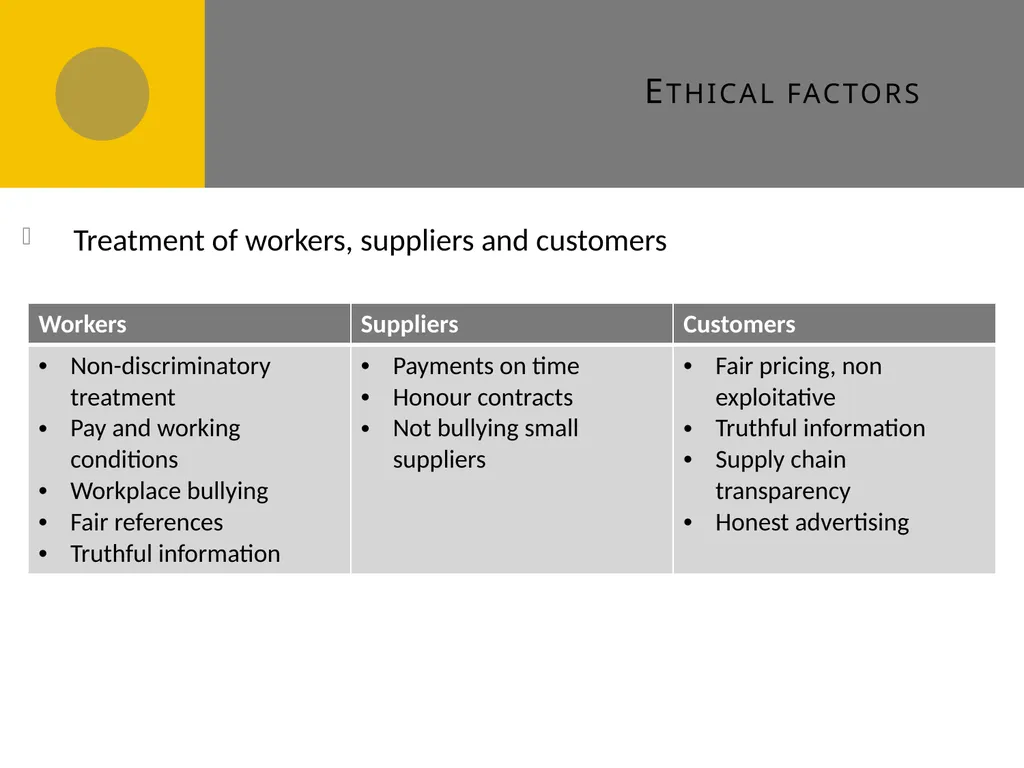
Ethical factors Treatment of workers, suppliers and customers<br>
42
Legal environment Legislation involves creating and enacting laws in order to protect individuals, businesses and society as a whole
The legal environment describes the collection of legislation that impact on the activities of organisations
Laws are passed through UK Acts of Parliament
The UK is subject to EU laws but this is likely to gradually change after leaving the European Union Should Sunday trading hours be dictated by the Law?<br>
The legal environment describes the collection of legislation that impact on the activities of organisations
Laws are passed through UK Acts of Parliament
The UK is subject to EU laws but this is likely to gradually change after leaving the European Union Should Sunday trading hours be dictated by the Law?<br>
43
Legal environment Competition law looks to promote fair competition in markets and stop the abuse of consumers by businesses due to monopoly power. This means that anticompetitive practices such as price fixing between businesses are illegal.
Mergers and takeovers are monitored and will not be allowed if it is deemed that they significantly reduce competition.
Markets that are not competitive will be investigated with a view to increasing competition.
Firms are not allowed:
to agree prices with competitors
to limit production in order to reduce competition
partition markets or customers between each other e.g. geographically where each firm takes a different region to avoid competition
Despite the UK voting to leave the EU in June 2016 it is likely that we will still have to abide by a majority of these laws in order to carry on trading with EU countries.<br>
Mergers and takeovers are monitored and will not be allowed if it is deemed that they significantly reduce competition.
Markets that are not competitive will be investigated with a view to increasing competition.
Firms are not allowed:
to agree prices with competitors
to limit production in order to reduce competition
partition markets or customers between each other e.g. geographically where each firm takes a different region to avoid competition
Despite the UK voting to leave the EU in June 2016 it is likely that we will still have to abide by a majority of these laws in order to carry on trading with EU countries.<br>
44
Legal environment Areas of legislation affecting businesses include:
Ability of businesses to issue free carrier bags
Display of cigarettes
Living wage
Trading hours
Labelling and packaging
Advertising Should there be a sugar tax and ban on offers?<br>
Ability of businesses to issue free carrier bags
Display of cigarettes
Living wage
Trading hours
Labelling and packaging
Advertising Should there be a sugar tax and ban on offers?<br>
45
Legal environment – research activity Are your chosen businesses either a partnership, a charity or a company?
As appropriate research:
Partnership Act
Company Act
Charities Act
What industries are your businesses in?
Are there any regulators?
Identify at least one other area of legislation that affects your businesses<br>
As appropriate research:
Partnership Act
Company Act
Charities Act
What industries are your businesses in?
Are there any regulators?
Identify at least one other area of legislation that affects your businesses<br>
46
In this topic you have learnt about
Political, e.g. government support, membership of trading communities such as the European Union
Economic, fiscal, monetary and other government policies e.g. supply side policy, economic growth, exchange rates
Social attitudes to saving, spending and debt; social responsibility requirements; change e.g. to demographic trends, consumers’ tastes/preferences
Technological change, e.g. Automation; improved communications
Environmental factors and ethical trends, e.g. carbon emissions, waste, recycling, pollution
Legal environment, e.g. Partnership Act 1890, Companies Act 2006, Charities Act 2011, Competition Act 1998, UK Corporate Governance Code, financial services regulation, industry regulators, government departments External Environment<br>
Political, e.g. government support, membership of trading communities such as the European Union
Economic, fiscal, monetary and other government policies e.g. supply side policy, economic growth, exchange rates
Social attitudes to saving, spending and debt; social responsibility requirements; change e.g. to demographic trends, consumers’ tastes/preferences
Technological change, e.g. Automation; improved communications
Environmental factors and ethical trends, e.g. carbon emissions, waste, recycling, pollution
Legal environment, e.g. Partnership Act 1890, Companies Act 2006, Charities Act 2011, Competition Act 1998, UK Corporate Governance Code, financial services regulation, industry regulators, government departments External Environment<br>