
Far North Queensland Region EXPLICIT INSTRUCTION
YM
Published · 30 slides · 0 views
1 / 1
Description
Far North Queensland Region EXPLICIT INSTRUCTION (TEACHING) Far North Queensland Region EXPLICIT INSTRUCTION (TEACHING) Definition Elements of Explicit Instruction Functions of Explicit Instruction Principles of Explicit Instruction Drill
Related Topics
Share
Embed code
Download this presentation From Below
"Far North Queensland Region EXPLICIT INSTRUCTION" is the property of its rightful owner. Permission is granted to download and print the materials on this website for personal, non-commercial use only, and to display it on your personal computer provided you do not modify the materials and that you retain all copyright notices contained in the materials. By downloading content from our website, you accept the terms of this agreement.
Presentation Transcript
01
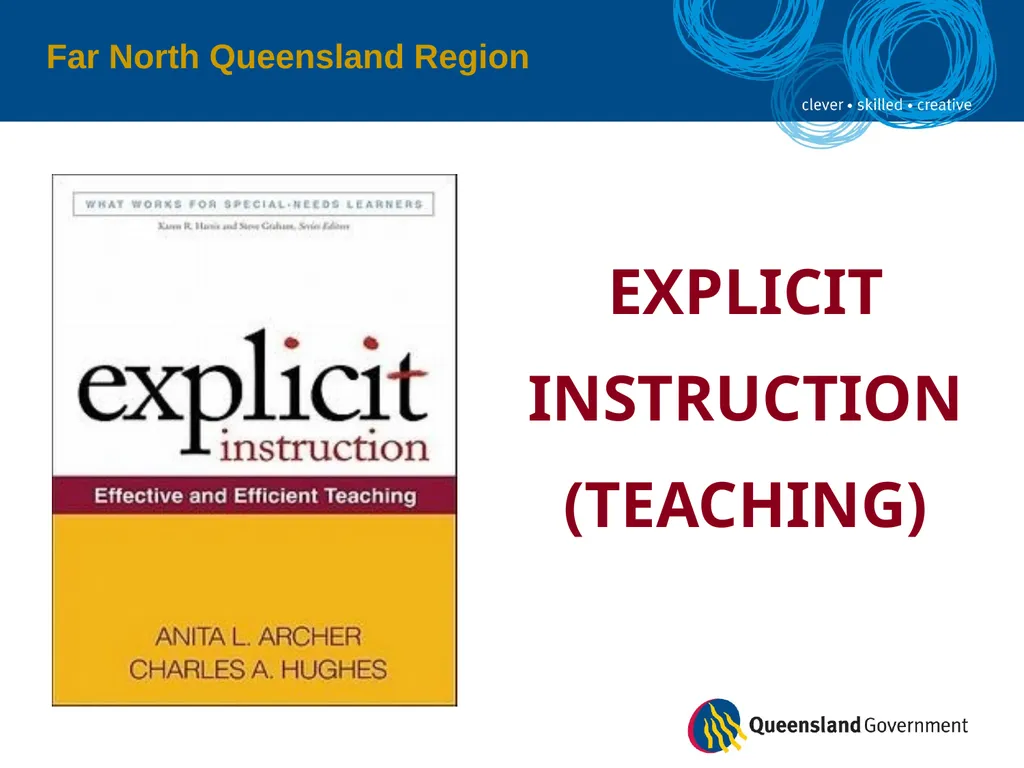
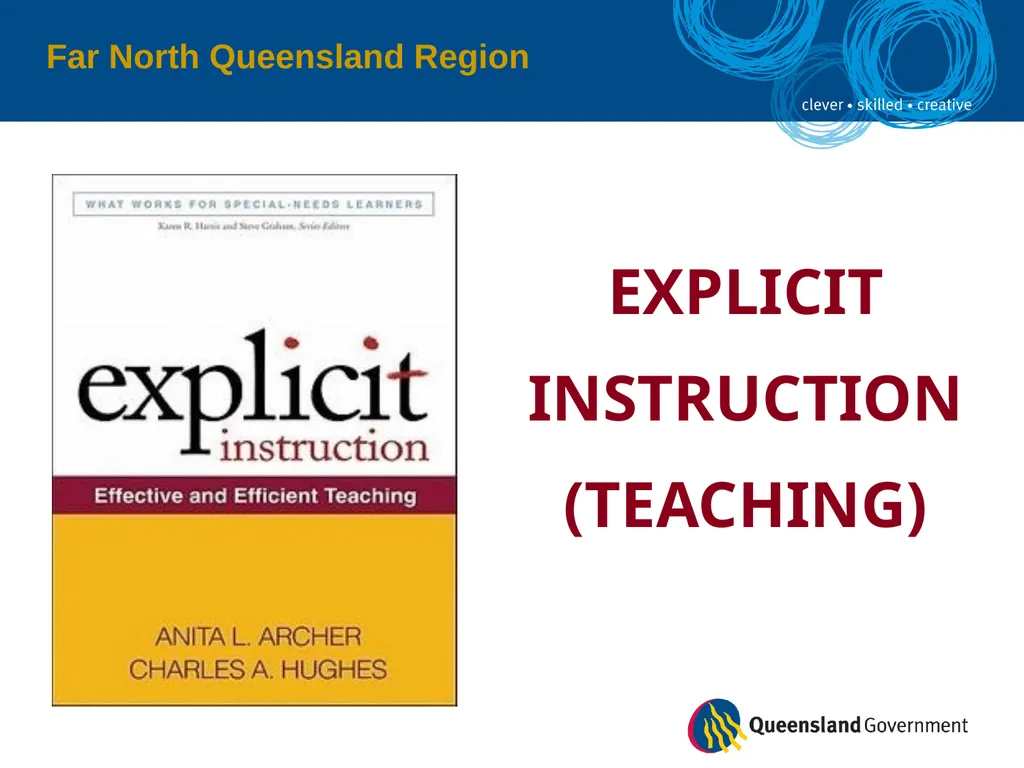
Far North Queensland Region EXPLICIT
INSTRUCTION
(TEACHING)<br>
INSTRUCTION
(TEACHING)<br>
02
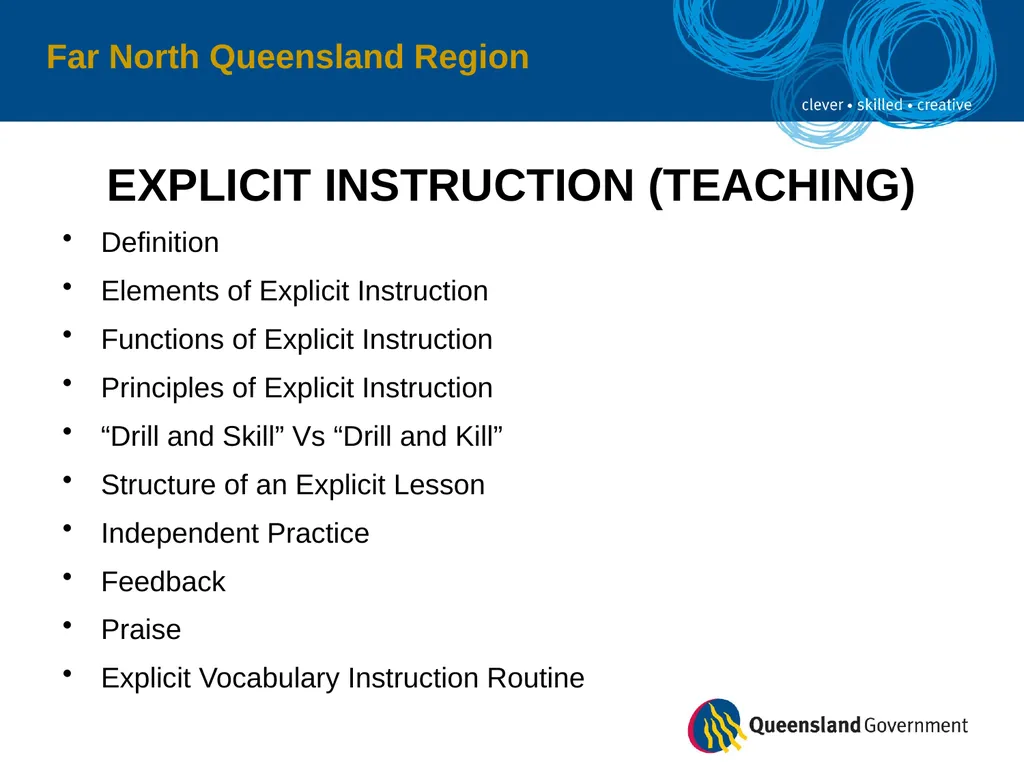
Far North Queensland Region EXPLICIT INSTRUCTION (TEACHING)
Definition
Elements of Explicit Instruction
Functions of Explicit Instruction
Principles of Explicit Instruction
“Drill and Skill” Vs “Drill and Kill”
Structure of an Explicit Lesson
Independent Practice
Feedback
Praise
Explicit Vocabulary Instruction Routine<br>
Definition
Elements of Explicit Instruction
Functions of Explicit Instruction
Principles of Explicit Instruction
“Drill and Skill” Vs “Drill and Kill”
Structure of an Explicit Lesson
Independent Practice
Feedback
Praise
Explicit Vocabulary Instruction Routine<br>
03
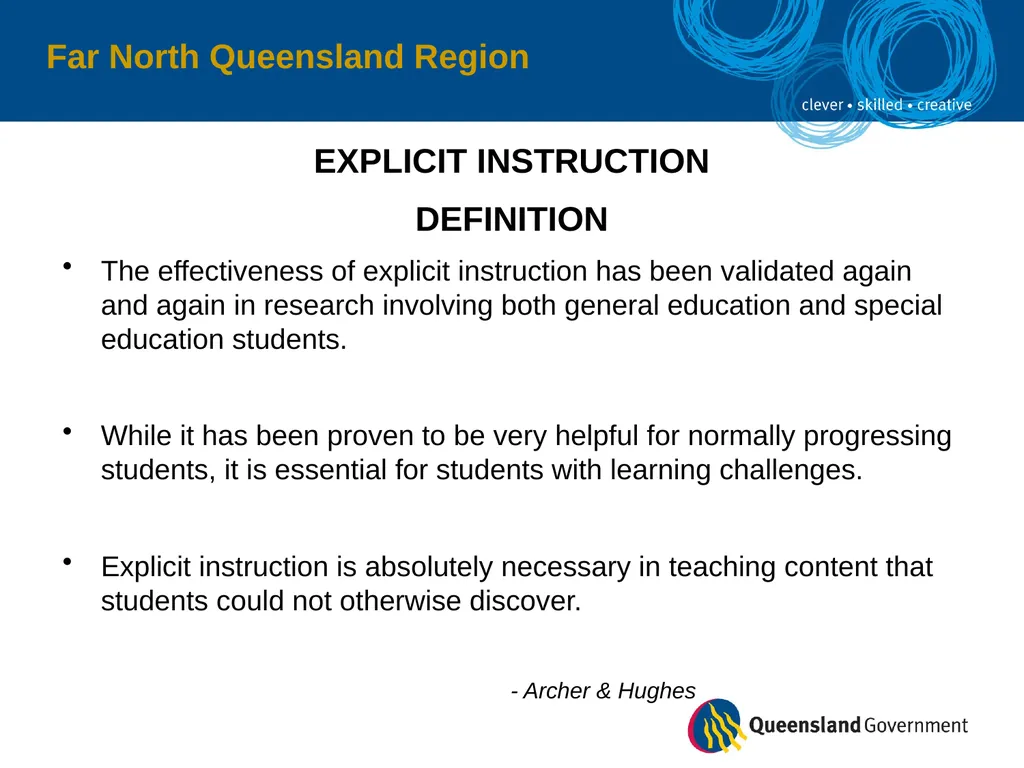
Far North Queensland Region EXPLICIT INSTRUCTION
DEFINITION
The effectiveness of explicit instruction has been validated again and again in research involving both general education and special education students.
While it has been proven to be very helpful for normally progressing students, it is essential for students with learning challenges.
Explicit instruction is absolutely necessary in teaching content that students could not otherwise discover.
- Archer & Hughes<br>
04
Far North Queensland Region EXPLICIT INSTRUCTION
REMOVING THE MYSTERY
Explicit instruction is characterised by a series of clear statements about the purpose and rationale for learning the new skill, clear explanations, and demonstrations of instructional target and supported practice with feedback until independent mastery has been achieved.
- Archer & Hughes<br>
05
Far North Queensland Region ELEMENTS OF EXPLICIT INSTRUCTION (1- 8)
Focus instruction on critical content.
Sequence skills logically.
Break down complex skills.
Design organised and focused lessons.
Begin lessons with a clear statement of the lesson’s goals and your expectations.
Review prior skills and knowledge before beginning instruction.
Provide step-by-step demonstrations.
Use clear concise language.
Ref Page 2<br>
06
Far North Queensland Region ELEMENTS OF EXPLICIT INSTRUCTION (9-16)
Provide an adequate range of examples and non-examples.
Provide guided and supported practice.
Require frequent responses.
Monitor student performance closely.
Provide immediate affirmation and corrective feedback.
Deliver the lessons at a brisk pace.
Help students organise knowledge.
Provide distributed and cumulative practice.
Ref Page 2<br>
07
Far North Queensland Region EXPLICIT INSTRUCTION SIX TEACHING FUNCTIONS
Review
a. Review homework and relevant previous learning.
b. Review prerequisite skills and knowledge.
Presentation
a. State lesson goals.
b. Present new material in small steps
c. Model procedures.
d. Provide examples and non-examples.
e. Use clear language.
f. Avoid digressions.
Guided practice
a. Require high frequency of responses
b. Ensure high rates of success.
c. Provide timely feedback, clues and prompts.
d. Have students continue practice until they are fluent.
Corrections and feedback
a. Reteach when necessary.
Independent practice
a. Monitor initial practice attempts.
b. Have students continue practice until skills are automatic.
Weekly and monthly reviews Ref Page 4<br>
08
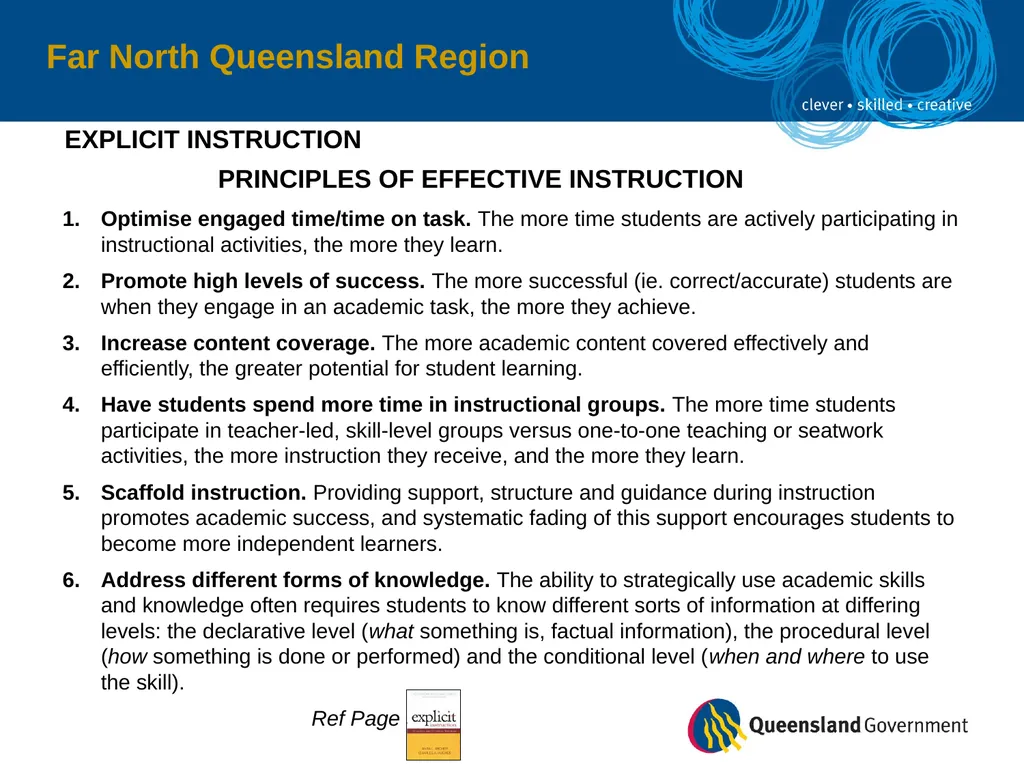
Far North Queensland Region EXPLICIT INSTRUCTION PRINCIPLES OF EFFECTIVE INSTRUCTION
Optimise engaged time/time on task. The more time students are actively participating in instructional activities, the more they learn.
Promote high levels of success. The more successful (ie. correct/accurate) students are when they engage in an academic task, the more they achieve.
Increase content coverage. The more academic content covered effectively and efficiently, the greater potential for student learning.
Have students spend more time in instructional groups. The more time students participate in teacher-led, skill-level groups versus one-to-one teaching or seatwork activities, the more instruction they receive, and the more they learn.
Scaffold instruction. Providing support, structure and guidance during instruction promotes academic success, and systematic fading of this support encourages students to become more independent learners.
Address different forms of knowledge. The ability to strategically use academic skills and knowledge often requires students to know different sorts of information at differing levels: the declarative level (what something is, factual information), the procedural level (how something is done or performed) and the conditional level (when and where to use the skill).
Ref Page 5<br>
09
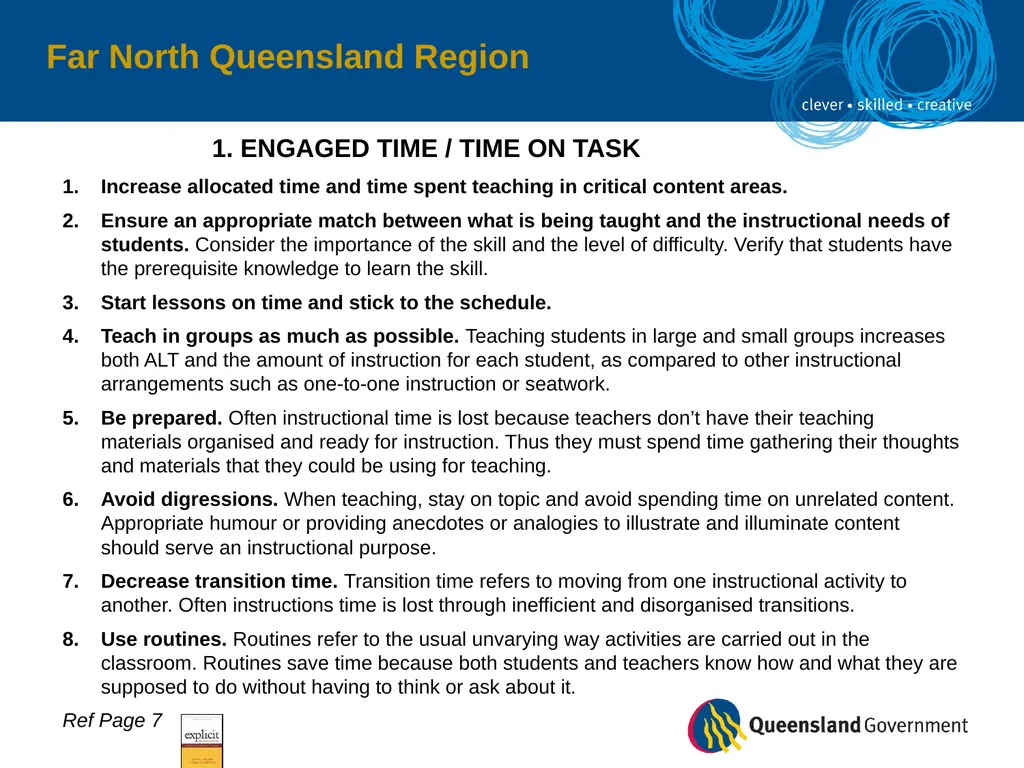
Far North Queensland Region 1. ENGAGED TIME / TIME ON TASK
Increase allocated time and time spent teaching in critical content areas.
Ensure an appropriate match between what is being taught and the instructional needs of students. Consider the importance of the skill and the level of difficulty. Verify that students have the prerequisite knowledge to learn the skill.
Start lessons on time and stick to the schedule.
Teach in groups as much as possible. Teaching students in large and small groups increases both ALT and the amount of instruction for each student, as compared to other instructional arrangements such as one-to-one instruction or seatwork.
Be prepared. Often instructional time is lost because teachers don’t have their teaching materials organised and ready for instruction. Thus they must spend time gathering their thoughts and materials that they could be using for teaching.
Avoid digressions. When teaching, stay on topic and avoid spending time on unrelated content. Appropriate humour or providing anecdotes or analogies to illustrate and illuminate content should serve an instructional purpose.
Decrease transition time. Transition time refers to moving from one instructional activity to another. Often instructions time is lost through inefficient and disorganised transitions.
Use routines. Routines refer to the usual unvarying way activities are carried out in the classroom. Routines save time because both students and teachers know how and what they are supposed to do without having to think or ask about it.
Ref Page 7<br>
10
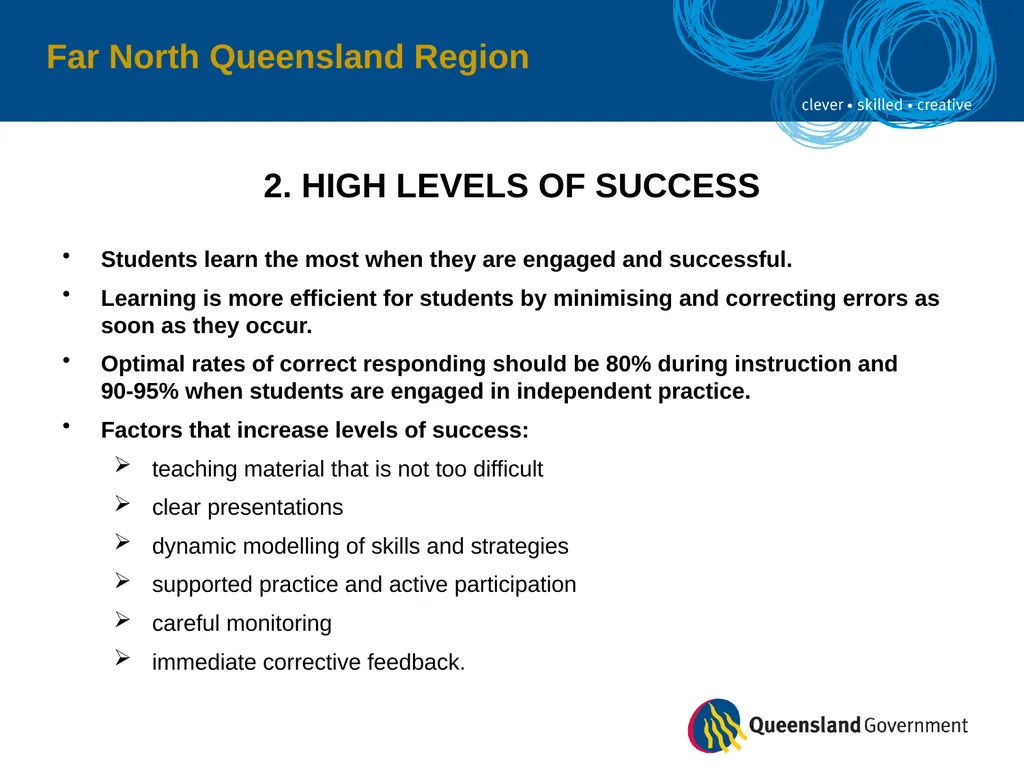
Far North Queensland Region 2. HIGH LEVELS OF SUCCESS
Students learn the most when they are engaged and successful.
Learning is more efficient for students by minimising and correcting errors as soon as they occur.
Optimal rates of correct responding should be 80% during instruction and 90-95% when students are engaged in independent practice.
Factors that increase levels of success:
teaching material that is not too difficult
clear presentations
dynamic modelling of skills and strategies
supported practice and active participation
careful monitoring
immediate corrective feedback.<br>
11
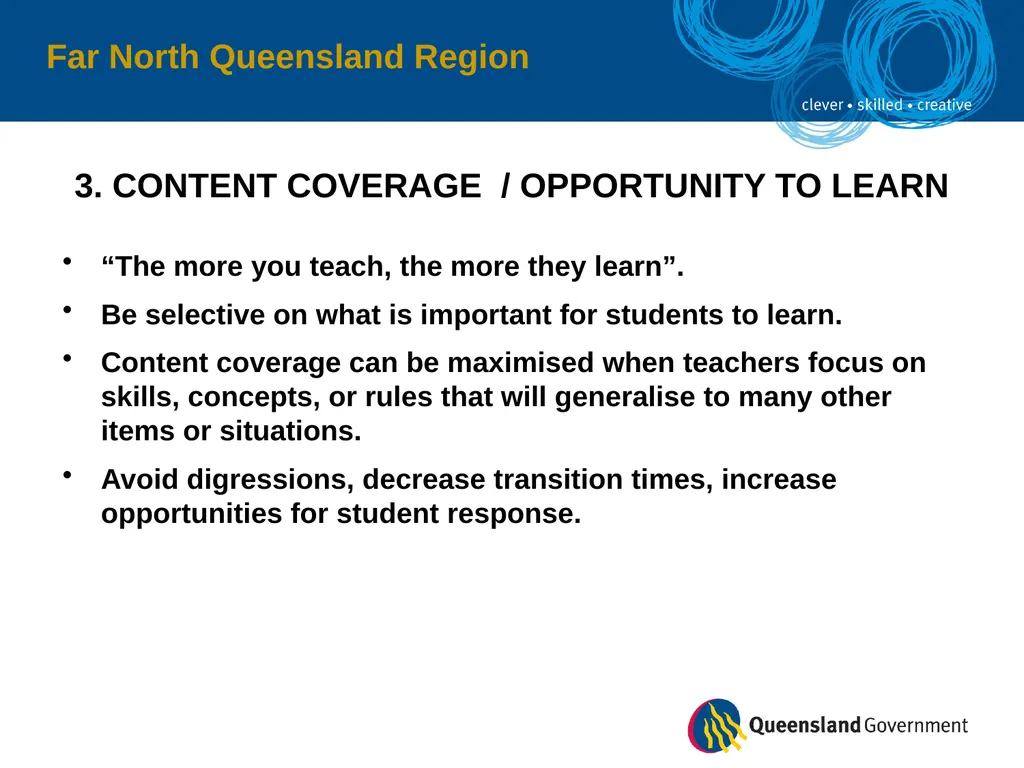
Far North Queensland Region 3. CONTENT COVERAGE / OPPORTUNITY TO LEARN
“The more you teach, the more they learn”.
Be selective on what is important for students to learn.
Content coverage can be maximised when teachers focus on skills, concepts, or rules that will generalise to many other items or situations.
Avoid digressions, decrease transition times, increase opportunities for student response.<br>
12
Far North Queensland Region 4. GROUPING FOR INSTRUCTION
Teacher-led group instruction has the most positive impact on achievement because of clear explanations, modelling, practice, feedback and frequent responding.
Small-group instruction is often more effective in targeting student needs.
Instructional groups of 6-8 are generally more effective than smaller or larger groups or one-to-one instruction.
Grouping by academic skill levels allows students to learn the skills most appropriate to them, thus increasing success.<br>
13
Far North Queensland Region 5. SCAFFOLDING INSTRUCTION
Through deliberate, careful and temporary scaffolding, students learn new basic skills as well as more complex skills, maintain a high level of success as they do so, and systematically move towards independent use of the skill.
Elements of scaffolding instruction:
Taking a complex skill (eg. a multistep strategy) and teaching it in manageable and logical pieces or chunks.
Sequencing skills so that they build on each other.
Selecting examples and problems that progress in complexity.
Providing demonstrations and completed models of problems.
Providing hints and prompts as students begin to practise a new skill.
Providing aids such as cur cards and checklists to help students remember the steps and processes used to complete tasks and solve problems.
Ref Page 11<br>
14
Far North Queensland Region 6. ADDRESSING DIFFERENT FORMS OF KNOWLEDGE
Provide instruction that targets different levels or forms of knowledge.
Declarative Knowledge – factual (what)
eg. number facts
Procedural Knowledge – how
eg. two digit multiplication
Conditional Knowledge – when and when not to apply
eg. problem solving<br>
Provide instruction that targets different levels or forms of knowledge.
Declarative Knowledge – factual (what)
eg. number facts
Procedural Knowledge – how
eg. two digit multiplication
Conditional Knowledge – when and when not to apply
eg. problem solving<br>
15
Far North Queensland Region “DRILL AND THRILL” Vs “DRILL AND KILL”
Routine practice is an extremely powerful tool that helps students learn and retain basic skills and facts in a fluent fashion.
Teaching for automaticity
Rote learning – repetition (chanting, jingles etc)
Flashcards
Interactive Whiteboards
Games
Choral Responses – teacher, stimulus, worksheet.
“Development of basic knowledge and skills to the necessary levels of automatic and errorless performance requires a great deal of drill and practice… Drill and practice activities should not be slighted as “low level”. Carried out properly, they appear to be just as essential to complex and creative intellectual performance as they are to the performance of a virtuoso violinist.”
- Brophy, 1986<br>
16
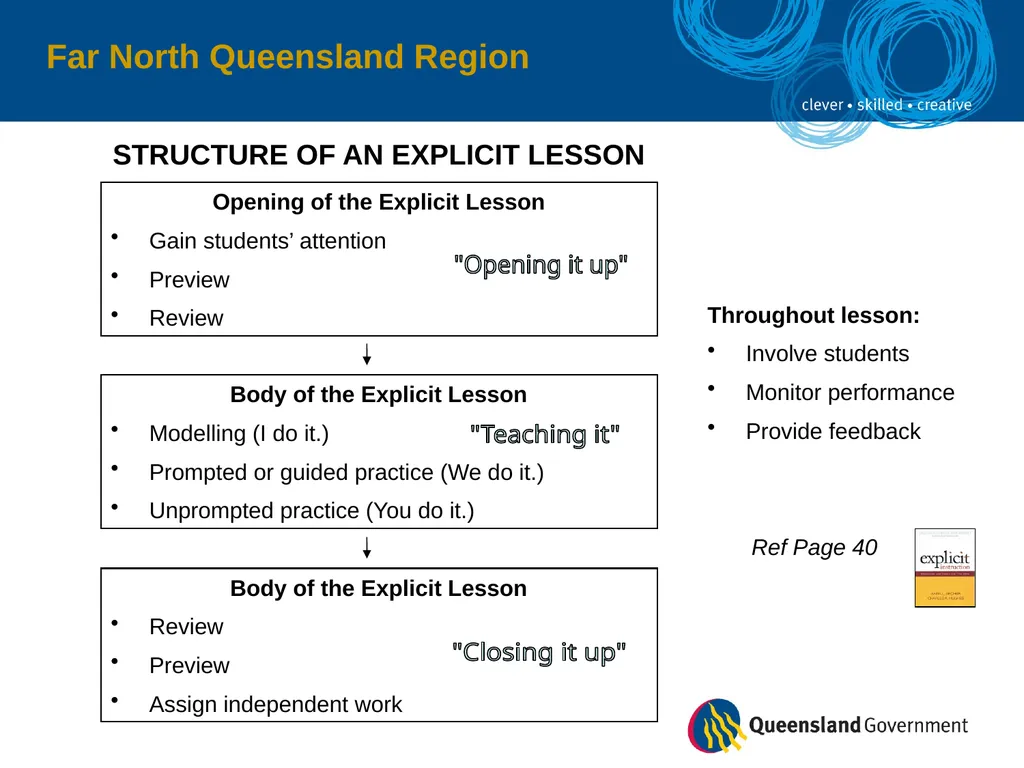
Far North Queensland Region STRUCTURE OF AN EXPLICIT LESSON Body of the Explicit Lesson
Review
Preview
Assign independent work "Closing it up" Throughout lesson:
Involve students
Monitor performance
Provide feedback
Ref Page 40<br>
Review
Preview
Assign independent work "Closing it up" Throughout lesson:
Involve students
Monitor performance
Provide feedback
Ref Page 40<br>
17
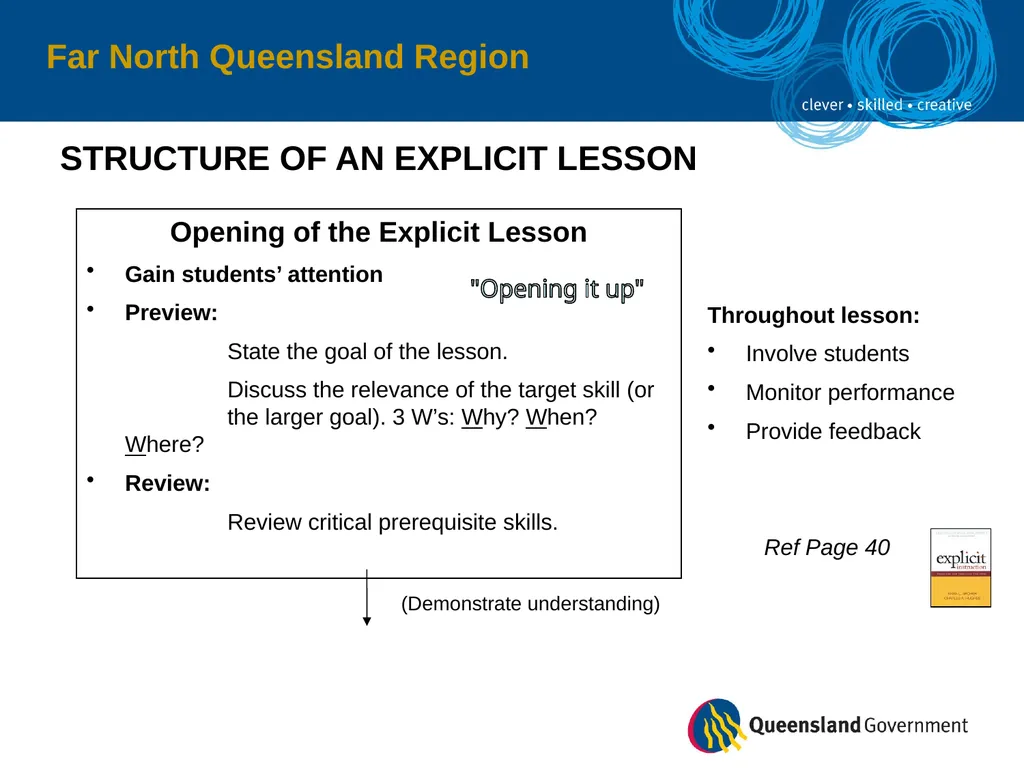
Far North Queensland Region STRUCTURE OF AN EXPLICIT LESSON Opening of the Explicit Lesson
Gain students’ attention
Preview:
State the goal of the lesson.
Discuss the relevance of the target skill (or the larger goal). 3 W’s: Why? When? Where?
Review:
Review critical prerequisite skills. "Opening it up" Throughout lesson:
Involve students
Monitor performance
Provide feedback
Ref Page 40 (Demonstrate understanding)<br>
18
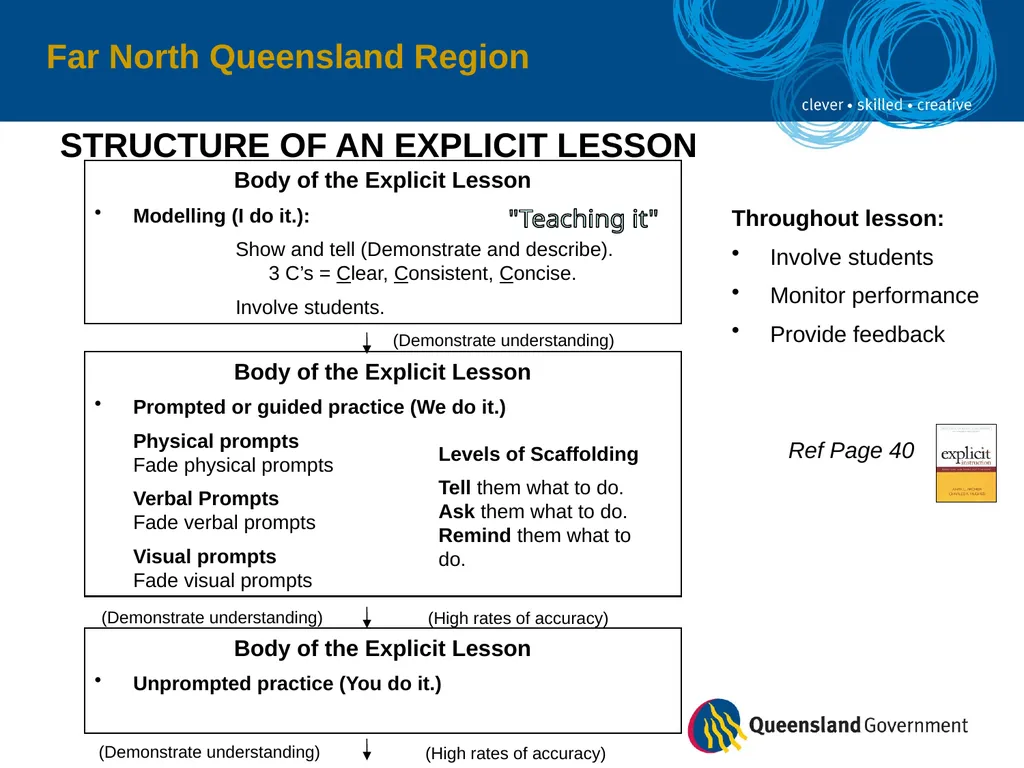
Far North Queensland Region STRUCTURE OF AN EXPLICIT LESSON Body of the Explicit Lesson
Modelling (I do it.):
Show and tell (Demonstrate and describe). 3 C’s = Clear, Consistent, Concise.
Involve students. "Teaching it" Throughout lesson:
Involve students
Monitor performance
Provide feedback
Ref Page 40 Body of the Explicit Lesson
Unprompted practice (You do it.) (Demonstrate understanding) (Demonstrate understanding) (High rates of accuracy) (Demonstrate understanding) (High rates of accuracy)<br>
19
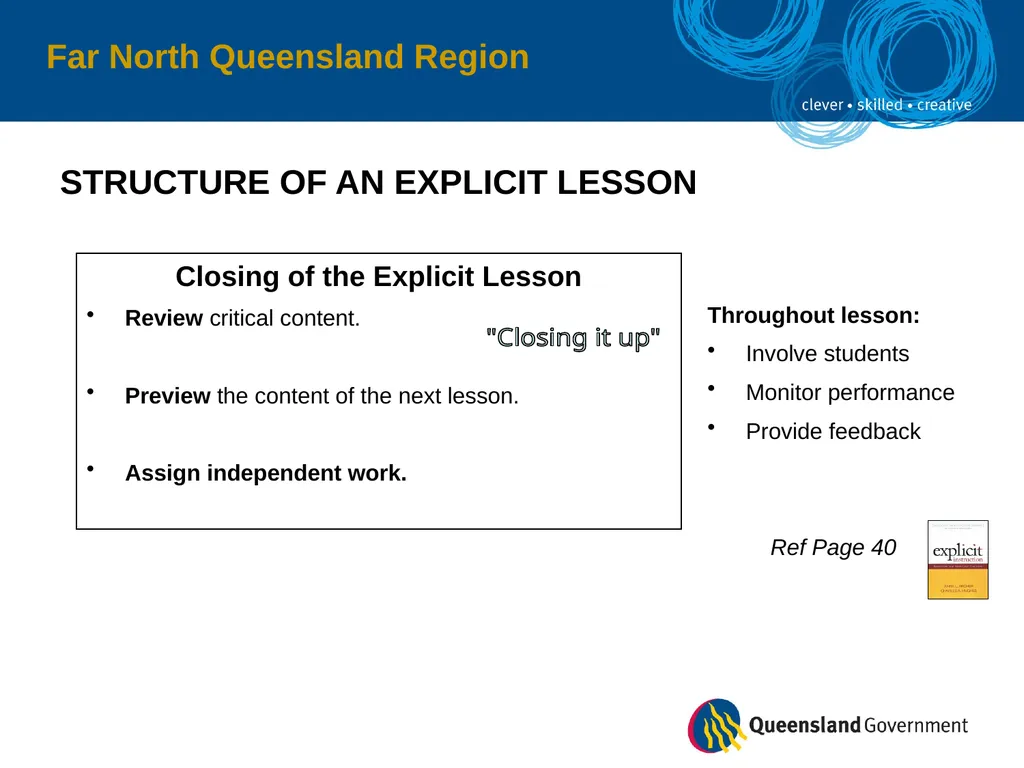
Far North Queensland Region STRUCTURE OF AN EXPLICIT LESSON Closing of the Explicit Lesson
Review critical content.
Preview the content of the next lesson.
Assign independent work. Throughout lesson:
Involve students
Monitor performance
Provide feedback
Ref Page 40 "Closing it up"<br>
Review critical content.
Preview the content of the next lesson.
Assign independent work. Throughout lesson:
Involve students
Monitor performance
Provide feedback
Ref Page 40 "Closing it up"<br>
20
Far North Queensland Region INDEPENDENT PRACTICE
Once proficiency has been reached, additional practice over time is needed to maintain that proficiency.
THE IMPORTANCE OF FLUENCY IN READING
If students can read words fluently within a text passage, they can focus more of their attention and working memory on comprehending what they read. Fluent reading at the word level has been shown to result in increased reading comprehension for many students, including those with learning disabilities.
IMPLICATIONS FOR READING
Strong empirical relationship between students’ passage-reading fluency (correct oral words per minute) and reading comprehension.
- Fuchs, Fuchs, Hosp & Jenkins, 2001<br>
21
Far North Queensland Region INDEPENDENT PRACTICE
OTHER IMPLICATIONS
If a student does not have fluent basic computation skills, complex operations will be interrupted – Woodward, 2006
When handwriting and spelling are not automatic processes, these deficits can conflict with generating and structuring content – Torrance & Galbraith, 2006
Even the most gifted among us reach their pinnacles through practice – and lots of it – Ericsson & Charness, 1994
Expertise does not simply depend on innate capacity or ability but to a large degree on
frequency (every day)
deliberate (to achieve a specific goal)
practice over a long period of time
along with supervision (feedback on performance).
“How do you get to Carnegie Hall? Practice, Practice, Practice”<br>
22
Far North Queensland Region FEEDBACK
One of the most powerful instructional acts is to provide feedback to students on their performance.
When providing corrective feedback provide:
Corrections – teachers must notice every error
Immediate corrections
Specific, informative corrections
A focus on the correct answer versus the incorrect answer
Corrections using the appropriate tone. Correction should be positive not punitive, constructive not destructive, respectful not insulting, encouraging not demoralising.
Opportunities to end every correction with the students giving a correct response.<br>
23
Far North Queensland Region PRAISE
When students consistently respond correctly, meet behavioural expectations, or demonstrate exemplary academic or behavioural performances, more elaborate praise can se offered.
Characteristics of Effective Praise
Contingent on behaviour that meets requirement
Specific rather than global
Highlights success or effort on difficult tasks
Focuses on effort and achievement
Compares students past performance
Is positive, credible and genuine
Flows with the lesson.<br>
24
Far North Queensland Region LESSON PACE
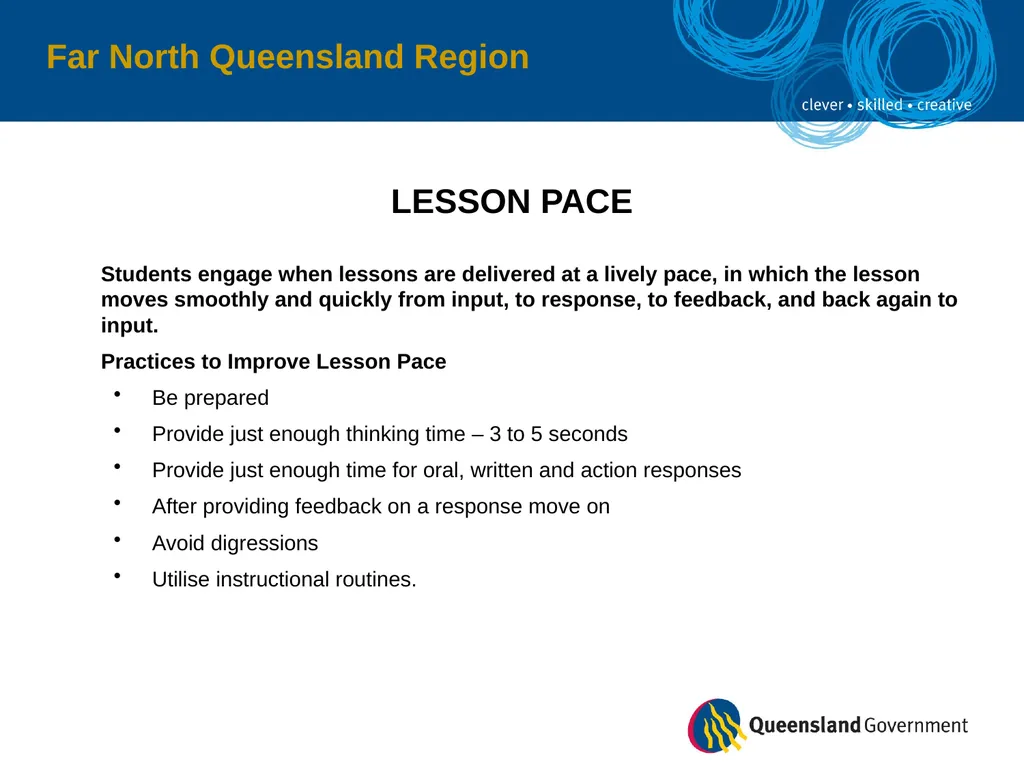
Students engage when lessons are delivered at a lively pace, in which the lesson moves smoothly and quickly from input, to response, to feedback, and back again to input.
Practices to Improve Lesson Pace
Be prepared
Provide just enough thinking time – 3 to 5 seconds
Provide just enough time for oral, written and action responses
After providing feedback on a response move on
Avoid digressions
Utilise instructional routines.<br>
25
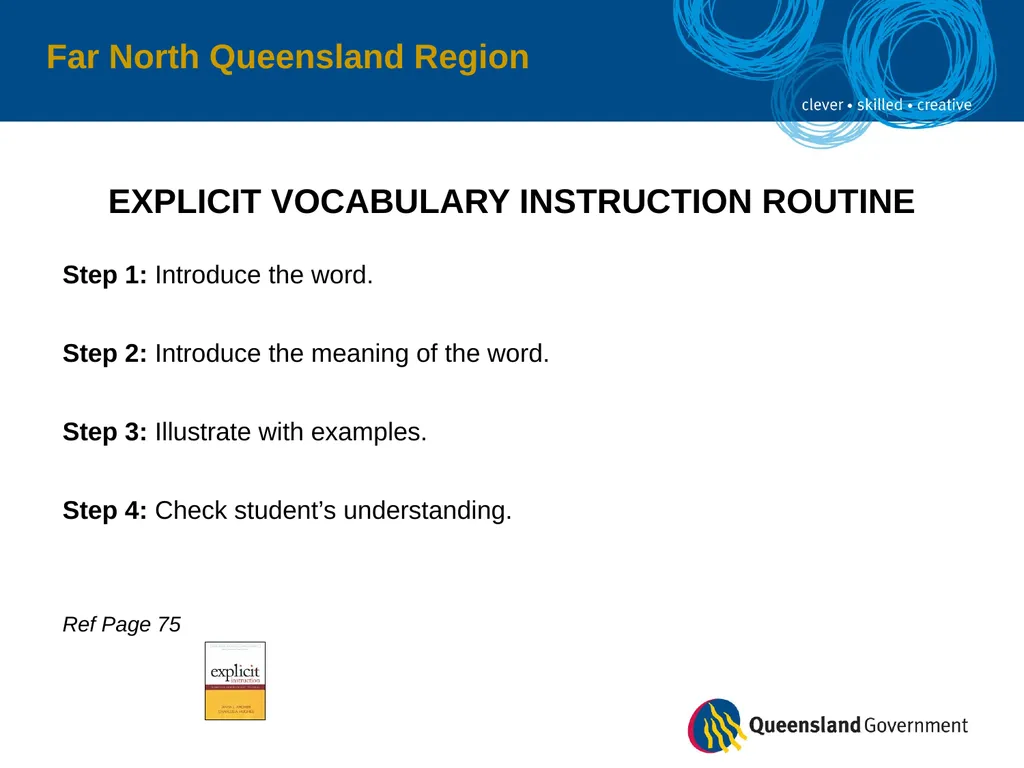
Far North Queensland Region EXPLICIT VOCABULARY INSTRUCTION ROUTINE
Step 1: Introduce the word.
Step 2: Introduce the meaning of the word.
Step 3: Illustrate with examples.
Step 4: Check student’s understanding.
Ref Page 75<br>
Step 1: Introduce the word.
Step 2: Introduce the meaning of the word.
Step 3: Illustrate with examples.
Step 4: Check student’s understanding.
Ref Page 75<br>
26
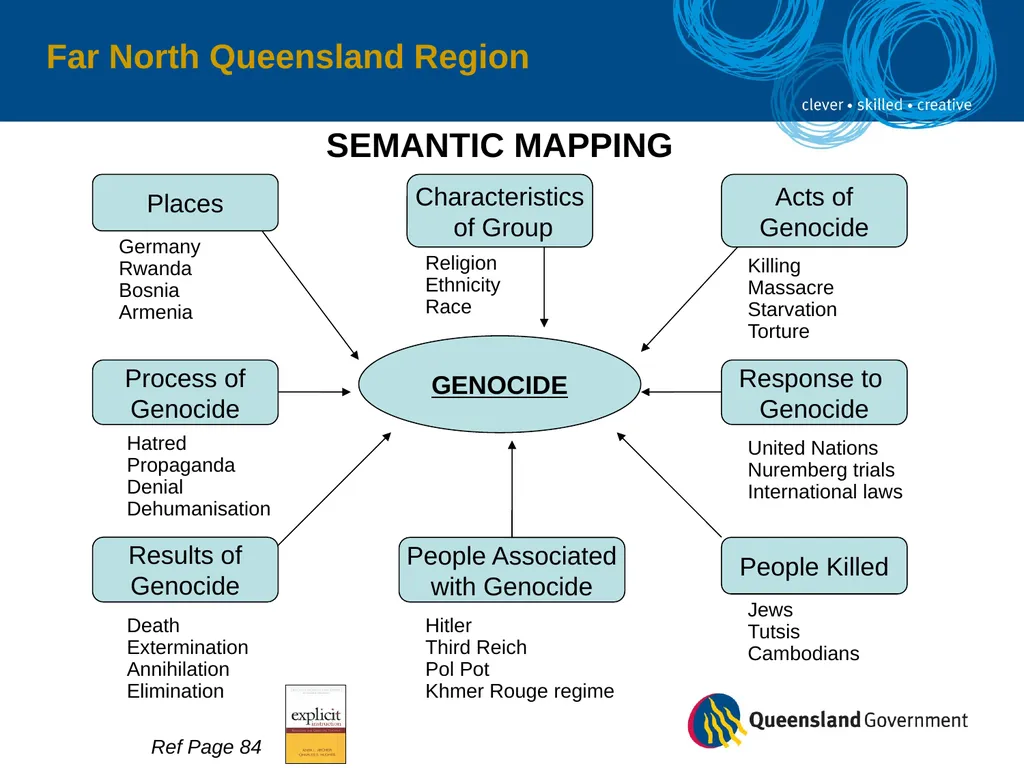
Far North Queensland Region SEMANTIC MAPPING Ref Page 84 GENOCIDE Places Characteristics
of Group Acts of
Genocide Process of
Genocide Response to
Genocide Results of
Genocide People Associated
with Genocide People Killed Germany
Rwanda
Bosnia
Armenia Religion
Ethnicity
Race Killing
Massacre
Starvation
Torture Hatred
Propaganda
Denial
Dehumanisation Hitler
Third Reich
Pol Pot
Khmer Rouge regime United Nations
Nuremberg trials
International laws Jews
Tutsis
Cambodians Death
Extermination
Annihilation
Elimination<br>
27
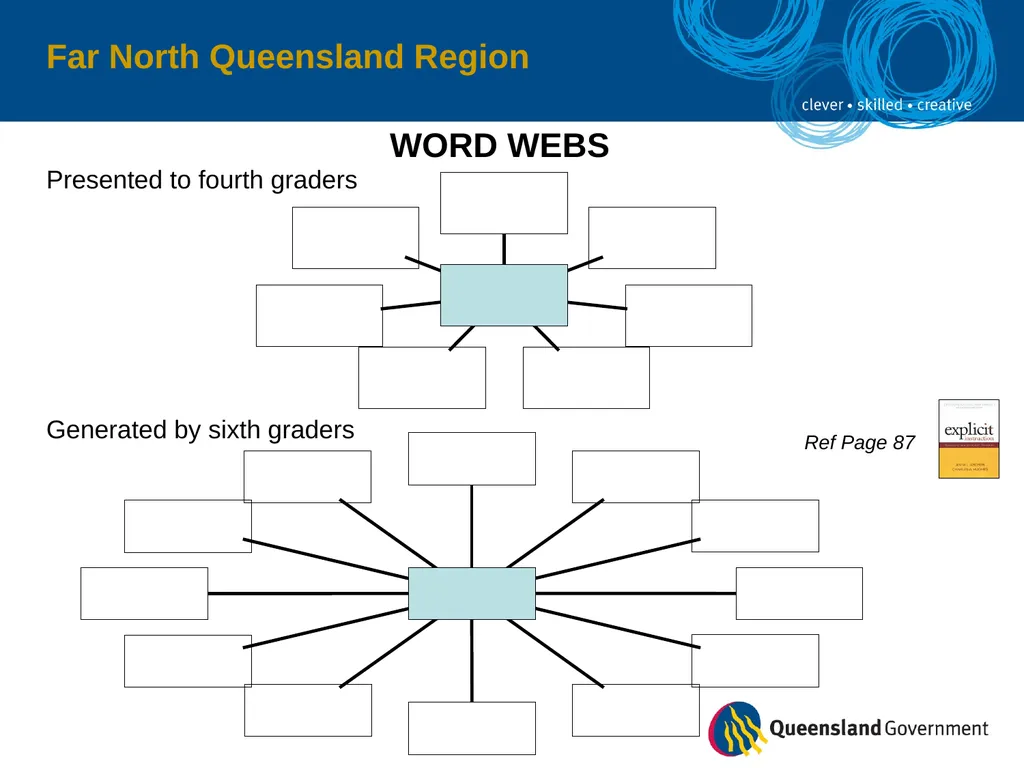
Far North Queensland Region WORD WEBS Ref Page 87 Presented to fourth graders Generated by sixth graders<br>
28
Far North Queensland Region USEFUL REFERENCES AND CHECKLISTS
Exploring the foundations of explicit instruction – page 247
Designing lessons – page 248
Organising for instruction – page 249
Delivering instruction – page 250
Providing appropriate independent practice – page 251<br>
Exploring the foundations of explicit instruction – page 247
Designing lessons – page 248
Organising for instruction – page 249
Delivering instruction – page 250
Providing appropriate independent practice – page 251<br>
29
LEADING TEACHING AND LEARNING in FNQ Schools: Charter of Expectations for Schools The school has a culture of care and of high expectations, inside and outside the classroom.
All students matter, every day.
All students can achieve high academic results.
Practices within the school enhance the learning climate and tone.
Feedback for learning is valued and practised at all levels.
There are high standards of student behaviour (positive school-wide behaviour, orderly student movement, high student engagement and motivation within the classroom).
There is an emphasis on the uniform and dress code.
There is an emphasis on achieving consistently high student attendance.
Curriculum delivery is underpinned by highly effective explicit teaching.
There is a high level of community engagement and support.
There are strong relationships between parents and their children’s teachers.
School leaders actively coach and support teachers in their skill development.
Staff share collective accountability for all student outcomes.<br>
30
Charter of Expectations for Teaching School-wide Pedagogy
Each teacher:
builds effective relationships with all students
accepts accountability for each student’s learning
uses data to inform their teaching and student learning
plans and teaches each lesson using the accepted explicit teaching model
uses strategies to move student knowledge from short term to long term memory.
Learning Environment
Each teacher:
sets a positive classroom learning tone.
establishes an atmosphere of high expectations
focuses on high standards of student presentation and handwriting
regularly corrects student work and provides feedback to each student
has a high standard of classroom display that is relevant and educationally stimulating
Student Engagement
Each teacher:
ensures that each student feels valued and respected by them
ensures that each student is given work and other learning experiences at their ability level
supports each student to have friends at school
engages each student in their progress towards their annual learning goals.<br>
Each teacher:
builds effective relationships with all students
accepts accountability for each student’s learning
uses data to inform their teaching and student learning
plans and teaches each lesson using the accepted explicit teaching model
uses strategies to move student knowledge from short term to long term memory.
Learning Environment
Each teacher:
sets a positive classroom learning tone.
establishes an atmosphere of high expectations
focuses on high standards of student presentation and handwriting
regularly corrects student work and provides feedback to each student
has a high standard of classroom display that is relevant and educationally stimulating
Student Engagement
Each teacher:
ensures that each student feels valued and respected by them
ensures that each student is given work and other learning experiences at their ability level
supports each student to have friends at school
engages each student in their progress towards their annual learning goals.<br>