
Filing a Non-Provisional Application Demystifying
TA
Published · 22 slides · 0 views

1 / 1


Description
Filing a Non-Provisional Application Demystifying the Filing Process Notice This content is for informational purposes only and is not legal advice. Please consult with appropriate sources for legal authority and guidance on these matters.
Related Topics
Share
Embed code
Download this presentation From Below
"Filing a Non-Provisional Application Demystifying" is the property of its rightful owner. Permission is granted to download and print the materials on this website for personal, non-commercial use only, and to display it on your personal computer provided you do not modify the materials and that you retain all copyright notices contained in the materials. By downloading content from our website, you accept the terms of this agreement.
Presentation Transcript
01
Filing a Non-Provisional Application Demystifying the Filing Process<br>
02
Notice This content is for informational purposes only and is not legal advice. Please consult with appropriate sources for legal authority and guidance on these matters.<br>
03
Objectives 4 Types of Patents
Non-Provisional Application Overview
Non-Provisional Application Filing Requirements<br>
Non-Provisional Application Overview
Non-Provisional Application Filing Requirements<br>
04
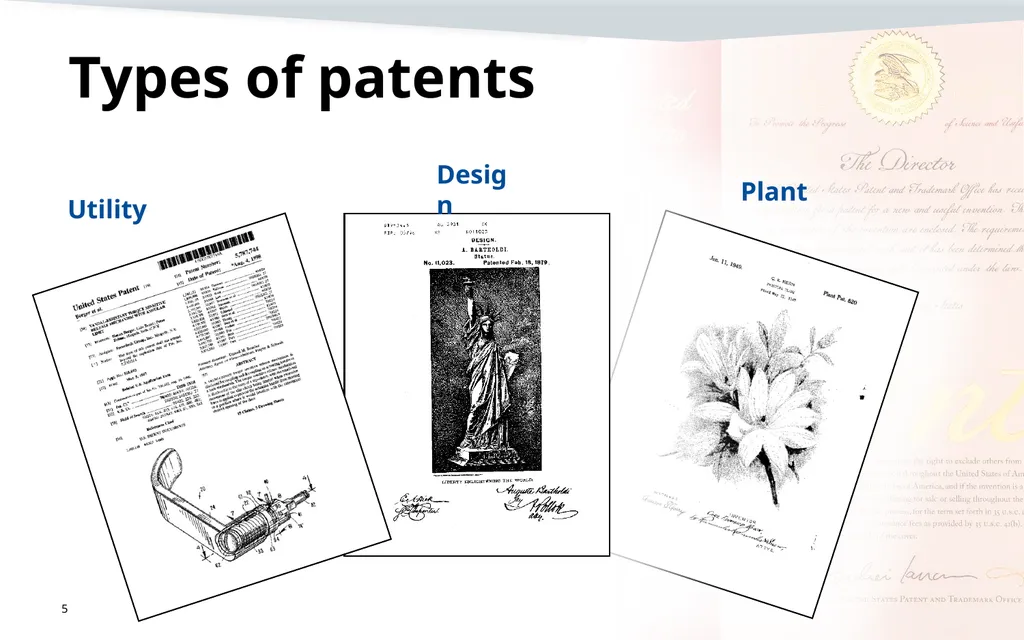
5 Plant Design Utility Types of patents<br>
05
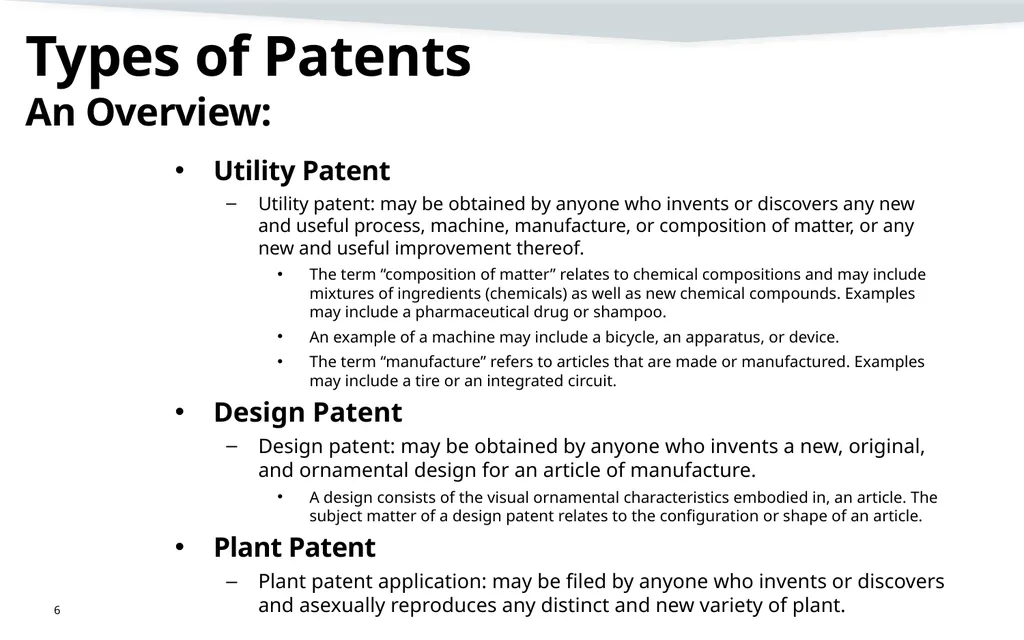
Types of Patents
An Overview: 6 Utility Patent
Utility patent: may be obtained by anyone who invents or discovers any new and useful process, machine, manufacture, or composition of matter, or any new and useful improvement thereof.
The term “composition of matter” relates to chemical compositions and may include mixtures of ingredients (chemicals) as well as new chemical compounds. Examples may include a pharmaceutical drug or shampoo.
An example of a machine may include a bicycle, an apparatus, or device.
The term “manufacture” refers to articles that are made or manufactured. Examples may include a tire or an integrated circuit.
Design Patent
Design patent: may be obtained by anyone who invents a new, original, and ornamental design for an article of manufacture.
A design consists of the visual ornamental characteristics embodied in, an article. The subject matter of a design patent relates to the configuration or shape of an article.
Plant Patent
Plant patent application: may be filed by anyone who invents or discovers and asexually reproduces any distinct and new variety of plant.<br>
06
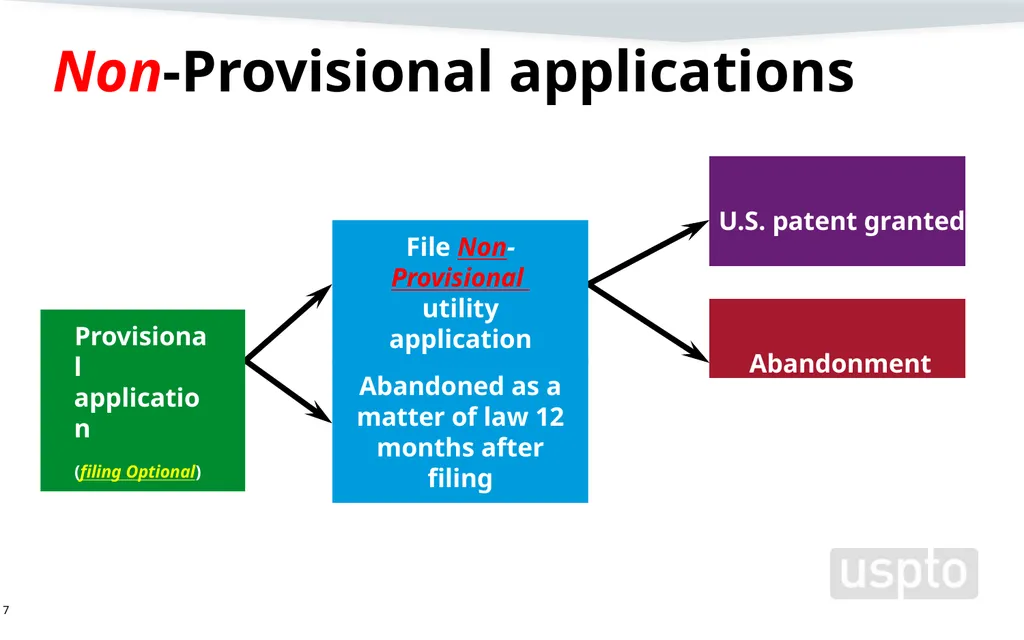
Non-Provisional applications 7 U.S. patent granted Abandonment Provisional application
(filing Optional) File Non- Provisional utility application Abandoned as a matter of law 12 months after filing<br>
(filing Optional) File Non- Provisional utility application Abandoned as a matter of law 12 months after filing<br>
07
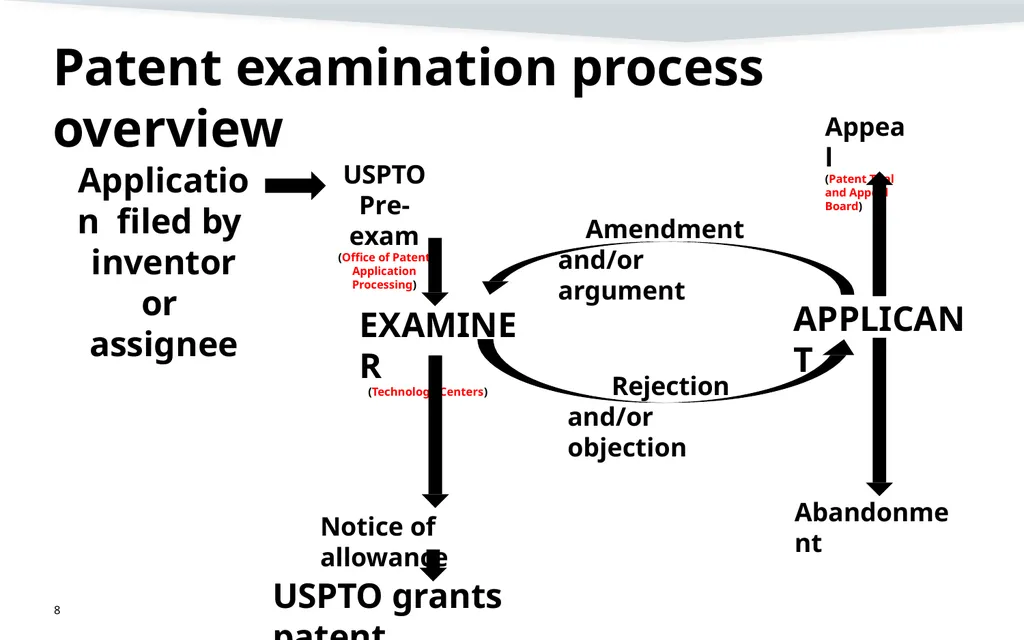
Patent examination process overview 8 USPTO
Pre-exam
(Office of Patent
Application Processing) Application filed by inventor or assignee Notice of allowance USPTO grants patent
(Office of Data Management) APPLICANT EXAMINER
(Technology Centers) Amendment and/or argument Appeal
(Patent Trial and Appeal Board) Rejection and/or objection Abandonment<br>
08
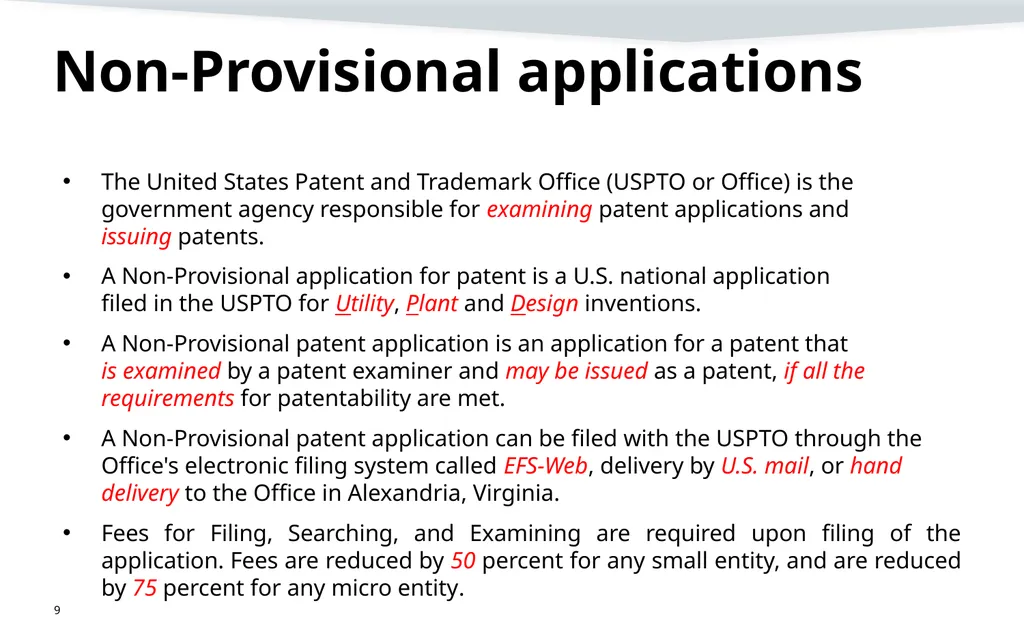
Non-Provisional applications The United States Patent and Trademark Office (USPTO or Office) is the government agency responsible for examining patent applications and issuing patents.
A Non-Provisional application for patent is a U.S. national application filed in the USPTO for Utility, Plant and Design inventions.
A Non-Provisional patent application is an application for a patent that is examined by a patent examiner and may be issued as a patent, if all the requirements for patentability are met.
A Non-Provisional patent application can be filed with the USPTO through the Office's electronic filing system called EFS-Web, delivery by U.S. mail, or hand delivery to the Office in Alexandria, Virginia.
Fees for Filing, Searching, and Examining are required upon filing of the application. Fees are reduced by 50 percent for any small entity, and are reduced by 75 percent for any micro entity. 9<br>
09
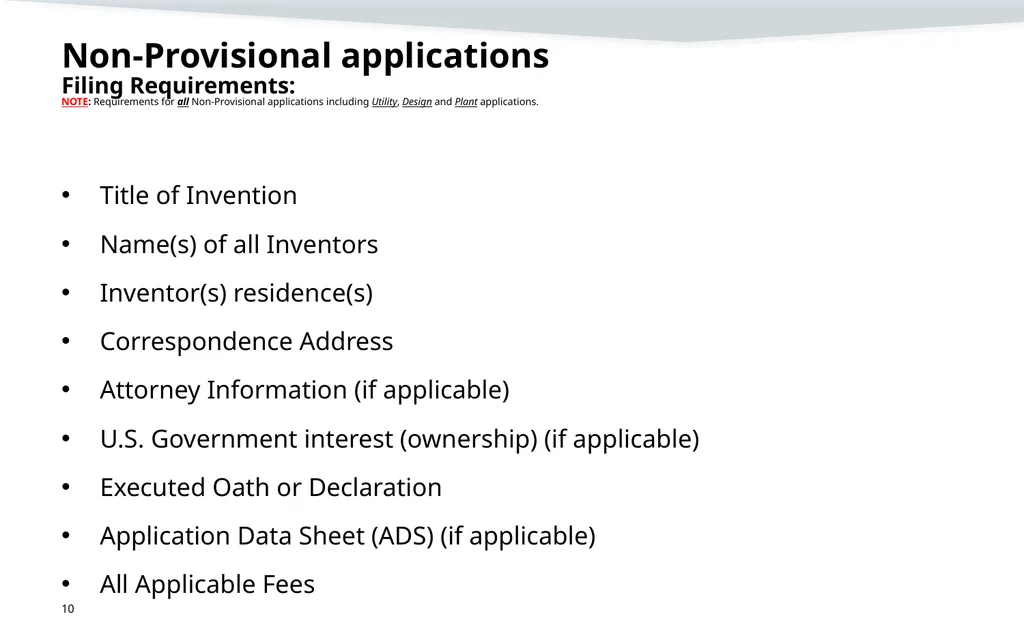
Non-Provisional applications
Filing Requirements:
NOTE: Requirements for all Non-Provisional applications including Utility, Design and Plant applications. Title of Invention
Name(s) of all Inventors
Inventor(s) residence(s)
Correspondence Address
Attorney Information (if applicable)
U.S. Government interest (ownership) (if applicable)
Executed Oath or Declaration
Application Data Sheet (ADS) (if applicable)
All Applicable Fees 10<br>
Name(s) of all Inventors
Inventor(s) residence(s)
Correspondence Address
Attorney Information (if applicable)
U.S. Government interest (ownership) (if applicable)
Executed Oath or Declaration
Application Data Sheet (ADS) (if applicable)
All Applicable Fees 10<br>
10
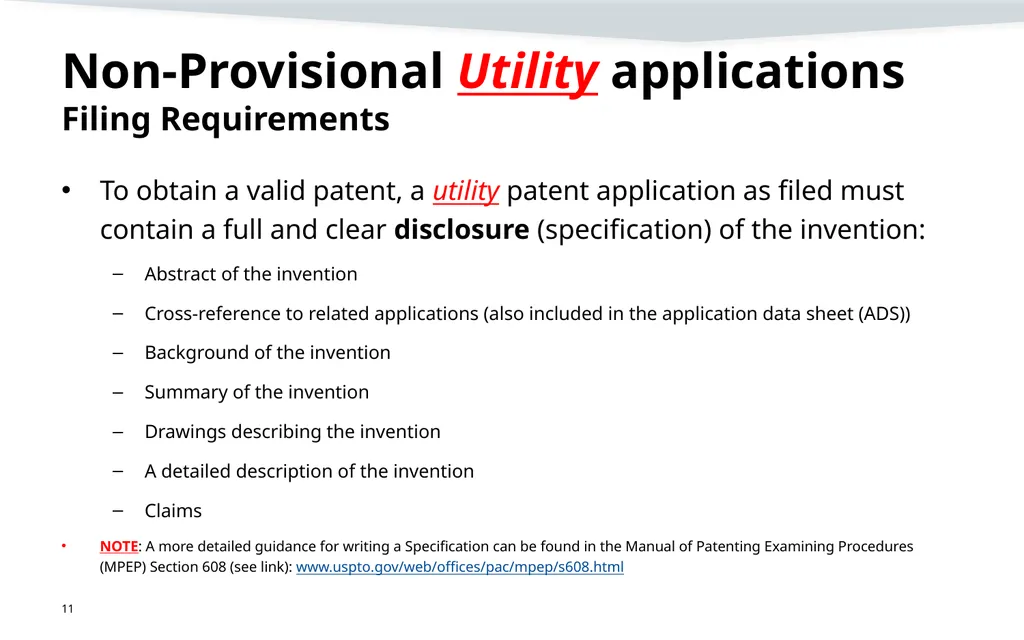
Non-Provisional Utility applications
Filing Requirements To obtain a valid patent, a utility patent application as filed must contain a full and clear disclosure (specification) of the invention:
Abstract of the invention
Cross-reference to related applications (also included in the application data sheet (ADS))
Background of the invention
Summary of the invention
Drawings describing the invention
A detailed description of the invention
Claims
NOTE: A more detailed guidance for writing a Specification can be found in the Manual of Patenting Examining Procedures (MPEP) Section 608 (see link): www.uspto.gov/web/offices/pac/mpep/s608.html 11<br>
11
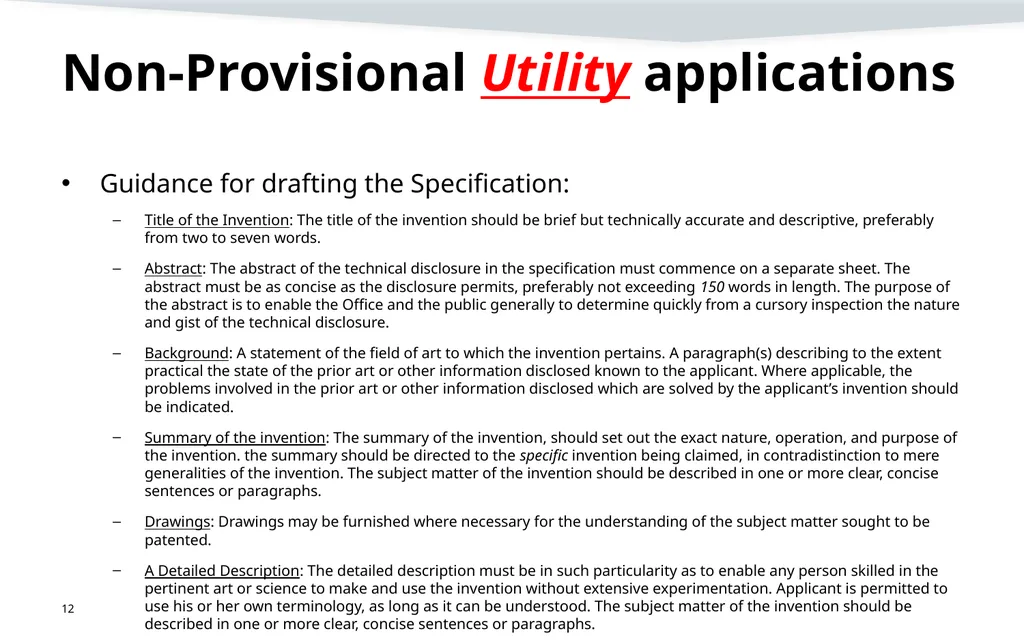
Non-Provisional Utility applications Guidance for drafting the Specification:
Title of the Invention: The title of the invention should be brief but technically accurate and descriptive, preferably from two to seven words.
Abstract: The abstract of the technical disclosure in the specification must commence on a separate sheet. The abstract must be as concise as the disclosure permits, preferably not exceeding 150 words in length. The purpose of the abstract is to enable the Office and the public generally to determine quickly from a cursory inspection the nature and gist of the technical disclosure.
Background: A statement of the field of art to which the invention pertains. A paragraph(s) describing to the extent practical the state of the prior art or other information disclosed known to the applicant. Where applicable, the problems involved in the prior art or other information disclosed which are solved by the applicant’s invention should be indicated.
Summary of the invention: The summary of the invention, should set out the exact nature, operation, and purpose of the invention. the summary should be directed to the specific invention being claimed, in contradistinction to mere generalities of the invention. The subject matter of the invention should be described in one or more clear, concise sentences or paragraphs.
Drawings: Drawings may be furnished where necessary for the understanding of the subject matter sought to be patented.
A Detailed Description: The detailed description must be in such particularity as to enable any person skilled in the pertinent art or science to make and use the invention without extensive experimentation. Applicant is permitted to use his or her own terminology, as long as it can be understood. The subject matter of the invention should be described in one or more clear, concise sentences or paragraphs. 12<br>
12
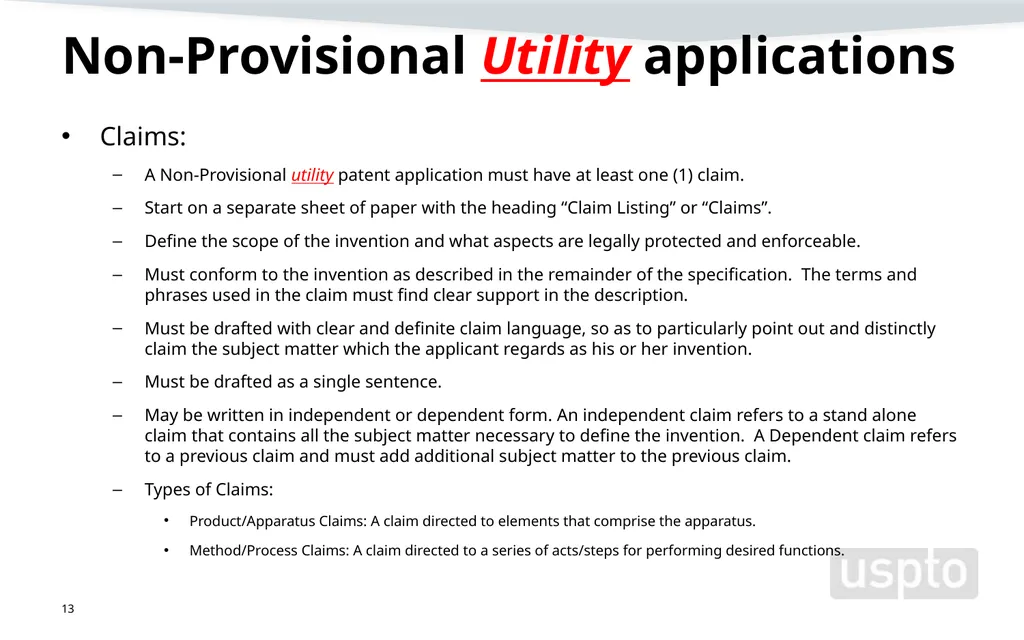
Non-Provisional Utility applications Claims:
A Non-Provisional utility patent application must have at least one (1) claim.
Start on a separate sheet of paper with the heading “Claim Listing” or “Claims”.
Define the scope of the invention and what aspects are legally protected and enforceable.
Must conform to the invention as described in the remainder of the specification. The terms and phrases used in the claim must find clear support in the description.
Must be drafted with clear and definite claim language, so as to particularly point out and distinctly claim the subject matter which the applicant regards as his or her invention.
Must be drafted as a single sentence.
May be written in independent or dependent form. An independent claim refers to a stand alone claim that contains all the subject matter necessary to define the invention. A Dependent claim refers to a previous claim and must add additional subject matter to the previous claim.
Types of Claims:
Product/Apparatus Claims: A claim directed to elements that comprise the apparatus.
Method/Process Claims: A claim directed to a series of acts/steps for performing desired functions. 13<br>
13
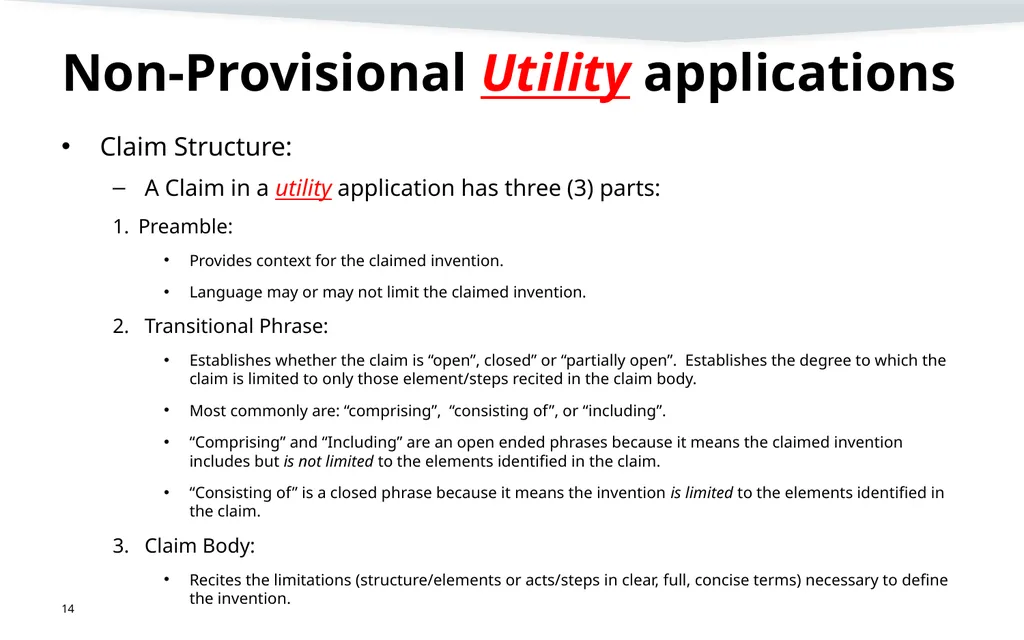
Non-Provisional Utility applications Claim Structure:
A Claim in a utility application has three (3) parts:
Preamble:
Provides context for the claimed invention.
Language may or may not limit the claimed invention.
Transitional Phrase:
Establishes whether the claim is “open”, closed” or “partially open”. Establishes the degree to which the claim is limited to only those element/steps recited in the claim body.
Most commonly are: “comprising”, “consisting of”, or “including”.
“Comprising” and “Including” are an open ended phrases because it means the claimed invention includes but is not limited to the elements identified in the claim.
“Consisting of” is a closed phrase because it means the invention is limited to the elements identified in the claim.
Claim Body:
Recites the limitations (structure/elements or acts/steps in clear, full, concise terms) necessary to define the invention. 14<br>
14
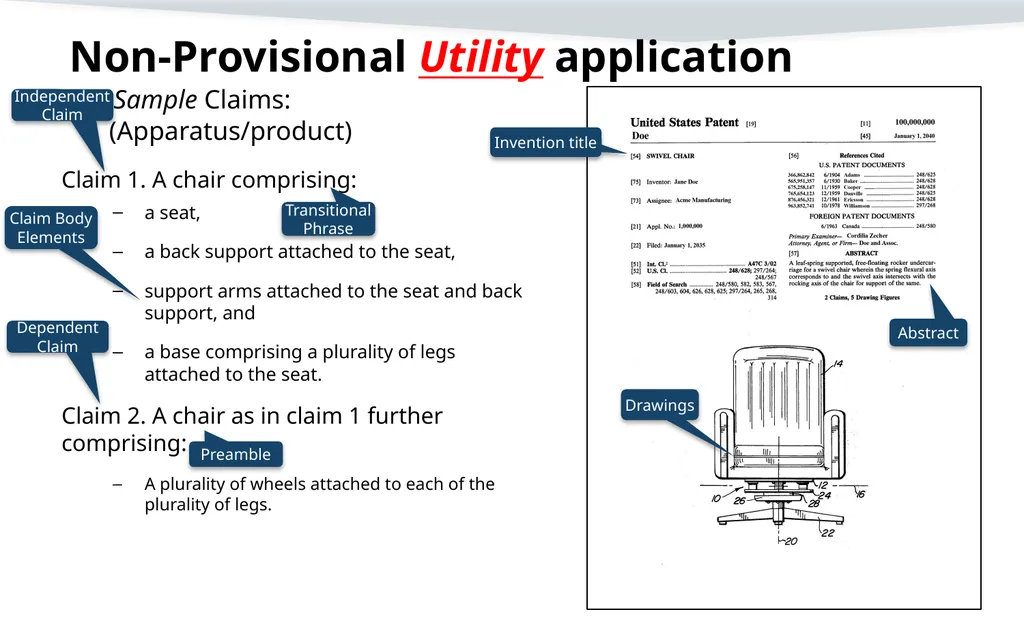
Claim 1. A chair comprising:
a seat,
a back support attached to the seat,
support arms attached to the seat and back support, and
a base comprising a plurality of legs attached to the seat.
Claim 2. A chair as in claim 1 further comprising:
A plurality of wheels attached to each of the plurality of legs. Non-Provisional Utility application Sample Claims: (Apparatus/product) Invention title Drawings Claim Body Elements Independent
Claim Abstract Transitional Phrase Dependent
Claim Preamble<br>
15
Non-Provisional Design applications
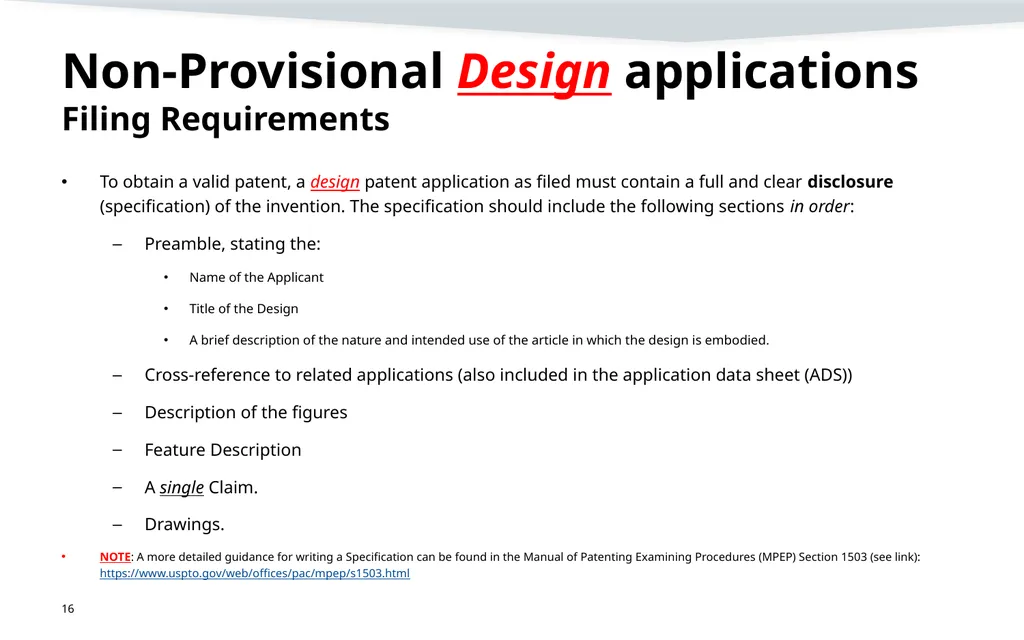
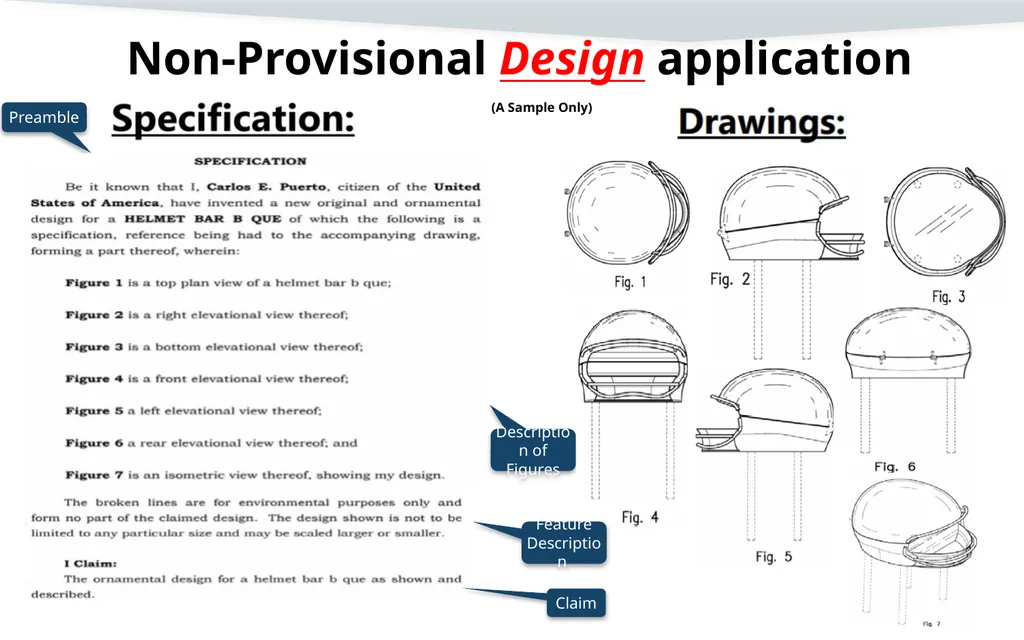
Filing Requirements To obtain a valid patent, a design patent application as filed must contain a full and clear disclosure (specification) of the invention. The specification should include the following sections in order:
Preamble, stating the:
Name of the Applicant
Title of the Design
A brief description of the nature and intended use of the article in which the design is embodied.
Cross-reference to related applications (also included in the application data sheet (ADS))
Description of the figures
Feature Description
A single Claim.
Drawings.
NOTE: A more detailed guidance for writing a Specification can be found in the Manual of Patenting Examining Procedures (MPEP) Section 1503 (see link): https://www.uspto.gov/web/offices/pac/mpep/s1503.html 16<br>
16
Non-Provisional Design applications Guidance for Drafting the Specification:
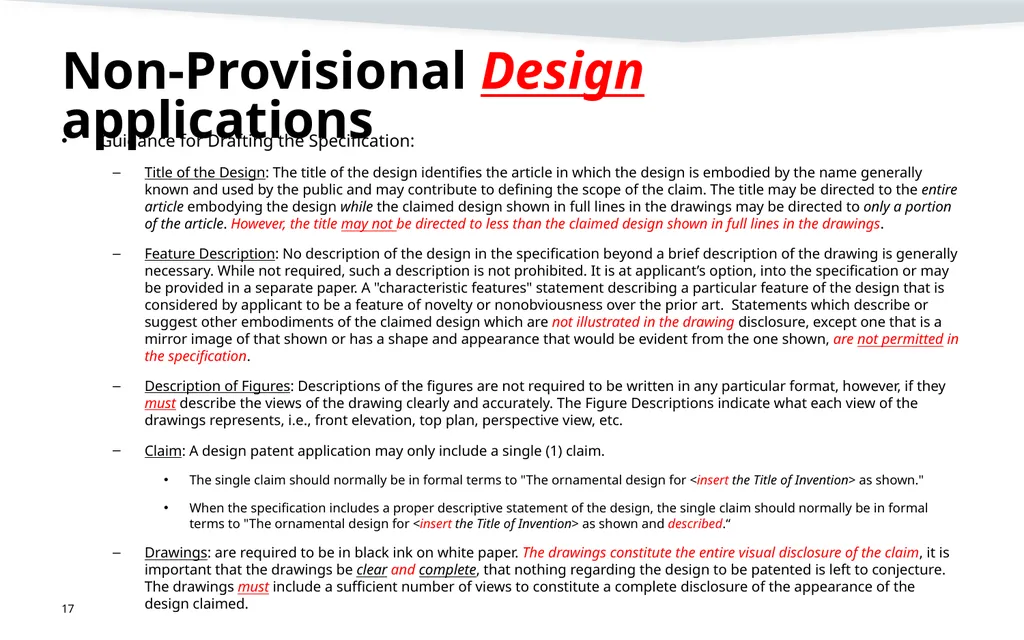
Title of the Design: The title of the design identifies the article in which the design is embodied by the name generally known and used by the public and may contribute to defining the scope of the claim. The title may be directed to the entire article embodying the design while the claimed design shown in full lines in the drawings may be directed to only a portion of the article. However, the title may not be directed to less than the claimed design shown in full lines in the drawings.
Feature Description: No description of the design in the specification beyond a brief description of the drawing is generally necessary. While not required, such a description is not prohibited. It is at applicant’s option, into the specification or may be provided in a separate paper. A "characteristic features" statement describing a particular feature of the design that is considered by applicant to be a feature of novelty or nonobviousness over the prior art. Statements which describe or suggest other embodiments of the claimed design which are not illustrated in the drawing disclosure, except one that is a mirror image of that shown or has a shape and appearance that would be evident from the one shown, are not permitted in the specification.
Description of Figures: Descriptions of the figures are not required to be written in any particular format, however, if they must describe the views of the drawing clearly and accurately. The Figure Descriptions indicate what each view of the drawings represents, i.e., front elevation, top plan, perspective view, etc.
Claim: A design patent application may only include a single (1) claim.
The single claim should normally be in formal terms to "The ornamental design for <insert the Title of Invention> as shown."
When the specification includes a proper descriptive statement of the design, the single claim should normally be in formal terms to "The ornamental design for <insert the Title of Invention> as shown and described.“
Drawings: are required to be in black ink on white paper. The drawings constitute the entire visual disclosure of the claim, it is important that the drawings be clear and complete, that nothing regarding the design to be patented is left to conjecture. The drawings must include a sufficient number of views to constitute a complete disclosure of the appearance of the design claimed. 17<br>
17
Non-Provisional Design application
(A Sample Only) Preamble Description of Figures Claim Feature Description<br>
18
Non-Provisional Plant applications
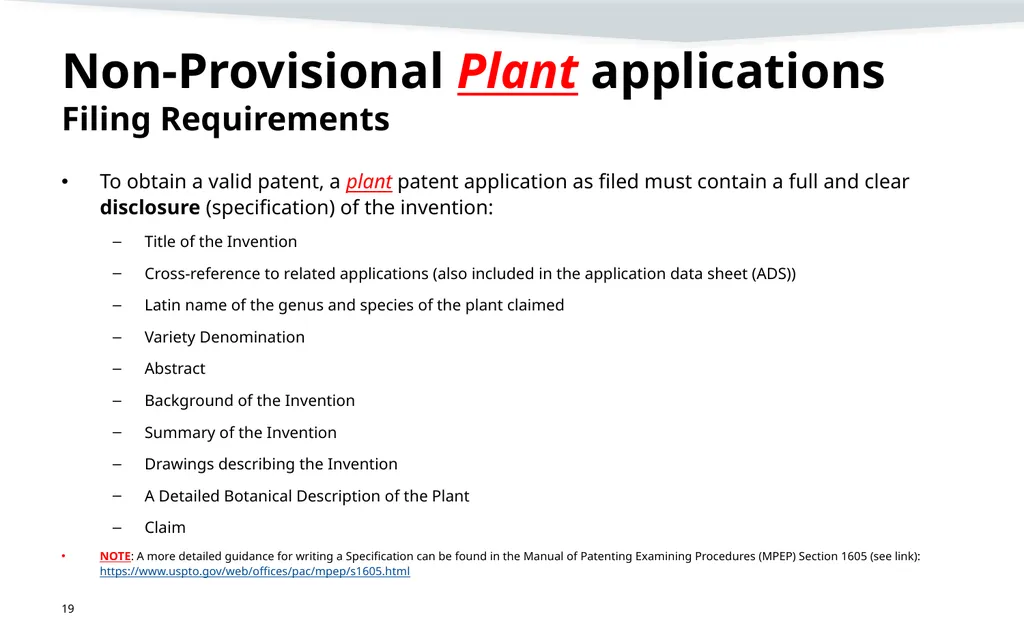
Filing Requirements To obtain a valid patent, a plant patent application as filed must contain a full and clear disclosure (specification) of the invention:
Title of the Invention
Cross-reference to related applications (also included in the application data sheet (ADS))
Latin name of the genus and species of the plant claimed
Variety Denomination
Abstract
Background of the Invention
Summary of the Invention
Drawings describing the Invention
A Detailed Botanical Description of the Plant
Claim
NOTE: A more detailed guidance for writing a Specification can be found in the Manual of Patenting Examining Procedures (MPEP) Section 1605 (see link): https://www.uspto.gov/web/offices/pac/mpep/s1605.html 19<br>
19
Non-Provisional applications
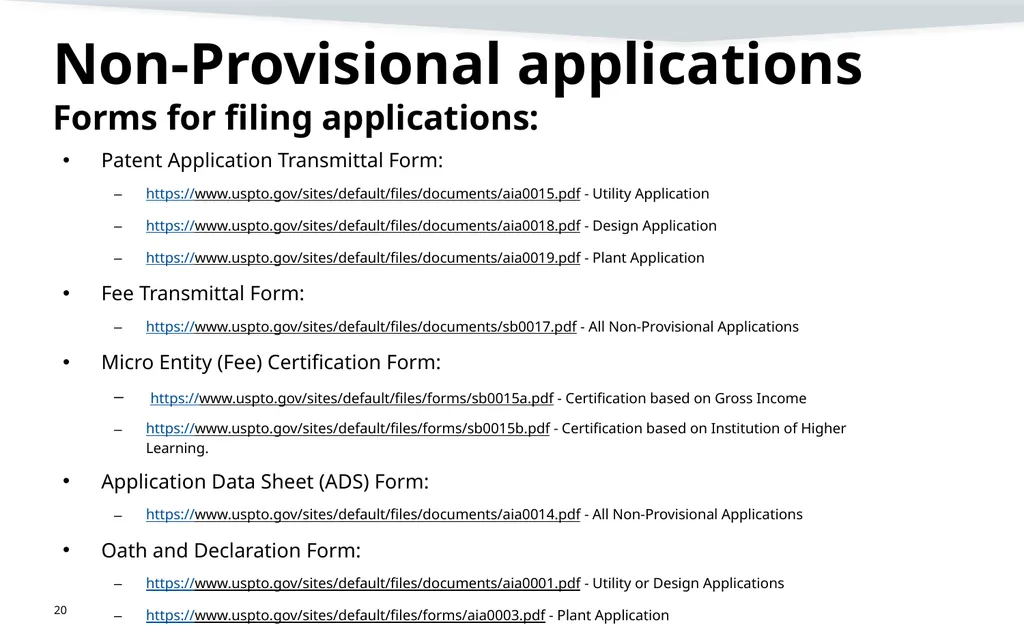
Forms for filing applications: Patent Application Transmittal Form:
https://www.uspto.gov/sites/default/files/documents/aia0015.pdf - Utility Application
https://www.uspto.gov/sites/default/files/documents/aia0018.pdf - Design Application
https://www.uspto.gov/sites/default/files/documents/aia0019.pdf - Plant Application
Fee Transmittal Form:
https://www.uspto.gov/sites/default/files/documents/sb0017.pdf - All Non-Provisional Applications
Micro Entity (Fee) Certification Form:
https://www.uspto.gov/sites/default/files/forms/sb0015a.pdf - Certification based on Gross Income
https://www.uspto.gov/sites/default/files/forms/sb0015b.pdf - Certification based on Institution of Higher Learning.
Application Data Sheet (ADS) Form:
https://www.uspto.gov/sites/default/files/documents/aia0014.pdf - All Non-Provisional Applications
Oath and Declaration Form:
https://www.uspto.gov/sites/default/files/documents/aia0001.pdf - Utility or Design Applications
https://www.uspto.gov/sites/default/files/forms/aia0003.pdf - Plant Application 20<br>
20
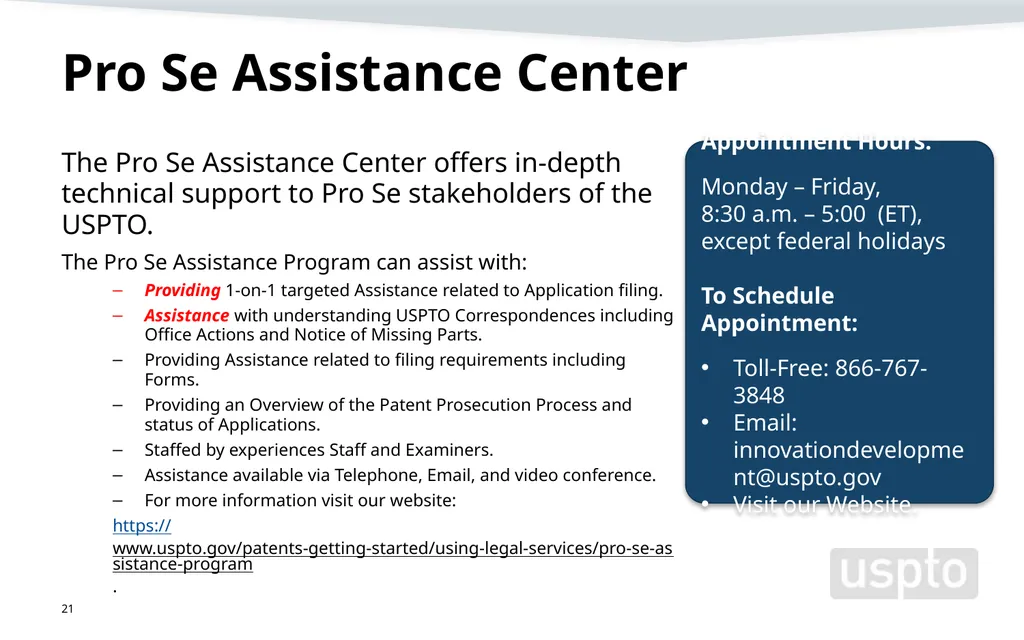
Pro Se Assistance Center The Pro Se Assistance Center offers in-depth
technical support to Pro Se stakeholders of the USPTO.
The Pro Se Assistance Program can assist with:
Providing 1-on-1 targeted Assistance related to Application filing.
Assistance with understanding USPTO Correspondences including Office Actions and Notice of Missing Parts.
Providing Assistance related to filing requirements including Forms.
Providing an Overview of the Patent Prosecution Process and status of Applications.
Staffed by experiences Staff and Examiners.
Assistance available via Telephone, Email, and video conference.
For more information visit our website:
https://www.uspto.gov/patents-getting-started/using-legal-services/pro-se-assistance-program. 21 Appointment Hours:
Monday – Friday,
8:30 a.m. – 5:00 (ET), except federal holidays
To Schedule Appointment:
Toll-Free: 866-767-3848
Email: innovationdevelopment@uspto.gov
Visit our Website.<br>