
Finance for Normal People Chapter 4 – Emotional
Description: Finance for Normal People Chapter 4 Emotional Shortcuts and Errors Emotional Shortcuts and Errors Emotional shortcuts, like cognitive shortcuts, are part of the intuitive blink System 1 in our minds, leading to good choices in most of
Related Topics
Download Presentation
"Finance for Normal People Chapter 4 – Emotional" is the property of its rightful owner. Permission is granted to download and print the materials on this website for personal, non-commercial use only, and to display it on your personal computer provided you do not modify the materials and that you retain all copyright notices contained in the materials. By downloading content from our website, you accept the terms of this agreement.
Presentation Transcript
slide1. Finance for Normal People
Chapter 4 – Emotional Shortcuts and Errors<br>
slide2. Emotional Shortcuts and Errors Emotional shortcuts, like cognitive shortcuts, are part of the intuitive “blink” System 1 in our minds, leading to good choices in most of life
But shortcuts turn into errors when they mislead us into poor choices
System 2, the reflective “think” system in our minds leads to better choices when System 1 misleads<br>
slide3. Emotional Shortcuts and Errors People with knowledge of human behavior and financial facts use emotional shortcuts correctly,
whereas people lacking such knowledge commit emotional errors as they use them incorrectly<br>
slide4. Emotional Shortcuts and Errors Fear
Fear acts as an emotional shortcut that turns into an error when fear is absent or when it is exaggerated
Fear guides us rightly when it prompts us to retreat from a knife-wielding stranger bearing an angry face, and when it prevents us from buying houses likely to be repossessed in foreclosures
But fear guides us wrongly when it prompts us to retreat from a knife-wielding friend who chops vegetables, and when it compels us to sell all our stocks in a financial crisis<br>
slide5. Emotional Shortcuts and Errors The interaction between cognition and emotion makes it difficult to attribute shortcuts, errors, and choices to one or the other
Reason tells us that flying is safer than driving long distances, yet some choose to drive
The choice can be attributed to cognition, where images of crashed airplanes are more readily available to mind than images of crashed cars, or to emotion, where airplane crashes evoke greater fear, or to a combination of both<br>
slide6. Emotional Shortcuts and Errors Emotion, mood, and affect
Emotion is very intense, with a short duration and clear focus
Mood is muted emotion, less intense than emotion, but longer lasting
Affect is the faint whisper of emotion or mood, stripped down to valence, positive or negative<br>
slide7. Emotional Shortcuts and Errors Emotion, mood, and affect
Emotion, mood, and affect are regularly comingled but they are distinct by intensity, duration, focus, and valence - positive or negative
Fear was a very intense negative emotion felt in early 2009 as we focused on stock markets that cut retirement savings by half for some and threatened to cut much more
Fear abated into a less intense but longer lasting negative mood that has persisted even as the stock market recovered
The emotion of fear and its mood have subsequently faded into a much less intense but longer lasting negative affect of stock markets<br>
slide8. Emotional Shortcuts and Errors Emotions
Psychologist Paul Ekman classically listed seven emotions whose physiological effects are evident in facial expressions:
Fear, anger, sadness, disgust, surprise, happiness, and contentment
Yet there is no generally accepted list of emotions. Other lists also include, hope, pride, regret, shame, guilt, and self-control<br>
slide9. Emotional Shortcuts and Errors The appraisal-tendency framework (ATF) distinguishes cognitive appraisals from appraisal tendencies
People experience anger after being cut off in traffic by bad drivers
Appraisal tendencies activated by this anger shape future perceptions and behavior
Appraisal tendencies lead angry people to take more risk in future activities even if these are unrelated to driving, such as taking more investment risk<br>
slide10. Emotional Shortcuts and Errors Hope and Fear
Fear is a negative emotion arising in response to danger whereas hope is a positive one in anticipation of reward
Cognitive appraisal notes that fear is unpleasant and hope is pleasant, but the two are similar in that control is in the hands of others, whether other people or situations
We fear the danger of an airplane crash but cannot control the outcome. We hope to win the lottery but cannot control the outcome Exuberance is extreme hope, as in the famed case of “irrational exuberance”<br>
slide11. Emotional Shortcuts and Errors Fear increases risk-aversion even among financial professionals, leading to high risk-aversion in financial busts and low risk-aversion in financial booms
Financial professionals asked to read a story about a financial bust became more fearful than those asked to read a story about a financial boom, and fear led them to reduce risky investments<br>
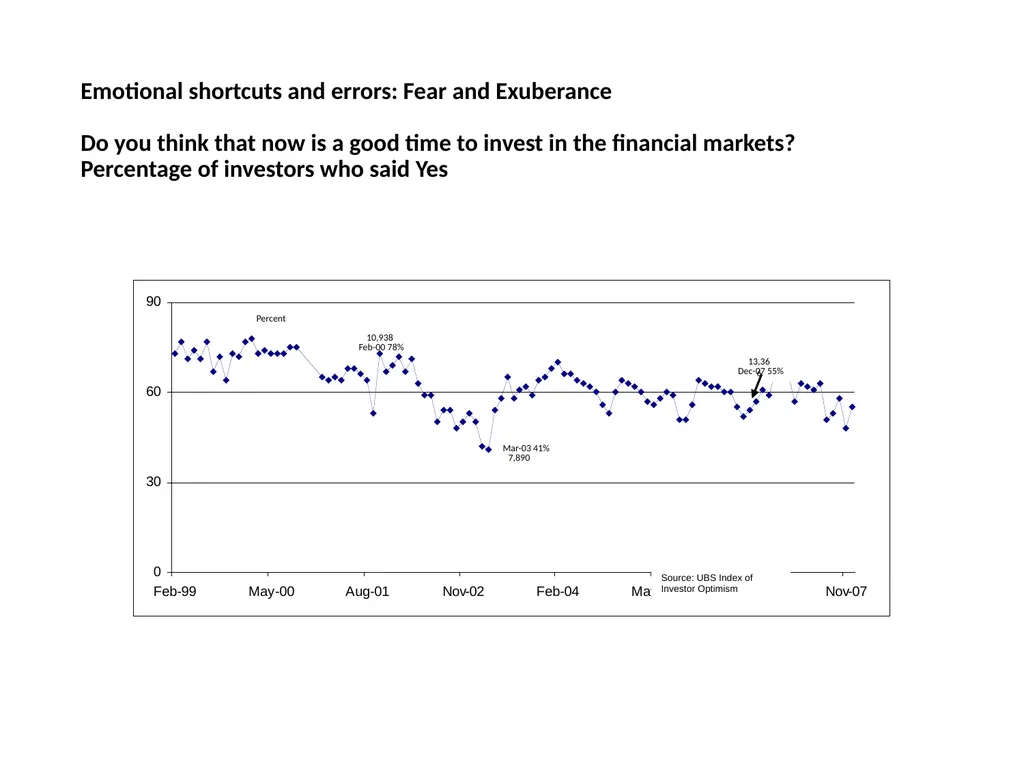
slide12. Emotional shortcuts and errors: Fear and Exuberance Do you think that now is a good time to invest in the financial markets? Percentage of investors who said Yes Percent Source: UBS Index of Investor Optimism 10,938 Feb-00 78% 7,890 Mar-03 41% Dec-07 55% 13,366<br>
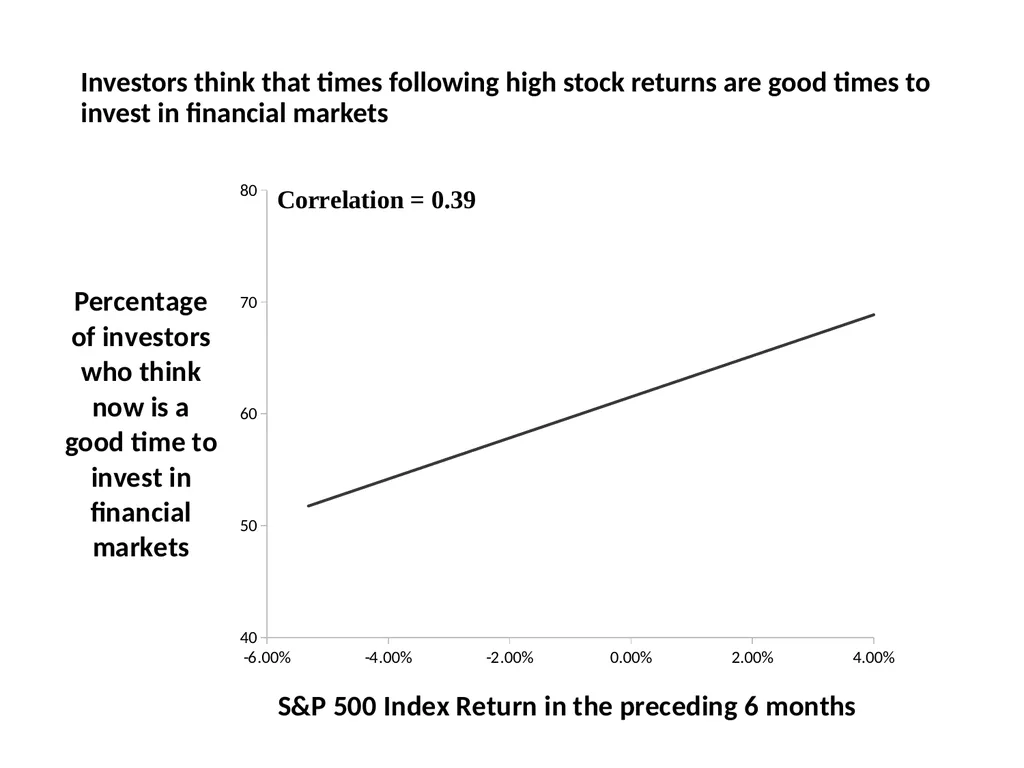
slide13. Investors think that times following high stock returns are good times to invest in financial markets<br>
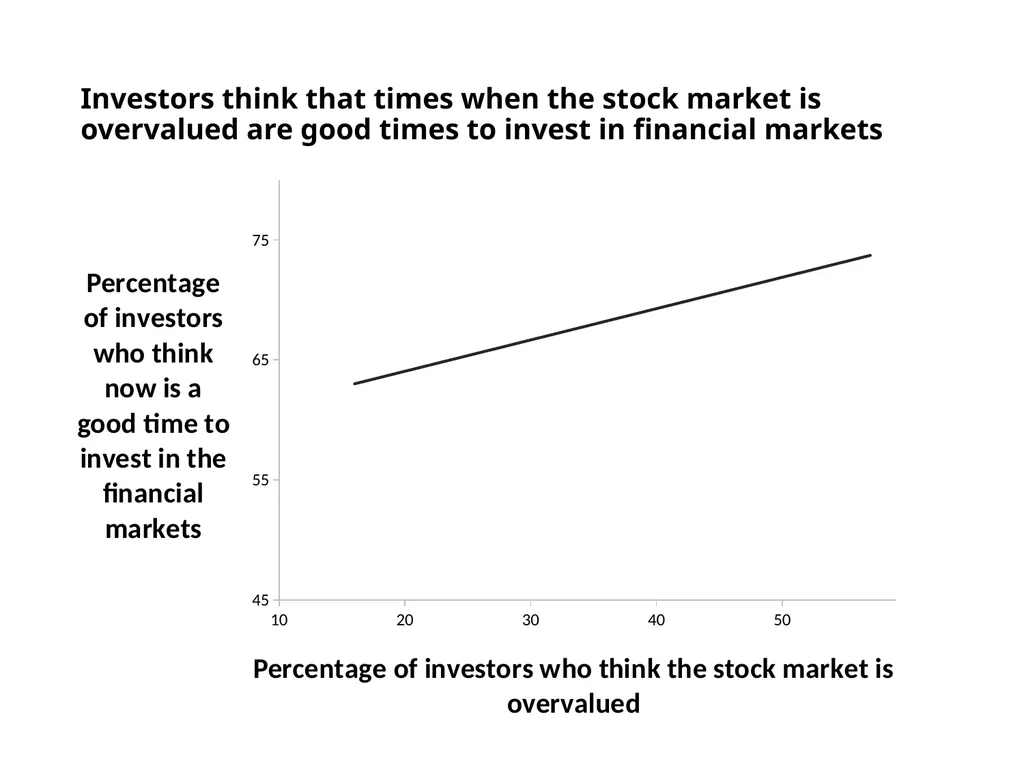
slide14. Investors think that times when the stock market is overvalued are good times to invest in financial markets<br>
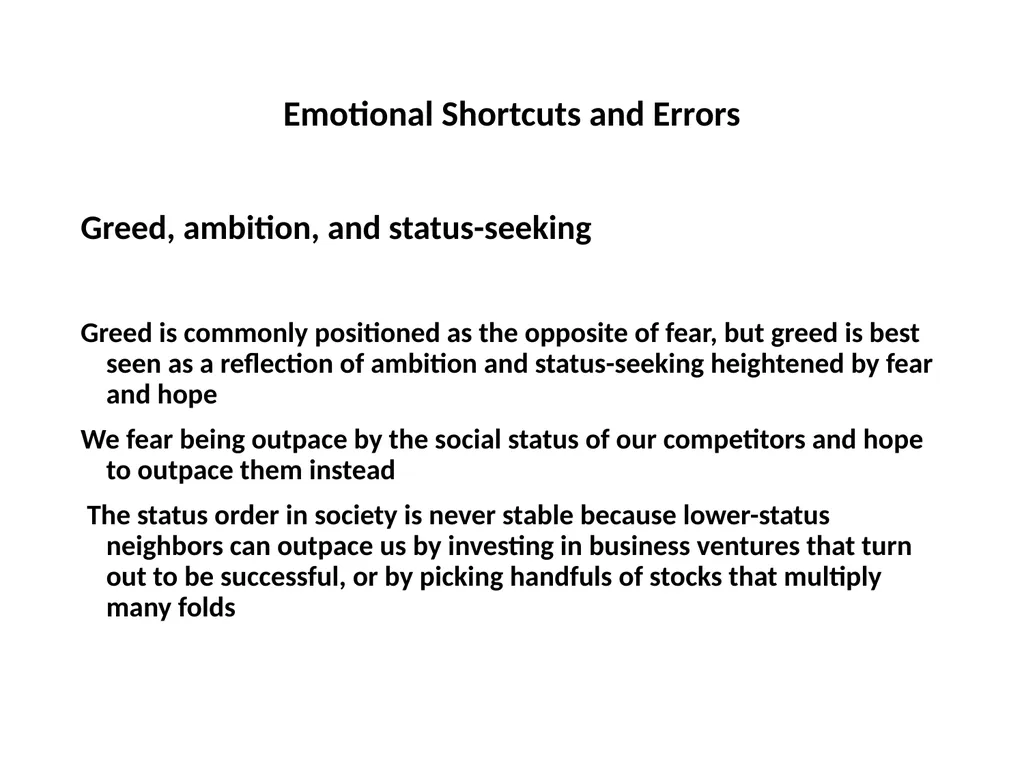
slide15. Emotional Shortcuts and Errors Greed, ambition, and status-seeking
Greed is commonly positioned as the opposite of fear, but greed is best seen as a reflection of ambition and status-seeking heightened by fear and hope
We fear being outpace by the social status of our competitors and hope to outpace them instead
The status order in society is never stable because lower-status neighbors can outpace us by investing in business ventures that turn out to be successful, or by picking handfuls of stocks that multiply many folds<br>
slide16. Emotional Shortcuts and Errors Happiness, Sadness, and Disgust
Happiness comes with gains and enjoyment, sadness with losses and helplessness, and disgust with proximity to distasteful objects or ideas
Happiness encourages us toward actions that bring further gains and enjoyment,
sadness prods us to pause and contemplate actions that would stem losses and helplessness,
and disgust prompts us to expel repellent objects and keep our distance from abhorrent ideas<br>
slide17. Emotional Shortcuts and Errors “The Champ” https://www.youtube.com/watch?v=SU7NGJw0kR8
“Trainspotting” https://www.youtube.com/watch?v=cyiC3x6-Kzk
The Great Barrier Reef https://www.youtube.com/watch?v=vTE_hQVccps<br>
slide18. Emotional Shortcuts and Errors The “ultimatum game”<br>
slide19. Emotional Shortcuts and Errors Regret and Pride
Regret is a “cognitive emotion,” a negative and unpleasant one we experience when we can easily imagine a different choice that would have brought a better outcome.
People mention regret as the most frequent negative emotion they experience<br>
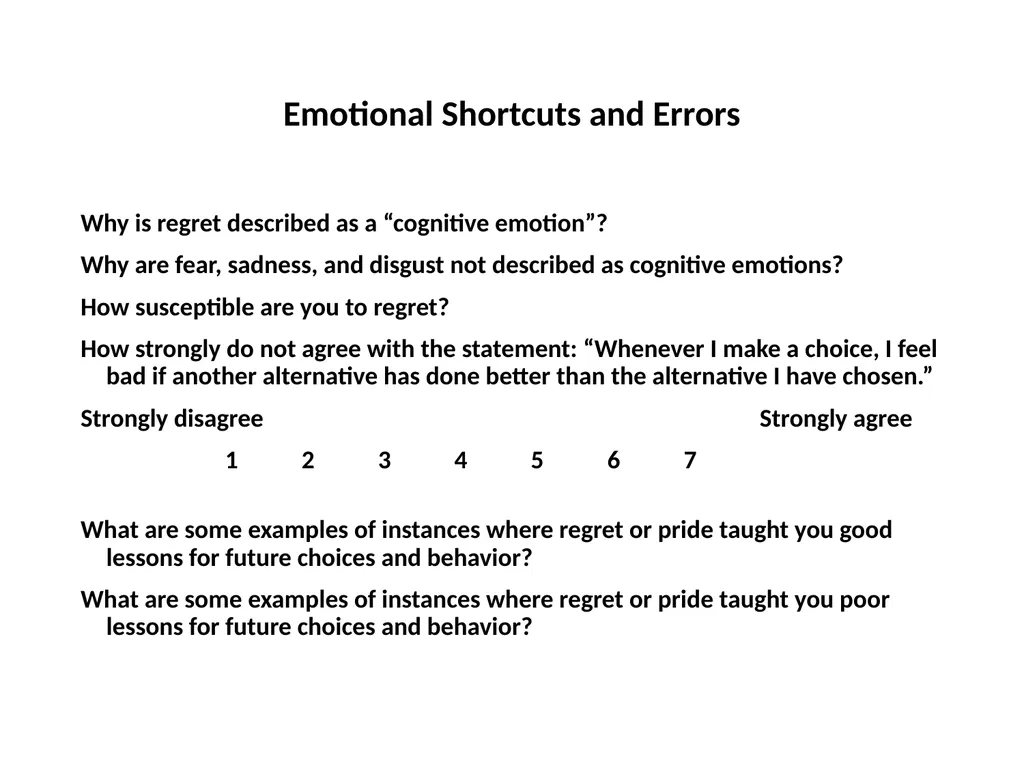
slide20. Emotional Shortcuts and Errors Why is regret described as a “cognitive emotion”?
Why are fear, sadness, and disgust not described as cognitive emotions?
How susceptible are you to regret?
How strongly do not agree with the statement: “Whenever I make a choice, I feel bad if another alternative has done better than the alternative I have chosen.”
Strongly disagree Strongly agree
1 2 3 4 5 6 7
What are some examples of instances where regret or pride taught you good lessons for future choices and behavior?
What are some examples of instances where regret or pride taught you poor lessons for future choices and behavior?<br>
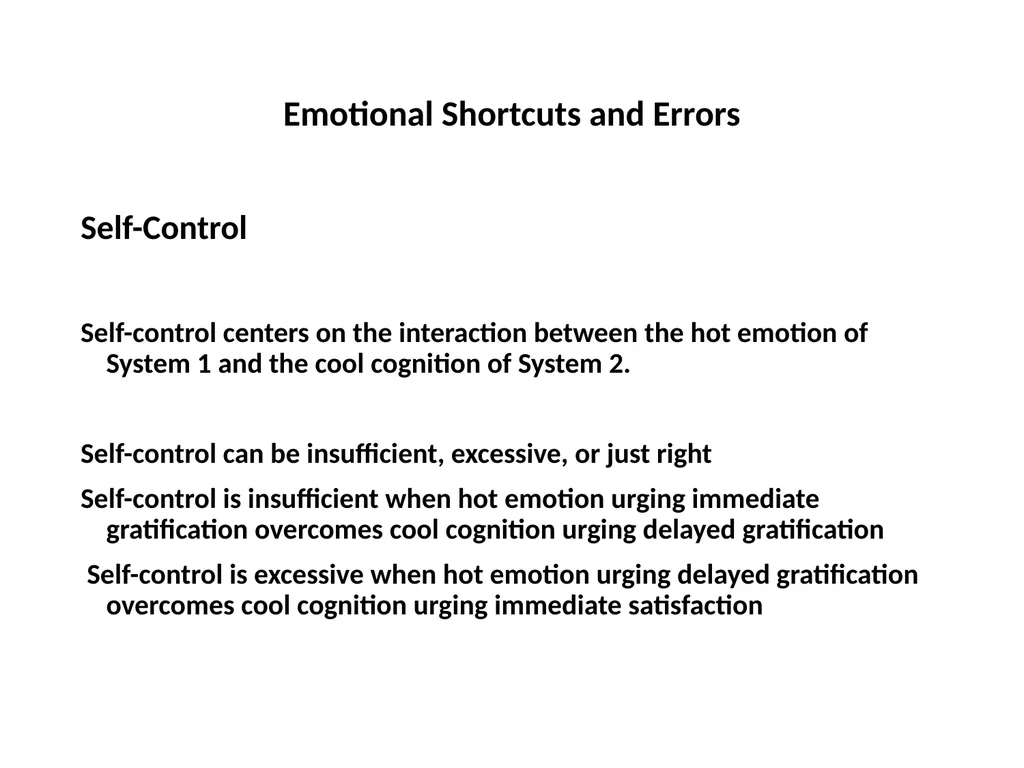
slide21. Emotional Shortcuts and Errors Self-Control
Self-control centers on the interaction between the hot emotion of System 1 and the cool cognition of System 2.
Self-control can be insufficient, excessive, or just right
Self-control is insufficient when hot emotion urging immediate gratification overcomes cool cognition urging delayed gratification
Self-control is excessive when hot emotion urging delayed gratification overcomes cool cognition urging immediate satisfaction<br>
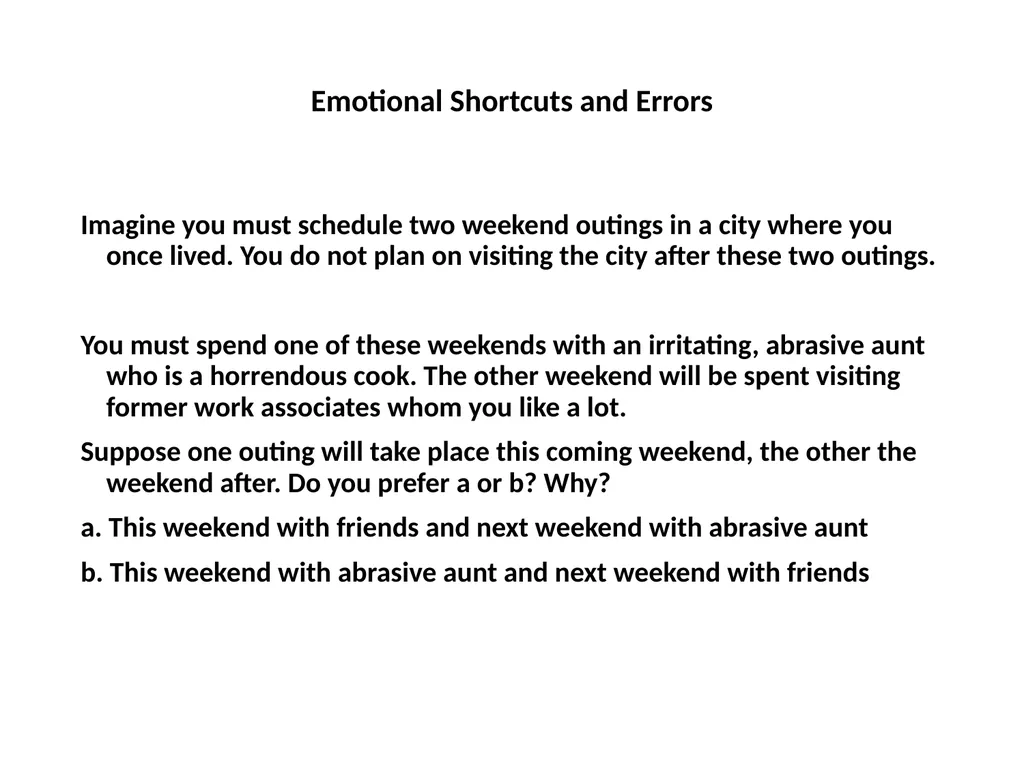
slide22. Emotional Shortcuts and Errors Imagine you must schedule two weekend outings in a city where you once lived. You do not plan on visiting the city after these two outings.
You must spend one of these weekends with an irritating, abrasive aunt who is a horrendous cook. The other weekend will be spent visiting former work associates whom you like a lot.
Suppose one outing will take place this coming weekend, the other the weekend after. Do you prefer a or b? Why?
a. This weekend with friends and next weekend with abrasive aunt
b. This weekend with abrasive aunt and next weekend with friends<br>
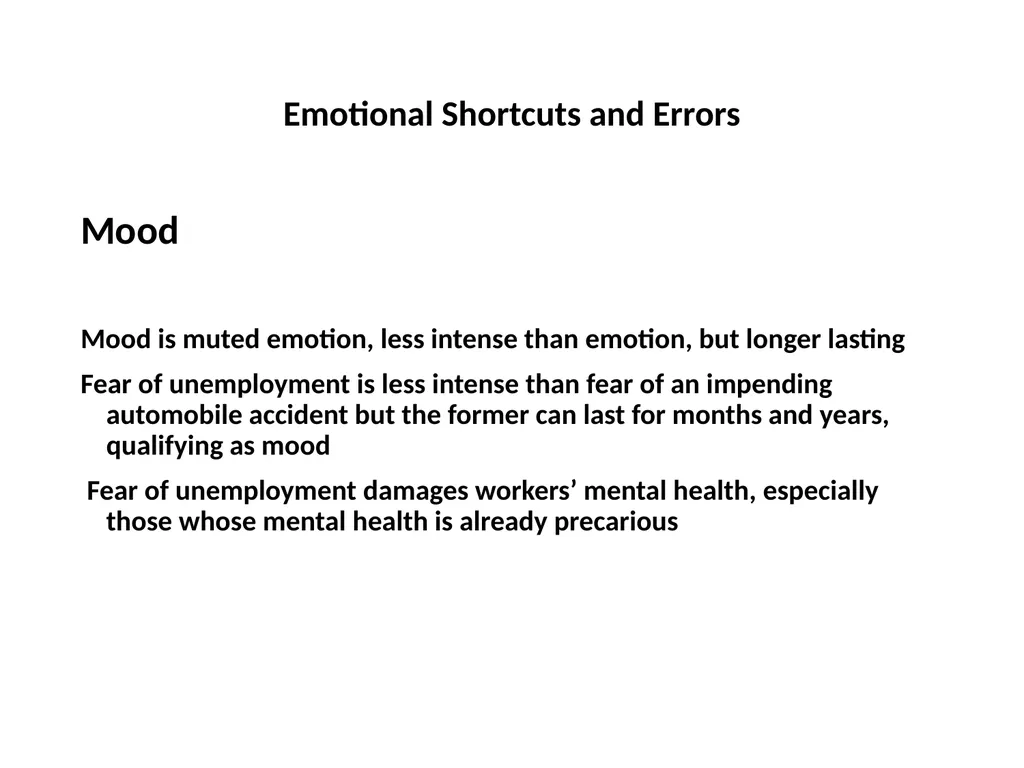
slide23. Emotional Shortcuts and Errors Mood
Mood is muted emotion, less intense than emotion, but longer lasting
Fear of unemployment is less intense than fear of an impending automobile accident but the former can last for months and years, qualifying as mood
Fear of unemployment damages workers’ mental health, especially those whose mental health is already precarious<br>
slide24. Emotional Shortcuts and Errors Optimism and pessimism can be described as moods
Optimism is associated with the emotions of hope and happiness, and pessimism with the emotions of fear and sadness, but optimism and pessimism are not as intense as hope, happiness, fear, or sadness. Sentiment in the context of investments often corresponds to mood
Bearish sentiment corresponds to pessimistic mood and bullish sentiment to optimistic one.<br>
slide25. Emotional Shortcuts and Errors Affect
Affect is the faint whisper of emotion or mood, stripped down to valence, positive or negative<br>
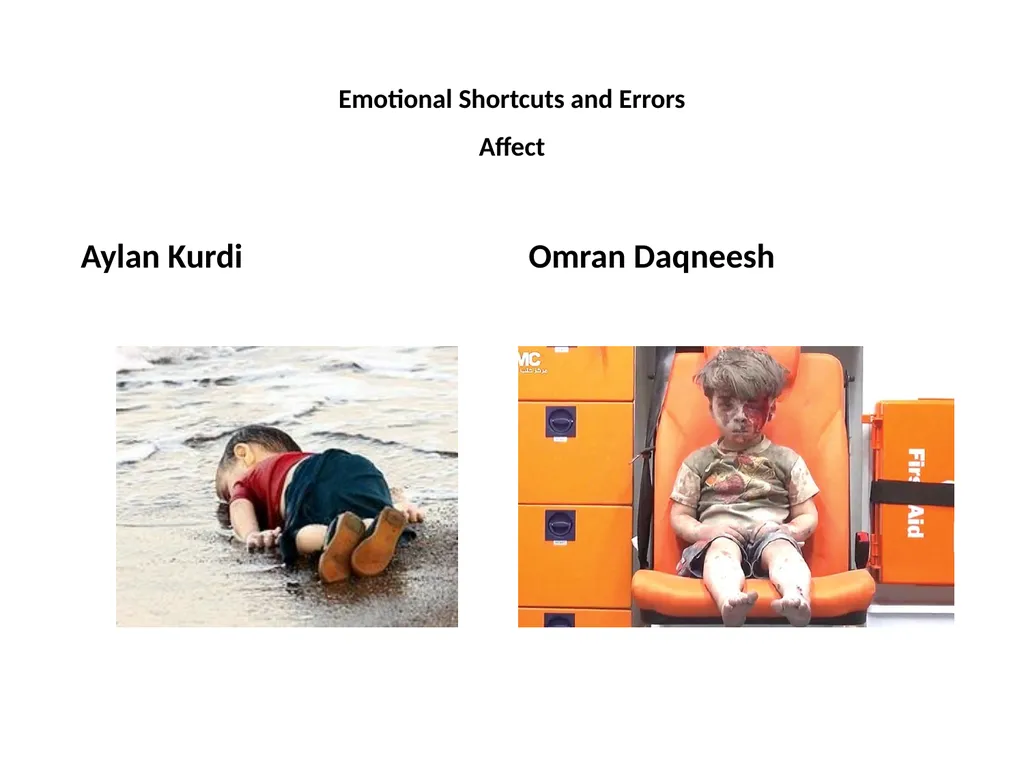
slide26. Emotional Shortcuts and Errors Affect Aylan Kurdi Omran Daqneesh<br>
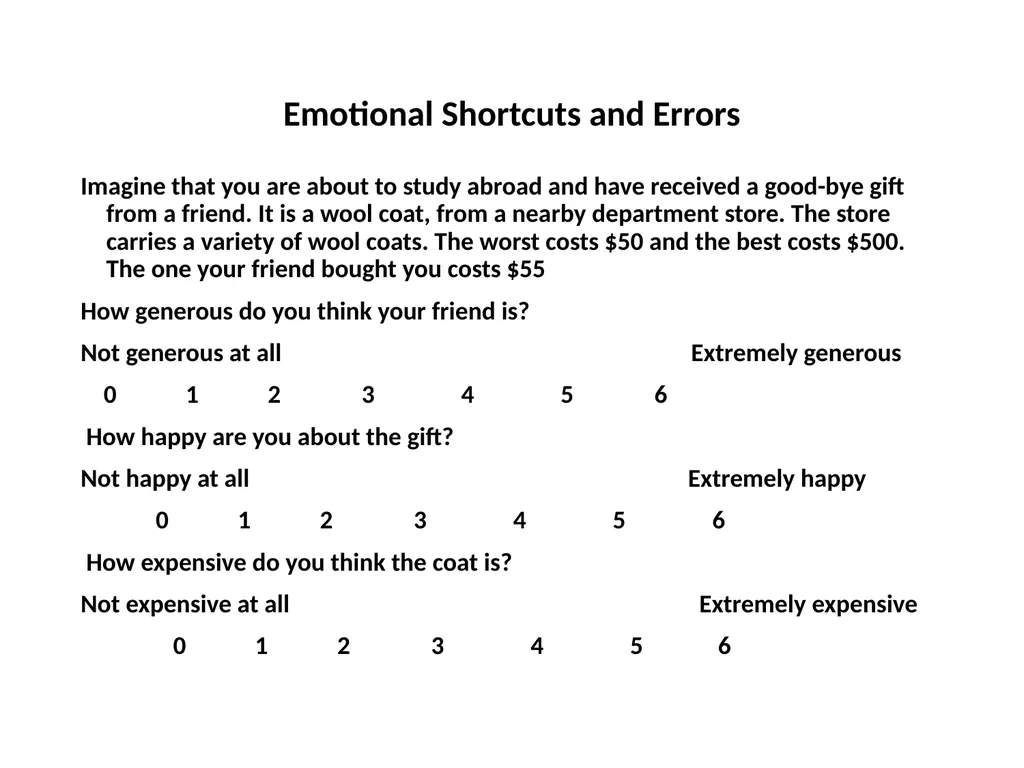
slide27. Emotional Shortcuts and Errors Imagine that you are about to study abroad and have received a good-bye gift from a friend. It is a wool coat, from a nearby department store. The store carries a variety of wool coats. The worst costs $50 and the best costs $500. The one your friend bought you costs $55
How generous do you think your friend is?
Not generous at all Extremely generous
0 1 2 3 4 5 6
How happy are you about the gift?
Not happy at all Extremely happy
0 1 2 3 4 5 6
How expensive do you think the coat is?
Not expensive at all Extremely expensive
0 1 2 3 4 5 6<br>
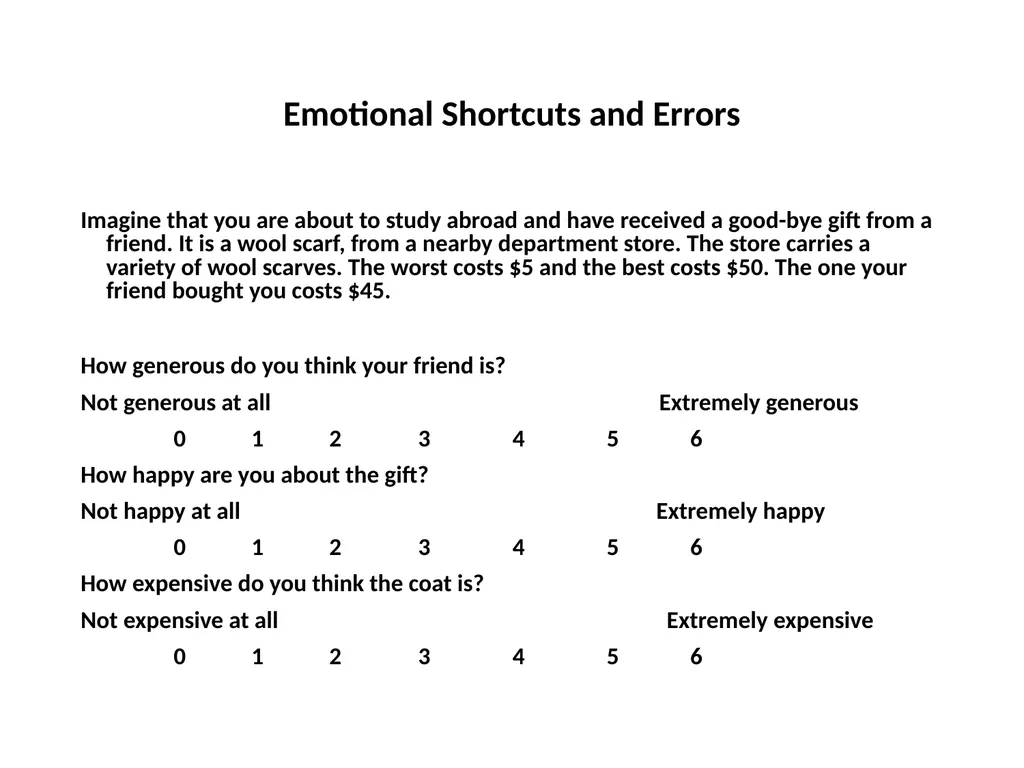
slide28. Emotional Shortcuts and Errors Imagine that you are about to study abroad and have received a good-bye gift from a friend. It is a wool scarf, from a nearby department store. The store carries a variety of wool scarves. The worst costs $5 and the best costs $50. The one your friend bought you costs $45.
How generous do you think your friend is?
Not generous at all Extremely generous
0 1 2 3 4 5 6
How happy are you about the gift?
Not happy at all Extremely happy
0 1 2 3 4 5 6
How expensive do you think the coat is?
Not expensive at all Extremely expensive
0 1 2 3 4 5 6<br>
Chapter 4 – Emotional Shortcuts and Errors<br>
slide2. Emotional Shortcuts and Errors Emotional shortcuts, like cognitive shortcuts, are part of the intuitive “blink” System 1 in our minds, leading to good choices in most of life
But shortcuts turn into errors when they mislead us into poor choices
System 2, the reflective “think” system in our minds leads to better choices when System 1 misleads<br>
slide3. Emotional Shortcuts and Errors People with knowledge of human behavior and financial facts use emotional shortcuts correctly,
whereas people lacking such knowledge commit emotional errors as they use them incorrectly<br>
slide4. Emotional Shortcuts and Errors Fear
Fear acts as an emotional shortcut that turns into an error when fear is absent or when it is exaggerated
Fear guides us rightly when it prompts us to retreat from a knife-wielding stranger bearing an angry face, and when it prevents us from buying houses likely to be repossessed in foreclosures
But fear guides us wrongly when it prompts us to retreat from a knife-wielding friend who chops vegetables, and when it compels us to sell all our stocks in a financial crisis<br>
slide5. Emotional Shortcuts and Errors The interaction between cognition and emotion makes it difficult to attribute shortcuts, errors, and choices to one or the other
Reason tells us that flying is safer than driving long distances, yet some choose to drive
The choice can be attributed to cognition, where images of crashed airplanes are more readily available to mind than images of crashed cars, or to emotion, where airplane crashes evoke greater fear, or to a combination of both<br>
slide6. Emotional Shortcuts and Errors Emotion, mood, and affect
Emotion is very intense, with a short duration and clear focus
Mood is muted emotion, less intense than emotion, but longer lasting
Affect is the faint whisper of emotion or mood, stripped down to valence, positive or negative<br>
slide7. Emotional Shortcuts and Errors Emotion, mood, and affect
Emotion, mood, and affect are regularly comingled but they are distinct by intensity, duration, focus, and valence - positive or negative
Fear was a very intense negative emotion felt in early 2009 as we focused on stock markets that cut retirement savings by half for some and threatened to cut much more
Fear abated into a less intense but longer lasting negative mood that has persisted even as the stock market recovered
The emotion of fear and its mood have subsequently faded into a much less intense but longer lasting negative affect of stock markets<br>
slide8. Emotional Shortcuts and Errors Emotions
Psychologist Paul Ekman classically listed seven emotions whose physiological effects are evident in facial expressions:
Fear, anger, sadness, disgust, surprise, happiness, and contentment
Yet there is no generally accepted list of emotions. Other lists also include, hope, pride, regret, shame, guilt, and self-control<br>
slide9. Emotional Shortcuts and Errors The appraisal-tendency framework (ATF) distinguishes cognitive appraisals from appraisal tendencies
People experience anger after being cut off in traffic by bad drivers
Appraisal tendencies activated by this anger shape future perceptions and behavior
Appraisal tendencies lead angry people to take more risk in future activities even if these are unrelated to driving, such as taking more investment risk<br>
slide10. Emotional Shortcuts and Errors Hope and Fear
Fear is a negative emotion arising in response to danger whereas hope is a positive one in anticipation of reward
Cognitive appraisal notes that fear is unpleasant and hope is pleasant, but the two are similar in that control is in the hands of others, whether other people or situations
We fear the danger of an airplane crash but cannot control the outcome. We hope to win the lottery but cannot control the outcome Exuberance is extreme hope, as in the famed case of “irrational exuberance”<br>
slide11. Emotional Shortcuts and Errors Fear increases risk-aversion even among financial professionals, leading to high risk-aversion in financial busts and low risk-aversion in financial booms
Financial professionals asked to read a story about a financial bust became more fearful than those asked to read a story about a financial boom, and fear led them to reduce risky investments<br>
slide12. Emotional shortcuts and errors: Fear and Exuberance Do you think that now is a good time to invest in the financial markets? Percentage of investors who said Yes Percent Source: UBS Index of Investor Optimism 10,938 Feb-00 78% 7,890 Mar-03 41% Dec-07 55% 13,366<br>
slide13. Investors think that times following high stock returns are good times to invest in financial markets<br>
slide14. Investors think that times when the stock market is overvalued are good times to invest in financial markets<br>
slide15. Emotional Shortcuts and Errors Greed, ambition, and status-seeking
Greed is commonly positioned as the opposite of fear, but greed is best seen as a reflection of ambition and status-seeking heightened by fear and hope
We fear being outpace by the social status of our competitors and hope to outpace them instead
The status order in society is never stable because lower-status neighbors can outpace us by investing in business ventures that turn out to be successful, or by picking handfuls of stocks that multiply many folds<br>
slide16. Emotional Shortcuts and Errors Happiness, Sadness, and Disgust
Happiness comes with gains and enjoyment, sadness with losses and helplessness, and disgust with proximity to distasteful objects or ideas
Happiness encourages us toward actions that bring further gains and enjoyment,
sadness prods us to pause and contemplate actions that would stem losses and helplessness,
and disgust prompts us to expel repellent objects and keep our distance from abhorrent ideas<br>
slide17. Emotional Shortcuts and Errors “The Champ” https://www.youtube.com/watch?v=SU7NGJw0kR8
“Trainspotting” https://www.youtube.com/watch?v=cyiC3x6-Kzk
The Great Barrier Reef https://www.youtube.com/watch?v=vTE_hQVccps<br>
slide18. Emotional Shortcuts and Errors The “ultimatum game”<br>
slide19. Emotional Shortcuts and Errors Regret and Pride
Regret is a “cognitive emotion,” a negative and unpleasant one we experience when we can easily imagine a different choice that would have brought a better outcome.
People mention regret as the most frequent negative emotion they experience<br>
slide20. Emotional Shortcuts and Errors Why is regret described as a “cognitive emotion”?
Why are fear, sadness, and disgust not described as cognitive emotions?
How susceptible are you to regret?
How strongly do not agree with the statement: “Whenever I make a choice, I feel bad if another alternative has done better than the alternative I have chosen.”
Strongly disagree Strongly agree
1 2 3 4 5 6 7
What are some examples of instances where regret or pride taught you good lessons for future choices and behavior?
What are some examples of instances where regret or pride taught you poor lessons for future choices and behavior?<br>
slide21. Emotional Shortcuts and Errors Self-Control
Self-control centers on the interaction between the hot emotion of System 1 and the cool cognition of System 2.
Self-control can be insufficient, excessive, or just right
Self-control is insufficient when hot emotion urging immediate gratification overcomes cool cognition urging delayed gratification
Self-control is excessive when hot emotion urging delayed gratification overcomes cool cognition urging immediate satisfaction<br>
slide22. Emotional Shortcuts and Errors Imagine you must schedule two weekend outings in a city where you once lived. You do not plan on visiting the city after these two outings.
You must spend one of these weekends with an irritating, abrasive aunt who is a horrendous cook. The other weekend will be spent visiting former work associates whom you like a lot.
Suppose one outing will take place this coming weekend, the other the weekend after. Do you prefer a or b? Why?
a. This weekend with friends and next weekend with abrasive aunt
b. This weekend with abrasive aunt and next weekend with friends<br>
slide23. Emotional Shortcuts and Errors Mood
Mood is muted emotion, less intense than emotion, but longer lasting
Fear of unemployment is less intense than fear of an impending automobile accident but the former can last for months and years, qualifying as mood
Fear of unemployment damages workers’ mental health, especially those whose mental health is already precarious<br>
slide24. Emotional Shortcuts and Errors Optimism and pessimism can be described as moods
Optimism is associated with the emotions of hope and happiness, and pessimism with the emotions of fear and sadness, but optimism and pessimism are not as intense as hope, happiness, fear, or sadness. Sentiment in the context of investments often corresponds to mood
Bearish sentiment corresponds to pessimistic mood and bullish sentiment to optimistic one.<br>
slide25. Emotional Shortcuts and Errors Affect
Affect is the faint whisper of emotion or mood, stripped down to valence, positive or negative<br>
slide26. Emotional Shortcuts and Errors Affect Aylan Kurdi Omran Daqneesh<br>
slide27. Emotional Shortcuts and Errors Imagine that you are about to study abroad and have received a good-bye gift from a friend. It is a wool coat, from a nearby department store. The store carries a variety of wool coats. The worst costs $50 and the best costs $500. The one your friend bought you costs $55
How generous do you think your friend is?
Not generous at all Extremely generous
0 1 2 3 4 5 6
How happy are you about the gift?
Not happy at all Extremely happy
0 1 2 3 4 5 6
How expensive do you think the coat is?
Not expensive at all Extremely expensive
0 1 2 3 4 5 6<br>
slide28. Emotional Shortcuts and Errors Imagine that you are about to study abroad and have received a good-bye gift from a friend. It is a wool scarf, from a nearby department store. The store carries a variety of wool scarves. The worst costs $5 and the best costs $50. The one your friend bought you costs $45.
How generous do you think your friend is?
Not generous at all Extremely generous
0 1 2 3 4 5 6
How happy are you about the gift?
Not happy at all Extremely happy
0 1 2 3 4 5 6
How expensive do you think the coat is?
Not expensive at all Extremely expensive
0 1 2 3 4 5 6<br>