
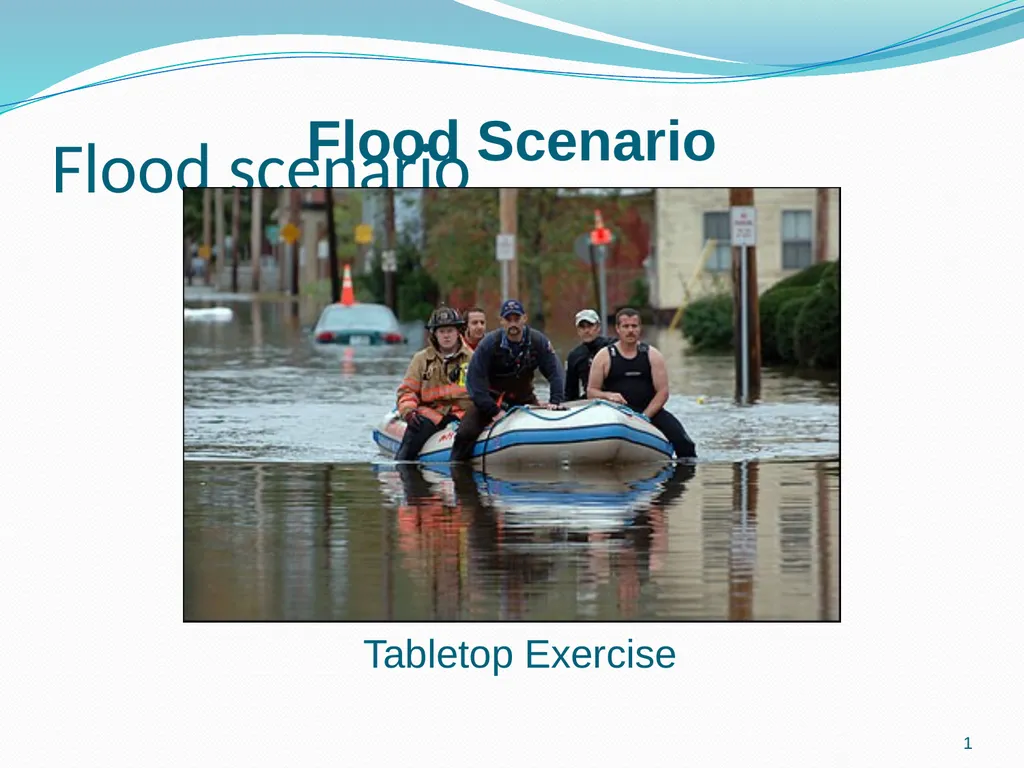
Flood scenario 1 Flood Scenario Tabletop Exercise
KL
Published · 29 slides · 0 views

1 / 1
Description
Flood scenario 1 Flood Scenario Tabletop Exercise Tabletop Exercise 2 Welcome and introductions Discuss agenda for the day Review administrative details Start the exercise Welcome and Introductions Name Organization Emergency response
Related Topics
Share
Embed code
Download this presentation From Below
"Flood scenario 1 Flood Scenario Tabletop Exercise" is the property of its rightful owner. Permission is granted to download and print the materials on this website for personal, non-commercial use only, and to display it on your personal computer provided you do not modify the materials and that you retain all copyright notices contained in the materials. By downloading content from our website, you accept the terms of this agreement.
Presentation Transcript
01
Flood scenario 1 Flood Scenario Tabletop Exercise<br>
02
Tabletop Exercise 2 Welcome and introductions
Discuss agenda for the day
Review administrative details
Start the exercise<br>
Discuss agenda for the day
Review administrative details
Start the exercise<br>
03
Welcome and Introductions Name
Organization
Emergency response experience 3<br>
Organization
Emergency response experience 3<br>
04
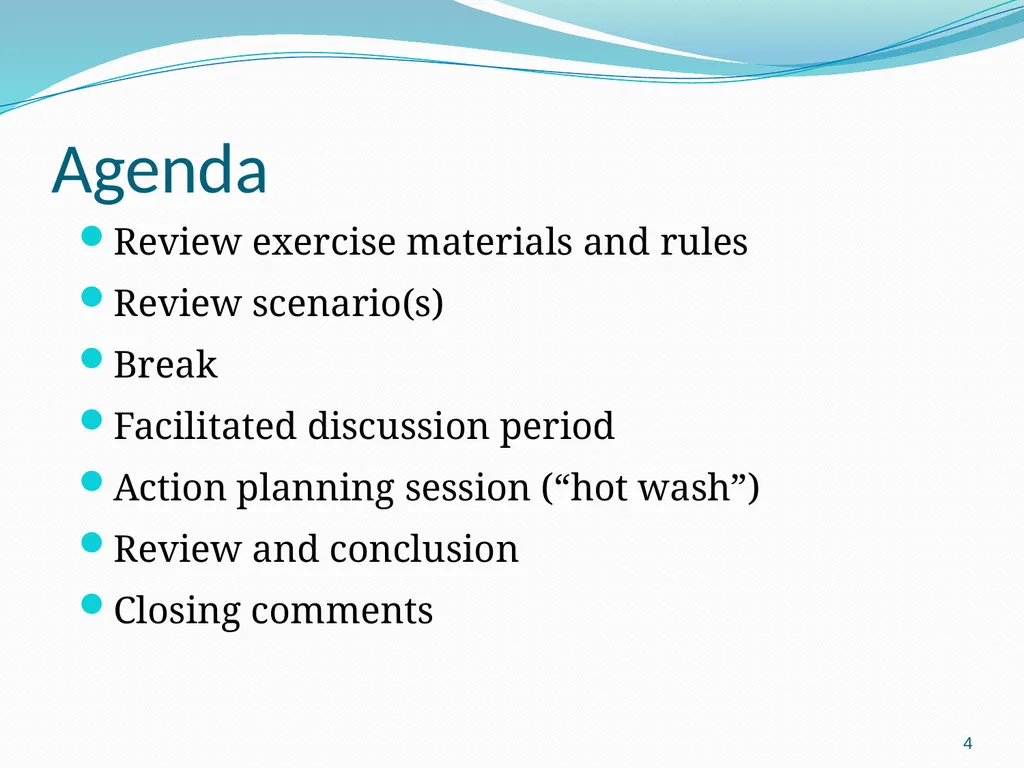
Agenda 4 Review exercise materials and rules
Review scenario(s)
Break
Facilitated discussion period
Action planning session (“hot wash”)
Review and conclusion
Closing comments<br>
Review scenario(s)
Break
Facilitated discussion period
Action planning session (“hot wash”)
Review and conclusion
Closing comments<br>
05
Administrative Details Location of emergency exits
Location of restrooms
Cell phone and pager management
Logging your time to fulfill training requirements
Sign-in sheet and participant evaluation form 5<br>
Location of restrooms
Cell phone and pager management
Logging your time to fulfill training requirements
Sign-in sheet and participant evaluation form 5<br>
06
Exercise Benefits: Increase readiness in the event of an actual emergency
Provide a means to assess effectiveness of response plans and response capabilities
Serve as a training tool for response personnel and their involvement with other response agencies
Provide an opportunity to practice skills and improve individual performance in a non-threatening environment 6<br>
Provide a means to assess effectiveness of response plans and response capabilities
Serve as a training tool for response personnel and their involvement with other response agencies
Provide an opportunity to practice skills and improve individual performance in a non-threatening environment 6<br>
07
Exercise Benefits: (cont.) Require participants to network with each other and pre-plan decisions on resources
Identify planning conflicts or gaps
Identify resource needs and opportunities for sharing of resources
Clarify internal and external roles and responsibilities 7<br>
Identify planning conflicts or gaps
Identify resource needs and opportunities for sharing of resources
Clarify internal and external roles and responsibilities 7<br>
08
8 Exercise Objectives: At the conclusion of this exercise, participants should be able to do the following:
Define or refine participants’ roles and responsibilities for managing the consequences of a flood incident, which should be reflected in their plans, policies and procedures and other preparedness elements currently in place or under development
Build relationships between utilities and stakeholders<br>
Define or refine participants’ roles and responsibilities for managing the consequences of a flood incident, which should be reflected in their plans, policies and procedures and other preparedness elements currently in place or under development
Build relationships between utilities and stakeholders<br>
09
9 Exercise Objectives: (cont.) Determine neighboring utility water infrastructure capabilities and needs
Identify other needed enhancements related to training and exercises and other preparedness elements currently in place or under development
This session will not be a success unless you as a participant go back to your office and follow through<br>
Identify other needed enhancements related to training and exercises and other preparedness elements currently in place or under development
This session will not be a success unless you as a participant go back to your office and follow through<br>
10
Roles and Responsibilities: 10 Players respond to the situation presented based on expert knowledge of response procedures, current plans and procedures, and insights derived from training and experience
Observers observe the exercise but do not participate in the facilitated discussion period
Facilitators lead the exercise by presenting the scenario narrative and facilitating the discussion period and “hot wash” (Action planning session or review session)
Evaluators monitor the exercise, track accomplishments according to objectives and may ask questions<br>
Observers observe the exercise but do not participate in the facilitated discussion period
Facilitators lead the exercise by presenting the scenario narrative and facilitating the discussion period and “hot wash” (Action planning session or review session)
Evaluators monitor the exercise, track accomplishments according to objectives and may ask questions<br>
11
Exercise Rules: This exercise will be held in an open, low-stress, no-fault environment varying viewpoints, even disagreements, are expected
Respond to the scenario using your knowledge of current plans and capabilities (i.e., you may use only existing assets) and insights derived from your training
Decisions are not precedent setting and may not reflect your organization’s final position on a given issue this exercise is an opportunity to discuss and present multiple options and possible solutions 11<br>
Respond to the scenario using your knowledge of current plans and capabilities (i.e., you may use only existing assets) and insights derived from your training
Decisions are not precedent setting and may not reflect your organization’s final position on a given issue this exercise is an opportunity to discuss and present multiple options and possible solutions 11<br>
12
Exercise Rules: (cont.) Issue identification is not as valuable as suggestions and recommended actions that could improve [prevention, protection, mitigation, response or recovery] efforts problem-solving efforts should be the focus
Assume there will be cooperation and support from other responders and agencies
The basis for discussion consists of the scenario narrative and modules, your experience, your understanding of your Emergency Response Plan (ERP), your intuition and other utility resources included as part of this material or that you brought with you
Treat the scenario as if it will affect your area 12<br>
Assume there will be cooperation and support from other responders and agencies
The basis for discussion consists of the scenario narrative and modules, your experience, your understanding of your Emergency Response Plan (ERP), your intuition and other utility resources included as part of this material or that you brought with you
Treat the scenario as if it will affect your area 12<br>
13
Action planning session 13 Action Planning Session: Following the facilitated discussion period, the facilitator will lead an Action Planning Session, also known as a “hot wash”
Participants are encouraged to identify, discuss and prioritize next steps, actions, tasks and other follow-up activities
Identify additional collaborators if needed
Schedule a follow-up meeting<br>
Participants are encouraged to identify, discuss and prioritize next steps, actions, tasks and other follow-up activities
Identify additional collaborators if needed
Schedule a follow-up meeting<br>
14
Flood Scenario Cybersecurity scenario 14<br>
15
Background Slow-moving storms brought significant and widespread heavy rains across the region
The heavy rains began saturating soils, filling local reservoirs, swelling streams and rivers and clogging storm drains with debris
Immediately following these events, another storm system moved through the region bringing heavy precipitation, high temperatures, humidity and winds over a 4-day period, causing further flooding in rivers and low-lying areas 15<br>
The heavy rains began saturating soils, filling local reservoirs, swelling streams and rivers and clogging storm drains with debris
Immediately following these events, another storm system moved through the region bringing heavy precipitation, high temperatures, humidity and winds over a 4-day period, causing further flooding in rivers and low-lying areas 15<br>
16
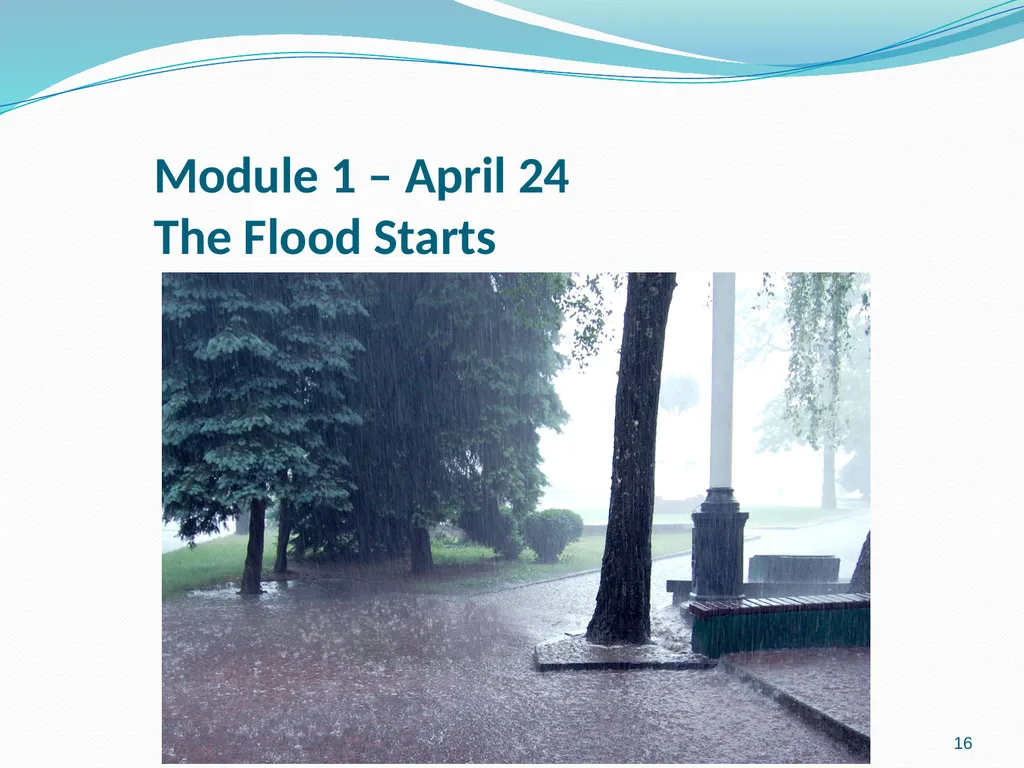
16 Module 1 – April 24
The Flood Starts<br>
17
17 Module 1 – April 24, 0700 hrs Mean average rainfall from the recent storm system varied from 6 inches to more than 8 inches, with some individual gauges reporting more than 9 inches
This storm system, combined with the effects of the earlier slow-moving storms, is expected to produce major flooding throughout the region
In addition, a new storm system is expected to arrive in the next 24 hours<br>
This storm system, combined with the effects of the earlier slow-moving storms, is expected to produce major flooding throughout the region
In addition, a new storm system is expected to arrive in the next 24 hours<br>
18
Key Issues – Module 1 The surface water treatment plant is partially flooded turbidity and total coliform counts are above acceptable limits
Customer calls are increasing in frequency, with the chief complaint being that the water is brown or “dirty”
The water utility laboratory is being strained by the number of samples that need to be analyzed and cannot run some of the needed tests
The wastewater treatment plant is partially under water, but the level of flood water is holding steady for now
Once the water recedes, the wastewater utility needs heavy equipment (that it does not have) to remove the flood debris piled in and around the pump stations and broken lines 18<br>
Customer calls are increasing in frequency, with the chief complaint being that the water is brown or “dirty”
The water utility laboratory is being strained by the number of samples that need to be analyzed and cannot run some of the needed tests
The wastewater treatment plant is partially under water, but the level of flood water is holding steady for now
Once the water recedes, the wastewater utility needs heavy equipment (that it does not have) to remove the flood debris piled in and around the pump stations and broken lines 18<br>
19
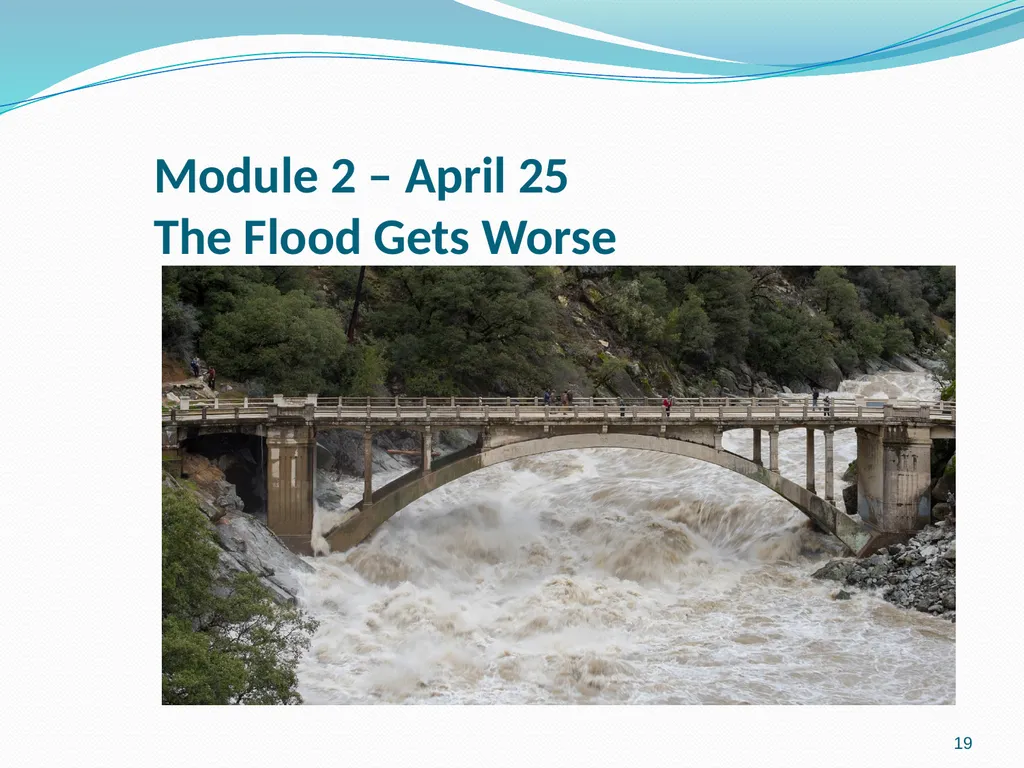
19 Module 2 – April 25
The Flood Gets Worse<br>
20
Module 2 – April 25, 0700 hrs Some creeks and rivers are expected to crest at 8 to 12 feet above flood stage
The National Weather Service is extending the flood watch, because flood peaks are expected within 24 hours
Communities throughout the region are working around the clock sandbagging vulnerable areas
Emergency Operation Centers (EOCs) have been activated
Hundreds of people are evacuating the area, including entire communities and towns 20<br>
The National Weather Service is extending the flood watch, because flood peaks are expected within 24 hours
Communities throughout the region are working around the clock sandbagging vulnerable areas
Emergency Operation Centers (EOCs) have been activated
Hundreds of people are evacuating the area, including entire communities and towns 20<br>
21
Key Issues – Module 2 Every available employee at the water utility is working to maintain service and protect the plant from further damage, but progress is slow and is expected to get worse as the floodwaters rise
Road washouts and sinkholes have caused water main and individual water service breaks and water pressure is low in some neighborhoods
The collection system is surcharged due to flooding upstream of the wastewater utility manholes are submerged and covers have floated off
At the effluent discharge point, flood debris has blocked the outfall and may cause a backup of effluent 21<br>
Road washouts and sinkholes have caused water main and individual water service breaks and water pressure is low in some neighborhoods
The collection system is surcharged due to flooding upstream of the wastewater utility manholes are submerged and covers have floated off
At the effluent discharge point, flood debris has blocked the outfall and may cause a backup of effluent 21<br>
22
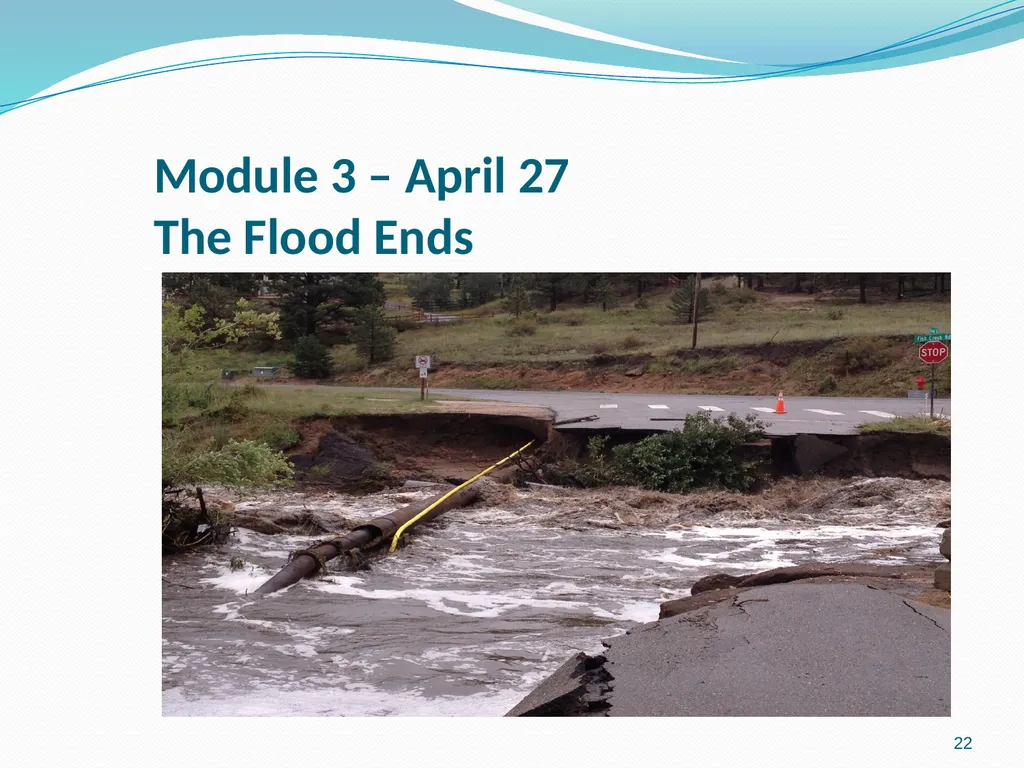
22 Module 3 – April 27
The Flood Ends<br>
23
Module 3 – April 27, 1200 hrs Trees fall, downing power lines and resulting in a loss of power across 75 percent of the area
There are dangerous road washouts and sinkholes
Water distribution and sewer collection lines are damaged, as well as other vulnerable underground infrastructure 23<br>
There are dangerous road washouts and sinkholes
Water distribution and sewer collection lines are damaged, as well as other vulnerable underground infrastructure 23<br>
24
Key Issues – Module 3 Backup generators are currently sustaining the utilities, but fuel is running low
The community hospital has notified the water utility that it is experiencing a significant loss of pressure
Treatment chemical deliveries will be delayed due to bridge washouts and temporary road closures 24<br>
The community hospital has notified the water utility that it is experiencing a significant loss of pressure
Treatment chemical deliveries will be delayed due to bridge washouts and temporary road closures 24<br>
25
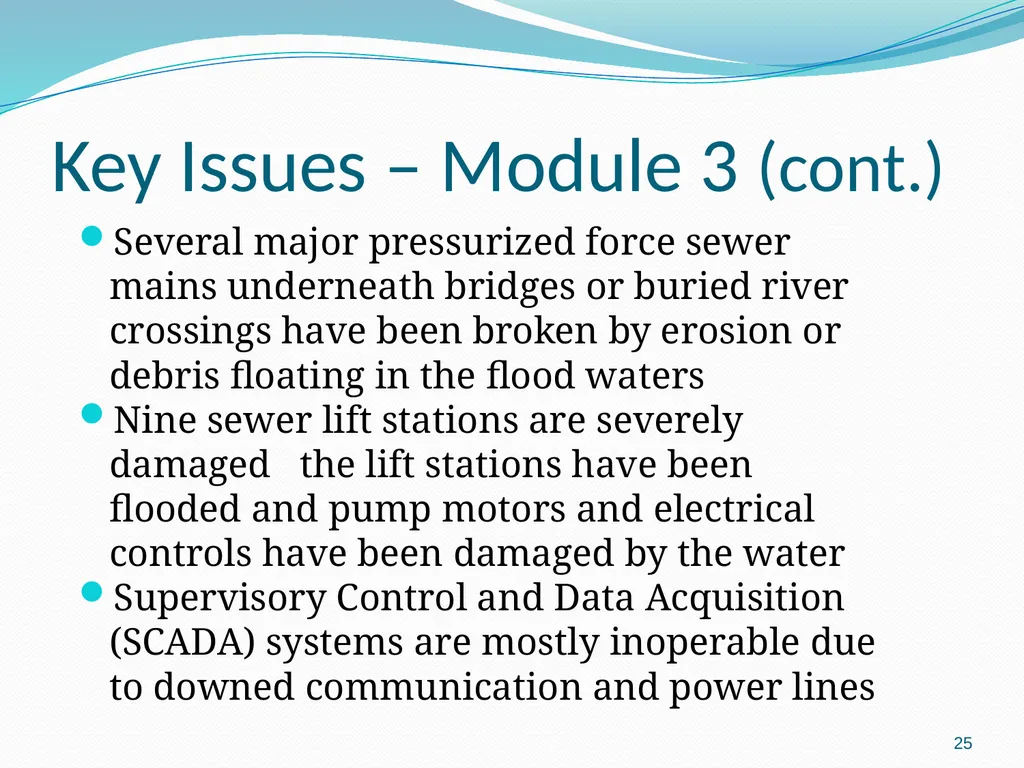
Key Issues – Module 3 (cont.) Several major pressurized force sewer mains underneath bridges or buried river crossings have been broken by erosion or debris floating in the flood waters
Nine sewer lift stations are severely damaged the lift stations have been flooded and pump motors and electrical controls have been damaged by the water
Supervisory Control and Data Acquisition (SCADA) systems are mostly inoperable due to downed communication and power lines 25<br>
Nine sewer lift stations are severely damaged the lift stations have been flooded and pump motors and electrical controls have been damaged by the water
Supervisory Control and Data Acquisition (SCADA) systems are mostly inoperable due to downed communication and power lines 25<br>
26
Action Planning Session Post-Exercise “Hot Wash” Action planning session
post exercise 26<br>
27
Review of exercise objectives 27 Review of Exercise Objectives Explore and address cybersecurity challenges
Define or refine participants’ roles and responsibilities for managing the consequences of a cybersecurity incident, which should be reflected in their plans, policies and procedures and other preparedness elements currently in place or under development
Build relationships between utilities and stakeholders
Increase awareness of the damage that can be caused by a cybersecurity incident on a business or control system
Identify other needed enhancements related to training and exercises and other preparedness elements currently in place or under development<br>
Define or refine participants’ roles and responsibilities for managing the consequences of a cybersecurity incident, which should be reflected in their plans, policies and procedures and other preparedness elements currently in place or under development
Build relationships between utilities and stakeholders
Increase awareness of the damage that can be caused by a cybersecurity incident on a business or control system
Identify other needed enhancements related to training and exercises and other preparedness elements currently in place or under development<br>
28
conclusion 28 Conclusion Please turn in your notes from the Action Planning Session, your participant evaluation form and any additional comments you wish to share
This information will be used to develop an After Action Report and Improvement Plan<br>
This information will be used to develop an After Action Report and Improvement Plan<br>
29
Closing Remarks Thank you for participating Closing remarks thank you for participating 29<br>