
GCSE: Bounds Dr J Frost

GCSE: Bounds Dr J Frost
1 / 1
GCSE: Bounds Dr J Frost - slide 1 of 9 GCSE: Bounds Dr J Frost - slide 2 of 9 GCSE: Bounds Dr J Frost - slide 3 of 9 GCSE: Bounds Dr J Frost - slide 4 of 9 GCSE: Bounds Dr J Frost - slide 5 of 9 GCSE: Bounds Dr J Frost - slide 6 of 9 GCSE: Bounds Dr J Frost - slide 7 of 9 GCSE: Bounds Dr J Frost - slide 8 of 9 GCSE: Bounds Dr J Frost - slide 9 of 9
GCSE: Bounds Dr J Frost (jfrosttiffin.kingston.sch.uk) www.drfrostmaths.com Last modified: 31st August 2015 GCSE Revision Pack Ref: 163 Write down the number 24.98063 to the following number of significant figures: ? ? ? ? ? The length of

Related Topics

Download this presentation From Below

"GCSE: Bounds Dr J Frost" is the property of its rightful owner. Permission is granted to download and print the materials on this website for personal, non-commercial use only, and to display it on your personal computer provided you do not modify the materials and that you retain all copyright notices contained in the materials. By downloading content from our website, you accept the terms of this agreement.

Presentation Transcript

01
GCSE: Bounds Dr J Frost (jfrost@tiffin.kingston.sch.uk)
www.drfrostmaths.com Last modified: 31st August 2015 GCSE Revision Pack Ref: 163<br>
02
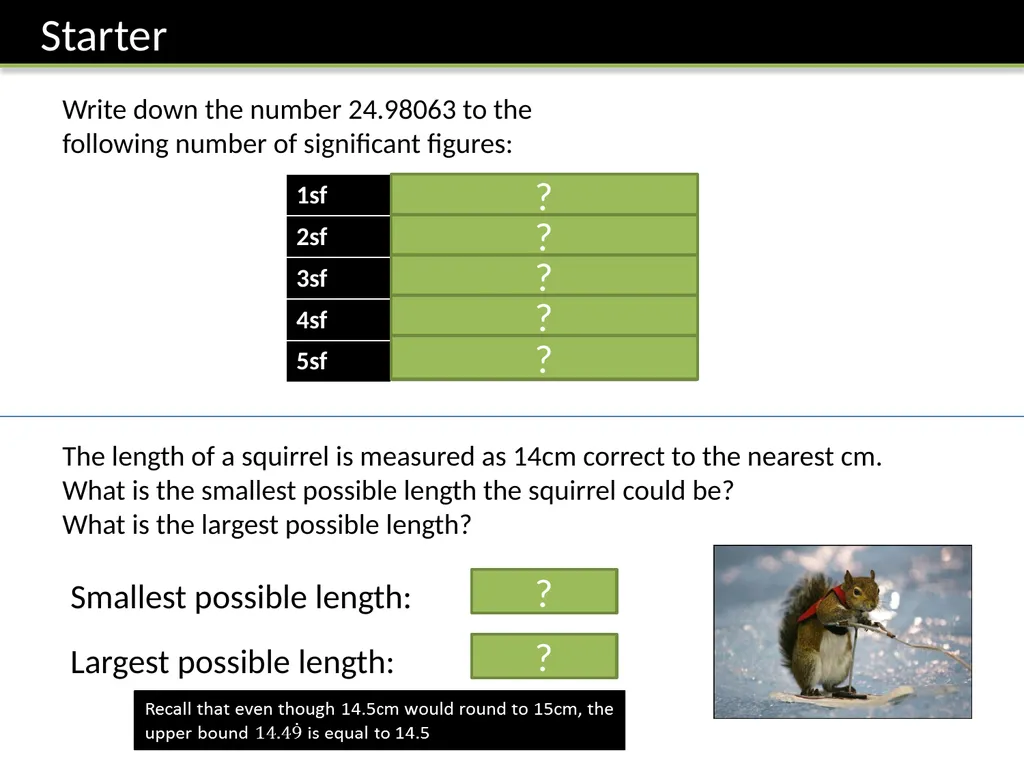
Write down the number 24.98063 to the following number of significant figures: ? ? ? ? ? The length of a squirrel is measured as 14cm correct to the nearest cm. What is the smallest possible length the squirrel could be?
What is the largest possible length? Smallest possible length: 13.5cm Largest possible length: 14.5cm* ? ?<br>
03
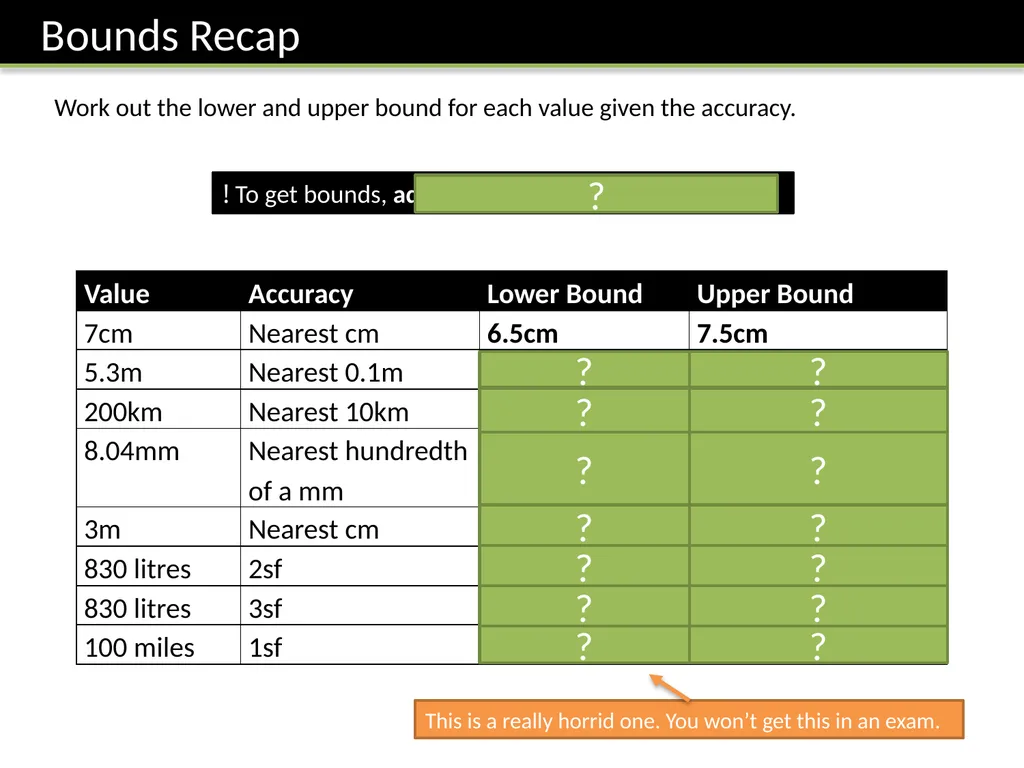
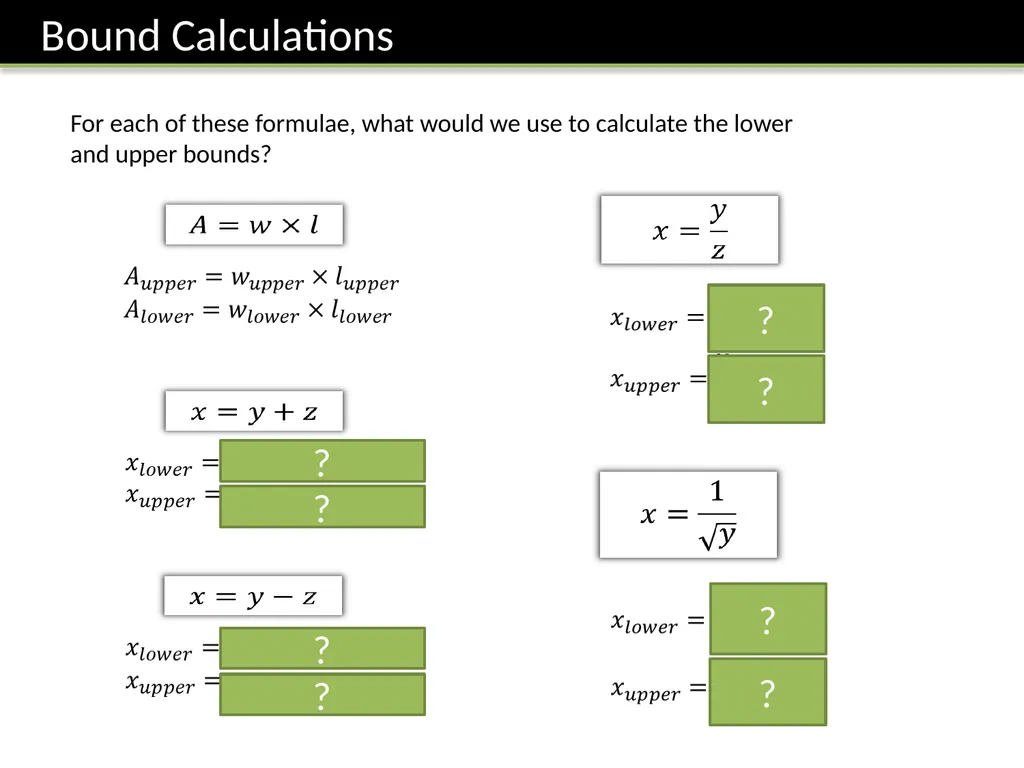
Work out the lower and upper bound for each value given the accuracy. ? ? ? ? ? ? ? ? ? ? ? ? ? ? ! To get bounds, add or subtract half the accuracy. ?<br>