
GENERAL EDUCATION REDESIGN December 8th, 2023




Description: GENERAL EDUCATION REDESIGN December 8th, 2023 Agenda Background Process Proposal Feedback Next steps Background Nation-wide trend to rethink General Education Confusion about purpose and value of general education Retention data ETSU 125 -
Related Topics
Download Presentation
"GENERAL EDUCATION REDESIGN December 8th, 2023" is the property of its rightful owner. Permission is granted to download and print the materials on this website for personal, non-commercial use only, and to display it on your personal computer provided you do not modify the materials and that you retain all copyright notices contained in the materials. By downloading content from our website, you accept the terms of this agreement.
Presentation Transcript
slide1. GENERAL EDUCATION REDESIGN December 8th, 2023<br>
slide2. Agenda Background
Process
Proposal
Feedback
Next steps<br>
slide3. Background Nation-wide trend to rethink General Education
Confusion about purpose and value of general education
Retention data
ETSU 125 - Chapter II recommendation
Faculty Senate
GEAC<br>
slide4. Process Our literature review suggested:
Competency rather than content-based
Transparency
Integration
Flexibility
High-Impact Teaching Practices<br>
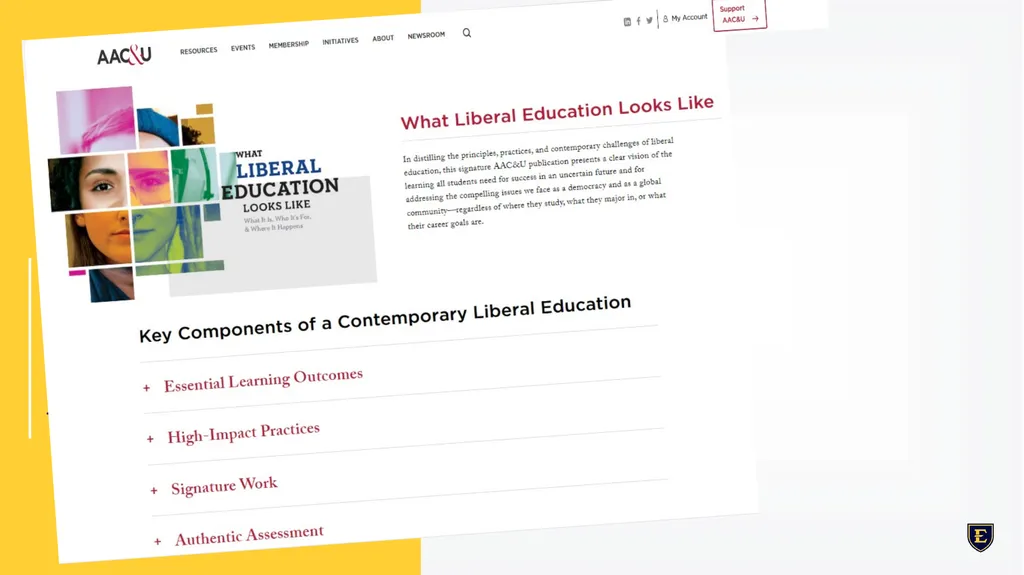
slide5. Process<br>
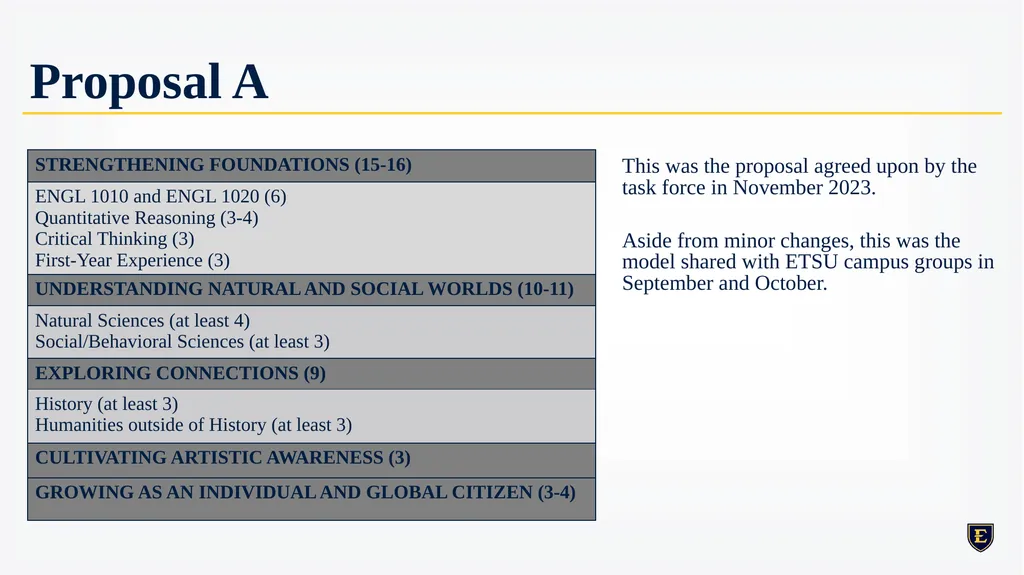
slide6. Proposal A This was the proposal agreed upon by the task force in November 2023.
Aside from minor changes, this was the model shared with ETSU campus groups in September and October.<br>
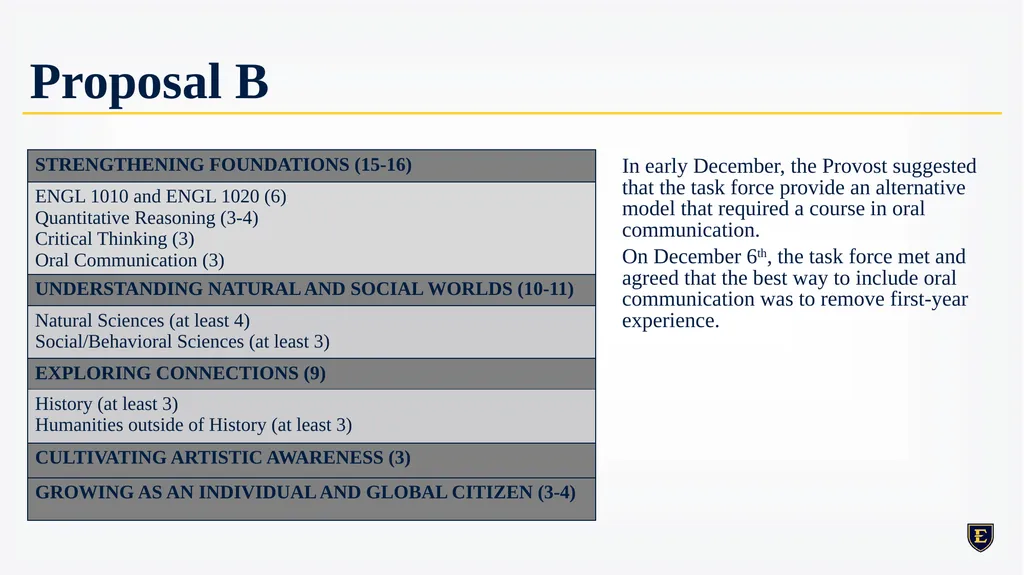
slide7. Proposal B In early December, the Provost suggested that the task force provide an alternative model that required a course in oral communication.
On December 6th, the task force met and agreed that the best way to include oral communication was to remove first-year experience.<br>
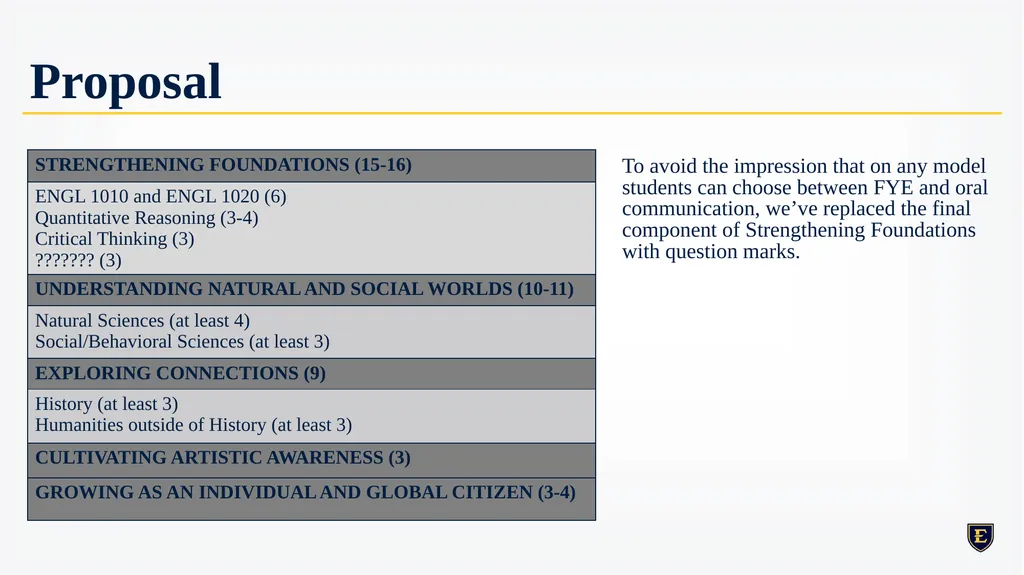
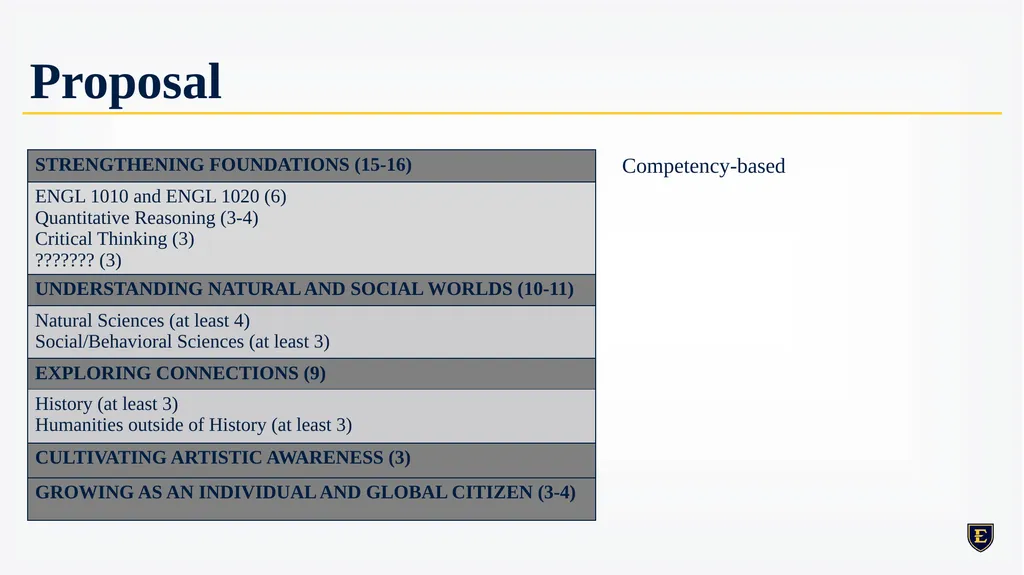
slide8. Proposal To avoid the impression that on any model students can choose between FYE and oral communication, we’ve replaced the final component of Strengthening Foundations with question marks.<br>
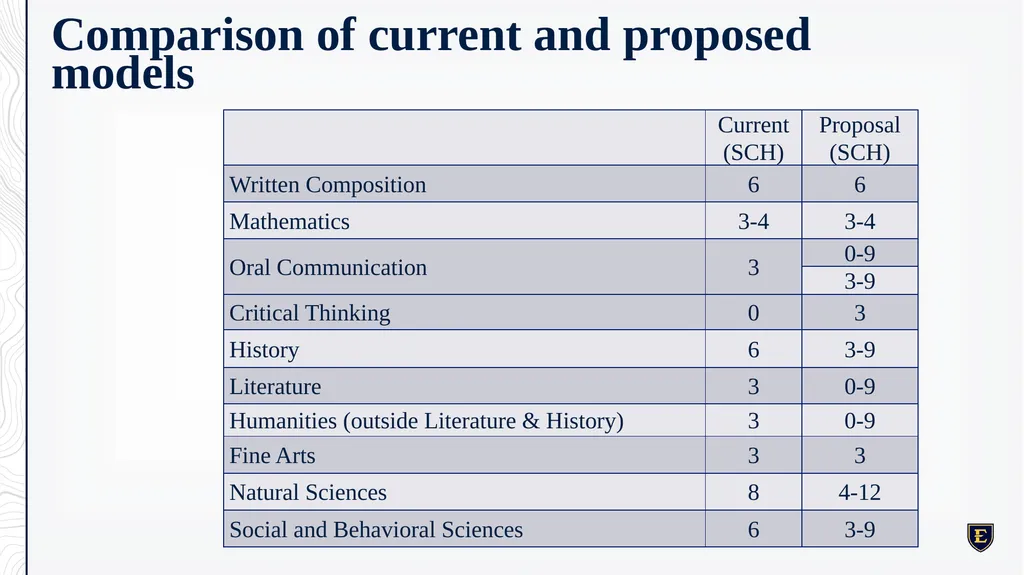
slide9. Comparison of current and proposed models<br>
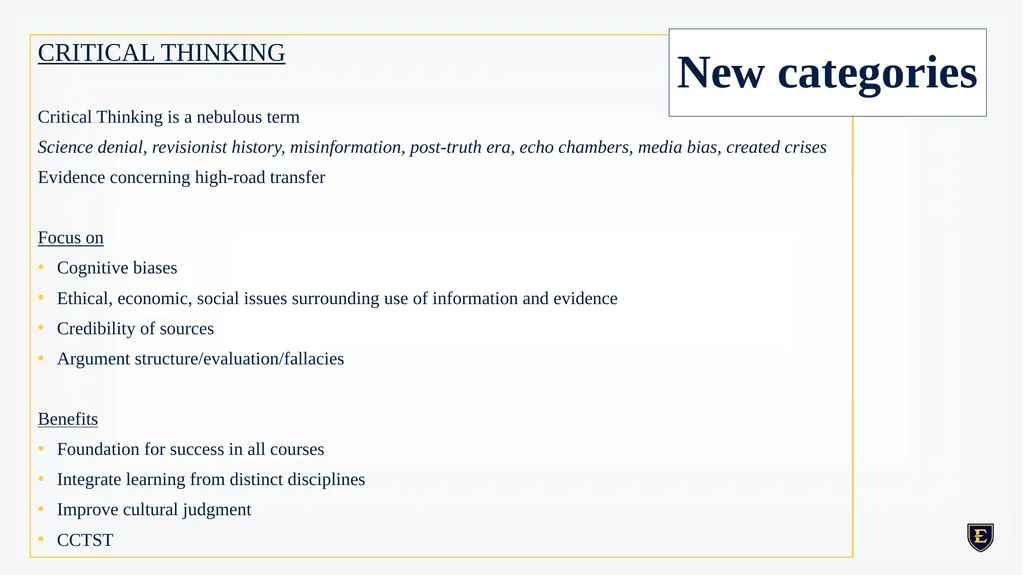
slide10. CRITICAL THINKING
Critical Thinking is a nebulous term
Science denial, revisionist history, misinformation, post-truth era, echo chambers, media bias, created crises
Evidence concerning high-road transfer
Focus on
Cognitive biases
Ethical, economic, social issues surrounding use of information and evidence
Credibility of sources
Argument structure/evaluation/fallacies
Benefits
Foundation for success in all courses
Integrate learning from distinct disciplines
Improve cultural judgment
CCTST New categories<br>
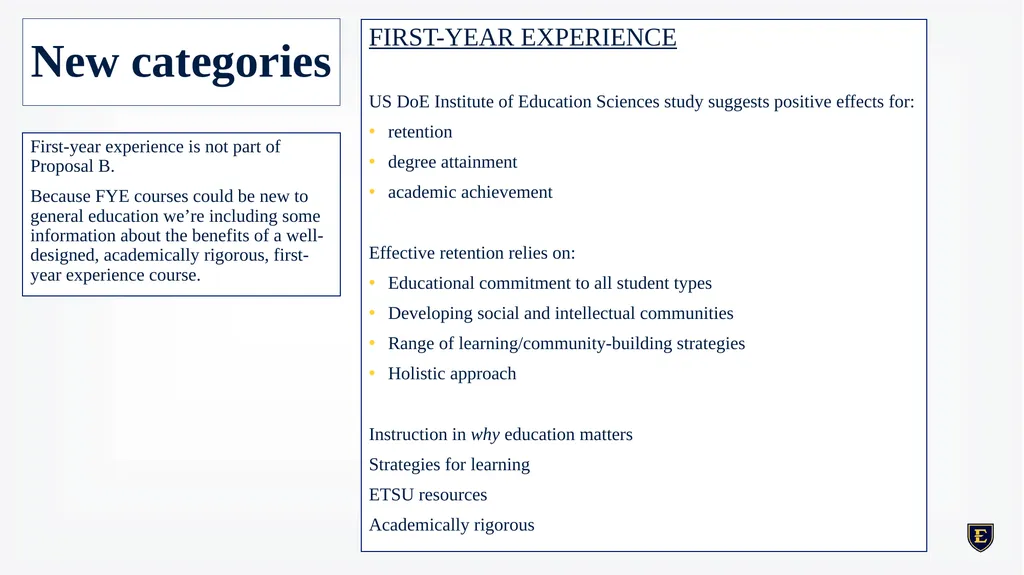
slide11. New categories First-year experience is not part of Proposal B.
Because FYE courses could be new to general education we’re including some information about the benefits of a well-designed, academically rigorous, first-year experience course. FIRST-YEAR EXPERIENCE
US DoE Institute of Education Sciences study suggests positive effects for:
retention
degree attainment
academic achievement
Effective retention relies on:
Educational commitment to all student types
Developing social and intellectual communities
Range of learning/community-building strategies
Holistic approach
Instruction in why education matters
Strategies for learning
ETSU resources
Academically rigorous<br>
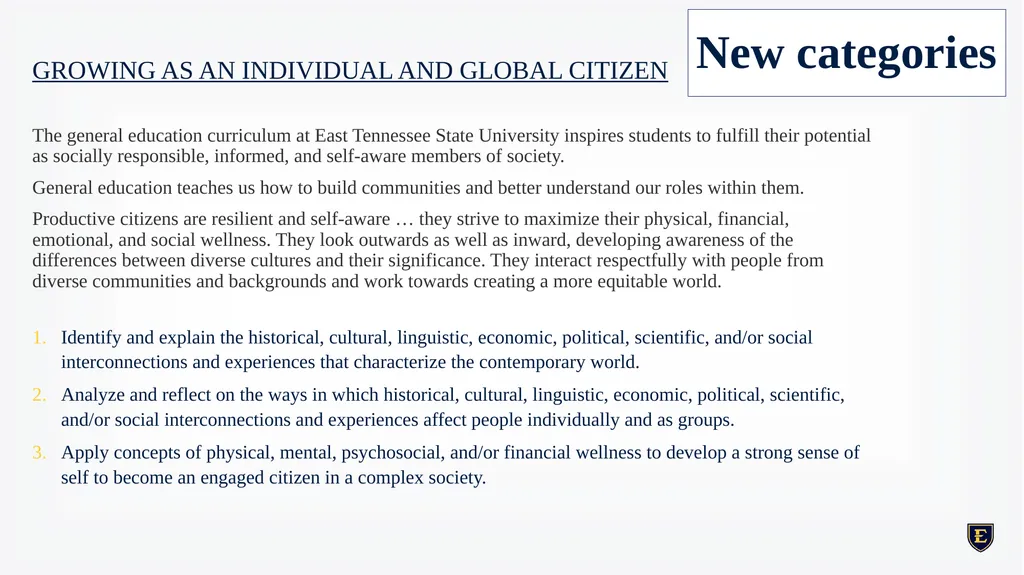
slide12. New categories GROWING AS AN INDIVIDUAL AND GLOBAL CITIZEN
The general education curriculum at East Tennessee State University inspires students to fulfill their potential as socially responsible, informed, and self-aware members of society.
General education teaches us how to build communities and better understand our roles within them.
Productive citizens are resilient and self-aware … they strive to maximize their physical, financial, emotional, and social wellness. They look outwards as well as inward, developing awareness of the differences between diverse cultures and their significance. They interact respectfully with people from diverse communities and backgrounds and work towards creating a more equitable world.
Identify and explain the historical, cultural, linguistic, economic, political, scientific, and/or social interconnections and experiences that characterize the contemporary world.
Analyze and reflect on the ways in which historical, cultural, linguistic, economic, political, scientific, and/or social interconnections and experiences affect people individually and as groups.
Apply concepts of physical, mental, psychosocial, and/or financial wellness to develop a strong sense of self to become an engaged citizen in a complex society.<br>
slide13. Proposal Competency-based<br>
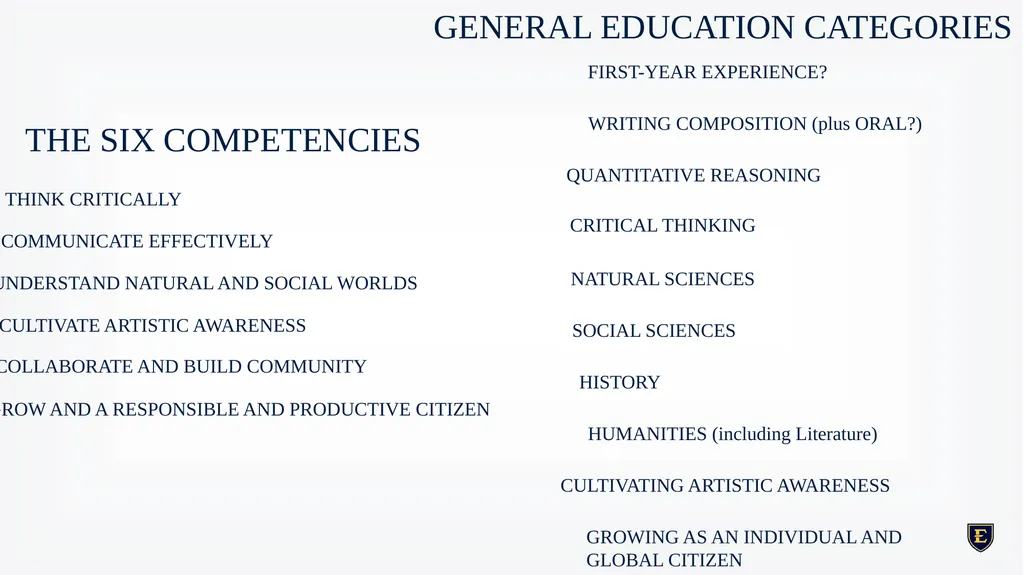
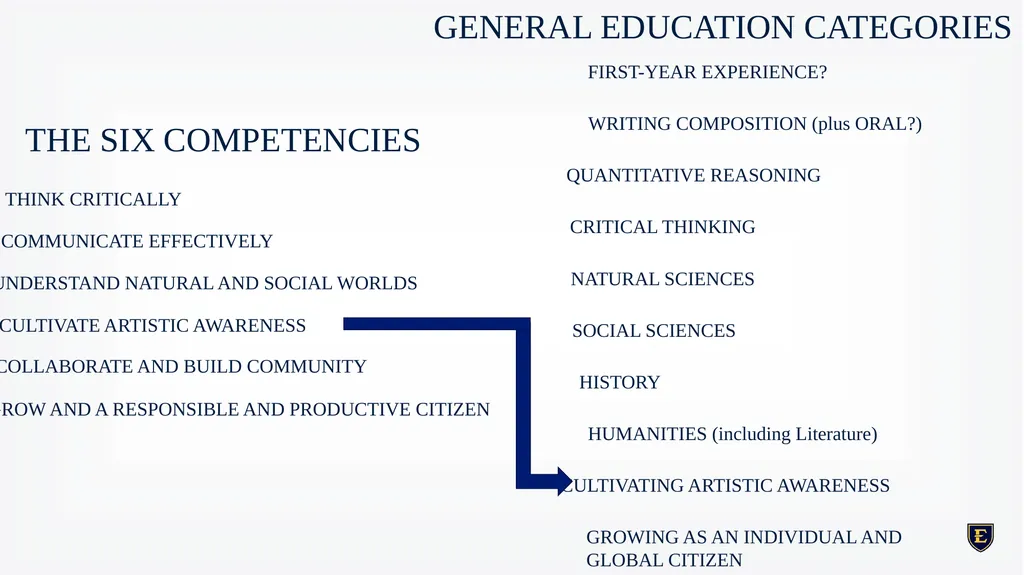
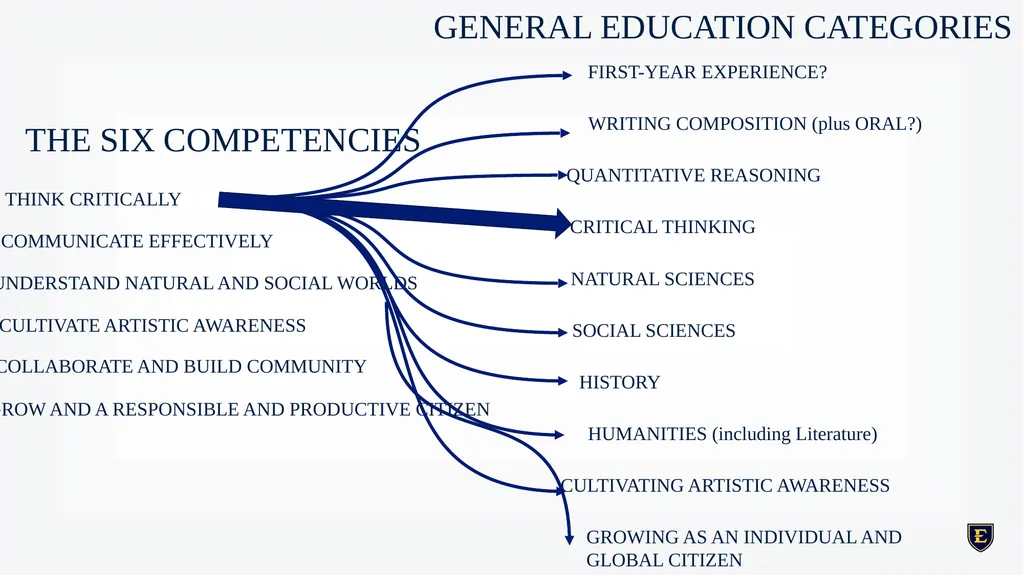
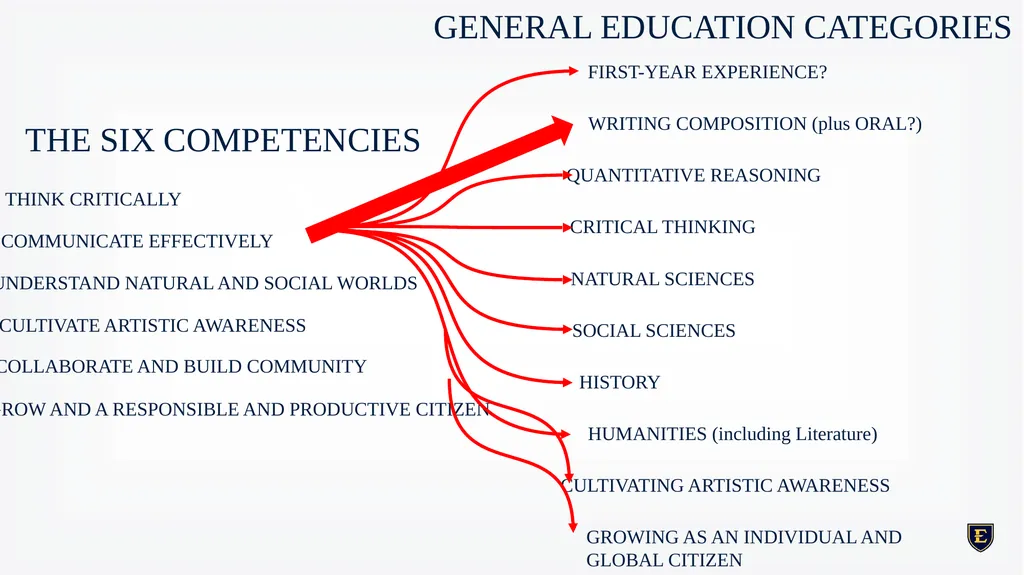
slide14. THE SIX COMPETENCIES THINK CRITICALLY COMMUNICATE EFFECTIVELY UNDERSTAND NATURAL AND SOCIAL WORLDS CULTIVATE ARTISTIC AWARENESS COLLABORATE AND BUILD COMMUNITY GROW AND A RESPONSIBLE AND PRODUCTIVE CITIZEN GENERAL EDUCATION CATEGORIES FIRST-YEAR EXPERIENCE? WRITING COMPOSITION (plus ORAL?) QUANTITATIVE REASONING CRITICAL THINKING NATURAL SCIENCES SOCIAL SCIENCES HISTORY HUMANITIES (including Literature) CULTIVATING ARTISTIC AWARENESS GROWING AS AN INDIVIDUAL AND GLOBAL CITIZEN Competencies and Categories<br>
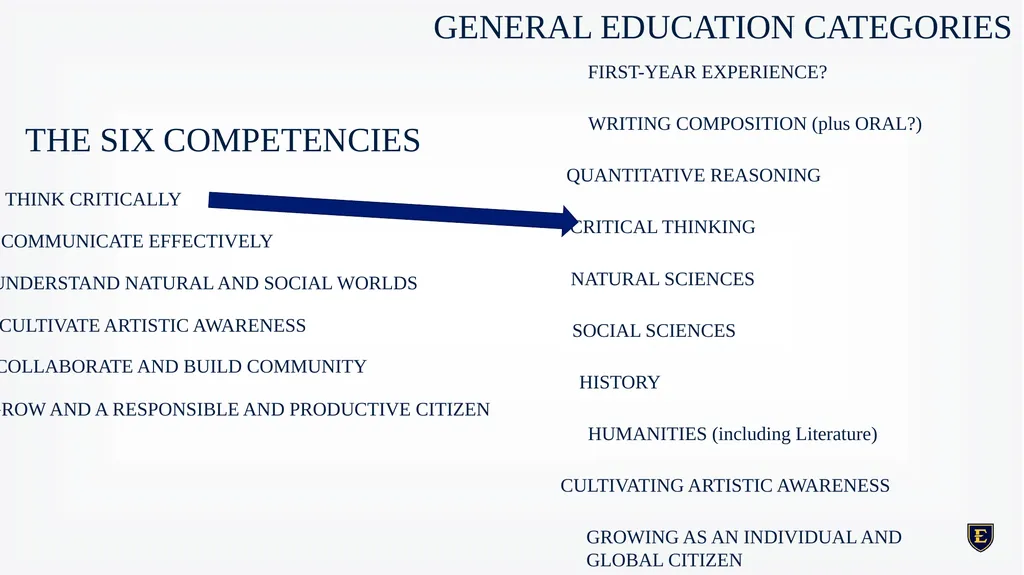
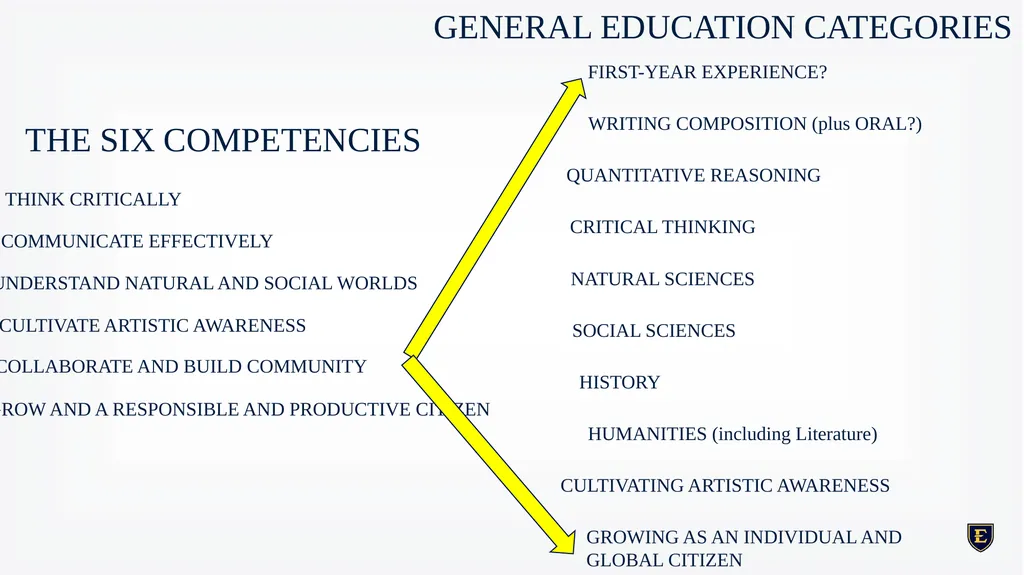
slide15. THE SIX COMPETENCIES THINK CRITICALLY COMMUNICATE EFFECTIVELY UNDERSTAND NATURAL AND SOCIAL WORLDS CULTIVATE ARTISTIC AWARENESS COLLABORATE AND BUILD COMMUNITY GROW AND A RESPONSIBLE AND PRODUCTIVE CITIZEN GENERAL EDUCATION CATEGORIES FIRST-YEAR EXPERIENCE? WRITING COMPOSITION (plus ORAL?) QUANTITATIVE REASONING CRITICAL THINKING NATURAL SCIENCES SOCIAL SCIENCES HISTORY HUMANITIES (including Literature) CULTIVATING ARTISTIC AWARENESS GROWING AS AN INDIVIDUAL AND GLOBAL CITIZEN Competencies and Categories<br>
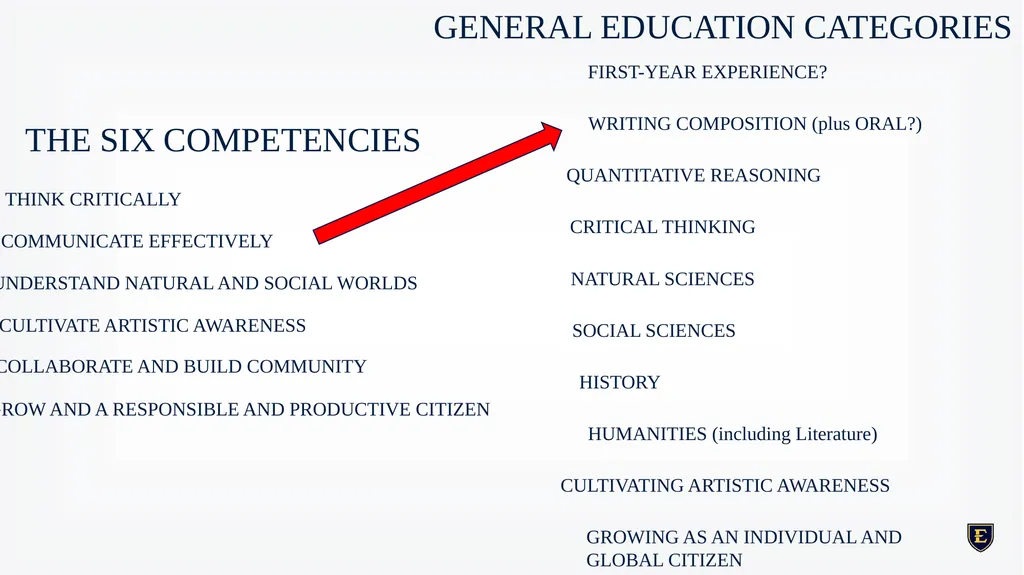
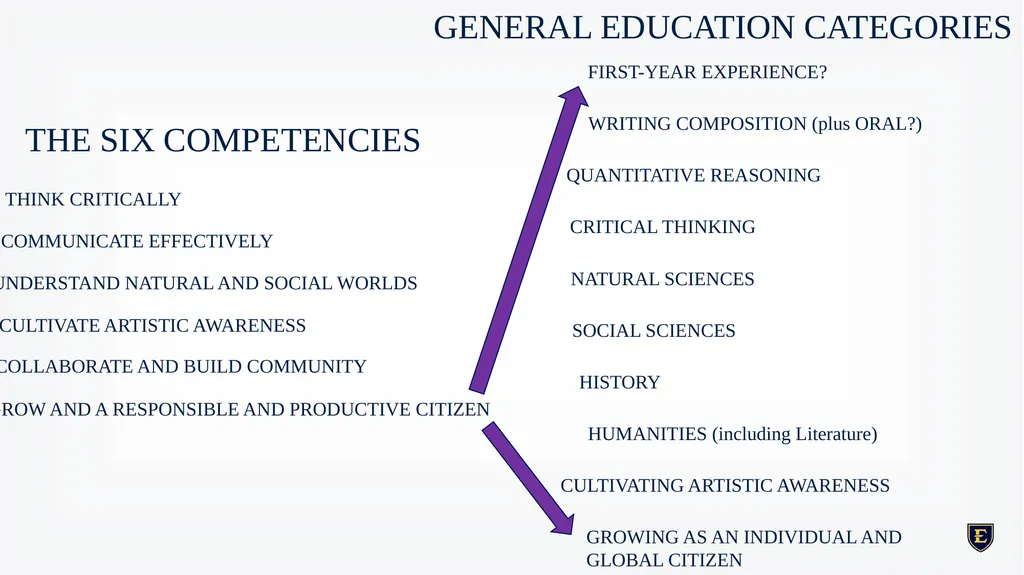
slide16. THE SIX COMPETENCIES THINK CRITICALLY COMMUNICATE EFFECTIVELY UNDERSTAND NATURAL AND SOCIAL WORLDS CULTIVATE ARTISTIC AWARENESS COLLABORATE AND BUILD COMMUNITY GROW AND A RESPONSIBLE AND PRODUCTIVE CITIZEN GENERAL EDUCATION CATEGORIES FIRST-YEAR EXPERIENCE? WRITING COMPOSITION (plus ORAL?) QUANTITATIVE REASONING CRITICAL THINKING NATURAL SCIENCES SOCIAL SCIENCES HISTORY HUMANITIES (including Literature) CULTIVATING ARTISTIC AWARENESS GROWING AS AN INDIVIDUAL AND GLOBAL CITIZEN Competencies and Categories<br>
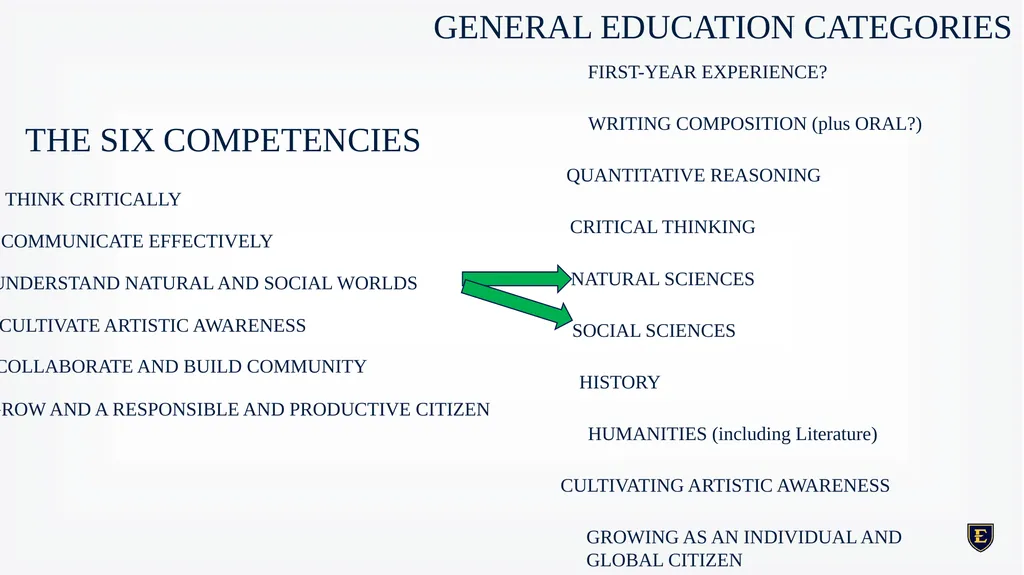
slide17. THE SIX COMPETENCIES THINK CRITICALLY COMMUNICATE EFFECTIVELY UNDERSTAND NATURAL AND SOCIAL WORLDS CULTIVATE ARTISTIC AWARENESS COLLABORATE AND BUILD COMMUNITY GROW AND A RESPONSIBLE AND PRODUCTIVE CITIZEN GENERAL EDUCATION CATEGORIES FIRST-YEAR EXPERIENCE? WRITING COMPOSITION (plus ORAL?) QUANTITATIVE REASONING CRITICAL THINKING NATURAL SCIENCES SOCIAL SCIENCES HISTORY HUMANITIES (including Literature) CULTIVATING ARTISTIC AWARENESS GROWING AS AN INDIVIDUAL AND GLOBAL CITIZEN Competencies and Categories<br>
slide18. THE SIX COMPETENCIES THINK CRITICALLY COMMUNICATE EFFECTIVELY UNDERSTAND NATURAL AND SOCIAL WORLDS CULTIVATE ARTISTIC AWARENESS COLLABORATE AND BUILD COMMUNITY GROW AND A RESPONSIBLE AND PRODUCTIVE CITIZEN GENERAL EDUCATION CATEGORIES FIRST-YEAR EXPERIENCE? WRITING COMPOSITION (plus ORAL?) QUANTITATIVE REASONING CRITICAL THINKING NATURAL SCIENCES SOCIAL SCIENCES HISTORY HUMANITIES (including Literature) CULTIVATING ARTISTIC AWARENESS GROWING AS AN INDIVIDUAL AND GLOBAL CITIZEN Competencies and Categories<br>
slide19. THE SIX COMPETENCIES THINK CRITICALLY COMMUNICATE EFFECTIVELY UNDERSTAND NATURAL AND SOCIAL WORLDS CULTIVATE ARTISTIC AWARENESS COLLABORATE AND BUILD COMMUNITY GROW AND A RESPONSIBLE AND PRODUCTIVE CITIZEN GENERAL EDUCATION CATEGORIES FIRST-YEAR EXPERIENCE? WRITING COMPOSITION (plus ORAL?) QUANTITATIVE REASONING CRITICAL THINKING NATURAL SCIENCES SOCIAL SCIENCES HISTORY HUMANITIES (including Literature) CULTIVATING ARTISTIC AWARENESS GROWING AS AN INDIVIDUAL AND GLOBAL CITIZEN Competencies and Categories<br>
slide20. THE SIX COMPETENCIES THINK CRITICALLY COMMUNICATE EFFECTIVELY UNDERSTAND NATURAL AND SOCIAL WORLDS CULTIVATE ARTISTIC AWARENESS COLLABORATE AND BUILD COMMUNITY GROW AND A RESPONSIBLE AND PRODUCTIVE CITIZEN GENERAL EDUCATION CATEGORIES FIRST-YEAR EXPERIENCE? WRITING COMPOSITION (plus ORAL?) QUANTITATIVE REASONING CRITICAL THINKING NATURAL SCIENCES SOCIAL SCIENCES HISTORY HUMANITIES (including Literature) CULTIVATING ARTISTIC AWARENESS GROWING AS AN INDIVIDUAL AND GLOBAL CITIZEN Competencies and Categories<br>
slide21. THE SIX COMPETENCIES THINK CRITICALLY COMMUNICATE EFFECTIVELY UNDERSTAND NATURAL AND SOCIAL WORLDS CULTIVATE ARTISTIC AWARENESS COLLABORATE AND BUILD COMMUNITY GROW AND A RESPONSIBLE AND PRODUCTIVE CITIZEN GENERAL EDUCATION CATEGORIES FIRST-YEAR EXPERIENCE? WRITING COMPOSITION (plus ORAL?) QUANTITATIVE REASONING CRITICAL THINKING NATURAL SCIENCES SOCIAL SCIENCES HISTORY HUMANITIES (including Literature) CULTIVATING ARTISTIC AWARENESS GROWING AS AN INDIVIDUAL AND GLOBAL CITIZEN Competencies and Categories<br>
slide22. THE SIX COMPETENCIES THINK CRITICALLY COMMUNICATE EFFECTIVELY UNDERSTAND NATURAL AND SOCIAL WORLDS CULTIVATE ARTISTIC AWARENESS COLLABORATE AND BUILD COMMUNITY GROW AND A RESPONSIBLE AND PRODUCTIVE CITIZEN GENERAL EDUCATION CATEGORIES FIRST-YEAR EXPERIENCE? WRITING COMPOSITION (plus ORAL?) QUANTITATIVE REASONING CRITICAL THINKING NATURAL SCIENCES SOCIAL SCIENCES HISTORY HUMANITIES (including Literature) CULTIVATING ARTISTIC AWARENESS GROWING AS AN INDIVIDUAL AND GLOBAL CITIZEN Competencies and Categories<br>
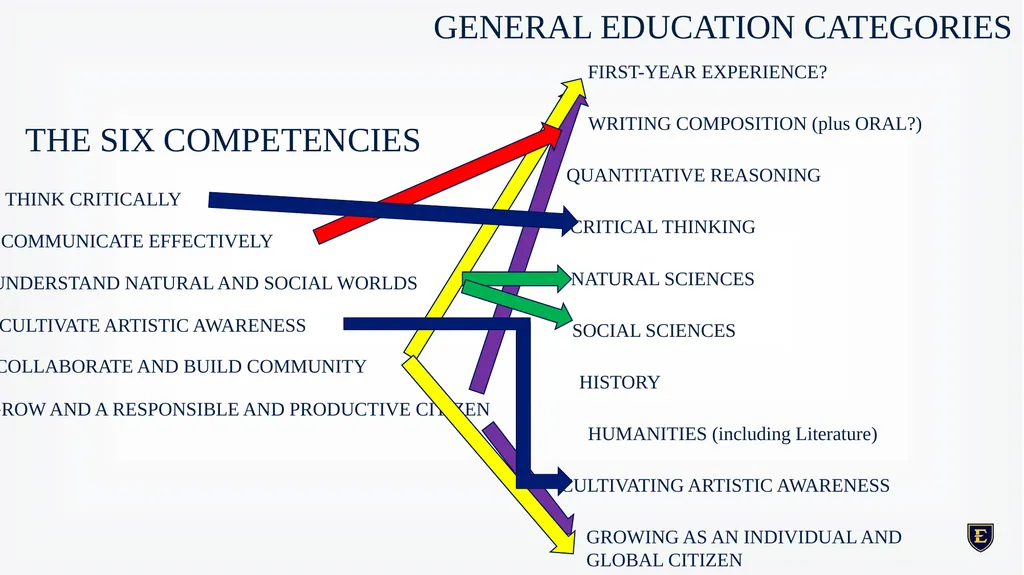
slide23. THE SIX COMPETENCIES THINK CRITICALLY COMMUNICATE EFFECTIVELY UNDERSTAND NATURAL AND SOCIAL WORLDS CULTIVATE ARTISTIC AWARENESS COLLABORATE AND BUILD COMMUNITY GROW AND A RESPONSIBLE AND PRODUCTIVE CITIZEN GENERAL EDUCATION CATEGORIES FIRST-YEAR EXPERIENCE? WRITING COMPOSITION (plus ORAL?) QUANTITATIVE REASONING CRITICAL THINKING NATURAL SCIENCES SOCIAL SCIENCES HISTORY HUMANITIES (including Literature) CULTIVATING ARTISTIC AWARENESS GROWING AS AN INDIVIDUAL AND GLOBAL CITIZEN Competencies and Categories<br>
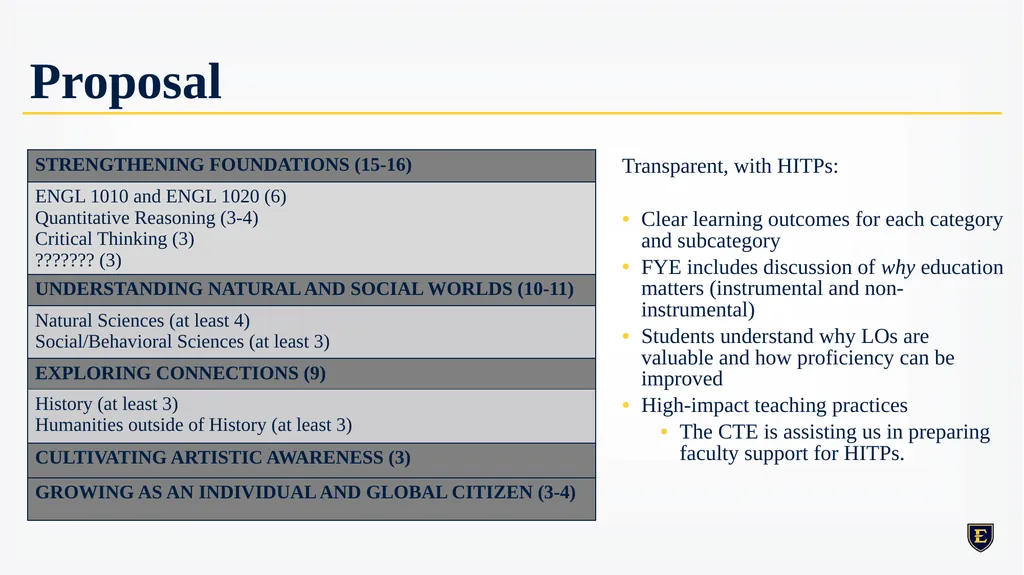
slide24. Proposal Transparent, with HITPs:
Clear learning outcomes for each category and subcategory
FYE includes discussion of why education matters (instrumental and non-instrumental)
Students understand why LOs are valuable and how proficiency can be improved
High-impact teaching practices
The CTE is assisting us in preparing faculty support for HITPs.<br>
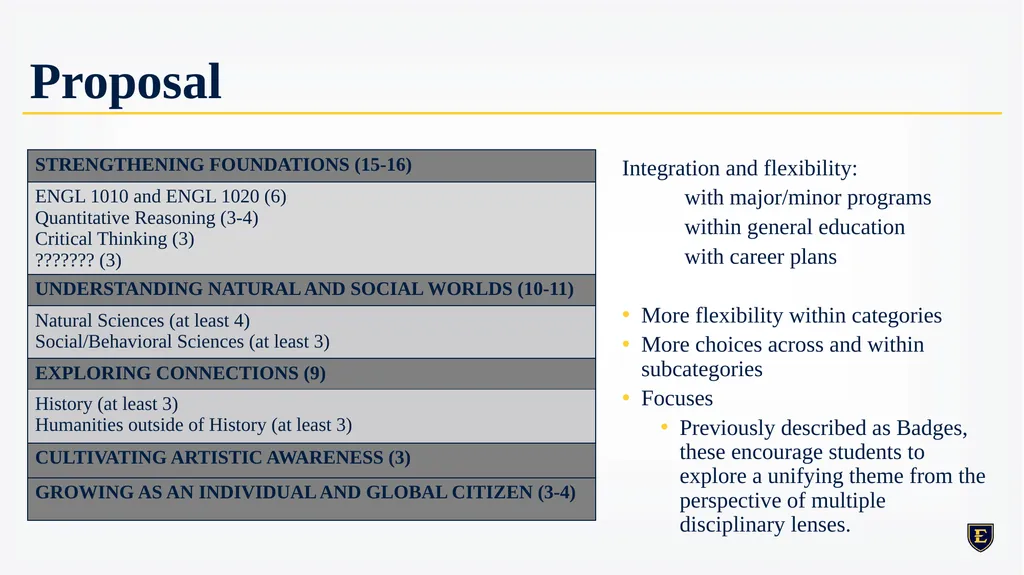
slide25. Proposal Integration and flexibility:
with major/minor programs
within general education
with career plans
More flexibility within categories
More choices across and within subcategories
Focuses
Previously described as Badges, these encourage students to explore a unifying theme from the perspective of multiple disciplinary lenses.<br>
slide26. Feedback Lots of excitement!
Questions about process and timing
Suggestions for FYE
Questions about required credit hours<br>
slide27. Next steps: Proposal
Comments and feedback through January 8th
Finalize written report
Academic Council, GEAC, University Council, Faculty Senate, Dean’s Council
Present to Board (2/16)<br>
slide28. Next steps: Implementation
Phase 1 (spring 2024)
Courses that are already part of General Education core will seek reaffirmation, aligned with appropriate SLOs and HITPs
GEAC & CTE are revising Curriculog proposal forms
Liaisons
Open for business early Spring
Phase 2 (beginning fall 2024)
New courses seek approval
Focus areas seek approval
GEAC reviews and decides whether to approve courses<br>
slide29. LEARNING OUTCOMES FIRST-YEAR EXPERIENCE COURSES
Learning outcomes:
Cultivate a strong sense of self to become an active, engaged citizen in a complex and diverse society.
Understand how individual and sociocultural factors interact in the development of beliefs, behaviors, and experiences of oneself and others.
Apply concepts that support multiple forms of wellness, including physical, mental, financial, and/or psychosocial wellness to individual and community well-being.<br>
slide30. LEARNING OUTCOMES ENGL 1010 AND ENGL 1020
Learning Outcomes:
Apply written, verbal, and/or visual communication theories, strategies, and evidence that are appropriate for the audience, purpose, and message.
Analyze, interpret, and evaluate messages in a variety of forms and contexts, including those that utilize emerging technology.
Engage in conversation as a speaker, writer, listener, and reader; ask questions to understand other perspectives; and offer productive ideas and evidence.
Demonstrate ethical and appropriate grammar, usage, conventions, and citations selected for audience and purpose in written, oral, and visual texts.<br>
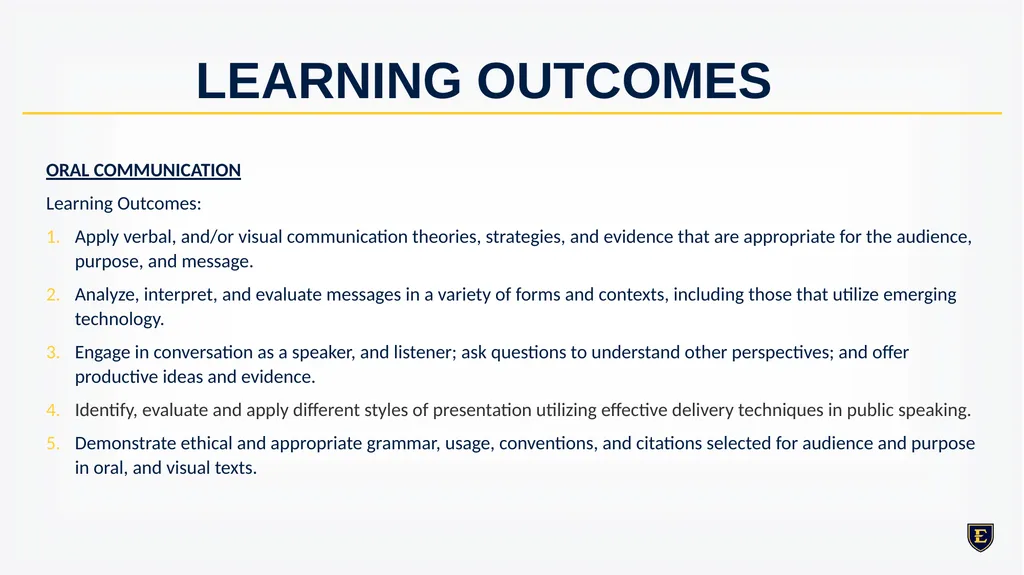
slide31. LEARNING OUTCOMES ORAL COMMUNICATION
Learning Outcomes:
Apply verbal, and/or visual communication theories, strategies, and evidence that are appropriate for the audience, purpose, and message.
Analyze, interpret, and evaluate messages in a variety of forms and contexts, including those that utilize emerging technology.
Engage in conversation as a speaker, and listener; ask questions to understand other perspectives; and offer productive ideas and evidence.
Identify, evaluate and apply different styles of presentation utilizing effective delivery techniques in public speaking.
Demonstrate ethical and appropriate grammar, usage, conventions, and citations selected for audience and purpose in oral, and visual texts.<br>
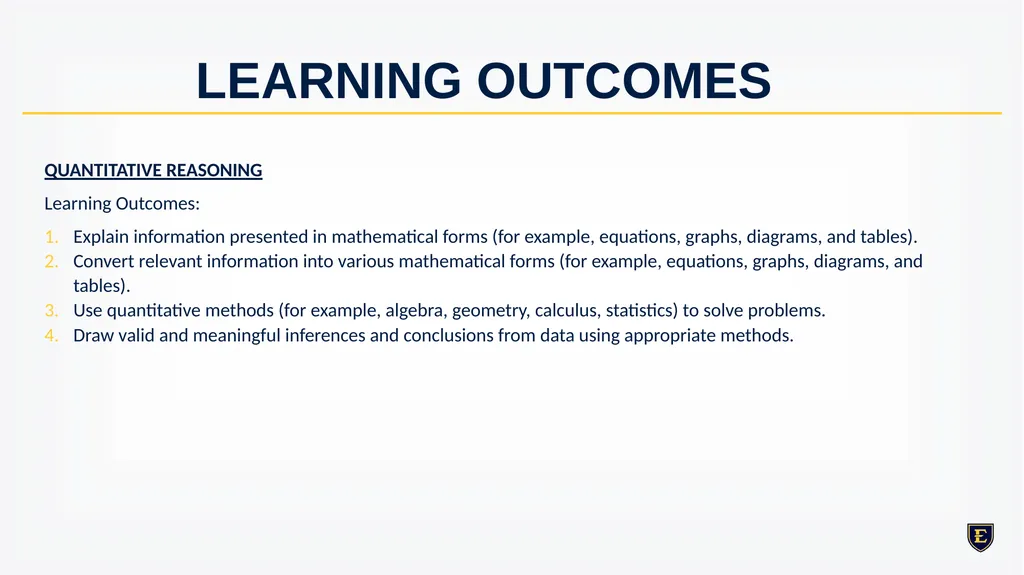
slide32. LEARNING OUTCOMES QUANTITATIVE REASONING
Learning Outcomes:
Explain information presented in mathematical forms (for example, equations, graphs, diagrams, and tables).
Convert relevant information into various mathematical forms (for example, equations, graphs, diagrams, and tables).
Use quantitative methods (for example, algebra, geometry, calculus, statistics) to solve problems.
Draw valid and meaningful inferences and conclusions from data using appropriate methods.<br>
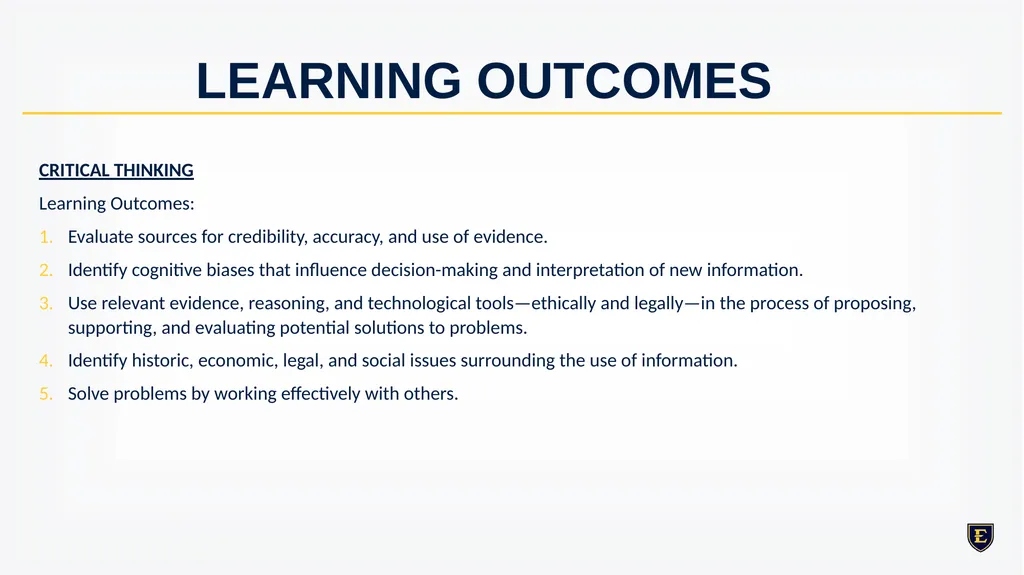
slide33. LEARNING OUTCOMES CRITICAL THINKING
Learning Outcomes:
Evaluate sources for credibility, accuracy, and use of evidence.
Identify cognitive biases that influence decision-making and interpretation of new information.
Use relevant evidence, reasoning, and technological tools—ethically and legally—in the process of proposing, supporting, and evaluating potential solutions to problems.
Identify historic, economic, legal, and social issues surrounding the use of information.
Solve problems by working effectively with others.<br>
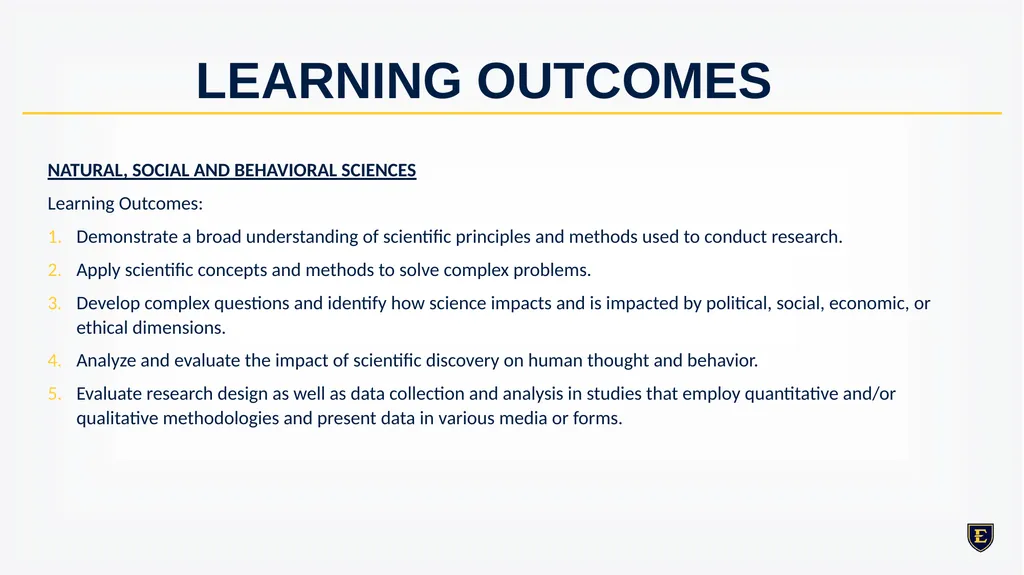
slide34. LEARNING OUTCOMES NATURAL, SOCIAL AND BEHAVIORAL SCIENCES
Learning Outcomes:
Demonstrate a broad understanding of scientific principles and methods used to conduct research.
Apply scientific concepts and methods to solve complex problems.
Develop complex questions and identify how science impacts and is impacted by political, social, economic, or ethical dimensions.
Analyze and evaluate the impact of scientific discovery on human thought and behavior.
Evaluate research design as well as data collection and analysis in studies that employ quantitative and/or qualitative methodologies and present data in various media or forms.<br>
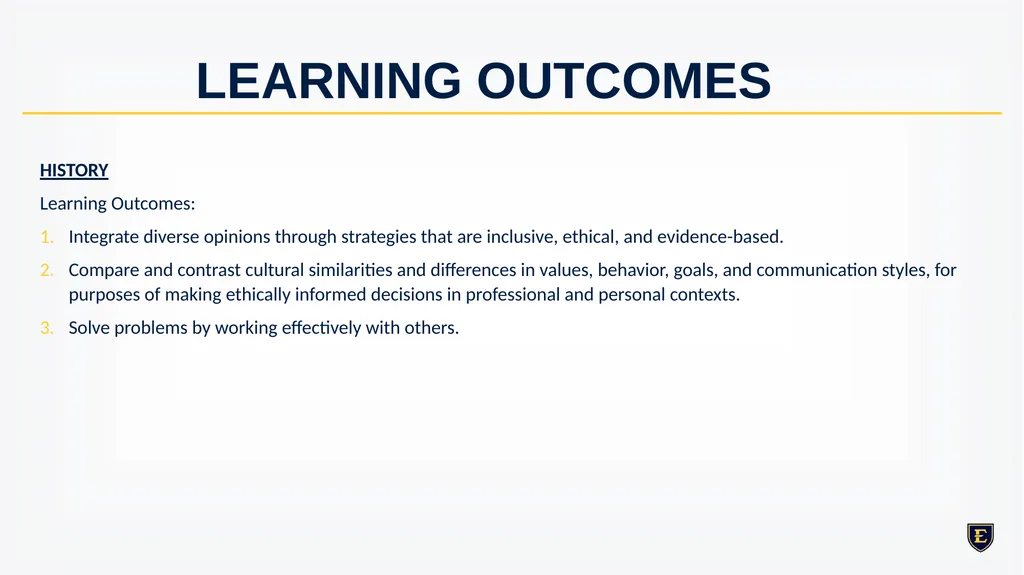
slide35. LEARNING OUTCOMES HISTORY
Learning Outcomes:
Integrate diverse opinions through strategies that are inclusive, ethical, and evidence-based.
Compare and contrast cultural similarities and differences in values, behavior, goals, and communication styles, for purposes of making ethically informed decisions in professional and personal contexts.
Solve problems by working effectively with others.<br>
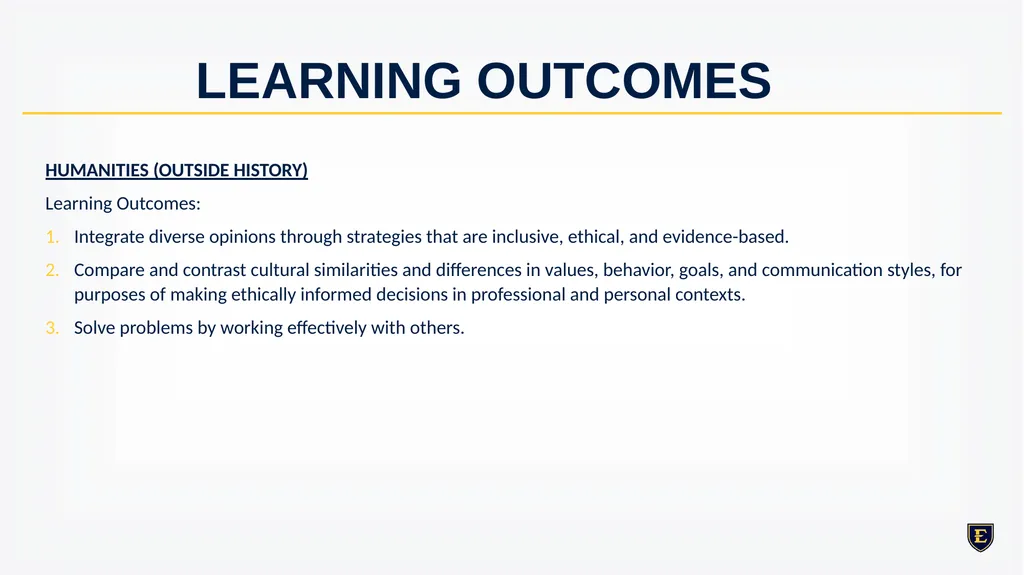
slide36. LEARNING OUTCOMES HUMANITIES (OUTSIDE HISTORY)
Learning Outcomes:
Integrate diverse opinions through strategies that are inclusive, ethical, and evidence-based.
Compare and contrast cultural similarities and differences in values, behavior, goals, and communication styles, for purposes of making ethically informed decisions in professional and personal contexts.
Solve problems by working effectively with others.<br>
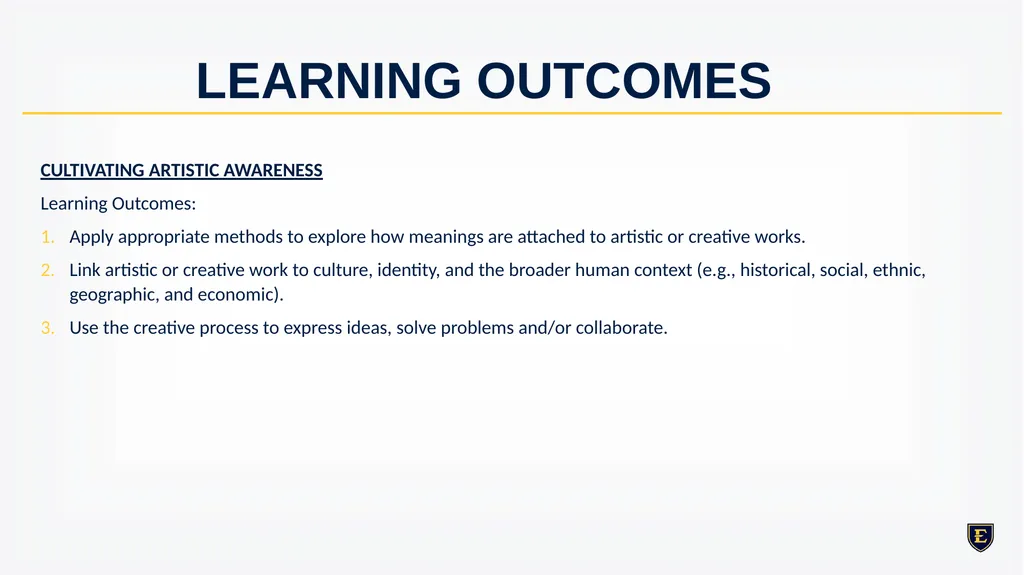
slide37. LEARNING OUTCOMES CULTIVATING ARTISTIC AWARENESS
Learning Outcomes:
Apply appropriate methods to explore how meanings are attached to artistic or creative works.
Link artistic or creative work to culture, identity, and the broader human context (e.g., historical, social, ethnic, geographic, and economic).
Use the creative process to express ideas, solve problems and/or collaborate.<br>
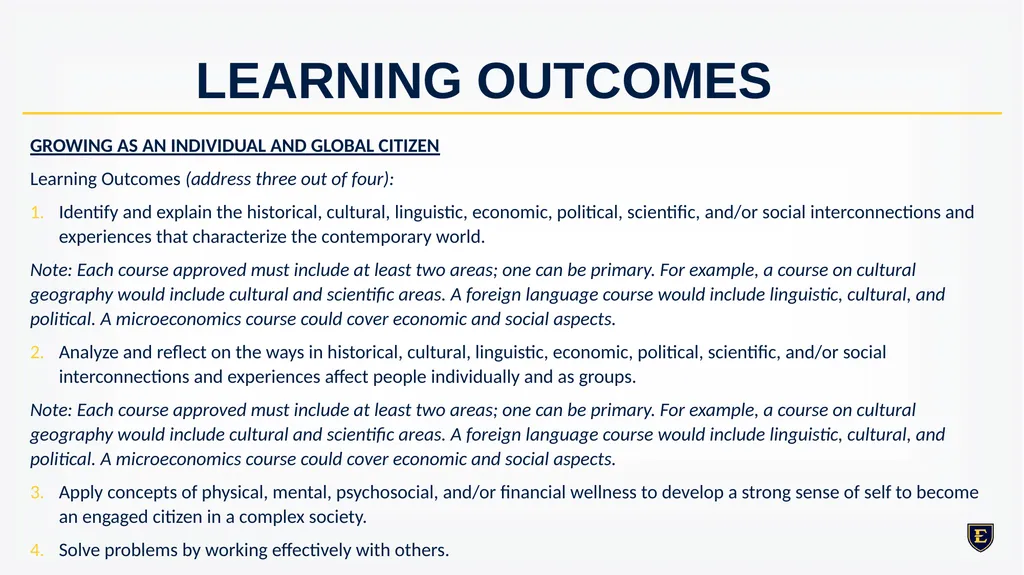
slide38. LEARNING OUTCOMES GROWING AS AN INDIVIDUAL AND GLOBAL CITIZEN
Learning Outcomes (address three out of four):
Identify and explain the historical, cultural, linguistic, economic, political, scientific, and/or social interconnections and experiences that characterize the contemporary world.
Note: Each course approved must include at least two areas; one can be primary. For example, a course on cultural geography would include cultural and scientific areas. A foreign language course would include linguistic, cultural, and political. A microeconomics course could cover economic and social aspects.
Analyze and reflect on the ways in historical, cultural, linguistic, economic, political, scientific, and/or social interconnections and experiences affect people individually and as groups.
Note: Each course approved must include at least two areas; one can be primary. For example, a course on cultural geography would include cultural and scientific areas. A foreign language course would include linguistic, cultural, and political. A microeconomics course could cover economic and social aspects.
Apply concepts of physical, mental, psychosocial, and/or financial wellness to develop a strong sense of self to become an engaged citizen in a complex society.
Solve problems by working effectively with others.<br>
slide39. THANK YOU!! Please leave feedback by January, 8th.
Go to ETSU RFC, or
Go to the Provost’s website.
The Left Navigation menu includes a link to our website.
If you have problems finding the link, email us:
harkerd@etsu.edu
mcgees@etsu.edu Thank you<br>
slide40. SACSCOC
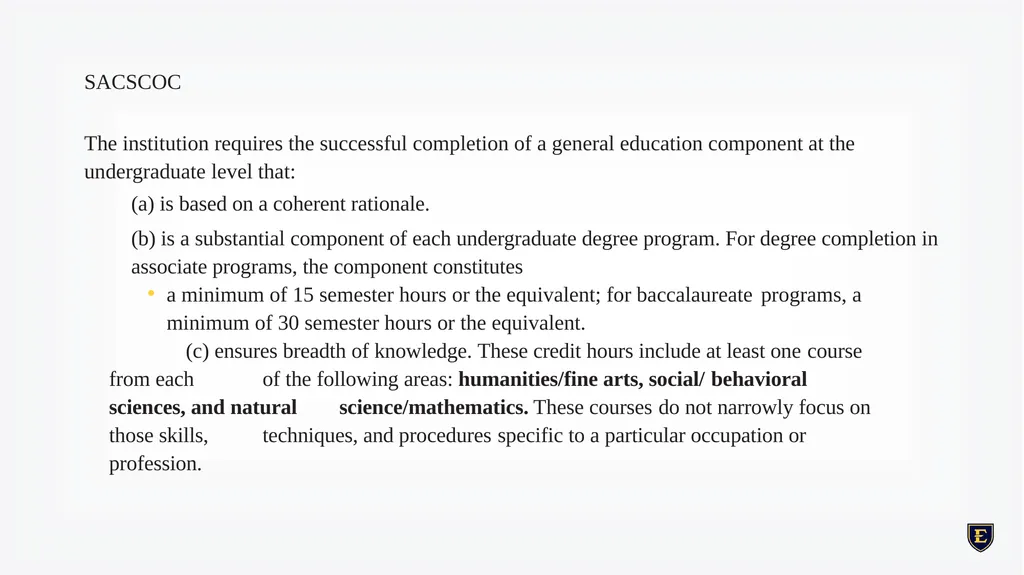
The institution requires the successful completion of a general education component at the undergraduate level that:
(a) is based on a coherent rationale.
(b) is a substantial component of each undergraduate degree program. For degree completion in associate programs, the component constitutes
a minimum of 15 semester hours or the equivalent; for baccalaureate programs, a minimum of 30 semester hours or the equivalent.
(c) ensures breadth of knowledge. These credit hours include at least one course from each of the following areas: humanities/fine arts, social/ behavioral sciences, and natural science/mathematics. These courses do not narrowly focus on those skills, techniques, and procedures specific to a particular occupation or profession. SACSCOC<br>
slide2. Agenda Background
Process
Proposal
Feedback
Next steps<br>
slide3. Background Nation-wide trend to rethink General Education
Confusion about purpose and value of general education
Retention data
ETSU 125 - Chapter II recommendation
Faculty Senate
GEAC<br>
slide4. Process Our literature review suggested:
Competency rather than content-based
Transparency
Integration
Flexibility
High-Impact Teaching Practices<br>
slide5. Process<br>
slide6. Proposal A This was the proposal agreed upon by the task force in November 2023.
Aside from minor changes, this was the model shared with ETSU campus groups in September and October.<br>
slide7. Proposal B In early December, the Provost suggested that the task force provide an alternative model that required a course in oral communication.
On December 6th, the task force met and agreed that the best way to include oral communication was to remove first-year experience.<br>
slide8. Proposal To avoid the impression that on any model students can choose between FYE and oral communication, we’ve replaced the final component of Strengthening Foundations with question marks.<br>
slide9. Comparison of current and proposed models<br>
slide10. CRITICAL THINKING
Critical Thinking is a nebulous term
Science denial, revisionist history, misinformation, post-truth era, echo chambers, media bias, created crises
Evidence concerning high-road transfer
Focus on
Cognitive biases
Ethical, economic, social issues surrounding use of information and evidence
Credibility of sources
Argument structure/evaluation/fallacies
Benefits
Foundation for success in all courses
Integrate learning from distinct disciplines
Improve cultural judgment
CCTST New categories<br>
slide11. New categories First-year experience is not part of Proposal B.
Because FYE courses could be new to general education we’re including some information about the benefits of a well-designed, academically rigorous, first-year experience course. FIRST-YEAR EXPERIENCE
US DoE Institute of Education Sciences study suggests positive effects for:
retention
degree attainment
academic achievement
Effective retention relies on:
Educational commitment to all student types
Developing social and intellectual communities
Range of learning/community-building strategies
Holistic approach
Instruction in why education matters
Strategies for learning
ETSU resources
Academically rigorous<br>
slide12. New categories GROWING AS AN INDIVIDUAL AND GLOBAL CITIZEN
The general education curriculum at East Tennessee State University inspires students to fulfill their potential as socially responsible, informed, and self-aware members of society.
General education teaches us how to build communities and better understand our roles within them.
Productive citizens are resilient and self-aware … they strive to maximize their physical, financial, emotional, and social wellness. They look outwards as well as inward, developing awareness of the differences between diverse cultures and their significance. They interact respectfully with people from diverse communities and backgrounds and work towards creating a more equitable world.
Identify and explain the historical, cultural, linguistic, economic, political, scientific, and/or social interconnections and experiences that characterize the contemporary world.
Analyze and reflect on the ways in which historical, cultural, linguistic, economic, political, scientific, and/or social interconnections and experiences affect people individually and as groups.
Apply concepts of physical, mental, psychosocial, and/or financial wellness to develop a strong sense of self to become an engaged citizen in a complex society.<br>
slide13. Proposal Competency-based<br>
slide14. THE SIX COMPETENCIES THINK CRITICALLY COMMUNICATE EFFECTIVELY UNDERSTAND NATURAL AND SOCIAL WORLDS CULTIVATE ARTISTIC AWARENESS COLLABORATE AND BUILD COMMUNITY GROW AND A RESPONSIBLE AND PRODUCTIVE CITIZEN GENERAL EDUCATION CATEGORIES FIRST-YEAR EXPERIENCE? WRITING COMPOSITION (plus ORAL?) QUANTITATIVE REASONING CRITICAL THINKING NATURAL SCIENCES SOCIAL SCIENCES HISTORY HUMANITIES (including Literature) CULTIVATING ARTISTIC AWARENESS GROWING AS AN INDIVIDUAL AND GLOBAL CITIZEN Competencies and Categories<br>
slide15. THE SIX COMPETENCIES THINK CRITICALLY COMMUNICATE EFFECTIVELY UNDERSTAND NATURAL AND SOCIAL WORLDS CULTIVATE ARTISTIC AWARENESS COLLABORATE AND BUILD COMMUNITY GROW AND A RESPONSIBLE AND PRODUCTIVE CITIZEN GENERAL EDUCATION CATEGORIES FIRST-YEAR EXPERIENCE? WRITING COMPOSITION (plus ORAL?) QUANTITATIVE REASONING CRITICAL THINKING NATURAL SCIENCES SOCIAL SCIENCES HISTORY HUMANITIES (including Literature) CULTIVATING ARTISTIC AWARENESS GROWING AS AN INDIVIDUAL AND GLOBAL CITIZEN Competencies and Categories<br>
slide16. THE SIX COMPETENCIES THINK CRITICALLY COMMUNICATE EFFECTIVELY UNDERSTAND NATURAL AND SOCIAL WORLDS CULTIVATE ARTISTIC AWARENESS COLLABORATE AND BUILD COMMUNITY GROW AND A RESPONSIBLE AND PRODUCTIVE CITIZEN GENERAL EDUCATION CATEGORIES FIRST-YEAR EXPERIENCE? WRITING COMPOSITION (plus ORAL?) QUANTITATIVE REASONING CRITICAL THINKING NATURAL SCIENCES SOCIAL SCIENCES HISTORY HUMANITIES (including Literature) CULTIVATING ARTISTIC AWARENESS GROWING AS AN INDIVIDUAL AND GLOBAL CITIZEN Competencies and Categories<br>
slide17. THE SIX COMPETENCIES THINK CRITICALLY COMMUNICATE EFFECTIVELY UNDERSTAND NATURAL AND SOCIAL WORLDS CULTIVATE ARTISTIC AWARENESS COLLABORATE AND BUILD COMMUNITY GROW AND A RESPONSIBLE AND PRODUCTIVE CITIZEN GENERAL EDUCATION CATEGORIES FIRST-YEAR EXPERIENCE? WRITING COMPOSITION (plus ORAL?) QUANTITATIVE REASONING CRITICAL THINKING NATURAL SCIENCES SOCIAL SCIENCES HISTORY HUMANITIES (including Literature) CULTIVATING ARTISTIC AWARENESS GROWING AS AN INDIVIDUAL AND GLOBAL CITIZEN Competencies and Categories<br>
slide18. THE SIX COMPETENCIES THINK CRITICALLY COMMUNICATE EFFECTIVELY UNDERSTAND NATURAL AND SOCIAL WORLDS CULTIVATE ARTISTIC AWARENESS COLLABORATE AND BUILD COMMUNITY GROW AND A RESPONSIBLE AND PRODUCTIVE CITIZEN GENERAL EDUCATION CATEGORIES FIRST-YEAR EXPERIENCE? WRITING COMPOSITION (plus ORAL?) QUANTITATIVE REASONING CRITICAL THINKING NATURAL SCIENCES SOCIAL SCIENCES HISTORY HUMANITIES (including Literature) CULTIVATING ARTISTIC AWARENESS GROWING AS AN INDIVIDUAL AND GLOBAL CITIZEN Competencies and Categories<br>
slide19. THE SIX COMPETENCIES THINK CRITICALLY COMMUNICATE EFFECTIVELY UNDERSTAND NATURAL AND SOCIAL WORLDS CULTIVATE ARTISTIC AWARENESS COLLABORATE AND BUILD COMMUNITY GROW AND A RESPONSIBLE AND PRODUCTIVE CITIZEN GENERAL EDUCATION CATEGORIES FIRST-YEAR EXPERIENCE? WRITING COMPOSITION (plus ORAL?) QUANTITATIVE REASONING CRITICAL THINKING NATURAL SCIENCES SOCIAL SCIENCES HISTORY HUMANITIES (including Literature) CULTIVATING ARTISTIC AWARENESS GROWING AS AN INDIVIDUAL AND GLOBAL CITIZEN Competencies and Categories<br>
slide20. THE SIX COMPETENCIES THINK CRITICALLY COMMUNICATE EFFECTIVELY UNDERSTAND NATURAL AND SOCIAL WORLDS CULTIVATE ARTISTIC AWARENESS COLLABORATE AND BUILD COMMUNITY GROW AND A RESPONSIBLE AND PRODUCTIVE CITIZEN GENERAL EDUCATION CATEGORIES FIRST-YEAR EXPERIENCE? WRITING COMPOSITION (plus ORAL?) QUANTITATIVE REASONING CRITICAL THINKING NATURAL SCIENCES SOCIAL SCIENCES HISTORY HUMANITIES (including Literature) CULTIVATING ARTISTIC AWARENESS GROWING AS AN INDIVIDUAL AND GLOBAL CITIZEN Competencies and Categories<br>
slide21. THE SIX COMPETENCIES THINK CRITICALLY COMMUNICATE EFFECTIVELY UNDERSTAND NATURAL AND SOCIAL WORLDS CULTIVATE ARTISTIC AWARENESS COLLABORATE AND BUILD COMMUNITY GROW AND A RESPONSIBLE AND PRODUCTIVE CITIZEN GENERAL EDUCATION CATEGORIES FIRST-YEAR EXPERIENCE? WRITING COMPOSITION (plus ORAL?) QUANTITATIVE REASONING CRITICAL THINKING NATURAL SCIENCES SOCIAL SCIENCES HISTORY HUMANITIES (including Literature) CULTIVATING ARTISTIC AWARENESS GROWING AS AN INDIVIDUAL AND GLOBAL CITIZEN Competencies and Categories<br>
slide22. THE SIX COMPETENCIES THINK CRITICALLY COMMUNICATE EFFECTIVELY UNDERSTAND NATURAL AND SOCIAL WORLDS CULTIVATE ARTISTIC AWARENESS COLLABORATE AND BUILD COMMUNITY GROW AND A RESPONSIBLE AND PRODUCTIVE CITIZEN GENERAL EDUCATION CATEGORIES FIRST-YEAR EXPERIENCE? WRITING COMPOSITION (plus ORAL?) QUANTITATIVE REASONING CRITICAL THINKING NATURAL SCIENCES SOCIAL SCIENCES HISTORY HUMANITIES (including Literature) CULTIVATING ARTISTIC AWARENESS GROWING AS AN INDIVIDUAL AND GLOBAL CITIZEN Competencies and Categories<br>
slide23. THE SIX COMPETENCIES THINK CRITICALLY COMMUNICATE EFFECTIVELY UNDERSTAND NATURAL AND SOCIAL WORLDS CULTIVATE ARTISTIC AWARENESS COLLABORATE AND BUILD COMMUNITY GROW AND A RESPONSIBLE AND PRODUCTIVE CITIZEN GENERAL EDUCATION CATEGORIES FIRST-YEAR EXPERIENCE? WRITING COMPOSITION (plus ORAL?) QUANTITATIVE REASONING CRITICAL THINKING NATURAL SCIENCES SOCIAL SCIENCES HISTORY HUMANITIES (including Literature) CULTIVATING ARTISTIC AWARENESS GROWING AS AN INDIVIDUAL AND GLOBAL CITIZEN Competencies and Categories<br>
slide24. Proposal Transparent, with HITPs:
Clear learning outcomes for each category and subcategory
FYE includes discussion of why education matters (instrumental and non-instrumental)
Students understand why LOs are valuable and how proficiency can be improved
High-impact teaching practices
The CTE is assisting us in preparing faculty support for HITPs.<br>
slide25. Proposal Integration and flexibility:
with major/minor programs
within general education
with career plans
More flexibility within categories
More choices across and within subcategories
Focuses
Previously described as Badges, these encourage students to explore a unifying theme from the perspective of multiple disciplinary lenses.<br>
slide26. Feedback Lots of excitement!
Questions about process and timing
Suggestions for FYE
Questions about required credit hours<br>
slide27. Next steps: Proposal
Comments and feedback through January 8th
Finalize written report
Academic Council, GEAC, University Council, Faculty Senate, Dean’s Council
Present to Board (2/16)<br>
slide28. Next steps: Implementation
Phase 1 (spring 2024)
Courses that are already part of General Education core will seek reaffirmation, aligned with appropriate SLOs and HITPs
GEAC & CTE are revising Curriculog proposal forms
Liaisons
Open for business early Spring
Phase 2 (beginning fall 2024)
New courses seek approval
Focus areas seek approval
GEAC reviews and decides whether to approve courses<br>
slide29. LEARNING OUTCOMES FIRST-YEAR EXPERIENCE COURSES
Learning outcomes:
Cultivate a strong sense of self to become an active, engaged citizen in a complex and diverse society.
Understand how individual and sociocultural factors interact in the development of beliefs, behaviors, and experiences of oneself and others.
Apply concepts that support multiple forms of wellness, including physical, mental, financial, and/or psychosocial wellness to individual and community well-being.<br>
slide30. LEARNING OUTCOMES ENGL 1010 AND ENGL 1020
Learning Outcomes:
Apply written, verbal, and/or visual communication theories, strategies, and evidence that are appropriate for the audience, purpose, and message.
Analyze, interpret, and evaluate messages in a variety of forms and contexts, including those that utilize emerging technology.
Engage in conversation as a speaker, writer, listener, and reader; ask questions to understand other perspectives; and offer productive ideas and evidence.
Demonstrate ethical and appropriate grammar, usage, conventions, and citations selected for audience and purpose in written, oral, and visual texts.<br>
slide31. LEARNING OUTCOMES ORAL COMMUNICATION
Learning Outcomes:
Apply verbal, and/or visual communication theories, strategies, and evidence that are appropriate for the audience, purpose, and message.
Analyze, interpret, and evaluate messages in a variety of forms and contexts, including those that utilize emerging technology.
Engage in conversation as a speaker, and listener; ask questions to understand other perspectives; and offer productive ideas and evidence.
Identify, evaluate and apply different styles of presentation utilizing effective delivery techniques in public speaking.
Demonstrate ethical and appropriate grammar, usage, conventions, and citations selected for audience and purpose in oral, and visual texts.<br>
slide32. LEARNING OUTCOMES QUANTITATIVE REASONING
Learning Outcomes:
Explain information presented in mathematical forms (for example, equations, graphs, diagrams, and tables).
Convert relevant information into various mathematical forms (for example, equations, graphs, diagrams, and tables).
Use quantitative methods (for example, algebra, geometry, calculus, statistics) to solve problems.
Draw valid and meaningful inferences and conclusions from data using appropriate methods.<br>
slide33. LEARNING OUTCOMES CRITICAL THINKING
Learning Outcomes:
Evaluate sources for credibility, accuracy, and use of evidence.
Identify cognitive biases that influence decision-making and interpretation of new information.
Use relevant evidence, reasoning, and technological tools—ethically and legally—in the process of proposing, supporting, and evaluating potential solutions to problems.
Identify historic, economic, legal, and social issues surrounding the use of information.
Solve problems by working effectively with others.<br>
slide34. LEARNING OUTCOMES NATURAL, SOCIAL AND BEHAVIORAL SCIENCES
Learning Outcomes:
Demonstrate a broad understanding of scientific principles and methods used to conduct research.
Apply scientific concepts and methods to solve complex problems.
Develop complex questions and identify how science impacts and is impacted by political, social, economic, or ethical dimensions.
Analyze and evaluate the impact of scientific discovery on human thought and behavior.
Evaluate research design as well as data collection and analysis in studies that employ quantitative and/or qualitative methodologies and present data in various media or forms.<br>
slide35. LEARNING OUTCOMES HISTORY
Learning Outcomes:
Integrate diverse opinions through strategies that are inclusive, ethical, and evidence-based.
Compare and contrast cultural similarities and differences in values, behavior, goals, and communication styles, for purposes of making ethically informed decisions in professional and personal contexts.
Solve problems by working effectively with others.<br>
slide36. LEARNING OUTCOMES HUMANITIES (OUTSIDE HISTORY)
Learning Outcomes:
Integrate diverse opinions through strategies that are inclusive, ethical, and evidence-based.
Compare and contrast cultural similarities and differences in values, behavior, goals, and communication styles, for purposes of making ethically informed decisions in professional and personal contexts.
Solve problems by working effectively with others.<br>
slide37. LEARNING OUTCOMES CULTIVATING ARTISTIC AWARENESS
Learning Outcomes:
Apply appropriate methods to explore how meanings are attached to artistic or creative works.
Link artistic or creative work to culture, identity, and the broader human context (e.g., historical, social, ethnic, geographic, and economic).
Use the creative process to express ideas, solve problems and/or collaborate.<br>
slide38. LEARNING OUTCOMES GROWING AS AN INDIVIDUAL AND GLOBAL CITIZEN
Learning Outcomes (address three out of four):
Identify and explain the historical, cultural, linguistic, economic, political, scientific, and/or social interconnections and experiences that characterize the contemporary world.
Note: Each course approved must include at least two areas; one can be primary. For example, a course on cultural geography would include cultural and scientific areas. A foreign language course would include linguistic, cultural, and political. A microeconomics course could cover economic and social aspects.
Analyze and reflect on the ways in historical, cultural, linguistic, economic, political, scientific, and/or social interconnections and experiences affect people individually and as groups.
Note: Each course approved must include at least two areas; one can be primary. For example, a course on cultural geography would include cultural and scientific areas. A foreign language course would include linguistic, cultural, and political. A microeconomics course could cover economic and social aspects.
Apply concepts of physical, mental, psychosocial, and/or financial wellness to develop a strong sense of self to become an engaged citizen in a complex society.
Solve problems by working effectively with others.<br>
slide39. THANK YOU!! Please leave feedback by January, 8th.
Go to ETSU RFC, or
Go to the Provost’s website.
The Left Navigation menu includes a link to our website.
If you have problems finding the link, email us:
harkerd@etsu.edu
mcgees@etsu.edu Thank you<br>
slide40. SACSCOC
The institution requires the successful completion of a general education component at the undergraduate level that:
(a) is based on a coherent rationale.
(b) is a substantial component of each undergraduate degree program. For degree completion in associate programs, the component constitutes
a minimum of 15 semester hours or the equivalent; for baccalaureate programs, a minimum of 30 semester hours or the equivalent.
(c) ensures breadth of knowledge. These credit hours include at least one course from each of the following areas: humanities/fine arts, social/ behavioral sciences, and natural science/mathematics. These courses do not narrowly focus on those skills, techniques, and procedures specific to a particular occupation or profession. SACSCOC<br>