
God v. The State Whose Laws Decide Future Peace or
CM
Published · 40 slides · 0 views
1 / 1

Description
God v. The State Whose Laws Decide Future Peace or War? the case of Iran Why is this important? To be able to predict the direction of a conflict towards peace or war would meet a great need of humanity, especially if it can be shown to
Related Topics
Share
Embed code
Download this presentation From Below
"God v. The State Whose Laws Decide Future Peace or" is the property of its rightful owner. Permission is granted to download and print the materials on this website for personal, non-commercial use only, and to display it on your personal computer provided you do not modify the materials and that you retain all copyright notices contained in the materials. By downloading content from our website, you accept the terms of this agreement.
Presentation Transcript
01
God v. The State Whose Laws Decide Future Peace or War? – the case of Iran<br>
02
Why is this important? To be able to predict the direction of a conflict towards peace or war would meet a great need of humanity,
especially if it can be shown to have little or nothing to do with politics over the long term 2 (c) Peter M. Southwood, 6 Apr 2016<br>
especially if it can be shown to have little or nothing to do with politics over the long term 2 (c) Peter M. Southwood, 6 Apr 2016<br>
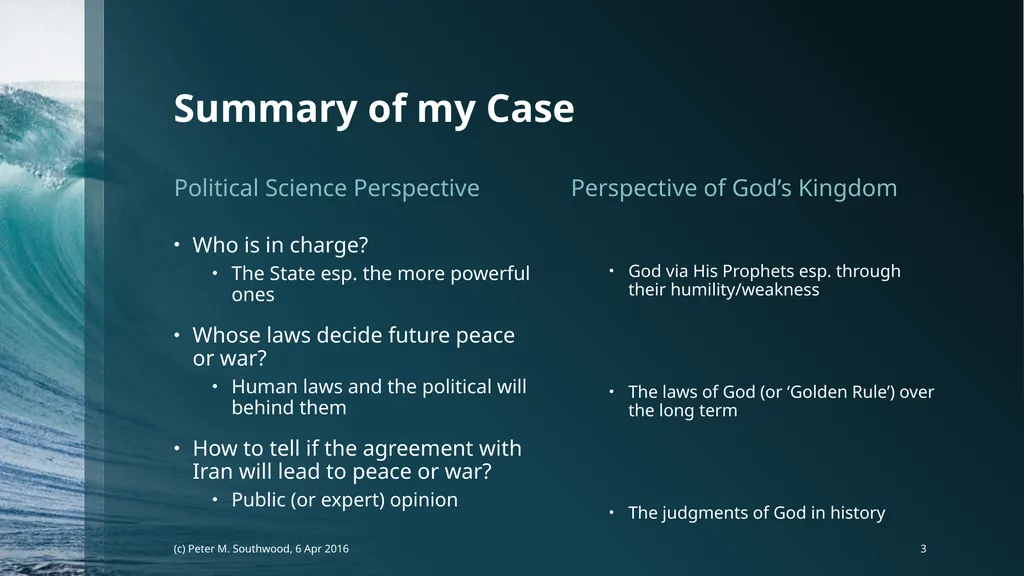
03
Summary of my Case Political Science Perspective Who is in charge?
The State esp. the more powerful ones
Whose laws decide future peace or war?
Human laws and the political will behind them
How to tell if the agreement with Iran will lead to peace or war?
Public (or expert) opinion Perspective of God’s Kingdom God via His Prophets esp. through their humility/weakness
The laws of God (or ‘Golden Rule’) over the long term
The judgments of God in history 3 (c) Peter M. Southwood, 6 Apr 2016<br>
The State esp. the more powerful ones
Whose laws decide future peace or war?
Human laws and the political will behind them
How to tell if the agreement with Iran will lead to peace or war?
Public (or expert) opinion Perspective of God’s Kingdom God via His Prophets esp. through their humility/weakness
The laws of God (or ‘Golden Rule’) over the long term
The judgments of God in history 3 (c) Peter M. Southwood, 6 Apr 2016<br>
04
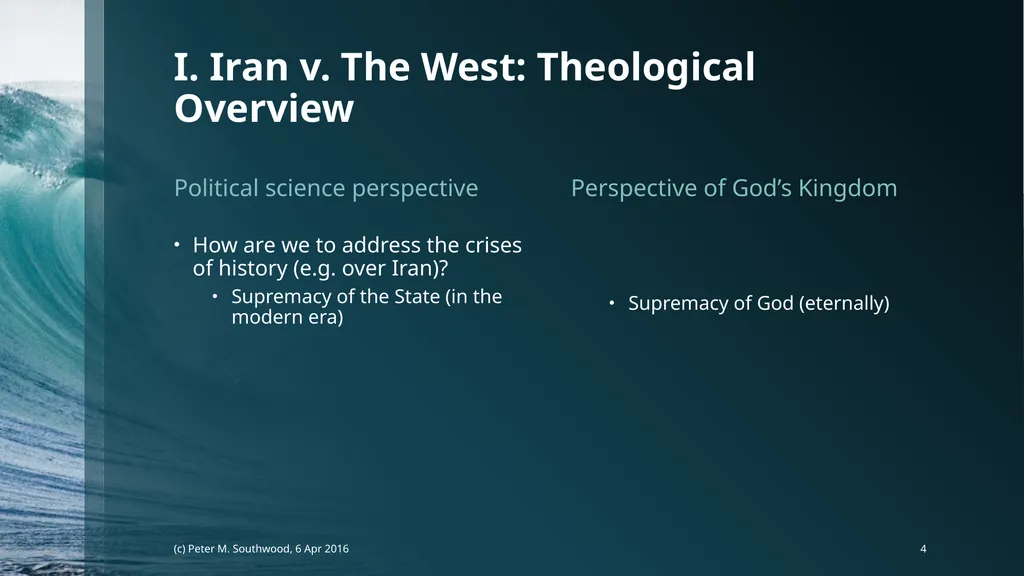
I. Iran v. The West: Theological Overview Political science perspective How are we to address the crises of history (e.g. over Iran)?
Supremacy of the State (in the modern era) Perspective of God’s Kingdom Supremacy of God (eternally) 4 (c) Peter M. Southwood, 6 Apr 2016<br>
Supremacy of the State (in the modern era) Perspective of God’s Kingdom Supremacy of God (eternally) 4 (c) Peter M. Southwood, 6 Apr 2016<br>
05
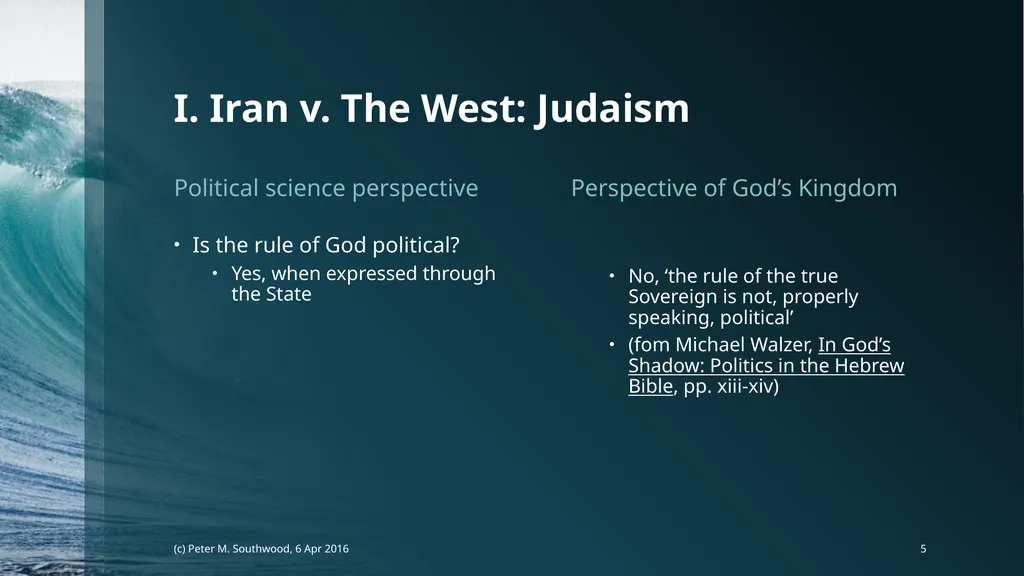
I. Iran v. The West: Judaism Political science perspective Is the rule of God political?
Yes, when expressed through the State Perspective of God’s Kingdom No, ‘the rule of the true Sovereign is not, properly speaking, political’
(fom Michael Walzer, In God’s Shadow: Politics in the Hebrew Bible, pp. xiii-xiv) 5 (c) Peter M. Southwood, 6 Apr 2016<br>
Yes, when expressed through the State Perspective of God’s Kingdom No, ‘the rule of the true Sovereign is not, properly speaking, political’
(fom Michael Walzer, In God’s Shadow: Politics in the Hebrew Bible, pp. xiii-xiv) 5 (c) Peter M. Southwood, 6 Apr 2016<br>
06
I. Iran v. The West: Judaism Political science perspective Did God’s chosen people reject His rule?
No, when the Kings of Israel acted as His servants
A rare occurrence especially after the kingdom divided Perspective of God’s Kingdom Yes, according to 1 Samuel 8: 5, 7:
Elders of Israel demanded a king ‘to judge us like all the nations’
God tells Samuel ‘… they have not rejected thee, but they have rejected me, that I should not reign over them’ [KJV] 6 (c) Peter M. Southwood, 6 Apr 2016<br>
No, when the Kings of Israel acted as His servants
A rare occurrence especially after the kingdom divided Perspective of God’s Kingdom Yes, according to 1 Samuel 8: 5, 7:
Elders of Israel demanded a king ‘to judge us like all the nations’
God tells Samuel ‘… they have not rejected thee, but they have rejected me, that I should not reign over them’ [KJV] 6 (c) Peter M. Southwood, 6 Apr 2016<br>
07
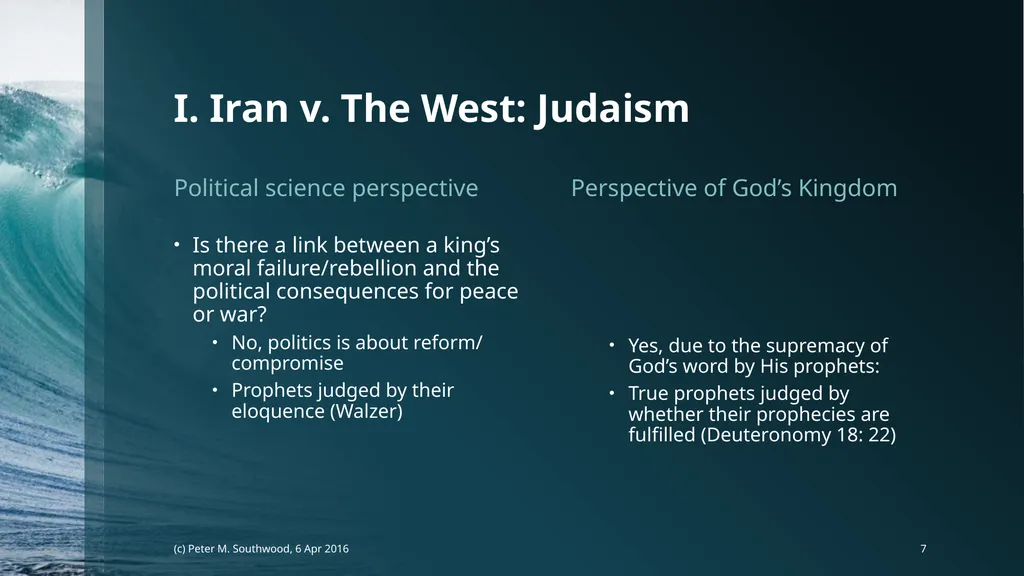
I. Iran v. The West: Judaism Political science perspective Is there a link between a king’s moral failure/rebellion and the political consequences for peace or war?
No, politics is about reform/ compromise
Prophets judged by their eloquence (Walzer) Perspective of God’s Kingdom Yes, due to the supremacy of God’s word by His prophets:
True prophets judged by whether their prophecies are fulfilled (Deuteronomy 18: 22) 7 (c) Peter M. Southwood, 6 Apr 2016<br>
No, politics is about reform/ compromise
Prophets judged by their eloquence (Walzer) Perspective of God’s Kingdom Yes, due to the supremacy of God’s word by His prophets:
True prophets judged by whether their prophecies are fulfilled (Deuteronomy 18: 22) 7 (c) Peter M. Southwood, 6 Apr 2016<br>
08
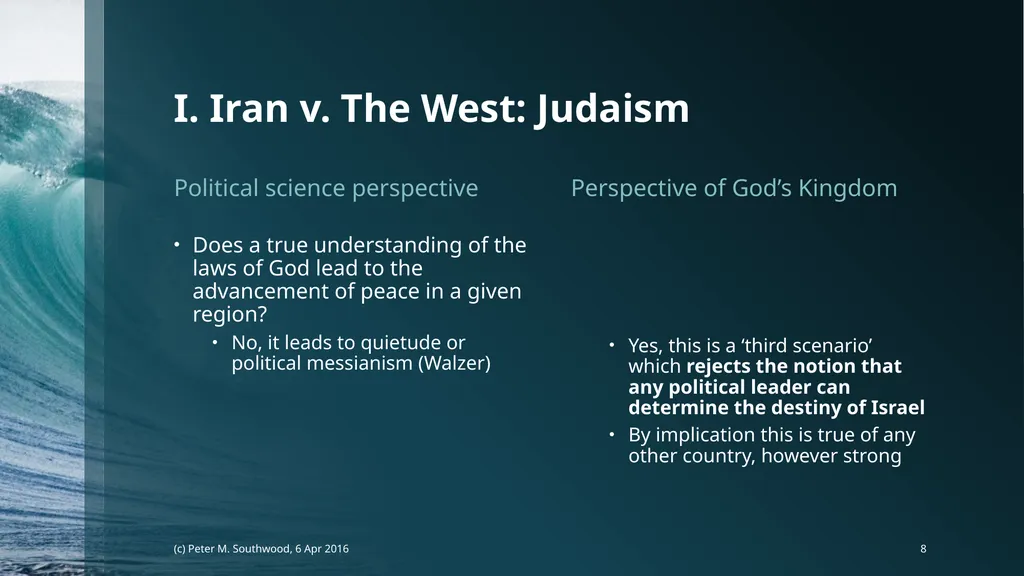
I. Iran v. The West: Judaism Political science perspective Does a true understanding of the laws of God lead to the advancement of peace in a given region?
No, it leads to quietude or political messianism (Walzer) Perspective of God’s Kingdom Yes, this is a ‘third scenario’ which rejects the notion that any political leader can determine the destiny of Israel
By implication this is true of any other country, however strong 8 (c) Peter M. Southwood, 6 Apr 2016<br>
No, it leads to quietude or political messianism (Walzer) Perspective of God’s Kingdom Yes, this is a ‘third scenario’ which rejects the notion that any political leader can determine the destiny of Israel
By implication this is true of any other country, however strong 8 (c) Peter M. Southwood, 6 Apr 2016<br>
09
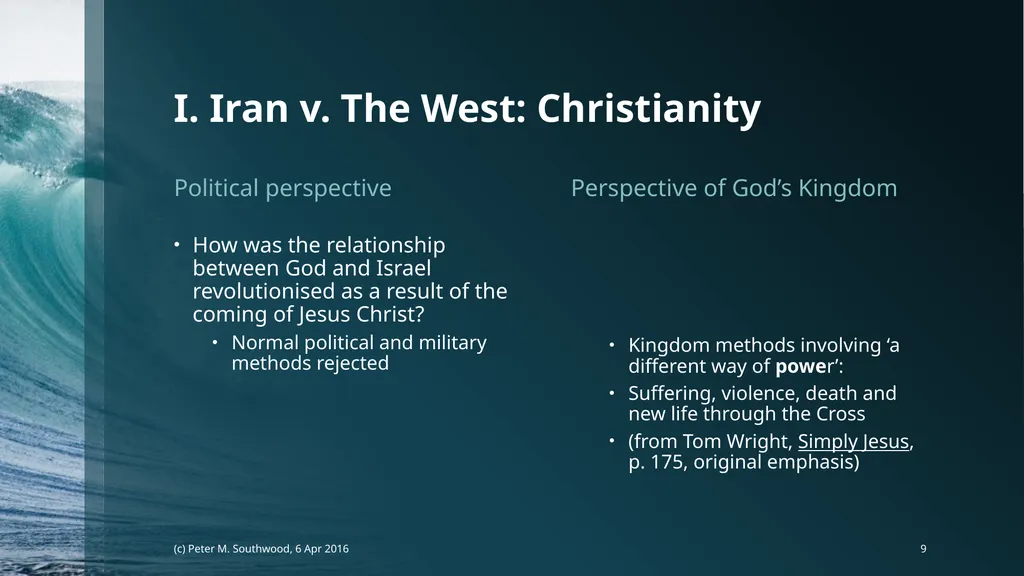
I. Iran v. The West: Christianity Political perspective How was the relationship between God and Israel revolutionised as a result of the coming of Jesus Christ?
Normal political and military methods rejected Perspective of God’s Kingdom Kingdom methods involving ‘a different way of power’:
Suffering, violence, death and new life through the Cross
(from Tom Wright, Simply Jesus, p. 175, original emphasis) 9 (c) Peter M. Southwood, 6 Apr 2016<br>
Normal political and military methods rejected Perspective of God’s Kingdom Kingdom methods involving ‘a different way of power’:
Suffering, violence, death and new life through the Cross
(from Tom Wright, Simply Jesus, p. 175, original emphasis) 9 (c) Peter M. Southwood, 6 Apr 2016<br>
10
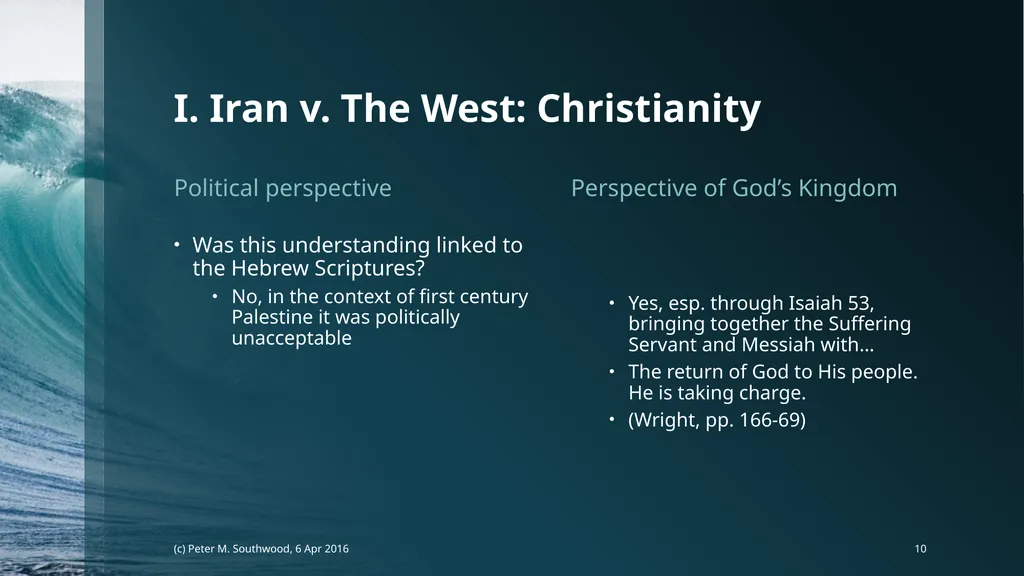
I. Iran v. The West: Christianity Political perspective Was this understanding linked to the Hebrew Scriptures?
No, in the context of first century Palestine it was politically unacceptable Perspective of God’s Kingdom Yes, esp. through Isaiah 53, bringing together the Suffering Servant and Messiah with…
The return of God to His people. He is taking charge.
(Wright, pp. 166-69) 10 (c) Peter M. Southwood, 6 Apr 2016<br>
No, in the context of first century Palestine it was politically unacceptable Perspective of God’s Kingdom Yes, esp. through Isaiah 53, bringing together the Suffering Servant and Messiah with…
The return of God to His people. He is taking charge.
(Wright, pp. 166-69) 10 (c) Peter M. Southwood, 6 Apr 2016<br>
11
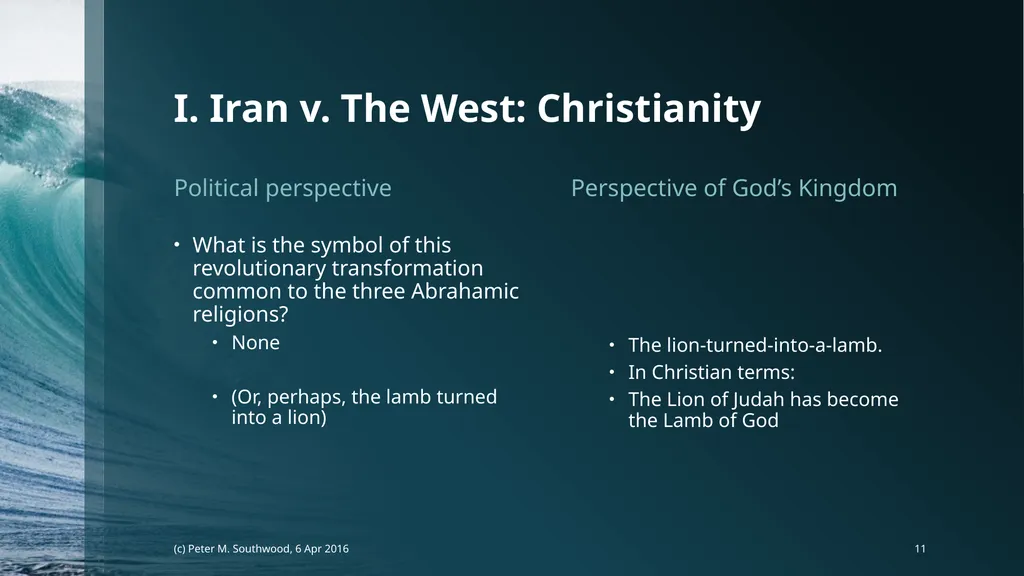
I. Iran v. The West: Christianity Political perspective What is the symbol of this revolutionary transformation common to the three Abrahamic religions?
None
(Or, perhaps, the lamb turned into a lion) Perspective of God’s Kingdom The lion-turned-into-a-lamb.
In Christian terms:
The Lion of Judah has become the Lamb of God 11 (c) Peter M. Southwood, 6 Apr 2016<br>
None
(Or, perhaps, the lamb turned into a lion) Perspective of God’s Kingdom The lion-turned-into-a-lamb.
In Christian terms:
The Lion of Judah has become the Lamb of God 11 (c) Peter M. Southwood, 6 Apr 2016<br>
12
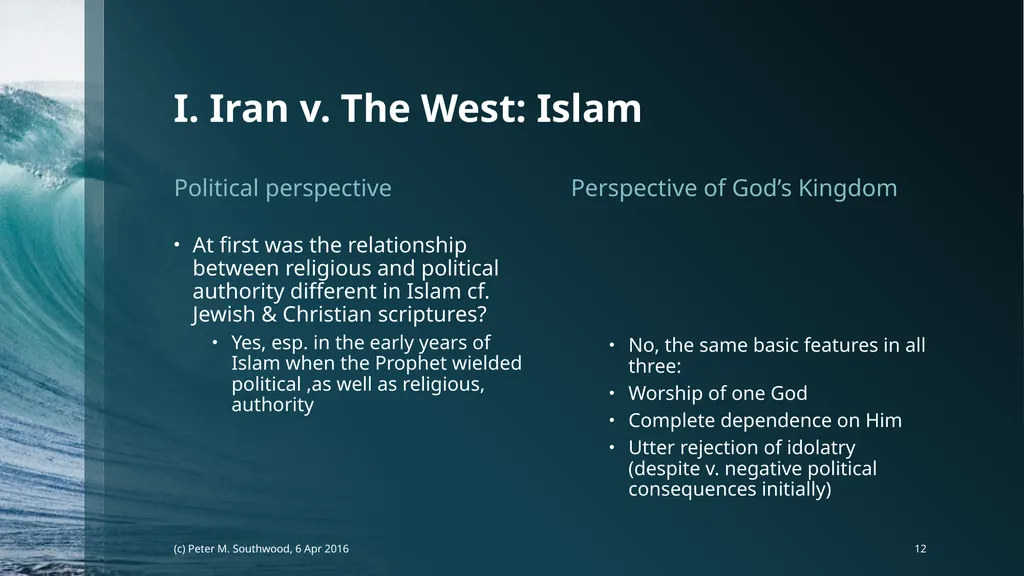
I. Iran v. The West: Islam Political perspective At first was the relationship between religious and political authority different in Islam cf. Jewish & Christian scriptures?
Yes, esp. in the early years of Islam when the Prophet wielded political ,as well as religious, authority Perspective of God’s Kingdom No, the same basic features in all three:
Worship of one God
Complete dependence on Him
Utter rejection of idolatry (despite v. negative political consequences initially) 12 (c) Peter M. Southwood, 6 Apr 2016<br>
Yes, esp. in the early years of Islam when the Prophet wielded political ,as well as religious, authority Perspective of God’s Kingdom No, the same basic features in all three:
Worship of one God
Complete dependence on Him
Utter rejection of idolatry (despite v. negative political consequences initially) 12 (c) Peter M. Southwood, 6 Apr 2016<br>
13
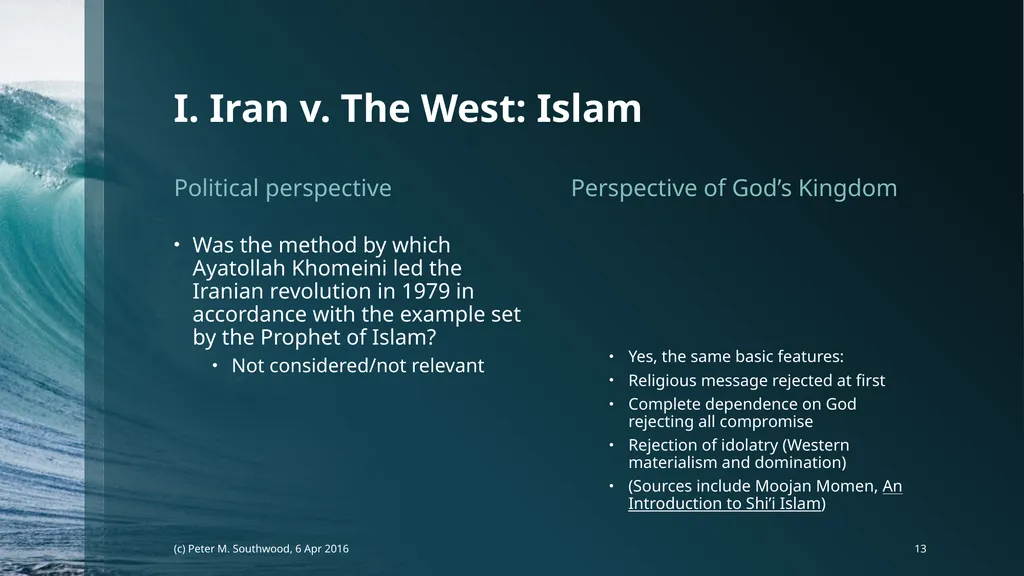
I. Iran v. The West: Islam Political perspective Was the method by which Ayatollah Khomeini led the Iranian revolution in 1979 in accordance with the example set by the Prophet of Islam?
Not considered/not relevant Perspective of God’s Kingdom Yes, the same basic features:
Religious message rejected at first
Complete dependence on God rejecting all compromise
Rejection of idolatry (Western materialism and domination)
(Sources include Moojan Momen, An Introduction to Shi’i Islam) 13 (c) Peter M. Southwood, 6 Apr 2016<br>
Not considered/not relevant Perspective of God’s Kingdom Yes, the same basic features:
Religious message rejected at first
Complete dependence on God rejecting all compromise
Rejection of idolatry (Western materialism and domination)
(Sources include Moojan Momen, An Introduction to Shi’i Islam) 13 (c) Peter M. Southwood, 6 Apr 2016<br>
14
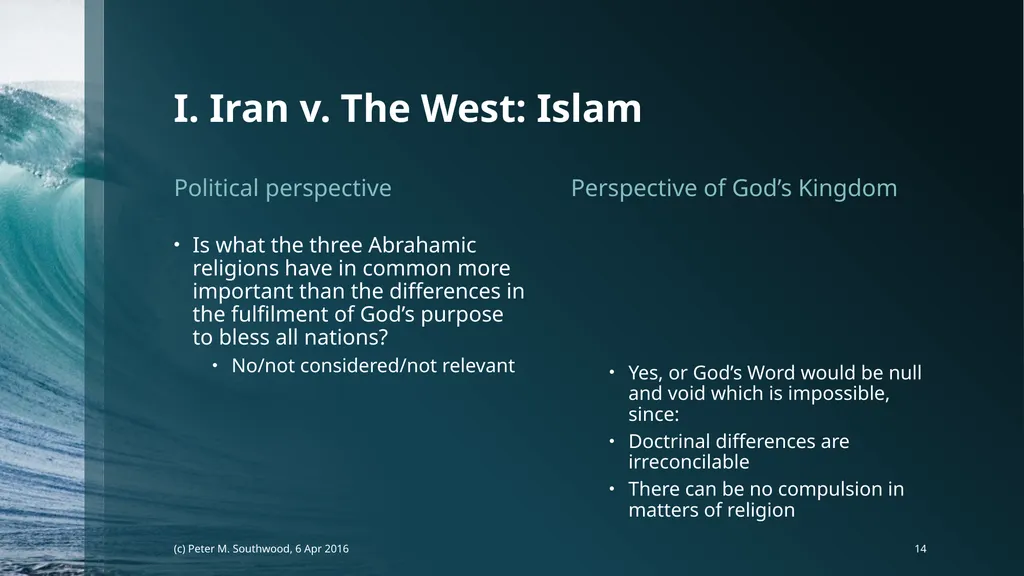
I. Iran v. The West: Islam Political perspective Is what the three Abrahamic religions have in common more important than the differences in the fulfilment of God’s purpose to bless all nations?
No/not considered/not relevant Perspective of God’s Kingdom Yes, or God’s Word would be null and void which is impossible, since:
Doctrinal differences are irreconcilable
There can be no compulsion in matters of religion 14 (c) Peter M. Southwood, 6 Apr 2016<br>
No/not considered/not relevant Perspective of God’s Kingdom Yes, or God’s Word would be null and void which is impossible, since:
Doctrinal differences are irreconcilable
There can be no compulsion in matters of religion 14 (c) Peter M. Southwood, 6 Apr 2016<br>
15
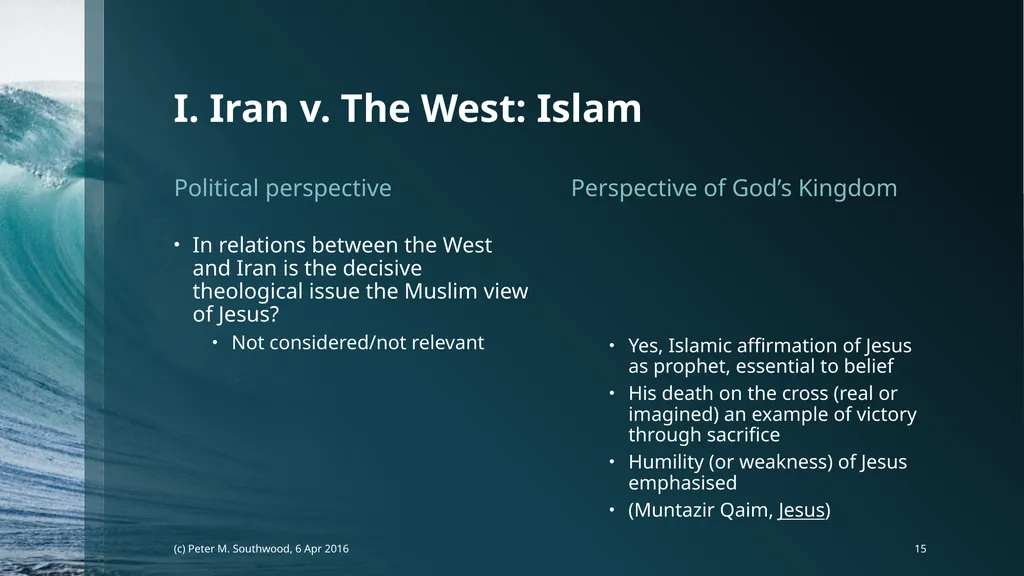
I. Iran v. The West: Islam Political perspective In relations between the West and Iran is the decisive theological issue the Muslim view of Jesus?
Not considered/not relevant Perspective of God’s Kingdom Yes, Islamic affirmation of Jesus as prophet, essential to belief
His death on the cross (real or imagined) an example of victory through sacrifice
Humility (or weakness) of Jesus emphasised
(Muntazir Qaim, Jesus) 15 (c) Peter M. Southwood, 6 Apr 2016<br>
Not considered/not relevant Perspective of God’s Kingdom Yes, Islamic affirmation of Jesus as prophet, essential to belief
His death on the cross (real or imagined) an example of victory through sacrifice
Humility (or weakness) of Jesus emphasised
(Muntazir Qaim, Jesus) 15 (c) Peter M. Southwood, 6 Apr 2016<br>
16
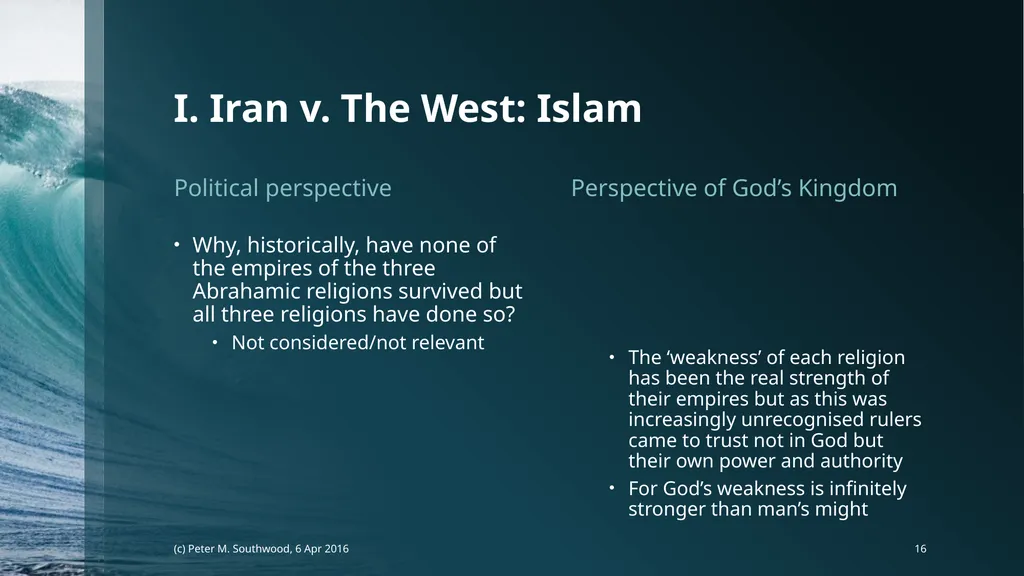
I. Iran v. The West: Islam Political perspective Why, historically, have none of the empires of the three Abrahamic religions survived but all three religions have done so?
Not considered/not relevant Perspective of God’s Kingdom The ‘weakness’ of each religion has been the real strength of their empires but as this was increasingly unrecognised rulers came to trust not in God but their own power and authority
For God’s weakness is infinitely stronger than man’s might 16 (c) Peter M. Southwood, 6 Apr 2016<br>
Not considered/not relevant Perspective of God’s Kingdom The ‘weakness’ of each religion has been the real strength of their empires but as this was increasingly unrecognised rulers came to trust not in God but their own power and authority
For God’s weakness is infinitely stronger than man’s might 16 (c) Peter M. Southwood, 6 Apr 2016<br>
17
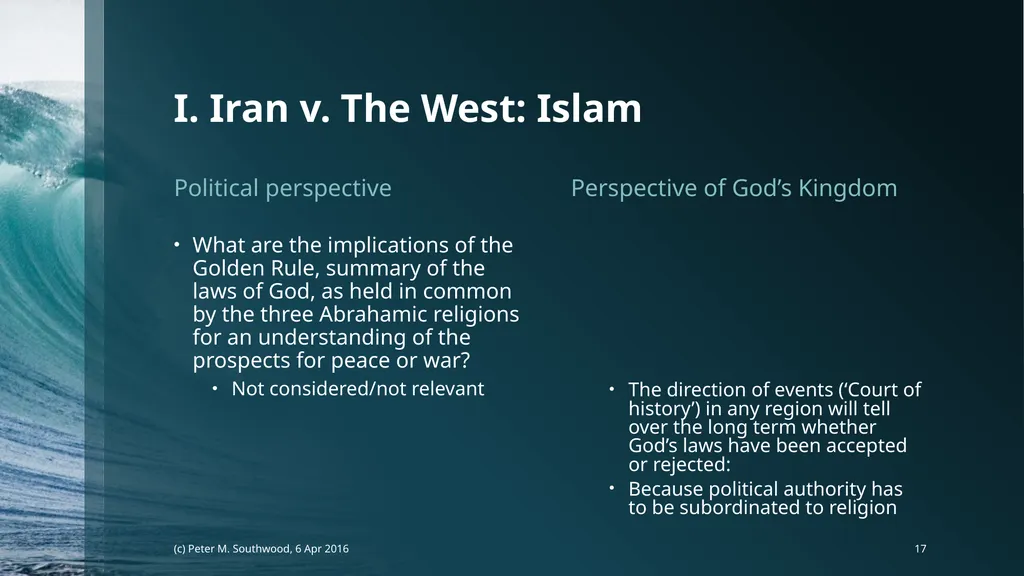
I. Iran v. The West: Islam Political perspective What are the implications of the Golden Rule, summary of the laws of God, as held in common by the three Abrahamic religions for an understanding of the prospects for peace or war?
Not considered/not relevant Perspective of God’s Kingdom The direction of events (‘Court of history’) in any region will tell over the long term whether God’s laws have been accepted or rejected:
Because political authority has to be subordinated to religion 17 (c) Peter M. Southwood, 6 Apr 2016<br>
Not considered/not relevant Perspective of God’s Kingdom The direction of events (‘Court of history’) in any region will tell over the long term whether God’s laws have been accepted or rejected:
Because political authority has to be subordinated to religion 17 (c) Peter M. Southwood, 6 Apr 2016<br>
18
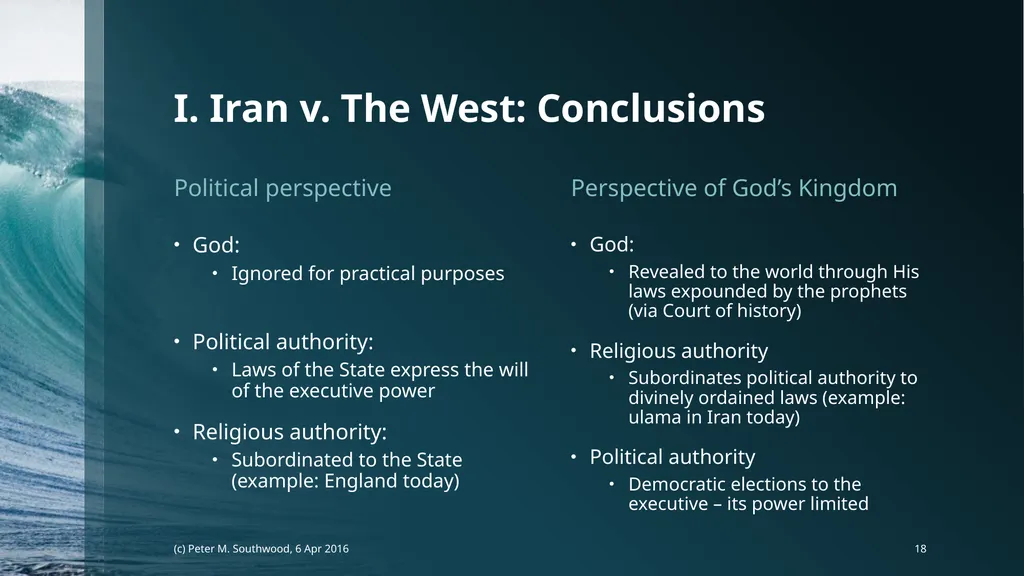
I. Iran v. The West: Conclusions Political perspective God:
Ignored for practical purposes
Political authority:
Laws of the State express the will of the executive power
Religious authority:
Subordinated to the State (example: England today) Perspective of God’s Kingdom God:
Revealed to the world through His laws expounded by the prophets (via Court of history)
Religious authority
Subordinates political authority to divinely ordained laws (example: ulama in Iran today)
Political authority
Democratic elections to the executive – its power limited 18 (c) Peter M. Southwood, 6 Apr 2016<br>
Ignored for practical purposes
Political authority:
Laws of the State express the will of the executive power
Religious authority:
Subordinated to the State (example: England today) Perspective of God’s Kingdom God:
Revealed to the world through His laws expounded by the prophets (via Court of history)
Religious authority
Subordinates political authority to divinely ordained laws (example: ulama in Iran today)
Political authority
Democratic elections to the executive – its power limited 18 (c) Peter M. Southwood, 6 Apr 2016<br>
19
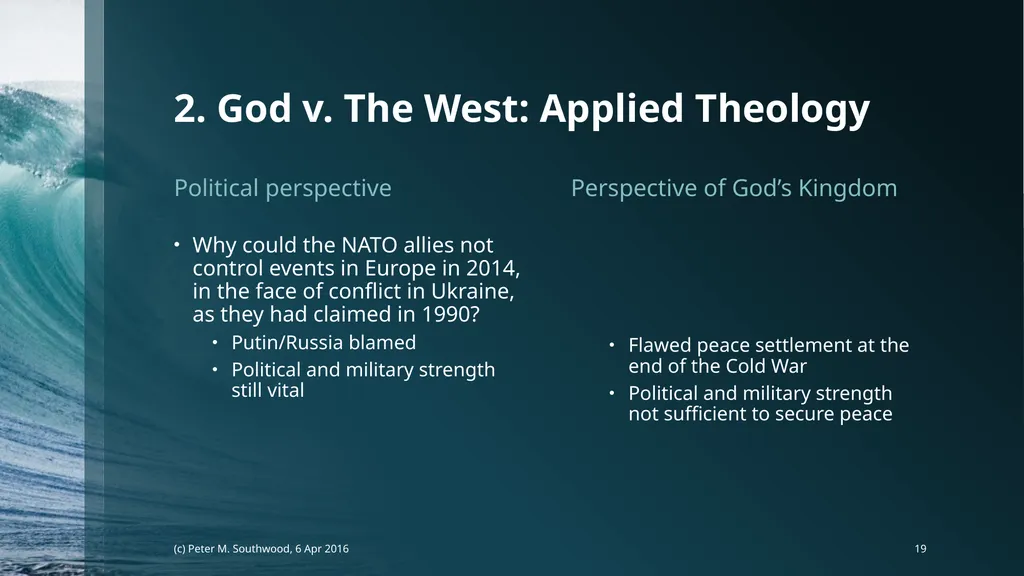
2. God v. The West: Applied Theology Political perspective Why could the NATO allies not control events in Europe in 2014, in the face of conflict in Ukraine, as they had claimed in 1990?
Putin/Russia blamed
Political and military strength still vital Perspective of God’s Kingdom Flawed peace settlement at the end of the Cold War
Political and military strength not sufficient to secure peace 19 (c) Peter M. Southwood, 6 Apr 2016<br>
Putin/Russia blamed
Political and military strength still vital Perspective of God’s Kingdom Flawed peace settlement at the end of the Cold War
Political and military strength not sufficient to secure peace 19 (c) Peter M. Southwood, 6 Apr 2016<br>
20
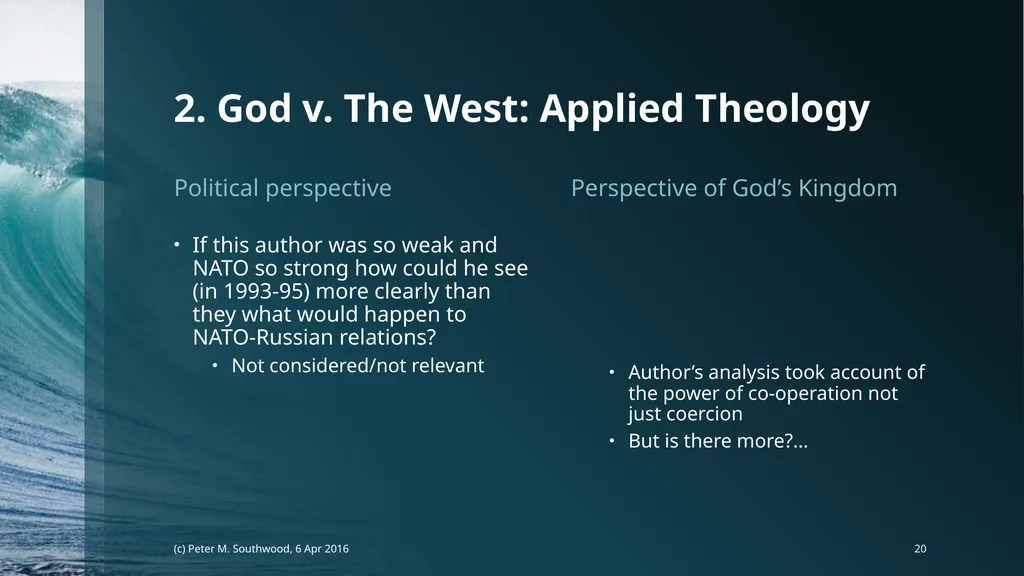
2. God v. The West: Applied Theology Political perspective If this author was so weak and NATO so strong how could he see (in 1993-95) more clearly than they what would happen to NATO-Russian relations?
Not considered/not relevant Perspective of God’s Kingdom Author’s analysis took account of the power of co-operation not just coercion
But is there more?... 20 (c) Peter M. Southwood, 6 Apr 2016<br>
Not considered/not relevant Perspective of God’s Kingdom Author’s analysis took account of the power of co-operation not just coercion
But is there more?... 20 (c) Peter M. Southwood, 6 Apr 2016<br>
21
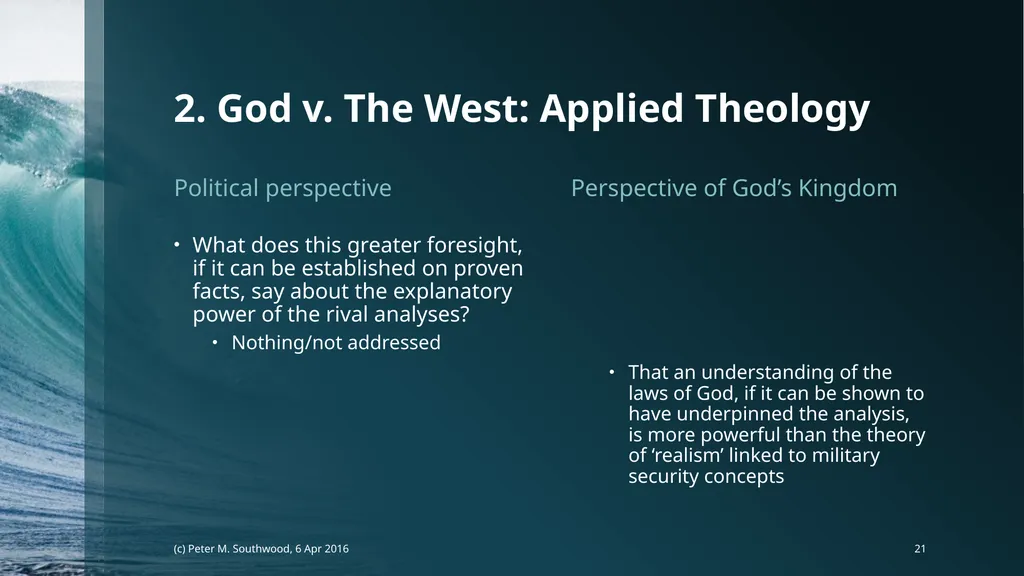
2. God v. The West: Applied Theology Political perspective What does this greater foresight, if it can be established on proven facts, say about the explanatory power of the rival analyses?
Nothing/not addressed Perspective of God’s Kingdom That an understanding of the laws of God, if it can be shown to have underpinned the analysis, is more powerful than the theory of ‘realism’ linked to military security concepts 21 (c) Peter M. Southwood, 6 Apr 2016<br>
Nothing/not addressed Perspective of God’s Kingdom That an understanding of the laws of God, if it can be shown to have underpinned the analysis, is more powerful than the theory of ‘realism’ linked to military security concepts 21 (c) Peter M. Southwood, 6 Apr 2016<br>
22
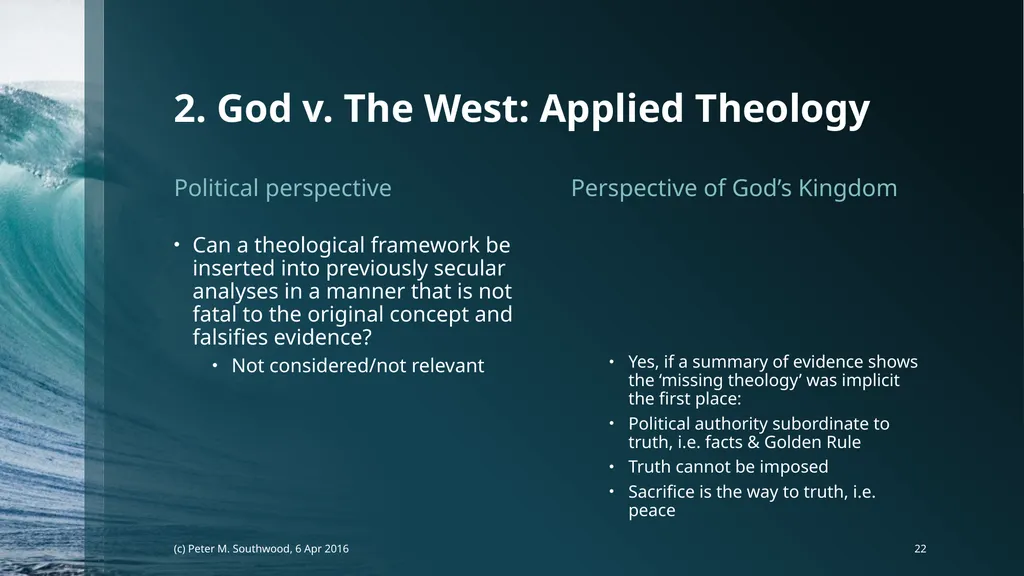
2. God v. The West: Applied Theology Political perspective Can a theological framework be inserted into previously secular analyses in a manner that is not fatal to the original concept and falsifies evidence?
Not considered/not relevant Perspective of God’s Kingdom Yes, if a summary of evidence shows the ‘missing theology’ was implicit the first place:
Political authority subordinate to truth, i.e. facts & Golden Rule
Truth cannot be imposed
Sacrifice is the way to truth, i.e. peace 22 (c) Peter M. Southwood, 6 Apr 2016<br>
Not considered/not relevant Perspective of God’s Kingdom Yes, if a summary of evidence shows the ‘missing theology’ was implicit the first place:
Political authority subordinate to truth, i.e. facts & Golden Rule
Truth cannot be imposed
Sacrifice is the way to truth, i.e. peace 22 (c) Peter M. Southwood, 6 Apr 2016<br>
23
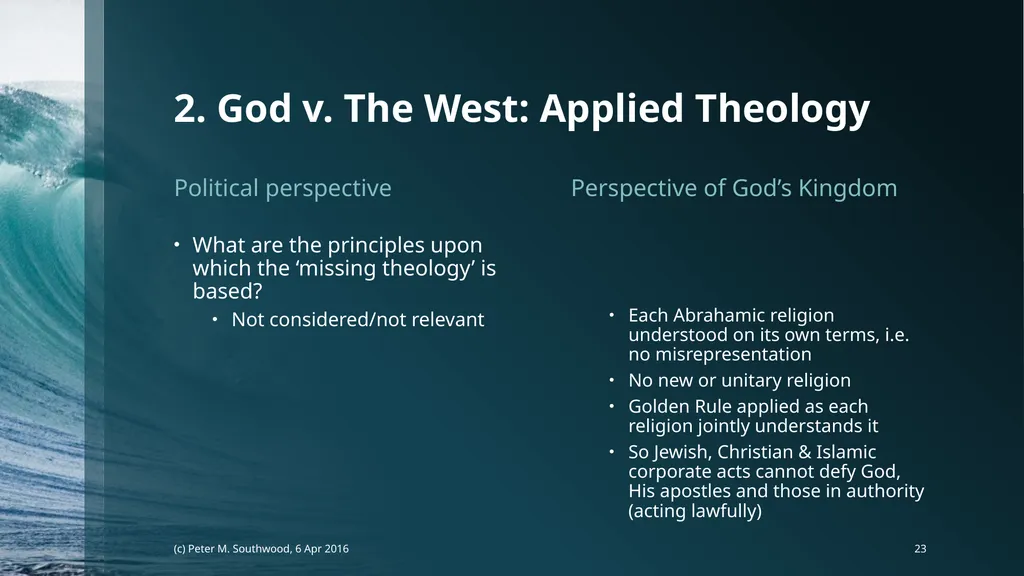
2. God v. The West: Applied Theology Political perspective What are the principles upon which the ‘missing theology’ is based?
Not considered/not relevant Perspective of God’s Kingdom Each Abrahamic religion understood on its own terms, i.e. no misrepresentation
No new or unitary religion
Golden Rule applied as each religion jointly understands it
So Jewish, Christian & Islamic corporate acts cannot defy God, His apostles and those in authority (acting lawfully) 23 (c) Peter M. Southwood, 6 Apr 2016<br>
Not considered/not relevant Perspective of God’s Kingdom Each Abrahamic religion understood on its own terms, i.e. no misrepresentation
No new or unitary religion
Golden Rule applied as each religion jointly understands it
So Jewish, Christian & Islamic corporate acts cannot defy God, His apostles and those in authority (acting lawfully) 23 (c) Peter M. Southwood, 6 Apr 2016<br>
24
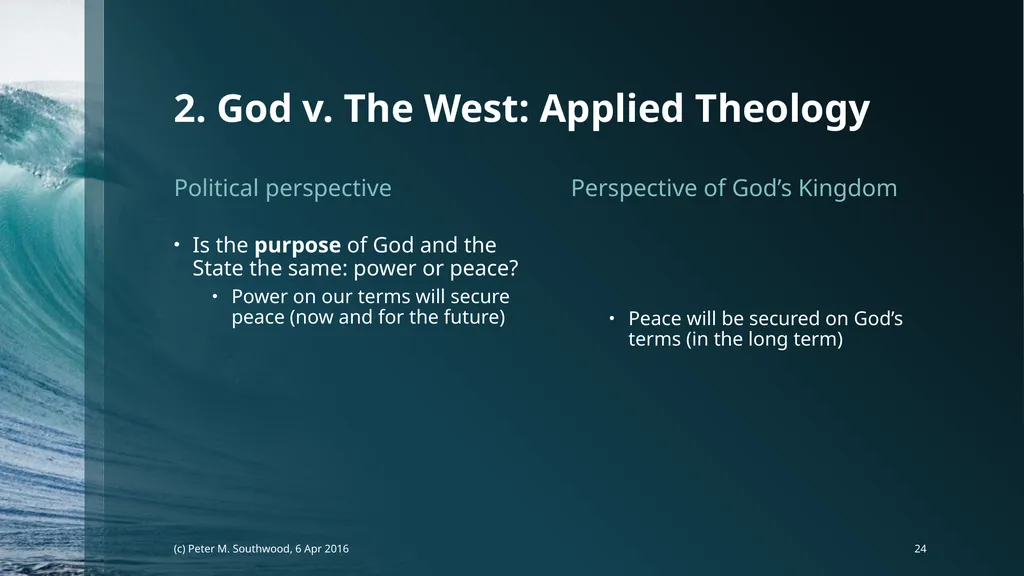
2. God v. The West: Applied Theology Political perspective Is the purpose of God and the State the same: power or peace?
Power on our terms will secure peace (now and for the future) Perspective of God’s Kingdom Peace will be secured on God’s terms (in the long term) 24 (c) Peter M. Southwood, 6 Apr 2016<br>
Power on our terms will secure peace (now and for the future) Perspective of God’s Kingdom Peace will be secured on God’s terms (in the long term) 24 (c) Peter M. Southwood, 6 Apr 2016<br>
25
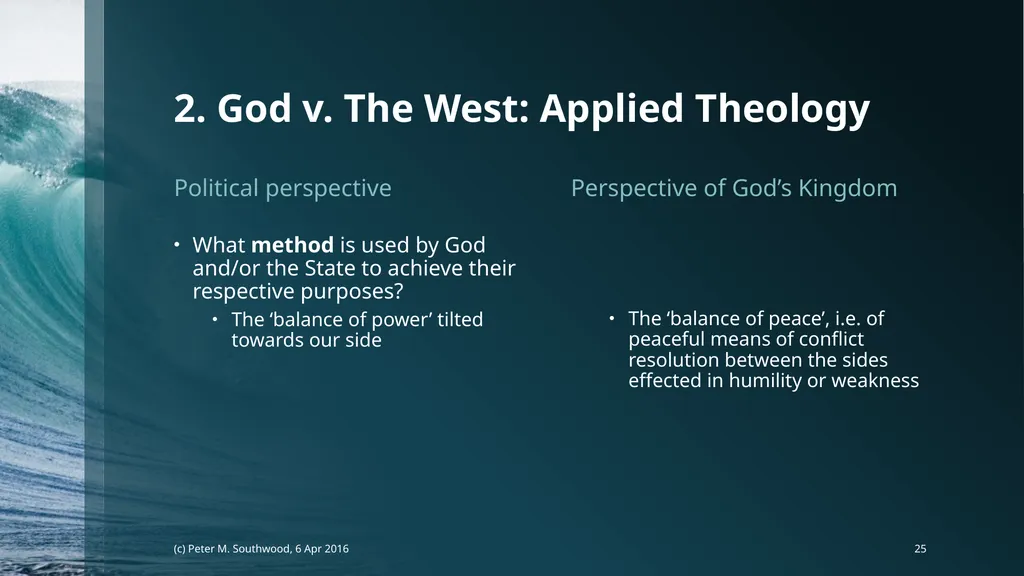
2. God v. The West: Applied Theology Political perspective What method is used by God and/or the State to achieve their respective purposes?
The ‘balance of power’ tilted towards our side Perspective of God’s Kingdom The ‘balance of peace’, i.e. of peaceful means of conflict resolution between the sides effected in humility or weakness 25 (c) Peter M. Southwood, 6 Apr 2016<br>
The ‘balance of power’ tilted towards our side Perspective of God’s Kingdom The ‘balance of peace’, i.e. of peaceful means of conflict resolution between the sides effected in humility or weakness 25 (c) Peter M. Southwood, 6 Apr 2016<br>
26
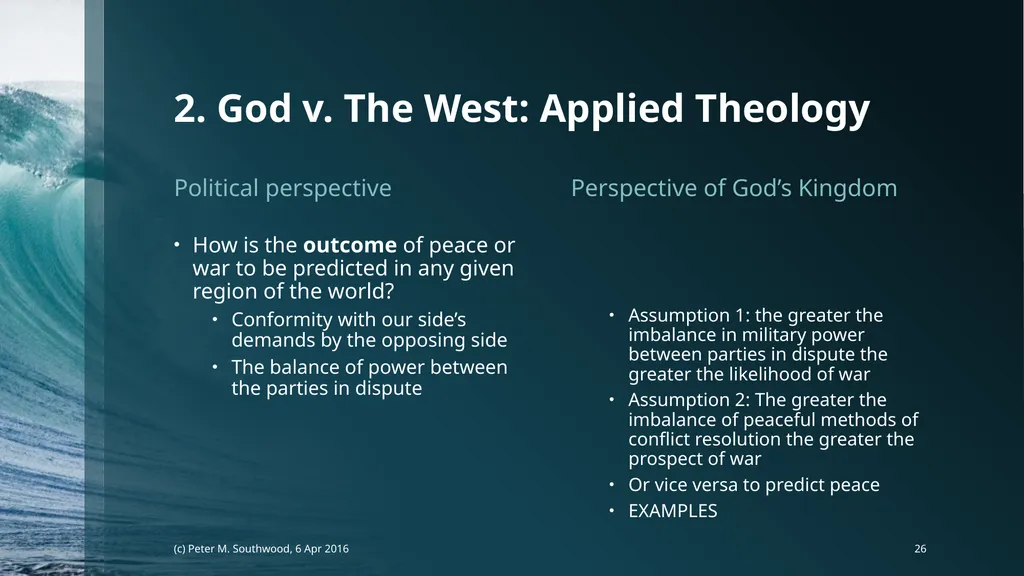
2. God v. The West: Applied Theology Political perspective How is the outcome of peace or war to be predicted in any given region of the world?
Conformity with our side’s demands by the opposing side
The balance of power between the parties in dispute Perspective of God’s Kingdom Assumption 1: the greater the imbalance in military power between parties in dispute the greater the likelihood of war
Assumption 2: The greater the imbalance of peaceful methods of conflict resolution the greater the prospect of war
Or vice versa to predict peace
EXAMPLES 26 (c) Peter M. Southwood, 6 Apr 2016<br>
Conformity with our side’s demands by the opposing side
The balance of power between the parties in dispute Perspective of God’s Kingdom Assumption 1: the greater the imbalance in military power between parties in dispute the greater the likelihood of war
Assumption 2: The greater the imbalance of peaceful methods of conflict resolution the greater the prospect of war
Or vice versa to predict peace
EXAMPLES 26 (c) Peter M. Southwood, 6 Apr 2016<br>
27
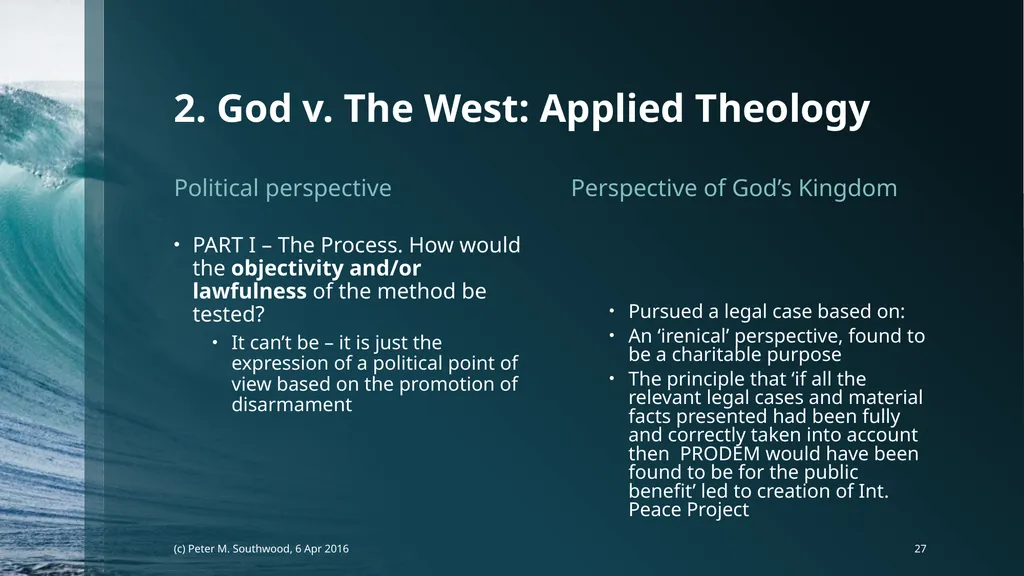
2. God v. The West: Applied Theology Political perspective PART I – The Process. How would the objectivity and/or lawfulness of the method be tested?
It can’t be – it is just the expression of a political point of view based on the promotion of disarmament Perspective of God’s Kingdom Pursued a legal case based on:
An ‘irenical’ perspective, found to be a charitable purpose
The principle that ‘if all the relevant legal cases and material facts presented had been fully and correctly taken into account then PRODEM would have been found to be for the public benefit’ led to creation of Int. Peace Project 27 (c) Peter M. Southwood, 6 Apr 2016<br>
It can’t be – it is just the expression of a political point of view based on the promotion of disarmament Perspective of God’s Kingdom Pursued a legal case based on:
An ‘irenical’ perspective, found to be a charitable purpose
The principle that ‘if all the relevant legal cases and material facts presented had been fully and correctly taken into account then PRODEM would have been found to be for the public benefit’ led to creation of Int. Peace Project 27 (c) Peter M. Southwood, 6 Apr 2016<br>
28
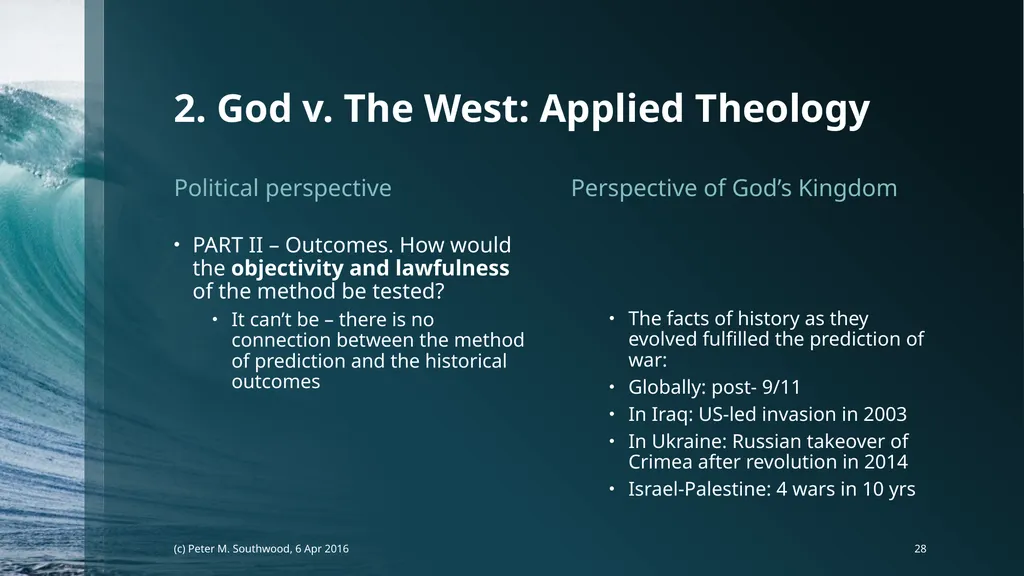
2. God v. The West: Applied Theology Political perspective PART II – Outcomes. How would the objectivity and lawfulness of the method be tested?
It can’t be – there is no connection between the method of prediction and the historical outcomes Perspective of God’s Kingdom The facts of history as they evolved fulfilled the prediction of war:
Globally: post- 9/11
In Iraq: US-led invasion in 2003
In Ukraine: Russian takeover of Crimea after revolution in 2014
Israel-Palestine: 4 wars in 10 yrs 28 (c) Peter M. Southwood, 6 Apr 2016<br>
It can’t be – there is no connection between the method of prediction and the historical outcomes Perspective of God’s Kingdom The facts of history as they evolved fulfilled the prediction of war:
Globally: post- 9/11
In Iraq: US-led invasion in 2003
In Ukraine: Russian takeover of Crimea after revolution in 2014
Israel-Palestine: 4 wars in 10 yrs 28 (c) Peter M. Southwood, 6 Apr 2016<br>
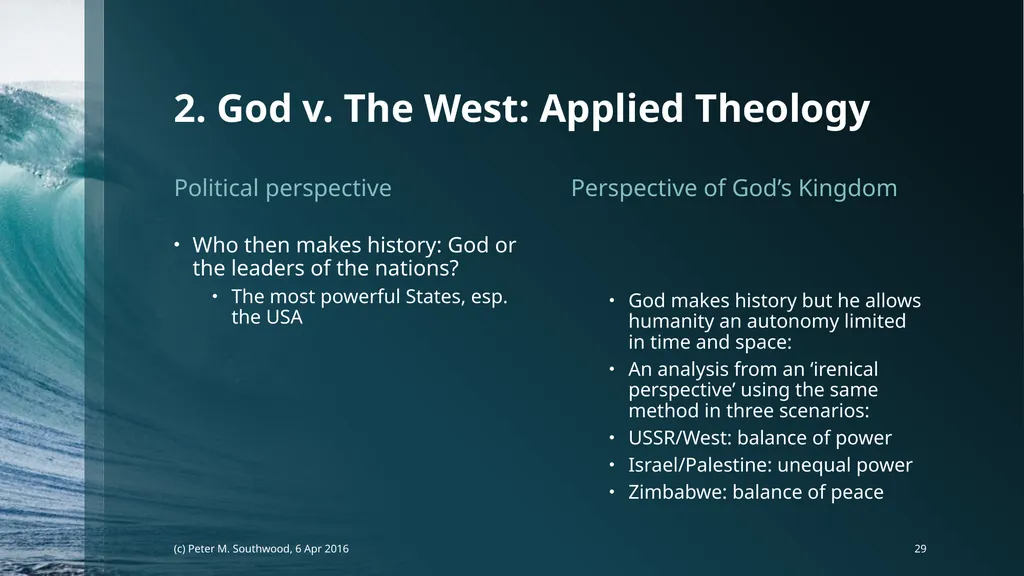
29
2. God v. The West: Applied Theology Political perspective Who then makes history: God or the leaders of the nations?
The most powerful States, esp. the USA Perspective of God’s Kingdom God makes history but he allows humanity an autonomy limited in time and space:
An analysis from an ‘irenical perspective’ using the same method in three scenarios:
USSR/West: balance of power
Israel/Palestine: unequal power
Zimbabwe: balance of peace 29 (c) Peter M. Southwood, 6 Apr 2016<br>
The most powerful States, esp. the USA Perspective of God’s Kingdom God makes history but he allows humanity an autonomy limited in time and space:
An analysis from an ‘irenical perspective’ using the same method in three scenarios:
USSR/West: balance of power
Israel/Palestine: unequal power
Zimbabwe: balance of peace 29 (c) Peter M. Southwood, 6 Apr 2016<br>
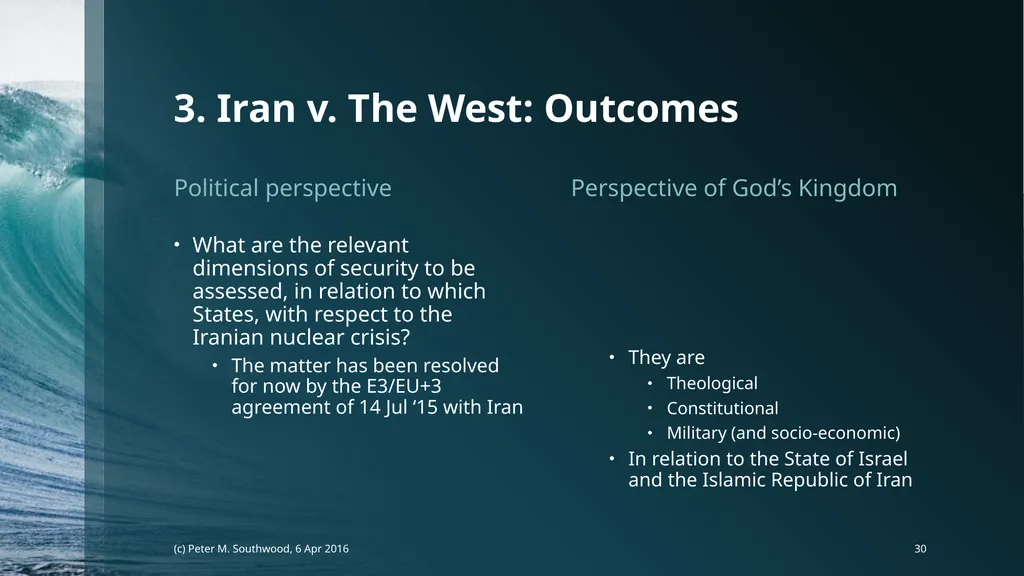
30
3. Iran v. The West: Outcomes Political perspective What are the relevant dimensions of security to be assessed, in relation to which States, with respect to the Iranian nuclear crisis?
The matter has been resolved for now by the E3/EU+3 agreement of 14 Jul ‘15 with Iran Perspective of God’s Kingdom They are
Theological
Constitutional
Military (and socio-economic)
In relation to the State of Israel and the Islamic Republic of Iran 30 (c) Peter M. Southwood, 6 Apr 2016<br>
The matter has been resolved for now by the E3/EU+3 agreement of 14 Jul ‘15 with Iran Perspective of God’s Kingdom They are
Theological
Constitutional
Military (and socio-economic)
In relation to the State of Israel and the Islamic Republic of Iran 30 (c) Peter M. Southwood, 6 Apr 2016<br>
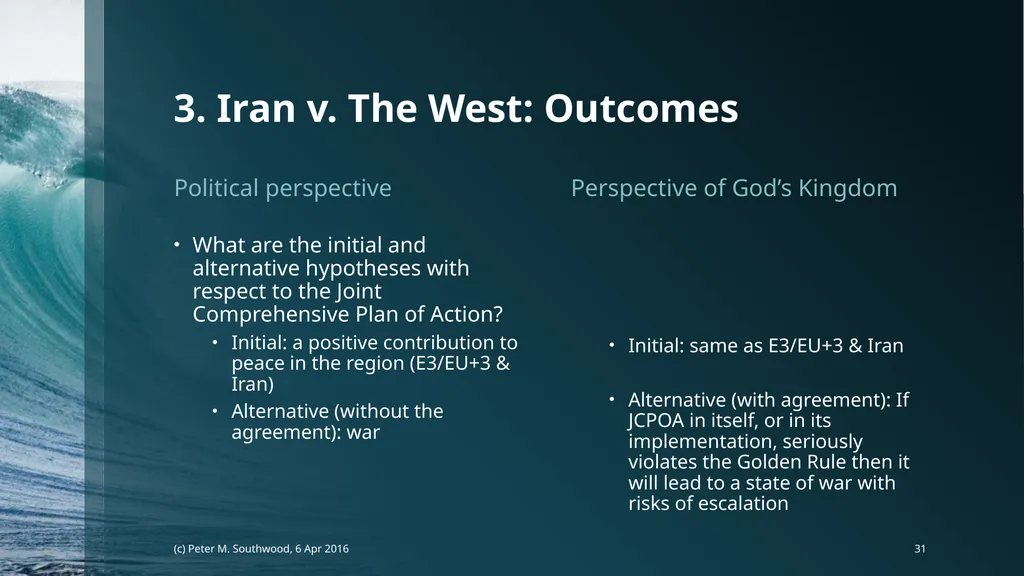
31
3. Iran v. The West: Outcomes Political perspective What are the initial and alternative hypotheses with respect to the Joint Comprehensive Plan of Action?
Initial: a positive contribution to peace in the region (E3/EU+3 & Iran)
Alternative (without the agreement): war Perspective of God’s Kingdom Initial: same as E3/EU+3 & Iran
Alternative (with agreement): If JCPOA in itself, or in its implementation, seriously violates the Golden Rule then it will lead to a state of war with risks of escalation 31 (c) Peter M. Southwood, 6 Apr 2016<br>
Initial: a positive contribution to peace in the region (E3/EU+3 & Iran)
Alternative (without the agreement): war Perspective of God’s Kingdom Initial: same as E3/EU+3 & Iran
Alternative (with agreement): If JCPOA in itself, or in its implementation, seriously violates the Golden Rule then it will lead to a state of war with risks of escalation 31 (c) Peter M. Southwood, 6 Apr 2016<br>
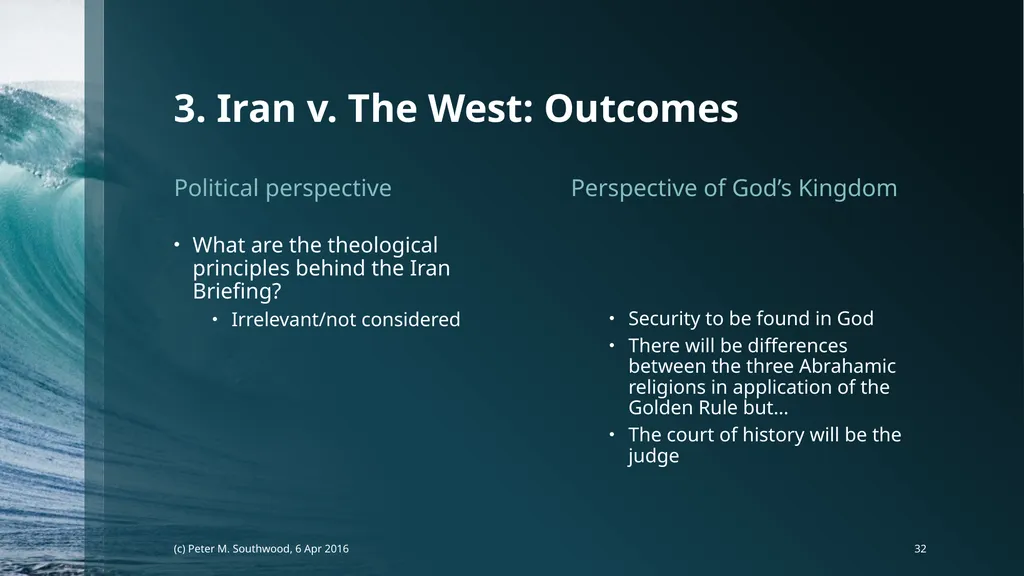
32
3. Iran v. The West: Outcomes Political perspective What are the theological principles behind the Iran Briefing?
Irrelevant/not considered Perspective of God’s Kingdom Security to be found in God
There will be differences between the three Abrahamic religions in application of the Golden Rule but…
The court of history will be the judge 32 (c) Peter M. Southwood, 6 Apr 2016<br>
Irrelevant/not considered Perspective of God’s Kingdom Security to be found in God
There will be differences between the three Abrahamic religions in application of the Golden Rule but…
The court of history will be the judge 32 (c) Peter M. Southwood, 6 Apr 2016<br>
33
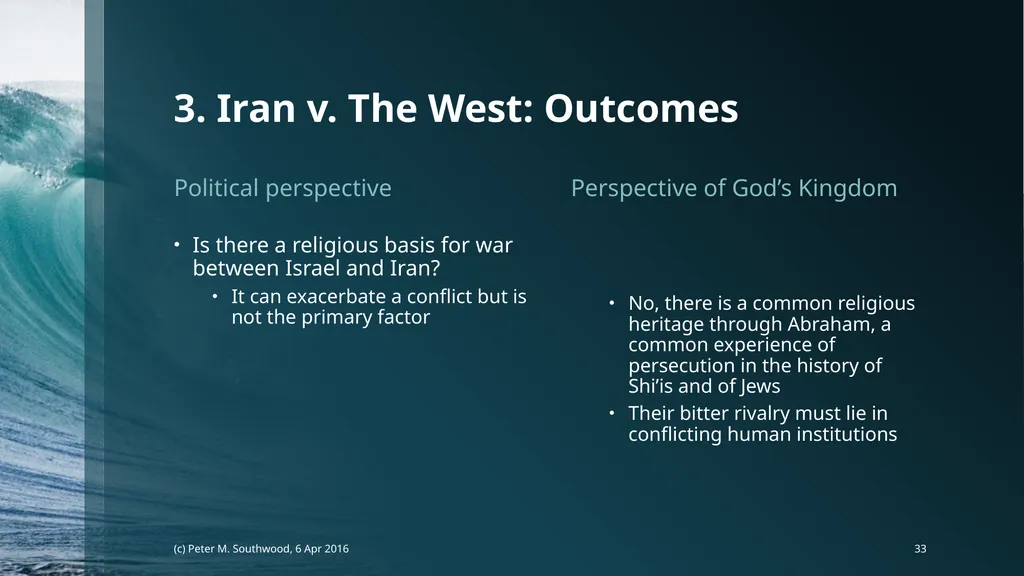
3. Iran v. The West: Outcomes Political perspective Is there a religious basis for war between Israel and Iran?
It can exacerbate a conflict but is not the primary factor Perspective of God’s Kingdom No, there is a common religious heritage through Abraham, a common experience of persecution in the history of Shi’is and of Jews
Their bitter rivalry must lie in conflicting human institutions 33 (c) Peter M. Southwood, 6 Apr 2016<br>
It can exacerbate a conflict but is not the primary factor Perspective of God’s Kingdom No, there is a common religious heritage through Abraham, a common experience of persecution in the history of Shi’is and of Jews
Their bitter rivalry must lie in conflicting human institutions 33 (c) Peter M. Southwood, 6 Apr 2016<br>
34
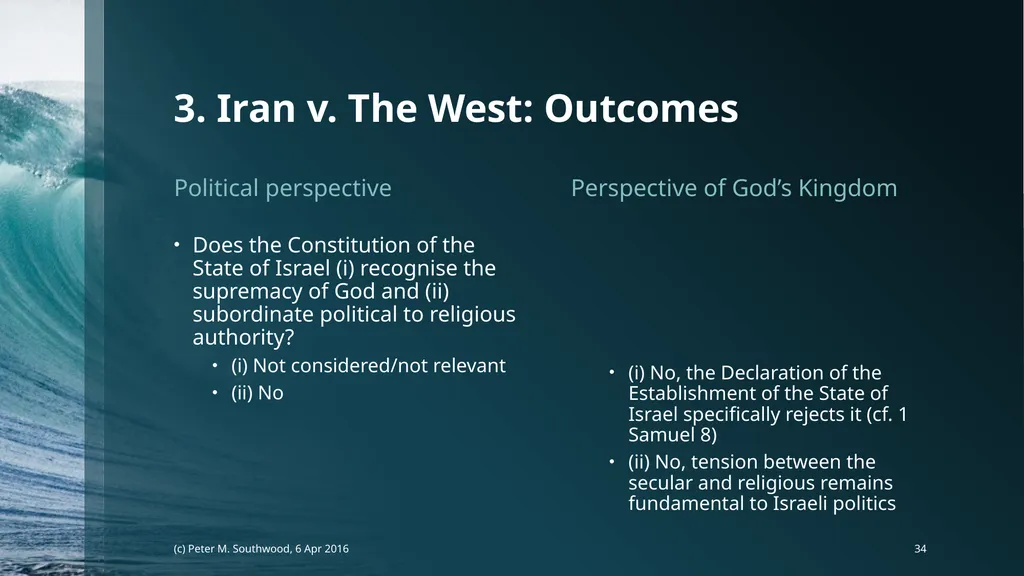
3. Iran v. The West: Outcomes Political perspective Does the Constitution of the State of Israel (i) recognise the supremacy of God and (ii) subordinate political to religious authority?
(i) Not considered/not relevant
(ii) No Perspective of God’s Kingdom (i) No, the Declaration of the Establishment of the State of Israel specifically rejects it (cf. 1 Samuel 8)
(ii) No, tension between the secular and religious remains fundamental to Israeli politics 34 (c) Peter M. Southwood, 6 Apr 2016<br>
(i) Not considered/not relevant
(ii) No Perspective of God’s Kingdom (i) No, the Declaration of the Establishment of the State of Israel specifically rejects it (cf. 1 Samuel 8)
(ii) No, tension between the secular and religious remains fundamental to Israeli politics 34 (c) Peter M. Southwood, 6 Apr 2016<br>
35
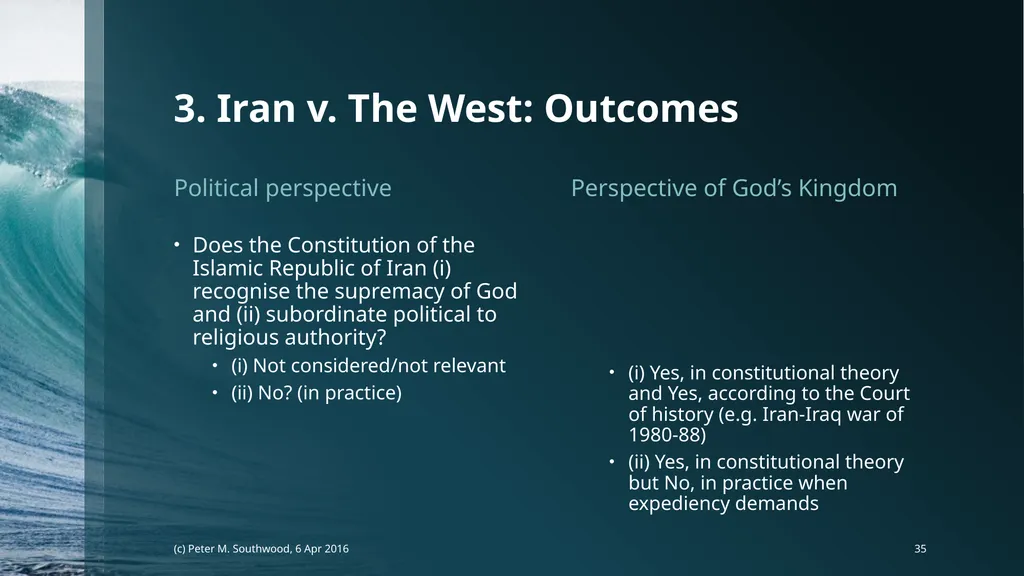
3. Iran v. The West: Outcomes Political perspective Does the Constitution of the Islamic Republic of Iran (i) recognise the supremacy of God and (ii) subordinate political to religious authority?
(i) Not considered/not relevant
(ii) No? (in practice) Perspective of God’s Kingdom (i) Yes, in constitutional theory and Yes, according to the Court of history (e.g. Iran-Iraq war of 1980-88)
(ii) Yes, in constitutional theory but No, in practice when expediency demands 35 (c) Peter M. Southwood, 6 Apr 2016<br>
(i) Not considered/not relevant
(ii) No? (in practice) Perspective of God’s Kingdom (i) Yes, in constitutional theory and Yes, according to the Court of history (e.g. Iran-Iraq war of 1980-88)
(ii) Yes, in constitutional theory but No, in practice when expediency demands 35 (c) Peter M. Southwood, 6 Apr 2016<br>
36
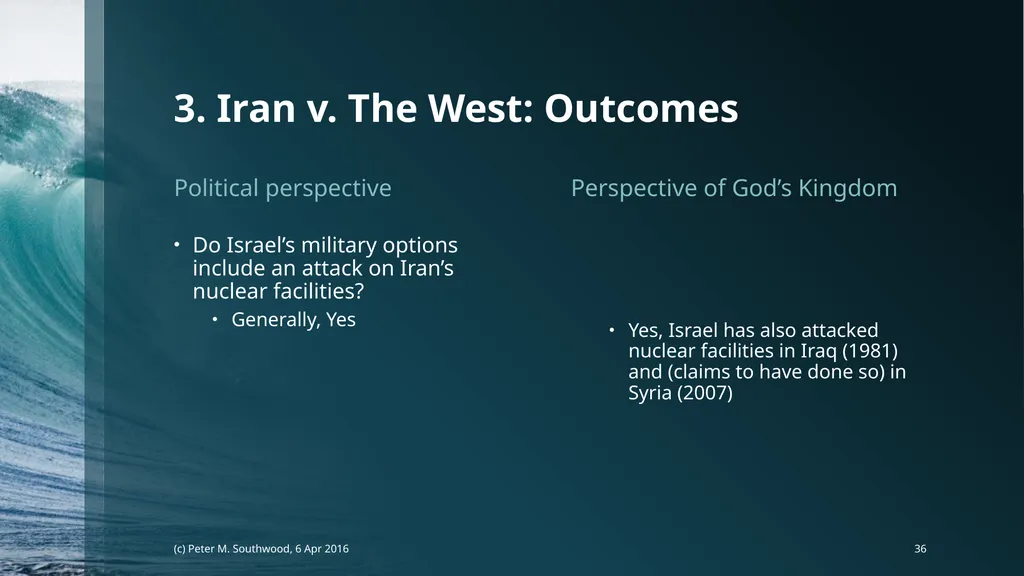
3. Iran v. The West: Outcomes Political perspective Do Israel’s military options include an attack on Iran’s nuclear facilities?
Generally, Yes Perspective of God’s Kingdom Yes, Israel has also attacked nuclear facilities in Iraq (1981) and (claims to have done so) in Syria (2007) 36 (c) Peter M. Southwood, 6 Apr 2016<br>
Generally, Yes Perspective of God’s Kingdom Yes, Israel has also attacked nuclear facilities in Iraq (1981) and (claims to have done so) in Syria (2007) 36 (c) Peter M. Southwood, 6 Apr 2016<br>
37
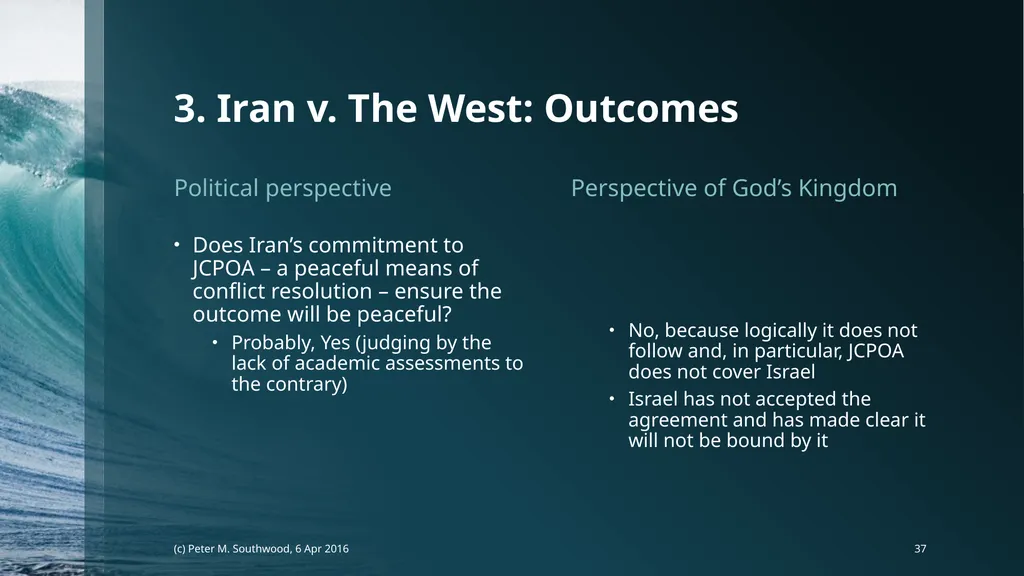
3. Iran v. The West: Outcomes Political perspective Does Iran’s commitment to JCPOA – a peaceful means of conflict resolution – ensure the outcome will be peaceful?
Probably, Yes (judging by the lack of academic assessments to the contrary) Perspective of God’s Kingdom No, because logically it does not follow and, in particular, JCPOA does not cover Israel
Israel has not accepted the agreement and has made clear it will not be bound by it 37 (c) Peter M. Southwood, 6 Apr 2016<br>
Probably, Yes (judging by the lack of academic assessments to the contrary) Perspective of God’s Kingdom No, because logically it does not follow and, in particular, JCPOA does not cover Israel
Israel has not accepted the agreement and has made clear it will not be bound by it 37 (c) Peter M. Southwood, 6 Apr 2016<br>
38
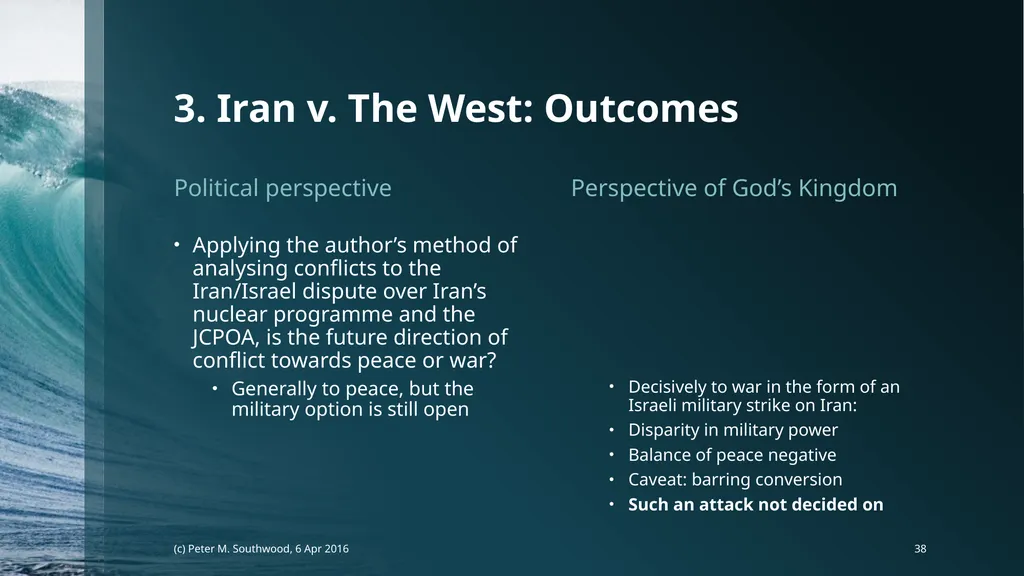
3. Iran v. The West: Outcomes Political perspective Applying the author’s method of analysing conflicts to the Iran/Israel dispute over Iran’s nuclear programme and the JCPOA, is the future direction of conflict towards peace or war?
Generally to peace, but the military option is still open Perspective of God’s Kingdom Decisively to war in the form of an Israeli military strike on Iran:
Disparity in military power
Balance of peace negative
Caveat: barring conversion
Such an attack not decided on 38 (c) Peter M. Southwood, 6 Apr 2016<br>
Generally to peace, but the military option is still open Perspective of God’s Kingdom Decisively to war in the form of an Israeli military strike on Iran:
Disparity in military power
Balance of peace negative
Caveat: barring conversion
Such an attack not decided on 38 (c) Peter M. Southwood, 6 Apr 2016<br>
39
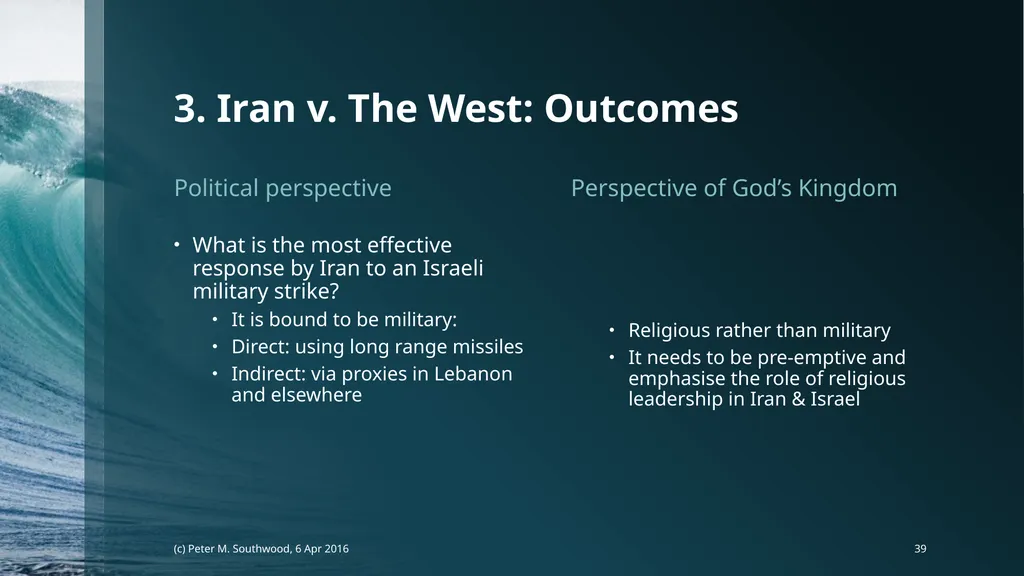
3. Iran v. The West: Outcomes Political perspective What is the most effective response by Iran to an Israeli military strike?
It is bound to be military:
Direct: using long range missiles
Indirect: via proxies in Lebanon and elsewhere Perspective of God’s Kingdom Religious rather than military
It needs to be pre-emptive and emphasise the role of religious leadership in Iran & Israel 39 (c) Peter M. Southwood, 6 Apr 2016<br>
It is bound to be military:
Direct: using long range missiles
Indirect: via proxies in Lebanon and elsewhere Perspective of God’s Kingdom Religious rather than military
It needs to be pre-emptive and emphasise the role of religious leadership in Iran & Israel 39 (c) Peter M. Southwood, 6 Apr 2016<br>
40
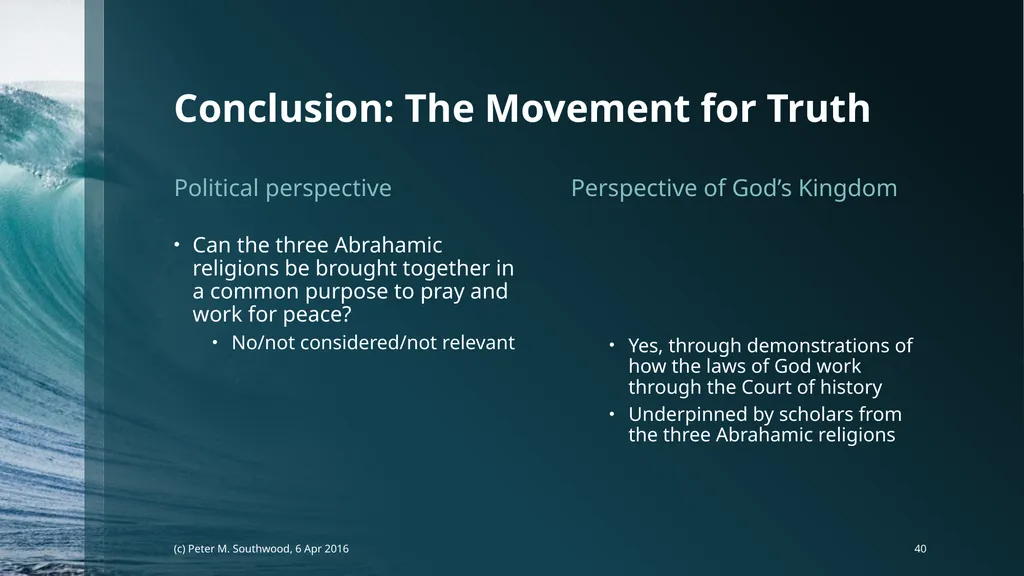
Conclusion: The Movement for Truth Political perspective Can the three Abrahamic religions be brought together in a common purpose to pray and work for peace?
No/not considered/not relevant Perspective of God’s Kingdom Yes, through demonstrations of how the laws of God work through the Court of history
Underpinned by scholars from the three Abrahamic religions 40 (c) Peter M. Southwood, 6 Apr 2016<br>
No/not considered/not relevant Perspective of God’s Kingdom Yes, through demonstrations of how the laws of God work through the Court of history
Underpinned by scholars from the three Abrahamic religions 40 (c) Peter M. Southwood, 6 Apr 2016<br>