Grammar Punctuation Frequently Asked Questions and Q A GSEP Writing Support Services Commas: Seven simple Rules Rule 1: Use a comma after an introductory clause in a sentence: After I ate dinner, I went for a long walk. While Dahlia was
"Grammar & Punctuation Frequently Asked Questions" is the property of its rightful owner. Permission is granted to
download and print the materials on this website for personal, non-commercial use only, and to display it
on your personal computer provided you do not modify the materials and that you retain all copyright
notices contained in the materials. By downloading content from our website, you accept the terms of this
agreement.
Presentation Transcript
01
Grammar & Punctuation Frequently Asked Questions and Q & A GSEP Writing Support Services<br>
02
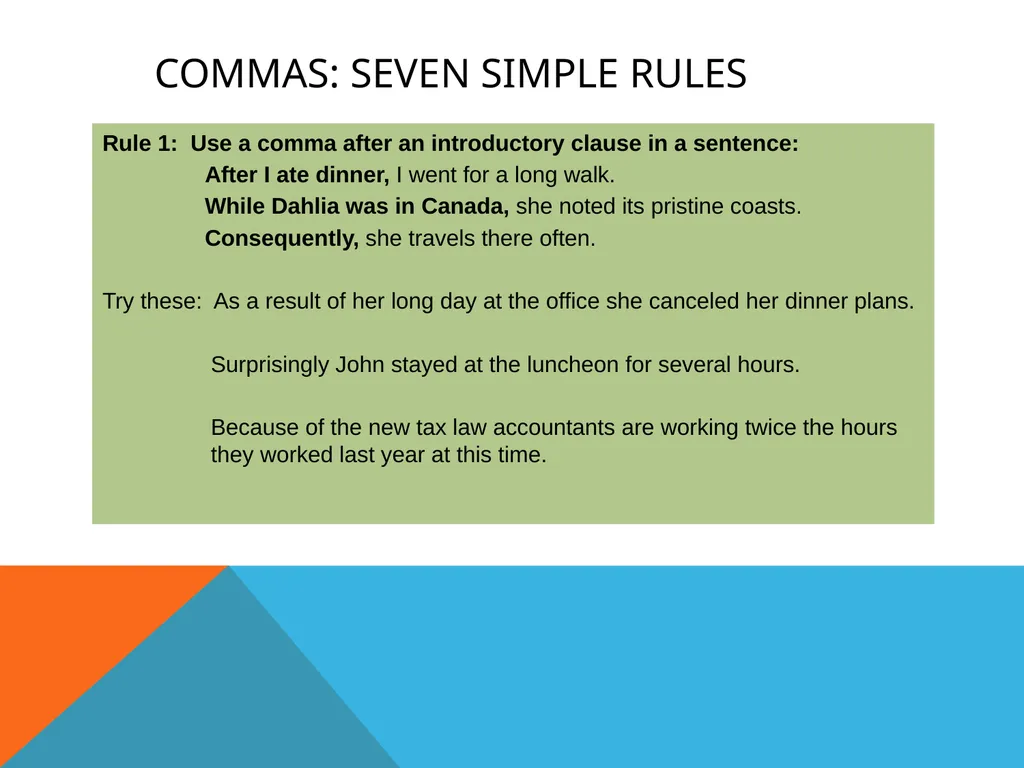
Commas: Seven simple Rules Rule 1: Use a comma after an introductory clause in a sentence:
After I ate dinner, I went for a long walk.
While Dahlia was in Canada, she noted its pristine coasts.
Consequently, she travels there often.
Try these: As a result of her long day at the office she canceled her dinner plans.
Surprisingly John stayed at the luncheon for several hours.
Because of the new tax law accountants are working twice the hours they worked last year at this time.<br>
03
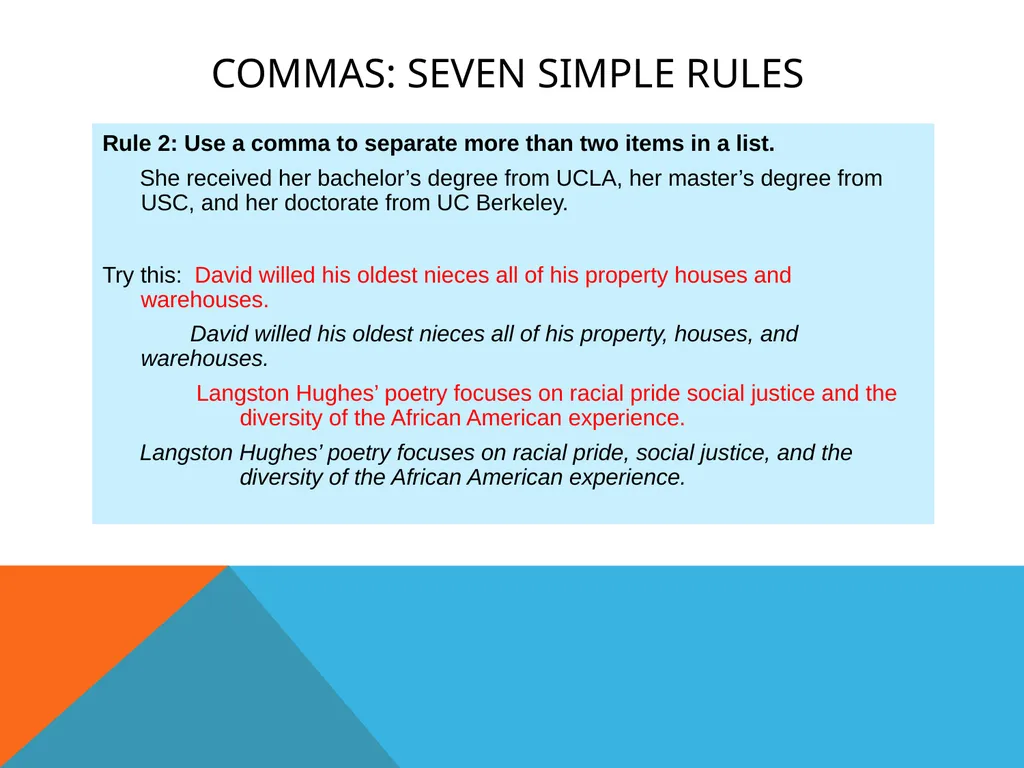
Commas: Seven simple rules Rule 2: Use a comma to separate more than two items in a list.
She received her bachelor’s degree from UCLA, her master’s degree from USC, and her doctorate from UC Berkeley.
Try this: David willed his oldest nieces all of his property houses and warehouses.
David willed his oldest nieces all of his property, houses, and warehouses.
Langston Hughes’ poetry focuses on racial pride social justice and the diversity of the African American experience.
Langston Hughes’ poetry focuses on racial pride, social justice, and the diversity of the African American experience.<br>
04
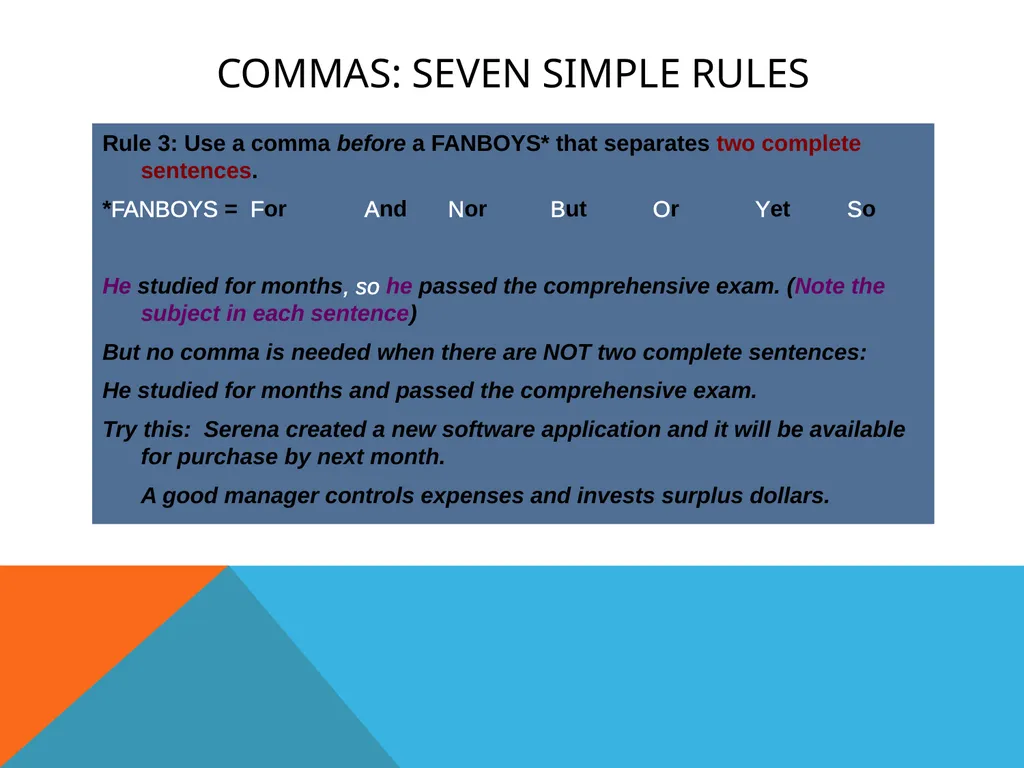
Commas: Seven Simple Rules Rule 3: Use a comma before a FANBOYS* that separates two complete sentences.
*FANBOYS = For And Nor But Or Yet So
He studied for months, so he passed the comprehensive exam. (Note the subject in each sentence)
But no comma is needed when there are NOT two complete sentences:
He studied for months and passed the comprehensive exam.
Try this: Serena created a new software application and it will be available for purchase by next month.
A good manager controls expenses and invests surplus dollars.<br>
05
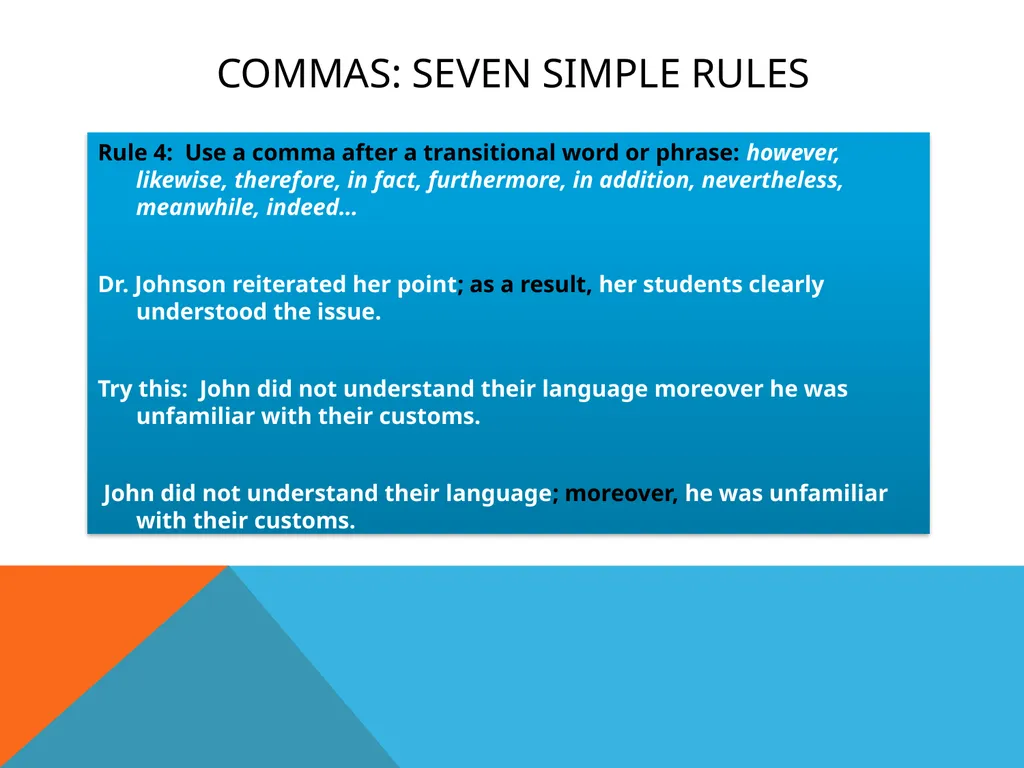
Commas: Seven Simple rules Rule 4: Use a comma after a transitional word or phrase: however, likewise, therefore, in fact, furthermore, in addition, nevertheless, meanwhile, indeed…
Dr. Johnson reiterated her point; as a result, her students clearly understood the issue.
Try this: John did not understand their language moreover he was unfamiliar with their customs.
John did not understand their language; moreover, he was unfamiliar with their customs.<br>
06
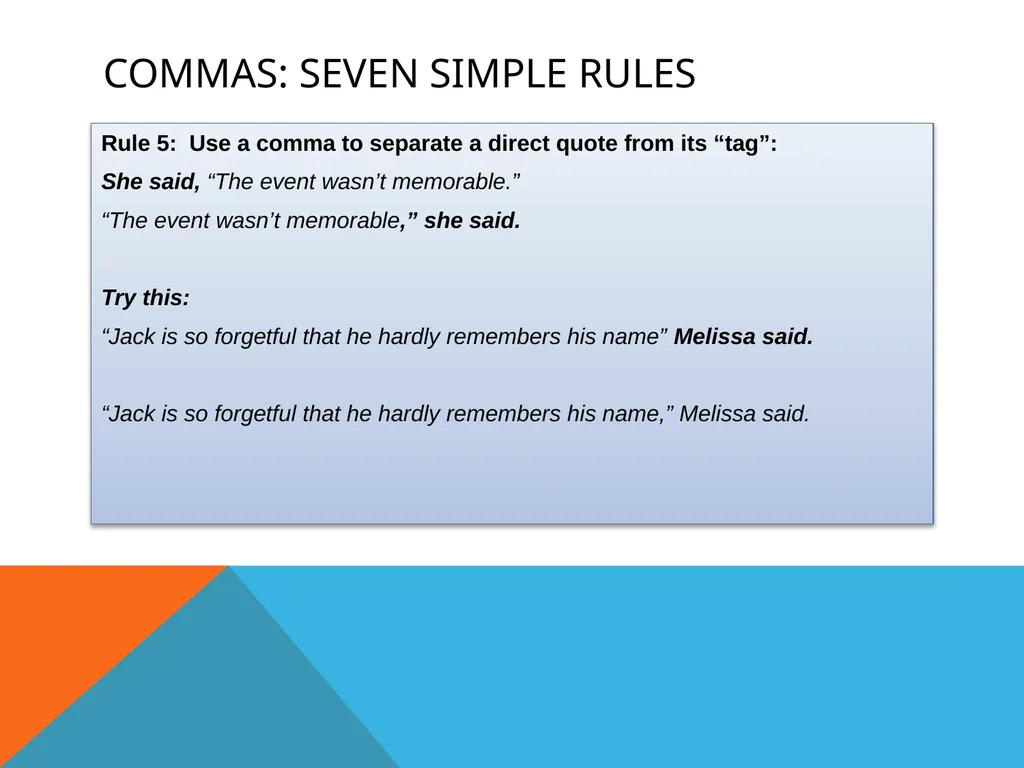
Commas: Seven simple rules Rule 5: Use a comma to separate a direct quote from its “tag”:
She said, “The event wasn’t memorable.”
“The event wasn’t memorable,” she said.
Try this:
“Jack is so forgetful that he hardly remembers his name” Melissa said.
“Jack is so forgetful that he hardly remembers his name,” Melissa said.<br>
07
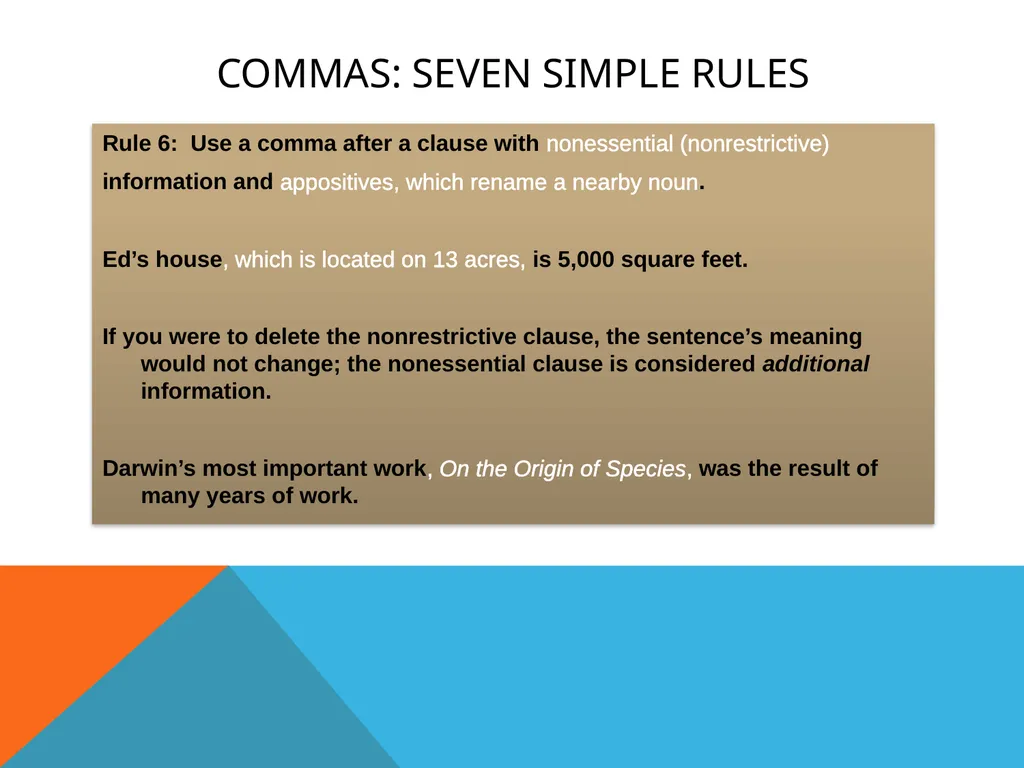
Commas: Seven simple rules Rule 6: Use a comma after a clause with nonessential (nonrestrictive)
information and appositives, which rename a nearby noun.
Ed’s house, which is located on 13 acres, is 5,000 square feet.
If you were to delete the nonrestrictive clause, the sentence’s meaning would not change; the nonessential clause is considered additional information.
Darwin’s most important work, On the Origin of Species, was the result of many years of work.<br>
08
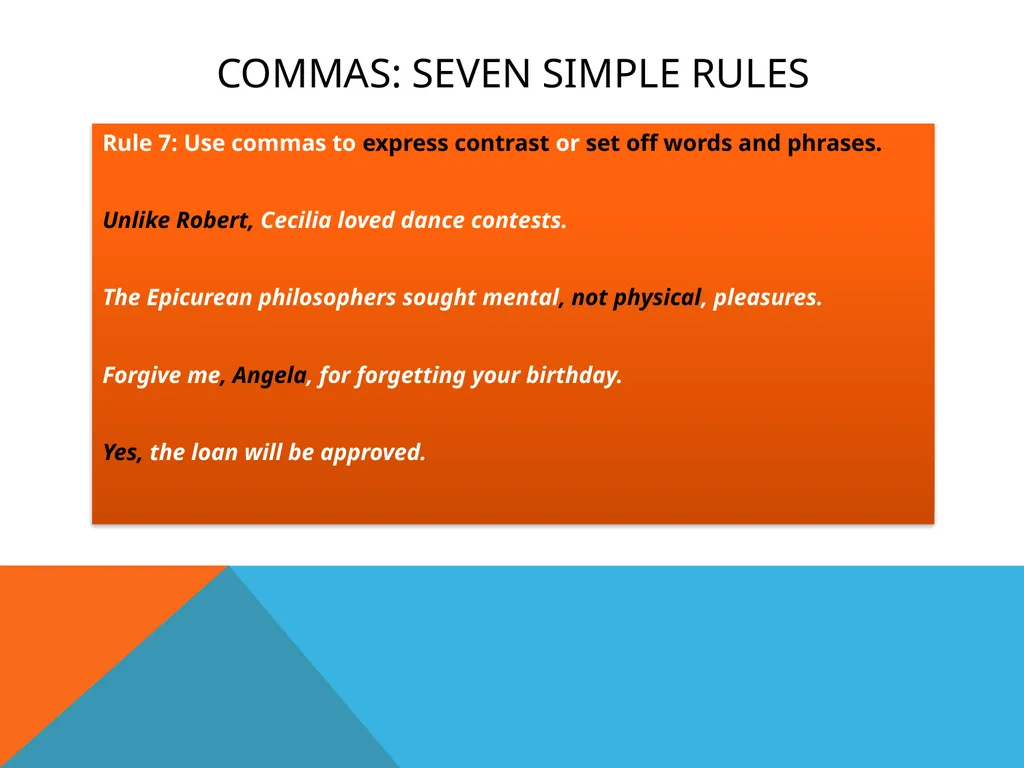
Commas: seven simple rules Rule 7: Use commas to express contrast or set off words and phrases.
Unlike Robert, Cecilia loved dance contests.
The Epicurean philosophers sought mental, not physical, pleasures.
Forgive me, Angela, for forgetting your birthday.
Yes, the loan will be approved.<br>
09
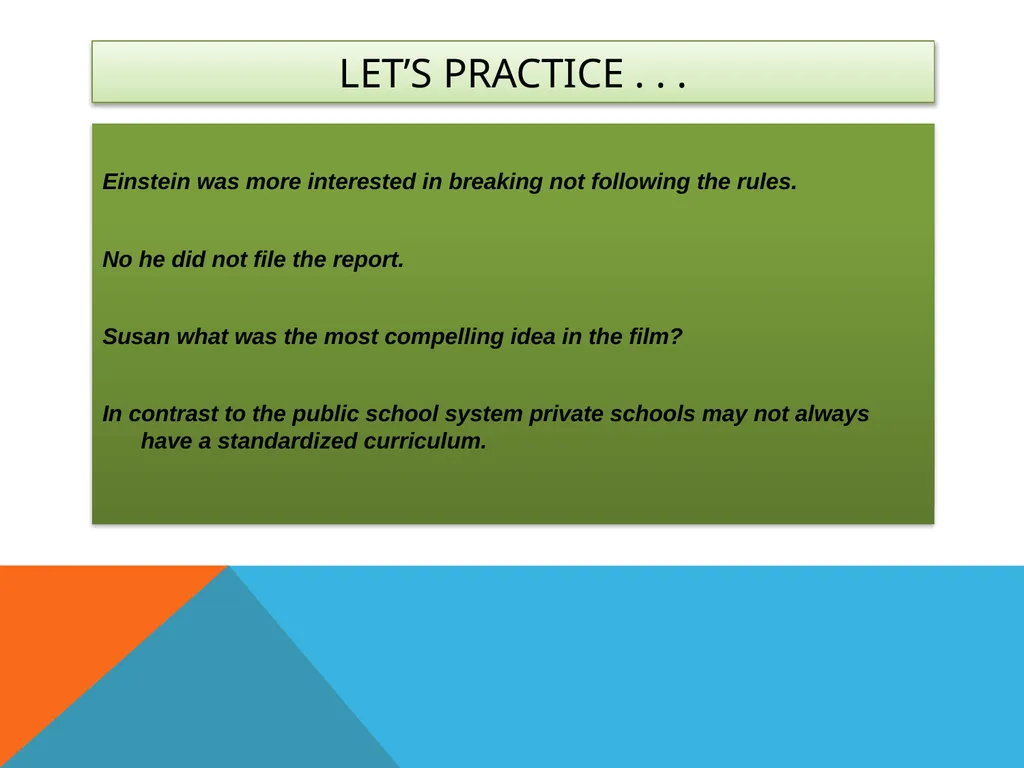
let’s practice . . . Einstein was more interested in breaking not following the rules.
No he did not file the report.
Susan what was the most compelling idea in the film?
In contrast to the public school system private schools may not always have a standardized curriculum.<br>
10
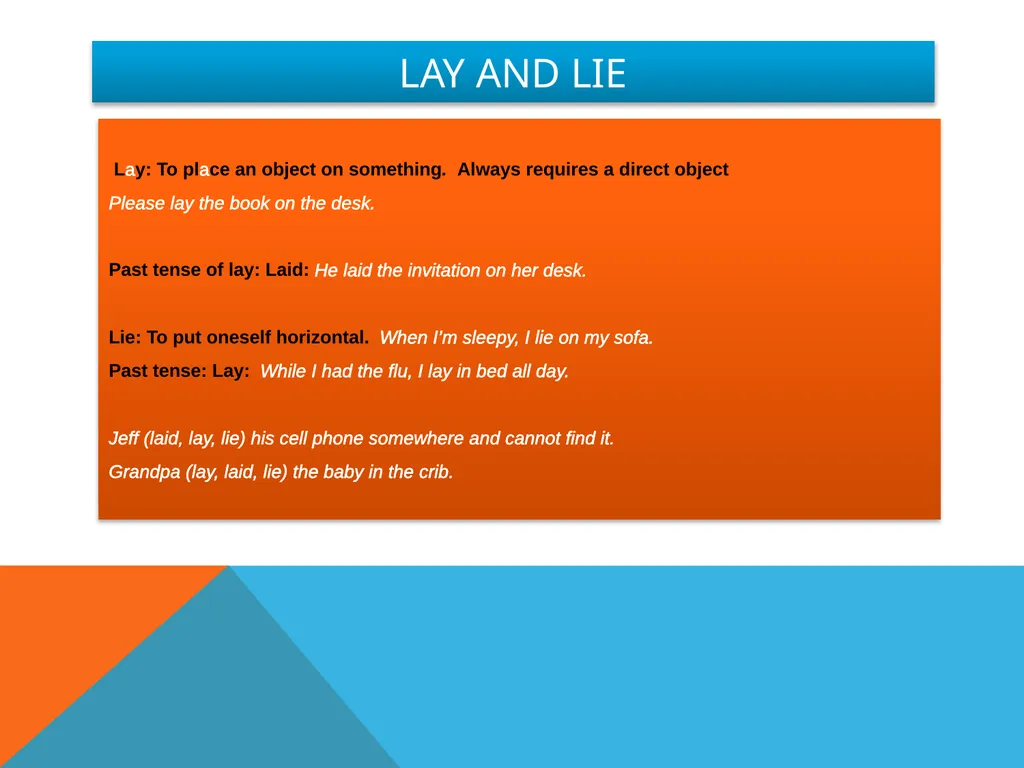
Lay and lie Lay: To place an object on something. Always requires a direct object
Please lay the book on the desk.
Past tense of lay: Laid: He laid the invitation on her desk.
Lie: To put oneself horizontal. When I’m sleepy, I lie on my sofa.
Past tense: Lay: While I had the flu, I lay in bed all day.
Jeff (laid, lay, lie) his cell phone somewhere and cannot find it.
Grandpa (lay, laid, lie) the baby in the crib.<br>
11
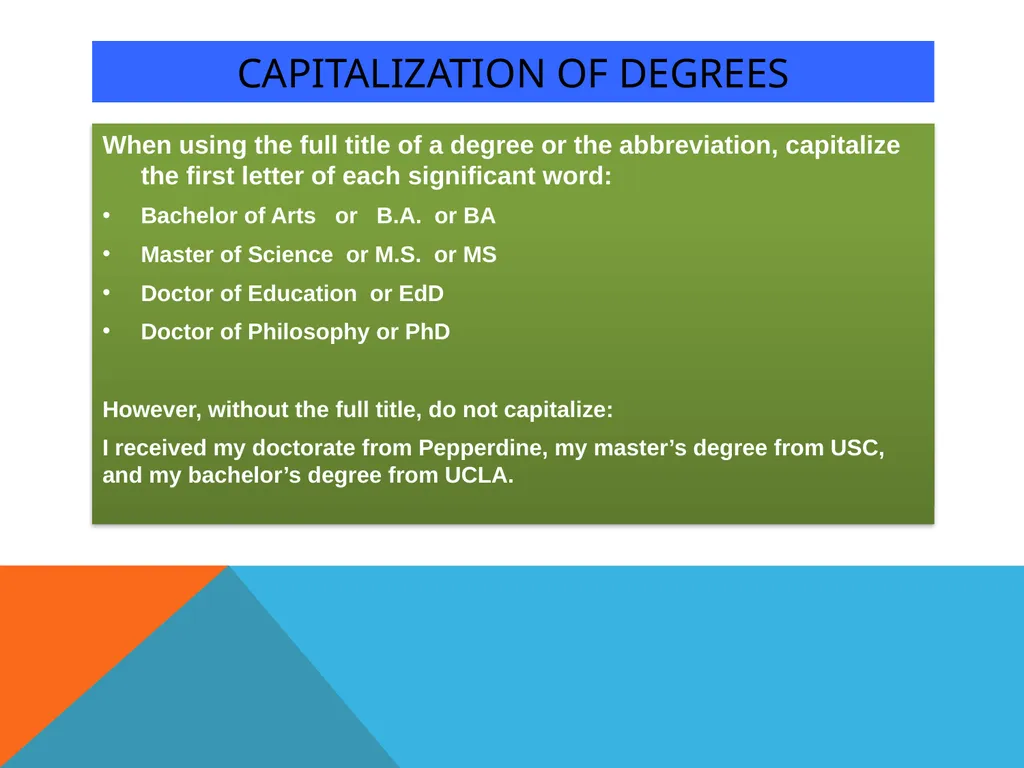
Capitalization of Degrees When using the full title of a degree or the abbreviation, capitalize the first letter of each significant word:
Bachelor of Arts or B.A. or BA
Master of Science or M.S. or MS
Doctor of Education or EdD
Doctor of Philosophy or PhD
However, without the full title, do not capitalize:
I received my doctorate from Pepperdine, my master’s degree from USC, and my bachelor’s degree from UCLA.<br>
12
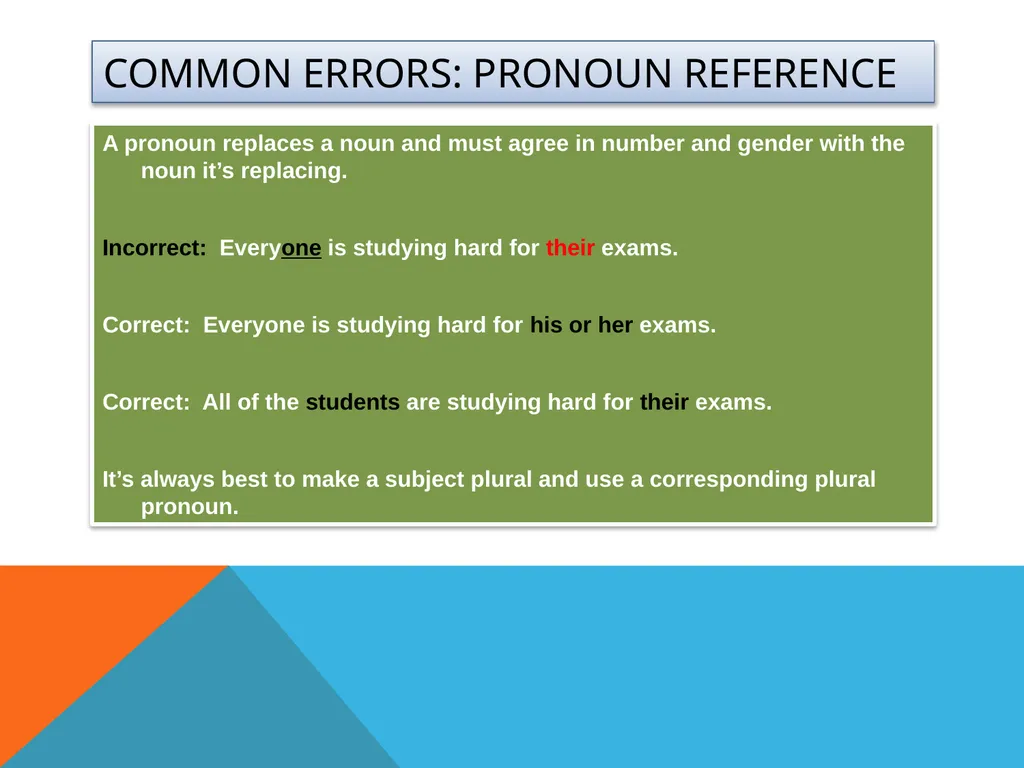
Common errors: Pronoun Reference A pronoun replaces a noun and must agree in number and gender with the noun it’s replacing.
Incorrect: Everyone is studying hard for their exams.
Correct: Everyone is studying hard for his or her exams.
Correct: All of the students are studying hard for their exams.
It’s always best to make a subject plural and use a corresponding plural pronoun.<br>
13
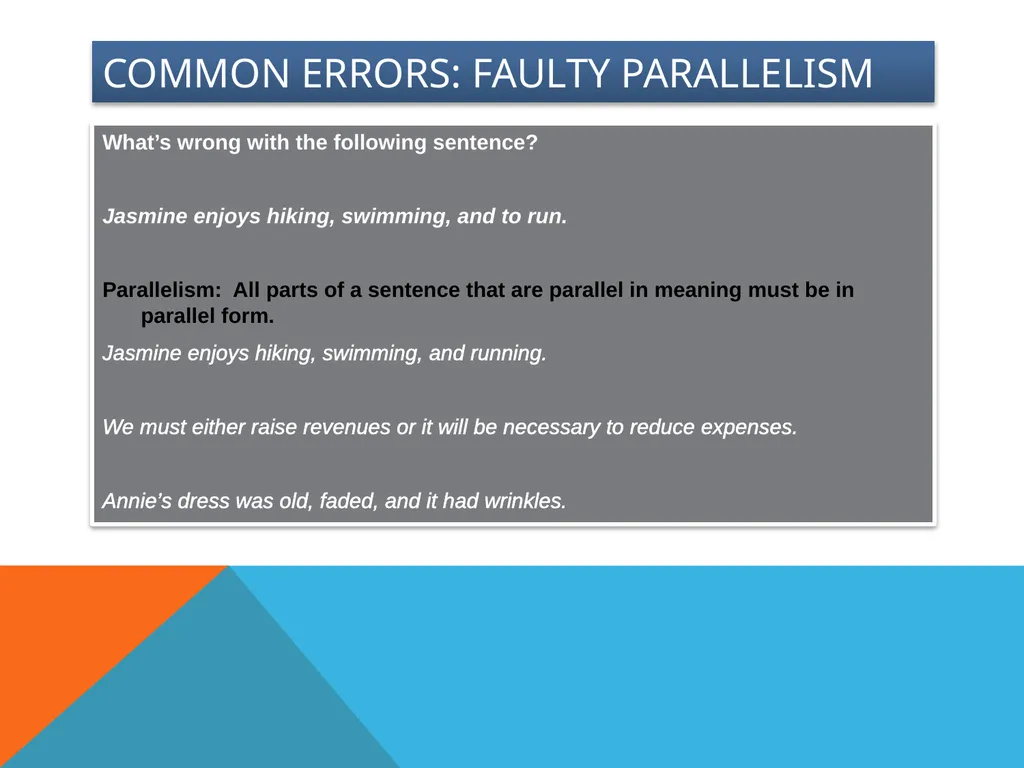
Common Errors: Faulty parallelism What’s wrong with the following sentence?
Jasmine enjoys hiking, swimming, and to run.
Parallelism: All parts of a sentence that are parallel in meaning must be in parallel form.
Jasmine enjoys hiking, swimming, and running.
We must either raise revenues or it will be necessary to reduce expenses.
Annie’s dress was old, faded, and it had wrinkles.<br>