Group V POWERPOINT PRESENTATION Alberto D. Agbuya Joshua C. Cayabyab Ma. Charisa M. Balatayo Liezl C. Barile Regine G. Calimlim Donna Grace A. Corpuz Jonalyn R. Palisoc Gaussian Elimination and gauss Jordan elimination Matrices and
"Group V POWERPOINT PRESENTATION Alberto D. Agbuya" is the property of its rightful owner. Permission is granted to
download and print the materials on this website for personal, non-commercial use only, and to display it
on your personal computer provided you do not modify the materials and that you retain all copyright
notices contained in the materials. By downloading content from our website, you accept the terms of this
agreement.
Presentation Transcript
01
Group V POWERPOINT PRESENTATION Alberto D. Agbuya
Joshua C. Cayabyab
Ma. Charisa M. Balatayo
Liezl C. Barile
Regine G. Calimlim
Donna Grace A. Corpuz
Jonalyn R. Palisoc<br>
02
Gaussian Elimination and gauss Jordan elimination<br>
03
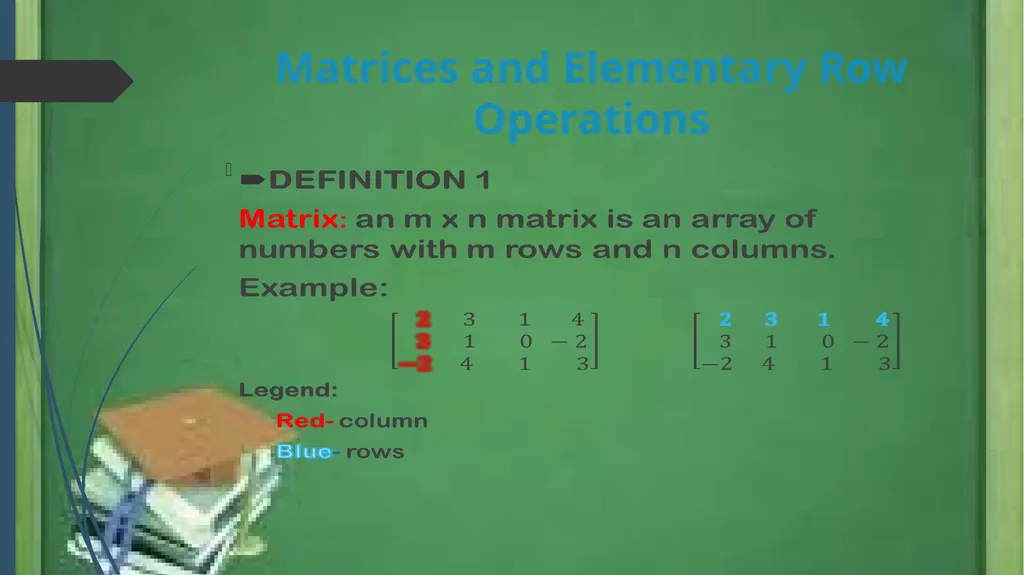
Matrices and Elementary Row Operations<br>
04
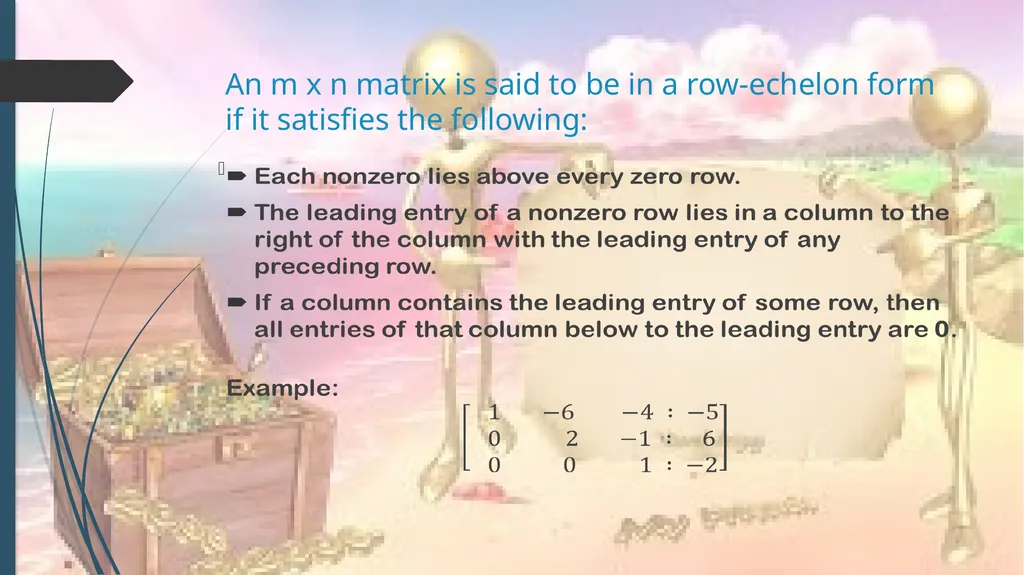
An m x n matrix is said to be in a row-echelon form if it satisfies the following:<br>
05
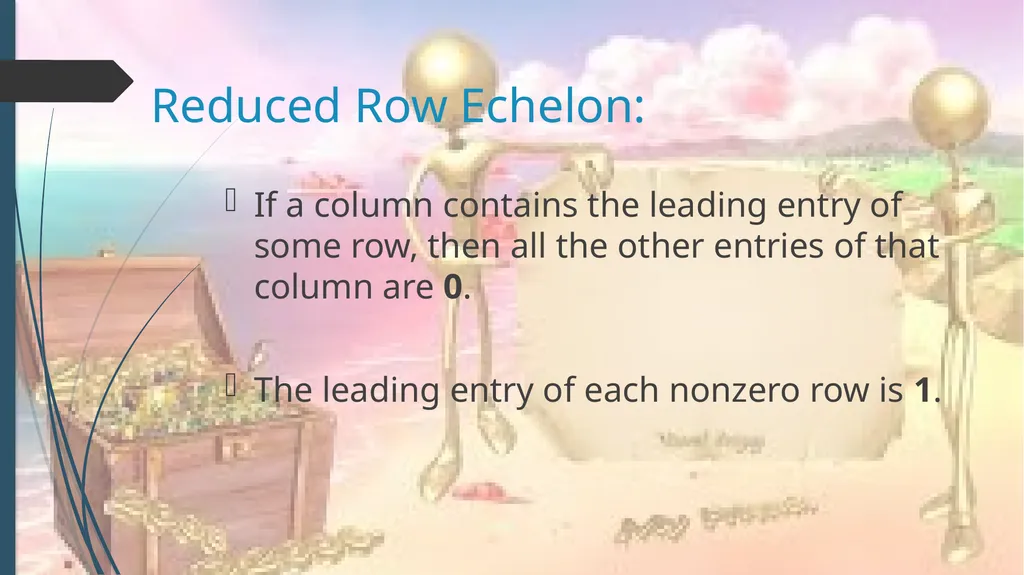
Reduced Row Echelon: If a column contains the leading entry of some row, then all the other entries of that column are 0.
The leading entry of each nonzero row is 1.<br>
06
Matrices and Elementary Row Operations THEOREM 2
Any one of the following operations performed on the augmented matrix, corresponding to a linear system, produces an augmented matrix corresponding to an equivalent linear system.
(1) Interchanging any two rows
(2) Multiplying any row by a non zero constant
(3) Adding a multiple of one row to another<br>
07
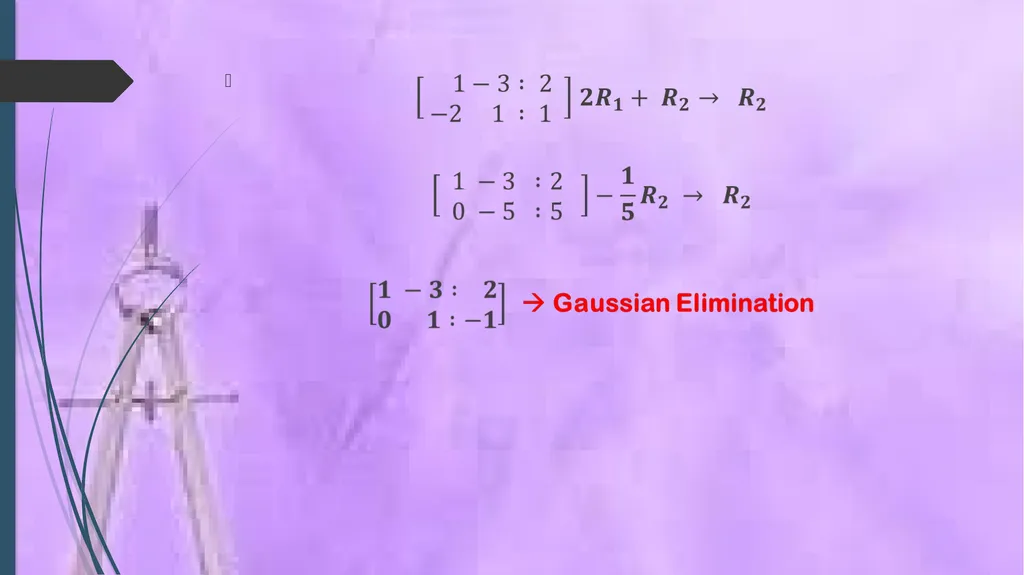
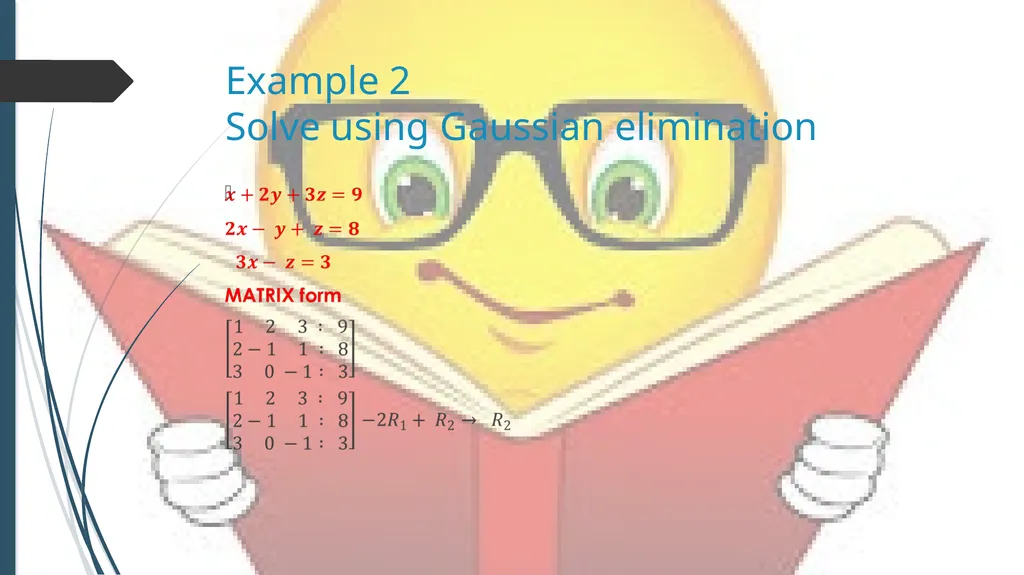
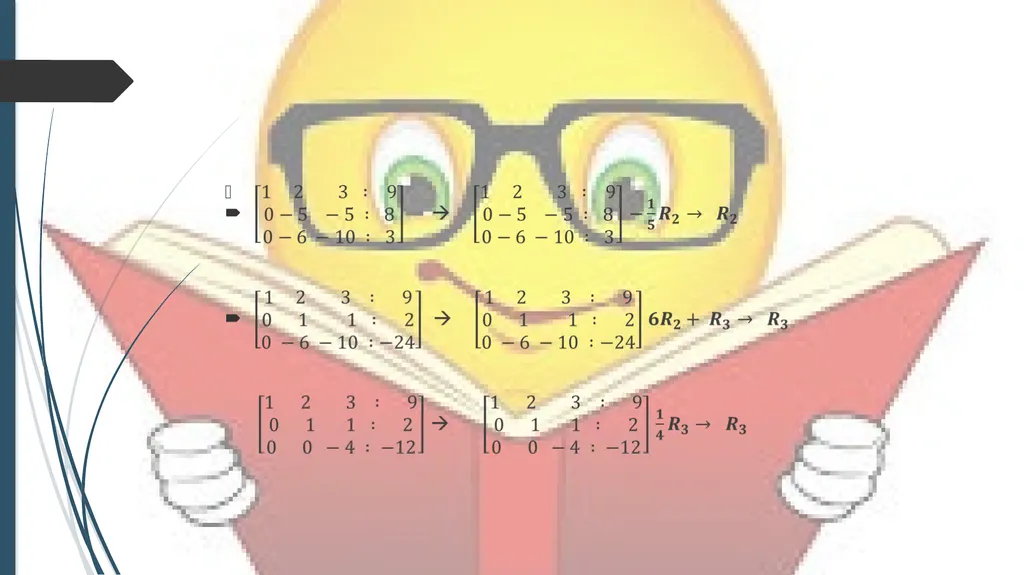
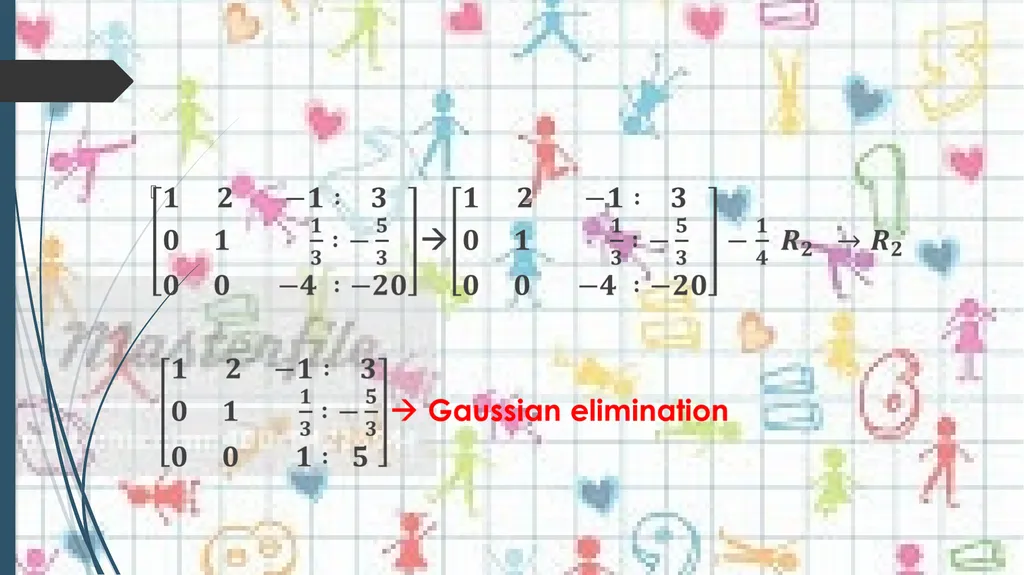
Gaussian Elimination This is done by transforming the system’s augmented matrix form into row-echelon form by means of row operations. The system is solved by back substitution.<br>
08
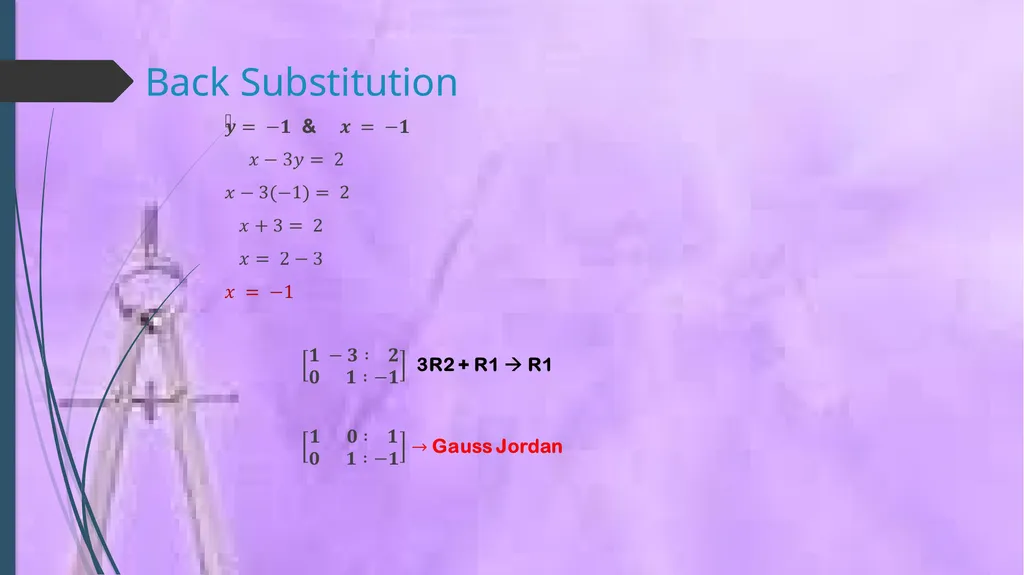
Gauss-Jordan Elimination DEFINITION 2
Echelon Form: An m x n matrix is in row echelon form if
1. Every row with all 0 entries is below every row with nonzero entries.
2. If rows 1, 2, …, k are the rows with nonzero entries and if the leading nonzero entry (pivot) in row i occurs in column ci , for 1, 2, … , k, then c1 < c2 < … < ck.<br>
09
Gauss-Jordan Elimination The matrix is in reduced row echelon form if, in addition,
3. The first nonzero entry of each row is a 1.
4. Each column that contains a pivot has all other entries 0.
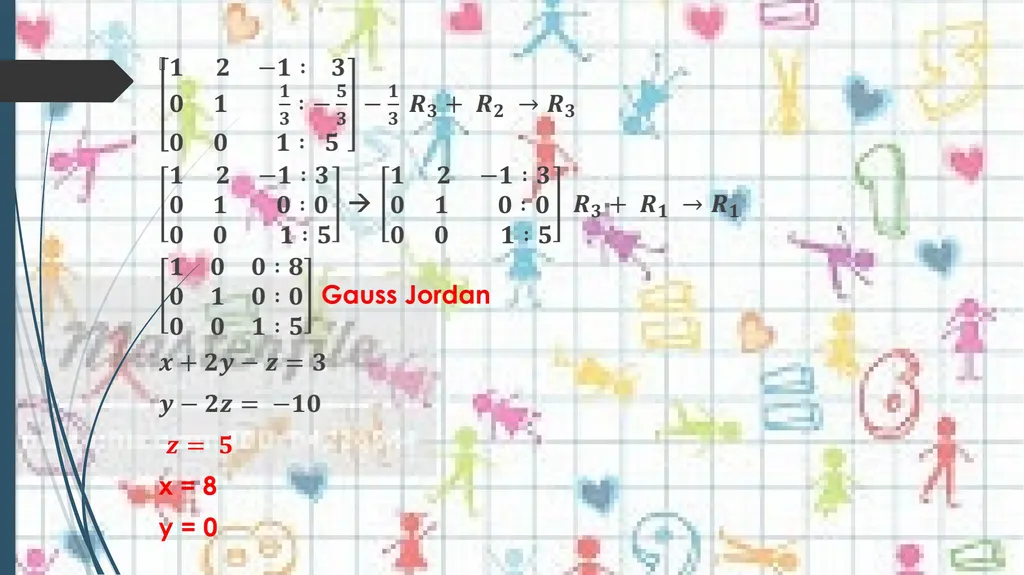
The process of transforming a matrix to reduced row echelon form is called Gauss-Jordan Elimination.<br>
10
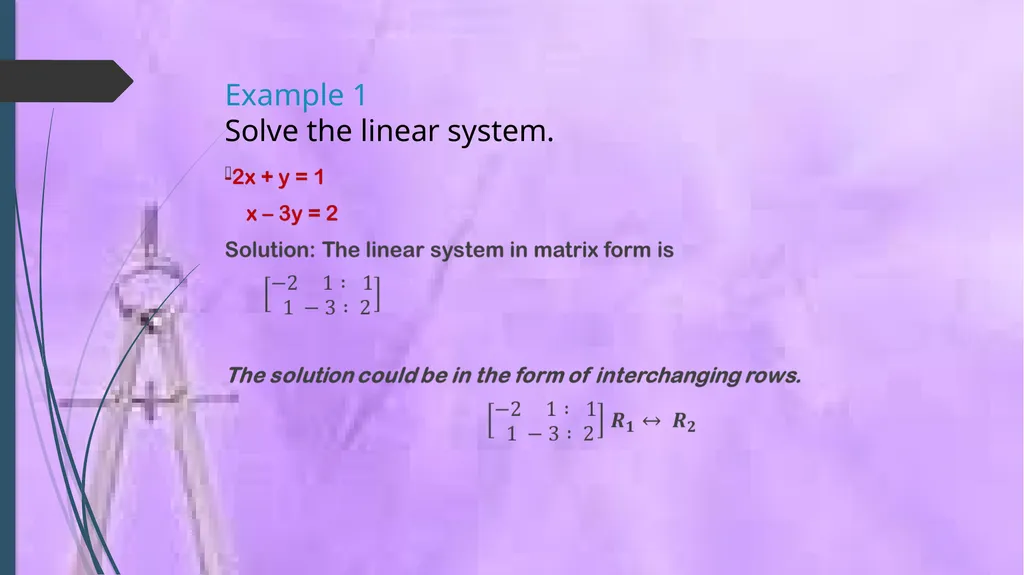
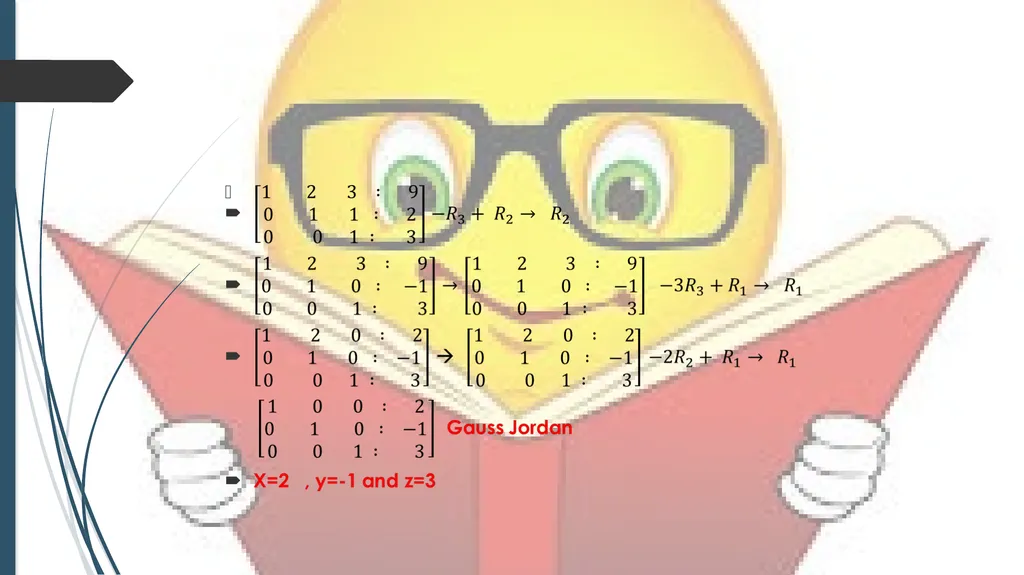
Example 1 Solve the linear system.<br>
11
Back Substitution<br>
12
Example 2 Solve using Gaussian elimination<br>
13
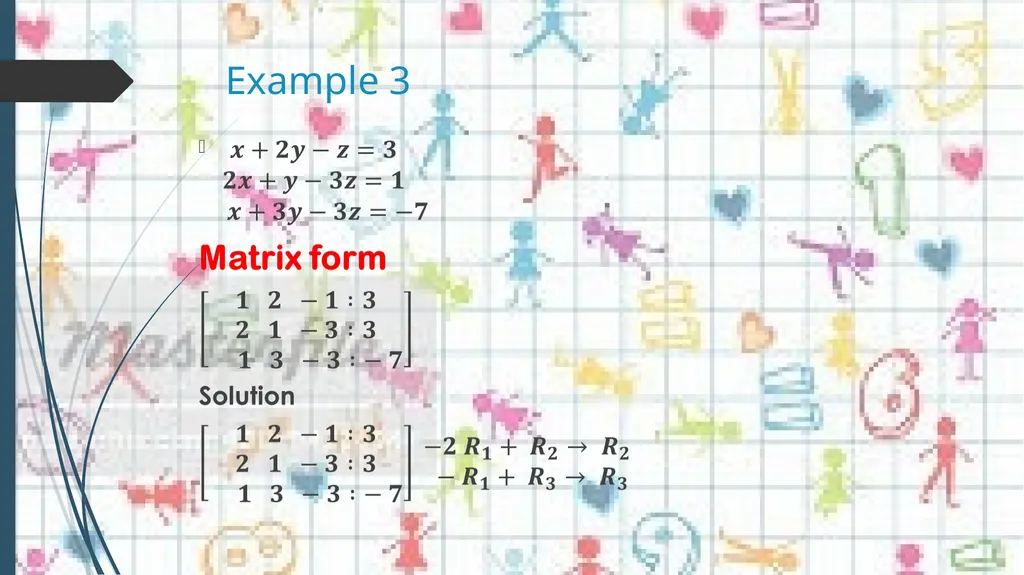
Example 3<br>
14
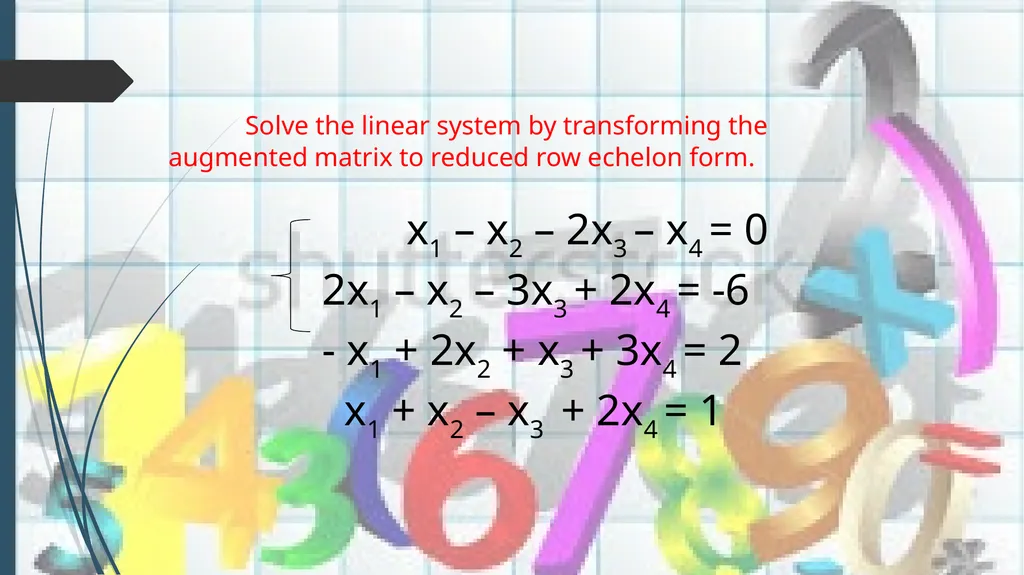
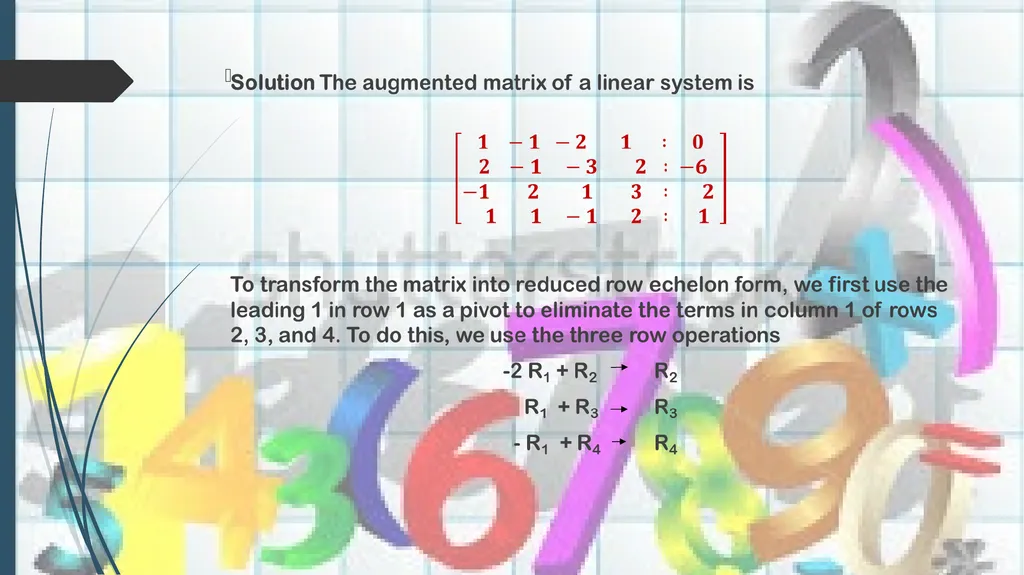
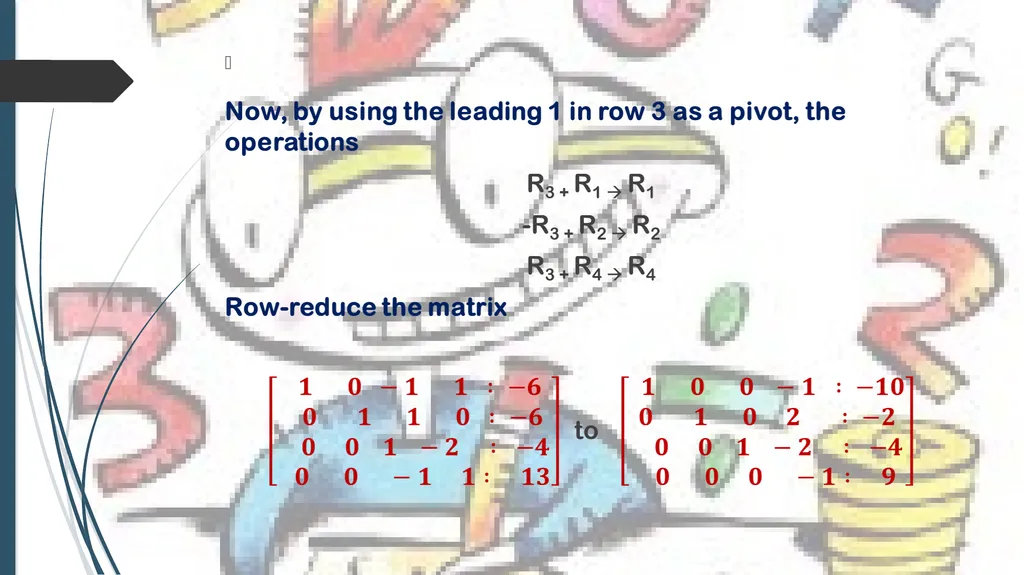
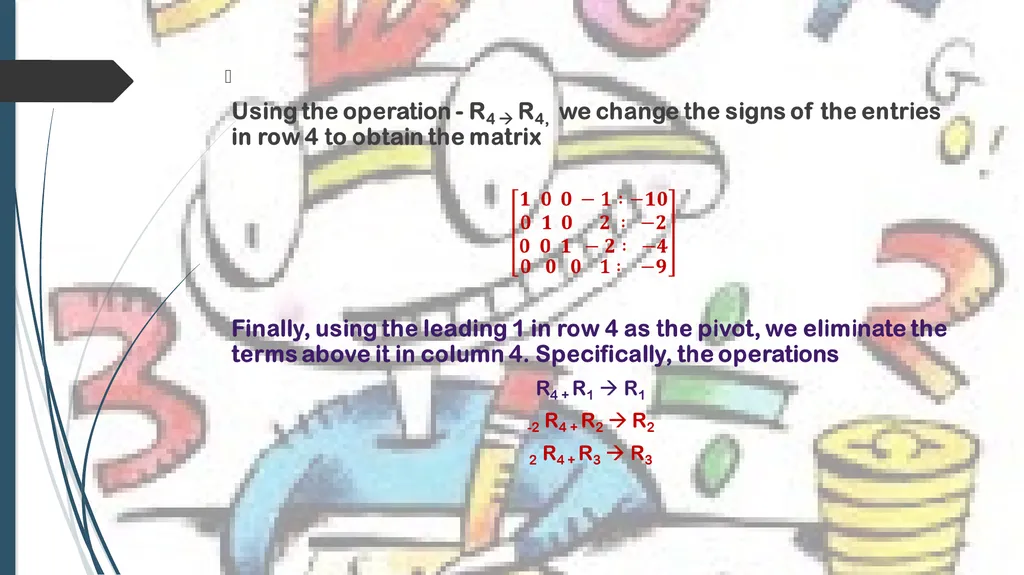
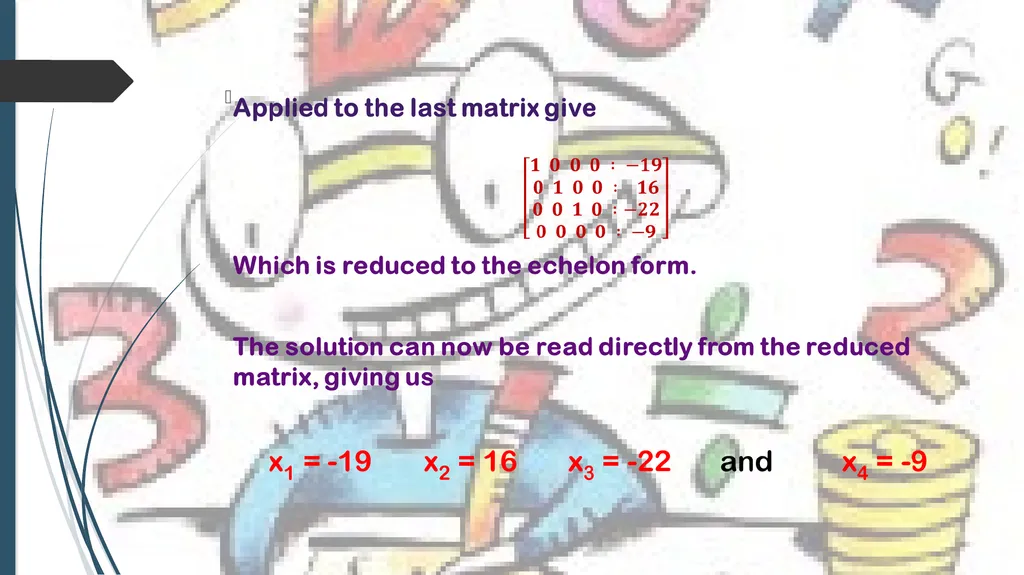
Solve the linear system by transforming the augmented matrix to reduced row echelon form.
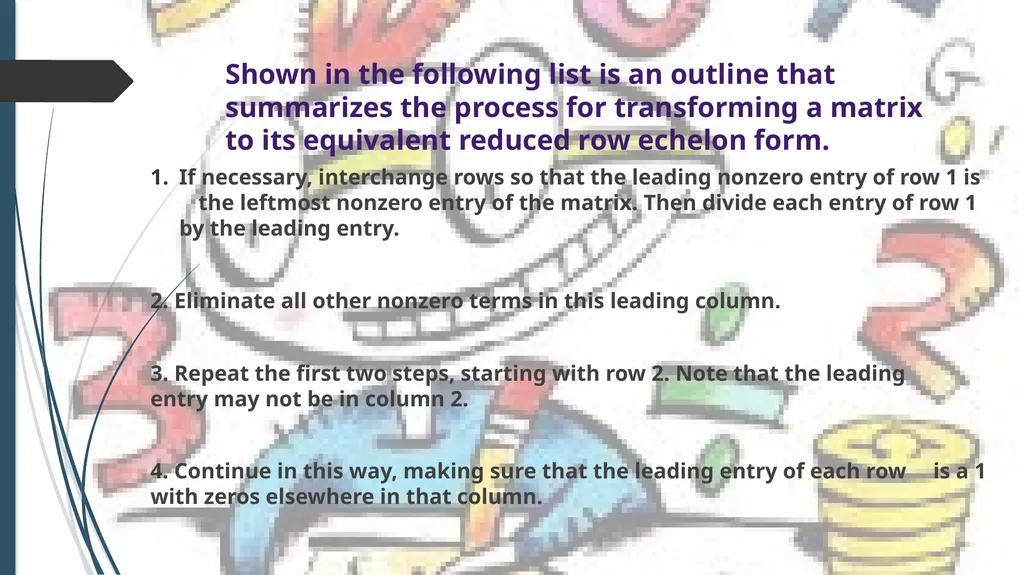
Shown in the following list is an outline that summarizes the process for transforming a matrix to its equivalent reduced row echelon form. If necessary, interchange rows so that the leading nonzero entry of row 1 is the leftmost nonzero entry of the matrix. Then divide each entry of row 1 by the leading entry.
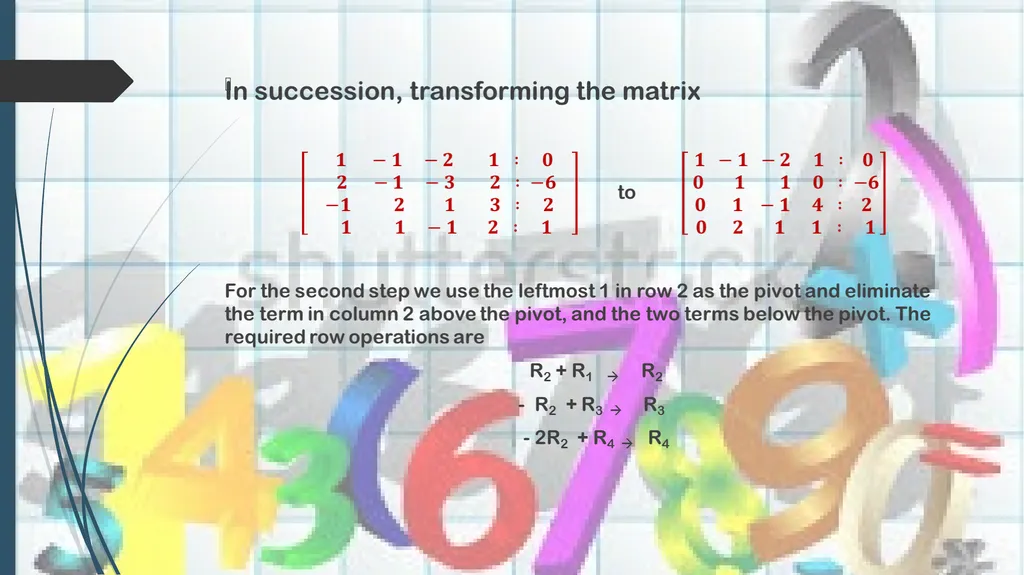
2. Eliminate all other nonzero terms in this leading column.
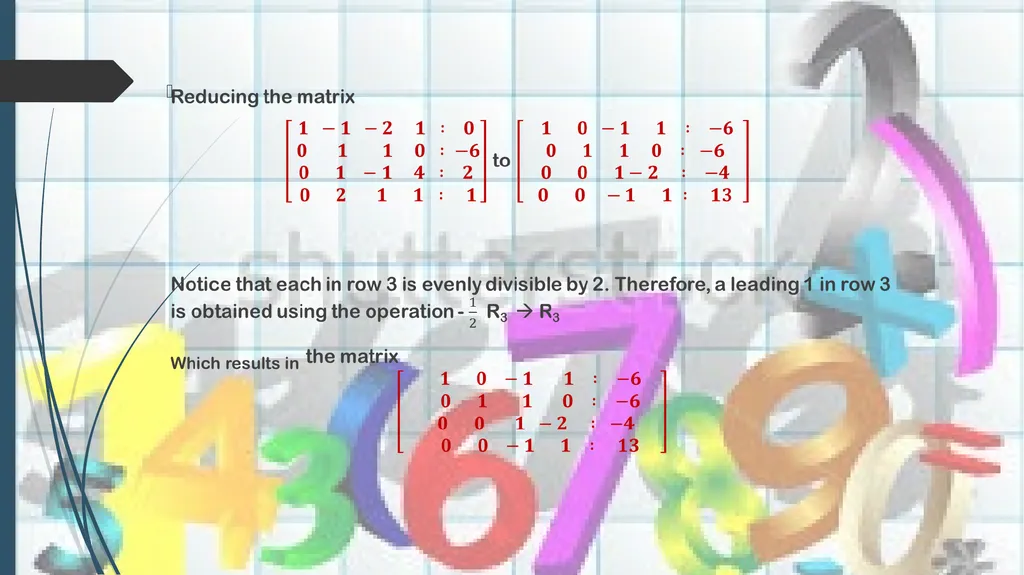
3. Repeat the first two steps, starting with row 2. Note that the leading entry may not be in column 2.
4. Continue in this way, making sure that the leading entry of each row is a 1 with zeros elsewhere in that column.<br>
16
4. The leading 1 in any row should be to the right of a leading 1 in the row above it.
5. All rows of zeros are placed at the bottom of the matrix.<br>
17
We have implicitly assumed in our discussion that every matrix is row equivalent to exactly one matrix in reduced row echelon form. It is an important fact that we will state here as a theorem without proof.
THEOREM 3: The reduced row echelon form of every matrix is unique.<br>
18
Fact Summary 1. Altering an augmented matrix by interchanging two rows, or multiplying a row by a nonzero constant, or replacing a row with the sum of the same row and a scalar multiple of another row does not alter the set of solutions of the corresponding linear system.
2. If an augmented matrix is row-reduced to triangular form, the coefficient matrix has a row of zeros, and the corresponding augmented term is not zero, then the linear system has no solutions.
3. Every matrix has a unique reduced row echelon form.<br>
19
Fact Summary 4. If the augmented matrix of an m x n linear system is row-reduced to triangular form and the coefficient matrix has no rows of zeros, then the linear system has a unique solution.
5. If the augmented matrix of an m x n linear system is row-reduced to triangular form, the coefficient matrix has rows of zeros, and each corresponding augmented term is 0, then the linear system has infinitely many solutions.<br>