
Guide to Performing a Root Cause Analysis: A








Description: Guide to Performing a Root Cause Analysis: A companion slide set for field education Introduction Patient safety events can cause serious harm or death. System and process flaws cause most failures and require systematic investigation and
Related Topics
Download Presentation
"Guide to Performing a Root Cause Analysis: A" is the property of its rightful owner. Permission is granted to download and print the materials on this website for personal, non-commercial use only, and to display it on your personal computer provided you do not modify the materials and that you retain all copyright notices contained in the materials. By downloading content from our website, you accept the terms of this agreement.
Presentation Transcript
slide1. Guide to Performing a Root Cause Analysis:
A companion slide set for field education<br>
slide2. Introduction Patient safety events can cause serious harm or death.
System and process flaws cause most failures and require systematic investigation and analysis to unearth root causes and develop solutions.
Most common comprehensive systematic analysis: Root Cause Analysis (RCA).
Process to identify basic causal factor(s) underlying system failures (the root; source below surface; obscured)
Adverse outcomes, sentinel events, or clusters of less serious incidents or near misses (the weed; problem above surface; obvious) RCA Guidebook, p 4<br>
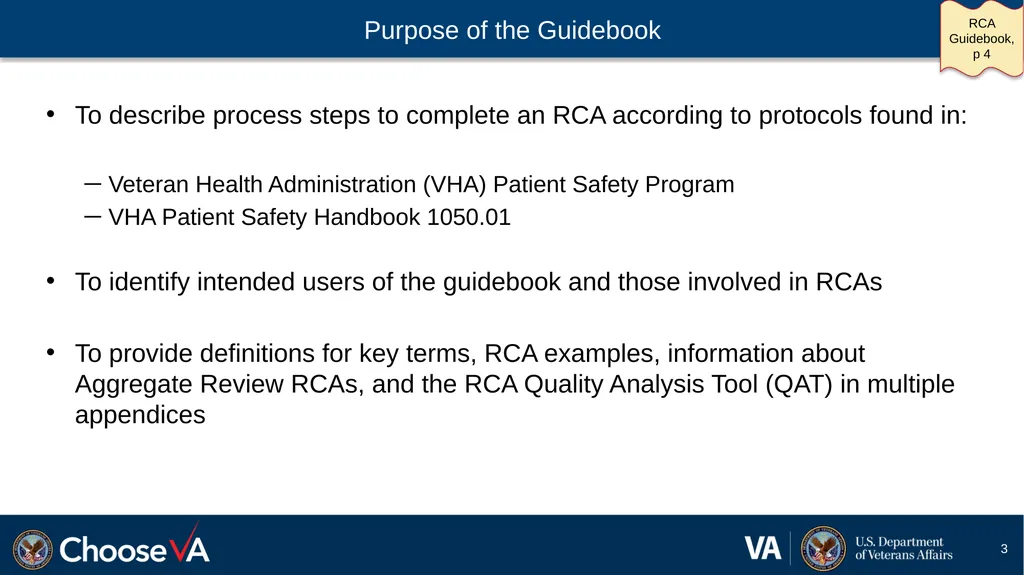
slide3. To describe process steps to complete an RCA according to protocols found in:
Veteran Health Administration (VHA) Patient Safety Program
VHA Patient Safety Handbook 1050.01
To identify intended users of the guidebook and those involved in RCAs
To provide definitions for key terms, RCA examples, information about Aggregate Review RCAs, and the RCA Quality Analysis Tool (QAT) in multiple appendices Purpose of the Guidebook RCA Guidebook, p 4<br>
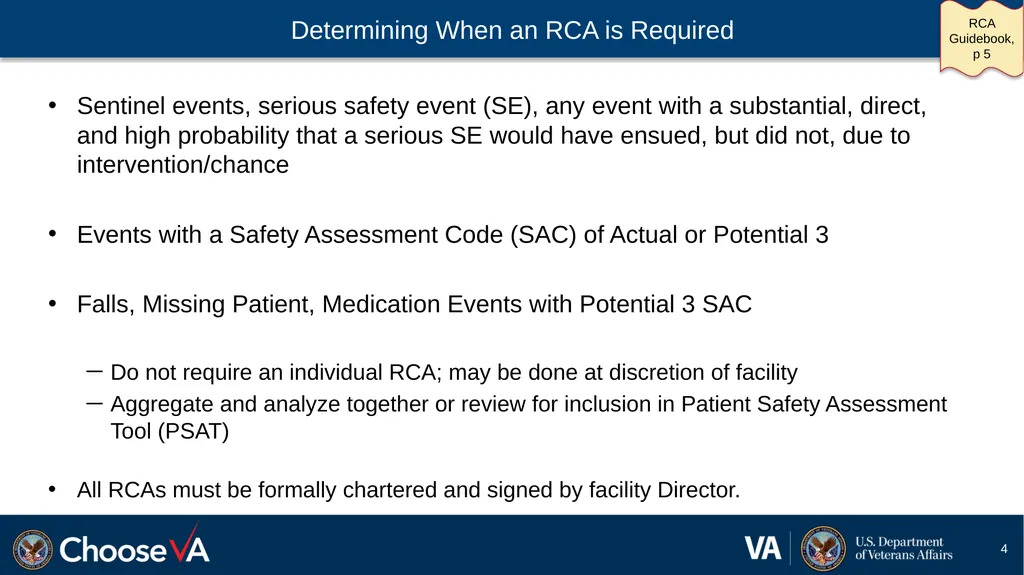
slide4. Sentinel events, serious safety event (SE), any event with a substantial, direct, and high probability that a serious SE would have ensued, but did not, due to intervention/chance
Events with a Safety Assessment Code (SAC) of Actual or Potential 3
Falls, Missing Patient, Medication Events with Potential 3 SAC
Do not require an individual RCA; may be done at discretion of facility
Aggregate and analyze together or review for inclusion in Patient Safety Assessment Tool (PSAT)
All RCAs must be formally chartered and signed by facility Director. Determining When an RCA is Required RCA Guidebook, p 5<br>
slide5. Adhere to procedures in RCA Guidebook and charter memorandum
All documents must have the term “Root Cause Analysis” to be protected/confidential:
38 U.S.C. 5705
Implementing regulations (VHA Directive 2008-077, Quality Management (QM) and Patient Safety Activities that Can Generate Confidential Documents)
NOT protected: email or RCAs if RCA charter memorandum unsigned by facility Director Characteristics of a Root Cause Analysis RCA Guidebook, p 5<br>
slide6. Within 45 days of facility becoming aware that an RCA is required, RCAs MUST be:
Completed,
Signed by facility Director or designee, and
Documented in SPOT
Follow the process steps provided in the RCA Guidebook and explained more fully in subsequent sections and appendices Characteristics of a Root Cause Analysis<br>
slide7. The crucial process steps in the Root Cause Analysis include:
Getting Started day 1 thru 14
Analysis 15-45 days
Feedback
Implementation and Measurement Root Cause Analysis Flow Diagram RCA Guidebook, p 6<br>
slide8. Composition (4-6 members): Leader, Advisor, Subject Matter Expert (SME), non-SME
Large enough for diverse viewpoints and opinions
Small enough to keep meetings manageable
Describe professional titles and specific roles of individuals on RCA team in charter and may also be included in charter memorandum
Recorder needed to document meeting notes, interviews, Q&As, and guide next steps Completing an RCA, Step 1: Charter a Team RCA Guidebook, p 7<br>
slide9. Conduct RCA team training with every RCA event, even if no new members are present.
Senior leader greeting shows tangible executive leadership support for RCA team
Just in Time Training Video (run time 18:27)
Just in Time Training should include: an overview of the RCA process; information on confidentiality, timeline of the process, roles and responsibilities of team members, event briefing, and milestones with meeting dates/times established at first meeting. Completing an RCA, Step 2: Conduct Just in Time Training RCA Guidebook, p 8<br>
slide10. Graphically documents known and relevant facts of the event Completing an RCA, Step 3: Create the Initial Flow Diagram RCA Guidebook, p 9<br>
slide11. 11<br>
slide12. 12<br>
slide13. Narrative expression of the Initial Flow Diagram
Adds greater detail of events
Staffing, equipment, products, environmental, or other influencing factors
Discovers the facts
Asks “why” for each item in the flow diagram
Identifies missing pieces
Identifies resources
Policies, medical records, or committee minutes
Determines who to interview Completing an RCA, Step 4: Craft the Initial Understanding RCA Guidebook, p 10<br>
slide14. Determine missing information
Gather data related to the event
Identify system and process vulnerabilities
Visit the scene of the event
Simulate event if possible Completing an RCA, Step 5: Identify Information Gaps RCA Guidebook, p 11<br>
slide15. Standard set of questions
Assists the team in considering areas of inquiry
Reveals vulnerabilities in systems and work processes
Link to Triage Questions Completing an RCA, Step 6: Use Triage Questions RCA Guidebook, p 11<br>
slide16. Identify team members to obtain and review documents
Identify individuals to be interviewed
Determine interview date/time and location
Draft interview questions Completing an RCA, Step 7: Collect Resources and Prepare for Interviews RCA Guidebook, p 12<br>
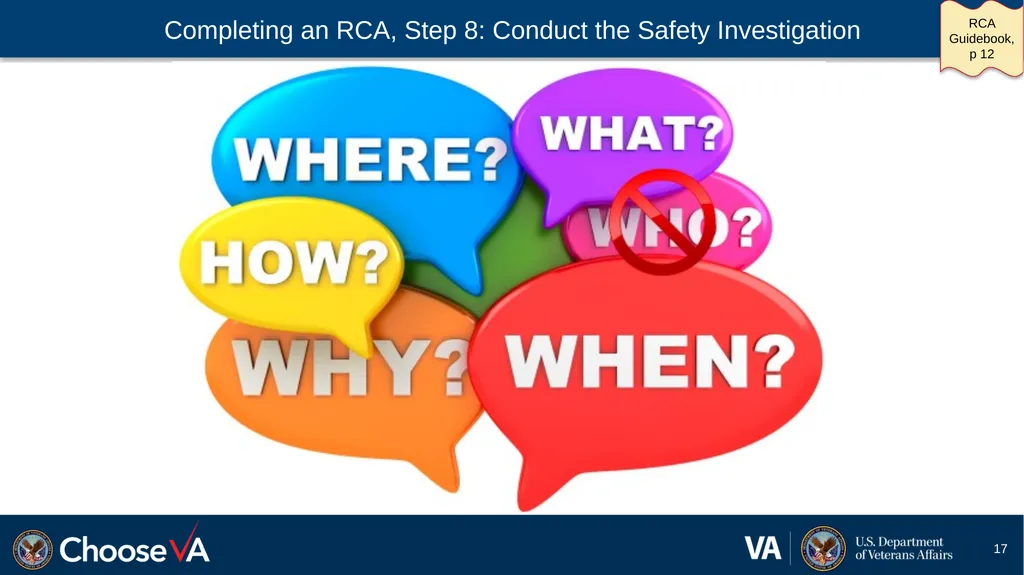
slide17. Completing an RCA, Step 8: Conduct the Safety Investigation RCA Guidebook, p 12<br>
slide18. Develop a strategy to “fill in the information gaps” including but not limited to:
Review pertinent documents
Interviews
Simulate the event
“…simulation and debriefing in event analysis helped identify multiple, underlying causes of teamwork errors, latent risk factors (things that make errors more likely), and more specifically system errors in surgical cases.” Lobos & Ward, 2019
Literature review
determine evidence-based practices
prevalence of incidence
Data pull
JPSR
SPOT Completing an RCA, Step 8: Conduct the Safety Investigation<br>
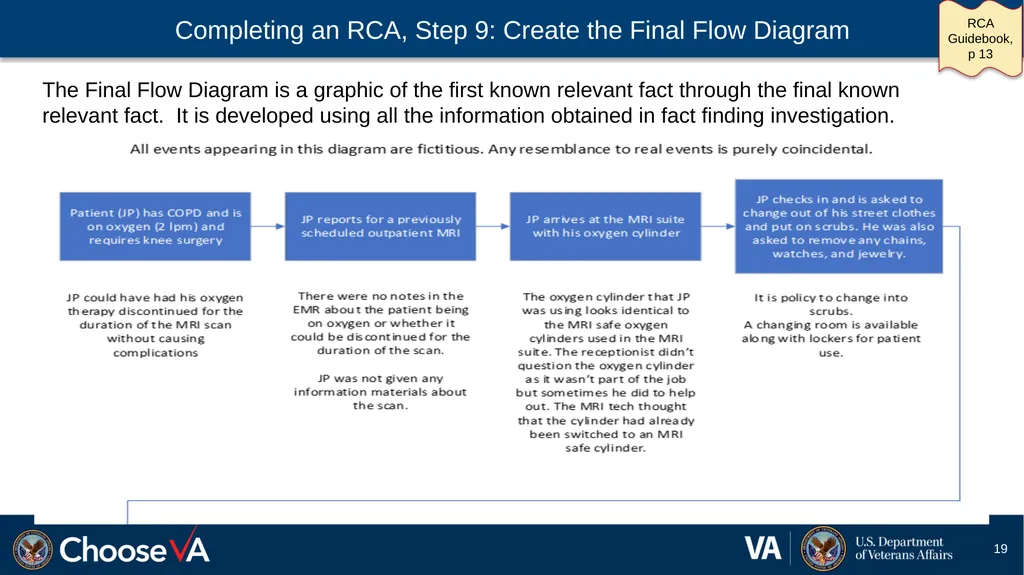
slide19. The Final Flow Diagram is a graphic of the first known relevant fact through the final known relevant fact. It is developed using all the information obtained in fact finding investigation. Completing an RCA, Step 9: Create the Final Flow Diagram RCA Guidebook, p 13<br>
slide20. Required!
What is a cause-and-effect diagram?
Systematic method
Determines causal links
Shows starting point and represents:
Preventing problem from:
Occurring (e.g., near miss)
Recurring (e.g., a fire happened) Completing an RCA, Step 10: Create the Cause-and-Effect Diagram RCA Guidebook, p 15<br>
slide21. Work backwards with "caused by" statements
For specific actions
For specific conditions
Keep working backwards until you can’t! Completing an RCA, Step 10: Create the Cause-and-Effect Diagram<br>
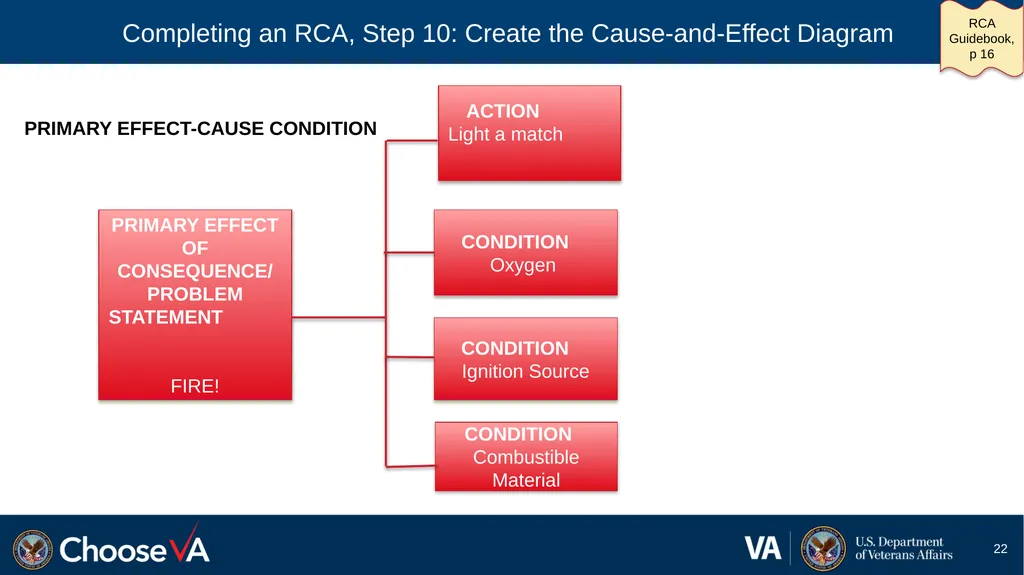
slide22. Completing an RCA, Step 10: Create the Cause-and-Effect Diagram PRIMARY EFFECT OF CONSEQUENCE/ PROBLEM STATEMENT
FIRE! ACTION Light a match CONDITION Oxygen CONDITION Ignition Source CONDITION Combustible Material PRIMARY EFFECT-CAUSE CONDITION RCA Guidebook, p 16<br>
slide23. PROBLEM STATEMENT ACTION CONDITION ACTION ACTION CONDITION CONDITION ACTION ACTION ACTION ACTION ACTION ACTION ACTION ACTION ACTION CONDITION CONDITION CONDITION ACTION ACTION CONDITION CONDITION CONDITION CONDITION CONDITION CONDITION CONDITION CONDITION CONDITION CONDITION CONDITION ACTION ACTION CONDITION CONDITION CONDITION ACTION ACTION CONDITION CAUSE AND EFFECT DIAGRAMS ARE NOT STRAIGHT FORWARD Completing an RCA, Step 10: Create the Cause-and-Effect Diagram RCA Guidebook, p 17<br>
slide24. 24 WHEN DO WE STOP? Completing an RCA, Step 10: Create the Cause-and-Effect Diagram RCA Guidebook, p 18<br>
slide25. STOP! When the RCA Team says:
Who cares?
We don’t know anymore!
That’s just how it is!
Or similar statements.. Completing an RCA, Step 10: Create the Cause-and-Effect Diagram<br>
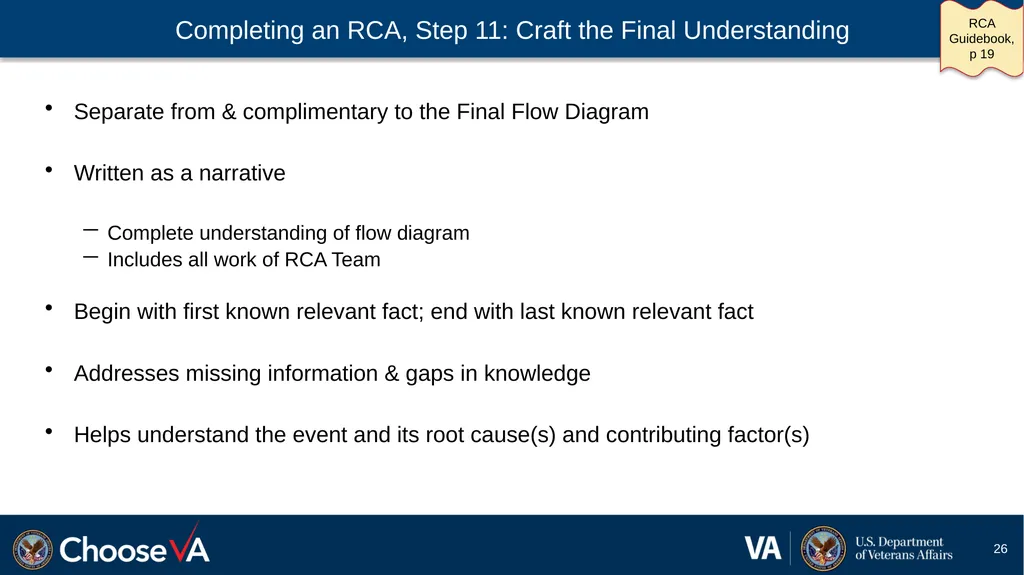
slide26. Completing an RCA, Step 11: Craft the Final Understanding Separate from & complimentary to the Final Flow Diagram
Written as a narrative
Complete understanding of flow diagram
Includes all work of RCA Team
Begin with first known relevant fact; end with last known relevant fact
Addresses missing information & gaps in knowledge
Helps understand the event and its root cause(s) and contributing factor(s) RCA Guidebook, p 19<br>
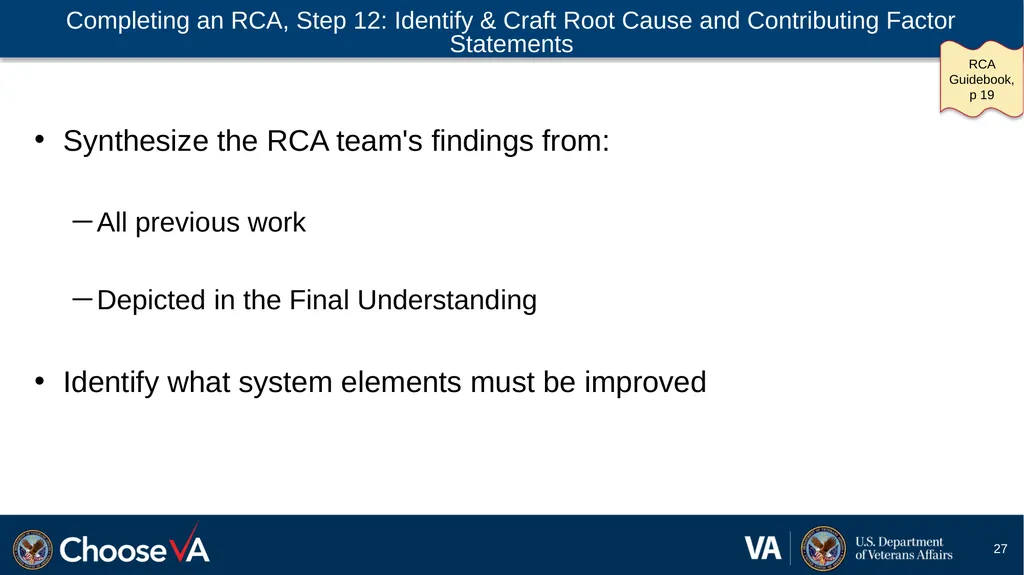
slide27. Synthesize the RCA team's findings from:
All previous work
Depicted in the Final Understanding
Identify what system elements must be improved Completing an RCA, Step 12: Identify & Craft Root Cause and Contributing Factor Statements RCA Guidebook, p 19<br>
slide28. Statements:
Address causal factors or action plans
Contribute the most
Have the greatest impact on the system
Have potential to prevent recurrence
Need to
Lead the team to an appropriate action plan
Be understood by the cold reader
Use the:
5 Rules of Causation (reviewed on the following slides) Completing an RCA, Step 12: Identify & Craft Root Cause and Contributing Factor Statements<br>
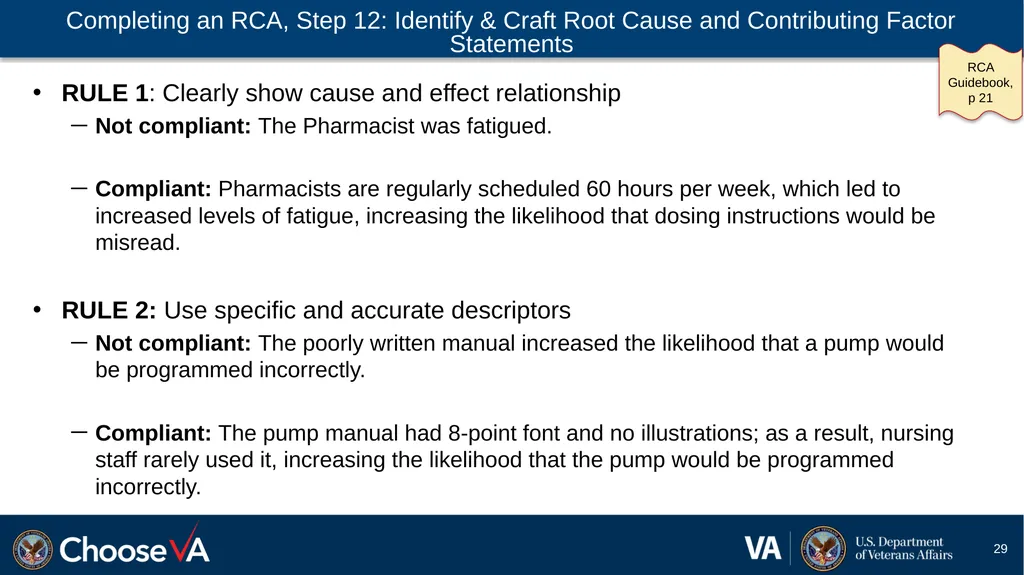
slide29. RULE 1: Clearly show cause and effect relationship
Not compliant: The Pharmacist was fatigued.
Compliant: Pharmacists are regularly scheduled 60 hours per week, which led to increased levels of fatigue, increasing the likelihood that dosing instructions would be misread.
RULE 2: Use specific and accurate descriptors
Not compliant: The poorly written manual increased the likelihood that a pump would be programmed incorrectly.
Compliant: The pump manual had 8-point font and no illustrations; as a result, nursing staff rarely used it, increasing the likelihood that the pump would be programmed incorrectly. Completing an RCA, Step 12: Identify & Craft Root Cause and Contributing Factor Statements RCA Guidebook, p 21<br>
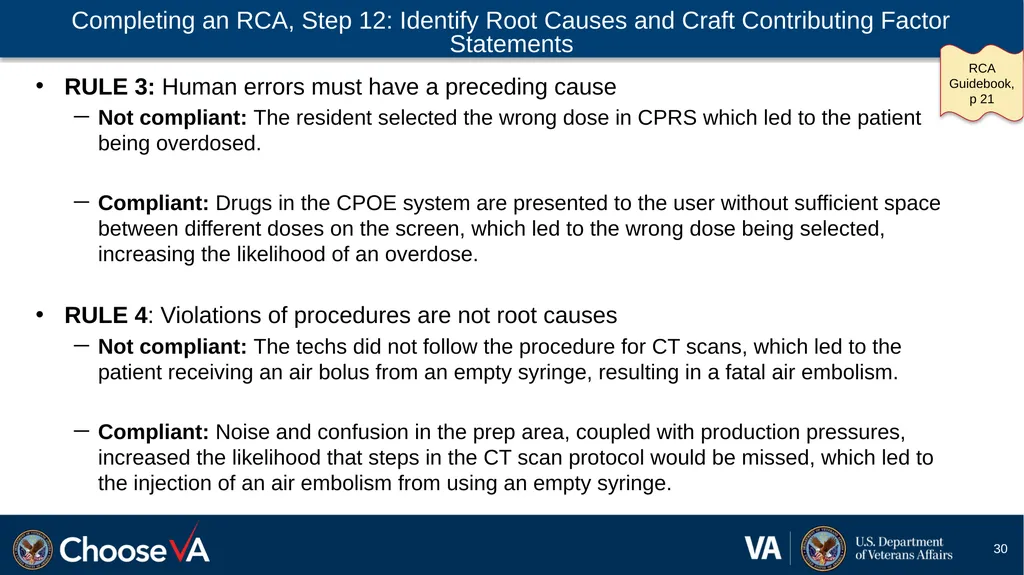
slide30. RULE 3: Human errors must have a preceding cause
Not compliant: The resident selected the wrong dose in CPRS which led to the patient being overdosed.
Compliant: Drugs in the CPOE system are presented to the user without sufficient space between different doses on the screen, which led to the wrong dose being selected, increasing the likelihood of an overdose.
RULE 4: Violations of procedures are not root causes
Not compliant: The techs did not follow the procedure for CT scans, which led to the patient receiving an air bolus from an empty syringe, resulting in a fatal air embolism.
Compliant: Noise and confusion in the prep area, coupled with production pressures, increased the likelihood that steps in the CT scan protocol would be missed, which led to the injection of an air embolism from using an empty syringe. Completing an RCA, Step 12: Identify Root Causes and Craft Contributing Factor Statements RCA Guidebook, p 21<br>
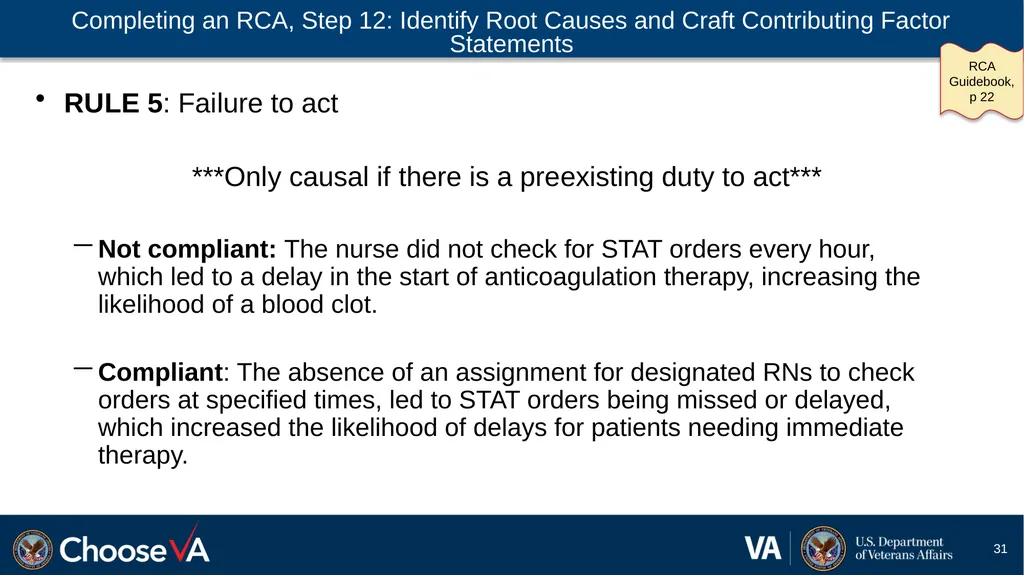
slide31. RULE 5: Failure to act
***Only causal if there is a preexisting duty to act***
Not compliant: The nurse did not check for STAT orders every hour, which led to a delay in the start of anticoagulation therapy, increasing the likelihood of a blood clot.
Compliant: The absence of an assignment for designated RNs to check orders at specified times, led to STAT orders being missed or delayed, which increased the likelihood of delays for patients needing immediate therapy. Completing an RCA, Step 12: Identify Root Causes and Craft Contributing Factor Statements RCA Guidebook, p 22<br>
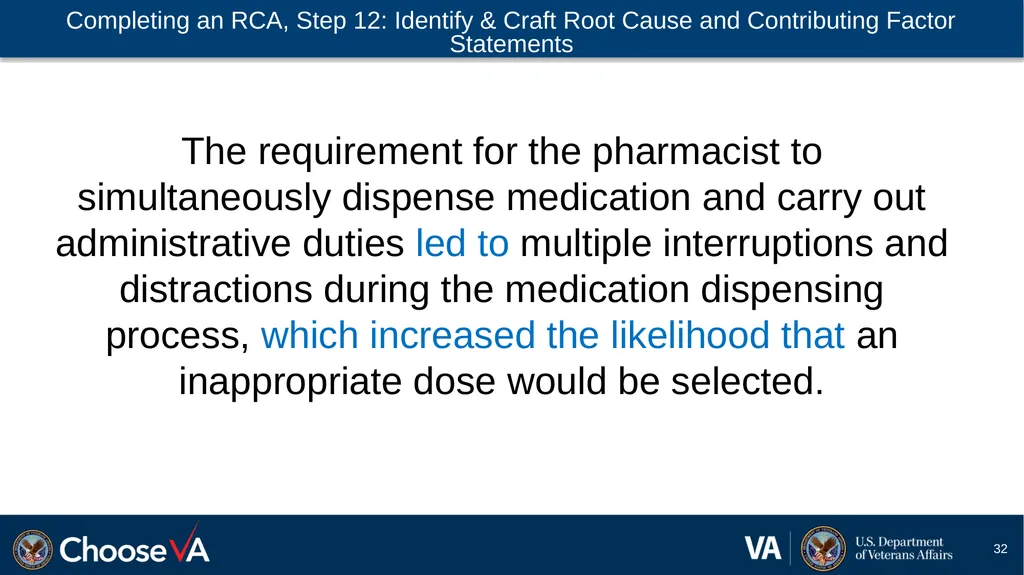
slide32. The requirement for the pharmacist to simultaneously dispense medication and carry out administrative duties led to multiple interruptions and distractions during the medication dispensing process, which increased the likelihood that an inappropriate dose would be selected. Completing an RCA, Step 12: Identify & Craft Root Cause and Contributing Factor Statements<br>
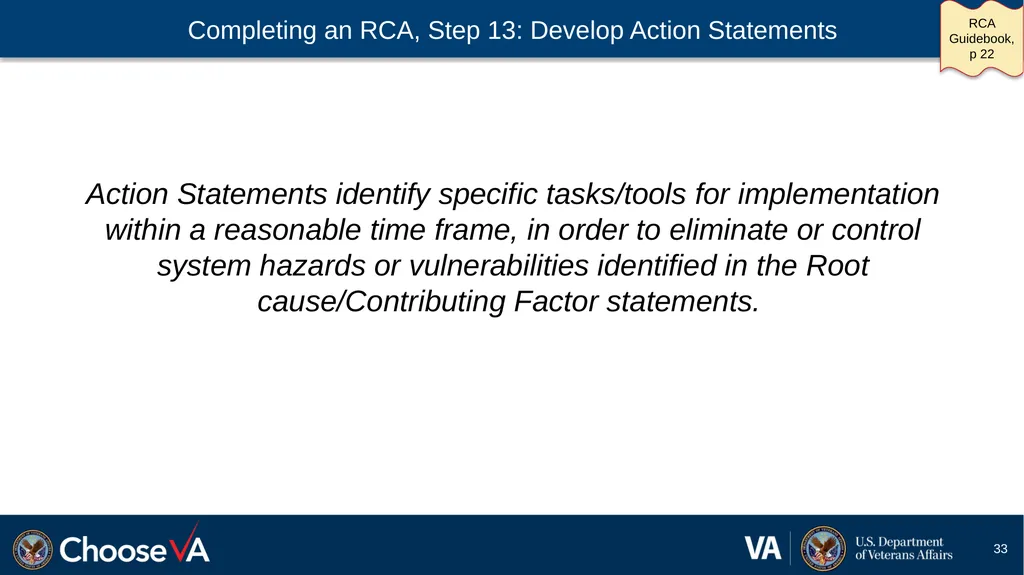
slide33. Action Statements identify specific tasks/tools for implementation within a reasonable time frame, in order to eliminate or control system hazards or vulnerabilities identified in the Root cause/Contributing Factor statements. Completing an RCA, Step 13: Develop Action Statements RCA Guidebook, p 22<br>
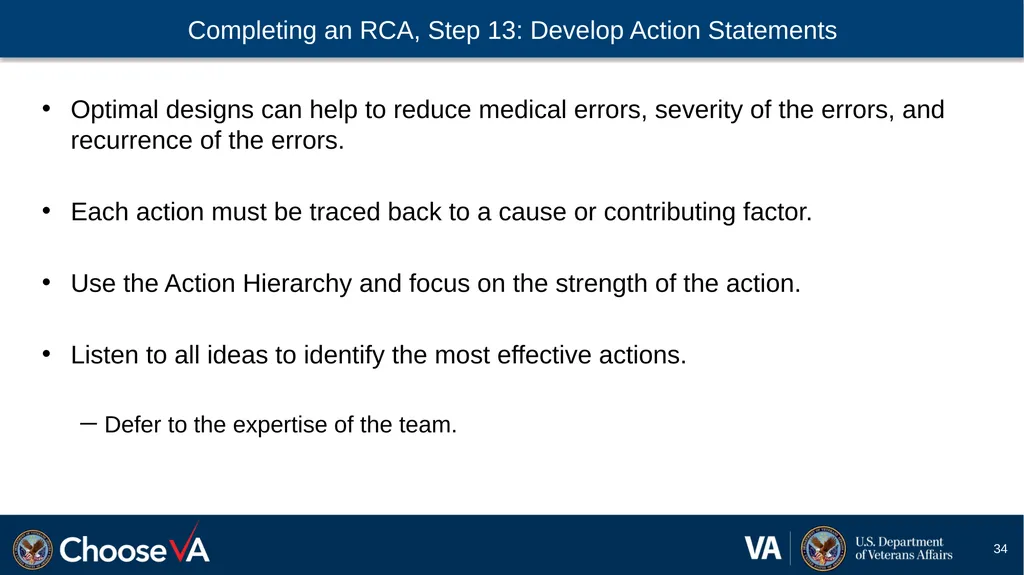
slide34. Optimal designs can help to reduce medical errors, severity of the errors, and recurrence of the errors.
Each action must be traced back to a cause or contributing factor.
Use the Action Hierarchy and focus on the strength of the action.
Listen to all ideas to identify the most effective actions.
Defer to the expertise of the team. Completing an RCA, Step 13: Develop Action Statements<br>
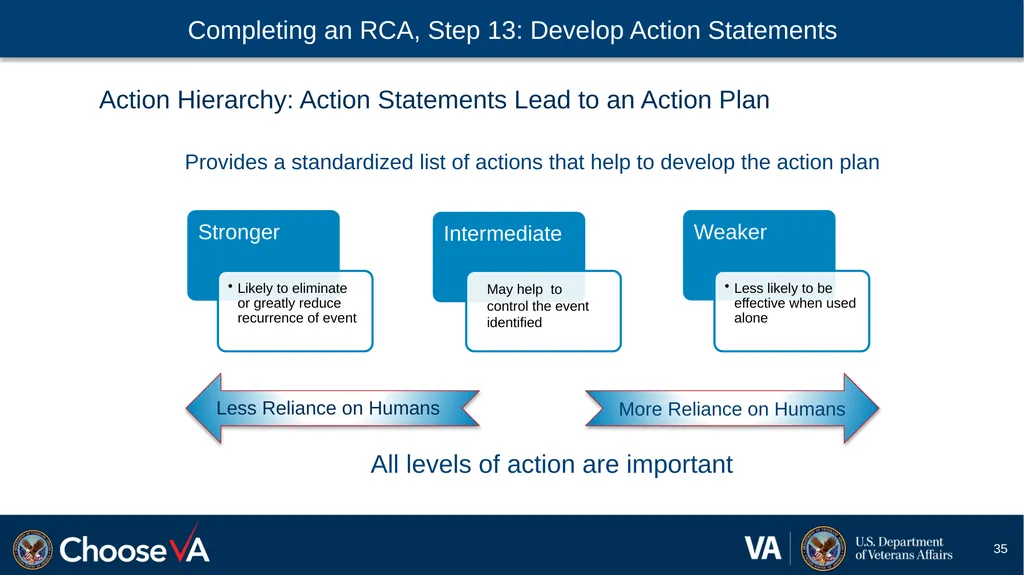
slide35. Action Hierarchy: Action Statements Lead to an Action Plan
Provides a standardized list of actions that help to develop the action plan
All levels of action are important More Reliance on Humans Less Reliance on Humans May help to control the event identified Completing an RCA, Step 13: Develop Action Statements<br>
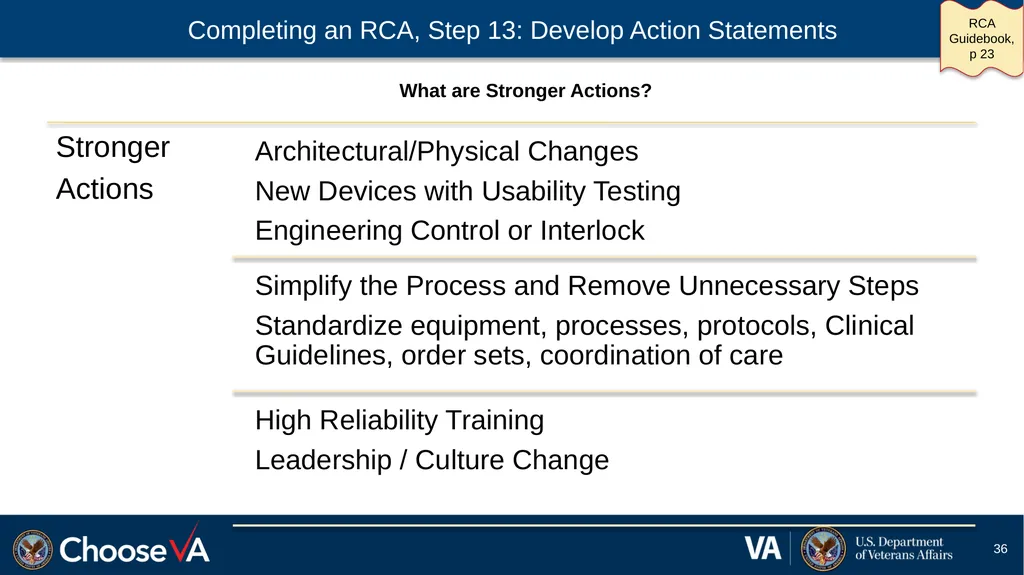
slide36. Completing an RCA, Step 13: Develop Action Statements What are Stronger Actions? RCA Guidebook, p 23<br>
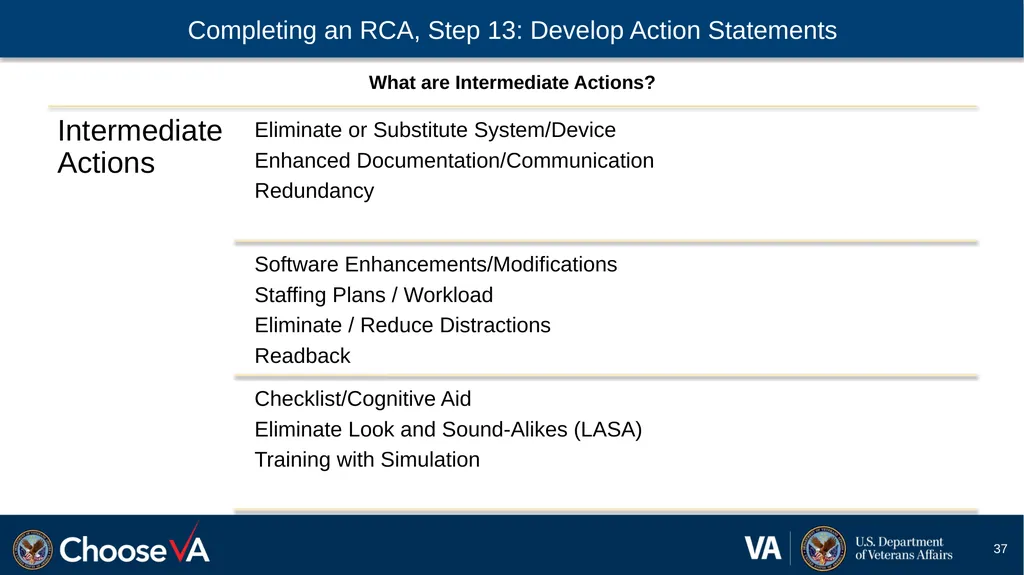
slide37. Completing an RCA, Step 13: Develop Action Statements What are Intermediate Actions?<br>
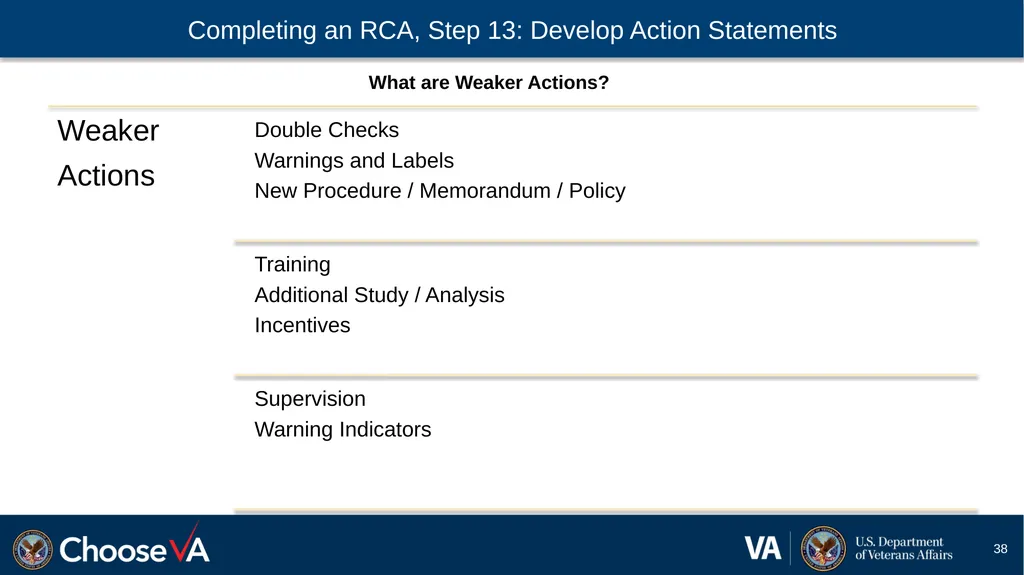
slide38. Completing an RCA, Step 13: Develop Action Statements What are Weaker Actions?<br>
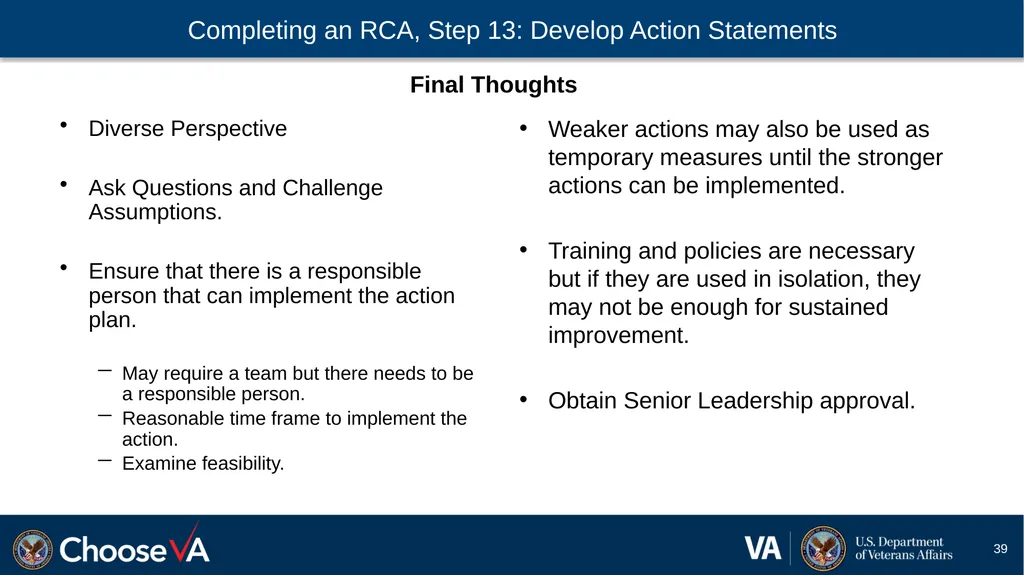
slide39. Diverse Perspective
Ask Questions and Challenge Assumptions.
Ensure that there is a responsible person that can implement the action plan.
May require a team but there needs to be a responsible person.
Reasonable time frame to implement the action.
Examine feasibility. Weaker actions may also be used as temporary measures until the stronger actions can be implemented.
Training and policies are necessary but if they are used in isolation, they may not be enough for sustained improvement.
Obtain Senior Leadership approval. Completing an RCA, Step 13: Develop Action Statements Final Thoughts<br>
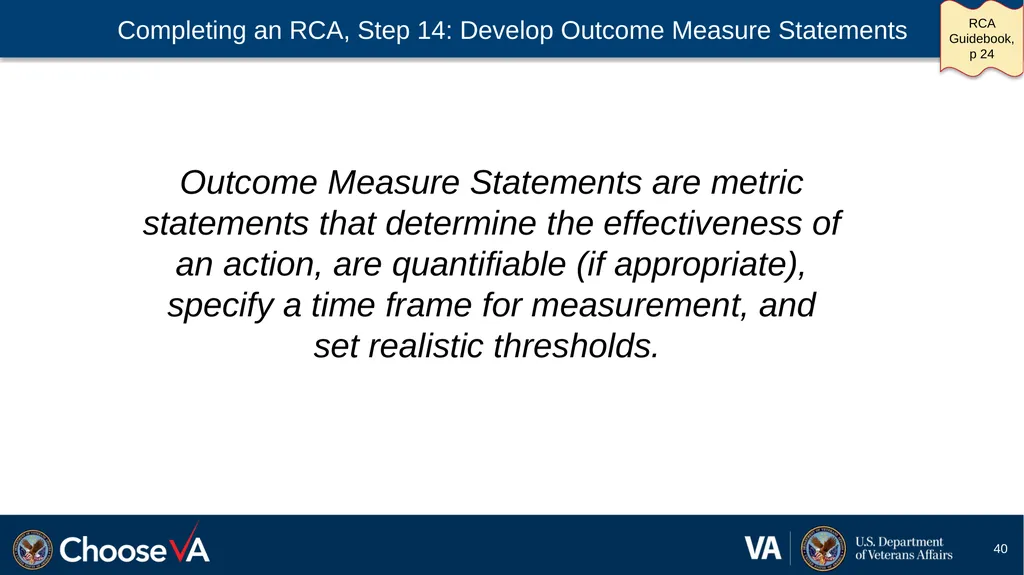
slide40. Completing an RCA, Step 14: Develop Outcome Measure Statements Outcome Measure Statements are metric statements that determine the effectiveness of an action, are quantifiable (if appropriate), specify a time frame for measurement, and set realistic thresholds. RCA Guidebook, p 24<br>
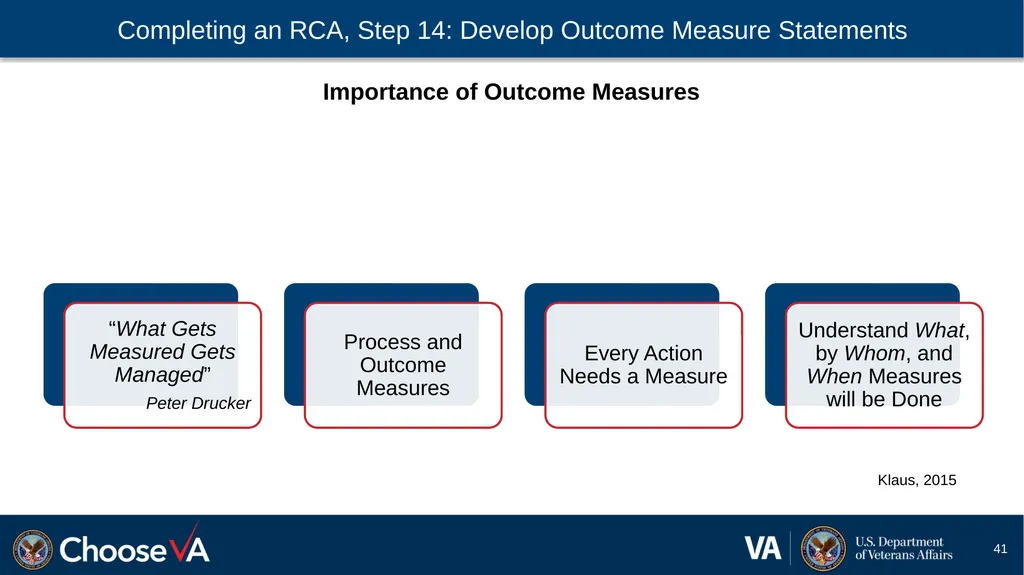
slide41. Klaus, 2015 Completing an RCA, Step 14: Develop Outcome Measure Statements Importance of Outcome Measures<br>
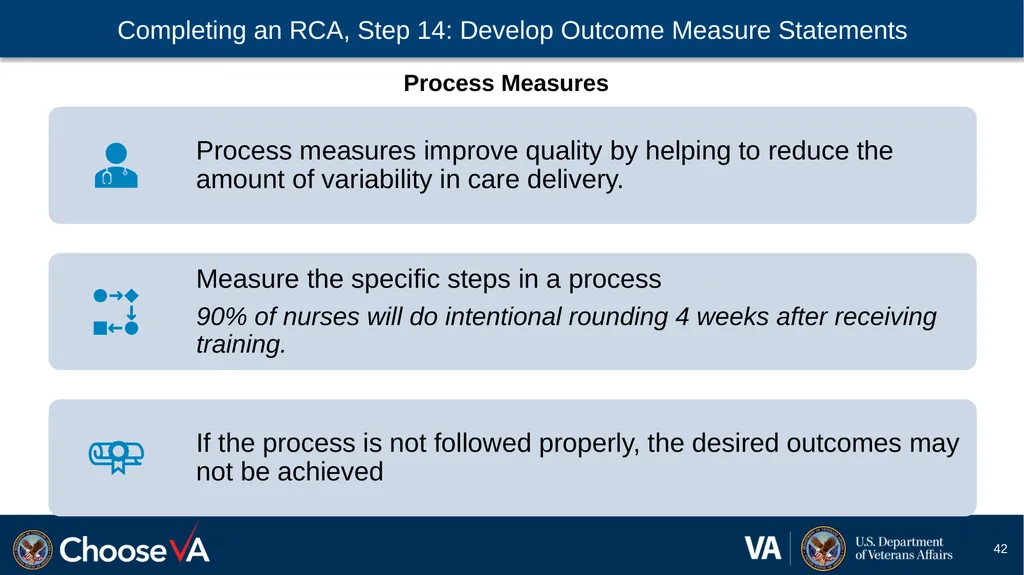
slide42. Completing an RCA, Step 14: Develop Outcome Measure Statements Process Measures<br>
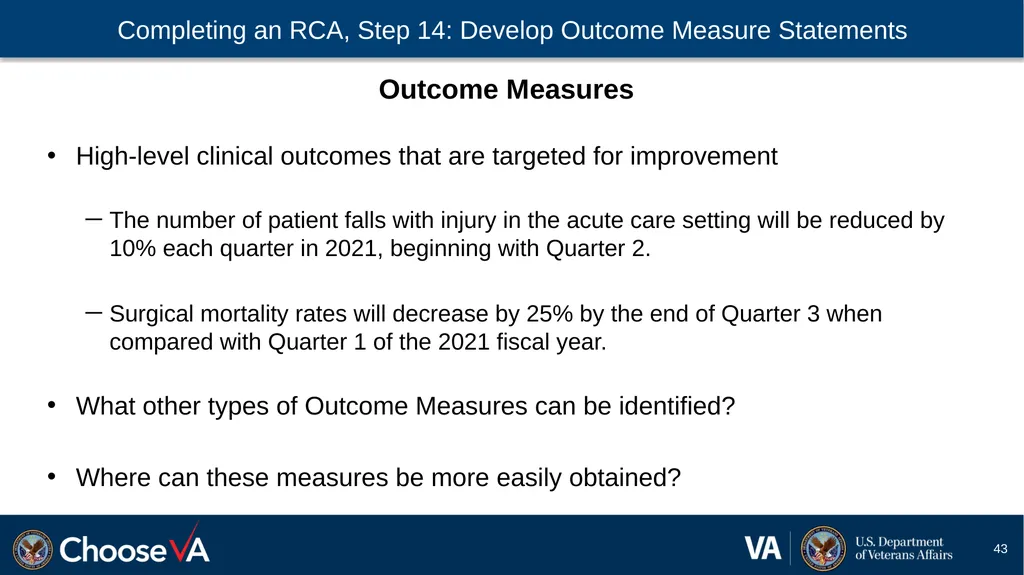
slide43. Outcome Measures
High-level clinical outcomes that are targeted for improvement
The number of patient falls with injury in the acute care setting will be reduced by 10% each quarter in 2021, beginning with Quarter 2.
Surgical mortality rates will decrease by 25% by the end of Quarter 3 when compared with Quarter 1 of the 2021 fiscal year.
What other types of Outcome Measures can be identified?
Where can these measures be more easily obtained? Completing an RCA, Step 14: Develop Outcome Measure Statements<br>
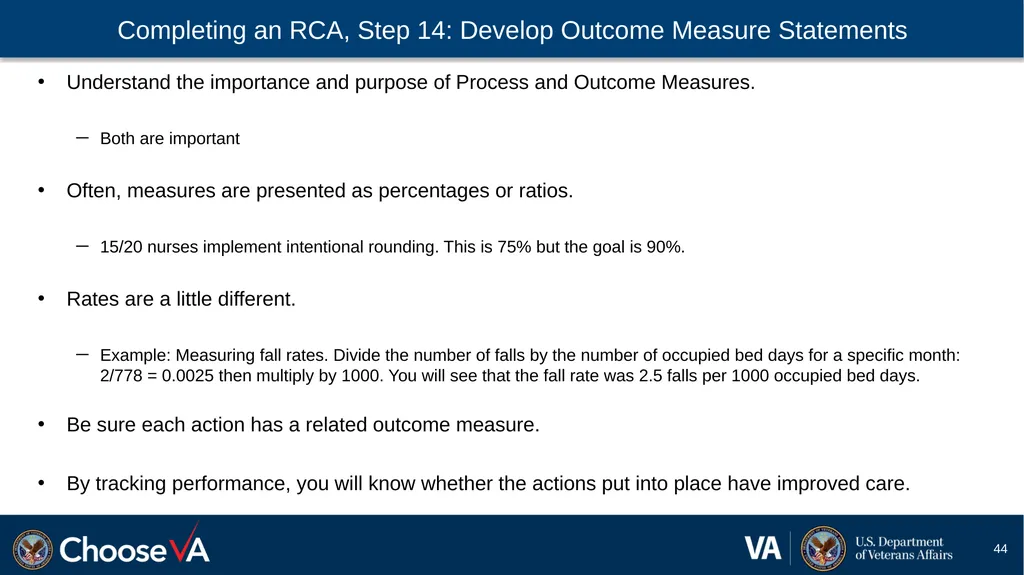
slide44. Understand the importance and purpose of Process and Outcome Measures.
Both are important
Often, measures are presented as percentages or ratios.
15/20 nurses implement intentional rounding. This is 75% but the goal is 90%.
Rates are a little different.
Example: Measuring fall rates. Divide the number of falls by the number of occupied bed days for a specific month: 2/778 = 0.0025 then multiply by 1000. You will see that the fall rate was 2.5 falls per 1000 occupied bed days.
Be sure each action has a related outcome measure.
By tracking performance, you will know whether the actions put into place have improved care. Completing an RCA, Step 14: Develop Outcome Measure Statements<br>
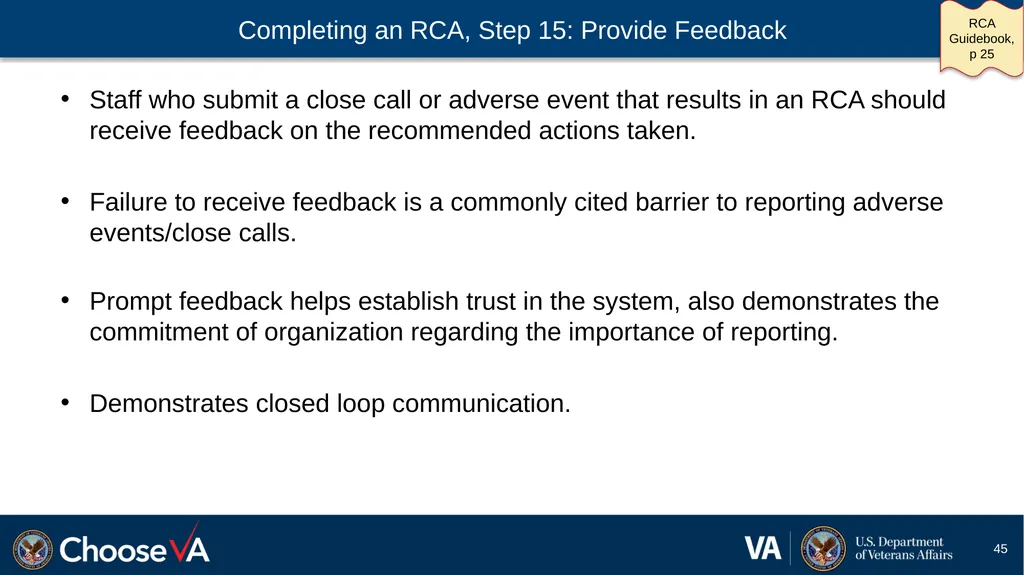
slide45. Staff who submit a close call or adverse event that results in an RCA should receive feedback on the recommended actions taken.
Failure to receive feedback is a commonly cited barrier to reporting adverse events/close calls.
Prompt feedback helps establish trust in the system, also demonstrates the commitment of organization regarding the importance of reporting.
Demonstrates closed loop communication. Completing an RCA, Step 15: Provide Feedback RCA Guidebook, p 25<br>
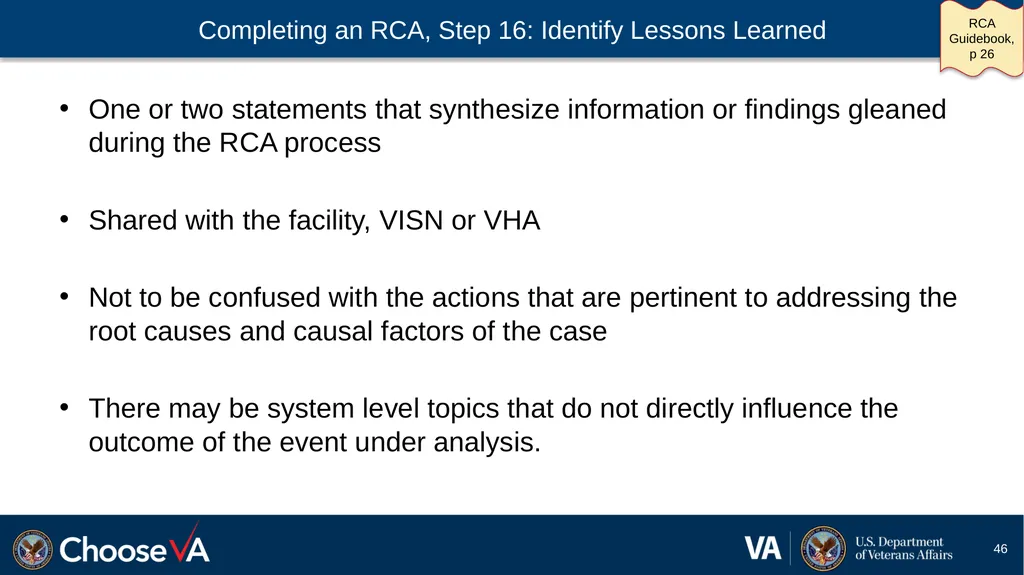
slide46. One or two statements that synthesize information or findings gleaned during the RCA process
Shared with the facility, VISN or VHA
Not to be confused with the actions that are pertinent to addressing the root causes and causal factors of the case
There may be system level topics that do not directly influence the outcome of the event under analysis. Completing an RCA, Step 16: Identify Lessons Learned RCA Guidebook, p 26<br>
slide47. A final RCA presentation to the Director and leadership team facilitates action plan concurrence.
May be printed out from SPOT.
May be a PowerPoint presentation. Completing an RCA, Step 17: Prepare and Present Findings to Leadership RCA Guidebook, p 26<br>
slide48. RCA actions and outcomes must be monitored and tracked for completion and sustainment.
Systems should be in place for monitoring and tracking.
Assigning one person to complete this function is not effective.
The status of RCA actions and outcomes should be standing agenda items at patient safety committee or workgroup meetings.
These updates are recorded in the meeting minutes. Upon Completion of an RCA: Monitor Actions & Outcomes RCA Guidebook, p 27<br>
slide49. Process improvements should be communicated to facility staff.
Significant final step so that staff are aware that event reporting makes a difference in the work they do to support Veteran care.
Safety Forums are one method used for this communication. Upon Completion of an RCA: Communicate Improvements to Staff RCA Guidebook, p 28<br>
slide50. Be sure to include all costs:
Person-hours for all members of the RCA team and any staff consulted during the RCA
Multiply this by the hourly cost of each person involved in the RCA.
Consultation costs for any non-staff time
Costs of materials used
Any additional costs incurred during the RCA Upon Completion of an RCA: Calculate the Cost RCA Guidebook, p 28<br>
slide51. Additional RCA Guidebook Resources Appendix A: Glossary
Appendix B: Example Root Cause Analysis
Appendix C: Aggregate Review RCAs
Appendix D: Quiz Questions
Appendix E: Quiz Answers
Guidebook References RCA Guidebook, p 31 - 50<br>
slide52. AHRQ Agency for Healthcare Research and Quality (2013). How do you measure fall rates and fall prevention practices? Content last reviewed January 2013, Rockville, MD. https://www.ahrq.gov/patient-safety/settings/hospital/fall-prevention/toolkit/measure-fall-rates.html
CDC Centers for Disease Control and Prevention (2016). Program performance and evaluation office (PPEO), Indicators: CDC approach to evaluation. https://www.cdc.gov
Guide to Performing a Root Cause Analysis (2020). Published by VHA National Center for Patient Safety (NCPS).
IHI Institute for Healthcare Improvement (2019). Patient safety essentials toolkit: Action hierarchy (part of RCA2 ). https://www.ihi.org
ISMP Institute for Safe Medication Practices (2018, July 12). Confusion with error-prone abbreviation, tPA. https://www.ismp.org/resources/confusion-error-prone-abbreviation-tpa
Just in Time Training Video (run time 18:27): RCA SEQ 180301d located at https://bcove.video/2F7cCCP
Klaus P. (2015) The Devil Is in the Details – Only What Get Measured Gets Managed. In: Measuring Customer Experience. Palgrave Macmillan, London. https://doi.org/10.1057/9781137375469_7
Lobos, Anna-Theresa MD; Ward, Natalie PhD, CE; Farion, Ken J. MD; Creery, David MSc, MD; Fitzgibbons, Colleen RN; Ramsay, Christa RRT; Hogue, Melanie RN; Langevin, Mélissa MD. Simulation-Based Event Analysis Improves Error Discovery and Generates Improved Strategies for Error Prevention Simulation in Healthcare: The Journal of the Society for Simulation in Healthcare: August 2019 - Volume 14 - Issue 4 - p 209-216
NPSF National Patient Safety Foundation. RCA2 Improving Root Cause Analyses and Actions to Prevent Harm: National Patient Safety Foundation; Version 2. January 2016
Root Cause Analysis (RCA) ppt presentation, VA NCPS.
VHA NCPS. (Oct 20, 2020). Guide to performing a root cause analysis. Ann Arbor, MI: VHA National Center for Patient Safety. References: additional to RCA Guidebook References, p 51 - 53<br>
A companion slide set for field education<br>
slide2. Introduction Patient safety events can cause serious harm or death.
System and process flaws cause most failures and require systematic investigation and analysis to unearth root causes and develop solutions.
Most common comprehensive systematic analysis: Root Cause Analysis (RCA).
Process to identify basic causal factor(s) underlying system failures (the root; source below surface; obscured)
Adverse outcomes, sentinel events, or clusters of less serious incidents or near misses (the weed; problem above surface; obvious) RCA Guidebook, p 4<br>
slide3. To describe process steps to complete an RCA according to protocols found in:
Veteran Health Administration (VHA) Patient Safety Program
VHA Patient Safety Handbook 1050.01
To identify intended users of the guidebook and those involved in RCAs
To provide definitions for key terms, RCA examples, information about Aggregate Review RCAs, and the RCA Quality Analysis Tool (QAT) in multiple appendices Purpose of the Guidebook RCA Guidebook, p 4<br>
slide4. Sentinel events, serious safety event (SE), any event with a substantial, direct, and high probability that a serious SE would have ensued, but did not, due to intervention/chance
Events with a Safety Assessment Code (SAC) of Actual or Potential 3
Falls, Missing Patient, Medication Events with Potential 3 SAC
Do not require an individual RCA; may be done at discretion of facility
Aggregate and analyze together or review for inclusion in Patient Safety Assessment Tool (PSAT)
All RCAs must be formally chartered and signed by facility Director. Determining When an RCA is Required RCA Guidebook, p 5<br>
slide5. Adhere to procedures in RCA Guidebook and charter memorandum
All documents must have the term “Root Cause Analysis” to be protected/confidential:
38 U.S.C. 5705
Implementing regulations (VHA Directive 2008-077, Quality Management (QM) and Patient Safety Activities that Can Generate Confidential Documents)
NOT protected: email or RCAs if RCA charter memorandum unsigned by facility Director Characteristics of a Root Cause Analysis RCA Guidebook, p 5<br>
slide6. Within 45 days of facility becoming aware that an RCA is required, RCAs MUST be:
Completed,
Signed by facility Director or designee, and
Documented in SPOT
Follow the process steps provided in the RCA Guidebook and explained more fully in subsequent sections and appendices Characteristics of a Root Cause Analysis<br>
slide7. The crucial process steps in the Root Cause Analysis include:
Getting Started day 1 thru 14
Analysis 15-45 days
Feedback
Implementation and Measurement Root Cause Analysis Flow Diagram RCA Guidebook, p 6<br>
slide8. Composition (4-6 members): Leader, Advisor, Subject Matter Expert (SME), non-SME
Large enough for diverse viewpoints and opinions
Small enough to keep meetings manageable
Describe professional titles and specific roles of individuals on RCA team in charter and may also be included in charter memorandum
Recorder needed to document meeting notes, interviews, Q&As, and guide next steps Completing an RCA, Step 1: Charter a Team RCA Guidebook, p 7<br>
slide9. Conduct RCA team training with every RCA event, even if no new members are present.
Senior leader greeting shows tangible executive leadership support for RCA team
Just in Time Training Video (run time 18:27)
Just in Time Training should include: an overview of the RCA process; information on confidentiality, timeline of the process, roles and responsibilities of team members, event briefing, and milestones with meeting dates/times established at first meeting. Completing an RCA, Step 2: Conduct Just in Time Training RCA Guidebook, p 8<br>
slide10. Graphically documents known and relevant facts of the event Completing an RCA, Step 3: Create the Initial Flow Diagram RCA Guidebook, p 9<br>
slide11. 11<br>
slide12. 12<br>
slide13. Narrative expression of the Initial Flow Diagram
Adds greater detail of events
Staffing, equipment, products, environmental, or other influencing factors
Discovers the facts
Asks “why” for each item in the flow diagram
Identifies missing pieces
Identifies resources
Policies, medical records, or committee minutes
Determines who to interview Completing an RCA, Step 4: Craft the Initial Understanding RCA Guidebook, p 10<br>
slide14. Determine missing information
Gather data related to the event
Identify system and process vulnerabilities
Visit the scene of the event
Simulate event if possible Completing an RCA, Step 5: Identify Information Gaps RCA Guidebook, p 11<br>
slide15. Standard set of questions
Assists the team in considering areas of inquiry
Reveals vulnerabilities in systems and work processes
Link to Triage Questions Completing an RCA, Step 6: Use Triage Questions RCA Guidebook, p 11<br>
slide16. Identify team members to obtain and review documents
Identify individuals to be interviewed
Determine interview date/time and location
Draft interview questions Completing an RCA, Step 7: Collect Resources and Prepare for Interviews RCA Guidebook, p 12<br>
slide17. Completing an RCA, Step 8: Conduct the Safety Investigation RCA Guidebook, p 12<br>
slide18. Develop a strategy to “fill in the information gaps” including but not limited to:
Review pertinent documents
Interviews
Simulate the event
“…simulation and debriefing in event analysis helped identify multiple, underlying causes of teamwork errors, latent risk factors (things that make errors more likely), and more specifically system errors in surgical cases.” Lobos & Ward, 2019
Literature review
determine evidence-based practices
prevalence of incidence
Data pull
JPSR
SPOT Completing an RCA, Step 8: Conduct the Safety Investigation<br>
slide19. The Final Flow Diagram is a graphic of the first known relevant fact through the final known relevant fact. It is developed using all the information obtained in fact finding investigation. Completing an RCA, Step 9: Create the Final Flow Diagram RCA Guidebook, p 13<br>
slide20. Required!
What is a cause-and-effect diagram?
Systematic method
Determines causal links
Shows starting point and represents:
Preventing problem from:
Occurring (e.g., near miss)
Recurring (e.g., a fire happened) Completing an RCA, Step 10: Create the Cause-and-Effect Diagram RCA Guidebook, p 15<br>
slide21. Work backwards with "caused by" statements
For specific actions
For specific conditions
Keep working backwards until you can’t! Completing an RCA, Step 10: Create the Cause-and-Effect Diagram<br>
slide22. Completing an RCA, Step 10: Create the Cause-and-Effect Diagram PRIMARY EFFECT OF CONSEQUENCE/ PROBLEM STATEMENT
FIRE! ACTION Light a match CONDITION Oxygen CONDITION Ignition Source CONDITION Combustible Material PRIMARY EFFECT-CAUSE CONDITION RCA Guidebook, p 16<br>
slide23. PROBLEM STATEMENT ACTION CONDITION ACTION ACTION CONDITION CONDITION ACTION ACTION ACTION ACTION ACTION ACTION ACTION ACTION ACTION CONDITION CONDITION CONDITION ACTION ACTION CONDITION CONDITION CONDITION CONDITION CONDITION CONDITION CONDITION CONDITION CONDITION CONDITION CONDITION ACTION ACTION CONDITION CONDITION CONDITION ACTION ACTION CONDITION CAUSE AND EFFECT DIAGRAMS ARE NOT STRAIGHT FORWARD Completing an RCA, Step 10: Create the Cause-and-Effect Diagram RCA Guidebook, p 17<br>
slide24. 24 WHEN DO WE STOP? Completing an RCA, Step 10: Create the Cause-and-Effect Diagram RCA Guidebook, p 18<br>
slide25. STOP! When the RCA Team says:
Who cares?
We don’t know anymore!
That’s just how it is!
Or similar statements.. Completing an RCA, Step 10: Create the Cause-and-Effect Diagram<br>
slide26. Completing an RCA, Step 11: Craft the Final Understanding Separate from & complimentary to the Final Flow Diagram
Written as a narrative
Complete understanding of flow diagram
Includes all work of RCA Team
Begin with first known relevant fact; end with last known relevant fact
Addresses missing information & gaps in knowledge
Helps understand the event and its root cause(s) and contributing factor(s) RCA Guidebook, p 19<br>
slide27. Synthesize the RCA team's findings from:
All previous work
Depicted in the Final Understanding
Identify what system elements must be improved Completing an RCA, Step 12: Identify & Craft Root Cause and Contributing Factor Statements RCA Guidebook, p 19<br>
slide28. Statements:
Address causal factors or action plans
Contribute the most
Have the greatest impact on the system
Have potential to prevent recurrence
Need to
Lead the team to an appropriate action plan
Be understood by the cold reader
Use the:
5 Rules of Causation (reviewed on the following slides) Completing an RCA, Step 12: Identify & Craft Root Cause and Contributing Factor Statements<br>
slide29. RULE 1: Clearly show cause and effect relationship
Not compliant: The Pharmacist was fatigued.
Compliant: Pharmacists are regularly scheduled 60 hours per week, which led to increased levels of fatigue, increasing the likelihood that dosing instructions would be misread.
RULE 2: Use specific and accurate descriptors
Not compliant: The poorly written manual increased the likelihood that a pump would be programmed incorrectly.
Compliant: The pump manual had 8-point font and no illustrations; as a result, nursing staff rarely used it, increasing the likelihood that the pump would be programmed incorrectly. Completing an RCA, Step 12: Identify & Craft Root Cause and Contributing Factor Statements RCA Guidebook, p 21<br>
slide30. RULE 3: Human errors must have a preceding cause
Not compliant: The resident selected the wrong dose in CPRS which led to the patient being overdosed.
Compliant: Drugs in the CPOE system are presented to the user without sufficient space between different doses on the screen, which led to the wrong dose being selected, increasing the likelihood of an overdose.
RULE 4: Violations of procedures are not root causes
Not compliant: The techs did not follow the procedure for CT scans, which led to the patient receiving an air bolus from an empty syringe, resulting in a fatal air embolism.
Compliant: Noise and confusion in the prep area, coupled with production pressures, increased the likelihood that steps in the CT scan protocol would be missed, which led to the injection of an air embolism from using an empty syringe. Completing an RCA, Step 12: Identify Root Causes and Craft Contributing Factor Statements RCA Guidebook, p 21<br>
slide31. RULE 5: Failure to act
***Only causal if there is a preexisting duty to act***
Not compliant: The nurse did not check for STAT orders every hour, which led to a delay in the start of anticoagulation therapy, increasing the likelihood of a blood clot.
Compliant: The absence of an assignment for designated RNs to check orders at specified times, led to STAT orders being missed or delayed, which increased the likelihood of delays for patients needing immediate therapy. Completing an RCA, Step 12: Identify Root Causes and Craft Contributing Factor Statements RCA Guidebook, p 22<br>
slide32. The requirement for the pharmacist to simultaneously dispense medication and carry out administrative duties led to multiple interruptions and distractions during the medication dispensing process, which increased the likelihood that an inappropriate dose would be selected. Completing an RCA, Step 12: Identify & Craft Root Cause and Contributing Factor Statements<br>
slide33. Action Statements identify specific tasks/tools for implementation within a reasonable time frame, in order to eliminate or control system hazards or vulnerabilities identified in the Root cause/Contributing Factor statements. Completing an RCA, Step 13: Develop Action Statements RCA Guidebook, p 22<br>
slide34. Optimal designs can help to reduce medical errors, severity of the errors, and recurrence of the errors.
Each action must be traced back to a cause or contributing factor.
Use the Action Hierarchy and focus on the strength of the action.
Listen to all ideas to identify the most effective actions.
Defer to the expertise of the team. Completing an RCA, Step 13: Develop Action Statements<br>
slide35. Action Hierarchy: Action Statements Lead to an Action Plan
Provides a standardized list of actions that help to develop the action plan
All levels of action are important More Reliance on Humans Less Reliance on Humans May help to control the event identified Completing an RCA, Step 13: Develop Action Statements<br>
slide36. Completing an RCA, Step 13: Develop Action Statements What are Stronger Actions? RCA Guidebook, p 23<br>
slide37. Completing an RCA, Step 13: Develop Action Statements What are Intermediate Actions?<br>
slide38. Completing an RCA, Step 13: Develop Action Statements What are Weaker Actions?<br>
slide39. Diverse Perspective
Ask Questions and Challenge Assumptions.
Ensure that there is a responsible person that can implement the action plan.
May require a team but there needs to be a responsible person.
Reasonable time frame to implement the action.
Examine feasibility. Weaker actions may also be used as temporary measures until the stronger actions can be implemented.
Training and policies are necessary but if they are used in isolation, they may not be enough for sustained improvement.
Obtain Senior Leadership approval. Completing an RCA, Step 13: Develop Action Statements Final Thoughts<br>
slide40. Completing an RCA, Step 14: Develop Outcome Measure Statements Outcome Measure Statements are metric statements that determine the effectiveness of an action, are quantifiable (if appropriate), specify a time frame for measurement, and set realistic thresholds. RCA Guidebook, p 24<br>
slide41. Klaus, 2015 Completing an RCA, Step 14: Develop Outcome Measure Statements Importance of Outcome Measures<br>
slide42. Completing an RCA, Step 14: Develop Outcome Measure Statements Process Measures<br>
slide43. Outcome Measures
High-level clinical outcomes that are targeted for improvement
The number of patient falls with injury in the acute care setting will be reduced by 10% each quarter in 2021, beginning with Quarter 2.
Surgical mortality rates will decrease by 25% by the end of Quarter 3 when compared with Quarter 1 of the 2021 fiscal year.
What other types of Outcome Measures can be identified?
Where can these measures be more easily obtained? Completing an RCA, Step 14: Develop Outcome Measure Statements<br>
slide44. Understand the importance and purpose of Process and Outcome Measures.
Both are important
Often, measures are presented as percentages or ratios.
15/20 nurses implement intentional rounding. This is 75% but the goal is 90%.
Rates are a little different.
Example: Measuring fall rates. Divide the number of falls by the number of occupied bed days for a specific month: 2/778 = 0.0025 then multiply by 1000. You will see that the fall rate was 2.5 falls per 1000 occupied bed days.
Be sure each action has a related outcome measure.
By tracking performance, you will know whether the actions put into place have improved care. Completing an RCA, Step 14: Develop Outcome Measure Statements<br>
slide45. Staff who submit a close call or adverse event that results in an RCA should receive feedback on the recommended actions taken.
Failure to receive feedback is a commonly cited barrier to reporting adverse events/close calls.
Prompt feedback helps establish trust in the system, also demonstrates the commitment of organization regarding the importance of reporting.
Demonstrates closed loop communication. Completing an RCA, Step 15: Provide Feedback RCA Guidebook, p 25<br>
slide46. One or two statements that synthesize information or findings gleaned during the RCA process
Shared with the facility, VISN or VHA
Not to be confused with the actions that are pertinent to addressing the root causes and causal factors of the case
There may be system level topics that do not directly influence the outcome of the event under analysis. Completing an RCA, Step 16: Identify Lessons Learned RCA Guidebook, p 26<br>
slide47. A final RCA presentation to the Director and leadership team facilitates action plan concurrence.
May be printed out from SPOT.
May be a PowerPoint presentation. Completing an RCA, Step 17: Prepare and Present Findings to Leadership RCA Guidebook, p 26<br>
slide48. RCA actions and outcomes must be monitored and tracked for completion and sustainment.
Systems should be in place for monitoring and tracking.
Assigning one person to complete this function is not effective.
The status of RCA actions and outcomes should be standing agenda items at patient safety committee or workgroup meetings.
These updates are recorded in the meeting minutes. Upon Completion of an RCA: Monitor Actions & Outcomes RCA Guidebook, p 27<br>
slide49. Process improvements should be communicated to facility staff.
Significant final step so that staff are aware that event reporting makes a difference in the work they do to support Veteran care.
Safety Forums are one method used for this communication. Upon Completion of an RCA: Communicate Improvements to Staff RCA Guidebook, p 28<br>
slide50. Be sure to include all costs:
Person-hours for all members of the RCA team and any staff consulted during the RCA
Multiply this by the hourly cost of each person involved in the RCA.
Consultation costs for any non-staff time
Costs of materials used
Any additional costs incurred during the RCA Upon Completion of an RCA: Calculate the Cost RCA Guidebook, p 28<br>
slide51. Additional RCA Guidebook Resources Appendix A: Glossary
Appendix B: Example Root Cause Analysis
Appendix C: Aggregate Review RCAs
Appendix D: Quiz Questions
Appendix E: Quiz Answers
Guidebook References RCA Guidebook, p 31 - 50<br>
slide52. AHRQ Agency for Healthcare Research and Quality (2013). How do you measure fall rates and fall prevention practices? Content last reviewed January 2013, Rockville, MD. https://www.ahrq.gov/patient-safety/settings/hospital/fall-prevention/toolkit/measure-fall-rates.html
CDC Centers for Disease Control and Prevention (2016). Program performance and evaluation office (PPEO), Indicators: CDC approach to evaluation. https://www.cdc.gov
Guide to Performing a Root Cause Analysis (2020). Published by VHA National Center for Patient Safety (NCPS).
IHI Institute for Healthcare Improvement (2019). Patient safety essentials toolkit: Action hierarchy (part of RCA2 ). https://www.ihi.org
ISMP Institute for Safe Medication Practices (2018, July 12). Confusion with error-prone abbreviation, tPA. https://www.ismp.org/resources/confusion-error-prone-abbreviation-tpa
Just in Time Training Video (run time 18:27): RCA SEQ 180301d located at https://bcove.video/2F7cCCP
Klaus P. (2015) The Devil Is in the Details – Only What Get Measured Gets Managed. In: Measuring Customer Experience. Palgrave Macmillan, London. https://doi.org/10.1057/9781137375469_7
Lobos, Anna-Theresa MD; Ward, Natalie PhD, CE; Farion, Ken J. MD; Creery, David MSc, MD; Fitzgibbons, Colleen RN; Ramsay, Christa RRT; Hogue, Melanie RN; Langevin, Mélissa MD. Simulation-Based Event Analysis Improves Error Discovery and Generates Improved Strategies for Error Prevention Simulation in Healthcare: The Journal of the Society for Simulation in Healthcare: August 2019 - Volume 14 - Issue 4 - p 209-216
NPSF National Patient Safety Foundation. RCA2 Improving Root Cause Analyses and Actions to Prevent Harm: National Patient Safety Foundation; Version 2. January 2016
Root Cause Analysis (RCA) ppt presentation, VA NCPS.
VHA NCPS. (Oct 20, 2020). Guide to performing a root cause analysis. Ann Arbor, MI: VHA National Center for Patient Safety. References: additional to RCA Guidebook References, p 51 - 53<br>