Guy Mbayo K. Technical officer WASH and CHE Team Lead a.i. WHO-AFRO Climate Change and Health Green Climate Fund Readiness webinar 16 and 17062020 Members-States falling under WHO AFRO (Green, red and orange) Key frameworks for climate
"Guy Mbayo K. – Technical officer WASH and CHE Team" is the property of its rightful owner. Permission is granted to
download and print the materials on this website for personal, non-commercial use only, and to display it
on your personal computer provided you do not modify the materials and that you retain all copyright
notices contained in the materials. By downloading content from our website, you accept the terms of this
agreement.
Presentation Transcript
01
Guy Mbayo K. – Technical officer WASH
and CHE Team Lead a.i.
WHO-AFRO Climate Change and Health Green Climate Fund Readiness webinar
16 and 17/06/2020<br>
02
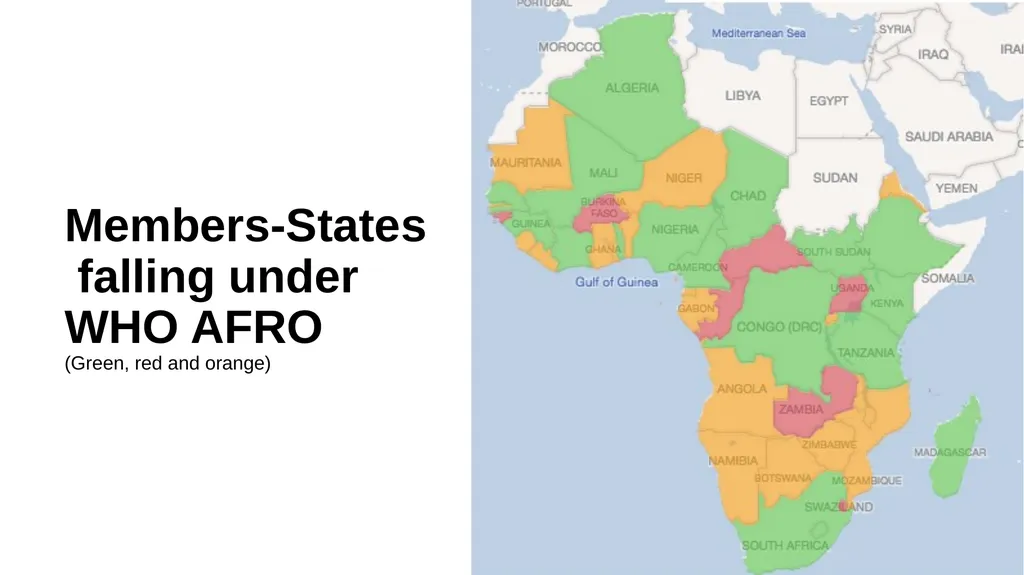
Members-States falling under WHO AFRO
(Green, red and orange)<br>
03
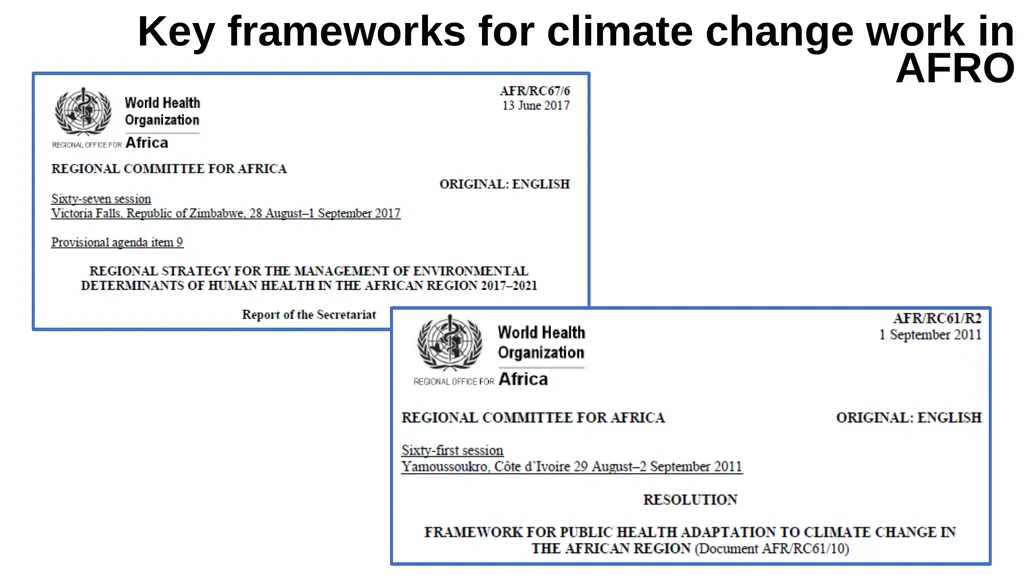
Key frameworks for climate change work in AFRO<br>
04
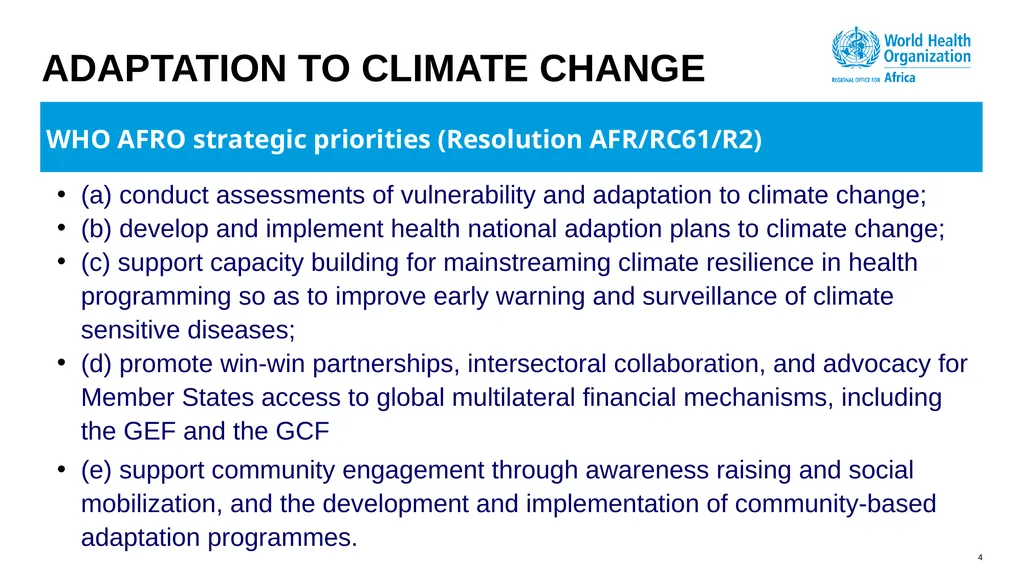
4 (a) conduct assessments of vulnerability and adaptation to climate change;
(b) develop and implement health national adaption plans to climate change;
(c) support capacity building for mainstreaming climate resilience in health programming so as to improve early warning and surveillance of climate sensitive diseases;
(d) promote win-win partnerships, intersectoral collaboration, and advocacy for Member States access to global multilateral financial mechanisms, including the GEF and the GCF
(e) support community engagement through awareness raising and social mobilization, and the development and implementation of community-based adaptation programmes. ADAPTATION TO CLIMATE CHANGE WHO AFRO strategic priorities (Resolution AFR/RC61/R2)<br>
05
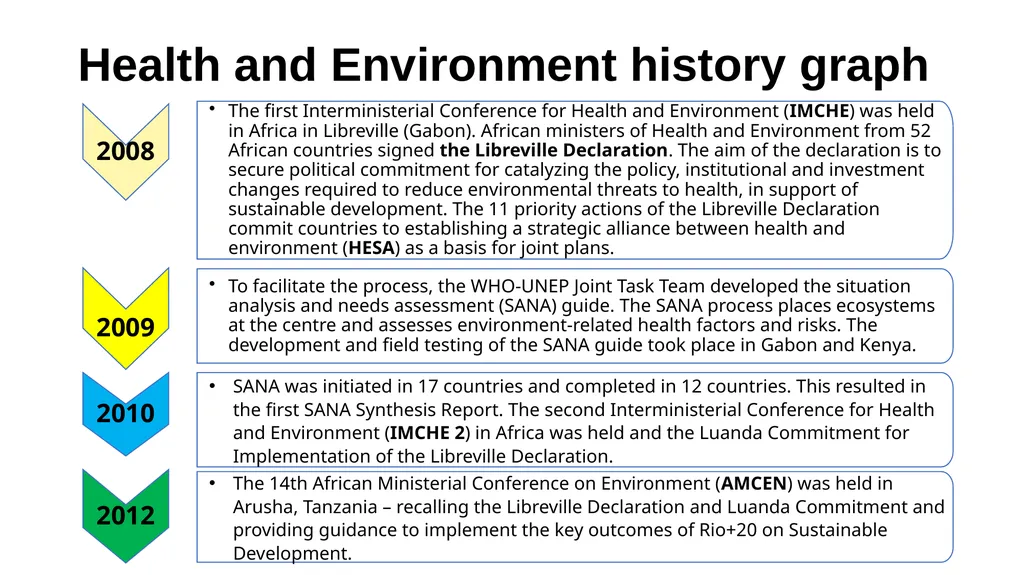
Health and Environment history graph The first Interministerial Conference for Health and Environment (IMCHE) was held in Africa in Libreville (Gabon). African ministers of Health and Environment from 52 African countries signed the Libreville Declaration. The aim of the declaration is to secure political commitment for catalyzing the policy, institutional and investment changes required to reduce environmental threats to health, in support of sustainable development. The 11 priority actions of the Libreville Declaration commit countries to establishing a strategic alliance between health and environment (HESA) as a basis for joint plans. To facilitate the process, the WHO-UNEP Joint Task Team developed the situation analysis and needs assessment (SANA) guide. The SANA process places ecosystems at the centre and assesses environment-related health factors and risks. The development and field testing of the SANA guide took place in Gabon and Kenya. The 14th African Ministerial Conference on Environment (AMCEN) was held in Arusha, Tanzania – recalling the Libreville Declaration and Luanda Commitment and providing guidance to implement the key outcomes of Rio+20 on Sustainable Development. SANA was initiated in 17 countries and completed in 12 countries. This resulted in the first SANA Synthesis Report. The second Interministerial Conference for Health and Environment (IMCHE 2) in Africa was held and the Luanda Commitment for Implementation of the Libreville Declaration. 2008 2009 2010 2012<br>
06
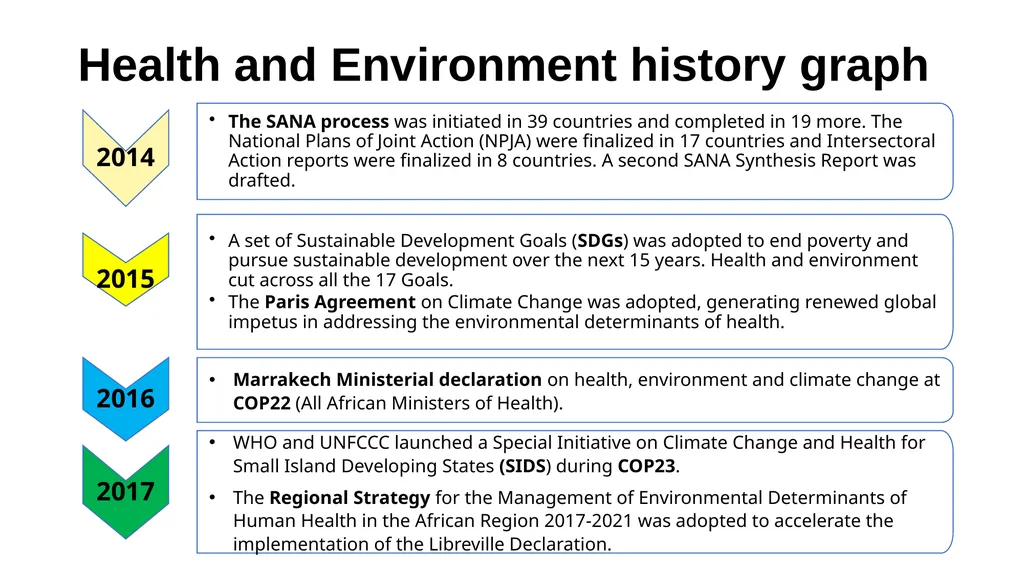
Health and Environment history graph The SANA process was initiated in 39 countries and completed in 19 more. The National Plans of Joint Action (NPJA) were finalized in 17 countries and Intersectoral Action reports were finalized in 8 countries. A second SANA Synthesis Report was drafted. A set of Sustainable Development Goals (SDGs) was adopted to end poverty and pursue sustainable development over the next 15 years. Health and environment cut across all the 17 Goals.
The Paris Agreement on Climate Change was adopted, generating renewed global impetus in addressing the environmental determinants of health. WHO and UNFCCC launched a Special Initiative on Climate Change and Health for Small Island Developing States (SIDS) during COP23.
The Regional Strategy for the Management of Environmental Determinants of Human Health in the African Region 2017-2021 was adopted to accelerate the implementation of the Libreville Declaration. Marrakech Ministerial declaration on health, environment and climate change at COP22 (All African Ministers of Health). 2014 2015 2016 2017<br>
07
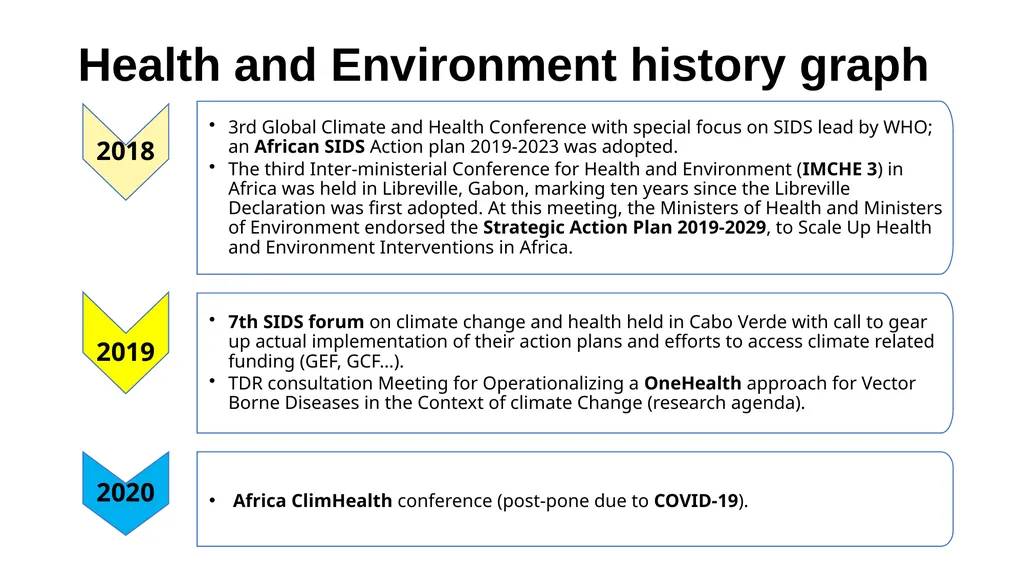
Health and Environment history graph 3rd Global Climate and Health Conference with special focus on SIDS lead by WHO; an African SIDS Action plan 2019-2023 was adopted.
The third Inter-ministerial Conference for Health and Environment (IMCHE 3) in Africa was held in Libreville, Gabon, marking ten years since the Libreville Declaration was first adopted. At this meeting, the Ministers of Health and Ministers of Environment endorsed the Strategic Action Plan 2019-2029, to Scale Up Health and Environment Interventions in Africa. 7th SIDS forum on climate change and health held in Cabo Verde with call to gear up actual implementation of their action plans and efforts to access climate related funding (GEF, GCF…).
TDR consultation Meeting for Operationalizing a OneHealth approach for Vector Borne Diseases in the Context of climate Change (research agenda). Africa ClimHealth conference (post-pone due to COVID-19). 2018 2019 2020<br>
08
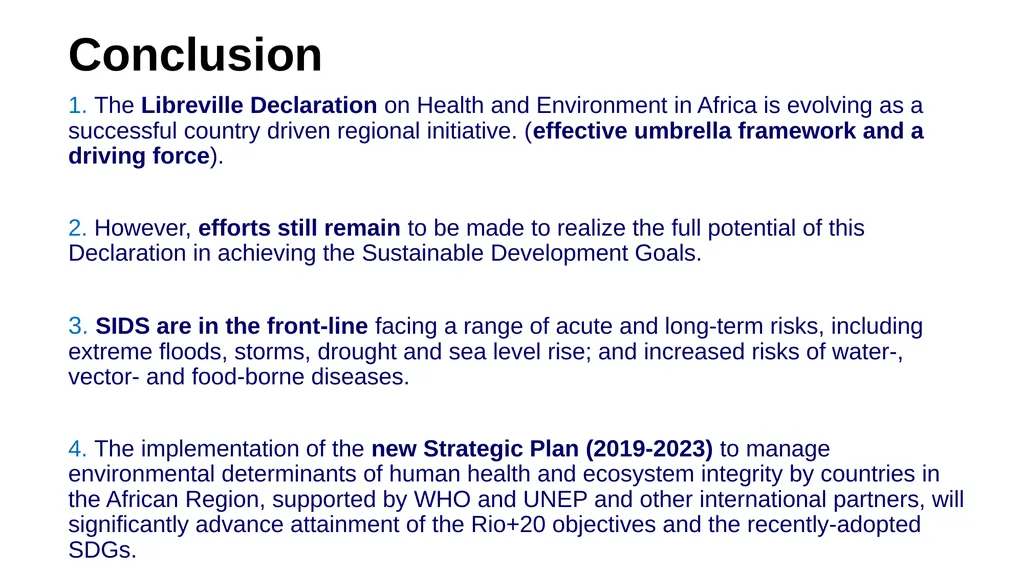
Conclusion 1. The Libreville Declaration on Health and Environment in Africa is evolving as a successful country driven regional initiative. (effective umbrella framework and a driving force).
2. However, efforts still remain to be made to realize the full potential of this Declaration in achieving the Sustainable Development Goals.
3. SIDS are in the front-line facing a range of acute and long-term risks, including extreme floods, storms, drought and sea level rise; and increased risks of water-, vector- and food-borne diseases.
4. The implementation of the new Strategic Plan (2019-2023) to manage environmental determinants of human health and ecosystem integrity by countries in the African Region, supported by WHO and UNEP and other international partners, will significantly advance attainment of the Rio+20 objectives and the recently-adopted SDGs.<br>